Why Legal Ethics Is an Oxymoron (II)

In an earlier post I merely linked (without comment) to a post by Eugene Volokh (The Volokh Conspiracy). There, Volokh defends a technically ethical (but blatantly wrong) act on the part of two lawyers. The act? Volokh quotes a report by CBS:

Alton Logan doesn’t understand why two lawyers with proof he didn’t commit murder were legally prevented from helping him. They had their reasons: To save Logan, they would have had to break the cardinal rule of attorney-client privilege to reveal their own client had committed the crime. But Logan had 26 years in prison to try to understand why he was convicted for a crime he didn’t commit….

Lawyers Jamie Kunz and Dale Coventry were public defenders when their client, Andrew Wilson, admitted to them he had shot-gunned a security guard to death in a 1982 robbery. When a tip led to Logan’s arrest and he went to trial for the crime, the two lawyers were in a bind. They wanted to help Logan but legally couldn’t….

The lawyers did get permission from Wilson, to reveal upon his death his confession to the murder Logan was convicted for. Wilson died late last year and Coventry and Kunz came forward. Next Monday, a judge will hear evidence in a motion to grant Logan a new trial.

This is Volokh’s initial defense of Kunz and Coventry’s failure to prevent the injustice to Logan:

[M]y understanding is that there is indeed no exception from attorney-client confidentiality in such cases. (If a client tells you that he intends to commit a crime in the future, you may be able to turn him in, but not when he admits that he has committed a crime in the past.)

Why should lawyer-client confidentiality trump justice? One line of thought (suggested by various commenters at Volokh) is that a breach of lawyer-client confidentiality might deter some clients from seeking legal counsel. Well, yes, it might deter guilty clients from seeking legal counsel. But how often is a guilty client candid about his guilt, anyway? Lawyers often defend guilty clients who haven’t been candid about their guilt. Suspecting that a client is guilty and knowing that he is guilty are two different things. A lawyer who doesn’t know that his client is guilty is probably better prepared, psychologically, to defend the client.

What about the excuse that professional ethics prevent lawyers from breaching attorney-client privilege? That excuse merely begs the question, in that codes of ethics are written and approved by lawyers.

Volokh has since penned a second post on the subject:

Some reactions to my “a classical ethical bind for lawyers” post suggested that the ethical question was easy:

The lawyers whose client had said he committed a murder should have revealed that information in order to free the person who was wrongly imprisoned for that murder, even assuming that would have meant disbarment or long-term suspension for violating lawyer-client confidentiality. If they didn’t do this, they’d be acting unethically.

But even assuming that the underlying confidentiality rule is unsound, surely it’s not so clear that people have an ethical duty to save another’s life at such great expense. My guess is that if you spent $10,000, you could likely save the life of some sick child in Africa; if you spent $50,000, I imagine this would be even likelier (and perhaps the number is actually a lot less). If you donated a kidney — which will expose you to a roughly 0.03% risk of death, and a slightly larger but still very small risk of complications — you could dramatically reduce a roughly 20% or more risk of death for someone on the kidney waiting list (since that’s how risky it is for him to be on long-term dialysis while he’s waiting for a new kidney). If you find someone who’s near the tail of the waiting list, you might reduce a still greater risk. Yet most of us wouldn’t say, I think, that it’s really your ethical obligation to run such a risk, or bear such a cost, to save a stranger’s life.

Likewise, I don’t think that it’s really your ethical obligation to lose what is likely hundreds of thousands of dollars in future income, by giving up a profession that you spent over a hundred thousand dollars to train for. You might deserve credit for making such a choice (assuming we conclude that the ethical rule you’re violating is indeed unsound). But that’s different from saying that you have an ethical duty to make that choice.

So, the bottom line (for Volokh) seems to be the “bottom line.” But this still begs the question. Lawyers could change their code of ethics to allow for cases similar to that of Alton Logan. Having thusly changed the code, a breach of attorney-client privilege (where warranted) would not result in disbarment and might not cause a loss of income. (Even where it might cause a loss of income, there is no argument in equity for Volokh’s position, as I explain below.)

Moreover, a change in the legal code of ethics to allow exculpatory breaches of confidentiality would instill greater confidence, not less, in the legal system. The public, on the whole, would be more inclined to believe that lawyers (especially criminal defense lawyers) serve justice. The case of Alton Logan reinforces the contrary perception, namely, that law is not justice.

I would go one step further in the interest of justice. I would make it a crime for a lawyer to withhold information that might exculpate a non-client for the sake of protecting a client. The law would then serve justice.

What about Volokh’s argument that lawyers (among others) do not have “an ethical duty to save another’s life at … great expense”? Suppose, for example, that lawyers who breach confidentiality in a circumstance allowed by their profession’s (revised) code of ethics and mandated by (revised) statutory law would nevertheless lose all of their remaining clients. Given that, Volokh argues (in effect), it would be equitable to force the rich to save the lives of starving African children, and to force anyone who has two healthy kidneys to donate one of them to a person who is on a kidney waiting-list.

Here’s my answer: A lawyer who withholds exculpatory information commits a harm; that is, he causes someone to be punished wrongly for a crime. That is not the case with a person who doesn’t give money to starving African children or who doesn’t donate a kidney to a person in need of one. The harm (starvation or kidney failure) isn’t caused by the person who withholds the money or kidney.

In sum, Volokh’s defense of Kunz, Coventry, and their ilk is fatally flawed. It begs the question and poses false analogies. One might say that Volokh is being lawyerly.

Why Legal Ethics Is an Oxymoron

Read this post, at The Volokh Conspiracy.

Religious Discrimination or Free Exercise?

Eugene Volokh is exercised about a ruling by the Supreme Court of Michigan in a child-custody case, which he characterizes as unconstitutional:

Michigan parents know that, to maximize their chances of keeping custody of their children, they need to go to church more often. A solid violation of the Establishment Clause, I think, plus of the Michigan Constitution’s religious freedom provision:

Every person shall be at liberty to worship God according to the dictates of his own conscience. No person shall be compelled to attend … any place of religious worship …. The civil and political rights, privileges and capacities of no person shall be diminished or enlarged on account of his religious belief.

Volokh’s real beef is with the Michigan statute (Child Custody Act of 1970), which spells out the “best interest” factors to be considered in child-custody cases. He specifically objects to the italicized portion of section 3(b):

The capacity and disposition of the parties involved to give the child love, affection, and guidance and to continue the education and raising of the child in his or her religion or creed, if any (emphasis added).

I cannot grasp the basis of Volokh’s objection. Neither the statute nor (in what I have read) any court’s interpretation of it seems to violate the relevant portion of the First Amendment:

Congress [and by incorporation through the Fourteenth Amendment, the States] shall make no law respecting an establishment of religion, or prohibiting the free exercise thereof….

The Michigan statute wisely gives proper recognition to the importance of religion (among several other factors) in the upbringing of a child. That’s all it does.

The clause at issue is not an establishment of religion. It does not force anyone to practice a religion. It simply gives due credit to a parent who continues to raise his or her child in the religion in which the child already was being raised, if any.

The clause at issue does not bar the free exercise of religion. Contrary to what Volokh seems to think, it is not a child’s place to dictate his or her religious upbringing. Would Volokh think it good to allow a child to decide (against parental command) to drop out of school at the age of, say, ten? I don’t think so. What makes religion different than education? Nothing, except that Volokh finds it objectionable that Michigan’s legislature and courts recognize the value of religion in the upbringing of a child.

Volokh, like so many other determined secularists, cannot countenance any governmental act that seems to approve of religion. But, contrary to Thomas Jefferson, there is no “wall of separation” between church and state, as Justice Antonin Scalia reminds us:

The same week that Congress submitted the Establishment Clause as part of the Bill of Rights for ratification by the States, it enacted legislation providing for paid chaplains in the House and Senate…. The day after the First Amendment was proposed, the same Congress that had proposed it requested the President to proclaim “ a day of public thanksgiving and prayer, to be observed, by acknowledging, with grateful hearts, the many and signal favours of Almighty God.”… President Washington offered the first Thanksgiving Proclamation shortly thereafter, devoting November 26, 1789 on behalf of the American people “ ‘to the service of that great and glorious Being who is the beneficent author of all the good that is, that was, or that will be,’ ”… thus beginning a tradition of offering gratitude to God that continues today…. The same Congress also reenacted the Northwest Territory Ordinance of 1787,… Article III of which provided: “Religion, morality, and knowledge, being necessary to good government and the happiness of mankind, schools and the means of education shall forever be encouraged.”… And of course the First Amendment itself accords religion (and no other manner of belief) special constitutional protection.

These actions of our First President and Congress … were not idiosyncratic; they reflected the beliefs of the period. Those who wrote the Constitution believed that morality was essential to the well-being of society and that encouragement of religion was the best way to foster morality.

And they were right.

The Real Constitution: I

This is the first installment of an effort to contrast the present, judicial interpretation of the Constitution with its original meaning, section by section and clause by clause. I draw heavily on The Heritage Guide to the Constitution (hereafter Heritage Guide). All quoted passages of the Constitution (including the Bill of Rights and other amendments) are from the version published by the National Records and Archives Administration.

PREAMBLE

We the People of the United States, in Order to form a more perfect Union, establish Justice, insure domestic Tranquility, provide for the common defence, promote the general Welfare, and secure the Blessings of Liberty to ourselves and our Posterity, do ordain and establish this Constitution for the United States of America.

The Preamble has no substantive legal meaning, but it is significant because it specifies the Constitution’s purposes. The most commonly misunderstood term in the Preamble is “general Welfare,” a term which recurs in the Spending Clause of Article I, Section 8. I will deal with the Spending Clause in its turn. As for the Preamble:

The word “Welfare” is crucial: in the eighteenth century the definition of welfare included well-being., but it also and equally encompassed happiness.

The Preamble as a whole, then, declares that the Constitution is designed to secure precisely the rights proclaimed in the Declaration [of Independence]. The Constitution was therefore not the negation of the Revolution; it was the Revolution’s fulfillment.

Forrest McDonald, Heritage Guide, p. 46

LEGISLATIVE VESTING CLAUSE

All legislative Powers herein granted shall be vested in a Congress of the United States, which shall consist of a Senate and House of Representatives.

(Article I, Section 1)

Much of what Americans and American businesses are permitted to do, under the regime that controls our lives and livelihoods, is determined not by legislation but by regulation. Congress has divested much of its legislative authority to the executive branch, where regulators do the work of legislators:

In 1928, the [U.S. Supreme] Court upheld a statute delegating the the President the power to adjust tariffs to any rate, within a wide range, he found necesary to “equalize the … differences in costs of production in the United States and the principal competing country.” J.W. Hampton, Jr. & Co. v. United States. In that case the Court for the first time set out what remains the governing standard: a “legislative action is not a forbidden delegation of legislative power” if the “Congress shall lay down by legislative act an intelligible principle to which the person or body [to whom power is delegated] is directed to conform.”…

[Thus t]he Court found in Whitman v. American Trucking Associations, Inc. an intelligible principle in Congress’s directive to the Environnmental Protection Agency to promulgate air quality standards “requisite to protect the public health” with “an adequate margin of safety.” Because no standard could eliminate all significant adverse effects to health, the statute effectively delegated to an unelected and unaccountable agency the decision how far our society should go and how many billions of dollars should be spent to reduce the adverse health effects of industrial pollution, a decision that seems quintessentially legislative, but undoubtedly one for which legislators would prefer to avoid responsibility.

Douglas Ginsburg, Heritage Guide, pp. 47-8

For many other posts about the erosion of the Constitution’s original meaning, see the category “Constitution – Courts – Law – Justice

Lochner, Where Are You When We Need You?

SCOTUSBLOG reports:

Supreme Court Justice Anthony M. Kennedy refused on Thursday afternoon to forbid the city and county of San Francisco to continue enforcing a local ordinance that sets minimum levels of spending by employers for their workers’ health care.

Back when the U.S. Supreme Court upheld the Constitution, the City of San Francisco would have thought long and hard before interfering in employment relationships. (See Lochner v. New York.) But that was before the New Deal Court began to find constitutionality in government-imposed conditions of employment, from mandatory unionization to Social Security to affirmative action.

Well, if the Circuit Court and the U.S. Supreme Court uphold San Francisco in this case, that “fair” city will be waving bye-bye to a lot of companies and a lot of jobs.

Related posts:
The Cost of Affirmative Action” (01 Jun 2004)
A Very Politically Incorrect Labor Day Post” (06 Sep 2004)
Freedom of Contract and the Rise of Judicial Tyranny” (07 Sep 2004)
Social Security Is Unconstitutional” (31 Oct 2004)
Race, Intelligence, and Affirmative Action” (05 Dec 2004)
An Agenda for the Supreme Court” (29 Jun 2005)
Substantive Due Process, Liberty of Contract, and States’ ‘Police Power’” (28 Nov 2005)
Positive Rights and Cosmic Justice: Part IV” (06 Aug 2007)

The Heritage Guide to the Constitution

I worked my way slowly through The Heritage Guide to the Constitution after receiving my copy more than two years ago. I finished the Guide two days ago. The exercise confirmed what I already knew, namely, that the original meaning of the Constitution (including its amendments) has been twisted badly.

I am now embarked on an effort to contrast the present, judicial interpretation of the Constitution with its original meaning, section by section and clause by clause.

Cell Phones and Driving, Once More

Almost two years ago I wrote about research conducted by the National Highway Traffic Administration and Virginia Tech’s Transportation Institute which finds, unsurprisingly, that inattention is a main cause of traffic accidents. Further,

[t]he most common distraction for drivers is the use of cell phones. [T]he number of crashes and near-crashes attributable to dialing is nearly identical to the number associated with talking or listening…. [D]ialing a hand-held device (typically a cell phone) [increased the risk of a crash] by almost three times.

Moreover, as the American Psychological Association points out,

[p]sychological research is showing that when drivers use cell phones, whether hand-held or hands-off [emphasis added], their attention to the road drops and driving skills become even worse than if they had too much to drink. Epidemiological research has found that cell-phone use is associated with a four-fold increase in the odds of getting into an accident [see below] – a risk comparable to that of driving with blood alcohol at the legal limit….

David Strayer, PhD, of the Applied Cognition Laboratory at the University of Utah has studied cell-phone impact for more than five years. His lab, using driving high-fidelity simulators while controlling for driving difficulty and time on task, has obtained unambiguous scientific evidence that cell-phone conversations disrupt driving performance. Human attention has a limited capacity, and studies suggest that talking on the phone causes a kind of “inattention blindness” to the driving scene.

In one study, when drivers talked on a cell phone, their reactions to imperative events (such as braking for a traffic light or a decelerating vehicle) were significantly slower than when they were not talking on the cell phone. Sometimes, drivers were so impaired that they were involved in a traffic accident. Listening to the radio or books on tape did not impair driving performance, suggesting that listening per se is not enough to interfere. However, being involved in a conversation takes attention away from the ability to process information about the driving environment well enough to safely operate a motor vehicle….

Disturbingly, forthcoming research [since reported in “A Comparison of the Cell Phone Driver and the Drunk Driver” and “Cell-Phone Induced Driver Distraction“] will show that talking on a cell phone (even hands-free) hurts driving even more than driving with blood alcohol at the legal limit (.08 wt/vol). When talking on a cell phone, drivers using a high-fidelity simulator were slower to brake and had more “accidents” than when they weren’t on the phone. Their impairment level was actually a little higher than that of people intoxicated by ethanol (alcohol).

The studies at Virginia Tech and the University of Utah rely on instrumented vehicles and simulators. Some skeptics dismiss the results of such studies because of their “artificiality.” But the results are consistent with after-the-fact analyses of the role of cell-phone use in actual accidents. See, for example, “Association between Cellular Telephone Calls and Motor Vehicle Collisions,” by Donald A Redelmeier and Robert J. Tibshirani (New England Journal of Medicine, February 1997), and “Role of mobile phones in motor vehicle crashes resulting in hospital attendance: a case-crossover study,” by Suzanne P. McEvoy et al. (BMJ, a journal of the British Medical Association, July 12, 2005).

Redelmeier and Tibshirani analyzed 26,798 cell-phone calls over a 14-month period and found that

[t]he risk of a collision when using a cellular telephone was four times higher than the risk when a cellular telephone was not being used (relative risk, 4.3; 95 percent confidence interval, 3.0 to 6.5). The relative risk was similar for drivers who differed in personal characteristics such as age and driving experience; calls close to the time of the collision were particularly hazardous (relative risk, 4.8 for calls placed within 5 minutes of the collision, as compared with 1.3 for calls placed more than 15 minutes before the collision; P risk, 5.9) offered no safety advantage over hand-held units (relative risk, 3.9; P not significant).

McEvoy et al. queried “456 drivers aged ≥ 17 years who owned or used mobile phones and had been involved in road crashes necessitating hospital attendance between April 2002 and July 2004.” The results:
Driver’s use of a mobile phone up to 10 minutes before a crash was associated with a fourfold increased likelihood of crashing (odds ratio 4.1, 95% confidence interval 2.2 to 7.7, P

All of the studies cited above are microscopic; that is, they examine the behaviors of specific drivers and/or the causes of specific accidents (or simulated accidents). They are also remarkably consistent in their findings: Using a cell phone while driving is risky — about as risky as driving while drunk.

Saurabh Bhargava and Vikram Pathania (hereafter B&P) are graduate students in economics at UC Berkeley who claim to have refuted the kinds of findings summarized above. Their effort is documented in “Driving Under the (Cellular) Influence: The Link Between Cell Phone Use and Vehicle Crashes” (AEI-Brookings Joint Center for Regulatory Studies, Working Paper 07-15, July 2007). As B&P explain, they

investigate[d] the causal link between cellular usage and crash rates by exploiting a natural experiment induced by a popular feature of cell phone plans in recent years—the discontinuity in marginal pricing at 9 pm on weekdays when plans transition from “peak” to “off-peak” pricing. We first document[ed] a jump in call volume of about 20-30% at “peak” to “off-peak” switching times for two large samples of callers from 2000-2001 and 2005. Using a double difference estimator which uses the era prior to price switching as a control (as well as weekends as a second control), we [found] no evidence for a rise in crashes after 9 pm on weekdays from 2002-2005.

What B&P found, in fact, is a slightly negative relationship between the rise in call volume and the accident rate. (See tables 5 and 6 on pages 28 and 29, and related discussion.) How could that be, if it is inherently reckless to use a cell phone while driving?

B&P’s paradoxical results flow from serious shortcomings in their analysis:

  • The actual use of cell phones by drivers isn’t known very well; B&P cite only broad averages based on survey samples.
  • The extent to which cell-phone use by drivers actually rises or falls at the switch-over certainly isn’t known.
  • The results rest on differences in accident rates between two periods: 1990-98 (before the introduction of “off-peak” pricing) and 2002-04 (after the introduction of “off-peak” pricing). But those two periods differ in potentially significant ways: the incidence of younger persons (i.e., more reckless drivers) in the population, the per capita consumption of alcohol, and the design of motor vehicles and highways. B&P acknowledge the second and third factors, but address none of them quantitatively. (See tables A1, a summary of data sources, and table A2, which gives summary statistics.)
  • B&P conduct three additional analyses (page 30) that, they claim, confirm their “basic results.” First, they find (unsurprisingly), a negative correlation between accidents and cell-phone ownership over time, but they merely acknowledge “that there are unobserved variables which are correlated with the growth in cell phone ownership across regions and time.” Second, their examination of the relationship between accident rates and cell-phone ownership across areas of varying population density (metropolitan, urban/suburban, rural) is unnecessarily convoluted and, therefore, unconvincing. Third, they trot out the apparent ineffectiveness of legislative bans on cell-phone use with fatal-accident rates in five jurisdictions, but they offer no statistics about the level of enforcement efforts that accompanied or followed the bans.

The bottom line is that B&P’s analysis fails to control for time-related variations in critical variables. For reasons detailed in the addendum to this post, time-series analysis is inadequate to the task at hand.

B&P expose some relevant cross-section data, but neglect its implications in their haste to exonerate cell-phone use as a cause of accidents. Figures 2 and 3 (page 4) give indices of cell-phone calls and fatal crashes in 2005, in 10-minute bins from 8 p.m. to 10 p.m. A set of observations for a single year offers the advantage of controlling for time-related factors (proportion of young persons in the population, per capita alcohol consumption, and automobile and highway design). B&P do not divulge the data underlying figures 2 and 3, but — given the scale on which the figures are drawn — the data are readily discernible. Regression analysis yields this result:

Index of fatal-accident rate =
23.249
– (0.074 x number of minutes after 8 p.m.)
+ (9.787 if weekend, zero if weekday)
+ (0.199 x index of outgoing cell-phone calls)

The t-values of the intercept and coefficients are 2.469, -3.423, 6.183, and 2.670, respectively (all significant at the 0.95 level or higher). The adjusted R-squared of the equation is 0.695. The mean values of the dependent and explanatory variables are 49.692, 60, 0.5, and 130.385, respectively. The standard error of the estimate (3.984)/the mean of the dependent variable (49.692) = 0.080. The equation is significant at the 0.99 level.

The signs of the intercept and the variables are intuitively correct. One would expect (a) a positive “baseline” rate of fatal accidents; (b) a negative relationship between the lateness of the day and the accident rate, as the number of vehicles on the road diminishes and the use of cell phones shifts from the highway to the home; (c) a higher accident rate on weekends, when there is more “partying,” especially among younger (i.e., more reckless) drivers; and (d) a positive relationship between cell-phone use and accidents.

In fact, at the mean values of the variables, a 1-percent rise in aggregate cell-phone use leads to a 0.26-percent rise in the index of fatal accidents, which is equivalent to a 0.52-percent rise in the rate of such accidents. Putting it another way, cell-phone use accounted for about 50 percent of fatal accidents during the hours of 8 p.m. to 10 p.m. in 2005. That may overstate the contribution of cell-phone use to fatal accidents, but (given the evidence cited earlier in this post) I have no doubt that it points in the right direction. For example:

  • If Redelmeier and Tibshirani (see above) are right about the relative of risk of collision arising from cell-phone use (relative risk of 4.3 = 3.3 x baseline rate), and
  • about 15 percent of drivers are on cell phones between 8 p.m. and 10 p.m., and
  • fatal accidents rise in proportion to total accidents, then
  • an estimate of about 50 percent is not unreasonable.

Despite having statistically exonerated cell-phone users as a menace to others, B&P concede the opposite. This is from the UC Berkeley press release announcing their paper:

The economists [B&P] don’t dispute that using cell phones while driving can be dangerous. Bhargava conducted his own personal experiment, talking on his cell phone while driving in Minnesota this summer. Acknowledging that he doesn’t often drive, much less drive and talk on the cell phone at the same time, Bhargava said he almost crashed twice on that trip.

“Our research should not be viewed as an endorsement to use cell phones in a negligent way,” he said. “It certainly may be risky for a marginal user.”

Pathania added another cautionary note: “Since we know that certain demographic groups such as teenagers frequently call and text while driving, and that they are also risky, inexperienced drivers, further research is needed in this area. Laws banning cell phone use in cars for such groups may well have some merit.”

Reality trumps cock-eyed statistical analysis every time.

The moral of the story is that cell phones and driving don’t mix. I am sticking with the bottom line of my earlier post:

[F]or the vast majority of drivers there is no alternative to the use of public streets and highways. Relatively few persons can afford private jets and helicopters for commuting and shopping. And as far as I know there are no private, drunk-drivers-and-cell-phones-banned highways. Yes, there might be a market for [such] highways, but that’s not the reality of here-and-now.

…I can avoid the (remote) risk of death by second-hand smoke by avoiding places where people smoke. But I cannot avoid the (less-than-remote) risk of death at the hands of a drunk or cell-phone yakker. Therefore, I say, arrest the drunks, cell-phone users, nail-polishers, newspaper-readers, and others of their ilk on sight; slap them with heavy fines; add jail terms for repeat offenders; and penalize them even more harshly if they take life, cause injury, or inflict property damage.

See the addendum at Liberty Corner II.

How to Think about Secession

At the risk of being called a “Doughface libertarian,” which I am not, I must express some reservations about Timothy Sandefur’s paper, “How Libertarians Ought to Think about the U.S. Civil War.”

Sandefur avers that “the Constitution does prohibit secession”; therefore, the States do not have the power to secede under the Tenth Amendment, which says:

The powers not delegated to the United States by the Constitution, nor prohibited by it to the States, are reserved to the States respectively, or to the people.

But the Constitution nowhere expressly prohibits secession. Sandefur’s argument that the Constitution does prohibit secession is an inferential one that rests on his conclusion that the action of a State (qua State)

cannot change the nature of the federal Constitution as adopted in 1787: it is a binding government of the whole people of the United States. No state may unilaterally leave the union.

Actually, the people of the each State were at liberty not to adopt the Constitution. The Constitution could have gone into effect upon being ratified by the conventions of nine of the thirteen States:

The ratification of the conventions of nine states, shall be sufficient for the establishment of this constitution…

In which case, however, the Constitution would have been binding only upon the States whose people ratified it; that is,

…between the states so ratifying the same.

That the people of all thirteen States did, eventually, ratify the Constitution is another matter. Four of the States could have remained outside the Union; that is, they could have “seceded” preemptively.

How could a State have the right to decline membership in the Union but not to withdraw from membership in the Union? Was the act of ratification equivalent to a Christian marriage vow (before Henry VIII)? It would seem so, according to the U.S. Supreme Court, which in Texas v. White (1868) anticipated Sandefur’s arguments; for example:

When…Texas became one of the United States, she entered into an indissoluble relation. All the obligations of perpetual union, and all the guaranties of republican government in the Union, attached at once to the State. The act which consummated her admission into the Union was something more than a compact; it was the incorporation of a new member into the political body. And it was final. The union between Texas and the other States was as complete, as perpetual, and as indissoluble as the union between the original States. There was no place for reconsideration, or revocation, except through revolution, or through consent of the States.

Considered therefore as transactions under the Constitution, the ordinance of secession, adopted by the convention and ratified by a majority of the citizens of Texas, and all the acts of her legislature intended to give effect to that ordinance, were absolutely null. They were utterly without operation in law. The obligations of the State, as a member of the Union, and of every citizen of the State, as a citizen of the United States, remained perfect and unimpaired. It certainly follows that the State did not cease to be a State, nor her citizens to be citizens of the Union.

But such fine reasoning, which echoes the pre-Civil War position of Union loyalists, did not prevent the secession (or rebellion) of eleven States. It would have been bad — bad for slaves, bad for the defense of a diminished Union — had the South prevailed in its effort to withdraw from the Union. But the failure of the South’s effort, in the end, was due to the force of arms, not the intentions of the Framers of the Constitution. Justice Grier fully grasped that point in his dissent from the majority in Texas v. White:

Is Texas one of these United States? Or was she such at the time this [case] was filed, or since?
This is to be decided as a political fact, not as a legal fiction. This court is bound to know and notice the public history of the nation….
It is true that no organized rebellion now exists there, and the courts of the United States now exercise jurisdiction over the people of that province. But this is no test of the State’s being in the Union; Dacotah is no State, and yet the courts of the United States administer justice there as they do in Texas. The Indian tribes, who are governed by military force, cannot claim to be States of the Union. Wherein does the condition of Texas differ from theirs?… I can only submit to the fact as decided by the political position of the government; and I am not disposed to join in any essay to prove Texas to be a State of the Union, when Congress have decided that she is not. It is a question of fact, I repeat, and of fact only. Politically, Texas is not a State in this Union. Whether rightfully out of it or not is a question not before the court.

Legalistic arguments about secession are irrelevant, even if they are intellectually entertaining. Secession is a political issue, and as Clausewitz said, “war is the continuation of politics by other means.” In paraphrase of Stalin, I ask: How many divisions does the Supreme Court (or a blogging lawyer) have?

For a deeper analysis of secession, see “How Libertarians Ought to Think about the Constitution.”

A Fact of Life Is No Excuse for Bad Behavior

I was intrigued by this (at Freespace):

Judicial notice

“…speaking of college students generally the court observes that it is a matter of common knowledge and well established that groups of students are for the most part exuberant, boisterous, and hilarious, and that they do not ordinarily keep regular hours and are addicted to the use and abuse of vibrant and sonorous musical instruments.”

City of Long Beach v. California Lambda Chapter of Sigma Alpha Epsilon Fraternity, 255 Cal.App.2d 789, 796 (1967).

It seems that the City of Long Beach had enjoined fraternities from maintaining frat houses in an area that is zoned for apartment houses. Long Beach prevailed at trial; SAE appealed. Does the quoted passage evince “understanding” of the mores of frat boys? It could be read that way.

I was gratified to learn, via FindLaw (free registration required), that the appellate court upheld the judgment of the trial court,

which, in effect, declared that defendants (fraternity houses) be enjoined from occupying, maintaining and using certain described properties in an “R-4” zone unless a variance or exception to the zoning ordinance of Long Beach be obtained.

The City of Long Beach brought an action to enjoin the named fraternities from continuing to use and occupy described premises as fraternity houses. The described premises are located in what is generally known as the “R-4” apartment house district under the Long Beach comprehensive zoning ordinance….

The ordinance in this instance is a valid and proper exercise of the police power, the city council properly and legally exercised its discretion in restricting fraternity houses in an “R-4” zone.

If the City of Long Beach sought to enforce the ordinance against the fraternity because of the behavior of the frat boys, so much the better. Statutory law should, if nothing else, preserve the norms of civilized behavior. Frat rats* are, in my experience, decidedly uncivilized — as noted by the court.
__________
* “Frat rat” was, in my long-ago days as a college student, a derogatory term for fraternity members. (Perhaps it’s still in use; see no. 3, here.) GDIs (Gosh Darned Independents), such as I was, used the term advisedly, having heard, seen, and endured more than enough of the rude, crude, and lewd doings of frat boys.

Torture, Revisited

UPDATED (12/29/07)

Jonathan Adler, writing at The Volokh Conspiracy, says:

Waterboarding was a horrific thing to do to someone, even someone as evil as Abu Zubaydah. Such conduct should be forbidden and never sanctioned as official policy…. At the same time, there may be extreme (and extremely rare) circumstances in which life does imitate an episode of “24,” and horrific measures may be necessary. This does not mean such measures should be legal. Rather… the specific context should be considered when authorities decide whether and how to prosecute those involved for breaking the law.

To which I say:

1. Adler, like most opponents of torture, frames the issue wrongly. If Abu Zubaydah is evil, he is evil because of what he does or enables others to do. The purpose of torture, when used against an Abu Zubaydah, is to prevent evil, not to commit it. By Adler’s standard, it would be wrong to defend oneself against an armed aggressor because the possible result — the aggressor’s death — would be “horrific.” As if one’s own death would not be “horrific.”

2. The “authorities” should prosecute those who commit an illegal act. To do otherwise — to wink at illegality — is to undermine the rule of law.

3. Uncertainty about prosecutorial responses to acts of “aggressive interrogation” will, in some cases, cause interrogators to restrain themselves when they should not.

4. It is better to define torture by statute and, as Alan Dershowitz advises, allow its authorized use.

UPDATE: Mark Bowden, in this article, makes the same wrong-headed case as Adler does with respect to the legality of torture. Bowden, at least, acknowledges its effectiveness in certain circumstances:

Opponents of torture argue that it never works, that it always produces false information. If that were so, then this would be a simple issue, and the whole logic of incentive/disincentive is false, which defies common sense. In one of the cases I have cited previously, a German police captain was able to crack the defiance of a kidnapper who had buried a child alive simply by threatening torture (the police chief was fired, a price any moral individual would gladly pay). The chief acted on the only moral justification for starting down this road, which is to prevent something worse from happening. If published reports can be believed, this is precisely what happened with Zubaydah.

People can be coerced into revealing important, truthful information. The German kidnapper did, Zubaydah did, and prisoners have throughout recorded time. What works varies for every individual, but in most cases, what works is fear, fear of imprisonment, fear of discomfort, fear of pain, fear of bad things happening to you, fear of bad things happening to those close to you. Some years ago in Israel, in the course of investigating this subject exhaustively, I interviewed Michael Koubi, a master interrogator who has questioned literally thousands of prisoners in a long career with Shin Bet. He said that the prisoner who resisted noncoercive methods was rare, but in those hard cases, fear usually produced results. Fear works better than pain.

In order to induce fear, torture must be known to be an option. There must be a real threat of pain or psychological terror (as in the case of waterboarding) if fear is to play its role in extracting crucial information.

Related posts:
Torture and Morality” (04 Dec 2005)
A Rant about Torture” (16 Feb 2006)
Taking on Torture” (15 Aug 2006)

A Political Compass: Locating the United States

This post builds on “A Political Compass” and its predecessor, “The Inevitability of the Communitarian State, or What’s a Libertarian to Do?” I apply the concept of the political compass to assess, harshly but realistically, our present location. Most of the links herein point to supporting posts at Liberty Corner.

Introduction

The left-right, liberal-conservative taxonomies of the political spectrum are inadequate because they are linear and lacking in subtlety. The political spectrum is more usefully thought of as a compass, with anarchy, libertarianism, communitarianism, and statism as its four main directions.

In the history of the United States, the compass’s needle has swung from a point near libertarianism, through communitarianism, and toward statism.

To change the metaphor, the tide of communitarianism — which began to swell around the turn of the twentieth century — rose inexorably to engulf the United States in the aftermath of the Great Depression and World War II. The tide has continued to rise, slowly and silently engulfing us in statism.

But let us begin with anarchy, the point of the compass that, thankfully, we have not visited.

Anarchy

According to anarchists (or anarcho-libertarians, as I call them), an individual’s freedom of action should be limited only by (a) voluntary observance of social norms and (b) contracts (enforced by third parties) that bind the members of a group to observe certain restraints and to pay certain penalties for failing to observe those restraints. Who keeps the third parties honest? Who arbitrates inter-group disputes in cases where the different groups clearly have different norms, interests, or objectives? What happens when a person or faction within a group or a faction outside any group attains superior force and decides to employ that force in the service of its norms, interests, or objectives. (See this and this for more in that vein.)

Anarchy, in other words, boils down to “might makes right,” even though its adherents would like it to be otherwise.

We in the United States have been spared anarchy. Our founding experience, in fact, held the promise of libertarianism.

Libertarianism

Given the inconsistency of anarchy with liberty (for liberty cannot thrive where might makes right), we turn to the only political arrangement that (if it is nurtured) can assure liberty, namely, minarchy.

Rights and liberty, it must be understood, are not Platonic abstractions; they are, rather, social phenomena. They are the best “deal” we can make with those around us — the set of compromises that define acceptable behavior, which is the boundary of liberty. Those compromises are not made by a philosopher-king but through an evolving consensus about harms — a consensus that flows from reason, experience, persuasion, and necessity.

Minarchism is true libertarianism because it provides a minimal state for the protection of the lives, liberty, and property of those who adhere to it; a state that otherwise remains neutral with respect to its adherents’ affairs; a state that does not distort the wisdom embedded in tradition, that is, in voluntarily evolved social norms; a state that is nevertheless sufficiently powerful to protect its willing adherents‘ interests from predators, within and without.

Minarchy, unlike anarchy, is possible, given sufficient luck and vigilance. As I wrote here,

[t]here must…be an overarching, non-market institution which enables markets to operate efficiently, that is, to reach outcomes that are seen as beneficial by all those willingly operate within markets. The necessary supervening institution is the minimal state (a minarchy) that is vested with enough authority to protect market participants from force and fraud, but not so much authority so as to enable its interference with market outcomes.

Only a wise (and rare) élite can establish such a state. The existence of such an élite — and its success in establishing a lasting minarchy — depends on serendipity, determination, and (yes) even force. That we, in the United States, came close (for a time) to having such a minarchy was due to historical accident (luck). We had just about the right élite at just about the right time, and the élite‘s wisdom managed to prevail for a while.

The dichotomy between anarcho-capitalism and minarchy is a false one. The true dichotomy is between minarchy and warlordism (which follows from anarchy).

That we have moved on to something worse than minarchy is not proof of the superiority of anarcho-capitalism. It is, rather, proof that our luck ran out.

For the 100-plus years between the ratification of the Constitution and the rise of the first Roosevelt, we had something close to minarchy here in the United States: a “night watchman” state of limited powers, standing guard over a collection of quasi-independent States. The people of those States (all of them, since the Civil War) were free — in the world of reality that lies beyond the ken of anarchists — to choose the most amenable State and locality in which to make the best possible “deal” for themselves.

We had nothing to fear but…that the minimal state would exceed its charter and descend into

Communitiarianism

Communitarianism is the regulation by the state of private institutions for the purpose of producing certain outcomes desired by controlling élites (e.g., income redistribution, “protection” from learning by our mistakes, “protection” from things deemed harmful by the worrying classes, and “social (or cosmic) justice“). Such outcomes, contrary to their stated purposes, are unwise, inefficient, and harmful to their intended beneficiaries.

Communitarianism is the stage that we passed through as our “luck ran out.” Which is to say, our vigilance faltered and we succumbed to the ruinous despotism of democracy: the voterenabled substitution of state-imposed and state-endorsed behavioral norms for socially evolved ones — always in the name of “liberality” or “progress.”

The communitarian state simply is too seductive. It co-opts its citizens through progressive corruption: more spending and regulation, to curry favor with certain voting blocs, higher taxes to fund more spending and to perpetuate the regulatory mechanisms of the state; still more taxation, spending, and regulation; and so on.

Each voting bloc insists on sustaining its benefits, and increasing them at every opportunity, for one of three reasons. Many voters actually believe that the largesse of the communitarian state is free to them, and some of them are right (but only for the short run). Other voters know better, but they grab what they can get because others will grab it if they don’t. Then there are those voters (and well-heeled political contributors) who exude noblesse oblige toward the “less fortunate” and “oppressed.” Such voters (and contributors), who now are predominant among the very-to-super rich, view the paying of taxes as a sacred duty (even a privilege), and consider the state a massive charitable and social-leveling organization.

Whatever the motivation for the communitarian state, those who vote for it and those who enable it through their political contributions are profoundly irrational. This irrational, communitarian urge began to dominate American politics with the rise of the first Roosevelt. Our descent into full-blown communitarianism was hastened by the Great Depression, a government-made and government-prolonged tragedy, exploited (then and now) by the proponents of communitarianism and statism.

Statism

We were, for decades, poised on the brink of the abyss of statism, which is outright state control of most social and economic institutions (e.g., medicine, notably but far from exclusively). I have concluded that we have gone over the brink and slid, silently and docilely, into the abyss.

Statism may be reached either as an extension of communitarianism or via post-statist anarchy or near-anarchy, as in Stalin’s Russia, Hitler’s Germany, and Mao’s China. We have come to statism via communitarianism, which leads inevitably to statism because the appetite for largesse is insatiable, as is the desire (in certain circles) to foster “social (or cosmic) justice.”

I was once optimistic that our transition to all-out statism would lead, in turn, to overthrow of statism:

[S]tatism is an easier target for reform than communitarianism. The high price of statism becomes obvious to more voters as more facets of economic and personal behavior are controlled by the state. In other words, statism’s inherent weakness is that it creates more enemies than communitarianism.

That weakness becomes libertarians’ opportunity. Persistent, reasoned eloquence in the cause of liberty may, at last, slow the rise of statism and hasten its rollback. And who knows, perhaps libertarianism will gain adherents as the rollback gains momentum.

My optimism has vanished, as I have come to understand that politicians their enablers (voters and contributors) are profoundly irrational. They prefer statism to liberty, regardless of what they say. They (most of them) mean to be benign, but statism is not benign. Statism may seem benign — as it does to Europeans, for example — but it is dehumanizing, impoverishing, and — at bottom — destructive of the social fabric upon which liberty depends.

Conclusion

Our statism is better-disguised than Europe’s, but it is there, in the insidious, voter-supported machinery of government that has caused us to be so heavily regulated and legislated by so many federal, State, and local agencies. Try to think of an aspect of your life — what you can do, what you can buy, what you can afford to buy, the income you earn as an employer or employee, and so on — that is not dictated by government, either directly or through taxation and regulation. As you think about your life, consider these things:

  • how zoning and building codes affect the cost, location, and specifications of your dwelling
  • how licensing and zoning affect the numbers and types of businesses that offer the goods and services you seek
  • the availability (or non-availability) to you of beneficial drugs because of testing mandates that result in more death and illness, not less
  • limitations on the numbers and types of doctors and other health-care providers from which you can choose
  • where you may smoke (even if the venue is private property)
  • whether or not you may own and carry a firearm with which to defend yourself
  • the security of your property from arbitrary seizure by government
  • the provision of myriad government “social services” (e.g, bike trails and nature preserves for yuppies, hippies, and tree-huggers) for which you have no need but for which you are nevertheless taxed because such services have voting constituencies and politicians who benefit from catering to those constituencies
  • relatedly, the provision of so-called federal money to your State and local governments, which money comes from taxes imposed by the federal government, over which you have even less control than you do of your State and local governments
  • the number, location, and characteristics of highways (which often are built as pork-barrel projects), none of which monitor or restrict the of entry or incompetent, drunk, or cell-phone-using drivers (as could be the case with private highways for selective users who are willing to pay the price to be able to drive sanely and safely)
  • the failure of government to defend you adequately against enemies and likely enemies, foreign and domestic, so that it may fund “social services” and cosset criminals
  • the number of public-utility providers who can serve you, and the rates that they may charge you
  • the persons whom you (or your employer) may hire, fire, and promote — almost regardless of their credentials and performance, and certainly regardless of how they affect your performance (or your employer’s ability to continue your employment)
  • the benefits that you (or your employer) must provide employees, regardless of the effect of such mandates on your ability (or that of your employer) to start or stay in business
  • how much you may contribute to a political campaign, and what may be said on the air about an upcoming election
  • the provision of “government” funding to political campaigns
  • the provision of your tax dollars to “scholars” who scoff at your morality and propound schemes to further regulate and impoverish you
  • whether, how, and where your children must be schooled

The list could go on and on. But you get the idea — I hope.

If you believe in the necessity of the things I have listed, and believe that you are better off because of them, you haven’t been paying attention — or you are an enabler of statism.

A bit of taxation here and a bit of regulation there, and before you know it you are living under the thumb of the state.

The Bill of Rights and Kelo v. City of New London

REVISED, 11/11/07

I hereby recant my earlier argument that the Bill of Rights was meant, originally, to apply to the States. It is now clear to me that it was meant to apply only to the central government, even though Madison had hoped that the passage of a federal Bill of Rights would cause the States to more jealously safeguard the liberties of their citizens. (On the latter point, see Irving Brant’s The Bill of Rights: Its Origin and Meaning, 1965 edition, pp. 49-50. For more about the history of the Bill of Rights, go here.)

Having recanted, I must now ask whether the Fourteenth Amendment really “incorporatesany of the rights enumerated in the Bill of Rights; that is, whether any article of the Bill of Rights properly applies to the States. I am now persuaded that the first eight articles of the Bill of Rights (the First through Eighth Amendments) were meant to apply to the States by the framers of the Fourteenth Amendment.

First, there is Justice Hugo L. Black’s dissent in Adamson v. California; for example:

My study of the historical events that culminated in the Fourteenth Amendment, and the expressions of those who sponsored and favored, as well as those who opposed, its submission and passage persuades me that one of the chief objects that the provisions of the Amendment’s first section, separately and as a whole, were intended to accomplish was to make the Bill of Rights, applicable to the states. [n5] With full knowledge of the import of the Barron decision, the framers and backers of the Fourteenth Amendment proclaimed its purpose to be to overturn the constitutional rule that case had announced. This historical purpose has never received full consideration or exposition in any opinion of this Court interpreting the Amendment.

In construing other constitutional provisions, this Court has almost uniformly followed the precept of Ex parte Bain, 121 U.S. 1, 12, that

It is never to be forgotten that, in the construction of the language of the Constitution . . . , as indeed in all other instances where construction becomes necessary, we are to place ourselves as nearly as possible in the condition of the men who framed that instrument.

See also Everson v. Board of Education, 330 U.S. 1, 8, 28, 33; Thornhill v. Alabama, 310 U.S. 88, 95, 102; Knowlton v. Moore, 178 U.S. 41, 89, 106; Reynolds v. United States, 98 U.S. 145, 162; Barron v. Baltimore, supra, at 250-251; Cohens v. Virginia, 6 Wheat. 264, 416-420.

Second, there is Richard L. Aynes’s article, “On Misreading John Bingham and the Fourteenth Amendment” (Yale Law Journal, October 1993); for example:

Shortly after the Fourteenth Amendment had been proposed, John Norton Pomeroy authored a treatise entitled An Introduction to the Constitutional Law of the United States. At the time, Pomeroy was Dean of the Law School and Griswold Professor of Political Science at the University of New York. [203]

In this treatise, Pomeroy described the provisions of the first eight amendments as “the immunities and privileges guarded by the Bill of Rights.” [204] He suggested that the generality of the language used in the first eight amendments could be read to indicate the amendments applied to the states as well as to the national government. [205] Pomeroy recognized that Barron v. Baltimore [206] and state cases following it held the first eight amendments applied only to the federal government. [207] He declared this result “an unfortunate one” [208] which called for a remedy. [209] According to Pomeroy “[s]uch a remedy is easy, and the question of its adoption is now pending before the people.” [210] Citing the portion of the Fourteenth Amendment drafted by Bingham–all of Section One but the Citizenship Clause–Pomeroy considered this provision “by far more important” than any other amendment except the Thirteenth Amendment. [211] Echoing Bingham’s views that the Amendment infringed on no right of the states, Pomeroy wrote: [Page 90]

[The Fourteenth Amendment] would give the nation complete power to protect its citizens against local injustice and oppression; a power which it does not now adequately possess, but which, beyond all doubt, should be conferred upon it. Nor would this amendment interfere with any of the rights, privileges, and functions which properly belong to the individual states. [212]

Pomeroy’s publications, like those of Farrar and Paschal, were known nationally. [213] Secretary of State Elihu Root, a student of Pomeroy’s, remembered him as possessing “broad and accurate learning and a powerful and discriminating mind, capable of the most accurate analysis, and a strong sense of proportion.” [214] Pomeroy was an important Republican theoretician who, like Paschal, has been described as a “state-rights nationalist.” [215] Illinois Senator Lyman Trumbull relied on Pomeroy on the issue of voting qualifications in congressional elections. [216] Furthermore, West Point and various other colleges used his treatise as a textbook. [217]

In a contemporary review of Pomeroy’s volume, the Nation praised it as a “statesmanlike” investigation of the Constitution and labelled the author “so impartial a writer.” [218] The Nation endorsed Pomeroy’s view that the Bill of Rights was not as yet enforceable against the states and, consequently, argued that the pending Fourteenth Amendment should be adopted. [219]…

[Representative John Armor] Bingham [principal author of the Fourteenth Amendment] was a respected lawyer and congressman; his reasoning was cogent and consistent; and his view that the Fourteenth Amendment applied the Bill of Rights to the states was widely shared by contemporary politicians and legal scholars. An analysis of the initial judicial interpretations concerning the Fourteenth Amendment reveals that several judges also believed that the Fourteenth Amendment applied the Bill of Rights against the states….

In United States v. Cruikshank, [270] the Court, in an opinion by Justice Waite, held that the Fourteenth Amendment did not apply the Bill of Rights to the states. [271] This was a repudiation of original intent rather than an attempt to apply it.

Indeed, many contemporary observers of the Court’s decisions agreed with this assessment. [272] In 1876, Senator Oliver Morton suggested that the Supreme Court had distorted the intent of the Fourteenth Amendment: “The fourteenth and fifteenth amendments which we supposed broad, ample, and specific, have, I fear, been very much impaired by construction, and one of [Page 100] them in some respects almost destroyed by construction.” [273] Similarly, in 1886 former Congressman and U.S. Senator James Blaine lamented that as a result of Supreme Court decisions:

[T]he Fourteenth Amendment has been deprived in part of the power which Congress no doubt intended to impart to it….

Undoubtedly a large proportion of the members of the Congress, while following the lead of those who constructed the Fourteenth Amendment, sincerely believed that it possessed a far greater scope than judicial inquiry and decision have left to it. [274]…

Although Bingham had his critics, his colleagues in the House of Representatives and the leaders of his party respected him and frequently commended his reasoning ability. Moreover, Bingham’s view that the Privileges or Immunities Clause of the Fourteenth Amendment applied the Bill of Rights to the states was not “singular.” Many of his contemporaries shared this view, including three highly-regarded legal treatise writers. The first federal courts to apply the Fourteenth Amendment decided cases consistently with Bingham’s position. In fact, as Michael Kent Curtis found, no contemporary source explicitly denied the contention of Bingham and his allies that the Fourteenth Amendment would enforce the Bill of Rights against the states. [296] Immediately after Senator Howard’s speech in the Senate stating that the Bill of Rights constituted a major portion of Fourteenth Amendment privileges and immunities, the Chicago Tribune reported that the caucus of Union Republican Senators agreed to limit debate on the Fourteenth Amendment. This action was taken because the Amendment had “already [been] thoroughly discussed and understood.” [297] Likewise, Governor Reuben E. Fenton of New York urged speedy ratification of the Amendment insisting that its provisions “are understood, appreciated and approved.” [298]

In sum, the first eight amendments to the Constitution, in their entirety, apply to the States. And they do so without resort to the kind of piecemeal “incorporation” that has failed to apply some of the amendments (or portions thereof).

With regard to the Fifth Amendment’s Takings (or Public Use) Clause, the application of which was at issue in Kelo v. City of New London (2005), many libertarians (myself included) were outraged by the Court’s decision to allow the seizure of private property for the benefit of private parties. My view, at the time, was that the Fifth Amendment (in toto) applies to the States because it was meant to at the time of its adoption (along with the rest of the Bill of Rights). That the Fifth Amendment actually applies because of the intent of the framers of the Fourteenth Amendment (as discussed above), does nothing to alleviate my outrage at the Kelo Court’s action. The Court’s 5-4 majority found for the city and against the persons (Susette Kelo et al.) whose property had been seized. In doing so, the pro-government majority (led by Justice John Paul Stevens) applied dubious precedent:

This Court’s authority…extends only to determining whether the City’s proposed condemnations are for a “public use” within the meaning of the Fifth Amendment to the Federal Constitution. Because over a century of our case law interpreting that provision dictates an affirmative answer to that question, we may not grant petitioners the relief that they seek.

The majority opinion is a transparently statist and unconstitutional screed. As Justice Clarence Thomas wrote in dissent,

[t]he disagreement among state courts, and state legislatures’ attempts to circumvent public use limits on their eminent domain power, cannot obscure that the Public Use Clause is most naturally read to authorize takings for public use only if the government or the public actually uses the taken property.

Our current Public Use Clause jurisprudence, as the Court notes, has rejected this natural reading of the Clause. Ante, at 8-10. The Court adopted its modern reading blindly, with little discussion of the Clause’s history and original meaning, in two distinct lines of cases: first, in cases adopting the “public purpose” interpretation of the Clause, and second, in cases deferring to legislatures’ judgments regarding what constitutes a valid public purpose. Those questionable cases converged in the boundlessly broad and deferential conception of “public use” adopted by this Court in Berman v. Parker, 348 U. S. 26 (1954), and Hawaii Housing Authority v. Midkiff, 467 U. S. 229 (1984), cases that take center stage in the Court’s opinion. See ante, 10-12. The weakness of those two lines of cases, and consequently Berman and Midkiff, fatally undermines the doctrinal foundations of the Court’s decision. Today’s questionable application of these cases is further proof that the “public purpose” standard is not susceptible of principled application. This Court’s reliance by rote on this standard is ill advised and should be reconsidered…

The “public purpose” test applied by Berman and Midkiff also cannot be applied in principled manner. “When we depart from the natural import of the term ‘public use,’ and substitute for the simple idea of a public possession and occupation, that of public utility, public interest, common benefit, general advantage or convenience … we are afloat without any certain principle to guide us.” Bloodgood v. Mohawk & Hudson R. Co., 18 Wend. 9, 60-61 (NY 1837) (opinion of Tracy, Sen.). Once one permits takings for public purposes in addition to public uses, no coherent principle limits what could constitute a valid public use-at least, none beyond Justice O’Connor‘s (entirely proper) appeal to the text of the Constitution itself. See ante, at 1-2, 8-13 (dissenting opinion). I share the Court’s skepticism about a public use standard that requires courts to second-guess the policy wisdom of public works projects. Ante, at 16-19. The “public purpose” standard this Court has adopted, however, demands the use of such judgment, for the Court concedes that the Public Use Clause would forbid a purely private taking. Ante, at 7-8. It is difficult to imagine how a court could find that a taking was purely private except by determining that the taking did not, in fact, rationally advance the public interest. Cf. ante, at 9-10 (O’Connor, J., dissenting) (noting the complicated inquiry the Court’s test requires). The Court is therefore wrong to criticize the “actual use” test as “difficult to administer.” Ante, at 8. It is far easier to analyze whether the government owns or the public has a legal right to use the taken property than to ask whether the taking has a “purely private purpose”-unless the Court means to eliminate public use scrutiny of takings entirely. Ante, at 7-8, 16-17. Obliterating a provision of the Constitution, of course, guarantees that it will not be misapplied.

For all these reasons, I would revisit our Public Use Clause cases and consider returning to the original meaning of the Public Use Clause: that the government may take property only if it actually uses or gives the public a legal right to use the property.

Thus:

  • I was right about the applicability of the Bill of Rights to the States, even though I was wrong about the circumstances under which the Bill of Rights became applicable to them.
  • I was right about Kelo v. City of New London for the right reasons, namely, that (contra some States’ rights absolutists) it was a proper issue for the U.S. Supreme Court to decide, and the Court decided it wrongly.

Crime, Explained


Background

As defined by the FBI, violent crime comprises murder, forcible rape, robbery, and aggravated assault; property crime comprises burglary, larceny-theft, and motor-vehicle theft. Here are the numbers:
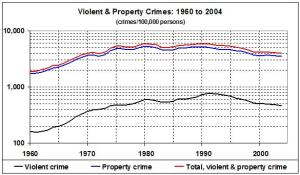
Steven Levitt, of Freakonomics fame, has hypothesized thusly about the drop in the violent-crime rate: more abortion (because legal), therefore fewer illegitimate babies, therefore fewer “unwanted” babies, therefore fewer young men (about 18 years later) whose upbringing was bound to have included more than a normal share of neglect and abuse, therefore less violent crime.

Levitt focuses on violent crime, which (conveniently for him) peaked just as the first abortion generation failed to come of age. But property crime, which is eight times more prevalent than violent crime, peaked about ten years earlier. Property crime, if Levitt is right, must be the preserve of pre-adolescent or middle-aged criminals. It is far more likely that Levitt is wrong.

Several months before I became aware of Levitt’s hypothesis, I said this:

According to an article in today’s NYTimes.com, “Most Crimes of Violence and Property Hover at 30-Year Lows.” Three important things happened after 1995 — the year in which the rate of violent crime began to drop markedly. First, the incarceration rate continued to rise: Persistence pays off. Second, the percentage of the population that is male and 20-24 years old continued to drop, in keeping with the general aging of the population. (Age usually brings with it a greater degree of maturity, stability, and aversion to committing criminal acts.) At the same time, spending on criminal justice functions (police, corrections, and courts) continued to rise, especially spending on police.

I’m sure there are other causal factors, but those are probably the big ones. The first and third of those factors — incarceration and spending on the criminal justice system — go hand in hand. And they are the public-policy weapons of choice in a society that values individual responsibility. (May 15, 2005)

I later backed it up with this:

Rather than rehash all the debates about Levitt’s work…, I decided to take a fresh look at the numbers. I drew on the U.S. Census Bureau’s “Mini-Historical Statistics” to derive the following statistics for the United States (each descriptor links to the Excel spreadsheet from which I derived the relevant statistics):

Violent crimes per 100,000 persons
Percentage of population aged 15-24
Births and illegitimate births per 100,000 women aged 15-19
Blacks as a percentage of the population
Persons incarcerated per 100,000

I selected the 15-24 year age range because persons in that age bracket are most prone to the commission of violent crimes. Because the midpoint of that age bracket is approximately 19, I lagged the birth statistics by 19 years so that birth rates in a particular year are measured against crime statistics 19 years later (e.g., births in 1960 vs. crime in 1977, births in 1973 vs. crime in 1990). I used the overall rate of incarceration rather than a rate for violent offenders because locking up offenders of any kind must ensure that persons who would otherwise commit violent crimes are unable to do so.

Before plunging into a regression analysis, I indexed the series to 1960 (the first year in the violent-crime series) and plotted them (again, with a 19-year lag on the birth-rate series). Here are the plots:

The relationships suggest strongly that the legalization of abortion did not have a significant effect on the rate of violent crime in the U.S. The violent-crime rate rose almost steadily from 1960 until 1991, when it peaked. The lagged rate of illegitimate births for women aged 15-19 (probably the best available proxy for “unwanted” children) leveled off about when the crime rate peaked, but the illegitimacy rate then resumed its steady rise, even as the violent-crime rate dropped dramatically. It is therefore improbable (if not impossible) that abortion — as measured by the rate of illegitimate births — had anything to do with the drop in the crime rate. Using the total rate of births for women aged 15-19 as a proxy for “unwantedness” yields even more problematic results: the lagged rate peaked in 1976, fully 15 years before the crime rate peaked.

I nevertheless ran many regressions on the violent-crime rate and various combinations of the key variables. Only one regression yields credible results (high R-squared, standard error of estimate among the lowest, intuitively correct signs on all coefficients, and high t-statistics on all coefficients). That regression takes the following form:

Number of violent crimes per 100,000 persons =
– 3723
+ 37058 x number of Blacks as a decimal fraction of the population
– 0.568 x number of persons incarcerated per 100,000 of population

The t-statistics on the intercept and coefficients are 15.854, 17.047, and 5.042, respectively; the adjusted R-squared is 0.936; [the standard error of the estimate/mean value of dependent variable = 0.097].

(January 3, 2006)

New Numbers

I have since extended my analysis, in time and in scope. I have looked at the rate of violent-plus-property crimes; I have added data for the five years from 2000 through 2004; and I have considered as explanatory variables the existence of mandatory federal sentencing guidelines (1989-2004), number of male enlisted personnel in the armed forces (in proportion to population), and year-over-year growth in real GDP per capita — in addition to the number of persons aged 15-24, number of prisoners, and number of blacks in proportion to total population, as before. (For sources, see the footnote to this post.) Here’s a graphical depiction of the crime rates and all of the variables I considered:
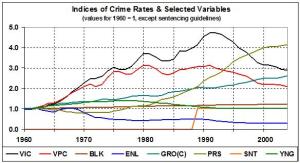
Key: VIC, violent crimes per 100,000 persons; VPC, violent+property+crimes per 100,000 persons; BLK, blacks as a proportion of population; ENL (active-duty, male, enlisted personnel as a proportion of population aged 15-24; GRO(C), growth of real GDP per capita as a proxy for year-to-year growth (GRO) used in the regression analysis; PRS, prisoners in federal and State penitentiaries as a proportion of population; SNT, mandatory sentencing guidelines in effect (0 = no, 1 = yes); YNG, persons aged 15-24 as a proportion of population.

A few comments about each of the explanatory variables: BLK, unfortunately, stands for a segment of the population that has more than its share of criminals — and victims. Having more men in the armed forces (ENL) should reduce, to some extent, the number of crime-prone men in the civilian population. (It would also help to alleviate our self-inflicted impotence, by putting moreboots on the ground” — and missiles in readiness.) I use the annual rate of real, per-capita economic growth (GRO) to capture the rate of employment — or unemployment — and the return on employment, namely, income. (The use of year-over-year growth vice cumulative growthavoids collinearity with the other variables.) PRS encompasses not only the effects of taking criminals off the streets, but the means by which that is done: (a) government spending on criminal justice and (b) juries’ and courts’ willingness to put criminals behind bars and keep them there for a good while. SNT ensures that convicted criminals are put away for a good while.

I focused on violent-plus-property crime (VPC) as the dependent variable, for two reasons. First, there is a lot more property crime than violent crime (VIC); that is, VPC is a truer measure of the degree to which crime affects Americans. Second, exploratory regression runs on VPC yielded more robust results than those on VIC.

Even at that, it is not easy to tease meaningful regressions from the data, given high correlations among several of the variables (e.g., mandatory sentencing guidelines and prison population, number of blacks and prison population, male enlistees and number of blacks). The set of six explanatory variables — taken one, two, three, four, five, and six at a time — can be used to construct 63 different equations. I estimated all 63, and rejected all of those that returned coefficients with counterintuitive signs (e.g., negative on BLK, positive on GRO).

Result and Discussion

Of the 63 equations, I chose the one that has the greatest number of explanatory variables, where the sign on every explanatory variable is intuitively correct, and — given that — also has the greatest explanatory power (as measured by its R-squared):

VPC (violent+property crimes per 100,000 persons) =

-33174.6

+346837BLK (number of blacks as a decimal fraction of the population)

-3040.46GRO (previous year’s change in real GDP per capita, as a decimal fraction of the base)

-1474741PRS (the number of inmates in federal and State prisons in December of the previous year, as a decimal fraction of the previous year’s population)

The t-statistics on the intercept and coefficients are 19.017, 21.564, 1.210, and 17.253, respectively; the adjusted R-squared is 0.923; the standard error of the estimate/mean value of VPC = 0.076.

The minimum, maximum, and mean values of the dependent and explanatory variables:

VPC: 1887, 5950, 4773 (violent-plus-property crimes/100,000 persons)

BLK: 0.1052, 0.1300, 0.1183 (blacks/population)

GRO: -0.02866, 0.06263, 0.02248 (growth in real GDP per capita during year n-1/real GDP per capita in year n-2)

PRS: 0.0009363, 0.004842, 0.002243 (federal and State prisoners in December of year n-1/average population in year n-1)

Even though the coefficient on GRO isn’t strongly significant, it isn’t negligible, and the sign is right — as are the signs on BLK and PRS. The sign on the intercept is counterintuitive — the baseline rate of crime could not be negative. The negative sign indicates the omission of key variables. But forcing variables into a regression causes some of them to have counterintuitive signs when they are highly correlated with other, included variables.

In any event, the equation specified above does a good job of explaining variations in the crime rate:

I especially like the fact that the equation accounts for two policy-related variables: GRO and PRS:

1. Crime can be reduced if economic growth is encouraged by rolling back tax rates. Crime will rise if growth is inhibited by raising tax rates (even for the very rich).

2. Crime can be reduced by increasing the rate at which it is prosecuted successfully, and by ensuring that prisoners do not receive lenient sentences. Therefore, we need to (a) spend even more on the pursuit of criminal justice and (b) restore mandatory sentencing guidelines, which had been in effect (and effective) from 1989 to 2004. (Look at the relationship between SNT and the indices of crime, in the next-to-last graph, and you will have no doubt that mandatory sentencing guidelines were effective and are represented in the equation — to some extent — by the variable PRS.)

ENL and YNG, like SNT, are key determinants of the crime rate. Each of the three variables appears, with the right sign, in many of the 63 equations. So, I am certainly not ruling out ENL and YNG as important variables. To the contrary, they are important variables. But, just as with SNT, I can’t satisfactorily quantify their importance because of the limitations of regression analysis.

Crime, then, depends mainly on two uncontrollable variables (BLK and YNG), and four controllable ones: ENL, GRO, PRS, and SNT. The controllable variables are salutary means of reducing crime, and the record shows that they work. Whatever else abortion is, it is not a crime-fighting tool; those who herald abortion as such are flirting with genocide.

Related posts:
Does Capital Punishment Deter Homicide?
Libertarian Twaddle about the Death Penalty
Crime and Punishment
Abortion and Crime
Saving the Innocent?
Saving the Innocent?: Part II
More on Abortion and Crime
More Punishment Means Less Crime
More About Crime and Punishment
More Punishment Means Less Crime: A Footnote
Clear Thinking about the Death Penalty
Let the Punishment Fit the Crime
Another Argument for the Death Penalty
Less Punishment Means More Crime
__________
Sources

Crimes per 100,000 persons, 1960-2002: Historical Statistical Abstracts, No. HS–23. Crimes and Crime Rates by Type of Offense: 1960 to 2002 (http://www.census.gov/statab/hist/02HS0023.xls).

Crimes per 100,000 persons, 2003-04: Statistical Abstracts, Table 295. Crimes and Crime Rates by Type of Offense: 1980 to 2004 (http://www.census.gov/compendia/statab/tables/07s0295.xls).

U.S resident population, 1960-99: Historical Statistical Abstracts, No. HS-2. Population Characteristics: 1900 to 2002 (http://www.census.gov/statab/hist/02HS0002.xls).

U.S. resident population, 2000-05: Statistical Abstracts, Table 13. Resident Population by Sex, Race, and Hispanic Origin Status: 2000 to 2005 (http://www.census.gov/popest/national/asrh/NC-EST2005/NC-EST2005-03.xls).

Persons aged 15-24, 1960-2002: Historical Statistical Abstracts, No. HS-3. Population by Age: 1900 to 2002 (http://www.census.gov/statab/hist/02HS0003.xls).

Persons aged 15-24, 2003-04: Statistical Abstracts, Table 11. Resident Population by Age and Sex: 1980 to 2005 (http://www.census.gov/compendia/statab/tables/07s0011.xls).

Blacks, 1960-99: Historical Statistical Abstracts, No. HS-2. Population Characteristics: 1900 to 2002 (http://www.census.gov/statab/hist/02HS0002.xls).

Blacks, 2000-04: Statistical Abstracts, Table 13. Resident Population by Sex, Race, and Hispanic Origin Status: 2000 to 2005 (http://www.census.gov/compendia/statab/tables/07s0013.xls). Specifically, I used the entry “Black or African American,” under “Race alone or in combination.” Regardless of the entry for “black” chosen from the table, there is a discontinuity between the number of blacks in 1999 (preceding source) and the number of blacks in 2000. To eliminate the discontinuity, I derived the growth rate for the number of blacks during 2000-05 (about 0.04 percent/year) and applied that rate to the number of blacks in 1999, for a consistent and continuous estimate of blacks as a percentage of population.

Real GDP per Capita, 1960-2004: What Was GDP Then? (Louis D. Johnston and Samuel H. Williamson, “The Annual Real and Nominal GDP for the United States, 1790 – Present.” Economic History Services, July 27, 2007, URL : http://eh.net/hmit/gdp/).

Federal and State prisoners, 1960-2001: Historical Statistical Abstracts, No. HS-24. Federal and State Prisoners by Jurisdiction and Sex: 1925-2001 (http://www.census.gov/statab/hist/02HS0024.xls).

Federal and State prisoners, 2002-04: Statistical Abstracts, Table 337. Federal and State Prisoners by Sex: 1980 to 2004 (http://www.census.gov/compendia/statab/tables/07s0337.xls).

Male enlisted personnel in the armed forces, 1960-2004: Statistical Abstracts, Table 500. Department of Defense Personnel: 1960 to 2005 (http://www.census.gov/compendia/statab/tables/07s0500.xls).

Sentencing guidelines: Start here: United States Sentencing Commission.

Here We Go Again

David Friedman, in “When Is a War Not a War?,” writes:

The problem is that the “War on Terror” is at least in part a metaphor. It is in some ways more like the War on Drugs or the War on Poverty, a project given emotional force by analogizing it to a military conflict, than it is like WW II or the Korean War.

Suppose the President declared a War on Crime–as, for all I know, some President at some point has. Is he then entitled to arrest people he claims are criminals and hold them without trial for an indefinite period of time–as prisoners of war?

The analogy is not perfect. The attack on the World Trade Center was more like an act of war than it was like a bank robbery. But it was less like an act of war than the Pearl Harbor attack was, not only because the targets were not primarily military but because the attackers were not agents of a hostile state. The War on Terror is not as metaphorical as the War on Drugs. But it fits the pattern of war as usually and literally understood poorly enough to make a policy of taking people prisoners and holding them without trial until the war is over at best problematical.

Friedman tries to equate war-fighting and crime-fighting by relying on the surface similarity between the phrases “war on terror” and “war on crime.” But a war on crime, if such there were such a thing, would exercise an entirely separate and distinct aspect of the president’s constitutional authority than does the War on Terror. The president cannot, under the rubric of a war on crime, “arrest people he claims are criminals and hold them without trial for an indefinite period of time–as prisoners of war.” A president might well announce a war on crime,” but it would not be a war (in the constitutional sense), it would an exercise of executive authority conducted by the non-military apparatus of government within constitutional bounds, that is, respecting Amendments I, II, IV, V, VI, and VIII of the Bill of Rights. The Framers of the Constitution understood the difference between war and crime (even if Friedman does not), and did a very nice job of distinguishing them in the Constitution.

The War on Terror is a real war, given that its components (e.g., operations in Afghanistan and Iraq, clandestine operations elsewhere overseas) are conducted under authority granted by Congress (i.e., the functional equivalent of a declaration of war). The president, as long as he acts under that authority — and as long as the U.S. Supreme Court sides with his interpretation of that authority — is conducting a war, not fighting crime.

The president’s authority to conduct the various components of the War on Terror was granted as a result of the attack on the World Trade Center. Friedman is playing word games when he suggests that that attack “was less like an act of war than the attack on Pearl Harbor, not only because the targets were not primarily military but because the attackers were not agents of a hostile state.” Since when do attacks on civilians not count as acts of war? (The dropping of A-bombs on Hiroshima and Nagasaki, for example were ultimate acts of war, aimed at forcing Japan’s surrender.) Since when do anarcho-libertarians (as is Friedman) view acts by non-state entities as somehow lacking authority because they were not explicitly authorized by a state (as far as we know). Is cold-blooded murder somehow less of a crime if it is committed by an anarchist gypsy, as opposed to a fascist functionary, for example?

Friedman seems dismayed by the prospect of enemy combatants being held indefinitely because there might be no end to the War on Terror. But why the dismay, if they are enemies? Friedman would answer: Because they have not been tried and found to be enemies. Friedman (along with his fellow anarchos and the anti-war Left) argues from one erroneous premise (the War on Terror isn’t really a war) to another (therefore, it must be an exercise in criminal justice), in order to reach a desired conclusion (prisoners in the War on Terror are entitled to the protections of the Bill of Rights). This they do, even though those prisoners are enemies who would spit on the Bill of Rights.

What to do about those enemy combatants who might be held indefinitely? My take: If military necessity dictates indefinite detention, so be it. The alternative? Take no prisoners.

War and justice are two different things, as the Framers wisely understood, and as Friedman — and his fellow anarchos and their brethren on the Left — cannot seem to understand. Wars are fought to protect the rights of U.S. citizens, not to strengthen our enemies in their quest to harm U.S. citizens and their legitimate economic interests.

We do not live in “one world.” And even if everyone in the world were endowed with equal rights (a concept that I reject), no one would be entitled to attack what we in the U.S. enjoy. To rephrase what I wrote here,

the sovereignty of the United States is inseparable from the benefits afforded Americans by the U.S. Constitution, most notably the enjoyment of civil liberties, the blessings of more-or-less free markets and free trade, and the protections of a common defense. To cede sovereignty — by allowing other nations a say in our laws or by treating our enemies as equals under the Constitution — is to risk the loss of the benefits we derive from the Constitution. That is why we must always be cautious in our commitments to international organizations and laws, and resist the temptation to treat enemies as if they were entitled to the very benefits they would deny us.

“War” is not “justice”; “nationalism” is not a dirty word.

A Glaring Omission

An AP “story” about capital punishment (really a thinly disguised anti-punishment editorial) ends with this:

Nearly 1,100 people have been put to death since 1977 and more than 3,000 others are on death row.

Not a word about the lives taken by those 4,100 “fine” individuals. Nor about the lives saved by capital punishment. Nor about justice.

Related posts:
Does Capital Punishment Deter Homicide?
Libertarian Twaddle about the Death Penalty
Crime and Punishment
Abortion and Crime
Saving the Innocent?
Saving the Innocent?: Part II
More on Abortion and Crime
More Punishment Means Less Crime
More About Crime and Punishment
More Punishment Means Less Crime: A Footnote
Clear Thinking about the Death Penalty
Let the Punishment Fit the Crime
A Precedent for the Demise of the Insanity Defense?
Another Argument for the Death Penalty
Less Punishment Means More Crime

Pascal’s Wager, Morality, and the State

David Friedman addresses Pascal’s wager:

Pascal famously argued that, as long as there was any probability that God existed, a rational gambler should worship him, since the cost if he did exist and you failed to worship him was enormously greater than the cost if it went the other way around.

A variety of objections can be made to this, most obviously that a just God would reject a worshiper who worshiped on that basis.

That is my view, also. But Friedman goes on to say that he has “a variant on the argument” that he “find[s] more persuasive.” Thus:

The issue is not God but morality. Most human beings have a strong intuition that some acts are good and some bad–that one ought not to steal, murder, lie, bully, torture, and the like. Details of what is covered and how it is defined vary a good deal, but the underlying idea that right and wrong are real categories and one should do right and not wrong is common to most of us.

There are two categories of explanation for this intuition. One is that it is a perception–that right and wrong are real, that we somehow perceive that, and that our feel for what is right and what is wrong is at least very roughly correct. The other is that morality is a mistake. We have been brainwashed by our culture, or perhaps our genes, into feeling the way we do, but there is really no good reason why one ought to feed the hungry or ought not to torture small children.

Suppose you are uncertain which of the two explanations is correct. I argue that you ought to act as if the first is. If morality is real and you act as if it were not, you will do bad things–and the assumption that morality is real means that you ought not to do bad things. If morality is an illusion and you act as if it were not, you may miss the opportunity to commit a few pleasurable wrongs–but since morality correlates tolerably well, although not perfectly, with rational self interest, the cost is unlikely to be large.

I think this version avoids the problems with Pascal’s. No god is required for the argument–merely the nature of right and wrong, good and evil, as most human beings intuit them. And, by the morality most of us hold, the fact that you are refraining from evil because of a probabilistic calculation does not negate the value of doing so–you still haven’t stolen, lied, or whatever. One of the odd features of our intuitions of right and wrong is that they are not entirely, perhaps not chiefly, judgements about people but judgements about acts.

Friedman actually changes the subject from Pascal’s wager (why one should believe in God) to the basis of morality. As I say above, I agree with Friedman’s observation about Pascal’s wager: God might well reject a cynical believer.

But it seems to me that Pascal’s wager has nothing much to do with the origin of morality. Not all worshipers are moral; not all moral persons are worshipers.

Moreover, Friedman overlooks two important (and not mutually exclusive) explanations of morality. The first is empathy; the second is consequentialism.

We (most of us) flinch from doing things to others that we would not want done to ourselves. Is that because of inbred (“hard wired”) empathy? Or are we conditioned by social custom? Or is the answer “both”?

If inbred empathy is the only explanation for self-control with regard to other persons, why is it that our restraint so often fails us in interactions with others are fleeting and/or distant? (Think of aggressive driving and rude e-mails, for just two examples of unempathic behavior.) Empathy, to the extent that it is a real and restraining influence, seems most to work best (but not perfectly) in face-to-face encounters, especially where the persons involved have more than a fleeting relationship.

If behavior is (also) influenced by social custom, why does social custom favor restraint? Here is where consequentialism enters the picture.

We are taught (or we learn) about the possibility of retaliation by a victim of our behavior (or by someone acting on behalf of a victim). In certain instances, there is the possibility of state action on behalf of the victim: a fine, time in jail, etc. So we are taught (or we learn) to restrain ourselves (to some extent) in order to avoid punishments that flow directly and (more or less) predictably from our unrestrained actions.

More deeply, there is the idea that “what goes around comes around.” In other words, bad behavior can beget bad behavior, whereas good behavior can beget good behavior. (“Well, if so-and-so can get away with X, so can I.” “So-and-so is rewarded for good behavior; it will pay me to be good, also.” “If so-and-so is nice to me, I’ll be nice to him so that he’ll continue to be nice to me.”)

Why do we care that “what goes around comes around”? First, we humans are imitative social animals; what others do — for good or ill — cues our own behavior. Second, there is an “instinctive” (taught/learned) aversion to “fouling one’s own nest.”

Unfortunately, our aversion to nest-fouling weakens as our interactions with others become more fleeting and distant — as they have done since the onset of industrialization, urbanization, and mass communication. Bad behavior then becomes easier because its consequences are less obvious or certain; it becomes a model for imitation and, perhaps, even a norm. Good behavior then flows from the fear of being retaliated against, not from socialized norms, or even from fear of state action. Aggression — among the naturally aggressive — becomes more usual.

And so we become ripe for rule by a “protective” state, and by rival warlords if the state fails to protect us.

No Kidding!

“Threat of punishment can deter bad behaviour,” says this article.

I agree, wholeheartedly. See:
Does Capital Punishment Deter Homicide?
Crime and Punishment
More Punishment Means Less Crime
More About Crime and Punishment
More Punishment Means Less Crime: A Footnote
Less Punishment Means More Crime

More (of the Same) Reasons to Vote Republican in ’08

I linked to some here. There’s more in that vein here.

"The Shoe Is on the Other Foot" — Updated

I have added three updates to “The Shoe Is on the Other Foot,” a post about the un-hiring and probable un-un-hiring of Erwin Chemerinsky as founding dean of the UC Irvine law school.

The Shoe Is on the Other Foot

UPDATED THRICE, BELOW

From Law Blog – WSJ.com: The O.C.:

According to Brian Leiter’s Law School Reports, a blog on comings-and-goings in legal academia, UC Irvine, which recently got approval to start a law school, reached an agreement with Duke’s Erwin Chemerinsky (pictured), a prominent constitutional law scholar, to have Chemerinsky be its inaugural dean — and then rescinded the offer yesterday because of his [liberal] political views….

“I’ve been a liberal law professor for 28 years,” Chemerinsky said. “I write lots of op-eds and articles, I argue high-profile cases, and I expected there would be some concern about me. My hope was that I’d address it by making the law school open to all viewpoints.”…

He added: “Obviously I’m sad because it’s something I was exciting about. I’m angry because I don’t believe anyone liberal or conservative should be denied a position like this because of political views.”

I must here admit to a bit of schadenfreude, given that academia is ruled mainly by Leftists who are in the habit of not hiring and not promoting conservatives.

But, but, but…many (even some conservatives) will say “two wrongs don’t make a right.” Actually, thousands of wrongs have been committed against conservative academics, but the un-hiring of Chemerinsky isn’t a wrong. I have encountered his view of the Constitution, and have found it highly unconstitutional. He shouldn’t have been hired for the deanship in the first place. The man has no place teaching constitutional law, anywhere. It has been his good luck (and our misfortune) that many law schools (like most of academia) are dominated by the Left.

UPDATE (09/17/07): Conservatives just play too nice. UC Irvine has been suckered into hiring Chereminsky as law dean, after all.

See the new law school open next year. Hear the new dean promise “to respect all points of view.” Wait for the new law school to begin veering to the Left. Peer into the not-so-distant future as the school drives out the few conservative-libertarian profs it was willing and able to recruit.

You can what’s going to happen because Brian Leiter, a Marxist who parades as a law prof, is happy about the news of Chereminsky’s hiring. (For more about Leiter, see this, this, this, and this.)

UPDATE (09/18/07): Chereminsky, I now learn, has been representing Rachel Corrie’s family in its suit against Caterpillar, Inc. Corrie, as you will remember, was the pro-Palestinian protester who failed to get out of the way of an Israeli-wielded Cat. So, Corrie’s family sued the company. “This is a case about direct commercial sales,” Chemerinsky said. “It’s about holding corporations liable when they aid and abet violations of human rights.”

Corrie’s family has a right to representation, but Chemerinsky wasn’t obliged to represent the family. In choosing to do so, he revealed his anti-U.S., anti-Israeli bias.

Fortunately, in this case, the Ninth Circuit (surprisingly) did the right thing: It affirmed the dismissal of the family’s suit by a district court judge. A telling passage from the court’s ruling:

It is not the role of the courts to indirectly indict Israel for violating international law with military equipment the United States government provided and continues to provide. . . . Plaintiffs may purport to look no further than Caterpillar itself, but resolving their suit will necessarily require us to look beyond the lone defendant in this case and toward the foreign policy interests and judgments of the United States government itself.

Which is precisely what the Corrie family, their supporters, and Chemerinsky sought: judicial intervention in what are essentially political questions. Isn’t that the Left’s preferred way? You bet it is. And that’s part of the mindset Chemerinsky will bring to the deanship of the new law school.

UPDATE (09/19/07): See this related post by Gail Heriot of The Right Coast.