Recommended Reading about NSA’s Surveillance Program

LINKS ADDED 02/07/06, 02/14/06, 03/07/06, 03/24/06

Buried in the middle of my rather long post about “Privacy: Variations on the Theme of Liberty” is a reading list that I update from time to time:

President had legal authority to OK taps (Chicago Tribune)
Our domestic intelligence crisis (Richard A. Posner)
Many posts by Tom Smith of The Right Coast (start with “Thank You New York Times” on 12/16/05 and work your way to the present)
Eavesdropping Ins and Outs (Mark R. Levin, writing at National Review Online)
The FISA Act And The Definition Of ‘US Persons’ (Ed Morrissey of Captain’s Quarters)
A Colloquy with the Times (John Hinderaker of Power Line)
September 10 America (editorial at National Review Online)
A Patriot Acts (Ben Stein, writing at The American Spectator)
More on the NSA Wiretaps (Dale Franks of QandO)
The President’s War Power Includes Surveillance (John Eastman, writing at The Remedy)
Warrantless Intelligence Gathering, Redux (UPDATED) (Jeff Goldstein, writing at Protein Wisdom)
FISA Court Obstructionism Since 9/11 (Ed Morrissey of Captain’s Quarters)
FISA vs. the Constitution (Robert F. Turner, writing at OpinionJournal)
Wisdom in Wiretaps (an editorial from OpinionJournal)
Under Clinton, NY Times Called Surveillance a Necessity (William Tate, writing at The American Thinker)
LEGAL AUTHORITIES SUPPORTING THE ACTIVITIES OF THE
NATIONAL SECURITY AGENCY DESCRIBED BY THE PRESIDENT
(U.S. Department of Justice)
Terrorists on Tap (Victoria Toensing, writing at OpinionJournal)
Letter from Chairman, Senate Intelligence Committee, to Chairman and Ranking Member of Senate Judiciary Committee
Letter from H. Bryan Cunningham to Chairman and Ranking Member of Senate Judiciary Committee
Has The New York Times Violated the Espionage Act? (article in Commentary by Gabriel Schoenfeld)
Point of No Return (Thomas Sowell, writing at RealClearPolitics) (ADDED 02/07/06)
Letter from John C. Eastman to Chairman of House Judiciary Committee (ADDED 02/14/06)
FISA Chief Judge Speaks Out, Bamford Misinforms (a post at The Strata-Sphere) (ADDED 03/07/06)
DoJ Responds to Congressional FISA Questions (another post at The Strata-Sphere) (ADDED 03/24/06)

(Final?) Words about Preemption and the Constitution

Toward the end of “Libertarianism and Preemptive War: Part II” I said that

[t]he decision to preempt is a political judgment in which Congress puts America’s sovereignty and the protection of Americans’ interests above putative treaty obligations. It seems unlikely that a court (the U.S. Supreme Court, in particular) would find that the constitutional grant of power to declare war, which is so fundamental to America’s sovereignty and to the protection of Americans’ interests, can be ceded by treaty to an international body that cannot be relied upon to protect our sovereignty and our interests.

When I quoted a portion of that passage in a comment thread at Catallarchy, Joe Miller took exception in a post at his blog, Bellum et Mores. Joe and I then had an inconclusive exchange in the comment thread. We focused on the constitutionality (or lack thereof) of those provisions of the UN Charter that bear on the conduct of war by members:

The Security Council shall determine the existence of any threat to the peace, breach of the peace, or act of aggression and shall make recommendations, or decide what measures shall be taken in accordance with Articles 41 and 42, to maintain or restore international peace and security. (Article 39)

Nothing in the present Charter shall impair the inherent right of individual or collective self-defense if an armed attack occurs against a Member of the United Nations, until the Security Council has taken measures necessary to maintain international peace and security. Measures taken by Members in the exercise of this right of self-defense shall be immediately reported to the Security Council and shall not in any way affect the authority and responsibility of the Security Council under the present Charter to take at any time such action as it deems necessary in order to maintain or restore international peace and security. (Article 51)

I won’t repeat the whole exchange between Joe and me (which you can read here), just some of my main points:

[The Charter] (in theory) delimits Congress’s authority to declare war, even though that authority isn’t delimited in the Constitution. (There’s no mention there of “self defense,” for example.) The . . . UN Charter, therefore, amounts to constitutional amendment by treaty. That’s not how the Constitution is supposed to be amended. . . .

. . . Our membership in the UN . . . amounts to a general concession that the Security Council (not Congress) gets to decide when we are acting in self-defense and when we can go to war when we are not acting in self-defense (as the Security Council sees it). . . . [T]he provisions of the UN Charter with respect to war do not merely implement Congress’s authority to declare war — rather, they fundamentally modify that authority.

. . . I have no problem with treaties that implement powers granted to Congress and the president (e.g., the negotiation and ratification of trade treaties). I have a fundamental problem with a treaty (the UN Charter) that circumscribes the power of Congress to declare war. That isn’t an implementation of a constitutional power, it’s a denial of a constitutional power. . . .

In ratifying the Charter, the Senate essentially surrendered a good chunk of (if not all of) Congress’s constitutional authority to declare war. . . . In other words, if the U.S. were to abide by the letter of the UN Charter (as interpreted by the Security Council, not Congress), the president and Congress would be prevented from taking actions that they judge to be in the best interest of Americans. That, it seems to me, vitiates the Framers’ intent, which was to place the decision about going to war in the hands of the elected representatives of the people of the United States — and certainly not in the hands of foreign powers. . . .

It all comes down to [this] question: Who gets to decide whether certain conditions [for going to war] are met — Congress or an international body over which Congress has no authority? Answer: international body over which Congress has no authority. The U.S. (in theory) can go to war only with the approval of both Congress and the international authority. Again, I submit that that’s an unconscionable violation of American sovereignty.

Brian Doss says it very well in a post at Catallarchy, which ends with this:

[S]ince the Constitution is the ultimate source of authority in the US government, and as it trumps both law and treaty when there is conflict; and as the Constitution may not be amended by treaty but by manner prescribed by the Constitution; and as it would require an amendment to the Constitution to substantively modify Congress’ warmaking authority; the UN treaty therefore is not a legal constraint upon the US Congress’ warmaking authority, and Congressional [authorizations for the use of military force] or declarations of war are necessary and sufficient for a US war’s legality.

Precisely.

But I’m confident that we’ll be hearing more from Joe. Stay tuned.

Related posts: War, Self-Defense, and Civil Liberties (a collection of links)

Clear Thinking about the Death Penalty

Here’s my position (from 10/04/04):

The econometric evidence is there, for those who are open to it: Capital punishment does deter homicide. See, for example, the careful analysis by Hashem Dezhbaksh, Paul Robin, and Joanna Shepherd, “Does capital punishment have a deterrent effect? New evidence from post-moratorium panel data,” American Law and Economics Review 5(2): 344–376 (available in PDF format here). Dezhbaksh, Rubin, and Shepherd argue that each execution deters eighteen murders. That number may be high, but the analysis is rigorous and it accounts for relevant variables, such as income, age, race, gender, population density, and use of the death penalty where it is legal. It’s hard to read that analysis and believe that capital punishment doesn’t deter homicide — unless you want to believe it. I certainly wouldn’t take “Ouija Board” Goertzel’s opinion over that of careful econometricians like Dezhbaksh, Rubin, and Shepherd.

Now, I must say that I don’t care whether or not capital punishment deters homicide. Capital punishment is the capstone of a system of justice that used to work quite well in this country because it was certain and harsh. There must be a hierarchy of certain penalties for crime, and that hierarchy must culminate in the ultimate penalty if criminals and potential criminals are to believe that crime will be punished. When punishment is made less severe and less certain — as it was for a long time after World War II — crime flourishes and law-abiding citizens become less secure in their lives and property.

John McAdams, a professor of political science at Marquette University, makes a succinct case for the death penalty, regardless of its deterrent effect:

I’m a bit surprised . . . [by the] claim that “the burden of empirical proof would seem to lie with the pro-death penalty scholar.” If we execute murderers and there is in fact no deterrent effect, we have killed a bunch of murderers. If we fail to execute murderers, and doing so would in fact have deterred other murders, we have allowed the killing of a bunch of innocent victims. I would much rather risk the former. This, to me, is not a tough call.

I wish I’d said that.

(Thanks to my son for the lead to the McAdams quotation.)

Related posts:
Does Capital Punishment Deter Homicide?
Libertarian Twaddle about the Death Penalty
Crime and Punishment
Abortion and Crime
Saving the Innocent?
Saving the Innocent?: Part II
More on Abortion and Crime
More Punishment Means Less Crime
More About Crime and Punishment
More Punishment Means Less Crime: A Footnote
Let the Punishment Fit the Crime
Another Argument for the Death Penalty
Less Punishment Means More Crime
Crime, Explained

Lest We Forget

Gonazles v. Oregon (“right to die”) is about more than federalism.

Obtuse Nonsense

Mark A.R. Kleiman (The Reality-Based Community) closes a post with this observation:

All judges judge by their personal beliefs. Whose beliefs would you expect them to judge by?

Kleiman misses the point entirely. Judges should judge from their “beliefs” about the law: what it requires, like it or not. Too many judges, however, judge from what they would like the law to require. There is a vast difference between those two positions, but Kleiman is too obtuse to grasp it or too argumentative to admit it. Kleiman’s relativistic standard allows him to excuse seven decades of Leftist opinions that have made a mockery of the Constitution and denuded it of liberty. Just what one would expect from a “reality-based” blogger.

Fie on Steve Bainbridge, who recommends Kleiman’s post.

More Punishment Means Less Crime: A Footnote

In “More Punishment Means Less Crime” I argued — with statistical support — that making federal sentencing guidelines advisory rather than mandatory, as the Supreme Court has done, will lead a resurgence of the violent-crime rate. I followed up with “More About Crime and Punishment,” in which I cited a case in point, the sentencing of a rapist to 60 days in jail. Now we have this, from an exchange at Legal Affairs Debate Club between Douglas Berman and Frank O. Bowman III:

Berman: 1/16/06, 09:43 AM
Given the enormous and unexpected shocks to the federal sentencing system over the past three years—Congress’ enactment of the PROTECT Act, then the Supreme Court’s decision in Blakely v. Washington, and finally the Supreme Court’s decision in United States v. Booker—I am wary about making any predictions about what will be the future of federal sentencing. But I am happy to opine about what should be the future of federal sentencing: Congress should allow the advisory guideline system created by the Booker decision to continue to operate while the U.S. Sentencing Commission and others assess its efficacy and fairness. . . .

Bowman: 1/17/06, 09:01 AM
. . . A year has passed since the Booker decision. The Sentencing Commission has been gathering and promulgating data about post-Booker practice on a nearly monthly basis since April 2005. In consequence, we have a very good idea about how the post-Booker system has worked so far:

. . . since Booker, the rate of compliance with the Guidelines, by which I mean the percentage of cases sentenced within the guideline range calculated by the sentencing judge, has declined by about 11% nationally—from about 72% to about 61%.

. . . Virtually the entire country has experienced a decline in compliance with the guidelines. The compliance rate of every circuit has fallen, and compliance fell in more than 90% of all districts.

. . . the average length of a federal sentence in 2005 stayed the same as it was in 2004. On the other hand, the trend in sentence length (and guidelines compliance) from 2001-2004 was sharply up, the apparent result of conscious efforts by both Congress and the central administration of DOJ to increase guidelines adherence and criminal penalties. In short, the average federal sentence length post-Booker seems to reflect not maintenance of the status quo, but the sudden arrest of what had been a powerful and continuing upward surge.

. . . the decrease in guidelines compliance after Booker is almost entirely due to judicial action. Judges are using their new authority to reduce sentences below the range in almost 10% of all cases, and it is their exercise of this authority that is driving the decline in overall compliance rate.

I’ll make no comment now on these facts, other than to suggest that the argument for delay in response to Booker cannot much longer be premised on the claim that we don’t know how the new system will work. In fact, we have a very good idea of how it’s working.

Indeed we do. It’s working in favor of criminals. And that will lead to a resurgence of crime.

Related posts:
Does Capital Punishment Deter Homicide?
Libertarian Twaddle about the Death Penalty
Crime and Punishment
Abortion and Crime
Saving the Innocent?
Saving the Innocent?: Part II
More on Abortion and Crime
More Punishment Means Less Crime
More About Crime and Punishment
Clear Thinking about the Death Penalty
Let the Punishment Fit the Crime
Another Argument for the Death Penalty
Less Punishment Means More Crime
Crime, Explained

A Supreme Court Quiz

Q. When are Justices Scalia and Thomas for federalism?

A. Always, except when they’re against it, as in Gonzales v. Oregon.

Q. When are Justices Stevens, Kennedy, Souter, Ginsburg, and Breyer against federalism?

A. Always, except when they’re for it, as in Gonzales v. Oregon.

Words for the Unwise

Those who are trying to dismantle our defenses should read this:

Reliapundit links to a report which he says can be considered circumstantial proof that the NY Times, in leaking the NSA wiretapping program, has tipped off terrorists and thus made our job more difficult. Seems disposable phones are selling like hotcakes in certain quarters. They’re tough to trace. . . .

Maybe some Americans forget what 9/11 was like. It’s easy to do; we don’t like to dwell on what is sad and tragic, and we don’t like to feel insecure. And perhaps because our president and his team HAVE managed to keep us safe, HAVE managed to prevent another attack on our soil, using these (what the left would call) “impeachable” tactics, perhaps we are feeling a little too safe, a little over-confident. That must be true for some, particularly many Democrats, who would like to “kill the Patriot act,” as Sen. Harry Reid crowed, or leak every covert measure we are taking, (hello, New York Times, hello James Risen) or who seem to wish to tie the hands of the government at every turn in the War on Terror.

Feeling pretty safe, are you? Pretty secure? Has 9/11 become a faded memory for you?

I haven’t forgotten. . . .

I remember Tom Brokaw’s voice as the endless loop of a plane slamming into a tower played, “This,” he intoned, gravely, “is war.” . . .

I remember knowing, four years ago, that terrorists were evil and that terrorism needed defeating. I thought we all knew it.

I’m a New Yorker, and if it happens again in New York, I will hold these “pure, patriotically motivated” leakers (yes, they’re leakers) responsible, because they allowed their hate to take them too far.

I will wonder how Harry Reid and the NY Times and the leakers and “anonymous sources” they have lionized can live with all the blood on their hands, even as they (predictably) immediately blame the White House for not “connecting the dots.”

If it happens anywhere in America, (or, really, anywhere else) I will look toward the NY Times and the rest of the “pure, patriotically motivated” press and leftists, because they will have, by their actions and their rhetoric, enabled terrorists to move forward where they had perhaps formerly been stalled. By making the job of surveillance and information-sharing more difficult (drop the Patriot Act and Jamie Gorelick’s wall snaps back in place) and the terrorist’s job easier, they will have participated in something deadly – all because they wanted to “get” the president and keep him from succeeding – which means keep America from succeeding – which means keep the world from progressing away from the scourge of terrorism.

If it happens again, if after we’ve been safe for nearly 5 years only to find – after these “noble” leaks – that we are safe no longer, I will know where to look. Most Americans will know where to look.

I know right where to look.

Related posts:

Getting It Wrong: Civil Libertarians and the War on Terror (A Case Study) (05/18/04)
The Illogic of Knee-Jerk Privacy Adocates (10/06/04)
Treasonous Blogging? (03/05/05)
Absolutism (03/25/05)
Shall We All Hang Separately? (08/13/05)
Foxhole Rats (08/14/05)
Treasonous Speech? (08/18/05)
Foxhole Rats, Redux (08/22/05)
September 11: A Remembrance (09/11/05)
The Faces of Appeasement (11/19/05)
Give Me Liberty or Give Me Non-Aggression? (12/08/05)
We Have Met the Enemy . . . (12/13/05)
Whose Liberties Are We Fighting For? (12/16/05)
Prof. Bainbridge and the War on Terror (12/17/05)
The Constitution and Warrantless “Eavesdropping” (12/21/05)
NSA “Eavesdropping”: The Last Word (from Me) (12/28/05)
Privacy, Security, and Electronic Surveillance (01/06/06)
Privacy: Variations on the Theme of Liberty (01/11/06)
Worth Repeating (01/13/06)

Tidbits

Does this signal a return to Lochnerian due process?

This week, the Seventh Circuit Court of Appeals gave labor groups and their political cronies in Illinois a good, swift kick in their collective behinds.In 520 South Michigan Ave. Assoc., Ltd. v. Devine, the court reversed the district court’s dismissal of an employer’s challenge to an amendment to an Illinois law prohibiting the use of temporary workers during a strike. . . .

Illinois law makes it a crime to employ “professional strikebreakers.” A few years ago, the state broadened this prohibition to criminalize the hiring of day laborers and temporary staff during strikes. After the amendment was enacted, the plaintiff, who was in the midst of a strike and facing probing inquiries from the local Illinois states attorney for Cook County, sought a declaratory judgment that the Strikebreakers Act is preempted by federal law. The district court found that the employer lacked standing, but the Seventh Circuit disagreed and remanded the case for decision on the merits.

Rather than stop there, the Seventh Circuit then launched into a biting critique of the constitutionality of the amendment. According to the court, the Strikebreakers Act places an impermissible limit on the employer’s use of an economic tactic that is protected by federal law. . . . (From Lou Michels at Suits in the Workplace)

Escape from D.C. In which economist (and Englishman) Tim Harford writes of his impending reassignment from D.C. to London:

There’s another point to consider [in favor of taking the London assignment]. Even living in Hackney I would be less than an hour away from the shopping and the arts of one of the world’s great cities. To get quickly from DC to the heart of one of the world’s great cities requires a helicopter trip to Manhattan.

Last, and certainly least, is this bit of wisdom from a constitutional scholar très manqué:

I am dismayed that Judge Samuel Alito is receiving any consideration for such an important post as Supreme Court justice. His known views are extremely partisan, reactionary and contrary to the provisions of the Constitution and the wishes of the majority of the American people.

Karen Price
Austin

Contrary to which “provisions” of the Constitution, the one that guarantees everyone a free lunch or the one that says we should lie prostrate before our enemies? And which majority would that be, the one that lies along the Kennedy-Schumer axis?

Worth Repeating

In light of the attention given the “unitary executive theory” during the Alito hearings, I borrow from myself:

The legitimate function of the state is to protect its citizens from predators and parasites, it is not to protect predators and parasites. The critics of aggressive defense like to proclaim their dedication to civil liberties, but their statist agenda in domestic matters betrays their selective dedication to liberty.

There is a balance to be struck between privacy and liberty, but it should not — and need not — be struck in favor of our enemies. The Constitution is, first and foremost, a mutual defense pact, not a suicide pact.

I certainly don’t believe in the extreme version of the unitary executive theory, in which the president is a law unto himself. But (continuing to borrow from myself) I do believe that the president has wide latitude in foreign affairs — which encompasses the defense of the nation. I quote Sai Prakash, who writes about the Constitution’s Executive Vesting Clause (Article II, Section 1, Clause 1) in The Heritage Guide to the Constitution (pp. 179-82):

The [Executive Vesting Clause] . . . accords the President those foreign-affairs authorities not otherwise granted to Congress or shared with the Senate. . . .

The Articles of Confederation lacked an independent chief executive. Instead, the Continental Congress exercised the executive power, appointing and dominating the secretaries of the executive departments. Unfortunately, law execution under the direction of a distracted, plural executive was neighter vigorous nor swift. Congress likewise proved a poor steward of foreign affairs, with American diplomats complaining that Congress could not act with the requisite speed or secrecy. . . .

Resolving to avoid the problems plaguing state and national executives, the Constitution’s makers created an energetic, responsible, and unified executive. . . . The Anti-Federalists well understood the Framers’ design and criticized the unitary executive [but they lost the argument: ED] . . . .

. . . [T]he delegates [to the Constitutional Convention] spoke of the President’s principal foreign-affairs role, oftentimes referring to the Senate’s role in treaty-making as a limited exception to the grant of foreign-affairs authority to the President. . . .

. . . [T]raditional rules of statutory interpretation require us to take seriously the differences in phrasing across the three vesting clauses. Artilce I, Section 1 (“All legislative Powers herein granted shall be vested in a Congress of the United States. . . .”) makes clear that it vests no authorities separate from those enumerated in the rest of Article I. In contrast, Article III, Section 1 (“The judicial Power of the United States, shall be vested in one supreme Court, and in such inferior Courts as the Congress may . . . establish.”) clearly vests the federal courts with judicial authority. The Executive Vesting Clause reads like its Article III counterpart, in sharp contrast to the Article I introductory clause. . . .

In a case touching upon foreign affairs, the judiciary has recently reaffired that the executive power grants foreign-affairs authority to the President. See American Insurance Ass’n v. Garamendi (2003). This marks a departure from prior case law, which had grounded the executive’s foreign-affairs powers not in any constitutional text, but in necessity and sovereignty. See United States v. Curtiss-Wright Export Corp. (1936).

John Yoo and James C. Ho, writing in the same volume about the president’s role as commander in chief (pp. 195-8), have this to say:

. . .[S]ome originalist scholars have concluded that Congress’s war power is limited to its control over funding and its power to impeach executive officers. They contend that the President is constitutionally empowered to engage in hostilities with whatever resources Congress has made available to the executive. . . .

In summary, the argument for executive initiative rests on the background understanding that the vesting of “executive Power” and the “Commander in Chief” designation together constitute a substantive grant of authority to the President to conduct military operations.

The Framers intended the executive to be a passive enforcer of laws passed by Congress that bear on domestic affairs (and those laws were to be strictly limited in scope by Article I, Section 8, of the Constitution). At the same time, the Framers intended the executive to defend Americans actively against enemies foreign and domestic. No one has put it more clearly than Justice Felix Frankfurter:

. . . [W]e have had recent occasion to quote approvingly the statement of former Chief Justice Hughes that the war power of the Government is ‘the power to wage war successfully.’ . . . Therefore, the validity of action under the war power must be judged wholly in the context of war. That action is not to be stigmatized as lawless because like action in times of peace would be lawless. To talk about a military order that expresses an allowable judgment of war needs by those entrusted with the duty of conducting war as ‘an unconstitutional order’ is to suffuse a part of the Constitution with an atmosphere of unconstitutionality. The respective spheres of action of military authorities and of judges are of course very different. But within their sphere, military authorities are no more outside the bounds of obedience to the Constitution than are judges within theirs. . . . To recognize that military orders are ‘reasonably expedient military precautions’ in time of war and yet to deny them constitutional legitimacy makes of the Constitution an instrument for dialetic subtleties not reasonably to be attributed to the hard-headed Framers, of whom a majority had had actual participation in war. If a military order such as that under review does not transcend the means appropriate for conducting war, such action . . . is as constitutional as would be any authorized action by the Interstate Commerce Commission within the limits of the constitutional power to regulate commerce.

Privacy: Variations on the Theme of Liberty

This post is an abridgement of the much longer version at Liberty Corner II. The complete version provides much supporting detail that I have omitted here.

I begin by addressing privacy as a right. I then turn to private-sector issues, namely, identity theft and the use of personal information by businesses. In the next substantive portion of this post I address privacy vis-a-vis government, disposing quickly of the national ID card to focus on warrantless “eavesdropping” and data-mining. I then offer a brief summary and conclusion.

IS PRIVACY AN ABSOLUTE RIGHT?

Privacy in the Law

Privacy is one among many values that liberty should serve. An individual’s desire for privacy is as legitimate as a desire for, say, a Lamborghini, a full head of hair, and perpetual youth. Seriously, privacy is a legitimate pursuit, yet (like a Lamborghini) it cannot an absolute right. For — as I have argued elsewhere — if privacy were an absolute right, it would be possible to get away with murder in one’s home simply by committing murder there. In fact, if there are any absolute rights, privacy certainly isn’t one of them. Privacy really is a bargain that individuals strike with the rest of the world. We cannot act in the world without ceding some privacy, so the question is how to decide when the bargain we are being asked to strike is a good one or a bad one, given the benefits and risks of ceding some privacy.

You may now ask: “What about the Constitution, the Bill of Rights, and all of that?” Read the Constitution and Bill of Rights and you will find that there is nothing about privacy in them. The Fourth and Fifth Amendments come closest to being “privacy” amendments, but they’re really about due process of law. The vaunted Ninth Amendment doesn’t protect an unemurated privacy right.

There is neverthess a notion that the Fourteenth Amendment guarantees privacy as a matter of substantive due process. As I have explained, however, substantive due process protects constitutionally guaranteed rights (e.g., liberty of contract). It does not protect imaginary rights, such as the non-existent general right to privacy.

The notion of a general right to privacy is a fairly recent invention of the Supreme Court. It was conjured to serve the Court’s legislative agenda in Griswold v. Connecticut (overturning a Connecticut law that banned the sale of contraceptives) and Roe v. Wade (overturning a Texas anti-abortion law).

There are, of course, federal and State laws that define specific areas of privacy. All such federal and State laws are carve-outs — delineations of specific areas of privacy. They are not general guarantees of privacy. Do we need even more carve-outs to deal with the “privacy crisis”? Let us begin by defining the real privacy problem.

Privacy in the Real World

You may, in spite of what I have just said, think that you have a “right” to privacy. But try that line with prospective creditors, who have a “right” to know enough about you to decide whether to extend credit to you; try that line with banks, which have a “right” to know enough about you so that they can safeguard your savings from impostors; and try that line with the police, who have a “right” (constitutionally) to obtain a warrant to search your home if you are suspected of a crime.

If you want absolute privacy you should not have a job (working for someone else), a credit card, a checking account, a brokerage account, a 401(k), a house, land, a car, a legalized marriage, children who were born in a hospital or educated formally, a formal education of your own, a telephone, an Internet connection, or almost any of the other trappings of what we call civilization. The real issue is the extent to which you are willing to forgo some aspects of privacy in order to work for someone else (other than the Mob), possess a credit card, etc.

PRIVACY ISSUES IN THE PRIVATE SECTOR

Dealing With “Identity Theft”

Let’s be clear about what is being stolen in “identity theft.” An identity thief’s real crime isn’t stealing a person’s identity, it’s using information about that person to steal from that person and/or to steal from others. With that understood, the solution to “identity theft” is straightforward: Fraud is fraud and theft is theft, and they ought to be prosecuted as such.

Moreover, businesses that abet “identity theft” through lax verification and security procedures should be held accountable for their misfeasance.

On to the tougher issue of how to cope with banks, lenders, vendors, and the like.

A Market Solution for Other Private-Sector Issues

So, beyond the obvious penalties for “identity theft” and for misfeasance on the part of businesses that hold personal information, the answer to the private-sector privacy quandary lies . . . in the private sector. The answer, specifically, is the use of what I will call “privacy brokers.” These would be companies that are qualified to explain to an individual his privacy options, and authorized to exercise the individual’s preferences on his behalf. Such firms would be fully knowledgeable of applicable laws and the ins-and-outs of the privacy policies of companies with which an individual might do business. (Bear with me as I explain why I’m not inventing a new and costly middleman.)

How would privacy brokers be paid? If they were paid by businesses, consumers rightly wouldn’t trust them. But how likely is it that consumers will shell out what looks like additional money for a service that, to most consumers, might seem unnecessary? After, in spite of all the personal information that’s afloat in the databases of businesses, credit-card issuers, and credit-rating agencies, relatively few consumers have been defrauded or otherwise compromised.

The answer, of course, is that consumers already are paying for the services of credit-rating agencies through the prices charged by businesses and the interest charged by credit-card issuers. It would be relatively easy for credit-rating agencies to transform themselves into privacy brokers. Privacy brokers would collect all of the information now required by creditors, but they would collect it as consumers’ agents, after duly informing consumers of their options and the risks and benefits of those options. Each consumer would agree to compensate his privacy broker by assigning a share of his credit purchases to the broker. Conveniently enough, the consumer’s creditors would no longer be paying the former credit-rating agency (now a privacy broker) a share of the consumer’s credit purchases for the same information. Thus the consumer would not see any increase in prices or interest charges.

Privacy brokers would compete on the basis of price, service, and reputation. If a privacy broker were to allow its data to be compromised, it would quickly lose customers to existing competitors and new entrants to the privacy-brokerage business. Moreover, privacy brokers — each with tens of millions of clients — would have considerable leverage over businesses’ privacy policies. As a selling point, privacy brokers could use that leverage on the behalf of their clients. Privacy brokers could, for example, negotiate reductions in the amount of personal information that is kept on consumers, ensure that consumers never have to opt-out when it comes to third-party use of personal information, and (most importantly) extract enforceable guarantees about the security of personal information. Those kinds of pro-consumer activities would be fostered by competition among privacy brokers.

PRIVACY VIS-A-VIS GOVERNMENT

Is a National ID Card a Good Idea?

A well-designed ID card might prevent some kinds of “identity theft” if the identifying information embedded in the card could be read only by secure machines and would not be accessible to opportunistic thieves (e.g., unskilled restaurant and department-store employees).

But well-heeled terrorist organizations would find ways to create seemingly legitimate ID cards for their members. And there’s the rub. Possession of a single piece of ID, one that is presumed to be authoritative, would make it easier for terrorists to gain access to vulnerable sites (e.g., passenger aircraft) and to elude investigation by deflecting suspicion.

Uncle Sam already knows (or can know) everything about me. A national ID card wouldn’t make a difference in that respect. But it would make it easier for terrorists to terrorize. The card is therefore a bad idea.

Privacy or Liberty?

It is sometimes necessary for government to intrude on privacy for the sake of liberty. If, for example, the punishment of crime fosters the security of life, limb, and property by deterring yet more crime, then liberty is served by certain types of governmental intrusion on privacy (e.g., searches of private property, questioning of suspects and witnesses, and compulsion of testimony in criminal cases).

Similarly, the defense of the United States (which includes the defense of Americans and American interests abroad), may justify governmental intrusions on privacy. But there must be restraints on governmental intrusion to ensure that no instance of intrusion is broader than required for the accomplishment of a legitimate governmental function. From a libertarian perspective, that rules out any governmental intrusion of privacy which isn’t aimed at promoting justice or defending citizens and their property.

Thus, for example, government is improperly intrusive when it issues a census questionnaire that asks for more information than is necesary to enumerate the population. By contrast, government is properly vigilant when it engages in clandestine surveillance that is warranted by a known threat to the life and limb of Americans (e.g., the continuing threat from al Qaeda).

Those who reflexively oppose certain provisions of the Patriot Act (e.g., the issuance of national security letters for library reading lists) and those who bemoan NSA intercepts of international communications want privacy to take precedence over other manifestations of liberty. As I wrote here, “There can be no absolute liberties where life is at stake. Without life, liberty is meaningless.”

It is clear that it is fully within the president’s constitutional authority to order electronic surveillance of communications between persons in the U.S. and persons overseas. It is especially clear that such surveillance is legitimate because of its war-related purpose.

The Framers intended the executive to be a passive enforcer of laws passed by Congress that bear on domestic affairs (and those laws were to be strictly limited in scope by Article I, Section 8, of the Constitution). At the same time, the Framers intended the executive to defend Americans actively against enemies foreign and domestic. No one has put it more clearly than Justice Felix Frankfurter:

. . . [W]e have had recent occasion to quote approvingly the statement of former Chief Justice Hughes that the war power of the Government is ‘the power to wage war successfully.’ . . . Therefore, the validity of action under the war power must be judged wholly in the context of war. That action is not to be stigmatized as lawless because like action in times of peace would be lawless. To talk about a military order that expresses an allowable judgment of war needs by those entrusted with the duty of conducting war as ‘an unconstitutional order’ is to suffuse a part of the Constitution with an atmosphere of unconstitutionality. The respective spheres of action of military authorities and of judges are of course very different. But within their sphere, military authorities are no more outside the bounds of obedience to the Constitution than are judges within theirs. . . . To recognize that military orders are ‘reasonably expedient military precautions’ in time of war and yet to deny them constitutional legitimacy makes of the Constitution an instrument for dialetic subtleties not reasonably to be attributed to the hard-headed Framers, of whom a majority had had actual participation in war. If a military order such as that under review does not transcend the means appropriate for conducting war, such action . . . is as constitutional as would be any authorized action by the Interstate Commerce Commission within the limits of the constitutional power to regulate commerce.

To get down to cases — the case of NSA surveillance, in particular — Tom Smith of The Right Coast has this to say:

. . . [I]t strikes me as just wrong, and very counter-intuitive, to think of the Fourth Amendment as limiting the President’s Article II wartime powers at all. If this were the case, it would mean something like the President’s powers to wage war against those US citizens who had decided to fight for the enemy, had to be conducted within something like the proscriptions of constitutional criminal procedure. Surely, that can’t be right. This is not to say the President’s Article II powers are unlimited. That is what, I take it, the Youngstown Steel case is about. But if FISA really does subject Article II wartime powers to the procedural rigamarole in FISA, then it would be unconstitutional. . . . So where that leaves us, it seems to me, is fairly clear. The President did not violate FISA, as that statute has been interpreted by the highest court other than the Supreme Court that has has the power to interpret it, and indeed specializes in interpreting it, so presumably is due some deference for that, and thus, for the President’s action to be illegal, it would have to have exceeded his Article II powers. . . . While it is logically possible that the NSA program exceeded the Article II powers, it strikes me as a very implausible claim. We are not talking here about nationalizing the steel industry, or interring all Muslims or something of that sort. We are talking about data-mining calls and emails which have an elevated probability of being connected to terrorism, because they are within a network anchored by phone numbers or email addresses found in al Qaeda phones or computers, or because of charateristics of the calls or emails. If anyone thinks . . . that doing that is outside the President’s Article II powers, they have a ludicrously narrow conception of those powers, a conception simply inconsistent with the President’s discharge of his duty to prevent future catastrophic terrorist attacks on the people of the United States. That alone suggests it is an incorrect conception of those powers, a fact even the Supreme Court is likely to notice.

What we see in the dispute about such things as the Patriot Act and NSA surveillance is a failure to distinguish between the free exercise of liberty, on the one hand, and the necessary exercise of governmental power to preserve liberty, on the other hand. That failure is unwitting — but nonetheless dangerous — when it emanates from persons who simply have no understanding of the Constitution or who wish to live in a dream-world in which government simply cannot encroach upon their privacy for any reason. That failure is entirely witting — and essentially subversive — when it emanates from persons who simply wish to twist the meaning of the Constitution so that it serves their anti-libertarian agenda: statism at home and surrender abroad.

What About Government Data-Mining?

There is, nevertheless, a real threat that surveillance could lead to the creation of massive databases that could be misused by government officials. It is one thing to create databases that enable law-enforcement officials to detect and avert attacks on Americans and Americans’ interests, at home and abroad. It is quite another thing to create and use such databases for the purpose, say, of anticipating or imagining criminal conspiracies.

How, then, is it possible to protect Americans from acts of war, terrorism, insurrection, or rebellion without subjecting them to the very real danger of overreaching on the part of government officials — who will be tempted to misuse the information to which they have access? We learned — on September 11, 2001 — that it is folly to put a firewall between domestic and foreign intelligence. The firewall must be placed elsewhere; here is how I would construct it and where I would place it:

  • No government agency (including contractors) may collect or store personal information other than that which is gathered pursuant to a specific, constitutionally authorized exercise of authority (e.g., issuing driving licenses, maintaining tax and property records, investigating crimes that have been reported, maintaining records of arrests and convictions, algorithmically surveilling communications for the purpose of detecting possible terrorist activity).
  • The federal government (and only particular units of the federal government, as authorized by law) may collate such information in a database or databases that may be used only for the purposes of detecting conspiracies to commit acts of war, terrorism, insurrection, or rebellion against the United States, a State, or the citizens of the United States or their property.
  • Information gleaned from such a database may be used, without judicial approval, to avert an imminent attack or to respond to an attack.
  • Otherwise, the information gleaned from such a database may be used, with judicial approval, to initiate surveillance of persons or property within the jurisdiction of the United States — and then only for the purpose of preventing acts of war, terrorism, insurrection, or rebellion.
  • Actions against persons or property outside the jurisdiction of the United States must be taken in accordance with the 1973 War Powers Resolution and/or applicable treaties.
  • Information gleaned from such a database may never be used for any purpose other than the prevention of or response to acts of war, terrorism, insurrection, or rebellion against the United States, a State, or the citizens of the United States or their property.

Details would be supplied by statute. Compliance would be monitored by a commission; the president, Congress (by concurrent resolution), and the chief justice of the United States each would appoint one-third of the commission’s members.

SUMMARY AND CONCLUSION

Privacy is not, never has been, and never should be an absolute right. To make it such would be incompatible with the defense of life, liberty, and property.

With respect to privacy in the private sector, we should remember that a one-size-fits-all regulation has the predictable effect of fitting almost no one and generally forcing buyers and sellers to make inferior choices. Government should protect Americans from force and fraud. Beyond that, it is up to Americans to decide for themselves how much privacy they wish to enjoy in their voluntary transactions. They could do so quite effectively, and at no additional cost, with the help of “privacy brokers” — firms that would do for consumers what they now do for businesses.

Turning to privacy vis-a-vis government, we should remember that government legitimately seeks to protect the lives and property of Americans, so that they can pursue happiness as they see it. Privacy absolutists — those who place privacy above security — endanger us all. They would render us defenseless against very real and potent threats to liberty and the pursuit of happiness. The idea of a national ID card fails because it would create a vulnerability, not because it would threaten privacy in the land of the ubiquitous Social Security number. On the other hand, there is a legitimate place for the surveillance of telecommunications and for data-mining, as long as the use of both is confined to the protection of life, liberty, and property against our enemies. A way of ensuring that surveillance and data-mining are not misused is to establish an oversight commission comprising members of all three branches of the federal government.

The legitimate function of the state is to protect its citizens from predators and parasites, it is not to protect predators and parasites. The critics of aggressive defense like to proclaim their dedication to civil liberties, but their statist agenda in domestic matters betrays their selective dedication to liberty.

There is a balance to be struck between privacy and liberty, but it should not — and need not — be struck in favor of our enemies. The Constitution is, first and foremost, a mutual defense pact, not a suicide pact.

Related collections of posts:
The Constitution: Original Meaning, Subversion, and Remedies
Economics: Principles and Issues
War, Self-Defense, and Civil Liberties

CLICK HERE TO READ THE ENTIRE POST AT LIBERTY CORNER II.

Privacy, Security, and Electronic Surveillance

Interesting takes on privacy, spawned by the controversy about NSA surveillance of internet and cell-phone communications.

From Orin Kerr (The Volokh Conspiracy):

For those with criminal law experience, this was basically a large-scale pen regsister/trap-and-trace or wiretap. . . .

[T]he details of the program from [James] Risen’s book [State of War: State of War : The Secret History of the C.I.A. and the Bush Administration] arguably explains the national security interest in keeping the domestic surveillance program a secret. It’s not that terrorists may suddenly realize that they may be monitored; that argument never made much sense, as every member of Al-Qaeda must know that they may be monitored. Rather, I suspect the security issue is twofold. In the short term, terrorist groups now know that they can stand a significantly better chance of hiding their communications from the NSA by chosing communications systems that don’t happen to route through the U.S. And in the long term, some countries may react to the disclosures of the program by redesigning their telecommunications networks so less traffic goes through the United States. The more people abroad know that the NSA can easily watch their communications routed through the U.S., the less people will be willing to route their communications through the U.S. Cf. Bruce Hayden’s comment. No doubt it was a long-term priority of the NSA to ensure that lots of international communications traffic was routed through the U.S., where the NSA could have much better access to it. Indeed, Risen’s book more or less says this. The disclosure of the program presumably helps frustrate that objective.

From anarcho-libertarian David Friedman (Ideas):

A computer wiretap is not really an invasion of privacy–nobody is listening. Why should it require a search warrant? If I were an attorney for the FBI, facing a friendly judiciary, I would argue that a computerized tap is at most equivalent to a pen register, which keeps track of who calls whom and does not currently require a warrant. The tap only rises to the level of a search when a human being listens to the recorded conversation. Before doing so, the human being will, of course, go to a judge, offer the judge the computer’s report on key words and phrases detected, and use that evidence to obtain a warrant.

And from Tom Smith (The Right Coast):

Jack Balkin has a very good point here.

To add to it a little bit, technology on the data mining front is moving very fast. In fact, the term data mining is too narrow and somewhat dated. For just a taste of one cutting edge approach, check this out. This company takes a semantic network approach to unstructured databases. There are other approaches as well.

What I am getting at is, if the government puts together a huge database — and Jack is absolutely correct; it is within their capabilities, well within — then with tech from the private sector, not to mention what NSA geniuses come up with, then what they can figure out about individuals, firms, and so on, really does not have any clear limit. It is not at all far fetched to say if the government wanted to, it could know more about people than they know about themselves, a lot more.

There are many questions here. The first is whether the storage of this information violates constitutional protections. I think sentience may make some difference here. If every email you have sent in the last five years is stored in some place the government has access to, but they do not actually access it, then I’m not sure your privacy has been affected at all.

But here is something that worries me, though maybe it shouldn’t. Search algorithms are already astonishingly powerful. They are advancing rapidly. It may be possible soon to pull out from such things as patterns of emails, phone calls, puchases and the like, people likely to be involved in drug trafficing, money laundering, whatever. If an impartial algorithm can troll through a database and produce a list of people who really are, to some high degree of probability, connected with herion trafficking say, should that be enough to support a warrant to start the really intrusive, traditional sort of surveillance?

I have already made clear that I think the President should be able to do exactly this if it is necessary to fight a war. But law enforcement agencies doing it does strike me as pretty creepy. It could be an extremely powerful law enforcement tool, though.

The use of surveillance to create databases from which law-enforcement officials can, with proper judicial oversight, solve crimes and detect actual criminal conspiracies is one thing; the use of those same databases to anticipate or imagine conspiracies is quite another thing, against which we should be on guard. But the second possiblity should not serve as an excuse to prevent the use of surveillance to detect actual or incipient conspiracies to commit acts of war against the United States.

P.S. This is worth reading.

More about Crime and Punishment

I argue in “More Punishment Means Less Crime” that making federal sentencing guidelines advisory rather than mandatory, as the Supreme Court has done, will lead a resurgence of the violent-crime rate. Eugene Volokh cites a case in point:

Why People Are Skeptical of Judicial Discretion in Sentencing: Here’s the story:

Wednesday [Vermont trial court Judge Edward Cashman] sentenced child rapist Mark Hulett to 60 days in jail. Hulett admitted he raped a little girl countless times when she was between 7 and 10 years old.

Prosecutors said Hulett deserved at least 8 years in prison in part as punishment.

But Judge Cashman said the 60-day sentence guaranteed that Hulett would get into sex offender rehabilitation quickly or face a possible life sentence. He said he had no choice because the Corrections Department classified Hulett as a low risk offender meaning he can’t get treatment until he’s out of jail.

And more importantly the judge announced that after 25 years on the bench, he no longer believes in punishment. . . .

There’s a similar situation in Australia, Norway, Sweden, and France, where“Islamic men are raping Western women for ethnic reasons. We know this because the rapists have openly declared their sectarian motivations.” Why is this happening? Political correctness or, more accurately, reverse racism:

In Australia, when journalist Paul Sheehan reported honestly on the Sydney gang rapes, he was called a racist and accused of stirring up anti-Muslim hatred. And when he reported in his Sydney Morning Herald column that there was a high incidence of crime amongst Sydney’s Lebanese community, fellow journalist, David Marr sent him an e-mail stating, “That is a disgraceful column that reflects poorly on us all at the Herald.”

Keysar Trad, vice-president of the Australian Lebanese Muslim Association said the gang rapes were a “heinous” crime but complained it was “rather unfair” that the ethnicity of the rapists had been reported.

Journalist Miranda Devine reported during the same rape trials that all reference to ethnicity had been deleted from the victim impact statement because the prosecutors wanted to negotiate a plea bargain.

So when Judge Megan Latham declared, “There is no evidence before me of any racial element in the commission of these offences,” everyone believed her. And the court, the politicians and most of the press may as well have raped the girls again.

Retired Australian detective Tim Priest warned in 2004 that the Lebanese gangs, which emerged in Sydney in the 1990s – when the police were asleep – had morphed out of control. “The Lebanese groups,” he said, “ were ruthless, extremely violent, and they intimidated not only innocent witnesses, but even the police that attempted to arrest them.”

Priest describes how in 2001, in a Muslim dominated area of Sydney two policemen stopped a car containing three well-known Middle Eastern men to search for stolen property. As the police carried out their search they were physically threatened and the three men claimed they were going to track them down, kill them and then rape their girlfriends.

According to Priest, it didn’t end there. As the Sydney police called for backup the three men used their mobile phones to call their associates, and within minutes, 20 Middle Eastern men arrived on the scene. They punched and pushed the police and damaged state vehicles. The police retreated and the gang followed them to the police station where they intimidated staff, damaged property and held the police station hostage.

Eventually the gang left, the police licked their wounds, and not one of them took action against the Middle Eastern men. Priest claims, “In the minds of the local population, the police are cowards and the message was, ‘Lebanese [Muslim gangs] rule the streets.’”

In France, in the banlieues, where gang rape is now known simply as tournantes or ‘pass-around,’ victims know the police will not protect them. If they complain, Samir Bellil said, they know that they and their families will be threatened.

However, Muslim women in the French ghettos are finally fighting back against gang rape and police non-action. They have begun a movement called, “We’re neither whores nor doormats.” They are struggling against the intrinsic violence that plagues their neighbourhoods and the culture that condones it.

In most French prosecutions, the Muslim rapists state that they do not believe they have committed a crime. And in a frightening parallel with the gang rapists in Australia, they claim the victim herself is to blame and accuse her of being a “slut” or a “whore.”

According to The Guardian, during the recent French riots, a Saudi Prince with shares in News Corporation boasted to a conference in Dubai that he had phoned Rupert Murdoch and complained about Fox News describing the disturbances as “Muslim riots.” Within half an hour he said, it was changed to “civil riots.”

Swedish translator, Ali Dashti, stated that in Sweden when three men raped a 22-year-old woman recently, they said one word to her. “Whore.” Such stories, according to Dashti, are in the Swedish newspapers every week. And, the politically correct “take great care not to mention the ethnic background of the perpetrators.”

Sweden’s English newspaper The Local reported in July that Malmo police commander Bengt Lindström had been charged with inciting racial hatred. He sent e-mails from his home computer to two city officials. To the head of healthcare, he wrote: “You…treat old Swedes who have worked hard building up the fatherland like parasites and would rather give my taxes to criminals called Mohammed from Rosengärd.”

In Malmo, the third largest city in Sweden, the police have admitted, Dashti says, that they no longer control the city. “It is effectively ruled by violent gangs of Muslim immigrants.” Ambulance personnel are regularly attacked and spat upon and are now refusing to help until a police escort arrives. The police are too afraid to enter parts of the city without backup.

In early 2005, Norwegian newspapers reported that Oslo had recorded the highest ever number of rape cases in the previous twelve months. However, Fjordman explained, the official statistics contained no data regarding “how immigrants were grossly over represented in rape cases”, and the media remain so strangely silent.

Oslo Professor of Anthropology, Unni Wikan, said Norwegian women must take responsibility for the fact that Muslim men find their manner of dress provocative. And since these men believe women are responsible for rape, she stated, the women must adapt to the multicultural society around them.

The BBC pulled a documentary scheduled for screening in 2004, after police in Britain warned it could increase racial tension. “In these exceptional circumstances… Channel 4 as a responsible broadcaster has agreed to the police’s request…” The documentary was to show how Pakistani and other Muslim men sexually abused young, white English girls as young as 11.

The number of rapes committed by Muslim men against women in the last decade is so incredibly high that it cannot be viewed as anything other than culturally implicit behaviour. It is overtly reinforced and sanctioned by Islamic religious leaders who blame the victims and excuse the rapists….

In July 2005, Melbourne Sheik Mohammad Omran told Sixty Minutes that “…we believe we have more rights than you because we choose Australia to be our home and you didn’t. “

In the same interview visiting Sheik Khalid Yasin warned “There’s no such thing as a Muslim having a non-Muslim friend, so a non-Muslim could be your associate but they can’t be a friend. They’re not your friend because they don’t understand your religious principles and they cannot because they don’t understand your faith.”

Despite being told over and over by Islamic scholars, and witnessing massive influxes of Islamic crime, Western countries continue to believe in the reality of assimilation and moral relativism.

It can happen here. If fact, it has been happening here since the 1960s, when America’s media and courts began in earnest to avoid blaming blacks for criminal conduct. Mandatory federal sentencing guidelines were a necessary and fairly effective counter-measure to that reign of reverse racism. But the Supreme Court has neutralized that counter-measure.

Government’s sole justification is to fight the enemies of liberty, namely, criminals and terrorists. The Judge Cashmans of this world have sided with those enemies.

Related posts:
Does Capital Punishment Deter Homicide?
Libertarian Twaddle about the Death Penalty
Crime and Punishment
Abortion and Crime
Saving the Innocent?
Saving the Innocent?: Part II
More on Abortion and Crime
More Punishment Means Less Crime
More Punishment Means Less Crime: A Footnote
Clear Thinking about the Death Penalty
Let the Punishment Fit the Crime
Another Argument for the Death Penalty
Less Punishment Means More Crime
Crime, Explained

Crime and Punishment

I have twice updated “More Punishment Means Less Crime” (scroll down to the updates). The new material reinforces my conclusion that incarceration is the key to controlling violent crime. As I said at the end of the original post,

[i]ncarceration follows from prosecution, which follows from investigation. I therefore stand by my earlier conclusion that “incarceration and spending on the criminal justice system . . . . are the public-policy weapons of choice” when it comes to fighting crime.

More Punishment Means Less Crime

UPDATED 01/04/06
UPDATED 01/05/06

In Freakonomics, Steven Levitt rehashed an earlier paper he wrote with John Donohue, in which the two economists posit a strong relationship between the legalization of abortion in the early 1970s and the drop in the crime rate, which began around 1990. Here’s how The Washington Post summarizes what Freakonomics has to say about the relationship between abortion and crime:

. . . First, Freakonomics shows that although commonly cited factors such as improved policing tactics, more felons kept in prison and the declining popularity of crack account for some of the national reduction in crime that began in about the year 1990, none of these completes the explanation. (New York City and San Diego have enjoyed about the same percentage decrease in crime, for instance, though the former adopted new policing tactics and the latter did not.) What was the significance of the year 1990, Levitt asks? That was about 16 years after Roe v. Wade . Studies consistently show that a disproportionate number of crimes are committed by those raised in broken homes or who were unwanted as children. When abortion became legal nationally, Levitt theorizes, births of unwanted children declined; 16 years later crime began to decline, as around age 16 is the point at which many once-innocent boys start their descent into the criminal life. Leavitt’s [sic] clincher point is that the crime drop commenced approximately five years sooner in Alaska, California, Hawaii, New York and Washington state than it did in the nation as a whole. What do these states have in common? All legalized abortion about five years before Roe .

Levitt has defended his findings against some well-qualified critics, most notably Steve Sailer (see here, here, here, and here, for example) and economists Christopher L. Foote and Christopher F. Goetz. If you’re interested in the minutiae of the debate, go here, where Levitt also discusses the sideshow involving Bill Bennett. Bennett, as you recall, created a stir with this colloquy during the September 28, 2005, broadcast of Salem Radio Network’s Bill Bennett’’s Morning in America:

BENNETT: . . . one of the arguments in this book Freakonomics that they make is that the declining crime rate, you know, they deal with this hypothesis, that one of the reasons crime is down is that abortion is up. Well . . .—

CALLER: Well, I don’’t think that statistic is accurate.

BENNETT: Well, I don’’t think it is either, I don’’t think it is either, because first of all, there is just too much that you don’t know. But I do know that it’’s true that if you wanted to reduce crime, you could . . . —if that were your sole purpose, you could abort every black baby in this country, and your crime rate would go down. That would be an impossible, ridiculous, and morally reprehensible thing to do, but your crime rate would go down. So these far-out, these far-reaching, extensive extrapolations are, I think, tricky.

Rather than rehash all the debates about Levitt’s work and Bennett’s statement, I decided to take a fresh look at the numbers. I drew on the U.S. Census Bureau’s “Mini-Historical Statistics” to derive the following statistics for the United States (each descriptor links to the Excel spreadsheet from which I derived the relevant statistics):

Violent crimes per 100,000 persons
Percentage of population aged 15-24
Births and illegitimate births per 100,000 women aged 15-19
Blacks as a percentage of the population
Persons incarcerated per 100,000

I selected the 15-24 year age range because persons in that age bracket are most prone to the commission of violent crimes. Because the midpoint of that age bracket is approximately 19, I lagged the birth statistics by 19 years so that birth rates in a particular year are measured against crime statistics 19 years later (e.g., births in 1960 vs. crime in 1977, births in 1973 vs. crime in 1990). I used the overall rate of incarceration rather than a rate for violent offenders because locking up offenders of any kind must ensure that persons who would otherwise commit violent crimes are unable to do so.

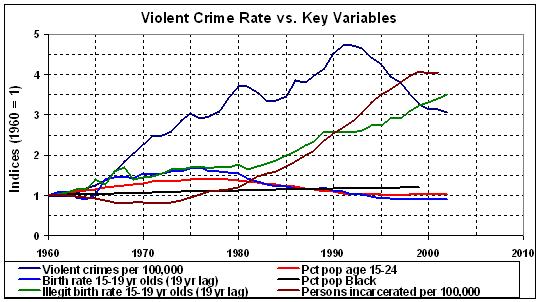
Before plunging into a regression analysis, I indexed the series to 1960 (the first year in the violent-crime series) and plotted them (again, with a 19-year lag on the birth-rate series). Here are the plots:

The relationships suggest strongly that the legalization of abortion did not have a significant effect on the rate of violent crime in the U.S. The violent-crime rate rose almost steadily from 1960 until 1991, when it peaked. The lagged rate of illegitimate births for women aged 15-19 (probably the best available proxy for “unwanted” children) leveled off about when the crime rate peaked, but the illegitimacy rate then resumed its steady rise, even as the violent-crime rate dropped dramatically. It is therefore improbable (if not impossible) that abortion — as measured by the rate of illegitimate births — had anything to do with the drop in the crime rate. Using the total rate of births for women aged 15-19 as a proxy for “unwantedness” yields even more problematic results: the lagged rate peaked in 1976, fully 15 years before the crime rate peaked.

I nevertheless ran many regressions on the violent-crime rate and various combinations of the key variables. Only one regression yields credible results (high R-squared, standard error of estimate among the lowest, intuitively correct signs on all coefficients, and high t-statistics on all coefficients). That regression takes the following form:

Number of violent crimes per 100,000 persons =
– 3723
+ 37058 x number of Blacks as a decimal fraction of the population
– 0.568 x number of persons incarcerated per 100,000 of population

The t-statistics on the intercept and coefficients are -15.854, 17.047, and -5.042, respectively; the adjusted R-squared is 0.936; the standard error of the estimate is 47.0.

The mean value of the dependent variable is 483.1, with a range of 158.1 to 758.2. The corresponding values for proportion of blacks: 0.117, 0.105, 0.125; for incarceration rate: 202.4, 93, 476.

The years represented in the regression are 1960-99 (the last year of data on Blacks as a fraction of the population).

That equation is especially compelling because both explanatory variables are statistically signficant even though they are strongly correlated (R = 0.84). Given that, and the evidence of the plots above — in which the declining crime rate is accompanied by a rising incarceration rate — two things are evident: incarceration is the key to crime reduction, and abortion has no place in the discussion of crime. What happened was that the incarceration rate finally became high enough, around 1991, to offset the countervailing influences on crime.

Incarceration follows from prosecution, which follows from investigation. I therefore stand by my earlier conclusion that “incarceration and spending on the criminal justice system . . . . are the public-policy weapons of choice” when it comes to fighting crime.

UPDATE (01/04/06): None of my regressions (not even the best one) fully accounts for the sharp decline in the violent-crime rate after 1990. That is because I did not try to model the effects of concerted efforts, since the late 1980s, to put violent offenders behind bars and to keep them there longer. The missing variable, of course, is to be found in the effectiveness of federal sentencing guidelines, which were enacted in 1987 and declared constitutional by the U.S. Supreme Court in 1989. Liberal do-gooders and their allies on the bench nevertheless persuaded the Supreme Court last year (in a pair of related cases) to find the guidelines unconstitutional and, therefore, only advisory rather than mandatory.

Given the inevitability of more lenient sentencing in many jurisdictions, I predict that the violent-crime rate will resume its long-term ascent. That ascent will mirror the continuing destruction of civil society at the hands of liberals — and those libertarians who seem unable to grasp the notion that liberty must be defended, at home and abroad.

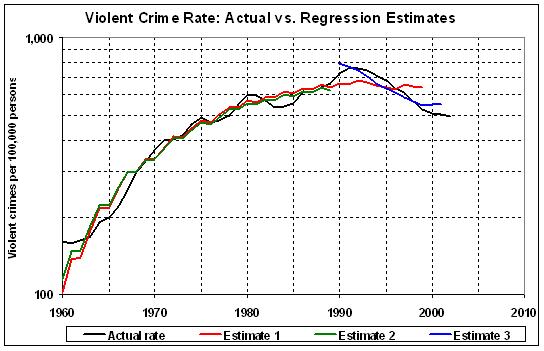
UPDATE (01/05/06): In light of the preceding update I ran separate regressions on the violent crime rate for two periods: 1960-89 and 1990-2001, 1990 being the first full year under the federal sentencing guidelines. The best regression for 1960-89 has the same two explanatory variables above. The best regression for 1990-2001 (the last year of my series on incarceration rate) has only one explanatory variable: number of persons incarcerated per 100,000 of population. The graph below gives plots of the following statistics and regression estimates:

  • actual rate of violent crimes (per 100,000 persons)
  • estimates for the original regression (estimate 1)
  • estimates for the separate regressions on 1960-89 (estimate 2) and 1990-2001 (estimate 3).

Estimate 3 further convinces me that more punishment means less crime, and that we are about to see a resurgence of violent crime because punishment has become less certain.

P.S., here are the numbers:

1. As in the original portion of the post.

2. Number of violent crimes per 100,000 persons =

– 3496
+ 34964 x number of Blacks as a decimal fraction of the population
– 0.528 x number of persons incarcerated per 100,000 of population

The t-statistics on the intercept and coefficients are -19.241, 20.544, and -2.982, respectively; the adjusted R-squared is 0.936; the standard error of the estimate is 47.0.

The mean value of the dependent variable is 419.8, with a range of 158.1 to 666.9. The corresponding values for proportion of blacks: 0.114, 0.105, 0.122; for incarceration rate: 139.6, 93, 276.

The years represented in the regression are 1960-89, as explained in this update.

3. Number of violent crimes per 100,000 persons =

1216 – 1.413 x number of persons incarcerated per 100,000 of population

The t-statistics on the intercept and coefficients are 15.976 and -7.595, respectively; the adjusted R-squared is 0.837; the standard error of the estimate is 40.4.

The mean value of the dependent variable is 645.0, with a range of 506.5 to 758.2. The corresponding values for incarceration rate: 404.5, 297, 476.

The years represented in the regression are 1990-2001, as explained in this update.

The “Black” variable drops out of #3 because it is almost constant during the relevant period. It is “working” in the background to produce a high crime rate, but the “incarceration” variable has a measurable countervailing effect on crime.

Related posts:
Does Capital Punishment Deter Homicide?
Libertarian Twaddle about the Death Penalty
Crime and Punishment
Abortion and Crime
Saving the Innocent?
Saving the Innocent?: Part II
More on Abortion and Crime
More About Crime and Punishment
More Punishment Means Less Crime: A Footnote
Clear Thinking about the Death Penalty
Let the Punishment Fit the Crime
Another Argument for the Death Penalty
Less Punishment Means More Crime
Crime, Explained

NSA "Eavesdropping": The Last Word (from Me)

I’ll begin with an op-ed by David B. Rivkin and Lee A. Casey, from yesterday’s NYT:

SHORTLY after the Sept. 11 attacks, President Bush ordered surveillance of international telephone communications by suspected members of Al Qaeda overseas, even if such calls also involved individuals within the United States. This program was adopted by direct presidential order and was subject to review every 45 days. Judicial warrants for this surveillance were neither sought nor obtained, although key members of Congress were evidently informed. The program’s existence has now become public, and howls of outrage have ensued. But in fact, the only thing outrageous about this policy is the outrage itself.

The president has the constitutional authority to acquire foreign intelligence without a warrant or any other type of judicial blessing. The courts have acknowledged this authority, and numerous administrations, both Republican and Democrat, have espoused the same view. The purpose here is not to detect crime, or to build criminal prosecutions – areas where the Fourth Amendment’s warrant requirements are applicable – but to identify and prevent armed attacks on American interests at home and abroad. The attempt, by Democrats and Republicans alike, to dismantle the president’s core constitutional power in wartime is wrongheaded and should be vigorously resisted by the administration.

After all, even the administration’s sternest critics do not deny the compelling need to collect intelligence about Al Qaeda’s plans so we can thwart future attacks. So instead of challenging the program on policy grounds, most have focused on its legal propriety, specifically Mr. Bush’s decision not to follow the framework established by the 1978 Foreign Intelligence Surveillance Act.

In an effort to control counterintelligence activities in the United States during the cold war, the surveillance act established a special court, known as the FISA court, with authority to issue wiretapping warrants. Instead of having to show that it has “probable cause” to believe criminal activity is taking place (which is required to obtain a warrant in an ordinary investigation), the government can get a warrant from the FISA court when there is probable cause to believe the target of surveillance is a foreign power or its agent.

Although the administration could have sought such warrants, it chose not to for good reasons. The procedures under the surveillance act are streamlined, but nevertheless involve a number of bureaucratic steps. Furthermore, the FISA court is not a rubber stamp and may well decline to issue warrants even when wartime necessity compels surveillance. More to the point, the surveillance act was designed for the intricate “spy versus spy” world of the cold war, where move and countermove could be counted in days and hours, rather than minutes and seconds. It was not drafted to deal with the collection of intelligence involving the enemy’s military operations in wartime, when information must be put to immediate use.

Indeed, it is highly doubtful whether individuals involved in a conflict have any “reasonable expectation of privacy” in their communications, which is the touchstone of protection under both the Fourth Amendment and the surveillance act itself – anymore than a tank commander has a reasonable expectation of privacy in his communications with his commanders on the battlefield. The same goes for noncombatants swept up in the hostilities.

Even if Congress had intended to restrict the president’s ability to obtain intelligence in such circumstances, it could not have constitutionally done so. The Constitution designates the president as commander in chief, and Congress can no more direct his exercise of that authority than he can direct Congress in the execution of its constitutional duties. As the FISA court itself noted in 2002, the president has “inherent constitutional authority to conduct warrantless foreign intelligence surveillance.”

In this instance, in addition to relying on his own inherent constitutional authority, the president can also draw upon the specific Congressional authorization “to use all necessary and appropriate force” against those responsible for the Sept. 11 attacks “in order to prevent any future attacks of international terrorism against the United States.” These words are sufficiently broad to encompass the gathering of intelligence about the enemy, its movements, its abilities and its plans, a core part of the use of force against Al Qaeda and its allies. The authorization does not say that the president can order the use of artillery, or air strikes, yet no one is arguing that therefore Mr. Bush is barred from doing so.

The fact that the statutory language does not specifically mention intelligence collection, or that this matter was not raised by the White House in negotiations with Congress, or even that the administration had sought even broader language, all points recently raised by former Senator Tom Daschle, is irrelevant.

Overall, this surveillance program is fully within the president’s legal authority, is limited in scope (involving communications to or from overseas related to the war against Al Qaeda), and is subject to stringent presidential review. The contretemps its revelation has caused reveals much more about the chattering classes’ fundamental antipathy to strong government in general, and strong executive power in particular, than it does about presidential overreaching.

The Constitution’s framers did not vest absolute power in any branch of the federal government, including the courts, but they did create a strong executive and equipped the office with sufficient authority to act energetically to defend the national interest in wartime. That is what President Bush has done, and nothing more.

David B. Rivkin and Lee A. Casey are lawyers who served in the Justice Department in the Reagan and George H. W. Bush administrations.

Now, to the Executive Vesting Clause of Article II of the Constitution:

The executive Power shall be vested in a President of the United States of America.

That short sentence carries a lot of weight. Here’s what Sai Prakash has to say about it in The Heritage Guide to the Constitution (pp. 179-82):

The [Executive Vesting Clause] . . . accords the President those foreign-affairs authorities not otherwise granted to Congress or shared with the Senate. . . .

The Articles of Confederation lacked an independent chief executive. Instead, the Continental Congress exercised the executive power, appointing and dominating the secretaries of the executive departments. Unfortunately, law execution under the direction of a distracted, plural executive was neighter vigorous nor swift. Congress likewise proved a poor steward of foreign affairs, with American diplomats complaining that Congress could not act with the requisite speed or secrecy. . . .

Resolving to avoid the problems plaguing state and national executives, the Constitution’s makers created an energetic, responsible, and unified executive. . . . The Anti-Federalists well understood the Framers’ design and criticized the unitary executive [but they lost the argument: ED] . . . .

. . . [T]he delegates [to the Constitutional Convention] spoke of the President’s principal foreign-affairs role, oftentimes referring to the Senate’s role in treaty-making as a limited exception to the grant of foreign-affairs authority to the President. . . .

. . . [T]raditional rules of statutory interpretation require us to take seriously the differences in phrasing across the three vesting clauses. Artilce I, Section 1 (“All legislative Powers herein granted shall be vested in a Congress of the United States. . . .”) makes clear that it vests no authorities separate from those enumerated in the rest of Article I. In contrast, Article III, Section 1 (“The judicial Power of the United States, shall be vested in one supreme Court, and in such inferior Courts as the Congress may . . . establish.”) clearly vests the federal courts with judicial authority. The Executive Vesting Clause reads like its Article III counterpart, in sharp contrast to the Article I introductory clause. . . .

In a case touching upon foreign affairs, the judiciary has recently reaffired that the executive power grants foreign-affairs authority to the President. See American Insurance Ass’n v. Garamendi (2003). This marks a departure from prior case law, which had grounded the executive’s foreign-affairs powers not in any constitutional text, but in necessity and sovereignty. See United States v. Curtiss-Wright Export Corp. (1936).

John Yoo and James C. Ho, writing in the same volume about the president’s role as commander in chief (pp. 195-8), have this to say:

. . .[S]ome originalist scholars have concluded that Congress’s war power is limited to its control over funding and its power to impeach executive officers. They contend that the President is constitutionally empowered to engage in hostilities with whatever resources Congress has made available to the executive. . . .

In summary, the argument for executive initiative rests on the background understanding that the vesting of “executive Power” and the “Commander in Chief” designation together constitute a substantive grant of authority to the President to conduct military operations.

It is clear that it is fully within the president’s constitutional authority to order electronic surveillance of communications between persons in the U.S. and persons overseas. It is especially that such surveillance is legitimate because of its war-related purpose. The interception of communications by U.S. citizens is merely incidental to that purpose.

The Framers intended the executive to be a passive enforcer of laws passed by Congress that bear on domestic affairs (and those laws were to be strictly limited in scope). At the same time, the Framers intended the executive to defend Americans actively against enemies foreign and domestic. Those who cavil at such things as the NSA’s surveillance of international communications would have it the other way around: They prefer a domestic dictator of social and economic outcomes (as in FDR and LBJ) who is, at the same time, content to leave America exposed to its enemies. Neither FDR nor LBJ were content to leave America exposed to its enemies, but their Democrat Party is not today’s Democrat Party.

Related post: The Constitution and Warrantless “Eavesdropping” (with many links therein)

The Bill of Rights, Updated

You probably once knew (and have since forgotten) that there were 12 amendments in Bill of Rights, as originally proposed. Here’s the story, in brief:

On September 25, 1789, the First Congress of the United States . . . proposed to the state legislatures 12 amendments to the Constitution that met arguments most frequently advanced against it. The first two proposed amendments, which concerned the number of constituents for each Representative and the compensation of Congressmen, were not ratified. Articles 3 to 12, however, ratified by three-fourths of the state legislatures, constitute the first 10 amendments of the Constitution, known as the Bill of Rights.

Lo and behold, the Bill of Rights actually comprises 11 amendments — not 10, but 11. How’s that? The original Second Amendment was ratified 13 years ago:

AMENDMENT XXVII

Originally proposed Sept. 25, 1789. Ratified May 7, 1992.

No law, varying the compensation for the services of the Senators and Representatives, shall take effect, until an election of representatives shall have intervened.

That’ll help you sleep better at night, no?

The Constitution and Warrantless "Eavesdropping"

FOUR LINKS ADDED, 12/22/05
ONE LINK ADDED, 12/23/05
ONE LINK ADDED, 12/24/05
TWO LINKS ADDED, 12/28/05

. . . no Warrants shall issue, but upon probable cause, supported by Oath or affirmation, and particularly describing the place to be searched, and the persons or things to be seized. (Amendment IV, Constitution of the United States)

Apropos the flap about NSA intercepts of international phone calls, there’s this from Prof. William J. Stuntz of Harvard Law:

. . . When the Fourth Amendment was written, the sole remedy for an illegal search or seizure was a lawsuit for money damages. Government officials used warrants as a defense against such lawsuits. Today a warrant seems the police officer’s foe — one more hoop to jump through — but at the time of the Founding it was the constable’s friend, a legal defense against any subsequent claim. Thus it was perfectly reasonable to specify limits on warrants (probable cause, particular description of the places to be search and the things to be seized) but never to require their use. (From the “Warrant Clause” article in The Heritage Guide to the Constitution, pp. 326-9.)

Thus, by the original meaning of the Constitution, all warrantless searches may be permissible. Judges and legislators have so changed the meaning of the Constitution that, instead, these views are prevalent: government cannot conduct searches without a warrant; warrantless searches are “invasions of privacy.” Moreover, there is — especially among “civil libertarians,” anti-American Americans, and right-wing loonies — a preference for an undifferentiated right to “privacy” (which is not guaranteed by the Constitution) over “the common defence” (to provide for which the Constitution was adopted). Antidotes to such views may be found here:

President had legal authority to OK taps
(Chicago Tribune)
Our domestic intelligence crisis (Richard A. Posner)
Several posts by Tom Smith of The Right Coast (start here and scroll up)
Eavesdropping Ins and Outs (Mark R. Levin, writing at National Review Online)
The FISA Act And The Definition Of ‘US Persons’ (Ed Morrissey of Captain’s Quarters)
A Colloquy with the Times (John Hinderaker of Power Line)
September 10 America (editorial at National Review Online)
A Patriot Acts (Ben Stein, writing at The American Spectator)
More on the NSA Wiretaps (Dale Franks of QandO)
The President’s War Power Includes Surveillance (John Eastman, writing at The Remedy)
Warrantless Intelligence Gathering, Redux (UPDATED) (Jeff Goldstein, writing at Protein Wisdom)
FISA Court Obstructionism Since 9/11 (Ed Morrissey of Captain’s Quarters)
FISA vs. the Constitution (Robert F. Turner, writing at OpinionJournal)

Related posts:

War, Self-Defense, and Civil Liberties (a collection of posts)
Prof. Bainbridge Flunks (11/15/05)
Prof. Bainbridge and the War on Terror (12/18/05)

A False Dichotomy

Timothy Sandefur ends an insightful review of the chief justiceship of William Rehnquist on this note:

American constitutional law is caught in a bind between those who believe that individuals derive their significance and their rights from the permissions of the majority, and those who believe that people have certain inalienable rights which government exists to respect.

Sandefur and I once clashed over the origin and essence of rights. I later published (here) my case for a consequentialist view of rights. In brief, Sandefur’s dichotomy is false because he resorts to the concept of inalienable rights.

The rights that we actually enjoy do derive from “the permissions of the majority” or, more accurately, from the permissions of the state, which may or not reflect the views of the majority. The rights that we should enjoy are not inalienable; that is, they are not in our genes, in our character, or gifts from heaven. The rights that we should enjoy are the rights that would make everyone better off if they were honored — everyone but predators and parasites, that is. It is that latter set of rights which the Founders and Framers sought, through war and politics, to deliver via the American state. The rights that we actually enjoy, however, are not the rights envisioned by the Founders and Framers because most Americans — not understanding the consequences of their actions — have sold those rights to the state in return for a false sense of security.

Great Minds and the Constitution

Bill Niskanen, chairman of Cato Institute, comments at Cato Unbound about Nobel laureate James Buchanan’s proposed amendments to the Constitution. Niskanen’s view, like mine, is that Prof. Buchanan’s proposal doesn’t go far enough. Specifically, Niskanen proposes a nullification amendment and a secession amendment. My very own rewrite of the Constitution happens to include such provisions:

Delegations of the States shall convene every four years for the purpose of considering revisions to and revocations of acts of Congress and/or holdings of the Supreme Court of the United States of America. Such conventions (hereinafter “convention of the States”) may revise and/or revoke any act or acts and/or any holding or holdings, in the sole discretion of a majority of State delegations present and voting. . . . (from Article VII)

* * *

Each State retains the right to secede from this Union, but secession must in each case be approved by three-fourths of the members of each house of a State’s legislature and ratified within thirty days by the executive of the State. At least one year must intervene between the ratification of an act of secession and its execution, during which time the act of secession may be nullified by a majority of the total number of legislators of a State. Revocation does not require ratification by the State’s executive. (Article VI, Section C.2)

Niskanen doubts the effectiveness of a secession amendment. I don’t. The prospective secession of a large number of Red States — which contain a disproportionate share of costly-to-replace military installations — might get the attention of those Blue Staters who understand the virtue of “the common defence.”