The Beginning of the End?

In a piece I cite here, columnist Jack Wheeler predicts that “The dark chapter of America’s peculiar institution of abortion is coming to an end.” Perhaps it is. Consider this story, from AP via Yahoo! News:

Congress Helps Providers Refuse Abortions

Sun Nov 21, 8:25 AM ET

Politics – U. S. Congress

WASHINGTON – Congress made it a little easier for hospitals, insurers and others to refuse to provide or cover abortions. A provision in a $388 billion spending bill passed by the House and Senate on Saturday would block any of the measure’s money from going to federal, state or local agencies that act against health care providers and insurers because they don’t provide abortions, make abortion referrals or cover them.

“This policy simply states that health care entities should not be forced to provide elective abortions, a practice to which a majority of health care providers object and which they will not perform as a matter of conscience,” said Rep. David Weldon, R-Fla., a doctor who sponsored the language.

Weldon said his measure was simply a refinement of decades-old restrictions against federal aid for most abortions. “This provision is meant to protect health care entities from discrimination because they choose not to provide abortion services,” he said.

But Democrats complained that the provision was slipped into the voluminous year-end spending bill without debate or discussion in the Senate or the House.

“Now any business entity can decide to tell doctors working for it they can’t give information to women about their right to choose,” said Sen. Barbara Boxer (news, bio, voting record), D-Calif.

Many clinics and other providers, in exchange for federal funds, are required to at least tell pregnant women who do not wish to have a child that abortion is among their options. Weldon’s language would make it more difficult to enforce that, opponents said.

“The Weldon amendment is essentially a domestic gag rule, restricting access to abortion counseling, referral and information,” said House Democratic leader Nancy Pelosi of California. “Health care companies should not be able to prevent doctors from giving medically necessary information.”…

Well, boo hoo, Ms. Boxer and Ms. Pelosi, but private businesses most certainly can tell their employees what constitutes acceptable, job-related speech. You may be able to say anything in the halls of Congress, but you can’t go to work for, say, an airline and expect to keep your job if you publish an article in which you advise travelers to fly with a different airline. The pending law merely nudges a traditional employer-employee relationship toward its proper state.

If a doctor doesn’t like it that his employer forbids him to discuss abortion as an option, the doctor can find an amenable employer or set up his own practice. Isn’t that the American way?

In any event, the pending law also signals another positive change. It breaks a link between federal funding and federal interference in the operations of state and local governments and businesses. It’s a small step, but it’s in the right direction.

Is It Time to Abolish the Electoral College?

Bush won 30 States and 271 electoral votes in 2000, while winning a minority of the two-party popular vote. For that fact, Republicans have been blessing the Electoral College.

Although Bush did better in 2004 — winning 31 States and 286 electoral votes — Republicans can see how Bush might nevertheless have lost, even while “winning” by more than 3 million popular votes. Kerry could have walked off with an electoral-vote victory simply (?) by rolling up another few hundred thousand popular votes in the right places: Ohio, by itself, or Colorado, Iowa, and New Mexico, altogether.

In sum, Kerry came fairly close to trumping Bush’s feat of four years earlier. But before Republicans panic and jump on the bandwagon to abolish the Electoral College, they should consider two reasons for keeping it.

The most obvious, and oft-cited, reason is that the existence of the College narrows the scope for decisive electoral fraud to those “battleground” States whose electoral votes might tip the balance in a close election. Deciding presidential elections by the popular-vote count is an invitation to fraud in every precinct in the land.

A less obvious, but — to me — equally compelling reason is that the abolition of the College would encourage more voters to vote. Think of all those abstaining Republicans in places like Massachusetts and New York and all those abstaining Democrats in places like Texas and Utah. Why do they abstain? Because they know that their votes won’t make a difference. Many of the abstainers would vote if they thought their votes might affect the outcome. But the act of voting might also lead them to expect something in return from the federal government: prayer in public schools, less gun control, more gun control, a ban on gay marriage, support of gay marriage, and on and on. In other words, they would swell the ranks of those who have a stake in the centralization of political power. That’s the last thing we need.

Contain electoral fraud, contain mobocracy — retain the Electoral College.

A Victory of Sorts

AP reports, via Yahoo! News:

The Illinois Supreme Court threw out two lawsuits accusing gunmakers of knowingly letting weapons fall into the hands of gang members and other criminals, ruling Thursday that the manufacturers cannot legally be blamed for street violence.

Both rulings were unanimous, but five of the seven justices were so disturbed by allegations raised in the case that they wrote a separate opinion urging the Legislature to create tougher gun regulations….

Chicago’s lawsuit cited a sting in which undercover officers bought guns at suburban shops even after plainly telling the sellers that they were gang members, buying them for gang members, or taking them to Chicago, where handguns are banned.

“Allegations about defendants’ conduct, if true, suggest that defendants were not only aware that their products were used by third parties for criminal acts, but the defendants affirmatively sought to increase their profit by pandering to that market,” the five justices said in their concurring, separate opinion…

Okay, gun manufacturers have no liability for crimes committed with guns. That’s the good news.

But why can’t gun sellers be charged with criminal conduct for knowingly selling guns that will be used for criminal purposes? Seems simple to me. What’s the catch?

PETA, NARAL, and Roe v. Wade

Hypothesis: Members of PETA tend to hold NARAL-like views about abortion. If that’s true, then those who profess to abhor almost any harm to animals — even if the harm feeds humans or benefits medical science — also tend to favor an almost-unbridled (perhaps totally unbridled) right to kill a living human fetus. In other words, I suspect that animals are more important than human fetuses in world of the fashionably left, as epitomized by PETA.

All of which is another way of saying that pro-abortion extremists have captured the moral low ground in the battle over abortion rights. As Jack Wheeler explains, in a piece at WorldNetDaily about “The beginning of the end of abortion“,

…Confederate Southerners held many decent values – but on slavery they were morally wrong. No relativistic morals here, no “that’s just your opinion” situational ethics, no wiggles, hesitations or qualifiers. Slavery is immoral, period – even the LibDems agree.

Thus the teachable moment – for abortion is morally no different than slavery, the claim that one human being may own another as personal property to be disposed of if the owner so chooses.

Thus we need to refer to abortion as “the peculiar institution,” and Roe v. Wade as disgracefully unconstitutional as Dred Scott. Watch for this to happen. Watch for abortion advocates to be increasingly on the defensive as they are made to understand the moral equivalence between abortion and slavery….

If you’re wondering how a libertarian can be against abortion, read here, here, and here.

How About Mandatory Corporal Punishment?

I have written before about mandatory mental screening, which still looms as a threat to replace parenting with something like state-sponsored thought control. Here’s the issue, according to a report at NewsMax:

By way of background: in April 2002, President George W. Bush created the New Freedom Commission on Mental Health. Its objective was to enhance mental health services to those in need.

Among other things, the commission concluded that there is a need to search for mental disorders – especially in children – and the best way to do this was with mandatory mental health screening for everyone, starting with preschoolers.

According to the Commission’s 2003 report: “Quality screening and early intervention should occur in readily accessible, low-stigma settings, such as primary health care facilities and schools.”

The report goes on to say: “…the extent, severity, and far-reaching consequences make it imperative that our Nation adopt a comprehensive, systemic approach to improving the mental health status of children.”

However, critics of the plan suggest that the random testing of millions of people makes little sense to anyone but the drug companies that will stand to profit from the potential customers.

The New Freedom Commission’s proposed treatment programs are based on the Texas Medication Algorithm Project (TMAP). TMAP, which was first used in Texas in 1996 and has since expanded to other states, is a set of very specific medication recommendations – most of them new, expensive, psychotropic drugs.

Despite the criticisms, the White House has remained solid behind the testing initiative, noting that the commission found that schools are in a “key position” to influence the phenomena of young children being “expelled from preschools and childcare facilities for severely disruptive behaviors and emotional disorders.”

But detractors are just as adamant that “problem” children in schools are readily identifiable, making the universal testing an unnecessary tool that does nothing but infringe on a parent’s right to make decisions regarding their child’s welfare.

Yes, and what many “problem” children need is a good swat or two, not a pill. Simplistic? Somewhat, perhaps, but there were far fewer problem children (and problem adults) in the days when giving a kid good swat or two wouldn’t land the swatter in jail.

(Thanks to my daugher-in-law for the tip.)

The Case for Devolved Government

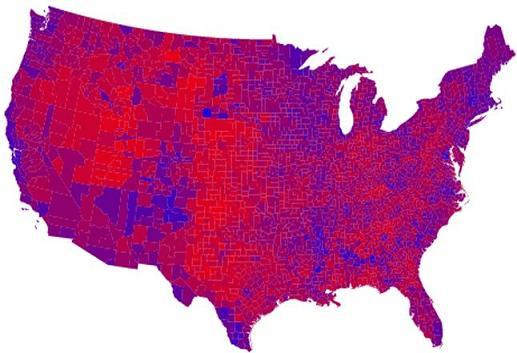
Libertarian purists argue that government should have almost no power. Libertarian pragmatists argue that government power should be devolved to the lowest practical level. The pragmatists case is the better one, given that the urge to regulate social and economic practices is especially strong where people (and votes) are concentrated. Consider the following graphics:


Shades of purple indicate the spectrum of election preferences within counties. The deeper the shade of purple the higher the proportion of votes cast for Kerry.


Counties shaded pink, red, and purple have the highest population density.

Comes as no surprise does it? Nor does it matter if the urban-rural split reflects a difference in “values” or traditions. A fact is a fact. City dwellers prefer more government because they “need” more; country folk feel less “need” for government because they don’t rub up against each other as much as city dwellers.

Thus the ultimate argument for devolution: Push government functions to the lowest practical level and allow citizens to express their preferences by voting with their feet.

(Thanks to Patrick Cox at Tech Central Station for the maps.)

A Pleasant Surprise

From Reuters, via Yahoo! News:

U.S. Justice Allows Challengers at Ohio Polls

By James Vicini

WASHINGTON (Reuters) – U.S. Supreme Court Justice John Paul Stevens (news – web sites) Tuesday allowed Republicans to challenge voter qualifications at the polls in Ohio, a key battleground state that could determine the presidential election.

Stevens acted on an emergency request shortly before polls opened in Ohio and across the nation. He refused to set aside a U.S. appeals court order that allowed political parties to send challengers to polling places across the state….

Social Security is Unconstitutional

I’m breaking away from election-related posting to touch briefly on a subject close to my heart: the unconstitutionality of Social Security. The Social Security Administration tells us this:

Three Social Security cases made their way to the Supreme Court during its October 1936 term. One challenged the old-age insurance program (Helvering vs. Davis) and two challenged the unemployment compensation program of the Social Security Act. The Court would issue rulings on all three on the same day.

Helvering vs. Davis:

George P. Davis was a minor stockholder in the Edison Electric Illuminating Company. Edison, like every industrial employer in the nation, was readying itself to start paying the employers’ share of the payroll tax in January 1937. Mr. Davis objected to this arguing that by making this expenditure Edison was robbing him of part of his equity, so he sued Edison to prevent their compliance with the Social Security Act. The government intervened on Edison’s behalf and the Commissioner of the IRS (Mr. Helvering) took on the lawsuit.

The attorneys for Davis argued that the payroll tax was a new type of tax not listed in the Constitution’s tally of taxes, and so it was unconstitutional. At one point they even introduced into their argument the definitions of “taxes” from dictionaries in 1788 (the year before the Constitution was ratified) to prove how earnest they were in the belief that powers not explicitly granted in 1789 could not be created in 1935. Davis was also of the view that providing for the general welfare of the aged was a power reserved to the states. The government argued that this was too inflexible an interpretation of the powers granted to Congress, and (loosely) that if the country could not expand the interpretation of the Constitution as it stood in 1789 progress would be impossible and it would still be 1789.

Steward Machine Company:

In the Steward Machine Company case the unemployment compensation provisions of the Act were disputed. The Company dutifully paid its first unemployment tax installment ($46.14) and then sued the government to recover the payment, claiming the Social Security Act was unconstitutional. Steward made the same as points as Davis about the meaning of the word “tax,” and argued in addition that the unemployment compensation program could not qualify as “providing for the general welfare.”

Carmichael vs. Southern Coal & Coke Co. and Gulf States Paper:

This was also a case disputing the validity of the unemployment compensation program. In this variation the companies were challenging the state portion of the federal/state arrangement. Unwilling to pay their share of state unemployment compensation taxes the two companies sued the state of Alabama declaring that it was the Social Security Act, which they deemed unconstitutional, that gave Alabama its authority to tax them in this way and since they believed the Act to be invalid, they did not have to pay the tax. Alabama differed. It was again the same issues as in the two prior cases.

Mr. Justice Cardozo for the Court-

On May 24, 1937 the Supreme Court handed down its decision in the three cases. Justice Cardozo wrote the majority opinion in the first two cases….

Mirroring the situation in Congress when the legislation was considered, the old-age insurance program met relatively little disagreement. The Court ruled 7 to 2 in support of the old-age insurance program. And even though two Justices disagreed with the decision, no separate dissents were authored. The unemployment compensation provisions, by contrast, were hotly disputed within the Court, just as they had been the focus of most of the debate in Congress. The Court ruled 5 to 4 in support of the unemployment compensation provisions, and three of the Justices felt compelled to author separate dissents in the Steward Machine case and one Justice did so in the Southern Coal & Coke case.

Justice Cardozo wrote the opinions in Helvering vs. Davis and Steward Machine. After giving the 1788 dictionary the consideration he thought it deserved, he made clear the Court’s view on the scope of the government’s spending authority: “There have been statesman in our history who have stood for other views. . .We will not resurrect the contest. It is now settled by decision. The conception of the spending power advocated by Hamilton . . .has prevailed over that of Madison. . .” Arguing that the unemployment compensation program provided for the general welfare, Cardozo observed: “. . .there is need to remind ourselves of facts as to the problem of unemployment that are now matters of common knowledge. . .the roll of the unemployed, itself formidable enough, was only a partial roll of the destitute or needy. The fact developed quickly that the states were unable to give the requisite relief. The problem had become national in area and dimensions. There was need of help from the nation if the people were not to starve. It is too late today for the argument to be heard with tolerance that in a crisis so extreme the use of the moneys of the nation to relieve the unemployed and their dependents is a use for any purpose [other] than the promotion of the general welfare.”

And finally, he extended the reasoning to the old-age insurance program: “The purge of nation-wide calamity that began in 1929 has taught us many lessons. . . Spreading from state to state, unemployment is an ill not particular but general, which may be checked, if Congress so determines, by the resources of the nation. . . But the ill is all one or at least not greatly different whether men are thrown out of work because there is no longer work to do or because the disabilities of age make them incapable of doing it. Rescue becomes necessary irrespective of the cause. The hope behind this statute is to save men and women from the rigors of the poor house as well as from the haunting fear that such a lot awaits them when journey’s end is near.”

With these cases decided, Justice Stone could then dispose of the third case in short order. “Together the two statutes now before us embody a cooperative legislative effort by state and national governments, for carrying out a public purpose common to both, which neither could fully achieve without the cooperation of the other. The Constitution does not prohibit such cooperation.”….

It is no coincidence that the Supreme Court reversed its record of opposition to the New Deal when faced with the certainty that Congress would approve Roosevelt’s court-packing plan and dilute the authority of the sitting justices. As SSA tells it:

Despite the intense controversy the court-packing plan provoked, and the divided loyalties it produced even among the President’s supporters, the legislation appeared headed for passage, when the Court itself made a sudden shift that took the wind out of the President’s sails. In March 1937, in a pivotal case, Justice Roberts unexpectedly changed his allegiance from the conservatives to the liberals, shifting the balance on the Court from 5-4 against to 5-4 in favor of most New Deal legislation. In the March case Justice Roberts voted to uphold a minimum wage law in Washington state just like the one he had earlier found to be unconstitutional in New York state. Two weeks later he voted to uphold the National Labor Relations Act, and in May he voted to uphold the Social Security Act. This sudden change in the Court’s center of gravity meant that the pressure on the New Deal’s supporters lessened and they felt free to oppose the President’s plan. This sudden switch by Justice Roberts was forever after referred to as “the switch in time that saved nine.”

In the end, the Court decided wrongly to legalize Social Security by invoking Hamilton’s supposedly looser view of the powers vested in Congress, and by improperly interpreting the “general welfare” clause.

Madison — the “Father of the Constitution” — had this to say about the general welfare in Federalist No. 41:

Some who have denied the necessity of the power of taxation [to the Federal government] have grounded a very fierce attack against the Constitution, on the language on which it is defined. It has been urged and echoed that the power to “lay and collect taxes, duties, imposts, and excises, to pay the debts, and provide for the common defense and general welfare of the United States” amounts to an unlimited commission to exercise every power which may be alleged to be necessary for the common defense or general welfare. No stronger proof could be given of the distress under which these writers labor for objections, than their stooping to such a misconstruction….

For what purpose could the enumeration of particular powers be inserted, if these and all others were meant to be included in the preceding general power? Nothing is more natural or more common than first to use a general phrase, and then to explain and qualify by an enumeration of the particulars. But the idea of an enumeration of particulars which neither explain nor qualify the general meaning, and can have no other effect than to confound and mislead, is an absurdity … what would have been thought of that assembly, if, attaching themselves to these general expressions and disregarding the specifications which limit their import, they had exercised an unlimited power of providing for the general welfare?…[quoted in testimony before Congress]

Was Hamilton of a different mind? Apparently not:

The Federalist Papers are one of our soundest guides to what the Constitution actually means. And in No. 84, Alexander Hamilton indirectly confirmed Madison’s point.

Hamilton argued that a bill of rights, which many were clamoring for, would be not only “unnecessary,” but “dangerous.” Since the federal government was given only a few specific powers, there was no need to add prohibitions: it was implicitly prohibited by the listed powers. If a proposed law — a relief act, for instance — wasn’t covered by any of these powers, it was ipso facto unconstitutional.

Adding a bill of rights, said Hamilton, would only confuse matters. It would imply, in many people’s minds, that the federal government was entitled to do anything it wasn’t positively forbidden to do, whereas the principle of the Constitution was that the federal government is forbidden to do anything it isn’t positively authorized to do.

Hamilton too posed some rhetorical questions: “For why declare that things shall not be done which there is no power to do? Why, for instance, should it be said, that the liberty of the press shall not be restrained when no power is given by which restrictions may be imposed?” Such a provision “would furnish, to men disposed to usurp, a plausible pretence for claiming that power” — that is, a power to regulate the press, short of actually shutting it down.

We now suffer from the sort of confusion Hamilton foresaw. But what interests me about his argument, for today’s purpose, is that he implicitly agreed with Madison about the narrow meaning of “general welfare.”

After all, if the phrase covered every power the federal government might choose to claim under it, the “general welfare” might be invoked to justify government control of the press for the sake of national security in time of war. For that matter, press control might be justified under “common defense.” Come to think of it, the broad reading of “general welfare” would logically include “common defense,” and to speak of “the common defense and general welfare of the United States” would be superfluous, since defense is presumably essential to the general welfare.

So Madison, Hamilton, and — more important — the people they were trying to persuade agreed: the Constitution conferred only a few specific powers on the federal government, all others being denied to it (as the Tenth Amendment would make plain).

Now we are embarked on a great mission to undo what Congress did so wrongly almost 70 years ago. The first step is to privatize Social Security. The next step is to abolish it. The ultimate step is to abolish Medicare and Medicaid. But one step at a time…as my father always said.

Restore Free Speech

The L.A. Times reports:

Stung by a radio campaign to oust veteran Rep. David Dreier, the National Republican Congressional Committee has filed a federal elections complaint. It contends that an ongoing campaign by a pair of radio talk-show hosts represents an illegal contribution to Dreier’s opponent.

That’s the Incumbent Protection Act — also known as the Bipartisan Campaign Reform Act (BCRA) — in action.

The Illogic of Helmet Laws

Liberals love laws that require bicyclists and motorcyclists to wear safety helmets. The usual reasons:

1. Taxpayers defray the cost of emergency services that go to the scene of accidents.

2. The failure to use helmets results in higher health-care costs and, thus, higher health-insurance premiums.

Proposition number 1 isn’t universally true. But even if it were, so what? Accidents aren’t caused by the use or non-use of helmets. Almost any accident involving a bicyclist or motorcyclist will require emergency services, whether or not the rider incurs a head injury.

Proposition number 2 overlooks the fact that non-helmeted riders are less likely to require prolonged, expensive care — because they’re likely to die more quickly than helmeted riders.

That brings us to the real proposition — number 3: Bicyclists and motorcyclists should wear helmets for their own good. The insistence on helmet laws is simply another liberal pretext for telling others how to lead their lives.

Here’s a deal for helmet-loving liberals. If you’re a bicyclist (likely) or motorcyclist (unlikely), you can wear a helmet if you want to. In return, non-liberal bicyclists and motorcyclists will agree that you don’t have to sport an American flag on your helmet.

The Washington Post’s Idea of Balance

From a WashPost story about 527s:

…Named after a section of the tax code, the 527 groups are doing much of the advertising and field work traditionally left to party organizations….

Until recently, virtually all the money going to 527s went to Democratic groups. But in the last few months, Republicans have balanced the equation, collecting $1 out of every $3 raised….

So, Republican-oriented groups are collecting one-third of the money going to 527s and that’s balanced? I guess that’s as much balance as the Post can stand.

Of course, whoever’s money it is doesn’t matter to me. The real issue is freedom of speech, and 527s are a convenient way of ensuring that it’s not completely quashed when it comes to elections. But the incumbents in Washington will keep trying to find a way to quash it completely. “Money in politics” scares them because it can be used against them.

I Know What Some of You Are Thinking…

…about this story:

Court: Terror Fears Can’t Curb ‘Liberty’

Sat Oct 16, 7:06 PM ET

By C.G. WALLACE, Associated Press Writer

ATLANTA – Fear of a terrorist attack is not sufficient reason for authorities to search people at a protest, a federal appeals court has ruled, saying Sept. 11 “cannot be the day liberty perished.”

A three-judge panel of the 11th U.S. Circuit Court of Appeals (news – web sites) ruled unanimously Friday that protesters may not be required to pass through metal detectors when they gather next month for a rally against a U.S. training academy for Latin American soldiers.

Authorities began using the metal detectors at the annual School of the Americas protest after the 2001 terrorist attacks, but the court found that practice to be unconstitutional….

But it’s not nice to say it in a blog. Curb your enthusiasm.

Due Process of Law

Jeff Jarvis asks “Would you go to jail for your weblog?” It’s a long post about the case of Judith Miller of The New York Times, who’s been jailed for contempt in her refusal to name sources in the Valerie Plame case. Jarvis wants to make Miller’s plight into a First Amendment case. It’s not that at all, as I said in my comment to Jarvis’s post:

There’s no freedom of speech or freedom of the press issue here. What’s at stake is due process of law, and that’s what Miller and her ilk are trying to subvert.

Someone — presumably a government official — may have committed a crime. The press has no right to thwart the investigation of a crime.

Libertarian Twaddle about the Death Penalty

In the middle of a post about the Supreme Court’s consideration of the death penalty for juveniles, McQ at QandO says:

…I am against the death penalty, have been for years. Yes I know all the arguments for to include the emotional ones. I simply don’t accept them as valid. My objection is based in man’s right to life, and unlike Jon, I feel it is inherent (man qua man) and therefore inviolable by all, to include the state. In essence I believe the state does to the murderer precisely that for which it is punishing the murderer….

By that logic, we shouldn’t have armed forces and use them to kill our enemies. As I have said:

…I don’t care whether or not capital punishment deters homicide. [Though it does, as the post explains.] Capital punishment is the capstone of a system of justice that used to work quite well in this country because it was certain and harsh. There must be a hierarchy of certain penalties for crime, and that hierarchy must culminate in the ultimate penalty if criminals and potential criminals are to believe that crime will be punished. When punishment is made less severe and less certain — as it was for a long time after World War II — crime flourishes and law-abiding citizens become less secure in their lives and property.

The state doesn’t do to the murderer that for which it is punishing the murderer. It does to the murderer that which the murderer shouldn’t have done, as a lesson to other would-be murderers, and as a way of ensuring that that murderer won’t murder again. Similarly, the state deprives other criminals of freedom (but not life) for doing what they shouldn’t have done, and as a way of keeping them away from the rest of us for a while. Or does McQ object to depriving criminals of their freedom? After all, freedom is right up there with the right to life in the pantheon of libertarian values. Oh, and what about abortion?

Related posts:
Does Capital Punishment Deter Homicide?
Crime and Punishment
Abortion and Crime
Saving the Innocent?
Saving the Innocent?: Part II
More on Abortion and Crime
More Punishment Means Less Crime
More About Crime and Punishment
More Punishment Means Less Crime: A Footnote
Clear Thinking about the Death Penalty
Let the Punishment Fit the Crime
Another Argument for the Death Penalty
Less Punishment Means More Crime
Crime, Explained

Arrgh, I Hate Being Right All the Time

Just a month ago I posted this:

Time to Regulate the Blogosphere?

That thought must have crossed the minds of some highly placed Democrat sympathizers in the “mainstream” media when the blogosphere started shredding the threadbare remnants of Dan Rather’s reputation for honest reporting. But the blogosphere is protected by the First Amendment, isn’t it?

There’s stark evidence that the blogosphere can be regulated, if the feds want to do it. Look at the airwaves, which the feds seized long ago, and which the feds censor by intimidation. Look at the ever-tightening federal control of political speech, which has brought us to McCain-Feingold. It’s all in the name of protecting us, of course….

Well, today Vodkapundit points to this AP story at myway:

FEC May Regulate Web Political Activity

Oct 13, 7:55 AM (ET)

By SHARON THEIMER

WASHINGTON (AP) – With political fund raising, campaign advertising and organizing taking place in full swing over the Internet, it may just be a matter of time before the Federal Election Commission joins the action. Well, that time may be now.

A recent federal court ruling says the FEC must extend some of the nation’s new campaign finance and spending limits to political activity on the Internet.

Long reluctant to step into online political activity, the agency is considering whether to appeal.

But vice chairwoman Ellen Weintraub said the Internet may prove to be an unavoidable area for the six-member commission, regardless of what happens with the ruling.

“I don’t think anybody here wants to impede the free flow of information over the Internet,” Weintraub said. “The question then is, where do you draw the line?”…

Hey, Ms. Weintraub, you’ll have to pry my blog out of my cold, dead hands.

Favorite Posts: Academic Freedom and Freedom of Speech

Score One for Justice

While the Supreme Court hears arguments about the death penalty for teen killers, Ohio dispatches one (from AP via Yahoo! News):

A teen killer who told the parole board that he regretted letting eyewitnesses survive was executed Wednesday for a shotgun murder during a $15 robbery.

And good riddance.

No One Should Be above the Law — Not Even a Reporter

This will invoke a lot of whining about “freedom of the press” and “chilling effects,” but “due process of law” won’t get a mention:

Judge Holds Reporter in Contempt in Leak Probe

WASHINGTON (Reuters) – A federal judge held a New York Times reporter in contempt on Thursday for refusing to testify in the investigation of whether the Bush administration illegally leaked a covert CIA officer’s name to the media….

The emphasis is mine, all mine.

It’s Called Freedom of Speech

But it’s too much for a university professor to handle, accustomed as he must be to the cozy confines of academic speech codes. I’m thinking of the University of Utah’s David Hailey, whose ill-begotten effort to salvage the Rathergate memos was thoroughly debunked by Paul at Wizbang. Paul’s posts triggered an avalanche of ridicule and e-mail abuse aimed at Hailey. Wired carries a somewhat balanced story by Staci D. Kramer about the whole business:

David Hailey says he didn’t know much about blogs before he flipped on his office computer one late September morning and watched hate mail flood into his inbox.

Author of a report (.pdf) claiming that the controversial CBS News Texas Air National Guard memos could have been produced on a typewriter, the Utah State University associate professor of technical communications didn’t know he had become fodder for vigilant political blogs and discussion boards. To liberals, the report was proof that CBS was in the clear — making it another claim for conservatives to debunk.

But the debunking quickly turned into name-calling, with a guest blogger at Wizbang, a conservative political blog, leading his detailed critique with the since-retracted accusation that Hailey was a “liar, fraud and charlatan.” It escalated as Hailey updated what he calls a work in progress and his critics declared a cover-up.

The result was what Howard Rheingold, author of Smart Mobs: The Next Social Revolution, calls “a semi-organized swarming.” It is but one of a spate of recent incidents that underscores the power of a rapidly mobilized group online to accomplish a goal — and the potential for harm when online mobs form [like Democrats beating up Republicans at rallies, destroying lawn signs, and damaging Republican offices — only not as bad.]….

“For political figures, it’s fair game,” said Rheingold. “For people expressing political opinions, it’s scary. If some researcher does something you don’t agree with and you go after him personally, that’s scary.”…

At first, Hailey thought it was funny that his type-matching exercise ticked people off enough for them to write. By the second day, he was far from amused. By the end of the week, the tenured academic literally cried in relief when university officials called him to a meeting to express their support; many of them had received numerous e-mails demanding his dismissal and calling him a liar or a fraud [not surprising, given the sloppiness of Hailey’s work].

“It’s one thing to go to a university and point out that there are these problems,” Hailey said. “It’s another thing to start character assassination.”

Wizbang owner Kevin Aylward says that was never the intention but admits the language used in postings got out of hand.

“People are trying to make this into ‘we’re out to get him,'” Aylward said. “We were out to discredit the report.”

The guest blogger on Wizbang was spurred by a post on another blog suggesting that the Boston Globe was working on a story; the thread is called “Fact Checking the Boston Globe in Advance.”

Aylward apologized for the name-calling, which he retracted from his guest blogger’s post.

“It was a bad idea to use those words, they didn’t further the story. They were opinion, not news.” Still, he asked, “don’t you think when you inject yourself into that debate you’re stepping onto a national stage?”

He points to a Sept. 16 message from Hailey at liberal weblog Take Back the Media linking to the post. Hailey, a Democrat who contributed $250 to Kerry’s campaign, also posted a link at Democrats.com.

Asked if he hoped as a Democrat to redeem the memos, Hailey replied, “I’m a complete person. I’m a liberal. I’m a Democrat. I felt Dan Rather was being totally abused … [so he tried, ineptly, to salvage the forged memos] but mostly it’s like a crossword puzzle.”…

For Aylward, the matter’s already moved to the back burner. He shut the comments down in the main Hailey thread. Guest blogger Paul wrote a coda, expressing dismay about the personal attacks that followed his first post.

“I was admittedly rude with my first post. With the benefit of hindsight, it was not my finest hour,” he wrote. “But some of the things you people are doing is just beyond the pale.”

Utah State Counsel Craig Simper, who has been monitoring Hailey’s situation for the university, was struck by leaps to conspiracy theories and assumptions that a downed server meant Hailey was being fired.

“One of the bloggers claimed it’s not the crime; it’s the cover-up. This conspiratorial mentality is absolutely scary. It’s incredible,” Simper said, adding, “It’s very chilling.” [not like being shot at]…

Hailey credits the questions from Wizbang and others for spurring him to make the report stronger and encouraging him to mark works in progress as drafts. He’s even enthralled by the possibility of blogs.

But he’s still feeling the effects of the last few days.

“It doesn’t matter if you vindicate yourself, you’re stained,” he said. “(The university) can support me and that stain won’t rub off. I can sue the pants off these guys…. That doesn’t change anything because everybody else only sees what is out on the internet.”

If you can’t stand the consequences of true academic freedom, perhaps you shouldn’t be an academic. The Wired story omits two critical facts: Wizbang‘s Paul was absolutely on target in his debunking of Hailey’s work. And that debunking has been underscored by Joseph Newcomer, a professor at Carnegie-Mellon University. Newcomer’s detailed and devastating review of Hailey’s work is here, and Newcomer’s resume is here. Hailey should have sought expert peer review before exposing his half-baked and perhaps politically motivated work to the wonderful world of the web.

The Illogic of Knee-Jerk Privacy Advocates

There’s much ado about a bill now before the Senate that would, in the words of Ryan Singel at Wired News,

let government counter-terrorist investigators instantly query a massive system of interconnected commercial and government databases that hold billions of records on Americans.

Some background (from the article):

The proposed network is based on the Markle Foundation Task Force’s December 2003 report, which envisioned a system that would allow FBI and CIA agents, as well as police officers and some companies, to quickly search intelligence, criminal and commercial databases. The proposal is so radical, the bill allocates $50 million just to fund the system’s specifications and privacy policies.

However,

[t]o prevent abuses of the system, the Markle task force recommended anonymized technology, graduated levels of permission-based access and automated auditing software constantly hunting for abuses.

An appendix to the report went so far as to suggest that the system should “identify known associates of the terrorist suspect, within 30 seconds, using shared addressees, records of phone calls to and from the suspect’s phone, e-mails to and from the suspect’s accounts, financial transactions, travel history and reservations, and common memberships in organizations, including (with appropriate safeguards) religious and expressive organizations.”

But task force member James X. Dempsey, director of the Center for Democracy & Technology, says the commercial records involved are more limited public records, such as home ownership data, not information about what mosque someone belongs to.

He said he believes it’s “absurd” to prohibit the FBI from using a commercial database like ChoicePoint to find a suspected terrorist’s home address (though the FBI currently can and does do this). On the other hand, he asked, “Should they be able to go to ChoicePoint and ask for all the subscribers to Gun Owners Monthly? No, I don’t think so.”

The proposed network would not look for patterns in data warehouses to attempt to detect terrorist activities, Dempsey said. Instead, an investigator would start with a name and the system would try to see what information is known about that person.

Seems to me that’s in keeping with the letter and spirit of the Constitution. But

critics say the Senate is moving too fast and the network could infringe on civil liberties. Lawmakers are taking a “boil the ocean” approach, according to Robert Griffin, president of Knowledge Computing. His company runs Coplink, a widely used system for linking law enforcement databases. Despite being a supporter of increased information sharing, Griffin criticized the proposal for trying too much too soon and relying too heavily on commercial data.

“The next Mohammed Atta is not going to be found in commercial databases,” Griffin said, referring to the tactical leader of the 9/11 attacks. “We are going to stop him running a red light somewhere, and we are going to run relationships associations with this guy and we are going to say, gee, you have things in common with guys on watch lists. That’s how you are going to find the guy — not because he has bad credit.”

Civil liberties lawyer Lee Tien of the Electronic Frontier Foundation accused Congress of “institutional laziness” for not holding hearings on the proposal to hear the perspectives of advocates for consumers or battered women. Tien also argued that a widespread lack of privacy and due process protections would make data sharing dangerous.

“If someone transfers your credit report or medical history, you have no way of knowing,” Tien said. “The natural feedback we expect in the physical world just doesn’t work in the area of information. You have to be careful.”

Tien is not alone in his concern. On Monday, more than 40 organizations, ranging from the American Association of Law Libraries to the National Association for the Advancement of Colored People, signed on to an open letter (.pdf) to Congress asking members to include adequate civil liberties safeguards in the pending legislation.

However,

technology professor Dave Farber said that his work on the task force convinced him the task force’s model was a “critical” tool in the fight against terrorists.

“A lot of (task force members) were very uncomfortable about data sharing,” Farber said. “But all of us at the end felt confident that if the recommendations were followed, it was as good as it was going to get relative to privacy protections.”

Let’s get this right, folks. We don’t know how the next Mohammed Atta will be found (if he is) before he commits an atrocity. How in the hell do you know, a priori, how you’re going to find him?

We’re talking about public records, right? If you don’t want to create a public record, don’t drive a car, own a house, open a public library account, borrow money from a regulated financial institution, and on and on. Look, do you think the government is going to slam you in jail because you live in Detroit, read Popular Mechanics, and give money to the Green Party? That’s a big waste of time. What the government needs is a better insight into the goings on of people who might, for other reasons, be suspected of implication in terrorist plots. It’s called “process of elimination”.

Get a grip on yourselves, folks. If 1984 is coming, it’s coming at your local university, where you can’t call say anything that might be construed as offensive to anyone who isn’t a white, Christian male.

Here are my questions for the hysterical, knee-jerk opponents of government data-mining: Are you (a) completely in favor of letting terrorists operate with impunity, (b) completely devoid of concern for the fate of your fellow Americans, (c) completely paranoid, (d) just waiting for a Democrat administration to propose the same legislation, when you’ll be for it, or (e) all of the above?

If you really think the proposal is a threat to your privacy and civil liberties, consider Dave Farber’s credentials. The man is a walking, talking, fire-breathing civil libertarian and Democrat. If he can live with, why can’t the rest of you?

Does Capital Punishment Deter Homicide?

Ted Goertzel wants to believe that it doesn’t. In “Capital Punishment and Homicide: Sociological Realities and Econometric Illusions,” he asks and answers the question:

Does executing murderers cut the homicide rate or not? Comparative studies show there is no effect. Econometric models, in contrast, show a mixture of results. Why the difference? And which is the more reliable method?

His argument for comparative studies is simplistic, to say the least:

The first of the comparative studies of capital punishment was done by Thorsten Sellin in 1959. Sellin was a sociologist at the University of Pennsylvania and one of the pioneers of scientific criminology….

Sellin applied his combination of qualitative and quantitative methods in an exhaustive study of capital punishment in American states. He used every scrap of data that was available, together with his knowledge of the history, economy, and social structure of each state. He compared states to other states and examined changes in states over time. Every comparison he made led him to the “inevitable conclusion . . . that executions have no discernible effect on homicide rates”….

Sellin’s work has been replicated time and time again, as new data have become available, and all of the replications have confirmed his finding that capital punishment does not deter homicide (see Bailey and Peterson 1997, and Zimring and Hawkins 1986). These studies are an outstanding example of what statistician David Freedman (1991) calls “shoe leather” social research. The hard work is collecting the best available data, both quantitative and qualitative. Once the statistical data are collected, the analysis consists largely in displaying them in tables, graphs, and charts which are then interpreted in light of qualitative knowledge of the states in question. This research can be understood by people with only modest statistical background. This allows consumers of the research to make their own interpretations, drawing on their qualitative knowledge of the states in question.

This is laughable. You compile a bunch of data and display it in “tables, graphs, and charts which are then interpreted in light of qualitative knowledge of the states in question.” In other words, you see what you want to see, and scores of researchers who want to believe that capital punishment doesn’t deter homicide have simply squinted at their “tables, graphs, and charts” in just the right way, so that they could “prove” what they already believed. Qualitative, gut-feeling, ouija-board analysis — in Goertzel’s view — is superior to rigorous statistical analysis, which he pooh-poohs. Worse than that, he seems to pooh-pooh it without understanding it:

Econometricians inhabit the mythical land of Ceteris Paribus, a place where everything is constant except the variables they choose to write about. Ceteris Paribus has much in common with the mythical world of Flatland in Edwin Abbot’s (1884) classic fairy tale. In Flatland everything moves along straight lines, flat plains, or rectangular boxes. In Flatland, statistical averages become mathematical laws. For example, it is true that, on the average, tall people weigh more than short people. But, in the real world, not every tall person weighs more than a shorter one. In Flatland knowing someone’s height would be enough to tell you their precise weight, because both vary only on a straight line. In Flatland, if you plotted height and weight on a graph with height on one axis and weight on the other, all the points would fall on a straight line.

Of course, econometricians know that they don’t live in Flatland. But the mathematics works much better when they pretend they do. So they adjust the data in one way or another to make it straighter (often by converting it to logarithms). Then they qualify their remarks, saying “capital punishment deters homicide, ceteris paribus.” But when the real-world data diverge greatly from the straight lines of Flatland, this can lead to bizarre results.

They don’t adjust their data to make it “straighter,” they introduce relevant controlling variables, which cannot done in any way other than through econometric (multiple regression) analysis. Try looking at “tables, graphs, and charts” of comparative homicide data while mentally accounting for such factors as income, age, race, gender, and population density, and see what you come up with. Nothing at all, unless you choose to ignore those and other relevant factors. Goertzel is either stupid or he simply chooses to misrepresent multiple regression analysis.

Goertzel does acknowledge and discuss some econometric analyses, for the purpose of contrasting their results:

…Mocan and Gittings…concluded that each execution decreases the number of homicides by five or six while Dezhbaksh, Rubin, and Shepherd…argued that each execution deters eighteen murders. Cloninger and Marchesini…published a study finding that the Texas moratorium from March 1996 to April 1997 increased homicide rates, even though no increase can be seen in the graph….The moratorium simply increased homicide in comparison to what their econometric model said it would have otherwise been….[Exactly. That’s what econometric models do.]

Cloninger and Marchesini concede that “studies such as the present one that rely on inductive statistical analysis cannot prove a given hypothesis correct.” [That’s simply a standard scientific disclaimer, which Goertzel wouldn’t understand.] However, they argue that when a large number of such studies give the same result, this provides “robust evidence” which “causes any neutral observer pause.”…[But Goertzel isn’t a neutral observer, as you can tell.]

Econometricians often dismiss the kind of comparative research that Thorsten Sellin did as crude and unsophisticated when compared to their use of complex mathematical formulas. But mathematical complexity does not make for good social science. The goal of multiple regression is to convert messy sociological realities into math problems that can be resolved with the certainty of mathematical proof…[No, the goal is to take relevant factors into account.]

Enough of Goertzel. The econometric evidence is there, for those who are open to it: Capital punishment does deter homicide. See, for example, the careful analysis by Hashem Dezhbaksh, Paul Robin, and Joanna Shepherd, “Does capital punishment have a deterrent effect? New evidence from post-moratorium panel data,” American Law and Economics Review 5(2): 344–376 (available in PDF format here). Dezhbaksh, Rubin, and Shepherd argue that each execution deters eighteen murders. That number may be high, but the analysis is rigorous and it accounts for relevant variables, such as income, age, race, gender, population density, and use of the death penalty where it is legal. It’s hard to read that analysis and believe that capital punishment doesn’t deter homicide — unless you want to believe it. I certainly wouldn’t take “Ouija Board” Goertzel’s opinion over that of careful econometricians like Dezhbaksh, Rubin, and Shepherd.

Now, I must say that I don’t care whether or not capital punishment deters homicide. Capital punishment is the capstone of a system of justice that used to work quite well in this country because it was certain and harsh. There must be a hierarchy of certain penalties for crime, and that hierarchy must culminate in the ultimate penalty if criminals and potential criminals are to believe that crime will be punished. When punishment is made less severe and less certain — as it was for a long time after World War II — crime flourishes and law-abiding citizens become less secure in their lives and property.

Related posts:
Libertarian Twaddle about the Death Penalty
Crime and Punishment
Abortion and Crime
Saving the Innocent?
Saving the Innocent?: Part II
More on Abortion and Crime
More Punishment Means Less Crime
More About Crime and Punishment
More Punishment Means Less Crime: A Footnote
Clear Thinking about the Death Penalty
Let the Punishment Fit the Crime
Another Argument for the Death Penalty
Less Punishment Means More Crime
Crime, Explained