Intelligence, Personality, Politics, and Happiness

Web pages that link to this post usually consist of a discussion thread whose participants’ views of the post vary from “I told you so” to “that doesn’t square with me/my experience” or “MBTI is all wet because…”.  Those who take the former position tend to be persons of above-average intelligence whose MBTI types correlate well with high intelligence. Those who take the latter two positions tend to be persons who are defensive about their personality types, which do not correlate well with high intelligence. Such persons should take a deep breath and remember that high intelligence (of the abstract-reasoning-book-learning kind measured by IQ tests) is widely distributed throughout the population. As I say below, ” I am not claiming that a small subset of MBTI types accounts for all high-IQ persons, nor am I claiming that a small subset of MBTI types is populated entirely by high-IQ persons.” All I am saying is that the bits of evidence which I have compiled suggest that high intelligence is more likely — but far from exclusively — to be found among persons with certain MBTI types.

The correlations between intelligence, political leanings, and happiness are admittedly more tenuous. But they are plausible.

Leftists who proclaim themselves to be more intelligent than persons of the right do so, in my observation, as a way of reassuring themselves of the superiority of their views. They have no legitimate basis for claiming that the ranks of highly intelligent persons are dominated by the left. Leftist “intellectuals” in academia, journalism, the “arts”, and other traditional haunts of leftism are prominent because they are vocal. But they comprise a small minority of the population and should not be mistaken for typical leftists, who seem mainly to populate the ranks of the civil service, labor unions, public-school “educators”, and the unemployed. (It is worth noting that public-school teachers, on the whole, are notoriously dumber than most other college graduates.)

Again, I am talking about general relationships, to which there are many exceptions. If you happen to be an exception, don’t take this post personally. You’re probably an exceptional person.

IQ AND PERSONALITY

Some years ago I found statistics about the personality traits of high-IQ persons (those who are in the top 2 percent of the population).* The statistics pertain to a widely used personality test called the Myers-Briggs Type Indicator (MBTI), which I have taken twice. In the MBTI there are four pairs of complementary personality traits, called preferences: Extraverted/Introverted, Sensing/iNtuitive, Thinking/Feeling, and Judging/Perceiving. Thus, there are 16 possible personality types in the MBTI: ESTJ, ENTJ, ESFJ, ESFP, and so on. (For an introduction to MBTI, summaries of types, criticisms of MBTI, and links to other sources, see this article at Wikipedia. A straightforward description of the theory of MBTI and the personality traits can be found here. Detailed descriptions of the 16 types are given here.)

In summary, here is what the statistics indicate about the correlation between personality traits and IQ:

  • Other personality traits being the same, an iNtuitive person (one who grasps patterns and seeks possibilities) is 25 times more likely to have a high IQ than a Sensing person (one who focuses on sensory details and the here-and-now).
  • Again, other traits being the same, an Introverted person is 2.6 times more likely to have a high IQ than one who is Extraverted; a Thinking (logic-oriented) person is 4.5 times more likely to have a high IQ than a Feeling (people-oriented) person; and a Judging person (one who seeks closure) is 1.6 times as likely to have a high IQ than a Perceiving person (one who likes to keep his options open).
  • Moreover, if you encounter an INTJ, there is a 22% probability that his IQ places him in the top 2 percent of the population. (Disclosure: I am an INTJ.) Next are INTP, at 14%; ENTJ, 8%; ENTP, 5%; and INFJ, 5%. (The next highest type is the INFP at 3%.) The  five types (INTJ, INTP, ENTJ, ENTP, and INFJ) account for 78% of the high-IQ population but only 15% of the total population.**
  • Four of the five most-intelligent types are NTs, as one would expect, given the probabilities cited above. Those same probabilities lead to the dominance of INTJs and INTPs, which account for 49% of the Mensa membership but only 5% of the general population.**
  • Persons with the S preference bring up the rear, when it comes to taking IQ tests.**

A person who read an earlier version of this post claims that “one would expect to see the whole spectrum of intelligences within each personality type.” Well, one does see just that, but high intelligence is skewed toward the five types listed above. I am not claiming that a small subset of MBTI types accounts for all high-IQ persons, nor am I claiming that a small subset of MBTI types is populated entirely by high-IQ persons.

I acknowledge reservations about MBTI, such as those discussed in the Wikipedia article. An inherent shortcoming of psychological tests (as opposed to intelligence tests) is that they rely on subjective responses (e.g., my favorite color might be black today and blue tomorrow). But I do not accept this criticism:

[S]ome researchers expected that scores would show a bimodal distribution with peaks near the ends of the scales, but found that scores on the individual subscales were actually distributed in a centrally peaked manner similar to a normal distribution. A cut-off exists at the center of the subscale such that a score on one side is classified as one type, and a score on the other side as the opposite type. This fails to support the concept of type: the norm is for people to lie near the middle of the subscale.

Why was it expected that scores on a subscale (E/I, S/N, T/F, J/P) would show a bimodal distribution? How often does one encounter a person who is at the extreme end of any subscale? Not often, I wager, except in places where such extremes are likely to be clustered (e.g., Extraverts in politics, Introverts in monasteries). The cut-off at the center of each subscale is arbitrary; it simply affords a shorthand characterization of a person’s dominant traits. But anyone who takes an MBTI (or equivalent instrument) is given his scores on each of the subscales, so that he knows the strength (or weakness) of his tendencies.

Regarding other points of criticism: It is possible, of course, that a person who is familiar with MBTI tends to see in others the characteristics of their known MBTI types (i.e., confirmation bias). But has that tendency been confirmed by rigorous testing? Such testing would examine the contrary case, that is, the ability of a person to predict the type of a person whom he knows well (e.g., a co-worker or relative).

The supposed vagueness of the descriptions of the 16 types arises from the complexity of human personality; but there are differences among the descriptions, just as there are differences among individuals. According to a footnote to an earlier version of the Wikipedia article about MBTI, half of the persons who take the MBTI are able to guess their types before taking it. Does that invalidate MBTI or does it point to a more likely phenomenon, namely, that introspection is a personality-related trait, one that is more common among Introverts than Extraverts? A good MBTI instrument cuts through self-deception and self-flattery by asking the same set of questions in many different ways, and in ways that do not make any particular answer seem like the “right” one.

IQ AND POLITICS

It is hard to find clear, concise analyses of the relationship between IQ and political leanings. I offer the following in evidence that very high-IQ individuals lean strongly toward libertarian positions.

The Triple Nine Society (TNS) limits its membership to persons with IQs in the top 0.1% of the population. In an undated survey (probably conducted in 2000, given the questions about the perceived intelligence of certain presidential candidates), members of TNS gave their views on several topics (in addition to speculating about the candidates’ intelligence): subsidies, taxation, civil regulation, business regulation, health care, regulation of genetic engineering, data privacy, death penalty, and use of military force.

The results speak for themselves. Those members of TNS who took the survey clearly have strong (if not unanimous) libertarian leanings.

THE RIGHT IS SMARTER THAN THE LEFT

I count libertarians as part of the right because libertarians’ anti-statist views are aligned with the views of the traditional (small-government) conservatives who are usually Republicans. Having said that, the results reported in “IQ and Politics” lead me to suspect that the right is smarter than the left, left-wing propaganda to the contrary notwithstanding. There is additional evidence for my view.

A site called Personality Page offers some data about personality type and political affiliation. The sample is not representative of the population as a whole; the average age of respondents is 25, and introverted personalities are over-represented (as you might expect for a test that is apparently self-administered through a website). On the other hand, the results are probably unbiased with respect to intelligence because the data about personality type were not collected as part of a study that attempts to relate political views and intelligence, and there is nothing on the site to indicate a left-wing bias. (Psychologists, who tend toward leftism, have a knack for making conservatives look bad, as discussed here, here, and here. If there is a strong association between political views and intelligence, it is found among so-called intellectuals, where the herd mentality reigns supreme.)

The data provided by Personality Page are based on the responses of 1,222 individuals who took a 60-question personality test that determined their MBTI types (see “IQ and Personality”). The test takers were asked to state their political preferences, given these choices: Democrat, Republican, middle of the road, liberal, conservative, libertarian, not political, and other. Political self-labelling is an exercise in subjectivity. Nevertheless, individuals who call themselves Democrats or liberals (the left) are almost certainly distinct, politically, from individuals who call themselves Republicans, conservatives, or libertarians (the right).

Now, to the money question: Given the distribution of personality types on the left and right, which distribution is more likely to produce members of Mensa? The answer: Those who self-identify as persons of the right are 15 percent more likely to qualify for membership in Mensa than those who self-identify as persons of the left. This result is plausible because it is consistent with the pronounced anti-government tendencies of the very-high-IQ members of the Triple Nine Society (see “IQ and Politics”).

REPUBLICANS (AND LIBERTARIANS) ARE HAPPIER THAN DEMOCRATS

That statement follows from research by the Pew Research Center (“Are We Happy Yet?”, February 13, 2006) and Gallup (“Republicans Report Much Better Health Than Others”, November 30, 2007).

Pew reports:

Some 45% of all Republicans report being very happy, compared with just 30% of Democrats and 29% of independents. This finding has also been around a long time; Republicans have been happier than Democrats every year since the General Social Survey began taking its measurements in 1972….

Of course, there’s a more obvious explanation for the Republicans’ happiness edge. Republicans tend to have more money than Democrats, and — as we’ve already discovered — people who have more money tend to be happier.

But even this explanation only goes so far. If one controls for household income, Republicans still hold a significant edge: that is, poor Republicans are happier than poor Democrats; middle-income Republicans are happier than middle-income Democrats, and rich Republicans are happier than rich Democrats.

Gallup adds this:

Republicans are significantly more likely to report excellent mental health than are independents or Democrats among those making less than $50,000 a year, and among those making at least $50,000 a year. Republicans are also more likely than independents and Democrats to report excellent mental health within all four categories of educational attainment.

There is a lot more in both sources. Read them for yourself.

Why would Republicans be happier than Democrats? Here’s my thought, Republicans tend to be conservative or libertarian (at least with respect to minimizing government’s role in economic affairs). Consider Thomas Sowell’s A Conflict of Visions:

He posits two opposing visions: the unconstrained vision (I would call it the idealistic vision) and the constrained vision (which I would call the realistic vision). As Sowell explains, at the end of chapter 2:

The dichotomy between constrained and unconstrained visions is based on whether or not inherent limitations of man are among the key elements included in each vision…. These different ways of conceiving man and the world lead not merely to different conclusions but to sharply divergent, often diametrically opposed, conclusions on issues ranging from justice to war.

Idealists (“liberals”) are bound to be less happy than realists (conservatives and libertarians) because idealists’ expectations about human accomplishments (aided by government) are higher than those of realists, and so idealists are doomed to disappointment.

All of this is consistent with findings reported by law professor James Lindgren:

[C]ompared to anti-redistributionists, strong redistributionists have about two to three times higher odds of reporting that in the prior seven days they were angry, mad at someone, outraged, sad, lonely, and had trouble shaking the blues. Similarly, anti-redistributionists had about two to four times higher odds of reporting being happy or at ease. Not only do redistributionists report more anger, but they report that their anger lasts longer. When asked about the last time they were angry, strong redistributionists were more than twice as likely as strong opponents of leveling to admit that they responded to their anger by plotting revenge. Last, both redistributionists and anti-capitalists expressed lower overall happiness, less happy marriages, and lower satisfaction with their financial situations and with their jobs or housework. [Northwestern Law and Economics Research Paper 06-29, “What Drives Views on Government Redistribution and Anti-Capitalism: Envy or a Desire for Social Dominance?”, March 15, 2011]

THE BOTTOM LINE

If you are very intelligent — with an IQ that puts you in the top 2 percent of the population — you are most likely to be an INTJ, INTP, ENTJ, ENTP, or INFJ, in that order. Your politics will lean heavily toward libertarianism or small-government conservatism. You probably vote Republican most of the time because, even if you are not a card-carrying Republican, you are a staunch anti-Democrat. And you are a happy person because your expectations are not constantly defeated by reality.


Related reading (listed chronologically):
Jeff Allen, “Conservatives: The Smartest (and Happiest) People in the Room“, Barbed Wire, February 20, 2014
James Thompson, “Election Special: Are Republicans Smarter than Democrats?”, The Unz Review, November 3, 2016
Dennis Prager, “Liberals and Conservatives are Unhappy for Different Reasons“, Townhall, February 13, 2018
John J. Ray, “Leftists Are Born Unhappy“, Dissecting Leftism, February 14, 2018


Related posts:
Intelligence and Intuition
Intelligence As a Dirty Word


Footnotes:

* I apologize for not having documented the source of the statistics that I cite here. I dimly recall finding them on or via the website of American Mensa, but I am not certain of that. And I can no longer find the source by searching the web. I did transcribe the statistics to a spreadsheet, which I still have. So, the numbers are real, even if their source is now lost to me.

** Estimates of the distribution of  MBTI types  in the U.S. population are given in two tables on page 4 of “Estimated Frequencies of the Types in the United States Population”, published by the Center for Applications of Psychological Type. One table gives estimates of the distribution of the population by preference (E, I, N, S, etc.). The other table give estimates of the distribution of the population among all 16 MBTI types. The statistics for members of Mensa were broken down by preferences, not by types; therefore I had to use the values for preferences to estimate the frequencies of the 16 types among members of Mensa. For consistency, I used the distribution of the preferences among the U.S. population to estimate the frequencies of the 16 types among the population, rather than use the frequencies provided for each type. For example, the fraction of the population that is INTJ comes to 0.029 (2.9 percent) when the values for I (0.507), N (0.267), T (0.402), and J (0.541) are multiplied. But the detailed table has INTJs as 2.1 percent of the population. In sum, there are discrepancies between the computed and given values of the 16 types in the population. The most striking discrepancy is for the INFJ type. When estimated from the frequencies of the four preferences, INFJs are 4.4 percent of the population; the table of values for all 16 types gives the percentage of INFJs as 1.5 percent.

Using the distribution given for the 16 types leads to somewhat different results:

  • There is a 31-percent probability that an INTJ’s IQ places him in the top 2 percent of the population. Next are INFJ, at 14 percent; ENTJ, 13 percent; and INTP, 10 percent. (The next highest type is the ENTP at 4 percent.) The  four types (INTJ, INFJ, ENTJ, AND INTP) account for 72 percent of the high-IQ population but only 9 percent of the total population. The top five types (including ENTPs) account for 78 percent of the high-IQ population but only 12 percent of the total population.
  • Four of the five most-intelligent types are NTs, as one would expect, given the probabilities cited earlier. But, in terms of the likelihood of having an IQ, this method moves INFJs into second place, a percentage point ahead of ENTJs.
  • In any event, the same five types dominate, and all five types have a preference for iNtuitive thinking.
  • As before, persons with the S preference generally lag their peers when it comes to IQ tests.

“Intellectuals and Society”: A Review

Thomas Sowell‘s Intellectuals and Society is a rewarding and annoying book.

The book is rewarding because it adds to the thick catalog of left-wing sins that Sowell has compiled and explicated in his long career as a public intellectual. When Sowell criticizes the anti-gun, soft-on-crime, peace-at-any-price, tax-spend-and-regulate crowd, he does it by rubbing their noses in the facts and figures about the messes that have been created by the policies they have promoted.

Having said that, I must also note the ways in which Intellectuals and Society annoys me, namely, that it is verbose and coy about the particular brand of intellectualism that it attacks.

VERBOSITY

Regarding verbosity, here is a randomly chosen example, from page 114:

Abstract people are above all equal, though flesh-and-blood people are remote from any such condition or ideal. Inequalities of income, power, prestige, health, and other things have long preoccupied intellectuals, both as things to explain and things to correct. The time and effort devoted to these inequalities might suggest that equality is so common or so automatic that its absence requires an explanation. Many intellectuals have approached equality in much the same spirit as Rousseau approached freedom: “Man was born free, and he is everywhere in chains.” To much of the modern intelligentsia, man is regarded as having been born equal but as having become mysteriously everywhere unequal.

Which means:

The notion of equality propounded by left-wing intellectuals bears no relation to the reality of the human condition. But the false ideal of equality enables leftists to advance the notion that disparities of income, power, prestige, and health (among other things) are injustices that call out for correction.

There are other ways of saying the same thing — all of them equally concise and therefore easier for the reader to grasp. Dozens, if not hundreds, of other passages in Intellectuals cry out for the same kind of ruthless editing. With that done, the book would be more compelling, because the facts and figures that make Sowell’s case against leftist intellectuals would stand out more sharply.

THE TRUE SUBJECTS OF THE BOOK

This brings me to the “intellectuals” who are the subject of the book. Sowell’s definition of intellectuals is so broad that it includes him and others of his ilk:

Here “intellectuals” refers to an occupational category, people whose occupations deal primarily with ideas — writers, academics, and the like. Most of us do not think of brain surgeons or engineers as intellectuals, despite the demanding mental training that each goes through, and virtually no one regards even the most brilliant and successful financial wizard as an intellectual.

At the core of the notion of an intellectual is the dealer in ideas, as such — not the personal application of ideas, as engineers apply complex scientific principles to create physical structures or mechanisms. A policy wonk whose work might be analogized as “social engineering,” will seldom personally administer the schemes that he or she creates or advocates. That is left to bureaucrats, politicians, social workers, the police or whoever else might be directly in charge of carry out the ideas of the policy wonk. (Intellectuals and Society, pp. 2-3)

Sowell’s definition encompasses thinkers who devoted much (or all) of their careers to combating the kinds of statist policies advanced by the left-wingers who are the real targets of Intellectuals and Soceity. Sowell even mentions two anti-statist intellectuals — Friedrich Hayek and Milton Friedman — in the first chapter of his book, in a context which suggests that they are among his targets. But Sowell later invokes Hayek, Friedman, and other “conservative” intellectuals as he confronts left-wing ideas and their consequences.

There can be no doubt that Sowell’s fire is directed at left-wing academicians and pundits — and their enablers in political-bureaucratic-media complex — for the many good reasons documented in the book. A truth-in-packaging law for book titles — a left-wing idea if ever there was one — would require the renaming of Intellectuals and Society to Left-Wing Intellectuals and the Dire Consequences of their Ideas.

My aim is not to quibble with Sowell’s title, but to lament his lack of clarity about which set of intellectuals he is attacking, and why that set of intellectuals deserves reproach, whereas Hayek, Friedman, and company do not. Surely the author of Intellectuals and Society — who is, by his own definition, an intellectual — does not mean to denigrate his decades of research and writing in the service of liberty. (This is not to say that conservatives and self-styled libertarians are above reproach; they are not, as I show elsewhere in this blog. But left-wing “intellectuals” deserve a special place in hell for their contributions to the destruction of the social fabric and demise of liberty, which Sowell so thoroughly documents.)

THE LEFT AND ITS ILLUSIONS

Now for the meat of Intellectuals and Society. And beneath an over-abundance of dressing, there is plenty of meat. Sowell draws on his own work and that of many distinguished philosophers and scholars as he puts the lie to left-wing ideas and policies. Thus we find the likes of Gary Becker, William F. Buckley Jr., Edmund Burke, Richard Epstein, Friedman, Hayek, Eric Hoffer, Paul Johnson, Jean-Francois Revel, Adam Smith, and James Q. Wilson pitted against left-wing stars of the past and present, including Louis D. Brandeis, Noam Chomsky, the Clintons, Herbert Croly, John Dewey, Walter Duranty, Ronald Dworkin, Paul Ehrlich, William Godwin, Edward Kennedy, Paul Krugman, Harold Laski, Roscoe Pound, Jean-Jacques Rousseau, Arthur M. Schlesinger Jr., George Bernard Shaw, the Webbs, and H.G. Wells.

Because of the timing of the book’s publication, Barack Obama makes only a cameo appearance as a senator who opposed the surge in Iraq:

[Obama] said in January 2007 that the impending surge was a “mistake that I and others will actively oppose in the days to come.” He called the projected surge a “reckless escalation,” and introduced legislation to begin removal of American troops from Iraq no later than May 1, 2007…. Another 20,000 troops [Obama said] “will not in any imaginable way be able to accomplish any new progress.” (p. 268)

Intellectuals and Society does not directly address the “highlights” of Obama’s presidency to date: “stimulus” spending, Obamacare, and new financial regulations. But they are merely new manifestations of old policies that — among others — the book amply discredits.

But I am getting ahead of myself. The hunt for left-wing error begins in earnest with “Knowledge and Notions,” Chapter 2 of Intellectuals and Society. There, Sowell highlights some leading tendencies of left-wingers. There are the experts in particular fields who act as if their expertise gives them license to expound on any and all subjects. Appositely, Sowell quotes Roy Harrod on John Maynard Keynes:

He held forth on a great range of topics, on some of which he was thoroughly expert, but on others of which he may have derived his views from the few pages of a book at which he had happened to glance. The air of authority was the same in both cases. (p. 12)

Sowell then turns to the matter of centralized, expert knowledge vs. decentralized knowledge, and how the former can never substitute for the latter when it comes to making personal and business decisions — left-wing dogma to the contrary. Here, Sowell echoes Hayek’s Nobel Prize lecture, “The Pretence of Knowledge.”

The final pages of Chapter 2 are devoted to a critique of rationalism. This is the habit of mind, usually found on the left, by which intellectuals superimpose their views of what “ought to be” on decades and centuries of human striving, and pronounce the results of that striving “irrational.” (A recent case in point is Judge Vaughn Walker’s fatuous decision in Perry v. Schwarzenegger.)

Chapter 4, which is out of place, continues in the same vein as Chapter 2. That is, it expose more systemic errors of the left-wing view of the world. The sequence opens with a reprise of the theme of Sowell’s earlier book, A Conflict of Visions, which is followed by a departure from the studied neutrality of that book:

Th[e] vision of society … in which there are many “problems” to be “solved” by applying the ideas of morally anointed intellectual elites is by no means the only vision, however much that vision may be prevalent among today’s intellectuals. A conflicting vision has co-existed for centuries — a vision in which the inherent flaws of human beings are the fundamental problem and social contrivances are simply imperfect means of trying to cope with that problem…. (p. 77)

[That conflicting] vision is a sort of zero-based vision of the world and of human beings, taking none of the benefits of civilization for granted. It does not assume that we can begin with what we already have and simply tack on improvement, without being concerned at every step with whether these innovations jeopardize the very processes and principles on which our existing level of well-being rests…. Above all, it does not assume that untried theories stand on the same footing as institutions and practices whose very existence demonstrate their ability to survive in the world of reality…. (p. 79)

If you happen to believe in free markets, judicial restraint, traditional values and other features of the [constrained] vision, then you are just someone who believes in free markets, judicial restraint and traditional values. There is no personal exaltation resulting from those beliefs. But to be for “social justice” and “saving the environment,” or to be “anti-war” is more than just a set of beliefs about empirical facts. This [unconstrained] vision puts you on a higher moral plane as someone concerned and compassionate, someone who is for peace in the world, a defender of the downtrodden, and someone who wants to preserve the beauty of nature and save the planet from being polluted by others less caring. In short, one vision makes you somebody special and the other vision does not. These visions are not symmetrical…. (pp. 79-80)

That is to say, adherents of the constrained vision (conservatives) put great stock in what works, and change it only for the sake of improving it, and not for the sake of changing it because it doesn’t comport with their a priori views of how the world “ought to be.” By contrast, adherents of the unconstrained vision (the left) are wedded to the rhetoric of “ought to be” and its close relation, the Nirvana fallacy. They judge existing arrangements against unattainable standards of perfection (invented by themselves), and proclaim themselves to be on the side of all that is good. The adherents of the constrained vision point out, quite rightly, that the left’s proposals are inherently flawed because they fail to take into account the ways in which human nature produces unintended consequences.

Sowell has more to say about the unconstrained vision; briefly, it invents “rights” (to a “living wage,” “decent housing,” and “affordable health care,” and so on) that cause “compassionate” politicians to impose obligations on third parties (i.e., hapless taxpayers). This legalized theft — for that is what it is — is committed with scant regard for the good that taxpayers would do with their own money; for example:

  • Save it in the form of bank deposits, bonds, and stocks so that businesses may be formed, expand, and adopt more productive technology, thus creating jobs and fueling economic growth.
  • Help private charities and members of their immediate families, who are no less worthy of such help than complete strangers (unless, of course, you are an omniscient leftist who thinks otherwise).

But such considerations are beneath the left, whose mission is to “do good,” and damn the consequences.

On that note, I return to Sowell’s dissection of left-wing rhetoric. Here are some other incisive passages from Chapters 4:

That some people [the left] should imagine that they are particularly in favor of progress is not only another example of self-flattery but also of an evasion of the work of trying to show, with evidence and analysis, where and why their particular proposed changes would produce better end results than other people’s proposed changes. Instead, [those other people] have been dismissed … as “apologists for the status quo.” (pp. 101-2)

If the real purpose of social crusades is to make the less fortunate better off, then the actual consequences of such policies as wage control become central and require investigation…. But if the real purpose of social crusades is to proclaim oneself to be on the side of the angels, then such investigations have a low priority…. The revealed preference of many, if not most, of the intelligentsia has been to be on the side of the angels. (pp. 104-5)

…William Godwin’s notion that the young “are a sort of raw material put into our hands” remains, after two centuries, a powerful temptation to classroom indoctrination in schools and colleges…. This indoctrination can start as early as elementary school, where students are encouraged or required to write about controversial issues…. More fundamentally, the indoctrination process habituates them to taking sides on weighty and complex issues after hearing just one side of those issues…. In colleges and universities, whole academic departments are devoted to particular prepackaged conclusions — whether on race, the environment or other subjects…. Few, if any, of these “studies” include conflicting visions and conflicting evidence, as educational rather than ideological criteria might require. (pp. 108-9)

While logic and evidence are ideal criteria for the work of intellectuals, there are many ways in which much of what is said and done by intellectuals has less to do with principles than with attitudes…. During the earlier [“progressive”] era [of the early 1900s], when farmers and workers were the special focus of solicitude, no one paid much attention to how what was done for the benefit of those groups might adversely affect minorities or others. Likewise, in a later era, little attention was paid by “progressive” intellectuals to how affirmative action for minorities or women might adversely affect others. There is no principle that accounts for such collective mood swings. There are simply reasons du jour, much like the adolescent fads that are compulsive badges of identity for a time and afterwards considered passé…. (pp. 110-12)

…Anyone who suggests that individuals — or worse yet, groups — are unequal is written off intellectually and denounced morally as biased and bigoted toward those considered less than equal. Yet the empirical case for equality ranges from feeble to non-existent…. Does anyone seriously believe that whites in general play professional basketball as well as blacks? [For readers new to Sowell: He is black.] How then can one explain the predominance of blacks in this lucrative occupation, which offers fame as well as fortune? For most of the period of black predominance in professional basketball, the owners of the teams have all been white, as have most of the coaches. Then by what mechanism could blacks have contrived to deny access to professional basketball to whites of equal ability in that sport? (p. 114)

Thus armed against the essential fallacies of left-wing intellectualism, the reader is treated to dissections of left-wing error with respect to economics (Chapter 3), the media and academia (Chapter 5), the law (Chapter 6), and war (Chapters 7 and 8).

THE LEFT AND ECONOMICS

Chapter 5 (“Intellectuals and Economics”) is a sustained litany of the left’s obdurate insistence on the truth of economic fallacies. If there were a Nobel Prize for Economic Illiteracy, it would be awarded to left-wing academics (some of them economists) and pundits, as a group.

One of the left’s favorite preoccupations is “income distribution”:

Although such discussions have been phrased in terms of people, the actual empirical evidence cited has been about what has been happening over time in statistical categories — and that turns out to be the direct opposite of what has happened over time to flesh-and-blood human beings…. [I]n terms of people, the incomes of those particular taxpayers who were in the bottom 20 percent in income in 1996 rose 91 percent by 2005, while the incomes of those particular taxpeayers who were in the top 20 percent in 1996 rose by only 10 percent by 2005 — and those in the top 5 percent and top one percent actually declined. (p. 37)

The left’s systematic misunderstanding of economics rises to astounding heights on many other issues:

  • High interest rates — “immoral,” even though they reflect the risk of lending to borrowers who are likely to default.
  • Capitalism — “exploitative,” even though it has brought workers to much higher standards of living than under socialism and communism.
  • Competition — “chaotic,” because shallow thinkers cannot conceive of progress without central planning and control (though they are ready enough to concede man’s superior mental capacity to the chaotic thing known as evolution).
  • Government intervention — “essential and beneficial,” despite generations of evidence to the contrary (which is ignored by wishful thinkers on the left).
  • Business — “economically dominant,” despite the rise and fall of many a business empire, and the fact that business is at the mercy of consumers, not the other way around. (See “capitalism” and “competition.”)
  • Recessions and depressions — “the result of capitalist excesses,” even though — normal business cycles aside, government intervention (so cherished by the left) has caused or exacerbated several recessions (including the present one) and the Great Depression.

(In the foregoing list, I have violated the letter, but not the spirit, of Sowell’s commentary on economic subjects.)

THE LEFT, THE MEDIA, AND ACADEMIA

The title of Chapter 5 is “Optional Reality in the Media and Academia.” The subtitle of the entire book could well have been “The Left and Optional Reality,” for in Chapter 5 and elsewhere Sowell exposes leftism and left-wing intellectuals as unconnected with reality. There is a preferred leftist version of the world — which changes from time to time and drags devoted leftists in its wake. From that preferred vision, leftists concoct their view of reality.

As Sowell reminds us in Chapter 5, the left’s concocted view of reality has included:

  • air-brushing the brutality of totalitarian regimes then being held up as leftist ideals (e.g. the USSR, Communist China, Cuba)
  • suppressing data that would show affirmative action to be counterproductive
  • depicting gun ownership as an unmitigated evil
  • trying to pin poverty among blacks on “racism,” when it predominates among the families of single, black mothers who have been lured into a cycle of dependency on welfare
  • portraying homosexuals as “victims,” except when they happen to be priest of the despised Catholic religion
  • giving publicity and credibility to trumped-up charges of rape and arson, when the victims are black or the alleged perpetrators are “privileged” whites
  • exaggerating the incidence of poverty in the United States
  • demonizing the left’s enemies by attributing to them evil deeds that they didn’t commit
  • coining euphemisms to promote pet causes (e.g., bums as homeless persons, swamps as wetlands, trolleys as light rail, liberalism as progressivism)
  • justifying all of the foregoing (and more) on the ground that truth is subjective
  • portraying Americans as barbaric, in the face of true barbarism among cultures currently in favor with leftists
  • exaggerating the importance of isolated events, for the sake of promoting the left’s agenda, while ignoring the great advances that have resulted from the hum-drum, daily work of millions of “average” Americans.

The point of all of this deception and self-deception is simple and straightforward: it is to make the case (first to oneself and then to the public) for the left’s vision of how the world should be run. In the left’s Alice-in-Wonderland world of reality, the vision precedes and shapes the facts, not the other way around.

THE LEFT AND THE LAW

Nowhere is the left’s upside-down world more evident than in the development and application of law, which is the subject of Chapter 6 (“Intellectuals and the Law”). As Sowell observes,

There can be no dependable framework of law where judges are free to impose as law their own individual notions of what is fair, compassionate or in accord with social justice. Whatever the merits or demerits of particular judges’ conceptions of these terms, they cannot be known in advance to others, or uniform from one judge to another, so that they re not law in the full sense of rules known in advance to those subject to those rules….

By the second half of the twentieth century, the view of law as something to be deliberately shaped according to the spirit of the times, as interpreted by intellectual elites, became more common in the leading law schools and among judges. Professor Ronald Dworkin of Oxford University epitomized this approach when he dismissed the systemic evolution of the law as a “silly faith,” — systemic processes being equated with chaos, as they have been among those who promoted central economic planning rather than the systemic interactions of markets. In both cases, the preference has been for an elite to impose its vision, overriding if necessary the views of the masses of their fellow citizens…. (pp. 157-160)

The left’s approach to the law is, in a word, rationalistic. That is, it would uproot tradition — which embodies the wisdom of experience — simply because it is tradition, and replace it with reductionist constructs that have been tested only in the minds of left-wing intellectuals. The left’s insight into human nature, and all that it entails, is profoundly shallow, to coin an apt oxymoron.

Sowell documents many of the ways in which the left has tortured the Constitution, so that it no longer serves its intended, minimalist role of preserving the liberty that had been won by the War of Independence. The story of how the Constitution — the supreme law of the land — became, in the hands of the left, a weapon in their war against liberty is too depressing (and long) to recount in detail. I will say, simply, that Sowell has the story down pat:

  • disregard for the original meaning of the Constitution (and, thus, disregard for the rule of law)
  • judicial interpretation of the Constitution in ways intended to reach outcomes favored by the left, even when those outcomes clearly ran contrary to the letter and spirit of the Constitution
  • the expansion of the power of the federal government, in the service of those outcomes, to a point where there is nothing beyond its dictatorial reach, and no one is secure in the right to the peaceful enjoyment of life, liberty, and property.

It is not only that government now enjoys unlimited reach, but that it has failed in its duty to curb the reach of the predators among us:

As noted in Chapter 2, a retired New York police commissioner who tried to tell a gathering of judges of the dangerous potential of some of their rulings was literally laughed at by the judges and lawyers present. In short, theory trumped experience….

[A]fter many years of rising crime rates had built up sufficient public outrage to force a change in policy, rates of imprisonment rose — and crime rates began falling for the first time in years. [Leftist intellectuals] lamented the rising prison population in the country and, when they acknowledged the declining crime rate at all, confessed themselves baffled by it, as if it were a strange coincidence that crime was declining as more criminals were taken off the streets….

In light of the fact that a wholly disproportionate amount of crime is committed by a relatively small segment of the population, it is hardly surprising that putting a small fraction of the total population behind bars has led to substantial reductions in the crime rate….

…The very mention of “Victorian” ideas about society in general, or crime control in particular, is virtually guaranteed to evoke a sneer from the intelligentsia. The fact that the Victorian era was one of a decades-long decline in alcoholism, crime and social pathology in general … carries virtually no weight among the intelligentsia, and such facts remain largely unknown among those in the general public who depend on either the media or academia for information.

Thus are the wages of leftist idealism and the left’s rationalistic dismissal of traditional ways and mores.

THE LEFT AND WAR

Sowell rolls out the heavy guns in Chapter 7 (“Intellectuals and War”) and Chapter 8 (“Intellectuals and War: Repeating History”). A good way to summarize the lessons of these chapters is to say that the left’s attitudes toward war resemble the ebbing and flowing of an emotional tide. War is good, in the abstract, when it is a distant memory and the one in the offing presents an opportunity to “do good” — “the war to end all war,” and all that.

Then comes a war and its aftermath, both of which are far messier than intellectuals had expected them to be, given that their minds run to abstraction. A reflexive anti-war posture then sets in, and becomes a sign of membership in the leftist coalition,much as a fraternity pin dangling from a watch chain used to be a sign of membership in this or that exclusive circle. Given the left’s dominance in the various mass media, anti-war propaganda soon dominates and colors the public’s view of war.

Anti-war sentiment — inflamed by the left — might have kept the U.S. out of WWII, with disastrous results, had it not been for the Hitler’s decision to attack the USSR  and Japan’s miscalculated attack on Pear Harbor. The former event was more important to left than the latter, which caused non-intellectual isolationists to awaken from their slumber.

A generation later, anti-war propaganda disguised as journalism helped to snatch defeat from the jaws of victory in Vietnam. What was shaping up as a successful military campaign collapsed under the weight of the media’s overwrought and erroneous depiction of the Tet offensive as a Vietcong victory, the bombing of North Vietnam as “barbaric” (where the Tet offensive was given a “heroic cast), and the deaths of American soldiers as somehow “in vain, ” though many more deaths a generation earlier had not been in vain. (What a difference there was between Edward R. Murrow and Walter Cronkite and his sycophants.)

Were it not for the determined leadership of Ronald Reagan, the left’s anti-war and anti-preparedness rhetoric — combined with a generous dose of fear-mongering — would have derailed the defense buildup in the 1980s, to which the collapse of the Soviet Union should be attributed. The left, of course, refuses to go along with the truth, preferring instead to credit the feckless Mikhail Gorbachev.

Only the 9/11 attacks helped to reverse the Clinton defense build-down of the 1990s. It has often been said, and said truly, that Clinton balanced the budget on the back of defense. But the 9/11 attacks might not have occurred had it not been for the “wall” of separation between foreign intelligence and domestic law-enforcement that was erected and maintained under Clinton’s Justice Department.

Only the determined leadership of George W. Bush (say whatever else you want to about him) brought about a reversal of fortune in the Iraq war, over the vocal and obstructive voices of the left — among which one must number the present occupant of the White House.

Then there is the constant campaign of leaks — originated through leftist media outlets — that compromise defense plans, intelligence operations, and anti-terrorist activities. That campaign meshes well with the left’s resolute determination to treat terrorists as criminal suspects, even when they are able to evade civilian justice because the evidence against them is too sensitive to be divulged in civilian courts.

Members of the armed forces are useful to the media mainly as a weapon with which to beat the anti-war, anti-defense drum. Aside from the occasional token remembrance of their sacrifices, they are mainly portrayed by the media as “victims” (because of war wounds), suicidal (though less so than the population at large), and violent (though less so than civilians of the same demographic group).

The beat goes on, relentlessly. In the meantime, America’s enemies and potential enemies take heart.

Americans now face a far more serious budget-balancing exercise, as the nation’s tax-payers face the looming mountain of debt arising from the accrual of “commitments,” past and present known as Social Security, Medicare, Medicaid, and their expansion through CHIP, the Medicare prescription drug program, and Obamacare. Instead of confronting the real problem, politicians will duck it — for a while — by cutting other programs and raising taxes. Defense will carry a disproportionate share of the burden.

Will the U.S. be prepared for the next Pearl Harbor, the one that is far more devastating than the 9/11 attacks? In light of history and the way in which politics is played, the answer is “no.” And the next time, the U.S. will not have months and years in which to mobilize for a counter-attack. The next time, the enemy — whoever it is — will strike directly at America’s energy, telecommunications, and transportation networks with devastating blows that cripple the economy and spread fear and chaos throughout the land. (Here, I should remind the left that a sudden defeat would deprive its members of the opportunity to do what they do well when their leaders signal approval of a war: writing propaganda pieces for the home front, making propaganda films (often thinly disguised as entertainment), and commandeering the economy to  plan wartime production, set price controls, and establishing ration quotas.)

Shouldn’t the nation be preparing assiduously against such a contingency, and spending what it takes to prevent it, to work around it, and to recover from it quickly? You would think so, but — thanks largely to the left-wing agenda of bread and circuses — the necessary steps will not be taken. And the left will be out in front of the opposition to preparedness, shouting that the nation cannot afford more defense spending when it faces critical social “obligations.”

On that note, I close this portion of the review with an apt quotation that I am fond of deploying:

It is customary in democratic countries to deplore expenditure on armaments as conflicting with the requirements of the social services. There is a tendency to forget that the most important social service that a government can do for its people is to keep them alive and free. (Marshall of the Royal Air Force Sir John Cotesworth Slessor, Strategy for the West, p. 75)

BAD IDEAS HAVE BAD CONSEQUENCES

The title of this final portion of a long review sums up the thesis of Intellectuals and Society. Sowell’s eponymous concluding Chapter 9 is not consistently on target, but it has its moments; for example:

The general public contributes to the income of intellectuals in a variety of ways involuntarily as taxpayers who support schools, colleges, and various other institutions and programs subsidizing intellectual and artistic endeavors. Other occupations requiring great mental ability — engineers, for example — have a vast spontaneous market for their end products…. But that is seldom true of people whose end products are ideas. There is neither a large nor a prominent role for them to play in society, unless they create it for themselves. (pp. 286-7)

*     *     *

While the British public did not follow the specific prescriptions of Bertrand Russell to disband British military forces on the eve of the Second World War, that is very different from saying that the steady drumbeat of anti-military preparedness rhetoric among the intelligentsia in general did not imped the buildup of a military deterrence or defense to offset Hitler’s rearming of Germany (p. 288)

In international issues of war and peace, the intelligentsia often say that war should be “a last resort.”… War should of course be “a last resort” — but last in terms of preference, rather than last in the sense of hoping against hope while dangers and provocations accumulate unanswered, while wishful thinking or illusory agreements substitute for serious military preparedness — or, if necessary, military action. As Franklin D. Roosevelt said in 1941, “if you hold your fire until you see the whites of his eyes, you will never know what hit you.” The repeated irresolution of France during the 1930s, and on into the period known as the “phony war” that ended in its sudden collapse in 1940, gave the world a painful example of how caution can be carried to the point where it becomes dangerous (pp. 289-90)

*     *     *

The period from the 1960s to the 1980s was perhaps the high tide of the influence of the intelligentsia in the United State. Though the ideas of the intelligentsia still remain the prevailing ideas, their overwhelming dominance ideologically has been reduced somewhat by counter-attacks from various quarters….

Nevertheless, any announcement of the demise of the [leftist intellectualism] would be very premature, if not sheer wishful thinking, in view of [its] continuing dominance … in the educational system, television and in motion pictures that deal with social or political issues. In short, the intellectuals’ vision of the world — as it is and as it should be — remains the dominant vision. Not since the days of the divine rights of kings has there been such a presumption of a right to direct others and constrain their decisions, largely through expanded powers of government. Everything from economic central planning to environmentalism epitomizes the belief that third parties know best and should be empowered to over-ride the decisions of others. This includes preventing children from growing up with the values taught them by their parent if more “advanced” values are preferred by those who teach in the schools and colleges. (pp. 291-92)

*     *     *

Unlike engineers, physicians, or scientists, the intelligentsia face no serious constraint or sanction based on empirical verification. NOne bould be sued for malpractice, for example, for having contributed to the hysteria over the insecticide DDT, which led to its banning in many countries around the world, costing the lives of literally millions of people through a resurgence of malaria. (pp. 296-7)

*     *     *

One of the things intellectuals have been doing for a long time is loosening the bonds that hold a society together. They have sought to replace the groups into which people have sorted themselves with groupings created and imposed by the intelligentsia. Ties of family, religion, and patriotism, for example, hav long been treated as suspect or detrimental by the intelligentsia, and new ties that intellectuals have created, such as class — and more recently “gender” — have been projected as either more real or more important. (p. 303)

*     *     *

Under the influence of the intelligentsia, we have become a society that rewards people with admiration for violating its own norms and for fragmenting that society into jarring segments. In addition to explicit  denigrations of their own society for its history or current shortcomings, intellectuals often set up standards for their society which no society of human beings has ever met or is ever likely to meet.

Calling those standards “social justice” enables intellectuals to engage in endless complaints about the particular ways in which society fails to meet their arbitrary criteria, along with a parade of groups entitled to a sense of grievance, exemplified in the “race, class and gender” formula…. (p. 305)

I remind you that Sowell (and I) are, in the main, talking about the left — especially its elites. These are the so-called intellectuals and technocrats who dominate the media, academia, left-wing think tanks, and the upper layers of government bureaucracies. The smugness, sameness, and other-worldliness of their views is depressingly predictable.

The left advances its agenda in many ways, for example, by demonizing its opponents as “mean” and even “fascistic” (look in the mirror, bub), appealing to envy (stuck on “soak the rich,” with the connivance of some of the guilt-ridden “rich”), sanctifying an ever-growing list of “victimized” groups (various protected “minorities”), and taking a slice at a time (e.g., Social Security set the stage for Medicare which set it for Obamacare).

The left’s essential agenda  is the repudiation of ordered liberty of the kind that arises from evolved social norms, and the replacement of that liberty by sugar-coated oppression. The bread and circuses of imperial Rome have nothing on Social Security, Medicaid, Medicare, Obamacare, and the many other forms of personal and corporate welfare that are draining America of its wealth and élan. All of that “welfare” has been bought at the price of economic and social liberty (which are indivisible).

Leftists like to say that there is a difference between opposition and disloyalty. But, in the case of the left, opposition arises from a fundamental kind of disloyalty. For, at bottom, the left pursues its agenda because  it hates the idea of what America used to stand for: liberty with responsibility, strength against foreign and domestic enemies.

Most leftists are simply shallow-minded trend-followers, who believe in the power of government to do things that are “good,” “fair,” or “compassionate,” with no regard for the costs and consequences of those things. Shallow leftists know not what they do. But they do it. And their shallowness does not excuse them for having been accessories to the diminution of  America. A rabid dog may not know that it is rabid, but its bite is no less lethal for that.

The leaders of the left — the office-holders, pundits, and intelligentsia — usually pay lip-service to “goodness,” “fairness,” and “compassion.” But their lip-service fails to conceal their brutal betrayal of liberty. Their subtle and not-so-subtle treason is despicable almost beyond words. But not quite…

“Buy Local”

I’ve never understood the “buy local” movement (if you can call it that).

Should I buy only those things that have local origins? Probably not, unless I have a strong preference for near-nudity, walking everywhere, and eating raw meat, wild cherries, and a limited selection of uncooked vegetables. Why raw meat and uncooked vegetables? Well, unless I’m very good at making things like ranges and cooking utensils (out of what?), I won’t have anything to cook on or with. Or maybe I’d be expected to cut down all the trees on my property for a few months’ worth of open fires, which I would start … how, by rubbing sticks together?

Anyway, what’s “local”? Is it the places I can walk to in, say, four hours, so that I have time to walk back home and prepare my meal of raw meat, and so on? It must be, if “buy local” rules out the purchase of a bicycle (not made locally) or a car (not made locally), which requires fuel (not made locally).

Well, let’s say that “buy local” means that I should buy only from local merchants, regardless of the source of the things they sell. Is Sam’s Club a local merchant? I think so. After all, the store sits in Austin, and the people who work there must live in and near Austin.

Oh, but I can’t buy things at Sam’s Club because it’s not a locally owned store. It’s part of a big, nationwide chain of stores — an offshoot of Wal-Mart. And stores like that put “local” merchants out of business. Or is it that wise consumers, who don’t like to ripped off, put “local” merchants out of business by taking their business elsewhere?

The fact that Sam’s Club, etc., are local stores, pay local taxes, and hire local people doesn’t matter, you say? The fact that the lower prices charged by outfits like Sam’s Club are a boon to consumers (many of them low-income consumers) doesn’t matter, you say? We should just suck it up and pay a premium to “local” merchants? Why? So they can sell us the same, mostly non-local stuff at higher prices because their operations are less efficient than those of Sam’s Club and the like? (I love to use Sam’s Club as an example because (a) I shop there and (b) it drives my left-wing acquaintances nuts. They talk as if the employees of Sam’s and Wal-Mart are slaves who have been dragooned into service, unlike the employees of Costco.)

And what about internet retailers like Amazon.com? Are they off-limits, too? Heaven forbid that I should be able to get more for my money, and save a lot of time and trouble, by shopping online. I could spend a lot more time, consume fuel, and wear out tires and brakes by going to a bunch of “local” stores for the same things. If they offer them. And if they do, I’ll probably pay more, to boot.

Perhaps “we” should go back to the “good old days” of the  late 1800s, when most things were purchased locally. (Though not made locally out of locally available materials.) No one had cars to bother with, just dirty, smelly horses and uncomfortable buggies and wagons. Anyway, when cars came along, they weren’t produced locally, so people were just as well off without them.

Wait a minute. The relative lack of mobility of the late 1800s led to the innovation known as catalog shopping. Remember Montgomery Ward and Sears, Roebuck and Company? If you don’t you ought to look them up. They were the Amazon. com of the day — and for many long years.  Not only that, but they also had “local” stores across the country, as did J.J. Newberry, F.W. Woolworth, and (within a few decades) S.S. Kresge, J.C. Penney, and many others. Then there was A&P, which — despite its later reputation as a third-rate grocery chain — led the way in bringing to American consumers a wider variety of foodstuffs at affordable prices.

I could go on, but I hope you get the idea. If you’re serious about buying “local” — in the strictest sense — you’re doomed to a life of hard labor and rudimentary shelter, clothing, food, entertainment, medical care, and everything else. Plus, there’s all that stuff you’ll never miss, like your iPhone, Facebook, the internet itself, movies, TV, radio, and whatever else passes for amusement these days.

You see, I just don’t know where one is supposed to draw the line when it comes to buying “local.” And once you go beyond that line — wherever it is — have you done something bad? Like enjoying a healthier, better-nourished, better-clothed, better, housed, more richly entertaining life? Like getting more for your money? Like providing employment for local people who don’t happen to work for “local” companies? Like providing employment for people who don’t live locally but are able to make things that can’t be made locally, at all, or as well or as cheaply?

All of this confusion about “buy local” is driving me nuts. Maybe I’ll sue the local chamber of commerce for emotional distress. But I’ll have to hire a lawyer who’s a native of Austin and who got his law degree at UT. Of course, there might be better lawyers who aren’t natives and who got their law degrees in other places. But that’s my tough luck, isn’t it?

Related post: Why Outsourcing Is Good: A Simple Lesson for “Liberal” Yuppies

A Modest (Passenger-Screening) Proposal

It seems that TSA allows some government officials to skip airport security. That’s fair enough; they’re probably trustworthy individuals, even if I wouldn’t want to have a beer with them or invite them to my home.

In their trustworthiness lies the solution to the screening brouhaha. Well, almost. Democrats aren’t trustworthy because they hang out with the likes of Bill Ayers and Jeremiah Wright. (Belated repudiations don’t count.)

So, let’s start with high-ranking Republican officials. A good place to start would be with the 290 or so Republican members of the next Congress, the one that will convene in January. Let’s allow each of them to name 20 other trustworthy U.S. citizens. Assuming a duplication rate of 50 percent, the net result would be a list of 2,900 trustworthy persons (290 x 10). If each of them names 20 other trustworthy persons (of whom half are duplicates), the next round produces a list of 29,000 persons. The next round produces 290,000; the next, 2,900,000; and the next 29,000,000.

If, along the way, some of the Republicans name Democrats who are trustworthy — which is possible, I suppose — the next round would bring the total to 290,000,000 trustworthy persons. That’s certainly more than the number of U.S. citizens who would want to fly on a commercial aircraft.

So, in a matter of seven rounds, which should take only a few months to complete, TSA could have a list of all the citizens who don’t need to be screened for flights leaving the U.S. or bound for the U.S. Everyone else (in the U.S. or abroad) would have to endure a body scan, pat-down, or whatever else TSA can dream up to make them uncomfortable. Foreign-based flights wouldn’t be allowed to land in the U.S. unless passengers not on the trustworthy list are screened under TSA supervision.

P.S. To ensure that individuals give some thought to the trustworthiness of the persons they name, there would be a harsh penalty attached to the naming of a person who commits, or tries to commit, a terrorist act on an airplane or in an airport. The penalty? The prominent publication via the internet of the irresponsible person’s body scan — front, sides, and back — accompanied by the person’s mug shot and home address.

More about the Quality of Films

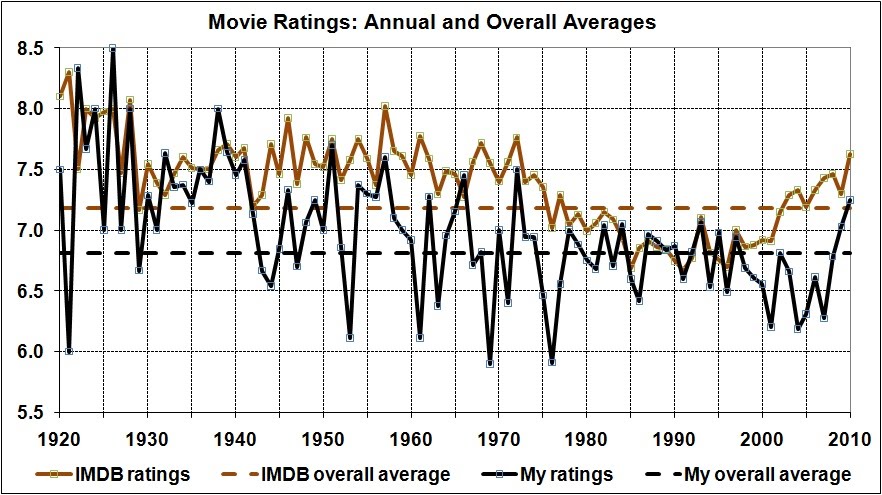
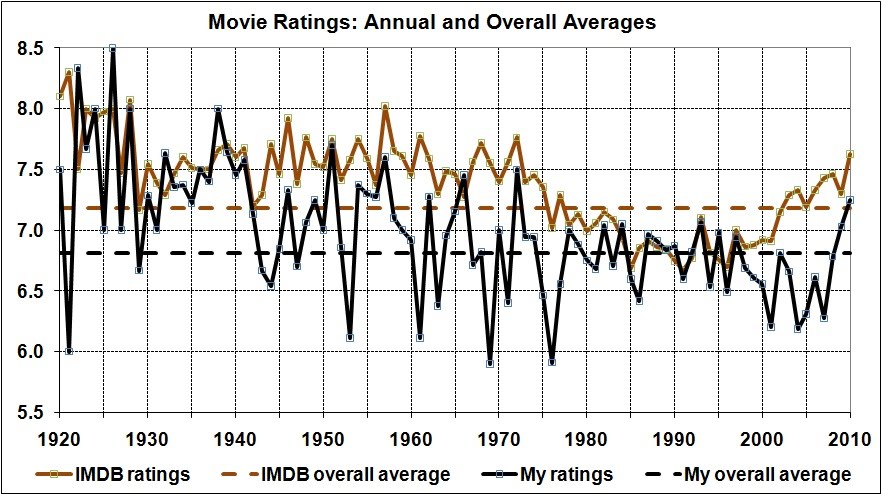
In “The Quality of Films over the Decades,” I compare my ratings of 1,900-plus feature films with the ratings given those same films by IMDb users:


An obvious reason for the difference is that many IMDb users, unlike me, have a strong taste for films of the 1940s through the mid-1970s. I, on the other hand, generally prefer the films of 1932-1942 (the “Golden Age”) to what has been produced since. (My high marks for films of 1920-1931 are based on small samples, and should be ignored for purposes of this discussion.)

It is evident, however, that I am in step with IMDb users with regard to the average quality of films produced from 1975 to 1995. I am less enthusiastic than IMDb users about the output of the last 15 years. (The jump in my ratings for 2009-2010 reflects limited viewing.)

That I am selective in what I choose to view is born out by the following graph:

The blue bars denote the ratings given by IMDb viewers to some 113,000 feature films. The average rating assigned to all of those films is 5.8, in contrast with the 7.1 assigned by IMDb users to films I’ve rated (my average rating, 6.8). The distribution of the red and green bars, relative to the blue ones, attests to my selectivity in choosing films to watch.

It is the difference between the red bars and the green bars that I find most interesting. Because of my selective viewing habits, I have given ratings of 8, 9, or 10 to 13 percent of the films I’ve rated; whereas, IMDb users apply ratings of 8, 9, or 10 to less than 6 percent of the same features. The picture then changes. I am less generous with ratings between 5 and 7, and more willing to apply ratings below 5.

It gives me solace, for two reasons, to know that the average rating for all feature films at IMDb is only 5.8. First, it means that I haven’t missed much by being selective. Second, it means that the average viewer (at least the ones who rate films at IMDb) is willing and able (at least somewhat) to tell what’s good, what’s bad, and what’s indifferent.

Finally, there’s a good reason for being selective: It prevents a sad waste of time. If the average length of the 113,000 features rated at IMDb is 105 minutes (1.75 hours), it would take about 100 years (at five hours a day, five days a week) to watch every film all the way through. That’s a lot of popcorn.

Time Out

It’s not that I’m going “on hiatus” as they say in blogworld. It’s just that I have a couple of things to “share” that aren’t about politics or economics. I maintain, and occasionally update, a blog called Americana, Etc., which is about “baseball, history, humor, language, literature, movies, music, nature, nostalgia, philosophy, psychology, and other (mostly) apolitical subjects.” (Actually, I do address history, language, literature, music, philosophy, and psychology here, but not in an apolitical way.)

In a relative frenzy of activity at Americana, Etc., I added yesterday (after two weeks’ work) a post in which I compare the greatest hitters in the history of the American League. (That’s a baseball thing-y, in case you’re wondering.) The title of the post, oddly enough, is “The American League’s Greatest Hitters.” Here’s a teaser: Ichiro Suzuki supplants Ty Cobb as the best all-time hitter — batting-average-wise — in the history of the American League. To find out why, and to see the entire list of 120 top hitters, click on the link in the sentence before last. [UPDATE: With a further adjustment to take age into account, Ty Cobb reclaims his title as the all-time American League batting champion. Ichiro Suzuki drops to second place. Shoeless Joe Jackson remains in third place. Details here.]

Today’s entry is “The Quality of Films over the Decades,” in which I revisit and reaffirm earlier posts to the effect that movies have been in a long decline since 1942.

Thank you for your kind attention.

-30-

The Quality of Films over the Decades

I have written before about my judgment of the quality of films in various eras. In 2007, I characterized the eras from 1933 to then as follows:

  • the Golden Age (1933-1942) — 179 films seen, 96 favorites (54 percent)
  • the Abysmal Years (1943-1965) — 317 films seen, 98 favorites (31 percent)
  • the Vile Years (1966-present) — 1,496 films seen, 359 favorites (24 percent)

Favorites are films that I have rated 8, 9, or 10 on IMDb’s 10-point scale.

I offered the following explanation for what I saw as a steady decline in quality after 1942:

  • The Golden Age had deployed all of the themes that could be used without explicit sex, graphic violence, and crude profanity — none of which become an option for American movie-makers until the mid-1960s.
  • Prejudice got significantly more play after World War II, but it’s a theme that can’t be used very often without boring audiences.
  • Other attempts at realism (including film noir) resulted mainly in a lot of turgid trash laden with unrealistic dialogue and shrill emoting — keynotes of the Abysmal Years.
  • Hollywood productions sank to the level of TV, apparently in a misguided effort to compete with that medium. The garish technicolor productions of the 1950s often highlighted the unnatural neatness and cleanliness of settings that should have been rustic if not squalid.
  • The transition from abysmal to vile coincided with the cultural “liberation” of the mid-1960s, which saw the advent of the “f” word in mainstream films. Yes, the Vile Years have brought us more more realistic plots and better acting (thanks mainly to the Brits). But none of that compensates for the anti-social rot that set in around 1966: drug-taking, drinking and smoking are glamorous; profanity proliferates to the point of annoyance; sex is all about lust and little about love; violence is gratuitous and beyond the point of nausea; corporations and white, male Americans with money are evil; the U.S. government (when Republican-controlled) is in thrall to that evil; etc., etc. etc.

How do things look now? About the same, on the whole, after another look at my ratings, which now extend into 2010.

I compared my ratings of individual movies with the ratings given the same movies by hundreds, thousands, and (sometimes) tens of thousands of viewers. Here’s how our ratings compare, year by year and overall, from 1920 through 2010:


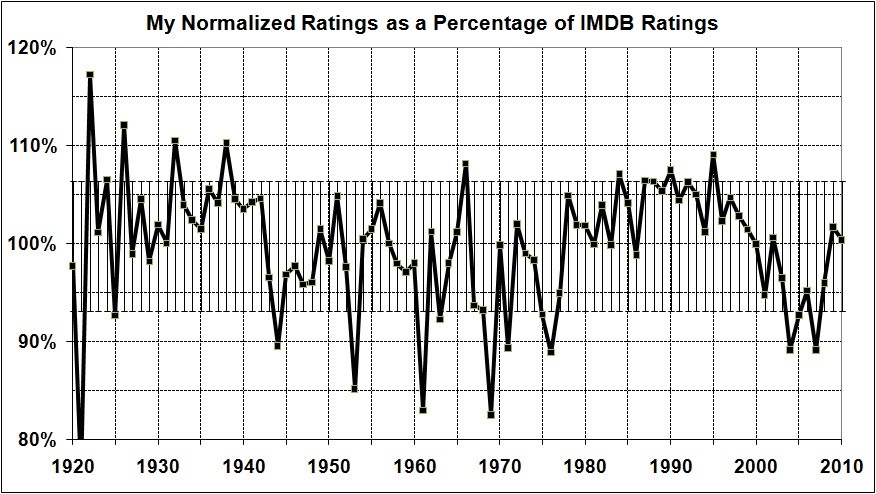
I’m not surprised that my ratings, on average, are lower than those of other viewers, on average. Assuming that the difference is merely a matter of tough grading on my part, I scaled up my ratings so that my overall average is the same as that of others who rated the same films. The result:


The band of vertical bars across the middle of the graph indicates the normal range of the annual ratings. Points above the vertical bands are in the upper 1/6 of my ratings; points below the vertical bands are in the bottom 1/6 of my ratings.

I find it a bit shocking to see that there is a period during the vile years with normalized ratings above 100 percent of the IMDb average, specifically, 1978 through 1997. On the other hand, the first graph shows that I considered the films of that period generally inferior to the films of earlier periods. Moreover, going back to the first graph, it is evident that there was a consensus (of which I was part) about the vileness of the Vile Years (give or take a few of them).

So, I will stick to my guns, with one amendment — the Golden Age began in 1932:

  • the Golden Age (1932-1942) — 184 films rated, 110 favorites (60 percent)
  • the Abysmal Years (1943-1965) — 284 films rated, 107 favorites (41 percent)
  • the Vile Years (1966-present) — 1,425 films rated, 416 favorites (29 percent)

Will movies ever get better? Only time — and a lot of movie-viewing — will tell.

Asymmetrical (Ideological) Warfare

Leftists are  kind, caring, and generous — because they say they are. Conservatives and libertarians are none of those things — because the possession of such traits is a question of behavior, not rhetoric.

Leftists dismiss human imperfection, while finding perfection in their vision of the world as they want it to be. Conservatives and libertarians understand human imperfection and offer only a vision of betterment through striving.

The rhetoric of leftism — when it is not downright hateful toward non-leftists — has wide appeal because to adopt it for one’s own and to echo it is to make oneself feel kind, caring, generous — and powerful — at a stroke. It matters not whether the policies that flow from leftist rhetoric actually make others better off. The important things, to a leftist, are how he feels about himself and how others perceive him.

It is easy for a leftist to seem kinder, more caring, and more generous than his conservative and libertarian brethren because a leftist focuses on intentions rather than consequences. No matter that the consequences of leftist dogma could match their stated intentions only if Santa Claus or the Tooth Fairy ruled the world.

In the leftist’s imagination, of course, government is Santa Claus or the Tooth Fairy. Government, despite the fact that it consists of venal and fallible humans, somehow (in the leftist’s imagination) wields powers that enable it to make “good” things happen with the stroke of a pen and at no cost.

Or if there is a cost, it is to be borne by those despised “rich,” who dare to acquire more than their “fair share” of income and wealth. Leftists seem know who is “too rich” and what is a “fair share” by mysterious intuitions that are inaccessible to mere mortals. Leftists seem to have acquired a fine knowledge of what others deserve to earn, though that knowledge seems not to have kept many a leftist from scrambling up the ladder of material prosperity. It’s all right to be “rich” if you proclaim your heart to be in the right place.

By the same token, it is all right to dictate the terms and conditions of human striving– what is made, how it is made, whether it is made, how much of it is made, how much of it may be consumed, etc. — as long as one’s heart is in the right place. The leftist, you see, is compelled to protect mere mortals (the unwashed masses) from themselves. That is because the leftist cannot grasp the the concepts of personal responsibility and betterment through (sometimes) bitter experience.

Such realities have no meaning for the leftist. For him, human progress is attained by the magical powers of government, which can raise up the impoverished, cure the stricken, and banish strife from the land. It is up to government to do such things because, in the view of a leftist, nothing that happens to anyone (or to anyone who is on the left’s list of favored groups) is his fault — it is the fault of “society” or the uncaring, unkind, ungenerous exploiters who (in the left’s imagination) control society. (The ultimate irony is that the uncaring, unkind, and ungenerous exploiters are the leftists who, when not held in check, write the rules by which we mortals live.)

In sum, the true nature of leftism is a blend of Utopianism and power-lust. Thus, in the left’s view of things, human wants can be met, but only without mussing the face of the Earth; people can live and work wherever they choose, as long as it is in compact cities in which government owns the only means of transportation; people can say what they want and associate with whom they please, as long as they say nothing to offend certain kinds of persons and are forced to associate with them, like it or not. (The list goes on, but that is more than enough to make my point.)

The idea of allowing individuals to make their own way (and sometimes to fail in the process of trying), to become sick and die because of the “lifestyles” they prefer, and to avoid one another (usually for very good reasons) is beyond the ken of the leftist. Imperfection — in the mind of a leftist — is impermissible. Individuals must not be allowed to fail, to become ill, or to harbor ill feelings (except toward the enemies of leftism). The antidote to failure is to arrange our lives and business affairs as the leftist would like to see them arranged. All in the name of kindness, compassion, and generosity, of course.

The ideal person — to a leftist — is not a human being but a cog in the left’s design for the world.

Related posts:
Fascism with a “Friendly” Face
Penalizing “Thought Crimes”
Parsing Political Philosophy
Utilitarianism vs. Liberty
The Near-Victory of Communism
Tocqueville’s Prescience
Accountants of the Soul
Rawls Meets Bentham
The Left
The Divine Right of the Majority
I Want My Country Back

I Want My Country Back

When a Tea Partier says something like “I want my county back,” leftists reliably label the sentiment as racist, sexist, homophobic, mean-spirited, and a lot of other things that are meant to be uncomplimentary. Well, I’m not an active member of the Tea Party movement, but I am sympathetic to it. And if I were to say “I want my country back,” here’s what I would mean by it:

Let’s start with the unlawfulness of government. The Constitution of the United States creates a “national” government of limited and enumerated powers, to act on behalf of the States and their citizens in certain matters. This “national” government has nevertheless blatantly and persistently exceeded its rightful powers. Moreover, much of what is done by all governments — not just the “national” government — is in fact unlawful at its core. There is a fundamental tenet of law — one that precedes and informs the Constitution — which is that “law” is law only when it serves the general welfare, regardless of its official status as an legislative, executive, or judicial act. Therefore, it is truly unlawful for the  “national” government or any other government in the United States to interfere with the lives, liberty, or property of Americans for the purpose of promoting special interests, however laudable those interests may seem. And yet, the “laws” under which Americans labor are, in the main, enactments that serve special interests and the power-lust of politicians, bureaucrats, and judges. In sum, I want my country (and its various parts) to return to the true “rule of law,” which is to promote the general welfare by

  • protecting all Americans from their enemies within and without
  • ensuring the free movement of all Americans
  • ensuring the free exchange of goods and services
  • and nothing more.

One of the most insidious ways in which government interferes with our liberty is by exercising a subtle but powerful form of thought control. It  is not the business of government to tell us what to believe or how we must arrive at our beliefs. But government — which puts it imprimatur on the vast majority of educational institutions and much of the “factual” information in many fields of endeavor — does all of those things. Thus, contrary to the intentions of the Founders, we have become a nation imbued with official beliefs about matters ranging from the origins of the universe to the goodness of our enemies to the climatic effects of (puny) human endeavors.

One of the key beliefs instilled by government — directly and through those who are in its thrall — is its beneficent role in our economic and social affairs. It never seems to occur to the proponents of governmental interference — or to its relatively few of its opponents — that there is a living, breathing case study which disproves the beneficence of economic meddling. When government spending and regulation played a tiny role in the economic affairs of the United States — from the 1790s to around 1900 — GDP grew at an annual rate of 4.2 percent. Now, with the regulatory-welfare state fully upon us, GDP grows at an annual rate of 3.1 percent (and falling). The difference between those two rates — when compounded over a generation, a lifetime, or a century —  ranges from significantly large to enormous. The road to economic lassitude is paved by the good intentions of regulation and spending by government. Liberty — part of which is the right to make mistakes and benefit from the resulting lessons — is a collateral victim of regulatory zeal. Liberty is a victim of government spending, as well, because it deprives individuals of some portion of the rewards for their labor and capital, and the full enjoyment of those rewards.

With respect to social matters, there is only one way to put it: Government is an enemy of society. Its main mission, when you think about it for more than a minute, is to supplant voluntary and beneficial social arrangements with schemes hatched in the vacuum of intellectualism. It is as if there were nothing to the eons-long learning that is expressed in the Ten Commandments and Golden Rule, and embodied in churches, clubs, and other voluntary, private associations. We must, instead, take our social marching orders from elites, who have their own peculiar views of what is right and just: serial polygamy, pederasty, and infanticide, to name just a few things. The social engineering favored by intellectualoids arises not from the wisdom of tradition, which fosters stable, trusting, and supportive social relationships, but from idle theorizing and a large dose of adolescent and post-adolescent rebellion.

Now, after a more than a century of “progressive” destruction of the Constitution and its restraints on government, Americans no longer enjoy the protection of government and the self-policing restraints of social custom. Instead, Americans suffer the fads and whims of the self-anointed, whose legacy lingers after their departure from the scene.

Now, after more than a century of “progressive” interference in the economic affairs of Americans, our progeny face unaffordable financial commitments, which they will be expected to honor even as their standard of living withers under the assault of taxation and regulation.

Now, after more than a century of social experimentation in which anti-social behavior has been exalted and long-standing voluntary social arrangements and institutions have been stripped of their authority, too many of our progeny are hooked on hard drugs, casual sex, and gratuitous violence as forms of “entertainment” and as “lifestyles.”

I want my country back.

The Politically Correct Cancer: Another Weapon in the War on Straight White Males

Breast cancer is by no means a matter for ridicule. But it has become the politically correct cancer, without a doubt.

There is a time during the baseball season when players wear pink caps and pink armbands, and when some of them even wield pink bats. There may be similar occurrences in basketball and football, but I don’t follow those sports, so I wouldn’t know.

The clincher came this morning, in the form of a special 24-page supplement to the Austin American-Statesman (known only as the Statesman in lefty Austin). The supplement not only contains articles about breast cancer and everything possibly related to it, but it is printed on pink newsprint. (NB: Newsprint is the kind of paper on which newspapers are printed; the impressions on the paper are made with printer’s ink.)

This latest evidence of enlightened concern about breast cancer led me to wonder if the disease really is quite the threat it’s made out to be — statistically, that is. (I know that it’s a devastating, life-threatening scourge to those who contract it.) Well the answer is “yes and no.” According to statistics for 2002-2006 (the most recent statistics published by the Centers for Disease Control and Prevention), female breast cancer is by far the most prevalent type of cancer among women in the United States. Here are the stats (annual incidence per 100,000 women):

Female Breast 121.7
Lung and Bronchus 55.8
Colon and Rectum 43.6
Corpus and Uterus, NOS 23.7
Non-Hodgkin Lymphoma 16.3
Melanomas of the Skin 14.7
Thyroid 14.2
Ovary 13.0
Kidney and Renal Pelvis 10.2
Pancreas 10.2

*     *     *

But look at this comparison of the top 10 cancers among females (left) and males (right):

Female Breast 121.7 Prostate 155.1
Lung and Bronchus 55.8 Lung and Bronchus 86.8
Colon and Rectum 43.6 Colon and Rectum 59.1
Corpus and Uterus, NOS 23.7 Urinary Bladder 37.9
Non-Hodgkin Lymphoma 16.3 Non-Hodgkin Lymphoma 23.1
Melanomas of the Skin 14.7 Melanomas of the Skin 22.6
Thyroid 14.2 Kidney and Renal Pelvis 19.6
Ovary 13.0 Oral Cavity and Pharynx 15.9
Kidney and Renal Pelvis 10.2 Leukemias 15.9
Pancreas 10.2 Pancreas 13.1
 

Total – top 10
323.4  

Total – top 10
449.1

*     *     *

Why does breast cancer get so much attention relative to prostate cancer? And why isn’t the greater overall vulnerability of males a big issue? In fact, Table B on page 5 of this official publication indicates that males are not only more vulnerable to cancer, but are generally more vulnerable to just about everything that causes death. Why isn’t there a national crusade against premature male demise?

I’ll tell you why males get short shrift. It’s the old story of opinion-and-media elites adopting the causes of groups they favor. Why are those groups favored? Because they were, at one time, oppressed by the straight-white-male-dominated “system.” (Though women — in America, at least — were neither as oppressed nor as powerless as elites like to imagine.)

And what happens when oppressed groups are no longer oppressed? Well, they remain favored by elites, who have it in their minds that an oppressed group is, by definition, morally superior to the group that had oppressed it. Thus “black” crime is somehow less blameworthy than “white” crime; the requirement to present a photo ID when voting is anti-Hispanic, not a precaution against voting fraud; AIDS is an “epidemic” to be fought by government, not a preventable disease transmitted by irresponsible sexual conduct; and so on.

Whatever happened to equality? Elites like to proclaim it as an ideal, but they choose not to practice it. (Or, if they do, it is to favor equality of outcome over neutrality of process.) The political correctness of breast cancer is just one point in evidence of elite hypocrisy.

The Firing of Juan Williams

The firing of Juan Williams by NPR isn’t surprising, given NPR’s political “sensitivity” (i.e., tendency toward craven appeasement). But I suspect that NPR had been waiting for a convenient excuse to fire Williams for consorting with the folks at Fox News.

In any event, Williams is to be commended for his candor, not condemned as a bigot.

Leave it to Andrew Sullivan to take the low road:

What if someone said that they saw a black man walking down the street in classic thug get-up. Would a white person be a bigot of he assumed he was going to mug him?

No! The white person would be prudently fearful, as would any respectable and sensible person of color.

Sullivan continues:

What percentage of traditionally garbed Muslims – I assume wearing a covered veil or some other indicator and being of darker skin – have committed acts of terror? And, of course, the 9/11 mass-murderers were in everyday attire, to blend in. So was the Christmas Day undie-bomber. The Fort Hood murderer was in US military uniform, for Pete’s sake.

The percentage of terrorist acts committed by Muslims in traditional garb is irrelevant. What is relevant is that Muslims are the most likely perpetrators of terrorist acts. Sullivan makes the dangerous assumption that a traditionally garbed Muslim is above suspicion. But a traditionally garbed Muslim who has acquired a seat on a plane — thanks to screening of dubious quality and the politically correct prohibition of profiling — is no less suspect than a Muslim wearing “everyday attire” or an Army uniform.

The Improbability of Us

An argument often used against the belief in a Creator who designed the universe runs like this:

The existence of humans is indeed improbable. The laws of nature that govern our existence are but one set out of infinitely many possible sets of laws of nature. Ad had they differed only slightly the universe would be a mere swirl of subatomic particles, free from medium-sized objects like rocks, trees and humans. And even given the actual laws of nature, evolutionary history would have taken different twists and turns and failed to deliver human beings. (Jamie Whyte, Bad Thoughts – A Guide to Clear Thinking, p. 125)

Embedded in that seemingly reasonable statement is an unwarranted — but critical — assumption: that there are infinitely many (or even a large number) of possible sets of laws of nature. But there is no way of knowing such a thing. There is only one observable universe, and one set of observable and (mostly*) consistent laws of nature within it. It is impossible for the human mind to conjure an alternative set of consistent natural laws that could, in fact, coexist in a possible universe. Any such conjuring would be mere speculation, not a falsifiable hypothesis.

Given that, it is impossible to deny that a grand design lies behind the universe. But it is also impossible to prove, by the methods of science, the existence of a grand design. The fact of the universe’s existence is, as I have called it, the greatest mystery.

Related posts:
Atheism, Religion, and Science
The Limits of Science
Three Perspectives on Life: A Parable
Beware of Irrational Atheism
The Creation Model
The Thing about Science
Evolution and Religion
Words of Caution for Scientific Dogmatists
Science, Evolution, Religion, and Liberty
The Legality of Teaching Intelligent Design
Science, Logic, and God
Capitalism, Liberty, and Christianity
Is “Nothing” Possible?
A Dissonant Vision
Debunking “Scientific Objectivity”
Science’s Anti-Scientific Bent
Science, Axioms, and Economics
The Big Bang and Atheism
The Universe . . . Four Possibilities
Einstein, Science, and God
Atheism, Religion, and Science Redux
Pascal’s Wager, Morality, and the State
Evolution as God?
The Greatest Mystery
What Is Truth?
__________
* The exception is quantum mechanics, the science of the sub-atomic world. Sub-atomic particles do not seem to behave according to the same physical laws that describe the actions of the visible universe; their behavior is discontinuous (“jumpy”) and described probabilistically, not by the kinds of continuous (“smooth”) mathematical formulae that apply to the macroscopic world.

Society and the State

Updated and revised, here.


The Return of the Missing Bloggers

In “Missing Bloggers,” I lamented the lapse of posting at The Fourth Checkraise and the disappearance of Occam’s Carbuncle. I am happy to report that posting has resumed at The Fourth Checkraise, and that Occam’s Carbuncle is back, in a new location: http://occamscarbuncle.wordpress.com/. (“Occam” hasn’t had much to say yet, but give him time.)

The Mood of the Country

UPDATED 09/25/10

From the morning of January 21, 2009, through this morning, Obama’s net popularity rating has dropped from +28 to -13 (according to Rasmussen Reports). That’s an average daily decline of 0.07 rating points. But how Obama’s rating fares on a given day depends, in part, on the day of the week; thus:

As the week wears on, the likely voters polled by Rasmussen become less satisfied — or more dissatisfied — with Obama’s performance in office. Irascibility peaks on Saturday, then begins to recede on Sunday. Blue Monday, oddly enough, is Obama’s best day in the eyes of Rasmussen’s survey group. Conversely, the first day of the weekend — a day eagerly anticipated by most working persons — is Obama’s worst day. Go figure.

UPDATE: Saturday continues to be Obama’s blue polling day. With today’s 2-point drop, Saturday’s average change is now -0.54.

The Birth of “Urban Legend”

The term “urban legend,” according to Wikipedia (citing the OED),

has appeared in print since at least 1968. Jan Harold Brunvand, professor of English at the University of Utah, introduced the term to the general public in a series of popular books published beginning in 1981.

I have news for the editors of the OED and the contributors to Wikipedia: Hilaire Belloc (1870-1953) got there first. In “Fun for Clio,” one of the essays collected in The Silence of the Sea (1941), Belloc writes:

Our great urban masses swallow the most fantastic legends and become furious if they hear the absurdity denied. (p. 87  in the Glendalough Press reprint)

In my book, that is close enough to count as the proximate source of “urban legend.”

Missing Bloggers

Ilkka, the owner of The Fourth Checkraise, has not posted since August 1.

Alan, the owner of Occam’s Carbuncle (no longer online) has not posted in more than a year.

I hope that both bloggers will once again take up their keyboards. I have missed their perceptive and wickedly entertaining commentaries.

Comments are enabled for this post, so that the bloggers in question (or someone who knows the whereabouts of either of them) can enlighten me.

UPDATE (09/06/10): Ilkka comments: “I’m on a break until I get the spark to write something good again.”

Youthful Wisdom

A recent e-mail from my 15-year-old grandson includes this:

I am great lover of industry and I fume when I hear people complain about the chemical plants in __________, but without industry you cannot have the comforts of home….

I was in my 30s before I even began to think about the preciousness of the intellectualoids. Here is a 15-year-old who already sees through their cant.

I am proud to be his grandfather.

The Meaning of the Mosque Controversy

The controversy about the ground-zero mosque — which is summarized here — reminds me of an old post of mine, “Losing Sight of the Objective”:

Those who are so keen to bestow constitutional rights on terrorists have lost sight of a key purpose — perhaps the key purpose — of the Constitution: to provide for the common defense. Of Americans. Against their enemies: foreign and domestic, overt and covert.

Whether the mosque will serve as a front for terrorist activity remains to be seen. But there is good reason to suspect that it will. And if it does, it will be further evidence that America’s “leaders” have lost sight of the objective in their rush to display “tolerance” for everyone — well, tolerance for everyone but heterosexual, white Christians and Jews; for example:

St. Nicholas Greek Orthodox Church, which once sat right across the street from the World Trade Center, was crushed under the weight of the collapse of Tower Two on September 11, 2001. St. Nicholas was the only church to be lost in the attacks, and nine years later, while City of New York officials are busy removing every impediment to the building of the Cordoba mosque two blocks from the site, St. Nicholas’ future remains unclear.

The last bit of hopeful news for St. Nicholas came two years ago, in July 2008, when church officials and the Port Authority of New York and New Jersey announced a deal which would have allowed the church to be rebuilt about two blocks from its original location….

Trouble emerged after St. Nicholas announced its plans to build a traditional Greek Orthodox church building, 24,000 square feet in size, topped with a grand dome. Port Authority officials told the church to cut back the size of the building and the height of the proposed dome, limiting it to rising no higher than the World Trade Center memorial. The deal fell apart for good in March 2009, when the Port Authority abruptly ended the talks after refusing to allow church officials to review plans for the garage and screening area underneath. Sixteen months later, the two sides have still not met to resume negotiations.

St. Nicholas Church’s difficulty in getting approvals to rebuild stands in stark contrast to the treatment that the developers of the proposed Cordoba mosque have received. New York City Mayor Mike Bloomberg, state Atty. Gen. Andrew Cuomo, and a raft of city officials have all come out publicly in favor of building the mosque, and the city’s Landmarks and Preservation Commission recently voted unanimously to deny protection to the building currently occupying the site where the mosque is to be built.

The mosque is proposed to rise 13 stories, far above the height of the World Trade Center memorial, with no height restrictions imposed. (Mark Imponemi, “Mosque Moves Forward, Yet Church in Limbo“)

The case of the ground-zero mosque is only a symptom of the larger problem, which is denial and appeasement. Bill Whittle spells it out in a 13-minute video, “Ground Zero Mosque Reality Check.” Denial and appeasement arise from what Thomas Sowell calls one-day-at-a-time rationalism:

One-day-at-a-time rationalism [addresses] the immediate implications of each issue as it arises, missing wider implications of a decision…. A classic example was a French intellectual’s response to the Czechoslovakian crisis that led to the Munich conference of 1938:

…Joseph Barthélemy, who taught constitutional law at the University of Paris and was French representative at the League of Nations, asked in Le Temps the question French leaders had to answer: “Is it worthwhile setting fire to the world in order to save the Czechoslovak state… ? Is it necessary that three million Frenchman …. would be sacrificed to maintain three million Germans under Czech sovereignty?

Since it was not France that was threatening to set fire to the world, but Hitler, the larger question was whether someone who was threatening to set fire to the world if he didn’t get his way was someone who should be appeased in this one-day-at-a time approach, without regard to what this appeasement could do to encourage a never-ending series of escalating demands. By Contrast, Winston Churchill had pointed out, six years earlier, that “every concession which has been made” to Germany “has been followed immediately by a fresh demand.” Churchill clearly rejected one-day-at-a-time rationalism. (Intellectuals and Society, p. 31)

Leftists will embrace the cause of the ground-zero mosque because it is in their nature to embrace anything that undermines civil society. Libertarian purists will embrace it because they embrace one-day-at-a-time rationalism (e.g., this blogger).

As a libertarian realist, I am prepared to say that the mosque should not rise if it is likely to become a front for terrorist activity. I am keeping my eyes on the objective, which is the defense of Americans’ lives, liberty, and property: against their enemies foreign and domestic, overt and covert.

Cornered by Gender?

Tanya Khovanova, writing at her math blog, plays a variation on a theme introduced by her guest blogger, Rebecca Frankel, about three weeks ago. Frankel, as I note in “Sexist Nonsense,” wants to redefine gender to exclude two things that make a big difference between males and females: testosterone and estrogen. By Frankel’s logic, males and females would be equal in ability, if only it weren’t for that pesky matter of gender. As I put it in “Sexist Nonsense,”

So “ability” now has a new definition. It is a hypothetical state of equality that is disturbed by a natural difference between males and females. And the fact that this natural difference has an influence on performance is somehow “proof” that males and females are born equally able. By that kind of reasoning, the fact that I cannot see well enough to hit a major-league fastball proves that I belong in the Hall of Fame, along with Babe Ruth. If you’re looking for “sexist nonsense,” look no further than Rebecca Frankel’s hypothesis.

In “Math Careers and Choices,” Khovanova laments that some women choose not to pursue academic careers because they are “cornered” into making such choices. She gives as evidence the cases of three women, plus her own case (described in an earlier post to which she links).

These are the main features of the cases:

  • All four women (including Khovanova) had academic ambitions.
  • In the all cases except Khovanova’s, actions by husbands (pursuit of their own academic careers) made it difficult or impossible for the women to pursue their own academic careers. (Khovanova’s description of her own situation suggests that she, in effect, abandoned her husband by choosing not to return to Israel with him at the end of their family’s visit to the U.S.)
  • Financial considerations and parental responsibilities led all of the women to drop out of academia.

How were these women “cornered”? And if they were in some sense “cornered,” why is it any more lamentable because of their gender?

As far as I can tell, they entered freely into marriage or freely abandoned it (in Khovanova’s casse), and (in this day of “a woman’s right to choose”) bore their children willingly.

Although one husband allegedly played a psychological power game to get his way, that kind of game-playing (as almost any husband can tell you) is far from the sole province of ambitious male academics.

That the husbands had better academic prospects should come as no surprise, given the findings that Frankel attempts (and fails) to refute in the post I discuss in “Sexist Nonsense.”

In each case (except Khovanova’s) the woman and her husband made a joint decision that furthered their family’s financial security. Khovanova made a similar decision, in order to advance her son’s education.

That is to say, the women were not “cornered.” They were acting in ways that seemed best in view of the circumstances in which they found themselves as a result of preceding choices, which they made freely.

If any of the women (including Khovanova) was “cornered,” then so are the countless men and women who are unable to pursue their fondest dreams because ugly reality intrudes.

Who promised us a rose garden? Who promised women (or men) an academic career, a career as a major-league baseball player, or a seat in a space shuttle? No one, that’s who.

Khovanova — a mathematician who loves logic puzzles — has committed the Nirvana fallacy:

the logical error of comparing actual things with unrealistic, idealized alternatives. It can also refer to the tendency to assume that there is a perfect solution to a particular problem.