On a Lighter Note . . .

On learning of the impending 75th anniversary of Blondie, I checked Wikipedia to refresh my memory about comic strips that I read in my youth. Listed below are some of the other strips that began before 1950 and which, once upon a time, I read daily or weekly (links courtesy Don Markstein’s Toonpedia):

Abbie and Slats (1937-71) — A soaper on newsprint.
Alley Oop (1932-) — A caveman out of his time.
Archie (1947-) — High-school hijinx.
Brenda Starr (1940-) — About a reporter who never seemed to report anything.
Bringing Up Father (1913-2000) — Drank more than the father in Father Knows Best.
Buz Sawyer (1943-89) — Forgettable adventure stuff.
Dick Tracy (1931-) — B.O. Plenty was a fitting character for this strip.
Donald Duck (1937-?, as the main character in a comic strip) — Quacking good fun.
Felix the Cat (1923-66) — Had a lot more energy than Garfield.
Gasoline Alley (1918-) — A family saga that just won’t stop.
Flash Gordon (1934-) — Loved Dale Arden’s outfits.
The Gumps (1917-59) — Small town doin’s.
Henry (1932-) — The silent kid.
Joe Palooka (1930-84) — The great white hope, even before Joe Louis came along.
The Katzenjammer Kids (1897-) — Shtoopid kid stuff.
Li’l Abner (1934-77) — Worth it to see Daisy Mae.
Little Annie Rooney (1927-66) — Gloriosky!
The Little King (1931-75) — Did he inspire the short king in The Wizard of Id?
Little Iodine (1943-86) — Dennis the Menace could have taken lessons.
Little Lulu (1935-48, as a comic strip) — Wanna buy some Kleenex?
Little Orphan Annie (1925-74, by that name) — Daddy Warbucks to the rescue.
Mandrake the Magician (1934-) — Who knows what evil . . . no, that was The Shadow.
Mark Trail (1946-) — No jokes about his girlfriend Cherry.
Mary Worth (1938-) — The comic-strip soap of all time.
Mickey Mouse (1930-?, as a comic strip) — Squeaky clean.
Moon Mullins (1923-91) — Low-life with humor.
Mutt and Jeff (1907-82) — Clean, corny yuks from a bygone age.
Nancy (1933-) — Sluggo’s girlfriend. I read it for yummy Aunt Fritzi Ritz.
Out Our Way (1922-77) — Americana, from when America was a “real” place.
Our Boarding House (1921-81) — Starring the original Hoople (Maj. Amos, that is).
The Phantom (1936-) — The man in tights . . . oops, The Ghost Who Walks.
Pogo (1949-71) — High irony for campus radicals.
Popeye (1929-) — World’s greatest spinach salesman.
Prince Valiant (1937-) — Great haircut Val, still looks good after 68 years.
Rex Morgan, M.D. (1948-) — Finally married his nurse when they were about 80 years old.
Sad Sack (1946-5?) — Beetle Bailey‘s older brother.
Smilin’ Jack (1933-73) — ADDED 11/22/07, after suddenly recalling the character Fatstuff,

Jack’s Hawaiian friend who was always popping his shirt buttons (usually into the mouths of hungry chickens, so under-nourished from eating buttons instead of bugs that they were unable to grow feathers)….

Smokey Stover (1935-73) — Notary Sojac and Gravy Ain’t Wavy. (You had to be there.)
Snuffy Smith (1934-) — Got rid of his host Barney Google. Who’s next, his nephew Jughead?
Steve Canyon (1947-88) — How can a guy go wrong with Happy Easter for a sidekick?
Terry and the Pirates (1934-73) — Dig the Dragon Lady.
They’ll Do It Every Time (1929-) — Wisdom in one panel.
Winnie Winkle (1920-98) — Early and long-running soaper, with a seriously pre-PC character: Denny Dimwit.

See, I was paying attention. But I must admit that I no longer read any of the strips that are still running.

Where are Superman, Batman, and their ilk? They were only in comic books. That’s another post.

Recent Reading

Recommended:

Garbo Laughs, by Elizabeth Hay

Hay’s second novel is not at all like her first (A Student of Weather), except that it, too, is beautifully written and thoroughly engaging.

The Hot Kid, by Elmore Leonard

Leonard changes his venue (from Detroit and Miami to Oklahoma) and his period (from the present to the 1920s and 1930s), but it’s the same old Elmore. That is to say, a ripping good read.

Lunch at the Picadilly, by Clyde Edgerton

The “dark side” of Clyde. A rather more realistic view of old people than than one gets in Edgerton’s earlier novels (as I remember them).

Case Histories, by Kate Atkinson

A funny, sad tale of interlocking mysteries, with a semi-hapless hero and a great supporting cast. Brits do it best.

Amsterdam, by Ian McEwan

Inferior to McEwan’s Atonement, but “inferior” is a relative thing. McEwan is such a good writer that I can still recommend this short romp through London’s music and journalistic scenes.

A Desert in Bohemia, by Jill Paton Walsh

A novel of ideas, which also features compelling characters and dramatic tension. Along the way, Walsh — who may be an idealistic socialist, for all I know — lays bare the hypocrisy and brutality of state socialism as it was practiced behind the Iron Curtain. Yet another brilliant Brit.

What Was She Thinking? (Notes on a Scandal), by Zoe Heller

A creepy, clinging narrator and a self-centered protagonist. A match made in a sadist’s heaven. More brilliant Brit prose.

Celebrity Twaddle

Sir (to some) Ian McKellen, interviewed in this week’s Newsweek, has this to say about his “coming out”:

I became a better actor, and my film career took off in a way that I couldn’t have expected. You can’t lie about something so central to yourself without harming yourself. Acting in my case is no longer about disguise—it’s about telling the truth, and my truth is that I’m gay. I’m very happy for people to know that, and then I can get on with telling the truth about the character that I’m playing. That’s why I can say to other actors: if you really want to be a good actor and a successful one, and you’re gay, let everybody know it.

It’s lucky for McKellen that he’s instinctively a good actor, for he doesn’t seem to understand what acting is all about. A character in a film or play has no “truth” because a character is, by definition, fictional. The actor’s job is to make the character believable to an audience. An actor can do that successfully and still be a liar, a cheat, a drunkard, a dope addict, or an adulterer (to name only a few traits common to actors) — as generations of actors have proved. Acting is acting. It has nothing to do with one’s “truth.”

But political correctness requires celebrities to utter twaddle such as that uttered by McKellen. One thing’s for sure: Successful acting doesn’t require a very high degree of intelligence, just good acting instincts and good scripts.

Technorati tag:

A Footnote about Movies

I noticed that as I was scouring the Internet Movie Database for movies to add to my Blockbuster.com queue I eschewed films starring Kirk Douglas, Glenn Ford, Burt Lancaster, and Robert Mitchum. Perhaps it’s because I tend to dislike the melodramatic, unrealistic movies of the late 1940s and 1950s, which was when Douglas, Ford, Lancaster, and Mitchum became stars. But even their later films don’t appeal to me. I’ll have to give it some more thought. Stay tuned for a P.S.

Movies

UPDATED 07/15/05

I have been building my queue at Blockbuster.com by searching the Internet Movie Database. In the process of searching, I’ve updated the lists of movies I keep there.

Here are my IMDb power-search criteria:

  • English language (I’m finding subtitles hard to read)
  • Made between 1910 and the present
  • Minimum of 100 voters (persons rating a movie)
  • Exclude all movies in all of my IMDb categories (see below)
  • Rated between 7 and 10 (where 10 is the highest rating) by persons aged 45 or older

And here are my IMDb categories and the numbers of movies currently in each one:

Blockbuster Queue — This category comprises the 158 titles on their way to me or in my queue at Blocbuster.com.

Must See — There are 65 movies I’d like to see that aren’t yet available (a few new movies, but mostly titles from the 1930s to 1960s).

Don’t See — This category (currently 941 titles) comprises movies I’m not interested in, or that I have rented and rejected, even though they meet my IMDb power-search criteria.

Seen — These are the 1,883 titles (good, bad, and indifferent) that I can remember having seen* in almost 60 years of movie-watching. Most of the titles are feature films, but the list does include about 80 notable TV miniseries, such as Bramwell; The Forsyte Saga (original and remake); The Sopranos; and Upstairs, Downstairs.

Related post: A Week in the Making…Now Showing on Your Computer Screen…”The 325 Greatest Movies of All Time”…
__________
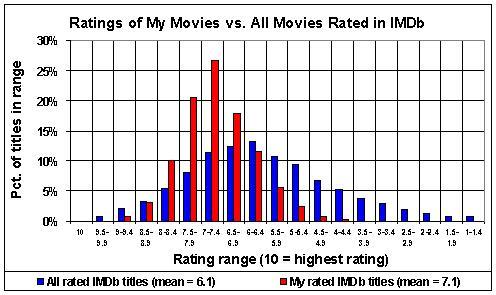
* IMDb has ratings for 1,851 of the 1,883 titles on my “Seen” list. The average rating for my titles is 7.1 (out of 10) as of 11 p.m. CT on 07/14/05. The average rating for the 105,886 IMDb titles with ratings (as of the same time and date) is 6.1. Pickiness pays off:

A Quick Note about Music

Here’s a scholarly take on “modern” music, by Miles Hoffman, violist and artistic director of the American Chamber Players, and music commentator for NPR’s Morning Edition. It squares with my amateur musings, which are here, here, here, and here. Some excerpts of Hoffman’s long and insightful essay:

The primary proposition in defense of avant-garde music of the relentlessly dissonant and persistently unpopular variety has always been that, through exposure and familiarity, we often come to appreciate, and even love, things that initially confuse or displease us. Here what we might call “the Beethoven Myth” comes into play. “Beethoven was misunderstood in his time,” the argument goes, “but now the whole world recognizes his genius. I am misunderstood in my time, therefore I am like Beethoven.” This reasoning, unfortunately, has been the refuge of countless second- and third-rate talents. Beethoven ate fish, too. If you eat fish, are you like Beethoven? But there’s a much graver flaw in the argument: Beethoven was not misunderstood in his time. Beethoven was without doubt the most famous composer in the world in his time, and the most admired. And if there were those who didn’t “get” his late string quartets, for example, there were plenty of others who did, and who rapidly accepted the quartets as masterpieces….

Have I exaggerated the intensity of the distaste that so much modernist music has aroused? No, sad to say, not if we keep certain factors in mind. One is the strength of the needs, the intensity of the desires, that we fulfill with music. Our expectations of music—expectations of the type nurtured, reinforced, and satisfied for generation upon generation—are enormous, and enormously important to us, and when those expectations are disappointed, we take it very badly indeed….

Inevitably, however, we return to the fact that there’s something basic to human nature in the perception of “pleasing sounds,” and in the strength of the tonal structures that begin and end with those sounds. Blue has remained blue to us over the centuries, and yellow yellow, and salt has never started tasting like sugar. With or without physics, consonances are consonances because to most people they sound good, and we abandon them at great risk. History will say—history says now—that the 12-tone movement was ultimately a dead end, and that the long modernist movement that followed it was a failure. Deeply flawed at their musical and philosophical roots, unloving and oblivious to human limits and human needs, these movements left us with far too many works that are at best unloved, at worst detested. They led modern classical music to crisis, confusion, and, in many quarters, despair, to a sense that we’ve wasted decades, and to a conviction that our only hope for whatever lies ahead starts with first making sure we abandon the path we’ve been on.

From a distance of centuries, knowledgeable observers can usually discern when specific cultural developments within societies or civilizations reached their peaks. The experts may argue over precise dates and details, but the existence of the peaks themselves is rarely in question. In the case of Western music, we don’t have to wait centuries for a verdict. We can say with confidence that the system of tonal harmony that flowered from the 1600s to the mid-1900s represents the broad summit of human accomplishment, and that our subsequent attempts to find successors or substitutes for that system are efforts—more or less noble—along a downhill slope. [But the joy of “serious” music began to diminish around 1900, when many leading composers (e.g., Mahler and R. Strauss, following the lead of Wagner and Bruckner), began to deploy tonality in pretentious, ponderous, and dreary works: ED.]

What lies ahead? Nobody can say, of course. But with the peak behind us, there’s no clear cause for optimism—no rational cause, anyway, to believe that another Beethoven (or Berlioz or Brahms…) is on the way. And even if he were on the way, in what musical language would he write when he got here? The present is totally free but totally uncertain, the immediate past offers little, and the more distant past is . . . past. And yet, irrational creatures that we are, we keeping hoping for the best, and it’s right that we do. We owe it to Music. The good news is that there are many composers today who, despite the uncertain footing, are striving valiantly, and successfully, to write works that are worthy of our admiration and affection. They write in a variety of styles, but the ones who are most successful are those who are finding ways—often by assimilating ethnic idioms and national popular traditions—to invest their music with both rhythmic vitality and lyricism. They’re finding ways to reconnect music to its eternal roots in dance and song.

Rhythmic vitality and lyricism. That’s what it takes, and that’s what’s been missing from most “serious” music for the past 100 years or so.

A Hollywood Circle

Note: The images shown below aren’t from the films mentioned in the text.


William Powell (1892-1984) played Moriarty in his film debut, the 1922 version of Sherlock Holmes, which starred


John Barrymore (1882-1942) as the legendary sleuth. Barrymore appeared as Mercutio in the 1936 version of Romeo and Juliet, in which


Norma Shearer (1902-83) played Juliet. Shearer starred as Mary Haines in 1939’s The Women, as did


Joan Crawford (1904-77), in the role of Crystal Allen. Crawford and


Bette Davis (1908-89) co-starred in Whatever Happened to Baby Jane? (1962), playing Blanche Hudson and Baby Jane Hudson, respectively. Davis played Libby Strong to the Sarah Webber of


Lillian Gish (1893-1993) in 1987’s The Whales of August. To complete the circle: Gish had the title role in Romala (1924), playing opposite William Powell as Tito.

From William Powell to William Powell, in six steps.

Speaking of the Senate…

The Frank Capra classic, Mr. Smith Goes to Washington, was invoked often during the recent debate about filibusters. Mostly forgotten is the 1976 “remake,” Billy Jack Goes to Washington. Here’s a plot summary, courtesy iMDB:

After a senator suddenly dies after completing (and sealing) an investigation into the nuclear power industry, the remaining senator and the state governor must decide on a person who will play along with their shady deals and not cause any problems. They decide on Billy Jack, currently sitting in prison after being sent to jail at the end of his previous film, as they don’t expect him to be capable of much, and they think he will attract young voters to the party. Billy is pardoned, released and nominated, after which he begins his duties. He soon notices that things aren’t right, and starts trying to find out just what is going on.

Now, there’s a movie with everything Hollywood loves: sleazy corporations, sleazy politicians, a wronged “little guy,” vengeance, etc., etc. etc. I’m glad I missed it.

The director and star of the movie was Tom Laughlin. Other than making “B” movies, his claims to fame seem to be that he beat up Gene Wilder (when he and Wilder were in high school) and garnered 147 votes in the 2004 New Hampshire primary.

Oh, and the producer of the movie was none other than Frank Capra Jr. A rather little chip off the old block.

Thoughts of Winter

As I welcome summer to central Texas — after a rainy fall, a drizzly winter, and an unusually cool spring — I reflect on the seasons and their associations. Winter, much as I dislike it — even in the relative warmth of central Texas — has its compensations:

The soft glow of twilight through the trees

A rumbling fire in the hearth

A chamber work on the sound system

A fine single-malt at my side

The Viking Book of Poetry of the English-Speaking World in my hand:

I have had enough of wisdom, and enough of mirth,
For the way’s one and the end’s one, and it’s soon to the ends of the earth;
And it’s then good-night and to bed, and if heels or heart ache,
Well, it’s sound sleep and long sleep, and sleep too deep to wake.

From Wanderer’s Song, by Arthur Symons (1865-1945)

The Lord knows what we may find, dear lass,
And the Deuce knows what we may do —
But we’re back once more on the old trail, our own trail, the out trail,
We’re down, hull-down, on the Long Trail — the trail that is always new!

From The Long Trail, by Rudyard Kipling (1869-1936)

They are not long, the weeping and the laughter,
Love and desire and hate:
I think they have no portion in us after
We pass the gate.

They are not long, the days of wine and roses;
Out of a misty dream
Our path emerges for a while, then closes
Within a dream.

Vitae Summa Brevis Spem Nos Vetat Inchohare Longam, by Ernest Dowson (1867-1900)

I have forgot much, Cynara! gone with the wind,
Flung roses, roses riotously with the throng,
Dancing, to put thy pale, lost lilies out of mind;
But I was desolate and sick of an old passion,
Yea, all the time, because the dance was long:
I have been faithful to thee, Cynara! in my fashion.

I cried for madder music and for stronger wine,
But when the feast is finish’d and the lamps expire,
Then falls thy shadow, Cynara! the night is thine;
And I am desolate and sick of an old passion,
Yes, hungry for the lips of my desire;
I have been faithful to thee Cynara! in my fashion.

From Non Sum Qualis Eram Bonae sub Regno Cynarae, by Dowson

Where are Elmer, Herman, Bert, Tom and Charley,
The weak of will, the strong of arm, the clown, the boozer, the fighter?
All, all, are sleeping on the hill.

One passed in a fever,
One was burned in a mine,
One was killed in a brawl,
One died in a jail,
One fell from a bridge toiling for children and wife —
All, all are sleeping, sleeping, sleeping on the hill.

From The Hill, by Edgar Lee Masters (1869-1930)

The beauty, shattered by the laws
That have creation in their keeping,
No longer trembles at applause,
Or over children that are sleeping;
And we who delve in beauty’s lore
Know all the we have known before
Of what inexorable cause
Makes Time so vicious in his reaping.

From For a Dead Lady, by Edwin Arlington Robinson (1869-1935)

“For Auld Lang Syne.” The weary throat gave out,
The last word wavered, and the song was done.
He raised again the jug regretfully
And shook his head, and was again alone.
There was not much that was ahead of him,
And there was nothing in the town below —
Where strangers would have shut the many doors
That many friends had opened long ago.

From Mr. Flood’s Party, by Robinson

Do not weep, maiden, for war is kind.
Because your lover threw wild hands toward the sky
And the affrighted steed ran on alone,
Do not weep.
War is kind.

From War Is Kind, by Stephen Crane (1871-1900)

Time, you old gipsy man,
Will you not stay,
Put up your caravan
Just for one day?….

Last week in Babylon,
Last night in Rome,
Morning and in the crush
Under Paul’s dome;
Under Paul’s dial
You tighten your rein —
Only a moment, and off once again;
Off to some city
Now blind in the womb,
Off to another
Ere that’s in the tomb.

From Time, You Old Gipsy Man, by Ralph Hodgson (1871-1962)

Take up our quarrel with the foe;
To you from falling hands we throw
The torch; be yours to hold it high.
If ye break faith with us who die
We shall not sleep, though poppies grow
In Flanders fields.

From In Flanders Fields, by John McCrae (1872-1918)

And they that rule in England,
In stately conclave met,
Alas, alas for England,
The have no graves as yet.

From Elegy in a Country Churchyard, by Gilbert Keith Chesterton (1874-1956)

Some say the world will end in fire,
Some say in ice.
From what I’ve tasted of desire
I hold with those who favor fire.
But if it had to perish twice,
I think I know enough of hate
To say that for destruction ice
Is also great
And would suffice.

Fire and Ice, by Robert Frost (1874-1963)

Pocahontas’ body, lovely as a poplar, sweet as a red haw
in November or a paw-paw in May, did she wonder, does
she remember? . . . in the dust, in the cool tombs?

From Cool Tombs, by Carl Sandburg (1878-1967)

“We are earth’s best, that learnt her lesson her.
Life is our cry. We have kept the faith!” we said;
“We shall go down with unreluctant tread
Rose-crowned into the darkness!” . . . Proud we were,
And laughed, that had such brave true things to say,
— And then you suddenly cried and turned away.

From The Hill, by Rupert Brooke (1887-1915)

Heart, you were never hot,
Nor large, nor full like hearts made great with shot;
And though your hand be pale,
Paler are all which trail
Your cross through flame and hail:
Weep, you may weep, for you may touch them not.

From Greater Love, by Wilfred Own (1893-1918)

Stick your patent name on a signboard
brother — all over — going west — young man
Tintex — Japalac — Certain-teed Overalls ads
and land sakes! under the new playbill ripped
in the guaranteed corner — see Bert Williams what!
Minstrels when you steal a chicken just
save me the wing for if it isn’t
Erie it ain’t for miles around a
Mazda — and the telegraphic night coming on Thomas
a Ediford — and whistling down the tracks a headlight rushing with the sound….

From The Bridge (“The River”), by Hart Crane (1899-1932)

Leave now
The shut gate and the decomposing wall:
The gentle serpent, green in the mulberry bush,
Riots with his tongue through the bush —
Sentinel of the grave who counts us all!

From Ode to the Confederate Dead, by Allen Tate (1899-1979)

It’s no go the merry-go-round, it’s no go the rickshaw,
All we want is a limousine and a ticket for the peepshow.
Their knickers are made of crepe-de-chine, their shoes are made of python,
Their halls are lined with tiger rugs and their walls with heads of bison….

It’s no go my honey love, it’s no go my poppet;
Work your hands from day to day, the winds will blow the profit.
The glass is falling hour by hour, the glass will fall for ever,
But if you break the bloody glass you won’t hold up the weather.

From Bagpipe Music, by Louis MacNeice (1907-1963)

And you, my father, there on the sad height,
Curse, bless, me now with your fierce tears, I pray.
Do not go gentle into that good night.
Rage, rage against the dying of the light.

From Do Not Go Gentle into That Good Night, by Dylan Thomas (1914-1953)

But those thoughts are for the melancholy and nostalgic reveries of winter. I now rejoice in glorious summer:

Into the rooms flow meadow airs,
The warm farm baking smell’s blown round.
Inside and out, and sky and ground
Are much the same; the wishing star,
Hesperus, kind and early born,
Is risen only finger-far;
All stars stand close in summer air,
And tremble, and look mild as amber;
When wicks are lighted in the chamber,
They are like stars which settled there.

From Country Summer, by Leonie Adams (1899-1988)

On Seeing "Dumbo" Again

I first saw Walt Disney’s rollicking Dumbo in the 1940s. I’m sure that the “pink elephant” scene gave me nightmares. Dumbo is an early pearl in the string of Disney’s greatest animated features:

Snow White and the Seven Dwarfs (1937)
Pinocchio (1940)
Fantasia (1940)
Dumbo (1941)
Bambi (1942)
Song of the South (1946)
Cinderella (1950)
Alice in Wonderland (1951)
Peter Pan (1953)

I include the ponderous Fantasia only because of its visual effects. The rest are good old-fashioned packages of fun, produced by the best animators ever to have been assembled in one studio. You can skip Fantasia, but if you haven’t seen the others — ever, or in a long time — don’t delay. Put them on your DVD wish list today.

Some Ear Candy

Click here for Marian Anderson‘s 1941 recording of Georg Friedrich Händel‘s “He shall feed His flock,” from the Messiah.

And here for a 1930 recording by Ezio Pinza of Wolfgang Amadeus Mozart‘s “Fin ch’han dal vino,” from Don Giovanni.

Pasquale Amato made this recording of “Largo al factotum” (Il Barbiere di Siviglia, Giaocchino Rossini) in 1911. It’s as clear as a bell, and almost as thrilling as this 1917 version by Riccardo Stracciari.

A Great Pro-Capitalist Movie

The Barbarian Invasions (Les Invasions Barbares), a French-Canadian flick that shreds socialized medicine and leftist politics with wit and bittersweet humor. A must see. I’m surprised that it wasn’t banned in Canada. (Caveat: in French, with English subtitles.)

But It’s Not Music

Tyler Cowen celebrates Pierre Boulez:

Today is his eightieth birthday, here are some appreciations and critiques. I side with George Benjamin:

…a rigorous compositional skill is coupled to an imagination of extraordinary aural refinement. Pli Selon Pli, Eclat/Multiples, the spectacularly inventive orchestral Notations, Explosante-Fixe – these are among the most beautiful works of our time. Boulez’s music has a very distinctive flavour – a love of rare timbres and spicy harmonies, a supreme formal elegance and a passion for virtuosity and vehement energy. The polemics that periodically surround him obscure the intensely poetic source of his musical vision.

But it’s not music. As Alex Ross, the music critic of The New Yorker, says:

Boulez arrived in Paris from the provinces in 1942….As a Schoenbergian atonalist,…he…found himself dissatisfied with twelve-tone music as it was then practiced. He was bothered by the fact that Schoenberg had radicalized harmony but still treated rhythm and form in traditional, even hackneyed ways. So he began working toward the idea of “serialism,” in which durations, dynamics, and instrumental attacks were organized along the same principles that governed the twelve-tone series. He achieved a mode of writing that was, if nothing else, internally consistent….

Even in the fifties and sixties, as Boulez abandoned strict serialism and began to write in a more fluid, impressionist style, he remained a composer of vibration, activity, unrest. He set the profile of “modern music” as it is popularly conceived and as it is still widely practiced—a rapid sequence of jabbing gestures, like the squigglings of a seismograph.

As I wrote a while back:

What happened around 1900 is that classical music became — and still is, for the most part — an “inside game” for composers and music critics. So-called serious composers (barring Gershwin and a few other holdouts) began treating music as a pure exercise in notational innovation, as a technical challenge to performers, and as a way of “daring” audiences to be “open minded” (i.e., to tolerate nonsense). But the result isn’t music, it’s self-indulgent crap (there’s no other word for it).

Lincoln, the Poet President

Abraham Lincoln ended his First Inaugural Address (March 4, 1861) with these words:

We are not enemies, but friends. We must not be enemies. Though passion may have strained it must not break our bonds of affection. The mystic chords of memory, stretching from every battlefield and patriot grave to every living heart and hearthstone all over this broad land, will yet swell the chorus of the Union, when again touched, as surely they will be, by the better angels of our nature.

Lincoln’s Gettysburg Address (November 19, 1863) is no less majestic:

…we can not dedicate—we can not consecrate—we can not hallow—this ground. The brave men, living and dead, who struggled here, have consecrated it, far above our poor power to add or detract. The world will little note, nor long remember what we say here, but it can never forget what they did here. It is for us the living, rather, to be dedicated here to the unfinished work which they who fought here have thus far so nobly advanced. It is rather for us to be here dedicated to the great task remaining before us—that from these honored dead we take increased devotion to that cause for which they gave the last full measure of devotion—that we here highly resolve that these dead shall not have died in vain—that this nation, under God, shall have a new birth of freedom—and that government of the people, by the people, for the people, shall not perish from the earth.

Lincoln’s poetry soared again in his Second Inaugural Address (March 4, 1865), weeks before Lee surrendered to Grant (April 9, 1865):

Fondly do we hope, fervently do we pray, that this mighty scourge of war may speedily pass away. Yet, if God wills that it continue until all the wealth piled by the bondsman’s two hundred and fifty years of unrequited toil shall be sunk, and until every drop of blood drawn with the lash shall be paid by another drawn with the sword, as was said three thousand years ago, so still it must be said “the judgments of the Lord are true and righteous altogether.”

With malice toward none, with charity for all, with firmness in the right as God gives us to see the right, let us strive on to finish the work we are in, to bind up the nation’s wounds, to care for him who shall have borne the battle and for his widow and his orphan, to do all which may achieve and cherish a just and lasting peace among ourselves and with all nations.

How’s Your Latin?

Or, do you know what you’re saying when you say such things as “in vino veritas”? Find out by taking a 10-question quiz at BBC news. I got nine out of 10, and I chalk up my wrong answer to a teacher who, long ago, implanted it in my mind.

(Thanks to my son for the tip.)

My Views on "Classical" Music, Vindicated

Last August I wrote this:

What happened around 1900 is that classical music became — and still is, for the most part — an “inside game” for composers and music critics. So-called serious composers (barring Gershwin and a few other holdouts) began treating music as a pure exercise in notational innovation, as a technical challenge to performers, and as a way of “daring” audiences to be “open minded” (i.e., to tolerate nonsense). But the result isn’t music, it’s self-indulgent crap (there’s no other word for it).

Then, this:

My litany of off-putting things about most “classical” music written after 1900 should have included dissonance, atonality, and downright dreariness. Music can be serious, but it needn’t be boring or depressing or just plain unlistenable. But a trip through the list of 20th century composers turns up relatively few who wrote much music that’s endurable. Among the many 20th century specialists in sheer boredom or cacophony are John Adams, Béla Bartók, Alban Berg, Pierre Boulez, John Cage, George Crumb, György Ligeti, Olivier Messiaen, Arnold Schoenberg, Igor Stravinsky, and Anton Webern.

Martin Kettle, writing in today’s Guardian, draws on Peter Van der Merwe’s Roots of the Classical: the Popular Origins of Western Music to make the following points:

[Van der Merwe] reckons that by 1939, the year of Rodrigo’s Concierto de Aranjuez, the flow of music that is both genuinely modern and popular had all but dried up. Van der Merwe nods towards Khachaturian, late Strauss and the Britten of Peter Grimes – and, er, that’s it. For the general public, he argues, classical music ceased to exist by 1950.

There will be an interesting argument about when and where the line can be drawn. That it can be drawn somewhere (1940, 1950 or 1960 hardly matters) is, however, beyond serious dispute. At some point in the past half-century, classical music lost touch with its public.

At the start of the 21st century, we can see what went wrong more clearly. What went wrong was western European modernism. Modernism is a huge, varied and complex phenomenon, and it took on different qualities in different national cultures. But an essential feature, especially as Van der Merwe argues it, was to turn music decisively towards theory – often political theory – and away from its popular roots.

The pioneer figure was Arnold Schoenberg, with his theory of the emancipation of dissonance (which, as Van der Merwe cleverly points out, also implied the suppression of consonance). But it was after Schoenberg’s death, in the period 1955-80, that his ideas achieved the status of holy writ.

The upshot was a deliberate renunciation of popularity. The audience that mattered to modernists (even the many who saw themselves as socialists) ceased to be the general public and increasingly became other composers and the intellectual, often university-based, establishment that claimed to validate the new music, not least through its influence over state patronage. Any failure of the music to become popular was ascribed not to the composer’s lack of communication but the public’s lack of understanding.

Not surprisingly, the public looked elsewhere, to what we are right to call, and right to admire for being, popular music. This embrace started in the early 20th century with ragtime and jazz and reached its apex with rock’n’roll, whose great years belong to that same period, 1955-80, when modernism ruled in the academy….

Classical music survived, after a fashion. But it has less to say about today. It endures overwhelmingly on the strength of its back catalogue and performance tradition, not of any new creativity. Having failed to persuade the public to embrace modern music, it has sustained itself only by rediscovering the music of earlier epochs and – though this is arguable – by learning the lessons of the modernist deviation.

I would draw the line much earlier than 1950, and I would certainly exclude the ponderous pair of Richard Strauss and Benjamin Britten from the list of “serious” composers who wrote in a popular style. Antonin Dvorák (1841-1904) was the last “serious” composer to do that consistently. After Dvorák, only George Gershwin succeeded very often in writing music that was both new and popular.

Can “classical” music make a popular comeback? Kettle has this to say:

[I]t is no longer anathema for composers to embrace popularity. The influence of American composers, for whom popularity is not a dirty word, and of composers from national traditions that survived the modernist onslaught (the Argentinian school, for instance) is perhaps a way forward. Van der Merwe, for one, believes that it is.

Classical music’s second coming, if it is to have one, could hardly be better timed. The popular music that once filled the place…vacated [by classical music] seems in turn to have largely burned itself out. Here, too, creativity is at its lowest ebb since the early 50s. The space awaiting good new music of any kind is immense.

But at least classical music has come up for air, and is asking the right questions. This is more than can be said of some of the visual arts, where the dislike of the public remains as striking and juvenile as ever. Even this, though, will not last. The need to create something beautiful that excites the public and goes beyond its experience is too strong to be frustrated indefinitely. It would just be nice to think it might resume in our lifetime.

It would be nice, but I’m not counting on it. “Serious” music and art are dominated by the academy. And the academy — for all its socialist cant — scorns “the masses.” Academicians (and their fellow travelers) would find it hard to maintain their air of mysterious superiority if they were to produce works that “the masses” could actually comprehend.

Today’s Entertainment Trivia

You may have heard of Efrem Zimbalist Jr. (1917 – ), who starred in two successful TV series: 77 Sunset Strip (1958-64) and The FBI (1965-74). Did you know that he is the son of concert violinist Efrem Zimbalist Sr. (1889-1985) and opera singer Alma Gluck (1884-1938). Here’s Gluck:

And here are links to RealAudio tracks of two of Gluck’s recordings:

Charpentier, Louise, “Depuis le jour” (Rec: 23 January 1913)

Rimsky-Korsakov, The Tsar’s Bride, “Liuba’s Air ” (Rec: 31 December 1913)

Debasing the Language

USA Today quotes that deep thinker of the Left, Linda Ronstadt:

“People don’t realize that by voting Republican, they voted against themselves,” she says. Of Iraq in particular, she adds, “I worry that some people are entertained by the idea of this war. They don’t know anything about the Iraqis, but they’re angry and frustrated in their own lives. It’s like Germany, before Hitler took over. The economy was bad and people felt kicked around. They looked for a scapegoat. Now we’ve got a new bunch of Hitlers.”

A “new bunch of Hitlers” — what a thought! Next thing you know kids will be marching off to Bush Youth camps; Bush’s Brown Shirts will invade Hollywood and hang everyone — er, every liberal — in sight; and Ronstadt will be sent to a “rest home” for a nice, hot shower. Now, that’s Hitlerian, Linda. Get your terms straight.

Billy Bob and the Bard

“Billy: Bard’s a load of bull.” That’s the headline on a piece at The Sun Newspaper Online. There’s more:

HOLLYWOOD star Billy Bob Thornton has created Much Ado in the acting world — by branding William Shakespeare “bulls**t”.

The heavily-tattooed American actor, 49 — whose films include Bad Santa and Armageddon — launched an astonishing attack on the Bard.

He compared the legendary English playwright’s work to corny soap operas.

He said: “I think Shakespeare’s overrated. It’s bulls**t. I’d never go and see a Shakespeare play. Who’d want to see me in Hamlet?…

“It’s not that I don’t understand it. But people think if you speak with an English accent it somehow makes you smarter.

“I don’t believe in all the flowery language — all of his plays are just a series of soap operas.”

Billy Bob — who plays a foul-mouthed Father Christmas in the Santa comedy — likened works such as Macbeth and Romeo and Juliet to US daytime drama Days Of Our Lives….

Well, Billy Bob, no one would want to see you in Hamlet, that’s for sure. If he thinks there’s nothing more to Shakespeare than “flowery language” he doesn’t understand it, in spite of his protestations. But what do you expect from someone who starred in Bad Santa, a vile piece of trash that I tolerated for about five minutes. If the DVD hadn’t been a rental I would have smashed it.

Actually, I think Billy Bob’s in a bad mood because he’s made so many stinkers lately. Not counting Bad Santa, six of his last seven movies have garnered fair-to-terrible ratings by viewers, according to Internet Movie Database.

Happy Belated Anniversary…

…to me. Yesterday, October 3, marked the Xth anniversary of my retirement from the defense think-tank where I had worked for 30 years. I won’t dwell on the reasons for my joy at retiring — but it was a joyous event. So, happy belated anniversary to me.

P.S. You will note that I wrote “Xth anniversary,” not “X-year anniversary” in the contemporary way. “Anniversary,” according to The Living Webster Encyclopedic Dictionary of the English Language (1975 edition), means a “stated day on which some event is annually celebrated.” The Latin roots of the word are annus, a year, and verto, versum, to turn. Thus, the literal meaning of “anniversary” is “returning with the year at a stated time.”

The construction “X-year anniversary” has arisen because it has become common to denote the passage of less than a year since an event as an “X-month anniversary.” Only a person who is completely ignorant of the meaning of “anniversary” — or a person who is unwilling to stand up to the forces of lexical barbarity — could say “X-month anniversary.” As for “X-year” anniversary, it’s wrong because it’s redundant; “anniversary” itself denotes the passage of years.

There’s only one way to say it correctly, and that’s my way: “Xth anniversary.”