Unemployment and Economic Growth

I just found this at an old blog of mine and decided to re-post it, with a few editorial changes. Perhaps I’ll get around to updating it, but the results given here should be robust because the data set consists of 117 observations (1891-2007).

An increase an the rate of unemployment usually signifies slower economic growth, but it need not signify negative economic growth. Alternatively, slower economic growth need not lead to a higher rate of unemployment. Why is that?

The key to economic growth is greater output per worker. (A note to leftists: Greater output may be due to capital investments.) A sufficiently large increase in productivity can offset a decline in the proportion of workers employed (i.e., a rise in the unemployment rate), with the result that real GDP can rise even as the unemployment rate rises.

Here is the historical relationship between the change in real, per-capita GDP and the change in the unemployment rate:


Sources: Rates of real, per-capita GDP derived from What Was the U.S. GDP Then? (http://www.measuringworth.org/usgdp/). Unemployment rates taken from Statistical Abstracts of the United States: Colonial Times to 1970, Series D85-D86 (http://www2.census.gov/prod2/statcomp/documents/CT1970p1-05.pdf) and Bureau of Labor Statistics, Employment Status of the Civilian Noninstitutional Population, 1942 to date (ftp://ftp.bls.gov/pub/special.requests/lf/aat1.txt).

There is, as one would expect, a negative relationship between economic growth (as measured by year-over-year changes in real, per-capita GDP) and unemployment (as measured by year-over-year percentage-point changes in the unemployment rate). But, note that the unemployment rate must rise by 1 percentage point (i.e. reach +1 on the horizontal axis) before real, per-capita GDP begins to decline (i.e., drop below 0 on the vertical axis).

Or, to look at it the other way around, declining real growth need not lead to a rising unemployment rate. Only when the real growth rate drops below 2 percent does the unemployment rate begin to rise (i.e., the change is 0 or positive). Why is that? At a growth rate below 2 percent, businesses cannot absorb all new entrants to the labor market, given their (generally) low productivity relative to experienced workers.

Say’s Law, Government, and Unemployment

“Supply creates its own demand,” or so goes the popular interpretation of Say’s law. (More about that, below.) But if what you have on offer is not in demand by others, you are out of luck.

That is the point of Megan McArdle’s post, “The New New New Economy.” McArdle writes:

One of my first jobs out of school, way back in 1994, was as a secretary.  I’d be shocked to find that any of the executives at that organization still have secretaries–maybe the executive director, but maybe not even him.  Already at the time there wasn’t really enough for me to do; my boss had a secretary because, well, people in his position did.  That’s not because the work was being outsourced to Bangalore, but because computers and the internet were eliminating much of the coolie labor that secretaries used to take care of.  And of course, the recession is accelerating the pace of change–and leaving the people who are displaced fewer options to transition.

Government interventions that destroy jobs — the minimum wage, capital gains taxes, progressive taxation, etc. — exacerbate the problem because they prevent low-skilled workers (teenagers, mainly) from stepping onto the bottom rung of the employment ladder and eventually acquiring skills (or the money with which to acquire skills) that enable them to compete in an increasingly cyber-mated economy.

Which brings me back to Say’s law, explained succinctly by Steven Horwitz in “Understanding Say’s Law of Markets“:

Say was making the claim that production is the source of demand. One’s ability to demand goods and services from others derives from the income produced by one’s own acts of production. Wealth is created by production not by consumption. My ability to demand food, clothing, and shelter derives from the productivity of my labor or my nonlabor assets. The higher (lower) that productivity, the higher (lower) is my power to demand.

When a firm adopts a more productive technology — one that enables it to reduce the price of a product or service and/or offer a better product or service for the same price — the firm benefits and its customers and potential customers benefit. The firm can reap higher profits (if it is in a competitive position to do so) by “sharing” the productivity gains with customers through its pricing strategy. Customers and potential customers, by the same token reap the benefit of a better and/or less expensive product or service.

Who is made worse off? The workers whose skills are such that they cannot produce things that are valued by consumers. Or, if they can produce them, they cannot produce them as cheaply as, say, an automated system. And that system may well have been introduced because government policies of the kind mentioned above make it less profitable for firms to employ labor.

Whose “fault” is that? In a free-market economy, it would be no one’s fault; it would be what it is: an unfortunate subset of the populace lacking the wherewithal to produce what others want. It follows that governmental interventions have created a large (and growing) additional subset of the populace who could — and should — blame their fate upon the minimum wage; capital gains taxes; progressive taxation; regulations that restrict inputs, processes, and outputs; and all other government policies that discourage employment, saving, capital formation, and business expansion.

Related posts:
The Causes of Economic Growth
Economic Growth since WWII
A Short Course in Economics
Addendum to a Short Course in Economics
The Price of Government
Gains from Trade
Does the Minimum Wage Increase Unemployment?
The Commandeered Economy
The Price of Government Redux
Trade
The Mega-Depression
The Real Burden of Government
Toward a Risk-Free Economy
The Rahn Curve at Work
The Illusion of Prosperity and Stability
Estimating the Rahn Curve: Or, How Government Inhibits Economic Growth
Competition Shouldn’t Be a Dirty Word
The Stagnation Thesis
America’s Financial Crisis Is Now
Money, Credit, and Economic Fluctuations
A Keynesian Fantasy Land
The Keynesian Fallacy and Regime Uncertainty
Creative Destruction, Reification, and Social Welfare
Why the “Stimulus” Failed to Stimulate
The “Jobs Speech” That Obama Should Have Given

The Planning Fallacy

David Brooks, sounding (unusually) like the conservative that he claims to be, writes about the planning fallacy:

…Most people overrate their own abilities and exaggerate their capacity to shape the future….

The planning fallacy is failing to think realistically about where you fit in the distribution of people like you….

Over the past three years, the [government of the: ED] United States has been committing the planning fallacy on stilts. The world economy has been slammed by a financial crisis. Countries that are afflicted with these crises typically experience several years of high unemployment. They go deep into debt to end the stagnation, but the turnaround takes a while.

This historical pattern has been universally acknowledged and universally ignored. Instead, leaders in both parties have clung to the analogy that the economy is like a sick patient who can be healed by the right treatment.

The Democrats, besotted by the myth that the New Deal ended the Great Depression, have consistently overestimated their ability to turn the economy around….

Combine the planning fallacy with the Nirvana fallacy — comparing actual things with unrealistic, idealized alternatives– and you have governance at its worst: politicians making an inevitably imperfect and messy world even less perfect and messier.

About

I have updated, expanded, and reorganized “About.” Go there if you’re curious about this blogger.

The “Jobs Speech” That Obama Should Have Given

The following actions will restore jobs by giving confidence to America’s businesses, will ensure robust economic growth over the long haul, and will ensure that future generations are not burdened with crushing debt:

  • Social Security, Medicare, Medicaid (and the expansions known as Obamacare) should be phased out. By the time today’s youngest workers are ready for retirement, those programs would no longer exist. The ability of individuals to enjoy comfortable, healthy retirement years would depend on their assiduous prudence, financially and physically. (I am not a stranger’s keeper, and vice versa.) Private financial institutions and insurers would be allowed to compete across State lines for the savings and premiums of newly empowered individuals. States and municipalities would maintain any “safety net” for the truly needy (including those who cannot afford the care associated with serious illnesses and disabilities). Profligate grants of aid, leading to higher State and local taxes, would be  punished at the ballot box and by emigration to locales where income and property are not targets of opportunity for demagogic politicians.
  • All other activities of the federal government that are not authorized by the Constitution should be phased out within ten years. That is to say, all “independent” agencies (especially including the Federal Reserve) would be abolished, along with every department but Defense, Justice, State, and Treasury. Any legitimate functions of the other departments and agencies would be folded into the four that remain, and those four would be thoroughly cleansed of illegitimate functions.
  • The preceding actions would negate most regulatory authority. That which remains would revert to Congress, which would no longer be able to delegate law-making to the executive branch, and which would have to make law strictly within the four corners of the Constitution. Specific targets for termination: regulation of resource extraction, “anti-discrimination” programs that in fact discriminate in favor of certain classes of individuals, environmental regulation (except for truly major environmental threats, and only then as authorized by an amendment to the Constitution), anything having to do with “global warming.” the Food and Drug Administration, and federal involvement in occupational licensing.
  • The streamlining of the federal government would be accompanied by a sale of all assets not required for the execution of constitutional functions. Thus would land and buildings become available for private use, personal and commercial.
  • The federal budget would be in balance — at a much lower level — within a decade. A tough balanced-budget amendment would keep it there. Such an amendment would cap federal spending at 10 percent of GDP, with a minimum of 6 percent of GDP going to defense. There would be an exception for a war (or wars) authorized by Congress, if the combat deployment of more than one-fourth of the personnel of the U.S. armed forces. Then, federal spending could exceed 10 percent of GDP, but only to the extent of the additional costs of the authorized war (or wars). Federal revenues would have to match spending in every 10-year period, plus or minus 1 percent of GDP.

By taking immediate steps to initiate these changes, we will be telling Americans — individuals and businesspersons — two important things. First, they are at long last free in their “pursuit of Happiness.” Second, because they are free, they do not have to worry about government changing the “rules of the game” capriciously or swooping in to take away what they’ve earned.

Only with such freedom and certainty can Americans, once again, confidently strive to make better lives for themselves and, in so doing, help their compatriots to make better lives.

Can Obama Erase the Deficit?

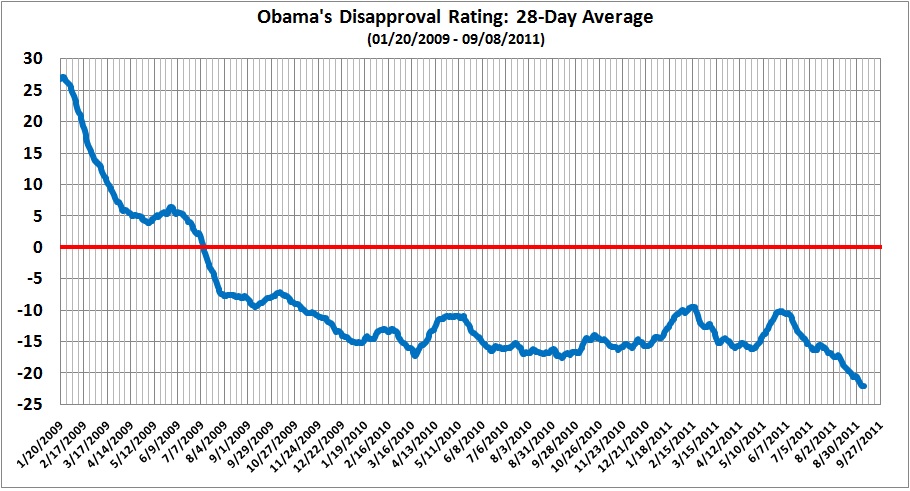
I don’t mean the federal government’s deficit or the jobs deficit. I mean Obama’s popularity deficit, which is s-o-o big:


Derived from Rasmussen Reports, Daily Presidential Tracking Poll.

When it comes to jobs, Don Boudreaux pegs it:

The problem isn’t that consumers aren’t spending; it’s that businesses aren’t investing.  And businesses aren’t investing because Congress and, especially, the administration exhibit a ceaseless fetish for top-down, command-and-control, debt-financed ‘governance’ of the economy – an enterprise-quashing recipe made only more poisonous by Mr. Obama’s soak-the-rich speechifying.

But that won’t keep the O from speechifying about “the rich” and trying to spend and regulate his way out of a recession that he has made worse by enlarging government and its reach, instead of shrinking both.

Related posts:
Taxing the Rich
More about Taxing the Rich
A Keynesian Fantasy Land
The Keynesian Fallacy and Regime Uncertainty
The Great Recession Is Not Over
Why the “Stimulus” Failed to Stimulate

The Arrogance of (Some) Economists

Paul Krugman, former economist, writes:

Think of the government budget as involving tradeoffs similar to those an individual household makes. On one side, there are all kinds of things the government could be doing, from dropping freedom bombs to providing children with dental care; think of each of these things as involving a certain marginal benefit per additional dollar spent, with the marginal benefit declining in the total amount spent on each concern. On the other side, raising revenue has a cost, both the direct cost of the money taken from taxpayers and the possible reduction in incentives from higher tax rates.

What the government should do, in this case, is set all the marginals equal: the marginal benefit of an additional dollar spent on bombs, dental work, national parks, soup kitchens, etc, should all be equal, and this common marginal benefit should equal the marginal cost of raising an additional dollar of revenue.

Krugman must know that the benefits of government programs are unlikely to flow to the persons who bear the costs of those programs. Even if the benefits were to be allocated in such a manner, it would be pure arrogance to assume that income-allocation decisions should be taken from individuals and placed in the hands of government official and bureaucrats. That, of course, is precisely the assumption that underlies government spending. And those who share that assumption, are guilty of the same arrogance. Krugman is so guilty that he should be serving time in a special hell of his own — being forced to listen to the recorded lectures of Milton Friedman, for example.

What is the problem with the kind of cost-benefit analysis prescribed by Krugman? It is this: If you take a dollar from me to make X happier, you have made me less happy, and X’s greater happiness doesn’t compensate for my greater unhappiness. I don’t even have to be a selfish curmudgeon to object to the transfer of my dollar to X. It could be that I wanted to give the dollar to one of my grandchildren, which would have made both me and my grandchild happy. As for X, I couldn’t care less. And it is presumptuous of Krugman (or anyone else) to suggest (even by implication) that it is okay to take a dollar from me just to make X (or a government bureaucrat) happier.

Government, in short, is a tool used by arrogant, self-serving individuals to impose their preferences on others. That is why government should be restricted to a night-watchman role — protecting citizens from predators, foreign and domestic. Anything more than that is social engineering.

Related posts:
Greed, Cosmic Justice, and Social Welfare
Positive Rights and Cosmic Justice
Utilitarianism, “Liberalism,” and Omniscience
Utilitarianism vs. Liberty
The Indivisibility of Economic and Social Liberty
Beware of Libertarian Paternalists
Negative Rights
Negative Rights, Social Norms, and the Constitution
Rights, Liberty, the Golden Rule, and the Legitimate State
The Near-Victory of Communism
Tocqueville’s Prescience
Accountants of the Soul
The Case of the Purblind Economist
Rawls Meets Bentham
The Left
The Divine Right of the Majority
Our Enemy, the State
Government vs. Community
Social Justice
The Left’s Agenda
Positive Liberty vs. Liberty
Taxing the Rich
More about Taxing the Rich
More Social Justice
Luck-Egalitarianism and Moral Luck
The Left and Its Delusions

Why the “Stimulus” Failed to Stimulate

This post examines practical reasons for the failure of “stimulus” to stimulate and the “multiplier” to multiply. The deeper truth is that the Keynesian multiplier is a mathematical fiction, as explained here, and government spending is in fact destructive of economic growth, as discussed here and in some of the posts listed at the end.

I spell out the reasons in “A Keynesian Fantasy Land.” There are six of them, including the timing-targeting problem (number 3).

[In an earlier version of this post, I also mentioned Ricardian equivalence, which is an aspect of reason number 2, the disincentivizing aspects of government borrowing and spending. I referred to a post by Steven Landsburg, which I had read hastily and misinterpreted as a discussion of Ricardian equivalence. When Dr. Landsburg graciously pointed out that I had the wrong end of the stick, I deleted the brief discussion of Ricardian equivalence from this post.]

A key component of the timing-targeting problem is the strong possibility that “stimulus” money will be spent on already-employed resources, thus bidding up their prices but doing little or nothing to stimulate real economic activity. Tyler Cowen recaps two papers that document the misdirection of “stimulus” money:

My colleagues Garett Jones and Daniel Rothschild conducted extensive field research (interviewing 85 organizations receiving stimulus funds, in five regions), asking simple questions such as whether the hired project workers already had had jobs.  There are lots of relevant details in the paper but here is one punchline:

…hiring people from unemployment was more the exception than the rule in our interviews.

In a related paper by the same authors (read them both), here is more:

Hiring isn’t the same as net job creation. In our survey, just 42.1 percent of the workers hired at ARRA-receiving organizations after January 31, 2009, were unemployed at the time they were hired (Appendix C). More were hired directly from other organizations (47.3 percent of post-ARRA workers), while a handful came from school (6.5%) or from outside the labor force (4.1%)(Figure 2).

One major problem with ARRA was not the crowding out of financial capital but rather the crowding out of labor.  In the first paper there is also a discussion of how the stimulus job numbers were generated, how unreliable they are, and how stimulus recipients sometimes had an incentive to claim job creation where none was present.  Many of the created jobs involved hiring people back from retirement.  You can tell a story about how hiring the already employed opened up other jobs for the unemployed, but it’s just that — a story.  I don’t think it is what happened in most cases, rather firms ended up getting by with fewer workers.

There’s also evidence of government funds chasing after the same set of skilled and already busy firms.  For at least a third of the surveyed firms receiving stimulus funds, their experience failed to fit important aspects of the Keynesian model.

The Keynesian model is deeply flawed because it is a simplistic model based on simplistic assumptions about the behavior of human beings and human institutions. I say in “A Keynesian Fantasy Land,” models are supposed to mirror reality, not the other way around. The Keynesian model — or the version embraced by Paul Krugman and his fellow leftists — is a version of the reality that they would prefer: a reality in which government runs the economy.

Related posts:
The Causes of Economic Growth
A Short Course in Economics
Addendum to a Short Course in Economics
The Indivisibility of Economic and Social Liberty
The Price of Government
The Fed and Business Cycles
The Price of Government Redux
The Mega-Depression
Ricardian Equivalence Reconsidered
The Real Burden of Government
Toward a Risk-Free Economy
The Rahn Curve at Work
How the Great Depression Ended
Microeconomics and Macroeconomics
The Illusion of Prosperity and Stability
Experts and the Economy
We’re from the Government and We’re Here to Help You
Estimating the Rahn Curve: Or, How Government Inhibits Economic Growth
Our Enemy, the State
Competition Shouldn’t Be a Dirty Word
The Stagnation Thesis
The Evil That Is Done with Good Intentions
Money, Credit, and Economic Fluctuations
A Keynesian Fantasy Land
“Tax Expenditures” Are Not Expenditures
The Keynesian Fallacy and Regime Uncertainty

Warren Buffet Is an Economic Ignoramus

Warren Buffet is the idiot savant of high finance. Not only would exorbitant taxes on the “super rich” do little to close the deficit or pay down the debt, but it would drive the economy deeper into recession — and perhaps into depression. Why? I will not repeat myself. Read “Taxing the Rich” and “More about Taxing the Rich,” and follow the links at the end of the latter post.

What Free-Rider Problem?

Steven Horwitz of The Coordination Problem writes:

This is an absolutely fascinating article by Laura Vanderkam at City Journal … that explores the role of private donations and private management in caring for Central Park and other green spaces in New York City.  Central Park remains public property, but the Central Park Conservancy that manages it relies overwhelmingly on private donations for its revenues.

But perhaps the most amazing thing about Central Park is how little tax money goes into maintaining it. Though it is still ultimately the city’s responsibility, the park has been managed since the 1980s by the nonprofit Central Park Conservancy, and it relies on private donations for most of its budget.

These are, to use a phrase from the article, “privately funded public spaces.”  It’s also worth noting, as the article does, that the condition of the parks has improved tremendously since the private organizations took over managing them.

This is consistent with my objection to the idea that there are “public goods”:

Public goods are thought to exist because certain services benefit “free riders” (persons who enjoy a service without paying for it). It is argued that, because of free riders, services like national defense be provided by government because it would be unprofitable for private firms to offer such services.

But that analysis overlooks the possibility that those who stand to gain the most from the production of a service such as defense may, in fact, value that service so highly that they would be willing to pay a price high enough to bring forth private suppliers, free riders notwithstanding. The free-rider problem isn’t really a problem unless the producer of a “public good” responds to requests for additional services from persons who don’t pay for those services. But private providers would not be obliged to respond to such requests.

Moreover, given the present arrangement of the tax burden, those who have the most to gain from defense and justice (classic examples of “public goods”) already support a lot of free riders and “cheap riders.” Given the value of defense and justice to the orderly operation of the economy, it is likely that affluent Americans and large corporations — if they weren’t already heavily taxed — would willingly form syndicates to provide defense and justice. Most of them, after all, are willing to buy private security services, despite the taxes they already pay.

I conclude that there is no “public good” case for the government provision of services.

With respect to defense, however, I continue with this:

It may nevertheless be desirable to have a state monopoly on police and justice — but only on police and justice, and only because the alternatives are a private monopoly of force, on the one hand, or a clash of warlords, on the other hand. (See this post, for instance, which also links to related posts.)

But I conclude with this:

You may ask: What about environmental protection? Isn’t it a public good that must be provided by government? No. Read this and this. Which leads me to “market failure.”

“Market failure” is another excuse for unnecessary and costly government intervention into private affairs. Go here and scroll to item 16 for more on that subject.

The Most Effective Stimulus…

…would be the replacement of Obama and Congress’s Democrats by free-market Republicans. See this and this.

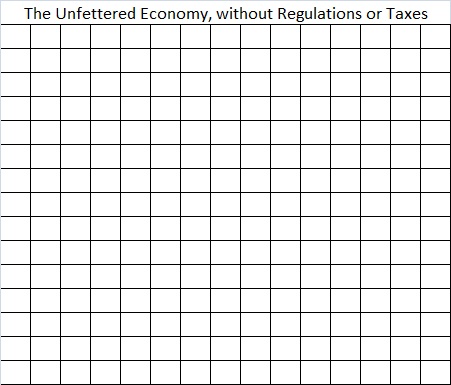
The Economic Effects of Taxes and Regulations, in Pictures

Specialization by economic units and trade between them enables all of them to enjoy more material things than they would if each of the units stood alone. This is “before,” where relatively inefficient economic units stand alone (indicated by the interstices):

With specialization and trade, there can be more economic units, and each of them can make a greater contribution to the output of others:

Taxes shrink the output of economic units by reducing incentives to produce, and by diverting resources to nonproductive, and counterproductive governmental uses. Regulations effectively eliminate many of the units that would otherwise exist and whose products would enable the expansion of all units:

And so, with regulations and taxes as they are today, the economy realizes a fraction of its potential output.

Related posts:
The Price of Government
The Fed and Business Cycles
The Commandeered Economy
The Price of Government Redux
The Mega-Depression
Ricardian Equivalence Reconsidered
The Real Burden of Government
Toward a Risk-Free Economy
The Rahn Curve at Work
The Illusion of Prosperity and Stability
Estimating the Rahn Curve: Or, How Government Inhibits Economic Growth
The Stagnation Thesis
America’s Financial Crisis Is Now
A Keynesian Fantasy Land
The Keynesian Fallacy and Regime Uncertainty

Tax Collector for the Welfare State

That used to be Bob Dole’s informal moniker, because he favored a balanced budget, even if it meant raising taxes to fund the welfare state. It seems that Megan McArdle is stepping into Dole’s shoes. She endorses Standard & Poor’s downgrading of U.S. government debt from AAA to AA+, and S&P’s reasons for the downgrading, including these:

Standard & Poor’s takes no position on the mix of spending and revenue measures that Congress and the Administration might conclude is appropriate for putting the U.S.’s finances on a sustainable footing.

The act calls for as much as $2.4 trillion of reductions in expenditure growth over the 10 years through 2021. These cuts will be implemented in two steps: the $917 billion agreed to initially, followed by an additional $1.5 trillion that the newly formed Congressional Joint Select Committee on Deficit Reduction is supposed to recommend by November 2011. The act contains no measures to raise taxes or otherwise enhance revenues, though the committee could recommend them. (Emphasis added: ED.)

In other words, as far as McArdle is concerned:

  • It doesn’t matter that the federal government’s long-term fiscal path is unsustainable.
  • It doesn’t matter that the path is unsustainable because of present commitments to “entitlement” programs.
  • It doesn’t matter that Republicans have succeeded in pushing the “debate” toward recognition of these facts.

This is not only unprincipled but also stupid.

It’s unprincipled because it means that McArdle — who sometimes calls herself a libertarian, but often talks like a big-government stooge — is willing to sacrifice the financial future of unborn Americans on the altar of a AAA credit rating.

It’s stupid because the debt of the U.S. government will become worthless — AAA rating or not — if it tries to stay the unsustainable course and drives America into the poorhouse by taxing its most productive citizens for the sake of its least productive ones.

So, What Now?

The title of this post echoes the title of a post by Victor Davis Hanson. I don’t agree entirely with Hanson’s diagnosis of America’s economic woes and prescription for curing them, but he points in the right general direction. If I were king, this is what I would do to put the U.S. back on the track to long-term economic health:

  • Social Security, Medicare, Medicaid (and the expansions known as Obamacare) would be phased out. By the time today’s youngest workers are ready for retirement, those programs would no longer exist. The ability of individuals to enjoy comfortable, healthy retirement years would depend on their assiduous prudence, financially and physically. (I am not a stranger’s keeper, and vice versa.) Private financial institutions and insurers would be allowed to compete across State lines for the savings and premiums of newly empowered individuals. States and municipalities would maintain any “safety net” for the truly needy (including those who cannot afford the care associated with serious illnesses and disabilities). Profligate grants of aid, leading to higher State and local taxes, would be  punished at the ballot box and by emigration to locales where income and property are not targets of opportunity for demagogic politicians.
  • All other activities of the federal government that are not authorized by the Constitution would be phased out within ten years. That is to say, all “independent” agencies (especially including the Federal Reserve) would be abolished, along with every department but Defense, Justice, State, and Treasury. Any legitimate functions of the other departments and agencies would be folded into the four that remain, and those four would be thoroughly cleansed of illegitimate functions.
  • The preceding actions would negate most regulatory authority. That which remains would revert to Congress, which would no longer be able to delegate law-making to the executive branch, and which would have to make law strictly within the four corners of the Constitution. Specific targets for termination: regulation of resource extraction, “anti-discrimination” programs that in fact discriminate in favor of certain classes of individuals, environmental regulation (except for truly major environmental threats, and only then as authorized by an amendment to the Constitution), anything having to do with “global warming.” the Food and Drug Administration, and federal involvement in occupational licensing.
  • The streamlining of the federal government would be accompanied by a sale of all assets not required for the execution of constitutional functions. Thus would land and buildings become available for private use, personal and commercial.
  • The federal budget would be in balance — at a much lower level — within a decade. A tough balanced-budget amendment would keep it there. Such an amendment would cap federal spending at 10 percent of GDP, with a minimum of 6 percent of GDP going to defense. There would be an exception for a war (or wars) authorized by Congress, if the combat deployment of more than one-fourth of the personnel of the U.S. armed forces. Then, federal spending could exceed 10 percent of GDP, but only to the extent of the additional costs of the authorized war (or wars). Federal revenues would have to match spending in every 10-year period, plus or minus 1 percent of GDP.

These actions would tell Americans — individuals and businesspersons — two important things. First, they are at long last free in their “pursuit of Happiness.” Second, because they are free, they do not have to worry about government changing the “rules of the game” capriciously or swooping in to take away what they’ve earned.

Only with such freedom and certainty can Americans, once again, confidently strive to make better lives for themselves and, in so doing, help their compatriots to make better lives.

This — not speeches, laws, regulations, taxes, spending, debt-ceiling compromises, etc. — is the stuff of a brighter future, a future that fulfills the promise of the Declaration of Independence.

The Great Recession Is Not Over

Here is my definition of a recession:

  • two or more consecutive quarters in which real GDP lower than real GDP in an earlier quarter, and
  • the year-over-year change in real GDP is negative in at least one quarter.

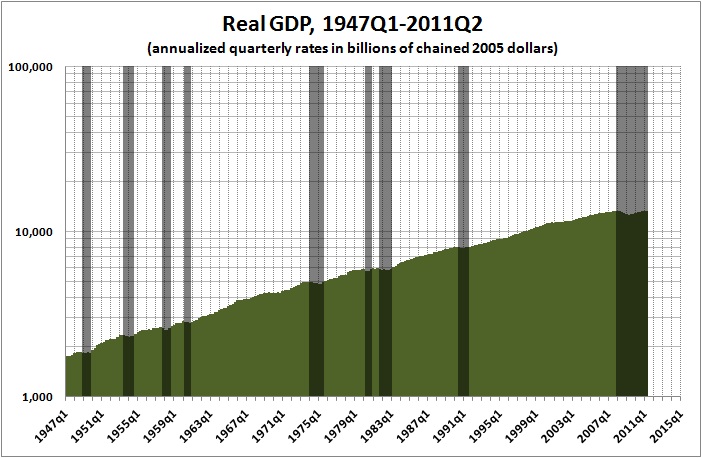
The latest GDP estimates from the Bureau of Economic Analysis indicate that the recession continues. By my definition, it has now lasted 14 quarters: 2008Q1 through 2011Q2. Real GDP for 2011Q2 was $13,270.1 billion (annualized rate, chained 2005 dollars), which is lower than the pre-recession peak of $13,326.0, which was reached in 2007Q4. Average annual real growth over the 3.5 years from 2007Q4 to 2011Q2 was -0.12 percent.

If real growth had continued at the 2007Q4 rate of 2.2 percent, real GDP in 2011Q2 would have been about $14,381 billion. That is to say, the shortfall in real GDP, was about 8 percent. Even worse, if real growth had continued at the 1866-1907 rate of 4.3 percent, real GDP would now be about three times its present level. But that is another story, which is told at the preceding link and several of the links at the bottom of this post.

Returning to the main theme of this post, here is how real GDP has fared from 1947Q1 through 2011Q2 (recessions are denoted by vertical bars):

(I have excluded the recession that was in progress as of 1947Q1 for lack of quarterly GDP estimates before that quarter.)

Here is a closer look at the depth and duration of post-war recessions:

Finally, here are year-over-year changes in real GDP, from the first quarter of 1948 through the third quarter of 2010:

This graph, by the way, updates the one I used in “The Price of Government: More Evidence,” where I say:

You will notice two things about the graph. First, the economy is cyclical, thanks in part to the actions of government (e.g., the low-interest, housing-bubble recession). Second, economic growth has declined from an annual rate of around 4 percent to an annual rate of about 2 percent, because of government.

“Because of government” refers to the unrelenting assault on the private (real) economy, in the form of transfers from productive persons to unproductive ones, other government spending, and ever-growing regulatory restrictions.

Related posts:
The Price of Government
The Fed and Business Cycles
The Commandeered Economy
The Price of Government Redux
The Mega-Depression
Ricardian Equivalence Reconsidered
The Real Burden of Government
Toward a Risk-Free Economy
The Rahn Curve at Work
The Illusion of Prosperity and Stability
Estimating the Rahn Curve: Or, How Government Inhibits Economic Growth
The Stagnation Thesis
America’s Financial Crisis Is Now
A Keynesian Fantasy Land
The Keynesian Fallacy and Regime Uncertainty

Creative Destruction, Reification, and Social Welfare

I was prompted to write this post by Mark Perry’s reprise of Walter Williams’s post about creative destruction.

Joseph Schumpeter used the term creative destruction

to describe the process of transformation that accompanies radical innovation. In Schumpeter’s vision of capitalism, innovative entry by entrepreneurs was the force that sustained long-term economic growth, even as it destroyed the value of established companies and laborers that enjoyed some degree of monopoly power derived from previous technological, organizational, regulatory, and economic paradigms.

The Wikipedia article about creative destruction (just quoted) offers an elaboration:

Companies that once revolutionized and dominated new industries – for example, Xerox in copiers or Polaroid in instant photography have seen their profits fall and their dominance vanish as rivals launched improved designs or cut manufacturing costs. Wal-Mart is a recent example of a company that has achieved a strong position in many markets, through its use of new inventory-management, marketing, and personnel-management techniques, using its resulting lower prices to compete with older or smaller companies in the offering of retail consumer products. Just as older behemoths perceived to be juggernauts by their contemporaries (e.g., Montgomery Ward, FedMart, Woolworths) were eventually undone by nimbler and more innovative competitors, Wal-Mart faces the same threat. Just as the cassette tape replaced the 8-track, only to be replaced in turn by the compact disc, itself being undercut by MP3 players, the seemingly dominant Wal-Mart may well find itself an antiquated company of the past. This is the process of creative destruction in its technological manifestation.

Other examples are the way in which online free newspaper sites such as The Huffington Post and the National Review Online are leading to creative destruction of the traditional paper newspaper. The Christian Science Monitor announced in January 2009 that it would no longer continue to publish a daily paper edition, but would be available online daily and provide a weekly print edition. The Seattle Post-Intelligencer became online-only in March 2009.  Traditional French alumni networks, which typically charge their students to network online or through paper directories, are in danger of creative destruction from free social networking sites such as Linkedin and Viadeo.

In fact, successful innovation is normally a source of temporary market power, eroding the profits and position of old firms, yet ultimately succumbing to the pressure of new inventions commercialised by competing entrants. Creative destruction is a powerful economic concept because it can explain many of the dynamics or kinetics of industrial change: the transition from a competitive to a monopolistic market, and back again….

So far, so good. But then the article implicitly adopts the reification (or hypstatization) fallacy and explicitly endorses the idea of a social-welfare function:

Creative destruction can cause temporary economic distress. Layoffs of workers with obsolete working skills can be one price of new innovations valued by consumers. Though a continually innovating economy generates new opportunities for workers to participate in more creative and productive enterprises (provided they can acquire the necessary skills), creative destruction can cause severe hardship in the short term, and in the long term for those who cannot acquire the skills and work experience.

However, some believe that in the long-term society as a whole (including the descendants of those that experienced short-term hardship) enjoys a rise in overall quality of life due to the accumulation of innovation – for example, 90% of Americans were farmers in 1790, while 2.6% of Americans were farmers in 1990. Over those 200 years farm jobs were destroyed by exponential productivity gains in agricultural technology and replaced by jobs in new industries. Present day farmers and non-farmers alike enjoy much more prosperous lifestyles than their counterparts in 1790.

The reification (or hypostatization) fallacy, which is implicit in the first paragraph of the preceding quotation, is that creative destruction is an actual force which is responsible for good and bad things: better jobs for some workers, worse jobs or none for other workers. But creative destruction is merely a term that refers to the consequences of innovation and entrepreneurship. And these are merely labels for types of activity that are as old as mankind — normal, non-pathological behavior. The results may seem “good” or “bad” to particular individuals, but creative destruction is neither “good” nor “bad.” To evaluate creative destruction in such terms makes no more sense than calling the results of evolution “good” or “bad.” The results of creative destruction, like the results of evolution, are what they are — nothing more, nothing less.

Which points to the second fallacy, which is  explicit in the second paragraph of the preceding quotation. The writer attempts to reconcile the “good” and “bad” results of creative destruction by appealing to the net effect of those results on social welfare (“quality of life”). On that subject, I borrow from myself:

How can a supposedly rational [commentator] imagine that the benefits accruing to some persons … somehow cancel the losses of other persons … ? There is no valid mathematics in which A’s greater happiness cancels B’s greater unhappiness.

By the same token, there is no valid mathematics by which the happiness of a group, or nation, can be summed over time, to justify past hardships in terms of present comforts. Individuals can, and do, make such calculations for themselves when they decide whether or not to postpone current consumption for the sake of obtaining a future goal (a house, retirement, etc.). But those individual calculations cannot be summed, because each individual is making decisions for the sake of his or her unique vision of happiness.

The farm laborers of the past, whose jobs went a-glimmering with the rise of mechanization and other agricultural advances, cannot be compensated by the consumers of today. Those jobs went a-glimmering, in the way that species go extinct, and that is that.

If you (or I) choose to think privately of such outcomes in terms of “bad” and “good,” and react accordingly (e.g., with charitable contributions to help the jobless), the thought and action are legitimate, but personal. “Bad” and “good” have no place in characterizations of unintentional phenomena, such as (the badly named) creative destruction.

Related posts:
Greed, Cosmic Justice, and Social Welfare
Positive Rights and Cosmic Justice
The Interest-Group Paradox
Inventing “Liberalism”
Freedom of Will and Political Action
Law and Liberty
Rights, Liberty, the Golden Rule, and the Legitimate State
Line-Drawing and Liberty
The Divine Right of the Majority
Our Enemy, the State
The Golden Rule and the State
A Not-So-Fine Whine
Social Justice
The Meaning of Liberty
Taxing the Rich
More about Taxing the Rich
Peter Presumes to Preach
More Social Justice
Positive Liberty vs. Liberty
On Self-Ownership and Desert
Luck-Egalitarianism and Moral Luck

A Tax Is a Tax Is a Tax

Some people just don’t get it. A closed loophole is a tax increase, not the end of a tax expenditure. See this.

Now, to be clear, I’m not defending the fact that some people benefit from “loopholes.” I would just as soon abolish all tax codes throughout the U.S., and start over from scratch. I would finance federal, State, and local governments entirely with income taxes, and have one tax rate with no exemptions, deductions, etc. There would be a basic federal rate, to which States and localities could add their own rates. Clarity about the effective tax rates of various States and localities would help businesses and individuals make better decisions about where to locate.

Maybe I’ll start a petition for a constitutional amendment that implements my modest proposal.

Does “Pent Up” Demand Explain the Post-War Recovery?

Russ Roberts wonders about the meaning of “pent up” demand:

The usual way that Keynesians explain the post-[World War II] expansion despite the huge cut in government spending is to say, well of course the economy boomed, there was a lot of pent-up demand. What does that mean? There is always pent-up demand in the sense there is a stuff I wish I could have but can’t. But the standard story is that people couldn’t buy washing machines or cars during the war–they were rationed or simply unavailable or unaffordable. So when the war ended, and rationing and price controls ended, people were eager to buy these things. But the reason these consumer goods were rationed or unavailable is because all the steel went into the tanks and planes during the war. So when the war ended, there was steel available to the private sector. That’s why cutting government activity can stimulate the private sector. Fewer resources are being commandeered by the public sector.

Roberts refers to an earlier post of his, in which he rightly ridicules Keynesians for believing in the magical multiplier:

One of the most mindless aspects of the multiplier is to treat is as a constant, such as 1.52. It can’t be a constant, not in any meaningful way. If the government conscripted half of the US population to dig holes all day and conscripted the other half to fill them back in, and paid each of us a billion dollars a day for the task, and valued holes that were dug and holes that were filled in at a trillion dollars a hole, then GDP would be very very large, unemployment would be zero and there would be no stimulating effect and we would soon be dead from starvation.

Priceless.

I share Roberts’s disdain for the multiplier. (See this and this.)

Nevertheless, the availability of resources for private use after the war ended is only half the story. Consumers and businesses had to demand things — not just want them, but demand them with money in hand. That is where pent-up demand comes into play, as I explain here:

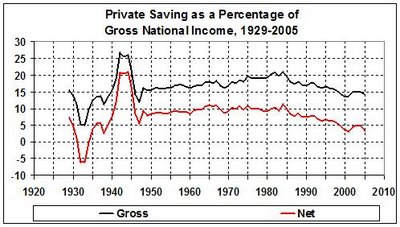
Conventional wisdom has it that the entry of the United States into World War II caused the end of the Great Depression in this country. My variant is that World War II led to a “glut” of private saving because (1) government spending caused full employment, but (2) workers and businesses were forced to save much of their income because the massive shift of output toward the war effort forestalled spending on private consumption and investment goods. The resulting cash “glut” fueled post-war consumption and investment spending.

Robert Higgs, research director of the Independent Institute, has a different theory, which he spells out in “Regime Uncertainty: Why the Great Depression Lasted So Long and Why Prosperity Resumed After the War” (available here), the first chapter his new book, Depression, War, and Cold War. (Thanks to Don Boudreaux of Cafe Hayek for the pointer.) Here, from “Regime Change . . . ” is Higgs’s summary of his thesis:

I shall argue here that the economy remained in the depression as late as 1940 because private investment had never recovered sufficiently after its collapse during the Great Contraction. During the war, private investment fell to much lower levels, and the federal government itself became the chief investor, directing investment into building up the nation’s capacity to produce munitions. After the war ended, private investment, for the first time since the 1920s, rose to and remained at levels sufficient to create a prosperous and normally growing economy.

I shall argue further that the insufficiency of private investment from 1935 through 1940 reflected a pervasive uncertainty among investors about the security of their property rights in their capital and its prospective returns. This uncertainty arose, especially though not exclusively, from the character of federal government actions and the nature of the Roosevelt administration during the so-called Second New Deal from 1935 to 1940. Starting in 1940 the makeup of FDR’s administration changed substantially as probusiness men began to replace dedicated New Dealers in many positions, including most of the offices of high authority in the war-command economy. Congressional changes in the elections from 1938 onward reinforced the movement away from the New Deal, strengthening the so-called Conservative Coalition.

From 1941 through 1945, however, the less hostile character of the administration expressed itself in decisions about how to manage the warcommand economy; therefore, with private investment replaced by direct government investment, the diminished fears of investors could not give rise to a revival of private investment spending. In 1945 the death of Roosevelt and the succession of Harry S Truman and his administration completed the shift from a political regime investors perceived as full of uncertainty to one in which they felt much more confident about the security of their private property rights. Sufficiently sanguine for the first time since 1929, and finally freed from government restraints on private investment for civilian purposes, investors set in motion the postwar investment boom that powered the economy’s return to sustained prosperity notwithstanding the drastic reduction of federal government spending from its extraordinarily elevated wartime levels.

Higgs’s explanation isn’t inconsistent with mine, but it’s incomplete. Higgs overlooks the powerful influence of the large cash balances that individuals and corporations had accumulated during the war years. It’s true that because the war was a massive resource “sink” those cash balances didn’t represent real assets. But the cash was there, nevertheless, waiting to be spent on consumption goods and to be made available for capital investments through purchases of equities and debt.

It helped that the war dampened FDR’s hostility to business, and that FDR’s death ushered in a somewhat less radical regime. Those developments certainly fostered capital investment. But the capital investment couldn’t have taken place (or not nearly as much of it) without the “glut” of private saving during World War II. The relative size of that “glut” can be seen here:

Derived from Bureau of Economic Analysis, National Income and Product Accounts Tables: 5.1, Saving and Investment. Gross private saving is analagous to cash flow; net private saving is analagous to cash flow less an allowance for depreciation. The bulge in gross private saving represents pent-up demand for consumption and investment spending, which was released after the war.

World War II did bring about the end of the Great Depression, not directly by full employment during the war but because that full employment created a “glut” of saving. After the war that “glut” jump-started

  • capital spending by businesses, which — because of FDR’s demise — invested more than they otherwise would have; and
  • private consumption spending, which — because of the privations of the Great Depression and the war years — would have risen sharply regardless of the political climate.

The post continues with an exchange between Higgs and me. The bottom line is the same.

What is the answer to the title question, then? It is that a period of forced, nominal saving can create pent-up demand, which can result in the employment of resources that had theretofore been unavailable. The pent-up demand at the end of World War II was, in great measure, responsible for the post-war recovery.

This rare phenomenon has nothing to do with the multiplier, and probably has nothing to do with the current economic situation. Government has commandeered a large chunk of the American economy, but so gradually that Americans have not acquire a “glut” of nominal savings, as they did in World War II.

The Social Security Trust Fund Is Not a “Get Out of Jail Free Card”

UPDATED BELOW

David Friedman, drawing on an op-ed by Thomas Saving, suggests that

Obama may have a $2.7 trillion dollar get out of jail free card, a way of spending that much additional money without exceeding the debt limit.

How does that work? Friedman explains:

Suppose no agreement is reached on raising the debt limit. Obama instructs the relevant people to spend the income from Social Security on the war in Afghanistan, bailouts, whatever he thinks needs money. He then instructs the Social Security system to cash in as many bonds as are required to meet its obligations to Social Security recipients, say $700 billion. He then instructs the treasury, since the national debt is now $700 billion below the debt limit, to borrow $700 billion. The net effect is that he has increased total expenditure, Social Security included, by $700 billion without exceeding the debt limit. The trust fund is currently at about $2.7 trillion, so he can do it for four more years.

Friedman’s scheme would work only if total federal receipts (including Social Security taxes) remain greater than or equal to total federal outlays (including SS benefits), from the point at which federal indebtedness hits the statutory ceiling. But that is not the situation.

Let us say, for the sake of argument, that the ceiling will be reached at the end of FY 2011. The president’s budget for FY 2012 shows total outlays of $3.729 trillion (including SS benefits of $0.761 T) and total revenues of $2.626 T (including SS taxes of $0.660 T). (See tables S-1 and S-3, here.) In other words, if Congress passes the president’s budget exactly as it stands, the debt ceiling must rise by $1.103 T ($3.729 T – $2.626 T) in FY 2012. And the SS trust fund, no matter how large it is, cannot alter the arithmetic.

Here is why. Suppose the feds spend all $0.660 T in SS taxes on things other than SS benefits (as they will, in effect). From an accounting standpoint, that reduces the non-SS deficit for FY 2012 from $1.001 T (non-SS spending less non-SS receipts) to $0.341 T. But the folks at SS are faced with a bill for $0.761 T in SS benefits. To pay the bill without having received a dime in SS taxes, the SS folks must go to the SS trust fund and grab U.S. treasury bonds with a value of $0.761 T, which they must then present to Tim Geithner for payment. Geithner thinks, “Who are these fools? Do they imagine that I’ve got that much unencumbered cash lying around, when I’m over my head in debt and sinking fast?” But being a good Obamanite, Geithner gives the SS folks their $0.761 T, and they go away happy.

If the analysis stops there, Friedman is correct. The treasury has just redeemed $0.761 T in bonds held by the SS trust fund, and the total debt of the federal government has magically dropped by $0.761 T. But the analysis cannot stop there, because the treasury does not have the $0.761 T in unencumbered cash. It must now borrow $0.761 T, to cover the redemption of the SS trust fund bonds, plus another $0.341 T, to cover the amount by which non-SS outlays exceed total receipts (including the SS taxes that it intercepts). With rounding, that comes to $1.103 T, which just happens to be the amount by which total federal outlays exceed total federal receipts.

Under what conditions would Friedman’s fix work? Here is a list (perhaps not an exhaustive one):

  • The debt ceiling will not be reached, given current projections of federal outlays and receipts (including SS benefits and taxes).
  • The debt ceiling has been reached but will not be exceeded, given current projections of federal outlays and receipts (including SS benefits and taxes).
  • The debt ceiling has been reached, but the surplus from non-SS programs will offset the deficit in SS accounts, or vice versa.

What about the SS trust fund? As long as the federal government is in debt by at least the face value of the SS trust fund, the trust fund has no real value. There is one (unlikely) saving condition, which is that the government’s net worth — represented by real assets — is equal to or greater than the face value of the trust fund. Such assets would have to be authorized for sale, by law, and would have to be valued at their quick-sale price on the open market. Given the reluctance with which Congress and federal agencies part with valuable assets (mainly land), it will be a cold day on the Equator before the SS trust fund is more than a valueless collection of accounting entries.

UPDATE (07/25/11)

The crux of my objection to Friedman’s scheme is found in the original post and my reply to his first comment; viz.:

If the analysis stops there, Friedman is correct. The treasury has just redeemed $0.761 T in bonds held by the SS trust fund, and the total debt of the federal government has magically dropped by $0.761 T. But the analysis cannot stop there, because the treasury does not have the $0.761 T in unencumbered cash….

*     *     *

3. This intra-governmental transaction does not affect the revenues that SS and non-SS receive from third parties.

4. Total spending by SS and non-SS must therefore equal their total receipts from third parties.

I ended my reply with this observation:

If you disagree with this analysis, then you and/or I must be making some assumptions (perhaps inadvertently) that remain hidden from view….

As it turns out, Friedman was making a hidden assumption that allows his scheme to work. That hidden assumption is revealed in a note appended to Friedman’s original post. The note was not there when I published this post, and I was unaware of it when I replied to Friedman’s first comment. In fact, I was unaware of it until late yesterday, when I revisited this post and Friedman’s after receiving his second comment. The note reads:

Some readers seem puzzled as to where the Treasury, in my story, is to find the $700 billion that it is to pay to the Social Security Administration, once the debt limit is reached. The answer is straightforward. With or without a debt limit, the federal government is continually collecting money and spending it. In my scenario, the government takes (say) $50 billion that it was supposed to pay as salary to federal employees, pays it to SSA instead. SSA cancels $50 billion in trust fund bonds. The national debt, which includes the debt owed by the federal government to the SSA, is now $50 billion below the limit, so the Treasury borrows $50 billion and pays out salaries to federal employees. Rinse and repeat as many times as necessary.

This is too clever by half. It requires exquisite timing on the part of the Treasury; otherwise, payrolls are not met, vendors are not paid, and existing debt is not serviced. In other words, the federal government would be in constructive default and violation of the debt limit. Moreover, it most certainly would not allow the federal government’s outlays to exceed its revenues over an extended period, which is why Obama seeks a higher debt limit in the first place. I could stop there, but there’s more to say about the scheme.

It resembles check-kiting, and may be just as illegal. But even if it is not illegal, it amounts to a patent evasion of the debt limit, and the evasion soon would be obvious to knowledgeable observers. Among other things, financial markets probably would react as if the federal government were in default — because the scheme could sooner or later result in a default of some kind (especially if outlays are rising as revenues stay flat). It would not take an act of Congress (over Obama’s veto) to put an end to the scheme; financial markets would do the job, as Treasury would be unable to refinance existing debt, except (possibly) at exorbitant interest rates.

In the best case, climbing interest payments would eat up revenues and force the federal government to cut back on the actual operations and programs. The result would be exactly opposite the one desired by Obama and company, which is real expansion of government. In the worst case, the Federal Reserve would pick up the tab, if it could scrape together a voting majority with the stomach for wading into a political firestorm. But that is another deus ex machina — of dubious durability — and not a surefire way of getting around the debt limit.

I am through with this subject. Comments are closed.

UPDATE (06/08/14)

I note, very belatedly, that Friedman later amended his post to add this:

A friend who knows much more law than I do writes:

It turns on, on further research, that Congress anticipated and prevented the very trick you have devised. Public Law 104-121, section 107(a), prohibits redemption of Social Security trust fund securities prior to maturity for any purpose other than the payment of benefits or administrative expenses.So it’s still true that the debt limit cannot block social security payments, at least until the trust fund runs out. But my multi-trillion dollar get out of jail free card has been cancelled.

Curses, foiled again.

Friedman later wrote a post that is properly focused on the ability of the federal government to continue paying SS benefits, regardless of the debt ceiling, as long as the trust fund is sufficiently large. The trustees expect the fund to be exhausted in 2033.

Miss Brooks’s “Grand Bargain”

The idiot known as David Brooks — The New York Times‘s idea of a conservative — is true to form today:

Imagine you’re a member of Congress. You have your own preferred way to reduce debt. If you’re a Democrat, it probably involves protecting Medicare and raising taxes. If you’re a Republican, it probably involves cutting spending, reforming Medicare and keeping taxes low.

Your plan is going nowhere. There just aren’t the votes. Meanwhile, the debt ceiling is fast approaching and a national catastrophe could be just weeks away.

At the last minute, two bipartisan approaches heave into view. In the Senate, the “Gang of Six” produces one Grand Bargain. Meanwhile, President Obama and John Boehner, the House speaker, have been quietly working on another. They suddenly seem close to a deal.

There’s a lot you don’t know about these two Grand Bargains….

You are being asked to support a foggy approach, not a specific plan. You are being asked to do this even though you have no faith in the other party and limited faith in the leadership of your own. You are being asked to risk your political life for an approach that bears little resemblance to what you would ideally prefer.

Do you do this? I think you do….

You do it because while the Grand Bargains won’t solve most of our fiscal problems. They will produce some incremental progress. We won’t fundamentally address the debt until we control health care inflation….

Both Grand Bargains produce real fiscal progress. They aim for $3 trillion or $4 trillion in debt reduction. Boehner and Obama have talked about raising the Medicare eligibility age and reducing Social Security benefit increases. The White House is offering big cuts in exchange for some revenue increases, or small cuts in exchange for few or none. The Gang of Six has a less-compelling blend of cuts, but it would repeal the Class Act, a health care Ponzi scheme. It would force committees across Congress to cut spending, and it would introduce an enforcement mechanism if they don’t. Sure there’s chicanery, but compared with any recent real-life budget, from Republican or Democratic administrations, these approaches are models of fiscal rectitude.

You do it because both bargains would boost growth. The tax code really is a travesty and a drag on the country’s economic dynamism. Any serious effort to simplify the code, strip out tax expenditures and reduce rates would have significant positive effects — even if it raised some tax revenues along the way….

In other words, Republicans should simply give in, on Miss Brooks’s say-so.

But Miss Brooks doesn’t know what he’s talking about.

First, with respect to “health care inflation,” government is the problem, not the solution. There are two key reasons for rising health-care prices, aside from innovation that yields expensive but effective drugs, procedures, and equipment. They are (a) the tax break that enables employers to subsidize employees’ health plans and (b) the subsidization of old folks’ health care via Medicare and (indirectly) SS. Those two interventions result in the overuse of health-care products and services. (There’s a 25-year old but still valid RAND study on the subject.) A far better system — if one insists on government involvement — would be to provide means-tested vouchers that can be redeemed for a  limited menu of vital medical products and services (e.g., critical surgeries, cardiovascular medications, chemotherapy). That’s it — no more Medicare, Medicaid, or their expansion via Obamacare.

Second, with respect to “tax expenditures” — there ain’t no such thing. Any action that results in higher taxes is a tax increase, no matter what Miss Brooks and his fellow Democrats choose to call it. And tax increases are growth inhibitors, not growth stimulators.

So much for the wisdom of The New York Times‘s pet “conservative.”

Related posts:
The Laffer Curve, “Fiscal Responsibility,” and Economic Growth
Our Miss Brooks
Rationing and Health Care
The Perils of Nannyism: The Case of Obamacare
More about the Perils of Obamacare
Health-Care Reform: The Short of It
Toward a Risk-Free Economy
Undermining the Free Society
The Constitution: Original Meaning, Corruption, and Restoration
The Unconstitutionality of the Individual Mandate
Does the Power to Tax Give Congress Unlimited Power?
Does Congress Have the Power to Regulate Inactivity?
“Tax Expenditures” Are Not Expenditures
My Negotiating Position on the Federal Debt