The Shape of Things to Come

Given the “State of the Union: 2010,” you may wonder how much worse things can get in this land of the once-free. Here are some very real possibilities:

  • More curbs on freedom of speech, in the name of “protecting” certain groups (e.g., homosexuals, immigrants, Muslims) and “preserving public order” (i.e., protecting government and government officials from criticism).
  • A complete government takeover of medical services (a U.S. National Heath Service), with no provision for opting-out to private care.
  • Environmentalism and warmism rampant, with draconian restrictions on everything from where we live, the design of our housing, and the range of products and services we are allowed to buy.
  • A stagnant economy — crushed by the weight of entitlement programs, environmentalism, warmism, and income equalization — affords a lower quality of life (on a par with the U.S. of the 1950s), and is unable to support a robust defense against foreign enemies.
  • Further reductions in quality of life, brought about by economic isolation, arising partly out of protectionism, partly out of voluntary withdrawal from overseas interests (in the name of self-sufficiency), and partly out of our unwillingness and inability to defend our overseas interests in the face of superior Chinese and Russian forces.
  • The erosion of traditional morality — aided by governmental endorsement of moral relativism — leading to the increasing brutalization of the citizenry and an eventual police-state response.

I could expand the list, but it is already depressing enough.

If you cannot participate in the efforts of the Tea Party movement, the American Conservative Union, and the Club for Growth to roll back the forces of oppression in this land, support those organizations with your dollars. Every little bit helps.

The State of the Union: 2010

We are in a state of statism.

Statism, as I have said,

boils down to one thing: the use of government’s power to direct resources and people toward outcomes dictated by government. . . .

The particular set of outcomes toward which government should strive depends on the statist who happens to be expounding his views. But all of them are essentially alike in their desire to control the destiny of others. . . .

“Hard” statists thrive on the idea of a powerful state; control is their religion, pure and simple. “Soft” statists [sometimes] profess offense at the size, scope, and cost of government, but will go on to say “government should do such-and-such,” where “such-and such” usually consists of:

  • government grants of particular positive rights, either to the statist, to an entity or group to which he is beholden, or to a group with which he sympathizes
  • government interventions in business and personal affairs, in the belief that government can do certain things better than private actors, or simply should do many things other than — and sometimes in lieu of — dispensing justice and defending the nation.

Hard statists simply reject liberty. Soft statists reject it in fact even as they claim to embrace it in principle. Together, hard and soft statists have harnessed themselves and the liberty-loving minority to the yoke of the state. It is by this tyranny of the majority that America has descended into Europeanism, from which there can be no escape unless the liberty-loving minority begins actively to resist it — as did a similar minority in 1775.

If you are a “fish in water,” and cannot see the extent to which America is in thrall to statism — nationally, regionally, and locally — consider these examples of the ways in which statism grips us:

1. Compulsory public education has been used by statists to inculcate statism. Higher education — especially the so-called liberal arts — is dominated by the products of statist inculcation.

2. “Free enterprise” and freedom of personal action are barely more free than they were under Hitler or Mussolini. If you doubt that, consider the hundreds of thousands of pages comprised in the U.S. Code, its implementing regulations, and the statutes, codes, and ordinances of States and municipalities.

3.  “Private property” has gone by the wayside, in company with “free enterprise,” thanks to the same enactments. If you doubt that, think about compulsory unionism, smoking bans, the continuing misuse of eminent domain, and various restrictions on the sale and use of personal and business property.

4. Productive Americans, on the whole, pay about half of their income to their governments, for the purpose of supporting the counterproductive activities of those governments and their clients. Some of those productive Americans endorse and support this confiscatory regime because (a) they don’t understand its costs and consequences; (b) it makes them feel good; and (c) they subscribe to the Nirvana fallacy, in which an all-good, all-knowing government can (somehow) do the “right” things and do them “right.” The persistence of the Nirvana fallacy owes much to compulsory public education (point 1).

5. Our prosperity, such as it is, waxes and wanes with the whims of the Federal Reserve, which has the power to inflate, to  feed bubbles, to cause depressions, and to fund government’s profligate spending (where taxation is insufficient or politically unpopular).

6. Incentives to work and save — to be self-reliant, in other words — have been diminished by the establishment of welfare “rights,” Social Security, Medicare, and Medicaid. To this list has been added the expansion of Medicare-Medicaid known as Obamacare.

7. Affirmative action, equal lending opportunity, equal housing opportunity, and other  “preference” schemes penalize the more-capable at the expense of the less-capable. In a single stroke, such schemes enable advancement based on personal characteristics instead of merit, while destroying freedom of association and freedom of contract.

8. Various legislative, executive, and judicial acts have led to a kind of perverted legality that requires prisoners to be released when prisons become “overcrowded”; allows unborn and partially born human beings to be killed on a whim; stifles the free expression of political views for which the Founders fought and suffered; and treats foreign enemies as mere criminals with the same jurisprudential rights as the American citizens whose lives and property they would destroy.

There is much more, but that is all I can bear to acknowledge in a single post.

Is it any wonder that the Tea Party movement enjoys strong support, that Barack Obama (our statist-in-chief) merits strong disapproval, or that we must resort to civil disobedience if we are to enjoy a smattering of liberty?

Have a nice day!

As Goes Greece . . .

. . . so goes the United States? Well, maybe the dependents of our welfare state won’t riot. But, riots aside, the U.S. has much in common with Greece: a huge and rising burden of government (accompanied by a huge and rising burden of government debt), leading to economic stagnation.

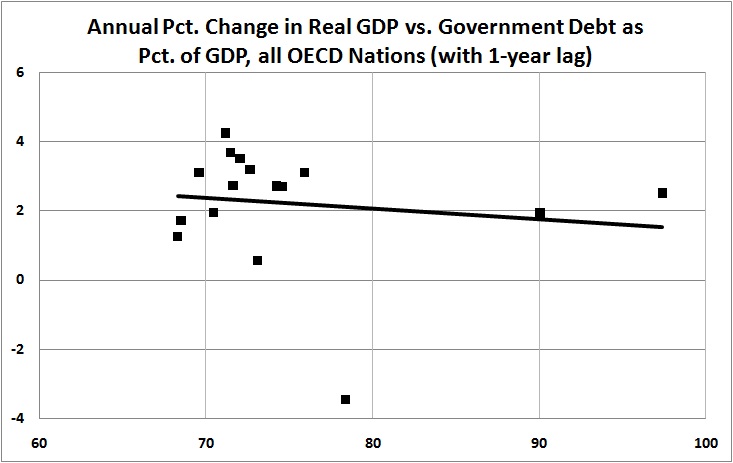
As for how the burden of government stagnates an economy, I’ve said plenty. See especially this and this. For more evidence, I turn to statistics and projections available from the Organization for Economic Cooperation and Development (OECD), which has 31 (mostly Western) member nations:

Derived from tables 1 and 32, available at OECD Economic Outlook No. 86 Annex Tables — Table of Contents. The debt-burden statistics represent gross government debt for 1995-2010. The changes in GDP are for 1996-2011.

How fares the debt burden of the United States? Not well:

Derived from OECD annex table 32. I use gross debt because net debt understates the debt burden. For example, it treats the federal government’s IOUs to the Social Security Trust Fund as if they were legitimate assets, which they are not.

All Euro zone countries are represented by the wide, gold line. Greece is a Euro zone country, but I have plotted its debt burden separately to highlight its plight. Japan, the most burdened OECD country, is infamous for its economic stagnation. And there’s the U.S. (wide, blue line) moving ahead of the Euro zone, and not far behind Greece. What’s worse is that the outlook for the U.S. beyond 2011 is deeper debt.

Here’s Robert J. Samuelson’s (correct) analysis of the situation:

What we’re seeing in Greece is the death spiral of the welfare state. This isn’t Greece’s problem alone, and that’s why its crisis has rattled global stock markets and threatens economic recovery. Virtually every advanced nation, including the United States, faces the same prospect. Aging populations have been promised huge health and retirement benefits, which countries haven’t fully covered with taxes. The reckoning has arrived in Greece, but it awaits most wealthy societies. . . .

The welfare state’s death spiral is this: Almost anything governments might do with their budgets threatens to make matters worse by slowing the economy or triggering a recession. By allowing deficits to balloon, they risk a financial crisis as investors one day — no one knows when — doubt governments’ ability to service their debts and, as with Greece, refuse to lend except at exorbitant rates. Cutting welfare benefits or raising taxes all would, at least temporarily, weaken the economy. Perversely, that would make paying the remaining benefits harder.

Greece illustrates the bind. To gain loans from other European countries and the International Monetary Fund, it embraced budget austerity. Average pension benefits will be cut 11 percent; wages for government workers will be cut 14 percent; the basic rate for the value added tax will rise from 21 percent to 23 percent. These measures will plunge Greece into a deep recession. In 2009, unemployment was about 9 percent; some economists expect it to peak near 19 percent.

If only a few countries faced these problems, the solution would be easy. Unlucky countries would trim budgets and resume growth by exporting to healthier nations. But developed countries represent about half the world economy; most have overcommitted welfare states. They might defuse the dangers by gradually trimming future benefits in a way that reassured financial markets. In practice, they haven’t done that; indeed, President Obama’s health program expands benefits. What happens if all these countries are thrust into Greece’s situation? One answer — another worldwide economic collapse — explains why dawdling is so risky.

Can Markets Force Fiscal Discipline?

Today’s market meltdown was triggered by the fear that Greece’s financial problems will spread to other European governments, and then to the United States. Greece’s problems can be described simply: The government cannot afford to pay the debts it owes because it has expanded the welfare state at the behest of its ignorant, greedy citizens. Moreover, the problems of Greece will spread to other Euro-zone nations if and as they incur debt in order to bail out Greece. (Recommended reading: “The Mother of All Bubbles.”)

Now, change “Greece” to the “United States” and you have a perfect description of what is likely to happen in this country if “our” government continues to drive us along the road to Europeanism.

The question of the day is whether the strongly negative response of financial markets to the situation in Europe will cause Europe’s “leaders” — and our own — to re-think their commitment to fiscal profligacy. Or, as seems more likely, will those “leaders” be so fearful of reneging on their irredeemable promises to their political constituents that they fall back on the time-honored “remedy” known as hyperinflation?

Hyperinflation — which is easy enough for central bankers to engineer — “solves” the problem of debt by smothering it under a mountain of new money. The problem with that “solution,” of course, is that it affects not just a government’s creditors but every economic actor. Real economic activity grinds to a near-standstill as vendors raise their prices to unaffordable levels in anticipation of facing even higher prices for their factors of production. Entrepreneurs give up on business formation for the same reason. In the end, a vibrant economy based on money and credit is reduced to a stagnant, near-subsistence economy based on personal relationships and barter.

Which way will Europe and the United States go? I have little confidence that our “leaders” will choose the path of fiscal discipline. They are especially unlikely to choose the path that encourages economic growth by shrinking the welfare state.

Discounting and “Libertarian” Paternalism

Richard Thaler is a leading proponent of “libertarian” (or “soft”) paternalism. But there is nothing “libertarian” or “soft” about paternalism, no matter what it’s called. (See this, for example.)

Thaler’s embrace of paternalism springs from arrogance — the presumption that he knows how others should lead their lives. A sign of that arrogance, and one that finds its way into Thaler’s rationale for paternalism, is the identification of well-being with wealth-maximization.

The surest route to wealth-maximization — for the Thalers of this world — is to evaluate alternative courses of action by discounting projected streams of revenues (income) or costs (expenses). Consider the following passage from an old paper of Thaler’s:

A discount rate is simply a shorthand way of defining a firm’s, organization’s, or person’s time value of money. This rate is always determined by opportunity costs. Opportunity costs, in turn, depend on circumstances. Consider the following example: An organization must choose between two projects which yield equal effectiveness (or profits in the case of a firm). Project A will cost $200 this year and nothing thereafter. Project B will cost $205 next year and nothing before or after. Notice that if project B is selected the organization will have an extra $200 to use for a year. Whether project B is preferred simply depends on whether it is worth $5 to the organization to have those $200 to use for a year. That, in turn, depends on what the organization would do with the money. If the money would just sit around for the year, its time value is zero and project A should be chosen. However, if the money were put in a 5 percent savings account, it would earn $10 in the year and thus the organization would gain $5 by selecting project B. (Center for Naval Analyses,  “Discounting and Fiscal Constraints: Why Discounting is Always Right,” Professional Paper 257, August 1979, pp. 1-2)

More generally, the preferred alternative — among alternatives conferring equal benefits (effectiveness, output, utility, satisfaction) — is the one whose cost stream has the lowest present value:

the value on a given date of a future payment or series of future payments, discounted to reflect the time value of money and other factors such as investment risk.

It is my view that economists seize on discounting as a way of evaluating options because it is a trivial exercise to compute the present value of a stream of outlays (or receipts). I should say that discounting seems like a trivial exercise because the difficult tasks — choosing a time horizon, choosing a discount rate, and translating outlays into future benefits — are assumed away.

Consider the choices facing a government decision-maker. In Thaler’s simplified version of reality, a government decision-maker (manager) faces a choice between two projects that (ostensibly) would deliver equal benefits (effectiveness, output), even though their costs would be incurred at different times. Specifically, the manager must choose between project A, at a cost of $200 in year 1, and equally-effective project B, at a cost of $205 in year 2. Thaler claims that the manager can choose between the two projects by discounting their costs:

A [government] manager . . . cannot earn bank interest on funds withheld for a year. . . .  However, there will generally exist other ways for the manager to “invest” funds which are available. Examples include cost-saving expenditures, conservation measures, and preventive maintenance. These kinds of expenditures, if they have positive rates of return, permit a manager to invest money just as if he were putting the money in a savings account.

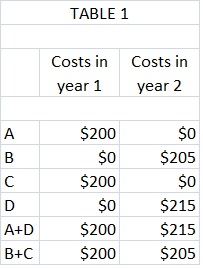
. . . Suppose a thorough analysis of cost-saving alternatives reveals that [in year 2] a maintenance project will be required at a cost of $215. Call this project D. Alternatively the project can be done [in year 1] (at the same level of effectiveness) for only $200. Call this project C. All of the options are displayed in table 1.

Discounting in the public sector_table 1

(op. cit, pp. 3-4)

Thaler believes that his example clinches the argument for discounting because the choice of project B (an expenditure of $205 in year 2) enables the manager to undertake project C in year 1, and thereby to “save” $10 in year 2. But Thaler’s “proof” is deeply flawed:

  • If a maintenance project is undertaken in year 1, it will pay off sooner than if it is undertaken in year 2 but, by the same token, its benefits will diminish sooner than if it is undertaken in year 2.
  • More generally, different projects cannot, by definition be equally effective. Projects A and B may be about equally effective by a particular measure of effectiveness, but because they are different things they will differ in other respects, and those differences could be crucial in choosing between A and B.
  • Specifically, projects A and B might be equally effective when compared quantitatively in the context of an abstract scenario, but A might be more effective in an unquantifiable but crucial respect. For example, the earlier expenditure on A might be viewed by a potential enemy as a more compelling deterrent than the later expenditure on B because it would demonstrate more clearly the government’s willingness and ability to mount a strong defense against the potential enemy.
  • The “correct” discount rate depends on the options available to a particular manager of a particular government activity. Yet Thaler insists on the application of a uniform discount rate by all government managers (op. cit., p. 6). By Thaler’s own example, such a practice could lead a manager to choose the wrong option.
  • For a decision to rest on the use of a particular discount rate, there must be great certainty about the future costs and benefits of alternative courses of action. But there seldom is. The practice of discounting therefore promotes an illusion of certainty — a potentially dangerous illusion, in the case of national defense.

The fundamental problem is that Thaler presumes to place himself in the position of the decision-maker. But every decision-maker — from a senior government executive to a young person starting his first job — has a unique set of objectives, options, uncertainties, and risk preferences. Because Thaler cannot locate himself in a decision-maker’s unique situation, he can exercise his penchant for arrogance only by insisting that each and every decision-maker adhere to a simplistic rule of thumb — one that obtains results favored by Thaler.

In the context of personal decision-making — which is the focal point of “libertarian” paternalism — the act of discounting serves wealth-maximization (a favored paternalistic objective). But, as I have said,

[t]here is simply a lot more to maximizing satisfaction than maximizing wealth. That’s why some people choose to have a lot of children, when doing so obviously reduces the amount they can save. That’s why some choose to retire early rather than stay in stressful jobs. Rationality and wealth maximization are two very different things, but a lot of laypersons and too many economists are guilty of equating them.

The 34-year-old Richard Thaler of 1979 was arrogantly wrong about government decision-making. The 65-year old Thaler of 2010 is — and has been — arrogantly wrong about personal decision-making.

I will have more to say about Thaler’s wrong-headedness. In the meantime, read this post and follow the links therein.

Is the Recession Still On?

Yes, by my definition of a recession:

  • two or more consecutive quarters in which real GDP (annualized) is below real GDP (annualized) for an earlier quarter, during which
  • the annual (year-over-year) change in real GDP is negative, in at least one quarter.

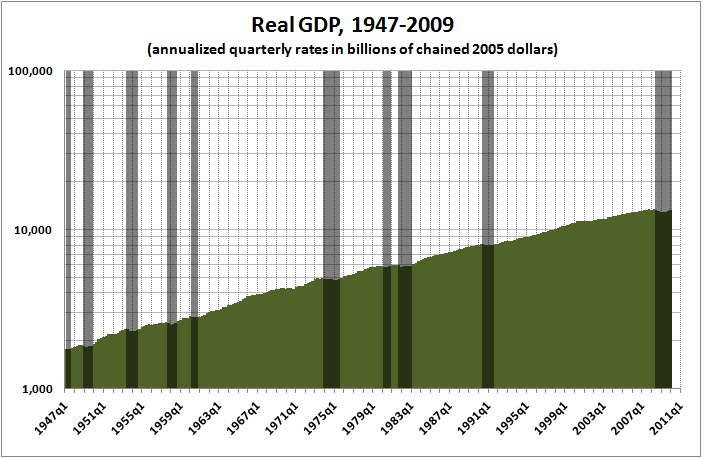
Here’s how real GDP has fared from the first quarter of 1947 through the first quarter of 2010 (recessions are denoted by vertical bars):

This picture is misleading, of course, because it fails to depict the length and depth of America’s mega-depression, which is now more than a century old and deepening every day.

Blasts from the Past

I have republished much of the pre-blog (“home page”) version of my old blog, Liberty Corner, in 29 posts at The Original Liberty Corner. (There’s a link to TOLC in the right sidebar, for permanent access.) Some of the material at TOLC is dated; most of it remains current; some of it is prescient.

The preceding post, “First Principles,” is based on one of my early contributions to the pre-blog version of Liberty Corner. From time to time, I will update other material and re-post it at this blog.

Economic "Wisdom"

Even though Stephen Jay Gould once accused social scientists of “physics envy,” he did not deter economists’ efforts to practice the dismal science as if it were really a science. Thus, for example, a Robert Shiller of Yale University arms himself with data about the past performance of the stock market and warns us that the Dow will lunge from 8,000 (make that 9,000 . . . 10,000 . . . 11,000) to 6,000 or less. The problem with such analytical exercises is that they tell us what has happened but not what will happen. Statistics predict the past with uncanny accuracy.

Not that Professor Shiller is entirely wrong about the future performance of the stock market. He is almost certainly right, in principle, because the only known monotonic trends in the universe are its expansion and its aging — and a lot of physicists aren’t sure about the permanence of those trends. No, Professor Shiller will probably be right, some day, because — as the old saying goes — a stopped watch is right twice a day.

John Maynard Keynes (created Lord Keynes for his services to economic thought and to some members of the Bloomsbury Set) averred that a government could spend an economy out of a depression. In spite of Keynes, the United States and Great Britain remained mired in the Great Depression for most of the 1930s. Some have argued that Keynes was vindicated by post-World War II prosperity, which they attribute to the the binge of consumer spending spawned by the massive infusion of government spending in wartime. That argument overlooks the inconvenient possibility that the Great Depression, like earlier depressions, would have ended without the benefit of government largesse. The argument also overlooks the fact that, unlike the United States, Great Britain did not plunge into prosperity at the end of World War II.

One could argue that Germany and Japan proved Keynes right because unemployment in those countries vanished in the face of their massive arms buildups. Yes, and one could say that the members of a chain gang are well off because they have “jobs.”

Enough of old feuds. Let us return to the present scene.

Today’s “green economists” advance the notion that free markets are all right in their place — but not when it comes to protecting the environment. Conjuring dire results for humankind if markets continue to cater to the crass demands of consumers, those economists would commandeer the economy in the name of future generations yet unborn. (Sound the trumpets! Wave the flag!) If one reasonably assumes that such economists know that there are market-based ways to solve the problems caused by pollution, what is one to make of their anti-market rhetoric? Answer: Just like any consumer of “political pork,” they’re perfectly willing to have the government aggrandize their own (psychic) income at the expense of the general welfare. That is, they simply don’t like economic growth and don’t care who is hurt by their anti-growth propoganda.

Consider, finally, the antediluvian agitators for antitrust actions against successful companies. The scions of Roosevelt the First seem to be stuck in a zero-sum view of the economic universe, in which “winners” must perforce be balanced by “losers.” Or perhaps they, like their green brethren, suffer a form of success envy.

Whatever the case, the antitrusters forget (or wish not to remember) that (1) successful companies become successful by satisfying consumers, (2) consumers wouldn’t buy the damned stuff if they didn’t think it was worth the price, and (3) “immense” profits invite competition (direct and indirect), which benefits consumers. On the third point, if the USPS — a government monopoly that claims to own my mailbox — can’t stave off competition from alternative delivery services and e-mail, what’s to keep a new Bill Gates from building a better mouse (pun) trap? Only the fear of being pursued by the almighty federal government. Thanks a lot, feds.

All of which underscores another old saying: A sucker is born every minute — and then he moves to Washington.

Miscellany, Potpourri, and Other Stuff That Comes to Mind

  • If there’s welfare for devastated foreigners, farmers, and owners of beachfront property, why not welfare for the devastated taxpayer? Give us a break — a tax break.
  • Re the “patients’ bill of rights”: The doctors have made their bargain with the devil — and we’ll all pay the bill.
  • Taxes and regulations drain almost half of the output of the U.S. economy. Where’s the outrage?
  • It’s time for the annual installment of “As the Fiscal Year Turns.” Stay tuned as the media foment fear and loathing of the Republican-controlled Congress — the evil-doer in this annual budget drama. Will the evil Congress shut down the government? Will the good guys in the White House come to the rescue and keep the government running? Frankly, my dears, who gives a damn? Does the federal government run our lives or are “we the people” in charge of ourselves? Shut it down. Let them eat red tape in Washington.
  • Truth is to government as daylight is to vampires.
  • Kansas is to science as a gorilla is to tapdancing.
  • If a nation must draft its soldiers, is it a nation worth fighting for?
  • Democrats — having embraced balanced budgets as a sign of “fiscal responsibility” — must keep taxes high to keep the welfare state intact. They know where their votes come from.
  • The latest liberal bogeyman is “urban sprawl.” Of course there’s urban sprawl. Not everyone wants to live in the hot, crowded, noisy, filthy confines of downtown Washington, D.C. — and its ilk — and pay twice what it costs to live in the suburbs. Unlike the rest of us, Al Bore and his fellow limousine liberals can live in the city and remain well-insulated from the “joys” of city life.
  • Patients already have the right to pay for uninsured medical expenses. The so-called “patients’ bill of rights” is merely a way of forcing everyone else to chip in. But some people still believe in free lunches — or free-loading.
  • The government’s so-called budget surplus is merely the difference between extortionate taxes and extravagant spending.
  • Instead of government of the people, by the people, for the people, we have government of the people, by the politicians, for the special interests.
  • GOP = Groveling Over-the-hill Party.
  • The GOP in 1994 was the “party of ideas”; the GOP in 1999 is the “party of pushovers” (for big-government liberals). What more proof do we need that a “principled politician” is a rare beast if not an oxymoron?
  • Given the events of the last year, it would be a good idea to limit politicians to a total of one term of office, any office, per lifetime.
  • Isn’t it odd that the draft-dodgers of the Vietnam era — who are now safely out of harm’s way — favor foreign adventures?
  • There’s really little difference between conservatives — who like government when it gives the “right” answers — and liberals — who like government when it gives the “left” answers. Both like government as long as they’re in charge of it.
  • In the best of all worlds, the end of the impeachment trial would mean the end of news from Washington.
  • Arguing about what to do with the budget surplus is like arguing about how to split the loot from a bank robbery.
  • The government that wants to invest your Social Security “contributions” for you is the same government that sued Microsoft for being “too” successful.
  • If the President is responsible for peace in the world and prosperity at home, he must be responsible for good weather and low golf scores as well.
  • Could Republicans and Democrats follow the NBA’s example and delay the start of the 2000 campaign until, say, after November 7, 2000?
  • If we’re truly lucky the Y2K bug will shut down TV for the duration of the next presidential campaign.
  • A race between Gore and Bush seems likely, which means that we’ll have another four-letter President.
  • If the Founding Fathers had been guided by polls we would be known as the Undecided States of America.
  • A politician is often a lawyer who has to hire other lawyers to keep himself out of jail.
  • Those who say that the era of big government is over he must be talking about the Soviet Union.
  • Here’s a success strategy for the Republicans: Drive the religious right out of the party and into the arms of the Democrats.
  • Old saying: “If you need a friend in Washington, buy a dog.” New corollary: “Check the dog for a wire before taking it home.”

First Principles

The Constitution is for “we the people,” not “we the politicians” or “we the bureaucrats.”

A society is formed by the voluntary bonding of individuals into overlapping, ever-changing groups whose members strive to serve each others’ emotional and material needs. Government — regardless of its rhetoric — is an outside force that cannot possibly replicate societal bonding, or even foster it. At best, government can help preserve society — as it does when it deters aggression from abroad or administers justice. But in the main, government corrodes society by destroying bonds between individuals and dictating the terms of social and economic intercourse — as it does through countless laws, regulations, and programs, from Social Security to farm subsidies, from corporate welfare to the hapless “war” on drugs, from the minimum wage to affirmative action. On balance, the greatest threat to society is government itself.

The promises made in America’s Constitution are valid only within the United States, not across international borders. Even with the benefit of a common Constitution, we Americans find it harder every year to honor and respect each other’s lives, fortunes, and honor. Expecting other nations to behave as if they were bound by our Constitution is like trusting Hitler in the 1930s — an exercise in false hope and self-delusion.>Free speech is a right. A free pass based on gender, race, religion, or any other incidental characteristic is extortion.

Liberty is not anarchy, nor is it the government dictating how we may live our lives and pursue happiness.

Liberty: the right to make mistakes, to pay for them, and to profit by learning from them.

The best government is that which walks the fine line between the tyranny of anarchy and the tyranny of special interests.

The constitutional contract charges the federal government with keeping peace among the States, ensuring uniformity in the rules of inter-State and international commerce, facing the world with a single foreign policy and a national armed force, and assuring the even-handed application of the Constitution and of constitutional laws. That is all.

The business of government is to protect the lawful pursuit and enjoyment of income and wealth, not to redistribute them.

Each citizen is a unique minority of one who should enjoy the same rights as all other minorities.

The most precious right these days is the right to be left alone.

Whither Inflation?

Who knows? My only observations: The recent up-tick is consistent with price behavior during an economic recovery. And, even with the up-tick, the current year-over-year rate of inflation is in line with the down-trend that began in 1980.


Derived from U.S. Department Of Labor, Bureau of Labor Statistics: Consumer Price Index, All Urban Consumers – (CPI-U), U.S. city average, All items, 1982-84=100.

UPDATED 05/27/10: See this post for an alternative estimate of the rate of inflation.

The Once and Future Ration Book

Our children and grandchildren will need ration books for medical services if Obamacare isn’t repealed. How else will medical services be acquired when providers exit in the face of arbitrary fee caps, when demand soars because of universal access to “cheap” or “free” medical services, and when private insurance companies have been squeezed out of business by government?

In anticipation of that bleak future, I dug out one of my World War II ration books and updated it. Here’s the revised cover (“health” replaces “war”), followed by a page of ration coupons:

The howitzer motif is appropriate, given that Obamcare is a war on medicine and liberty. Other coupon pages feature equally appropriate symbols: tanks, aircraft carriers, and dive bombers.

The Mega-Depression

In the preceding post, I offered my definition of recession and asked whether the current one has ended. (The answer: not yet, but I may know soon — or sooner than the official score-keepers at the National Bureau of Economic Research.) It since occurred that to focus on the current recession — or any recession — is to ignore America’s mega-depression, which is now more than a century old.

As I explain here, the mega-depression began in the early 1900s, when the economy began to sag under the weight of “progressivism” (e.g., trust-busting, regulation, the income tax, the Fed). Then came the New Deal, whose interventions provoked and prolonged the Great Depression (see, for example, this, and this). From the New Deal and the Great Society arose the massive anti-market/initiative-draining/dependency-promoting schemes known as Social Security, Medicare, and Medicaid. The extension and expansion of those and other intrusive government programs has continued unto the present day (e.g., Obamacare), with the result that our lives and livelihoods are hemmed in by mountains of regulatory restrictions.

The mega-depression is an example of  “that which is not seen,” a coinage of Frédéric Bastiat. In “That Which Is Seen and That Which Is Not Seen,” Bastiat writes:

Have you ever chanced to hear it said “There is no better investment than taxes. Only see what a number of families it maintains, and consider how it reacts on industry; it is an inexhaustible stream, it is life itself.” . . .

The advantages which officials advocate are those which are seen. The benefit which accrues to the providers is still that which is seen. This blinds all eyes.

But the disadvantages which the tax-payers have to get rid of are those which are not seen. And the injury which results from it to the providers, is still that which is not seen, although this ought to be self-evident.

When an official spends for his own profit an extra hundred sous, it implies that a tax-payer spends for his profit a hundred sous less. But the expense of the official is seen, because the act is performed, while that of the tax-payer is not seen, because, alas! he is prevented from performing it.

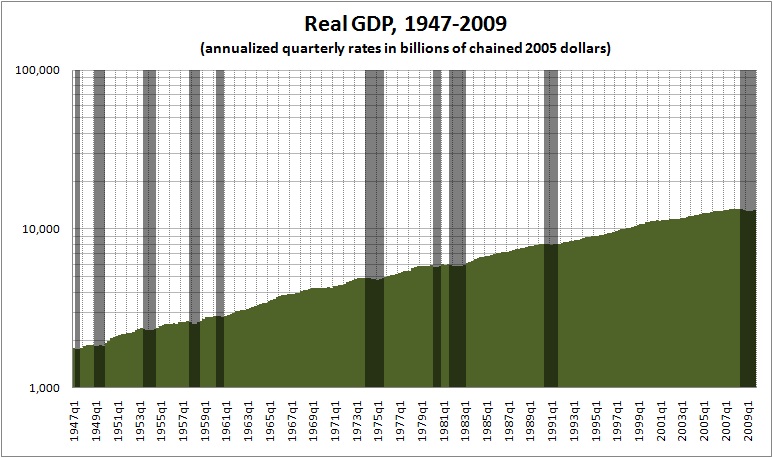
In the case of aggregate economic activity, what we see is what has been left to us by government. What we do not see is the extent to which the money taken from us by government and the restrictions placed upon us by government have deprived the economy of entrepreneurship, innovation, technology, and productive capacity. The cumulative effect of those deprivations — that which we do not see — dwarfs the Great Depression in depth and extent. The cumulative effect is our mega-depression:

Is the Recession Over?

The National Bureau of Economic Research (NBER) has not yet declared an end to the recession. But no matter . . . according to the NBER, a recession ends when the economy has stopped contracting and begun expanding. In other words, the NBER could (and has) declared the end of a recession when the rate of aggregate economic activity (as measured by constant-dollar GDP) remains below its level at the beginning of the recession. That anomaly leads me to the following definition:

  • two or more consecutive quarters in which real GDP (annualized) is below real GDP (annualized) for an earlier quarter, during which
  • the annual (year-over-year) change in real GDP is negative, in at least one quarter.

That is to say, a recession lasts as long as there is a real and sustained dip in economic activity.

Here is my take on postwar recessions, which are marked by the vertical bars (click image to enlarge it):

Contrary to the NBER, there were no recessions in 1969-1970 or 2001. The Reagan-Volcker boom — which began in 1983 and was interrupted by the very mild recession of 1990-1991 — lasted until 2008.

To answer the title question: I don’t know if the recession is over, but I will know as soon as the Bureau of Economic Analysis releases its GDP estimate for the first quarter of 2010. Or, you can wait until the NBER makes its call in 2011.

Quick Takes

1. Bryan Caplan, who is prone to wrong-headed generalizations, is at it again. He defends survey research (e.g., “how happy are you?”) by pointing out that all economic statistics are based on surveys — as if to equate subjective measures of happiness with objective (if not precise) measures of employment, unemployment, prices, etc., etc.

2. Caplan does himself one better when he argues for a “Consumer Satisfaction Standard.” He writes:

Most economists still cling to the Demonstrated Preference Standard: If A buys X, then X makes A better off by definition.

Actually, “most” economists (if I may speak for them) would say that at the time A buys X, he believes that buying X will make him better off. If A later suffers buyer’s remorse, that is simply the result of having acquired additional information that A can then apply to future decisions. Only a supremely naive economist (Caplan?) would believe that humans are perfectly prescient about the consequences of their decisions.

Unabashed, Caplan continues by offering the Consumer Satisfaction Standard (CSS):

[I]f A buys X, and would do so if he had the chance to make the decision over again, then X makes A better off.

The validity of the CSS rests on the assumption that the buyer somehow knows that buying something else (Y) instead of X would have made him happier. But the buyer can’t know that unless he actually buys Y and finds that he doesn’t suffer buyer’s remorse. This kind of imaginary second-guessing could go on forever.

3. I must give Caplan credit for challenging the addiction-as-disease school of psychology. He writes:

While I think that addictive behavior should be legal, it’s still irresponsible and emotionally abusive towards the people who care about you.   The addiction-as-disease story shifts the blame from where it belongs – the self-destructive addict – to family, friends, co-workers, employers, tax-payers, and other victims.  Calling bad behavior a “disease” may be merciful, but it’s unjust.

Bravo!

4. Megan McArdle, as usual, makes sense. Some of her predictions about Obamacare:

[A]t least one of the major funding sources, and possibly all of them, will be substantively repealed:  the Medicare cuts (except Medicare Advantage), the excise tax, and so forth.

This program will not reduce the rate of growth in medical costs by anything like 1.5% a year.

A fiscal crisis of some sort is quite likely by 2030, though not just because of this program.  But this program will make it worse, either by increasing the deficit directly, or by using up the low-hanging fruit that should have funded Medicare reform.

By 2030, there’s an 80% chance that the government will have imposed substantial price controls on pharma and other medical technology–and this will noticeably slow the rate of innovation.

5. Finally — and aptly — is a review of Thomas Sowell’s Intellectuals and Society. The reviewer, J.R. Nyquist, refers to the subjects of Sowell’s book as “Civilization’s Wrecking Crew.”  An excerpt:

. . . Sowell offers a detailed examination of those who carry today’s ideological equivalent of the Black Death. He defines the term “intellectual” as referring to those teachers and writers who chiefly deal in ideas, and are paid — by the media or the state — for batting ideas around. By focusing on intellectuals who are paid for intellectualizing, he is able to make a series of observations about their ideological tendencies, their lack of accountability, and their tendency to live outside the “real world.” . . . It is one of those sociological tragedies that intellectuals act as if “their special kind of knowledge of generalities can and should substitute for, and override, the mundane specific knowledge of others.” The intellectuals, as a class, tend to reject the first-hand knowledge of non-intellectuals as “prejudice” or “stereotypes.” Abstract formulas, adopted by the intelligentsia as dogma, are advanced as some kind of superior wisdom and used to undergird insane government policies that fly in the face of common sense. How else, indeed, has our Republic arrived at its present state?

Once established, the intellectual class continues to feed politicians and bureaucrats with ideas that point toward one solution: big government, interventionism, wealth redistribution, and other egalitarian absurdities. The country is pushed, inch by inch, toward an unnamed catastrophe. Who will name it? Who will stop the pushing? The intellectuals are feeding at the public trough, and they are entrenched. It seems that the rest of society is helpless to stop them.

To decry their push for “judicial activism” avails us nothing. If you stop them in the Supreme Court they will infect popular opinion and a new Congress will be elected. If they don’t elect Congress, they will elect a president. If they cannot act politically, they will take over the universities and bring out a generation of politically correct drones. Here we are not dealing with a particular set of abuses that can be fixed with appeals to democracy, Christianity, or legal reform. Here we are dealing with thousands of writers and professors who have, through some mysterious process, arisen from the lower depths, from the inner hell of a confused though fashionable relativism. The welfare state is their brainchild, and economic calamity is also theirs.

Civilization’s Wrecking Crew has been working overtime lately.

Obamacare

Rather than repeat myself, I refer you to these posts:

Rationing and Health Care
The Perils of Nannyism: The Case of Obamacare
More about the Perils of Obamacare
Health Care “Reform”: The Short of It

Columnist, Heal Thyself

David Brooks’s recent column, “The Protocol Society,” is a typical Brooksian muddle, in which he attributes evolutionary changes in economic behavior to the “discoveries” of contemporary economists.

Despite Brooks, there is nothing new under the sun of economic analysis. The practitioners of today who draw on sociology and psychology are simply returning to the roots of economics — the description of human behavior — which can be found in Adam Smith and his successors, well into the 20th century. This “old school” of literary economics didn’t give way to the “new school” of mathematical economics until after WWII, when Paul Samuelson led the profession down the dead-end street of convoluted, abstract theorizing.

The difference between the old-old school and the new-old school is that the moderns rely less on introspection and casual observation and more on data collection, “laboratory” experiments, statistical analysis, and the research findings of sociologists and psychologists. That this is not an unalloyed blessing can be seen in the “accomplishments” of a leading member of the new-old school, one Richard Thaler, whom Brooks omits to mention. Thaler’s specialty, which has been dubbed “behavioral economics,” focuses on the psychology of decision-making and how it leads individuals to make what Thaler believes are sub-optimal and even unwise choices. From there, Thaler and his collaborator, Cass Sunstein, have ventured into normative policy recommendations, which they dub “libertarian” or “soft” paternalism. Needless to say, actual libertarians find much to criticize in Thaler’s normative prescriptions, which carve out a role for government in “nudging” people in directions that “wise men” like Thaler and Sunstein would like to seem them nudged.  For much more about the dangers of “libertarian” paternalism, see these two posts and follow the links therein.

In any event, Brooks writes as if there were a real difference between economic activity in the 19th century and economic activity in the 21st century. As if, for example, there wasn’t a lot of brainpower and organizational skill involved in the “second industrial revolution” of the last third of the 19th century. As if, to take another example, the “protocols” of the modern food court didn’t have their counterparts in the market squares of yore. As if, to take a final example, the manufacture of steel, autos, and other durable goods doesn’t (and didn’t) involve massive capital investments (many of which were made possible by patented processes and machinery), so that the average cost of making each unit declines markedly as the rate of output rises. It is as if the 21st century simply arrived, bright and shining, with no connection to the past.

On the whole, Brooks is onto something, which is that economists are getting back in touch with the realities of human behavior. However, he is guilty of a gross attribution error. He writes as if there were something new in economic behavior because economists are now better able to describe it. The same attribution error is found among teenagers (of every era), who believe that sex didn’t exist until they discovered it.

Trade

Imagine two individuals, A and B, each of whom makes something different. Let’s say that A makes bread and B makes butter. If A wants butter for his bread, he buys some butter from B; if B wants bread to go with his butter, he buys some bread from A. This kind of exchange for mutual benefit, stripped of monetary measures, is the essence of economic activity.

What is special about trade if it happens to take place across international borders? Nothing. If I’m B (in Boston), and I have a choice between bread produced by A (in Alberta) and bread produced by C (in Chicago), I’ll choose A’s bread if I consider it a better value than C’s (e.g., same quality, lower price or higher quality, same price). Do I owe C a living? No. If C can’t compete with A in bread-making, he ought to try his hand at something else, but he shouldn’t use superior force (i.e., government) to force me to buy his product.

If B spends more on A’s bread than A spends on B’s butter, B is running a deficit. Isn’t that awful? No, it isn’t. B, to finance his deficit, can draw on his savings, borrow from A, or sell stock in his butter-making business to A. All of these are voluntary choices; none should be cause for alarm. If B draws on his savings, he’s getting something in return that he values: bread. No problem there. If B borrows from A, A is taking a risk and B is getting bread. No problem there. If A buys stock in B’s butter-making operation, A is taking a risk and B is getting bread. No problem there. (None of these actions is different, in principle, than allocating a portion of one’s savings to a down payment on a house, and financing the balance with a loan — which isn’t much different than selling the lender stock in one’s future earnings prospects.)

In each case, A and B are making informed decisions based on direct knowledge of their wants and the risks involved in satisfying them. The aggregation of such decisions into national accounts (e.g, the trade account) gives the impression that the transactions are collective, that “we” Americans in the aggregate are suffering at the hands of shifty foreigners, and that government ought to “do something” about it. Well, they aren’t collective decisions, the Americans involved aren’t being fleeced, and government efforts to “do something”  (e.g., raise tariffs on imported goods) invite the kind of disaster that followed enactment of the Smoot-Hawley Tariff Act.

What about unemployment that might result from trade? Well, yes, trade can cause transitional unemployment, but that’s true of domestic trade as well as international trade. If the U.S. government, as a matter of long-standing policy, had banned domestic and international trade because it might cause transitional unemployment, we wouldn’t have progressed from buggies to Model Ts to reliable Japanese cars, from parchment and quill pens to PCs, from face-to-face conversation to cell phones, and so on. In growing economies — as more-or-less laissez-faire economies are most of the time — temporary unemployment is soaked up by growth, that is, by the expansion of existing industries and the addition of new ones. It’s Schumpeter’s “creative destruction” at work.

The alternative to “creative destruction” (of which international trade is a necessary part) is the kind of insular, centrally directed economy that prevailed in Soviet Russia, where nominal “full employment” masked the wholesale misuse and real underemployment of land, labor, and capital. The same thing has happened by “democratic” means in most of Europe, and is happening by similarly “democratic” means in the United States. Witness, for example, the Environmental Protection Agency’s recent decree about “greenhouse gas” emissions.

In summary, trade is trade, whether domestic or foreign. When government acts in ways that stifle trade, the result is underemployment of land, labor, and capital. There are but two valid reason to stifle trade. One is to prevent, deter, or punish truly harmful acts. The other is to prevent, deter, or punish the easy acquisition of U.S. military secrets and technology by enemies and potential enemies.

For related posts, see these categories:

Economics – Fundamentals
Economics – Growth & Decline
Political Economy & Civil Society

Health Care “Reform”: The Short of It

Congress and Obama will deliver unto us:

  • an entitlement program that promises “free” or “inexpensive” access to drugs and medical services;
  • higher prices for drugs and medical services, fueled by greater demand (thanks to the entitlement program) and shrinking supply (as more providers decline to accept government-set fees and red tape); and, therefore,
  • more expensive, and rationed, medical care.

The unthinkable alternative — and the only workable one — is to stimulate supply by deregulating the medical professions and the pharmaceutical industry.

In short, Obamacare will not work, unless government (a) nationalizes the drug industry and the medical professions and (b) drafts individuals into the medical professions, Soviet-style. Neither event is unimaginable, as evidenced by the enthusiasm with which  politicians have embraced the nationalization and regimentation of American financial institutions.

Of course, to suggest that Obamacare could be made to work through nationalization and regimentation is to suggest that nothing works unless it is run from Washington. That is precisely the belief held by Obama, most members of Congress, and far too many Americans.

UPDATE: Nationalization and regimentation will not take place immediately upon the enactment of Obamacare, but in response to its obvious objective: Drive private insurers out of business so that government is “forced” to step in, assume the role of the “single payer,” and effectively ration the delivery of prescription drugs and medical services. For an analysis of the slippery-slope mechanisms by which this will happen, see Mario Rizzo’s “Fast Track to the Single Payer.”

UPDATE 2: The chief actuary of the Centers for Medicare and Medicaid services confirms that Obamacare will drive costs up, not down.

Related posts:
Fear of the Free Market — Part I
Fear of the Free Market — Part II
Fear of the Free Market — Part III
Rationing and Health Care
The Perils of Nannyism: The Case of Obamacare
More about the Perils of Obamacare

More about the Perils of Obamacare

This is an addendum to “The Perils of Nannyism: The Case of Obamacare.”

If you believe that Obamacare is a good idea, read Megan McArdle’s “Controlling Healthcare Costs the American Way: Not Doing It,” Peter Suderman’s “The Lessons of State Health-Care Reforms,” and Mark Perry’s “Cost of Health Care Legislation: $829B? Not Likely.”

If you then still believe in the wisdom of Obamacare, perhaps you would like to buy a piece of land here.