Are We Mortgaging Our Children’s Future?

Or, what will the “stimulus package” stimulate?

Congressional Democrats used to depict George W. Bush’s tax-rate reductions as fiscally irresponsible. The real problem, for Democrats, wasn’t that tax cuts might cause the national debt to swell. The real problem, for Democrats, was the prospect of having less money to spend on things that Democrats like to spend money on.

Now that Democrats control the White House and both houses of Congress, fiscal irresponsibility is all the rage (among Democrats). It seems that an increase in the national debt isn’t fiscally irresponsible if (a) it results from Democrat policies and (b) it’s caused not by lower taxes but by huge government spending programs.

Predictably, some Republicans have reverted to the old GOP line that deficit spending mortgages our children’s future (or some such thing).  The flaws in this assertion are exposed very nicely here, by professional economists.

However, the suggestion that the national debt represents inter-generational theft does hint at an essential truth. The burgeoning size and influence of government (which is the cause of the burgeoning national debt) amounts to theft — period:

1. Government spending (whether financed by taxes, borrowing, or money creation) commandeers resources that could have been used to produce goods and services in the private sector. Government spending diverts those resources to uses deemed “beneficial” not by producers and consumers but by politicians and interest groups.

2. Some of the commandeered resources are devoted to the payment of government employees for the purpose of making work for them, which includes the  writing and enforcement of regulations that hinder economic growth. Other resources are commandeered for the purpose of transferring purchasing power from productive members of society to less-productive and unproductive ones, thus penalizing and discouraging the traits that drive economic growth: hard work, thrift, innovation, and entrepreneurship.

3. The net effect  — near-term and long-run — is to reduce total economic output below what it could have been.

In other words, the “stimulus package” doesn’t simply “mortgage our children’s future.”  It does a lot more than that. Like all government spending that isn’t undertaken for the protection of Americans from foreign and domestic predators, the “stimulus package” mortgages our present, our future, our children’s future, and their children’s future, ad infinitum. The real problem isn’t the size of the national debt, it’s the size of government.

The best way to stimulate the economy is to reduce the tax and regulatory burdens that stifle hard work, thrift, innovation, and entrepreneurship — words that don’t seem to be in Democrats’ vocabulary. On the contrary, Democrats (Barack Obama, in particular) are bent on increasing the tax and regulatory burdens on Americans, especially those upon whom growth most depends.

As Friedrich Hayek explains, in The Constitution of Liberty,

the illusion that by means of progressive taxation the burden can be shifted substantially onto the shoulders of the wealthy has been the chief reason why taxation has increased as fast as it has done and that, under the influence of this illusion, the masses have come to accept a much heavier load than they would have done otherwise. The only major result of the policy has been the severe limitation of the incomes that could be earned by the most successful and thereby gratification of the envy of the less-well-off.

The answer to the question asked at the beginning of this post: The “stimulus package” (and other Obama initiatives) will stimulate a massive growth in the size and intrusiveness of government. Greg Mankiw agrees (here and here, for example).

Further reading:
Curing Debt Hysteria in One Easy Lesson
The Real Meaning of the National Debt
Debt Hysteria, Revisited
Why Government Spending Is Inherently Inflationary
Joe Stiglitz, Ig-Nobelist
A Simple Fallacy
Ten Commandments of Economics
Professor Buchanan Makes a Slight Mistake
More Commandments of Economics
Productivity Growth and Tax Cuts
Risk and Regulation
Liberty, General Welfare, and the State
Do Future Generations Pay for Deficits?
The Laffer Curve, “Fiscal Responsibility,” and Economic Growth
And much more, here.

Giving Back

In the latter years of my tenure at a tax-funded think-tank, our CEO established a “community service” program so that our professional staff of well-paid, mostly white, economists, mathematicians, and scientists could “give back to the community.” The “community” to which the aforementioned professionals gave “service” did not, of course, comprise well-paid, white professionals.

I am confident that the targets of our CEO’s “social consciousness” paid only a minuscule fraction of the taxes that funded the nicely appointed offices, high salaries, and generous benefits enjoyed by our professionals. “Giving back” to the “community” that actually supported them would have involved mowing lawns, tutoring, and babysitting for mostly white, middle- and upper-income professionals in other parts of the D.C. area than the one selected by our CEO as the “community” to which to “give back.”

If the services provided by our professional staff in exchange for their splendid offices, salaries, and benefits had been worth their weight in taxes, there would have been no need for those professionals to “give back” to any community. Taxpayers would have received their money’s worth, and that would have been that.

Our CEO either felt guilty about his huge office, princely salary, and obscene benefits or he thought that the think-tank wasn’t giving taxpayers fair value for their money. As he would have been the last person in the United States to admit that the think-tank wasn’t delivering fair value, I can only conclude that his yearning to “give back” arose from feelings of guilt, which he projected onto his employees — many of whom undoubtedly had similar feelings. For, even as the CEO pressed his employees to “give back,” he sought to justify the spending of more tax dollars on better quarters and higher compensation for the think-tank and its employees (himself included, of course).

Feelings of guilt aren’t confined to those who feed at the public trough, of course. CEOs and senior executives of large corporations have a good thing going for themselves — which they owe to their chummy relations with boards of directors — and they know it. Thus the impetus for private-sector “giving back.”

In summary, “giving back to the community” is either an unnecessary act — because “the community” already has received fair value for its money — or it is emblematic of guilt. In the first instance, “giving back” is really an act of charity, which comes at the expense of those who pay for a company’s products (i.e., taxpayers or consumers). In the second instance, “giving back” is really a false act of contrition and an inadequate, misdirected form of atonement for executive avarice.

Having said all of that, I must add this: In the era of bailouts that is now upon us, there is much to be said for “giving back” by bankers, U.S. auto makers, members of the UAW, and defaulting mortgagors — to name a few of the recent and prospective additions to the already vast roster of government clients. That these new clients, like their predecesssors, will not “give back” is, of course, a foregone conclusion.

Moreover, if the present regime has its way there will be some kind of “national service” program which (through tax incentives if not downright conscription) will divert resources from useful (i.e., marketable) ends to “socially conscious” (i.e., government-dictated) ones. “National service,” in other words, is assuredly not a means of “giving back.” It is, rather, a means of taking away — of stealing time and opportunities from those who are conscripted into it, of stealing money from those whose incomes are conscripted (taxed) to support it.

A Logical Fallacy

The sub-hed of an article at City Journal asks “If human beings are naturally risk-averse, then what the heck happened on Wall Street?” The question can be expressed in the following syllogism:

Major premise: All humans are risk-averse.

Minor premise: Humans work on Wall Street (i.e., financial markets).

Conclusion: The humans who work on Wall Street are risk-averse.

It should be obvious to the casual observer that both the major premise and conclusion are false.

The article, by the way, is spot-on. Don’t be deceived by its flawed sub-hed.

The Fed and Business Cycles

Given the recent (official) announcement that the U.S. has been in recession since December 2007, I decided to look at the record of business cycles compiled by the National Bureau of Economic Research. The following graphs depict the length of expansions and contractions (and the trends in both), before and since the creation of the Federal Reserve System in 1913.

Source: “Business Cycle Expansions and Contractions,” National Bureau of Economic Research.

It seems that the creation of the Fed might have had a stabilizing effect on business cycles. (How much of an effect is impossible to tell, given the many other variables at work.)

But…the graphs don’t depict the relative severity of the various contractions. It is worth noting that the worst of them all — the Great Depression — occurred after the creation of the Fed and, in part, because of actions taken by the Fed. (A note to the history-challenged: The Great Depression began in September 1929 and ended only because of America’s entry into World War II.)

In any event, the long-run cost of economic stability has been high. (See this and this, for example.)

My Crystal Ball

From a post at my old blog, dated January 16, 2008:

On November 14, 2007, I wrote:

Is it possible that the current bull market reached a temporary peak in May of this year, and is now descending toward a secondary bottom that it will not reach for a few years?

This was my tentative answer, then:

A reversal that lasts a year or two seems entirely possible to me.

My less tentative answer, now, is that the stock market (as measured by the Dow Jones Wilshire 5000 Composite Index) has crossed into “bear country.” That is, it has met the two conditions which indicate a “correction” or bear market that will last for months or years:

  • the index has dropped below its 250-trading-day average, and
  • the 250-day average is moving downward (if imperceptibly)….

P.S. [added March 12, 2008] By my reckoning, every downturn in the 250-day average since 1970 has signaled every recession since 1970.

It’s been obvious for months that we’re in a bear market. It’s now also obvious (to the National Bureau of Economic Research) that we’re in a recession and have been since January of this year (a “peak” in economic activity having occurred in December 2007).

Macroeconomics and Microeconomics: Part I

Macroeconomics (the study of aggregate economic activity), in most expositions of it that I have seen, fails on two counts. First, macroeconomics usually ignores or accounts inadequately for microeconomic behavior, that is, the behavior of individual persons and firms. Second, it aggregates that which cannot be aggregated, namely, disparate forms of economic activity performed by disparate actors.

Regarding the first point, macro without micro is meaningless. Macroeconomic aggregates have no independent existence.

Secondly, an aggregate is meaningless if it represents disparate phenomena. A foot (measure of distance) is a meaningful measure only if it represents a collection of inches (or fractions thereof); a pound (measure of weight) is meaningful only if it represents a collection of ounces (or fractions thereof); and so on. But a foot is a foot, and a pound is a pound; the two cannot be aggregated because they measure different things. (Yes, there is in physics a measure of force known as the foot-pound, which “is the amount of energy expended when a force of one pound acts through a distance of one foot along the direction of the force.” But “foot-pound” is something distinct from “foot” and “pound”; it is a measure of force, not a way of making length and weight commensurate.)

This post illustrates both points. Consider A and B, who have discovered, through trial and error, that each can have more clothing and more food if they specialize: A in the manufacture of clothing, B in the production of food.

Our primitive pair also has discovered a “just right” balance in the amount and allocation of clothing and food that they make and consume. Through voluntary exchange (bargaining), they have found a jointly satisfactory balance of production and consumption. A makes “just enough” clothing so that he can cover himself adequately, keep some clothing on hand for emergencies, trade the balance to B for “just enough” food, and enjoy “just enough” leisure. B does likewise with food. Both A and B might like to have more clothing and/or food, but both are doing as well as they can do in a voluntary relationship.

A and B’s respective decisions and actions are microeconomic; the sum of their decisions, macroeconomic. The microeconomic picture might look like this:

  • A produces 10 units of clothing a week, 5 of which he trades to B for 5 units of food a week, 4 of which he uses each week, and 1 of which he saves for an emergency.
  • B, like A, uses 4 units of clothing each week and saves 1 for an emergency.
  • B produces 10 units of food a week, 5 of which she trades to A for 5 units of clothing a week, 4 of which she consumes each week, and 1 of which she saves for an emergency.
  • A, like B, consumes 4 units of food each week and saves 1 for an emergency.

Given the microeconomic picture, it is trivial to depict the macroeconomic situation:

  • Gross weekly output = 10 units of clothing and 10 units of food
  • Weekly consumption = 8 units of clothing and 8 units of food
  • Weekly saving = 2 units of clothing and 2 units of food

You will note that the macroeconomic metrics add no useful information; they merely summarize the salient facts of A and B’s economic lives — though not the essential facts of their lives, which include (but are far from limited to) the degree of satisfaction that A and B derive from their economic activities.

The customary way of getting around the aggregation problem is to sum the dollar value of microeconomic activity. But this method simply masks the aggregation problem by assuming that it is possible to add the marginal valuations (i.e., prices) of disparate products and services being bought and sold at disparate moments in time by disparate individuals and firms for disparate purposes. One might as well add two bananas to two apples and call the result four bapples. The essential problem is that A, B, and everyone else will derive different types and levels of enjoyment from clothing and food (both of which come in many forms), not to mention the vast array of other kinds of goods and services that are bought and sold. (For a long disquisition on this point, go here.)

In sum, macroeconomic concepts (e.g., aggregate demand) are not exogenous entities that exist independently of microeconomic activity. At best, they are ambiguous, qualitative proxies for a host of disparate microeconomic activities.

In future installments I will cover such topics as recession and fiscal policy.

Why Settle for a Theoretical Estimate…

of the Laffer Curve, when you can have the real thing? The author of the first-linked item suggests that the amount of income remaining in private hands is maximized at an overall tax rate of 25 percent. My empirically-based estimate (second link) puts the private-income maximizing tax rate at 15 percent. The latter figure is a practical minimum:

The normal peacetime burden of government spending between the end of the Civil War and the eve of the Great Depression ranged from 5 to 10 percent of GDP,1 enough to maintain law and order and to provide minimal “social services.” To that I would add 5 to 10 percent for the kind of defense that we need in these parlous times. (See this post, for example.)

You can’t have a vibrant economy without law, order, and defense from foreign enemies.

Random Thoughts

Why is “gunite” pronounced gun-ite, whereas “granite” is pronounced gran-it?

If, in 1950, Harry Truman had said “four score and seven years ago,” he would have been referring to 1863, the year in which Abraham Lincoln uttered that famous phrase.

In the computer industry, “email” is preferred to “e-mail.” But it seems to me that “e-mail” better represents the phrase “electronic mail.” The meaning of “e-mail” is immediately obvious to me; “email,” at first glance, looks like a typo.

If the dismal northern weather of early April and late October — which delayed the start of the 2008 baseball season in some cities and then disrupted the World Series — doesn’t convince Major League Baseball to lop two weeks from each end of the regular season, nothing will.

One of the funniest movies I’ve seen is Harold Lloyd’s Dr. Jack (1922). It starts slowly, but builds to a hilariously frantic finish. Lloyd’s Safety Last! is better known — and deservedly considered a comedy classic — but it isn’t half as funny as Dr. Jack.

Between novels, I have been slogging my way through Thomas K. McCraw’s Prophet of Innovation: Joseph Schumpeter and Creative Destruction. There’s too much armchair psychology in it, but it whets my appetite for Schumpeter’s classic Capitalism, Socialism, and Democracy, which (I hate to admit) I haven’t read. Schumpter’s famous term for capitalism, “creative destruction,” often is applied with an emphasis on “destruction”; the emphasis should be on “creative.”

I must observe, relatedly, that my grandmother’s lifetime (1880-1977) spanned the invention and adoption of far more new technology than is likely to emerge in my lifetime, even if I live as long as my grandmother did.

Panic in the Street (Wall, That Is)

As measured by the Dow Jones Wilshire 5000 Composite Index, the price of U.S. stocks has declined about 45 percent from the peak of about a year ago. That drop rivals the crash of 1929, when the value of the Dow Jones Industrial Average lost 48 percent of its value from the peak on September 1 to an initial bottom on November 13. (After recovering for a while, the Dow continued to slide, reaching its final bottom on July 8, 1932 — 89 percent below its peak value.)

My objective isn’t to spread panic but, rather, to chastise those who sell in panic. The resources that produce real goods and services haven’t vanished suddenly; the economies of the U.S. and other developed countries can still produce all that they have been producing; and they can continue to grow as they have done for centuries and millenia.

In sum, the current panic has nothing to do with the state of the “real” economy. It is an over-reaction to a credit “crunch” that involves a relatively small portion of the world’s financial markets. Those who sell stocks in the current panic will, in a few months or years, regret having done so as credit markets stabilize and the economy returns to full production and normal growth.

If you are ready to panic, just take a deep breath and consider the big picture:


And just remember this: You haven’t lost money in the stock market until you actually sell stock for less than your purchase price. Up to that point the quoted price of a stock is nothing more than a guess as to its current value. Sure, you can sell at a loss and (maybe) claim the loss as a deduction on your tax return, but the value of a deduction is always less (usually far less) than the loss. And you can sell at a loss and put the money into something else — like a 3-percent savings account (whoopee!) — and then miss the turnaround in stock prices.

Perspective on the Stock Market

Yes, we are in a bear market, as I foresaw here and confirmed here. But let’s put the downturn in perspective:

Dow Jones Wilshire 5000 Composite Index
(12,184.44, as of 4:46 p.m. ET today)

(c) BigCharts.com

Even with today’s significant drop (4.55 percent), the market is high by historical standards. (For example, the Wilshire 5000 Full-Cap Index, a broad measure of U.S. stock prices, is still higher than it was at any time before the “bubble” of the late 1990s, even after the index is adjusted for inflation.) Moreover, the decline from March 2000 to October 2002 — which somehow seems to be a distant memory for today’s headline writers — was far steeper and deeper than the slide that began last October. There may be a time to panic, but it hasn’t yet arrived.

Unemployment

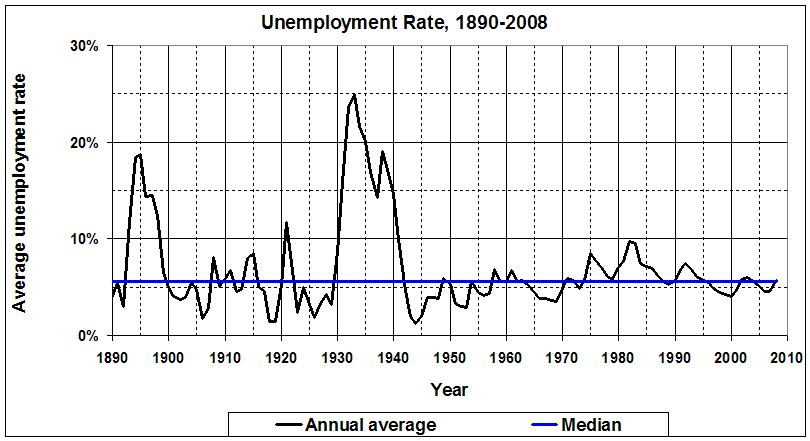
I present, without comment, a petite histoire graphique of the unemployment rate in the United States. The median is 5.5 percent.

Sources: Statistical Abstracts of the United States: Colonial Times to 1970, Series D85-D86 (http://www2.census.gov/prod2/statcomp/documents/CT1970p1-05.pdf) and Bureau of Labor Statistics, Employment Status of the Civilian Noninstitutional Population, 1942 to date (ftp://ftp.bls.gov/pub/special.requests/lf/aat1.txt). Rate for July 2008 used as the average for 2008.

The Budweiser Buy-Out

Guest commentary by Postmodern Conservative.

The coverage at The American Spectator is generally good. But everyone’s entitled to say something stupid at least once and awhile. In this case it’s G. Tracy Mehan, III (“This Bud’s Not for You“) waxing nostalgic about his hometown company, Anheuser-Busch, which has just been bought out by the Belgian mega-brewer, InBev. In his desperation Mr. Mehan says he’s willing to abandon his “free-market, free-trade principles” all because of “an American brand.” I’m just as nostalgic as anyone else at times, but when push comes to shove, A-B is an overrated producer of stale suds. So if InBev buys out a US brewery, what’s the upshot? I imagine that most of the jobs will stay and, heck…. maybe the beer will get better! After all, the Japanese gave America better cars. That’s what the market is all about.

Are You Happy?

Justin Wolfers (Freakonomics blog) has completed a series of six posts about the economics of happiness (here, here, here, here, here, and here). The bottom line, according to Wolfers:

1) Rich people are happier than poor people.
2) Richer countries are happier than poorer countries.
3) As countries get richer, they tend to get happier.

All of which should come as no surprise to anyone, without the benefit of “happiness research.” Regarding which, I agree with Arnold Kling, who says:

My view is that happiness research implies Nothing. Zero. Zilch. Nada. I believe that you do not learn about economic behavior by watching what people say in response to a survey.

You learn about economic behavior by watching what people actually do.

And…you consult your “priors.” It is axiomatic that individuals prefer more to less; that is, more income yields more satisfaction because it affords access to goods and services of greater variety and higher quality. Moreover, income and the wealth that flows from it are valued for their own sake by most individuals. (That they might be valued because they enable philanthropic endeavors is a case in point.)

It is reasonable to conclude, therefore, that the “law” of diminishing marginal utility, which may apply to particular goods and services, does not generally apply to income or wealth in the aggregate. But, in any event, given that Wolfers’s first conclusion is self-evidently true, the second and third conclusions follow. And they follow logically, not from “happiness research.”

What’s Next, Slavery?

Mark Perry discusses House Resolution 5800, introduced by Rep. Paul Kanjorski (D-PA), the “Consumer Reasonable Energy Price Protection Act of 2008,” which would:

  • Tax the oil industries’ “windfall profits.”
  • Set up a “Reasonable Profits Board” to determine when the oil companies’ profits are in excess, and then tax them on those windfall profits.
  • As oil and gas companies’ windfall profits increase, so would the tax rate for those companies.

…Kanjorski said “his legislation will encourage oil companies to lower prices to prevent them from receiving higher tax rates.”

A few Questions/Comments:

1. Oil companies don’t set oil and gas prices, global market forces do. The fact that oil and gas prices change daily demonstrate very clearly that oil companies are at the mercy of market forces of supply and demand.

2. If you tax something (oil), you get less of it. If you get less of something (oil), prices go up, not down.

3. How does Rep. Kanjorski know what “reasonable profits” are?….

Well, Rep. Kanjorski is a typical member of Congress, whose members’ economic views reflect their constituents’ economic illiteracy.

Those constituents, I am sure, would reject slavery out of hand. But they favor measures like Kanjorski’s because they want to buy a given amount of a good or service (gas, health care, etc.) at a lower price. But the only way to get the same amount of anything at a lower price is through greater productivity (which can’t be legislated) or by forcing people to produce more of it, that is, by making slaves of them.

(For more about economic illiteracy, follow these links. Relatedly, some links about irrational voters are here.)

Income Inequality: Myths vs. Facts

Cross-temporal comparisons of incomes by percentile are meaningless, as Arnold Kling and Russell Roberts explain. The bottom line: the persons included in a particular income range (e.g., bottom decile or quintile) in one year are not the same persons who were included in that income range five, ten, twenty, or thirty years earlier. Moreover, real (inflation-adjusted) income has grown steadily across the board: at the bottom and all the way to the top.

Those persons who are (temporarily) at the top do not take away anything from those who are at the bottom or in between. Those at the top earn because more they produce things of commensurate value. (I exclude politicians, lobbyists, and the beneficiaries of economically restrictive regulation.) Those in the middle and at the bottom earn what they earn because they produce things of less value. (Teachers, for example, earn less than baseball players because there are so many more persons who are able to be teachers than there are persons who are able to be major league ballplayers. It’s that fact — not “social injustice” — which accounts for the fact that teachers, firemen, policemen, etc., don’t make as much as ballplayers.) There’s no other way for an economic system to generate more for all than to allow it to reward producers according to the market value of what they produce.

Income inequality is a bogus issue. It is exploited by economic illiterates, do-gooders, and politicians to advance various forms of welfare, which necessarily involves income redistribution. The result, of course, is to make almost everyone worse off. The only beneficiaries of income redistribution are the welfare bureaucracy, vote-grabbing politicians, and perennial parasites. The rest of us pay via higher taxes and slower economic growth.

Related posts:
Why Class Warfare Is Bad for Everyone” (21 Sep 2004)
Fighting Myths with Facts” (27 Sep 2004)
Debunking More Myths of Income Inequality” (13 Oct 2004)
The Destruction of Wealth and Income by the State” (01 Jan 2005)
Ten Commandments of Economics” (02 Dec 2005)
More Commandments of Economics” (06 Dec 2005)
Zero-Sum Thinking” (29 Dec 2005)
On Income Inequality” (09 Mar 2006)
The Causes of Economic Growth” (08 Apr 2006)
The Last(?) Word about Income Inequality” (21 Jul 2006)
Your Labor Day Reading” (04 Sep 2006)
Status, Spite, Envy, and Income Redistribution” (04 Sep 2006)
“Things to Come” (27 Jun 2007)
The Poor Get Richer” (06 Feb 2008)

Root Causes

No matter how much money is spent to combat poverty, crime, sloth, slovenliness, rudeness, obesity, poor grades, and all other “social ills,” those “ills” cannot and will not be cured unless three things change:

1. The state quits discouraging innovation, entrepreneurship, and capital investment through taxation and regulation.

2. The state quits subsidizing the less capable at the expense of the more capable, which subsidization (a) helps to ensure the reproduction of the less capable at a faster rate that of the more capable, and (b) traps the less capable in a cycle of dependency which prevents them from taking ownership of their lives and striving to escape the ills of poverty, crime, sloth, etc.

3. The state quits discouraging heterosexual marriage, family formation, and the inculcation of traditional values. The state discourages those things through its bureaucracies, public schools, and public universities, which (altogether) celebrate “diversity” and “alternative lifestyles,” belittle religion, denigrate traditional marriage, foster teen sex through contraception, elevate abortion to a secular sacrament, underwrite single motherhood, encourage mothers to work outside the household, and enable couples to divorce at the drop of a hat rather than work out their differences.

I have written so many related posts that I cannot begin to list all of them. I refer you to “The Best of Liberty Corner.”

Paternalism, Yet Again

Bryan Caplan skewers another effort by Richard Thaler and Cass Sunstein to defend government-mandated, “libertarian” paternalism. As Caplan says, “government long ago took up the burden of helping consumers, and the result is a mess.”

Thaler, Sunstein, and their ilk must not have been paying attention when Ronald Reagan (supposedly) said that the scariest phrase a person can hear is “We’re from the government, and we’re here to help you.” If you’re not scared by that phrase, you should be. If you badly want government to do something, government will do it badly.

Related posts:
Libertarian Paternalism” (24 Apr 2005)
A Libertarian Paternalist’s Dream World” (23 May 2005)
The Short Answer to Libertarian Paternalism” (24 Jun 2005)
Second-Guessing, Paternalism, Parentalism, and Choice” (13 Jul 2005)
Another Thought about Libertarian Paternalism” (16 Aug 2005)
Back-Door Paternalism” (20 Jan 2006)
Another Voice Against the New Paternalism” (22 Feb 2006)
The Feds and Libertarian Paternalism” (17 Aug 2006)
A Further Note about Libertarian Paternalism” (15 Sep 2006)
Apropos Paternalism” (04 Oct 2006)

Changing Perceptions on Population: Chevron ad

Guest post:

Is Chevron Corporation another example of changing perceptions about “overpopulation.” According to its recent print ad, appearing in many and news magazines:

With our planet’s population continuing to increase, and the quality of life for millions in the developing world improving daily, our demand for energy is also growing. And to meet everyone’s needs 25 years from now may take 50% more energy than we use today.

Finding and developing all the fuel and power we need for our homes, businesses and vehicles, while protecting the environment, could be one of the greatest challenges our generation will face. The key to ensuring success is found in the same place that created this need: humanity itself. When the unique spirit we all possess is allowed to flourish, mankind has proven its ability to take on, and overcome, any issue. It’s a spirit of hard work, ingenuity, drive, courage and no small measure of commitment. To success, to each other, to the planet. The problem…becomes the solution.

This is very much in line with the analysis of Donald Boudreaux (Cafe Hayek) about unduly panicky UN population growth predictions, as cited in an earlier post. The new perception of many people, including Chevron, is that a growing population — with the right political and economic resources — can more than support itself.

The Population Mystery, Again

Donald Boudreaux explains, in about one thousand words, what this chart depicts:

Source: Liberty Corner, The Population Mystery” (02 Mar 2005)

Bail-Outs

For my views about the present effort to bail out home buyers who borrowed money foolishly and lenders who lent money foolishly, see this and this. Just change the subject from bankruptcy to default.