Where’s My Nobel?

The Royal Swedish Academy of Sciences has awarded the Sveriges Riksbank Prize in Economic Sciences in Memory of Alfred Nobel for 2006 to Edmund Phelps, “for his analysis of intertemporal tradeoffs in macroeconomic policy.” Specifically,

Phelps formulated the hypothesis of the expectations-augmented Phillips curve, according to which inflation depends on both unemployment and inflation expectations.

As a consequence, the long-run rate of unemployment is not affected by inflation but only determined by the functioning of the labor market. . . . Phelps showed how the possibilities of stabilization policy in the future depend on today’s policy decisions: low inflation today leads to expectations of low inflation also in the future, thereby facilitating future policy making.

Thereby making capital investments more attractive and boosting the rate of economic growth — which is what I established in “The Anti-Phillips Curve.” Where’s my $1.3 million (the approximate dollar value of this year’s prize)?

Apropos Paternalism

Will Wilkinson, in a TCS Daily review of John Cassidy’s New Yorker article about neuronomics, writes:

Paternalism is the use of coercion to force people to do or refrain from something against their will for their own good. Liberals of all stripes generally reject paternalism for reasons most lucidly laid out in J.S. Mill’s masterpiece On Liberty. First, we assume the individual is the best judge of her own good. Second, whether or not the individual is the best judge of her own good, we rightly doubt that another individual (or assembly thereof) has the legitimate moral authority to substitute their judgment for the individual’s by force — especially in light of widespread disagreement about the nature of a good life. Third, truth is hard to come by, and none of us can be fully certain we’ve pinned it down. Allowing people to act on diverse opinions about morality (or rationality) broadens the search for truth about good lives by setting up a decentralized system of social laboratories where experiments in living succeed or fail in plain view. So, unless an action harms somebody else, people should be at liberty to satisfy their preferences, whether saintly or sinful, coolly rational or impulsively emotional.

The conceit of the new paternalism is that the state isn’t going to be in the business of telling us which beliefs and desires we are allowed to act on, but will simply nudge people into doing what we wanted to do anyway, but couldn’t manage by ourselves. The idea is that there are things we want to do, but, due to some foible of mind, we are unable to do it without a little outside help. . . .

Some of the new so-called “soft” paternalistic measures, such as employers helping workers to increase their rate of savings by requiring them to opt out of, rather than opt into, a retirement plan aren’t paternalistic in any sense; that’s a part of a fully voluntary labor contract. [ED: This is not true when government, through tax incentives, encourages the widespread adoption by employers of such practices.] And policies like increasing the taxes on cigarettes or fatty foods in order to discourage potentially harmful consumption choices, are straightforwardly paternalistic in the old sense, requiring a one-size-fits-all value judgment about how much and for what reason we should consume certain goods.

Those kinds of judgments aren’t the proper work of government. In any case, if you really think people make systematic “mistakes” in judgment and choice, there is no reason to believe that democratic voters — who have less at stake when casting their ballots than when choosing what to have for lunch — will be especially good at populating the government with Spock-like rational legislators interested in tweaking cognition through expertly targeted policy rather than with well-coiffed primates interested in hoarding status and power.

As Michael Munger puts it, in an essay at The Library of Economics and Liberty,

The boundary we fight over today divides what is decided collectively for all of us from what is decided by each of us. You might think of it as a property line, dividing what is mine from what is ours. And all along that property line is a contested frontier in a war of ideas and rhetoric.

For political decisions, “good” simply means what most people think is good, and everyone has to accept the same thing. In markets, the good is decided by individuals, and we each get what we choose. This matters more than you might think. I don’t just mean that in markets you need money and in politics you need good hair and an entourage. Rather, the very nature of choices, and who chooses, is different in the two settings. P.J. O’Rourke has a nice illustration of the way that democracies choose.

Imagine if all of life were determined by majority rule. Every meal would be a pizza. Every pair of pants, even those in a Brooks Brothers suit, would be stone-washed denim. Celebrity diets and exercise books would be the only thing on the shelves at the library. And—since women are a majority of the population, we’d all be married to Mel Gibson. (Parliament of Whores, 1991, p. 5).

O’Rourke was writing in 1991. Today, we might all be married to Ashton Kutcher, instead. But you get the idea: Politics makes the middle the master. The average person chooses not just for herself, but for everyone else, too. . . .

The thing to keep in mind is that market processes, working through diverse private choice and individual responsibility, are a social choice process at least as powerful as voting. And markets are often more accurate in delivering not just satisfaction, but safety. We simply don’t recognize the power of the market’s commands on our behalf. As Ludwig von Mises famously said, in Liberty and Property, “The market process is a daily repeated plebiscite, and it ejects inevitably from the ranks of profitable people those who do not employ their property according to the orders given by the public.”

Paternalism — when it is sponsored or enforced by government — deprives us of the ability to think for ourselves, to benefit from our wise decisions, and to learn from our mistakes. It all adds up to regress, not progress.

Related posts:
The Rationality Fallacy
Libertarian Paternalism
A Libertarian Paternalist’s Dream World
The Short Answer to Libertarian Paternalism
Second-Guessing, Paternalism, Parentalism, and Choice
Another Thought about Libertarian Paternalism
Back-Door Paternalism
Another Voice Against the New Paternalism
A Further Note about “Libertarian” Paternalism

The Dow and the Stock Market

There is much ado today about the Dow Jones Industrial Average, which hit an all-time high. That’s nice, but the Dow is a narrow, price-weighted index of stock prices. It does not include gains from reinvested dividends, and it is not adjusted for inflation.

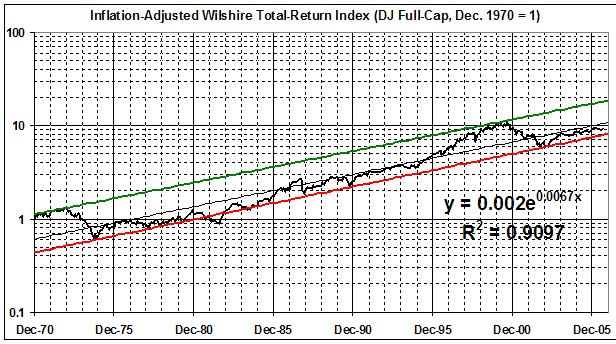
Far better is the Dow Jones Wilshire 5000 Composite Index (better known as the Wilshire 5000), which now tracks about 5,400 U.S. stocks and is weighted by the market capitalization of those stocks. There is a total-return version of the index that includes gains from reinvested dividends, as opposed to price gains only. (I obtain monthly values for the total-return index here.)

When adjusted for inflation, the total-return index gives a good indication of the state of the U.S. stock market as a long-term investment vehicle. (I use the CPI-U, available here, as the measure of inflation.)

The green and red lines trace the “trading channel” around the long-term trend (black line), the equation for which is shown on the chart. The long-term trend represents a real, annual gain of 8.4 percent a year, with dividends reinvested.

It’s evident that the cumulative value of U.S. stocks, in real terms, remains well below the speculative peak of six years ago. That’s just as well. We are seeing steady, restrained growth in the inflation-adjusted cumulative index — much like that of the late ’80s and early ’90s — which is a good sign for the stock market and for the economy.

Median Household Income and Bad Government

Remember this map?


It appeared in the Detroit Free Press on August 30, and it was picked up quickly by the Left-blogosphere because it seems to discredit President Bush’s economic policies. (For example, Kevin Drum (Political Animal) got the map from the Freep, John Campanelli at Daily Kos got it from Drum, and Benj Hellie at Leiter Reports linked to Campanelli’s post.)

In case you missed it, Stuart Buck and Megan McArdle, in a September 14 piece at the DCExaminer, describe the map and discredit it — as have other savvy observers. As Buck and McArdle explain,

the Detroit Free Press published a horrifying map showing huge losses in household income across America. Horrifying and totally wrong, that is.

According to the map, between 1999 and 2005 median household income had fallen in 46 states, sometimes by double digits, plunging by 6 percent in the U.S. as a whole.

We knew incomes had fallen slightly since the peak of the technology bubble. . . . But the declines shown on the map were shocking. The Free Press claimed that nine states, with a total of 75 million citizens, had seen median incomes plummet by roughly 10 percent.

More surprisingly, these figures didn’t match those in the Census Bureau’s Current Population Survey, or CPS, which showed that median household income in the US had fallen only 2.8 percent — and had risen in around 20 states, not four. Where, we wondered, had they gotten their figures?

An e-mail exchange with the journalists gave us the answer: They had taken their 2005 numbers not from the CPS, but from the American Community Survey, a new research product that is scheduled to replace the detailed “long form” census collected every decade. But they hadn’t taken the 1999 figures from the ACS — in fact, the ACS is so new that it didn’t even publish nationwide data for 1999. Instead, the journalists had taken the 1999 income figures from the official 2000 census.

Some statisticians already will be shaking their heads in dismay; different surveys, taken at different times and asking slightly different questions, often produce very different pictures of the economy. If the journalists had checked the helpful section of the Census Bureau Web site called “Using the Data”, they would have discovered this warning: “Users should exercise care when comparing income figures from the American Community Survey with those of Census 2000.”

They might also have found another Census Web page warning that “[E]stimates from any one survey will almost never exactly match the estimates from any other (unless explicitly controlled), because of differences such as in questionnaires, data collection methodology, reference period, and edit procedures.” Or had they Googled “Comparing the ACS and the Census,” they’d have discovered a helpful document on the comparison problems, available from multiple state governments. It calls the two income numbers “not comparable.”

With good reason. A 2003 report by census staff indicated that median incomes from the ACS were much lower than those from the 2000 census: 4.4 percent lower for the United States.

What does this mean? Simple: If you start with income from the 2000 census, and then compare it to income from the 2005 ACS, which we know tends to be much lower because of survey differences — you’ll find a much greater decline than really was the case. Much of the reported 6 percent drop — probably more than half — comes from comparing apples to oranges.

There’s more to be said, however, and I said it on September 5 in a comment on a post at AnalPhilosopher. Here are the key points of my comment, which I have edited to focus on the issues at hand:

The use of the period 1999 to 2005 amounts to cherry-picking the data. (The use of incompatible data sets, of which I was unaware at the time of my comment, merely compounded the cherry-picking.) Specifically, real median household income in the U.S. declined from 1999 — while Bill Clinton was president — through 2004, then rose in 2005, though the 2005 level was below the 1999 level. (To see what I am talking about, open this Census Bureau report and go to Figure 1, which I have reproduced below.)

The 1999-2004 decline is typical of a long-standing pattern, one that the figure below depicts only as far back as 1967. Even in the relatively brief period since 1967 there have been dips in real median household income more severe than that of 1999-2004. There is nothing at all unusual about a temporary dip in real median household income; it is part of the natural cycle of long-term economic growth. (Leftists like to imagine that there’s an alternative to such cycles, which involves the counter-productive fine-tuning of the economy by an omniscient Left-wing government or the even more destructive practice of income redistribution.)

The fact that some States (e.g., Michigan) fared worse than others during the recent downturn can be attributed to Michigan’s particularly benighted economic policies (e.g., high taxation and unionization), which have been impoverishing Michiganders for decades.

The Sick Man of the Midwest: Michigan — a liberal failure,” by Rich Lowry at NRO, confirms my point about Michigan. Lowry reports:

According to the free-market Mackinac Center for Public Policy’s analysis of United Van Lines data, Michigan is now the No. 1 state in the continental United States for outbound traffic. An estimated 65 percent of the moving company’s Michigan interstate traffic is families moving out of the state, headed to more economically open and vital destinations. As an official in Wyoming put it, “Michigan has been very good for us.” . . .

Michael LaFaive of the Mackinac Center calls Michigan “the France of North America.” Economically competitive states might have a personal income tax, or corporate income tax, or sales tax — Michigan has all three. It has long been the only state with a European-style, value-added tax — the Single Business Tax. A company can be in bankruptcy and still have a tax liability, making Michigan a bad state even to lose money in. In a 2002 filing for relief from the tax, General Motors explained that it would operate at a loss, but one of its projects would still create a $7 million-a-year tax liability. . . .

Meanwhile, unions make the state an inhospitable place to do business. A company can be bankrupt in Michigan and still face threats of a strike, as Northwest Airlines and the auto-parts maker Delphi have learned. Michigan’s unionization rate of 21.8 percent is much higher than the national average of 13.5 percent. This accounts for it having the second-highest unit-labor cost in the nation, according to the Mackinac Center. States with right-to-work laws, and consequently less unionization, experience more growth and create more jobs, at the expense of troglodytes like Michigan.

It used to be that unions could force unnaturally high wages and benefits on U.S. manufacturers, and the costs would be passed along to consumers. Those were the days prior to globalization when the U.S. auto industry had a lock on the domestic market and experienced little international competition. It was inevitable that Michigan would find the new competition disruptive, but not that it would react to it so poorly.

The way to thrive in a globalized environment is to create a low-tax economy without the rigidities that come with heavy unionization and regulation. For those who disagree, Michigan beckons.

Addendum: See also this post at The Club for Growth blog.

Here’s the figure from the Census Bureau report:

See also:
Your Labor Day Reading
Status, Spite, Envy, and Income Redistribution

A Further Note about "Libertarian" Paternalism

I last discussed “libertarian” (or “soft”) paternalism here (and posted a related note here). Any single instance of government-sponsored (and therefore government-encouraged) paternalism may seem benign. But it is not.

Take the case of default enrollment in 401(k) plans, which the Pension Protection Act of 2006 further encourages. Default enrollment in 401(k) plans — however benign its intention and however easily overcome by the enrollee who wants out — is a small act of paternalism that opens the door to more intrusive ones. What comes after default enrollment? Mandatory enrollment? Mandatory enrollment in certain types of retirement fund (e.g., government bond funds for the feeble-minded)?

Analagous questions can be asked about any government-sponsored paternalistic scheme. And such questions should be asked, because government-sponsored schemes shift decison-making power from individuals to bureaucrats, with their one-size-fits-all rules.

Moreover, as Peter Van Doren, editor of Regulation,* observes in a post at Cato-at-liberty,

government actors appear to be no more rational than economic actors — and it is quite possible that soft paternalism could be more detrimental to public welfare than the private choices studied by behavioral economics. Harvard economics professor Ed Glaeser states this case (pdf) in the summer issue of Regulation.

In a subsequent (and too-optimistic) post, Mark Moller quotes from the conclusion of Stephen Choi and Adam Pritchard’s 2003 article Behavioral Economics and the SEC (Stanford Law Review; working paper version available here):

Regulators are vulnerable to a wide range of behavioral contagion. Regulators may suffer from overconfidence and process information with only bounded rationality. . . .

And in groups the decisionmaking of regulators may decline rather than improve. On the one hand, groups and organizational structures may help alleviate some of the mistakes that derive from individually biased decisions. Studies of group decisionmaking provide evidence that the total can indeed be greater than the sum of individuals in enhancing the accuracy of decisions. But cognitive illusions may grip entire groups. Groupthink may also lead to an uncritical acceptance of regulatory decisions.

Will Wilkinson adds a post in which he observes that

[b]ehavioral economics done right is just good science. The real peril is in the transition over the gap from psychology to policy. Big philosophical and ideological assumptions lurk in the gap.

The biggest assumption is that government can and should steer the lawful behavior of individuals in certain directions, not knowing the specific circumstances that cause individuals to choose particular courses of action.**

We are mired in a tremendously costly regulatory-welfare state that arose from paternalistic concerns. Will we never learn? No, we will not. We will move further and further from realizing our economic potential by depleting individual freedom of choice. The road to dependency on the state is paved with the benign intentions of academics, politiicians, and bureaucrats.

Other related posts:
The Rationality Fallacy
Libertarian Paternalism
A Libertarian Paternalist’s Dream World
The Short Answer to Libertarian Paternalism
Second-Guessing, Paternalism, Parentalism, and Choice
Another Thought about Libertarian Paternalism
Back-Door Paternalism
Another Voice Against the New Paternalism
__________

* Full disclosure: I worked for Peter Van Doren in 1999-2000, when I was the managing editor of Regulation.

** A case in point: I did not enroll in my company’s 403(b) plan (the nonprofit equivalent of a 401(k)) when I was 22, because I needed the money to accrue household capital. But by the time I was 24, I could afford to join, and I did.

I Said It First

Well, I said it before George Will did, anyway. There’s a lot of buzz in the blogosphere about Will’s column of today, in which he defends Wal-Mart. What did I say on September 2? This (among other things):

Wal-Mart provides jobs for low-income families; Wal-Mart offers low prices to low-income families. When politicians hurt Wal-Mart, they hurt low-income families. Get it? Republicans do.

Read on.

How to View Defense Spending

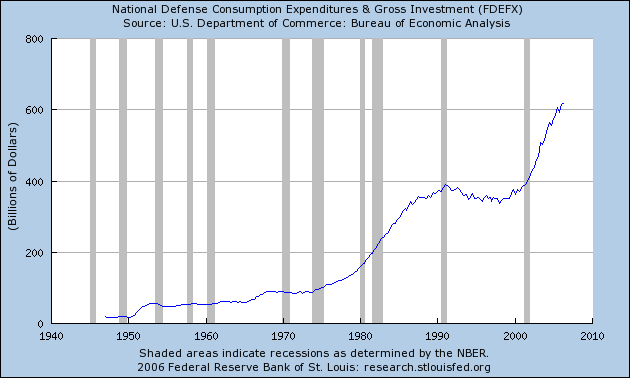
Jeffrey Tucker, one of the inmates of the Mises Economics Blog, posts “Why Libertarians Should Care about Defense.” The entire post consists of this chart:


Because Tucker doesn’t state the point of the chart, I’ll have to read his mind. He’s probably trying to convey a message like this:

  • Defense spending was just “right” (i.e., close to zero) in the years immediately after World War II, which might or might not have been a justifiable war for the United States.
  • Look at what has happened since then: Defense spending (in inflated dollars) has risen to a very large number.
  • Inasmuch as the United States really needs little defense, we’re obviously spending way too much on it.

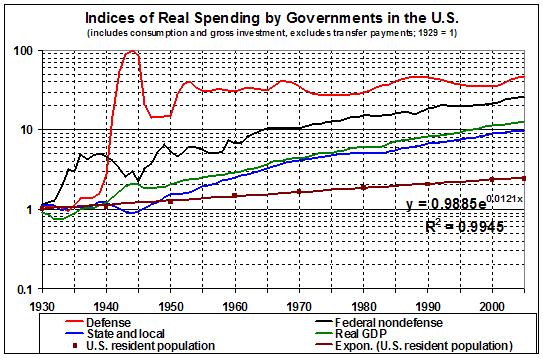
Defense spending, unlike domestic spending is driven by the outside world, by what others could or would do to us, regardless of our delusions about their benignity. It is necessary to spend a lot on defense even when we are not at war, for two reasons: deterrence and preparedness. With that thought in mind, let’s look at three indices of real (inflation-adjusted) government spending: defense, federal nondefense, and state and local — the red, black, and blue lines, respectively:

Sources: Indices of government spending derived from Bureau of Economic Analysis, National Income and Product Accounts, Table 3.9.1: Percent Change From Preceding Period in Real Government Consumption Expenditures and Gross Investment. Real GDP from What Was GDP Then? (Louis D. Johnston and Samuel H. Williamson, “The Annual Real and Nominal GDP for the United States, 1790 – Present.” Economic History Services, April 1, 2006, URL : http://eh.net/hmit/gdp/). Population statistics from U.S. Census Bureau, 2006 Statistical Abstract, Population: National Estimates and Projections, Population and Area: 1790 to 2000 and Resident Population Projections 2005 to 2050.

What does the chart suggest? Several things:

  • The benchmark for “necessary” defense spending is World War II. Real defense spending has yet to return to that level.
  • But, as a result of our foolish rush to demobilize after World War II, defense spending had to rise in response to Soviet- and Communist Chinese-backed aggression in Korea and the growing military power and aggressiveness of the Soviet Union.
  • The partial demobilizations following the Vietnam and Cold Wars necessitated remobilizations to deal with the continuing Soviet miltary buildup and the USSR’s adoption of a forward naval strategy; the likelihood that second-rate powers (e.g., Russia) would strive to counterbalance U.S. power; and our belated understanding of the threat posed by terrorist organizations and their state sponsors.
  • Federal nondefense spending and state and local spending have risen generally in step with GDP (green line), and faster than population (purple points and purple regression line). (Note that the chart does not reflect the massively disproportionate growth in spending on transfer-payment programs: Social Security, Medicare, and Medicaid.)

In sum, having becoming locked into the regulatory-welfare state via the New Deal and Great Society, nondefense spending at the federal, state, and local levels has kept pace with what we can “afford” to spend on programs that actually destroy income and wealth. By contrast, defense spending has fluctuated around a high but necessary level, a level that we are much better able to afford now than we were in the days of World War II.

It is customary in democratic countries to deplore expenditures on armaments as conflicting with the requirements of the social services. There is a tendency to forget that the most important social service that a government can do for its people is to keep them alive and free.

— Marshal of the Royal Air Force Sir John Slessor, in Strategy for the West

Related posts:
Not Enough Boots
Defense as the Ultimate Social Service
I Have an Idea
The Price of Liberty

Economics: The Dismal (Non) Science

Marton Fridson, writing at TCS Daily, pours some “Rain on the Economic Forecasters’ Parade“:

Investors are keenly interested in the pronouncements of economic forecasters, judging by the massive amounts of ink and airtime allotted to them by the media. It doesn’t necessarily follow, however, that heeding the prognosticators is useful in selecting securities. Whether or not seers have insight into future conditions is a testable proposition. If it turns out that they don’t, governmental attempts to guide the economy also come into question. Such efforts, after all, rely on forecasts generated by the same methodology that private-sector economists utilize.

Statistics compiled by Bloomberg L.P. shed light on the success of prominent forecasters. Each month, the financial information company surveys 60-plus economists from business and academe. The respondents handicap key indicators for the current quarter (which will not be reported until after quarter-end), and for the next four quarters. Among several indicators covered in the survey, I’ll focus on gross domestic product (GDP), the most popular measure of aggregate economic activity. . . .

[The forecasters] overestimated current-quarter GDP 15 times and underestimated it just 6 times, with one bulls-eye. . . .

[D]uring 2001-2006, the year-ahead forecast hardly varied from one year to the next. The median prediction was in the range of 3.1% to 4.0% in every single quarter. Perhaps not coincidentally, the actual quarterly GDP increase over the past 25 years (1981-2005) averaged 3.14%. The forecasters, in aggregate, perennially thought that one year hence, business conditions would be just about average. In reality however, actual GDP gains gyrated between 0.2% and 7.5%. The forecasters’ nearly inert consensus was all but worthless. . . .

As for government policymakers, the message is to forget about trying to control short-run economic performance. Given the lagged impact of fiscal or monetary intervention, deciding whether stimulus or restraint is needed depends on knowing where GDP will be a few quarters down the line. That isn’t something economists have shown they can reliably predict. A more appropriate mission for government policy is to refrain from meddling that ultimately undermines confidence among business and consumers.

Fridson corroborates my similar critique of macroenomic forecasting (first link below). But the failure of economics as a quantitative discipline runs deeper than its inability to model macroeconomic activity with any degreee of reliability.

“Hard science” is far from “hard.” But economics, by comparison, is essentially a pre-scientific, a priori mode of analysis. That’s not to denigrate the valid insights of the likes of Friedrich Hayek and Milton Friedman, but to suggest that the validity of their insights precedes quantification and does not depend on it.

Read on:
About Economic Forecasting
Is Economics a Science?
Economics as Science
Maybe Economics Is a Science
Hemibel Thinking
Physics Envy
Proof That “Smart” Economists Can Be Stupid
Time to Retire the Fair Model
The Thing about Science
What’s Wrong with Game Theory
Debunking “Scientific Objectivity”
Science’s Anti-Scientific Bent
Ten Commandments of Economics
More Commandments of Economics
Science, Axioms, and Economics
Mathematical Economics

Status, Spite, Envy, and Income Redistribution

Andrew Roth of The Club for Growth summarizes the current blogospheric debate about income redistribution. Will Wilkinson (The Fly Bottle) adds what I think is the clincher. Go. Read.

(My views about income inequality and redistribution are captured in the preceding post and the various posts linked to therein.)

Your Labor Day Reading

This, this, and this (summarized here). The poor in the U.S. are less poor than they used to be (and they are not, by and large, the same poor of a generation ago). Moreover, the poor in the U.S. are no poorer than the poor in the socialistic “paradises” of Western Europe and Canada. But the poor in the U.S. can become better off than the denizens of those other nations. And the chances of becoming better off are much greater in the U.S., given its superior economic performance.

Related posts:
Why Class Warfare Is Bad for Everyone
Fighting Myths with Facts
Debunking More Myths of Income Inequality
Ten Commandments of Economics
More Commandments of Economics
Zero-Sum Thinking
On Income Inequality
The Causes of Economic Growth
The Last(?) Word about Income Inequality

Related links:
Now and Then, by Don Boudreaux of Cafe Hayek
More Data on Middle Class Americans, ditto
Half Empty or Half Full, Part I, by Russell Roberts of Cafe Hayek
A Kept Promise, by Greg Mankiw of the eponymous blog
A Primer on the Standard of Living and the Cost of Living, by Russell Roberts of Cafe Hayek
Census and Sensibility, by Jerry Bowyer at TCS Daily
Is the Increased Earnings Inequality among Americans Bad?, by Gary Becker of The Becker-Posner Blog
Why Rising Income Inequality in the United States Should Be a Noninssue, by Richard Posner of ditto

Democrats: The Anti-People People

From a story by Jim Kouri at The National Ledger:

The continuous demonizing and vilifying of Wal-Mart Stores by Democrat Party officials is not working to turn Americans against the enormously successful US retailer, according to a recent poll. It may actually be hurting some Democrat politicians who are trying to hide their liberal-left agenda.

Wal-Mart spokeswoman Sarah Clark on Friday released the following statement on a new poll conducted by the Pew Research Center for the People & the Press:

“This poll is the latest proof that politicians will turn off most voters by attacking Wal-Mart and that the attacks themselves are not working. America’s working families want to decide for themselves where to work and where to shop.

“The numbers make it clear that America’s working families value Wal-Mart’s job opportunities, savings, and the benefits we provide the communities we serve. By attacking Wal-Mart, politicians show they are out of touch with working families.

“Working families support Wal-Mart because the company creates tens of thousands of jobs each year, provides health care for as little as $11 per month, and because economic studies verify that Wal-Mart saves American families $2300 a year.”

Here’s the moral, in a nutshell, for those Democrats who are open to reason: Wal-Mart provides jobs for low-income families; Wal-Mart offers low prices to low-income families. When politicians hurt Wal-Mart, they hurt low-income families. Get it? Republicans do.

Related: See this post by Donald Boundreaux, whom I sometimes chide for his radical libertarianism. When sticks to economics he is first rate.

The Anti-Phillips Curve

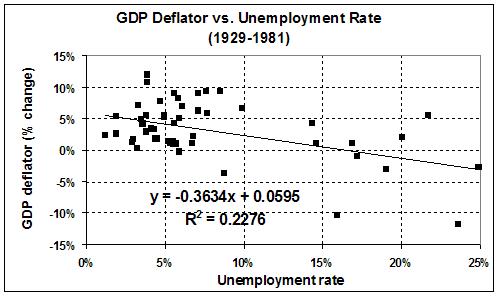
The Phillips Curve, as you probably know, depicts an inverse relationship between inflation and unemployment: Inflation abates as the unemployment rate rises, and vice versa. That inverse relationship, however, holds only in a stagnant or slowly growing economy. In an economy with robust gains in productivity, inflation can abate even as the unemployment rate falls.

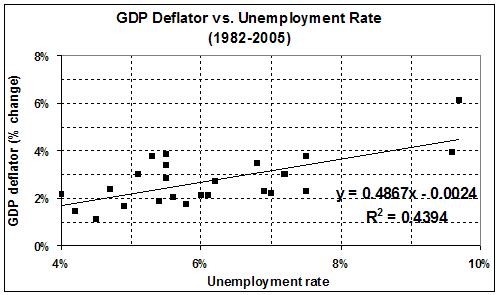
As Lawrence Kudlow notes, in a post at Kudlow’s Money Politic$, “over the last 25 years, unemployment and inflation have actually moved in tandem and they have both moved down.” That’s exactly right. From 1929 until the early 1980s, when inflation was brought under control, inflation (as measured by the GDP deflator) tended to move in a direction opposite that of the unemployment rate. Since the early 1980s, both inflation and the unemployment rate have been moving generally downward, that is, in the same direction:

Expectations of higher inflation, ceteris paribus, drive up interest rates and make capital investments less attractive; expectations of lower inflation, by the same token, make capital investments more attractive. Expectations of lower and then consistently low inflation since the early 1980s have encouraged investments that, in themselves, help to contain inflation by making it possible to produce goods and services at lower (real) cost. Those investments also have fueled more rapid (and less volatile) economic growth than that experienced from the end of World War II to the early 1980s. As a result, job creation has tended to outpace the growth of the labor pool; thus the downward trend in the unemployment rate. The postive frame of mind caused by lower inflation, coupled with more robust economic growth, has been reinforced by having had two tax-cutting presidents (Reagan and Bush II) and the Republican-enforced fiscal discipline of the Clinton presidency. It’s all a virtuous cycle.

Thus endeth the Phillips Curve, unless and until our “masters” in Washington decide, once again, to stifle economic growth by raising taxes and reinstituting the regulatory excesses of the Clinton era.

The Feds and "Libertarian" Paternalism

President Bush today signed into law the Pension Protect Act of 2006. Why the federal government — or any government in the U.S. — is in the business of regulating and insuring pension plans is another whole story, as they say. (See this for a general treatment of the erosion of the Constitution’s meaning. See this about liberty of contract, which applies to the States.)

In reading McGuireWoods’s detailed summary of the act, I am especially struck by this:

The Internal Revenue Service (“IRS”) has permitted automatic enrollment of employees in 401(k) plans since 1998. The PPA adds a number of provisions to the Code and ERISA to facilitate and encourage automatic enrollment.

A victory of sorts for “libertarian paternalists.” A defeat for liberty and, in particular, liberty of contract and the right to make decisions and learn from their consequences.

Related post: Another Voice Against the New Paternalism (with links to several other related posts)

Carnival of Links

I collect interesting links, group them by topic, and dump each related set of links into a draft post. Then, using the links as a starting point, I convert the draft to a full-blown post, as I have time.

I still have many interesting links in my collection that I probably won’t build into full-blown posts. Rather than hoard or discard those links, I present them here, organized by topic and with brief descriptions.

Liberty and the State

Mere Libertarianism: Blending Hayek and Rothbard: Agree or not with the author’s premises and conclusions, it’s an informative comparison of the two main schools of libertarianism.

Anarchism: Further Thoughts: An analysis of the varieties of anarchism and the faults of each.

Tax Rates Around the World: A brief post about the disincentivizing effects of high tax rates.

Paternalism and Psychology: A different look at the wrongness of “libertarian paternalism.”

Principles and Pragmatism: Why one libertarian blogger prefers idealism to pragmatism.

Lochner v. New York: A Centennial Perspective: (go to download link for full paper) The author of this long paper suggests that Lochner‘s much reviled “substantive due process” holding is in fact the basis for key Supreme Court decisons (e.g., Griswold v. Connecticut, Roe v. Wade, and Lawrence v. Texas).

Terrorism, War, and Related Matters

Apply the Golden Rule to Al Qaeda?: Why it makes no sense to apply Common Article 3 of the Geneva Conventions to terrorist detainees.

Captain Ed’s archive on Saddam’s Documents: A collection of posts about Saddam’s WMDs and terrorist ties.

The ACLU and Airport Security: How the ACLU is trying to depict behavior profiling as racial profiling.

Infinite Hatred: Considers and rejects the idea that it is futile to kill terrorists.

They, the People: An essay that parses the degrees of conflict and suggests that all-out war is the best way to change the hearts and minds of the enemy.

The Brink of Madness: A Familiar Place and The Mideast’s Munich: War with the Mullahs Is Coming: Two persuasive arguments that the West’s present mindset is like that which prevailed at the time of the Munich Agreement in 1938.

Sustaining Our Resolve: A sober but upbeat assessment of the prospects for the Middle East and the war on terror, by George P. Schultz.

Is the Bush Doctrine Dead?: An analysis by Norman Podhoretz.

Code Red: In which the writer tackles several anti-war and anti-anti-terror shibboleths.

Presidential Signing Statements

Bush’s Tactic of Refusing Laws Is Probed: An article about a panel of the American Bar Association’s so-called probe of Bush’s signing statements. (This WaPo article is anti-Bush, of course, but it sets the stage for the next two links.)

Enforcing the Constitution: A brief post defending signing statements.

The Problem with Presidential Signing Statements: A longer analysis of signing statements that also defends them.

Ideas

The Fifty Worst (and Best) Books of the Century: A distinguished panel of libertarian-conservatives compiles a list of the worst and best. The lists of worsts seems about right. The list of bests includes too many boring “classics.”

“Fake but Accurate?” Science: A scathing indictment of the “hockey stick” curve — which purports to show that global warming is only a recent phenomenon — its author, and its coterie of defenders.

The Problem of the Accuracy of Economic Data: An exposition of the spurious precision of economic statistics and analyses based on them.

An Un-Happy Birthday to Social Security

Social Security turns 71 today. It’s still unconstitutional.

Related post: Social Security: The Permanent Solution

Why "Net Neutrality" Is a Bad Idea

I am not neutral about net neutrality. I am opposed to it.

Almost everything that one can buy comes in different gradations of quality: automobiles, shoes, bread, haircuts, computers, internet service, and on and on. Those gradations of quality enable each of us to buy goods and services that meet our particular needs, given our income constraints and preferences.

Why should I object if certain producers of web content getter better service (faster delivery of their content) if they pay a fee for that better service? They’re paying a fee for a service, just as I’m paying a higher fee for my high-speed DSL service than are many other consumers who can’t afford or choose not to pay as much for their internet service as I do. My higher fee enables me to obtain web content faster than those other consumers. Should I be forced to accept a slower speed so that they won’t be relegated to “second class” status? What about those consumers who pay even more than I do and, in return, get even faster DSL or cable service? What about those consumers who buy big Lexuses when others can only afford Honda Civics? What about those consumers who buy tailored suits when others can only afford to buy their clothes at Wal-Mart?

You can see the end of it can’t you? By the “logic” of net neutrality, everyone would be forced to accept goods and services of the same quality. That quality would be poor because there would be no incentive to produce better goods and services to earn more money in order to buy better goods and services — because they couldn’t be bought. Reminds me of the USSR.

But it’s “different” for providers of web content. Or so say the proponents of net neutrality. The providers of web content aren’t consumers, they’re producers. (Aren’t we all?) If they’re able to deliver their content faster than other producers, they’ll have an “unfair” advantage over those other providers. To which I say balderdash. Here’s why:

1. A demand for faster delivery of web content will be met by a supply of greater internet capacity, as supliers of internet capacity upgrade their networks in their competitive efforts to meet the demand for faster delivery. That is, the loss of net neutrality is unlikely to have any effect on other content providers. But there’s more to it . . .

2. Faster delivery will command a premium, just as a Lexus commands a premium over a Honda Civic.

3. Content providers will demand faster delivery and pay the premium for it only to the extent that it yields a positive return (i.e., greater profit).

4. Faster delivery will yield a positive return only to the extent that consumers actually respond to the products and services offered by buying sufficiently more of them.

5. Those consumers, therefore, will pay the premium for the faster delivery of web content.

End of discussion.

The Bad News about Wal-Mart’s Victory in Maryland

It’s not news that a federal judge has overturned Maryland’s anti-Wal-Mart law, which would have dictated how much Wal-Mart must contribute to the health-insurance premiums of its Maryland employees. Lost in the celebratory noise, however, is the fact that Wal-Mart’s “victory” is a hollow one for liberty, as I will explain.

First, the Maryland law, which was scheduled to take effect next January 1. Here, from the law firm of McGuireWoods, is a good description of the law’s intended effect and how it was tailored to attack Wal-Mart:

The Fair Share Health-Care Fund Act, Md. Code Ann., Lab. & Empl. § 8.5-101, et seq. (“Fair Share Act”), was enacted in January of this year and was to become effective January 1, 2007. By its terms, the Fair Share Act applies to non-governmental employers of 10,000 or more people in Maryland, but effectively covers only Wal-Mart Stores, Inc. The Fair Share Act requires that a for-profit employer that “does not spend up to 8% of the total wages paid to employees in the state on health insurance costs, shall pay to the Secretary an amount equal to the difference between what the employer spends for health insurance costs, and an amount equal to 8% of the total wages paid to employees in the State.” The Fair Share Act also requires certain reporting and disclosure requirements separate from those required under ERISA.

Only four non-governmental entities employ 10,000 or more in Maryland: Johns Hopkins University, Northrop Grumman Corp., Giant Food, Inc. and Wal-Mart. Johns Hopkins, as a non-profit, meets a lower 6% standard for such institutions set by the Act. Northrop Grumman successfully lobbied for an exclusion for compensation paid above the Maryland median income, thus permitting Northrop Grumman to meet the 8% standard. Giant Food, which actively lobbied for passage of the law, spends well over 8% of wages to Maryland employees on healthcare. Wal-Mart was thus the clear target of this legislation.

Note that Giant Food lobbied the Maryland legislature in an effort to harm a competitor: Wal-Mart. Welcome to the real world of regulation, where “bootleggers and Baptists” collude.

Anyway, Wal-Mart’s “victory” is not a victory for liberty because Maryland’s law (according to the federal judge who overturned it) is preempted by the Employee Retirement Income Security Act of 1974. In other words, neither Wal-Mart nor any other employer or employee in the U.S. has a right to enter into voluntary contracts regarding the terms and conditions of employment. The feds have the final say. Maryland’s “Wal-Mart law” just happened to encroach on the feds’ territory, and so it was chucked out.

Well, the decision is good for Wal-Mart (which is okay) and — if upheld — it does set a useful precedent. Quoting again from McGuire Woods:

The Court’s ERISA analysis, if upheld on appeal, will help employers challenge similar existing and proposed legislation, including the Chicago “big-box” retail store ordinance expected to be voted upon July 26. If adopted, this ordinance would initially raise the local minimum wage to $9.25 per hour, and would also give workers $1.50 per hour in benefits, at stores of at least 90,000 square feet that are owned by retailers having $1 billion in sales.

But that’s not progress toward liberty. Progress would be to get government out of employment relationships, thus honoring the Constitution’s guarantee of liberty of contract. That guarantee was affirmed in Lochner v. New York (1905) but dismissed in Nebbia v. New York (1934), never to be seen since.

Related posts:
An Agenda for the Supreme Court
Substantive Due Process, Liberty of Contract, and States’ “Police Power”
Where’s Substantive Due Process When You Need It?
Substantive Due Process Redux?

The Last(?) Word about Income Inequality

It’s here, in a post by Russell Roberts at Cafe Hayek, and in the linked paper from which he draws. Roberts demolishes, along the way, the lunacies of Paul Krugman, whose Leftism blinds him to economic principles that even he once understood.

Related posts:
Why Class Warfare Is Bad for Everyone
Fighting Myths with Facts
Debunking More Myths of Income Inequality
Ten Commandments of Economics
More Commandments of Economics
Zero-Sum Thinking
On Income Inequality
The Causes of Economic Growth

Mathematical Economics

Those economists who mainly use the language of mathematics like to say (and perhaps even believe) that mathematical expression is more precise than mere words. But, as Arnold Kling points out, mathematical economics is a language of “faux precision,” which is useful only when applied to well defined, narrow problems. It cannot address the big issues — such as economic growth — which depend on variables (such as the rule of law) that defy mathematical expression and quantification.

I would go a step further and argue that mathematical economics borders on obscurantism. It is a cult whose followers speak an arcane language not only to communicate among themselves but to obscure the essentially bankrupt nature of their craft from others. Mathematical expression actually hides the assumptions that underlie it. It is far easier to identify and challenge the assumptions of “literary” economics than it is to identify and challenge the assumptions of mathematical economics.

I daresay this is true even for persons who are conversant in mathematics. They may be able to manipulate easily the equations of mathematical economics, but they can do so without grasping the deeper meanings — the assumptions — hidden in those equations. In fact, the ease of manipulating the equations gives them a false sense of mastery over the underlying, non-mathematical concepts.

But much of the economics profession is dedicated to the protection and preservation of the essential incompetence of mathematical economists. I quote Arnold Kling again:

One of the best incumbent-protection rackets going today is for mathematical theorists in economics departments. The top departments will not certify someone as being qualified to have an advanced degree without first subjecting the student to the most rigorous mathematical economic theory. The rationale for this is reminiscent of fraternity hazing. “We went through it, so should they.”

Mathematical hazing persists even though there are signs that the prestige of math is on the decline within the profession. The important Clark Medal, awarded to the most accomplished American economist under the age of 40, has not gone to a mathematical theorist since 1989.

These hazing rituals can have real consequences. In medicine, the controversial tradition of long work hours for medical residents has come under scrutiny over the last few years. In economics, mathematical hazing is not causing immediate harm to medical patients. But it probably is working to the long-term detriment of the profession.

The hazing ritual in economics has the real consequence of making much of economics irrelevant — and dead wrong.

Related posts:
About Economic Forecasting
Is Economics a Science?
Economics as Science
Maybe Economics Is a Science
Hemibel Thinking
Physics Envy
Proof That “Smart” Economists Can Be Stupid
Time to Retire the Fair Model
The Thing about Science
What’s Wrong with Game Theory
Debunking “Scientific Objectivity”
Science’s Anti-Scientific Bent
Libertarian Paternalism
A Libertarian Paternalist’s Dream World
The Short Answer to Libertarian Paternalism
Second-Guessing, Paternalism, Parentalism, and Choice
Another Thought about Libertarian Paternalism
Another Voice Against the New Paternalism
Slippery Paternalists
Ten Commandments of Economics
More Commandments of Economics
Science, Axioms, and Economics

Starving the Beast: Readings

I have written here, here, and here about the concept of starving the beast, which is to cut taxes in order to force reductions in government spending. I consider the concept valid. And I find that the present administration is no more (and no less) profligate than other administrations post-Great Society, when the profligacy ushered in by the New Deal became a permanent fixture of federal spending.

Several related items have come to my attention:

“Starving the Beast” Just Does Not Work, by Bill Niskanen (Cato@Liberty), repeats the arguments that I dealt with in the first and third of the above-linked posts.

Nick Schulz, writing at NRO in Tax Cuts = More Spending?, takes on three pundits whose perverted reading of Niskanen suggests (to them) that tax cuts actually cause spending increases.

Chris Edwards of Cato@Liberty writes in Starving and Feeding the State Beast about

a new report by the National Association of State Budget Officers [that] indicates a clear Starve the Beast pattern at the state level. (See Table 2 on page 3.)

In years when revenue growth was slow — early 1980s, early 1990s, and early 2000s — state legislators moderated their spending increases (they are generally required to balance their budgets each year).

Finally, and perhaps conclusively, there is a long-forgotten article by Henning Bohn, which appeared in the Journal of Monetary Economics (Volume 27, Issue 3, June 1991, Pages 333-359): “Budget balance through revenue or spending adjustments? Some historical evidence for the United States.” This is from the abstract:

The paper provides a historical perspective on the issue of whether budget deficits are typically eliminated by increased taxes or by reduced spending. By examining U.S. budget data from 1792–1988, I conclude that about 50–65% of all deficits due to tax cuts and about 65–70% of all deficits due to higher government spending have been eliminated by subsequent spending cuts, while the remainder was eliminated by subsequent tax increases.