The Principles of Economics

Noted economist Greg Mankiw offers his 10 principles of economics. My list of principles is somewhat longer — it comes in two installments — and the principles are more fleshed out than Mankiw’s. As a bonus, I offer this ancillary set of principles about the causes of economic growth.

And there’s lots more where that comes from. Just go here and follow the links.

Thoughts for Father’s Day

From Marianne J. Legato (“The Weaker Sex,” The New York Times, June 17, 2006):

What emerges when one studies male biology in a truly evenhanded way is the realization that from the moment of conception on, men are less likely to survive than women. It’s not just that men take on greater risks and pursue more hazardous vocations than women. There are poorly understood — and underappreciated — vulnerabilities inherent in men’s genetic and hormonal makeup. This Father’s Day, we need to rededicate ourselves to deepening our knowledge of male physiology. . . .

Thinking about how we might correct the comparative vulnerability of men instead of concentrating on how we have historically neglected women’s biology will doubtless uncover new ways to improve men’s health — and ultimately, every human’s ability to survive.

From Bjorn Carey (“Men and Women Really Do Think Differently,” LiveScience.com, January 20, 2005):

The brain is made primarily of two different types of tissue, called gray matter and white matter. This new research reveals that men think more with their gray matter, and women think more with white. . . .

The results are detailed in the online version of the journal NeuroImage. [Main index here, related articles here: ED]

In human brains, gray matter represents information processing centers, whereas white matter works to network these processing centers. The results from this study may help explain why men and women excel at different types of tasks. . . . For example, men tend to do better with tasks requiring more localized processing, such as mathematics, . . . while women are better at integrating and assimilating information from distributed gray-matter regions of the brain, which aids language skills.

From Larry Cahill (“His Brain, Her Brain,” ScientificAmerican.com, April 25, 2005):

. . . A generation of neuroscientists came to maturity believing that “sex differences in the brain” referred primarily to mating behaviors, sex hormones and the hypothalamus.

That view, however, has now been knocked aside by a surge of findings that highlight the influence of sex on many areas of cognition and behavior, including memory, emotion, vision, hearing, the processing of faces and the brain’s response to stress hormones. This progress has been accelerated in the past five to 10 years by the growing use of sophisticated noninvasive imaging techniques such as positron-emission tomography (PET) and functional magnetic resonance imaging (fMRI), which can peer into the brains of living subjects.

These imaging experiments reveal that anatomical variations occur in an assortment of regions throughout the brain. Jill M. Goldstein of Harvard Medical School and her colleagues, for example, used MRI to measure the sizes of many cortical and subcortical areas. Among other things, these investigators found that parts of the frontal cortex, the seat of many higher cognitive functions, are bulkier in women than in men, as are parts of the limbic cortex, which is involved in emotional responses. In men, on the other hand, parts of the parietal cortex, which is involved in space perception, are bigger than in women, as is the amygdala, an almond-shaped structure that responds to emotionally arousing information–to anything that gets the heart pumping and the adrenaline flowing. These size differences, as well as others mentioned throughout the article, are relative: they refer to the overall volume of the structure relative to the overall volume of the brain. . . .

In a comprehensive 2001 report on sex differences in human health, the prestigious National Academy of Sciences asserted that “sex matters. Sex, that is, being male or female, is an important basic human variable that should be considered when designing and analyzing studies in all areas and at all levels of biomedical and health-related research.”

Neuroscientists are still far from putting all the pieces together–identifying all the sex-related variations in the brain and pinpointing their influences on cognition and propensity for brain-related disorders. Nevertheless, the research conducted to date certainly demonstrates that differences extend far beyond the hypothalamus and mating behavior. Researchers and clinicians are not always clear on the best way to go forward in deciphering the full influences of sex on the brain, behavior and responses to medications. But growing numbers now agree that going back to assuming we can evaluate one sex and learn equally about both is no longer an option.

Finally, John Kekes (“The Absurdity of Egalitarianism,” TCS Daily, April 12, 2004), addresses inequalities of all kinds:

Here is a consequence of egalitarianism. According to the Statistical Abstract of the United States, men’s life expectancy is on the average about 7 years less than women’s. There is thus an inequality between men and women. If egalitarians mean it when they say that it would be a better state of affairs if everyone enjoyed the same level of social and economic benefits, or that how could it not be an evil that some people’s prospects at birth are radically inferior to others, then they must find the inequality between the life expectancy of men and women unjust. . . .

Egalitarians, thus must see it as a requirement of justice to equalize the life expectancy of men and women. This can be done, for instance, by men having more and better health care than women; by employing fewer men and more women in stressful or hazardous jobs; and by men having shorter work days and longer vacations than women. . . .

Yet a further policy follows from the realization that since men have shorter lives than women, they are less likely to benefit after retirement from Social Security and Medicare. . . . There is thus much that egalitarian policies could do to reduce the unjust inequality in the life expectancy of men and women.

However much that is, it will affect only future generations. There remains the question of how to compensate the present generation of men for the injustice of having shorter lives than women. No compensation can undo the damage, but it may make it easier to bear. The obvious policy is to set up preferential treatment programs designed to provide for men at least some of the benefits they would have enjoyed had their life expectancy been equal to women’s. . . .

These absurd policies follow from egalitarianism, and their absurdity casts doubt on the beliefs from which they follow. . . . One may actually come to suspect that the familiar egalitarian policies do not appear absurd only because they are made familiar by endlessly repeated mind-numbing rhetoric that disguise the lack of reasons for them.

Can egalitarians avoid these absurdities? They might claim that there is a significant difference between the unequal life expectancy of men and women, and the inequality of rich and poor, whites and blacks, or men and women in respects other than life expectancy. The difference, egalitarians might say, is that the poor, blacks, and women are unequal as a result of injustice, such as exploitation, discrimination, prejudice, and so forth, while this is not true of the life expectancy of men.

A moment of thought shows, however, that this claim is untenable. . . . It is but the crudest prejudice to think of men as Archie Bunkers, of women as great talents sentenced to housewifery, and of blacks as ghetto dwellers doomed by injustice to a life of poverty, crime, and addiction. Many men have been victims of injustice, and many women and blacks have not suffered from it.

It will be said against this that there still is a difference because the poor, blacks, and women are more likely to have been victims of injustice than men. Suppose this is true. What justice requires then, according to egalitarians, is to redistribute resources to them and to compensate them for their loss. But these policies will be just only if they benefit victims of injustice, and the victims cannot be identified simply as poor, blacks, or women because they, as individuals, may not have suffered any injustice. . . . This more precise identification requires asking and answering the question of why specific individuals are in a position of inequality.

Answering it, however, must include consideration of the possibility that people may cause or contribute to their own misfortune and that it is their lack of merit, effort, or responsibility, not injustice, that explains their position. Egalitarians, however, ignore this possibility. . . . If the policies of redistribution and compensation do take into account the degree to which people are responsible for being in a position of inequality, then the justification of these policies must go beyond what egalitarians can provide. For the justification must involve consideration of the choices people make, as well as their merit, effort, responsibility. To the extent to which this is done, the justification ceases to be egalitarian. . . .

Suppose that egalitarianism is seen for what it is: an absurd attempt to deny in the name of justice that people should be held responsible for their actions and treated as they deserve based on their merits or demerits. A nagging doubt remains. It is undeniable that there are in our society innocent victims of misfortune and injustice. Their inequality is not their fault, they are not responsible for it, and they do not deserve to be in a position of inequality. The emotional appeal of egalitarianism is that it recognizes the plight of these people and proposes ways of helping them. Counting on the compassion of decent people, egalitarians then charge their society with injustice for ignoring the suffering of innocent victims. . . .

[T]he relentless egalitarian propaganda eagerly parroted by the media would have us believe that our society is guilty of dooming people to a life of poverty. What this ignores is the unprecedented success of our society in having less than 13 percent of the population live below a very generously defined poverty level and 87 percent above it. The typical ratio in past societies is closer to the reverse. It is a cause for celebration, not condemnation, that for the first time in history a very large segment of the population has escaped poverty. If egalitarians had a historical perspective, they would be in favor of the political and economic system that has made this possible, rather than advocating absurd policies that undermine it.

(This is a partial response to Joe Miller’s recent post. More later.)

How the Great Depression Ended

UPDATED BELOW

Conventional wisdom has it that the entry of the United States into World War II caused the end of the Great Depression in this country. My variant is that World War II led to a “glut” of private saving because (1) government spending caused full employment, but (2) workers and businesses were forced to save much of their income because the massive shift of output toward the war effort forestalled spending on private consumption and investment goods. The resulting cash “glut” fueled post-war consumption and investment spending.

Robert Higgs, research director of the Independent Institute, has a different theory, which he spells out in “Regime Uncertainty: Why the Great Depression Lasted So Long and Why Prosperity Resumed After the War” (available here), the first chapter his new book, Depression, War, and Cold War. (Thanks to Don Boudreaux of Cafe Hayek for the pointer.) Here, from “Regime Change . . . ” is Higgs’s summary of his thesis:

I shall argue here that the economy remained in the depression as late as 1940 because private investment had never recovered sufficiently after its collapse during the Great Contraction. During the war, private investment fell to much lower levels, and the federal government itself became the chief investor, directing investment into building up the nation’s capacity to produce munitions. After the war ended, private investment, for the first time since the 1920s, rose to and remained at levels sufficient to create a prosperous and normally growing economy.

I shall argue further that the insufficiency of private investment from 1935 through 1940 reflected a pervasive uncertainty among investors about the security of their property rights in their capital and its prospective returns. This uncertainty arose, especially though not exclusively, from the character of federal government actions and the nature of the Roosevelt administration during the so-called Second New Deal from 1935 to 1940. Starting in 1940 the makeup of FDR’s administration changed substantially as probusiness men began to replace dedicated New Dealers in many positions, including most of the offices of high authority in the war-command economy. Congressional changes in the elections from 1938 onward reinforced the movement away from the New Deal, strengthening the so-called Conservative Coalition.

From 1941 through 1945, however, the less hostile character of the administration expressed itself in decisions about how to manage the warcommand economy; therefore, with private investment replaced by direct government investment, the diminished fears of investors could not give rise to a revival of private investment spending. In 1945 the death of Roosevelt and the succession of Harry S Truman and his administration completed the shift from a political regime investors perceived as full of uncertainty to one in which they felt much more confident about the security of their private property rights. Sufficiently sanguine for the first time since 1929, and finally freed from government restraints on private investment for civilian purposes, investors set in motion the postwar investment boom that powered the economy’s return to sustained prosperity notwithstanding the drastic reduction of federal government spending from its extraordinarily elevated wartime levels.

Higgs’s explanation isn’t inconsistent with mine, but it’s incomplete. Higgs overlooks the powerful influence of the large cash balances that individuals and corporations had accumulated during the war years. It’s true that because the war was a massive resource “sink” those cash balances didn’t represent real assets. But the cash was there, nevertheless, waiting to be spent on consumption goods and to be made available for capital investments through purchases of equities and debt.

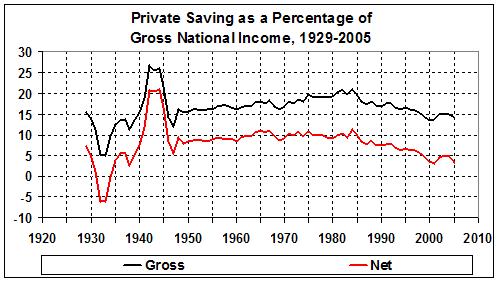
It helped that the war dampened FDR’s hostility to business, and that FDR’s death ushered in a somewhat less radical regime. Those developments certainly fostered capital investment. But the capital investment couldn’t have taken place (or not nearly as much of it) without the “glut” of private saving during World War II. The relative size of that “glut” can be seen here:

Derived from Bureau of Economic Analysis, National Income and Product Accounts Tables: 5.1, Saving and Investment. Gross private saving is analagous to cash flow; net private saving is analagous to cash flow less an allowance for depreciation. The bulge in gross private saving represents pent-up demand for consumption and investment spending, which was released after the war.

World War II did bring about the end of the Great Depression, not directly by full employment during the war but because that full employment created a “glut” of saving. After the war that “glut” jump-started

  • capital spending by businesses, which — because of FDR’s demise — invested more than they otherwise would have; and
  • private consumption spending, which — because of the privations of the Great Depression and the war years — would have risen sharply regardless of the political climate.

UPDATE: Robert Higgs, in an e-mail to me dated 06/24/06, submitted the following comment:

I happened upon your blog post that deals with my ideas about why the depression lasted so long and about the way in which the war related to the genuine prosperity that returned in 1946 for the first time since 1929. I appreciate the publicity, of course. I suggest, however, that you read my entire book, especially, with regard to the points you make on your blog, its chapter 5, “From Central Planning to the Market: The American Transition, 1945-47” (originally published in the Journal of Economic History, September 1999. I show there that the “glut of savings” idea, which is an old one, indeed perhaps even the standard theory of the successful postwar reconversion, does not fit the facts of what happened in 1945-47.

Here is my reply of 10/12/06:

I apologize for the delay in replying to your e-mail about my post… Your book, Depression, War, and Cold War, has not yet made it to the top of my Amazon.com wish list, but I have found “From Central Planning to the Market: The American Transition, 1945-47” on the Independent Institute’s website (here). If the evidence and arguments you adduce there are essentially the same as in chapter 5 of your book, I see no reason to reject the “glut of savings” idea, which is an old one, as I knew when I wrote the post. But, because it is not necessarily an old one to everyone who might read my blog, it is worth repeating — to the extent that it has merit.

At the end of the blog post I summarized the causes of the end of the Great Depression, as I see them:

World War II did bring about the end of the Great Depression, not directly by full employment during the war but because that full employment created a “glut” of saving. After the war that “glut” jump-started

  • capital spending by businesses, which — because of FDR’s demise — invested more than they otherwise would have; and
  • private consumption spending, which — because of the privations of the Great Depression and the war years — would have risen sharply regardless of the political climate.

In the web version of chapter 5 of your book you attribute increased capital spending to an improved business outlook (owing to FDR’s demise) and (in the section on the Recovery of the Postwar Economy, under Why the Postwar Investment Boom?) to “a combination of the proceeds of sales of previously acquired government bonds, increased current retained earnings (attributable in part to reduced corporate-tax liabilities), and the proceeds of corporate securities offerings” to the public. It seems that those “previously acquired government bonds” must have arisen from the “glut” of corporate saving during World War II.

What about the “glut” of personal saving, which you reject as the main source of increased consumer demand after World War II? In the online version of chapter 5 (in the section on the Recovery of the Postwar Economy, under Why the Postwar Consumption Boom?) you say:

The potential for a reduction of the personal saving rate (personal saving relative to disposable personal income) was huge after V-J Day. During the war the personal saving rate had risen to extraordinary levels: 23.6 percent in 1942, 25.0 percent in 1943, 25.5 percent in 1944, and 19.7 percent in 1945. Those rates contrasted with prewar rates that had hovered around 5 percent during the more prosperous years (for example, 5.0 percent in 1929, 5.3 percent in 1937, 5.1 percent in 1940). After the war, the personal saving rate fell to 9.5 percent in 1946 and 4.3 percent in 1947 before rebounding to the 5 to 7 percent range characteristic of the next two decades. After having saved at far higher rates than they would have chosen in the absence of the wartime restrictions, households quickly reduced their rate of saving when the war ended.

That statement seems entirely consistent with the proposition that consumers spent more after the war because they had the money to spend — money that they had acquired during the war when their opportunities for spending it were severely restricted. Not so fast, you would say: What about the fact that “individuals did not reduce their holdings of liquid assets after the war” (your statement)? They didn’t need to. Money is fungible. If consumers had more money coming in (as they did), they could spend more while maintaining the same level of liquid assets — because they had a “backlog” of saving. Here’s my take:

  • Higher post-war incomes didn’t just happen, they were the result of higher rates of investment and consumption spending.
  • The higher rate of investment spending was due, in part, to corporate saving during the war and, in part, to individuals’ purchases of corporate securities and equities.
  • At bottom, the wartime “glut” of personal saving enabled the postwar saving rate to decline to a more normal level, thus allowing consumers to buy equities and securities — and to spend more — without drawing down on their liquid assets.

Granted, business and personal saving during World War II was not nearly as large in real terms as it was on paper — given the very high real cost of the war effort. But it was the availability of paper savings that strongly influenced the behavior of businesses and consumers after the war.

Perhaps I am misinterpreting the evidence you present in chapter 5. And perhaps there is more in other chapters of your book that I should take into account. I will be grateful for a reply, if and when you have the time.

I will further update this post if Mr. Higgs replies to my note of October 12, 2006.

I Wish I’d Said That

A few choice bits from today’s reading:

Skating on the floor of the roller rink is an example of what Friedrich Hayek called spontaneous order. The process is beneficial and orderly, but also spontaneous. No one plans or directs the overall order. Decision making is left to the individual skater. It is decentralized.

— Daniel B. Klein, “Rinkonomics: A Window on Spontaneous Order,” The Library of Economics and Liberty

Killing the #2 man in al Qaida just means everybody in the organization moves up one notch. The former #3 guy is the new #2 guy, the former #10 guy is now the #9 guy, and the new #48 guy is Howard Dean.

Just so you know, I’m ashamed that the Dixie Chicks are from America.

— Ann Coulter, in an interview at FrontPageMag.com

If the fact that a man who regards his son’s butcher as a better man than the American president is rewarded with a party’s nomination to Congress does not tell you all you need to know about the morally twisted world of the Greens, nothing will.

— Dennis Prager, writing of Michael Berg, the father of Nick Berg, at FrontPageMag.com

The beauty of doing nothing is that you can do it perfectly. Only when you do something is it almost impossible to do it without mistakes. Therefore people who are contributing nothing to society except their constant criticisms can feel both intellectually and morally superior.

“”We are a nation of immigrants,” we are constantly reminded. We are also a nation of people with ten fingers and ten toes. Does that mean that anyone who has ten fingers and ten toes should be welcomed and given American citizenship?”

— Thomas Sowell, “Random thoughts,” Townhall.com

After the London tube bombings, Angus Jung sent the Aussie pundit Tim Blair a note-perfect parody of the typical newspaper headline:

“British Muslims fear repercussions over tomorrow’s train bombing.”

An adjective here and there, and that would serve just as well for much of the coverage by the Toronto Star and the CBC, where a stone through a mosque window is a bigger threat to the social fabric than a bombing thrice the size of the Oklahoma City explosion.

— Mark Steyn, “You can’t believe your lyin’ eyes,” Macleans.ca

Carnival of Links

Tomorrow I will post Carnival of Liberty XLIX. While you’re waiting for that, try these:

Cornel West’s Favorite Communist
, by David Horowitz (FrontPageMag.com)

Guest workers aren’t cheap; they’re expensive, by Phyllis Schlafly (Townhall.com)

Clinton Links GOP Policies to More Storms (wrongly, of course), from the Associated Press (via Breitbart.com)

A review of Not Even Wrong: The Failure of String Theory and the Continuing Challenge to Unify the Laws of Physics, by John Cornwell (Times Online)

Libertarianism and Poverty
, by Arnold Kling (TCS Daily)

Coulter clash on LI, at Newsday

Favorite passage:

New York Sen. Hillary Rodham Clinton called the book a “vicious, mean-spirited attack,” and said, “Perhaps her book should have been called ‘Heartless.'”

Coulter responded to Clinton on the radio show yesterday: “I think if she’s worried about people being mean to women she should have a talk with her husband.”

(More here and here.)

Why Do We Spend So Much on Defense?, by Justin Logan (Cato@Liberty)

Answer: Because, in addition to fighting terrorists, which you wrongly think can be done on the cheap, we must be prepared to ensure that the next generation of ambitious regimes (e.g., Russia) doesn’t try to pull a “Munich” on us. That’s why, you libertarian nay-sayer.

Starving the Beast, by Greg Mankiw (Greg Mankiw’s Blog)

See especially this linked article. See also my post, Starving the Beast, Updated.

More Saddam Terrorist Ties Discovered, by Lorie Byrd (Wizbang!)

Next: WMD. Bush lied?

Motives, by Don Boudreaux (Cafe Hayek)

Haditha: Backtrack Baby, Backtrack
, by Mary Katharine Ham (Hugh Hewitt)

Why I cannot trust the Democrats
, by Jon Henke (QandO)

Free Market Environmentalism? Not This Time

Cato’s Jerry Taylor — a smart, no-nonsense fellow — comments about a current environmental lawsuit:

We don’t need no stinkin’ environmental regulations to save the earth — all we need are well functioning property rights for environmental resources and common law courts to protect that property against trespass. Pollution is simply a neighbor’s garbage dumped in your backyard without permission. If we simply recognize and enforce property rights for nature, the need for most environmental regulation goes away.

That’s the libertarian pitch anyway, and it goes by the moniker “Free Market Environmentalism,” or “FME” to its acolytes. FME was given a firm theoretical foundation by Ronald Coase, embellished and blessed by libertarian economist Murray Rothbard, given academic life by the Political Economy Research Center and the Foundation for Research on Economics and the Environment, popularized in Washington by the Competitive Enterprise Institute, and even pitched by yours truly to the Board of Trustees of the Natural Resources Defense Council about nine years ago.

Alas, there has never been much evidence to suggest that libertarians were making much headway with these arguments and I have come to believe that they have less promise than I had once imagined. But what do you know? FME is now all the rage amongst environmentalists who have discovered that suing polluters for tresspass is easier than passing satisfactory laws against the same.

Jerry nevertheless finds a glimmer of hope in the case at hand, in which

eight states, New York City and conservation groups pressed for reduced greenhouse gas emissions from the nation’s five largest electric utilities.

Jerry concludes with this:

Sure, one can argue that the plaintiffs don’t have proper standing, that there is really no nuisance here to begin with, that the tort system is so messed up that employing it in such cases is problematic, etc. But nonetheless, this is a growing trend and libertarians seem surprisingly ambivalent about it.

You said it, Jerry, the plaintiffs don’t have proper standing. The case has nothing to do with FME. It’s just another attempt to legislate through litigation, which has been tried in the case of tobacco (with success) and gun control (without success). FME is about private parties seeking redress under the common law. That’s not what’s happening here. Find a better example — if you can.

The Indivisibility of Economic and Other Freedoms

John Stuart Mill, whose harm principle I have found wanting (e.g., here, here, and here) had this right:

If the roads, the railways, the banks, the insurance offices, the great joint-stock companies, the universities, and the public charities, were all of them branches of government; if in addition, the municipal corporations and local boards, with all that now devolves on them, became departments of the central administration; if the employees of all these different enterprises were appointed and paid by the government, and looked to the government for every rise in life; not all the freedom of the press and popular constitution of the legislature would make this or any other country free otherwise in name.

From On Liberty, Chapter 5
(thanks to Mike Rappaport of The Right Coast for the pointer)

Friedrich A. Hayek put it this way:

There is, however, yet another reason why freedom of action, especially in the economic field that is so often represented as being of minor importance, is in fact as important as the freedom of the mind. If it is the mind which chooses the ends of human action, their realization depends on the availability of the required means, and any economic control which gives power over the means also gives power over the ends. There can be no freedom of the press if the instruments of printing are under the control of government, no freedom of assembly if the needed rooms are so controlled, no freedom of movement if the means of transport are a government monopoly, etc. This is the reason why governmental direction of all economic activity, often undertaken in the vain hope of providing more ample means for all purposes, has invariably brought severe restrictions of the ends which the individuals can pursue. It is probably the most significant lesson of the political developments of the twentieth century that control of the material part of life has given government, in what we have learnt to call totalitarian systems, far‑reaching powers over the intellectual life. It is the multiplicity of different and independent agencies prepared to supply the means which enables us to choose the ends which we will pursue.

From part 16 of Liberalism (go here and scroll down)

A Market Solution to the Social Security Mess?

Andrew Roth of The Club for Growth posts about a

man [who] is trying to sell his future Social Security benefits on eBay. The starting bid is $200,000. . . .

[D]oes this portend the public’s desire to do an end run around the government? If Washington is unwilling to create personal accounts for Social Security, what’s to prevent citizens from creating an alternative market themselves? Of course a big legal roadblock, which would make all of this irrelevant, is the fact that people don’t technically own their benefits so the law might prevent them from selling to another person.

But I don’t think that the law could prevent something like this from happening:

1. A borrower (B) gives a prospective lender (L) full access to B’s Social Security earnings record, employment record, financial data, health history, and other information relevant to B’s future earnings prospects and life expectancy.

2. L estimates B’s Social Security benefit (or likely range of benefits), using the detailed calculator that is available at the Social Security website.

3. L computes the present value (v) of the B’s Social Security benefit, using a rate of interest (r) that would enable L to earn an acceptable rate of return, given (a) L’s prospecitve uses of B’s loan payments; (b) B’s personal, physical, and financial situation; and (c) the possibility of changes in (uninflated) Social Security benefits during B’s expected lifetime.

4. L offers B a loan in the amount of v, repayable over the remainder of B’s life at rate of interest r, and subject to certain safeguards for L. For example, the loan (or portions of it) might be secured by a mortgage and/or a life insurance policy.

5. L and B negotiate the terms and conditions of the loan.

6. The model established by L and B is adopted on a large scale by financial institutions, resulting in a market for Social Security-benefit-backed securities.

No one would force the Ls and Bs of the country to make or take loans. The would act only if they believe that they would be better off by making and taking such loans. And — most of the time — both would be better off. The Bs would receive lump sums on which they could earn better returns than the 2 to 3 percent current workers will earn on their “contributions” to Social Security. The Ls would gain by making fairly secure long-term loans, the payments on which they would be able to roll over into similar loans or ventures with potentially greater payoffs.

The Social Security system, in large part, would become a mechanism for funding productive investments in the private sector. That would be a major, positive change — given that the current (de facto) function of Social Security is to direct funding away from productive investments and toward current consumption.

Related post (with links to reference materials and other posts on the subject): Social Security: The Permanent Solution

Keynes the Arrogant

This evening I recalled this statement of John Maynard Keynes:

The ideas of economists and political philosophers, both when they are right and when they are wrong, are more powerful than is generally understood. Indeed, the world is ruled by little else. Practical men, who believe themselves to be quite exempt from any intellectual influences, are usually the slaves of some defunct economist.

The General Theory of Employment, Interest and Money (Macmillan, London, 1949), p. 383

What Keynes should have said is this:

Economists and political philosophers — on those rare occasions when they succeed in modeling human behavior — are the slaves of the living and dead persons whose behavior they observed and happened (luckily) to explain correctly.

Krugman and Monopoly

Paul Krugman reviews David Warsh’s Knowledge and the Wealth of Nations. In the course of the review Krugman asserts that

for the invisible hand to work properly, there must be many competitors in each industry, so that nobody is in a position to exert monopoly power. Therefore, the idea that free markets always get it right depends on the assumption that returns to scale are diminishing, not increasing.

Krugman’s agenda, of course, is to make the case for government regulation of industry, generally, and antitrust prosecutions, specifically. His unstated premise is that the phenomenon of increasing returns to scale is widespread — even though it is not, as evidenced by the wealth of industries in which there are many competitors. More fundamentally than that, Krugman clings to the notion that monopoly is bad, either out of ignorance or anti-business malice (certainly the latter but possibly both). Monopoly is not only not bad, it is good — as I have explained here.

What’s most interesting about Krugman’s review is his failure to discuss the federal government, which holds a legal monopoly on the governance of the United States, which it has perpetuated through the use and threat of force. Does the federal government exhibit increasing returns to scale? I say yes, given that the addition of a few buildings, some bureaucrats, and a handful of regulations adds disproportionately to the federal government’s stranglehold on the economy. Krugman, were he consistent, would call for the breakup of the federal government, just as he is longing to call for the breakup of successful businesses that actually produce things of value.

(Thanks to AnalPhilosopher for the pointer to Krugman’s trash.)

Is Freakonomics Hard Up for Topics?

UPDATE: See this related post at Chronicle of the Conspiracy.

UPDATE 2: And see this takedown, at The Buck Stops Here, of the Freakonomics post discussed below.

Steven Levitt and Stephen Dubner of Freakonomics (the blog) and Freakonomics (the book) also have a column in The New York Times Magazine. (What’s next, a glow-in-the-dark compass and decoder?) Their latest column (“A Star Is Made“) is about

Anders Ericsson, a 58-year-old psychology professor at Florida State University, . . . . the ringleader of what might be called the Expert Performance Movement, a loose coalition of scholars trying to answer an important and seemingly primordial question: When someone is very good at a given thing, what is it that actually makes him good?

Ericsson’s answer, according to Levitt and Dubner, is found in the Cambridge Handbook of Expertise and Expert Performance, which

makes a rather startling assertion: the trait we commonly call talent is highly overrated. Or, put another way, expert performers — whether in memory or surgery, ballet or computer programming — are nearly always made, not born. And yes, practice does make perfect. These may be the sort of clichés that parents are fond of whispering to their children. But these particular clichés just happen to be true.

But

when it comes to choosing a life path, you should do what you love — because if you don’t love it, you are unlikely to work hard enough to get very good. Most people naturally don’t like to do things they aren’t “good” at. So they often give up, telling themselves they simply don’t possess the talent for math or skiing or the violin. But what they really lack is the desire to be good and to undertake the deliberate practice that would make them better.

How did Ericsson (and his co-authors) discover these “truths”? By

studying expert performers in a wide range of pursuits, including soccer, golf, surgery, piano playing, Scrabble, writing, chess, software design, stock picking and darts.

It seems that Ericsson and company have studied only experts, yet they want to generalize their findings to include non-experts. Their study evidently suffers from selection bias. For example, boys with good athletic skills are more likely to enjoy athletics than boys who are weak, have poor eyesight, are obese, etc. Boys who enjoy athletics are thus far more likely to become good athletes than boys who do not participate in athletics. But the boys who enjoy athletics will, on the whole, have superior athletic skills to begin with. To continue the metaphor, Ericsson and company seem to have studied only the boys who began with superior athletic skills.

More generally, experts presumably have chosen to do what they “love.” And why do they (or did they) love what they do? Because they were good at doing it — relative to doing other things — in the first place. Yes, experts become experts because they study and practice that at which they eventually excel. But they choose to study and practice that which they like to do, and they like to do those things for which they had some talent to begin with.

Ericsson and company have proved nothing beyond what most of us know from experience and casual observation. Experts are born with certain talents, and then they become experts because they cultivate those talents. Experts are born and made. But they must be born with a degree of talent that allows them to make themselves into experts.

I am surprised that Levitt and Dubner have chosen to highlight Ericsson’s work. Are they desperate for new material? Or are they attacking the idea of genetic inheritance? Or both?

Science, Axioms, and Economics

UPDATE 05/20/06: Read this related post by Don Luskin (Chronicle of the Conspiracy).

Science is a four-fold process:

1. gathering and analyzing data about observable phenomena

2. theorizing causal relationships from those observations and analyses

3. testing those theories to see if they are accurate predictors of previously unobserved phenomena

4. adjusting old theories, as necessary, and developing new ones in the light of new observations.

Every scientific theory rests eventually on axioms: self-evident principles that are accepted as true without proof. Such principles may be self-evident to scientists who specialize in a particular discipline, even though they may not be self-evident to a non-specialist or non-scientist. The relativity principle of Galileo is an example of an axiom that is not self-evident to most non-scientists. The relativity principle

essentially states that, regardless of an observer’s position or velocity in the universe, all physical laws will appear constant. From this principle, it follows that an observer cannot determine either his absolute velocity or direction of travel in space.

Galileo’s 400-year-old principle is a fundamental axiom of modern physics, most notably of Einstein’s special and general theories of relativity.

One aim of science is to push the boundaries of knowledge outward, away from old axioms and toward a deeper understanding of the causes of observable phenomena and the relationships among those phenomena. But no matter how far scientists push the boundaries of knowledge, they must at some point rely on untestable axioms, such as Galileo’s relativity principle.

Self-evident principles notwithstanding, it is possible to discover important and useful quantitative information about physical phenomena. Consider the speed of light, for example. Maxwell’s equations, combined with Galileo’s relativity principle, tell us that the speed of light is the same for all observers, regardless of their respective velocities. But Einstein’s special theory of relativity, which is where Maxwell’s equations and the relativity principle are combined, does not define the speed of light, which was determined experimentally, just as Einstein’s theory has been confirmed experimentally.

That brings me to economics, which — in my view — rests on these self-evident axioms:

  • Each person strives to maximize his or her sense of satisfaction, which may also be called well-being or happiness.
  • Happiness can and often does include an empathic concern for the well-being of others; that is, one’s happiness may be served by what is usually labelled altruism or self-sacrifice.
  • Happiness can be and often is served by the attainment of non-material ends. Not all persons (perhaps not even most of them) are interested in the maximization of material goods (or monetary claims on material goods). That is, not everyone is a wealth maximizer.
  • The feeling of satisfaction an individual derives from a particular good (a product, service, or activity) is situational — unique to the individual and to the time and place in which the individual undertakes to acquire or enjoy a good. Generally, however, there is a (situationally unique) point at which the acquisition or enjoyment of additional units of a good during a given period of time tends to offer less satisfaction than would the acquisition or enjoyment of units of other goods that could be obtained at the same cost.
  • Work may be a good or it may simply be a means of acquiring and enjoying goods. Even when work is a good it is subject to the “law” of diminishing marginal satisfaction (preceding bullet).
  • There is no limit on the feeling of satisfaction that an individual may derive from the acquisition and enjoyment of goods, as long as there is always a greater variety of goods than an individual can enjoy at a given time.
  • Individual degrees of satisfaction are ephemeral, nonquantifiable, and incommensurable. There is no such thing as a social welfare function that a third party (e.g., government) can maximize by taking from A to give to B. Whenever a third party intervenes in the affairs of others, that third party is merely imposing its preferences on those others.

It may be possible to test some physical axioms, such as the constancy of the speed of light, but it is not possible to test the axioms of economics. For the purpose of “doing” economics, one must accept (or reject) the idea of personal utility maximization (for example), but one cannot disprove it. Nor can one devise (to my satisfaction) a measure of interpersonal utility that would enable a government to maximize a (non-existent) social welfare function.

My position aligns me (mainly) with the Austrians. The “dean” of that “school” was Ludwig von Mises, about whom Gene Callahan writes at the website of the Ludwig von Mises Institute:

As I understand [Mises], by categorizing the fundamental principles of economics as a priori truths and not contingent facts open to empirical discovery or refutation, Mises was not claiming that economic law is revealed to us by divine action, like the ten commandments were to Moses. Nor was he proposing that economic principles are hard-wired into our brains by evolution, nor even that we could articulate or comprehend them prior to gaining familiarity with economic behavior through participating in and observing it in our own lives. In fact, it is quite possible for someone to have had a good deal of real experience with economic activity and yet never to have wondered about what basic principles, if any, it exhibits.

Nevertheless, Mises was justified in describing those principles as a priori, because they are logically prior to any empirical study of economic phenomena. Without them it is impossible even to recognize that there is a distinct class of events amenable to economic explanation. It is only by pre-supposing that concepts like intention, purpose, means, ends, satisfaction, and dissatisfaction are characteristic of a certain kind of happening in the world that we can conceive of a subject matter for economics to investigate. Those concepts are the logical prerequisites for distinguishing a domain of economic events from all of the non-economic aspects of our experience, such as the weather, the course of a planet across the night sky, the growth of plants, the breaking of waves on the shore, animal digestion, volcanoes, earthquakes, and so on.

Unless we first postulate that people deliberately undertake previously planned activities with the goal of making their situations, as they subjectively see them, better than they otherwise would be, there would be no grounds for differentiating the exchange that takes place in human society from the exchange of molecules that occurs between two liquids separated by a permeable membrane. And the features which characterize the members of the class of phenomena singled out as the subject matter of a special science must have an axiomatic status for practitioners of that science, for if they reject them then they also reject the rationale for that science’s existence.

Economics is not unique in requiring the adoption of certain assumptions as a pre-condition for using the mode of understanding it offers. Every science is founded on propositions that form the basis rather than the outcome of its investigations. For example, physics takes for granted the reality of the physical world it examines. Any piece of physical evidence it might offer has weight only if it is already assumed that the physical world is real. Nor can physicists demonstrate their assumption that the members of a sequence of similar physical measurements will bear some meaningful and consistent relationship to each other. Any test of a particular type of measurement must pre-suppose the validity of some other way of measuring against which the form under examination is to be judged.

Why do we accept that when we place a yardstick alongside one object, finding that the object stretches across half the length of the yardstick, and then place it alongside another object, which only stretches to a quarter its length, that this means the first object is longer than the second? Certainly not by empirical testing, for any such tests would be meaningless unless we already grant the principle in question. In mathematics we don’t come to know that 2 + 2 always equals 4 by repeatedly grouping two items with two others and counting the resulting collection. That would only show that our answer was correct in the instances we examined — given the assumption that counting works! — but we believe it is universally true. Biology pre-supposes that there is a significant difference between living things and inert matter, and if it denied that difference it would also be denying its own validity as a special science.

What is notable about economics in this regard is just how much knowledge can be gained by hunting down the implications of its postulates. Carl Menger arrived at the great insight that the value of a good to an actor depends on its marginal utility to him based entirely on pursuing the consequences of the assumption that people act with the purpose of improving their circumstances. Mises’s magnum opus, Human Action, is a magnificent display of the results that can be achieved along these lines.

The great fecundity from such analysis in economics is due to the fact that, as acting humans ourselves, we have a direct understanding of human action, something we lack in pondering the behavior of electrons or stars. The contemplative mode of theorizing is made even more important in economics because the creative nature of human choice inherently fails to exhibit the quantitative, empirical regularities, the discovery of which characterizes the modern, physical sciences. (Biology presents us with an interesting intermediate case, as many of its findings are qualitative.) . . .

I hope the above considerations will make Mises’s apriorism more intelligible to staunch empiricists. But I suspect that some of them still may look askance at the proposal that we have this “oddball” kind of knowledge, one that is neither empirical nor analytical. They still may be inclined to dismiss it, noting that its claim to axiomatic status shields it from further analysis. It also appears suspiciously like those outcasts from post-Enlightenment epistemological respectability: intuitive, revealed, and mystical claims to knowledge. However, a deeper examination of human knowledge, undertaken without a prejudice in favor of the currently sanctioned methods of inquiry, reveals every mode of understanding, including the logical, the mathematical, and the experimental, as ultimately grounded upon our intuitive judgment.

For instance, a person can be presented with scores of experiments supporting a particular scientific theory is sound, but no possible experiment ever can demonstrate to him that experimentation is a reasonable means by which to evaluate a scientific theory. Only his intuitive grasp of its plausibility can bring him to accept that proposition. (Unless, of course, he simply adopts it on the authority of others.) He can be led through hundreds of rigorous proofs for various mathematical theorems and be taught the criteria by which they are judged to be sound, but there can be no such proof for the validity of the method itself. (Kurt Gödel famously demonstrated that a formal system of mathematical deduction that is complex enough to model even so basic a topic as arithmetic might avoid either incompleteness or inconsistency, but always must suffer at least one of those flaws.)

A person can be instructed in mechanical systems of formal logic, but there is no mechanical procedure for deciding which of these possible systems are worth developing. (It is quite possible to specify perfectly consistent, formal systems of logic that yield conclusions that are correct per the rules of the system but that any intelligent person can see are nonsense. For example, we might devise a system in which, if x implies y and z implies y, then x implies z. Within that system, the acceptance of “all men are mortal” and “all slugs are mortal” would mean that all men are slugs. Aside, perhaps, from particularly bitter feminists, we can all see that argument is rubbish, but we can only judge between alternative formalisms based on our intuitive sense of deductive truth.)

Michael Polanyi has shown that intuitive judgment is the final arbiter even in the “hard” sciences like physics and chemistry.

While experimental findings are, quite properly, a major factor in a scientist’s choice of which of two rival theories to accept, the scientist’s personal, intuitive judgment will always have the final say in the matter. When the results of an experiment are in conflict with a theory, the flaw may be in either the theory or the experiment. In the end, it is up to the scientist to choose which to discard, a question that cannot be answered by the very empirical results in doubt.

This ultimate, inescapable reliance on judgment is illustrated by Lewis Carroll in Alice Through the Looking Glass. He has Alice tell Humpty Dumpty that 365 minus one is 364. Humpty is skeptical, and asks to see the problem done on paper. Alice dutifully writes down:

365
– 1
___
364

Humpty Dumpty studies her work for a moment before declaring that it seems to be right. The serious moral of Carroll’s comic vignette is that formal tools of thinking are useless in convincing someone of their conclusions if he hasn’t already intuitively grasped the basic principles on which they are built.

All of our knowledge ultimately is grounded on our intuitive recognition of the truth when we see it. There is nothing magical or mysterious about the a priori foundations of economics, or at least nothing any more magical or mysterious than there is about our ability to comprehend any other aspect of reality.

(Callahan has more to say here. For a technical discussion of the science of human action, or praxeology, read this. Some glosses on Gödel’s incompleteness theorem are here.)

I omitted an important passage from the preceding quotation, in order to single it out. Callahan says also that

Mises’s protégé F.A. Hayek, while agreeing with his mentor on the a priori nature of the “logic of action” and its foundational status in economics, still came to regard investigating the empirical issues that the logic of action leaves open as a more important undertaking than further examination of that logic itself.

There, I agree with Hayek. It is one thing to know axiomatically that the speed of light is constant; it is quite another thing to know experimentally that the speed of light (in empty space) is about 671 million miles an hour. Similarly, it is one thing to deduce from the axioms of economics that demand curves generally slope downward and supply curves generally slope upward; it is quite another thing to estimate specific supply and demand functions.

But one must always be mindful of the limitations of quantitative methods in economics. As James Sheehan writes at the website of the Mises Institute,

economists are prone to error when they ascribe excessive precision to advanced statistical techniques. They assume, falsely, that a voluminous amount of historical observations (sample data) can help them to make inferences about the future. They presume that probability distributions follow a bell-shaped pattern. They make no provision for the possibility that past correlations between economic variables and data were coincidences.

Nor do they account for the possibility, as economist Robert Lucas demonstrated, that people will incorporate predictable patterns into their expectations, thus canceling out the predictive value of such patterns. . . .

As [Nassim Nicholas] Taleb points out [in Fooled by Randomness], the popular Monte Carlo simulation “is more a way of thinking than a computational method.” Employing this way of thinking can enhance one’s understanding only if its weaknesses are properly understood and accounted for. . . .

Taleb’s critique of econometrics is quite compatible with Austrian economics, which holds that dynamic human actions are too subjective and variegated to be accurately modeled and predicted.

In some parts of Fooled by Randomness, Taleb almost sounds Austrian in his criticisms of economists who worship “the efficient market religion.” Such economists are misguided, he argues, because they begin with the flawed hypothesis that human beings act rationally and do what is mathematically “optimal.” . . .

As opposed to a Utopian Vision, in which human beings are rational and perfectible (by state action), Taleb adopts what he calls a Tragic Vision: “We are faulty and there is no need to bother trying to correct our flaws.” It is refreshing to see a highly successful practitioner of statistics and finance adopt a contrarian viewpoint towards economics.

Yet, as Arnold Kling explains, many (perhaps most) economists have lost sight of the axioms of economics in their misplaced zeal to emulate the physical sciences:

The most distinctive trend in economic research over the past hundred years has been the increased use of mathematics. In the wake of Paul Samuelson’s (Nobel 1970) Ph.D dissertation, published in 1948, calculus became a requirement for anyone wishing to obtain an economics degree. By 1980, every serious graduate student was expected to be able to understand the work of Kenneth Arrow (Nobel 1972) and Gerard Debreu (Nobel 1983), which required mathematics several semesters beyond first-year calculus.

Today, the “theory sequence” at most top-tier graduate schools in economics is controlled by math bigots. As a result, it is impossible to survive as an economics graduate student with a math background that is less than that of an undergraduate math major. In fact, I have heard that at this year’s American Economic Association meetings, at a seminar on graduate education one professor quite proudly said that he ignored prospective students’ grades in economics courses, because their math proficiency was the key predictor of their ability to pass the coursework required to obtain an advanced degree.

The raising of the mathematical bar in graduate schools over the past several decades has driven many intelligent men and women (perhaps women especially) to pursue other fields. The graduate training process filters out students who might contribute from a perspective of anthropology, biology, psychology, history, or even intense curiosity about economic issues. Instead, the top graduate schools behave as if their goal were to produce a sort of idiot-savant, capable of appreciating and adding to the mathematical contributions of other idiot-savants, but not necessarily possessed of any interest in or ability to comprehend the world to which an economist ought to pay attention.

. . . The basic question of What Causes Prosperity? is not a question of how trading opportunities play out among a given array of goods. Instead, it is a question of how innovation takes place or does not take place in the context of institutional factors that are still poorly understood.

These are behavioral issues that economists can address legitimately with quantitative methods, as long as they are aware of and honest about the limitations of their methods. One of those limitations is that, while quantitative analysis may reveal certain general relationships and tendencies, those relationships and tendencies are the residue of myriad individual choices that cannot be quantified or predicted. (I am with Kling on the subject of “happiness” research. See also this post by Will Wilkinson.)

Many economists (e.g., “libertarian” paternalists) get around that essential limitation by insinuating their own values into the minds of others. Such economists simply are not content with the notion that A’s happiness and B’s happiness are unique and incommensurable. They claim to know what makes A and B happy, and they wish to make A and B (and every other “lesser being”) act accordingly. We can have a priori knowledge about the axioms of economic behavior, but we cannot presume a priori knowledge about any individual’s preferences.

Nor can we repeal the axioms of economics. Wherever quantitative methods yield results that are at odds with those axioms, it is the results that should be rejected, not the axioms.

Related posts:
About Economic Forecasting
Is Economics a Science?
Economics as Science
Maybe Economics Is a Science
Hemibel Thinking
Physics Envy
Proof That “Smart” Economists Can Be Stupid
Time to Retire the Fair Model
The Thing about Science
What’s Wrong with Game Theory
Debunking “Scientific Objectivity”
Science’s Anti-Scientific Bent
Libertarian Paternalism
A Libertarian Paternalist’s Dream World
The Short Answer to Libertarian Paternalism
Second-Guessing, Paternalism, Parentalism, and Choice
Another Thought about Libertarian Paternalism
Another Voice Against the New Paternalism
Slippery Paternalists
Ten Commandments of Economics
More Commandments of Economics

The Romney Plan: Part II

I wrote a few weeks ago about the new health-care scheme in Massachusetts. It’s worse than I thought. Arnold Kling, writing at Cato-at-liberty, quotes

Betsy McCaughey [who] digs into some of the details on the effects on business of Massachusetts’ brave, new health insurance experiment:

Say, for example, you open a restaurant and don’t provide health coverage. If the chef’s spouse or child is rushed to the hospital and can’t pay because they don’t have insurance, you — the employer — are responsible for up to 100% of the cost of that medical care. There is no cap on your obligation. Once the costs reach $50,000, the state will start billing you and fine you $5,000 a week for every week you are late in filling out the paperwork on your uncovered employees (Section 44). These provisions are onerous enough to motivate the owners of small businesses to limit their full-time workforce to 10 people, or even to lay employees off.

What else is surprising about this new law? Union shops are exempt (Section 32).

The next step should be the repeal of the Massachusetts plan because it is bad medicine for the people of Massachusetts. It will cut employment and wages, while driving up the cost of health care. Most of the intended beneficiaries of the plan will suffer as a result.

Given the perverse political climate of Massachusetts, the next step probably will be the State’s seizure of health-care services. The State will disclaim responsibility for the failure of its plan. Instead, it will pin the blame on the private sector, and the gullible public will swallow the story. The State will then declare itself the single payer of health-care costs, effectively creating a State-run health-care system. Welcome to Canada.

Related posts:
Fear of the Free Market — Part I
Fear of the Free Market — Part II
Fear of the Free Market — Part III
Free-Market Healthcare
Where’s Substantive Due Process When You Need It?
The Romney Plan

There’s More to Income than Money

Paul F. has been selling bagels and doughnuts at nonprofit research firms in the Washington, D.C., area for more than 20 years. Paul was an economist before that, and a good one. (I have known him since 1963.) When Paul reached his early 50s he was able to retire from the research business and devote himself to a less demanding vocation as The Bagel Man. Joshua Gans writes about Paul in a post at Aplia Econ Blog entitled “Maximizing the Bagel Dollar.” There, Gans summarizes a paper by Steve Levitt (abstract here, paper available by subscription only), in which Levitt analyzes the wealth of data collected by Paul in his years as a bagel and doughnut vendor.

Paul buys his wares fresh daily and then schlepps to various locations around the D.C. area, where he offers a variety of bagels (with cream cheese on the side) and doughnuts. He delivers his wares to each site once a week — an event known as Bagel Day. Paul doesn’t hang around to collect money from his customers; he trusts them to leave the right amount of money in a collection box, and his trust is generally well-placed.

After making his deliveries, Paul cycles back through his route to pick up his collection boxes. He then meticulously records his sales, overages, shortages, left-overs, and stock-outs. Levitt’s analysis is based on Paul’s meticulous records. According to Gans,

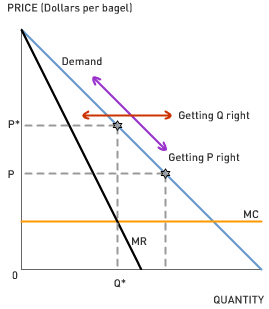
Levitt shows that Paul gets quantities right (for both bagels and donuts, there are very few stock-outs or left-overs), but he often gets prices wrong. Paul systematically prices donuts and bagels too low. Indeed . . . Paul could actually increase total revenue by increasing his prices. Hence, his prices are at a point like P in the figure. At point P, marginal revenue is negative (below the x-axis); so increasing price and reducing sales will raise revenue.

The question is whether Paul — the savvy economist — really sets his prices “too low.” I suspect not. Paul doesn’t need the money. Knowing Paul, he’s making himself happy by more-or-less correctly judging the number of bagels and doughnuts he can sell at prices that don’t cause him to lose money. That is, he wants to maximize the quantity of bagels and doughnuts enjoyed by his customers, as long as he’s making “enough” to warrant the effort he puts into his business. There’s more to income than money, and Paul’s behavior is a good case in point.

The kind of behavior exhibited by Paul also is a good long-run business strategy. “Underpricing” helps to build loyalty. Consumers are less likely to switch to competing vendors and products if they have been pleased by a vendor’s or manufacturer’s long record of offering good value for the money.

Related posts:
The Rationality Fallacy
The Social Welfare Function
What Economics Isn’t
Ten Commandments of Economics
More Commandments of Economics
It’s the Spending Stupid

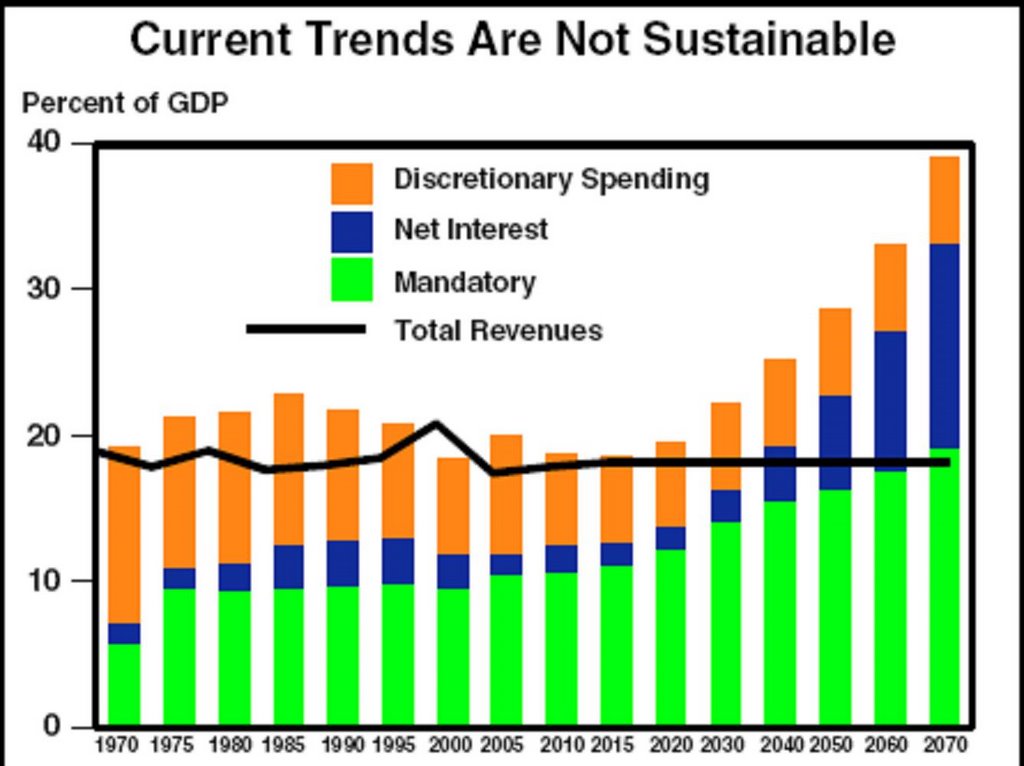
. . . as I’ve explained many times, most recently here. The Skeptical Optimist has a rosy outlook because his focus is on near-term prospects for eliminating the deficit. But look at the following chart (and ignore the revenue line).

I’m certainly not picking on The Skeptical Optimist, who has a rather sensible view of the deficit. But I am picking on “deficit hawks” who want to attack the deficit by raising taxes. All that does is lend an air of legitimacy to the government’s confiscation of resources through spending.

The Importance of Deficits

Here’s the conclusion of “Deficits: Do They Matter?” by Brian S. Westbury and Bill Mulvihill of First Trust Portfolios L.P.:

The one worry we have is that government spending has soared – from 18.4% to 20.1% of GDP between 2000 and 2005. This spending represents resources shifted from the private sector to the public sector. With entitlement spending set to rise dramatically in coming decades, this spending is the real threat to the economy.

Precisely. The focus on deficits is misplaced; the real threat to the economy is the amount of government spending. The more government spends, the less there is for the private sector to consume and invest.

Related posts:
The Destruction of Income and Wealth by the State
Curing Debt Hysteria in One Easy Lesson
Understanding Economic Growth
The Real Meaning of the National Debt
Debt Hysteria, Revisited
Why Government Spending Is Inherently Inflationary
Joe Stiglitz, Ig-Nobelist
Professor Buchanan Makes a Slight Mistake
More Commandments of Economics
Productivity Growth and Tax Cuts
Do Future Generations Pay for Deficits?
Liberty, General Welfare, and the State
Starving the Beast, Updated
Trade, Government Spending, and Economic Growth
The Causes of Economic Growth

The Romney Plan

Massachusetts has a new health-care panacea, which the Commonwealth’s governor, Mitt Romney, outlines and defends in a recent OpinionJournal op-ed. Cutting through all the bleeding-heart rhetoric and pseudo-economics, here’s the bottom line:

  • The already over-burdened taxpayers of Massachusetts now face a heavier burden, in the form of subsidies to persons who don’t need health insurance.
  • Persons who don’t need health insurance will be forced to carry it. And having it, they will probably try to get their “money’s worth” out of it — thus driving up the cost of health care.
  • Businesses will be taxed if they don’t contribute to employees’ health-insurance premiums. That tax will be paid by workers in the form of lower wages, and by consumers in the form of higher prices.

It is possible that the Massachusetts plan will enable insurers to offer coverage with high deductibles and low premiums. But such a reform is unlikely to last very long in Massachusetts, where politicians thrive on big-brotherhood. The Massachusetts plan is otherwise a decided step backward because:

  • It adds a heavy burden of government bureaucracy to the Commonwealth’s already burdened health-care providers.
  • It reduces individual responsibility for health care, thus making it even less likely that health-care resources will be used sensibly.

What’s the difference between Democrats and Republicans in Massachusetts? Not a dime’s worth, as someone used to say.

Recommended reading:
What’s wrong with RomneyCare (an OpinionJournal article by Brendan Minter)
The Massachusetts Delusion (a TCS Daily article by Arnold Kling)
Romney and Kling on Massachusetts Health Care (an EconLog post by Arnold Kling)

Related posts:
Fear of the Free Market — Part I
Fear of the Free Market — Part II
Fear of the Free Market — Part III
Free-Market Healthcare
Where’s Substantive Due Process When You Need It?

Hillary’s Latest Brainstorm

Thirteen years ago Americans were saved from HillaryCare. Now the wannabe president-of-us-all wants to undermine one of the pillars of economic growth, which is capital investment. Larry Kudlow has the story; here’s his opening:

In a speech delivered in Chicago earlier this week, the New York Senator went on ad nauseam about all these alleged problems plaguing our booming American economy and how to fix them. She said “we cannot go on letting our basic infrastructure decay and failing to invest in new technologies if we expect America to maintain its economic leadership.”

Mrs. Clinton’s idea? She wants to see us put into place a “national investment authority.” This brilliant idea is based on a recent report by Felix Rohatyn and Senator Warren Rudman that would create some newfangled government institution to help “finance accelerated commitment to rebuilding our national infrastructure.” Read between the lines and all this means is just more intrusive meddling and spending from Washington. We know where that gets us.

Kudlow goes on to explain why Hillary’s latest brainstorm is yet another dangerous Clintonian fantasy. And yet, Ms. Rodham Clinton’s proposal will resonate with the intelligentsia, who like to believe that they are smarter than markets, and who certainly would like to tell us what to eat for breakfast (for starters).

One of the intelligentsia who probably applauds HillaryInvest is Nobel laureate Joe Stiglitz, who thinks he has proved the superiority of government over the private sector in the realm of R&D. I popped that thought balloon a while back, in this post, where I concluded that

[t]he true private rate of return to R&D is about 4 to 6 times that of the government rate of return. What else would one expect, knowing that the private sector responds to the signals sent by consumers while government just makes it up as it goes along?

But logic and facts will not daunt committed statists like Hillary Clinton and Joe Stiglitz.

Slippery Paternalists

Glen Whitman of Agoraphilia echoes my objections to “libertarian paternalism.” He says, for example, that

[t]he paternalists’ rhetorical purpose . . . is to get us to think of paternalism as all one thing, a nice continuous spectrum from policies that restrict choice slightly to those that restrict choice substantially. As they slide along this spectrum, they fail (I think deliberately) to draw attention to when they’ve crossed the line from libertarian (non-coercive) to unlibertarian (coercive). . . .

If paternalism can be coercive (as with a sin tax) or non-coercive (as with an employers pension plan rules), it is crucial to distinguish between these two types; acceptance of one form of paternalism does not imply acceptance of the other. Lest it seem I’m drawing a distinction without a difference, we should note that private non-coercive paternalism can be avoided much more easily than the public coercive variety. You can choose whether to take a job with a restrictive benefits package; you cannot choose whether to contribute to Social Security. You can choose whether to join AA or Weight Watchers; you cannot opt out of a sin tax.

Moreover, what “libertarian paternalists” really seem to want is for government to require such things as restrictive benefits packages (e.g., automatic opt-in to retirement plans).

UPDATE: I have just discovered an excellent article by Arnold Kling at TCS Daily. Some excerpts:

Roll over, Adam Smith. You said that we can trust the self-interested actions of individuals to benefit others. You said that an “invisible hand” guides markets, meaning that they did not require government control. But some of your economist descendants now claim that the self-interested actions of individuals do not even benefit themselves. Instead, government should intervene to make sure that individual choice serves to promote subjective well-being.

Alan Krueger and Daniel Kahneman hail the progress that has been made in measuring subjective well-being, or happiness. They say that researchers in this field, which is on the boundary between economics and psychology, have developed reliable methods to measure how well a person is feeling. This in turn enables them to make reliable assessments of how happiness is affected by income (both in absolute terms and relative to that of others), marital status, and how people allocate time among various activities, from socializing (good) to commuting alone (bad). . . .

[T]he reader may have surmised that I am not altogether sympathetic to Krueger and Kahneman. In fact, you may think that the totalitarian examples I have come up with are an unfair distortion of their work. They merely claimed to be “interested in maximizing society’s welfare.” Hasn’t that always been the goal of economists?

Indeed most economists, with the exception of the Austrian school, have seen the economist as an adviser to government. The advice of Adam Smith and David Ricardo was to promote free trade. To this day, I believe that the most reliable advice economists can give on topics such as trade, outsourcing, and immigration, is to point out the broad, long-term and often unappreciated benefits of these activities relative to their narrow, short-term and exaggerated adverse effects.

In the twentieth century, economists refined their analysis of the social benefits of markets. They proved that free markets lead to an optimal allocation of resources. This proof rests on a specific definition of “optimal allocation” and, more importantly, on perfectly competitive markets.

Because some important industries clearly are not perfectly competitive, economists conceded the desirability of regulation of such industries. Then, during and after the Great Depression, economists focused on the need for government to manage the business cycle and in particular to fight unemployment.* Finally, in the 1970’s and later, economists discovered many types of market imperfections, notably problems related to information, that could be used to justify government intervention — see my essay on Hayekians and Stiglitzians.

My point is that — with the exception of the Austrians — economists have been going down a slippery slope of interventionism for a long time. Krueger and Kahneman are simply further down that slope.

Here’s my take on “libertarian paternalism” and related matters:

Libertarian Paternalism
A Libertarian Paternalist’s Dream World
The Short Answer to Libertarian Paternalism
Second-Guessing, Paternalism, Parentalism, and Choice
Another Thought about Libertarian Paternalism
The Economics of Corporate Fitness Programs
Another Voice Against the New Paternalism

Charles Murray’s Grand Plan

Charles Murray — he of The Bell Curve fame — recently unveiled his grand plan to overhaul the welfare state. His plan, which Murray outlines in his new book, In Our Hands : A Plan To Replace The Welfare State, amounts to this: Cut out the government middleman and give everyone who is older than 21 and not in jail $10,000 a year (or less, depending on income). The idea, I guess, is to accomplish three things:

  • Eliminate the “house cut,” that is, the cost of maintaining the multitude of bureaucracies, consultants, and contractors. In addition to wasting money, they often are effective self-promoters.
  • Eliminate myriad special-interest programs — each of which has a vocal constituency — because these are seldom cut or eliminated individually, in spite of an aggregate cost to which most taxpayers object. Make the welfare state an all-or-nothing proposition in which every free adult has an equal stake.
  • Let individuals decide for themselves how best to use their “gift” from other taxpayers. On balance, they will make better decisions than bureaucrats, and those decisions (e.g., more education) will yield higher incomes. Thus the cost of the program will go down in the long run, and support for its expansion will be harder to come by.

Here are excerpts of Murray’s interview with Kathryn Jean Lopez, editor of National Review Online:

Kathryn Jean Lopez: First things first. $10,000? Who’s getting and when? And can I use it on my credit-card debt?

Charles Murray: If you’ve reached your 21st birthday, are a United States citizen, are not incarcerated, and have a pulse, you get the grant, electronically deposited in monthly installments in an American bank of your choice with an ABA routing number. If you make more than $25,000, you pay part of it back in graduated amounts. At $50,000, the surtax maxes out at $5,000. I also, reluctantly but with good reason, specify that $3,000 has to be devoted to health care. Apart from that, you can use the grant for whatever you want. Enjoy. . . .

Lopez: How can even low-income folks have a “comfortable retirement” under your plan? Is that foolproof?

Murray: Someone turning 21 has about 45 years before retirement. The lowest average real return for the U.S. stock market for any 45-year period since 1801 is 4.3 percent. Round that down to 4 percent and work the magic of compound interest. Just a $2,000 contribution a year amounts to about $253,000 at retirement. A low-income couple that has followed that strategy retires with more than half a million dollars in the bank plus $20,000 continuing annual income from the grant. Sounds comfortable to me. As for “foolproof,” think of it this way: All of the government’s guarantees for Social Security depend on the U.S. economy growing at a rate that, at the very least, is associated with an historically worst average return of 4 percent in the stock market (actually, it needs a much stronger economy than that). Absent economic growth, no plan is foolproof. With economic growth, mine is. . . .

Lopez: Under your plan, the government spends more first, but saves money in the long run, right? But is there any guarantee folks in the future abide by the plan? Can’t a few pols wanting to restore an entitlement here or there ruin things?

Murray: I leave the size of the grant to the political process, but there is a built-in brake. Congress can pass hundreds of billions of dollars in favors for special groups, because no single allocation is large enough to mobilize the opposition of a powerful coalition opposing it. A change in the size of the grant directly effects everyone over the age of 21. Every time Congress talks about changing the size of the grant, it will be the biggest story in the country.

The one thing that can’t be left to the political process is the requirement that the grant replace all other transfers. That has to be a constitutional requirement, written in language that even Supreme Court justices can’t ignore. Assuming such a thing is possible.

And there’s the rub. Coalitions of special-interest groups will band together in defense of the status quo because each of them will seek to preserve “its” program. The fact that they and their constituencies are paying each other’s freight won’t matter. They’ll believe (or pretend to believe) that they’re soaking the rich and “big business,” when — in reality — they are burdening the poor by disincentivizing the inventors, innovators, and entrepreneurs who are the mainspring of economic growth. Murray’s grand plan is therefore more likely to be implemented as an add-on to the welfare state than as a substitute for it.

Nevertheless, unlike the anarcho-capitalist contingent, I won’t characterize his proposal as unlibertarian. If it were adopted as an alternative to the present system it probably would lighten the weight that government places on us. That would be great progress, but anything short of the abolition of government is unacceptable to Rothbardians, for they dwell in a wonderland of impossibility. (See this post, for example, and follow the links therein.)

One commenter — a columnist at Bloomberg.com by the name of Andrew Ferguson — has a different objection to Murray’s plan:

His larger goal is to revive those social institutions, particularly the family, the workplace and the local community, which the welfare state has weakened and supplanted and “through which people live satisfying lives.”

If you want to see the enervating effects of the all- encompassing welfare state, he says, look at Europe, where marriage and birth rates have plunged and work and religion have lost their traditional standing as sources of happiness and personal satisfaction. . . .

In Europe, he says with evident disdain, “the purpose of life is to while away the time as pleasantly as possible.”

Here the reader of “In Our Hands” may suddenly pull up short. What began as a wonkish policy tract enlarges into an exploration of how people live lives of meaning and purpose.

Who knew? It turns out that Charles Murray, the nation’s foremost libertarian philosopher, is a moralist.

In the end, though, moralizing and libertarianism make for an uncomfortable fit.

On the one hand, Murray says he wants to liberate citizens from the welfare state so they can live life however they choose. On the other hand, by liberating citizens from the welfare state, he hopes to force them back into lives of traditional bourgeois virtue.

Mr. Ferguson once wrote speeches for President George H.W. Bush. And it shows in the shallowness of his analysis. Murray is not “moralizing.” Murray is explaining that when individuals are liberated from the welfare state they are more likely to adopt — voluntarily — those mores that keep the welfare state at bay. Murray isn’t hoping to “force” people “back into lives of traditional bourgeois virtue” (the condescenscion drips from that phrase), he is saying that liberty rests on what Ferguson chooses to call “traditional bourgeois virtue.” (For an extended analysis of that proposition, read this, and especially this segment.)