Taxes, Charitable Giving, and Republicanism

I wrote recently about the apparent superiority of Red States over Blue States when it comes to charitable giving. Subsequent posts by Stephen Bainbridge and Gail Heriot prompted me to look more closely at the numbers behind the numbers that I cited.

I went to Generosity Index at the Catalogue for Philanthropy, where I found the underlying data about itemized charitable contributions vs. income, by State. The measure of income used to compute the Generosity Index is adjusted gross income. To get a truer picture of the propensity to give to charity, I converted adjusted gross income to after-tax income by calculating and applying an effective tax rate for each State based on its Tax Freedom Day (detailed data here). With that result in hand I calculated each State’s average itemized charitable contributions as a percentage of average after-tax income. I plotted that statistic against the percentage of votes cast for Bush in 2004, by State.

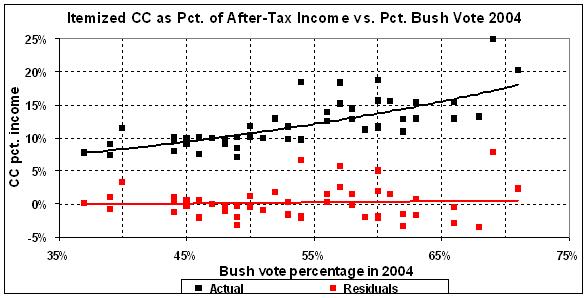
The relationship between after-tax giving and Bush votes is indicated by the black plot points in the following graph:

The best regression fit for the relationship between after-tax charitable giving and Bush votes is an exponential (the black line):

Itemized charitable contributions as percentage of after-tax income =
0.0304e^2.5026 x (percentage of votes cast for Bush in 2004)
R-squared = 0.59

The exponential fit indicates that the rate of after-tax giving accelerates as the percentage of Bush votes increases. Moreover, the fit — as good as it is — understates the rate of acceleration, as can be seen by inspecting the residuals (the differences between the regression estimates and the actual data), which are plotted in red. Note that the four largest residuals are positive (that is, the equation underestimates charitable giving) and represent pro-Bush States, with vote percentages of 54, 57, 60, and 69.

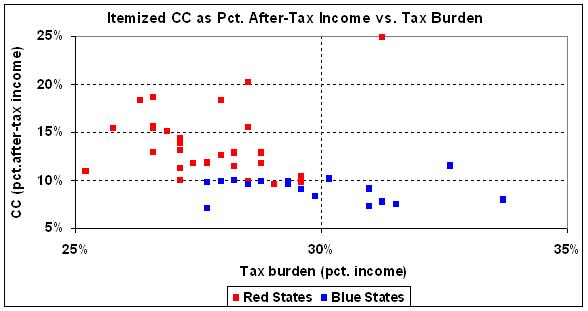
You might think that the higher rate of giving among Red States is the result of lighter tax burdens in those States. It is true that Red States generally have lighter tax burdens than Blue States, as the following graph attests:

But you can see readily that — given the same tax burden — Red States outstrip Blue States in charitable giving. You can see, also, that there is a strong negative relationship between taxes and charitable giving. It doesn’t show up in the data for the Blue States, which are almost uniformly parsimonious when it comes to charitable giving, but it’s definitely there in the case of the Red States. For all States (with the exception of Wyoming, the far “outlier” at the top of the graph), a linear regression yields a one-to-one negative relationship between the tax burden and charitable giving; that is, for every 1 percentage point rise in the tax burden, after-tax charitable giving drops by 1 percentage point.

I draw two conclusions:

  • There is a significant, positive relationship between Republicanism and charitable giving, as indicated by both graphs.
  • Taxes crowd out charity (no surprise), as indicated by the second graph.

Red vs. Blue Charity

From Yahoo! News:

“We believe that generosity is a function of how much one gives to the ability one has to give,” said Martin Cohn, a spokesman for the Catalogue for Philanthropy, a Boston-based nonprofit that publishes a directory of nonprofit organizations.

Using that standard, the 10 most generous states were, in descending order, Mississippi, Arkansas, South Dakota, Oklahoma, Tennessee, Alabama, Louisiana, Utah, South Carolina and West Virginia.

The 10 stingiest, starting from the bottom, were New Hampshire, Massachusetts, New Jersey, Rhode Island, Wisconsin, Connecticut, Minnesota, Colorado, Hawaii and Michigan.

Some New Englanders, of course, don’t like the result, so they have concocted their own measures of charitableness. But the Catalogue’s method strikes me as right. And what does it tell us? This:

Most Generous States (ranked from most-to-less generous; percentage of popular vote for Bush in 2004 in parentheses)

Mississippi (60%)
Arkansas (54%)
South Dakota (60%)
Oklahoma (66%)
Tennessee (57%)
Alabama (63%)
Louisiana (57%)
Utah (71%)
South Carolina (58%)
West Virginia (56%)

Least Generous States (ranked from least-to-more generous; percentage of popular vote for Bush in 2004 in parentheses)

New Hampshire (49%)
Massachusetts (37%)
New Jersey (46%)
Rhode Island (39%)
Wisconsin (49%)
Connecticut (44%)
Minnesota (48%)
Colorado (53%)
Hawaii (45%)
Michigan (48%)

So much for those mean-spirited, Bible-thumping Republicans.

Conservatism and Capitalism

From my second comment on a post at Right Reason:

Conservatism of the Burkean-Hayekian kind isn’t an ideology of the status quo, it’s an ideology of voluntary social evolution — and capitalism is one of the great manifestations of voluntary social evolution. Capitalism favors accomplishment rather than class, rank, and ritual (unlike European conservatism). Capitalism most decidedly does not exploit workers: it enables them to progress materially in ways that caste systems, socialism, and welfarism cannot because they stifle accomplishment and reward stupidity, incompetence, and ignorance.

How to End the Postal Monopoly

In my lifetime, the price of a first-class postage stamp

Began at           .03
Then increased to .05 on Jan. 7, 1963
Then increased to .06 on Jan. 7, 1968
Then increased to .08 on May 16, 1971
Then increased to .10 on March 2, 1974
Then increased to .13 on Dec. 31,1975
Then increased to .15 on May 29, 1978
Then increased to .18 on March 22, 1981
Then increased to .20 on Nov. 1, 1981
Then increased to .22 on Feb. 17, 1985
Then increased to .25 on April 3, 1988
Then increased to .29 on Feb. 3, 1991
Then increased to .32 on Jan. 1, 1995
Then increased to .33 on Jan. 10, 1999
Then increased to .34 on Jan. 7, 2001
Then increased to .37 on June 30, 2002

The price will increase to 39 cents in 2006.

Are we getting our money’s worth? Of course not. The U.S. Postal Service (formerly known as the U.S. Post Office) enjoys a legal monopoly on the delivery of letters, bills, catalogs, and junk mail to your mailbox. Well, its not your mailbox, even though you bought it. It’s there for the exclusive use of USPS, and its use by any other party invites a stiff penalty.

The best evidence that we don’t get our money’s worth from the post office is the flight to online banking, online billpaying, online shopping, and the rise of UPS, FedEx, and similar carriers. USPS boasts of an operating surplus in 2004, but that surplus is down from the one recorded in 2003, and it is probably due to the continuing contraction of USPS employment. USPS is in a death spiral, and its management knows it.

In recognition of that, USPS contrived a partnership with FedEx. Perhaps, in the long run, that partnership will evolve into the absorption of USPS by FedEx. That would be a good thing, except that it might enable FedEx to acquire a taxpayer-funded asset cheaply — or even for nothing.

The best solution would be to dissolve USPS and auction its assets. The proceeds should be spread among taxpayers in the form of a tax credit proportional to each taxpayer’s income tax liability for the year in which the proceeds are realized.

I, for one (among many), would not miss the surly presence of a USPS carrier or clerk in my life. It is pleasant to do business with UPS and FedEx drivers and other employees. They may be pleasant only because they make good money and want to keep it that way, but that doesn’t matter. They are pleasant and they do deliver the goods, literally and figuratively.

Joe Stiglitz, Ig-Nobelist

Economist Joseph Stiglitz (a.k.a. Paul Krugman plus Nobel prize) recently reviewed Benjamin Friedman’s The Moral Consequences of Economic Growth. Stiglitz delivers many outrageous ideas, not the least outrageous of which is this:

Inequality did seem to fall in the United States after the Great Depression, but in the last 30 years it has increased enormously.

Inequality seems to go with economic growth — as Stiglitz admits. But he prefers equality and lower incomes for all to inequality and higher incomes for all. He has no regard for those whose talents and entrepreneurship fuel growth and help to make everyone better off. That’s probably why he’s an academic.

Then there is this:

The question should be, are there policies that can promote what might be called moral growth — growth that is sustainable, that increases living standards not just today but for future generations as well, and that leads to a more tolerant, open society? Also, what can be done to ensure that the benefits of growth are shared equitably, creating a society with more social justice and solidarity rather than one with deep rifts and cleavages of the kind that became so apparent in New Orleans in the aftermath of Hurricane Katrina?

This is absurd talk coming from a so-called economist. He must have learned his economics at the knee of Karl Marx. Aside from enforcing laws against force and fraud, government should simply get out of the way. Markets thrive without government intervention. Markets are the essence of cooperation. Markets are inherently “tolerant” and “open” because the pursuit of self-interest (profit) requires service to the interests of others. Markets ensure equitable sharing of the benefits of growth by incentivizing and rewarding contributions to growth. A society of free markets and limited government would not have fostered the conditions that led to New Orleans’s poverty and rank dependence on incompetent government.

But Stiglitz continues undaunted by the ghost of Adam Smith:

As the income distribution becomes increasingly skewed, with an increasing share of the wealth and income in the hands of those at the top, the median falls further and further below the mean. That is why, even as per capita GDP has been increasing in the United States, U.S. median household income has actually been falling.

Left-wingers like to talk about the “skewed” distribution of income, but they don’t like to talk about the fact that there is considerable mobility across that distribution. As I wrote here, for example,

at the end of the 20th century, only about 15 percent of the households (3 million of 21 million) then in the bottom quintile had been there for a generation.

(See also this post and this one.) Moreover, Stiglitz views household income selectively. Instead of looking at the long-term trend, which clearly is upward, he focuses on recent, recession-related data. Here is the big picture:


Source: Census Bureau. See Figure 5, at this link.

Stiglitz, of course, likes to invoke the usual Left-wing bugbears, as if the bottom line (rising real income) were irrelevant. Thus he alludes to the poverty rate, which in fact is in long-term decline; job security, a nebulous scare-term that somehow cancels out rising real income and the 20-year decline in the unemployment rate, which is now well below the average for 1948-2004; the percentage of persons without health insurance, which has risen somewhat since 1987, probably due to immigration and government mandates that have raised the cost of health insurance; and so on.

Now Stiglitz mounts a direct assault on Adam Smith:

In a market economy with imperfect and asymmetric information and incomplete markets — which is to say, every market economy — the reason that Adam Smith’s invisible hand is invisible is that it does not exist. Economies are not efficient on their own. This recognition inevitably leads to the conclusion that there is a potentially significant role for government.

Of course nothing is perfect, except in the mind of a delusional economist or engineer. The price of perfection is too high: perfection is inefficient and stagnant. But Stiglitz doesn’t want to talk about that; he wants to talk about how the visible, heavy hand of government can do to us what we refuse to do to ourselves. He doesn’t want to talk about the very high cost of government intervention in markets, which I have documented here. That high cost includes the direct cost of government — which, including welfare programs, now amounts to 40-50 percent of GDP — and the incentive-dampening costs of taxation and regulation — which, over the past 100 years, have slashed GDP to about 60 percent of its potential level.

Finally, Stiglitz offers this bit of “evidence” for the superior wisdom of government:

There is, for instance, a greater role for government in promoting science and technology than Friedman seems to suggest. A report by the Council of Economic Advisers (conducted when I was its chair) found that the returns on public investment in science and technology were far higher than for private investment in these areas and than for conventional investment in plant and equipment.

I wonder how it was that Stiglitz, as chairman of the Council, was able to sponsor a report that came to such pro-government conclusions? (Just asking.) Actually, Stiglitz misrepresents the findings of the study to which he refers. The study (as cited here) actually found

the private rate of return of R&D to be between 10 and 40 percent, while the social rate of return ranged from about 20 to 140 percent.

(An analysis with similar results can be found here. The following critique applies to all such studies.)

What we have here are apples and cucumbers. The private rate of return to R&D is the additional profit that results from additional investments in R&D. The social rate of return to R&D is the gain in consumption (GDP) that results from additional government investments in R&D. Thus, according to Stiglitz’s study, if a corporation invests a dollar in R&D, it can expect that dollar to return a profit of between 10 and 40 cents a year, whereas a dollar of government R&D enables an future increase in consumption (additional GDP) of between 20 cents and $1.40 per year. However, a corporation’s profit is net of something, namely its sales. If a corporate investment of $1 is to yield a profit of 10 to 40 cents a year, it must generate additional sales (additional GDP) of considerably more than 10 to 40 cents a year.

To convert the apple of private R&D to the cucumber of government R&D we must convert after-tax profits to the equivalent amount of GDP required to generate those profits. Drawing on National Income and Product Accounts Table 1.15 (Price, Costs, and Profit Per Unit of Real Gross Value Added of Nonfinancial Domestic Corporate Business) for 1929-2004, I find the mean and median after-tax profit of nonfinancial corporations to be have been 7.7 percent of value-added for that period.* Thus, over the long haul, every dollar of profit represents about $13 in additional GDP. Applying that ratio, we get a valid comparison of the returns to private and government R&D:

  • The private rate of return to R&D, in terms of additional GDP, is between 130 and 520 percent.
  • The so-called social rate of return (i.e. return to government R&D, in terms of additional GDP) ranged from about 20 to 140 percent.

The true private rate of return to R&D is about 4 to 6 times that of the government rate of return. What else would one expect, knowing that the private sector responds to the signals sent by consumers while government just makes it up as it goes along?

I hereby nominate Joe Stiglitz for the Perpetual Ig-Nobel Prize in Left-Wing Economics.
__________
* The profit rate for 1999-2003 dropped below the long-term mean and median. That wouldn’t bother Stiglitz, of course. He seems to believe that government, not business, is mainly responsible for economic growth, and that corporate poverty is somehow good for people, when just the opposite is true.

Much Ado about Donning

The U.S. Supreme Court, in the first case argued before Chief Justice Roberts,

ruled on November 8 that the Fair Labor Standards Act (FLSA) requires two meat-packing companies to pay employees for time walking within the plant to their workstations after the employees don specialized protective gear, plus time spent at the end of the day walking back and waiting to doff such gear. (IBP v. Alvarez, No. 03 1238, and Tum v. Barber Foods, Inc., No. 04 66.)

All right, so the Court didn’t find the FLSA unconstitutional, much as I would welcome such a result. The Court’s reticence in that respect is unsurprising, given that the FLSA has survived (with amendments) these 70 years.

In any event, the Court wasted its time in requiring the meat-packing companies to pay employees for the time involved in the activities covered by its ruling. Sooner or later, the real hourly wages paid the workers who wear special protective clothing and/or the number of such workers will be reduced to compensate for the fact that the Court’s ruling does not make those workers any more productive than they were before the ruling. The intial boost in employees’ pay (hourly wages times the amount of time spent in donning, doffing, and walking) will have to come from somewhere — and the somewhere is wage rates and/or employment.

Yes, the adjustment will take some time — especially because the companies affected by the ruling must negotiate with unions. But it will happen because consumers aren’t going to demand more meat products or pay higher prices for meat products just because the Supreme Court has chosen to waste its time enforcing the FLSA.

(The quotation above is from an e-mail sent by the Richmond, Virginia, law firm of McGuireWoods.)

Understanding Outsourcing

What U.S. consumers should (and do) care about is getting the most for their money. If more of their dollars happen to flow across international borders as American companies strive for efficiency, so what? If American companies “send jobs” to Juan in Nuevo Laredo, Mexico, and Pierre in St. Stephen, New Brunswick, Juan and Pierre wil use the extra dollars they earn to buy things of good value to them that are made in the U.S., things that they couldn’t afford before. That’s called job creation.

In sum, Juan and Pierre outsource to us because we outsource to them, just as you outsource auto repair to your local mechanic and he outsources, say, computer programming to you. And if Juan and Pierre don’t spend all of their dollars on consumer goods, they put some of their dollars (directly or indirectly) into U.S. stocks and bonds, which helps to finance economic growth in the U.S.

Outsourcing, which is really the same thing as international trade, creates jobs, creates wealth, and raises real incomes — for all. Economics is a positive-sum “game.”

If you’re not convinced, think of it this way: If product X is a good value, does it matter to you whether it was made in Poughkeepsie or Burbank? Well, then, there’s nothing wrong with Laredo, Texas, or Calais, Maine, is there?

Now imagine that the Rio Grande River shifts course and, poof, Nuevo Laredo, Mexico, becomes Nuevo Laredo, Texas. Or suppose that the Saint Croix River between Maine and New Brunswick shifts course and the former St. Stephen, New Brunswick, becomes St. Stephen, Maine. Juan and Pierre are now Americans. Feel better?

What’s in a border? A border is something to be defended against an enemy. But do you want a border to stand between you and lower prices, more jobs, and economic growth? I thought not.

Plus Ca Change

IT is one of the most melancholy reflections of the present day, that while wealth and capital have been rapidly increasing, while science and art have been working the most surprising miracles in aid of the human family, and while morality, intelligence, and civilization have been rapidly extending on all hands;—that at this time, the great material interests of the higher and middle classes, and the physical condition of the labouring and industrial classes, are more and more marked by characters of uncertainty and insecurity.

What hasn’t changed, of course, is the tendency of the press to see problems where others see progress.

(Thanks to Pejman at A Chequer-Board of Nights and Days for the pointer.)

The Economics of Corporate Fitness Programs

One of the many fads to sweep the corporate world in recent years is the fitness fad. The fad has two components: real costs and putative benefits. The real costs involve the installation of exercise facilities on company property, subsidies for off-site health-club memberships, a certain amount of paid time off for fitness programs, the hiring of nutritionists for company-subsidized cafeterias, and on and on. The putative benefits of the fitness fad are (1) more productive workers (healthy bodies, healthy minds, and all that); (2) workers who, in the longer run, will be less costly to insure; and (3) greater competitiveness in the labor market (i.e., being able to hire and keep employees who value fitness programs).

The fitness fad has five main proponents:

  • Executives who wish to be known as “progressive” and “interested in employee welfare”
  • Consultants who are hired by executives for the purpose of recommending the fitness programs that executives already favor
  • Vendors of fitness-related products and services
  • Those employees who already are physically fit, but who find it easier and cheaper to stay fit because of company programs
  • Other employees who want to be part of the “in” crowd or to curry favor with bosses who preach fitness.

As for the immediate benefits of company fitness programs, I have observed that the already-fit tend to stay fit, but at the company’s expense, while the less-fit give fitness a try, but it doesn’t last. If it did, Americans wouldn’t be getting fatter, would they?

What about the returns to the company in the form of lower health-insurance costs? Health-care costs rise with age. Assuming that fitness programs actually make employees more fit, which I doubt, a company is unlikely to reap long-run returns unless (a) its employees are exceptionally loyal or (b) it is able to hire equally fit replacements from other companies that have similarly effective (or ineffective) fitness programs.

And what about hiring and retention? Well, it’s like an arms race in which the objective isn’t to fight a war but to spend more than the other guy. If “everyone does it” in a certain industry, here’s what happens:

  • Workers who don’t participate in fitness programs (that is, most of them) lose because compensation has been shifted from wages and non-fitness benefits toward fitness benefits. Therefore, that industry finds it harder to hire and retain workers for whom fitness isn’t an important consideration; that is, productivity declines and costs rise.
  • If firms in the industry try to raise prices in order to cover the costs of fitness programs, consumers find substitute products or services, thus cutting into the industry’s sales and profits.
  • And so, one way or the other, shareholders take a hit in the form of lower stock prices.

Who benefits? Trendy executives and employees who’d rather work out than work.

That’s my hypothesis, and I’m sticking with it until I see hard numbers that prove it wrong.

The Corporation and the State

The existence of the corporation (and such similar entities as limited liability companies) encourages business and capital formation by mitigating investors’ personal risks. Because the corporation is state-sanctioned, some apologists for the state like to argue that the existence of the corporation is a proof of the indispensibility of the state.

The existence of the corporation, in fact, proves no such thing. Absent the state, investors could indemnify themselves through private contractual arrangements, that is, insurance pools.

The state exists because powerful individuals and coalitions with an agreed agenda find it convenient to enforce that agenda through an entity that has a monopoly of power in a geographical area. The desirability of a particular state can be judged only by the extent to which its agenda fosters the unforced evolution of peaceful, voluntary, social and business arrangements.

What’s Wrong with Game Theory

I took aim at a particular application of game theory in “Schelling and Segregation.” Dave Patterson (Order from Chaos), offers a general critque of game theory. Here’s a sample:

[G]ame theory has one major flaw inherent in it: The arbitrary assignment of expected outcomes and the assumption that the values of both parties are equally reflected in these external outcomes. By this I mean a matrix is filled out by an individual (we’ll call them the conductor), it is up to that conductor’s discretion to assign outcome values to that grid. This means that there is an inherent bias towards the expected outcomes of conductor.

Or: Garbage in, garbage out.

Further Erosion of the Employment Relationship

UPDATED TWICE BELOW

From the law firm of McGuireWoods:

The National Labor Relations Board recently held that an employee’s statements to a local newspaper and subsequent postings on an Internet message board in the context of labor organizing were protected activity under the National Labor Relations Act.

Following the purchase of a manufacturing facility and subsequent layoff of roughly 200 employees by the new owner, the union attempting to organize the facility’s employees approached a retained employee to talk to a newspaper about the firings. The newspaper quoted the employee that the layoffs “left gaping holes in this business”. The company warned the employee that such comments violated the employee handbook because they were disparaging to the company, and that the employee would be fired if he did it again. Two weeks later, the same employee responded to an anti-union posting on the newspaper’s internet message board. Among other statements, the employee stated in his post that the company was “being tanked by a group of people that have no ability to manage it.” He was fired soon after, and the union filed an unfair labor practice.

Affirming the statement that management “cannot be too thin-skinned,” the Board affirmed the ALJ’s decision that the activity was protected for three reasons. First, the newspaper quote and internet posting both involved employment matters. Second, there was a sufficient link between the statements and the ongoing controversy. Finally, the Board ruled that the comments were “not so egregious” as to fall outside the realm of protected activity.

Clearly, the NLRB remains in the grip of Left-wing doctrines, if not in the grip of Left-wing members. It takes a lot of specious reasoning to hold for the employee in the case cited by McGuireWoods. First, the newspaper quote and internet posting were statements by the employee, not the employer. Second, the employee made the link between the statements and the “ongoing controversy.” Finally, the employee’s statements could be found to be “not so egregious” only by a body that is already biased against employers. In sum, the employee bad-mouthed his employer and got away with it simply because of an “ongoing controversy” about unionization. It’s an invitation to disgruntled employees to incite unionization. Apparently almost anything goes under the cover of an effort to unionize a workplace.

Is there a free-speech issue involved? Not at all. The Constitution’s guarantee of freedom of speech is — or was intended to be — nothing more than a guarantee that government cannot suppress speech. Of course, that guarantee has been vitiated by restrictions on such things as commercial speech and campaign speech.

Nothing in the Constitution gives anyone the right to disparage an employer and duck the consequences. In fact, nothing in the Constitution gives government the right to legislate unionism, in particular, or to interfere in employment relationships, in general.

The NLRB’s ruling is another dreary reminder of the many unconstitutional excesses of the New Deal.

UPDATE: A reader objects to my opening comment on the NLRB decision: “Clearly, the NLRB remains in the grip of Left-wing doctrines, if not in the grip of Left-wing members.” He says:

Left-wing doctrines maybe, but to imply the current Board members are a bunch of left-wingers is an absurdity. Anybody who even casually follows Board decisions readily admits that the Board has moved sharply toward management-side on the whole in recent years. If you feel the statute is left-wing, then your gripe is with Congress, not the Board–unless you can point to an example of the Board interpreting the statute in a left-biased way, which I expect you can’t.

My reply:

Regardless of the Board’s current ideological composition, it’s clear that the Board acted in a Left-biased way in the case at hand. I need look no further. The Board chose to interpret the employer’s actions as an act of interference with an attempt to unionize. I would have interpreted the employer’s actions as a justifiable course of discipline against an employee who contravened the employer’s stated policies.

I have had dealings with a similar body (the EEOC), and I doubt very much that the problem is statutory. No statute can prescribe precisely how a body like the NLRB must judge the motivations of employer and employee in a particular case. The Board made a judgment call, which smacks of complaisant adherence to decades of Left-wing precedent. Perhaps the Board is too willing to accept the recommendations of its Regional Directors and their long-serving staff employees, many of whom are likely to be imbued with the “rightness” of Left-wing interpretations of the NLRA.

Anyway, the sentence to which you object . . . means this: “The NLRB remains in the grip of Left-wing doctrines (interpretations of statutory authority), even though its members may (or may not) be Leftists.” . . .

I might have written this: “Clearly, the NLRB remains in the grip of Left-wing precedents that the Board’s current membership is too gutless to reverse.” But I’ll leave it as it stands.

UPDATE 2: My correspondent rightly notes that the National Labor Relations Act (Wagner Act), which established the NLRB, “could have been an overwhelmingly destructive statute.” Although it has been destructive enough, I agree that things could have been worse had the anti-business (and therefore anti-growth) intentions of its framers been executed down the line. But in spite of the intentions of the Act’s framers, its words (in my opinion) give the NLRB leeway for pro-employer decisions. It’s a shame that the NLRB didn’t take advantage of that leeway in the case highlighted by McGuire Woods.

Consider the Children

I have written before about the hidden cost of government programs that encourage mothers to work outside the home:

The twentieth century was a time of great material progress. And we know that there would have been significantly greater progress had the hand of government not been laid so heavily on the economy. But what we don’t know is the immeasurable price we have paid — and will pay — for the exodus of mothers from the home. We can only name that price: greater incivility, mistrust, fear, property loss, injury, and death.

I focused on the economic evidence. But there’s direct evidence of the harm caused by pushing mothers out of the home. First, there’s this:

Researchers tracked the reaction of 70 toddlers in Berlin to their separation from their parents and homes.

They found stress levels were still raised months after beginning child care – even though outward signs of distress had stopped.

“For most toddlers the initiation of daycare is a major stress,” writes report co-author Michael Lamb.

The study of children’s reaction to leaving home casts light on a question that will have been asked by many working parents: “Do children really worry about being away from their parents?”

The answer from this study suggests that children do experience increased stress. . . .

And, more tellingly, there’s this:

A study, the results of which were reported in The [UK] Independent yesterday, indicates that toddlers who are looked after by their mothers develop significantly better than those cared for by nurseries, childminders or relatives.

The report, presented by Penelope Leach, president of the National Childminders’ Association and one of the co-authors, shows that toddlers given nursery care fared worst of all. According to The Independent these children “exhibited higher levels of aggression and were inclined to become more compliant, withdrawn or sad.” Those under the care of relatives fared somewhat better.

The research, which involved 1,200 children and their families in the London and Oxfordshire area, showed that “youngsters looked after by childminders and nannies came second in terms of their development to those who stayed at home with mother.”

The report confirms other studies that show that young children develop best when in the care of a parent, usually the mother, in a loving environment. The report also showed that institutionalized daycare, as proposed by many governments, is detrimental to the development of toddlers.

Society is nothing without civility. Government efforts to push mothers out of the home are nothing less than a crime against society.

(Thanks for my daughter-in-law for the lead.)

Related posts:

I Missed This One (08/12/04)
A Century of Progress? (01/30/05)
Feminist Balderdash (02/19/05)
Libertarianism, Marriage, and the True Meaning of Family Values (04/06/05)
Judge Roberts and Women (08/19/05)

Economics for Real People

From Arnold Kling:

[I]n the case of economics, the academy has been more or less hijacked by mathematicians who want economics to masquerade as engineering.

Mathematical economics overlays a false precision on an unconcern for flesh-and-blood reality.

Why Government Spending Is Inherently Inflationary

Note that the title of this post doesn’t say “only deficit spending is inherently inflationary,” which is the prevalent conception among laypersons, commentators, and even many economists. In the interest of keeping the preceding post from being any longer that it is, I glossed over the relationship between government spending, deficits, and inflation. This post fills the gap.

That government spending is inherently inflationary can be shown by the following first-order approximation of its effects, in the case where government spending is “financed” by taxes:

  • Suppose the GDP of the United States would be, as it is today, about $12 trillion in the absence of all government. (Actually, as I show here, GDP would be a lot more than today’s $12 trillion in the absence of government — defense and justice, excepted — but I’m giving government some benefit of the doubt in this example.)
  • Suppose government arrives on the scene one fine day and says: “You Americans need our services, so we’re going to tax you $2 trillion in order to provide things that we want you to have.” A few of those things — such as defense and justice — will be worth something to almost everyone. Some of those things will be valued only by persons who want someone else to pay for them. Most of those things will be heavily regulatory and thus will detract from GDP. To assume, as I do in this example, that the $2 trillion is effectively thrown away is to be generous to government.
  • Government’s edict has the same effect as if the producers of $2 trillion worth of valuable goods and services walk off the job. (More accurately, it’s as if they walk off the job and begin to vandalize homes and businesses.) Only, in this case, government entices them off the job with $2 trillion in “tax dollars.” But the the taxes are an illusion.
  • When the producers of $2 trillion worth of real output walk off the job, at the behest of government, it is as if government were destroying real output. But government pretends that it’s producing $2 trillion worth of real output, so (1) it levies taxes for government services, most of which taxes fall on the productive sector, and (2) it pays producers of government services from those taxes.
  • But the producers of real output know what’s happening, so they raise prices by enough to compensate for the taxes they’re paying. And government collects those “empty dollars” in the form of taxes. Why are those tax dollars “empty”? Because they don’t represent real output, government having destroyed the same by enticing producers out of the real economy.
  • In sum, government pays the producers of government services in “empty dollars,” which those producers then try to spend on real output.And so we have $12 trillion chasing $10 trillion worth of real goods and services.

That’s real inflation. No deficit spending necessary. And it happens every time government finds a way to widen the gap between what the productive sector could produce and what it actually produces, after government has worked its will.

What if government were to borrow the $2 trillion instead of raising taxes by $2 trillion? Borrowing doesn’t change the outcome, just the way we get there. It’s still as if the producers of $2 trillion worth of valuable goods and services walk off the job. Only, in this case, government entices them off the job with $2 trillion that it calls “borrowing” instead of “taxes.” Again, if the producers of $2 trillion simply walk off the job, that leaves a real GDP worth $10 trillion. This time, however, the producers of that output don’t raise prices to compensate for taxes; they raise prices to capture the $2 trillion that government puts in the hands of producers of government services. The result is as before.

Here’s another way to look at it: Taxation results in supply-side inflation, as producers of real output raise prices to compensate for taxes; borrowing results in demand-side inflation, as producers of real output raise prices as government injects new money into the system.

What about the “crowding out” effect of government borrowing on private, growth-inducing investment? Here’s the real story:

  • When government enters financial markets for additional funds, that raises the demand for money. The usual result would be higher interest rates, which would tend to dampen private investment and consumption to some degree.
  • However, when government borrows instead of raising taxes it leaves nominal dollars in the hands of the private sector. Some of those dollars flow into financial markets, thus increasing the supply of money.

The precise net effect depends on the marginal propensity to save, and on the elasticity of investment and consumption with respect to interest rates. But it seems likely that the net effect of government borrowing is close to zero. As I wrote here:

The actual effect of government borrowing on interest rates — and thus on the cost of private capital formation — is minuscule, and perhaps nonexistent, as Brian S. Westbury explains:

The theory [that deficits drive up interest rates] suggests that deficits “crowd out” private investment, putting upward pressure on interest rates. In other words, government borrowing eats up the available pool of capital. But today’s forecasted deficits of $300 to $500 billion are just a small drop in the pool of global capital markets. In the U.S. alone, capital markets are $30 trillion dollars deep, for the world as a whole they approach $100 trillion. Deficits of the size projected in the years ahead cannot possibly have the impact on interest rates that many fear….

The next time someone tells your that taxes should be raised in order to be “fiscally responsible” and to stem the tide of inflation, tell him this: Government spending is inherently irresponsible because it reduces real output. And government spending is inherently inflationary, not matter how it’s financed.

Debt Hysteria, Revisited

Recently I had a long and unproductive exchange with a blogger, an evident “gold bug,” who insisted on making a big deal of these factoids:

Dallas Morning News columnist Scott Burns wrote June 1 that the government’s debt is actually “a mind-numbing $43 trillion. . . .”

Burns said the Federal Reserve has put the net worth of all U.S. households at just $40.6 trillion. . . .

Dr. Kent Smetters [an economist on a Treasury Department project], testified before a subcommittee of the House Judiciary Committee, Burns wrote.

Smetters told the subcommittee: “The government reports that the national debt in 2003 was about $3.6 trillion in the form of government ‘debt held by the public.’ But that number ignores massive imbalances in Medicare and Social Security programs and the government’s other programs.

“When the liabilities associated with those programs are taken into account, the nation’s fiscal policy is currently off-balance by over $43.4 trillion in present value, a number that is not reported in standard budget documents,” he told the subcommittee. . . .

The hysterical blogger thereupon concluded that “we” are bankrupt because “our” debt outstrips “our” net worth. As I tried to explain to the hysterical blogger, the $43 trillion is not debt “we” (householders) owe today, it’s an estimate of the present (discounted) value of future, unfunded obligations of the U.S government. Only about 1/6 of that amount is now on the government’s books (the current, gross federal debt). The rest won’t become a legal obligation unless and until the government is required to borrow money because future outlays exceed future revenues.

Let me elaborate: $43 trillion is an estimate of the present (discounted) value of debt the U.S. government might eventually owe, given certain projections about revenues and spending (including spending on entitlement programs such as Social Security, Medicare, and Medicaid). Those projections might prove to be wrong, either because of (1) cuts from projected entitlement benefits (which wouldn’t mean cuts in actual benefits, as benefits are scheduled to become more generous), (2) increases in the taxes that partially underwrite those benefits, or (3) some combination of the two. The same is true for government’s general accounts (the ones that fund actual government operations as opposed to transfer payments), which also are subject to future changes in spending and taxes.

But let’s assume that all of the projections will come to pass, so that the discounted value of future government spending less future taxes is in fact $43 trillion. Does that somehow mean we are bankrupt or on the verge of bankruptcy? No it does not. Consider this example: Mr. & Mrs. X apply for a mortgage loan. Based on their current family income of $100,000, the lender gives them a $250,000 loan to buy a house. Now, I know that the loan becomes a real, current obligation (unlike the $43 trillion), but bear with me. The loan doesn’t bankrupt Mr. & Mrs. X; otherwise, the bank wouldn’t give them the loan. The loan doesn’t bankrupt Mr. & Mrs. X because the lender is pretty certain, based on the couple’s employment history and prospects, that the couple is going to keep making $100,000 a year, and more.

How does that relate to the $43 trillion? The $43 trillion includes today’s federal debt (which already is being serviced) plus a stream of projected future deficits of, let’s say, $1 trillion a year. Now, I don’t like that extra $1 trillion a year any more than anyone else (except liberals, to whom I’ll come). My reason for not liking it is this: It is part (and only a small part) of a massive redistribution of resources by government; taking from those who are productive and either pouring the resources down ratholes or giving the resources to people who haven’t earned them. Regardless of that, Americans can “afford” the extra $1 trillion a year because they’re now making about $12 trillion a year (GDP), less federal, state, and local taxes (excluding transfer payments) of $2+ trillion a year. So, like Mr. & Mrs. X, we taxpayers can afford the annual “mortgage” payment (the additional $1 trillion a year) from future income (GDP), so we’re a good credit risk. Or, rather, the U.S. government is a good credit risk because it can always tap into our pockets by raising taxes.

That brings me to the question whether the U.S. government’s debt can continue to grow, and at what rate. I addressed that question at length in an earlier post on “debt hysteria”; for example:

Because individuals and institutions are quite willing to lend money to the federal government, it can keep piling up debt indefinitely. In fact the federal government has been able to increase its debt almost continuously since opening for business. From January 1, 1791, to April, 19, 2004, the federal debt rose at an average annual rate of 5.5%. During that period, the debt reached a low of $33,733.05 on January 1, 1835. From then until April 19, 2004, the debt rose at an average annual rate of 11.3%. That’s a much greater rate of increase than we’ve experienced recently or expect to experience in the next several years.

What about those future generations? Well, future generations not only “inherit” the debt, they also inherit an offsetting asset. If you lend the government $10,000 by buying a 10-year Treasury note, and you keep rolling the note over (that is, buying a new 10-year note when the old one matures), the note eventually will pass to your heirs.

Future generations of taxpayers also inherit an obligation to pay interest on the federal debt. But those same future generations receive the interest that is being paid.

What about debt service? It comes down to the same thing. One person’s interest payment is another person’s income. The interest rate on the government’s debt does fluctuate, but that’s due less to the size of the debt than to conditions in credit markets. U.S government debt, as large as it is, is a small component of global capital markets — currently less than 10 percent. (There’s a relevant chart about interest on the debt in this post by The Skeptical Optimist.)

What about those “foreigners” who hold U.S. government debt? There is the notion that, by holding our debt, foreigners have a “hold” over us. How so? It hurts them if U.S. debt loses value. Foreigners have absolutely no incentive to “dump” U.S. debt unless financial markets already have signaled that it’s losing value, or unless they get wind of a sudden, unanticipated change in America’s economic picture. The $43 trillion isn’t such a change; it’s long been anticipated by financial markets. In any event, given the liquidity of U.S. government securities, there is scant room for speculative attacks on those securities. If any large investor were “dumping” U.S. debt, in the absence of new information, that would be the investor’s loss because the investor would be driving down the value of its own holdings. The value of those holdings would return to something like their former levels once the investor had finished its “dumping,” thus rewarding the buyers with windfall profits.

Variations in the price of U.S. government debt depend mainly on inflationary expectations for the U.S. vis-a-vis other countries. Inflationary expectations and trade deficits also influence exchange rates, and exchange rates play back into the price of debt. We’ve been through periods of high inflation, high interest rates, large trade deficits, and low exchange rates at varying times, and we’ll go through them again. Today we have relatively low (but rising) inflation, and relatively low (but rising) interest rates, a persistently large trade deficit (willingly financed by foreigners), and therefore a falling exchange rate. But all of that can and will change as higher interest rates and lower exchange rates work their way through the economy, dampening investment and consumption spending and, therefore, imports.

Today is not forever. Doomsaying is an ancient and long-discredited profession. Remember the ten years between the “oil shocks” of the early 1970s and the end of double-digit inflation in the early 1980s? Remember the next 20 years of almost unmitigated economic growth with low inflation? Extrapolating from current economic conditions is a sucker’s game, unless you bet on the underlying trend in the U.S., which is long-term economic growth.

Yes, we could go through a prolonged period of higher inflation and higher interest rates, but that doesn’t mean the U.S. government won’t be able to fund its debt. Someone always steps up to buy U.S. government debt, because it’s so secure. And given the underlying strength of America’s economy, which is the source of the U.S. government’s good credit, someone always will buy U.S. government debt.

And now we come to the real problem: government spending. Whether government spending is financed by debt or taxes, it is a generally destructive force. Government spending (with some exceptions for defense and justice) results in the gross misuse of resources. And the ways in which Americans are taxed to fund government spending (which is still how most of it is funded) tends to penalize, and thus discourage, growth-inducing initiatives.

Let me say it again: The real problem isn’t government debt, it’s government spending. Government debt is the effect, not the cause; the symptom, not the disease. Our “leaders” in Washington obviously don’t want to do anything to fight the disease; they’re like terminal alcoholics who keep ordering triple shots.

It’s up to libertarians and legitimate conservatives to make some real noise about government spending. Focusing on debt plays into liberals’ hands because they’ve come around to “fiscal responsibility” — their kind of fiscal responsibility: higher taxes to support higher spending.

No Mention of Opportunity Costs

The Marxist take on New Orleans is here (h/t Marginal Revolution):

How the Free Market Killed New Orleans

By

The free market played a crucial role in the destruction of New Orleans and the death of thousands of its residents. Forewarned that a momentous (force 5) hurricane was going to hit that city and surrounding areas, what did officials do? They played the free market.

They announced that everyone should evacuate. Everyone was expected to devise their own way out of the disaster area by private means, just like people do when disaster hits free-market Third World countries.

It is a beautiful thing this free market in which every individual pursues his or her own personal interests and thereby effects an optimal outcome for the entire society. Thus does the invisible hand work its wonders in mysterious ways.

In New Orleans there would be none of the collectivistic regimented evacuation as occurred in Cuba. When an especially powerful hurricane hit that island in 2004, the Castro government, abetted by neighborhood citizen committees and local Communist party cadres, evacuated 1.5 million people, more than 10 percent of the country’s population. The Cubans lost 20,000 homes to that hurricane—but not a single life was lost, a heartening feat that went largely unmentioned in the U.S. press.

And blah, blah, blah, blah.

Actually, the disaster in New Orleans was set up by government, as I explain here. And the failure to evacuate people was surely a government failure. Remember all those school buses and other municipal vehicles that went unused by the unesteemed mayor of NO? What happened in NO was by no means a test of free markets; it was proof that government isn’t the answer.

Moreover, total preparedness for every conceivable disaster is a prescription for impoverishment. But that thought would never cross the mind of a Marxist apologist for Castro’s regime. Cubans have little say in how they live their lives. Sometimes (rarely) that works to the advantage of Cubans; most of the time it works to their detriment. But that concept — namely, opportunity cost — is too subtle for your average Marxist propagandist to comprehend.

A Modest Proposal for Disaster Preparedness

Evidently, in l’affaire Katrina, the central government’s “failure” to usurp the responsibilities of individuals, businesses, and local and state governments will lead to something like this:

  • Congress will invoke the Commerce Clause to make such usurpation constitutional.
  • No president will dare veto such a “popular” mandate.
  • The Supreme Court, with its “Living Constitution” majority intact, will endorse the central government’s usurpation of responsibilities that lie elsewhere.
  • Congress will appropriate vast sums of money to ensure that no disaster goes unanticipated or is not reacted to instantly.

After all, how else can we possibly be certain that Mother Nature will never again claim as a victim an American or a visitor to the United States (legal or illegal)?

And when the central government is through earthquake-proofing, fire-proofing, and flood-proofing every structure in the United States it will start accident-proofing every vehicle and baby-proofing every bit of furniture and clothing. It would then go on to illness-and-death-proofing every person — perhaps retroactively — but by then it would have long since driven the economy into the ground. And so, as usual, the poor will be left to fend for themselves (as if everyone else doesn’t have to do so). But all will be poor, and the Left will — at last — be happy. A perfect world in which all are equal, and equally miserable.

My Labor Day Message

I posted this on Labor Day 2004. I stand by it.

Labor Day gives most workers a day off. That’s good because an extra day off now and then is a pause that refreshes. A longish trek to a park or a beach on a hot day with a car full of kids isn’t a refreshing way to spend Labor Day, but those workers who spend the day at home, perhaps reading a book and listening to music, will find their souls somewhat restored.

Now let us consider the significance of Labor Day as a holiday. According to Wikipedia:

The origins of Labor Day can be traced back to the Knights of Labor in the United States, and a parade organized by them at that time on September 5, 1882 in New York City. In 1884 another parade was held, and the Knights passed resolutions to make this an annual event. Other labour organizations (and there were many), but notably the affiliates of the International Workingmen’s Association who were seen as a hotbed of socialists and anarchists, favoured a May 1 holiday. With the event of Chicago’s Haymarket riots in early May of 1886, president Grover Cleveland believed that a May 1 holiday could become an opportunity to commemorate the riots. But fearing it may strengthen the socialist movement, he quickly moved in 1887 to support the position of the Knights of Labor and their date for Labor Day. The date was adopted in Canada in 1894 by the government of Prime Minister John Thompson, although the concept of a Labour Day actually originated with marches in both Toronto and Ottawa in 1872. On the other hand, socialist delegates in Paris in 1889 appointed May 1 as the official International Labour Day.

Labor Day has been celebrated on the first Monday in September in the United States and Canada since the 1880s. The September date has remained unchanged, even though the two governments were encouraged to adopt May 1 as Labor Day, the date celebrated by the majority of the world. Moving the holiday, in addition to violating U.S. tradition, could have been viewed as aligning U.S. labor movements with internationalist sympathies.

In summary (for those of you who didn’t grow up in the North), Labor Day is an invention of organized labor, and the historical roots of organized labor are socialistic.

Labor Day also serves to remind us of one of the “monuments” of FDR’s New Deal (quoting again from Wikipedia):

The National Labor Relations Act of 1935 (or Wagner Act) protects the rights of workers in the private sector of the United States to organize unions, to engage in collective bargaining over wages, hours, and terms and conditions of employment, and to take part in strikes and other forms of concerted activity in support of their demands….

In the first few years of the Wagner Act, however, many employers simply refused to recognize it as law. The United States Supreme Court had already struck down a number of other statutes passed during the New Deal on the grounds that Congress did not have the constitutional authority to enact them under its power to regulate interstate commerce. Most of the initial appellate court decisions reached the same conclusion, finding the Act unconstitutional and therefore unenforceable. It was not until the Supreme Court upheld the constitutionality of the statute in 1937 in National Labor Relations Board v. Jones & Laughlin Steel Corp. that the Wagner Act became law in practical terms as well.

Thus Labor Day, in its way, commemorates legislative and judicial infamy. The Wagner Act, at one stroke, deprived business owners of their property rights and thus discouraged investment and business formation; invalidated the freedom of employers to contract with employees on terms acceptable to employers as well as employees; caused artificially high wages and benefits that harmed American workers by making American industry less and less competitive with foreign industry; and set the stage for the use of the Commerce Clause as an excuse for the federal government’s interference in all aspects of business.

So, if you are a worker, enjoy your Labor Day holiday, but don’t thank organized labor or the New Deal for your material blessings.

"The Private Sector Isn’t Perfect"

Stephen Bainbridge (ProfessorBainbridge.com) actually says that in this post. Well, “So what?” you may say: No system for organizing human activity is perfect, except in such dream-worlds as anarcho-capitalism (where market forces defeat bullies by the sheer force of theory), Objectivism (which talks a good game about reality but seems unable to grasp it), and socialism (which promises free lunches and destroys incentives).

What Bainbridge goes on to say is almost right, however:

. . . but we’ve known since Adam Smith that economic incentives work. . . .

We also know that the modern public corporation is the greatest engine of prosperity the world has ever seen.[*] In The Company: A Short History of a Revolutionary Idea, John Micklethwait and Adrian Wooldridge demonstrate that the corporation is “the basis of the prosperity of the West and the best hope for the future of the rest of the world.”

The capital, product, and labor markets give corporate managers directors incentives to produce goods and services efficiently. What defenders of government regulation often overlook is that regulators are also actors with their own self-interested motivations. The trouble is that the incentives to which regulators and legislators respond are often contrary to the public interest. The incentives of legislators and regulators are driven by rent-seeking and interest group politics, which have no necessary correlation to corporate profit-maximization. Accordingly, government preparation for and response to disasters is likely to be driven by the political concerns of the governmental actors rather than the public good.

In sum, it may be time to try Adam Smith’s invisible hand by outsourcing disaster relief.

But the best way to outsource disaster relief isn’t to have government use our tax dollars to hire private disaster-relief specialists. No, the best way to “outsource” disaster relief is this:

  • Leave tax dollars in the hands of the private sector.
  • Tell the private sector that when it comes to disasters it’s your responsibility to plan prudently — and to bear the consequences of your planning.
  • Get government out of the insurance business and let the private sector respond (without restraint) to consumers’ demands for disaster insurance.

The best way to ensure that people make prudent decisions is to let them knowing that they’re responsible for themselves, require them to “play” with their own money, and allow them to spend their money where they think it will do them the most good.

Though it’s meant to bash the Bush administration, this headline (from Slate) captures the essence of the problem:

$41 Billion, and Not a Penny of Foresight
Why is the New Orleans recovery going so badly? Just look at the DHS budget.

As if government could ever take taxpayers’ money away from them and then spend it better than taxpayers could.** So Bush spends the money on the war (according to the Bush-bashers). Well, Clinton would have spent the money on his pet projects. That’s what happens when politicians get into your wallet. They decide what’s most important to you.

The private sector (i.e., free-market capitalism) is less perfect than everything, except all of the alternatives to it.

P.S. Ignoramuses and die-hard statists will say that free-market capitalism leaves everyone on his or her own. (Oh, how I hate the awkwardness that results from gender-correct writing.) In fact, free-market capitalism is the best vehicle for large-scale cooperation that has ever emerged from human endeavor. Free-market capitalism, among many other things, allows for insurance against risk and provides the wherewithal to combat the elements (e.g., plywood for boarding up windows, concrete for deep footings). What it doesn’t do is offer the illusion that “someone else” will protect you from all harm and immediately make you whole when you come to harm.

Related post: Katrina’s Aftermath: Who’s to Blame?
__________
* Apologists for the state like to say that public corporations couldn’t exist without the state’s blessing. Balderdash! Insurance markets would do the job of protecting shareholders quite nicely, thank you.

** I argue in “But Wouldn’t Warlords Take Over?” that government should take taxpayers’ money in order to provide for criminal justice and national defense. But that’s for the prudential reason suggested by the title of the post, not because government can necessarily provide such services more efficiently than free-market capitalism.