The Bankruptcy Bill in Perspective

UPDATED THRICE, BELOW

The bankruptcy-reform bill, as described in an article by Stephen Laboton of The New York Times:

The Senate assured final passage of the first major overhaul of the nation’s bankruptcy laws in 27 years on Tuesday….

The bill would disqualify many families from taking advantage of the more generous provisions of the current bankruptcy code that permit them to extinguish their debts for a “fresh start.” It would also impose significant new costs on those seeking bankruptcy protection and give lenders and businesses new legal tools for recovering debts.

…The senators…voted 69 to 31 to limit debate and cut off any effort to kill the legislation by filibuster.

Final passage of the measure is now an inevitable formality.

Good.

Of course, there’s the usual hand-wringing from the usual sources:

“This bankruptcy bill is mean-spirited and unfair,” said Senator Edward M. Kennedy, Democrat of Massachusetts. “In anything like its present form, it should and will be an embarrassment to anyone who votes for it. It’s a bonanza for the credit card companies, which made $30 billion in profits last year, and a nightmare for the poorest of the poor and the weakest of the weak.”

Hmmm….In other words, it’s okay for some people to rack up credit-card debt and then dishonor their obligation to repay that debt. (Think of it as a financial Chappaquiddick.) The result, of course, is that other people wind up subsidizing the deadbeats through higher prices and interest rates.

And how does Teddy K. know how much profit credit-card companies ought to make? The market should determine that, not Senator Stumblebum. If the profits of credit-card companies are “too high” it’s only because banking regulations restrict competition. But Teddy and his ilk never saw a regulation they didn’t like. Teddy has himself to blame for those “high” profits that he finds so offensive.

The bottom line: Bankruptcy reform will make goods, services, and credit somewhat cheaper for responsible citizens. And it will make responsible citizens out of many who otherwise would have racked up too much debt, knowing there was an easy way out it. Seems like a win-win situation to me.

UPDATE: And if you think otherwise, you’re just another addict of the regulatory-welfare state. As I have written:

Unless Americans become aware of the extremely high and largely hidden cost of the regulatory-welfare state, they will remain addicted to it. For reliance on government is an addictive drug — and a very expensive one. We swallow each dose in the hope that it will make us secure, and when that dose doesn’t make us secure we swallow another dose, in the hope that that dose will make us secure. And on and on. In the end, we are left with nothing but a costly addiction to government that impairs our liberty therefore ruins our economic health.

What Americans have failed to understand, is that there is less risk of coming to harm in a free-market economy — where individuals have an incentive to take care of themselves — than there is of coming to harm in the regulatory-welfare state. (See my series of posts on “Fear of the Free Market,” in three parts; my post on “Free Market Healthcare“; and my post on “Why Class Warfare Is Bad for Everyone.”) Free people do not stay mired in poverty and tend not to repeat their mistakes, if they are allowed to learn from those mistakes. (See my posts about income inequality.)

The price of addiction (from the same post):

  • Real GDP (in year 2000 dollars) was about $10.7 trillion in 2004.
  • If government had grown no more meddlesome after 1906, real GDP might have been $18.7 trillion (see first chart above).
  • That is, real GDP per American would have been about $63,000 (in year 2000 dollars) instead of $36,000.
  • That’s a deadweight loss to the average American of more than 40 percent of the income he or she might have enjoyed, absent the regulatory-welfare state.
  • That loss is in addition to the 40-50 percent of current output which government drains from the productive sectors of the economy.

And that is the price of privilege — of ceding liberty piecemeal in the mistaken belief that helping this interest group or imposing that regulation will do little harm to the general welfare, and might even increase it.

Those who favor the regulatory-welfare state — in any of its manifestations — effectively favor the ill fortune of all their fellow citizens. That is either grossly immoral, grossly ignorant, or grossly stupid — take your pick.

UPDATE II: Those who believe the canard that medical bills are a major cause of bankruptcy should read this post by Gail Heriot at The Right Coast, and follow the links. Even if medical bills were a major cause of bankruptcy (which they’re not), the cause of high medical costs in the United States is an artifact of the regulatory-welfare state:

  • High demand is fuelled by taxpayer-subsidized healthcare facilities, laws mandating access to emergency rooms, and government “insurance” programs (e.g., Medicare and Medicaid). “Free” care and subsidized premiums discourage self-rationing.
  • High demand is further fuelled by tax laws that encourage employers to offer subsidized health-insurance plans, many of which must render certain legally mandated benefits. Self-rationing is discouraged by the low premiums and co-payments that result from employer subsidies.
  • On the supply side, there’s restrictive licensing (favored by the various “unions”: doctors, hospitals, etc.) and slow FDA approval of new drugs.

Artificially high demand plus artificially low supply equals higher healthcare costs for all, including those persons who actually need healthcare.

The solution to the minuscule problem of bankruptcies caused by medical bills — and to the real problem of high medical costs — isn’t laxer bankruptcy laws, it’s less government interference in health care.

UPDATE III: The inestimable David Broder, reliable purveyor of leftish conventional wisdom, doesn’t like the bill (my comments bolded in brackets):

This “reform,” which parades as an effort to stop folks from spending lavishly on themselves and then stiffing their creditors by filing for bankruptcy protection, is a perfect illustration of how the political money system tilts the law against average Americans….[It is an effort to discourage deadbeat-itis, whatever else it may be. You can’t take that away, David. As for the “political money system,” money always talks; the answer to “money in politics” isn’t the impossible dream of less money, it’s less government power.]

Few policy battles draw enough public and press interest for the legislators to feel real scrutiny — Social Security being a current example. Most are in a netherworld, where media coverage is cursory and interest groups’ pressure determines the outcome. That’s how bankruptcy reform made it through the Senate, and why it will soon pass the House and be signed into law by President Bush. [Oh, do you really think so? Smacks of sour grapes to me. Lots of things get passed by Congress without a lot of media coverage. You win some, you lose some.]

The recent decade’s rise in the number of bankruptcy cases has been dramatic, and it is not difficult to find cases of abuse. But most bankruptcy petitions are filed by people with real financial problems, often the result of family illness, divorce or loss of jobs. [But “they hired the money,” as Silent Cal used to say. Personal responsibility implies prudent planning.] This bill will make it harder for everyone — chiselers and innocent victims alike — to get a clean start on their future without the overhang of mounting interest payments on unpaid credit cards and other debt…[As I said above: good. There’ll be one less moral hazard on the golf course of life.]

[W]hen an amendment was offered to restrict so-called “asset protection trusts,” used by wealthy individuals to shelter their portfolios from creditors, it was rejected. Five states — Alaska, Delaware, Nevada, Rhode Island and Utah — have changed their laws to let people who live anywhere in the country establish trusts of unlimited size that cannot be reached by federal bankruptcy proceedings. The amendment would have limited this “millionaires’ loophole” to $125,000.

But Sen. Charles Grassley of Iowa, the bill’s chief sponsor, intent on blocking any amendment that might prove indigestible in the House, said, “This is an issue that just needs more time for us to determine whether there is an abuse that needs to be corrected.” With no more debate, it was rejected.

These amendments came from the liberal camp — senators such as Edward Kennedy, Russ Feingold, Richard Durbin and Charles Schumer — and were easily dismissed by the Republican majority. Even more instructive was what happened when a conservative, Republican Sen. John Cornyn of Texas, tried to put a little balance into the bill.

As attorney general of Texas, Cornyn said the Enron bankruptcy case “opened my eyes to a very real abuse in the current bankruptcy system,” the loophole that allows corporations to go “judge-shopping” for jurisdictions with permissive standards. Enron, which had 7,500 employees in Houston, filed for bankruptcy in New York, where it had 57 workers, because New York, along with Delaware, is known as being lenient on big business.

Congress recently passed a law restricting plaintiffs in class-action suits from judge-shopping in the state courts, and Cornyn argued that it should also require corporate bankruptcy cases to be filed in their principal place of business. Citing cases of Polaroid, K-Mart, WorldCom and Enron, he said the judge-shopping loophole “serves to unfairly enable corporate debtors to evade their financial commitments.”

No one rose to dispute Cornyn. So what happened? He withdrew the amendment, without a vote, “out of respect to the managers of this bill who say that amendments to this bill would endanger its ultimate passage.” [I agree that no one should get a special break when it comes to honoring debt. Absolutely, no question. But let’s take half a loaf rather than none. The present version of bankruptcy reform may not be perfect, but it’s a step in the right direction. The alternative of no reform is worse, unless you’re a class-baiting liberal like Broder.]

Practical Libertarianism for Americans: Part V

V. THE ECONOMIC CONSEQUENCES OF LIBERTY

This is an excerpt of Part V of a nine-part work in progress. I welcome constructive criticisms and suggestions. Please send an e-mail to: libertycorner-at-sbcglobal-dot-net .

Absent the welfare-regulatory state, most of the poor would be rich, by today’s standards. And those who remain relatively poor or otherwise incapable of meeting their own needs — because of age, infirmity, and so on — would reap voluntary charity from their affluent compatriots….

[A]t the onset of the Great Depression — Americans and American politicians lost their bearings and joined Germany, Italy, and Russia on the road to serfdom. Most Americans still believe that government intervention brought us out of the Depression. That bit of shopworn conventional wisdom has been debunked thoroughly by Jim Powell, in FDR’s Folly: How Roosevelt and His New Deal Prolonged the Great Depression, and Murray N. Rothbard, in America’s Great Depression. The bottom line of FDR’s Folly is stark:

The Great Depression was a government failure, brought on principally by Federal Reserve policies that abruptly cut the money supply; unit banking laws that made thousands of banks more vulnerable to failure; Hoover’s tariff’s, which throttled trade; Hoover’s taxes, which took unprecedented amounts of money out of people’s pockets at the worst possible time; and Hoover’s other policies, which made it more difficult for the economy to recover. High unemployment lasted as long as it did because of all the New Deal policies that took more money out of people’s pockets, disrupted the money supply, restricted production, harassed employers, destroyed jobs, discouraged investment, and subverted economic liberty needed for sustained business recovery [p. 167].

All we got out of the New Deal was an addiction to government intervention, as people were taught to fear the free market and to believe, perversely, that government intervention led to economic salvation. The inculcation of those attitudes set the stage for the vast regulatory-welfare state that has arisen in the United States since World War II….

You know the rest of the story: Spend, tax, redistribute, regulate, elect, spend, tax, redistribute, regulate, elect, ad infinitum. We became locked into the welfare state in the 1970s…, and the regulatory burden on Americans is huge and growing. The payoff:

  • Real GDP (in year 2000 dollars) was about $10.7 trillion in 2004.
  • If government had grown no more meddlesome after 1906, real GDP might have been $18.7 trillion (see first chart above).
  • That is, real GDP per American would have been about $63,000 (in year 2000 dollars) instead of $36,000.
  • That’s a deadweight loss to the average American of more than 40 percent of the income he or she might have enjoyed, absent the regulatory-welfare state.
  • That loss is in addition to the 40-50 percent of current output which government drains from the productive sectors of the economy.

And that is the price of…ceding liberty piecemeal in the mistaken belief that helping this interest group or imposing that regulation will do little harm to the general welfare, and might even increase it….

The next several years will see a showdown between the forces of darkness and the forces of progress in America. The forces of darkness — having already greatly diminished the general welfare in the name of improving it — will seek to tighten the shackles of the regulatory-welfare state in the name of environmentalism. The forces of progress will seek to tame the regulatory-welfare state — if not repeal it. But they will be labeled evil, greedy, know-nothings for trying to protect us generally from the predations of the welfare-regulatory state and particularly from the ravages of environmental hysteria. As Ludwig von Mises put it:

[I]f a revolution in public opinion could once more give capitalism free rein, the world will be able gradually to raise itself from the condition into which the policies of the combined anticapitalist factions have plunged it.14 [Quoted by Bryan Caplan.]

I am doubtful of a revolution in public opinion, especially because it would require a revolution in elite opinion and in the media — both of which are in thrall to the god of the regulatory-welfare state.

As I will argue in Part VI, we have come to our present state because public opinion, elite opinion, and the media have combined to undo the great work of the Framers, whose Constitution prevented tyranny by the majority. Unchecked democracy has become the enemy of liberty and, therefore, of material progress. As Michael Munger says, “The real key to freedom is to secure people from tyranny by the majority, or freedom from democracy.”

The last best hope for liberty and prosperity lies in the neutralization of public opinion through a renewal of constitutional principles. I’ll have more to say about that in Parts VII and VIII.

Click here for the full text of Part V.

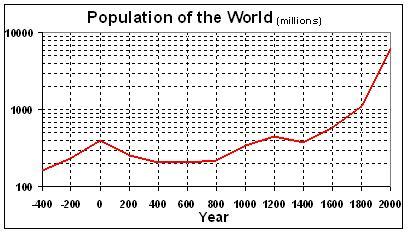
The Population Mystery

If a species that cannot provide for itself must decline, what does the following chart say about the ability of humans to provide for themselves?


Estimates for -400 through 1800 are from U.S. Census Bureau, “Historical Estimates of World Population“; estimate for 2000 is from U.S. Census Bureau, “Total Midyear Population for the World: 1950-2050.” Year 1 is plotted as Year 0 for ease of illustration. “Upper” estimates are used for -400 through 1800 (where given) because those estimates are taken from a series that extends from -10000 through 1950, and the upper estimate for 1950 in that series agrees with the estimate for 1950 in the series for 1950-2050.

See, People Can Think for Themselves

Craig William Perry and Harvey S. Rosen (both of Princeton) have published a paper that goes by this provocative title: “The Self-Employed are Less Likely to Have Health Insurance Than Wage Earners. So What?” Here’s the abstract:

There is considerable public policy concern over the relatively low rates of health insurance coverage among the self-employed in the United States. Presumably, the reason for the concern is that their low rates of insurance lead to worse health outcomes. We use data from the Medical Expenditure Panel Survey conducted in 1996 to analyze how the self-employed and wage-earners differ with respect to insurance coverage and health status. Using a variety of ways to measure health status, we find that the relative lack of health insurance among the self-employed does not affect their health. For virtually every subjective and objective measure of health status, the self-employed and wage earners are statistically indistinguishable from each other. Further, we present some evidence that this phenomenon is not due to the fact that individuals who select into self-employment are healthier than wage-earners, ceteris paribus. Thus, the public policy concern with the relative lack of health insurance among the self-employed may be somewhat misplaced.

In other words, the self-employed tend to make an informed calculation about the risks to their health and don’t waste money on unneeded health-insurance coverage. No doubt many persons who work for others make the same rational calculation.

But if the health-care hysterics on the left had their way, the U.S. government would force health insurance down the throats of everyone, driving up health-care costs and premiums. But it would be “free” because we (as taxpayers) would share the burden. Right.

(Thanks to Alex Tabarrok at Marginal Revolution for the pointer to the abstract.)

Social Security: The Permanent Solution

Many, many posts ago I promised to unveil my plan for fixing Social Security. I have duly kept up with the continuing debate about Social Security “privatization,” which is hardly what the President’s plan envisions. (There’s a selected bibliography at the bottom of this post.) Having weighed it all, I am reinforced in my belief that the only way out of the Social Security “mess” is to phase out Social Security.

Why? As a bleeding-heart libertarian who wants the best for others as well as for himself, and who understands that economics is a positive-sum game, I say this: The best way to incentivize people to work hard, to acquire new and higher-paying skills, and to stay sober is to allow them take responsibility for their old age. Put them on notice (reasonable notice, of course) that they are responsible for themselves; unless they can count on family, friends, or private charity to see themselves through old age, they should consume less, save more, and invest wisely.

What’s the worst that can happen? Some form of public assistance would be demanded for the truly needy (and for their fellow travelers, the lazy and the imprudent), and by those who simply bleed envy or pity at the thought of “excessive” income inequality. But the accompanying tax burden would be much smaller than the burden that now hangs over future taxpayers if we try to redeem anything resembling the “promises” implicit in the present Social Security scheme. Moreover, the demise of Social Security would give added impetus to the coming economic boom (see here and here), as the higher rate of personal saving necessitated by the phase-out of Social Security would finance additional investments in productivity-enhancing growth. Lower taxes and a more robust economy would also foster a resurgence of private charity, in aid of the truly needy (if not the lazy and imprudent).

Here’s my plan:

1. Abolish Social Security payroll taxes as of a date certain (Abolition Day).

2. Pay normal benefits (those implicitly promised under the present system) to persons who are then collecting Social Security and to all other qualifying persons who have then reached the age of 62.

3. Persons who are 55 to 61 years old would receive normal benefits, pro-rated according to their contributions as of Abolition Day.

4. The retirement age for full benefits would be raised for all persons who are younger than 55 as of Abolition Day. The full retirement age is now scheduled to rise to 67 in 2027; it should rise to 73 by, say, 2020. Moreover, partial benefits would no longer be available to persons between the age of 62 and full-retirement age.

4. Persons who are 45 to 54 years old also would receive pro-rata benefits based on their contributions as of Abolition Day. But their initial benefits would be reduced on a sliding scale, so that the benefits of those persons who are 45 as of Abolition Day would be linked entirely to the CPI rather than the wage index.

5. Persons who are younger than 45 would receive a lump-sum repayment of their contributions (plus accrued interest) at full retirement age, in lieu of future benefits. That payment would automatically go to a surviving spouse or next-of-kin if the recipient dies intestate. Otherwise, the recipient could bequeath, transfer, or sell his interest in the payment at any time before it comes due.

6. The residual obligations outlined in points 2-5 would be funded by a payroll tax, which would diminish as those obligations are paid off.

Repeat, with appropriate variations, for Medicare and Medicaid.

SELECTED BIBLIOGRAPHY

The Official State of Social Security
2004 OASDI Trustees Report: Contents
2004 OASDI Trustees Report: Conclusion
The looming deficit problem: Table VI.F8.–Operations of the Combined OASI and DI Trust Funds, in Constant 2004 Dollars, Calendar Years 2004-80
The underlying causes: Shrinking worker-retiree ratio, increasing longevity, and wage indexing

Some Alternative Solutions to the Problem
General Accounting Office
Brookings Institution
Cato Institute
Laurence J. Kotlikoff

Analytical Perspectives of Other Bloggers
Arnold Kling: Fighting Murphy (also known as “A Social Security Policy Primer”)
Alex Tabarrok: The Microeconomics of Social Security Privatization
Tyler Cowen: Should We Privatize Social Security?
Arnold Kling: The Cost of Privatization
Will Wilkinson: How Much Does SS Screw You?
Alex Tabarrok: Prescott on Social Security Reform
Tyler Cowen: Social Security and Our Future
Tyler Cowen: Freezing Social Security Benefits
For much more, browse this list of articles by Arnold Kling, many of which are about Social Security.

My Posts on Social Security and Related Issues
Social Security Is Unconstitutional
Why It Makes Sense to Privatize Social Security
P.S. on Privatizing Social Security
Fear of the Free Market — Part III
Social Injustice
Let’s Just Say He’s a Bit Evasive
A Good Reason to Favor the “Ownership Society”
That Mythical, Magical Social Security Trust Fund
The Real Social Security Issue
Social Security — Myth and Reality
Nonsense and Sense about Social Security
More about Social Security
Social Security Privatization and the Stock Market
Oh, That Mythical Trust Fund!
Understanding Economic Growth
The Problem with Voluntary Personal Accounts

Socialist Calculation and the Turing Test

The socialist calculation debate” is a provocative post by Tyler Cowen at Marginal Revolution. Cowen links to a review he wrote of G.C. Archibald’s Information, Incentives and the Economics of Control: A Reexamination of the Socialist Calculation Debate. The jacket flap says:

This book examines methods for controlling or guiding a sector of the economy that do not require all the apparatus of economic planning or rely on the vain hope of sufficiently “perfect” competition, but instead rely entirely on the self-interest of economic agents and voluntary contract. The methods involved require trial-and-error steps in real time, with the target adjusted as the results of each step become known. The author shows that the methods are equally applicable to industries that are wholly privately owned, wholly nationalized, mixed or labor-managed.

The suggestion seems to be that one can emulate the outcomes that would be produced by competitive markets — if not something “better” — by writing rules that, if followed, would mimic the behavior of competitive markets. The problem with that suggestion — as I understand it — is that someone outside the system must make the rules to be followed by those inside the system.

And that’s precisely where socialist planning and regulation always fail. At some point not very far down the road, the rules will not yield the outcomes that spontaneous behavior would yield. Why? Because better rules cannot emerge spontaneously from rule-driven behavior. (It’s notable that the book’s index lists neither Hayek nor spontaneous order.)

Where, for instance, is there room in the socialist or regulatory calculus for a rule that allows for unregulated monopoly? Yet such an “undesirable” phenomenon can yield desirable results by creating “exorbitant” profits that invite competition (sometimes from substitutes) and entice innovation. (By “unregulated” I don’t mean that a monopoly should be immune from laws against force and fraud, which must apply to all economic actors.)

I suppose exogenous rules are all right if you want economic outcomes that accord with those rules. But such rules aren’t all right if you want economic outcomes that actually reflect the wants of consumers.

It reminds me of the Turing test:

The Turing test is a proposal for a test of a machine’s capability to perform human-like conversation. Described by Alan Turing in the 1950 paper “Computing machinery and intelligence“, it proceeds as follows: a human judge engages in a natural language conversation with two other parties, one a human and the other a machine; if the judge cannot reliably tell which is which, then the machine is said to pass the test. It is assumed that both the human and the machine try to appear human. In order to keep the test setting simple and universal (to explicitly test the linguistic capability of some machine), the conversation is usually limited to a text-only channel.

And so, the machine might — sometimes — emulate human behavior, but only then if it can engage in an interaction that’s limited to textual conversation. And that’s as far as it goes. The machine cannot be human, nor can it emulate the many, many other aspects of human behavior.

If you want to interact with a human, don’t talk to a rule-based computer. If you want an economy that produces outcomes desired by humans, don’t rely on an economy that’s run by the equivalent of rule-based computer. Why settle for a machine when you can have the real thing?

Of course, the whole point of socialist planning is to produce outcomes that are desired by planners. Those desires reflect planners’ preferences, as influenced by their perceptions of the outcomes desired by certain subsets of the populace. The immediate result may be to make some of those subsets happier, but at a great cost to everyone else and, in the end, to the favored subsets as well. A hampered economy produces less for everyone.

The Real Meaning of the "National Debt"

UPDATED 02/12/05 (new text in bold)

The so-called national debt is really the debt of the government of the United States of America. I have written before about the debt and why it isn’t all that important, in spite of the hysterics it invokes. Some writers (The Skeptical Optimist via EconoPundit, for instance) try to diminish the importance of put the debt in perspective by comparing its size with GDP, which they take as an indication of “our” is analogous to a standard measure of a private debtor’s ability to service the debt.

I have two problems with that depiction of the debt. First, that depiction assumes it might be taken by as a suggestion that it’s necessary to pay off the debt* — as if it were a home mortgage — which is a notion that I have previously debunked. (Steve Conover, The Skeptical Optimist, doesn’t mean to suggest that the debt must be paid off. In fact, he has written several excellent pieces about the debt and why it needn’t be repaid.**) My second objection arises from the first, and is more fundamental. The debt really is a measure of the extent to which spending by the U.S. government has exceeded taxes collected by the U.S. government since 1789. In other words, the damage has already been done: first, by government spending, which on balance diverts resources from productive uses; second, by the inflationary effects of government spending, which deficits merely aggravate. (For more on those two points, see the preceding post — especially the final four paragraphs.)

The notion of paying off the debt — or measuring “our” ability to pay it off — is an unfortunate and inappropriate carryover from personal and corporate finance. (The notion persists in spite of the writings of sensible thinkers like Steve Conover.) We, the citizens of the United States, already have paid off the debt of the United States government by allowing that government to commandeer resources from the private sector — a self-inflicted sacrifice that can be measured in the trillions of dollars, and which encompasses not only the debt but most of what government has spent on activities other than defense and justice. Why should we now worry about paying off the shadowy residue of the debt, which is nothing more than an approximate measure of the wasteful ways of the U.S. government? Who’s going to make us fork over, the shade of John Gotti?

P.S. A reader says:

You leave out one small detail from your post – interest on the debt. That is not an accounting entry and is most definitely not “in the past.” It’s the present and the future and it’s very real. $135.46 billion in FY2005.

And of course, fluctuating interest rates notwithstanding, the debt is very good proxy of the national interest burden, which must be paid in cash today by taxpayers today.

My reply:

Interest on the debt is real — but it’s essentially a transfer payment from one set of persons (taxpayers) to another set of persons (those who hold the debt). Because the two groups overlap, it’s sort of like robbing Peter to pay Peter and Paul. (Where’s Mary when you need her?)

__________

* The usual meaning of “debt service,” in my experience, is “interest payment plus repayments of principal to creditors, that is, retirement of debt,” which is the definition given in The New York Times Financial Glossary.

** Recommended articles and posts by Steve Conover:

Deficits, the National Debt, and Economic Growth: Summary

Deficits, the National Debt, and Economic Growth: Who Owes Whom? Think.

How to Neutralize the National Debt’s Interest Burden

Deficits, the National Debt, and Economic Growth: We’ll Never Have to Pay It Back

Oh, That Mythical Trust Fund!

Many of those who wish to preserve Social Security as we know and love it will insist that the Social Security trust fund is real. The usual argument goes like this: Yes, the trust fund holds government bonds. But if government bonds are a real asset to private investors, they must be a real asset to the trust fund. Wrong.

If the Social Security Administration (SSA) had invested net Social Security receipts in stocks, corporate bonds, and private mortgages — or had stashed the receipts in many, many passbook savings accounts, à la W.C. Fields — the trust fund could be a real asset. Why? Because SSA would have simply done for individuals what they could have done for themselves, namely, held their savings in the form of claims on real assets (business equipment, homes, and automobiles, for instance) and/or the future income produced by those assets.

But the problem is bigger than SSA’s failure to invest forced savings in claims on real assets. SSA is just a branch of the U.S. government. Even if SSA had wanted to take its net receipts to the bank, it couldn’t have. A robber would have intercepted SSA on the way to the bank, taken the money, and blown it on booze. Actually, what happened was that the rest of the U.S. government grabbed SSA’s net receipts and blew them on this welfare program, that regulatory effort, and other “public services.” Unlike the typical thief, the U.S. government then handed SSA a bunch of IOUs.

Now, tell me where the real asset is. It’s not to be found in the creation of government programs or even in the physical assets employed by government in those programs. For, the economic benefits that sometimes flow from government activities are far more than offset by the economic disbenefits of government activities (a). A real asset must — on balance — add to wealth or income, not subtract from it.

But what about all those private investors who hold government bonds? Aren’t they holding real assets? Well, they’re holding financial assets, which give them a claim on real assets. Let’s take Citizen Kane as an example. Suppose he has scrimped and saved $1 million. He could place that amount in some combination of stocks, corporate bonds, mortgages, and savings accounts, but he chooses to buy government bonds, instead. Now, Citizen Kane has already done his bit for the creation of real assets merely by saving $1 million in the first place. That is, through the magic of macroeconomics, the $1 million that he forbore to spend on this bauble, that bangle, and another bead enabled the creation of $1 million in real capital (plant, equipment, business software, etc.), which fosters economic growth.

Thus, in the first approximation, where Citizen Kane actually puts his $1 million is less important than the fact the he has saved (not consumed) $1 million, so that others (businesses, to be precise) can direct $1 million worth of resources into the creation of capital. If he chooses to put the $1 million in government bonds, that’s his lookout. Those bonds have a market value, which will fluctuate just like the market value of all financial assets. But the marketability of the bonds simply means that he can claim his share of the wealth that was created when he saved $1 million in the first place.

Government bonds held by government entities, on the other hand, don’t even pretend to be claims on real assets. They’re nothing but pieces of paper whose value can be realized only through taxation. Well, government can tax us without going through the charade of creating government bonds. Thus the bonds held by the SSA amount to nothing more than a superfluous excuse to raise our taxes. The power to tax is a real asset only to those who are net recipients of the taxes that are collected. By the same token, the power to tax is a real liability to those who are net payers of the taxes that are collected. Asset = liability = zero.

So much for those “real assets” in the Social Security trust fund.

But I’m not through discussing the shell game that goes by the exalted name of “public finance.” There’s a lot more to it than the mythical Social Security trust fund.

Government spending, however it is financed, is a way of commandeering resources that otherwise would flow to private consumption and investment (i.e., capital formation). To the extent that government activities fail to pay their own way by yielding goods and services of equivalent value — and they don’t (a) — the resources used by government are simply wasted — thrown down a rat hole (b).

Government nevertheless goes through the charade of taxing and borrowing to finance its activities, instead of simply sending goon squads to impress those resources into government service. Thus the total amount of money in circulation remains more or less unaffected by government spending, while the total output of real goods and services (including capital assets) is reduced as government commandeers resources. The result, of course, is inflationary (c).

In particular, the injection of government bonds into financial markets, with the help of the Federal Reserve’s authority to create money, means that the total nominal value of financial assets is at least the same as it would have been in the absence of government borrowing, and probably higher (d). At the same time, government spending reduces the output of real assets, thus diluting the value of financial assets. Financial assets are fungible, so the holder of a government bond has the same claim on real assets as the holder of, say, a share of Berkshire Hathaway stock.

Think of it this way: Every time the government issues a new bond because it’s spending more money, your real share of stock in America’s economy becomes worth less, even if the nominal price of the stock rises. Depressing, isn’t it?
__________
a. An official estimate of the annual benefits flowing from federal regulations places the value of those benefits at less than $200 billion. But the annual cost of those regulations — including the hidden costs not included in the government estimate — is approaching or has exceeded $1 trillion, as discussed here, here, here, and here. But that’s just the tip of the iceberg that rammed into the American economy about 100 years ago, as I will show in Part V of “Practical Libertarianism for Americans.”

b. I exclude most expenditures on defense and justice from that indictment.

c. That is, government spending causes prices to be higher than they otherwise would be because total spending remains about the same as it would have been, whereas real output is reduced. Whether or not those nominal prices rise (the usual meaning of inflation) depends on the rate at which government spending grows relative to the growth of output of real consumer goods, services, and assets.

d. The total nominal value of financial assets is approximately unaffected by government borrowing, if you accept the crowding-out theory. The total nominal value of financial assets rises with government borrowing if you don’t, if you don’t accept the crowding-out theory. I don’t.

Practical Libertarianism for Americans: Part IV

IV. LIBERTY AND ITS PREREQUISITES

This is an excerpt of Part IV of a nine-part work in progress. I welcome constructive criticisms and suggestions. Please send an e-mail to: libertycorner-at-sbcglobal-dot-net .

[A] people who band together in liberty — and who successfully defend their liberty against encroachments from within and without — not only will be able to pursue happiness, but also will reap greater happiness (call it personal satisfaction or well-being, if you will). For, the pursuit of happiness isn’t a zero-sum game; you can advance your happiness by helping me advance mine, and vice versa. But we can do so only if we are at liberty to do so — untrammeled by predators, parasites, and constraints — other than those constraints of law and custom that help to secure our liberty. A firm, communal commitment to liberty is therefore a matter of self-interest to all but predators and parasites….

Libertarianism, like physics, has evolved from rudimentary beginnings. Physics has evolved because physicists have expanded their store of facts about the physical world and found truer ways of describing the forces that make the universe what it is — in the large and in the small. Libertarianism has evolved beyond the assertion that humans have “certain unalienable rights” because such thinkers as Adam Smith (1723-90), John Stuart Mill (1806-73), and Friedrich A. Hayek (1899-1992) observed the workings of society — in all of its aspects — and told us how liberty serves self-interest….

mith observed that when we are at liberty to advance our own economic interests we must necessarily advance the economic interests of others.

Mill instructed us that personal freedoms should be preserved because through them we become more knowledgeable and more capable. Therefore, the state should intervene in our lives only to protect us from actual harm, as opposed to mere offense.

Hayek made the case that economic and personal liberty are inseparable: We engage in economic activity to serve our personal values, and our personal values are reflected in our economic activity. When the state restricts economic liberty, it necessarily restricts personal liberty, and vice versa. The state, simply cannot make personal and economic decisions more effectively than individuals operating freely within an ever-evolving socio-economic network….

Not only are economic and social liberty indivisible, but also is liberty itself indivisible. To reap the full benefit of liberty we must be willing to accept “bad” outcomes as well as “good” ones. That is, we must adhere to the principle of liberty and ignore the occasionally unhappy outcome that flows from it. For, as I will discuss further in Parts V and VI, liberty can improve the lot of all but predators and parasites.

By what criteria, then, should we decide where to draw the line between governmental action and private action? I propose these principles:

1. Government may not act or condone action (e.g., civil litigation) except when it seeks to deter, prevent, or remedy an actionable harm to liberty.

2. An actionable harm to liberty is one that arises or would arise directly from the commission of a specific act or acts by any person or entity, domestic or foreign. An expression of thought is not an act, for this purpose.

3. An expression of thought cannot be an actionable harm unless it

a. intentionally obstructs or would obstruct governmental efforts to deter, prevent, or remedy an actionable harm (e.g., divulging classified defense information, committing perjury),

b. intentionally causes or would cause an actionable harm (e.g., plotting to commit an act of terrorism, forming a lynch mob), or

c. purposely — through a lie or the withholding of pertinent facts — causes a person to act against self-interest in an economic transaction (e.g., misrepresenting a product, inflating a corporation’s statement of earnings).

4. An expression of thought cannot be an actionable harm until it has led or will lead directly to the commission of an act. A mere statement of fact, belief, opinion, or attitude cannot be an actionable harm, regardless of the subject of the statement, unless it amounts to slander or libel (both of which are offenses against liberty). Othewise, those persons who do not care for the facts, beliefs, opinions, or attitudes expressed by other persons would be able to stifle speech they find offensive merely by claiming to be harmed by it.

5. An act of omission (e.g., the refusal of social or economic relations because of some form of bias), other than a breach of contract or duty, cannot be an actionable harm. It is incompatible with liberty for government to judge voluntary actions that are not otherwise actionable harms.

In other words, to enjoy the benefits of liberty we must enjoy broad latitude of action (or inaction), speech, and thought….

Click here for the full text of Part IV.

The Problem with Voluntary Personal Accounts

A “senior administration official,” speaking on background before President Bush’s State of the Union speech on February 2, said this:

For individuals who were born in 1950 or later, they would have the opportunity — the voluntary opportunity — to participate in personal accounts. If they wished, they could not choose a personal account and they could stay entirely within the current system. The President has said we want to make sure that system is reformed to be fiscally sustainable. Certainly, though, individuals have the option of not taking a personal account and [receiving] the benefits that the traditional system would be able to pay.

What will happen, of course, is that those who choose to participate in personal accounts will draw larger benefits than those who choose to rely on solely on the traditional system. Why? The “return” on “contributions” to the traditional system will continue to shrink as the worker:retiree ratio shrinks. That “return” will be far less than the return earned on personal accounts, even those personal accounts that are invested solely in government bonds.

I predict that those who are foolish enough to remain in the traditional system will complain about the “unfairness” of it all when they reach retirement age and realize that they made a mistake. Congress, bowing inevitably to pressure from the powerful and ever-growing ranks of the elderly, will raise benefits payable on traditional accounts to a level consistent with the benefits payable on personal accounts invested in government bonds. That will necessitate higher payroll taxes, thus negating two important objectives of privatization: (1) to diminish, if not eliminate, the growing burden on workers, and (2) to stimulate economic growth by injecting more money into capital markets.

Privatization will fail to meet its objectives unless everyone who is eligible to open a personal account is required to do so, even if the account is invested only in government bonds.

I’d rather see Social Security abolished, of course, after paying off those who are collecting benefits or have “contributed” to the system. But abolition seems to be out of the question, so the next best thing is to convert Social Security from a transfer-payment Ponzi scheme to something resembling a real retirement plan.

Understanding Economic Growth

In “More about Social Security,” I wrote:

As we know well from long experience, the course of the economy isn’t expressed by a smooth, upward rising curve of progress. Aggregate economic output can be thought of as a quantum phenomenon, in that it has many potential values at each point in time. Shocks and stimuli determine which of those potential values becomes reality. Shocks (e.g., the collapse of the American stock market in 1929) can lead to sharp and prolonged downturns that can be reversed only by strong stimuli (e.g., the mobilization for World War II). Despair feeds on itself, as does hope. And hope fuels the kind of creativity that we saw, for example, in the aftermath of the Civil War, when the rapid invention and adoption of new technologies and production processes took us to new heights of prosperity in the 1920s.

The same kind of creativity resurfaced in the late 1900s — spurred by the stimulus of an inflation-busting recession and significant cuts in marginal tax rates. Will it last? Will it take us to ever-higher levels of economic output? It might, but not as a matter of historical inevitability, as some suggest. Historical inevitability is what we see in the rear-view mirror of experience. Something must happen to spur the creation and adoption of new technologies that will take us to new economic heights.

Arnold Kling points to and quotes from a relevant article by Meir Kohn:

Growth does not mean movement along an equilibrium path but rather the unfolding of a complex process. At any moment the potential of the economy is not completely realized: unexploited opportunities for mutually advantageous exchange abound. Indeed the “potential” of the economy is not defined; it depends on the initiative and ingenuity of individuals. Individuals engaging in trading, innovation, and institutional change generate the process of growth, not only discovering potential but also creating it.

The secret ingredient, of course, is purposeful human behavior. As I have shown shown elsewhere, deterministic models of aggregate behavior are woefully inadequate to the understanding of economic and social phenomena.

Social Security Privatization and the Stock Market

Paul Krugman’s latest wrong-headed argument against the privatization of Social Security appears in today’s New York Times. Krugman says:

Schemes for Social Security privatization, like the one described in the 2004 Economic Report of the President, invariably assume that investing in stocks will yield a high annual rate of return, 6.5 or 7 percent after inflation, for at least the next 75 years. Without that assumption, these schemes can’t deliver on their promises. Yet a rate of return that high is mathematically impossible unless the economy grows much faster than anyone is now expecting.

Krugman can make all the economic assumptions he wants. And you know that he’ll make assumptions which “prove” his case. But he can’t argue with history.

The S&P 500 — reconstructed back to 1870, with dividends reinvested — grew at an annualized rate of 6.8 percent, after inflation. To repeat, that’s a real rate of return of almost 7 percent. What about all those ups and downs between 1870 and 2004? Well, an exponential fit of the growth curve for 1870-2004 gives an annualized return of precisely 6.5 percent — just what the professor ordered. If 135 years is a too-long run, how about the 59 years since the end of World War II? The rate of return for 1946 through 2004 was 7.4 percent. An exponential fit of the growth curve for 1946-2004 gives an annualized return of 7.1 percent. *

Krugman wants so badly to denigrate the benefits of privatizing Social Security that he’ll stoop to any sort of slippery argument. In this case, he makes the following key assertions (my comments are bracketed in boldface):

In the long run, profits grow at the same rate as the economy. So to get that 6.5 percent rate of return, stock prices would have to keep rising faster than profits, decade after decade. [In fact, the total return on stocks — including reinvested dividends — has been rising faster than the economy for at least 13 decades. And it has been rising at an annualized rate of 6.5 percent.]

The price-earnings ratio – the value of a company’s stock, divided by its profits – is widely used to assess whether a stock is overvalued or undervalued. Historically, that ratio averaged about 14. Today it’s about 20. Where would it have to go to yield a 6.5 percent rate of return? I asked Dean Baker, of the Center for Economic and Policy Research, to help me out with that calculation (there are some technical details I won’t get into). Here’s what we found: by 2050, the price-earnings ratio would have to rise to about 70. By 2060, it would have to be more than 100. [The PE ratio on the S&P 500 (as reconstructed back to 1871) has been drifting generally upward. There have been sharp rises and dips in the PE ratio, because of market bubbles and crashes, but it is clear that the perception of risk has diminished with time and that stocks can command higher PE ratios than they did in the past. A statistical analysis of the relationship between PE and total stock-market returns (including dividends), based on 103 30-year periods ending in 1901 through 2004, produces absolutely no relationship between PE and future returns. In fact, for the 134 years (1870-2004) in which the total real return on the S&P 500 averaged 6.5 percent a year, the year-end PE ratio on the S&P 500 ranged from 5 to 33 — nowhere near the PE ratio of 70 or 100 demanded by Krugman.]

Krugman is simply determined to preserve a wasteful, socialistic relic of the Great Depression. He gives away his game in the first sentence of his article: “The fight over Social Security is, above all, about what kind of society we want to have.” The rest is a rather clumsy attempt at economic sleight-of-hand. Well, as usual, Krugman has fumbled his trick.

__________

* I’ll have more to say about the significance of stock-market returns, and their relation to GDP, in Part V of “Practical Libertarianism for Americans.” For now, I’ll just tantalize you with some of the numbers that I’ll document and discuss in that future post.

A Century of Progress?

Many, many horrific things happened in the twentieth century, but — despite it all — America made tremendous economic progress. Consider real GDP per capita, which (in year 2000 dollars) was about $4,300 in 1900 and $34,900 in 2000. That increase represents an annualized rate of growth of 2.1 percent.

Before we throw a party to celebrate that great accomplishment, let’s look behind the numbers.

Monetary measures of GDP exclude a lot of things that might be captured in the term “quality of life”; for example:

[F]ailing to account for the output produced within households may lead to misleading comparisons of economy-wide production, as conventionally measured. The female labor force participation rate in the United States has grown enormously since the early part of the 20th century. To the extent that the entry of women into paid employment has reduced the effort women devote to household production, the long-term trend in output, as measured by gross domestic product (GDP), may exaggerate the true growth in national output. [Committee on National Statistics (CNSTAT), Designing Nonmarket Accounts for the United States: Interim Report (2003), p. 9 in HTML version]

The “effort that women devote to household production” involves a lot more than shopping, cooking, cleaning, and all of the other activities usually associated with the term “housewife.” Not the least among those activities is the raising of children. Child-rearing (a quaint but still meaningful phrase) includes more than feeding, bathing, and toilet training. Parents — and especially mothers — impart lessons about civility — lessons that are neglected when children are left on their own to disport with friends, watch TV, and imbibe the nihilistic lyrics that pervade popular music.

Yet, the apparently robust growth of real GDP per capita between owes much to the huge increase in the proportion of women seeking work outside the home. The labor-force participation rate for women of “working age” (14 and older in 1900, 16 and older in 2000) grew from 19 percent in 1900 to 60 percent in 2000, while the rate for men dropped only slightly, from 80 percent to 75 percent. Who knows how much damage society has suffered — and will yet suffer — because of the exodus into the workforce of women with children at home? These figures suggest the extent of that exodus in the latter half of the twentieth century:

Because estimates of GDP don’t capture the value of child-rearing and other aspects of “household production” by stay-at-home mothers, the best way to put 1900 and 2000 on the same footing is to estimate GDP for 2000 at the labor-force participation rates of 1900. The picture then looks quite different: real GDP per capita of $4,300 in 1900, real GDP per capita of $25,300 in 2000 (a reduction of 28 percent), and an annualized growth rate of 1.8 percent, rather than 2.1 percent.

The adjusted rate of growth in GDP per capita still overstates the expansion of prosperity in the twentieth century because it includes government spending, which is demonstrably counterproductive. A further adjustment for the cost of government — which grew at an annualized rate of 7.5 during the century (excluding social transfer payments) — yields these estimates: real GDP per capita of $3,900 in 1900, real GDP per capita of $19,800 in 2000, and an annualized growth rate of 1.6 percent. (In Part V of “Practical Libertarianism for Americans,” I will estimate how much greater growth we would have enjoyed in the absence of government intervention.)

The twentieth century was a time of great material progress. And we know that there would have been significantly greater progress had the hand of government not been laid so heavily on the economy. But what we don’t know is the immeasurable price we have paid — and will pay — for the exodus of mothers from the home. We can only name that price: greater incivility, mistrust, fear, property loss, injury, and death.

Most “liberal” programs have unintended negative consequences. The “liberal” effort to encourage mothers to work outside the home has vastly negative consequences. Unintended? Perhaps. But I doubt that many “liberals” would change their agenda, even if they were confronted with the consequences.

Are You an "Austrian"?

Well, I’m 95-percent “Austrian” according to my score on a 10-question quiz at the website of the Ludwig von Mises Institute:

Your score is: 95 / 100.

Each question is followed by an Austrian School answer (10 points), a Chicago School answer (5 points), a Keynesian-Neoclassical School answer (2 points), and a Socialist answer (no points)–all broadly defined….

1. What is the correct economic status of private property?

A. Property is at the heart of most serious inequalities and oppressions in modern civilization. Only by regulation, transfer payments, redistribution of property, and common ownership can society arrive at fairness, justice, and human dignity for all. Socialist answer

B. Property is a naturally arising relationship between human beings and material things. Property and enforceable property rights make possible economic calculation, a wider and more productive division of labor, and therefore increasing levels of prosperity. Indeed, civilization itself is inconceivable in absence of private property. Any encroachment on property results in loss of freedom and prosperity. The Austrian answer. http://www.mises.org/libprop.asp

C. Property is central to prosperity and economic growth. Accordingly, it is of the utmost importance that the state, or more abstractly the law, maintain and modify the bundle of property rights in such a way as to allocate transactions costs in such a way as to promote maximum growth and economic efficiency. Property does not arise naturally, but is the end product of the legal system. Chicago answer

D. Property is an important component of our social system but its status as a “right” is contingent. It must be subject to regulation and modification for the general good. The state must intervene to prevent abuses of economic power, even at the cost of reducing traditional prerogatives of owners. Keynesian/Neoclassical answer

Your answer: B

The Austrian answer. http://www.mises.org/libprop.asp

You chose the Austrian Answer!

2. What is money and how does it originate?

A. Money can emerge from barter, but private interests will probably not develop it to suit the needs of a modern economy. We need central banks to sustain the financial sector. Efforts to manipulate the economy using the money supply will at best fail, and at worst cause severe problems. Monetary authorities should not increase the money supply at their discretion. They should increase it at a steady rate, matching the long term growth rate of the economy. Chicago answer.

B. Money is a vehicle for exploitation that distorts real values. Money is neither necessary nor desirable, but is an arbitrary artifact of history. Social progress will lead to revolutionary social changes, including the elimination of money. This will end exploitation and result in a society that aims at satisfying real values, instead of aiming at private financial profit. Socialist answer

C. Money always emerges out of barter. The difficulties of finding trading partners under barter systems results in the emergence of commodity monies. Durable, portable, and divisible commodities, like gold and silver, typically fit the bill as money best. Money and related institutions emerge as an unintended consequence of self interested trading. The evolution of such institutions is best left to the competitive market forces that created them in the first place, as governmental intervention will result in inflation and other distortions. Austrian answer. http://www.mises.org/rothbard/money.pdf

D. Money is a creature of the state. Sound monetary institutions require planning and a central bank. Central banks can also stabilize markets. Central bankers can counteract booms and busts in the private sector by expanding the money supply during recessions and slowing it during booms. Public control of the institution of money is key to running the economy. Keynesian/Neoclassical answer

Your answer: C

Austrian answer. http://www.mises.org/rothbard/money.pdf

You chose the Austrian Answer!

3. What is the proper method to conduct research in economic science?

A. The economist should not mimic the behavior of the natural scientists, because the social sciences involve human beings. Human action is characterized by intentional behavior, which involves the rational use of means to achieve desired ends. The very subject matter of economics—capital goods, money, wage rates, etc.—is not defined by physical or chemical properties, but instead by the mental or subjective attitudes that human minds take toward these things. Consequently, the proper method for an economist is to start with self-evident axioms—such as that people try to achieve the highest utility at the lowest cost—and logically deduce conclusions from them. The Austrian answer. http://www.mises.org/StudyGuideDisplay.asp?SubjID=3

B. Like the physicist, the economist (if he wants to be scientific) should construct a precise model that yields quantitative predictions about economic variables, such as GDP and unemployment. Then the economist should test those predictions against the actual data as collected by statistical researchers. At any given time, the best explanation or “theory” of a certain economic phenomenon is that model which yields the best fit between predictions and actual data. The Chicago answer

C. The question is misleading; economics cannot really be scientific in the conventional sense of the term. In physics we have fixed “laws” that are the same in every society and every time period. In contrast, there are no fixed laws in economics. The economist might study a certain historical episode and conclude that, say, rent control didn’t achieve its objectives when it was tried in Manhattan after World War II. Nonetheless, it may still be true that rent control could work in Paris in 2004 if the people in charge take care to avoid the mistakes of the past. There is no distinctly Keynesian answer; this is the position of the historical school.

D. To be scientific, we need to modify the traditional economistic approach of viewing society as nothing but a collection of atomistic, egoistic individuals. In reality, human beings consider themselves to be part of a greater social whole. A more fruitful avenue of research would be to study the complex groups with which people identify, whether class, race, or sex. Such an analysis would reveal the undeniable power of relationships in society, and give a much better understanding of economic events than typical, simplistic economic models. The socialist answer.

Your answer: A

The Austrian answer. http://www.mises.org/StudyGuideDisplay.asp?SubjID=3

You chose the Austrian Answer!

4. What is the reason for the interest rate, and should it be regulated?

A. Interest payments compensate investors for their loss of liquidity when they sink cash into a business project or lend it out for a certain period; the interest rate is the price of liquidity. Interest is a monetary phenomenon, not a “real” one (as the classical economists thought). Modern economics recognizes the role of expectations or what might generically be called “confidence in the future.” For example, if the interest rate jumps from 5% to 10%, this does not mean that people have become more oriented towards present consumption; it could simply reflect heightened anxiety about the economy. Government manipulation of the interest rate is certainly one of several tools needed to smooth economic fluctuations, but by itself this approach is relatively impotent. If everyone fears a worsening recession, employers will not hire more workers or build more factories, no matter how low the interest rate is pushed. Keynesian answer

B. Interest payments are a return on capital, and the interest rate in equilibrium equals the marginal product of capital. The situation is perfectly analogous to labor, where the wage rate equals the marginal product of labor. There are various technological recipes yielding output at various future dates, and consumers have preferences for consumption at various future dates. On the margin, present consumption will be preferred to future consumption, and an extra unit of capital invested will yield an increment in output (available in the future) that just makes the consumer indifferent between consuming now or waiting an additional unit of time and consuming the higher yield made possible by the productivity of capital. The government should not meddle with interest rates, for the same reasons that the government should not meddle with wage rates. Chicago answer

C. “Interest” is just a codeword for profit; a capitalist earns interest when he spends less on wages and raw materials than he earns from selling the final product. This surplus value arises from the exploited workers hired by the capitalist. Under the wage system, workers are paid the bare minimum they need to survive, even though the full product of their labor far exceeds their compensation from the employer. In this respect, the wage system is no different from traditional slavery, where the slave owner keeps the product yielded by his slaves’ toil, and from this fund only “pays” them enough to maintain their bare survival. Obviously interest is a barbaric feature of capitalist societies, and will disappear once the system of wage slavery is overturned. The socialist answer

D. Interest payments reflect the higher value of present goods over future goods. Other things equal, everyone wants to consume sooner rather than later. The current price of a computer might be $1,000, but the price of a claim to a computer delivered in one year would currently sell for less than that, say $900. An entrepreneur might invest $900 in labor and raw materials in order to sell a product next year for $1,000; his implicit interest return is due to the fact that the factors of production represent technological “claims” on future consumption goods, and thus their current price (the $900) is less than their ultimate sale price ($1,000). Obviously the government need not interfere with the market interest rate, since it merely reflects the subjective premium individuals place on a marginal present good over a marginal future good. The Austrian answer. http://www.mises.org/StudyGuideDisplay.asp?SubjID=10

Your answer: D

The Austrian answer. http://www.mises.org/StudyGuideDisplay.asp?SubjID=10

You chose the Austrian Answer!

5. What is the economic impact of saving?

A. In normal times, saving is not economically harmful but in a recessionary environment it can cause the economy to spiral downward. Saving reduces consumer spending and may not be translated into investment spending because of investor pessimism. This will reduce total demand in the economy and lead to unemployment. One way of

Keynesian/Neoclassical answer

B. The vast accumulation of wealth within select classes and families creates an economic oligarchy that shuts out those who cannot gain a foothold within the economic system. Inheritance taxes, and taxes on dividends, are essential to a society that values equality. After all, the yield from vast bank accounts really amounts to unearned income. No society can tolerate some people living off interest while others live paycheck-to-paycheck off the meager sums offered by minimum wages. Socialist answer

C. Saving (which means forestalling current consumption) is essential for capital formation, but there is no socially optimal ratio of consumption to saving that should predominate in society. It all depends on the social rate of time preference, that is, the extent to which people prefer goods sooner to later. Individuals may choose consumption over investment or vice-versa. Government intervention can skew these choices, subsidizing or taxing savings or consumption or both. In order to have the mix reflect the most economical choices, government should have no policy toward saving, even in the case of saving for old age. The Austrian answer. http://www.mises.org/humanaction/chap18sec9.asp

D. There is no investment, and hence no economic growth, without saving. For this reason, the encouragement of saving should be an economic priority. Inflation discourages savings, which is a major reason why a policy of stable money should be the central-banking policy. Empirical studies show that saving takes place over the life-cycle of individuals. Miscalculations can occur, which is why the government might need to encourage private retirement accounts, a system that is more efficient than Social Security because it yields higher returns. The Chicago answer.

Your answer: C

The Austrian answer. http://www.mises.org/humanaction/chap18sec9.asp

You chose the Austrian Answer!

6. What is the source of economic value?

A. Physical objects such as a banana or an automobile do not possess intrinsic economic value. On the contrary, only a human mind can attribute value to such items, and only then do economists classify them as goods. An object is valuable only because there is at least one human being who believes that this object can help satisfy his or her subjective desires. For example, even if a particular root cures cancer, if no one knows this fact, then the root has no economic value, and people will not trade money for it. Consequently, value is caused by an individual’s subjective desires and his or her beliefs about the causal properties of a particular item. The Austrian answer. http://www.mises.org/StudyGuideDisplay.asp?SubjID=4

B. The value of a commodity is equal to the amount of total labor used in its construction. If one bicycle has the same market value as, say, 500 eggs, then we can write 1 bicycle = 500 eggs. In what does this equality consist? Obviously the bicycle is not “equal” to the eggs because of any of its physical properties. If we examine the matter carefully, we will conclude that the one thing that the two have in common is the amount of labor used in their construction. The socialist answer.

C. The value of a good is determined by the interdependence of supply and demand, or what might be called the interaction of cost and utility. In contrast to some schools of thought, which try to explain value on the basis of utility alone, the correct approach is that of Alfred Marshall, who realized that economic value is due to both subjective preferences and to objective technological conditions. To see this most clearly, consider that if the costs of production go up for a particular good, in the new equilibrium its final price must be that much higher. Chicago answer

D. Economic value is a complex matter that cannot be explained through simple formulas. To understand why the people in a particular society value some things more than others, we must study their culture and history. For example, a Native American tribe might have valued a particular animal as sacred. The white Europeans, of course, did not share this value system and thus slaughtered the animals. The same is true of a good or service on the market. Historical School (there is no distinctly Keynesian answer to this question)

Your answer: C

Chicago answer

For optimal results the answer must be: A

The Austrian answer. http://www.mises.org/StudyGuideDisplay.asp?SubjID=4

7. What causes the business cycle?

A. Variations in the money supply cause GDP growth to deviate from its general trend. Absent these variations the economy is relatively stable. Variations in the money supply cause inflationary booms and crashes. Lags in the adjustment of wages with these cycles mean that financial booms and busts will entail significant changes in unemployment rates. Chicago answer

B. Competition in the face of declining profits and increasing monopolization generates increasingly large crises under capitalism. Capitalists invest in labor saving devices to keep unemployment high and wages down. Competition leads to falling profit rates and crashes. Some capitalists will then get good deals on capital from bankrupt capitalists, raising their profitability for the moment. However, the tendency of capitalism to reduce profit rates will lead to further unemployment and another crash. Socialist answer

C. Expansion of the money supply artificially reduces interest rates. This causes a boom in consumer and investor spending. With businesses thinking longer term, and consumer thinking shorter term, a discoordination emerges in the economy. The time relationship between saving and investment, production and consumption, is disrupted. Market processes reveal that many investments are not really profitable but instead are clusters of errors. Businesses then liquidate these investments, causing a recession. Austrian answer. http://www.mises.org/StudyGuideDisplay.asp?SubjID=12

D. Booms begin in excessive optimism, often prompted by technological shifts, resulting in speculative frenzies. Deficient total spending then causes recessions/depressions. When total savings exceed total investment, total spending on goods falls. This decreases the demand for labor to produce these goods. Then pessimism among business investors leads to insufficient aggregate demand and economic hard times. Keynesian/Neoclassical answer

Your answer: C

Austrian answer. http://www.mises.org/StudyGuideDisplay.asp?SubjID=12

You chose the Austrian Answer!

8. What causes economic growth?

A. A balanced relationship between aggregate demand and aggregate supply is the leading determinant of economic growth. Because private markets cannot always provide this, stable institutional environments are necessary. The public sector plays a vital role in securing economic growth by providing a framework of legal and financial institutions. A variety of public-sector efforts such as low-interest rates and subsidies may also play a positive role. A limited amount of regulation is necessary, but this is not necessarily true. Chicago answer

B. Private consumer demand is not enough for economic growth. Overall private spending is often too little, too manipulated by business, and rife with choices that overlook social priorities. Consumers may save too little or too much. This sometimes makes public deficit spending necessary to stimulate the economy. Also, private spending fails to supply public goods. Public spending in such areas is necessary for economic growth—particularly in education, infrastructure, and scientific research. Keynesian/Neoclassical answer

C. The capitalist process causes economic growth, but this is a non sequitur. While capitalism is the most productive system, the distribution of wealth under capitalism is wrong. Whole classes of citizens are left out. Capitalists take advantage of workers by paying them the lowest possible wage instead of the value of their labor. So capitalism delivers the goods, but to the wrong addresses. What we need are workers’ democracies where productivity can go hand-in-hand with a more just distribution of wealth. Socialist answer

D. The source of economic growth is mutually beneficial, voluntary exchange. Within the exchange economy, consumers spend part of their income on goods and services to satisfy their most immediate wants. This drives current production. Consumers save part of their income according to their less immediate wants. This drives entrepreneurial investment in future production and leads to the development of sophisticated capital markets. Private contracts, competition in markets, and private institutions that allow for capital investment and accumulation are all you need to attain optimal economic growth. Austrian answer. http://www.mises.org/journals/qjae/pdf/qjae2_2_5.pdf

Your answer: D

Austrian answer. http://www.mises.org/journals/qjae/pdf/qjae2_2_5.pdf

You chose the Austrian Answer!

9. Do markets create and sustain monopolies and what should be done about it?

A. If the history of capitalism shows us anything, it is that it leads to business concentration. With fewer and fewer firms dictating the terms, the result is ever higher prices combined with ever lower wages. Unions and antitrust enforcement have had some measure of success in curbing this, but neither institution goes far enough to counter the trend toward monopoly within market settings. We must also question the idea that competition itself should be a policy goal. Most often, it is socially wasteful and a slogan repeated by monopolists to justify exploitative behavior. The ideal of cooperation between all, a truly democratic economy, should be the ideal. Socialist answer

B. The market tends to generate monopolies of varying sizes and types. Business should not be permitted to exercise monopoly power in pricing. It can be detected by various formulas comparing costs with output price according to a perfectly competitive model. Geographic monopolies may not be as important as they once were due to advances in transportation technology. What we face today are a variety of technologically driven monopolies, such as the example of Microsoft shows. Still, regulators need to be constantly on the lookout for businesses that attempt to employ market power, enriching themselves at consumer expense. Competition needs rigorous enforcement. Keynesian/Neoclassical answer

C. Economists of the classical school were right to define a monopoly as a government-grant privilege, for gaining legal rights to be a preferred producer is the only way to maintain a monopoly in a market setting. Predatory pricing cannot be sustained over the long haul, and not even the attempt should be regretted since it is a great benefit to consumers. Attempted cartel-type behavior typically collapses, and where it does not, it serves a market function. The term “monopoly price” has no effective meaning in real market settings, which are not snapshots in time but processes of change. A market society needs no antitrust policy at all; indeed, the state is the very source of the remaining monopolies we see in education, law, courts, and other areas. Austrian answer. http://www.mises.org/StudyGuideDisplay.asp?SubjID=7

D. Monopoly regulation has caused more harm than good by protecting particular competitors, not competition. Some types of regulation against trusts are based on flawed models that fail to understand that some firms gain market share solely because of their products’ desirability to consumers. Most cited cases of “path dependency” turn out to be mythical. What is left for regulators to do? As Adam Smith said, they should prevent business conspiracy, blatantly predatory behavior, and otherwise assure a level playing field leading toward genuine competition. Finally, some goods lend themselves to being best provided by monopolies, e.g. courts and defense. Chicago answer

Your answer: C

Austrian answer. http://www.mises.org/StudyGuideDisplay.asp?SubjID=7

You chose the Austrian Answer!

10. What is the role of equality and inequality?

A. Equality is a term that properly relates to mathematics but not to social science. Human beings are unequal in their endowments, opportunities, and will to achieve. Unequal does not mean inferior or superior; it merely means different. Differences are the very source of the division of labor, and, within a market setting, lead not to conflict but cooperation. While differences should be celebrated, property owners have every right to treat people unequally because it is owners that bear responsibility. Legislators, however, should not have any concern for bringing about equality of result or opportunity, either between individuals or groups of individuals classified according to any criterion. The only place for equality concerns the law, which should treat all individuals the same without regard to their station in life. Austrian answer. http://www.mises.org/fipandol.asp

B. It is a great mistake to make equality of result a policy goal, because egalitarian legislation can kill incentives to improve. Punishing the rich is self defeating, even for the poor striving to make their way. Equality of opportunity, however, is something different. It something everyone merits by their very dignity as a human being. Thus should a nation strive for quality educational institutions, institute a limited inheritance tax, and otherwise assist those who, through no fault of their own, lack the means to gain entry into the division of labor. Once these institutions are in place, we will find that the forces of market competition will achieve egalitarian goals through predominately voluntary means. Chicago answer

C. Inequality is an intrinsic feature of a social structure that is mired in a prejudicial overhang from the long and shameful history of the manner in which Western society has treated women and other minorities. The prejudicial impulse, rooted in the spirit of conquest that gave birth to Western capitalism in the first place, is a form of violence and yet part of the corrupt infrastructure of the market economy itself. If the owners of capital were left to their own devices, excluded groups would remain so in perpetuity, so society had to act to restrain them. Full equality will continue to elude us, so long as we have a society that treats people as goods to be bought and sold, and so long as we make a god out of private property. Socialist answer

D. The modern emphasis on equality is the great policy advance of the last century. No longer does the political and economic system exclude women and minorities from participation but rathers include them as a matter of law. These groups tend to be artificially undervalued by the “invisible hand” of the market, which is why there is a role for anti-discrimination and public-accommodations law. The welfare state, too, has benefited society by insuring that the benefits of rising wealth are spread throughout society, so that the rich do not become richer at the expense of the poor. We’ve come a long way, but we still have a long way to go. Keynesian/Neoclassical answer

Your answer: A

Austrian answer. http://www.mises.org/fipandol.asp

You chose the Austrian Answer!

Are You an "Austrian"?

Well, I’m 95-percent “Austrian” according to my score on a 10-question quiz at the website of the Ludwig von Mises Institute.

The quiz is an education in itself. For each question, the quiz-taker must choose from among four detailed and sometimes subtly different answers: an Austrian School answer (10 points), a Chicago School answer (5 points), a Keynesian-Neoclassical School answer (2 points), and a Socialist answer (no points, though negative points would be more appropriate). I chose a Chicago School answer to one question and the Austrian School answer to the other nine questions. Thus my score of 95/100.

To see all 10 questions and answers, click here.

For a more arduous test of your economic philosophy, try the 25-question quiz.

More about Social Security

UPDATED, 12/16/04 – 12/18/04

Earlier, I explained why privatizing Social Security makes economic sense. Now, Arnold Kling has an article (“Social Security’s Worn-Out Roof“) at Tech Central Station on the same subject:

Suppose that we want to reform Social Security so that your contributions go into a reserve account. One particular form that this reserve account could take would be a savings account in your name and under your control (within limits). That is called “privatization.”…


Your contributions that go into a reserve account cannot be used to pay benefits to current retirees. The government will have to borrow additional money in order to meet its obligations. However, by the same token, because of the reserve account, when you retire the government will not have to find as much money to pay for your benefits. The additional borrowing in the short term is like taking out a loan to repair [your] roof. But just as the new roof reduces future maintenance costs, putting your contributions into a reserve fund reduces the government’s future cost of providing Social Security benefits.

If “privatization” or a similar reform were to be enacted, the government would have to borrow more money.[*] That would be the “cash flow cost.” However, the economic cost is zero. The government is extinguishing an off-balance-sheet liability (unfunded promises to pay benefits) and creating an equivalent on-balance-sheet liability (new debt). To put it another way, the government’s “cash flow cost” incurred today will be offset by a “cash flow benefit” many years from now, as you receive lower tax-financed benefits and instead live off your reserve account. The net effect is essentially a wash….[**]

It is important to understand that, to a first approximation, there is no difference between maintaining the status quo and undertaking privatization that is financed entirely by borrowing. Either way, future generations have a liability.[***] Under the status quo, that liability is off the government’s balance sheet, like the dilapidated roof. Under privatization, the off-balance sheet liability is extinguished in exchange for debt that appears on the balance sheet.

As I have pointed out elsewhere, privatization financed by borrowing would have some advantages relative to the status quo. In particular, it would create a “lockbox” that would keep government from adding to the disconnect between its promises and the ability to find tax revenue to make good on those promises….

Precisely.

UPDATE:
I want to be clear that I’m not rescinding my earlier suggestion that the creation of private Social Security accounts would spur economic growth (see here, for example). With higher incomes, future taxpayers could more readily afford to bear the burden of supporting those retirees who remain somewhat dependent on Social Security.

I agree with Kling on two points: Privatization would take decisions about future benefits (and thus taxes) out of the government’s hands. Privatization is a “wash” to the extent that government borrowing to finance the transition to private accounts simply recognizes — and finances — future deficits.

I disagree with Kling that privatization is a wash when it comes to economic growth. Kling believes that the net economic stimulus from privatization is approximately zero because he subscribes to the crowding-out hypothesis: A dollar spent by the federal government is a dollar that can’t be spent in the private sector; in particular, a dollar borrowed by the federal government is a dollar that can’t be invested in growth-producing capital.

The crowding-out hypothesis, however, is based on a static analysis — a mere truism — which says that a given level of national output can be reallocated, but not changed. But the crowding-out hypothesis, which has reputable critics and doubters (see here, here, here, and here, for instance) doesn’t apply to a dynamic economy. The actual effect of government borrowing on interest rates — and thus on the cost of private capital formation — is minuscule, and perhaps nonexistent, as Brian S. Westbury explains:

The theory [that deficits drive up interest rates] suggests that deficits “crowd out” private investment, putting upward pressure on interest rates. In other words, government borrowing eats up the available pool of capital. But today’s forecasted deficits of $300 to $500 billion are just a small drop in the pool of global capital markets. In the U.S. alone, capital markets are $30 trillion dollars deep, for the world as a whole they approach $100 trillion. Deficits of the size projected in the years ahead cannot possibly have the impact on interest rates that many fear….

Our dynamic economy will take privatization for what it is: a continuation of consumption spending by retirees, legitimated by government borrowing, plus an infusion of new saving, generated by the diversion of Social Security taxes to private accounts. That infusion will spark new, growth-producing business investments, undeterred by vanishingly small increases in interest rates.

Privatization — no, the certain promise of privatization — will act as a spur to economic growth that wouldn’t have occurred otherwise. There is such a thing as a free lunch in aggregate economic activity.

As we know well from long experience, the course of the economy isn’t expressed by a smooth, upward rising curve of progress. Aggregate economic output can be thought of as a quantum phenomenon, in that it has many potential values at each point in time. Shocks and stimuli determine which of those potential values becomes reality. Shocks (e.g., the collapse of the American stock market in 1929) can lead to sharp and prolonged downturns that can be reversed only by strong stimuli (e.g., the mobilization for World War II). Despair feeds on itself, as does hope. And hope fuels the kind of creativity that we saw, for example, in the aftermath of the Civil War, when the rapid invention and adoption of new technologies and production processes took us to new heights of prosperity in the 1920s.

The same kind of creativity resurfaced in the late 1900s — spurred by the stimulus of an inflation-busting recession and significant cuts in marginal tax rates. Will it last? Will it take us to ever-higher levels of economic output? It might, but not as a matter of historical inevitability, as some suggest. Historical inevitability is what we see in the rear-view mirror of experience. Something must happen to spur the creation and adoption of new technologies that will take us to new economic heights.

There is no practical limit to human creativity: The greater the stimulus, the greater the response. Human creativity thrives on the stimulus of hope — hope that a better future is attainable and that those who help to create that better future will be amply rewarded. What better way to inject additional hope into the economic system than to fund capital markets?

Yes, that infusion would amount to a form of government intervention in the economy. But it would be — or could be — a relatively neutral form of intervention, as long as private accounts can be invested in total-market stock and bond index funds. Moreover, it would be intervention with a noble purpose: cleaning up the government-created mess known as Social Security. So, let the privatization of Social Security begin — and hope that it continues until the whole system is privatized.

In sum, the privatization of Social Security, in whole or in part, should have four beneficial effects:

  • Future retirees will be more self-sufficient, thus reducing the burden on future taxpayers.
  • The economy will grow more rapidly.
  • Future taxpayers will therefore find it easier to bear the remaining burden of Social Security and other government programs.
  • More Americans — perhaps the vast majority of them — will acquire a stake in free-market capitalism.

__________
My notes:

* Actually, as long as Social Security receipts from payroll taxes exceed benefits (until 2018), the government wouldn’t have to borrow all the money needed to cover benefits. It’s true that the government probably would use the surpluses to finance other government programs, so that diverting the surpluses to private accounts would require the government to borrow more in order to finance those other programs. But the real cause of the borrowing would be the existence of those other programs, not the privatization of Social Security.

** The “wash” is a wash with respect to the government’s true liabilities. But future retirees who invest in private accounts would be better off than if they opted for “traditional” Social Security.

*** Again, the unchanged liability is the amount of government debt. Meanwhile, Social Security (or at least a large portion of it) is in a “lockbox,” where it is invested in real assets, and thus contributing to economic growth, unlike government debt.

Nonsense and Sense about Social Security

E.J. Dionne Jr., writing in The Washington Post on November 30, opined that

…President Bush carries a heavy burden in trying to sell the country on his plan to carve private accounts out of Social Security. Bush has been pushing privatization since he first ran for the presidency in 2000. But he keeps changing his explanation of how the program will be paid for and what its effect on the deficit will be….

Dionne goes on in that vein throughout his column, using what seems to be a discrepancy between what Bush said four years ago and what he and his aides are saying now to play “gotcha.” Worse than that, however, Dionne — who is a Washington insider of sorts — spends much of his column spreading confusion about Social Security; for example:

The big cost of privatization comes from allowing individuals to keep a share of the Social Security taxes they now pay into the system and use it for private investment accounts. This reduces the amount of money available to pay current beneficiaries. Since Bush has promised the retired and those near retirement that their benefits won’t be cut, he needs to find cash somewhere. The only options are to raid the rest of the budget, to raise taxes or to borrow big time….

[During the 2000 presidential campaign] Gore…challenged Bush on his numbers. “He has promised a trillion dollars out of the Social Security trust fund for young working adults to invest and save on their own, but he’s promised seniors that their Social Security benefits will not be cut and he’s promised the same trillion dollars to them,” Gore said at that third presidential debate. “Which one of those promises will you keep and which will you break, Governor?”

…Bush is about to offer an easy answer to Gore’s challenge: More borrowing….

…Last week The Post’s Jonathan Weisman reported that Republicans were considering moving the costs of social security reform “off-budget” so that, on paper at least, they wouldn’t inflate the deficit. And Joshua B. Bolten, the director of the White House’s Office of Management and Budget, let the cat out of the bag over the weekend in an interview with Richard W. Stevenson of the New York Times. “The president does support personal accounts, which need not add over all to the cost of the program but could in the short run require additional borrowing to finance the transition,” Bolten said. “I believe there’s a strong case that this approach not only makes sense as a matter of savings policy, but is also fiscally prudent.”

A huge new borrowing — “from hundreds of billions to trillions of dollars over a decade,” as Stevenson notes — is suddenly “fiscally prudent” in the administration’s eyes….

Dionne betrays such stupendous misunderstanding of the issue that the only way to deal with his ignorance is to explain the whole megillah, step-by-step:

1. The cost of Social Security is the cost of the benefits paid out, not the payroll taxes or borrowing required to finance those benefits. There are two basic issues: how much to pay in benefits and how to finance those benefits.

2. Assuming, for the moment, that benefits will be paid to future retirees (today’s workers) in accordance with the present formula for computing benefits — which today’s workers believe is a “promise” they have been made — something must “give” when payroll taxes no longer cover benefits, beginning in 2018.*

3. No matter how you slice it, someone will pay for those future benefits. The question is: who and when? There are three conventional ways to do it:

  • Raise future workers’ payroll taxes by enough to cover benefits.
  • Borrow enough to cover benefits, thus shifting the immediate burden from future workers to willing lenders, who are also the “future generations” that “bear the burden” of the debt. The cost of borrowing (i.e., interest) raises the cost of the program a bit, but interest is also income to those who lend money to the government. In other words, borrowing — on balance — doesn’t create a burden, it merely shifts it, voluntarily.**
  • Raise taxes and borrow, in combination.

4. There’s an “unconventional” way to deal with the looming deficit in Social Security: invest payroll taxes in real assets (i.e., stocks, corporate bonds, mortgages). Why? Because money invested in real assets yields a real return that’s far higher than the “return” today’s workers will receive on their payroll taxes. (See, for example, figure 2 in this paper.) There are three ways to “privatize” Social Security by investing in real assets:

  • Abolish Social Security and make individuals responsible for their retirement (perhaps with a minimal “safety net” funded by general taxation).
  • Let the government do it, through a “blind trust” run by an independent agency.
  • Let individuals do it, through mandatory private accounts.

5. I assume that the first option is off the table, for now, even though Social Security (like so many other government programs and activities) is unconstitutional. Given the large sums of money involved, the second and third options would yield about the same result, on average. I’ll continue by outlining the third option, which is the proposal that has drawn the ire of E.J. Dionne and so many other anti-privatization leftists.

6. Workers would invest some (or all) of their payroll taxes in real assets (private accounts). Those same workers would agree to receive lower Social Security benefits when they retire. (The precise tradeoff would depend on the age at which a worker opens a private account and how much the worker has already paid into Social Security. Workers who are over a certain age — say 50 or 55 — when privatization begins wouldn’t be allowed to drop out, but would receive the Social Security benefits they expect to receive.) That leads to a series of questions and answers:

  • Q: What happens when the shift of payroll taxes to private accounts results in a deficit, that is, when payroll tax receipts are less than benefit payments? A: The government borrows to make up the difference. (See the discussion of borrowing in point 3 and the second footnote, below.)
  • Q: What happens to the money invested in private accounts? A: It would belong to the workers who invested it. They’d receive smaller payments from “regular” Social Security, but those smaller payments would be more than made up by the income they’d receive from their private accounts.
  • Q: When does it all end? A: It would depend on how much workers are allowed to invest in private accounts and how much those private accounts earn. If workers were allowed to invest all of their payroll taxes in private accounts, and if all workers elected to do so, Social Security — as we know it — would wither away. Every worker would have his or her own source of retirement income. That income come from earnings on real assets, not from taxes paid by those who are then working. And that income would exceed what the retiree would have received in Social Security benefits — even for private accounts invested “safely” in high-grade corporate bonds or mortgage-backed securities.

In sum, whether or not Bush is telling the same “story” now that he told four years ago, there is no shell game of the kind suggested by Dionne, and Gore before him. Dionne (and Gore) are simply unable to grasp the notion that by diverting payroll taxes to real investments, with real returns, no one would be made worse off, and many would be better off. They’re hung up on the borrowing that must take place in the initial stage of privatization, and they overlook the return on that borrowing, namely, higher income for future retirees and lower payroll taxes on future workers. And the threat of borrowing, as I have explained, is a bogeyman, which the economically illiterate use to scare the economically illiterate.

__________
* As I’ve explained here, here, and here, the so-called Social Security trust fund, which won’t be exhausted (on paper) until 2042, is just a myth.

** If you’re still bothered by the prospect of borrowing, read my post on “Curing Debt Hysteria in One Easy Lesson.”

Affirmative Action: A Modest Proposal

Recent posts by Alex Tabarrok at Marginal Revolution discuss a study that reveals the effects of nature and nurture on income. (Tabarrok’s original post is here. He has posted some clarifying remarks here.) The study shows that the income of a Korean orphan who was adopted in the U.S. between 1970 and 1980, through a process of random selection, is about the same regardless of the income of the adoptive parents. On the other hand, the income of the biological children of the same parents is highly correlated with the parents’ income; that is, low -income parents tend to produce low-income children, whereas high-income parents tend to produce high-income children. The obvious implication of these findings is that intelligence (and hence income) is a heritable trait, one that remains differentiated along racial lines (a consistent but controversial finding discussed here, for example). Thus the findings give further evidence, if any were needed, that affirmative action policies — whether government-prescribed or voluntarily adopted — tend to undermine the quality of workplaces and educational institutions. (I am speaking here of the quality of effort and thought, not the value of workers and students as human beings.)

The premise of affirmative action finds expression in a 1986 speech to the Second Circuit Judicial Conference by Justice Thurgood Marshall, where he

urged Americans to “face the simple fact that there are groups in every community which are daily paying the cost of the history of American injustice. The argument against affirmative action is… an argument in favor of leaving that cost to lie where it falls. Our fundamental sense of fairness, particularly as it is embodied in the guarantee of equal protection under the laws, requires us,” Marshall said, “to make an effort to see that those costs are shared equitably while we continue to work for the eradication of the consequences of discrimination. Otherwise,” Marshall concluded, “we must admit to ourselves that so long as the lingering effects of inequality are with us, the burden will [unfairly] be borne by those who are least able to pay.” [From “Looking Ahead: The Future of Affirmative Acton after Grutter and Gratz,” by Professor Susan Low Bloch, Georgetown University Law Center.]

In sum, affirmative action is a way of exacting reparations from white Americans for the sins of their slave-owning, discriminating forbears — even though most of those forbears didn’t own slaves and many of them didn’t practice discrimination. Those reparations come at a cost, aside from the resentment toward the beneficiaries of affirmative action and doubt about their qualifications for a particular job or place in a student body. As I wrote here:

Because of affirmative action — and legal actions brought and threatened under its rubric — employers do not always fill every job with the person best qualified for the job. The result is that the economy produces less than it would in the absence of affirmative action….

[A]ffirmative action reduces GDP by about 2 percent. That’s not a trivial amount. In fact, it’s just about what the federal government spends on all civilian agencies and their activities — including affirmative action….

Moreover, that effect is compounded to the extent that affirmative action reduces the quality of education at universities, which it surely must do. But let us work with 2 percent of GDP, which comes to about $240 billion a year, or more than $6,000 a year for every black American.

Thus my modest proposal to improve the quality of education and the productivity of the workforce: End affirmative action and give every black American an annual voucher for, say, $5,000 (adjusted annually for inflation). The vouchers could be redeemed for educational expenses (tuition, materials, books, room and board, and mandatory fees). Recipients who didn’t need or want their vouchers could sell them to others (presumably at a discount), give them away, or bequeath them for use by later generations. The vouchers would be issued for a limited time (perhaps the 25 years envisioned by Justice O’Connor in Grutter), but they would never expire.

That settles affirmative action, reparations, and school vouchers (for blacks), at a stroke. If only I could solve the Social Security mess as easily.

Favorite Posts: Affirmative Action and Race

The Greatest Good of the Greatest Number?

I don’t know what that means, but it can’t refer to something like a quotient of national (or global) happiness. It’s patently absurd to think of measuring individual degrees of happiness, let alone summing those measurements. Suppose the government takes from A (making him miserable) and gives to B (making him joyous). Does B’s joyousness cancel A’s misery? Only if you’re B or a politician who has earned B’s support by joining in the raid on A’s bank account.

Something like “the greatest good for the greatest number” can come about only in a representative democracy, where political bargaining about legitimate government functions leads to a compromise that’s satisfactory to most members of the body politic. An example would be an agreement to have a defense budget of a certain size and to authorize (or not) the use of the armed forces for a particular defensive objective.

But representative democracy has adopted modern liberalism’s conception of the greatest good for the greatest number, which is to tell us how we should live our lives — for our own good, of course. It’s busy-body government. It may yield the greatest psychic good to those who make the rules, but it yields untold economic harm to almost everyone, including those who make the rules. (See the preceding post.)

The True Cost of Government: An Addendum

Five months ago, in “The True Cost of Government,” I wrote this:

Americans are far less prosperous than they could be, for three reasons:

• Government uses resources that would otherwise be used productively in the private sector (19 percent of GDP in 2003).

• Government discourages work and innovation by taxing income at progressive rates and by transferring income from the productive to the non-productive (12 percent of GDP for recipients of Social Security, Medicare, Medicaid, etc., in 2003).

• Government regulation stifles innovation and raises the cost of producing goods and services (a net loss of 16 percent of GDP in 2003)….

I noted that

the regulatory state began to encroach on American industry with the passage of the Food and Drug Act and the vindictive application of the Sherman Antitrust Act, beginning with Standard Oil (the Microsoft of its day). There followed the ratification of Amendment XVI (enabling the federal government to tax incomes); World War I (a high-taxing, big-spending operation); a respite (the boom of the 1920s, which was owed to the Harding-Coolidge laissez-faire policy toward the economy); and the Great Depression and World War II (truly tragic events that imbued in the nation a false belief in the efficacy of the big-spending, high-taxing, regulating, welfare state).

The Great Depression also spawned the myth that good times (namely the Roaring ’20s) must be followed by bad times, as if good times are an indulgence for which penance must be paid. Thus the Depression often is styled as a “hangover” that resulted from the “partying” of the ’20s, as if laissez-faire — and not wrong-headed government policies — had caused and deepened the Depression.

I should have noted, also, the debilitating effect of labor unionism, which received the imprimatur of the federal government in the 1930s. An article by Thomas E. Woods includes this estimate of the economic effects of unionism:

The ways in which labor unionism impoverishes society are legion, from the distortions in the labor market…to union work rules that discourage efficiency and innovation. The damage that unions have inflicted on the economy in recent American history is actually far greater than anyone might guess. In a study published jointly in late 2002 by the National Legal and Policy Center and the John M. Olin Institute for Employment Practice and Policy, economists Richard Vedder and Lowell Gallaway of Ohio University calculated that labor unions have cost the American economy a whopping $50 trillion over the past 50 years alone.

That is not a misprint. “The deadweight economic losses are not one-shot impacts on the economy,” the study explains. “What our simulations reveal is the powerful effect of the compounding over more than half a century of what appears at first to be small annual effects.” Not surprisingly, the study did find that unionized labor earned wages 15 percent higher than those of their nonunion counterparts, but it also found that wages in general suffered dramatically as a result of an economy that is 30 to 40 percent smaller than it would have been in the absence of labor unionism….

Woods’s article lays out the argument against unionism at length. I highly recommend it.