The Next Big Financial Disaster

From Arnold Kling at EconLog (quoting the Wall Street Journal):

Congress and the White House produced a big, fat bailout for the most financially shaky companies, and some of those same companies are now joining the queue to dump their liabilities on the feds. Meanwhile, PBGC’s [Pension Benefit Guaranty Corporation] deficit was left to balloon, as it now has — by $12 billion with 155 company plans terminating.

Kling adds:

A friend who once did consulting for the PBGC says that its policies are completely irrational. It tells companies with overfunded pension plans that they can take every dollar of overfunding out the plans, and it tells companies with underfunded plans that it will bail them out. There is no risk-based pricing or other incentive mechanism to make companies want to maintain sound plans. He says that it makes the pre-S&L-crisis FSLIC seem well-run by comparison.

Will politicians never learn that the best way to help individuals and businesses avoid poverty and financial ruin is to make them responsible for the consequences of their own decisions? Apparently not.

Social Security — Myth and Reality

Not only is Social Security unconstitutional, but — as I said here — “Social Security is merely a transfer-payment Ponzi scheme that’s going to begin claiming victims in about 14 years, when benefits begin to outrun taxes. ”

What about the Social Security trust fund, which is supposed to last another 38 years? As I pointed out here, the trust fund is mythical. I quoted two members of the President’s Commission to Strengthen Social Security — Olivia S. Mitchell, a Democrat, and Thomas R. Saving, a Republican — who reiterated the commission’s view of the trust fund in a July 2001 Washington Post op-ed piece:

…When Social Security ran annual surpluses in the past, it enabled other parts of government to spend more. The trust fund measures how much the government has borrowed from Social Security over the years, just as your credit card balance indicates how much you have borrowed. The only way to get the money to pay off your credit balance is to earn more, spend less or take out a loan. Likewise, the only way for the government to redeem trust fund IOUs is to raise taxes, cut spending or borrow….

We are surprised that this perspective on the trust fund is controversial. The commission’s interim report quotes credible sources — the Congressional Budget Office, the General Accounting Office and the Congressional Research Service — supporting the view that the trust fund is an asset to Social Security but a liability to the rest of the government. The Clinton administration’s fiscal year 2000 budget indicated a similar perspective:

“These [trust fund] balances are available to finance future benefit payments and other Trust Fund expenditures — but only in a bookkeeping sense. . . . They do not consist of real economic assets that can be drawn down in the future to fund benefits. Instead, they are claims on the Treasury that, when redeemed, will have to be financed by raising taxes, borrowing from the public, or reducing benefits or other expenditures. The existence of large Trust Fund balances, therefore, does not, by itself, have any impact on the Government’s ability to pay benefits.”…

[T]he nation has only three ways to redeem trust fund bonds: raising taxes, cutting spending or increasing government borrowing. If there is some alternative source of funds, no one has yet suggested it….

Nevertheless, the trust fund has some true believers, among them Paul Krugman, who in July 2001 made this effort to rebut the commission’s position:

The Social Security system has been running surpluses since 1983, when the payroll tax was increased in order to build up a trust fund out of which future benefits could be paid. These surpluses could have been invested in stocks or corporate bonds, but it seemed safer and less problematic to buy U.S. government debt instead. The system now has $1.2 trillion in its rapidly growing trust fund. But the commission says that the government bonds in that trust fund aren’t real assets….

Every dollar that the Social Security system puts in government bonds — as opposed to investing in other assets, such as corporate bonds — is a dollar that the federal government doesn’t have to borrow from other sources. If the Social Security trust fund hadn’t used its accumulated surpluses to buy $1.2 trillion in government bonds, the government would have had to borrow those funds elsewhere. And instead of crediting the trust fund with $65 billion in interest this year, the government would have had to cough up at least that much extra in actual, cash interest payments to private bondholders. So the trust fund makes a real contribution to the federal budget. Doesn’t that make it a real asset?…

No. Here’s why: As Krugman admits, the government didn’t invest Social Security surpluses in stocks and corporate bonds, it squandered the surpluses. Did the surpluses enable the government to borrow less from other sources, or did the surpluses simply enable the government to spend more money without raising taxes from other sources? We’ll never know, but I suspect the latter; that is, the surpluses simply fed Washington’s big-spending addiction. No matter how you slice it, the government didn’t invest in real assets. Ergo, the trust fund is nothing more than a big IOU.

To come at it another way, consider the following thought experiment: Suppose the government is collecting $700 billion in Social Security taxes and spending $500 billion of that on benefits and program administration. Suppose, further, that Social Security is the government’s only program; it collects no other taxes and has no other outlays. The government can do four things with its $200 billion surplus:

  • simply make a bookkeeping entry to record the surplus (without doing anything else)
  • increase benefits by $200 billion
  • cut taxes by $200 billion
  • invest the $200 billion in real assets (e.g., stocks and corporate bonds)

What are economic effects of the four policy options?

Making a bookkeeping entry — and doing nothing else — would mean that the government has chosen to increase taxes without increasing spending by the same amount. That would soon lead to a reduction in national income and employment; in the longer run it would reduce economic growth by reducing the flow of saving that underwrites capital investment.

Increasing benefits (spending the surplus) would — in the short run — leave the economy roughly in the status quo, with some shifts in the level of consumption and saving because of the redistribution of income from workers to retirees. But the economy would suffer in the longer run because future retirees would expect — and probably get — the same higher benefits as their predecessors. Because the retiree-to-worker ratio is rising, the average future worker would face a higher tax burden, thus reducing incentives to work and invest.

Cutting taxes to the level of benefits would boost the economy in the short run, by increasing incentives to work and invest. But actuarial reality would set in, as the retiree-to-worker ratio rises, and the average future worker would face a higher tax burden, thus reducing incentives to work and invest.

Investing in real assets would shift resources from consumption to investment — for as long as there are surpluses — with beneficial long-run economic effects and roughly neutral short-run effects. However, even with real assets, the trust fund would someday be exhausted without imposing some combination of tax increases and benefit reductions (including further increases in the retirement age). Then, we’d be right back where we started.

Here’s the bottom line: The trust fund is mythical and cannot be salvaged. Social Security is a drag on the economy, no matter how it’s packaged. Complete privatization (i.e., abolition) of Social Security is the only economically sensible option:

  • It would increase incentives to work and invest, thus boosting employment in the short run and economic growth in the long run.
  • Armed with greater prosperity, we could do a better job (privately and publicly) of helping the aged, their survivors, and the disabled who are truly in need.

But that’s an economic perspective which won’t survive political scrutiny (not yet, anyway).

Perhaps the easiest way, politically, to “fix” Social Security would be to allow benefits to slide gradually to a level that can be supported by the current tax formula. Additionally, the benefit formula might be skewed even further in favor of low-income workers. Given ample notice, higher-income workers would increase their rate of saving, thus underwriting beneficial, growth-generating capital investments.

Call it partial, back-door privatization. But it would be better than the more likely alternative, which is to transfer an ever-larger chunk of the economy from those who produce to those who don’t. There’s a formula for economic disaster.

Too Rational for My Taste

Sometimes the “rationality” of the “marginal” mindset drives me a bit nuts. Glen Whitman, an assistant professor of economics and a co-blogger at Agoraphila, wrote this:

When I return to my car in a parking lot, I’ll often find advertisements, flyers, brochures, etc., stuck underneath the windshield wipers. The latest was an ad for Billy Graham’s upcoming performances in the L.A. area. As an individual car owner, what policy should I follow for these unsolicited pieces of trash? In general, I’m not a litterbug; I think people should clean up after themselves and keep public areas clean. But in this case, I make an exception. I refuse to bring the unwanted material into my vehicle, so I immediately throw it on the ground of the parking lot.

I believe my policy is the correct one. If parking lot owners don’t like the litter, they can (a) police their lots to stop the offenders, or (b) collect the litter and track down the perpetrators – after all, their locations and phone numbers are usually written right there.

Litter is litter. So I posted this comment:

Do you leave your shopping cart in a parking space or — even worse — in a traffic lane? Do you fail to stop at the stop sign or traffic light on the way out of the parking lot? I just want to know where you draw the line between littering as a form of “speech”, discourtesy, and risking the lives of others. Observation leads me to believe that there’s a high correlation between self-indulgence, discourtesy, and recklessness. It may be libertine, but it’s not libertarian.

Chalk it up to Irritable Male Syndrome, exacerbated by a raging sinus infection.

Round Up the Usual Balderdash

This is front-page news in my local rag:

It will be 50 years before the pay of women matches that of men, and another century will pass before women make up half the U.S. Congress, a report released Tuesday by an independent research organization predicted.

And it might never happen, but so what? Suppose that women, on the whole, choose not to pursue education, careers, and political power to the same degree as men. In spite of feminist cant, it is honorable, productive, and civilizing to make a home and raise children. Moreover, the tendency of women to avoid competitive occupations may arise from inherent gender differences, perhaps of hormonal origin.

The Real Social Security Issue

The solvency or insolvency of the so-called Social Security trust fund is irrelvant. The trust fund is an artifact of bookkeeping, not a real asset. So, forget the trust fund and focus on what really matters: taxes paid in and benefits paid out.

Taxes paid into Social Security don’t yield real returns. Social Security is merely a transfer-payment Ponzi scheme that’s going to begin claiming victims in about 14 years, when benefits begin to outrun taxes.

Private accounts, on the other hand, would yield real returns. Thus, investments in private accounts would provide income that doesn’t depend on transfer payments.

The only question, then, is how to make the transition from the present Ponzi scheme to a system of private accunts.

Free-Market Healthcare

Arnold Kling writes today at Tech Central Station about “market-oriented reforms for health care.” Some key points:

…On the demand side, I propose event reimbursement in health insurance instead of procedure reimbursement. On the supply side, I propose reputation systems instead of credential-based regulation.

Event reimbursement insurance would give you a lump sum if you become injured or seriously ill. The lump sums might be in multiples of $5000. You might get $5000 for a broken wrist that requires surgery, $25,000 if you are diagnosed with stage one breast cancer, etc. The insurance contract would spell out which events result in which dollar amounts….

One advantage of event reimbursement compared with procedure reimbursement is that it gives patients and providers the incentive to control costs. It also gets insurance companies out of the business of setting fees for services. Providers set fees, and consumers decide either to accept those fees or go somewhere else for service. Relative to current practice, this is a radical concept, and it would take some learning on the part of both consumers and health care providers to adapt. We seem to be able to handle this aspect of markets in other goods and services, so I am optimistic that this would work.

However, the primary advantage of event reimbursement insurance is that it is true insurance. As I pointed out in “You Call This Health Insurance,” the traditional “health insurance” that we have today is really something quite different. The current system cannot deal with someone who develops a disease that puts him or her at risk for expensive procedures going forward. The competitive market breaks down at that point….

…Leaving aside medical insurance, for the medical field as a whole I believe that reputation systems would work better than our current system of credential-based regulation.

A friend who is an optometrist puts a lot of time into lobbying the state legislature. That is because the boundaries between what he can do relative to an optician or an ophthalmologist are determined by state laws. One group is constantly trying to use the legislative process to take territory away from the others.

These sorts of regulatory boundaries impose tremendous costs on consumers, without our realizing it. Like fish unaware that they are swimming in water, most of us go through life without ever thinking about the pervasive, murky regulatory swamp through which we swim when we seek medical care.

In most industries, government does not get involved in defining work rules. If a company decides to have a financial analyst do computer programming or a computer programmer do financial analysis, that is none of the government’s business. In the medical industry, however, the government does dictate such work rules. This creates all sorts of supply bottlenecks. For example, if there is an increase in the number of patients needing help with starting exercise programs to recover from orthopedic injuries, the result is a shortage of “physical therapists.” Any other market would adapt by coming up with a close substitute. In medicine, that is not allowed.

Another example is the rule that only a physician may write prescriptions. This protects the income of physicians, but by the same token it prevents lower-cost alternative health delivery systems from emerging….

Although medical work rules serve primarily to carve out economic rents for health care providers, they are not sold that way to the public. Instead, these regulations ride in under the banner of “consumer protection.”

The free market principle is that as consumers we should protect ourselves. The key to protecting ourselves in a deregulated environment for medical care would be reputation systems. As Howard Rheingold discusses in his book Smart Mobs, the concept of reputation systems receives increasing attention in our information-rich, networked society.

There are reputation systems all around us. Consumer Reports ratings are a reputation system. eBay uses a reputation system to keep buyers and sellers honest. Mortgage lenders and other suppliers of consumer credit rely on a reputation system known as credit scoring.

In medicine, we already use reputation systems. The diploma on the doctor’s wall is one. The referral that is made by friends or other doctors is another. All sorts of private systems are springing up to evaluate data on hospitals, doctors, and so on.

Reputation systems could provide us with an alternative to the strict, credential-driven structure that we have today. Someone could earn a reputation as capable of training you to do certain exercises without earning a license as a physical therapist. Someone could earn a reputation as a reliable prescriber for certain types of medications in certain types of situations without getting a full-fledged MD. In fact, the drug industry could be deregulated, with reputation systems for medicines replacing “FDA approval.”

If you took away the centrally-planned regulatory system for medical care, my conjecture is that reputation systems would emerge as a more efficient Hayekian market response. In some cases, such as medicines, I would want to see a gradual deregulatory process, rather than lose consumer protection completely and suddenly.

Some of the expense of operating reputations systems could be offset by lower costs elsewhere. If bad doctors (and incompetent technicians as well) were dealt with by reputation systems, malpractice lawsuits would be needed much less, if at all.

If we took away the regulatory swamp, the changes would be dramatic. You could have your gall bladder surgery done by a dental assistant. That would not be a good idea, but it would be your responsibility as a consumer to make that decision. Your protection against making bad decisions would be common sense, information, and effective reputation systems.

My guess is that a lot of business process re-engineering would take place spontaneously if the regulatory swamp were replaced by consumer choice and reputation systems. I think that this is the best hope for allowing medical care to become as efficient as possible by taking advantage of the best technologies and practices our economy has to offer….

For more about the deregulation of healthcare, among other things, see my series “Fear of the Free Market” (here, here, and here).

Is the Postal Service Next?

FuturePundit asks, “Can We Finally Retire The Space Shuttle?

It is my hope that the success of [Burt Rutan’s] SpaceShipOne and the coming flights of SpaceShipTwo and other private spacecraft designs will allow the American public to get over their emotional attachment to the Space Shuttle.

Now, if Congress would only allow UPS, FedEx, and their imitators to deliver the mail. For one thing, I’ll bet that they would be willing and able to do the following: Let me set up an online account where I can simply check off the vendors whose catalogs I don’t want to receive. I’d gladly pay something not to lug those catalogs up the driveway, then back down the driveway, in the recycling bin.

In the "So What?" Department

Wizbang‘s Kevin Aylward laments the distribution of income from CD sales:

This breakdown of the cost of a typical major-label release by the independent market-research firm Almighty Institute of Music Retail shows where the money goes for a new album with a list price of $15.99.

$0.17 Musicians’ unions

$0.80 Packaging/manufacturing

$0.82 Publishing royalties

$0.80 Retail profit

$0.90 Distribution

$1.60 Artists’ royalties

$1.70 Label profit

$2.40 Marketing/promotion

$2.91 Label overhead

$3.89 Retail overhead

That’s a pretty remarkable breakdown. Label[s] get $7.01per CD and retailers get $4.69 for a combined percentage of 73% of the price of each CD. Royalties, artists, and manufacturing costs combined total only $4.29.

Is someone forcing the artists to record at gunpoint? Why don’t we just take half of everyone else’s share and give it to the artists? Mmmm…I wonder what would happen to the marketing and sales of CDs then.

Here’s a better way to look at it, Kevin. The artists’ royalties from each CD are split among a small number of people. All the other entities in the production-distribution chain are corporations who have to cover the cost of wages, benefits, rent, utilities, supplies, lawyers, etc., etc. It’s fair to say that artists, per capita, do better than everyone else in the chain. But, as I asked above, is someone forcing the artists to record at gunpoint? If not, what they make is no one else’s business.

I’m surprised that a blogger who seems otherwise to have a firm grasp of conservative-libertarian principles would presume to second-guess the outcome of free-market transactions.

Debunking More Myths of Income Inequality

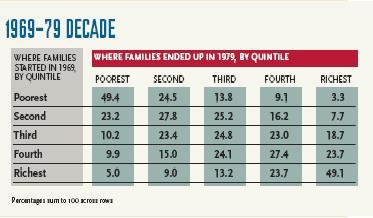
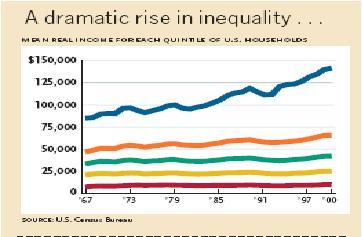
EconoPundit points to a piece that appeared in the Boston Fed’s Regional Review (Q4 2002). The authors, Katharine Bradbury and Jane Katz, try to argue that income inequality is growing and that we should do something about it. Exhibit A is this graph, which shows real income by quintile for 1967-2000:

Looks bad, doesn’t it? If you didn’t know anything about the underlying dynamics, you’d think that the poorest American households made almost no progress in more than 30 years. Bradbury and Katz then try to convince their readers that it really is bad because the patterns of mobility between quintiles have changed little in recent decades:

What those “stable” patterns really mean is something quite different than Bradbury and Katz would have us believe. If you do the math correctly, you find that in a stable population only about 25 percent of the households that were in the poorest quintile in the late 1960s were still there a generation (about 30 years) later. Similarly, only about 25 percent of the households that were in the richest quintile in the late 1960s were still there a generation later. A small fraction of households stay in the same quintile; a smaller fraction move out of that quintile and then come back to it; most leave, never to return.

Actually, the percentage of households that remained in the poorest quintile in the last one-third of the 20th century must have been far less than 25 percent. The number of households wasn’t stable during that period (nor will it remain stable). According to the Census Bureau, the number of households increased from about 63 million in 1970 to about 103 million in 2000 (and will continue to grow by more than 1 million a year). What income quintile do you suppose is occupied by most new households, which consist mainly of young couples and immigrants*? The bottom quintile, of course.

So, let’s take population growth into account. The bottom quintile consisted of about 13 million households in 1970 (one-fifth of the total of 63 million). Of those 13 million, only about 3 million (25 percent) remained there in 2000. But by 2000, the bottom quintile consisted of about 21 million households (one-fifth of the total of 103 million). Therefore, at the end of the 20th century, only about 15 percent of the households (3 million of 21 million) then in the bottom quintile had been there for a generation.

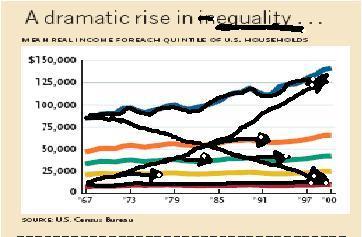
The first graph really should look something like this:

I’ve kept it simple by omitting most of the inter-quintile movement, but you get the idea. The way I’ve drawn it is the way it really happens, according to the numbers kindly provided by Bradbury and Katz.

All Bradbury and Katz have shown us is that new households are generally poorer than more established households. What they haven’t shown us — because it’s untrue — is that households that start at the bottom stay at the bottom. Nor do households that start at the top stay at the top.
__________
* See Robert J. Samuelson’s column, “The Changing Face of Poverty,” in this week’s Newsweek. Here are the key points about immigrants and poverty:

…For 2003, the Census Bureau estimated that 35.9 million Americans had incomes below the poverty line; that was about $12,000 for a two-person household and $19,000 for a four-person household. Since 2000, poverty has risen among most racial and ethnic groups. Again, that’s the recession and its after-math. But over longer periods, Hispanics account for most of the increase in poverty. Compared with 1990, there were actually 700,000 fewer non-Hispanic whites in poverty last year. Among blacks, the drop since 1990 is between 700,000 and 1 million, and the poverty rate—though still appallingly high—has declined from 32 percent to 24 percent. (The poverty rate measures the percentage of a group that is in poverty.) Meanwhile, the number of poor Hispanics is up by 3 million since 1990. The health-insurance story is similar. Last year 13 million Hispanics lacked insurance. They’re 60 percent of the rise since 1990.

To state the obvious: not all Hispanics are immigrants, and not all immigrants are Hispanic. Still, there’s no mystery here. If more poor and unskilled people enter the country—and have children—there will be more poverty. (The Census figures cover both legal and illegal immigrants; estimates of illegals range upward from 7 million.) About 33 percent of all immigrants (not just Hispanics) lack a high-school education. The rate among native-born Americans is about 13 percent. Now, this poverty may or may not be temporary. Some immigrants succeed quickly; others do not….

Straight Thinking About Business Cycles

Economists and common folk have long thought that a recession — a sustained drop in the total output of goods and services — is caused by a failure of markets or government “to do the right thing.” Now, the Nobel prize for economics has been awarded to Finn E. Kydland and Edward C. Prescott, a pair of economists who say otherwise. Here’s the story, according to Alex Tabarrok at Marginal Revolution:

…Recessions have almost always been thought of as a failure of market economies. Different theories point to somewhat different failures, in Keynesian theories it’s a failure of aggregate demand, in Austrian theories a mismatch between investment and consumption demand, in monetarist theories a misallocation of resource due to a confusion of real and nominal price signals. In some of these theories government actions may prompt the problem but the recession itself is still conceptualized as an error, a problem and a waste.

Kydland and Prescott show that a recession may be a purely optimal and in a sense desirable response to natural shocks. The idea is not so counter-intuitive as it may seem. Consider Robinson Crusoe on a desert island….Every day Crusoe ventures out onto the shoals of his island to fish. One day a terrible storm arises and he sits the day out in his hut – Crusoe is unemployed. Another day he wanders out onto the shoals and finds an especially large school of fish so he works especially long hours that day – Crusoe is enjoying a boom economy. Now add into Crusoe’s economy some investment goods, nets for example, that take “time to build.” A shock on day one will now exert an influence on the following days even if the shock itself goes away – Crusoe begins making the nets when it rains but in order to finish them he continues the next day when it shines. Thus, Crusoe’s fish GDP falls for several days in a row – first because of the shock and then because of his choice to build nets, an optimal response to the shock.

An analogy is one thing but K[ydland] and P[rescott] showed that a model built from exactly the same microeconomic forces as in the Crusoe economy could duplicate many of the relevant statistics of the US economy over the past 50 years. This was a real shock to economists! There are no sticky prices in K & P’s model, no systematic errors or confusions over nominal versus real prices and no unexploited profit opportunities. A perfectly competitive economy with no deviations from classical Arrow-Debreau assumptions could/would exhibit behaviour like the US economy.

That’s what I’ve been trying to tell my wife (a Bush-hater), who likes to parrot the Democrats’ line about “all those people who don’t have jobs.” My response: First, right now it’s no worse than usual. The 5.4 percent unemployment rate for September was slightly lower than the average of 5.6 percent for 1948-2003 (computed from BLS data given here). Second, when the unemployment rate was worse it wasn’t Bush’s fault, nor was it Clinton’s (even though the latest recession began on his watch). Recessions happen. They’re inevitable and even desirable in a dynamic economy; they’re fluctuations around an ever-rising trend, albeit a trend that has become less robust since the onset of the regulatory-welfare state about 100 years ago:


Data on real GDP for 1870-2003 are from Louis Johnston and Samuel H. Williamson, “The Annual Real and Nominal GDP for the United States, 1789 – Present.” Economic History Services, March 2004, URL: http://www.eh.net/hmit/gdp/. Real GDP for 2004 estimated by deflating nominal 2004 GDP (source at footnote a) by increase in CPI between 2000 and 2004 (from Bureau of Labor Statistics).

The Consequences of Drug Reimportation

What will happen if it becomes U.S. policy to allow the reimportation of drugs from Canada? A recent paper in the Quarterly Journal of Economics, by Daron Acemoglu and Joshua Linn, tells the tale. Here’s the bottom line, according to Alex Tabarrok at Marginal Revolution:

Acemoglu and Linn’s paper is formally about a different issue [than reimportation]; the effect of market size on innovation. What they find is that a 1 percent increase in the potential market size for a drug leads to an approximately 4 percent increase in the growth rate of new drugs in that category. In other words, if you are sick it is better to be sick with a common disease because the larger the potential market the more pharmaceutical firms will be willing to invest in research and development. Misery loves company.

Although they don’t mention it, this finding has implications for price controls. In the pharmaceutical market the major costs are all fixed costs (they don’t vary much with market size) so profit =P*Q-F. Acemoglu and Linn look at changes in Q but a 1% change in P has exactly the same effects on profits, and thus presumably on R&D, as a 1% change in Q.

We can expect, therefore, that a 1% reduction in price will reduce the growth rate of new drug entries by 4% and a 10% reduction in price will reduce new drug entries by 40%. That is a huge effect. I suspect that the authors have overestimated the effect but even if it were one-half the size would you be willing to trade a 10% reduction in price for a 20% reduction in the growth rate of new drugs? No one who understands what these numbers mean would think that is a good deal.

What the numbers mean is that allowing large-scale reimportation of drugs from Canada (where prices are controlled) will cut into drug companies’ profits. Now, before you send up a loud cheer because you’ve been raised to believe that “profit” is a dirty word, consider what will happen after that. The reduction in profits will have a chilling effect on R&D and, therefore, on the introduction of new, life-enhancing drugs.

The logic of the issue is that simple, but it’s probably lost on consumers and politicians, who will focus on what we pay for today’s drugs and ignore the dire, long-term consequences of reimportation.

It’s just another case where consumers will suffer because economic illiteracy leads to wrong-headed government intervention in markets.

How to Save Social Security: Part I

REVISED AT 4:58 PM (CT) – 10/06/04

The day of reckoning for Social Security — as we know it — can be postponed by converting the trust fund to real assets that generate real income. The question then becomes whether to keep it as we know it, to privatize it, or to do some of both. This post shows how the day of reckoning can be postponed. Future posts will examine the future shape of the program.

In an earlier post I pointed out (1) that the Social Security trust fund is mythical, not real, and (2) that the trust fund could be converted from myth to reality by gradually selling the Treasury securities now held in the fund and replacing them with high-grade corporate bonds and conventional mortgages.

The trust fund would then hold real assets, and those assets would yield a higher rate of return than the putative rate of return on the “special obligation bonds” now held by the trust fund. How much higher? The following graphic compares the interest rates credited on new special obligation bonds issued from 1990 to 2003 with the yield to maturity for AAA corporate bonds, conventional mortgages, and BAA corporate bonds:


(Sources: Average annual interest rates on new trust fund bonds from Nominal Interest Rates on Special Issues at Social Security Online, Actuarial Resources; average annual rates on AAA corporate bonds, conventional mortgages, and BAA corporate bonds from Federal Reserve Statistical Release.)

For the period 1990-2003, the average yield on AAA bonds was 7.43 percent, as opposed to 6.34 percent for trust fund bonds. That’s 17 percent more interest income, on average, for each dollar invested in a AAA bond rather than a trust fund bond. Conventional mortgages and BAA bonds are even better: Conventional mortgages yielded 7.76 percent on average, 22 percent more than trust fund bonds; BAA bonds yielded an average of 8.27 percent, or 30 percent more than trust fund bonds. Somewhere in that mix lies a partial solution to Social Security’s underlying problem.

What is that problem? According to the 2004 report of Social Security’s trustees, it’s this:

[P]program cost will exceed tax revenues starting in 2018….Social Security’s combined trust funds are projected to allow full payment of benefits until they become exhausted in 2042.

What’s the solution? Again, according to the trustees, it’s this:

Over the full 75-year projection period the actuarial deficit estimated for the combined trust funds is 1.89 percent of taxable payroll–slightly lower than the 1.92 percent deficit projected in last year’s report. This deficit indicates that financial adequacy of the program for the next 75 years could be restored if the Social Security payroll tax were immediately and permanently increased from its current level of 12.4 percent (for employees and employers combined) to 14.29 percent. Alternatively, all current and future benefits could be immediately reduced by about 13 percent. Other ways of reducing the deficit include making transfers from general revenues or adopting some combination of approaches.

* If no action were taken until the combined trust funds become exhausted in 2042, much larger changes would be required. For example, payroll taxes could be raised to finance scheduled benefits fully in every year starting in 2042. In this case, the payroll tax would be increased to 16.91 percent at the point of trust fund exhaustion in 2042 and continue rising to 18.31 percent in 2078.

* Similarly, benefits could be reduced to the level that is payable with scheduled tax rates in every year beginning in 2042. Under this scenario, benefits would be reduced 27 percent at the point of trust fund exhaustion in 2042, with reductions reaching 32 percent in 2078.

Changes of this magnitude would eliminate the actuarial deficit over the 75-year period through 2078. However, because of the increasing average age of the population, Social Security’s annual cost will very likely continue to exceed tax revenues after 2078. As a result, ensuring the sustainability of the system beyond 2078 would require even larger changes than those needed to restore actuarial balance for the 75-year period.

The nugget in all of that is this: An immediate tax increase from 12.4 percent to 14.29 percent would eliminate the problem for 75 years. A tax increase of that size — about 15 percent — is equivalent to about $81 billion. (According to this table, Social Security “contributions” for 2003 were $533.5 billion; 15 percent of that is $81 billion.)

Interest on trust fund bonds generated $84.9 billion in 2003. That’s a fictional return of about 5.8 percent on the trust fund’s average assets of $1,454 billion for the year (from end-of-year data for 2002 and 2003 given here). That’s more than the return on new bonds, because the trust fund’s portfolio consists of a mix of bonds issued in various years at various rates. In any event, if the trust fund’s portfolio had been invested equally in AAA bonds, conventional mortgages, and BAA bonds, it would have yielded around 7.1 percent — about 23 percent more.

Let’s say the trust fund were completely converted to real assets by 2015, at which time it would have a current-dollar value of $4.4 trillion and earn about 5.6 percent interest (estimates derived from this table). The accumulation of additional interest earnings in the years after 2015 would prolong the life of the fund by about five years, that is, from 2042 into the late 2040s. Almost everyone who is now collecting Social Security benefits and who will begin collecting benefits in this decade would be assured of complete lifetime coverage. There would be no need to raise tax rates, cut benefits, or raise the retirement age beyond the current maximum of 67 years (for persons born in 1960 or later).

A slight upward adjustment in the retirement age would buy even more time in which to save Social Security without unduly burdening the coming generation of workers and retirees. And time is what it will take.

That Mythical, Magical Social Security Trust Fund

You know the trust fund that’s supposed to keep Social Security solvent until 2042, even though benefit payments will begin to exceed receipts in 2018? First, it’s phony, as explained by Olivia S. Mitchell and Thomas R. Saving in a July 31, 2001, Washington Post op-ed piece:

…When Social Security ran annual surpluses in the past, it enabled other parts of government to spend more. The trust fund measures how much the government has borrowed from Social Security over the years, just as your credit card balance indicates how much you have borrowed. The only way to get the money to pay off your credit balance is to earn more, spend less or take out a loan. Likewise, the only way for the government to redeem trust fund IOUs is to raise taxes, cut spending or borrow.

Politicians and independent analysts have recognized the past inability of government to “lock-box” the trust fund. In 1989, for example, the assistant comptroller of the General Accounting Office said, “We shouldn’t kid the American people into thinking extra savings is going on.” It wasn’t until 1999 that the non-Social Security portion of the government budget finally reached balance. Only then was the Social Security surplus actually used to retire government debt.

We are surprised that this perspective on the trust fund is controversial. The commission’s interim report quotes credible sources — the Congressional Budget Office, the General Accounting Office and the Congressional Research Service — supporting the view that the trust fund is an asset to Social Security but a liability to the rest of the government. The Clinton administration’s fiscal year 2000 budget indicated a similar perspective:

“These [trust fund] balances are available to finance future benefit payments and other Trust Fund expenditures — but only in a bookkeeping sense. . . . They do not consist of real economic assets that can be drawn down in the future to fund benefits. Instead, they are claims on the Treasury that, when redeemed, will have to be financed by raising taxes, borrowing from the public, or reducing benefits or other expenditures. The existence of large Trust Fund balances, therefore, does not, by itself, have any impact on the Government’s ability to pay benefits.”

Does this mean the government will not make good on those trust fund claims? Of course not, and the commission never suggested this. In fact, one principle guiding the commission’s work is that current and near-retirees must have their benefits preserved. Still, the nation has only three ways to redeem trust fund bonds: raising taxes, cutting spending or increasing government borrowing. If there is some alternative source of funds, no one has yet suggested it. And the annual amounts to be repaid are large and rising over time: $93 billion in 2020, $194 billion in 2025, and $271 billion in 2030 (in today’s dollars).

Some have suggested we could solve our Social Security problems simply by legislating a higher interest rate on trust fund bonds. This has superficial appeal, since it would be a simple bookkeeping matter for the Treasury. It would make the trust fund look bigger and extend the date when the trust fund is exhausted — on paper. But no increase in the amount we owe ourselves creates new saving. The same people will be retiring, expecting the same benefits and posing the same need for revenues irrespective of the size of the trust fund.

One way or another, promises of Social Security benefits made under the current system must be financed by taxpayers. These costs are slated to grow from 10.5 percent of taxable wages today to 13.3 percent in 2016, 17.8 percent in 2038 and 19.3 percent in 2075. That is why reform now is crucial, when time is still on our side. With each passing year of non-action, the day of reckoning draws nearer, leaving us with fewer options.

Olivia S. Mitchell, a Democrat, is a professor of insurance and risk management at the University of Pennsylvania’s Wharton School. Thomas R. Saving, a Republican, is a professor of economics at Texas A&M and a member of the Social Security Board of Trustees.

So much for the mythical trust fund. Now, about those magical interest rates. According to the Social Security Administration, bonds issued to the trust funds in 2003 had an interest rate of 3.5 percent, compared with an interest rate of 5.25 percent for bonds issued in 2002. That’s not too bad, considering that the average rate on 20-year Treasury bonds (the Treasury’s longest maturity) was 4.96 percent in 2003 and 5.43 percent in 2002. But it’s not nearly as good as, say, AAA and BAA rated corporate bonds and conventional mortgages, which had these average yields: AAA 2003, 5.66 percent; AAA 2002, 6.49 percent; BAA 2003, 6.76 percent; BAA 2002, 7.80 percent; conventional mortgage 2003, 6.54 percent; conventional mortgage 2002, 5.82 percent. In other words, high quality corporate bonds and conventional mortgages carry significantly higher interest rates than government bonds (because of the perception that corporate bonds and conventional mortgages are riskier than government debt).

These facts point to a way to ease the transition to private Social Security accounts. First, convert the mythical trust fund to a real one by creating an independent agency to invest the trust fund in high-quality corporate bonds and conventional mortgages. The agency would gradually sell off the trust fund’s portfolio of highly marketable government bonds and replace them with high-quality corporate bonds and conventional mortgages. In the end, the trust fund would comprise real assets, and those real assets would earn real income, at rates higher than those magically credited to the mythical trust fund upon which the future of Social Security now rests uneasily.

The additional revenue earned by the new trust fund wouldn’t wipe out the pending deficit in Social Security, nor would it prevent the eventual depletion of the trust fund. But the depletion of the trust fund could be held off long enough to enable a graceful transition to private social security accounts. The slower that transition, the less painful would be the temporary — but necessary — combination of tax increases and/or benefit reductions.

In the end, we’ll be better off because each worker will be investing for his or her own retirement — unlike the present system, which places an increasingly heavy burden on future generations. But we need more time to get there, and “privatizing” the trust fund is a good way to buy that time.

Why I Don’t Hang Around with Economists

Sometimes economists who blog remind me why hanging around with economists is not good for the soul. Matthew Yglesias, a philosopher, started if off by saying, in connection with some controversy about Al-Zarqawi’s tied to bin Laden:

Maybe the Marginal Revolution guys can shed some light on whether it’s better to be fighting a consolidated jihadi monopoly or several competing terrorist firms.

Unfortunately, the economists rose to the bait. First, Tyler Cowen at Marginal Revolution goes through the usual, “if this, then that” routine before saying:

My guess: In Iraq you would prefer a smaller number of groups, since there is some chance of striking a deal with them. And there we are more worried about the suicide bombers than a loose nuclear device, so economies of scale do not overturn this conclusion. We are less likely to ever “trade” with al Qaeda and its offshoots, so in that case I would prefer splintering. Furthermore al Qaeda has a greater long-run nuclear potential, so it is more important to deny them potential economies of scale. I suspect we do not much mind if western Pakistan becomes a scene for terrorist infighting, whereas such conflicts could scuttle reconstruction in Iraq.

Then Glen Whitman at Agoraphilia gets into the act:

In reality, both models apply. Terrorists get money both from sales of other products and from donations, and they commit terrorist acts both for consumption and as a business venture. If it’s true that terrorist organizations are becoming more decentralized and independent, the net gain or loss to the victim-class will depend on which source of funding, sales of illicit services or donor contributions, is more important. My sinking suspicion is that it’s the latter.

For pity’s sake, fellas, it doesn’t matter because we can’t do anything about it, other than figure out where they are and what they’re up to, then stymie their plans and kill them.

Economists often lose sight of the ball. They’re so busy explaining what makes it curve that they’re not ready to swing at it.

All of which reminds me of going to lunch with economists, which I quit doing after a few outings. The idea of going to lunch with colleagues is to have some laughs, some good conversation (not about economics), and a few beers to help you coast through the afternoon. With economists, however, lunch always went something like this: Carping at the waiter about what’s not on the menu, followed by carping at the waiter about whether he brought the right orders to the table, followed by carefully dissecting the bill to ensure that everyone pays for precisely what he ordered, followed by computing the tip down to the last red cent instead of rounding up to the nearest dollar out of consideration for the beleaguered waiter. I’d rather have lunch with undertakers.

Fear of Corporate Power

Arnold Kling, writing at Tech Central Station, spells out the right way to deal with “corporate power”:

…One of the differences between Sweetwater and Saltwater economists concerns monopoly. On the left, saltwater economists tend to share [the] view that government is the logical check on corporate power. On the right, sweetwater economists believe that government naturally allies with large interests, so that more government involvement tends to strengthen the hand of the corporate giants and weaken the position of consumers and small businesses.

My own reading of history is that it supports the Sweetwater point of view. Once an industry becomes regulated, economic competition dries up, to be replaced by lobbyist infighting. The profit center moves from the market to Washington, and resources shift accordingly.

Corporate power is a bad thing. I like to see big corporations humbled by innovation and competition.

But fear of corporate power can be a worse thing. Politicians play up that fear, because they are eager to intervene. However, it seems to me that government interventions do not wind up reining in corporations, and the net result is to leave ordinary individuals less powerful than in a less-regulated environment….

No form of legislation has done more to harm consumers — and to shackle the economy — than anti-trust legislation.

Fighting Myths with Facts

REVISED AND RE-DATED

Liberals and deluded economists (the same thing) constantly decry the fact that one-fifth of the nation’s households are in the lowest 20 percent of the income distribution. (A quasi-intellectual joke — get it?)

Anyway, there’s this clamor for someone (namely taxpayers) to do something (namely redistribute income or simply tax higher earners to provide expensive and needless training, healthcare, and daycare programs for low earners). Many sensible economists (a rare breed) know better. They know two important facts:

1. There’s a lot of up and down movement in the distribution of incomes.

2. Even those who stay near the bottom of the income distribution are a lot better off than they used to be.

The first pont is illustrated by these data* from a panel of families surveyed in 1975 and again in 1991 (income quintile in 1975 and percentage that had moved to the top two quintiles in 1991):

Lowest Fifth – 59% moved to the top two quintiles

Second Fifth – 52% “

Middle Fifth – 49% “

Fourth Fifth – 70% remained in the top two quintiles

Highest Fifth – 86% “

The second point is illustrated by this** graphic:


__________
* Source: Myths of Rich & Poor, W. Michael Cox and Richard Alm, via Arnold Kling, writing at Tech Central Station.)

** Source: The Washington Post, via Wizbang.

That’s It, Exactly

Why is it that many economists (epitomized by Paul Krugman) seem not to understand the principles of economics? That is, why do they consistently favor government intervention in economic affairs (e.g., heavy handed regulation of the drug industry, government as the single payer in a universal health insurance plan)? Here’s why, according to Arnold Kling, writing at Tech Central Station:

My sense is that even for the best students, mathematical constructs in economics tend to go into short-term memory. The really important lessons of economics can be forgotten, if they are even learned in the first place, in a class where students are graded on their ability to manipulate diagrams as opposed to their ability to apply economic reasoning.

Some economists seem completely lost without their mathematical tool kit. Unable to explain economics in plain English, they stoop to the novice level, or even lower. I put Paul Krugman in this category….

Many economists are considered “good” economists because of their command of mathematics and statistics — not because they truly understand the principles of economics.

Why Class Warfare Is Bad for Everyone

Let’s say the economy consists of two persons: A, who makes bread, and B, who invents things. A pays B in bread whenever B invents something that A wants.

B’s first invention is the toaster. A likes it a lot, so he and B agree on a price for the toaster: B gets a loaf of bread a week for as long as the toaster works. So far, so good?

Now suppose that B invents TV. A really likes that invention, so he offers to pay B five loaves of bread for every week the TV works. B makes a counter offer of 10 loaves of bread per week. A doesn’t think it’s “fair” to pay that much for TV, so he forces B at gunpoint to accept five loaves a week. (Get the not-so-subtle dig at the coercive power of the state?)

Now B says to himself, “If that’s the way it’s going to be, I’m not going to the trouble of inventing anything else as complex as TV. I’ll stick to simple stuff like toasters.” So B keeps on inventing things, but they’re not things that A would be willing to pay a lot of bread for.

Here’s the quiz: Who’s worse off because the “state” (A’s pistol) intervened on behalf of the laborer (A) who envied the entrepreneur (B) — A or B? Answer: Both are worse off. A doesn’t get to enjoy the things B would have invented if the state hadn’t removed B’s incentive to invent them. And B doesn’t earn as much bread as he could have earned for inventing things that would make A happier.

So, when you think of progressive taxation and other methods of redistributing income, think of A and B and the parable of the loaves.

A Story That Makes Me See Red (Ink)

From AP via Yahoo! News:

US Airways Gets OK to Use Taxpayer Funds

By MATTHEW BARAKAT, AP Business Writer

ALEXANDRIA, Va. – A bankruptcy judge gave US Airways Group Inc. permission Monday to tap a government loan to fund daily operations — a move expected to allow the airline to continue its normal flight schedule while it searches for additional financing….

The headline has it right. A “loan fund” is funded by taxpayers. I guess airlines have become as indispensible as farms. Why can’t we just let them disappear gracefully instead of prolonging their death throes? Too little faith in the power of America’s economic engine; too much clout in Washington.

Me, Too

Arnold Kling of EconLog, quoting from his forthcoming book, says this about the incomprehensibility of what most economists write:

I believe that some of the fault lies with the top graduate schools in economics, such as the Massachusetts Institute of Technology, where I obtained my Ph.D. The focus on mathematical training in these programs is so intense that they tend to produce a sort of idiot-savant, competent only to publish in academic journals. It pains me to see economists for whom expounding economic principles and speaking in plain English are mutually exclusive activities.

Precisely. I began Ph.D. work in economics at M.I.T. in the early ’60s. I quit, fairly promptly, because I found the program depressingly, deadeningly sterile. I’m sure it only got worse.