Save Me from Self-Appointed Saviors

A recent NYT piece by Richard Zacks (“How Dry We Aren’t“) highlights the antics of Theodore Roosevelt:

When Theodore Roosevelt was police commissioner [of New York City], from 1895 to 1897, he tried to stop the sales of beer, wine and liquor on Sundays in saloons.

Men and women, who worked six days a week in that era, were not amused. New York State Sabbath laws already forbade attending sporting events or theater performances, or selling groceries, after 10 a.m. on Sundays; the excise laws also made it illegal to sell alcohol in bars, saloons and taverns all 24 hours of the Lord’s Day.

New Yorkers in droves defied that particular edict. (Sunday actually marked the barkeep’s biggest sales day.) Saloon owners handed a bribe to precinct cops who forwarded some loot to Tammany politicians, and the city’s thirsty could discreetly slip in the side doors of saloons. For almost 40 years, it was a popular pragmatic compromise.

Enter Roosevelt. Fearless and bullheaded, the new commissioner vowed to enforce the law, both to root out bribery in the Police Department and also to reunite families on Sundays….

Roosevelt’s liquor crackdown backfired…. The city’s spirit of place, what Stephen Crane once dubbed New York’s “wild impulse,” refused to be tamed.

Theodore Roosevelt the reformer was deeply proud of his efforts to clean up New York but in his illustrious later days, running for governor, then for vice president, then president, he never won a majority vote in the city. Never take a beer away from a New Yorker.

If only it were that easy to subvert the intentions of zealous office-holders.

In another recent NYT piece (“The C.E.O. in Politics“), David Brooks observes that

great leaders tend to have an instrumental mentality. They do not feel the office is about them. They are just God’s temporary instrument in service of a larger cause. Lincoln felt he was God’s instrument in preserving the union. F.D.R. felt he was an instrument to help the common man and defeat fascism.

Whatever FDR felt, he was not a great leader. Nor was his distant cousin, Teddy Roosevelt. What they shared with other so-called great leaders was overwhelming ego: the belief that their wishes should be everyone’s wishes. And, with the help of compliant Congresses and Supreme Courts, they made it so.

TR spoke and acted as if he were God’s instrument. As president, his aspiration to savior-hood led him to embrace Progressivism (e.g., trust-busting). His actions brought an end to 40 years of rapid economic growth, which — contrary to myth — had uplifted the masses as well as the “robber barons.” After a too-brief respite from dictatorship, under Taft, Woodrow Wilson (another “leader” who thought he was an instrument of God) extended the Progressive state, and economic growth slowed further.

The Great Depression, predictably enough, swept out Hoover, whose “do something” ethic turned a recession into a depression, and brought in FDR, with his second-rate mind. He soon enough began to think of himself as a savior, empowered (by perverse logic) to uplift the downtrodden by running roughshod over America’s businesses. What he accomplished, in fact, was a deeper and longer depression. (By contrast, the economy quickly rebounded from the deep recession of 1920-21 because “do nothing” Harding did nothing but encourage business.) LBJ’s deliberate mimicking of FDR’s New Deal put in motion the Great Society, the aftermath of which has been economic growth on a par with that of the TR-Wilson era.

Now comes Barack Obama, a storefront version of TR, FDR, and LBJ. “Bush fatigue” elected him and presented him with a Democrat-controlled Congress. He took his luck for a kind of divine mandate, which he exploited to impose upon Americans his ruinous visions of universal health care, Keynesian deficit-spending, and defensive weakness (masked by the inconsequential if satisfying erasure of bin Laden).

God save us from “leaders” who want to be our saviors. For every Lincoln — whose principal legacy was the forcible stitching up of a union that has yet to heal — there are too many TRs, WWs, FDRs, LBJs, and BHOs.

Related posts:
The Price of Government
Fascism and the Future of America
The Indivisibility of Economic and Social Liberty
The Price of Government Redux
The Real Burden of Government
The Illusion of Prosperity and Stability
The Mega-Depression
Estimating the Rahn Curve: Or, How Government Inhibits Economic Growth
Money, Credit, and Economic Fluctuations
A Keynesian Fantasy Land
The Keynesian Fallacy and Regime Uncertainty
Why the “Stimulus” Failed to Stimulate
Regime Uncertainty and the Great Recession
Regulation as Wishful Thinking
Vulgar Keynesianism and Capitalism
Why Are Interest Rates So Low?
Don’t Just Stand There, “Do Something”
Economic Growth Since World War II
The Commandeered Economy

Preemptive War and Iran

My post, “Preemptive War,” is mainly a general argument for preemption, where American’s vital interests are at stake. But it was prompted by ” the imminent acquisition by Iran of material with which to produce nuclear weapons.”

The authors of “Why Obama Should Take Out Iran’s Nuclear Program” (Foreign Affairs, November 9, 2011) see the wisdom of preemption:

The November 8 International Atomic Energy Agency (IAEA) report casts further doubt on Iran’s continual claims that its nuclear program is intended solely for peaceful use….

…[T]he Obama administration has downplayed the findings of the new IAEA report, suggesting that a change in U.S. policy is unlikely. Yet this view underestimates the challenges that the United States would confront once Iran acquired nuclear weapons.

For example, the Obama administration should not discount the possibility of an Israeli-Iranian nuclear conflict….

Beyond regional nuclear war, Tehran’s acquisition of these weapons could be a catalyst for additional proliferation throughout the Middle East and beyond….

…Iran’s rivals for regional dominance, such as Turkey, Egypt, and Saudi Arabia, might seek their own nuclear devices to counterbalance Tehran. The road to acquiring nuclear weapons is generally a long and difficult one, but these nations might have shortcuts. Riyadh, for example, could exploit its close ties to Islamabad — which has a history of illicit proliferation and a rapidly expanding nuclear arsenal — to become a nuclear power almost overnight….

The closer Iran gets to acquiring nuclear weapons, the fewer options will be available to stop its progress. At the same time, Iran’s incentives to back down will only decrease as it approaches the nuclear threshold. Given these trends, the United States faces the difficult decision of using military force soon to prevent Iran from going nuclear, or living with a nuclear Iran and the regional fallout.

But the Obama administration — more accurately, Barack Obama — seems committed to a perverse foreign policy in the Middle East. This is from “Panetta Assures Iran It Has Little to Worry About” (Commentary, November 11, 2011):

If the leaders of the Iranian regime were worried about Jeffrey Goldberg’s prediction that Barack Obama would confound the world and launch a U.S. military strike designed to save Israel from nuclear destruction, they can now calm down. Secretary of Defense Leon Panetta made it crystal clear at a Pentagon news conference yesterday he has no intention of supporting an American attack on Iran’s nuclear facilities….

…But by publicly throwing cold water on the idea the United States is ready and able to militarily squash Iran’s nuclear ambitions, Panetta has sent a dangerous signal to Tehran that the Pentagon intends to veto any use of force against them. Combined with Russia’s pledge to block any further sanctions on Iran, the statement should leave the Khameini/Ahmadinejad regime feeling entirely secure as they push ahead to the moment when they can announce their first successful nuclear test.

This — combined with Obama’s dubious support of Israel, his unseemly withdrawal from Iraq, and his reluctant and easily reversed decision to “surge” in Afghanistan — confirms Obama’s position as the Jimmy Carter of the 21st century. Where is the next Ronald Reagan when we need him?

The “loss” of the Middle East and its relatively cheap oil would be a disaster for America’s economy. Further, it would leave an opening for an ambitious and increasingly powerful China.

Does Obama care about such things? Evidently not. He is too busy trying to remake the U.S. in the image of Europe: defenseless, bankrupt, and hostage to enviro-nuts.

See also “Some Thoughts and Questions about Preemptive War.”

Politics, Sophistry, and the Academy

By “politics” I mean the business of acquiring and applying governmental power, which involves — among other things — persuading the electorate, either directly or through advertising and the utterances of political allies and friendly “opinion elites” among journalists and academicians.

“Sophistry” is more complex. Its meaning has evolved, as described at Wikipedia:

The Greek word sophos, or sophia, has had the meaning “wise” or “wisdom” since the time of the poet Homer and originally was used to describe anyone with expertise in a specific domain of knowledge or craft. For example, a charioteer, a sculptor or a warrior could be described as sophoi in their occupations. Gradually, however, the word also came to denote general wisdom and especially wisdom about human affairs (in, for example, politics, ethics, or household management)….

In the second half of the 5th century BC, particularly at Athens, “sophist” came to denote a class of mostly itinerant intellectuals who taught courses in various subjects, speculated about the nature of language and culture and employed rhetoric to achieve their purposes, generally to persuade or convince others: “Sophists did, however, have one important thing in common: whatever else they did or did not claim to know, they characteristically had a great understanding of what words would entertain or impress or persuade an audience.”…

Plato is largely responsible for the modern view of the “sophist” as a greedy instructor who uses rhetorical sleight-of-hand and ambiguities of language in order to deceive, or to support fallacious reasoning. In this view, the sophist is not concerned with truth and justice, but instead seeks power.

Here, I am concerned with sophistry in its modern, political sense: the cynical use of language in the pursuit and application of power. In a word, propaganda. Josef Pieper (1903-97), a German Catholic philosopher, has much to say about this in Abuse of Language, Abuse of Power (for which I thank my son). There, Pieper notes that propaganda

can be found wherever a powerful organization, and ideological clique, a special interest, or a pressure group uses the word as their “weapon”…. (p. 32)

A bit later, Pieper says that “the abuse of political power is fundamentally connected with the sophistic abuse of the word” (p. 32). But this is nothing new under sun, and should come as no surprise to anyone who has even a superficial knowledge of modern history and understanding of politics.

Less evident, I believe, is the tragically corrosive confluence of politics and sophistry in the academy. To push the metaphor, what was a trickle in the middle of the twentieth century has grown to a wide, roaring river of academic dishonesty in the service of political ends.

About the corruption of the academy, Pieper writes:

[T]he term academic expresses something that remained unchanged throughout the centuries, something that can be identified quite accurately. It seems that in the midst of society there is expressly reserved an area of truth, a sheltered space for the autonomous study of reality, where it is possible, without restrictions,to examine, investigate, discuss, and express what is true about any thing — a space, then, explicitly protected against all potential special interests and invading influences, where hidden agendas have no place, be they collective or private, political, economic, or ideological. At this time in history we  have been made aware amply, and forcefully as well, what consequences ensue when a society does or does not provide such a “refuge”. Clearly, this is indeed a matter of freedom — not the whole of freedom, to be sure, yet an essential and indispensable dimension of freedom. Limitations and restrictions imposed from the outside are intolerable enough; it is even more depressing for the human spirit when it is made impossible to express and share, that is, to declare publicly, what according to one’s best knowledge and clear conscience is the truth about things….

Such a space of freedom needs not only a guarantee from the outside, from the political power that thus imposes limits on itself. Such a space of freedom also depends on the requirement that freedom be constituted — and defended — within its own domain. By “defended” we mean here not against any threat from the outside but against dangers arising — disturbingly! — within the scholarly domain itself…. (pp. 37-8)

Pieper’s depiction of the academy may seem, at first glance, to be unrealistically romantic. But Pieper is merely setting forth an ideal toward which the academy should strive. If the academy would renew its dedication to the ideal, it would banish and bar the sophists who lurk within and seek to infiltrate it.

Where are the sophists most likely to be found in the academy? In such pseudo-disciplines as “women’s studies,” “black studies,” and the like, of course. But also throughout the liberal arts, humanities, and social sciences, where artistic forms, economics, history, literature, and sociology serve (to name a few) serve as vehicles for those who would destroy the foundations of Western civilization in the name of “liberation,” “equality,” and “social justice.” Even the sciences are not immune, as evidenced by almost-obligatory belief in anthropogenic global warming, and the need to subscribe to that belief or be ostracized. More generally, there is the selection bias that works against the hiring and promotion of those who come from schools that have a reputation for dissenting from left-wing academic orthodoxy, or who have themselves overtly dissented from the orthodoxy. Especially damning is the fact of dissent based on hard evidence and impeccable logic — especially damning because it is especially threatening to the orthodoxy.

The last word goes to Pieper:

“Academic” must mean “antisophistic” if it is to mean anything at all. This implies also opposition to anything that could destroy or distort the nature of the word as communication and its unbiased openness to reality. In this respect we are well able to pronounce the general principle and at the same time to to be very specific: opposition is required, for instance, against every partisan simplification, every ideological agitation, eery blind emotionality; against seduction through well-turned yet empty slogans, against autocratic terminology with no room for dialogue, against personal insult as an element of style … , against the language of evasive appeasement and false assurance …, and not least against the jargon of the revolution, against categorical conformism, and categorical nonconformism…. (pp. 38-9)

Related posts:
I Missed This One
Affirmative Action: Two Views from the Academy
Feminist Balderdash
What Is the Point of Academic Freedom?
How to Deal with Left-Wing Academic Blather
It’s Not Anti-Intellectualism, Stupid
The Case Against Campus Speech Codes
The Left, Abortion, and Adolescence
Lefty Profs
Apropos Academic Freedom and Western Values
Why So Few Free-Market Economists?
Affirmative Action: Two Views from the Academy, Revisited
Affirmative Action for Conservatives and Libertarians?
Academic Bias
Intellectuals and Capitalism
The Left
Enough of Krugman
“Intellectuals and Society”: A Review
Social Justice
The Left’s Agenda
More Social Justice
The Left and Its Delusions
The Ideal as a False and Dangerous Standard
Utilitarianism and Psychopathy
Demystifying Science

More Fool He

David Brooks, The New York Times‘s ersatz conservative, writes:

When the president unveiled the second half of his stimulus it became clear that this package has nothing to do with helping people right away or averting a double dip. This is a campaign marker, not a jobs bill….

This wasn’t a speech to get something done. This was the sort of speech that sounded better when Ted Kennedy was delivering it. The result is that we will get neither short-term stimulus nor long-term debt reduction anytime soon, and I’m a sap for thinking it was possible.

Yes, I’m a sap. I believed Obama when he said he wanted to move beyond the stale ideological debates that have paralyzed this country. I always believe that Obama is on the verge of breaking out of the conventional categories and embracing one of the many bipartisan reform packages that are floating around….

Being a sap, I still believe that the president’s soul would like to do something about the country’s structural problems. I keep thinking he’s a few weeks away from proposing serious tax reform and entitlement reform. But each time he gets close, he rips the football away.

No s***, Sherlock. Being a bit smarter than Charlie Brown isn’t exactly a mark of distinction.

Welcome to the party David, even if it has taken you three years to get here.

Oh, but wait…

The White House has decided to wage the campaign as fighting liberals. I guess I understand the choice, but I still believe in the governing style Obama talked about in 2008. I may be the last one. I’m a sap.

Fool David once, Obama’s to blame. Fool David twice, David’s to blame. Fool David thrice (at least), and you know that David’s no sap — he’s a fool.

Creepy Doings at BarackObama.com

Obama for America is “an Authorized Committee of a Candidate For the Office of President or Vice President.” The website barackobama.com is “paid for by Obama for America.” There is (as of this writing) a post at barackobama.com dated September 13, 2011, “Launching AttackWatch.com,” which announces a “new resource,” namely AttackWatch.com. Among the features of that site is Report an attack:

This rather unsophisticated stab at compiling an enemies list will come back to haunt the O. Although the effort has just begun, it already has garnered some attention. I expect the snowball effect to kick in tomorrow.

P.S. I will be proud if I am placed on the enemies list, though I will leave it to the creeps at barackobama.com to find for themselves the large number of attacks that I have posted on this blog. Grrrr.

P.P.S. (09/23/11) It seems that Attack Watch was mortally wounded by the attacks (and ridicule) it drew.

September 20, 2001: Hillary Clinton Signals the End of “Unity”

This is my 9/11 post, a day early. For my remembrance of 9/11, go here.

I reluctantly watched George W. Bush’s post-9/11 speech before a joint session of Congress. I say “reluctantly” because I cannot abide the posturing, pomposity, and wrong-headedness that are the usual ingredients of political speeches — even speeches that follow events like the attack on Pearl Harbor and the atrocities of 9/11. (Churchill’s rallying speeches during World War II are another thing: masterworks of inspirational oratory.)

In any event, Bush’s performance was creditable (thanks, no doubt, to his writers and ample preparation). And I found nothing to fault in what he said, inasmuch as I am a libertarian hawk. The vigorous and evidently sincere applause that greeted Bush’s applause lines — applause that arose from Democrats as well as Republicans — seemed to confirm the prevailing view that Americans (or their political leaders, at least) were defiantly united in the fight against terrorism.

But I noted then, and have never forgotten, the behavior of Hillary Clinton, who was a freshman senator. Some of Clinton’s behavior is captured in this video clip, from 11:44 to 12: 14. The segment opens with Bush saying

Terror unanswered can not only bring down buildings, it can threaten the stability of legitimate governments. And you know what, we’re not going to allow it.

The assemblage then rises in applause. The camera zooms to Hillary Clinton, who seems aware of it and stares at the camera briefly while applauding tepidly. (Compare her self-centered reaction with that of the noted camera-hog Chuck Shumer, who is standing next to her, applauding vigorously, and looking toward Bush.) Clinton then turns away from the camera and, while still applauding tepidly, directs a smirk at someone near her. I also noted — but cannot readily find on video — similar behavior, include eye-rolling, at the conclusion of Bush’s speech.

Clinton — as a veteran political campaigner who knew that her behavior would draw attention — was sending a clear signal of her reluctance to support Bush because … because why? Because he had an opportunity for leadership that her husband had squandered through his lame responses to the 1993 bombing of the World Trade Center, the downing of U.S. helicopters in Somalia, and the bombings of U.S. embassies in East Africa? Because Bush was a Republican who had won the presidency after great controversy? Because she resented not being at the center of attention after having been there for eight years, as an influential FLOTUS?

Yes Clinton was “hawkish” on the wars in Afghanistan and Iraq. But I will always suspect that her hawkishness was, in part, a kind of atonement for her public display of disdain for George W. Bush on an occasion when such a display was inappropriate. No president should be given leave to do as he will, for any reason, but neither should his unexceptionable remarks on a solemn occasion be mocked.

Regardless of Clinton’s later stances, her behavior on January 20, 2011, signaled that the war on terror would become a partisan feast for Democrats and head-in-the clouds pseudo-libertarians. And it became just that.

Can Obama Erase the Deficit?

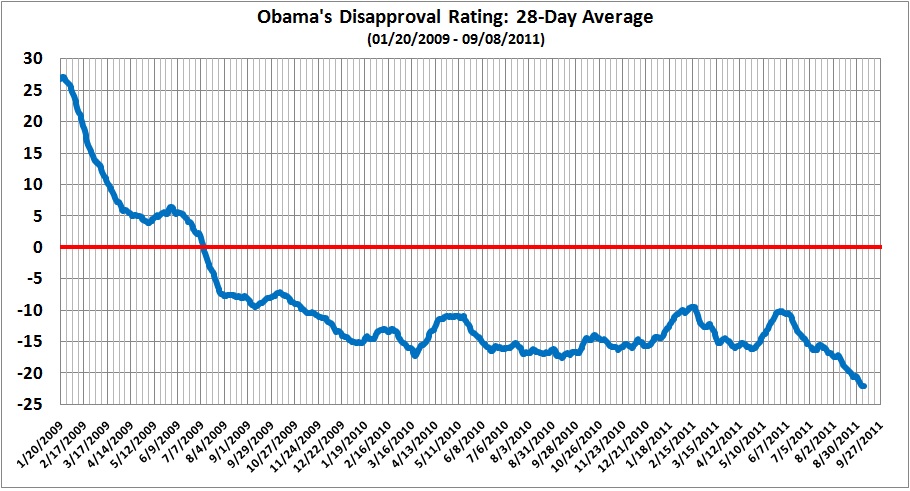
I don’t mean the federal government’s deficit or the jobs deficit. I mean Obama’s popularity deficit, which is s-o-o big:


Derived from Rasmussen Reports, Daily Presidential Tracking Poll.

When it comes to jobs, Don Boudreaux pegs it:

The problem isn’t that consumers aren’t spending; it’s that businesses aren’t investing.  And businesses aren’t investing because Congress and, especially, the administration exhibit a ceaseless fetish for top-down, command-and-control, debt-financed ‘governance’ of the economy – an enterprise-quashing recipe made only more poisonous by Mr. Obama’s soak-the-rich speechifying.

But that won’t keep the O from speechifying about “the rich” and trying to spend and regulate his way out of a recession that he has made worse by enlarging government and its reach, instead of shrinking both.

Related posts:
Taxing the Rich
More about Taxing the Rich
A Keynesian Fantasy Land
The Keynesian Fallacy and Regime Uncertainty
The Great Recession Is Not Over
Why the “Stimulus” Failed to Stimulate

A Sign of the Times


Derived from Rasmussen Reports, Daily Presidential Tracking Poll.

Stan Greenberg’s Tin Ear

UPDATED 08/08/11

Lefty pollster Stan Greenberg whines that

Barack Obama can’t catch a break from the American public on the economy, even though he prevented a depression and saved global capitalism.

I must have missed something, because all Barack Obama has done for the economy is to dig a deeper debt hole for our descendants — in the form of Obamacare — and waste a lot of resources on his misguided and ineffective “stimulus.” Unemployment remains high because businesses are reluctant to add jobs in the face of Obama’s commitment to environmental correctness and heavy-handed regulation.

All of that aside, Greenberg reveals his political incompetence with this:

When unemployment is high, and the rich are getting richer, you would think that voters of average means would flock to progressives, who are supposed to have their interests in mind — and who historically have delivered for them.

This is the typical leftist’s zero-sum, stagnationist view of economics. Zero-sum because of the implicit belief that the rich are getting richer at the expense of the less-rich. Stagnationist because of the implicit — and mistaken — belief that today individuals and households remain mired in a particular range of the income “distribution,” to which they are assigned for life. Never mind that all ranges of the “distribution” are better off than they were a generation ago, two generations ago, etc. More importantly, individuals and households move freely up and down the “distribution.”*

Greenberg is wrong on an even deeper level. He wants to enlist voters to the “progressive” cause by appealing to class-envy. It might work in desperate times, as it did to some degree during the Great Depression. But it won’t work in these times, which remain hopeful for most Americans. A person who is striving to become richer — even modestly so — doesn’t want to hear lectures about the evil of his striving.

UPDATE: Michael Barone agrees:

[O]rdinary Americans don’t want money as much as they want honor. They want what the chance to achieve what American Enterprise Institute President Arthur Brooks calls “earned success.”

__________
* I put “distribution” in quotation marks because most incomes are not distributed by some power on high, but earned by individuals, who strike bargains with employers and customers. The success of an individual’s bargaining depends heavily on an assessment of the individual’s contributions to the output of products and services. That assessment is delivered by markets for outputs and markets for the labor that contributes to those outputs.

Income is distributed, in the real meaning of the word, when it comes to government employees. They are the recipients of government largesse, and are sheltered from competition and market evaluations of their outputs. (Here is but one example of the general condition of government-employee compensation.)

The Continuing Resurgence of Obamacare

In October I noted a sharp turnaround in likely voters’ views of Obamacare, namely, that is had become markedly less unpopular. Why? I called it bribery (and still do):

Millions of $250 checks have been sent to Medicare beneficiaries in recent weeks — and more will be sent in the four weeks remaining until election day.

There’s more to the bribery than $250 checks. Here are excerpts of the letter that accompanies the checks:

The Affordable Care Act, a new law passed by Congress and signed by President Obama on March 30, 2010, provides a one-time rebate to help with your drug cots. The rebate is sent automatically to most people enrolled in Medicare Part D who reach the Medicare drug plans coverage gap (“doughnut hole”) in 2010….

As part of this new law, starting next year, you will get a 50% discount on covered brand name drugs if you reach the coverage gap. On top of this, Medicare will add even more savings over the next several years until the coverage gap is closed by 2020.

The Affordable Care Act has many other provisions that protect and strengthen your Medicare, reduce your costs, and give you and your familymore control over health care….

It’s the old “something for nothing” trick. In this case, millions of old folks are getting something for nothing, while millions of younger folks will be getting nothing for something — their tax dollars. But the tax bill hasn’t come due yet because the federal government is still able to borrow money from abroad. And so, most of the people have been fooled — for the time being. By the time they understand what’s happening, it will be too late for them to do anything about it.

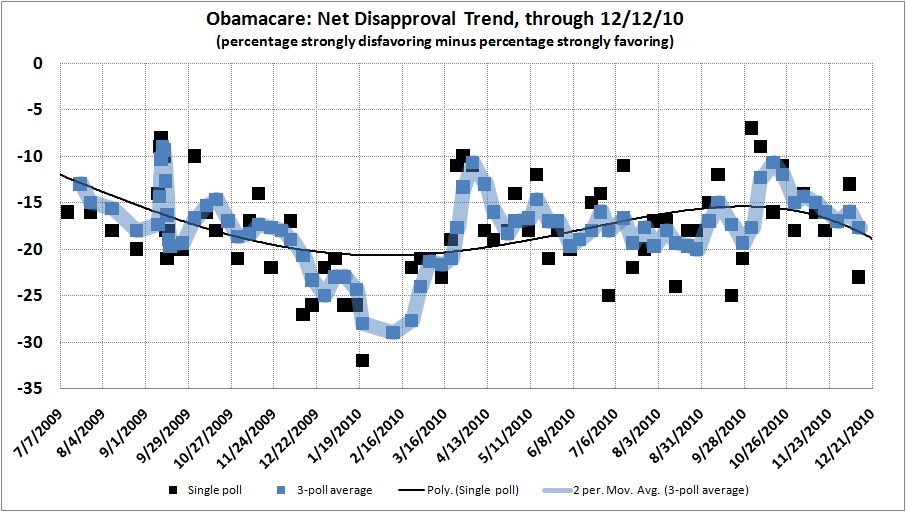
What has happened since October? Bribery still pays. Obamacare, though still unpopular on balance, has been gaining adherents a bit at a time:


Derived from this article and its predecessors at Rasmussen Reports. Poll results before passage of Obamacare represent strong approval minus strong disapproval. Poll results after passage of Obamacare represent strong approval of repeal minus strong disapproval of repeal.

The steep decline early in 2010 reflects “fashionable” pre-enactment resistance to Obamacare among independents, many of whom quickly changed their mind and became “fashionable” supporters of the fait accompli.

The polynomial fit (curved line) simply highlights the trend to date, and does not necessarily indicate Obamacare’s future popularity. But … if the upward movement continues, Republicans will find it hard going to repeal Obamacare, even if they win the Senate and White House in November 2012.

The present budget crisis could lead to a paring back of Obamacare. But if the crisis is resolved decisively, Obama (if not Democrats generally) will get much of the credit, and it will be more difficult to unseat him — unless job creation and economic growth remain in low gear.

Uncertainty abounds, as always.

Was There a “bin Laden bump” for Obama?

I was tempted to ask if there was an “Osama bump” for Obama. Ah well, mustn’t be snarky about our “gutsy” leader, who did no more than he should have done, though he had to “sleep on it” before he approved the Abbottabad operation.

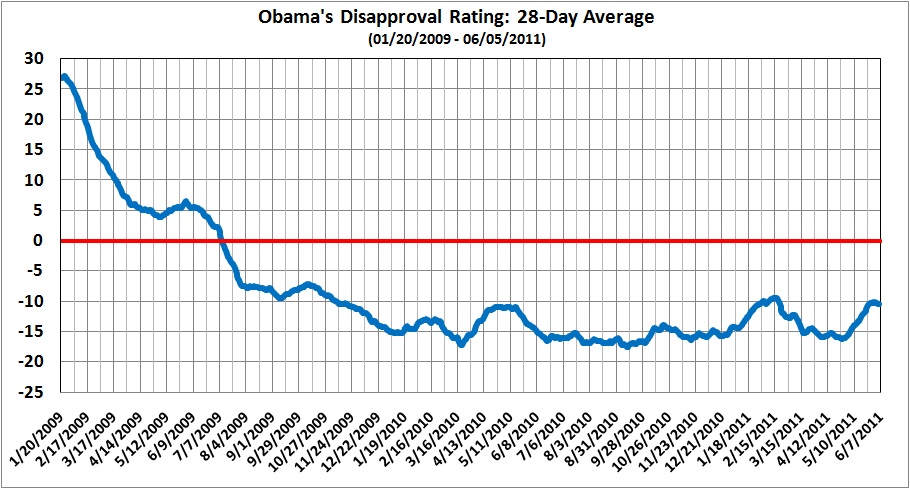
The first graph below gives Obama’s unpopularity ratings for the ten weeks surrounding the date on which Osama’s demise was announced: May 1, 2011. The blue shading spans polls that preceded the announcement. (The May 1 results were released in the morning; Obama announced Osama’s death later that day.) The green shading spans the two days (May 2 and 3) for which Obama’s disapproval rating reflected, in part, the results of polling conducted before the May 1 announcement.

It is evident that Obama was gaining ground, even before the May 1 announcement. We may take his rating of -11 on May 1 as a baseline for the evaluation of the effect of bin Laden’s death. Generously, Obama gained 4 points, and held that gain from May 7 through May 18. So much for the “bin Laden bump.”

It appears that Obama’s unpopularity was already returning to its core level of about -10 — a level that it had reached in the aftermath of the enactment of Obamacare. (See the second and third graphs.) And Obama’s unpopularity has stayed around its core level since the end of the modest “bin Laden bump.”

Why has Obama’s unpopularity returned to its core level? Here is my surmise: The battle lines are being drawn for election 2012, and those independents who enjoyed deriding Obama (for many legitimate reasons) are “coming home to roost” because they fear that if Obama loses in 2012 they will have abetted the demise of “free lunch” governance. They are of the ilk that decries the deficit while resisting the necessary (and inevitable) reductions in “entitlements.”


Net unpopularity is measured as the percentage of likely voters who strongly approve of BO, minus the percentage of likely voters who strongly disapprove of BO. The approval and disapproval statistics are derived from Rasmussen Reports’ Daily Presidential Tracking Poll. There is a gap in the 7-day trend because no poll was released on May 9. I use Rasmussen’s polling results because Rasmussen has a good track record with respect to presidential-election polling. The following graphs are derived from the same source.

Osama, Obama, and 2012

Obama did what any president should have done. However, because Osama was killed by U.S. forces on Obama’s watch, much of the glory will redound to Obama. But the glory really belongs to the team of Americans who conducted the raid on Osama’s lair, to the intelligence apparatus that led the team there, and to everyone directly involved in command and support of the operation.

The killing of Osama, at this late date, probably will have little or no effect on the operations of al-Qaeda and other terrorist organizations. The killing of Obama is a symbolic act of justice, and that’s about all it is. But that, in itself, is worth a lot to any American who abhors the 9/11 attacks for what they were: murderous attacks on innocent persons by cold-blooded fanatics. Anyone who is celebrating today but who said ten years ago that “we asked for it” is a hypocrite who should be wearing sackcloth instead of celebrating.

It remains to be seen whether the almost-certain surge in Obama’s popularity will last. There is much about the man and his policies that deserves deep unpopularity. Yesterday’s events will recede from view before long, and Americans will return to their struggles with unemployment, inflation, intrusive government, and mounting debt. It is those things that most likely will occupy Americans’ minds when they cast their votes in November 2012.

A case in point: Bush senior enjoyed a surge of popularity following the decisive (but incomplete) victory in the Gulf War of 1990-91, but he was nevertheless unable to win re-election in 1992. The third-party candidacy of Ross Perot had a lot to do with Bush’s unseating. But had the election taken place right after the defeat of Saddam’s forces, Bush probably would have won handily. Unfortunately for Bush — and the country — the election took place 20 months later, by which time Americans’ discontent with their economic lot led too many of them to vote for Perot and Clinton.

As Yogi says, “It ain’t over ’til it’s over.”

Leading Indicators?

If the political mood of the country (or much of it) doesn’t change markedly in the next several months, don’t be surprised if there’s an anti-Obama insurgency in the Democrat party. The Democrats my lose the White House no matter the party’s nominee for president, but a landslide loss would create an anti-Democrat bandwagon effect that lasts for years or decades.

For the history challenged among you, I point to the post-Civil War succession of Republican administrations from 1869 to 1913, broken only by the two terms of Grover Cleveland — a pro-business, gold-standard, small-government, northern Democrat. Then, there was the reaction to the Great Depression, which yielded Democrat presidencies from 1933 to 1969, broken only by the two terms of Dwight Eisenhower — a middling Republican known mainly to the public as the general in charge of the D-Day invasion and subsequent defeat of Hitler’s armies.

With those precedents in mind, there must be a goodly number of influential Democrats who are thinking about alternatives to Obama. If they are not, they should be. BO’s net popularity index has returned to the slough of despond, after having risen somewhat in the post-election “honeymoon” that followed BO’s cave-in on the extension of the Bush tax cuts:


Each plot-point represents the 7-day trend in BO’s net popularity (or lack thereof). Net popularity is measured as the percentage of likely voters who strongly approve of BO, minus the percentage of likely voters who strongly disapprove of BO. The approval and disapproval statistics are derived from Rasmussen Reports’ Daily Presidential Tracking Poll. I use Rasmussen’s polling results because Rasmussen has a good track record with respect to presidential-election polling.

Then there is Obamacare, which has never been popular, and has just receded to its lowest rating since congressional Democrats committed collective suicide by ramming it through:


Derived from this article and its predecessors at Rasmussen Reports. Poll results before passage of Obamacare represent strong approval minus strong disapproval. Poll results after passage of Obamacare represent strong approval of repeal minus strong disapproval of repeal.

Reality Strikes Again

Ross Douthat writes in  today’s NYT (“Obama the Realist“):

On the campaign trail in 2008, Barack Obama played to two very different foreign policy constituencies. Often he presented himself as the tribune of the anti-war left — the only candidate who had opposed the invasion of Iraq from the beginning, the man who could be trusted to civilize the global war on terror, and the perfect figure to smooth the transition to a post-American world order. To more bipartisan audiences, though, he cast himself as a cold-eyed realist — the rightful heir to George H. W. Bush, if not Henry Kissinger, who would pursue America’s interests without pretending (as the younger President Bush often did) that they matched up perfectly with America’s democratic ideals….

From the war on terror to the current unrest in Egypt, [Obama’s] foreign policy has owed far more to conservative realpolitik than to any left-wing vision of international affairs….

On nearly every anti-terror front, from detainee policy to drone strikes, the Obama administration has been what The Washington Times’s Eli Lake calls a “9/14 presidency,” maintaining or even expanding the powers that George W. Bush claimed in the aftermath of 9/11. (Dick Cheney himself admitted as much last month, effectively retracting his 2009 claim that Obama’s terrorism policies were undermining national security.) Time and again, this president has proved himself a careful custodian of both American and presidential prerogatives — and the most perceptive critics of his policies, tellingly, have been civil libertarians rather than Republican partisans.

Obama’s adoption of realpolitik is unsurprising to me. In the heat of the 2004 election, when Kerry had pulled even with Bush in the polls and it seemed that Kerry the anti-warrior might become president, I wrote this:

Assuming the best on the domestic front — that is, deadlock — what about the war on terror? All wouldn’t be lost if Kerry were to win the White House. He says dangerous multilateralist things about defense policy. But, in these times of clear and present danger, even a Democrat president will put defense above the trappings of internationalism. A massive failure to defend the homeland or to secure vital overseas interests would ensure a rout in the mid-term elections and a one-term presidency, if not impeachment.

It is good to know that Obama seems to take seriously his role as commander-in-chief. But I do wonder whether his new-found “realism” arises from a sense of responsibility or fear of impeachment.  I would not rule out the latter.

The Fall and Rise (and Fall?) of Obamacare

There are portents (aside from Judge Hudson’s timely ruling against the individual mandate):


Derived from this article and its predecessors at Rasmussen Reports. Poll results before passage of Obamacare represent strong approval minus strong disapproval. Poll results after passage of Obamacare represent strong approval of repeal minus strong disapproval of repeal.

“Intellectuals and Society”: A Review

Thomas Sowell‘s Intellectuals and Society is a rewarding and annoying book.

The book is rewarding because it adds to the thick catalog of left-wing sins that Sowell has compiled and explicated in his long career as a public intellectual. When Sowell criticizes the anti-gun, soft-on-crime, peace-at-any-price, tax-spend-and-regulate crowd, he does it by rubbing their noses in the facts and figures about the messes that have been created by the policies they have promoted.

Having said that, I must also note the ways in which Intellectuals and Society annoys me, namely, that it is verbose and coy about the particular brand of intellectualism that it attacks.

VERBOSITY

Regarding verbosity, here is a randomly chosen example, from page 114:

Abstract people are above all equal, though flesh-and-blood people are remote from any such condition or ideal. Inequalities of income, power, prestige, health, and other things have long preoccupied intellectuals, both as things to explain and things to correct. The time and effort devoted to these inequalities might suggest that equality is so common or so automatic that its absence requires an explanation. Many intellectuals have approached equality in much the same spirit as Rousseau approached freedom: “Man was born free, and he is everywhere in chains.” To much of the modern intelligentsia, man is regarded as having been born equal but as having become mysteriously everywhere unequal.

Which means:

The notion of equality propounded by left-wing intellectuals bears no relation to the reality of the human condition. But the false ideal of equality enables leftists to advance the notion that disparities of income, power, prestige, and health (among other things) are injustices that call out for correction.

There are other ways of saying the same thing — all of them equally concise and therefore easier for the reader to grasp. Dozens, if not hundreds, of other passages in Intellectuals cry out for the same kind of ruthless editing. With that done, the book would be more compelling, because the facts and figures that make Sowell’s case against leftist intellectuals would stand out more sharply.

THE TRUE SUBJECTS OF THE BOOK

This brings me to the “intellectuals” who are the subject of the book. Sowell’s definition of intellectuals is so broad that it includes him and others of his ilk:

Here “intellectuals” refers to an occupational category, people whose occupations deal primarily with ideas — writers, academics, and the like. Most of us do not think of brain surgeons or engineers as intellectuals, despite the demanding mental training that each goes through, and virtually no one regards even the most brilliant and successful financial wizard as an intellectual.

At the core of the notion of an intellectual is the dealer in ideas, as such — not the personal application of ideas, as engineers apply complex scientific principles to create physical structures or mechanisms. A policy wonk whose work might be analogized as “social engineering,” will seldom personally administer the schemes that he or she creates or advocates. That is left to bureaucrats, politicians, social workers, the police or whoever else might be directly in charge of carry out the ideas of the policy wonk. (Intellectuals and Society, pp. 2-3)

Sowell’s definition encompasses thinkers who devoted much (or all) of their careers to combating the kinds of statist policies advanced by the left-wingers who are the real targets of Intellectuals and Soceity. Sowell even mentions two anti-statist intellectuals — Friedrich Hayek and Milton Friedman — in the first chapter of his book, in a context which suggests that they are among his targets. But Sowell later invokes Hayek, Friedman, and other “conservative” intellectuals as he confronts left-wing ideas and their consequences.

There can be no doubt that Sowell’s fire is directed at left-wing academicians and pundits — and their enablers in political-bureaucratic-media complex — for the many good reasons documented in the book. A truth-in-packaging law for book titles — a left-wing idea if ever there was one — would require the renaming of Intellectuals and Society to Left-Wing Intellectuals and the Dire Consequences of their Ideas.

My aim is not to quibble with Sowell’s title, but to lament his lack of clarity about which set of intellectuals he is attacking, and why that set of intellectuals deserves reproach, whereas Hayek, Friedman, and company do not. Surely the author of Intellectuals and Society — who is, by his own definition, an intellectual — does not mean to denigrate his decades of research and writing in the service of liberty. (This is not to say that conservatives and self-styled libertarians are above reproach; they are not, as I show elsewhere in this blog. But left-wing “intellectuals” deserve a special place in hell for their contributions to the destruction of the social fabric and demise of liberty, which Sowell so thoroughly documents.)

THE LEFT AND ITS ILLUSIONS

Now for the meat of Intellectuals and Society. And beneath an over-abundance of dressing, there is plenty of meat. Sowell draws on his own work and that of many distinguished philosophers and scholars as he puts the lie to left-wing ideas and policies. Thus we find the likes of Gary Becker, William F. Buckley Jr., Edmund Burke, Richard Epstein, Friedman, Hayek, Eric Hoffer, Paul Johnson, Jean-Francois Revel, Adam Smith, and James Q. Wilson pitted against left-wing stars of the past and present, including Louis D. Brandeis, Noam Chomsky, the Clintons, Herbert Croly, John Dewey, Walter Duranty, Ronald Dworkin, Paul Ehrlich, William Godwin, Edward Kennedy, Paul Krugman, Harold Laski, Roscoe Pound, Jean-Jacques Rousseau, Arthur M. Schlesinger Jr., George Bernard Shaw, the Webbs, and H.G. Wells.

Because of the timing of the book’s publication, Barack Obama makes only a cameo appearance as a senator who opposed the surge in Iraq:

[Obama] said in January 2007 that the impending surge was a “mistake that I and others will actively oppose in the days to come.” He called the projected surge a “reckless escalation,” and introduced legislation to begin removal of American troops from Iraq no later than May 1, 2007…. Another 20,000 troops [Obama said] “will not in any imaginable way be able to accomplish any new progress.” (p. 268)

Intellectuals and Society does not directly address the “highlights” of Obama’s presidency to date: “stimulus” spending, Obamacare, and new financial regulations. But they are merely new manifestations of old policies that — among others — the book amply discredits.

But I am getting ahead of myself. The hunt for left-wing error begins in earnest with “Knowledge and Notions,” Chapter 2 of Intellectuals and Society. There, Sowell highlights some leading tendencies of left-wingers. There are the experts in particular fields who act as if their expertise gives them license to expound on any and all subjects. Appositely, Sowell quotes Roy Harrod on John Maynard Keynes:

He held forth on a great range of topics, on some of which he was thoroughly expert, but on others of which he may have derived his views from the few pages of a book at which he had happened to glance. The air of authority was the same in both cases. (p. 12)

Sowell then turns to the matter of centralized, expert knowledge vs. decentralized knowledge, and how the former can never substitute for the latter when it comes to making personal and business decisions — left-wing dogma to the contrary. Here, Sowell echoes Hayek’s Nobel Prize lecture, “The Pretence of Knowledge.”

The final pages of Chapter 2 are devoted to a critique of rationalism. This is the habit of mind, usually found on the left, by which intellectuals superimpose their views of what “ought to be” on decades and centuries of human striving, and pronounce the results of that striving “irrational.” (A recent case in point is Judge Vaughn Walker’s fatuous decision in Perry v. Schwarzenegger.)

Chapter 4, which is out of place, continues in the same vein as Chapter 2. That is, it expose more systemic errors of the left-wing view of the world. The sequence opens with a reprise of the theme of Sowell’s earlier book, A Conflict of Visions, which is followed by a departure from the studied neutrality of that book:

Th[e] vision of society … in which there are many “problems” to be “solved” by applying the ideas of morally anointed intellectual elites is by no means the only vision, however much that vision may be prevalent among today’s intellectuals. A conflicting vision has co-existed for centuries — a vision in which the inherent flaws of human beings are the fundamental problem and social contrivances are simply imperfect means of trying to cope with that problem…. (p. 77)

[That conflicting] vision is a sort of zero-based vision of the world and of human beings, taking none of the benefits of civilization for granted. It does not assume that we can begin with what we already have and simply tack on improvement, without being concerned at every step with whether these innovations jeopardize the very processes and principles on which our existing level of well-being rests…. Above all, it does not assume that untried theories stand on the same footing as institutions and practices whose very existence demonstrate their ability to survive in the world of reality…. (p. 79)

If you happen to believe in free markets, judicial restraint, traditional values and other features of the [constrained] vision, then you are just someone who believes in free markets, judicial restraint and traditional values. There is no personal exaltation resulting from those beliefs. But to be for “social justice” and “saving the environment,” or to be “anti-war” is more than just a set of beliefs about empirical facts. This [unconstrained] vision puts you on a higher moral plane as someone concerned and compassionate, someone who is for peace in the world, a defender of the downtrodden, and someone who wants to preserve the beauty of nature and save the planet from being polluted by others less caring. In short, one vision makes you somebody special and the other vision does not. These visions are not symmetrical…. (pp. 79-80)

That is to say, adherents of the constrained vision (conservatives) put great stock in what works, and change it only for the sake of improving it, and not for the sake of changing it because it doesn’t comport with their a priori views of how the world “ought to be.” By contrast, adherents of the unconstrained vision (the left) are wedded to the rhetoric of “ought to be” and its close relation, the Nirvana fallacy. They judge existing arrangements against unattainable standards of perfection (invented by themselves), and proclaim themselves to be on the side of all that is good. The adherents of the constrained vision point out, quite rightly, that the left’s proposals are inherently flawed because they fail to take into account the ways in which human nature produces unintended consequences.

Sowell has more to say about the unconstrained vision; briefly, it invents “rights” (to a “living wage,” “decent housing,” and “affordable health care,” and so on) that cause “compassionate” politicians to impose obligations on third parties (i.e., hapless taxpayers). This legalized theft — for that is what it is — is committed with scant regard for the good that taxpayers would do with their own money; for example:

  • Save it in the form of bank deposits, bonds, and stocks so that businesses may be formed, expand, and adopt more productive technology, thus creating jobs and fueling economic growth.
  • Help private charities and members of their immediate families, who are no less worthy of such help than complete strangers (unless, of course, you are an omniscient leftist who thinks otherwise).

But such considerations are beneath the left, whose mission is to “do good,” and damn the consequences.

On that note, I return to Sowell’s dissection of left-wing rhetoric. Here are some other incisive passages from Chapters 4:

That some people [the left] should imagine that they are particularly in favor of progress is not only another example of self-flattery but also of an evasion of the work of trying to show, with evidence and analysis, where and why their particular proposed changes would produce better end results than other people’s proposed changes. Instead, [those other people] have been dismissed … as “apologists for the status quo.” (pp. 101-2)

If the real purpose of social crusades is to make the less fortunate better off, then the actual consequences of such policies as wage control become central and require investigation…. But if the real purpose of social crusades is to proclaim oneself to be on the side of the angels, then such investigations have a low priority…. The revealed preference of many, if not most, of the intelligentsia has been to be on the side of the angels. (pp. 104-5)

…William Godwin’s notion that the young “are a sort of raw material put into our hands” remains, after two centuries, a powerful temptation to classroom indoctrination in schools and colleges…. This indoctrination can start as early as elementary school, where students are encouraged or required to write about controversial issues…. More fundamentally, the indoctrination process habituates them to taking sides on weighty and complex issues after hearing just one side of those issues…. In colleges and universities, whole academic departments are devoted to particular prepackaged conclusions — whether on race, the environment or other subjects…. Few, if any, of these “studies” include conflicting visions and conflicting evidence, as educational rather than ideological criteria might require. (pp. 108-9)

While logic and evidence are ideal criteria for the work of intellectuals, there are many ways in which much of what is said and done by intellectuals has less to do with principles than with attitudes…. During the earlier [“progressive”] era [of the early 1900s], when farmers and workers were the special focus of solicitude, no one paid much attention to how what was done for the benefit of those groups might adversely affect minorities or others. Likewise, in a later era, little attention was paid by “progressive” intellectuals to how affirmative action for minorities or women might adversely affect others. There is no principle that accounts for such collective mood swings. There are simply reasons du jour, much like the adolescent fads that are compulsive badges of identity for a time and afterwards considered passé…. (pp. 110-12)

…Anyone who suggests that individuals — or worse yet, groups — are unequal is written off intellectually and denounced morally as biased and bigoted toward those considered less than equal. Yet the empirical case for equality ranges from feeble to non-existent…. Does anyone seriously believe that whites in general play professional basketball as well as blacks? [For readers new to Sowell: He is black.] How then can one explain the predominance of blacks in this lucrative occupation, which offers fame as well as fortune? For most of the period of black predominance in professional basketball, the owners of the teams have all been white, as have most of the coaches. Then by what mechanism could blacks have contrived to deny access to professional basketball to whites of equal ability in that sport? (p. 114)

Thus armed against the essential fallacies of left-wing intellectualism, the reader is treated to dissections of left-wing error with respect to economics (Chapter 3), the media and academia (Chapter 5), the law (Chapter 6), and war (Chapters 7 and 8).

THE LEFT AND ECONOMICS

Chapter 5 (“Intellectuals and Economics”) is a sustained litany of the left’s obdurate insistence on the truth of economic fallacies. If there were a Nobel Prize for Economic Illiteracy, it would be awarded to left-wing academics (some of them economists) and pundits, as a group.

One of the left’s favorite preoccupations is “income distribution”:

Although such discussions have been phrased in terms of people, the actual empirical evidence cited has been about what has been happening over time in statistical categories — and that turns out to be the direct opposite of what has happened over time to flesh-and-blood human beings…. [I]n terms of people, the incomes of those particular taxpayers who were in the bottom 20 percent in income in 1996 rose 91 percent by 2005, while the incomes of those particular taxpeayers who were in the top 20 percent in 1996 rose by only 10 percent by 2005 — and those in the top 5 percent and top one percent actually declined. (p. 37)

The left’s systematic misunderstanding of economics rises to astounding heights on many other issues:

  • High interest rates — “immoral,” even though they reflect the risk of lending to borrowers who are likely to default.
  • Capitalism — “exploitative,” even though it has brought workers to much higher standards of living than under socialism and communism.
  • Competition — “chaotic,” because shallow thinkers cannot conceive of progress without central planning and control (though they are ready enough to concede man’s superior mental capacity to the chaotic thing known as evolution).
  • Government intervention — “essential and beneficial,” despite generations of evidence to the contrary (which is ignored by wishful thinkers on the left).
  • Business — “economically dominant,” despite the rise and fall of many a business empire, and the fact that business is at the mercy of consumers, not the other way around. (See “capitalism” and “competition.”)
  • Recessions and depressions — “the result of capitalist excesses,” even though — normal business cycles aside, government intervention (so cherished by the left) has caused or exacerbated several recessions (including the present one) and the Great Depression.

(In the foregoing list, I have violated the letter, but not the spirit, of Sowell’s commentary on economic subjects.)

THE LEFT, THE MEDIA, AND ACADEMIA

The title of Chapter 5 is “Optional Reality in the Media and Academia.” The subtitle of the entire book could well have been “The Left and Optional Reality,” for in Chapter 5 and elsewhere Sowell exposes leftism and left-wing intellectuals as unconnected with reality. There is a preferred leftist version of the world — which changes from time to time and drags devoted leftists in its wake. From that preferred vision, leftists concoct their view of reality.

As Sowell reminds us in Chapter 5, the left’s concocted view of reality has included:

  • air-brushing the brutality of totalitarian regimes then being held up as leftist ideals (e.g. the USSR, Communist China, Cuba)
  • suppressing data that would show affirmative action to be counterproductive
  • depicting gun ownership as an unmitigated evil
  • trying to pin poverty among blacks on “racism,” when it predominates among the families of single, black mothers who have been lured into a cycle of dependency on welfare
  • portraying homosexuals as “victims,” except when they happen to be priest of the despised Catholic religion
  • giving publicity and credibility to trumped-up charges of rape and arson, when the victims are black or the alleged perpetrators are “privileged” whites
  • exaggerating the incidence of poverty in the United States
  • demonizing the left’s enemies by attributing to them evil deeds that they didn’t commit
  • coining euphemisms to promote pet causes (e.g., bums as homeless persons, swamps as wetlands, trolleys as light rail, liberalism as progressivism)
  • justifying all of the foregoing (and more) on the ground that truth is subjective
  • portraying Americans as barbaric, in the face of true barbarism among cultures currently in favor with leftists
  • exaggerating the importance of isolated events, for the sake of promoting the left’s agenda, while ignoring the great advances that have resulted from the hum-drum, daily work of millions of “average” Americans.

The point of all of this deception and self-deception is simple and straightforward: it is to make the case (first to oneself and then to the public) for the left’s vision of how the world should be run. In the left’s Alice-in-Wonderland world of reality, the vision precedes and shapes the facts, not the other way around.

THE LEFT AND THE LAW

Nowhere is the left’s upside-down world more evident than in the development and application of law, which is the subject of Chapter 6 (“Intellectuals and the Law”). As Sowell observes,

There can be no dependable framework of law where judges are free to impose as law their own individual notions of what is fair, compassionate or in accord with social justice. Whatever the merits or demerits of particular judges’ conceptions of these terms, they cannot be known in advance to others, or uniform from one judge to another, so that they re not law in the full sense of rules known in advance to those subject to those rules….

By the second half of the twentieth century, the view of law as something to be deliberately shaped according to the spirit of the times, as interpreted by intellectual elites, became more common in the leading law schools and among judges. Professor Ronald Dworkin of Oxford University epitomized this approach when he dismissed the systemic evolution of the law as a “silly faith,” — systemic processes being equated with chaos, as they have been among those who promoted central economic planning rather than the systemic interactions of markets. In both cases, the preference has been for an elite to impose its vision, overriding if necessary the views of the masses of their fellow citizens…. (pp. 157-160)

The left’s approach to the law is, in a word, rationalistic. That is, it would uproot tradition — which embodies the wisdom of experience — simply because it is tradition, and replace it with reductionist constructs that have been tested only in the minds of left-wing intellectuals. The left’s insight into human nature, and all that it entails, is profoundly shallow, to coin an apt oxymoron.

Sowell documents many of the ways in which the left has tortured the Constitution, so that it no longer serves its intended, minimalist role of preserving the liberty that had been won by the War of Independence. The story of how the Constitution — the supreme law of the land — became, in the hands of the left, a weapon in their war against liberty is too depressing (and long) to recount in detail. I will say, simply, that Sowell has the story down pat:

  • disregard for the original meaning of the Constitution (and, thus, disregard for the rule of law)
  • judicial interpretation of the Constitution in ways intended to reach outcomes favored by the left, even when those outcomes clearly ran contrary to the letter and spirit of the Constitution
  • the expansion of the power of the federal government, in the service of those outcomes, to a point where there is nothing beyond its dictatorial reach, and no one is secure in the right to the peaceful enjoyment of life, liberty, and property.

It is not only that government now enjoys unlimited reach, but that it has failed in its duty to curb the reach of the predators among us:

As noted in Chapter 2, a retired New York police commissioner who tried to tell a gathering of judges of the dangerous potential of some of their rulings was literally laughed at by the judges and lawyers present. In short, theory trumped experience….

[A]fter many years of rising crime rates had built up sufficient public outrage to force a change in policy, rates of imprisonment rose — and crime rates began falling for the first time in years. [Leftist intellectuals] lamented the rising prison population in the country and, when they acknowledged the declining crime rate at all, confessed themselves baffled by it, as if it were a strange coincidence that crime was declining as more criminals were taken off the streets….

In light of the fact that a wholly disproportionate amount of crime is committed by a relatively small segment of the population, it is hardly surprising that putting a small fraction of the total population behind bars has led to substantial reductions in the crime rate….

…The very mention of “Victorian” ideas about society in general, or crime control in particular, is virtually guaranteed to evoke a sneer from the intelligentsia. The fact that the Victorian era was one of a decades-long decline in alcoholism, crime and social pathology in general … carries virtually no weight among the intelligentsia, and such facts remain largely unknown among those in the general public who depend on either the media or academia for information.

Thus are the wages of leftist idealism and the left’s rationalistic dismissal of traditional ways and mores.

THE LEFT AND WAR

Sowell rolls out the heavy guns in Chapter 7 (“Intellectuals and War”) and Chapter 8 (“Intellectuals and War: Repeating History”). A good way to summarize the lessons of these chapters is to say that the left’s attitudes toward war resemble the ebbing and flowing of an emotional tide. War is good, in the abstract, when it is a distant memory and the one in the offing presents an opportunity to “do good” — “the war to end all war,” and all that.

Then comes a war and its aftermath, both of which are far messier than intellectuals had expected them to be, given that their minds run to abstraction. A reflexive anti-war posture then sets in, and becomes a sign of membership in the leftist coalition,much as a fraternity pin dangling from a watch chain used to be a sign of membership in this or that exclusive circle. Given the left’s dominance in the various mass media, anti-war propaganda soon dominates and colors the public’s view of war.

Anti-war sentiment — inflamed by the left — might have kept the U.S. out of WWII, with disastrous results, had it not been for the Hitler’s decision to attack the USSR  and Japan’s miscalculated attack on Pear Harbor. The former event was more important to left than the latter, which caused non-intellectual isolationists to awaken from their slumber.

A generation later, anti-war propaganda disguised as journalism helped to snatch defeat from the jaws of victory in Vietnam. What was shaping up as a successful military campaign collapsed under the weight of the media’s overwrought and erroneous depiction of the Tet offensive as a Vietcong victory, the bombing of North Vietnam as “barbaric” (where the Tet offensive was given a “heroic cast), and the deaths of American soldiers as somehow “in vain, ” though many more deaths a generation earlier had not been in vain. (What a difference there was between Edward R. Murrow and Walter Cronkite and his sycophants.)

Were it not for the determined leadership of Ronald Reagan, the left’s anti-war and anti-preparedness rhetoric — combined with a generous dose of fear-mongering — would have derailed the defense buildup in the 1980s, to which the collapse of the Soviet Union should be attributed. The left, of course, refuses to go along with the truth, preferring instead to credit the feckless Mikhail Gorbachev.

Only the 9/11 attacks helped to reverse the Clinton defense build-down of the 1990s. It has often been said, and said truly, that Clinton balanced the budget on the back of defense. But the 9/11 attacks might not have occurred had it not been for the “wall” of separation between foreign intelligence and domestic law-enforcement that was erected and maintained under Clinton’s Justice Department.

Only the determined leadership of George W. Bush (say whatever else you want to about him) brought about a reversal of fortune in the Iraq war, over the vocal and obstructive voices of the left — among which one must number the present occupant of the White House.

Then there is the constant campaign of leaks — originated through leftist media outlets — that compromise defense plans, intelligence operations, and anti-terrorist activities. That campaign meshes well with the left’s resolute determination to treat terrorists as criminal suspects, even when they are able to evade civilian justice because the evidence against them is too sensitive to be divulged in civilian courts.

Members of the armed forces are useful to the media mainly as a weapon with which to beat the anti-war, anti-defense drum. Aside from the occasional token remembrance of their sacrifices, they are mainly portrayed by the media as “victims” (because of war wounds), suicidal (though less so than the population at large), and violent (though less so than civilians of the same demographic group).

The beat goes on, relentlessly. In the meantime, America’s enemies and potential enemies take heart.

Americans now face a far more serious budget-balancing exercise, as the nation’s tax-payers face the looming mountain of debt arising from the accrual of “commitments,” past and present known as Social Security, Medicare, Medicaid, and their expansion through CHIP, the Medicare prescription drug program, and Obamacare. Instead of confronting the real problem, politicians will duck it — for a while — by cutting other programs and raising taxes. Defense will carry a disproportionate share of the burden.

Will the U.S. be prepared for the next Pearl Harbor, the one that is far more devastating than the 9/11 attacks? In light of history and the way in which politics is played, the answer is “no.” And the next time, the U.S. will not have months and years in which to mobilize for a counter-attack. The next time, the enemy — whoever it is — will strike directly at America’s energy, telecommunications, and transportation networks with devastating blows that cripple the economy and spread fear and chaos throughout the land. (Here, I should remind the left that a sudden defeat would deprive its members of the opportunity to do what they do well when their leaders signal approval of a war: writing propaganda pieces for the home front, making propaganda films (often thinly disguised as entertainment), and commandeering the economy to  plan wartime production, set price controls, and establishing ration quotas.)

Shouldn’t the nation be preparing assiduously against such a contingency, and spending what it takes to prevent it, to work around it, and to recover from it quickly? You would think so, but — thanks largely to the left-wing agenda of bread and circuses — the necessary steps will not be taken. And the left will be out in front of the opposition to preparedness, shouting that the nation cannot afford more defense spending when it faces critical social “obligations.”

On that note, I close this portion of the review with an apt quotation that I am fond of deploying:

It is customary in democratic countries to deplore expenditure on armaments as conflicting with the requirements of the social services. There is a tendency to forget that the most important social service that a government can do for its people is to keep them alive and free. (Marshall of the Royal Air Force Sir John Cotesworth Slessor, Strategy for the West, p. 75)

BAD IDEAS HAVE BAD CONSEQUENCES

The title of this final portion of a long review sums up the thesis of Intellectuals and Society. Sowell’s eponymous concluding Chapter 9 is not consistently on target, but it has its moments; for example:

The general public contributes to the income of intellectuals in a variety of ways involuntarily as taxpayers who support schools, colleges, and various other institutions and programs subsidizing intellectual and artistic endeavors. Other occupations requiring great mental ability — engineers, for example — have a vast spontaneous market for their end products…. But that is seldom true of people whose end products are ideas. There is neither a large nor a prominent role for them to play in society, unless they create it for themselves. (pp. 286-7)

*     *     *

While the British public did not follow the specific prescriptions of Bertrand Russell to disband British military forces on the eve of the Second World War, that is very different from saying that the steady drumbeat of anti-military preparedness rhetoric among the intelligentsia in general did not imped the buildup of a military deterrence or defense to offset Hitler’s rearming of Germany (p. 288)

In international issues of war and peace, the intelligentsia often say that war should be “a last resort.”… War should of course be “a last resort” — but last in terms of preference, rather than last in the sense of hoping against hope while dangers and provocations accumulate unanswered, while wishful thinking or illusory agreements substitute for serious military preparedness — or, if necessary, military action. As Franklin D. Roosevelt said in 1941, “if you hold your fire until you see the whites of his eyes, you will never know what hit you.” The repeated irresolution of France during the 1930s, and on into the period known as the “phony war” that ended in its sudden collapse in 1940, gave the world a painful example of how caution can be carried to the point where it becomes dangerous (pp. 289-90)

*     *     *

The period from the 1960s to the 1980s was perhaps the high tide of the influence of the intelligentsia in the United State. Though the ideas of the intelligentsia still remain the prevailing ideas, their overwhelming dominance ideologically has been reduced somewhat by counter-attacks from various quarters….

Nevertheless, any announcement of the demise of the [leftist intellectualism] would be very premature, if not sheer wishful thinking, in view of [its] continuing dominance … in the educational system, television and in motion pictures that deal with social or political issues. In short, the intellectuals’ vision of the world — as it is and as it should be — remains the dominant vision. Not since the days of the divine rights of kings has there been such a presumption of a right to direct others and constrain their decisions, largely through expanded powers of government. Everything from economic central planning to environmentalism epitomizes the belief that third parties know best and should be empowered to over-ride the decisions of others. This includes preventing children from growing up with the values taught them by their parent if more “advanced” values are preferred by those who teach in the schools and colleges. (pp. 291-92)

*     *     *

Unlike engineers, physicians, or scientists, the intelligentsia face no serious constraint or sanction based on empirical verification. NOne bould be sued for malpractice, for example, for having contributed to the hysteria over the insecticide DDT, which led to its banning in many countries around the world, costing the lives of literally millions of people through a resurgence of malaria. (pp. 296-7)

*     *     *

One of the things intellectuals have been doing for a long time is loosening the bonds that hold a society together. They have sought to replace the groups into which people have sorted themselves with groupings created and imposed by the intelligentsia. Ties of family, religion, and patriotism, for example, hav long been treated as suspect or detrimental by the intelligentsia, and new ties that intellectuals have created, such as class — and more recently “gender” — have been projected as either more real or more important. (p. 303)

*     *     *

Under the influence of the intelligentsia, we have become a society that rewards people with admiration for violating its own norms and for fragmenting that society into jarring segments. In addition to explicit  denigrations of their own society for its history or current shortcomings, intellectuals often set up standards for their society which no society of human beings has ever met or is ever likely to meet.

Calling those standards “social justice” enables intellectuals to engage in endless complaints about the particular ways in which society fails to meet their arbitrary criteria, along with a parade of groups entitled to a sense of grievance, exemplified in the “race, class and gender” formula…. (p. 305)

I remind you that Sowell (and I) are, in the main, talking about the left — especially its elites. These are the so-called intellectuals and technocrats who dominate the media, academia, left-wing think tanks, and the upper layers of government bureaucracies. The smugness, sameness, and other-worldliness of their views is depressingly predictable.

The left advances its agenda in many ways, for example, by demonizing its opponents as “mean” and even “fascistic” (look in the mirror, bub), appealing to envy (stuck on “soak the rich,” with the connivance of some of the guilt-ridden “rich”), sanctifying an ever-growing list of “victimized” groups (various protected “minorities”), and taking a slice at a time (e.g., Social Security set the stage for Medicare which set it for Obamacare).

The left’s essential agenda  is the repudiation of ordered liberty of the kind that arises from evolved social norms, and the replacement of that liberty by sugar-coated oppression. The bread and circuses of imperial Rome have nothing on Social Security, Medicaid, Medicare, Obamacare, and the many other forms of personal and corporate welfare that are draining America of its wealth and élan. All of that “welfare” has been bought at the price of economic and social liberty (which are indivisible).

Leftists like to say that there is a difference between opposition and disloyalty. But, in the case of the left, opposition arises from a fundamental kind of disloyalty. For, at bottom, the left pursues its agenda because  it hates the idea of what America used to stand for: liberty with responsibility, strength against foreign and domestic enemies.

Most leftists are simply shallow-minded trend-followers, who believe in the power of government to do things that are “good,” “fair,” or “compassionate,” with no regard for the costs and consequences of those things. Shallow leftists know not what they do. But they do it. And their shallowness does not excuse them for having been accessories to the diminution of  America. A rabid dog may not know that it is rabid, but its bite is no less lethal for that.

The leaders of the left — the office-holders, pundits, and intelligentsia — usually pay lip-service to “goodness,” “fairness,” and “compassion.” But their lip-service fails to conceal their brutal betrayal of liberty. Their subtle and not-so-subtle treason is despicable almost beyond words. But not quite…

The Bowles-Simpson Report

The National Commission on Fiscal Responsibility and Reform (a.k.a. the Bowles-Simpson commission) issued a report on December 1. Voting on December 3, the 18 commissioners cast 11 votes for the report and 8 against it. Those who voted for it — including some fiscal conservatives — see it as a place to start. Presumably the fiscal conservatives who voted against it see it for what it is:

This report contains a ten-year net tax hike of over $1 trillion and increases tax revenues from their historical 18 percent of GDP to a record and permanent 21 percent.  This report shifts the debate from where it properly should be—spending—and onto deficit reduction, and thereby tax increases.

The report confirms my earlier view, based on the co-chairs’ proposal, that

It aims at too many spending targets, and misses the elephant in the room: “entitlement” commitments, namely, Social Security, Medicare, and Medicaid (and their promised expansion via Obamacare).

The report also confirms my view of Alan Simpson as a Bob Dole Republican: a tax collector for the welfare state.

Yes, there are proposals about Social Security, Medicare, and Medicaid, but their main thrust is to make those programs even more “progressive”; that is, to use them as instruments of income redistribution. Well, that’s to be expected from a gaggle of politicians, most of whom cannot imagine a world in which individuals take responsibility for themselves. There is much to criticize in the report, beyond the permanent tax increase noted above. Here are some of its more egregious statements and proposals:

P. 11 — Rising debt will also hamstring the government, depriving it of the resources needed to respond to future crises and invest in other priorities.

What crises and what priorities? The only crises contemplated by the Constitution are insurrection, rebellion, and war. But that isn’t what the authors have in mind. Is this a signal that the authors approve the federal government’s bailouts and “investments” in failing businesses?

P. 12 — We must ensure that our nation has a robust, affordable, fair, and sustainable safety net. Benefits should be focused on those who need them the most.

Why must “we” have any kind of tax-funded safety net? Family, friends, and private charities could provide an ample “safety net,” if only government would leave the money in the private sector where it could be invested. As a result, there would be fewer persons in need and more sources of private support for those who are. I will not even bother to say anything about moral hazard and the cycle of dependency, except that they are natural and inevitable consequences of things like Social Security, Medicare, and Medicaid.

P. 13 — We need to implement policies today to ensure that future generations have retirement security, affordable health care, and financial freedom.

We” do, do “we”? See the preceding comment.

P. 21 — RECOMMENDATION 1.2: CUT BOTH SECURITY AND NON-SECURITY SPENDING. Establish firewall between the two categories through 2015, and require equal percentage cuts from both sides. — In other words, balance the budget on the back of national defense. This, combined with later recommendations about war spending, suggests that Bowles-Simpson believe in instant defense. There’s no need, in their view, to build and maintain defense capabilities against undetected and unforeseen threats. No, the necessary capabilities will materialize magically, as they are needed.

P. 23 — [F]ederal budgets rarely set aside adequate resources in anticipation of such disasters, and instead rely on emergency supplemental funding requests. The Commission plan explicitly sets aside funds for disaster relief and establishes stricter parameters for the use of these funds.

What is the federal government doing in the business of disaster relief, anyway? “Stricter parameters” will vanish in a bleeding-heartbeat. And, with a permanent fund to milk, the idiots will continue to build homes and businesses in places where floods, tornadoes, hurricanes, and wildfires are as predictable as sunrise. Talk about moral hazard and cycles of dependency!

P. 24 — RECOMMENDATION 1.7: FULLY FUND THE TRANSPORTATION TRUST FUND INSTEAD OF RELYING ON DEFICIT SPENDING. Dedicate a 15-cent per gallon increase in the gas tax to transportation funding, and limit spending if necessary to match the revenues the trust fund collects each year.

How far we have come from the Constitution’s grant of authority to build “post roads” and make interstate commerce regular (i.e., regulate it) so that it flows freely. This proposal, like the one about disaster funding, is simply designed to ensure that an unconstitutional function enjoys a permanent claim on tax dollars. And it opens the door to more bridges and roads to nowhere. I would like to put Bowles and Simpson on a flight to nowhere.

P. 25 — The Commission recommends creating a new, bipartisan Cut-and-Invest Committee to be charged each year with identifying 2 percent of the discretionary budget that should be cut and identifying how to redirect half of that savings, or 1 percent, into high-value investment. Over the next decade, the Cut-and-Invest Committee will be expected to recommend more than $200 billion in discretionary cuts, freeing up $100 billion for high-priority investments America will need to remain competitive, such as increasing college graduation rates, leveraging private capital through an infrastructure bank, and expanding high-value research and development in energy and other critical areas.

It is depressing to think that a bunch of politicians and bureaucrats get to decide how the hard-earned income of citizens should be spent, and to presume that their judgments are better than the judgments of individuals and businesses acting cooperatively through free markets. A serious deficit-cutting exercise would include a proposal to get government completely out of “investing” in anything other than defense and law enforcement.

Pp. 29-30 — Maintain or increase progressivity of the tax code. Though reducing the deficit will require shared sacrifice, those of us who are best off will need to contribute the most. Tax reform must continue to protect those who are most vulnerable, and eliminate tax loopholes favoring those who need help least…. The Commission proposes tax reform that relies on “zero-base budgeting” by eliminating all income tax expenditures….

In other words, Bowles-Simpson would raise taxes by cutting so-called tax expenditures, while trying to disguise that fact by advertising lower rates. And they would shift the burden of higher taxes in the direction of high-income earners. It so happens that high-income earners already “contribute” a disproportionate share of their incomes. (You know you’re up against con-men when their word for “taxes” is “contributions,” and they view as “spending” anything that reduces the tax-collector’s take.) Greater progressivity is a recipe for slower economic growth because it will (a) further reduce the incentive to acquire and apply skills and (b) further reduce the amounts invested in capital formation.

P. 37 — RECOMMENDATION 3.3: PAY FOR THE MEDICARE “DOC FIX” AND CLASS ACT REFORM. Enact specific health savings to offset the costs of the Sustainable Growth Rate (SGR) fix and the lost receipts from repealing or reforming the CLASS Act. To offset the cost of the SGR fix and recover lost receipts in the first decade from repealing or reforming the CLASS Act, the Commission proposes a set of specific options for health savings that, combined, total nearly $400 billion from 2012 to 2020.

Everything that follows on pages 37-40 could — and should — be done anyway. This isn’t deficit reduction, it’s window dressing.

P. 41 — RECOMMENDATION 3.6: ESTABLISH A LONG-TERM GLOBAL BUDGET FOR TOTAL HEALTH CARE SPENDING. Establish a global budget for total federal health care costs and limit the growth to GDP plus 1 percent.

What follows is a classic cop-out. Some of the commissioners want more government intrusion into the health-care business, others want less. Ho-hum. The “compromise” is a victory for those who want more government intrusion, which is a main reason for the growth of government-funded and private health-care costs in the first place. They’re like idiots who try to put out a fire by pouring gasoline on it.

P. 45 — IV. Other Mandatory Policies

Slightly less than one-fifth of the federal budget is dedicated to other mandatory programs. These include civilian and military retirement, income support programs, veterans’ benefits, agricultural subsidies, student loans, and others.

These mandatory programs are not projected to be the main drivers of rising deficits over the next ten years, but they nevertheless should be part of a comprehensive plan to correct our fiscal path. This is especially true because mandatory spending is not subject to the scrutiny of the annual appropriations process – so poorly directed spending can continue for years with minimal oversight. The Commission’s goals in reforming these policies are:

Protect the disadvantaged. About 20 percent of mandatory spending is devoted to income support programs for the most disadvantaged. These include programs such as unemployment compensation, food stamps, and Supplemental Security Income (SSI). These programs provide vital means of support for the disadvantaged, and this report does not recommend any fundamental policy changes to these programs.

End wasteful spending. The first place to look for savings must be wasteful spending, including subsidies that are poorly targeted or create perverse incentives, and improper payments that can be eliminated through program integrity efforts.

Look to the private sector. Some mandatory programs, like federal civilian and military retirement systems, are similar to programs in the private sector. When appropriate, we should apply innovations and cost-saving techniques from the private sector. (p. 45)

Gee whiz, how compassionate and original. The “compassion,” of course, is the cheap kind that politicians purchase with other people’s money. The “originality” is found in the bankrupt view of government as business: “end wasteful spending” and “look to the private sector,” indeed. Government is neither a charitable institution nor a profit-motivated one. It is an instrument of force, and ought to be recognized and treated as such. What follows, on pages 45-47, is mostly pap, when it isn’t merely wrong-headed.

Take government pensions and government pay, for example. Studies that purport to compare the compensation of government employees with the compensation of private-sector employees are simply a waste of time and money, and usually end up justifying government’s largesse toward a large, safely Democrat, voting bloc. The way to attain pay and pension equity is as follows:

  • Abolish all the unconstitutional departments, agencies, and bureaus.
  • Cut the pay of the employees in the surviving departments, etc., until the government quit rate rises to the level of the private sector. (Exclude from the private sector any firm that derives more than, say, 50 percent of its revenues from government contracts. Such firms tend to have padded salaries and benefits.)
  • Add 25 percent to resulting pay level, in lieu of benefits. Government employees would have the choice of how to take allocate the 25 percent between cash compensation, participation in a health-insurance plan (e.g., a local Blue Cross-Blue Shield group), and tax-sheltered contributions to a private retirement plan. The accrual of government pension benefits would cease immediately upon adoption of this plan, and active government employees would receive a tax-free, lump-sum settlement in lieu of future benefits, based on length of service and years spent at various pay grades.

Now, that’s the kind of deficit reduction the overburdened taxpayers of this country deserve.

P. 48 — V. Social Security

Social Security is the foundation of economic security for millions of Americans. More than 50 million Americans – living in about one in four households – receive Social Security benefits, with about 70 percent going to retired workers and families, and the rest going to disabled workers and survivors of deceased workers. Social Security is far more than just a retirement program – it is the keystone of the American social safety net, and it must be protected….

The Commission proposes a balanced plan that eliminates the 75-year Social Security shortfall and puts the program on a sustainable path thereafter. To save Social Security for the long haul, all of us must do our part. The most fortunate will have to contribute the most, by taking lower benefits than scheduled and paying more in payroll taxes. Middle-income earners who are able to work will need to do so a little longer. At the same time, Social Security must do more to reduce poverty among the very poor and very old who need help the most.

There’s nothing in these pages (pp. 48-55) but recommendations that would increase moral hazard and reinforce the cycle of dependency, topped off with a healthy dose income redistribution. There’s not even a hint of real reform, which would be to phase out Social Security and replace it with private accounts. Those would fund actual investments in economic growth, raise incomes, and reduce the incidence of “poverty,” which isn’t the fault of high-income earners in the first place.

P. 56 — VI. Process Reform

The few pages under this heading (pp. 56-58) deliver more pap and mirrors. Here’s a sample, consisting of paraphrases (bold italics) followed by my comments:

Hide the rising cost of living by switching to chained CPI. — Not that I’m a big fan of CPI-indexed pay and benefits — I’m not. But a chained price index is simply a dishonest way of representing price increases. If the price of apples rises relative to the price of oranges, and consumers buy fewer apples and more oranges as a result, simple introspection will tell you that consumers (most of them, anyway) are worse off unless their “real” incomes have risen and they switch from apples to oranges as a matter of taste.

Adopt a “debt stabilization” process to enforce deficit reduction. — If it ain’t happening, it ain’t happening. A spendthrift Congress can change the law at a whim, and that’s exactly what will happen with this idea. What’s needed is a balanced-budget amendment to the Constitution that very strictly spells out what’s in the budget (namely every red cent spent by government for any reason), and imposes harsh civil penalties on the president, Senate majority leader, speaker of the House, and other leading lights if the budget is not balanced. Period. No excuses about economic conditions. (We’ve seen how “stimulating” the “stimulus package” has been.) Just do it.

Replace ad-hoc extensions to unemployment benefits with automatic triggers. — In other words, make Congress even less accountable than it is now.

*     *     *

I am sorely underwhelmed by the work of the Bowles-Simpson Commission. “The Moment of Truth” — the grandiose sobriquet applied to the report (by Bowles and Simpson, presumably) — is nothing more than a waste of time, money, paper, and electrons.

The report begins with what seems to be a honest effort to estimate the size of the problem. But in the end it amounts to nothing more than a quibble about how to spend our money.

I’ll tell you how to spend my money. Just defend the country, administer justice, and send me a bill at the end of the year for my share of the cost — and don’t try to pad the bill, because I’ll be watching what you do.

There’s nothing to see in the Bowles-Simpson report, folks. Move along.

Our Enemy, the State

I have written much about the economic and social damage wrought by state action. In this post, I step back from particular instances of state action to explain, in general terms, how it damages the economic and social infrastructure that it is supposed to protect, in a so-called free nation.

I begin with tutorials about economic and social behavior and their intertwining. When I have laid that groundwork, I explain the destructiveness of state action when it goes beyond the protection of life, liberty, and property.

ECONOMIC BEHAVIOR AND “ECONOMICS”

There is more to economic behavior than production and exchange, at arm’s length. But it is those aspects of economic behavior that usually come to mind when one refers to “economics.” In the narrow view, economic behavior has five facets:

  • Buyers allocate their disposable (after-tax) incomes among various goods (products and services, including forms of saving), according to their individual tastes and preferences, which are influenced by many things (e.g., socioeconomic status, family status, and cultural heritage).
  • Sellers choose the quantities and prices of goods that they offer to buyers, given the factors that affect their production costs and possibilities (e.g., resource prices, innovation, government intervention).
  • Buyers and sellers act — through the mechanism known as “the market,” which usually is not a physical place — to determine the mix of goods that changes hands.
  • The mix of goods exchanged varies across time, as tastes and preferences change; goods change because of  invention, innovation, and variations in resource prices; and government intervention varies in type and intensity (usually waxing rather than waning).
  • The general level of goods exchanged — as measured roughly by their aggregate monetary value — is affected by the foregoing.

All of these actions occur simultaneously and dynamically.

Aggregation has no validity unless it is grounded in an understanding and valid description of the disaggregated behavior of buyers and sellers. Even then, aggregation fails to depict the totality of economic activity because (a) much of it is unmeasured (e.g., so-called household production); (b) not all activity moves in the same direction at the same time; (c) tastes, preferences, and production possibilities are constantly changing; and, most importantly, (d) there is no valid way of aggregating the satisfaction, pleasure, happiness, or utility (call it what you will) that the fruits of economic activity impart to the unique individuals who partake of it.

In any event, the underlying characteristic of economic behavior is its transactional nature. Two or more parties agree to exchange things (goods, money, other stores of value) in an effort by each party to gain satisfaction, pleasure, happiness, or utility (call it what you will). Transactional behavior is a manifestation of social behavior, in that it is cooperative.

ECONOMIC BEHAVIOR AS SOCIAL BEHAVIOR

The kinds of economic behavior listed above typically are studied as “economics,” which — until recent decades — was limited mainly to the explicit exchange of goods for goods or goods for money. But such transactions are not the whole of economic behavior, and are far from the whole of social behavior.

Some kinds of transactional behavior are considered deeply personal — and they are deeply personal — but they involve exchange, nonetheless. One such behavior is friendship; another is sex; a third is loyalty:

  • Friendship is mutual, so its economic nature should need no explanation.
  • So is sex mutual, when it is consensual. It may be given for many reasons other than monetary gain, but its essential character is transactional: parties giving each other pleasure.
  • Loyalty arises from a kind of tacit exchange; that is, loyalty-inducing acts yield loyalty, which can be drawn upon (or not) at the behest of the person who commits loyalty-inducing acts. Loyalty may accompany friendship, but it also may exist apart from friendship.

These and other kinds of “personal” acts are not usually considered to be economic in nature, for three reasons: (a) the medium of exchange is far removed from money (or anything like it); (b) the transactions are so idiosyncratic as to defy the usual statistical-mathematical reductionism of economics; and (c) the transactions are far removed in character from, say, the buying and selling of potatoes.

The distinction between economic and social behavior has almost vanished in recent decades, with the rise of behavioral economics. This brand of economics focuses on the psychological determinants of economic behavior. There is much research and speculation about how and why individuals choose as they do, not only in the spending of money but also it other, more “personal,” types of social interaction.

Formal economics aside, the essential character of economic behavior is, as I have said, transactional. Economic transactions — even those that are deeply personal — are cooperative. But not all social behavior is transactional. In that subtle distinction lies the difference between economic behavior and “pure” social behavior.

“PURE” SOCIAL BEHAVIOR

What is “pure” social behavior? A good example can be found in religion. Certainly, religion has transactional aspects, as in the “giving” of one’s belief in the hope of a heavenly afterlife. But religion, for billions of persons, is much more than that. So is sex in a loving marriage. So friendship can be.

What is this deeper aspect of “pure,” non-transactional (non-economic) social behavior? It is rooted in the capacity of humans for self-generated emotional satisfaction. This can manifest itself as a uni-directional attachment to another person or being, an attachment that does not depend on the actions of its subject. A mundane but not all-encompassing term for it is “unconditional love.” A perhaps more apt term is “needing to belong” to someone or something.

A uni-directional attachment becomes a “pure” social relationship when individuals join to celebrate an attachment in common. To offer a short list of examples, the attachment may be to a family (nuclear or extended) as a family, apart from mutual attachments between individuals; religion; club; patriotic organization; or even a neighborhood, where the attachment is to the neighborhood itself, instead of or in addition to neighborly friendships. Membership in such organizations — the feeling of belonging to something “bigger” than oneself — can complement and heighten the underlying uni-directional attachment felt by each member.

POLITICS

Politics, as I use the term here, is simply an aspect of social behavior. It is the working out of the rules (signals, customs, taboos) and roles that individuals will follow and adopt in transactional and “pure” social relationships. Some rules may be confined to particular relationships; others may spread widely through emulation and necessity. Necessity arises when there is a network of transactional and “pure” social relationships that comprises disparate local sub-groups. Common rules, in such a case, help to ensure that members are recognized, and that their behavior is consistent with the purpose of the social network.

Rules range from the use of secret handshakes (to signal membership in a particular organization) to shunning (as a signal that the target has been ejected from a particular social organization). In between, there are things like the religious symbolism (e.g., the way in which the Sign of the Cross is made), deportment (stiff upper lip, and all that), the use of drugs (or not), and myriad other tokens of membership in the overlapping social groupings that comprise humanity. Such groupings include the fraternity of individualists, who despite their individualism, share an allegiance to it and variations on themes that justify it.

Roles denote one’s standing in a social group. Roles are determined by rules and signaled by the observance of certain of them. The role of a wife in many cultures, for example, was (and remains) overt subservience to the edicts of the husband. Subservience is signaled by the observance of rules that include, for example, standing while the husband eats his meal, and eating only when he has finished. The extent to which a particular wife is truly subservient to her husband — bowing to his political judgments or, alternatively, influencing them — is a political matter that lies between them and depends very much on the individuals involved.

Here, I must digress about the difference between voluntarily evolved social distinctions and dominance by force. Busybodies are quick to adopt the view that outward signs of subservience — and similar social phenomena that seem to create classes of individuals — indicate the forceful imposition of rules and roles. Busybodies, in other words, cannot (or do not wish to) tell the difference between something as abhorrent as slavery and a time-honored rule or role that, by facilitating social behavior, saves time and effort and reduces the likelihood of conflict. The role of a busybody is to question and challenge everything that is not done the way he would do it; a busybody, in other words, is a person of limited empathy and imagination. (For more about the proper role of the state with respect to social behavior, see “The Principles of Actionable Harm.”)

THE INDIVISIBILITY OF SOCIAL AND ECONOMIC BEHAVIOR

Everything I have discussed to this point involves real politics: transactions for mutual benefit, within a framework of voluntarily evolved rules and roles, without the imposition or threat of force by the state.

For example, the dietary laws of Judaism, when observed strictly (as they are in certain sects) affect the kinds of foodstuffs that observant Jews will grow, raise, or buy. Those of us who are old enough to remember when the three top-selling makes of automobile in the U.S. were Ford, Chevrolet, and Plymouth will also remember that the choice of which to buy was (in certain socioeconomic circles and age groups) a sign of membership in a loose affiliation of kindred auto owners. More generally, the demand for certain kinds of clothing, electronic equipment, beverages, automobiles, and so on is determined to some extent by socioeconomic status and group membership. Outsiders may mimic insiders in an effort to increase their standing with peers, to signal an aspiration to belong to a certain group, or as a sign of membership in an auxiliary group (e.g., a fan club, or whatever it is called now).

Thus we have real politics as the lubricant of social behavior. And we have economic behavior as an aspect of social behavior.

There is nevertheless a widely held view that economic behavior is distinct from social behavior. But when the state taxes or regulates “economic” activity, it shapes and channels related “social” activity. For example, the family that pays 25 percent of its income in taxes is that much less able to join and support organizations of its choice, to own and exhibit tokens of its socioeconomic status, to afford better education for its children, and so on. The immediate rejoinder will be that nothing has been changed if everyone is affected equally. But because of the complexity of tax laws and regulations, everyone is not affected equally. Moreover, even if everyone were deprived equally of the same kind of thing — a superior education, say — everyone would be that much worse off by having been deprived of opportunities to acquire remunerative knowledge and skills, productive relationships, and mental stimulation. Similarly, everyone would be that much worse off by being less well clothed, less well housed, and so on. Taxes and regulations, even if they could be applied in some absolutely neutral way (which they can’t be), have an inevitably deleterious effect on individuals.

In sum, there is no dividing line between economic and social behavior. What we call social and economic behavior are indivisible aspects of human striving to fulfill wants, both material and spiritual. The attempt to isolate and restrict one type of behavior is futile. It is all social behavior.

“POWER POLITICS”: OR, ENTER THE STATE

The activity that we usually call “politics” is not politics at all. Real politics, as I have said, is the voluntary working out of rules and roles, in the context of social behavior, which encompasses so-called economic behavior. With voice and exit, those who are unhappy with their lot can try to persuade the other members of their voluntary association to adopt different rules. If they fail, they can choose a more congenial social set (if one is available to them), which may involve moving to a different place. The ability to “vote with one’s feet” is an instrument of persuasion, as well, for it signals the group that one leaves (or credibly threatens to leave) of a defect that may cause others to leave, thus endangering the attainment  of the group’s common objective.

What we usually call “politics” is entirely different from true politics. I call it “power politics.” It amounts to this:

  • A state is established, either by force alone or through a combination of consent, by limited to certain social and/or interest groups, and force, imposed on dissenting and uninvolved persons.
  • The state enjoys a monopoly of force, which it may — in the beginning, at least — apply to limited purposes, usually the defense of its citizens from aggression, intimidation, fraud, and theft.
  • There is a constant struggle for control of the state, either by force or by the kind of “politics” endemic to the state. The “politics” amounts to non-violent contests between and among various social and/or interest groups. The contests are conducted according to formal rules established under the aegis of the state,  not a working-out of a modus vivendi in the normal course of real politics.
  • Control of the state enables the winners to override the rules that arise voluntarily through social cooperation. Rules imposed by the state come in the form of statutes, regulations, executive orders, judicial decrees, and administrative decisions (which may take a life of their own).
  • The effects of the various statutes, etc., are long-lasting because they often are not repealed when power changes hands. Instead, they remain in place, with the result that state power accrues and expands, while — as a result — the scope of social behavior shrinks and becomes less potent.

In other words, power in the hands of the state — and those who control it — is anti-social. Acts of the state are not acts of “society” or “community.” Those terms properly refer to consenting relationships among individuals — relationships that are shaped by real politics.

The state, in its ideal form, upholds and defends “society” and “community.” But when it oversteps its legitimate bounds, it commits the very acts of aggression, intimidation, fraud, and theft that it is supposed to deter and prevent. Moreover, it undoes the fabric of “society” and “community” by unraveling the voluntarily evolved social rules that bind them and guide them in peaceful cooperation.