
Were it not for the fickleness of voters, we would be rid of Obama and Obamacare. Rasmussen’s latest poll results yield a net rating of -22 for Obama and a net rating of -27 for Obamacare. Compare those numbers with the ratings that prevailed from mid-2009 until late summer of 2012; contrast those numbers with Obama’s pre-election surge and short-lived post-election honeymoon:
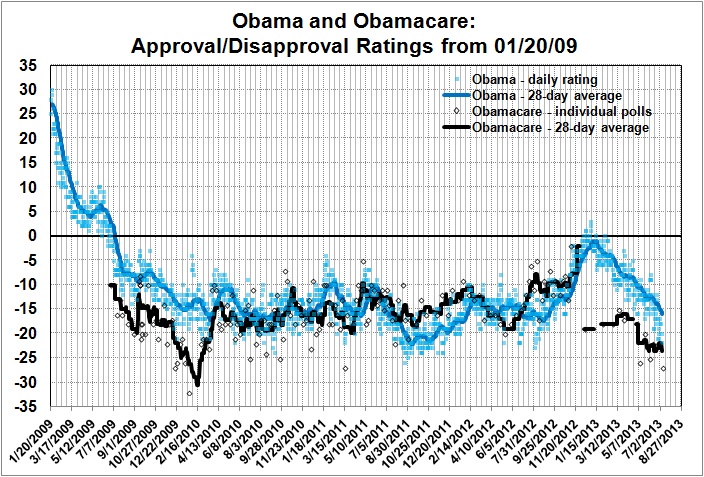
Sources: Rasmussen Reports, Obama Approval Index History and Health Care Law. Obama’s net disapproval rating measures the percentage of respondents who strongly approve of his performance, minus the percentage of respondents who strongly disapprove of his performance. The ratings for Obamacare are constructed as follows: For the period before Obamacare was signed into law on March 23, 2010, the numbers represent the percentage of respondents who strongly favored the passage of Obamacare, less the percentage of respondents who strongly opposed the passage of Obamacare. From the enactment of Obamacare to the present, the numbers represent the percentage of respondents who have strongly opposed the repeal of Obamacare, minus the percentage of respondents who have strongly favored the repeal of Obamacare.
Category: Electoral Politics
The Fourth Stage of Grief
My absence from blogging (except for a few brief notes) approaches two month. Why the absence? My self-diagnosis is that I am in the fourth stage of Elisabeth Kübler-Ross’s Five Stages of Grief:
- Denial
- Anger
- Bargaining
- Depression
- Acceptance
I am, of course, grieving about the re-election of Barack Obama, the failure of Republicans to gain control of the Senate, and the resurgence of Obama’s popularity in the wake of his re-election. All of this bodes ill for the nation’s political and economic future — higher taxes, more spending, more regulation, quasi-socialized medicine, and on and on.
My denial came just before the election, when I clung to the hope — despite polling evidence to the contrary — that Obama would lose and the GOP would gain at least a tie in the Senate.
My anger was evident in my first post-election offering: “Secession for All Seasons.”
Bargaining followed, as I began writing about how to arrange a division of the United States between “Reds” and “Blues,” so that those of us who love liberty might be able to have it.
Depression (of a kind) overcame me, however, and I have been unable to muster the energy required to lay out a workable plan for division.
But whatever happens — even if I never post again — I will not advance to the stage of acceptance. Never, never, never. If I must revert to anger, I will, and happily.
Well-Founded Pessimism
I have never been more pessimistic than I am now about the future of the United States. Not even in the aftermath of 9/11, when the enemy was without and could be defeated, with persistence and resolve.
Patrick Buchanan observes that
Americans are already seceding from one another—ethnically, culturally, politically. Middle-class folks flee high-tax California, as Third World immigrants, legal and illegal, pour in to partake of the cornucopia of social welfare benefits the Golden Land dispenses.
High-tax states like New York now send tens of thousands of pension checks to Empire State retirees in tax-free Florida. Communities of seniors are rising that look like replicas of the suburbs of the 1950s. People gravitate toward their own kind. Call it divorce, American-style.
What author William Bishop called “The Big Sort”—the sorting out of people by political beliefs—proceeds. Eighteen states have gone Democratic in six straight presidential elections. A similar number have gone Republican.
“Can we all just get along?” asked Rodney King during the Los Angeles riot of 1992. Well, if we can’t, we can at least dwell apart.
After all, it’s a big country.
Buchanan has it right — until he counsels voluntary segregation as an antidote to statism. Liberty lovers cannot escape the dictatorial grip of the central government simply by living in a Red locale in a Red State. Big Brother is everywhere: carting off chunks of our income; dictating the manufacture of products that we use; dictating the wages and benefits that must be paid to the employees of companies that we patronize; driving up the cost of the health care that we need while driving providers and insurers out of the market for health care; subsidizing the follies of State and local governments through grants of “federal” (taxpayer) money; setting standards for education at local public schools; undermining the quality of the products and services we buy, locally and on the web, by dictating the racial and gender composition of workforces; driving the economy into stagnation (if not outright decline) through profligate spending on “entitlements”; and on an on.
The country is not big enough — not by a long shot — for voluntary segregation to work. Something has to give, and give soon, or those of us who prefer liberty to slavery will never escape the serfdom into which our “leaders” are marching us. What has to give, of course, is our attachment to the union that was preserved by the force of arms in 1865. As long as we cling to that union we remain subject to its now-irreversible statist commitments. At best, the election of conservative presidents and legislators will slow our descent into total statism, but it will not halt that descent.
Finally (for now), I am rightly pessimistic about the willingness of the left to allow a return to the true federalism that was supposed to have been ensured by the Constitution. The left’s mantra is control, control, control — and it will not relinquish its control of the machinery of government. The left’s idea of liberty is the “liberty” to follow its dictates. I will continue to point out the follies and fallacies of leftist policies, but I will not waste my time by dissecting the left’s specious arguments for its policies. Enough!
More to come.
A Contrarian View of Universal Suffrage
Timothy Sandefur, in the course of a commentary about Steven Spielberg’s Lincoln, quotes the man himself:
The doctrine of self government is right–absolutely and eternally right–but it has no just application, as here attempted. Or perhaps I should rather say that whether it has such just application depends upon whether a negro is not or is a man. If he is not a man, why in that case, he who is a man may, as a matter of self-government, do just as he pleases with him. But if the negro is a man, is it not to that extent, a total destruction of self-government, to say that he too shall not govern himself? When the white man governs himself that is self-government; but when he governs himself, and also governs another man, that is more than self-government–that is despotism. If the negro is a man, why then my ancient faith teaches me that ‘all men are created equal;’ and that there can be no moral right in connection with one man’s making a slave of another…. I say this is the leading principle–the sheet anchor of American republicanism. [Peoria, Illinois: October 16, 1854]
But there is a good case to be made that the votes of American blacks are responsible for the growth of oppressive government. Take the elections of 2008 and 2012, for example, which enabled the birth of Obamacare, and quite possibly its continued existence.
According to a report issued by the Census Bureau, about 16 million blacks voted in 2008. There is no similar report for 2012, but it is reasonable to assume that about the same number of blacks voted this year, with a somewhat lower voting rate being offset by somewhat larger numbers of voting-age blacks. Of the 16 million or so black votes in each election, 95 percent went to Obama in 2008 and 93 percent went to Obama in 2012 (according to The New York Times exit polls).
Given the preceding information, and armed with a Census Bureau tally of the distribution of blacks by State, I estimated:
- the number of votes in each State for the Democrat and Republican candidates in 2008 and 2012, had blacks not voted, and
- the resulting distribution of electoral votes (EVs) in each election.
Obama might have edged out McCain in 2008, despite losing the popular vote by 54 million to 59 million. Nevertheless, McCain almost certainly would have gained the District of Columbia (yes!), with 3 EVs, Florida (27), Indiana (11), North Carolina (15), Ohio (20), and Virgina (13). Those wins would have brought McCain’s total to 266 — just 3 EVs short of a tie.
There is no doubt that Romney would have won in 2012 but for the black vote. With the addition of DC (3), Florida (29), Michigan (16), Nevada (6), Ohio (18), Pennsylvania (20), and Virginia (13), Romney would have taken a total of 311 EVs. Also, he would have won the popular vote by 59 million to 49 million.
So, I beg to differ with Sandefur and Lincoln. To paraphrase Lincoln, when the black man governs himself and also governs whites by voting almost exclusively for the Democrat-welfare state, that is despotism.
Economists and Voting
It is the time of year when economists like to remind the unwashed that voting is a waste of time. A classic of the genre appeared seven years ago, in the form of “Why Vote?,” by Stephen J. Dubner and Steven D. Levitt (of Freakonomics fame). Here are some relevant passages:
The odds that your vote will actually affect the outcome of a given election are very, very, very slim. This was documented by the economists Casey Mulligan and Charles Hunter, who analyzed more than 56,000 Congressional and state-legislative elections since 1898. For all the attention paid in the media to close elections, it turns out that they are exceedingly rare. The median margin of victory in the Congressional elections was 22 percent; in the state-legislature elections, it was 25 percent. Even in the closest elections, it is almost never the case that a single vote is pivotal. Of the more than 40,000 elections for state legislator that Mulligan and Hunter analyzed, comprising nearly 1 billion votes, only 7 elections were decided by a single vote, with 2 others tied. Of the more than 16,000 Congressional elections, in which many more people vote, only one election in the past 100 years – a 1910 race in Buffalo – was decided by a single vote….
Still, people do continue to vote, in the millions. Why? Here are three possibilities:
1. Perhaps we are just not very bright and therefore wrongly believe that our votes will affect the outcome.
2. Perhaps we vote in the same spirit in which we buy lottery tickets. After all, your chances of winning a lottery and of affecting an election are pretty similar. From a financial perspective, playing the lottery is a bad investment. But it’s fun and relatively cheap: for the price of a ticket, you buy the right to fantasize how you’d spend the winnings – much as you get to fantasize that your vote will have some impact on policy.
3. Perhaps we have been socialized into the voting-as-civic-duty idea, believing that it’s a good thing for society if people vote, even if it’s not particularly good for the individual. And thus we feel guilty for not voting. [The New York Times Magazine, November 6, 2005]
In true economistic fashion, Dubner and Levitt omit a key reason for voting: It makes a person feel good. Even if one’s vote will not change the outcome of an election, one attains a degree of satisfaction from taking an official (even if secret) stand in favor of or in opposition to a certain candidate, bond issue, or other item on a ballot.
Dubner and Levitt (and their ilk) seem to inhabit a world in which a thing is not worth doing unless the payoff can be measured with some precision and compared with other, similarly quantifiable, uses of one’s time and money. I doubt they govern their own lives accordingly. If they do, they must be missing out on a lot of life’s pleasures: sex and ice cream, to name only two.
Their article continues on a different tack:
But wait a minute, you say. If everyone thought about voting the way economists do, we might have no elections at all. No voter goes to the polls actually believing that her single vote will affect the outcome, does she? And isn’t it cruel to even suggest that her vote is not worth casting?
This is indeed a slippery slope – the seemingly meaningless behavior of an individual, which, in aggregate, becomes quite meaningful. Here’s a similar example in reverse. Imagine that you and your 8-year-old daughter are taking a walk through a botanical garden when she suddenly pulls a bright blossom off a tree.
“You shouldn’t do that,” you find yourself saying.
“Why not?” she asks.
“Well,” you reason, “because if everyone picked one, there wouldn’t be any flowers left at all.”
“Yeah, but everybody isn’t picking them,” she says with a look. “Only me.”
Clever, what? Too clever by half. This argument overlooks the powerful effect of exemplary behavior — where “exemplary,” as used here, does not imply “laudable.” By Dubner and Levitt’s account, allowing a vandal to deface a public building would not encourage other vandals to do the same thing, and would not lead to the widespread defacement of buildings and other anti-social acts. (I refer, of course, to James Q. Wilson’s widely accepted Broken Windows Theory, which Levitt and Dubner tried to cast doubt on in Freakonomics. They wrongly suggested that the onset of legalized abortion was instrumental in the reduction of crime rates.)
Dubner and Levitt’s argument also overlooks the key fact that when economists preach against voting, they are not just preaching to themselves. Dubner and Levitt’s sermon appeared in the pages of one of the country’s most widely read and influential publications. It was not addressed to an individual, but to thousands and thousands of individuals. And I doubt that they would have objected if the article had appeared in every newspaper and magazine in the country. In effect, the Dubner-Levitt argument is not just an argument that the marginal vote makes little difference — it is advice to millions of Americans that they should abstain from voting.
In that respect, Levitt and Dubner are guilty of paternalism as well as economism. Thus the many links to posts about paternalism in the following list of related posts:
The Rationality Fallacy
Libertarian Paternalism
A Libertarian Paternalist’s Dream World
The Short Answer to Libertarian Paternalism
Second-Guessing, Paternalism, Parentalism, and Choice
Another Thought about Libertarian Paternalism
Back-Door Paternalism
Another Voice Against the New Paternalism
Slippery Paternalists
A Further Note about “Libertarian” Paternalism
Apropos Paternalism
Beware of Libertarian Paternalists
Externalities and Statism
Extreme Economism
Irrational Rationality
Not-So-Random Thoughts (III) (third item)
Obesity and Statism
“Redness,” Unemployment, and the Election
“Redder” is better, generally speaking. For many reasons, including economic health. Using Bush’s average margin of loss or victory in 2004 and 2008 as an index of “redness” (and disregarding the anomalous 2008 race), here is the relationship between unemployment and a State’s degree of “redness”:
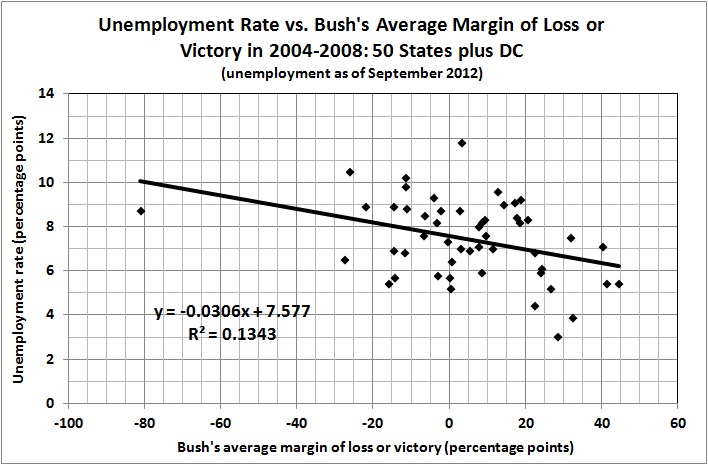
Derived from Bureau of Labor Statistics, Unemployment Rates for States (preliminary September estimates, issued 10/19/12), and official tabulations of popular votes by State. The correlation, though not strong, is statistically significant (less than 1-percent probability of occurring by chance).
The “outlier” on the left is the District of Columbia. DC, despite its predominantly black population, does not have an exceedingly high unemployment rate because the federal government and its contractors are havens of patronage and reverse discrimination. In any event, the omission of DC would strengthen the correlation, and would yield a more pronounced negative relationship between “redness” and unemployment: y = -0.0386x + 7.6566; R² = 0.1434.
I have seen some “news” stories which suggest that lower unemployment in swing States will help Obama. Such speculation strikes me as wishful thinking by left-biased media. In fact, of the four States that seem to have swung to Romney — Florida, Missouri, North Carolina, and Virginia — the first three experienced better-than-average improvements in unemployment from a year earlier. A possible reason for this apparent anomaly is that voters know that there has been little change in the real rate of unemployment. Further, they also know that unless Obama is kicked out, things will not get better very soon, if ever.
Making a Worse “Mess”
Obama and his pet grinning baboon VP like to claim that the economy is still in bad shape because of the “horrific mess” that they inherited from Bush. That the mess wasn’t Bush’s is lie number 1. That Obama’s policies would have “worked” but for Republican intransigence is lie number 2. There are many more lies lying around the Obama White House, but a distaste for nausea prevents me from detailing them.
I will give Obama the benefit of the doubt by measuring the effectiveness of his “stimulus” not by the current state of the economy, but by how far it has advanced the economy since the depth of the Great Recession. As it happens, the Great Recession bottomed in the second quarter of 2009. The latest estimates of real GDP, 12 quarters later, indicate real growth since the bottom of 2.2 percent a year. How does that stack up against previous post-WWII recessions? Here’s how:

Even the short-lived recoveries from the 1958 and 1980 recessions were more robust than the Obama recovery of 2009-2012. Enough said.
Related posts:
Economic Growth Since World War II
The Economy Slogs Along
The Obama Effect: Disguised Unemployment
Obama’s Economic Record in Perspective
Where We Are, Economically
Keynesianism: Upside-Down Economics in the Collectivist Cause
The Name Game
With the Social Security baby-name database, one can find the popularity* of a newborn’s name in any year from 1880 through 2011. Armed with the database, I set out to determine whether the relative popularity of presidential candidates’ names had any bearing on the outcome of the 33 elections of 1880-2008. Here is what I learned from an analysis of the names of the two leading candidates** in each of the 33 elections:
- The candidate with the more popular name — in the year of the election — won only 15 times out of 33.
- Ten of the winners with the more popular name were Republicans.
- Ten of the 18 winners with the less popular name were Democrats.
- The Democrat had the less popular name in 20 of the 33 elections.
The moral of the story: It is a slight disadvantage to have a popular name. Democrats are more likely than Republicans to have weird names. This latter tendency confers a slight advantage on Democrat candidates.
What about 2012? Willard (Mitt Romney’s first name) has not been in the top 1,000 since 1989, but it was in the top 1,000 in every year before that — ranking as high as 58th in 1915. Barack, needless to say, has never been in the top 1,000. It seems likely that Willard is somewhat more popular than Barack, even now.***
But Mitt — like Grover, Woodrow, and Calvin — is the name in the political arena. And I have no reason to believe that Mitt is any more popular than Barack. If Barack is the less-popular name, that might count as an advantage for Obama. But a less-than-dismal performance in a debate would do him more good than his weird name.
__________
* Restricted to the top 1,000 boys’ names and the top 1,000 girls’ names in each year.
** All of them Republicans and Democrats, except in 1912, when Theodore Roosevelt ran on the Progressive ticket and was the runner-up to Woodrow Wilson.
*** It does not seem that presidents’ first names become more popular during their time in office. The rank of Grover (Cleveland) went from 20 in 1884 (when Cleveland was first elected) to 47 in 1892 (the year of Cleveland’s second victory). Benjamin (Harrison) dropped from 25 in 1888 to 42 in 1892. Woodrow (Wilson) barely budged, going from 192 in 1912 to 190th in 1916. Herbert (Hoover) was 25 in 1928 and 44 in 1932 (another victim of the Great Depression, no doubt). Franklin (Roosevelt) went from 66 to 65 to 87 to 112 (in 1932, 1936, 1940, and 1944, respectively). Dwight (Eisenhower) was 123 in 1952 and 139 in 1956. (And, lest you think that Dwight should have been a Democrat, remember that his opponent was the more weirdly named Adlai — or Adelaide, as some wags called him.) Richard (Nixon) fell from 8 in 1968 to 14 in 1972 (and, unsurprisingly, kept falling steadily thereafter, to 127 in 2010-2011). Ronald (Reagan) went from 58 in 1980 to 67 in 1984. George (Bush I and II) declined from 78 (1988) to 95 (1992) to 130 (2000) to 146 (2004). George has come a long way (down) since Washington was first in the hearts of his countrymen.
Protected: Election Projections Updated
Obama’s Big Lie
I was too easy on Barack Obama in “Barack Channels Princess SummerFall WinterSpring.” It’s not that I gave him a pass for denigrating the accomplishments of successful businesspersons. Far from it. But the Obama piñata deserves another good beating.
This beating is prompted by Jason Brennan’s tone-deaf post, “On Quoting Out of Context and the Right-Wing Smear Machine,” at Bleeding Heart Libertarians. Referring to Obama’s remarks in Roanoke, Virginia, on July 13. Brennan writes:
Obama said:
If you’ve been successful, you didn’t get there on your own…
If you are successful, somebody along the line gave you some help. There was a great teacher somewhere in your life. Somebody helped to create this unbelievable American system we have that allowed you to thrive. Somebody invested in roads and bridges. If you’ve got a business, you didn’t build that. Somebody else made that happen. The Internet didn’t get invented on its own. Government research created the Internet, so then all the companies could make money off the Internet. The point is, is that, when we succeed, we succeed because of our individual initiative, but also because we do things together.
The right-wing smear machine quotes this out of context, as follows:
If you’ve got a business, you didn’t build that. Somebody else made that happen.
Wow, notice how quoting out of context changes the apparent meaning of those two sentences. In context, the sentences mean: If you own a business, you relied upon background institutions, infrastructure, and help from others to build that business. Your success depended upon many of the rest of us and on government. You didn’t create everything from scratch. The bolded “that” refers to “this unbelievable American System” and “roads and bridges”. This is what Obama actually said.
Out of context, the sentences seem to mean: You didn’t build your business; someone else did. Quoting him out of context makes it seem like the bolded “that” refers to your business.
Well, as it happens, the only way to interpret Obama’s statement — in or out of context — is to read it exactly as the so-called right-wing smear machine interprets it. To help Brennan understand that, I hereby reproduce the paragraph from the official White House source:
If you were successful, somebody along the line gave you some help. There was a great teacher somewhere in your life. Somebody helped to create this unbelievable American system that we have that allowed you to thrive. Somebody invested in roads and bridges. If you’ve got a business — you didn’t build that. Somebody else made that happen. The Internet didn’t get invented on its own. Government research created the Internet so that all the companies could make money off the Internet.
Note that the official source places an em-dash where Brennan places a comma. I will come to the em-dash in a moment.
The pronoun “that” in the fourth sentence unambiguously refers to “business,” which (in context) is the antecedent of “that.” And the em-dash that sets off the clause “you didn’t build that” makes it all the clearer that “that” refers to “business.” For it is the task of an emphatic clause set off by an em-dash to make an additional or clarifying statement about what immediately precedes the clause.
Further, having introduced the “that” in the fourth sentence, Obama repeats it in the next sentence. So, what Obama says in the fourth and fifth sentence of the paragraph is this:
If you’ve got a business — you didn’t build that [business]. Somebody else made that [business] happen.
One doesn’t have to be a right-winger to see through Obama’s rhetoric.
It may be legitimate to say that (almost) nothing is accomplished (these days) by individuals working on their own. But Obama is trying, not so subtly, to denigrate those who are successful in business (e.g., Mitt Romney) and to make a case for redistributionism. The latter rests on Obama’s (barely concealed) premise that the fruits of a collective enterprise should be shared on some basis other than market valuations of individual contributions. (Brennan seems to share that view, so perhaps he is not altogether unsympathetic to Obama’s aims.)
It is (or should be) obvious that Obama’s agenda is the advancement of collectivist statism. I will credit Obama for the sincerity of his belief in collectivist statism, but his sincerity only underscores and how dangerous he is. (Note to Jason Brennan: “his” and “he” refer to “Obama.”)
Related reading:
Thomas Sowell, “Obama’s Rhetoric,” Townhall.com, July 19, 2012
Thomas Sowell, “Trashing Achievements,” JWR Insight, July 19, 2012
Mark J. Perry, “Milton Friedman Responds to Obama’s Claim That There Is No Such Thing As Individual Achievement,” Carpe Diem, July 20, 2012
Mark Steyn, “Golden Gateway to Dependency,” National Review Online, July 21, 2012
Related posts:
The Causes of Economic Growth
A Short Course in Economics
Addendum to a Short Course in Economics
The Price of Government
The Price of Government Redux
The Mega-Depression
The Real Burden of Government
The Illusion of Prosperity and Stability
Estimating the Rahn Curve: Or, How Government Inhibits Economic Growth
Taxing the Rich
More about Taxing the Rich
A Keynesian Fantasy Land
The Keynesian Fallacy and Regime Uncertainty
Why the “Stimulus” Failed to Stimulate
The “Jobs Speech” That Obama Should Have Given
Say’s Law, Government, and Unemployment
The Real Multiplier
Vulgar Keynesianism and Capitalism
Why Are Interest Rates So Low?
The Commandeered Economy
Estimating the Rahn Curve: A Sequel
In Defense of the 1%
The Real Multiplier (II)
Lay My (Regulatory) Burden Down
The Burden of Government
Economic Growth Since World War II
More Evidence for the Rahn Curve
“Big SIS”: A Review
Don’t Use the “S” Word When the “F” Word Will Do
Barack Channels Princess SummerFall WinterSpring
Progressive Taxation Is Alive and Well in The U.S. of A.
The Economy Slogs Along
Barack Channels Princess SummerFall WinterSpring
The princess of the title is Elizabeth Warren, self-reputed to be of Cherokee descent. And, as Native Americans go, Warren is about as authentic as Princess SummerFall WinterSpring of Howdy Doody.
You may remember Warren’s bleat of last September, in support of Obama’s plan to soak “the rich.” It caused ripples in the blogosphere (here and here, for example). The bleat? It goes like this:
I hear all this, you know, Well, this is class warfare, this is whatever. No. There is nobody in this country who got rich on his own — nobody.
You built a factory out there? Good for you. But I want to be clear. You moved your goods to market on the roads the rest of us paid for. You hired workers the rest of us paid to educate. You were safe in your factory because of police-forces and fire-forces that the rest of us paid for. You didn’t have to worry that marauding bands would come and seize everything at your factory — and hire someone to protect against this — because of the work the rest of us did.
Now look, you built a factory and it turned into something terrific, or a great idea. God bless — keep a big hunk of it. But part of the underlying social contract is, you take a hunk of that and pay forward for the next kid who comes along.
Last week, in Virgina, The Mighty O said the same thing in slightly different words:
There are a lot of wealthy, successful Americans who agree with me — because they want to give something back. They know they didn’t — look, if you’ve been successful, you didn’t get there on your own. You didn’t get there on your own. I’m always struck by people who think, well, it must be because I was just so smart. There are a lot of smart people out there. It must be because I worked harder than everybody else. Let me tell you something — there are a whole bunch of hardworking people out there.
I repeat what I said in response to Warren’s bleat:
Who said anything about anyone getting rich on his own? But didn’t the factory owner — and other “malefactors of great wealth” — pay a “fair share”of the taxes that support roads, education, and police and fire forces? Yes.* Didn’t the factory owner pay his workers for their labor? Yes, and sometimes (in the case of union workers) at the expense of consumers and those workers who couldn’t find employment because unions effectively limit entry to the labor market.
If anyone owes “the rest of us” anything, it’s the workers who received subsidized educations that enabled them to earn good wages at factories that were built because factory owners, shareholders, bond holders, and (sometimes) venture capitalists put their own money at risk.
Workers and others (including Elizabeth Warren) ought to be grateful to the “malefactors of great wealth” who have — against heavy odds — enabled America’s prosperity.
Tom Smith of The Right Coast weighs in with this:
…{H]ow many more successful businesses, inventions, products, services, toys, tools, insights, and just plain fun would there be, if government did not in the first place make it so ridiculously difficult to start a business and keep it going? I don’t see our young president taking credit on behalf of the state for all the failures it help cause, all the ideas that never got off the ground because the regulatory hurdles were so high, or all the established companies that never had to face competition because they had managed to get their rents written into law. This is part of the seen and not seen insight of Bastiat. What you see is a successful business when it manages to survive, and then people run up, the same people who taxed and regulated it nearly to death, and say I helped! I helped! What you don’t see are all the businesses that perished or never got started because of the heavy hand of the state. And it’s a very heavy hand….
I started a business, commercially unsuccessful, sadly, but we created some great technology. I was a libertarian before that, but I was really a libertarian afterwards. It’s difficult to even explain how pervasive, expensive, frustrating and sometimes just plain insuperable the regulatory and taxation burden of the state is. It’s not what did our venture in, but it helped….
It’s obvious, but still worth saying — for our young President to suggest that government deserves some large part of the credit for the achievements of business founders who manage, in spite of it all, to start a business and make of a go of it, is deeply, deeply perverse. What it ought to get credit for are all the unseen businesses, no longer here or never to be, that it is responsible for.
I can tell you, from bitter experience as a business owner and corporate officer, that Smith is exactly right. The burdens that government imposes on the creation, expansion, and operation of businesses are myriad and onerous. Most Americans aren’t aware of just how much government does to discourage the creation of jobs, income, and wealth because most Americans — even those who are employed — are not exposed to the ugliness of the business-government interface. If business-government transactions were rated like movies, they would be rated XXX.
There is one more thing to be said about the Warren-Obama attack on industriousness. It’s wrong, as any economist worth his salt could tell you. (That excludes Paul Krugman and his fellow worshipers at the altar of big government.) Despite the pretensions of bleeding heart libertarians and their brethren on the left, no one on Earth is qualified to say how much a person deserves to earn. Aside from thieves and others who coerce their earnings from others (e.g., government officials, members of compulsory unions), Americans earn what they are able to command for their services, on the basis of the value of those services to others.
The factory owner who makes a lot of money does so — after having taken the considerable risk of owning a factory and putting up with a lot of crap from government — because what he produces is valuable to others. He is being rewarded more than his employees because he is taking risks and putting up with harassment. He is, in other words, being rewarded for his contributions to the success of his enterprise. (Did Barack or Elizabeth do anything to help him create it? Did the workers do more than they were paid to do? No, to both questions.)
And if the factory owner loses a lot of money and goes out of business, is it the fault of those who failed to buy his products? Would Barack Obama and Elizabeth Warren say that everyone let him down? They should, because by their “logic” the failed factory owner was failed by everyone who didn’t buy his products, and so they owe him something.
But most American business owners are not whiny brats like Barack Obama, Elizabeth Warren, and the freeloaders whose votes they depend on to stay in power.
Related posts:
The Causes of Economic Growth
A Short Course in Economics
Addendum to a Short Course in Economics
The Price of Government
Asymmetrical (Ideological) Warfare
“Buy Local”
Giving Back, Again
Taxing the Rich
More about Taxing the Rich
Luck-Egalitarianism and Moral Luck
Union-Busting
In Defense of Wal-Mart
Union Thuggery
Estimating the Rahn Curve: Or, How Government Inhibits Economic Growth
Obama: Not Bailed out by CJ Roberts
UPDATED 07/03/12
Chief Justice Roberts’s bailout of Obama care — a.k.a. CJ Roberts’s sellout — may have brought some wavering believers in big government back into the corral, but probably not enough of them to rescue Obama from defeat at the hands of Mitt Romney. I continue to forecast a Romney win over Obama, the strong possibility of a GOP takeover of the Senate, and approximately no change in the GOP’s large House majority (see left sidebar).
Further evidence for my forecasts, is found in Scott Rasmussen’s polls about the “popularity” (i.e., unpopularity) of Obama and Obamacare:
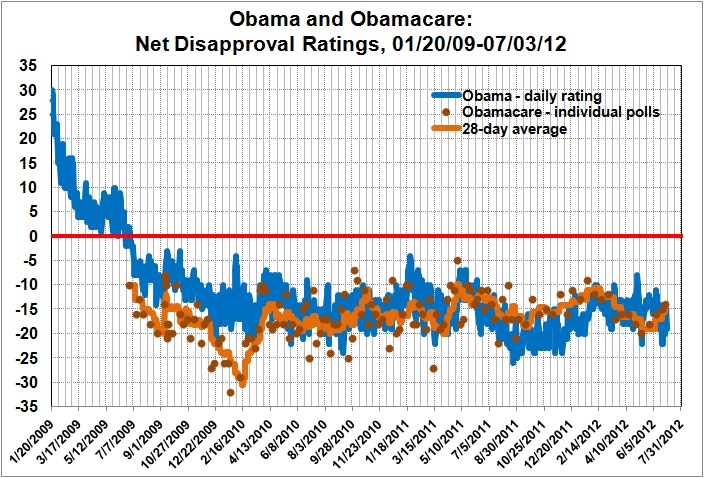
Sources: Rasmussen Reports, Obama Approval Index History and Health Care Law.
The latest poll results show a net disapproval rating of -18 for Obama (as of July 3) and a net disapproval rating of -14 for Obamacare (as of June 29-30, the two days immediately following CJ Roberts’s bombshell).
Obama’s net disapproval rating measures the percentage of respondents who strongly approve of his performance, minus the percentage of respondents who strongly disapprove of his performance. It has been three years since the arithmetic yielded a positive number, which is why I usually refer to the poll results as Obama’s disapproval or unpopularity rating.
The ratings for Obamacare are constructed as follows: For the period before Obamacare was signed into law on March 23, 2010, the numbers represent the percentage of respondents who strongly favored the passage of Obamacare, less the percentage of respondents who strongly opposed the passage of Obamacare. From the enactment of Obamacare to the present, the numbers represent the percentage of respondents who have strongly opposed the repeal of Obamacare, minus the percentage of respondents who have strongly favored the repeal of Obamacare.
Needless to say, Obamacare has always been in negative territory. In the latest poll (June 29-30) it gained only one percentage point from the poll conducted a week earlier. The recent uptick began in May, probably as a result of the intense p.r. campaign conducted by Obama and other Democrats (most notably Sen. Patrick Leahy, chairman of the Senate Judiciary Committee).
The save-Obamacare campaign may have worked on CJ Roberts, but its overall effect has been small. In fact, the recent gain in popularity is minuscule in comparison to the bandwagon-effect gain that began in January 2010 — when it became clear that Obamacare would become law — and continued until the eve of enactment on March 23, 2010.
The real silver lining in the Supreme Court’s Obamacare decision — if there is any silver lining — is that the Obamacare target still hangs from Obama’s neck.
Leaks, What Leaks?
Victor Davis Hanson is in a justifiable state of stratospheric dudgeon about the leaks that clearly are meant to portray Barack Obama as a steely, anti-terrorist warrior:
Recent leaks — the cyberwar secrets, the drone methodology, the double agent in Yemen, the details of the bin Laden mission, and the trove of information that accrued from it — juxtaposed with polls that have consistently shown uncertainty about Obama’s natural-security fides (cf. the serial boasting of Joe Biden that Obama’s decision is the most significant accomplishment in recent military history) are a time bomb.
Unlike the terrible Fast and Furious scandal, the Secret Service fiasco, the Solyndra boondoggle and solar con, or the GSA mess, we are talking about endangerment to the collective security of the entire United States — and not just due to laxity or incompetence but apparently due to calibrated political advantage. These targeted leaks seem to be part of a larger culture of narrowly defined and opportunistic access and political imaging. For is there not something terribly wrong when, to take just two examples, a David Sanger is apparently given access to such top-secret information, or when a David Ignatius, chest-thumps “exclusive,” as he offers his own analyses of once classified al-Qaeda documents seized from the bin Laden compound, for which he alone apparently was selected as gatekeeper to examine and analyze what he thinks is and is not important for Americans to know?…
This scandal will not go away, because it is so reckless that it will go well beyond Republican efforts to score political points, as it equally enrages congressional Democrats, Defense Department non-political officials, the CIA, and the intelligence community at large, whose careers and lives are jeopardized by such serial leaking. There is a toxic relationship now between high members of this administration, and favored marquee reporters such as those at the New York Times and Washington Post, who have crafted a hand-washes-hand relationship that, whether inadvertent or not, has put all our safety at risk. Obama himself seems not so much angry that his own are leaking to form favorable narratives, but angry that anyone would dare suggest to him that they are. That, too, is an untenable position and will change.
This will not stand, and until those who are doing these terrible things to the country are fired, the story will not go away. [“Court Journalism and the National Interest,” The Corner at National Review Online, June 12, 2012]
Update (06/13/12): Today, Hanson writes:
Securitygate has Nixonian trademarks all over it and is far more injurious to the republic than all the previous Obama administration–era scandals combined. Attorney General Holder simply cannot select an attorney to investigate key players in the administration who was both a recent appointee of Obama and a campaign contributor to and political supporter of him….
That the result was lives endangered and national policy imperiled makes an outside investigator essential. Even more chilling is that unlike prior leaking during past administrations when the media was at odds with the executive branch, in this case the administration apparently welcomed the leaks. The reporters involved were assumed to operate, not as self-proclaimed auditors trying to enhance their careers purportedly by keeping government honest, but rather more as court toadies determined to make their sources look good as payback for “exclusives.”…
At some point, watch the journalistic community: Typically they rally around the leaky reporter and law breaker as some sort of wounded fawn punished for trying to speak truth to power, but now what? Are they to close ranks with Ministry of Truth careerists who may well have been used as stooges of a government that serially broke the law for partisan advantage? [“Securitygate Is Not Going Away,” The Corner at National Review Online, June 13, 2012]
Here are links to some of the leak-ticles that prompted Hanson’s [continued] sub-orbital flight:
“Secret ‘Kill List’ Proves a Test of Obama’s Principles and Will,” Jo Becker and Scott Shane, The New York Times, May 29, 2012
“Obama Order Sped Up Wave of Cyberattacks Against Iran,” David Sanger, The New York Times, June 1, 2012
“Stuxnet was work of U.S. and Israeli experts, officials say,” Ellen Nakashima and Joby Warwick, The Washington Post, June 1, 2012
And here links to some relevant commentary (in addition to Hanson’s):
“Covert Wars, Waged Virally: ‘Confront and Conceal’,” a review by Thomas Ricks of David Sanger’s book about cyberwar against Iran and various anti-terrorist action, The New York Times, June 5, 2012
“For U.S. Inquiries on Leaks, a Difficult Road to Prosecution,” Charlie Savage, The New York Times, June 9, 2012
“Obama loses veneer of deniabilty with intelligence leaks,” Richard Cohen, The Washington Post, June 11, 2012
Ricks, an erstwhile Pentagon correspondent of some note, seems unfazed by leakage — an indifference that must have served him well in the day. He notes, without irony, that
Mr. Sanger clearly has enjoyed great access to senior White House officials, most notably to Thomas Donilon, the national security adviser.
Well, the moral code of Washington is encapsulated in “go along to get along” and “give something to get something.” (A former colleague — now a late and (by me) unlamented one — of no firm convictions, who fancied himself politically astute, was fond of spouting those feeble justifications of his sleaziness.) Thus Ricks’s next sentences should come as no shock to anyone but a pre-schooler:
Mr. Donilon, in effect, is the hero of the book, as well as the commenter of record on events. He leads the team that goes to Israel and spends “five hours wading through the intelligence in the basement of the prime minister’s residence.” He is shown studying the nettlesome problems of foreign relations, working closely with the president, and fending off the villains of this story— which in Mr. Sanger’s account tend to be the government of Pakistan and, surprisingly, the generals of the American military.
Yes, there is righteous outrage in Washington. Savage’s piece opens with this:
Anger over leaks of government secrets and calls for prosecution have once again engulfed the nation’s capital. Under bipartisan pressure for a crackdown, Attorney General Eric H. Holder Jr. on Friday announced the appointment of two top prosecutors to lead investigations into recent disclosures.
But
the prospects for those efforts are murky. Historically, the vast majority of leak-related investigations have turned up nothing conclusive, and several of the nine that have been prosecuted — six already under the Obama administration, and just three more under all previous presidents — collapsed.
“These cases are very difficult to pursue,” said Kenneth L. Wainstein, a former assistant attorney general for national security under President George W. Bush.
Why?
Many people are surprised to learn that there is no law against disclosing classified information, in and of itself. The classification system was established for the executive branch by presidential order, not by statute, to control access to information and how it must be handled. While officials who break those rules may be admonished or fired, the system covers far more information than it is a crime to leak.
Instead, leak prosecutions rely on a 1917 espionage statute whose principal provision makes it a crime to disclose, to persons not authorized to receive it, national defense information with knowledge that its dissemination could harm the United States or help a foreign power.
The statute should be changed to make it a criminal act to knowingly disclose classified information to anyone not authorized to receive it. But that would not suit the leak-happy mentality of Washington. Nor would it suit the primary beneficiaries of that mentality, namely, the major media outlets. So, the leaks will continue apace and every once in a while they will be condemned — even by the leakers, if not the leakees.
Cue Lefty Cohen, who makes sport of the whole thing:
Pity the poor Obama administration leakers. They impart their much-cherished secrets to make their man look good and then, at the first chirp of criticism, are ordered to confess their (possible) crimes by the very same president they were seeking to please. In this, they are a bit like the male praying mantis. He does as asked, and then the female bites his head off.
What is remarkable about the recent leaks is the coincidence — it can only be that — that they all made the president look good, heroic, decisive, strong and even a touch cruel; born, as the birthers long suspected, not in Hawaii — but possibly on the lost planet Krypton. The leak that displayed all these Obamian attributes was the one that said the president personally approves the assassinations of terrorists abroad. He gives his okay, and the bad guys are dispatched via missiles from drones.
Cohen is not worried so much about leaks, which are potage to the Post, as he is about those terrorists who refuse to surrender to American justice and so are dispatched at long distance:
The leak that troubles me concerns the killing of suspected or actual terrorists. The triumphalist tone of the leaks — the Tarzan-like chest-beating of various leakers — not only is in poor taste but also shreds a long-standing convention that, in these matters, the president has deniability. The president of the United States is not the Godfather.
But he is commander-in-chief, and if he has performed any constitutionally legitimate act during his presidency, it has been to advance the common defense by terrorizing terrorists.
But that does not excuse the acts of leakage, which are morally if not legally criminal. They have been committed on behalf of Barack Obama, and — I cannot doubt — at his behest.
Rush to Judgment
CNN harps on an old theme (as reported at TheBlaze):
CNN Article: Republican Voters are ‘White, Aging and Dying Off,’ And the Party Could, Too
The GOP has been written off before — notably in the 1930s and 1940s, the early 1960s, and 1990s. But the strangest things keeps happening: New voters don’t always live down to the left’s expectations; new voters become older voters; and, most surprisingly, a lot of voters are not to be pigeon-holed as easily as leftists would like them to be.
Here is a picture of how GOP presidential candidates have fared since the Civil War: not a steady decline, but oscillation around a mean (approximately 50 percent of the two-party popular vote):

Recent history is perhaps more relevant. Here is an interesting piece of recent history that must cause the left some discomfort:

(I have included my current estimate of the pro-GOP vote in 2012. The blue shading indicates elections held during the terms of Democrat presidents.)
I do not mean to say that current trends are entirely favorable to the GOP. The following table compares the “Redness” (and “Blueness”) of States in recent presidential elections (1996-2008) with their Redness in earlier elections (1972-1988). (I go back only to 1972 because that is when the Southern States became solidly Republican, following the Wallace interlude of 1968).

The bad news (for the GOP) is that the Blue States (in 1996-2008) which are trending Red (IA, MN, OR, PA, WI) have 53 electoral votes (EVs), whereas the Red States that are trending Blue (AZ, CO, FL, NV, VA) have 68 EVs. Further, the States that have become significantly Redder (AL, AK, ID, IN, KS, KY, MN, MO, MT, NE, ND, OK, SD, TN, TX, UT, WI, WY) control 150 EVs; the States that have become significantly Bluer (CA, CT, HI, IL, ME, MD, MS, MI, NV, NH, NJ, NY, RI, VT, WA) control 199 EVs. (Here, the trend for a State is considered significant when the State’s average index of Redness for 1996-2008 varies from its average for 1972-1988 by more than one standard deviation of the State’s Redness index for the entire period, 1972-2008.)
The good news is that the Red States (in 1996-2008) have 281 EVs, as against 257 for the Blue States. If the GOP is “doomed,” it a long way from dead. It has been closer to death in the past than it is today, and yet it is now alive and well.
Only a fool says that anything (other than death and taxes) is inevitable. The death of the GOP is not among life’s inevitabilities.
Related posts:
What Happened to the Permanent Democrat Majority?
More about the Permanent Democrat Majority
Obama and Obamacare: Twin Disasters
A picture worth 2,000 words:
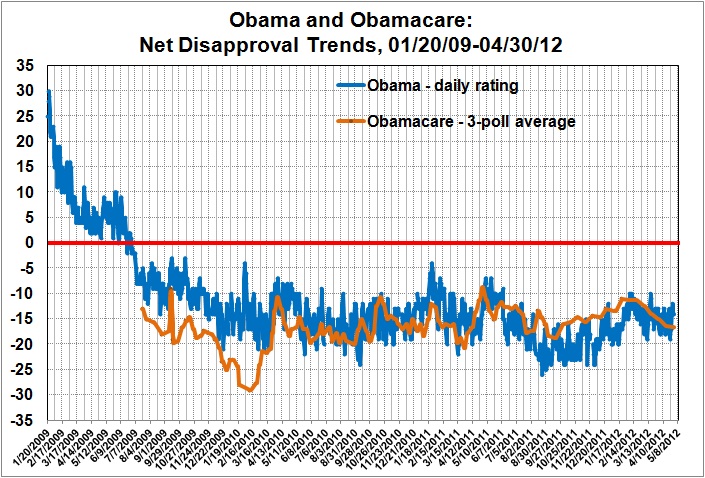
Sources: Rasmussen Reports, Obama Approval Index History and Health Care Law.
I could have added graphs about the unemployment rate (2 percentage points above the peak reached during GWB’s administration), the employment/population ratio (5 percentage points below the GWB peak), and the federal debt (which has grown almost 50 percent in the 3 years and 3 months of Obama’s presidency, as against a 25-percent rise in the first 3 years and 3 months of GWB’s presidency) — but why rub it in?
Too Much Protection for the President?
How much protection does the president need? The current scandal surrounding the Secret Service raises this question: Does the president really need so many protectors that large numbers of them have the luxury of arranging and attending parties with prostitutes?
To answer the question, I adopt the case-study method: Lincoln, Garfield, and McKinley could have used more SS protection than the none or little available to them. In every case, the VP who succeeded was a worse president than the man he succeeded. (No fan of TR am I.)
JFK had a lot of SS protection, but not as much as presidents of latter years. JFK’s death led not only to the elevation of (ugh!) LBJ but also helped LBJ ram through the Great Society legislation that has had dire consequences for the country.
My conclusion: I should be in charge of deciding the level of SS protection afforded a president, given his policies, the identity of his VP, and the likely effect of the president’s demise on the next president’s ability to “get things done.” Sympathy passage of Obama-Biden policies, followed by the election of Biden would be a bad thing.
Therefore, I would protect Obama as if he were the holiest of holies, so that he can be defeated in November.
Not-So-Random Thoughts (II)
Links to the other posts in this occasional series may be found at “Favorite Posts,” just below the list of topics.
Atheism
Philip Kitcher reviews Alex Rosenberg’s The Atheist’s Guide to Reality:
The evangelical scientism of “The Atheist’s Guide” rests on three principal ideas. The facts of microphysics determine everything under the sun (beyond it, too); Darwinian natural selection explains human behavior; and brilliant work in the still-young brain sciences shows us as we really are. Physics, in other words, is “the whole truth about reality”; we should achieve “a thoroughly Darwinian understanding of humans”; and neuroscience makes the abandonment of illusions “inescapable.” Morality, purpose and the quaint conceit of an enduring self all have to go.
The conclusions are premature. Although microphysics can help illuminate the chemical bond and the periodic table, very little physics and chemistry can actually be done with its fundamental concepts and methods, and using it to explain life, human behavior or human society is a greater challenge still. Many informed scholars doubt the possibility, even in principle, of understanding, say, economic transactions as complex interactions of subatomic particles. Rosenberg’s cheerful Darwinizing is no more convincing than his imperialist physics, and his tales about the evolutionary origins of everything from our penchant for narratives to our supposed dispositions to be nice to one another are throwbacks to the sociobiology of an earlier era, unfettered by methodological cautions that students of human evolution have learned: much of Rosenberg’s book is evolutionary psychology on stilts. Similarly, the neuroscientific discussions serenely extrapolate from what has been carefully demonstrated for the sea slug to conclusions about Homo sapiens.
And David Albert gets rough with Lawrence M. Krauss’s A Universe from Nothing:
Look at how Richard Dawkins sums it up in his afterword: “Even the last remaining trump card of the theologian, ‘Why is there something rather than nothing?,’ shrivels up before your eyes as you read these pages. If ‘On the Origin of Species’ was biology’s deadliest blow to supernaturalism, we may come to see ‘A Universe From Nothing’ as the equivalent from cosmology. The title means exactly what it says. And what it says is devastating.”
Well, let’s see. There are lots of different sorts of conversations one might want to have about a claim like that: conversations, say, about what it is to explain something, and about what it is to be a law of nature, and about what it is to be a physical thing. But since the space I have is limited, let me put those niceties aside and try to be quick, and crude, and concrete.
Where, for starters, are the laws of quantum mechanics themselves supposed to have come from?…
Never mind. Forget where the laws came from. Have a look instead at what they say. It happens that ever since the scientific revolution of the 17th century, what physics has given us in the way of candidates for the fundamental laws of nature have as a general rule simply taken it for granted that there is, at the bottom of everything, some basic, elementary, eternally persisting, concrete, physical stuff….
The fundamental laws of nature generally take the form of rules concerning which arrangements of that stuff are physically possible and which aren’t, or rules connecting the arrangements of that elementary stuff at later times to its arrangement at earlier times, or something like that. But the laws have no bearing whatsoever on questions of where the elementary stuff came from, or of why the world should have consisted of the particular elementary stuff it does, as opposed to something else, or to nothing at all.
The fundamental physical laws that Krauss is talking about in “A Universe From Nothing” — the laws of relativistic quantum field theories — are no exception to this. The particular, eternally persisting, elementary physical stuff of the world, according to the standard presentations of relativistic quantum field theories, consists (unsurprisingly) of relativistic quantum fields. And the fundamental laws of this theory take the form of rules concerning which arrangements of those fields are physically possible and which aren’t, and rules connecting the arrangements of those fields at later times to their arrangements at earlier times, and so on — and they have nothing whatsoever to say on the subject of where those fields came from, or of why the world should have consisted of the particular kinds of fields it does, or of why it should have consisted of fields at all, or of why there should have been a world in the first place. Period. Case closed. End of story….
[Krauss] has an argument — or thinks he does — that the laws of relativistic quantum field theories entail that vacuum states are unstable. And that, in a nutshell, is the account he proposes of why there should be something rather than nothing.
But that’s just not right. Relativistic-quantum-field-theoretical vacuum states — no less than giraffes or refrigerators or solar systems — are particular arrangements of elementary physical stuff…. And the fact that particles can pop in and out of existence, over time, as those fields rearrange themselves, is not a whit more mysterious than the fact that fists can pop in and out of existence, over time, as my fingers rearrange themselves. And none of these poppings — if you look at them aright — amount to anything even remotely in the neighborhood of a creation from nothing.
None of this is news to me. This is from my post, “The Atheism of the Gaps“:
The gaps in scientific knowledge do not prove the existence of God, but they surely are not proof against God. To assert that there is no God because X, Y, and Z are known about the universe says nothing about the creation of the universe or the source of the “laws” that seem to govern much of its behavior.
(See also the many posts linked at the bottom of “The Atheism of the Gaps.”)
Caplan’s Perverse Rationalism
Regular readers of this blog will know that I have little use for the psuedo-libertarian blatherings of Bryan Caplan, one of the bloggers at EconLog. (See also this and this.) Caplan, in a recent post, tries to distinguish between “pseudo output” and “real output”:
1. Some “output” is actually destructive. At minimum, the national “defense” of the bad countries you think justifies the national defense of all the other countries.
2. Some “output” is wasted. At minimum, the marginal health spending that fails to improve health.
3. Some “output” doesn’t really do what consumers think it does. At minimum, astrology.
Note: None of these flaws have any definitional libertarian component. Even if there’s no good reason for tax-supported roads, existing government roads really are quite useful. Still, coercive support is often a credible symptom of pseudo-output: If the product is really so great, why won’t people spend their own money on it?
Once you start passing output through these filters, the world seems full of pseudo-output. Lots of military, health, and education spending don’t pass muster. Neither does a lot of finance. Or legal services. In fact, it’s arguably easier to name the main categories of “output” that aren’t fake. Goods with clear physical properties quickly come to mind:
- Food. People may be mistaken about food’s nutritional properties. But they’re not mistaken about its basic life-preserving and hunger-assuaging power – or how much they enjoy the process of eating it.
- Structures. People may overlook a structure’s invisible dangers, like radon. But they’re not mistaken about its comfort-enhancing power – or how aesthetically pleasing it is.
- Transportation. People may neglect a transport’s emissions. But they’re not mistaken about how quickly and comfortably it gets them from point A to point B.
Lest this seem horribly unsubjectivist, another big category of bona fide output is:
- Entertainment. People may be misled by entertainment that falsely purports to be factual. But they’re not mistaken about how entertained they are.
Caplan is on to something when he says that “coerc[ed] support is often a credible symptom of pseudo-output,” but he gives away the game when he allows entertainment but dismisses astrology. In other words, if Caplan isn’t “entertained” (i.e., made to feel good) by something, it’s of no value to anyone. He is a pacifist, so he dismisses the value of defense. He (rightly) concludes that the subsidization of health care means that a lot of money is spent (at the margin) to little effect, but the real problem is not health care — it is subsidization.
Once again, I find Caplan to be a muddled thinker. Perhaps, like his colleague Robin Hanson, he is merely being provocative for the pleasure of it. Neither muddle-headedness nor provocation-for-its-own-sake is an admirable trait.
The Sociopaths Who Govern Us
I prefer “psychopath” to “sociopath,” but the words are interchangeable; thus:
(Psychiatry) a person afflicted with a personality disorder characterized by a tendency to commit antisocial and sometimes violent acts and a failure to feel guilt for such acts Also called sociopath
In “Utilitarianism and Psychopathy,” I observe that the psychopathy of law-makers is revealed “in their raw urge to control the lives of others.” I am not alone in that view.
Steve McCann writes:
This past Sunday, the Washington Post ran a lengthy front-page article on Obama’s machinations during the debt ceiling debate last summer. Rush Limbaugh spent a considerable amount of his on-air time Monday discussing one of the highlights of the piece: Barack Obama deliberately lied to the American people concerning the intransigence of the Republicans in the House of Representatives. The fact that a pillar of the sycophantic mainstream media would publish a story claiming that their hero lied is amazing….
What I say about Barack Obama I do not do lightly, but I say it anyway because I fear greatly for this country and can — not only from personal experience, but also in my dealing with others — recognize those failings in a person whose only interests are himself and his inbred radical ideology, which as its lynchpin desires to transform the country into a far more intrusive state by any means possible….
… Obama is extremely adept at exploiting the celebrity culture that has overwhelmed this society, as well as the erosion of the education system that has created a generation or more of citizens unaware of their history, culture, and the historical ethical standards based on Judeo-Christian teaching….
The reality is that to Barack Obama lying, aka “spin,” is normal behavior. There is not a speech or an off-the cuff comment since he entered the national stage that does not contain some falsehood or obfuscation. A speech on energy made last week and repeated on March 22 is reflective of this mindset. He is now attempting to portray himself as being in favor of drilling in order to increase oil production and approving pipeline construction, which stands in stark contrast to his stated and long-term position on energy and reiterated as recently as three weeks ago. This is a transparent and obvious ploy to once again fool the American people by essentially lying to them….
[T]here has been five years of outright lies and narcissism that have been largely ignored by the media, including some in the conservative press and political class who are loath to call Mr. Obama what he is, in the bluntest of terms, a liar and a fraud. That he relies on his skin color to intimidate, either outright or by insinuation, those who oppose his radical agenda only adds to his audacity. It is apparent that he has gotten away with his character flaws his entire life, aided and abetted by the sycophants around him; thus, he is who he is and cannot change.
Obama: Sociopath-in-Chief.
Poetic Justice
“Newspaper Ad Revenues Fall to 60-Yr. Low in 2011”
“Nuff said.
Obama’s Latest Act of Racism
UPDATED 03/26/12, 03/27/12
The despicably distorted mind of Barack Obama at work:
[O]bviously, this is a tragedy. I can only imagine what these parents are going through. And when I think about this boy, I think about my own kids. And I think every parent in America should be able to understand why it is absolutely imperative that we investigate every aspect of this, and that everybody pulls together — federal, state and local — to figure out exactly how this tragedy happened.
So I’m glad that not only is the Justice Department looking into it, I understand now that the governor of the state of Florida has formed a task force to investigate what’s taking place. I think all of us have to do some soul searching to figure out how does something like this happen. And that means that examine the laws and the context for what happened, as well as the specifics of the incident.
But my main message is to the parents of Trayvon Martin. If I had a son, he’d look like Trayvon. And I think they are right to expect that all of us as Americans are going to take this with the seriousness it deserves, and that we’re going to get to the bottom of exactly what happened. (Said at the White House, on March 23, 2012, in answer to a reporter’s question about the killing of Trayvon Martin.)
So, Barry singles out one killing of a young black man, among the many such that were committed on or about February 26, 2012. You can be sure than Barry’s thug-in-chief, Eric Holder, will do his best to paint the killing as a racist violation of Trayvon Martin’s civil rights, thus making it a federal case and enabling Democrats to keep the race card in play well into the election cycle. Why? Because Republicans are racists, don’t you know, and the Martin case can be used as a reminder that to vote Republican (i.e., against Obama) is an act of racism.
Never mind that such a strategem is both racist and a cynical abuse of the central government’s power.
Never mind that George Zimmerman — who is accused of killing Trayvon Martin — has a Latina mother, and that George (despite his name) looks more like a target for racists than a racist white yahoo.
Never mind that many who voted for Obama in 2008, to prove they aren’t racists, will vote against Obama in 2012, to prove they aren’t idiots. Obama’s deployment of the Trayvon Martin card is a blatant attempt to keep the idiots in his camp.
UPDATE: Trayvon Martin’s mother proves to be Obama’s equal in cynicism. From stltoday.com:
The mother of slain Florida teenager Trayvon Martin has filed papers seeking to trademark two slogans based on his name.
The U.S. Patent and Trademark Office filings by Sybrina Fulton are for the sayings “I Am Trayvon” and “Justice For Trayvon.” The applications were filed last week.
The applications say the trademarks could be used for such things as DVDs and CDs. An attorney who filed the papers says Fulton wants to protect intellectual property rights for use in projects to help other families in similar situations.
Sick.
Still More about the “Permanent Democrat Majority”
The left likes to claim that the GOP is doomed to be the minority party, in perpetuity; for example:
On April 9, 2009, Emory political scientist Alan Abramowitz published a paper arguing that Obama’s victory “was made possible by long-term changes in the composition of the American electorate, especially the growing voting power of African-Americans, Hispanics, and other nonwhites. As a result of these demographic changes, the Democratic Party enjoys a large advantage over the Republican Party in the size of its electoral base — an advantage that is almost certain to continue growing for the foreseeable future.”
The problem is that such wishful thinking does not square with election results. As I say in “More about the ‘Permanent Democrat Majority’,” there is, if anything, a trend toward the GOP, which began in the 1950s. That statement is followed and supported by several graphs which depict the outcomes of House and Senate elections from 1916 through 2010. You can view the graphs by clicking on the link in the first sentence of the paragraph. (If you cannot follow the preceding instruction, you are probably a Democrat.)
Here is another indicator of the fallacy of the “permanent Democrat majority” thesis:

The Gallup results for 1988-2010 are derived from the first graph in Gallup’s “Democrats’ 2008 Advantage in Party ID Largest Since ’83” and the first graph in Gallup’s “Democratic Party ID Drops in 2010, Tying 22-Year Low.” The Rasmussen results for 2004-2012 are derived from Rasmussen’s “Summary of Party Affiliation” (averages of quarterly statistics for 2004-2011 and averages of January-February statistics for 2012). The congruence of Gallup and Rasmussen estimates indicates the accuracy of Rasmussen’s estimates for 2011-2012.
The trend line (dashed, purple) fits the combined Gallup-Rasmussen estimates of party affiliation. Note that the trend is away from the Democrat Party and toward the Republican Party. Enough said, for now.
Three Inglorious Years
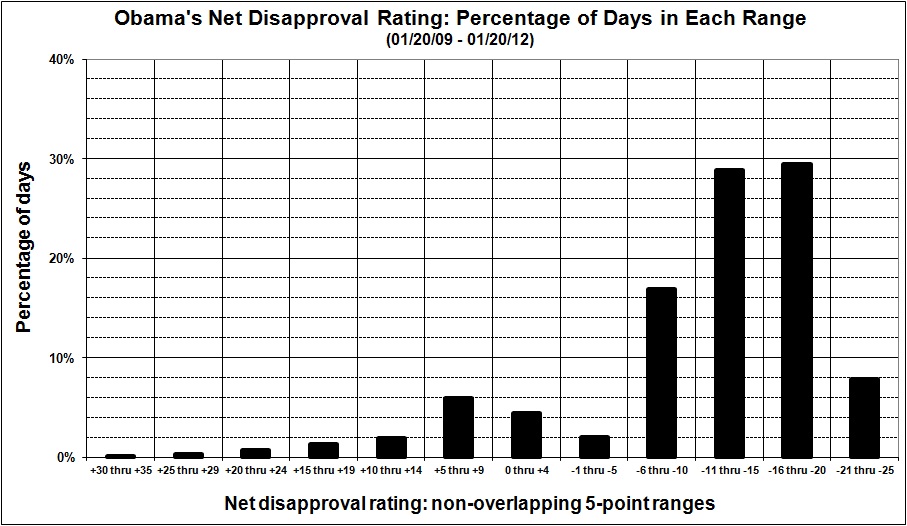
Net disapproval rating: percentage of likely voters strongly disapproving of BO, minus percentage of likely voters strongly approving of BO. Derived from Rasmussen Reports’ Daily Presidential Tracking Poll.
 Politics and Prosperity