
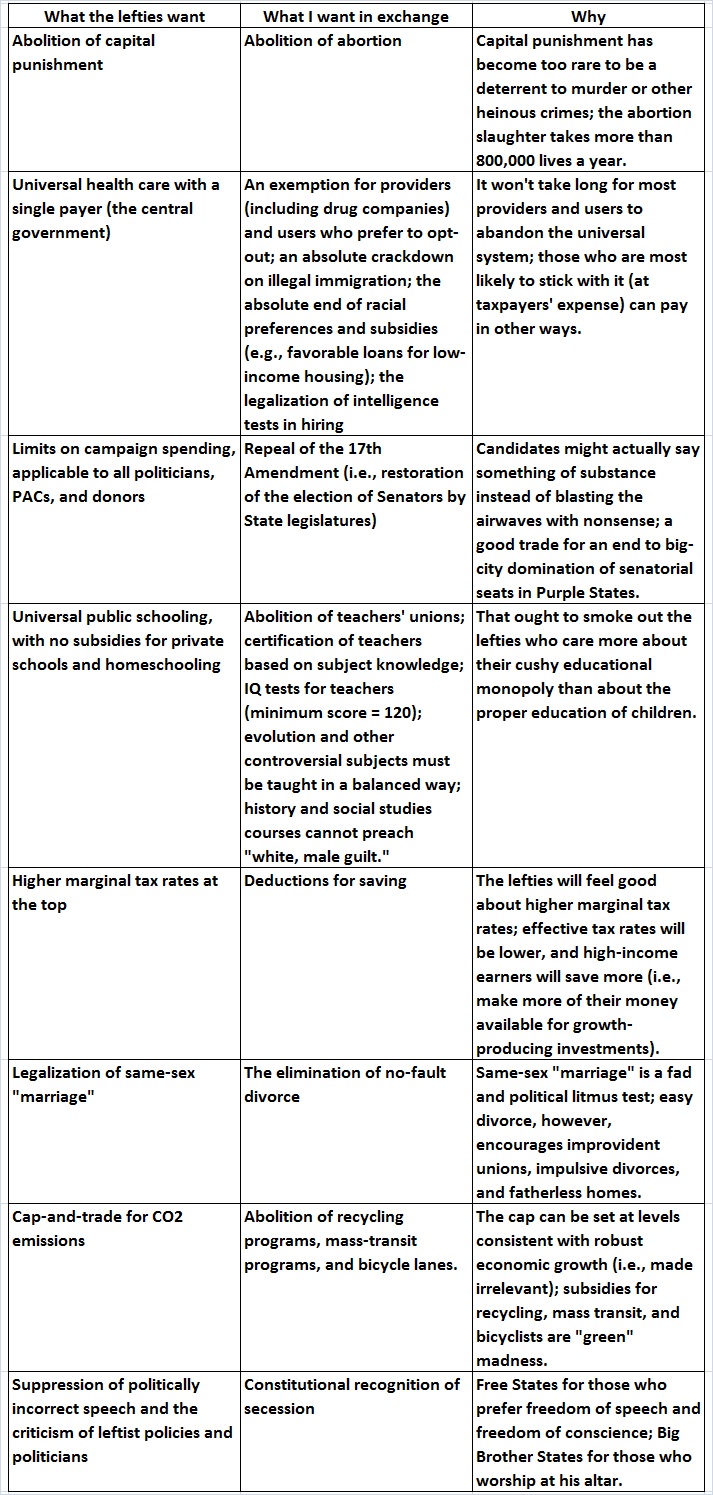
The last deal negates all of the concessions made in the other deals — for those of us who will choose to live in Free States.
The last deal negates all of the concessions made in the other deals — for those of us who will choose to live in Free States.
Here’s how:
Overall, the results presented in this paper suggest several important facts. First, the findings suggest that there is an explicit and quantifiable cost to public debate during wartime in the form of increased attacks. Based on these results, it appears that Iraqi insurgent groups believe that when the U.S. political landscape is more uncertain, initiating a higher level of attacks increases the likelihood that the U.S. will reduce the scope of its engagement in the conflict. However, the magnitude of the response by Iraqi insurgent groups is relatively small. To the extent that U.S. political speech does affect insurgent incentives, it changes things only by about 10-20 percent….
[R]egardless of whether the observed effect represents an overall increase or intertemporal substitution, the evidence in this study indicates that insurgent groups are strategic actors that respond to the incentives created by the policies and actions of the counterinsurgentforce, rather than groups driven by purely ideological concerns with little sensitivity to costs. There appears to be a systematic response of Iraqi insurgent groups to information about the U.S. willingness to remain in Iraq and/or public support for the war.
(NBER Working Paper No. 13839, “Is There an Emboldenment Effect? Evidence from the Insurgency in Iraq,” by Radha Iyengar and Jonathan Monten. The quotations are from pp. 24-25 of the version available at Iyengar’s site.)
The “however” in the first quotation is gratuitous; it takes only “relatively small” increases in “insurgent” attacks to goad defeatists into spewing yet more defeatism. The point — underscored in the second quotation — is that the “insurgents” not only are trying to influence U.S. policy but also are influenced by their perception of our willingness to stay the course.
Should the U.S. execute the 9/11 plotters being held at Guantanomo? AG Mukasey says “no,” and Stephen Bainbridge circles the issue several times before agreeing with the AG:
Let KSM and his pals sit in Guantanamo for the rest of their lives, contemplating their sins.
Doug Mataconis seems to agree with Prof. Bainbridge:
The visceral reaction is to say that these men should die a slow, painful death. But I’ve got to wonder what that’s going to accomplish at this point.
I stand by what I said three years ago:
Justice serves civilization and social solidarity…. [I]t meets the deep, common need for catharsis through vengeance, while protecting the innocent (and all of us) by replacing mob rule with due process of law.
Justice — to serve its purposes — must be swift, sure, and hard. That is, it must work and be seen to work, by the just and unjust alike.
“Swift” and “sure” seldom apply to the death penalty anymore, but “hard” certainly does. The need for social catharsis through judicial vengeance was never greater than in the case of 9/11. Fry ’em.
Margaret Thatcher often is quoted as saying that “there is no such thing as society.” But when Mrs. Thatcher said that, she was arguing against the entitlement mindset, as in ” ‘society’ owes me a roof over my head and three meals a day.” As she put it, “people must look to themselves first. It’s our duty to look after ourselves and then, also to look after our neighbor.”
What Mrs. Thatcher meant to say is that people shouldn’t look to the state (and, thus, to taxpayers) for charity. “Look[ing] after our neighbor” is a clear acknowledgment of the primacy of society (as against the state) as the source of legitimate charity, that is, voluntary charity.
The question now becomes: What is society?
“Society” is not easily defined; it is a word with many meanings, most of them vague. In that respect, it resembles “culture.” And the two words sometimes are used to mean the same thing. Where to begin?
What Society Is Not, and Is
I begin by defining what society is not. It is not merely an economic arrangement: an arms’ length exchange of goods and services for mutual benefit. Nor is it merely a political arrangement, such as the vesting of power in a government for the purpose of making and enforcing laws within a specified geographical area.
There is more to society than economic and political arrangements. The “more” is mutual respect. Mutual respect implies trust, and with trust goes forbearance — a willingness to forgo retribution and violence for slights and trespasses, until one is mightily provoked. (That is why, for example, “redneck culture” is a culture — a way of life — but not the basis of a society.)
There are three outward signs of mutual respect: politeness, thoughtfulness, and neighborliness — practiced in combination, not singly or in twos. Politeness is simple civility: “please,” “thank you,” and the like. (Easier said than done, these days.) Thoughtfulness goes a step beyond politeness; it is seen in such simple acts as returning a stray animal to its owner or picking up litter along a public thoroughfare. Neighborliness (true voluntarism) goes well beyond thoughtfulness; it boils down to burden-sharing, that is, helping others in need through direct action (e.g., cutting a sick neighbor’s grass or bringing her a meal).
As the saying goes, “what goes around comes around.” Mutual respect is impossible where politeness, thoughtfulness, and neighborliness are met consistently with their opposites, which can be characterized as disdain, hostility, or enmity, depending on the virulence of the contrary behavior. To put it positively, by acting (or not acting) in certain ways we foster mutual respect, which repays us with the trust and forbearance of others. This is, of course, the “Golden Rule,” stated in other words.
Mutual respect, by my rigorous definition, is meaningless in the abstract; it must be tested and proved through continuous social contact. Mutual respect is therefore meaningful only to the extent that it is found among persons who are well known to each other and who have frequent social contact with each other. Family and work contacts, like cocktail-party contacts, may involve mere role-playing and politeness. You can pick your friends but not your family or, in most cases, your co-workers. This is not to rule out families and workplaces as venues for mutual respect, but simply to note that they do not rely on mutual respect for their sustenance.
Social Units, the Extent of a Society, and Alliances of Convenience
How many persons can be comprised in a cohesive social unit that adheres around mutual respect? An individual probably can have a relationship of mutual respect (as I define it) with no more than 150 persons (and probably far fewer). A cohesive social unit is most likely to be a nuclear family, an extended family, a rural community, a very small village (or part of a larger one), or a neighborhood in a town, suburb, or city.
A social unit can be likened to a physical atom: an entity with a nucleus (an individual or small number of tightly bonded individuals), surrounded by some number of other persons who are connected to the nucleus by mutual respect. Just as a chemically bonded group of atoms forms a compound, an interlocking network of social units forms a society. By interlocking network, I mean that some (perhaps most) members of each social unit (outside its nucleus) also are nuclei or members of other social units.
How far can a society extend; that is, how many interlocking social units can it comprise? That depends on the extent to which the various social units possess common socio-economic (i.e., cultural) characteristics. (See below.) For, though it is true that a culture does not make a society, a society is bound to have a dominant set of cultural characteristics. It is not in the nature of human beings to bond in mutual respect without the “glue” of core cultural values, or social norms. The more disparate the range of cultural characteristics in a given geographic area (such as the United States), the greater the number of distinct (and possibly antipathetic) societies will be found in that geographic area. This nation is not a society, even though the word “society” often is used (incorrectly) instead of “nation.”
What about those persons who are not members of a social unit? It takes no more than casual experience of life in cities and suburbs to confirm that most of the denizens thereof are not members. (Nodding acquaintances with neighbors, memberships in churches and clubs, and a few friendships with work associates do not a society make.) I am not denigrating those who live in social isolation — whether it is urban, suburban, or even rural — but merely saying that they are not members of a social unit, and that their numbers have been growing faster than the nation’s population. (For more on this point, see this article by Robert Putnam, author of Bowling Alone: America’s Declining Social Capital. See also this table, prepared by the Census Bureau, which documents the growing urbanization of America.)
There is no such thing as American society because not only are Americans too often socially isolated, but also they are too disparate in their cultural characteristics. What we have (for the most part) is not mutual respect but indifference and state-imposed order. More than that, we have state-imposed behavioral norms, which — in and of themselves — have contributed to the breakdown of societal bonds. We are left with some number of distinct (and probably dwindling) societies, around which are spread a vast number of unaffiliated, loosely affiliated, or simpatico individuals.
Distinct societies and unaffiliated persons may, despite their social separation, join in common cause. In the United States, for example, there was until recent decades broad agreement about the ends and means of ensuring “domestic tranquility” and providing for “the common defence.” But cultural diversity begets political strife, which intensifies as the state (goaded and led by élites) undermines traditional societies and their cultural values. The state becomes the arbiter of moral values and the dispenser of charity. The voluntary bonds that enable societies to persist over time — and to co-exist within a nation — are therefore frayed and, eventually, snapped. The nation becomes less like a collection of distinct societies joined by common purposes and more like scorpions fighting in a bottle. (For more on this point, see “The downside of diversity” at the online edition of The Boston Globe.)
Societies in the United States
What characteristics delineate the societies that are found in the United States? The most important characteristics are moral values: definitions of right and wrong actions. In this context, moral values are deeper than generalities (e.g., murder is wrong, terrorism is wrong, theft is wrong); they extend to specific practices (e.g., abortion is murder, terrorists have legitimate grievances, government-enforced theft is theft). Other salient characteristics are:
I do not mean to say that mutual respect is impossible among persons who possess different cultural characteristics. But persistent differences (especially on fundamentals such as morality) tend to strain mutual respect and, thus, mutual forbearance. When the strain is too great, mutual respect breaks down, and restraint must be state-imposed.
Each of the characteristics listed above, beginning with moral values and running down the list, is a potential source of unity and division. Certain characteristics often appear in clusters. Think, for example, of academics in the so-called liberal arts, who tend to be pro-abortion-anti-U.S.-socialistic moral relativists, strident atheists, Ph.D.s (in impractical specialties), “toilers” in the fields of mental esoterica, upper-half to upper-quintile earners, and effete in their tastes. Those who live near each other (in the vicinity of a particular campus, for example) may sometimes form a social unit — in spite of their innate misanthropy. But those social units will exclude unlike-minded persons and members of groups toward which they (the liberal-arts academics) feign compassion (e.g., poor blacks and Latins), while living securely in their comfortable enclaves.
Which brings me to the types of society that do exist in the U.S.:
Some types of society are extensive, regionally (e.g., Mexican immigrants in Texas, Muslim Arabs in southeastern Michigan). But there is no single, large society that extends throughout the United States. And there has not been one since the demise of the rather extensive societies of early America — notably, those societies whose members represented various regions of the British Isles.
Whether today’s rather fragmented and dispersed societies will persist is another question. The United States was long a “melting pot,” wherein education, out-marriage, economic progress, and geographic mobility tended to make generic “Americans” of immigrants. But that was true mainly of white, European immigrants. “Persons of color,” whose cultures and geographic origins differ vastly — blacks, Latins, Middle Easterners, and Asians of various types — will not “melt” for a very long time, if ever. Which means that they will retain their political influence, as protégés and supporters of the vast, Left-wing alliance.
The Vast, Left-Wing Alliance and Its Anti-Social Agenda
Another type of society to be found in the U.S. is composed of liberal-arts academics. Whether there is an extensive society of such academics is doubtful. The quality of mutual respect probably is rather strained within any given social unit, and unlikely to survive the trip from campus to campus, fraught as such distances are with academic rivalries.
But there certainly is a broad, Left-wing alliance that consists of liberal-arts academics and their sycophantic students; Hollywood and New York celebrities and their hangers-on; “artists” and “intellectual workers” of most stripes; well-educated, upper-income, professionals who live in and around major metropolitan areas; and hordes of politicians (local, State, and national), who foster and benefit from the prejudices of the alliance. This broad alliance patronizes — and draws political strength disproportionately from — blacks, Latins, and labor-union members.
The Leftist alliance scorns America and traditional American values. It exalts the politics of class, ethnic, racial, and gender conflict. It has demolished the long-standing, trans-societal agreement to ensure “domestic tranquility” and provide for “the common defence.” (See, for example, this, this, this, this, this, this, this, this, this, this, this, this, and many of the posts at this blog in the category “Leftism – Statism – Democracy.”) If there were an American society, the Left would not be part of it.
Conclusion
There is such a thing as society, contra Margaret Thatcher. But that “thing” is not the state. It is not even a single “thing”; it is a multitude of them.
Members of a true society may, by virtue of their membership, depend on other members of the same society for succor in times of need. But citizenship in the United States is not membership in a society.
Moreover, citizenship in the United States is no longer what it once was: membership in a broad alliance dedicated to justice and defense. Thanks to the vast, Left-wing alliance, U.S. citizenship has become a passport to statism.
I’m working on a post titled “Is There Such a Thing as Society?” There is, but it certainly isn’t coterminous with the nation. In evidence of that point are the City Council of Berkeley, California, and lawyer-terrorist Lynne Stewart — sociopaths all. More later.
Bookworm (of Bookworm Room) plays a theme that I explore in “The Adolescent Rebellion Syndrome.” Writing about an episode of Frontline, she says,
those who oppose Cheney and the Neocons are outraged that all those guys had the temerity to take so seriously the 9/11 attacks and their aftermath. The opposers clearly want to view these matters as Kerry once did: police matters, with the crime scene encompassing a few thousand, rather than one or two…. And to them, to these opposers, it just seems ridiculous that Cheney et al are trying to put in place systems that enable the Commander in Chief to try to nip any future attacks in the bud.
Listening to this outrage, outrage that’s certainly not unique to this Frontline episode, I couldn’t help but think of the difference between your average teenager and your average grownup. To the grownup, things such as mortgages, insurance, and other life security matters are of overriding importance. To the teenager in the house, “Dad is, like, so totally stupid, because he’s, you know, like, always sitting at his desk worrying about the bills, you know. So, I’m all, ‘Dude, stop thinking about that. You know, I’m like trying to score some tickets to the Ugly Red Rash concert, and I need, like, oh, $200 dollars. Right?’”
All of which is both amusing and irritating when you’re in the house with the teenager, but remarkably less interesting when the teenagers are trying to run your country.
As I say in “…Syndrome,”
adolescent rebellion and other forms of intellectual immaturity…are to be found mainly — but not exclusively — among “artists,” academicians, and the Left generally.
I leave room in that indictment for anarcho-libertarians, though they’re so ineffectual that their adolescent petulance is of no account (but of some intellectual interest).
What is a post-American? From Mark Krikorian of NRO, via an earlier post:
Let me be clear [as to] what I mean by a post-American. He’s not an enemy of America — not Alger Hiss or Jane Fonda or Louis Farrakhan. He’s not necessarily even a Michael Moore or Ted Kennedy. A post-American may actually still like America, but the emotion resembles the attachment one might feel to, say, suburban New Jersey — it can be a pleasant place to live, but you’re always open to a better offer. The post-American has a casual relationship with his native country, unlike the patriot, “who more than self his country loves,” as Katharine Lee Bates wrote. Put differently, the patriot is married to America; the post-American is just shacking up.
What makes Katie Couric a post-American? This:
“The whole culture of wearing flags on our lapel and saying ‘we’ when referring to the United States and, even the ‘shock and awe’ of the initial stages, it was just too jubilant and just a little uncomfortable. And I remember feeling, when I was anchoring the ‘Today’ show, this inevitable march towards war and kind of feeling like, ‘Will anybody put the brakes on this?’ And is this really being properly challenged by the right people? And I think, at the time, anyone who questioned the administration was considered unpatriotic and it was a very difficult position to be in.” (Quotation from Jonah Goldberg of NRO, via many bloggers.)
Katie, Katie, Katie, how could anyone possibly question your patriotism after reading that?
Actually, one cannot fault the patriotism of a person who questions how the administration pursues the enemy, as long as that person offers a reasonable alternative in good faith. But the loony Left and whacky Right simply assert that “we” are the enemy and “we” had it coming to “us,” when they are not peddling the notion that “we” did it to ourselves — as in “inside job.”
But Couric is, by her own admission, unpatriotic. She is more than unpatriotic, however. She is, at best, a dupe for the loony Left and whacky Right. She is, at worst (I think), a witting dupe (to coin an oxymoron).
Related post: Depressing But True (and the links at the end)
I recently quoted this definition of Methaethical Moral Relativism (MMR):
The truth or falsity of moral judgments, or their justification, is not absolute or universal, but is relative to the traditions, convictions, or practices of a group of persons.
I found the definition useful, regardless of the validity of MMR. I now address its validity.
The “traditions, convictions, or practices of a group of persons” are not ends in themselves. Rather, they are (or were originally) aimed at the attainment of a “greater good” — a moral imperative — which is (or was) served by such traditions, convictions, or practices.
The moral impetus for those traditions, convictions, or practices becomes tenuous with the passage of time. As the generations roll by, the members of a group turn their focus from the original moral imperative to the traditions, convictions, or practices that once served it. That is to say, the group’s morality becomes rote.
Because of this rote morality, the moral framework of the group becomes falsely identified with its particular traditions, convictions, or practices. (A good analogy can be found in the widespread practice of celebrating the Fourth of July without giving more than a moment’s thought — then or during the rest of the year — to the struggle for independence or to the meaning of liberty.)
MMR is valid only to the extent that there is no moral imperative that cuts across groups of persons: nations, races, ethnicities, clans, tribes, religions, political parties, and the like. (I disregard — for the moment — exceptions to the rule, that is, sociopaths, who (a) are likely to be found in any group of more than a few members, (b) quite often force or connive their way into positions of power (it goes with sociopathy), and (c) surround themselves with sociopathic henchmen.)
The crucial issue, then, is the existence (or non-existence) of a universal moral imperative, one that is common to the people (if not to the leaders) of nations, races, ethnicities, clans, tribes, religions, and the like. Kant would say that there is such an imperative, his categorical imperative (in its first formulation): “Act only according to that maxim whereby you can at the same time will that it should become a universal law.” [1]
Kant’s categorical imperative, however, is a Platonic universal: something that just is, a deontological duty. Kant, himself, distinguishes it from The Golden Rule, which (because of its commonality to so many forms of religion and philosophy) can be understood as a man-made utilitarian or consequentialist command. The Zoroastorian version, for example goes: “”Whatever is disagreeable to yourself do not do unto others.”
Why is The Golden Rule utilitarian or consequentialist? Because people have learned — from experience over the eons — that if most everyone follows the command to “do unto others as you would have them do unto you,” most everyone will benefit from doing so. One’s self-restraint with respect to others encourages (almost all) others to practice self-restraint toward one’s self. The Golden Rule does not apply to rule-breakers, who must face consequences (or one kind or another) for their rule-breaking. (That there are rule-breakers only underscores the humanness of The Golden Rule.)
Now, to answer the question of the title: Metaethical Moral Relativism, as defined above, is neither neither a valid concept nor an invalid one; it is an irrelevant concept. It treats different groups as if they had different moral imperatives. By and large, they do not; most groups (or, more exactly, most of their members) have the same moral imperative: The Golden Rule.
There are, of course, groups that seldom if ever observe The Golden Rule. Such groups are ruled by force and fear, and they deny voice and exit to their members. The rulers of such groups are illegitimate because they systematically try to suppress observance of The Golden Rule, which is deep-seated in human nature. Other groups may therefore justly seek to oust and punish those despotic rulers.
There is a relevant — but logically and factually invalid — form of Metaethical Moral Relativism:
The United States is imperfect. It is, therefore, no better than its enemies.
Such is the relativism we see in those who excuse despotic, murderous regimes and movements because “we asked for it” or “we are no better than they are” or “war is never the answer” or “one man’s terrorist is another man’s freedom fighter” or “terrorists deserve the protections of the Geneva Convention.” That kind of relativism empowers the very despots and terrorists whose existence is an affront to The Golden Rule.
Here.
The outcome of yesterday’s elections can be summed up in the phrase “throw the rascals in.” That’s, of course, an ironic variation on the usual expression of voter dissatisfaction with incumbents, which is to “throw the rascals out.”
A marginal minority of voters having “thrown the rascals in,” all Americans now face at least two years of Democrat control of the House (and probably the Senate), from which will emanate efforts to
The only silver lining in this very dark cloud is that President Bush can — if he is willing — wield the veto pen. Two years of gridlock would indeed be a blessing, for the federal government might actually do less to screw up our lives and the lives of our progeny. But I do fear for the war effort, especially because our enemies undoubtedly have been emboldened by the prospect of a Congress that is controlled by an anti-war faction. And I also fear that President Bush, facing a hostile Senate, will be unable to appoint constitutionalists to succeed Justices John Paul Stevens and Ruth Bader Ginsburg, both of whom are likely to postpone retirement in the hope that Bush is succeeded by a Democrat.
I am as worried about the future of the country as I was — justifiably — when Jimmy Carter won the election of 1976. My only hope is that the Leftist agenda of congressional Democrats will frighten Americans and induce an electoral backlash that brings pro-defense, small-government Republicanism to power in 2008. All we need are some small-government Republicans.
World Climate Report reproduces this graphic:
 Read the whole post. Then read this, and follow the links. See also this piece by Debra Saunders.
* * *
Donald Boudreaux explains, once again, why making healthcare a “right” will only make it more expensive and harder to come by.
* * *
Selwyn Duke’s “The Fascists among Us,” at The American Thinker, reminds me of my post, “Calling a Nazi a Nazi.” P.S. There’s also Thomas Sowell’s “Can we talk?” at Townhall.com.
* * *
Related to that, there’s wide support among Democrats — those “tolerant” people — for the “outing” of gay Republicans. (See this post at Patterico’s Pontifications.) It’s the old Leftist double standard: The only good gay is a Democrat gay; Bill Clinton couldn’t have been guilty of sexual harrassment because his “heart was in the right place”; the only “stolen” elections are those won by Republicans, even though Democrats are past masters at the art of stealing elections; etc., etc., etc.
* * *
Speaking of Democrats, read this post by Ed Lasky at The American Thinker, which opens thusly: “Jihadists admit they are killing for the the camera and for the Democrats.”
* * *
Tyler Cowen (Marginal Revolution) asks “Why hasn’t Mexico done better?” Perhaps because it’s not populated by immigrants from the British Isles and Northern Europe, and their descendants, whose political and economic leadership brought liberty and prosperity to the United States.
Captain Ed reports:
A federal judge sentenced [attorny Lynne] Stewart to 28 months in prison for assisting Omar Abdel Rahman in activating his terrorist network while the US held him in custody — and then temporarily released her on her own recognizance:
A firebrand civil rights lawyer who has defended Black Panthers and anti-war radicals was sentenced Monday to nearly 2 1/2 years in prison — far less than the 30 years prosecutors wanted — for helping an imprisoned terrorist sheik communicate with his followers on the outside. …
The judge said Stewart was guilty of smuggling messages between her client and his followers that could have “potentially lethal consequences.” He called the crimes “extraordinarily severe criminal conduct.”
But in departing from federal guidelines that called for 30 years behind bars, he cited Stewart’s more than three decades of dedication to poor, disadvantaged and unpopular clients.
“Ms. Stewart performed a public service, not only to her clients, but to the nation,” Koeltl said.
The judge said Stewart could remain free while she appeals, a process that could take more than a year.
This woman sent messages to Rahman’s followers in Egypt that instructed them to begin terrorist activity. She knew exactly what she did — after all, she had defended Rahman and had seen the evidence against him — and turned her back on her country and her humanity in order to suck up to a man who plotted the murder of tens of thousands of Americans. Stewart’s actions could easily have led to the deaths of many innocent civilians.
Despicable. Both Judge Koetl and Lynne Stewart, that is. There is no excuse for a sentence of less than 30 years, certainly not the excuse given by Judge Koetl. And why is the judge allowing the woman to go free, pending appeal? She will either abscond to Pakistan, to be with Osama, or find new ways to betray her country, right here at home.
It’s telling that Stewart gave “more than three decades of [service] to poor, disadvantaged and unpopular clients.” Lawyers like that aren’t really altruists who are dedicated to their clients. They’re malcontents who are dedicated to the subversion of the rule of law by playing the criminal-as-victim card.
Had I been prosecuting the case I would have gone for a charge of treason and the death penalty. Perhaps Stewart might have “pled out” to a 30-year sentence, to be served with hardened criminals — not at a “country club” for white-collar criminals.
The outcome of Stewart’s case reminds me of the grave mistake made by the U.S. Supreme Court when it emasculated federal sentencing guidelines by making them advisory. For more on that subject, see “More Punishment Means Less Crime,” “More About Crime and Punishment,” and “More Punishment Means Less Crime: A Footnote.”
ADDENDUM: See also Justin Levine’s post, “Attorney Lynne Stewart – Traitorous Scumbag.”
Tom W. Bell (Agoraphilia) notes that
[a] grand jury in Orange County filed a charge of treason against Adam Yahiye Gadahn [on October 11]. That marks him as the first person charged with treason against the U.S. since 1952. If captured and found guilty, Gadahn could face the death sentence.
The indictment accuses Gadahn of acting as a propagandist for al-Qaeda in several of that group’s videos. He allegedly announced that he had joined al-Qaeda and claimed, “Fighting and defeating America is our first priority. . . . The streets of America shall run red with blood.” Gadahn also supposedly called on Americans to convert to Islam and urged U.S. soldiers to switch sides in the Iraq and Afghan wars. On the basis of those and other allegations, the indictment concludes that Gadhan “knowingly adhered to an enemy of the United States, namely, al-Qaida, and gave al-Qaida aid and comfort . . . with intent to betray the United States.”
Bell concludes: “If prosecutors can catch Gadahn, they have a fair chance of convicting him of treason.” The main doubt in Bell’s mind is whether or not Gadahn, who left the U.S. in 1998, had previously renounced his citizenship, which — as Bell observes — “it is not quite as easy as, say, simply burning a flag.”
Regarding treason and speech, generally, Bell refers to his article, “Treason, Technology, and Freedom of Expression.” I posted here (March 5, 2005) about an earlier version of the article.
Some months later (August 18, 2005) I had more to say about Bell’s views, as well as those of Eugene Volokh. Volokh yesterday repeated same points upon which I commented on August 18, 2005. Volokh’s option 2 regarding the treatment of speech runs thusly:
Speech is unprotected whenever the speaker has the purpose of aiding the enemy (and perhaps there’s some evidence that the speech is indeed likely to provide some at least modest aid). This exception would justify punishing any speech that falls within the statutory and constitutional definition of “treason.”
I think this too is probably too broad. Perhaps the speaker’s intentions made him morally culpable and thus theoretically deserving of punishment. But prohibiting all speech that intentionally helps the enemy risks punishing or deterring even speakers who intend only to protect American interests, but whose intentions are mistaken by prosecutors and juries — a serious risk, especially in wartime. On the other hand, I suspect that quite a few judges would take the view that treason by speech that is intended to help the enemy should be treated the same as treason by action that is intended to help the enemy.
As I wrote at the time,
I prefer Volokh’s option 2. . . .
[P]resumably an intention to aid the enemy would have to be proven in a court of law. I doubt very much that an unsubstantiated intention would survive an appeal. Why not give it a try and see how the Supreme Court rules on the issue — as surely it would be asked to do.
I must add this: Speech that intentionally aids the enemy cannot also be speech that is intended to protect Americans’ interests. You are either with us or against us.
Mark Steyn on 9/11:
In the New York Times, Thomas Friedman wrote: “The failure to prevent Sept. 11 was not a failure of intelligence or coordination. It was a failure of imagination.” That’s not really true. Islamist terrorists had indicated their interest in U.S. landmarks, and were known to have plans to hijack planes to fly into them. But men like John O’Neill could never quite get the full attention of a somnolent federal bureaucracy. The terrorists must have banked on that: After all, they took their pilot-training classes in America, apparently confident that, even if anyone noticed the uptick in Arab enrollments at U.S. flight schools, a squeamish culture of political correctness would ensure nothing was done about it.
Five years on, half America has retreated to the laziest old tropes, filtering the new struggle through the most drearily cobwebbed prisms: All dramatic national events are JFK-type conspiracies, all wars are Vietnam quagmires. Meanwhile, Ramzi Yousef’s successors make their ambitions as plain as he did: They want to acquire nuclear technology in order to kill even more of us. And, given that free societies tend naturally toward a Katrina mentality of doing nothing until it happens, one morning we will wake up to another day like the “day that changed everything.” Sept. 11 was less “a failure of imagination” than an ability to see that America’s enemies were hiding in plain sight.
Michael Liccione picks up the theme:
Americans and Westerners generally do not, as a whole, seem yet to understand what all the conflict within and about the Middle East has in common. This is not a war about “terrorism,” which is only the most obvious weapon wielded by our true enemy. Whether one looks at Iraq, Southern Lebanon, Palestine, Afghanistan, or any place where Islamist terrorism has spilled blood, the enemy is the same: radical Islamic jihadism, whether of the Sunni (Wahhabi) or the Shi’ite variety best represented by Hezbollah and sustained by Iran in Iraq too. The aim of all jihadists is the same: the destruction of Israel and ultimately of the West, making way for the worldwide rule of Islam. . . [T]he trends throughout the Middle East and Southern Asia . . . are toward increasing convergence of jihadist groups. Saddam paid off the families of Palestinian suicide bombers of Israelis and tolerated Iraq’s homegrown jihadist group, Ansar al-Sunna. The hydra-headed monster had been, and has since been getting, more cohesive for quite some time. One might argue that the overthrow of Saddam and the subsequent Iraqi insurgency has only accelerated that process; but if it has, that is not such a bad thing. It helps prevent people from sleeping too long.
Wherever there is Islamist terrorism, one finds jihadists from many different countries joining together. We’re seeing only the earliest stages of what will, in due course, evolve into a true “clash of civilizations.”
At some point those Americans who are playing nicey-nicey — when they are not imitating ostriches — will embolden and enable the enemy to do something that not even a Democrat or a Buchananite will tolerate. Fair warning to the enemy. You ain’t seen nothin’ yet.
Related links:
A Top-Ten List on Jihad That’s Way Too Long and Quite Possibly Too Dour
Who’s Going to Win?
World War IV As Fourth-Generation Warfare
The New Juristocracy
Americans Should Not Die for Article 3, Geneva Conventions
The Fallacy of Reciprocity
“For McCain It’s Personal” (in Best of the Web)
The Religion of Peace Firebombs & Fatwas
Ahmadinejad’s Apologists
Our Covert Enemies
Know Your Enemy
Related posts:
Why Sovereignty?
Shall We All Hang Separately?
Foxhole Rats
Treasonous Speech?
Foxhole Rats, Redux
Know Thine Enemy
The Faces of Appeasement
Whose Liberties Are We Fighting For?
Words for the Unwise
Riots, Culture, and the Final Showdown
More Foxhole Rats
Moussaoui and “White Guilt”
The New York Times: A Hot-Bed of Post-Americanism
Post-Americans and Their Progeny
American Royalty
“Peace for Our Time”
Anti-Bush or Pro-Treason?
Com-Patriotism and Anti-Patriotic Acts
Parsing Peace
The Problem of Good vs. Evil
A Message to Our Domestic Enemies
Taking on Torture
Conspiracy Theorists’ Cousins
Not Enough Boots
Defense as the Ultimate Social Service
I Have an Idea
The Price of Liberty
September 11: Five Years On
How to View Defense Spending
Losing Sight of the Objective
Those who are so keen to bestow constitutional rights on terrorists have lost sight of a key purpose — perhaps the key purpose — of the Constitution: to provide for the common defense. Of Americans. Against their enemies: foreign and domestic, overt and covert.
The time-date stamp of this post is 7:46 a.m. CDT (8:46 a.m. EDT), September 11, 2006 — exactly five years after Mohammed Elamir Awad al-Sayed Atta flew American Airlines Flight 11 into the north tower of the World Trade Center. Atta was an Egyptian-born Muslim who was recruited into al Qaeda in 1998.
Al Qaeda is led by Osama bin Laden and dominated by adherents of Wahabism, a fundamentalist sect of Islam. Al Qaeda is one of dozens of Islamic terrorist organizations, many of which are devoted to Islamism — “a set of political ideologies that hold that Islam is not only a religion, but also a political system that governs the legal, economic and social imperatives of the state according to its interpretation of Islamic Law” — and to jihad in pursuit of Islamism.
Those terrorist organizations that are not devoted to Islamism, as such, are nevertheless motivated by an intolerance for non-Islamic cultures in general, a jealous hatred of Western civilization in particular, and a zeal to eradicate Israel, which is an outpost of Western civilization in the midst of Muslim lands. The attacks of September 11, 2001, underscored what had been true for years — and what remains true today — which is that America and the West are chosen enemies of Islamist jihadists. Those who ignore that truth are doomed either to die at the hands of Islamists or to suffer under their rule.
* * *
When my wife and I turned on our TV set on the morning of September 11, 2001, we learned that a plane had, minutes earlier, struck the north tower of the World Trade Center. Minutes later we watched in horror as a second plane soared through the bright blue sky and struck the south tower. And with that horror came the understanding that America had been attacked. That understanding soon was confirmed when — in the awful silence that had fallen over Arlington, Virginia — we could hear the “whump” as a third plane slammed into the Pentagon.
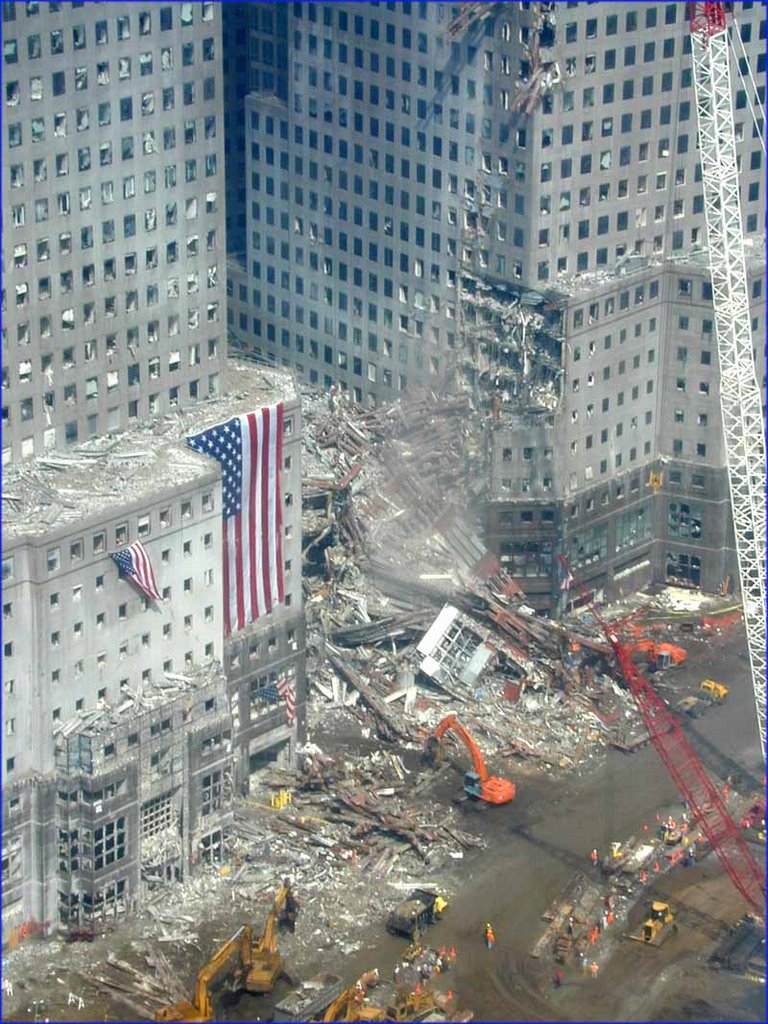
Our shock and rage were accompanied by fear for our daughter, whom we knew was at work in the adjacent World Financial Center when the planes struck the World Trade Center. (See photos below.) Was her office struck by debris? Had she fled her building only to be struck by or trapped in debris? Had she smothered in the huge cloud of dust that enveloped lower Manhattan as the towers collapsed? Because telephone communications were badly disrupted, we didn’t learn for several hours that she had made it home safely, before the towers collapsed.
Our good fortune was not shared by tens of thousands of other persons: the grandparents, parents, brothers, sisters, husbands, wives, children, grandchildren, lovers, and good friends of the 3,000 who died that day in Manhattan, the Pentagon, and western Pennsylvania.
I was enraged by the events of September 11, 2001, and I remain enraged. I am, of course, enraged at the perpetrators and those like them who remain at large. I am, if anything, even more enraged by those of my fellow citizens who seem unable to grasp the fact that terror is the fault of terrorists, and that the United States must defend itself against those terrorists, even if it means that we are at times inconvenienced and at other times deprived of a smattering of privacy. Those who lament inconvenience and conjure a police state where there is none are rank narcissists and untrustworthy companions in the fight to the finish in which we are engaged.
I have reserved a special place in hell for those politicians, pundits, journalists, celebrities, and bloggers (especially Leftists and anarcho-libertarians) who criticize the war effort simply for the sake of criticizing it, who exude schadenfreude when there is bad news from the front or when the administration suffers a political or judicial setback in its efforts to combat terrorists, and who are able to indulge themselves precisely because they live in a nation that affords them that luxury. It is not a luxury they would enjoy under Leftist or Islamist rule.
A time of war is a time for constructive criticism, for being on the same team and helping that team win by offering ideas about how to win the war. When your country loses a war, you do not win. In fact, you cannot win, unless you choose to join the other side — and the other side chooses to accept you. But, as always, be careful what you wish for.
As for me, I repeat what I have said on every anniversary of September 11, 2001:
Never forgive, never forget, never relent.
* * *
The photos below include views of the building in the World Financial Center in which our daughter was working on the morning of September 11, 2001. (The building is at the right in the first photo, center in the second, and right in the third.) The second photo shows how close her building was to the twin towers of the World Trade Center — the remains of which are partly visible in the foreground. The third photo hints at the substantial damage her building suffered as a result of the collapse of the towers. (The photos are three of many that were taken on September 13, 2001. The entire collection is available here. I am indebted to Keith Burgess-Jackson (AnalPhilosopher) for providing the link to the collection.)


Yesterday I quoted Alan Furst. In light of last night’s events in the UK, I repeat what Mr. Furst said:
[G]ood people don’t spend much time being good, mostly they want to mow the lawn and play with the dog, whereas bad people spend all their time being bad, or thinking up ways to be worse. Then, one day, the good people have to turn around and do something, or the whole thing will go off the cliff.
Any person or institution who stands in the way of detecting and preventing terrorism is traitorous. Do you read me, George Soros, Mikhail Moore, Cindy Sheehan, The New York Times, and the ACLU?
UPDATE: There should be a special place in hell for leakers.
Related post: Com-Patriotism and Anti-Patriotic Acts
This post isn’t about compatriots, who are persons who happen to be citizens of the same nation. This is about com-patriots — persons who happen to be citizens of the same nation and who share a moral commitment to the defense of that nation and its ideals. This post is necessarily also about anti-patriots — citizens who do not evidence the same moral commitment. The nation in question, of course, is the United States.
What, then, is American com-patriotism? I begin with this definition of patriotism:
Love of and devotion to one’s country.
Which I expand to get American com-patriotism, which is decidedly not mere flag-waving. It is:
There are many legitimate ways by which a citizen may contribute to the defense of the nation’s ideals; for example: reasoned questioning of the aims, policies, and actions of government; honorable service in the armed forces; or reasoned challenges to those who seek to use the levers of government to deprive their citizens of liberty and property. Such are com-patriotic acts.
But it is not com-patriotic to speak or act in blatant disregard of the nation’s founding ideals and principles of governance; for example:
Such acts endanger the lives, liberty, and property of peaceable, honorable Americans. Such acts flout the Constitution. They are not to be tolerated. They must be called what they are: anti-patriotic. That is what I will call them at every opportunity.
Related reading: American Exceptionalism (Wikipedia), Points of No Return (Eternity Road)
Related posts:
Patriotism and Taxes
Why Sovereignty?
Shall We All Hang Separately?
Foxhole Rats
Treasonous Speech?
Foxhole Rats, Redux
Know Thine Enemy
The Faces of Appeasement
Whose Liberties Are We Fighting For?
Words for the Unwise
More “McCarthyism”
More Foxhole Rats
Moussaoui and “White Guilt”
The New York Times: A Hot-Bed of Post-Americanism
Post-Americans and Their Progeny
Certain Unalienable Rights
The First Roosevelt
American Royalty
“Peace for Our Time”
Anti-Bush or Pro-Treason?
Consent of the Governed
Kelo, Revisited
Parsing Peace
Slopes, Ratchets, and the Death Spiral of Liberty
Peace comes through amity, comity, deterrence, victory, or surrender. When you have intransigent enemies — enemies who are dedicated to the demise of your civilization — the only available options are deterrence, victory, or surrender. When those enemies are fanatical, the only options are victory or surrender.
Those who merely wish for peace — but who are unwilling to fight for it (or support the fight for it) — have opted for the peace of surrender.
Related post: Riots, Culture, and the Final Showdown
 Politics and Prosperity