Foxhole Rats

Apropos the preceding post, there’s a sizable cheering section for the enemy, right here in the U.S. of A. David Kopel of The Volokh Conspiracy has more:

I just ran “support the Iraqi resistance” through Yahoo, and looked at some of the top hits. Among the supporters of the so-called “resistance” are James Petras (an emeritus professor at the State University of NY), . . . . comedienne Janeane Garafolo analogizing the Iraqi resistance to Americans resisting an illegitimate Russian-Chinese invasion of the United States, and Virginia Rodino (Green Party candidate for U.S. House in Maryland in 2004), who declares herself “in solidarity with the courageous Iraqi resistance.” This is obviously not a comprehensive list, just what was easy to find in a few minutes.

An interesting thread on Democratic Underground shows that among rank and file activists (not the more famous types that Eugene originally asked about), there is a substantial diversity of opinion about whether anti-war activists should support the “resistance.”

There may be a “diversity of opinion” at the Democratic Underground about support for the “resistance,” but one graphic is worth a bunch of words about the allegiance of the post-patriots who lurk in the Underground. Here’s the answer to the question “which country having ‘nukes’ concerns/scares your the most?”:

Poll result (42 votes)
Iran (3 votes, 7%)
North Korea (2 votes, 5%)
Pakistan (1 votes, 2%)
India (0 votes, 0%)
China (1 votes, 2%)
France (0 votes, 0%)
Russia (0 votes, 0%)
Israel (1 votes, 2%)
United States
(34 votes, 81%)


What scares me the most is that those people are breathing the same air as I am.

Now, some may say that I’m equating dissent with disloyalty. Not at all. I’m equating decades of anti-defense, anti-war, and sometimes pro-enemy rhetoric with a willingness to abandon the common defense.

You can call it what you like.

Shall We All Hang Separately?

I believe that the willingness of humans to come to each other’s defense has emotional and practical roots:

1. An individual is most willing to defend those who are emotionally closest to him because of love and empathy. (Obvious examples are the parent who risks life in an effort to save a child, and the soldier who throws himself on a grenade to protect his comrades.)

2. An individual is next most willing to defend those who are geographically closest to him because those persons, in turn, are the individual’s nearest allies. (This proposition is illustrated by the Union and the Confederacy in the American Civil War, and by the spirit of “we’re all in this together” that prevailed in the U.S. during World War I and World War II. This proposition is related to but does not depend on the notion that patriotism has evolutionary origins.)

3. If an individual is not willing to defend those who are emotionally or geographically closest to him, he cannot count on their willingness to defend him. In fact, he may be able to count on their enmity. (A case in point is Southerners’ antagonism toward the North for many decades after the Civil War, which arose from Southerners’ resentment toward the “War of Northern Aggresssion” and Reconstruction.)

The Constitution — in its pledge to “provide for the common defence” and its specific language enabling that “defence” — embodies the second and third observations. As Benjamin Franklin said to John Hancock at the signing of the Declaration of Independence, “We must indeed all hang together, or, most assuredly, we shall all hang separately.” A main impetus for the adoption of the Constitution, to replace the Articles of Confederation that first bound the States, was to ensure that the States and the people could indeed hang together. And so we did, in the main, through World War II (the Civil War being the exception that truly proves the rule about geographic cohesion).

What we have seen since the end of World War II is the dissipation of the spirit that “we’re all in this together.” Every American war has had its domestic opponents, even World War II — at least before America joined it. But the Leftish voices of opposition to war — and to preparedness for war — have become louder and more strident in recent decades.

Republicans who opposed LBJ’s handling of the war in Vietnam opposed it largely because they viewed LBJ’s incrementalism as self-defeating. And they were right. My own contemporary, non-Republican view of the Vietnam War was that it was the wrong war, in the wrong place, at the wrong time, but that we ought to try to win it or simply walk away from it. We did neither, opting instead for virtual defeat. That defeat emboldened and legitimated America’s anti-defense, anti-war Leftists, who came to dominate the Democrat Party even before that Party’s venture in Vietnam had ended in ignominy. And thus it came to pass that the Democrat Party’s presidential nominee in 2004 was a notorious anti-Vietnam War veteran of that war.

Congressional Democrats, who mainly opposed George H.W. Bush’s entry into Gulf War I, weren’t granted enough time in which to beat him about the head with his “mistakes.” The war ended too quickly for that. The senior Bush’s real mistake was to heed the advice of those who wanted to walk away with the job half done, that is, with Saddam Hussein defeated but not unseated.

The many congressional Democrats who ostensibly supported George W. Bush’s entry into Iraq felt they had little choice but to do so in the aftermath of 9/11. But many of them since have followed their instincts (and their constituents’ instincts) and reneged on their initial support of the war. They have reverted to the anti-defense, anti-war posture of the modern Democrat Party, reviling President Bush for his “mistakes” (i.e., lack of 100-percent foresight) and blaming him for a fictitious “climate of oppression” in which voices against the war are stifled. They are so stifled that it is hard to be heard above the din of anti-defense, anti-war talk in the media and on the Web.

The country is divided. An important reason for that division is that half the country is unsure, for good reason, that the other half understands the value of — or even wants — a “common defence.” It is apparent to many Americans that many other Americans (i.e., most Democrats and all unaffiliated Leftists) will not countenance the defense of a fellow American (except perhaps a loved one or a next-door neighbor) unless and until the enemy is within spitting distance — if then.

This isn’t about the Iraq War being “the wrong war, in the wrong place, at the wrong time.” That’s merely the latest excuse for the American Left’s long-standing allegiance to anti-defense, anti-war dogmas, under which lies the post-patriotic attitude that America is nothing special, just another place to live. Christopher Chantrill of The American Thinker explains:

Among the many things that our American liberals ask us to swallow in our own best interest is the idea that it is an act of lèse-majesté to call them unpatriotic even though they are utterly embarrassed by patriotism. Who has not heard the liberal across the dinner table dismissing nationalism as dangerous and aggressive? But we are not allowed to call them on it.

This power play began after World War II when it came to public knowledge that a number of people with first names that sounded like last names had been passing government secrets to the Soviet Union. We call this time the McCarthy Era.

The McCarthy Era taught liberals that their ideas of a post-nationalist world did not go down too well with the American people. By the skin of their teeth they managed to swim back into the mainstream through a successful counterattack upon Senator McCarthy. Ever since, when caught in a post-patriotic act, they have waved the bloody shirt of McCarthyism to cow their accusers into silence.

Alger Hiss and Dexter White were unpatriotic and proud of it, and so are today’’s liberals — in their hearts. Hiss and White believed in a world higher and better than nation states. From their experience in the 1930s they knew that the age of capitalism and fractious nation states was coming to an end, and they wanted to be part of the exciting and altruistic movement that would create a new world order to replace the old, failed system. There would be no place for atavisms like patriotism in the post-patriotic world that they wanted to build.

And so it goes today.

Well, I wonder how those anti-defense, anti-war, post-patriots would feel if there weren’t some pro-defense, willing-to-go-to-war patriots around to defend them before the enemy is at their throats? Would France save them? How about their precious enemy detainees at Gitmo?

The Left has, by its words and deeds over the decades, seceded from the mutual-defense pact of the Constitution. The Left has served notice that it will do everything in its power to weaken the ability of those Americans who aren’t post-patriotic to prepare for and execute an effective mutual defense.

Lincoln said, “A house divided against itself cannot stand.” And Lincoln was right, but he was able to reunite the “house” by force. That is not an option now. The Left has more effectively seceded from the Union than did the Confederacy, but the Left’s secession cannot be rectified by force.

And so, those Americans who wish “to provide for the common defence” are forced to share a foxhole with those post-patriots who wish to undermine “the common defence.”

If the Left’s agenda prevails, we shall indeed all hang separately.

Defending My Right to Be Bombed

Now we learn this from The Times Online:

Mohammed Atta and three other men who hijacked aircraft on September 11, 2001 were identified by the US Government as possible members of an al-Qaeda cell more than a year before the attacks, it was reported today. . . .

The secret military team, known as Able Danger, recommended that the identities of the four men be shared with the FBI and other parts of the military, but the recommendation was never taken up, according to a Republican Congressman, Curt Weldon, quoted by the newspaper. . . .

The CIA tracked the men through 2000 before passing their information to the FBI in the spring of 2001.

According to Mr Weldon, who said he has tried to share this information since September 2001, when it first came to his notice, the risk posed by Atta and his cohorts never spread through America’a law enforcement agencies because of the uneasy co-operation between the FBI and the military. . . .

The classified military intelligence unit used sophisticated “data mining” techniques, which process huge amounts of data to find patterns, to identify Atta and the three other men as likely members of an al-Qaeda cell within two months of their arrival in America in 2000.

And from The International Herald Tribune:

. . . Able Danger, prepared a chart in the summer of 2000 that included visa photographs of the four men, including the ringleader, Mohammed Atta. The unit recommended to the military’s Special Operations Command that the information be shared with the FBI, the former official and the Republican congressman, Curt Weldon of Pennsylvania, said Monday.

The recommendation was rejected, and the information was not shared, they said, apparently at least in part because Atta and the others were in the United States on valid entry visas.

Under U.S. law, intelligence agencies may not collect intelligence on individual citizens and permanent residents. That protection does not extend to visa holders, but Weldon and the former official said it may have reinforced a sense of discomfort[*] common before Sept. 11 about sharing intelligence information with a law enforcement agency.

So we have here two lessons:

  • Data mining can actually detect bad guys.
  • Intelligence sharing might well have led to the capture of the bad guys before they did something terribly bad.

But knee-jerk civil libertarians won’t have any of it. They want to defend my right to be bombed.
__________
* There was more than “discomfort” about intelligence-sharing, there was a wall between criminal investigators and intelligence agents.

Technorati tag:

Sunday’s Question

Is a rabid dog any less dangerous because of its brain abnormalities, because it doesn’t know what it’s doing, because it’s not fully grown, or because it’s merely defending its territory?

I invite those who seek to “understand” terrorists and those who oppose the death penalty to ponder that question.

Technorati tag:

Whose Side Are They On?

NYCLU Calls Decision To Conduct Random Searches Of Individuals On New York’s Subways Unconstitutional

Judge Roberts and the Defense of America

Emily Bazelon, writing at Slate, doesn’t like Judge John Roberts’s willingness to defend America:

Roberts may…turn out to be a wise, thoughtful, and appealing justice. Tonight when Bush announced his nomination, Roberts talked about feeling humbled, which won him points on TV. But an opinion that the 50-year-old judge joined just last week in the case Hamdan v. Rumsfeld should be seriously troubling to anyone who values civil liberties. As a member of a three-judge panel on the D.C. federal court of appeals, Roberts signed on to a blank-check grant of power to the Bush administration to try suspected terrorists without basic due-process protections.

According to the government, Salim Ahmed Hamdan is the former driver and bodyguard of Osama Bin Laden. He was captured by an Afghan militia in November 2001, during the U.S. invasion, and shipped off to Guantanamo Bay. In July 2003, the Bush administration brought charges against Hamdan, as it has done against only three others among the hundreds of suspected terrorists being held at Guantanamo. Hamdan was accused of conspiring to commit attacks on civilians, murder, and terrorism, and the Bush administration moved to try him before a special military tribunal.

This tribunal isn’t like the courts-martial that are used for prisoners of war. It goes by rules that cut back the rights of defendants even more drastically than the tribunal that the United States has helped establish in Iraq to try Saddam Hussein has. Hamdan has no right to be present at his trial. Unsworn statements, rather than live testimony, can be presented as evidence against him. The presumption of innocence can be taken away from him at any time; so can his right not to testify to avoid self-incrimination. If Hamdan is convicted, he can be sentenced to death.

The opinion Roberts joined, written by Judge A. Raymond Randolph for a unanimous panel (though the third judge, Stephen Williams, expressed a reservation in a concurrence), swallows all of that and then some. The opinion says that Congress authorized the president to set up whatever military tribunal he deems appropriate when it authorized him to use “all necessary and appropriate force” to fight terrorism in response to 9/11. While the president has claimed the authority only to try foreign suspects before the tribunals, there’s nothing in the Hamdan opinion that stops him from extending their reach to any other suspected terrorist, American citizens included. This amounts to a free hand—and one Bush is not shy about extending. The administration has already devised its own tribunals to review its claims that the Guantanamo detainees are all enemy combatants who are not entitled to the international protections accorded to prisoners of war. As of February, 558 hearings had resulted in freedom for only three prisoners. The Supreme Court has yet to rule on the legality of these tribunals—a question that Roberts may now help decide.

I hope so.

What Bazelon and her ilk cannot seem to grasp is that America is at war. Hamdan isn’t a jay-walker; he’s an enemy; he could have been shot on the spot. As Justice Franfurter wrote 61 years ago:

The provisions of the Constitution which confer on the Congress and the President powers to enable this country to wage war are as much part of the Constitution as provisions looking to a nation at peace. And we have had recent occasion to quote approvingly the statement of former Chief Justice Hughes that the war power of the Government is ‘the power to wage war successfully.’… Therefore, the validity of action under the war power must be judged wholly in the context of war. That action is not to be stigmatized as lawless because like action in times of peace would be lawless. To talk about a military order that expresses an allowable judgment of war needs by those entrusted with the duty of conducting war as ‘an unconstitutional order’ is to suffuse a part of the Constitution with an atmosphere of unconstitutionality. The respective spheres of action of military authorities and of judges are of course very different. But within their sphere, military authorities are no more outside the bounds of obedience to the Constitution than are judges within theirs. ‘The war power of the United States, like its other powers … is subject to applicable constitutional limitations’,….To recognize that military orders are ‘reasonably expedient military precautions’ in time of war and yet to deny them constitutional legitimacy makes of the Constitution an instrument for dialectic subtleties not reasonably to be attributed to the hard-headed Framers, of whom a majority had had actual participation in war.

Judge Roberts seems to adhere to that principle. Let’s hope that he joins the Supreme Court, for America’s sake.

Related posts:

Getting It Wrong: Civil Libertarians and the War on Terror
(A Case Study) (05/18/04)
More about War and Civil Liberties (06/28/04)
Why Soverignty? (09/14/04)
Why We Fight (12/07/04)
Redeeming the Promise of Liberty (05/06/05)
Where Do You Draw the Line? (05/22/05)
An Agenda for the Supreme Court (06/29/05)

By Their Deeds You Shall Know Them

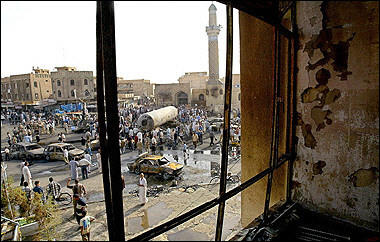
A small taste of what would happen if U.S. forces were to leave Iraq:


A general view of the square where a suicide bomber killed at least 60 people and wounded 85 in a massive fireball, when he blew himself up next to a liquefied gas tanker outside a Shiite mosque in the town of al-Mussayib, south of Baghdad. More than 110 Iraqis were killed and 300 wounded in a three day suicide bombing blitz as justice officials lifted the curtain on the trial of ousted dictator Saddam Hussein.(AFP/Ahmad al-Rubaye)

I Dare Call It Treason

The New York Times today reports on a CIA cover operation. Winds of Change summarizes:

Today’s New York Times provides intimate detail on the charter flights used by the CIA to ferry prisoners across the globe. The names of the charter companies are disclosed. The types of aircraft flown are revealed. The points of departure and destinations of these flights are stated. There is even a picture of one of the charter craft, with the identification number of the aircraft in full display.

All of this is extremely valuable to al Qaeda members who may have an interest in rescuing, or if deemed appropriate, conducting a suicide attack against suspected extraction flights. A successful attack resulting from this story can endanger the lives of CIA, security and civilian personnel involved in these missions, as well as deprive the intelligence and military communities of valuable information that can be gained from interrogations….

What exactly is the purpose of the New York Times in reporting on sensitive issues such as these? Do they even care about the consequences of making such information pubic? It appears the editors of the New York Times feel that breaking a titillating story about sensitive CIA operations is much more important than national security and the lives of those fighting in the war. All to our detriment.

If the Times‘s reporting isn’t “aid and comfort” to the enemy, I don’t know what is. As I wrote here:

The preservation of life and liberty necessarily requires a willingness to compromise on what — in the comfortable world of abstraction — seem to be inviolable principles. For example:

  • The First Amendment doesn’t grant anyone the right to go on the air to compromise a military operation by American forces…

The NYT article about a CIA operation being conducted in support of an authorized war amounts to the same thing. The right to publish cannot be absolute and should not exempt anyone from a charge of treason.

Getting It Right about Terrorism

This makes sense to me:

In Poverty, Political Freedom, and the Roots of Terrorism (NBER Working Paper No. 10859) Alberto Abadie…finds that the risk of terrorism is not significantly higher for poorer countries, once other country-specific characteristics are considered. In particular, Abadie finds that a country’s level of political freedom better explains the presence of terrorism….

After controlling for the level of political rights, fractionalization, and geography, Abadie concludes that per capita national income is not significantly associated with terrorism. He finds, though, that lower levels of political rights are linked to higher levels of terrorism[.] [C]ountries with the highest levels of political rights are also the countries that suffer the lowest levels of terrorism. However, the relationship between the level of political rights and terrorism is not a simple linear one. Countries in an intermediate range of political rights experience a greater risk of terrorism than countries either with a very high degree of political rights or than severely authoritarian countries with very low levels of political rights.

Why this relationship? Abadie offers two possibilities. “On the one hand, the repressive practices commonly adopted by autocratic regimes to eliminate political dissent may help [keep] terrorism at bay,” he explains. “On the other hand, intermediate levels of political freedom are often experienced during times of political transitions, when governments are weak, political instability is elevated, so conditions are favorable for the appearance of terrorism.”

(Thanks to EconoPundit for the pointer.)

What’s Your Point?

Apropos today’s scare in the air over D.C., Slate’s Timothy Noah writes:

[J]udging from past history the de facto procedure is that an airborne threat to the White House or the Capitol will not be shot down if doing so poses a meaningful risk that one or more bystanders will be killed. I applaud the policy. But if I’m able to figure this out, I have little doubt that al-Qaida figured it out long ago.

It ain’t necessarily so. A lot depends on the response (or non-response) of the pilot of an aircraft that ventures into the no-fly zone above Washington, D.C., as well as other information that might be gathered about an intrusive aircraft.

Yes, shooting down an intrusive aircraft might pose a risk of casualties and damage on the ground, but that risk must be weighed against the risk of a catastrophic strike on the White House, Capitol, or other symbol of American pride. The loss of such a symbol — and the disruption of government that might accompany it — would be far more damaging to America and Americans than the collateral damage from a shoot-down.

Perhaps Noah is cheering al-Qaida on, in the hope that it will again venture an airstrike against a prominent government building. It would be in keeping with his Leftist anti-Americanism.

Treasonous Blogging?

Tom W. Bell of Agoraphilia posts about and links to an article he has submitted to several law reviews. The title is of the article is “Treason, Technology, and Freedom of Expression.” Here are some excerpts of the abstract and concluding section:

The power to punish treason against the U.S. conflicts with the First Amendment freedoms of speech and of the press. Far from a question of mere theory, that conflict threatens to chill public dissent to the War on Terrorism….After World War II, the United States won several prosecutions against citizens who had engaged in propaganda on behalf of the Axis powers. Today, critics of the War on Terrorism likewise face accusations of treason. Under the law of treasonous expression developed following World War II, those accusations could credibly support prosecutions. Any such prosecutions could win convictions, moreover, unless courts narrow the law of treasonous expression to satisfy the First Amendment….

In terms of abstract doctrine, the law of treason condemns anyone who owes allegiance to the U.S., who adheres to U.S. enemies, and who gives them aid and comfort by an overt act to which two witnesses testify. As courts have applied that doctrine, however, it threatens any citizen or resident of the U.S. who publicly expresses disloyal sentiments. The Internet has made it cheap, easy, and dangerous to publish such sentiments….Even if no prosecutions for treason arise, the alarmingly broad yet ill-defined reach of the law of treason threatens to unconstitutionally chill innocent dissent….

As courts have interpreted it, the law of treason allows for the punishment of an indeterminate but wide range of disloyal public expressions that help enemies of the U.S. That interpretation both subverts the original meaning of the constitution’s treason clause and violates the strict scrutiny test applied to content-based restrictions on expression. To save the law from unconstitutionality, courts should in cases of treasonous expression interpret the “adhering to [U.S.] enemies” element of treason as nothing broader than “being employed by enemies of the U.S.” Perhaps courts should demand a still less restrictive variation on the law of treason. Perhaps they should do away with the law of treasonous expression altogether. At the least, though, they should limit liability for treasonous expression to defendants employed by enemies of the U.S. Anything broader than that would, by wounding our First Amendment rights, do far more to harm the U.S. than disloyal expressions would.

I disagree with the compromise position Bell offers in the final sentence. If it’s treason, it’s treason. An unpaid traitor can do just as much harm to the nation as can a paid traitor.

It would be better to do away with the law of treasonous expression altogether than to draw an arbitrary line between paid and unpaid traitors. If a person’s treachery goes no further than expressions of hatred for America or sympathy with America’s enemies, let that person suffer the consequences in the forum of public opinion.

We bloggers are already facing enough trouble, given the strong possibility that our freedom of expression may be throttled by the strict application of the McCain-Feingold Act. The last thing that we (bloggers) need is an inquisition into our views about the War on Terrorism.

I do detest the extremists of the left and right who portray America as the villain of the piece. But I defend their right to do so — as long as they aren’t doing it on my dime.

Why We Fight

December 7, 1941


September 11, 2001


I was far too young on December 7, 1941, to understand what had happened on that awful day in American history. I remember September 11, 2001, all too well.

I am not by nature an empathic person. But on the morning of September 11, 2001, I immediately empathized with those Americans who — 60 years earlier — must have felt the kind of shock, fear, and rage that I felt when I saw and learned what 19 vicious fanatics had unleashed in New York, Virginia, and Pennsylvania. Now we are engaged in a war — at home and abroad — against the comrades and supporters of those 19 vicious fanatics.

Some Americans support that war but question the way our government is pursuing it. Other Americans wonder why we are engaged in that war or whether it is worth the cost. I will not try to persuade either of those groups, nor will I call them names. My thoughts, today, are aimed at those who have supported the war and the way the government is pursuing it, but who may be beginning to waver in the face of what the press portrays as adversity.

Don’t lose heart. Don’t fall victim to the post-Vietnam syndrome of American defeatism. I will explain.

Vietnam was the wrong war, in the wrong place, at the wrong time. But once we had committed our forces there, we should have fought to win, regardless of the amount of force required for victory. Why? Because our ignominious withdrawal from Vietnam changed the national psyche — especially coming as it did within a generation of the stalemate in Korea. As a result of Vietnam, we went from believing that we could win any war we set our minds to win to believing that there wasn’t a war worth fighting.

Our (incomplete) victory in the Gulf War of 1991 came so quickly and at so little cost that it didn’t really reinvigorate America’s military self-confidence. Our 1999 bombing campaign in Kosovo succeeded only in showing our willingness to win a quick victory (if it was that) in a situation that posed little or no threat to American forces.

On the other hand, the new, defeatist American psyche — which most of the mainstream press has been striving for 30 years to perpetuate — manifested itself in our abrupt withdrawals from Lebanon (1983) and Somalia (1993) after the public saw “too many” body bags. Then there was our legalistic response to the 1993 World Trade Center bombing and our tepid military response to the 1998 bombings of the U.S. embassies in Kenya and Tanzania. The sum total of American actions in 1983, 1993, and 1998 — coupled with the obvious ascendancy of American defeatism — surely led Osama bin Laden to believe that he could accomplish his aims through a few spectacular terrorist attacks within the U.S., and the threat of more such attacks.

Thus, although we may be having a hard time in Iraq — and the hard time may continue for a while — we cannot back down. We must redouble our efforts to quell the insurgency and to build a stable Iraq. To do otherwise would be to admit that the American psyche remains defeatist. It would invite our enemies and potential enemies to take bold actions — if not directly against us, then against our interests around the world. We would find it harder and harder to fight back, diplomatically and militarily, against increasingly emboldened enemies and rivals — even if we had the will to fight back. Vital resources would become exorbitantly expensive to us, if we did not lose access to them altogether. America’s economic and military might would descend together, in a death spiral, and with them — very likely — the remnants of domestic civility.

And that is how bin Laden will destroy America, if he can. And that is why we must persevere in Iraq.

Some argue that such scenarios are so unrealistic as to be unthinkable. Well, that’s what English pacifists were saying about Hitler until 1939.

Then, there are those who profess to believe that America would be better off shorn of its economic and military might. They should reflect on the 1930s, when we were mired in the Great Depression and surrounded by a rising tide of totalitarianism.

Others, mimicking the one-worlders who dominated the conventional wisdom about foreign policy after the two world wars, suggest that our hubris foments hatred, hostility, and rivalry toward America . Their naïve notion — based on hope rather than reality — is that we would court less trouble and find more support by suppressing our sovereign pride and adapting our values, interests, and policies to those of “the international community.” Those who think that should consider this:

The sovereignty of the United States is inseparable from the benefits afforded Americans by the U.S. Constitution, most notably the enjoyment of civil liberties, the blessings of more-or-less free markets and free trade, and the protections of a common defense. To cede sovereignty is to risk the loss of those benefits….

Given the low estate of civil liberties and free markets in Europe — and most of the world — it is worth almost any price to preserve America’s sovereign independence, which is the bodyguard of America’s values and interests. The immediate price we must pay is the price of perseverance in Iraq.

Does the Constitution Allow This?

The First Amendment says that “Congress shall make no law…abridging the freedom of speech, or of the press….” Great stuff. I buy it. But then there’s this, from a story at latimes.com:

On the evening of Oct. 14, a young Marine spokesman near Fallouja appeared on CNN and made a dramatic announcement.

“Troops crossed the line of departure,” 1st Lt. Lyle Gilbert declared, using a common military expression signaling the start of a major campaign. “It’s going to be a long night.” CNN, which had been alerted to expect a major news development, reported that the long-awaited offensive to retake the Iraqi city of Fallouja had begun.

In fact, the Fallouja offensive would not kick off for another three weeks. Gilbert’s carefully worded announcement was an elaborate psychological operation — or “psy-op” — intended to dupe insurgents in Fallouja and allow U.S. commanders to see how guerrillas would react if they believed U.S. troops were entering the city, according to several Pentagon officials.

In the hours after the initial report, CNN’s Pentagon reporters were able to determine that the Fallouja operation had not, in fact, begun.

“As the story developed, we quickly made it clear to our viewers exactly what was going on in and around Fallouja,” CNN spokesman Matthew Furman said.

Officials at the Pentagon and other U.S. national security agencies said the CNN incident was not an isolated feint — the type used throughout history by armies to deceive their enemies — but part of a broad effort underway within the Bush administration to use information to its advantage in the war on terrorism….

Surely the viewers of CNN included our enemies, or persons friendly to them who passed along the information broadcast by CNN.

I know the arguments about undermining the credibility of the news media — and the government — by using the media to broadcast disinformation. But those are just arguments. The fact is that the U.S. is engaged in a legal war against a determined and ruthless enemy, and the use of disinformation is a time-honored tactic of warfare. Why not risk undermining the credibility of the media — to the extent that the media have much credibility left — if it helps to win the war?

Unless CNN’s report and the news story I’ve quoted are part of a disinformation campaign, it seems that media may be undermining the war effort by revealing particular instances of disinformation and giving the enemy hints as to the shape of our disinformation campaign.

That leads to my question: Is there an interpretation of the Constitution that would make it illegal for the media to publish information that compromises military operations?

ADDENDUM: If there is a compelling governmental interest in the regulation of political speech (i.e., campaign-finance “reform”) and a compelling governmental interest in allowing publicly funded universities to pursue “diversity” (a concept that I cannot find in the Constitution), why not a compelling governmental interest in the suppression of media reports that undermine the prosecution of a constitutional war?

I’m being provocative here because I hope to draw out my host and some of his readers on this issue.

Escalating the Netwar

Douglas Hanson, in “Netwar: The first battles” at The American Thinker, lays down some heavy fire on the Left and the press:

…A recent unclassified study by the Army’s Intelligence and Security Command predicted, in a conceptual sense, what we have witnessed in the information war during the [recent] political campaign. In concert with the guerilla war in Iraq against Coalition forces, the leadership of global Islamofascism has executed a well thought-out IW campaign, since they realize that the armed forces of Western civilization cannot be defeated on the battlefield….

Al Qaeda (AQ) understands well the concepts of information warfare (IW). They not only want to achieve information dominance, but also understand that Psychological Operations (PSYOPs) are a critical part of IW, so that they can influence the target population’s emotions and objective reasoning. But IW is normally waged within the confines of the theater of war and consists of targeting the enemy’s command and control apparatus and attempting to influence his soldiers involved in the fight. The new IW is different.

If AQ wants to target a civilian population beyond its normal area of influence, that is, outside of the Middle East and Central Asia, it must establish its own network of groups who share in AQ’s goals and objectives, and capitalize on the efforts of independent actors whose own goals and activities also unwittingly serve AQ’s ends. Simply put, AQ understands and practices Netwar, which according to the Army Intelligence and Security Command study is,

Information-related conflict at a grand level between nations or societies. It means trying to disrupt or damage what a target population knows or thinks it knows about itself and the world around it. A Netwar may focus on public or elite opinion, or both [emphasis mine]. It may involve diplomacy, propaganda and psychological campaigns, political and cultural subversion, deception of or interference with local media, infiltration of computer networks and databases, and efforts to promote dissident or opposition movements across computer networks.

The Netwar battlefield is not confined to the internet, it involves using the entire array of communication and information infrastructure of “open societies” to achieve victory over the US and the Coalition. Misdirection is a key tactic. Understand that the Islamofascists have, in fact, chosen Iraq as the key physical battlefield for the global jihad. This is why they have staked their Netwar campaign on operations to portray Operation Iraqi Freedom as a “distraction” from the War on Terror. We are hurting them badly, and they want the American left, the EU, the UN, and other actors of the so-called international community to make it stop….

…An average of polling data just before the election was showing a Bush victory, and the new video of Osama Bin Laden, promising peace and prosperity to Blue states and death and destruction to Red states, certainly didn’t help matters for the Democrats. If one listened closely to some of bin Laden’s words, a reasonable person might ask if he were parroting the talking points of the DNC. Clearly, this was bin Laden’s last ditch attempt at PSYOPs on the American electorate. Most Americans thankfully took it as a challenge, and concluded that we were not going to be dissuaded from our decision by threats. John Kerry, after thinking about it for more than a week following his defeat, blamed the bin Laden tape for his loss….

This last year has witnessed just the beginning of intense fights in the ongoing Netwar. After all, it’s the only hope for the terrorists’ cause. The outcome of our Armed Forces conventional battles against Islamofascism will never be in doubt, but the Netwar battles in the ether are just as critical in fighting the War on Terror….

Strong stuff. Stronger stuff omitted. Hanson goes over the top in practically accusing the Left and the press of complicity with the enemy. But there’s certainly nothing wrong with pointing out that the Left and the press, at times, advance the enemy’s cause. Free speech works in both directions.

Conservative Revisionism, Conservative Backlash, or Conservative Righteousness?

Cathy Young, writing from her libertarian perch at reasononline, asks “Why are conservatives trying to rehabilitate McCarthyism and the Japanese internment?” Young refers specifically to Michelle Malkin’s In Defense of Internment: The Case for “Racial Profiling” in World War II and the War on Terror and to Ann Coulter’s Treason.

I have yet to read either book (though I’ve followed the debate about Malkin’s), so I’ll defer to Young’s summary of their theses. She says of Malkin’s book:

Malkin believes our safety is being compromised because any common-sense proposal that involves profiling — be it extra-vigilant screening of Middle Eastern passengers at airports, targeted monitoring of visitors with guest visas from countries with terrorist links, or special scrutiny of Muslim chaplains in the armed forces — is shouted down by invoking the specter of internment camps.

That leads Malkin to a defense of the internment of Japanese-Americans who were living on the West Coast.

As for Coulter’s book, Young characterizes it as a

rehabilitation of Sen. Joseph McCarthy and a debunking of “the myth of ‘McCarthyism.’” McCarthy, Coulter proclaimed, was a true hero in the struggle against communism, and the only unjust persecution was that of Tail Gunner Joe himself by his left-wing, America-hating enemies.

Although she is unsympathetic (hostile, really) to Malkin and Coulter’s theses, Young seems to grasp their essential point:

Why the rush to defend what was only recently seen, across the political spectrum, as indefensible? Partly, it’s the sheer appeal and satisfaction of skewering sacred cows, liberal ones especially — and there are, God knows, so many that deserve skewering. Indeed, in the case of McCarthyism, the stubborn blindness of leftists and many liberals both to the brutality of the Soviet regime and to the extent of Soviet espionage during the Cold War undoubtedly helped create fertile ground for Coulter-style polemics.

A similar dynamic may be at work with the Japanese internment issue. Some of the history textbooks Malkin indignantly quotes probably do err on the side of dismissing all World War II-era concerns about subversive activities by Japanese ethnics as unfounded paranoia….

It is useful, too, to remember that defending the indefensible has long been a popular sport on the left, whose own revisionist historians are busy trying to sugarcoat not McCarthyism but Stalinism….

Also at work, however, is the dark side of modern American conservatism. The left’s obsession with America’s allegedly unique evilness, and in particular with real or imagined racism, has prompted a fully justified backlash. But that backlash can morph into an ugly and disturbing mind-set — one that regards all efforts to confront America’s past wrongs as the province of sissy liberals and wild-eyed lefties….

I agree with “fully justified backlash.” As for the notion that “all efforts to confront America’s past wrongs [are] the province of sissy liberals and wild-eyed lefties,” I’ll say that all efforts to blacken Americans as a benighted, racist, ravening pack of fundamentalist yahoos are, indeed, the province of liberals and lefties. Conservatives, for the most part, have done a pretty good job of confronting America’s past wrongs and moving beyond them.

On the substance of Coulter’s book, McCarthy was right, but his methods backfired and caused otherwise sensible people to conclude that the “witch hunt” was nothing more than that. From Wikipedia, here:

In 1995, when the VENONA transcripts were declassified, it was learned that regardless of the specific number, McCarthy consistently underestimated the extent of Soviet espionage. VENONA specifically references at least 349 people in the United States–including citizens, immigrants, and permanent residents–who cooperated in various ways with Soviet intelligence agencies.

It is generally believed that McCarthy had no access to VENONA intelligence, deriving his information from other sources. VENONA does confirm that some individuals investigated by McCarthy were indeed Soviet agents. For example, Mary Jane Keeney was identified by McCarthy simply as “a communist”; in fact she and her husband were both Soviet agents. Another individual named by McCarthy was Lauchlin Currie, a special assistant to President Roosevelt. He was confirmed by VENONA to be a Soviet Agent.

And here:

The VENONA documents, and the extent of their significance, were not made public until 1995. They show that the US and others were targeted in major espionage campaigns by the Soviet Union as early as 1942.

The decrypts include 349 individuals who were maintaining a covert relationship with the Soviet Union. It can be safely assumed that more than 349 agents were active, as that number is from a small sample of the total intercepted message traffic. Among those identified are Alger Hiss, believed to have been the agent “ALES”; Harry Dexter White, the second-highest official in the Treasury Department; Lauchlin Currie, a personal aide to Franklin Roosevelt; and Maurice Halperin, a section head in the Office of Strategic Services. Almost every military and diplomatic agency of any importance was compromised to some extent, including, of course, the Manhattan Project. Even today, the identities of fewer than half of the 349 agents are known with any certainty. Agents who were never identified include “Mole”, a senior Washington official who passed information on American diplomatic policy, and “Quantum”, a scientist on the Manhattan Project.

Some known spies, including Theodore Hall, were neither prosecuted nor publicly implicated, because the VENONA evidence against them could not be made public. VENONA evidence has also clarified the case of Ethel and Julius Rosenberg, making it clear that Julius was guilty of espionage while Ethel was guilty of cooperating, while also showing that their contributions to Soviet nuclear espionage were less important than was publicly alleged at the time. In fact, Ethel had been only an accomplice, and Julius’ information was probably not as valuable as that provided by sources like “Quantum” and “Pers” (both still unidentified.)

This is an extremely different picture from the one that which had developed over most of 50 years in the absence of solid evidence. While critics debate the identity of individual agents, the overall picture of infiltration is more difficult to refute. The release of the VENONA information has forced reevaluation of the Red Scare in the US….

Tell me, again, why I shouldn’t consider FDR a Soviet dupe and why McCarthy was merely a publicity-seeking loudmouth.

As for the internment (or exclusion) of Japanese-Americans, there’s this from Wikipedia:

The attack on Pearl Harbor on December 7, 1941 led many to suspect the Japanese were preparing a full-scale attack on the West Coast. Further attacks, such as the submarine shelling of a California oil refinery in 1942 redoubled these suspicions. Also, Japan’s rapid military conquest of much of Asia made their military machine seem to Americans frighteningly unstoppable. Civilian and military officials had concerns about the loyalty of the ethnic Japanese on the West Coast and considered them to be a security risk.

Critics of the exclusion argue that the military justification was unfounded, claiming that there are no cases of military espionage that were attributable to Japanese Americans. David Lowman has, however, asserted that the decryption of the MAGIC codes suggested to the military and political leaders at the time that there was a substantial spy network of Japanese Americans feeding information to the Japanese military. Lowman’s claims have been controversial with others pointing out that much of the information that the Japanese officials obtained may have come from public sources such as newspapers, and that communications by Japanese consular officials stating an attempt to recruit Japanese-Americans did not necessarily mean that those attempts were successful. However, historical revisionists who rely on Lowman’s claims point to his assertion that some of the intercepted messages specifically said that the information had come from Japanese-American spies. One captured Japanese officer who had graduated from UCLA, and spoke fluent English specifically reported attempting to cultivate contacts for such spying, as reported in a letter sent to Congressman Wallop of Wyoming by a serviceman.

Lieutentant Commander Kenneth Ringle, a naval intelligence officer tasked with evaluating the loyalty of the Japanese American population, estimated in a 1941 report to his superiors that “better than 90% of the Nisei [second generation] and 75% of the original immigrants were completely loyal to the United States.” A 1941 report prepared on President Roosevelt’s orders by Curtis B. Munson, special representative of the State Department, concluded that most Japanese nationals and “90 to 98 percent” of Japanese American citizens were loyal. He wrote: “There is no Japanese `problem’ on the Coast … There is far more danger from Communists and people of the Bridges type on the Coast than there is from Japanese.”

Historical revisionists state that approximately 20,000 Japanese-Americans in Japan at the start of the war joined the Japanese war effort, and hundreds joined the Japanese Army. They also state that Tomoya Kawakita, an American citizen who worked as an interpreter and a POW guard for the Japanese army, actively participated in the torture (and at least one death) of American soldiers, including survivors of the Bataan Death March.

In January 25, 1942 the Secretary of War reported that “on the Pacific coast not a single ship had sailed from our Pacific ports without being subsequently attacked”. Due to this, espionage was suspected.

In addition to espionage, there was also concern that in the event of an invasion there could be sabotage of both military and civilian facilities inside the United States. Military officials expressed concerns that California’s water systems were highly vulnerable, and there were concerns about the possibility of arson, brush fires in particular….

In early 1944, the government began clearing individuals to return to the West Coast; on January 2, 1945, the exclusion order was rescinded entirely. The internees then began to leave the camps to rebuild their lives at home, although the relocation camps remained open for residents who weren’t ready to make the move back. The fact that this occurred long before the Japanese surrender (see V-J day), while the war was arguably at its most vicious, weighs heavily against the claim that the relocation was an essential security measure….

However, the outcome of the war in the Pacific had ceased to be in doubt since the Battle of Midway, which

took place on June 5, 1942 [when] [t]he United States Navy defeated a Japanese attack against Midway Atoll, marking a turning point in the war in the Pacific theatre….

…The loss of four carriers stopped the expansion of the Japanese Empire in the Pacific, and put Japan on the defensive. It had been six months to the day since the attack on Pearl Harbor. Admiral Yamamoto had predicted to his superiors that Japan would prevail for only six months to a year against the United States, after which American resources would begin to overwhelm the Japanese Navy. He had been exactly correct….

Thus, by 1944, Japanese forces were in vicious retreat, a threat to Allied forces but no longer a threat to the American homeland.

War (hot or cold) is not an academic debate. It is a life-and-death struggle, conducted in the midst of great uncertainty, without a lot of second chances. It is better to act somewhat rashly than not to act at all; the enemy whose life (or feelings) you spare will rise up to stab you in the back.

Wars aren’t won by scrupulous self-doubters, they’re won by the bold and brave. I want Malkin and Coulter on my side in the heat of battle, not a bunch of liberals, lefties, and libertarian doves.

Setting the Record Straight

The Last Amazon corrects Osama bin Laden Moore’s rewriting of history, with a vengeance. Here’s where she starts:

In Osama bin Laden’s latest video release he said something that piqued my interest. He stated that is was the behaviour of the American 6th Fleet in Lebanon in 1982 that inspired him to attack Americans. I could have sworn that originally Osama bin Laden and Al Qaeda declared war against America because American infidel soldiers were being based in Saudi Arabia and polluting the sacred soil, but hey, never let it be said that I cannot go with the flow.

She then rips into bin Laden Moore’s fabrication, at length, leaving his story in tatters. Read the whole thing.

Can He Be Serious?

Thomas P.M. Barnett — self-styled strategic planner — has reacted to the latest bin Laden tape by posting this:

Not so much a warning as yet another offer of civilizational apartheid. Last spring Osama told Europeans they had 90 days to leave the Middle East or he promised to have all of them still there killed–one by one. This time he sounds a far softer note, in effect telling Americans it doesn’t matter who wins the election, there will be no peace until America “respects” the security of Muslim states in the region: “Any state that does not mess with our security, has naturally guaranteed its own security.”…

Take Osama’s offer, America. In your heart, you know he’s right . . . about us. We’re a selfish, greedy country, full of guns and self-hating polemicists. We’re not built for this long-haul conflict. We just got lucky on the Cold War because it was led by the Greatest Generation. We don’t have that leadership now because we don’t want that leadership now. Bush is the most polarizing president in anyone’s memory, beginning to eclipse Nixon with this campaign. Neither he nor Kerry could ever hope to rule over anything but a severely divided and self-doubting nation after this election.

Take Osama’s offer, America. Let the self-healing truly begin.

Is he serious? Perhaps. There’s this:

If Kerry wins, it’ll be put up or shut up on Iraq, and most European experts expect a booming silence from the Old Continent come 3 November if winner Kerry starts speed-dialing his chums across the pond.

I think the last prognosis is a bit gloomy, reelecting the European tendency to want to weasel out of any difficult job as quickly as possible (but understanding their reticence on this one because it’s completely our doing). I don’t think Europe stonewalls Kerry because it really would create a backlash–hence the depressive fear of a Kerry win (Mon Dieu! Now we must actually help the Americans!).

Plus, I don’t think the price tag the Europeans assume will be so hard for us to meet will actually be that hard to meet. Here’s the list from the editor of Die Zeit, the hugely influential German paper:

(1) After Abu Ghraib, we have to promise to the world that we’ll be more careful in following the Geneva Conventions [Hell, I’ll throw in an apology if they’d like]

(2) That we work to dramatically reduce our own nuclear stockpile at home and not just tell others to stay away from WMD [Wow, that one would be really hard, wouldn’t it?]

(3) That we enter into serious discussions on how to fix Kyoto [Easy, get India and China into the treaty]

(4) “a return to a less arrogant tone of conversation” [Again, not exactly stressing]

That’s it! That’s the entire list to get Europe to come to the aid of the US in Iraq!

Tell me any of those is hard for Kerry, then tell me Bush is capable of making any of them happen.

And this:

…My point is this: the strategic despair is on our side (our troops decry: “My God, there’s too many of them to kill, we’ll never get the job done!”), when it should be on our opponents’ side (“My Allah, there’s too many of them to kill, we’ll never get the job done!”). So guess who’s talking about pullout and who’s talking about jacking up the effort?

The only way we effectively jack up the effort is to internationalize the military occupation force dramatically, plussing up our total numbers hugely. That’s how we’ll create strategic despair on their side: filling our ranks with New Core troops who have a long and bloody history of killing Muslims. We can generate that strategic despair in the minds of the terrorists fielding a team of almost exclusively European-descent countries. We need to change the occidental skin tone of this force and fast. Otherwise the terrorists think all they need do is wait out the Americans just like they waited out the Sovs in Afghanistan.

Any other talk of getting more aggressive in Iraq is complete bullshit. Ask any knowledgeable military officer who’s been there: there is no military solution to this situation—only a political one.

The question of this election is—therefore—who will get you that solution fastest and at the lowest cost? A nuanced and deal-cutting Kerry or the steadfast and full-of-certitude Bush?

That may well be the choice between winning and losing in Iraq.

And this:

…Here’s the interesting conclusion on foreign policy from these two*: they see the neocons as being a spent force, so the real question for Bush II is who rules the roost: the social conservatives or the anti-gov types?

My point is this: either way it goes, this administration will be sorely restricted in its ability to continue this global war on terrorism. That’s why I know Kerry will do better: not just the change in his tone, but the leeway offered within his party.

There’s a brilliant, all-knowing “strategic” planner for you. The world and its workings can be explained in glib, assured — if defeatist — tones. Barnett must be hoping for a slot in a Kerry administration,** so that he can wave his magic wand and transform the world into a place where Americans are beloved by Euro-snobs and Islamofascists. It’s all so easy to do — just surrender.

__________

* “‘Bushism’: This president has remade the politics of the right,” op-ed by John Micklethwait and Adrian Wooldridge, Wall Street Journal, 27 October 2004, p. A16.

** Or as a script writer for “The West Wing” — where every problem, no matter how complex or irrelvant to the legitimate functions of government, can be solved in an hour (including commercials) by wise, all-knowing, all-seeing President Bartlett and his merry band of genii.

Left-Wing Logic at Work

Lambert at corrente opines:

If OBL says 9/11 and Iraq have nothing to do with each other, and Kerry says 9/11 and Iraq have nothing to do with each other… That makes OBL and Kerry moral equivalents, right?

No, it simply shows that Lambert is stupid if not duplicitous. Osama admitted responsibility for 9/11 (no news there), but he didn’t say that it happened without help from others.

Nor does the case for regime change in Iraq hinge on Iraq’s degree of involvement in 9/11. The invasion of Iraq was — and is — a means of removing an avowed enemy of the U.S. and gaining a base in the Middle East. If Bush wins re-election, watch the dominos fall in Syria and Iran — both of which are assuredly sponsors of terrorism.

P.S.

It’s obvious that Osama favors a Kerry victory. Why else would he go to such lengths to try to discredit Bush and remind American voters that the “choice” is ours?

Does that equate Osama and the American left? It would by the left’s vilely strident, anti-war, anti-Bush rhetoric. But I won’t stoop to the left’s level of illogic. I’ll say only that some on the left sympathize with Osama’s ends and means because they’re essentially acting out a form of adolescent rebellion.

Osama Parrots Michael Moore

In the newly released videotape bin Laden also says (via Drudge):

[W]e never thought that the high commander of the US armies would leave 50 thousand of his citizens in both towers to face the horrors by themselves when they most needed him because it seemed to distract his attention from listening to the girl telling him about her goat butting was more important than paying attention to airplanes butting the towers which gave us three times the time to execute the operation thank god.

What was Bush supposed to do, don his Superman outfit, fly instantly to Metropolis, and perch all 50,000 (?) citizens on his shoulders? Or was he supposed to start barking orders left and right, without detailed knowledge of events on the ground and in the air? By the time he had learned all there was to know, it would have been too late to start giving orders.

In this country, we don’t wait for Allah or Premier Stalin to tell us what to do. We rely on free individuals and institutions to do the best they can do with the resources at their disposal.* That concept seems to be beyond the ken of religious and irreligious fanatics like bin Laden and Moore.

__________

* If the FAA and armed forces of the United States were less prepared for 9/11 than they might have been, the blame rests with Clinton as much as anyone. What was he doing on the morning of 9/11, and with whom was he doing it?

Bin Laden Threatens SUV Owners

That’s one of the implications of the newly released videotape made by bin Laden (or an actor), somewhere, sometime since the Dems nominated Kerry. Via Drudge, bin Laden says:

Your security is not in the hands of Kerry or Bush or Al Qaeda. Your security is in your hands. Each state that doesn’t mess with our security has automatically secured their security.

In other words, America should get out of the oil-pumping lands of the Middle East and al Qaida will leave America alone.

I’m sure there are many left-leaners and pseudo-pacifists out there who 1) are ready to believe bin Laden and 2) ready to do the deal. Before they consider it seriously, however, they ought to think of what would happen to the price of oil and the state of the U.S. economy if we were simply to abandon the Middle East to bin Laden and his thugs.

Hundred of billions for defense, not one cent for tribute.