Comrade Gorbachev, Sore Loser

Mikhail sez:

At a meeting with foreign reporters this week, Gorbachev blamed the United States for losing a chance to build a safer and more stable world following the Soviet demise.

“Ending the Cold War was given as a gift” to the United States. . . .

Right.The fact that you couldn’t afford to keep up with the U.S., militarily, had nothing to do with it, eh?

The Associated Press, of course, refuses to credit Ronald Reagan, the man who make Mikhail cry “uncle” — describing Gorby as

[t]he man who ended the Cold War and launched democratic reforms that broke the repressive Soviet regime . . .

The press, for the most part, opposed Reagan’s defense buildup because (in the press’s view) it was certain to lead to war with the USSR. The buildup had just the opposite — and intended — effect of ending the threat of war with the USSR. But rather than admit that, the press likes to pretend that the end of the Cold War was Gorbachev’s doing. It’s like saying that James J. Braddock was responsible for Joe Louis’s acsencdancy to the heavyweight boxing championship.*
___________
* For those of you who don’t know about Joe Louis’s career, he won the heavyweight championship on June 22, 1937, by knocking out Braddock (the defending champ) in the eighth round of their title fight.

Rating the Presidents, Again

Almost two years ago I commented on ratings of the presidents that were published at OpinionJournal. My own ratings were implicit in my comments, but I didn’t finish the job and produce a top-to-bottom list of presidents. David N. Mayer (MayerBlog) has done so, and done it with brilliance — here. The post is quite long, as Mayer’s posts usually are, and every bit as rewarding. You should read the whole thing, but I cannot resist the urge to give you a preview.

Mayer notes that his “rating system differs from others in deemphasizing “leadership” per se and instead emphasizing fidelity to the Constitution.” By that standard his “Great” presidents are Washington, Jefferson and Lincoln. His “Failures” comprise, in descending order, Theodore Roosevelt and Woodrow Wilson (tie), Franklin Roosevelt, Lyndon Johnson, Richard Nixon, and (last and least) Bill Clinton. I find no fault with Mayer’s rating scheme or his results.

Mayer’s designation of Lincoln as a “Great” will rankle many libertarians, especially the anarcho-capitalists who hang around the Ludwig von Mises Institute and LewRockwell.com. (My latest disparagement of their anarcho-romanticism is here. See also this piece about slavery.) Mayer says of Lincoln:

[H]e does not warrant the severe criticism that certain libertarian scholars have given him, calling him “tyrant” or “dictator” and erroneously claiming that the modern regulatory/welfare state began with the Civil War. Rather, I maintain, Lincoln did indeed save not only the Union but also the Constitution itself, from the most formidable internal threat it has ever (yet) faced.

In the end, what matters most is whether a president preserves liberty, and even advances it. How he does it is less important than whether or not he does it.

Finally, happy 274th birthday to George Washington.


Source: Wikipedia.

Happy Birthday, Mr. Lincoln

In observance of the 197th anniversary of Abraham Lincoln’s birth, I am reproducing two earlier posts.

The Young Mr. Lincoln

Thanks to American Digest, I found an article by Claude N. Frechette, M.D., “A New Lincoln Image: A Forensic Study,” in which Dr. Frechette documents his authentication of an early daguerreotype of Abraham Lincoln.

Believe it or not — and I believe it after having read Dr. Frechette’s article — the following image is that of Abraham Lincoln in the early 1840s, when he was in his early 30s:

The next image, about which there was no controversy, is that of Lincoln in 1848 at the age of 39:

Finally, we see Lincoln in 1862 at the age of 53:


Lincoln, the Poet President

Abraham Lincoln ended his First Inaugural Address (March 4, 1861) with these words:

We are not enemies, but friends. We must not be enemies. Though passion may have strained it must not break our bonds of affection. The mystic chords of memory, stretching from every battlefield and patriot grave to every living heart and hearthstone all over this broad land, will yet swell the chorus of the Union, when again touched, as surely they will be, by the better angels of our nature.

Lincoln’s Gettysburg Address (November 19, 1863) is no less majestic:

…we can not dedicate—we can not consecrate—we can not hallow—this ground. The brave men, living and dead, who struggled here, have consecrated it, far above our poor power to add or detract. The world will little note, nor long remember what we say here, but it can never forget what they did here. It is for us the living, rather, to be dedicated here to the unfinished work which they who fought here have thus far so nobly advanced. It is rather for us to be here dedicated to the great task remaining before us—that from these honored dead we take increased devotion to that cause for which they gave the last full measure of devotion—that we here highly resolve that these dead shall not have died in vain—that this nation, under God, shall have a new birth of freedom—and that government of the people, by the people, for the people, shall not perish from the earth.

Lincoln’s poetry soared again in his Second Inaugural Address (March 4, 1865), weeks before Lee surrendered to Grant (April 9, 1865):

Fondly do we hope, fervently do we pray, that this mighty scourge of war may speedily pass away. Yet, if God wills that it continue until all the wealth piled by the bondsman’s two hundred and fifty years of unrequited toil shall be sunk, and until every drop of blood drawn with the lash shall be paid by another drawn with the sword, as was said three thousand years ago, so still it must be said “the judgments of the Lord are true and righteous altogether.”

With malice toward none, with charity for all, with firmness in the right as God gives us to see the right, let us strive on to finish the work we are in, to bind up the nation’s wounds, to care for him who shall have borne the battle and for his widow and his orphan, to do all which may achieve and cherish a just and lasting peace among ourselves and with all nations.

Let us indeed strive on to finish the work we are in, and — as is our custom — make peace with former enemies who seek peace, while remaining vigilant against those who wish us harm.

Time on the Cross, Re-revisited

There has been endless debate as to whether or not the American Civil War was fought over slavery. My own view is that the Civil War was about slavery, in a roundabout way:

  • The mainly agrarian South wanted low tariffs on manufactured goods because high tariffs meant that Southerners had to pay higher prices for manufactured goods. The North wanted high tariffs to protect its new manufacturing industries.
  • Slave labor was fundamental to Southern agrarianism. Abolition was largely a Northern phenomenon.
  • Anti-Northern feelings among Southern elites had been running high for decades. With the rise of the Republican Party, Southerners faced not only the continued prospect of Northern economic dominance but also the prospect that slavery would be abolished. In sum, the election of Abraham Lincoln posed an imminent threat to the Southern “way of life.”
  • War then was inevitable, given the South’s aversion to the North’s economic and abolitionist agenda, on the one hand, and Lincoln’s determination to preserve the Union, on the other hand.

The North’s victory in the Civil War meant an end to slavery in the United States, even though ending slavery was, in Lincoln’s view, secondary to preserving the Union. According to one account of a failed peace parley in January 1865 — an account that is somewhat disingenuous about the South’s interest in preserving slavery — Lincoln

stated that it was never his intention to interfere with slavery in the states where it already existed and he would not have done so during the war, except that it became a military necessity. He had always been in favor of prohibiting the extension of slavery into the territories but never thought immediate emancipation in the states where it already existed was practical. He thought there would be “many evils attending” the immediate ending of slavery in those states.

Be that as it may, the government of the United States did take advantage of the Civil War to eradicate slavery, first partially through the Emancipation Proclamation, then fully through the Thirteenth, Fourteenth, and Fifteenth Amendments to the Constitution.

Slavery’s demise, as a byproduct of the Civil War, raises two questions:

  • Would slavery have been ended peacefully?
  • Is slavery an indelible stain on American history?

Would Slavery Have Been Ended Peacefully?

There are those who argue that if the North had fought the Civil War over slavery, it had fought an unnecessary war because economic forces would eventually have put an end to slavery. There are others who argue that slavery would not have succumbed to economic forces. Crucial to the debate between the two camps is the validity (or invalidity) of Robert Fogel and Stanley Engerman’s cliometric study, Time on the Cross: The Economics of American Negro Slavery (1974), which makes a case that slavery would not have succumbed to economic forces. Fogel and Engerman’s study, however, is fraught with errors. Thomas J. DiLorenzo explains some of those errors:

. . . Fogel and Engerman’s . . . reliance on . . . the price of slaves . . . as “evidence” that slavery could not have been ended peacefully is poor economics. . . . For one thing, the Fugitive Slave Act socialized the enforcement costs of slavery, thereby artificially inflating slave prices. Abolition of the Act, as would have been the reality had the Southern states been allowed to leave in peace would have caused slave prices to plummet and quickened the institution’s demise. That, coupled with a serious effort to do what every nation on the face of the earth did to end slavery during the nineteenth century – compensated emancipation – could have ended slavery peacefully. Great Britain did it in just six years time, and Americans could have followed their lead.. . .

[T]he high price of slaves . . . in 1860 created strong incentives for Southern farmers to find substitutes in the form of free labor and mechanized agriculture. It also increased the expected profitability of mechanized agriculture, so that the producers of that equipment were motivated to develop and market it in the South. This is what happens in any industry where there are rapidly-rising prices of factors of production of any kind. As Mark Thornton wrote in “Slavery, Profitability, and the Market Process” (Review of Austrian Economics, vol. 7, No. 2, 1994), by 1860 “slavery was fleeing from both the competition of free labor and urbanization towards the isolated virgin lands of the Southwest.” Gunderson does not cite any literature past 1974 on this point, so he is probably unaware of such facts.

[T]here is a difference between slave labor being “efficient” for the slave owner and its effect on society as a whole. Of course slavery was profitable to slave owners. This government-supported system helped them confiscate the fruits of the slaves’ labor. But since slave labor is inherently less efficient than free labor, and since so many resources had to be devoted to enforcing the system — most of which were the result of government interventions such as the Fugitive Slave Act, mandatory slave patrol laws, and laws that prohibited manumission — the system imposed huge burdens (“dead weight loss,” in the language of economics) on the rest of society. Free laborers and non-slave owners in the South (at least 80 percent of the adult population) were the primary victims of these government-imposed costs, and would have been a natural political constituency for their eventual abolition. As Hummel concluded, “In real terms, the entire southern economy, including both whites and blacks, was less prosperous” overall because of slavery.

There was net internal migration from South to North, confirming the fact that free laborers in the South were also indirectly exploited by the slave system which forced them into lower-paying jobs. . . .

DiLorenzo — an anarcho-libertarian who despises Abraham Lincoln and is rabidly pro-secession (column archive) — may strike you as a biased source, even though he seems to have facts and logic on his side, in this instance. But we need not rely on DiLorenzo. Fogel and Engerman’s thesis has been attacked, on its merits, from many quarters. Here, for example, are excerpts of a review essay by Thomas L. Haskell, “The True and Tragical History of ‘Time on the Cross’ ” (fee required), from The New York Review of Books (October 2, 1975):

The flaws of Time on the Cross are not confined to its parts but extend to its conceptual heart: the efficiency calculation. No finding raised more eyebrows than the dramatic claim that slaves, through their personal diligence and enthusiastic commitment to the work ethic, made southern agriculture 35 percent more efficient than the family farms of the North. My own nonspecialist’s doubts about this contention . . . have been amply confirmed (and superseded in expertise and weight of evidence) by the work of a half-dozen economic historians.

Fogel and Engerman should have known from the beginning that any comparison of regional efficiency in the antebellum period was fraught with breathtaking difficulties. The basis for their comparison, a rather controversial economist’s tool known as the “geometric index of total factor productivity,” gives results whose interpretation is debatable in even the most conventional applications. . . .

Since the index is based on market value it reflects not only the performance of producers (which is what we have in mind when we talk about productive efficiency) but also the behavior of consumers, whose eagerness for the product helps to determine its market value. Consumer behavior is clearly irrelevant to productive efficiency and the index is misleading to the extent that it is influenced by this factor.

In short, the index is sensitive to demand: if two producers organize their work in equally rational ways, work equally hard, and even produce equal amounts of physical output, the so-called “efficiency” index may nonetheless rank one producer more “efficient” than the other because his product is in greater demand. As David and Temin observe, this is not the accepted meaning of “efficiency.”

Given the sensitivity of the index to demand and the heavy demand for the South’s principal crop, cotton, the index by itself is utterly incapable of justifying the chief inference that Fogel and Engerman drew from it—that slaves must have been hard-working Horatio Alger types and their masters skilled scientific managers. Gavin Wright confirms that the efficiency gap has more to do with voracious consumer demand for cotton than with any Herculean feats of productivity by southern producers. . . .

The bias introduced by cotton demand is only the most obvious of the flaws in the efficiency calculation. Even apart from the inherent frailties of the index in this especially difficult application, Fogel and Engerman’s use of it rests on some extremely dubious assumptions. The choice of 1860 as a typical year for measurement has been sharply questioned. So has the authors’ proposition that an acre of northern farmland was on average 2.5 times better in quality than southern farmland. This extraordinary assumption alone is enough to guarantee a finding of southern superiority in productivity. . . .

Lance Davis of the California Institute of Technology, a prominent cliometrician, singled out the efficiency calculation as the least plausible argument of a generally unpersuasive book. He estimated that Fogel and Engerman’s chances of successfully defending the efficiency finding were about one in ten. This is a telling judgment from the man who introduced the term “New Economic History,” who once called Fogel’s railroad study a “great book,” and who even crowned Fogel himself as “the best” of the cliometricians nine years ago. The efficiency calculation has been closely scrutinized not only by Davis, Wright, Temin, and Paul David, but also by Stanley Lebergott of Wesleyan, Harold Woodman of Purdue, Jay Mandle of Temple, and Frank B. Tipton, Jr. and Clarence E. Walker, both of Wesleyan. No one has a kind word to say for it.

Haskell certainly wasn’t offering an apology for slavery or for any other form of oppression. Nor am I. Slavery was evil, but it existed. The question facing our forbears was how best to eradicate it and then improve the lot of those who had been enslaved. With the advantage of hindsight a case can be made that America’s blacks would be better off today if their ancestors had been freed and integrated into society voluntarily — through economic forces if not social ones. But that is merely hindsight. Regardless of Lincoln’s motivation for prosecuting the Civil War, that war brought an end to slavery. And that — thankfully — is that.

Moreover, Lincoln-hater DiLorenzo gives us good reason to believe that slavery would have died hard in the South. DiLorenzo wants the best of both worlds. He wants to prove that the Civil War was not fought (by the North) because of slavery, and also to prove that the Civil War was fought (by the North) unnecessarily because economic forces would have put an (eventual) end to slavery. The second proposition is inconsistent with the first. DiLorenzo’s inconsistency arises because he is a pro-secessionist who also has the good grace to oppose slavery. He must therefore resort to alternative history in order to justify his secessionist views. His alternative history (sampled above) is that economic forces would have brought an end to slavery in the South, absent the Civil War. But would they have done so? Perhaps eventually, but not for an unconscionably long time.

Economic forces arise from human nature. One facet of human nature is a “taste” that manifests itself in the oppression of “inferior” races (e.g., blacks, Jews, Tutsis, Hutus). Such a “taste” can override “rational” (i.e., wealth-maximizing) forces. The post-Civil War history of race in the South suggests very strongly that slavery would have died hard in the South. Thomas Sowell examines a slice of that history:

The death of Rosa Parks has reminded us of her place in history, as the black woman whose refusal to give up her seat on a bus to a white man, in accordance with the Jim Crow laws of Alabama, became the spark that ignited the civil rights movement of the 1950s and 1960s.

Most people do not know the rest of the story, however. Why was there racially segregated seating on public transportation in the first place? “Racism” some will say — and there was certainly plenty of racism in the South, going back for centuries. But racially segregated seating on streetcars and buses in the South did not go back for centuries.

Far from existing from time immemorial, as many have assumed, racially segregated seating in public transportation began in the South in the late 19th and early 20th centuries.

Those who see government as the solution to social problems may be surprised to learn that it was government which created this problem. Many, if not most, municipal transit systems were privately owned in the 19th century and the private owners of these systems had no incentive to segregate the races.

These owners may have been racists themselves but they were in business to make a profit — and you don’t make a profit by alienating a lot of your customers. There was not enough market demand for Jim Crow seating on municipal transit to bring it about.

It was politics that segregated the races because the incentives of the political process are different from the incentives of the economic process. Both blacks and whites spent money to ride the buses but, after the disenfranchisement of black voters in the late 19th and early 20th century, only whites counted in the political process.

It was not necessary for an overwhelming majority of the white voters to demand racial segregation. If some did and the others didn’t care, that was sufficient politically, because what blacks wanted did not count politically after they lost the vote.

The incentives of the economic system and the incentives of the political system were not only different, they clashed. . . .

The “incentives of the political system” — a “taste” for racial oppression, in other words — dominated Southern politics until the 1960s. And that was in a defeated South. The determination of Southern political leaders to defend slavery in the first place, and then to salvage the remnants of slavery through Jim Crow, is strong evidence that economic forces might not have been allowed to operate freely in the South, at least not for a long time. The evil (take note, Mr. DiLorenzo) was to be found in Southern political leaders, not in the White House.

Opponents of slavery, unarmed as they were with “sophisticated” (and flawed) cliometric techniques, saw the evil in slavery and eradicated it when they had the opportunity to do so. Uncertain gradualism in the defense of liberty is no virtue. Opportunistic abolitionism in the defense of liberty is far from a vice.

The Stain of Slavery

The fact that slavery existed in the United States for so long is taken by some — especially those of the Left, here and abroad — as evidence that white-male-capitalist-dominated-America is evil incarnate. But slavery in the United States was ended when white, male capitalists still dominated America, whereas slavery still exists in non-white areas of the world.

Strident critics of the United States nevertheless persist in saying that the existence in the United States of slavery (or any other “evil,” real or imagined) means that the U.S. was and is no better than, say, the fascistic Third Reich. (Leftists don’t like to remind us about the longer-lived and equally fascistic USSR.) Such assertions studiously ignore the fact that most Americans always have been freer than the subjects of Hitler and Stalin. The economic forces that could eventually have brought an end to slavery in the United States would not have been allowed to operate in Nazi Germany or the Soviet Union — or in Communist China, Cuba, Saddam’s Iraq, North Korea, and other dictatorial regimes of the kind that Leftists often have defended and even idealized as “progressive” and even “freedom-loving.” Nor should it go without notice that Nazi Germany and the USSR met their demise at the hands of the “militaristic” United States.

It is supremely ironic that Leftists — who like to attack the United States as “fascistic” and “militaristic” — are proponents of government interventions in private affairs that are confiscatory and stultifying in their effects on economic output. All working persons in the United States — and all who depend on them — are in thrall to the “plantation owners” who run our affairs from the Capitol in Washington, the various State capitols, and sundry municipal buildings. The Left applauds that thralldom and agitates for its intensification.

Yes, the fact that slavery existed in the United States for so long is a stain on the history of the United States, but it is not an indelible stain. To err is human, which must come as news to the Left, with its penchant for judging its enemies (mainly conservative, white, American males) by superhuman standards of conduct, while seeking to impose its utopian social and economic order through the power of the state. The Left’s cynicism stands in stark contrast to the vision of the Framers, who sought “a more perfect Union” by enabling the free exchange of ideas and goods.

Celebrating My Heritage

In keeping with the spirit of the day, I celebrate my heritage and take pride in these, my biological (though not actual) kinsmen, who are pictured from top to bottom, as follows:

Marquis de Condorcet (French)
Johann Sebastian Bach (Saxon)
Edmund Burke (British)
Chief Stone Child, a.k.a. “Rocky Boy” (Chippewa)


(All images courtesy of Wikipedia.)

Ethics and the Socialist Agenda

UPDATE BELOW, 12/29/05

From a story in the L.A. Times (get an ID and password from bugmenot.com):

“This letter is for yourself alone,” [reads a letter written by Upton Sinclair to his attorney on Sept. 29, 1929]. “Stick it away in your safe, and some time in the far distant future the world may know the real truth about the matter. I am here trying to make plain my own part in the story.”

The story was “Boston,” Sinclair’s 1920s novelized condemnation of the trial and execution of Nicola Sacco and Bartolomeo Vanzetti, Italian immigrants accused of killing two men in the robbery of a Massachusetts shoe factory.

Prosecutors characterized the anarchists as ruthless killers who had used the money to bankroll antigovernment bombings and deserved to die. Sinclair thought the pair were innocent and being railroaded because of their political views.

Soon Sinclair would learn something that filled him with doubt. During his research for “Boston,” Sinclair met with Fred Moore, the men’s attorney, in a Denver motel room. Moore “sent me into a panic,” Sinclair wrote in the typed letter that Hegness found at the auction a decade ago.

“Alone in a hotel room with Fred, I begged him to tell me the full truth,” Sinclair wrote. ” … He then told me that the men were guilty, and he told me in every detail how he had framed a set of alibis for them.” . . .

Upton Beall Sinclair was a giant of the nation’s Progressive Era, a crusading writer and socialist who championed the downtrodden and persecuted. President Theodore Roosevelt, who pushed through the nation’s first food-purity laws in response to “The Jungle,” coined the name for Sinclair’s craft: muckraker. . . .

“I faced the most difficult ethical problem of my life at that point,” [Sinclair] wrote to his attorney. “I had come to Boston with the announcement that I was going to write the truth about the case.”

Other letters tucked away in the Indiana archive illuminate why one of America’s most strident truth tellers kept his reservations to himself. . . .

He also worried that revealing what he had been told would cost him readers. “It is much better copy as a naïve defense of Sacco and Vanzetti because this is what all my foreign readers expect, and they are 90% of my public,” he wrote to Minor.

It surpriseth me not. Sinclair was a role model for today’s Left-leaning media. What other lies did Sinclair tell in order to advance the “progressive” (i.e., socialist) cause?

UPDATE: This is from a post by Eugene Volokh at The Volokh Conspiracy:

The ACLU’s founding director and likely most influential official, Roger Baldwin, had long been an admitted supporter of communism as an economic system, and on balance an apologist for the Soviet Union. Though he criticized the Soviets at times, he had also praised the USSR as on balance a haven for liberty. His true break with the Soviets (which ultimately brought him around to pretty vociferous anti-Communism) came not with Stalin’s ascent, not with the Ukrainian famine, not with the Terror and the show trials — he defended the Soviets even after that — but only in 1939, with the Molotov-Ribbentrop pact.

On top of that, Baldwin was on the record as having said that his commitment to civil liberties for supposed reactionaries was sheerly instrumental, just a tool for advancing the cause of communism. His struggle for free speech, he said, was just incidental to the class struggle, a useful tactic for furthering communist goals. When the working class took over, the resulting regime should be supported by any means necessary, including dictatorship. Dictatorship and suppression of civil liberties would be necessary to get to a socialist society, so such suppression is justified. That was the position of the founding director of the ACLU.

A 32-Year Error

An otherwise spot-on post about 12/12 Democrats* opens with this chronological error:

Today marks the fifth anniversary of the birth of the wing of the Democratic Party which now controls the party apparatus. And while the leaders of that wing do not speak all Democrats, they have become the face (and voice) of the Democratic Party in President George W. Bush’s second term.

The Democrat Party began its veer to the hard left in 1968, with Eugene McCarthy’s anti-war candidacy. McCarthy didn’t win the party’s nomination that year, but his strong showing made reflexive anti-war rhetoric a respectable staple of Democrat discourse.

The Democrats proceeded in 1972 to nominate George McGovern, who seems moderate only by contrast with Ramsey Clark and Michael Moore. Since McGovern’s ascendancy, the left-wing nuts generally have dominated the party — in voice if not in numbers. Nominees since McGovern: Carter (a latter-day Tokyo Rose), Mondale (Carter’s one-term accomplice), Dukakis, Clinton, Gore, and Kerry — all well to the left of the mainstream (to borrow some Democrat rhetoric). Bill Clinton (of the failed plan to socialize health care) became a moderate only because he faced Republican majorities in Congress. Clinton lately has been showing his true colors.
__________
* The U.S. Supreme Court decided Bush v. Gore on December 12, 2000, thus setting off five years of Bush-hatred on the left.

Days of Infamy

December 7, 1941

September 11, 2001

It’s All Truman’s Fault

Harry Truman showed the world that America had lost its will to win. And so, we have gone from Korea, to Vietnam, to Lebanon, to Gulf War I, to Somalia, and — now, it seems — to Iraq. I must quote myself:

Vietnam was the wrong war, in the wrong place, at the wrong time. But once we had committed our forces there, we should have fought to win, regardless of the amount of force required for victory. Why? Because our ignominious withdrawal from Vietnam changed the national psyche — especially coming as it did within a generation of the stalemate in Korea. As a result of Vietnam, we went from believing that we could win any war we set our minds to win to believing that there wasn’t a war worth fighting.

Our (incomplete) victory in the Gulf War of 1991 came so quickly and at so little cost that it didn’t really reinvigorate America’s military self-confidence. Our 1999 bombing campaign in Kosovo succeeded only in showing our willingness to win a quick victory (if it was that) in a situation that posed little or no threat to American forces.

On the other hand, the new, defeatist American psyche — which most of the mainstream press has been striving for 30 years to perpetuate — manifested itself in our abrupt withdrawals from Lebanon (1983) and Somalia (1993) after the public saw “too many” body bags. Then there was our legalistic response to the 1993 World Trade Center bombing and our tepid military response to the 1998 bombings of the U.S. embassies in Kenya and Tanzania. The sum total of American actions in 1983, 1993, and 1998 — coupled with the obvious ascendancy of American defeatism — surely led Osama bin Laden to believe that he could accomplish his aims through a few spectacular terrorist attacks within the U.S., and the threat of more such attacks.

Thus, although we may be having a hard time in Iraq — and the hard time may continue for a while — we cannot back down. We must redouble our efforts to quell the insurgency and to build a stable Iraq. To do otherwise would be to admit that the American psyche remains defeatist. It would invite our enemies and potential enemies to take bold actions — if not directly against us, then against our interests around the world. We would find it harder and harder to fight back, diplomatically and militarily, against increasingly emboldened enemies and rivals — even if we had the will to fight back. Vital resources would become exorbitantly expensive to us, if we did not lose access to them altogether. America’s economic and military might would descend together, in a death spiral, and with them — very likely — the remnants of domestic civility.

And that is how bin Laden will destroy America, if he can. And that is why we must persevere in Iraq.

Armistice Day

I grew up with Armistice Day (now Veterans Day). And I shall think of it always as Armistice Day — an end to a gratuitously brutal and bloody war, and perhaps an unnecessary one.

Twenty-Five Years Ago Today . . .

. . . the voters of 44 States elected the electors who elected Ronald Reagan to the presidency. I was already a libertarian by then (albeit an instinctive rather than reflective one), and I certainly preferred Reagan to Carter, against whom I had voted in 1976. But by 1980 I was so disenchanted by electoral politics — because of Carter’s win in 1976 — that I didn’t bother to vote.

The more I learn about Reagan and his well-thought-out brand of almost-libertarian Republicanism, the more I wish for two things:

  • that I had voted for him, just for the satisfaction of having done so.
  • that his domestic agenda had not been thwarted by congressional opposition. (Strong Democrat control of the House more than offset the slim majority Republicans enjoyed in the Senate for the first six years of Reagan’s presidency.)

If only . . . the saddest words man can pen.

Ages of Presidents

UPDATED (03/25/08)

The subtitle of this post might be: Things you never needed to know about the presidents of the United States. To enlarge a graph, right-click on it and select “open in a new tab.”

The following graph highlights gaps between presidential birth years.


The longest gap is the most recent. Carter and G.H.W. Bush were born in 1924; Clinton and G.W. Bush were born in 1946. That’s a gap of 22 years — an entire generation (mine) deprived of a presidency. No fair! What’s worse, my generation is unlikely ever to have a president because by 2008 the youngest member will be 63 — not an impossible age for election to the presidency, but an unlikely age. Perhaps our last (best?) hope is Rudolph Giuliani, who was born in 1944. UPDATE (11/05/05): I suppressed the name of John McCain (born 1936) because I associate him first, last, and always with McCain-Feingold, that unconstitutional piece of incumbent-protecting legislation. McCain, who will be 72 in 2008 may well run for president again, but perhaps by then his age will be held against him. One can only hope. UPDATE (03/25/08): Well, McCain may be the next president. Whether he faces Barack Obama or Hillary Clinton in November matters not to me; he will be the lesser of two evils, in either event.

The next graph highlights trends (such as they are) in the age at which presidents have died (or to which they have survived if still living), the age at which they were elected or succeeded to the presidency, and the number of years by which they survived (or have thus far survived) election or succession. (I have omitted assassinated presidents from the data for age of death and number of years surviving, thus the gaps in the first and third series.)


It seems to me that the early presidents were generally “healthy and wise” (and wealthy, by the standards of their time). That is, they were of superior genetic stock, relative to the average person. Their successors have tended to be of less-superior stock, and it shows in the downward trends after 1836.

The general rise in life expectancies since 1900 masks the relative inferiority of twentieth century presidents. The rising age of accession to the presidency after 1932 and the rise in years of survivorship after 1924 (both with wide variations around the trend) should not be taken to indicate that presidents of the twentieth century are on a par, genetically, with the early presidents. They are not.

Plus Ca Change

IT is one of the most melancholy reflections of the present day, that while wealth and capital have been rapidly increasing, while science and art have been working the most surprising miracles in aid of the human family, and while morality, intelligence, and civilization have been rapidly extending on all hands;—that at this time, the great material interests of the higher and middle classes, and the physical condition of the labouring and industrial classes, are more and more marked by characters of uncertainty and insecurity.

What hasn’t changed, of course, is the tendency of the press to see problems where others see progress.

(Thanks to Pejman at A Chequer-Board of Nights and Days for the pointer.)

September 11: A Remembrance

When my wife and I turned on our TV set that morning, the first plane had just struck the World Trade Center. A few minutes later we saw the second plane strike. In that instant what had seemed like a horrible accident became an obvious act of terror.

Then, in the awful silence that had fallen over Arlington, Virginia, we could hear the “whump” as the third plane hit the Pentagon.

Our thoughts for the next several hours were with our daughter, whom we knew was at work in the adjacent World Financial Center when the planes struck the World Trade Center. Was her office struck by debris? Did she flee her building only to be struck by or trapped in debris? Had she smothered in the huge cloud of dust that enveloped lower Manhattan as the Twin Towers collapsed? Because telephone communications were badly disrupted, we didn’t learn for several hours that she had made it home safely.

Our good fortune was not shared by tens of thousands of other persons: the grandparents, parents, brothers, sisters, husbands, wives, children, grandchildren, lovers, and good friends of the 3,000 who died that day in Manhattan, the Pentagon, and western Pennsylvania.

Never forgive, never forget, never relent.

My Labor Day Message

I posted this on Labor Day 2004. I stand by it.

Labor Day gives most workers a day off. That’s good because an extra day off now and then is a pause that refreshes. A longish trek to a park or a beach on a hot day with a car full of kids isn’t a refreshing way to spend Labor Day, but those workers who spend the day at home, perhaps reading a book and listening to music, will find their souls somewhat restored.

Now let us consider the significance of Labor Day as a holiday. According to Wikipedia:

The origins of Labor Day can be traced back to the Knights of Labor in the United States, and a parade organized by them at that time on September 5, 1882 in New York City. In 1884 another parade was held, and the Knights passed resolutions to make this an annual event. Other labour organizations (and there were many), but notably the affiliates of the International Workingmen’s Association who were seen as a hotbed of socialists and anarchists, favoured a May 1 holiday. With the event of Chicago’s Haymarket riots in early May of 1886, president Grover Cleveland believed that a May 1 holiday could become an opportunity to commemorate the riots. But fearing it may strengthen the socialist movement, he quickly moved in 1887 to support the position of the Knights of Labor and their date for Labor Day. The date was adopted in Canada in 1894 by the government of Prime Minister John Thompson, although the concept of a Labour Day actually originated with marches in both Toronto and Ottawa in 1872. On the other hand, socialist delegates in Paris in 1889 appointed May 1 as the official International Labour Day.

Labor Day has been celebrated on the first Monday in September in the United States and Canada since the 1880s. The September date has remained unchanged, even though the two governments were encouraged to adopt May 1 as Labor Day, the date celebrated by the majority of the world. Moving the holiday, in addition to violating U.S. tradition, could have been viewed as aligning U.S. labor movements with internationalist sympathies.

In summary (for those of you who didn’t grow up in the North), Labor Day is an invention of organized labor, and the historical roots of organized labor are socialistic.

Labor Day also serves to remind us of one of the “monuments” of FDR’s New Deal (quoting again from Wikipedia):

The National Labor Relations Act of 1935 (or Wagner Act) protects the rights of workers in the private sector of the United States to organize unions, to engage in collective bargaining over wages, hours, and terms and conditions of employment, and to take part in strikes and other forms of concerted activity in support of their demands….

In the first few years of the Wagner Act, however, many employers simply refused to recognize it as law. The United States Supreme Court had already struck down a number of other statutes passed during the New Deal on the grounds that Congress did not have the constitutional authority to enact them under its power to regulate interstate commerce. Most of the initial appellate court decisions reached the same conclusion, finding the Act unconstitutional and therefore unenforceable. It was not until the Supreme Court upheld the constitutionality of the statute in 1937 in National Labor Relations Board v. Jones & Laughlin Steel Corp. that the Wagner Act became law in practical terms as well.

Thus Labor Day, in its way, commemorates legislative and judicial infamy. The Wagner Act, at one stroke, deprived business owners of their property rights and thus discouraged investment and business formation; invalidated the freedom of employers to contract with employees on terms acceptable to employers as well as employees; caused artificially high wages and benefits that harmed American workers by making American industry less and less competitive with foreign industry; and set the stage for the use of the Commerce Clause as an excuse for the federal government’s interference in all aspects of business.

So, if you are a worker, enjoy your Labor Day holiday, but don’t thank organized labor or the New Deal for your material blessings.

Now, Let’s Talk About Something Else

UPDATED BELOW

From Richard B. Frank, writing at The Weekly Standard:

The sixtieth anniversary of Hiroshima seems to be shaping up as a subdued affair–though not for any lack of significance. A survey of news editors in 1999 ranked the dropping of the atomic bomb on August 6, 1945, first among the top one hundred stories of the twentieth century. And any thoughtful list of controversies in American history would place it near the top again. It was not always so. In 1945, an overwhelming majority of Americans regarded as a matter of course that the United States had used atomic bombs to end the Pacific war. They further believed that those bombs had actually ended the war and saved countless lives. This set of beliefs is now sometimes labeled by academic historians the “traditionalist” view. One unkindly dubbed it the “patriotic orthodoxy.”

But in the 1960s, what were previously modest and scattered challenges of the decision to use the bombs began to crystallize into a rival canon. The challengers were branded “revisionists,” but this is inapt. Any historian who gains possession of significant new evidence has a duty to revise his appreciation of the relevant events. These challengers are better termed critics.

The critics share three fundamental premises. The first is that Japan’s situation in 1945 was catastrophically hopeless. The second is that Japan’s leaders recognized that fact and were seeking to surrender in the summer of 1945. The third is that thanks to decoded Japanese diplomatic messages, American leaders knew that Japan was about to surrender when they unleashed needless nuclear devastation. The critics divide over what prompted the decision to drop the bombs in spite of the impending surrender, with the most provocative arguments focusing on Washington’s desire to intimidate the Kremlin. Among an important stratum of American society–and still more perhaps abroad–the critics’ interpretation displaced the traditionalist view….

[I]t is clear [from a review of the evidence now available] that all three of the critics’ central premises are wrong. The Japanese did not see their situation as catastrophically hopeless. They were not seeking to surrender, but pursuing a negotiated end to the war that preserved the old order in Japan, not just a figurehead emperor. Finally, thanks to radio intelligence, American leaders, far from knowing that peace was at hand, understood–as one analytical piece in the “Magic” Far East Summary stated in July 1945, after a review of both the military and diplomatic intercepts–that “until the Japanese leaders realize that an invasion can not be repelled, there is little likelihood that they will accept any peace terms satisfactory to the Allies.” This cannot be improved upon as a succinct and accurate summary of the military and diplomatic realities of the summer of 1945.

UPDATE: See also this piece by Victor Davis Hanson.

Technorati tag:

Today in History

Today is Flag Day, which commemorates the adoption by the Continental Congress of the stars and stripes for the flag of the United States on June 14, 1777.

Today is the 121st anniversary of the birth of tenor John McCormack, arguably Ireland’s greatest gift to the world of music. (Listen to this recording from 1910.)

And most importantly to me, today would have been my father’s 88th birthday. I still miss you, Pop.

The Population Mystery

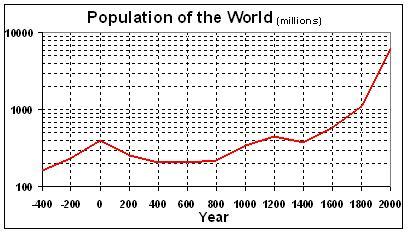
If a species that cannot provide for itself must decline, what does the following chart say about the ability of humans to provide for themselves?


Estimates for -400 through 1800 are from U.S. Census Bureau, “Historical Estimates of World Population“; estimate for 2000 is from U.S. Census Bureau, “Total Midyear Population for the World: 1950-2050.” Year 1 is plotted as Year 0 for ease of illustration. “Upper” estimates are used for -400 through 1800 (where given) because those estimates are taken from a series that extends from -10000 through 1950, and the upper estimate for 1950 in that series agrees with the estimate for 1950 in the series for 1950-2050.

Lincoln, the Poet President

Abraham Lincoln ended his First Inaugural Address (March 4, 1861) with these words:

We are not enemies, but friends. We must not be enemies. Though passion may have strained it must not break our bonds of affection. The mystic chords of memory, stretching from every battlefield and patriot grave to every living heart and hearthstone all over this broad land, will yet swell the chorus of the Union, when again touched, as surely they will be, by the better angels of our nature.

Lincoln’s Gettysburg Address (November 19, 1863) is no less majestic:

…we can not dedicate—we can not consecrate—we can not hallow—this ground. The brave men, living and dead, who struggled here, have consecrated it, far above our poor power to add or detract. The world will little note, nor long remember what we say here, but it can never forget what they did here. It is for us the living, rather, to be dedicated here to the unfinished work which they who fought here have thus far so nobly advanced. It is rather for us to be here dedicated to the great task remaining before us—that from these honored dead we take increased devotion to that cause for which they gave the last full measure of devotion—that we here highly resolve that these dead shall not have died in vain—that this nation, under God, shall have a new birth of freedom—and that government of the people, by the people, for the people, shall not perish from the earth.

Lincoln’s poetry soared again in his Second Inaugural Address (March 4, 1865), weeks before Lee surrendered to Grant (April 9, 1865):

Fondly do we hope, fervently do we pray, that this mighty scourge of war may speedily pass away. Yet, if God wills that it continue until all the wealth piled by the bondsman’s two hundred and fifty years of unrequited toil shall be sunk, and until every drop of blood drawn with the lash shall be paid by another drawn with the sword, as was said three thousand years ago, so still it must be said “the judgments of the Lord are true and righteous altogether.”

With malice toward none, with charity for all, with firmness in the right as God gives us to see the right, let us strive on to finish the work we are in, to bind up the nation’s wounds, to care for him who shall have borne the battle and for his widow and his orphan, to do all which may achieve and cherish a just and lasting peace among ourselves and with all nations.

What Realignment?

Several of the blogs that I follow have commented on a recent Washington Post article by John F. Harris, “Was Nov. 2 Realignment — Or a Tilt?” Harris opens by saying this:

By any measure, President Bush and his fellow Republicans had a good night on Nov. 2. The question now is whether the election results set the GOP up for a good decade — or more.

Harris then goes on to cite various experts, but only one whose views seem to be grounded in historical fact:

Yale political scientist David R. Mayhew two years ago wrote a book calling the entire notion of realignments a fiction, at least at the presidential level. In the 15 presidential elections since World War II, he noted, the incumbent party has kept power eight times and lost it seven times. “You can’t get any closer to a coin toss than this,” he said. “At the presidential level, the traits of the candidates are so important that they blot out party identification.”

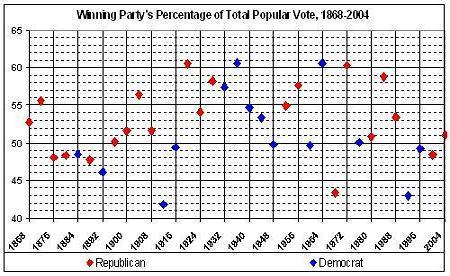
Mayhew is on to something, but his perspective is too short. Let’s go back to 1868, the year of the first presidential election following the Civil War. That span of 136 years covers 35 presidential elections and three more-or-less distinct eras of dominance by one party or the other. Here’s the big picture:

In the first era, Republicans dominated presidential politics from 1868 through 1928, winning 11 of 15 elections. The GOP might have made it 13 of 15 had Theodore Roosevelt’s “Bull Moose” candidacy of 1912 not enabled the election (and re-election) of Woodrow Wilson. Following the Wilsonian interregnum, the Republican era resumed resoundingly in 1920, when the GOP “realigned” itself with its pre-Theodore Roosevelt theme of limited government.

The brief era of Democratic dominance began in 1932 and barely survived the 1948 election. Franklin D. Roosevelt’s victory in 1932 had everything to do with the Great Depression and nothing to do with political philosophy. FDR wasn’t offering “big government” in 1932, he was merely offering a fresh face. Southern Democrats continued to be Democrats and many Northern Republicans simply switched sides out of despair. This second era ended as abruptly as it had begun, with the Dixiecrat rebellion of 1948, which nearly cost Harry Truman the election.

And so the third era — a new Republican era — began with Eisenhower’s victory in 1952. That victory — built on Ike’s popularity and Southern Democrats’ repugnance for the national party’s stance on civil rights — marked the beginning of a long realignment in presidential politics. That realignment didn’t end until the 1980s. Since then, Republicans and Democrats have been fighting border skirmishes over personalities and the issues of the day, just as they have in the past.

But there is no doubt that we are still in a Republican era. Republican control of Congress is as secure as it has been since the 1920s, as is Republican control of State governments. The current Republican era will end — if and when it does — in the aftermath of an economic, social, or military trauma whose nature and timing are unpredictable.

Will the continuation of the current Republican era be good or bad for the cause of libertarianism? Republicans, for the most part, seem to have given up on “limited government” for the sake of winning elections. Now, the GOP is the party of “relatively limited government.” But the alternative — a return to Democratic dominance — is probably worse. What’s a libertarian to do?

I’ll end this post with that question.