Moral Luck

I have just come across the philosophical concept known as moral luck, which is illustrated by this example from Wikipedia:

Suppose there are two truck drivers, Driver A, and Driver B. They are exactly alike in every single way, drive the same exact car, have the same driving schedule, have the same exact reaction time, and so forth. Let’s say that Driver A is driving down a road, following all legal driving requirements, when suddenly, a child runs out in the middle of the road to retrieve a lost ball. Driver A slams the brakes, swerves, in short, does everything to try to avoid hitting the child — alas, the inertia of the truck is too great, and the distance between the truck and the child is too short. Unfortunately, the child is killed as the result of the collision. Driver B, in the meantime, is following the exact same route, doing all the exact same things, and everything is quite exactly the same –– except for one important distinction. In his scenario, there is no child that appears on the road as if out of nowhere. He gets to his destination safely, and there no accident occurs.

If a bystander were asked to morally evaluate Drivers A and B, there is very good reason to expect him to say that Driver A is due more moral blame than Driver B. After all, his course of action resulted in the death of a child, whereas the course of action taken by Driver B was quite uneventful. However, there are absolutely no differences in the controllable actions performed by Drivers A and B. The only disparity is that in the case of Driver A, an external uncontrollable event occurred, whereas it did not in the case of Driver B. The external uncontrollable event, of course, is the child appearing on the road. In other words, there is no difference at all in what the two of them could have done –– however, one seems clearly more to blame than the other. How does this occur?

This is the problem of moral luck. If we agree that moral responsibility should only be relevant when the agent voluntarily performed or failed to perform some action, we should blame Drivers A and B equally, or praise them equally, as may be the case. At the same time, this seems to be at least intuitively problematic, as — whatever the external circumstances are –– one situation resulted in an unfortunate death, and the other did not.

My reaction: The example only shows that moral luck is an artificial philosophical construct. Specifically, Driver B’s experience is irrelevant because Driver B wasn’t placed in the same circumstances as Driver A. The example avoids the real issues, which are these:

  • Did Driver A in fact drive prudently? That isn’t the same thing as “following all legal driving requirements.” Driver A might have passed a breathalyzer test, but perhaps just barely. Or Driver A might have been talking on his cell phone in a jurisdiction that doesn’t forbid doing so while driving. Or Driver A might not have been paying full attention to his surroundings (an undetectable lapse) because he was thinking about where to make his next turn.
  • More fundamentally, the example fails to mention the actions of the child and the child’s parents. Was the child of an age to have known better than to dart into the street without looking? Why was the child allowed to play with a ball near the street? Why wasn’t someone keeping an eye on the child? Why hadn’t the child’s parents fenced the front yard and seen to it that the child couldn’t unlatch the gate?

If Driver A drove prudently, no blame can attach to Driver A. The blame, if any, must attach to the child or the child’s parents, an option that the example omits.

Wikipedia continues:

Moral luck entails two extreme outcomes, both of which seem intuitively unacceptable.

If, one hand, we accept moral luck as a real phenomenon and accept it as a valid restriction on personal responsibility (and, consequently, the assign[ment] of moral blame or praise), it is difficult to identify a situation where moral luck does not affect an event or an individual. Many, if not all, of the moral judgments that we engage in daily seem to become problematic, since any single action can be defended as having been affected by moral luck. Constitutive moral luck [pertaining to the personal character of the moral agent] especially highlights this problem –– after all, it is perfectly valid to argue that every single thing that we do relates in some way to our personal character disposition, and is not one hundred percent voluntary. Thus, if we do stick by our requirement of moral responsibility as needing complete volition, we cannot validly morally assess any action performed by an individual. As Nagel himself points out, if moral luck is accepted as a valid premise, the area of individual moral responsibility seems to ““shrink . . . to an extensionless point.”

On the other hand, if we deny the influence of moral luck and refuse to accept that it has anything to do with moral evaluation (as Kant most certainly would, for example), we are left with a single unappealing option: we are responsible for everything that we do, whether voluntarily or not, and for all the consequences, no matter how unforeseen or unlikely, that our actions entail. By this logic, the unlucky Driver A from our earlier example can take no solace in the fact that there was nothing he could have done to prevent the death of the child as the result of the accident –– he deserves the full amount of moral blame that can be assigned for such an outcome.

That is, moral luck either (1) negates personal responsibility or (2) places all responsibility on the individual actor to whom things happen. I reject the first premise because we have free will or must act as if we have it. (See this post.) I reject the second premise because, as I argued above, it fails to account for the freely chosen actions of others.

The concept of moral luck strikes me as useless philosophical casuistry. I’m sorry it came to my attention. I will now try to forget it.

Technorati tag:

The Left, Abortion, and Adolescence

The Left will bitterly oppose any nominee for the Supreme Court if the Left finds in that nominee a scintilla of opposition to legal abortion.

What I want to know is why that issue is of such great importance to the Left. What is it about abortion (or the “right” to have one) that seizes the passions of the Left? Is it the notion of self-ownership, that is, the “right” to do with “one’s body” as one will? If the Left were consistent about self-ownership it wouldn’t also encourage government to take money from others in order to provide “free” programs, ranging from health care to bike trails.

The Left’s selective embrace of self-ownership indicates that its elevation of abortion to sacramental status has deeper, more psychological roots. The Left is in an arrested state of adolescent rebellion: “Daddy” doesn’t want me to smoke, so I’m going to smoke; “Daddy” doesn’t want me to drink, so I’m going to drink; “Daddy” doesn’t want me to have sex, so I’m going to have sex. But, regardless of my behavior, I expect “Daddy” to give me an allowance, and birthday presents, and cell phones, and so on.

“Daddy,” in the case of abortion, is government, which had banned abortion in many places. If it’s banned, the Left wants it. But the Left — like an adolescent — also expects government to cough up money (others’ money, of course) to quench its material desires.

Persons of the Left simply are simply unthinking, selfish adolescents who want what they want, regardless of the consequences for others. The Left’s stance on abortion should be viewed as just one more adolescent tantrum in a vast repertoire of tantrums.

A Familiar Story

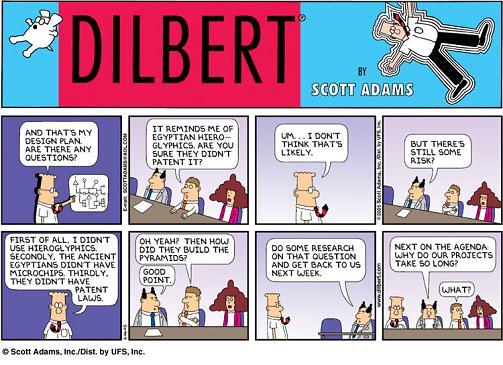
Today’s Dilbert reminds me of my (former) pointy-haired boss, the analytic paralytic:

"Thinking" vs. "Feeling"

Arnold Kling, in n a recent Tech Central Station column, posits a correlation between libertarianism and the “thinking” aspect of personality:

In my experience, libertarians and collectivists often talk past one another. Libertarians believe that collectivists are not thinking, while collectivists believe that libertarians are not feeling.

There’s a lot to that. But a post by Alex Tabarrok at Marginal Revolution reminds me of my “feeling” side:

Here is a new interview with Milton Friedman. I liked this from the introduction:

San Francisco seems an unlikely home for the man who in 1962 first proposed the privatization of Social Security.

Asked why he dwells in liberalism’s den, Milton Friedman, 92, the Nobel laureate economist and father of modern conservatism, didn’t skip a beat.

“Not much competition here,” he quipped.

How does that remind me of my “feeling” side? Friedman’s quip is obviously just that, a quip. Friedman probably could live anywhere he wants to live. Why San Francisco, then? Why not? It has more than Lefties; it has “culture” — universities, museums, and the arts (of all kinds).

In fact, one tends to find “culture” where one finds a lot of Lefties. Moreover, many Lefties are actually nice people, as long as they can avoid talking about George W. Bush, a topic that seems to bring out the worst in their natures.

So, when I want to be a “feeling” person I hang out with Lefties and engage in pursuits that are more typical of Lefties than Righties. To tell the truth, with a few exceptions I avoid the company of Righties because I don’t share their tastes in music (the Nashville sound), sports (NASCAR), and media personalities (Limbaugh, O’Reilly, and Hannity), among other things.

Well, that’s enough “feeling” for today.

Talk Is Cheap

Last month I commented on a post by Bryan Caplan at The Library of Economics and Liberty, in which he said:

One reaction to my recent piece in Econ Journal Watch is “economics isn’t about what people say or believe; it’s about what people DO.” The easy response is: Not anymore, it isn’t! Survey research has exploded in economics….

I know by introspection that my beliefs affect my behavior, and I know by experience that asking people what they are doing is often informative. So how did a doctrine so contrary to common sense ever become conventional wisdom?…

How can asking people be so useful for getting new ideas, but so useless for testing existing ideas? It’s not impossible, but highly implausible. If people have insightful new things to tell us, they probably have informative old things to tell us too….

I hate to speak ill of the dead, but duty calls. Behaviorism had a lot of smart adherents, but their arguments on its behalf were lame from the start. Furthermore, I strongly suspect that even in its heydey, a lot of economists didn’t believe it, but were too scared to say so.

I posted this comment:

“I know by introspection that my beliefs affect my behavior, and I know by experience that asking people what they are doing is often informative. So how did a doctrine so contrary to common sense ever become conventional wisdom?”

Yes “beliefs affect behavior” and “asking people what they are doing is often informative.” But stated beliefs don’t reliably affect behavior, and people often don’t give informative answers. Most people say, for example, that they oppose government spending, but most of those same people will scream like mad when the programs they favor are threatened.

The reliable prediction of economic choices on the basis of expressed beliefs or attitudes requires a degree of skill in posing questions that is beyond the ability of most surveyors. The rare, skillful survey is so intrusive or annoying as to deter all but the two-sigma cases who enjoy responding to surveys. That is to say, surveys are likely to produce either garbage or unrepresentative views.

Talk is cheap, inconsistent, and often at odds with behavior. The only reliable way to understand behavior is to observe behavior.

As the old saying goes (revised slightly to fit the occasion): Don’t believe a word I say, just watch what I do.

“…How can asking people be so useful for getting new ideas, but so useless for testing existing ideas? It’s not impossible, but highly implausible. If people have insightful new things to tell us, they probably have informative old things to tell us too.”

That’s sloppy reasoning. Here’s why: “Asking people” can suggest testable hypotheses, which can be tested only by collecting data about economic behavior. But, as I explain above, “asking people” isn’t a valid way of collecting data with which to test hypotheses.

Glen Whitman of Agoraphilia seems to be on my side of the argument:

[P]eople will say all kinds of things, but what they say means very little unless accompanied by real choices, with real sacrifices and trade-offs. “Actions speak louder than words,” goes the old cliché.

Of course, speech is also a form of action. In evaluating a speech act, the revealed preference approach would conclude that the subjective benefit of speaking must be greater than the subjective cost of speaking, and no more. It would not foolishly assume the meaningfulness of what’s been said. Saying “I want X” does not reveal that I want X; it reveals that I want someone to think I want X. If the behavioral objection to revealed preference is right, then the speech act may reveal even less – but it certainly doesn’t reveal more.

If lots of people say, “I want to quit smoking,” maybe they really do wish to quit, all things considered, including the pain and difficulty of quitting. Or maybe they just know the “right” answer to the question. Quitting smoking is hard; saying you’d like to quit is easy. Ask people if they’d like to visit Jamaica, and I’ll bet most of them say yes, and they won’t be lying. But tickets to Jamaica are expensive, and talk is cheap. The real test is whether they’re buying the tickets and boarding the plane.

I rest my case.

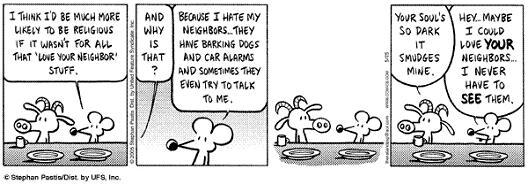
High Fences Make Good Neighbors

Here’s why:

The goat must be a sensitive soul. The rat is my kind of guy.

The Advantages of Introversion

Compare and contrast:

The terms Introvert and Extrovert…[pertain to] how a person orients and receives…energy. In the extr[o]verted attitude the energy flow is outward, and the preferred focus is on people and things, whereas in the introverted attitude the energy flow is inward, and the preferred focus is on thoughts and ideas. [Emphasis mine.]

In sum, an introvert — compared with an extrovert — is likely to be analytical and deliberate. Unfortunately, the Framers of the Constitution, whose work connotes introversion, were followed by a succession of extroverted office-seekers.

Free Will: A Proof by Example? — Updated

Go here.

Desideratum

This epitaph:

He knew what he wanted from life; what he wanted was within his reach; he took it and was content.

Sir Ernest Gowers, writing of H.W. Fowler in the preface to the revised edition of Fowler’s masterful and indispensible A Dictionary of Modern English Usage.

Free Will: A Proof by Example?

UPDATED BELOW (04/17/05)

Is there such a thing as free will, or is our every choice predetermined? Here’s a thought experiment:

Suppose I think that I might want to eat some ice cream. I go to the freezer compartment and pull out an unopened half-gallon of vanilla ice cream and an unopened half-gallon of chocolate ice cream. I can’t decide between vanilla, chocolate, some of each, or none. I ask a friend to decide for me by using his random-number generator, according to rules of his creation. He chooses the following rules:

  • If the random number begins in an odd digit and ends in an odd digit, I will eat vanilla.
  • If the random number begins in an even digit and ends in an even digit, I will eat chocolate.
  • If the random number begins in an odd digit and ends in an even digit, I will eat some of each flavor.
  • If the random number begins in an even digit and ends in an odd digit, I will not eat ice cream.

Suppose that the number generated by my friend begins in an even digit and ends in an even digit: the choice is chocolate. I act accordingly.

I didn’t inevitably choose chocolate because of events that led to the present state of my body’s chemistry, which might otherwise have dictated my choice. That is, I broke any link between my past and my choice about a future action.

I call that free will.

I suspect that our brains are constructed in such a way as to produce the same kind of result in many situations, though certainly not in all situations. That is, we have within us the equivalent of an impartial friend and an (informed) decision-making routine, which together enable us to exercise something we can call free will.

UPDATE: Sir James Jeans, near the end of Physics and Philosphy (1943), says this:

The classical physics seemed to bolt and bar the door leading to any sort of freedom of the will; the new [quantum] physics hardly does this; it almost seems to suggest that the door may be unlocked — if only we could find the handle. The old physics showed us a universe which looked more like a prison than a dwelling-place. The new physics shows us a universe which looks as though it might conceivably form a suitable dwelling-place for free men, and not a mere shelter for brutes — a home in which it may at least be possible for us to mould events to our deires and live lives of endeavour and achievement. (Dover edition, p. 216)

Even if our future behavior is tightly linked to our past and present states of being — and to events outside of us that have their roots in the past and present — those linkages are so complex that they are safely beyond our comprehension and control.

If nothing else, we know that purposive human behavior can make a difference in the course of human events. Given that, and given how little we know about the complexities of existence, we might as well have free will.

Redefining Altruism

Roger Kimball at Right Reason asks “Is Altruism an Illusion?” He answers in the negative. Here’s the core of his argument:

One proposition is that we cannot knowingly act except from a desire or interest which is our own. Not only is this true: it is what philosophers call a necessary truth — it could not be otherwise.

The other proposition is that all of our actions are self-interested. But this proposition, far from being self-evidently true, is a scandalous falsehood.

It is a tautology that any interest we have is an interest of our own: whose else could it be? But the objects of our interest are as various as the world is wide. No doubt much of what we do we do from motives of self-interest. But we might also do things for the sake of flag and country; for the love of a good woman; for the love of God; to discover a new country; to benefit a friend; to harm an enemy; to make a fortune; to spend a fortune.

“It is not,” Butler notes, “because we love ourselves that we find delight in such and such objects, but because we have particular affections towards them.”

Indeed, it often happens that in pursuit of some object — through “fancy, inquisitiveness, love, or hatred, any vagrant inclination” — we harm our self-interest. Think of the scientist who ruins his health in single-minded pursuit of the truth about some problem, or a soldier who gives his life for his country.

Those examples simply prove the proposition that Kimball seeks to disprove. Take the scientist who ruins his health in a single-minded pursuit of the truth. That scientist has simply chosen between health and truth, and truth has won out. That is to say, he revealed through his actions that his self-interest was more bound up in the pursuit of truth than in his own health.

All of our actions are self-interested, to the extent that they are taken with a good understanding of their consequences. An action that seems “unselfish” — that is, directed toward the benefit of others — must necessarily arise out of self-interest. It may simply be that the satisfaction gained from, say, a relentless pursuit of truth outweighs the resulting ill-health.

The problem, as I see it, is merely definitional. Altruism is defined as “the quality of unselfish concern for the welfare of others.” (Other sources also invoke “unselfishness.”) A better definition of altruism would go like this:

Altruism is the quality of concern for the welfare of others, as evidenced by action. An altruistic act is intended, necessarily, to satisfy the moral imperatives of the person performing the act, otherwise it would not be performed. The self-interestedness of an act altruism does not, however, detract in the least from the value of such an act to its beneficiary or beneficiaries. By the same token, an act that may not seem to arise from a concern for the welfare of others may nevertheless have as much beneficial effect as a purposely altruistic act.

Adam Smith said it thus:

As every individual, therefore, endeavours as much as he can…to direct [his] industry that its produce may be of the greatest value; every individual necessarily labours to render the annual revenue of the society as great as he can. He generally, indeed, neither intends to promote the public interest, nor knows how much he is promoting it….[B]y directing that industry in such a manner as its produce may be of the greatest value, he intends only his own gain, and he is in this, as in many other cases, led by an invisible hand to promote an end which was no part of his intention.

…By pursuing his own interest he frequently promotes that of the society more effectually than when he really intends to promote it. I have never known much good done by those who affected to trade for the public good. It is an affectation, indeed, not very common among merchants, and very few words need be employed in dissuading them from it.

As for “altruistic” scientists, only a few days ago I quoted the great mathematician, G.H. Hardy:

There are many highly respectable motives which may lead men to prosecute research, but three which are much more important than the rest. The first (without which the rest must come to nothing) is intellectual curiosity, desire to know the truth. Then, professional pride, anxiety to be satisfied with one’s performance, the shame that overcomes any self-respecting craftsman when his work is unworthy of his talent. Finally, ambition, desire for reputation, and the position, even the power or the money, which it brings. It may be fine to feel, when you have done your work, that you have added to the happiness or alleviated the sufferings of others, but that will not be why you did it. So if a mathematician, or a chemist, or even a physiologist, were to tell me that the driving force in his work had been the desire to benefit humanity, then I should not believe him (nor should I think any better of him if I did). His dominant motives have been those which I have stated and in which, surely, there is nothing of which any decent man need be ashamed. [A Mathematician’s Apology, 1979 edition, p. 79]

There is no essential difference between altruism, defined properly, and the pursuit of self-interest, even if that pursuit does not “seem” altruistic. In fact, the common belief that there is a difference between altruism and the pursuit of self-interest is one cause of (excuse for) purportedly compassionate but actually destructive government intervention in human affairs.

Can You Throw a Curveball?

Throwing a curveball is easy, just do as it says here. Well, try doing it until you really know how to do it, that is, until your brain and muscles work together in just the right way. Which may never happen, or happen very often, no matter how many articles you read or how much you practice.

The moral of the story is simple: Don’t presume to know how things work until you’ve actually done them yourself.

That’s why I don’t trust a politician who hasn’t put his own money at risk in a business on which his livelihood depends. Such a politician has no real idea of the debilitating effects of taxation and regulation on the entrepreneurial spirit, job creation, and employee compensation.

That’s why I don’t trust a politician who thinks that fallible human beings can magically solve problems when they become government employees.

That’s why I don’t trust a politician to do the right thing when it comes to dealing with a tragedy like the Schiavo case if that politician hasn’t faced the death of a loved one whose life might yet be saved.

Full disclosure:

  • In my days of playing catch, which I did seriously for many years, I seldom broke off a good curveball even though I could throw fast, far, and with good control.
  • I have owned and operated a business into which I poured a substantial portion of my savings and which was the sole source of income for my family and me.
  • I worked in and closely with the federal government for 32 years.
  • I have a child whose life was in mortal danger but was saved by a timely operation, from which he has long since recovered fully.

Analysis Paralysis

During the late presidential campaign I observed of John Kerry:

The difference between Kerry and Bush isn’t experience, it’s temperament. I worked for a Kerry-like CEO — always asking questions, probing answers, asking more questions, ad infinitum. He always postponed decisions as long as possible, not because he lacked the facts but because he had confused himself with the facts. He sought facts for their own sake, not because they would help him plot the best path toward a specific goal. He was almost purely inductive, hoping to find his principles in a morass of information.

That’s how Kerry, with his limitless flip-flopping, has struck me — a man without principles who hopes to discover them in the next piece of information that he receives….

To change metaphors: You don’t advance the ball down the field by counting the laces on it. You advance the ball down the field by knowing where the goal is and then choosing the plays that will help you reach it. Kerry knows how many laces there are. Bush figures out where to throw the ball, and all Kerry knows how to do is carp like an armchair quarterback when some of the passes aren’t caught.

I was reminded of that passage by this one, from an essay by Larry McMurtry:

A compulsion to over-informedness is most apt to occur in individuals who have been arrested at a graduate school level of development; it is an intellectual infirmity, rather than a sign of health, and is so common now that it perhaps deserves to be elevated to the status of a syndrome: the Star-Pupil syndrome. If the desire to shine as a pupil is sustained too long it can cause even the most committed worker to work badly. [Film Flam: Essays on Hollywood, “Movie Tripping: My Own Rotten Film Festival,” p. 204.]

That is why, in my experience, persons who have acquired a Ph.D. — or who lack one but work in a “learned institution” — tend to count the laces on the football instead of trying to advance it down the field.

Shakespeare said it best, in Hamlet (Act III, Scene 1):

And thus the native hue of resolution
Is sicklied o’er with the pale cast of thought,
And enterprises of great pith and moment
With this regard their currents turn awry,
And lose the name of action.

Three Perspectives on Life: A Parable

The parable:

Imagine that 100 randomly selected humans are locked in a large room without food or water. During a panicky struggle to break down the door, 50 of the humans are trampled to death. The other 50 humans then agree to cooperate in an effort to escape. Because that cooperative effort doesn’t quickly succeed, however, it breaks down in acrimony; cliques develop and fights break out. Before long, there are only a few dozen humans left, and they have split into three camps.

One camp (the scientists) believes that it can find a way to escape the room, given adequate observation and analysis. The second camp (the stoics) believes that there’s no way out and prepares for death by calmly meditating. The third camp (the pragmatists) is agnostic about escape, but isn’t ready to die, so its members begin to kill and eat the stoics.

As they are being killed by the pragmatists, the stoics console themselves by saying that death is inevitable.

What happens next? After eating the stoics, do the pragmatists turn on the scientists and eat them as well? Or do the pragmatists keep (some of) the scientists alive, in case the scientists can find a way out of the room?

If the pragmatists eat all the scientists, the pragmatists will then begin to eat each other. The last pragmatist to die (of starvation) will say that he did the best he could with the hand he was dealt.

If the pragmatists spare the scientists (or some of them), and the scientists don’t find a way out of the room, the pragmatists will begin to finish off the scientists, then each other. The last pragmatist to die (of starvation) will say that he did the best he could with the hand he was dealt. The last scientist to die of cannibalism will say that death was only one possible outcome — an outcome that seems inevitable only in retrospect.

If the pragmatists spare the scientists (or some of them), and the scientists find a way out of the room, the pragmatists will claim that their decision not to kill all the scientists made escape possible. The surviving scientists will say that escape was only one possible outcome — an outcome that seems inevitable only in retrospect.

And the surviving scientists will say this about the stoics: If they had survived they would have claimed that survival was inevitable.

Happiness requires a judicious blend of stoicism, action, and reason:

  • Stoicism makes it possible to accept that over which we have no control. But unblinking stoicism can lead to premature acceptance of a bad outcome.
  • Action is essential to progress, but it must be harnessed to reason. Action for action’s sake is indulgence.
  • Reason is essential to progress, but it must be harnessed to action. Pure reason wields no more power than pure stoicism.

Race, Intelligence, and Affirmative Action

In “Affirmative Action: A Modest Proposal,” I began by writing about the findings of a study which

shows that the income of a Korean orphan who was adopted in the U.S. between 1970 and 1980, through a process of random selection, is about the same regardless of the income of the adoptive parents. On the other hand, the income of the biological children of the same parents is highly correlated with the parents’ income; that is, low -income parents tend to produce low-income children, whereas high-income parents tend to produce high-income children….

I went on to say this:

…The obvious implication of these findings is that intelligence (and hence income) is a heritable trait, one that remains differentiated along racial lines (a consistent but controversial finding discussed here, for example). Thus the findings give further evidence, if any were needed, that affirmative action policies — whether government-prescribed or voluntarily adopted — tend to undermine the quality of workplaces and educational institutions. (I am speaking here of the quality of effort and thought, not the value of workers and students as human beings.)

A reader objects — sort of. He begins by saying:

[T]here’s a flaw in your guest blogger’s logic. He takes the adoption study as evidence that intelligence is a heritable trait and thus passed through racial lines (fine). He then says since affirmative action rewards racial minorities who may be less qualified (fine), that affirmative action tends to undermine quality of work.

[H]is conclusion may be correct, but is only tenuously related to the first premise. he seems to be saying that, on average, if you give preference to minorities, the quality of work will suffer, because on average minorities are less intelligent….

Let’s stop right there and take things one step at a time.

Click here for full post.

Affirmative Action: A Modest Proposal

Recent posts by Alex Tabarrok at Marginal Revolution discuss a study that reveals the effects of nature and nurture on income. (Tabarrok’s original post is here. He has posted some clarifying remarks here.) The study shows that the income of a Korean orphan who was adopted in the U.S. between 1970 and 1980, through a process of random selection, is about the same regardless of the income of the adoptive parents. On the other hand, the income of the biological children of the same parents is highly correlated with the parents’ income; that is, low -income parents tend to produce low-income children, whereas high-income parents tend to produce high-income children. The obvious implication of these findings is that intelligence (and hence income) is a heritable trait, one that remains differentiated along racial lines (a consistent but controversial finding discussed here, for example). Thus the findings give further evidence, if any were needed, that affirmative action policies — whether government-prescribed or voluntarily adopted — tend to undermine the quality of workplaces and educational institutions. (I am speaking here of the quality of effort and thought, not the value of workers and students as human beings.)

The premise of affirmative action finds expression in a 1986 speech to the Second Circuit Judicial Conference by Justice Thurgood Marshall, where he

urged Americans to “face the simple fact that there are groups in every community which are daily paying the cost of the history of American injustice. The argument against affirmative action is… an argument in favor of leaving that cost to lie where it falls. Our fundamental sense of fairness, particularly as it is embodied in the guarantee of equal protection under the laws, requires us,” Marshall said, “to make an effort to see that those costs are shared equitably while we continue to work for the eradication of the consequences of discrimination. Otherwise,” Marshall concluded, “we must admit to ourselves that so long as the lingering effects of inequality are with us, the burden will [unfairly] be borne by those who are least able to pay.” [From “Looking Ahead: The Future of Affirmative Acton after Grutter and Gratz,” by Professor Susan Low Bloch, Georgetown University Law Center.]

In sum, affirmative action is a way of exacting reparations from white Americans for the sins of their slave-owning, discriminating forbears — even though most of those forbears didn’t own slaves and many of them didn’t practice discrimination. Those reparations come at a cost, aside from the resentment toward the beneficiaries of affirmative action and doubt about their qualifications for a particular job or place in a student body. As I wrote here:

Because of affirmative action — and legal actions brought and threatened under its rubric — employers do not always fill every job with the person best qualified for the job. The result is that the economy produces less than it would in the absence of affirmative action….

[A]ffirmative action reduces GDP by about 2 percent. That’s not a trivial amount. In fact, it’s just about what the federal government spends on all civilian agencies and their activities — including affirmative action….

Moreover, that effect is compounded to the extent that affirmative action reduces the quality of education at universities, which it surely must do. But let us work with 2 percent of GDP, which comes to about $240 billion a year, or more than $6,000 a year for every black American.

Thus my modest proposal to improve the quality of education and the productivity of the workforce: End affirmative action and give every black American an annual voucher for, say, $5,000 (adjusted annually for inflation). The vouchers could be redeemed for educational expenses (tuition, materials, books, room and board, and mandatory fees). Recipients who didn’t need or want their vouchers could sell them to others (presumably at a discount), give them away, or bequeath them for use by later generations. The vouchers would be issued for a limited time (perhaps the 25 years envisioned by Justice O’Connor in Grutter), but they would never expire.

That settles affirmative action, reparations, and school vouchers (for blacks), at a stroke. If only I could solve the Social Security mess as easily.

Favorite Posts: Affirmative Action and Race

Too Rational for My Taste

Sometimes the “rationality” of the “marginal” mindset drives me a bit nuts. Glen Whitman, an assistant professor of economics and a co-blogger at Agoraphila, wrote this:

When I return to my car in a parking lot, I’ll often find advertisements, flyers, brochures, etc., stuck underneath the windshield wipers. The latest was an ad for Billy Graham’s upcoming performances in the L.A. area. As an individual car owner, what policy should I follow for these unsolicited pieces of trash? In general, I’m not a litterbug; I think people should clean up after themselves and keep public areas clean. But in this case, I make an exception. I refuse to bring the unwanted material into my vehicle, so I immediately throw it on the ground of the parking lot.

I believe my policy is the correct one. If parking lot owners don’t like the litter, they can (a) police their lots to stop the offenders, or (b) collect the litter and track down the perpetrators – after all, their locations and phone numbers are usually written right there.

Litter is litter. So I posted this comment:

Do you leave your shopping cart in a parking space or — even worse — in a traffic lane? Do you fail to stop at the stop sign or traffic light on the way out of the parking lot? I just want to know where you draw the line between littering as a form of “speech”, discourtesy, and risking the lives of others. Observation leads me to believe that there’s a high correlation between self-indulgence, discourtesy, and recklessness. It may be libertine, but it’s not libertarian.

Chalk it up to Irritable Male Syndrome, exacerbated by a raging sinus infection.

Let’s Talk about Intelligence

I ran across an article on “Theories of Multiple Intelligence,” by Grady M. Towers, which was published in the Prometheus Society’s journal, Gift of Fire (Issue No. 33, September 1988). I know little about the measurement of intelligence and the controversies surrounding it. With that disclaimer, here are some bits I find fascinating:

We now know that there are two [kinds of intelligence]: one called fluid g, measured by culture fair tests such as the Raven Progressive Matrices or the LAIT, and another called crystallized g, measured by culture loaded tests like the Concept Mastery Test or the Miller Analogies Test. What we call g has been defined as the ability to “educe relations and correlates,” or in more everyday terms, the abilities for inductive (“relations”) and deductive (“correlates”) reasoning. Culture fair tests measure the ability to educe relations and correlates using abstract diagrams, and other material that requires only a minimum of formal learning. Culture loaded tests measure the ability to educe relations and correlates using learned and over learned material, such as vocabulary, algorithms for arithmetic or multiplication, recognition of common objects and their uses, etc. Ordinary IQ tests measure both kinds of intelligence, but not necessarily to the same degree; they are generally biased in favor of crystallized g.

The currently accepted relationship between these two kinds of ability is called the investment theory of intelligence. It says, in effect, that we are all born with a certain raw ability, or the eduction of relations and correlates, which can be measured with culture fair tests. As we get older, we “invest” this fluid g in certain kinds of judgment skills, such as those involved in doing a mathematical word problem, or parsing a sentence. When we are young, the theory goes, our formal educations are so much alike that we all invest our fluid g in much the same kinds of judgment skills. That means that our fluid intelligence and our crystallized intelligence are so similar at an early age that it’s almost impossible to tell them apart. After we leave school, however, we all begin to invest our fluid g abilities in different things. Measures of fluid g and crystallized g begin to draw apart. Those that invest their fluid g in school-like activities, such as accounting or law, continue to show intellectual growth on conventional (crystallized) IQ tests. Those that put their intelligence to work in other ways, such as becoming ranchers or artists, will not show the same intellectual growth, and may even show a decline in IQ on conventional measures of intelligence….

None of this would matter except that each kind of ability brings with it its own kind of cognitive style, its own kind of personality, and its own set of values. In fact, the contrast between persons gifted with fluid g and those gifted with crystallized g is so sharp that, with a little practice, most people find that they can learn to tell them apart at a glance. Those gifted with fluid g (LAIT) tend to be socially retiring, independent of the good opinion of others, analytical, interested in theoretical and scientific problems, and to dislike rigid systematization and routine. Those gifted primarily with crystallized g (conventional tests) tend to be sociable, quick in reactions, artistic, and to dislike logical and theoretical problems. And then there are those who are equally gifted with both kinds of ability, and tend to be mixtures of all these qualities….

In other words, there are those who can do, those who can teach, and those who can do both. In other-other words, don’t “misunderestimate” the intelligence of people who seem to lack “book smarts” and who talk like “regular people.”

Who’s Got the Brains?

An article at Wired News asks “Dems, GOP: Who’s Got the Brains?” The gist of the article, if you read it closely, is that Dems tend to be more emotional than Republicans. As for who’s smarter, I answered that question when I wrote “The Right Is Smarter Than the Left.”

Dancing around Racial Differences

Climatology isn’t the only politically correct science. Nicholas Wade of The New York Times reports about race and genetics in “Articles Highlight Different Views on Genetic Basis of Race“:

…In articles in the current issue of the journal Nature Genetics, scientists at Howard, a center of African-American scholarship, generally favor the view that there is no biological or genetic basis for race. “Observed patterns of geographical differences in genetic information do not correspond to our notion of social identities, including ‘race’ and ‘ethnicity,’ ” writes Dr. Charles N. Rotimi, acting director of the university’s genome center.

But several other geneticists writing in the same issue of the journal say the human family tree is divided into branches that correspond to the ancestral populations of each major continent, and that these branches coincide with the popular notion of race. “The emerging picture is that populations do, generally, cluster by broad geographic regions that correspond with common racial classification (Africa, Europe, Asia, Oceania, Americas),” say Dr. Sarah A. Tishkoff of the University of Maryland and Dr. Kenneth K. Kidd of Yale….

Here we have so-called scientists at Howard University trying to deny the obvious and their “peers” at other universities merely confirming it. You’d think scientists would want to do something worthwhile with their time.

Wade continues:

Two years ago Dr. Risch, a population geneticist, plunged into the long-taboo subject of race and said that these geographic patterns correlated with the popular conception of continental-based races – principally Africans, East Asians, American Indians and Caucasians (a group that includes Europeans, Middle Easterners, and people of the Indian subcontinent).

These categories were useful in understanding the genetic roots of disease, many of which follow the same geographic pattern, Dr. Risch said. His article was provoked by editorials in medical journals suggesting there was no biological basis for race.

The articles in today’s issue of Nature Genetics represent a second round of the debate. The Howard scientists agree that there is a geographic pattern in human genetic variation but favor the approach of going directly to the underlying genetic causes of disease without taking into account any possible correlation with race….

Why is race off limits as a scientific topic? What are the “scientists” at Howard afraid of learning about their race? Where’s the shame in truth?

I will say once again that I fully understand Bush’s refusal to kow-tow to scientists (see here and here). Most Americans, unfortunately, have subscribed to a false view of science as coldly precise and unerringly accurate in its power to prescribe “wise” policies. I don’t subscribe to that view, as you’ll find by reading this and following the links.