A Concurring Opinion

The opinion is by Steve Boriss (The Future of News), and it’s about Cass Sunstein and his twisted view of the First Amendment.

I have similar things to say about Sunstein and “unfree speech.” Here I quote the gist of Sunstein’s argument for “unfree speech” (which he offers in the name of freedom, of course). And here I subject him to an (imaginary) interview about his proposal.

Hillary Meets Cass

By which I mean that Hillary Clinton, who would control the blogosphere, is of a mind with Cass Sunstein, who would regulate speech in order to make it “more free.”

Parents and the State

Timothy Sandefur (Freespace) has it almost right:

[T]he danger of allowing the state to control such decisions [whether a child must have a blood test] is far greater than the threat here [to public health]…. Give the state the power to take children away from parents for the children’s own good, and you have opened a door to the persecution of religious minorities….

Not to mention the denial of the right of parents to educate their children in private schools or at home, as the parents see fit.

But…I wonder if Sandefur means that the state should never have the power to take children from their parents, for the good of the children. Never? Not even in the case of children who are abused persistently?

It’s true that, in such cases, intervention by other parties (e.g., friends, family, church) would be preferable to intervention by the state, given the state’s power (and demonstrated ability) to act peremptorily and capriciously. But, given the dearth of private intervenors (because the state has so deeply sundered the social fabric), we are forced to rely on the state as the intervenor of last resort.

Rich Voter, Poor Voter: Revisited

REVISED AND EXTENDED, 10/27/07

All manner of good (and bad) stuff has popped up about the relationship between income and political preferences. Tyler Cowen of Marginal Revolution points to this post at Free exchange, which I shamelessly repeat in its entirety (with the addition of some comments and additional links) and then expand upon:

PAUL KRUGMAN, brimming with conscience [a reference to Krugman’s recently published The Conscience of a Liberal: LC], continues to scrounge for evidence [here also: LC] that the monied prefer the Grand Old Party. “There’s a weird myth among the commentariat that rich people vote Democratic,” Mr Krugman sighs.

Well, I suppose it’s weird for the commentariat to believe Pew Research Center reports that find “Democrats pulling even with Republicans among registered voters with annual family incomes in excess of roughly $135,000 per annum.” $135,000 may not sound exactly “rich” to some of us, but it is well into the top decile of the income distribution, which counts as the “upper class” if we’re doing decile-based class analysis. As part of his myth-slaying efforts, Mr Krugman offers a chart from Columbia’s Andrew Gelman from whom we have also learned that the wealthiest American states now lean Democratic (as was noted in this August post on precisely this issue). [I wrote here about an earlier version of the Gelman paper that is linked in the preceding sentence. Krugman links to a recently updated version, which is here: LC] Wealthy localities remains likely to tilt Republican in the South, Gelman finds. But in “media center” states such as New York, California, and the states contiguous to the Imperial Capital, Democrats dominate the country clubs. [See this post by Gelman, especially the x-y plots and the final sentence. See also this list of the 100 Zip Codes with the highest incomes: LC]

Furthermore, the writer and bon vivant Julian Sanchez points us to this Daniel Gross column in Slate wherein we are informed of a poll showing that:

The petit bourgeoisie millionaires were passionately for Bush: Those worth between $1 million and $10 million favored Bush by a 63-37 margin. But the haute millionaires, those worth more than $10 million, favored Kerry 59-41.

Mr Sanchez smartly comments:

You hit a point at which you don’t just have a lot of money; you’ve got “f[—] you” money. … At which point “voting your economic self-interest” ceases to mean much, since your economic interests are covered [by] whoever’s in power. You can afford to stop voting your pocketbook and start voting whatever makes you feel like a mensch. [You can vote your inner adolescent or your irrespsonsible “take that” attitude: LC]…

Ironically, this may be a point in favor of those who appeal to the declining marginal utility of money as an argument for economic redistribution. If this is right, then the efficient place to start imposing really crushing marginal taxes is at the income or wealth level where people start voting heavily Democratic.

Ha! But seriously, the real issue here is whether economic interests are a major determinant of voting patterns at all. If wealthy voters in certain culturally similar states prefer Democrats and those in other culturally similar states prefer Republicans, we might plausibly infer that something other than their wealth is determining wealthy votes. And since individual votes are drops in an ocean, with barely a whisper of causal power, those of us who take economic logic seriously might expect citizens, wealthy or not, to forget about voting their interests and instead cast ballots that will reliably supply utility by, say, expressing their moral values, political identity, or sense of solidarity with an imagined community. As Loren Lomasky and Geoffrey Brennan write in their classic work “Democracy and Decision“:

It would be an error of method to assume whenever electoral behavior is consistent with the self-interest hypothesis that citizens vote in order to further self-interest. And it is an error of logic to assume that rational agents will, purely as a matter of course, vote in a self-interested manner.

I fear that Mr Krugman’s book may turn on at least one of these.

I have no doubt that Krugman’s book is both erroneous of method and logic.

I entirely agree with Julian Sanchez’s point that very rich voters vote mainly to make a statement. As I wrote here,

[t]he “rich” in the rich States — as is obvious from casual reading about limousine liberals and wannabe limousine liberals in New York and California — have by and large bought into the regulatory-welfare state, which is mainly a creation of the Democrat Party. So, the rich-State rich vote their “consciences” or, rather, they tend to vote Democrat because the think they can

  • keep the unwashed masses at bay with the modern equivalent of bread and circuses.
  • salve their (misplaced) guilt about the “good luck” that made them rich….

Why does it work like that? Because where you live has a lot to do with your values. People tend to adapt (“go along and get along”) or migrate.

The same principle applies to academia [e.g., see this]. Conservative and libertarian intellectuals tend to avoid academic careers (call it pre-emptive migration) because they don’t want to adapt their thinking to fit in with the liberal supermajority on most campuses.

Joining Andrew Gelman and the Pew Research Center, I offer this evidence of Krugman’s displacement from reality:

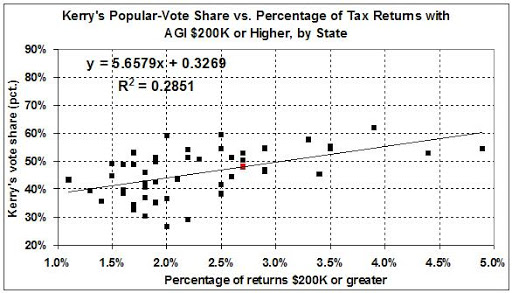
Sources: Kerry’s vote, as a percentage of the total number of popular votes cast in each State, is from RealClearPolitics (here). I derived the percentage of tax returns with an adjusted gross income of $200,000 or more from “Table 2.–Individual Income and Tax Data, by State and Size of Adjusted Gross Income, Tax Year 2005,” which is available through this page at the IRS website.

What could be clearer than that? The more you make, once you have crossed a threshold, the more likely you are to vote Democrat. That threshold, according to the Pew Research Center, is a household income in 2007 of $135,000 — the point at which one joins the top 10 percent.

Let’s take a closer look at the graph. The red dot — at 2.7 percent of tax returns and 48.3 percent of the popular vote — represents the U.S. in the aggregate. The Red-State outliers are represented by the many points that lie to the left of the red dot and well below the regression line, which include Nebraska (1.7, 32.4), Idaho (1.8, 30.3), Utah (2.0, 26.5), and Wyoming (2.2, 29.1) — States that are deeply Republican, far from the effete East and West Coasts, and too small to carry any weight in a national election. Their political opposites are (well above the line) Maine (1.7, 53.0), Vermont (2.0, 59.1) and Rhode Island (2.5, 59.6), and (on the far right, graphically speaking) New York (3.3, 57.8), Virginia (3.4, 45.2 — a high Blue vote for this once deep-Red State), California (3.5, 54.6), Maryland (3.5, 55.4), Massachusetts (3.9, 62.1), New Jersey (4.4, 52.3), D.C. (the Imperial Capital) (4.6, 89.3), and Connecticut (4.9, 54.2). We know all we need to know about the pathological politics of the Northeastern States and California. As for the formerly conservative States of Maryland and Virginia, elections there are increasingly dominated by the affluent and rapidly growing suburbs that border the Imperial Capital.

A geographical breakdown confirms the generalization that the more you make (above the threshold), the more likely you are to vote Blue:

Sources as above. States in each region (from left to right on the x-axis): West — North Dakota, Montana, South Dakota, Nebraska; Southeast — Mississippi, Arkansas, Kentucky, Oklahoma, Alabama, Louisiana, South Carolina, Missouri, Tennessee, North Carolina, Georgia, Texas, Florida, Virginia; North Central — West Virginia, Iowa, Indiana, Ohio, Michigan, Wisconsin, Minnesota, Illinois; West Coast & Far Southwest — New Mexico, Hawaii, Oregon, Arizona, Nevada, Washington, California; Northeast — Maine, Vermont, Pennsylvania, Delaware, Rhode Island, New Hampshire, New York, Maryland, Massachusetts, New Jersey, D.C., Connecticut.

In ascending order of Blueness (or descending order of Redness) we have:

West
Southeast
North Central/West Coast & Far Southwest (about the same)
Northeast

A few observations and explanations: The Southeast isn’t as Red as it was a few elections ago — owing to the rapid urbanization of such States as Georgia, Florida, and Virginia — but most Southeastern States remain on the Red side of the ledger, most of the time. Maryland and D.C., as long-standing denizens of the super-urban Bos-Wash corridor, belong in the Northeast region, just as West Virginia — a unionized, industrial State — belongs in the North Central region with its neighbor, Ohio.

Out of curiosity, I tried moving Maryland and D.C. from the Northeast to the Southeast, with these results: a flat trendline for the Northeast; a more positive slope on the trendline for the Southeast. In other words, the Northeast without Maryland and D.C. displays a constant degree of Blueness (about 55 percent for Kerry), regardless of the proportion of tax returns with AGI of $200,000 or more. Thus, the omission of Maryland and D.C. from the Northeast simply underscores the deep-rooted Blueness of the “old” Northeast. It just is Blue, from its heavily unionized “working stiffs” to its super-affluent “masters of the universe.” But, as I say in the preceding paragraph, Maryland and D.C. merged into the Northeast quite some time ago.

In any event, the positive relationship between income and Blueness holds for each region, even though there are also inter-regional differences. (“Birds of a feather…,” as suggested above.) If Blueness were simply a regional trait, each of the trendlines would be flat — but, in fact, each one slopes upward to the right. Thus (to say it again):

The more you make (above a threshold which is now $135,000), the more likely you are to vote Democrat.

Paul Krugman (no prole he) is living evidence of that statement.

Why Would We Want to Do That?

Ilya Somin asks “can we make the Constitution more democratic?” His answer seems to be “why would we want to do that?” Right answer. Here’s why:
Democracy vs. Liberty
Something Controversial
Liberty, Democrarcy, and Voting Rights
More about Democracy and Liberty
Yet Another Look at Democracy
Conservatism, Libertarianism, Socialism, and Democracy
If Liberty Depends on Democracy, We’re Doomed to Slavery
Democracy and the Irrational Voter
The Ruinous Despotism of Democracy

Adolescents Will Be Adolescents, Even When They’re Grown

Bookworm (of Bookworm Room) plays a theme that I explore in “The Adolescent Rebellion Syndrome.” Writing about an episode of Frontline, she says,

those who oppose Cheney and the Neocons are outraged that all those guys had the temerity to take so seriously the 9/11 attacks and their aftermath. The opposers clearly want to view these matters as Kerry once did: police matters, with the crime scene encompassing a few thousand, rather than one or two…. And to them, to these opposers, it just seems ridiculous that Cheney et al are trying to put in place systems that enable the Commander in Chief to try to nip any future attacks in the bud.

Listening to this outrage, outrage that’s certainly not unique to this Frontline episode, I couldn’t help but think of the difference between your average teenager and your average grownup. To the grownup, things such as mortgages, insurance, and other life security matters are of overriding importance. To the teenager in the house, “Dad is, like, so totally stupid, because he’s, you know, like, always sitting at his desk worrying about the bills, you know. So, I’m all, ‘Dude, stop thinking about that. You know, I’m like trying to score some tickets to the Ugly Red Rash concert, and I need, like, oh, $200 dollars. Right?’”

All of which is both amusing and irritating when you’re in the house with the teenager, but remarkably less interesting when the teenagers are trying to run your country.

As I say in “…Syndrome,”

adolescent rebellion and other forms of intellectual immaturity…are to be found mainly — but not exclusively — among “artists,” academicians, and the Left generally.

I leave room in that indictment for anarcho-libertarians, though they’re so ineffectual that their adolescent petulance is of no account (but of some intellectual interest).

Leftists I Know

I know some Leftists. They’re not Leftists of the loony, venomous, conspiracy-theory variety who hang out in the comment threads of Left-wing blogs. They’re you’re garden-variety, conservatives-are-mean, government-is-good, Bush-is-bad, pull-out-of-Iraq, global-warming-is real, Social Security-Medicare-and-universal-health-care-are-necessary type of Leftist. But they’re generally quiet about it, unless they’re talking to each other, in mutual support.

The thinking of the Leftists I know was shaped by “educators” and is constantly reinforced by selective (i.e., biased) reading, listening, and viewing. In other words, they have never matured mentally. They’re stuck on the themes they were force-fed before and during their college years. I would say “stuck on stupid,” but they’re not stupid — just ignorant and mentally lazy.

The hard part is: Most of them are nice. So, it’s hard to dislike a garden-variety Leftist, in spite of his or her views. Of course, it will be a different story if any of them starts hanging around the comment threads of Leftist blogs.

Affirmative Action for Conservatives and Libertarians?

Greg Mankiw and Ilya Somin raise the issue. Mankiw says:

Question to think about: If right-wingers are underrepresented in universities relative to the population and discriminated against by the left-wing majority, as Larry suggests, should there be affirmative action for right-leaning academics? It seems that, on principle, those on the left (who favor affirmative action to promote diversity and correct past injustice) should endorse such a university policy, and those on the right (who more often oppose affirmative action) would be against.

Somin comments:

The underrepresentation of conservatives (and, I would add, libertarians) is almost certainly not all due to ideological discrimination. But evidence suggests that discrimination is probably at least a part of the story. In this excellent Econlog post, economist Bryan Caplan explained why ideological discrimination is more likely to flourish in academia than in most other employment markets. Even aside from discrimination, the ideological homogeneity of much of academia causes a variety of problems, such as reducing the diversity of ideas reflected in research, skewing teaching agendas, and generating the sorts of “groupthink” pathologies to which ideologically homogenous groups are prone.

However, whether or not [ideological] discrimination is the cause of the problem, affirmative action for conservative academics (or libertarian ones) is a poor solution. Among other things, it would require universities to define who counts as a “conservative” for affirmative action purpose, a task that they aren’t likely to do well. Affirmative action for conservatives would also give job candidates an incentive to engage in deception about their views in the hopes of gaining professional advancement. Moreover, conservative professors hired on an affirmative basis despite inferior qualifications would find it difficult to get their ideas taken seriously by colleagues and students. They might therefore be unable to make a meaningful contribution to academic debate – the very reason why we want to promote ideological diversity in hiring to begin with.

Somin’s argument is correct, as far as it goes. I would add this: Left-dominated disciplines (primarily the so-called liberal arts) will become less and less rewarding, relative to other (non-ideological) disciplines) as they become less and less relevant, economically. Left-dominated disciplines, therefore, will attract (proportionally) fewer and fewer students — because students (especially grad students) tend to go where the money is. As a result, the number of faculty supported by such disciplines will shrink (relatively, if not absolutely), and the academic influence of Leftists will diminish (relatively, if not absolutely).

In other words, the market will take care of the problem, albeit over a longish period of time. Market signals will influence tax-funded universities, as well as private ones, because tax-funded universities do compete with each other and with private ones for the “best and the brightest” students.

Oxymoron at Work

Someone named Reihan is pinch-hitting for Ross Douthat. Reihan writes,

better to have a smart, coherent welfare system at the federal or at least state level than a patchwork that encourages the arbitrary and often harmful shifting around of the poor.

A politically designed, state-run “smart, coherent welfare system.” There’s an oxymoron, in spades. What does that say about Reihan? I report, you decide.

Hurry back, Ross.

Pascal’s Wager, Morality, and the State

David Friedman addresses Pascal’s wager:

Pascal famously argued that, as long as there was any probability that God existed, a rational gambler should worship him, since the cost if he did exist and you failed to worship him was enormously greater than the cost if it went the other way around.

A variety of objections can be made to this, most obviously that a just God would reject a worshiper who worshiped on that basis.

That is my view, also. But Friedman goes on to say that he has “a variant on the argument” that he “find[s] more persuasive.” Thus:

The issue is not God but morality. Most human beings have a strong intuition that some acts are good and some bad–that one ought not to steal, murder, lie, bully, torture, and the like. Details of what is covered and how it is defined vary a good deal, but the underlying idea that right and wrong are real categories and one should do right and not wrong is common to most of us.

There are two categories of explanation for this intuition. One is that it is a perception–that right and wrong are real, that we somehow perceive that, and that our feel for what is right and what is wrong is at least very roughly correct. The other is that morality is a mistake. We have been brainwashed by our culture, or perhaps our genes, into feeling the way we do, but there is really no good reason why one ought to feed the hungry or ought not to torture small children.

Suppose you are uncertain which of the two explanations is correct. I argue that you ought to act as if the first is. If morality is real and you act as if it were not, you will do bad things–and the assumption that morality is real means that you ought not to do bad things. If morality is an illusion and you act as if it were not, you may miss the opportunity to commit a few pleasurable wrongs–but since morality correlates tolerably well, although not perfectly, with rational self interest, the cost is unlikely to be large.

I think this version avoids the problems with Pascal’s. No god is required for the argument–merely the nature of right and wrong, good and evil, as most human beings intuit them. And, by the morality most of us hold, the fact that you are refraining from evil because of a probabilistic calculation does not negate the value of doing so–you still haven’t stolen, lied, or whatever. One of the odd features of our intuitions of right and wrong is that they are not entirely, perhaps not chiefly, judgements about people but judgements about acts.

Friedman actually changes the subject from Pascal’s wager (why one should believe in God) to the basis of morality. As I say above, I agree with Friedman’s observation about Pascal’s wager: God might well reject a cynical believer.

But it seems to me that Pascal’s wager has nothing much to do with the origin of morality. Not all worshipers are moral; not all moral persons are worshipers.

Moreover, Friedman overlooks two important (and not mutually exclusive) explanations of morality. The first is empathy; the second is consequentialism.

We (most of us) flinch from doing things to others that we would not want done to ourselves. Is that because of inbred (“hard wired”) empathy? Or are we conditioned by social custom? Or is the answer “both”?

If inbred empathy is the only explanation for self-control with regard to other persons, why is it that our restraint so often fails us in interactions with others are fleeting and/or distant? (Think of aggressive driving and rude e-mails, for just two examples of unempathic behavior.) Empathy, to the extent that it is a real and restraining influence, seems most to work best (but not perfectly) in face-to-face encounters, especially where the persons involved have more than a fleeting relationship.

If behavior is (also) influenced by social custom, why does social custom favor restraint? Here is where consequentialism enters the picture.

We are taught (or we learn) about the possibility of retaliation by a victim of our behavior (or by someone acting on behalf of a victim). In certain instances, there is the possibility of state action on behalf of the victim: a fine, time in jail, etc. So we are taught (or we learn) to restrain ourselves (to some extent) in order to avoid punishments that flow directly and (more or less) predictably from our unrestrained actions.

More deeply, there is the idea that “what goes around comes around.” In other words, bad behavior can beget bad behavior, whereas good behavior can beget good behavior. (“Well, if so-and-so can get away with X, so can I.” “So-and-so is rewarded for good behavior; it will pay me to be good, also.” “If so-and-so is nice to me, I’ll be nice to him so that he’ll continue to be nice to me.”)

Why do we care that “what goes around comes around”? First, we humans are imitative social animals; what others do — for good or ill — cues our own behavior. Second, there is an “instinctive” (taught/learned) aversion to “fouling one’s own nest.”

Unfortunately, our aversion to nest-fouling weakens as our interactions with others become more fleeting and distant — as they have done since the onset of industrialization, urbanization, and mass communication. Bad behavior then becomes easier because its consequences are less obvious or certain; it becomes a model for imitation and, perhaps, even a norm. Good behavior then flows from the fear of being retaliated against, not from socialized norms, or even from fear of state action. Aggression — among the naturally aggressive — becomes more usual.

And so we become ripe for rule by a “protective” state, and by rival warlords if the state fails to protect us.

Rothbard: Sometimes Right

Here, for instance. (See this related post of mine.)

A Century of Regress

If this is true, so is this.

The Ruinous Despotism of Democracy

Not long ago, in “‘Liberalism,’ as Seen by Liberals,” I quoted from a review in The Washington Post of Paul Starr’s Freedom’s Power: The True Force of Liberalism. Here is an especially telling paragraph from the review:

By opening up power to progressively broader participation, liberal constitutions have subjected government to scrutiny, criticism and even resistance, and thus have helped to protect citizens against overweening bureaucracies. At the same time, they have made democratic states more legitimate and have enabled them to borrow, tax and, until recently, conscript more and more. Paradoxically, then, constitutionally limited states historically have wielded more power than despotic ones.

I was reminded of that passage by one that I have just came upon in Christopher Dawson’s The Dynamics of World History (a compilation of Dawson’s essays written 1921-55):

Today the common traditions [of religion and culture] have been abandoned by the rulers of the modern [s]tate and the planners of modern society, while at the same time the latter have come to exercise a more complete control over the thought and life of the whole population than the most autocratic and authoritarian powers of the past ever possessed.

Dawson wrote that in 1949. Though he was writing about Britain, he might just as well have been writing about the United States. And matters have only worsened here (as in Britain). Consider the economic realm, for example:


Of course, there’s more to it than that. There are social consequences aplenty (e.g., higher rates of violent crime) arising from the voterenabled substitution of state-imposed and state-endorsed behavioral norms for socially evolved ones — always in the name of “liberality” or “progress.” For example, as I wrote here:

[A]bortion-on-demand and same-sex marriage are not manifestations of liberality, they are manifestations of statism because they are (or would be) state-imposed — which is what “liberals” want.

If abortion-on-demand and same-sex marriage were manifestations of liberality, they would have arisen from voluntarily evolved social norms. That they have not done so means that they are destructive of the social order — of civil society — upon which liberty depends.

If my position makes me out to be a reactionary, I stand with Barry Goldwater:

I would remind you that extremism in the defense of liberty is no vice. And let me remind you also that moderation in the pursuit of justice is no virtue.

To put it more baldly, todays “democratic statism” is antithetical to liberty, justice, and progress. For our sake and the sake of our progeny, it must by replaced by the founding principles of limited-government republicanism.

There’s more — much more — in the following categories:
Affirmative Action – Immigration – Race
Constitution – Courts – Law – Justice
Economics: Principles and Issues
Leftism- Statism – Democracy
Liberty – Libertarianism – Rights
Religion – Science – Pseudoscience
Self-Ownership… – Gender – Etc.
War – Peace – Foreign Affairs

FDR and Fascism

A blogger (to whom I will not link) once tried to disparage me by referring to my position that (in his words) “Franklin Roosevelt, Adolph Hitler and Joseph Stalin were all essentially dictators.” I suppose that the blogger in question believes Hitler and Stalin to have been dictators. His poorly expressed complaint, therefore, is my lumping of FDR with Hitler and Stalin.

I doubt that the not-to-be-named blogger considers FDR a saint, or even a praiseworthy president. Such a view would be inconsistent with the blogger’s (rather murky) paleo-conservative/libertarian views. The blogger’s apparent aim was not to defend FDR but to discredit me by suggesting that my view of FDR is beyond the pale.*

To the contrary, however, the perception of FDR as a dictator (or dictator manqué) with a fascistic agenda is of long standing and arises from respectable sources. Albert Jay Nock, an early and outspoken opponent of the New Deal — and a paleo-libertarian of the sort admired by the blogger in question — certainly saw Roosevelt’s fascistic agenda for what it was. Many mainstream politicians also attacked Roosevelt’s aims; for example:

While the First New Deal of 1933 had broad support from most sectors, the Second New Deal challenged the business community. Conservative Democrats, led by Al Smith, fought back with the American Liberty League, savagely attacking Roosevelt and equating him with Marx and Lenin.[21]

That Smith and others were unsuccessful in their opposition to FDR’s agenda does not alter the essentially fascistic nature of that agenda.

Now comes David Boaz’s “Hitler, Mussolini, Roosevelt: What FDR had in common with the other charismatic collectivists of the 30s,” a review of Wolfgang Schivelbusch’s Three New Deals: Reflections on Roosevelt’s America, Mussolini’s Italy, and Hitler’s Germany, 1933–1939. Toward the end of the review, Boaz writes:

Why isn’t this book called Four New Deals? Schivelbusch does mention Moscow repeatedly…. But Stalin seized power within an already totalitarian system; he was the victor in a coup. Hitler, Mussolini, and Roosevelt, each in a different way, came to power as strong leaders in a political process. They thus share the “charismatic leadership” that Schivelbusch finds so important.

…B.C. Forbes, the founder of the eponymous magazine, denounced “rampant Fascism” in 1933. In 1935 former President Herbert Hoover was using phrases like “Fascist regimentation” in discussing the New Deal. A decade later, he wrote in his memoirs that “the New Deal introduced to Americans the spectacle of Fascist dictation to business, labor and agriculture,” and that measures such as the Agricultural Adjustment Act, “in their consequences of control of products and markets, set up an uncanny Americanized parallel with the agricultural regime of Mussolini and Hitler.” In 1944, in The Road to Serfdom, the economist F.A. Hayek warned that economic planning could lead to totalitarianism. He cautioned Americans and Britons not to think that there was something uniquely evil about the German soul. National Socialism, he said, drew on collectivist ideas that had permeated the Western world for a generation or more.

In 1973 one of the most distinguished American historians, John A. Garraty of Columbia University, created a stir with his article “The New Deal, National Socialism, and the Great Depression.” Garraty was an admirer of Roosevelt but couldn’t help noticing, for instance, the parallels between the Civilian Conservation Corps and similar programs in Germany. Both, he wrote, “were essentially designed to keep young men out of the labor market. Roosevelt described work camps as a means for getting youth ‘off the city street corners,’ Hitler as a way of keeping them from ‘rotting helplessly in the streets.’ In both countries much was made of the beneficial social results of mixing thousands of young people from different walks of life in the camps. Furthermore, both were organized on semimilitary lines with the subsidiary purposes of improving the physical fitness of potential soldiers and stimulating public commitment to national service in an emergency.”

And in 1976, presidential candidate Ronald Reagan incurred the ire of Sen. Edward Kennedy (D-Mass.), pro-Roosevelt historian Arthur M. Schlesinger Jr., and The New York Times when he told reporters that “fascism was really the basis of the New Deal.”

You get the idea by now, I hope. The correlation of FDR’s regime with those of Hitler and Mussolini (not to mention Stalin’s) is hardly discredited or beyond the pale.

Boaz writes, also, about the ends and means of the New Deal:

On May 7, 1933, just two months after the inauguration of Franklin Delano Roosevelt, the New York Times reporter Anne O’Hare McCormick wrote that the atmosphere in Washington was “strangely reminiscent of Rome in the first weeks after the march of the Blackshirts, of Moscow at the beginning of the Five-Year Plan.…America today literally asks for orders.” The Roosevelt administration, she added, “envisages a federation of industry, labor and government after the fashion of the corporative State as it exists in Italy.”

That article isn’t quoted in Three New Deals, a fascinating study by the German cultural historian Wolfgang Schivelbusch. But it underscores his central argument: that there are surprising similarities between the programs of Roosevelt, Mussolini, and Hitler….

The dream of a planned society infected both right and left. Ernst Jünger, an influential right-wing militarist in Germany, reported his reaction to the Soviet Union: “I told myself: granted, they have no constitution, but they do have a plan. This may be an excellent thing.” As early as 1912, FDR himself praised the Prussian-German model: “They passed beyond the liberty of the individual to do as he pleased with his own property and found it necessary to check this liberty for the benefit of the freedom of the whole people,” he said in an address to the People’s Forum of Troy, New York.

American Progressives studied at German universities, Schivelbusch writes, and “came to appreciate the Hegelian theory of a strong state and Prussian militarism as the most efficient way of organizing modern societies that could no longer be ruled by anarchic liberal principles.” The pragmatist philosopher William James’ influential 1910 essay “The Moral Equivalent of War” stressed the importance of order, discipline, and planning….

In the North American Review in 1934, the progressive writer Roger Shaw described the New Deal as “Fascist means to gain liberal ends.” He wasn’t hallucinating. FDR’s adviser Rexford Tugwell wrote in his diary that Mussolini had done “many of the things which seem to me necessary.” Lorena Hickok, a close confidante of Eleanor Roosevelt who lived in the White House for a spell, wrote approvingly of a local official who had said, “If [President] Roosevelt were actually a dictator, we might get somewhere.” She added that if she were younger, she’d like to lead “the Fascist Movement in the United States.” At the National Recovery Administration (NRA), the cartel-creating agency at the heart of the early New Deal, one report declared forthrightly, “The Fascist Principles are very similar to those we have been evolving here in America.

Roosevelt himself called Mussolini “admirable” and professed that he was “deeply impressed by what he has accomplished.”…

Schivelbusch argues that “Hitler and Roosevelt were both charismatic leaders who held the masses in their sway—and without this sort of leadership, neither National Socialism nor the New Deal would have been possible.” This plebiscitary style established a direct connection between the leader and the masses. Schivelbusch argues that the dictators of the 1930s differed from “old-style despots, whose rule was based largely on the coercive force of their praetorian guards.” Mass rallies, fireside radio chats—and in our own time—television can bring the ruler directly to the people in a way that was never possible before.

To that end, all the new regimes of the ’30s undertook unprecedented propaganda efforts. “Propaganda,” Schivelbusch writes “is the means by which charismatic leadership, circumventing intermediary social and political institutions like parliaments, parties, and interest groups, gains direct hold upon the masses.” The NRA’s Blue Eagle campaign, in which businesses that complied with the agency’s code were allowed to display a “Blue Eagle” symbol, was a way to rally the masses and call on everyone to display a visible symbol of support. NRA head Hugh Johnson made its purpose clear: “Those who are not with us are against us.”…

Program and propaganda merged in the public works of all three systems. The Tennessee Valley Authority, the autobahn, and the reclamation of the Pontine marshes outside Rome were all showcase projects, another aspect of the “architecture of power” that displayed the vigor and vitality of the regime.

If FDR’s aims were fascistic — and clearly they were — why didn’t the U.S. become a police state, in the mold of Germany, Italy, and the Soviet Union? Boaz concludes:

To compare is not to equate, as Schivelbusch says. It’s sobering to note the real parallels among these systems. But it’s even more important to remember that the U.S. did not succumb to dictatorship. Roosevelt may have stretched the Constitution beyond recognition, and he had a taste for planning and power previously unknown in the White House. But he was not a murderous thug. And despite a population that “literally waited for orders,” as McCormick put it, American institutions did not collapse. The Supreme Court declared some New Deal measures unconstitutional. Some business leaders resisted it. Intellectuals on both the right and the left, some of whom ended up in the early libertarian movement, railed against Roosevelt. Republican politicians (those were the days!) tended to oppose both the flow of power to Washington and the shift to executive authority.

Germany had a parliament and political parties and business leaders, and they collapsed in the face of Hitler’s movement. Something was different in the United States. Perhaps it was the fact that the country was formed by people who had left the despots of the Old World to find freedom in the new, and who then made a libertarian revolution. Americans tend to think of themselves as individuals, with equal rights and equal freedom. A nation whose fundamental ideology is, in the words of the recently deceased sociologist Seymour Martin Lipset, “antistatism, laissez-faire, individualism, populism, and egalitarianism” will be far more resistant to illiberal ideologies.

In other words, Americans eluded fascism not because of FDR’s intentions but (in part) because FDR wasn’t “a murderous thug” and (in the main) because of the strength of our “national character.”

Will our character enable us to resist the next FDR? Given the changes in our character since the end of World War II, I very much doubt it.

(For more about FDR’s regime, its objectives, and its destructive consequences, see this, this, and this.)
__________
* That the blogger was trying to discredit me in order to discredit someone related to me is only one bit of evidence of the blogger’s intellectual ineptitude. Further evidence is found in his resort to name calling and logical inconsistency. For example, I am, in one sentence, guilty of “extreme libertarianism” and, in another, an attacker of extreme libertarians, that is, those who “adhere[] to the [non-aggression] principle with deranged fervor” (my words).

As for my so-called extreme libertarianism, if the blogger had bothered to read my blog carefully he would have found plenty of evidence that I am far from being an extreme, individualistic, anti-state libertarian. See, for example, this post and the compilation of posts referenced therein, both of which I published more than a month before the blogger attacked me and my views about FDR.

I could say much more about the blogger’s rabid irrationality, but the main point of this post is FDR’s barely contained fascistic agenda, so I will stop here. Happily for the blogosphere, the blogger-not-to-be-named-here seems to have suspended his blogging operation.

Things to Come, Revised

Here.

The Political Case for Traditional Morality

Lee Harris makes it, in “Drug Addiction and the Open Society,” at The New Atlantis. Here is one of many telling passages:

Herein may well lie one of the great advantages that highly authoritarian forms of government have over open and liberal society. They are in a position to crack down on social epidemics, like drugs, in ways that are far more effective, because far more brutal, than any option available to societies like Dalrymple’s England or DeGrandpre’s America. If so, what a fascinating paradox to present to Mr. Mill—those societies that most closely followed his “simple universal principle” could eventually be undone by their excess of liberty; in which case, the epitaph of the open society might well be taken from Dalrymple’s assessment of the addicts he dealt with in the British slum: “Freedom was bad for them, because they did not know what to do with it.”

Moral anarchy is fertile ground for totalitarianism.

Related posts:
The Meaning of Liberty
Social Norms, State Action, and Liberty

Depressing But True

From Mark Steyn’s post of Monday last:

In his pugnacious new book [World War IV: The Long Struggle against Islamofascism: LC], Norman Podhoretz calls for redesignating this conflict as World War IV.* Certainly, it would have been easier politically to frame the Iraq campaign as being a front in a fourth world war than as a necessary measure in an anti-terrorist campaign. Yet who knows? Perhaps we would still have mired ourselves in legalisms and conspiracies and the dismal curdled relativism of the Flight 93 memorial’s “crescent of embrace.” In the end, as Podhoretz says, if the war is to be fought at all, it will “have to be fought by the kind of people Americans now are.” On this sixth anniversary, as 9/11 retreats into history, many Americans see no war at all.

Depressing but true.

In a related essay at OpinionJournal, Podhoretz writes this:

It is impossible at this point to predict how and when the battle of Iraq will end. But from the vitriolic debates it has unleashed we can already say for certain that the attacks of Sept. 11, 2001, did not do to the Vietnam syndrome what Pearl Harbor did to the old isolationism. The Vietnam syndrome is back and it means to have its way. But is it strong enough in its present incarnation to do what it did to the honor of this country in 1975? Well acquainted though I am with its malignant power, I still believe that it will ultimately be overcome by the forces opposed to it in the war at home. Even so, I cannot deny that this question still hangs ominously in the air and will not be answered before more damage is done to the long struggle against Islamofascism into which we were blasted six years ago and that I persist in calling World War IV.

We have, I fear, gone beyond the “Vietnam syndrome” — the simplistic view that war is always bad — to something much worse: Many Americans — far too many — simply think of America as the enemy. Thus these posts:
Shall We All Hang Separately?
Foxhole Rats
Foxhole Rats, Redux
The Faces of Appeasement
We Have Met the Enemy . . .
Whose Liberties Are We Fighting For?
Words for the Unwise
More Foxhole Rats
Post-Americans and Their Progeny
Anti-Bush or Pro-Treason?
Com-Patriotism and Anti-Patriotic Acts

Wrong, Wrong, Wrong

Michael Cannon of Cato-at-Liberty writes:

In response to Andrew Sullivan: all liberals understand free markets.

It’s the leftists that are the problem.

Cannon assumes that modern “liberals” — you know the kind: LBJ, Hubert Humphrey, Ted Kennedy — actually understand free markets. It’s true that LBJ, HHH, EMK, and their ilk are not really “liberals” by the classic definition of the word “liberal,” but they long ago absconded with the word and corrupted it.

That “liberals” now call themselves “progressives” is evidence of the corruption of the word “liberal.” The use of “progressive” is an obvious semantic dodge, an effort to avoid association with what “liberal” has come to mean: a proponent of the nanny state.

As far as I can tell, all “liberals” (and “progressives”) are Leftists: anti-libertarian statists extraordinaire.

P.S. A Cato-type libertarian probably thinks that such “rights” as abortion-on-demand and same-sex marriage are manifestations of liberality, in the old-fashioned meaning of the word (see Noun 1. here). In fact, abortion-on-demand and same-sex marriage are not manifestations of liberality, they are manifestations of statism because they are (or would be) state-imposed — which is what “liberals” want.

If abortion-on-demand and same-sex marriage were manifestations of liberality, they would have arisen from voluntarily evolved social norms. That they have not done so means that they are destructive of the social order — of civil society — upon which liberty depends.

By the way, segregation in the South was state-imposed.

Some related posts:
Why I’m Not a Democrat or a Liberal
Left, Right, What’s the Difference?
The Liberal Mindset
The Meaning of Liberty
Social Norms, State Action, and Liberty

For much more, click on Leftism – Statism – Democracy

Irrationality, Suboptimality, and Voting

In “The Rational Voter?” I define rationality as the application of “sound reasoning and pertinent facts to the pursuit of a realistic objective (one that does not contradict the laws of nature or human nature).” I later say that

[m]any (a majority of? most?) voters are guilty of voting irrationally because they believe in such claptrap as peace through diplomacy, “social justice” through high marginal tax rates, or better health care through government regulation. To be perfectly clear, the irrationality lies not in favoring peace, “social justice” (whatever that is), health care, and the like. The irrationality lies in knee-jerk beliefs in such contradictions as peace through unpreparedness for war, “social justice” through soak-the-rich schemes, better health care through complete government control of medicine, etc., etc., etc. Voters whose objectives incorporate such beliefs simply haven’t taken the relatively little time it requires to process what they already know or have experienced about history, human nature, and social and economic realities….

Another way to put it is this: Voters too often are rationally irrational. They make their voting decisions “rationally,” in a formal sense (i.e., [not “wasting” time in order to make correct judgments]). But those decisions are irrational because they are intended to advance perverse objectives (e.g., peace through unpreparedness for war).

Voters of the kind I describe are guilty of suboptimization, which is “optimizing some chosen objective which is an integral part of a broader objective; usually the broad objective and lower-level objective are different.”

I will come back to suboptimal voting. But, first, this about optimization: If you aren’t familiar with the concept, here’s good non-technical definition: “to do things best under the given circumstances.” To optimize, then, is to achieve the best result one can, given a constraint or constraints. On a personal level, for example, a rational person tries to be as happy as he can be, given his present income and prospects for future income. (Note that I do not define happiness as the maximization of wealth.) A person is not rational who allows, say, his alchololism to destroy his happiness (if not also the income that contributes to it). He is suboptimizing on his addiction instead of optimizing on his happiness.

By the same token, a person who votes irrationally also suboptimizes. A vote may “make sense” at the moment (just as another drink “makes sense” to an alcoholic), but it is an irrational vote if the voter does not (a) vote as if he were willing to live by the consequences if his vote were decisive and/or (b) take the time to understand those consequences.

In some cases, a voter’s irrationality is signaled by the voter’s (inner) reason for voting; for example: to feel smug about having voted, to “protest” or to “send a message” (without being able to explain coherently the purpose of the protest or message), or simply to reinforce unexamined biases by voting for someone who seems to share them. More common (I suspect) are the irrational votes that are cast deliberately for candidates who espouse the kinds of perverse objectives that I cite above (e.g., peace without preparedness for war).

Why is voter irrationality important? Does voting really matter? Well, it’s easy to say that an individual’s vote makes very little difference. But that just isn’t true. Consider the presidential election of 2000, for example, where the outcome of the election depended on about five hundred votes out of the almost six million cast in Florida. I recall that Florida was thought to be safely in Bush’s column, until after all the votes had been cast.

If you are certain that your vote won’t make a difference (as in Massachusetts, for example), don’t bother to vote — unless the act of voting, itself, gives you satisfaction. Otherwise, always vote as if your vote will make a difference to you and those about whom you care. Vote as if your vote will be decisive. To vote otherwise is irrational, in and of itself.

The next (necessary) step is to vote correctly. Short-sighted voters (i.e., irrational ones) vastly underestimate the importance of voting correctly. As Glen Whitman points out, there is a tendency to

give[] too little attention to the political dynamics of…a mandate, instead naively assuming that the mandate could be crafted once-and-for-all in a wise and lobbying-resistant fashion.

That is to say, voters (not to mention those who profess to understand voters) overlook the slippery slope effects of voting for those who promise to “deliver” certain benefits. It is true that the benefits, if delivered, would temporarily increase the well-being of certain voters. But if one group of voters reaps benefits, then another group of voters also must reap them. Why? Because votes are not won, nor offices held, by placating a particular class of voter; many other classes of them must be placated as well.

The “benefits” sought by voters (and delivered by politicians) are regulatory as well as monetary. Many voters (especially wealthy, paternalistic ones) are more interested in controlling others than they are in reaping government handouts (though they don’t object to that either). And if one group of voters reaps certain regulatory benefits, it follows (as night from day) that other groups also will seek (and reap) regulatory benefits. (Must one be a trained economist to understand this? Obviously not, because most trained economists don’t seem to understand it.)

And then there is the “peaceat-any-priceone-worldcrowd, which is hard to distinguish from the crowd that demands (and delivers) monetary and regulatory “benefits.”

So, here we are:

  • Many particular benefits are bestowed and many regulations are imposed, to the detriment of investors, entrepreneurs, innovators, inventors, and people who simply are willing to work hard to advance themselves. And it is they who are responsible for the economic growth that bestows (or would bestow) more jobs and higher incomes on everyone, from the poorest to the richest.
  • A generation from now, the average American will “enjoy” about one-fourth the real output that would be his absent the advent of the regulatory-welfare state about a century ago.

Conclusion: Voters who have favored the New Deal, the Square Deal, the Great Society, or almost any Democrat who has run for national office in the past seventy-five years have been supremely irrational. They have voted against their own economic and security interests, and the economic and security interests of their progeny.

This isn’t rocket science or advanced economics or clinical psychology. It’s common sense, a quality that seems to be lacking in too many voters — and in the politicians who prey on them. What else can you expect after seven decades in which creeping socialism and “internationalism” have been inculcated through public “education” and ratified by the courts.

"The Shoe Is on the Other Foot" — Updated

I have added three updates to “The Shoe Is on the Other Foot,” a post about the un-hiring and probable un-un-hiring of Erwin Chemerinsky as founding dean of the UC Irvine law school.