Positive Rights and Cosmic Justice: Part IV

The prologue is here, part I is here, part II is here, and part III is here. In this post — probably the last in the series — I argue that cosmic justice (a.k.a. redistributionism) is largely futile. Those who are created less-than-equal — with respect to the attributes that yield material success — cannot be made equal by handouts, “head starts,” or affirmative action. UPDATE: For a long, well-substantiated survey about the validity of intelligence as a concept, the validity of race as a concept, persistent differences in IQ between races, and related matters, go here.
BACKGROUND
I say in Part II that

[l]iberals’ arrogant willingness to play at being gods [i.e., meting out cosmic justice through redistributionism]…rests on these deep[] (and usually unacknowledged) assumptions:

  • One person’s well-being can be measured against another person’s well-being through interpersonal comparisons of utility.
  • There is a kind of cosmic justice — or social welfare function — that is advanced by harming some persons for the benefit of other persons. That is, a benefit cancels a harm — at least when the benefit and harm are decided by liberals.
  • Taking wealth and income from those who have “too much” does not, on balance, harm those who have “too little” by dampening economic growth and voluntary charity….

(The first and second assumptions enable [liberal redistributionists] to assert that “positive freedom entails negative freedom.” To [liberal redistributionists], there is one big “welfare pie” in sky, in which we all somehow share — despite the obvious fact that A is made worse off when some of his wealth or income is confiscated and given to B.)
…Given the foregoing, liberals see it as necessary and desirable to redistribute wealth and income from persons who have “too much” to persons who have “too little” — or “too little” of the things that wealth and income can buy. Otherwise, those who have “too little” wealth or income (or the things they can buy) would enjoy only “theoretical” freedom. But the use of the word “theoretical” is a rhetorical trick, a bit of verbal sleight-of-hand. It implies, without proof, that anyone who does not enjoy a certain “minimal” state of health, wealth, etc. — as “minimal” is defined by a liberal — simply lacks the wherewithal to strive toward ends that he or she values….
The liberal argument for redistribution, therefore, is really a circular argument intended to justify liberals’ particular sense of fitting outcomes.

A “liberal” (or “progressive”) would be quick to proclaim that most of the poor are not poor simply for lack of wherewithal (i.e., education and training); rather, they are victims of discrimination based on race, ethnicity, or gender. That is, they are “trapped by the system,” and it is the duty of liberals to rectify the system’s wrongs.
TOUGH QUESTIONS, UNPOPULAR ANSWERS
But are the poor (and other groups favored by liberals) really trapped by the system, that is, by prejudicial discrimination? Or are they generally lacking in wherewithal because they are trapped by their genetic and cultural inheritance? If the latter, as I argue here, the quest for cosmic justice through redistribution is counterproductive, largely futile, and unfair. How so?
The quest for cosmic justice through redistribution is counterproductive for three reasons

  • Redistribution is like giving a person a fish instead of teaching him how to fish; if he becomes dependent on the handout he is less likely to better himself, within the scope of his ability.
  • Because redistribution reduces the rewards that accrue to superior achievement it leads to a lower rate of economic growth — to the detriment of all, including those for whom liberals’ hearts bleed. (For more about the counterproductive effects of redistribution, see this, this, and this.)
  • The lowering of rewards for superior achievement (i.e., taxation) reduces voluntary charity. And yet it is voluntary charity that is most likely to help those in need better themselves. Why? Because voluntary donors, operating through truly non-governmental organizations (i.e., not the Red Cross, United Way, and their ilk) are personally committed to — and vigilant about — the effective use of their contributions.

The quest is largely futile because — contrary to liberal rhetoric and political correctness (which are much the same thing) — all races, ethnic groups, and genders are not equal when it comes to mental and behavioral inheritance. (Races, ethnic groups, and genders differ broadly in their mental and behavioral traits, but each race, ethnic group, and gender is not And it is one’s mental and behavioral inheritance that largely determines one’s income. homogeneous, even though liberals like to treat them as if they were.) Redistribution — in any form (e.g., welfare payments, preferential hiring and promotion of “protected” groups) — does not offset the “barriers” of race, ethnicity, and gender because, in the main, it cannot do so. Because liberals will not admit the futility of redistribution they are bound to redouble and perpetuate it, as they have done for more than 70 years.
As to the unfairness of redistribution, I think Anthony de Jasay hits it on the head in “Risk, Value, and Externality“:

Stripped of rhetoric, an act of social justice (a) deliberately increases the relative share….of the worse-off in total income, and (b) in achieving (a) it redresses part or all of an injustice….This implies that some people being worse off than others is an injustice and that it must be redressed. However, redress can only be effected at the expense of the better-off; but it is not evident that they have committed the injustice in the first place. Consequently, nor is it clear why the better-off should be under an obligation to redress it….

For more about the counterproductive and unfair nature of redistribution, see parts II and III (linked above). My focus, from here on, is the essential futility of the redistrutionist urge.
BEGINNING AT THE BEGINNING
Hypotheses
The rest of this post summarizes some of the evidence that is available with respect to relationships between genes, intelligence, and behavior. Much of the evidence is controversial not because it is false but because (a) some of its authors are controversial* and (b) it tells a politically incorrect story:

  • There are heritable differences in behavior and intelligence.
  • Those differences show up in education and income.
  • Those differences run (generally) along the lines of race, ethnicity, and gender.

Those who deny such evidence do so, I believe, because their political leanings preclude objectivity. They are committed to the dispensation of cosmic justice in the service of “equality.” They are therefore committed to the enforcement of discrimination in favor of certain classes of persons. Their first, loudest, and everlasting reaction to evidence which indicates that races, ethnic groups, and genders are not created equal when it comes to income-producing aptitudes is to cry “racism” and “sexism.”
Disclaimer
Thus this anticipatory disclaimer:

I anticipate — and reject — accusations that I am a racist and a misogynist. A racist is “a person with a prejudiced belief that one race is superior to others.” A misogynist hates women. I hew to neither trait.
I am very far from being a woman-hater; women are (among other things) essential to civil society, without which liberty is impossible (e.g., see this). More generally, I do not believe that a particular race, ethnic group, or gender is a superior one — in the sense of being entitled to a position of power over other races or ethnic groups or another gender. I do believe, based on evidence of the kind I sample below, that there are very real, measurable, and persistent differences in aptitudes across races, ethnic groups, and genders, and that those differences underlie persistent differences in the average incomes earned by various races, ethnic groups, and genders.
My belief is based not on prejudice: “an adverse judgment or opinion formed beforehand or without knowledge or examination of the facts.” I was once a prejudiced (i.e., ignorant) liberal, a believer in cosmic justice. Facts, experience, and reason have led me away from that benighted persuasion.
The careful reader will observe that the evidence I sample here most decidedly does not support any claim of “white supremacy.” White supremacy in the United States involves the presumption that whites are superior to blacks. But there is more to it than that. White supremacy also encompasses anti-Semitism and prejudice against such “non-white” groups as Arabs and Asians. Moreover, white supremacists in the United States usually are anti-Catholic, and they consider persons of Eastern and Southern European origin to be of inferior stock. The IQ measures I cite here decidedly favor Ashkenazi Jews and East Asians over the particular kinds “whites” favored by white supremacists (e.g., the “Herrenvolk“).

Intelligence, a Central Concept
I should now elaborate on the concept of intelligence — in particular, IQ or “general intelligence” — and its importance in the context of this post. I do not deny the possibility of “multiple intelligences.” But, for the purpose of this post, the relevant kind of intelligence is

a property of mind that encompasses many related abilities, such as the capacities to reason, plan, solve problems, think abstractly, comprehend ideas and language, and learn….

Despite the variety of concepts of intelligence, the most influential approach to understanding intelligence (i.e., with the most supporters and the most published research over the longest period of time) is based on psychometric testing. Such intelligence quotient (IQ) tests include the Stanford-Binet, Raven’s Progressive Matrices, the Wechsler Adult Intelligence Scale and the Wechsler-Bellevue.

All forms of IQ tests correlate highly with one another. The traditional view is that these tests measure g or “general intelligence factor“. g can be derived as the principal factor using the mathematical method of factor analysis.

Why is IQ the relevant kind of intelligence? Arnold Kling explains:

[T]he reality is that the intelligences that feed into IQ are what drive economic success. I have an unwritten essay on the meadow and the food court. It’s a way of capturing Gregory Clark’s economic history in a metaphor.
In a meadow economy, the human race is a grazing herd. The naturalists are the ones who eat the best. This was the economy up until about 1800 everywhere, and it still applies in the underdeveloped world today.
In the West since 1800, we’ve been moving to the food court economy, where we use complex recipes and convoluted trading mechanisms to translate basic ingredients into fancy consumption goods. Overall, most of the value nowadays is in the recipes, not in the ingredients.

SAMPLES OF THE EVIDENCE
Nature Outweighs Nurture
Bruce Sacerdote’s “What Happens When We Randomly Assign Children to Families?” (October 2004) directly addresses the issue of nature versus nurture. Wading through the statistics, we come to this key conclusion:

[T]ransmission of education and income for adoptees is much less strong than for non-adoptees. Hence, by definition, either initial endowments [i.e., genetically transmitted traits] or the interaction between family environment and initial endowments must be driving a large portion of the transmission of income and education to children.

In sum, according to “Nature versus nurture” at Wikipedia,

[e]vidence suggests that family environmental factors may have an effect upon childhood IQ, accounting for up to a quarter of the variance. On the other hand, by late adolescence this correlation disappears, such that adoptive siblings are no more similar in IQ than strangers.[5] Moreover, adoption studies indicate that, by adulthood, adoptive siblings are no more similar in IQ than strangers (IQ correlation near zero), while full siblings show an IQ correlation of 0.6. Twin studies reinforce this pattern: monozygotic (identical) twins raised separately are highly similar in IQ (0.86), more so than dizygotic (fraternal) twins raised together (0.6) and much more than adoptive siblings (~0.0). [6] Consequently, in the context of the “nature versus nurture” debate, the “nature” component appears to be much more important than the “nurture” component in explaining IQ variance in the general adult population of the United States.

Cultural Differences That Influence Income Are Heritable
I turn now to Nicholas Wade of The New York Times, whose International Herald Tribune article (“Cultural Differences: A DNA Link?,” March 2006) suggests that an

explanation for such long- lasting character traits [as social interdependence] may be emerging from the human genome. Humans have continued to evolve throughout prehistory and perhaps to the present day, according to a new analysis of the genome reported last week by Jonathan Pritchard, a population geneticist at the University of Chicago.
So human nature may have evolved as well.
If so, scientists and historians say, a fresh look at history may be in order. Evolutionary changes in the genome could help explain cultural traits that last over many generations as societies adapted to different local pressures….
In a study of East Asians, Europeans and Africans, Pritchard and his colleagues found 700 regions of the genome where genes appear to have been reshaped by natural selection in recent times. In East Asians, the average date of these selection events is 6,600 years ago….
Some of the genes are active in the brain and, although their role is not known, may have affected behavior….
Some geneticists believe the variations they are seeing in the human genome are so recent that they may help explain historical processes.
“Since it looks like there has been significant evolutionary change over historical time, we’re going to have to rewrite every history book ever written,” said Gregory Cochran, a population geneticist at the University of Utah.
“The distribution of genes influencing relevant psychological traits must have been different in Rome than it is today,” he added. “The past is not just another country but an entirely different kind of people.”
John McNeill, a historian at Georgetown University in Washington, said “it should be no surprise to anyone that human nature is not a constant” and that selective pressures have probably been stronger in the last 10,000 years than at any other epoch in human evolution….
The political scientist Francis Fukuyama has distinguished between high-trust and low-trust societies, arguing that trust is a basis for prosperity. Since his 1995 book on the subject, researchers have found that oxytocin, a chemical active in the brain, increases the level of trust, at least in psychological experiments.
Oxytocin levels are known to be under genetic control in other mammals.
It is easy to imagine that in societies where trust pays off, generation after generation, the more trusting individuals would have more progeny and the oxytocin-promoting genes would become more common in the population.
If conditions should then change, and the society be engulfed by strife and civil warfare for generations, oxytocin levels might fall as the paranoid produced more progeny.
Napoleon Chagnon for many decades studied the Yanomamo, a warlike people who live in the forests of Brazil and Venezuela. He found that men who had killed in battle had three times as many children as those who had not. Since personality is heritable, this would be a mechanism for Yanomamo nature to evolve and become fiercer than usual.
Since the agricultural revolution, humans have to a large extent created their own environment. But that does not mean the genome has ceased to evolve. The genome can respond to cultural practices as well as to any other kind of change.
Northern Europeans, for instance, are known to have responded genetically to the drinking of cow’s milk, a practice that began in the Funnel Beaker Culture that thrived 5,000 to 6,000 years ago. They developed lactose tolerance, the unusual ability to digest lactose in adulthood….
The most recent example of a society’s possible genetic response to its circumstances is one advanced by Cochran and Henry Harpending, an anthropologist at the University of Utah.
In an article last year they argued that the unusual pattern of genetic diseases found among Ashkenazi Jews (those of Central and Eastern Europe) was a response to the demands for increased intelligence imposed when Jews were largely confined to the intellectually demanding professions of money lending and tax collection.
Though this period lasted only from A.D. 900 to about 1700, it was long enough, the two scientists argue, for natural selection to favor any variant gene that enhanced cognitive ability….
But the variant genes common among the Ashkenazi do not protect against any known disease. In the Cochran and Harpending thesis, the genes were a response to the demanding social niche into which Ashkenazi Jews were forced and the nimbleness required to be useful to their unpredictable hosts.
No one has yet tested the Cochran-Harpending thesis, which remains just an interesting, though well worked out, conjecture. But one of its predictions is that the same genes should be targets of selection in any other population where there is a demand for greater cognitive skills. That demand might have well have arisen among the first settled societies where people had to deal with the quite novel concepts of surpluses, property, value and quantification.
And indeed Pritchard’s team detected strong selection among East Asians in the region of the gene that causes Gaucher’s disease, one of the variant genes common among Ashkenazim.

Intelligence and Race
To this point I have reviewed evidence that nature (i.e., genetic inheritance) generally outweighs nurture (i.e., environmental factors) in determining intelligence and income. Also, I have reviewed evidence that suggests the heritability of certain cultural traits (e.g., the kind of group solidarity that leads to economic betterment). Consider, now, some evidence about intelligence as it relates directly to race.

From “Race and Intelligence” at Wikipedia:

The modern controversy surrounding intelligence and race focuses on the results of IQ studies conducted during the 20th century, mainly in the United States and some other industrialized nations. In almost every testing situation where tests were administered and evaluated correctly, the mean IQ of Blacks was approximately one standard deviation below that of Whites. [That is, the average white person has an IQ higher than about two-thirds of all black persons: ED.]….

It is a matter of debate whether IQ differences between races in the U.S. are…entirely environmental or…partly genetic. Several published consensus statements agree that the large differences between the average IQ scores of Blacks and Whites in the U.S. cannot be attributed to biases in test construction, nor can they be explained just by simple differences in socio-economic status, however they are still well with in the range that may be attributed to other environmental factors….

But are inter-racial IQ differences “well within the range that may be attributed to…environmental factors”? Charles Murray, writing in Commentary about two years ago (article now behind paywall), reviews what had been learned about gender, race, and IQ since the publication of his (and the late Richard Herrnstein’s) The Bell Curve (1994). As for race, Murray reviews the evidence at length and concludes

that we know two facts beyond much doubt. First, the conventional environmental explanation of the black-white difference [in IQ] is inadequate. Poverty, bad schools, and racism, which seem such obvious culprits, do not explain it. Insofar as the environment is the cause, it is not the sort of environment we know how to change, and we have tried every practical remedy that anyone has been able to think of. Second, regardless of one’s reading of the competing arguments, we are left with an IQ difference that has, at best, narrowed by only a few points over the last century. I can find nothing in the history of this difference, or in what we have learned about its causes over the last ten years, to suggest that any faster change is in our future.

John J. Ray, an Australian psychometrician, observes that

[McElwain and Kearney] constructed a test that WAS biased — but biased towards blacks rather than towards whites. They included in their test (the Queensland Test or QT) only those items that blacks responded well to and which actually could be shown to be valid predictors of problem solving performance among blacks. In effect, blacks constructed the test themselves — by providing the responses used to select the individual questions within the test.

But you know what happened, don’t you? On a test intrinsically biased against them, whites still greatly outperformed blacks. So there really is an underlying difference between blacks and whites. The difference is not just the result of naively constructed tests.

Some (e.g., Thomas Sowell) have argued that the persistence of the inter-racial IQ gap is owed to black culture — “black redneck” culture, in Sowell’s words. But, as I say here,

[i]f “black redneck” culture is the cause of the inter-racial gap in IQ, and if blacks choose to perpetuate the “black redneck” culture, then the perpetuation of the IQ gap might as well be genetic. For, it will be the result of blacks’ self-imposed servitude to the forces of ignorance.

And it well may be that the “black redneck” culture has become a genetically heritable trait.

Finally, on this topic, let us hear again from Rushton. In a review of Lynn’s book, Race Differences in Intelligence: An Evolutionary Analysis (2006), he says:

Lynn’s book represents the culmination of more than a quarter of a century’s work on race differences in intelligence. It was in 1977 that he first ventured into this field – some would say minefield – with the publication of two papers on the IQ in Japan and Singapore. Both showed that the East Asians obtained higher means than white Europeans in the United States and Britain….

His conclusions are that the East Asians (Chinese, Japanese and Koreans) have the highest mean IQ at 105. These are followed by the Europeans (IQ 100). Some way below these are the Inuit (Eskimos) (IQ 91), South East Asians (IQ 87), Native American Indians (IQ 87), Pacific Islanders (IQ 85), South Asians and North Africans (IQ 84). Well below these come the sub-Saharan Africans (IQ 67) followed by the Australian Aborigines (IQ 62). The least intelligent races are the Bushmen of the Kalahari desert together with the Pygmies of the Congo rain forests (IQ 54).

After the ten chapters setting out the evidence for each of the ten races there follows a chapter on the reliability and validity of the measures. These show that the studies have high reliability in the sense that different studies of racial IQs give closely similar results. For instance, East Asians invariably obtain high IQs, not only in their own native homelands but in Singapore, Malaysia, Hawaii and North America. To establish the validity of the racial IQs he shows that they have high correlations with performance in the international studies of achievement in mathematics and science. Racial IQs also have high correlations with national economic development, providing a major contribution to the problem of why the peoples of some nations are rich and others poor. He argues further that the IQ differences between the races explain the differences in achievement in making the Neolithic transition from hunter-gathering to settled agriculture, the building of early civilizations, and the development of mature civilizations during the last two thousand years.

Lynn tackles the problem of the environmental and genetic determinants of race differences in intelligence and concludes that these contribute about equally to the phenotypic differences. He argues that the consistency of racial IQs in many different locations can only be explained by powerful genetic factors….

He elaborates the argument he has advanced over the last fifteen years that the race differences in intelligence have evolved as adaptations to colder environments as early humans migrated out of Africa. In North Africa and South Asia, and even more in Europe and Northeast Asia, these early humans encountered the problems of having to survive during cold winters when there were no plant foods and they had to hunt big game to survive. They also had to solve the problems of keeping warm. These required greater intelligence than was needed in tropical and semi-tropical equatorial Africa where plant foods are plentiful throughout the year….His analysis relating race differences in intelligence to exposure to low winter temperatures has recently been independently corroborated by Templer and Arikawa (2005)….

To the arguments presented by Jensen (1998) for a substantial genetic determination of the difference in intelligence between blacks and whites in the United States, Lynn adds a more general one. He advances the general principle of evolutionary biology that wherever subspecies, strains or races have evolved in different environments they invariably develop differences in all characteristics for which there is genetic variation as a result of mutations occurring in some subspecies and of adaptations to different environments, and asserts that intelligence cannot be an exception. He concludes witheringly that:

“The position of environmentalists that over the course of some 100,000 years peoples separated by geographical barriers in different parts of the world evolved into ten different races with pronounced genetic differences in morphology, blood groups and the incidence of genetic diseases, and yet have identical genotypes for intelligence, is so improbable that those who advance it must either be totally ignorant of the basic principles of evolutionary biology or else have a political agenda to deny the importance of race. Or both.”

Intelligence and Gender

On to the gender gap in IQ. There is a male-female gap, in favor of males, but it is much smaller than the black-white gap. In “Sex differences on the progressive matrices: A meta-analysis,” Intelligence, September-October 2004) Richard Lynn and Paul Irwing report this:

A meta-analysis…of 57 studies of sex differences in general population samples on [Raven’s] Progressive Matrices….showed that there is no difference among children aged 6–14 years, but that males obtain higher means from the age of 15 through to old age. Among adults, the male advantage is…equivalent to 5 IQ points. These results disconfirm the frequent assertion than there are no sex differences on the progressive matrices and support a developmental theory that a male advantage appears from the age of 15 years….

Given that [an] increasing female advantage in educational achievement coexists with somewhat lower scores among adult women on the progressive matrices, it can be inferred that there are other factors predominantly possessed by women that facilitate this achievement. Possibly, this may be stronger work motivation. Thus, it has been found in the United States that women obtain lower mean scores on the SAT-M [Scholastic Aptitude Test for Mathematics] but they did not obtain lower math grades (Wainer & Steinberg, 1992). The most probable explanation is that women’s stronger work motivation compensates for their lower test scores.

Rushton and Douglas N. Jackson confirm the male-female IQ gap in “Males have greater g: Sex differences in general mental ability from 100,000 17- to 18-year olds on the Scholastic Assessment Test” (Intelligence, September-October 2006). This is from the abstract:

In this study we found that 17- to 18-year old males averaged 3.63 IQ points higher than did their female counterparts on the 1991 Scholastic Assessment Test (SAT). We analysed 145 item responses from 46,509 males and 56,007 females (total N=102,516) using a principal components procedure. We found (1) the g factor [general intelligence] underlies both the SAT Verbal (SAT-V) and the SAT Mathematics (SAT-M) scales with the congruence between these components greater than 0.90; (2) the g components predict undergraduate grades better than do the traditionally used SAT-V and SAT-M scales; (3) the male and the female g factors are congruent in excess of .99; (4) male–female differences in g have a point-biserial effect size of 0.12 favoring males (equivalent to 3.63 IQ points); (5) male–female differences in g are present throughout the entire distribution of scores; (6) male–female differences in g are found at every socioeconomic level; and (7) male–female differences in g are found across several ethnic groups. We conclude that while the magnitude of the male–female difference in g is not large, it is real and non-trivial.

Jennifer Roback Morse, writing at Townhall.com on the concept of male-female equality, adds this:

Cambridge professor of Psychology and Psychiatrist Simon Baron-Cohen [who] reports on numerous studies that have found differences in skill levels between men and women. In his book, The Essential Difference: the Truth about the Male and Female Brain, Dr. Baron-Cohen explains that sex differences in math have been documented in children as young as seven years old. And when you look at the different aspects of math, an even more interesting fact emerges. There is no difference in the ability to calculate, or the “primary mathematical abilities.” The difference shows up in the “secondary abilities,” such as geometry, spatial relationships and problem-solving.
For instance, boys tend to perform better than girls at a test called the Mental Rotation Test. The examiner shows someone two shapes and asks whether they are mirror images of each other. This ability to visualize a shape even when rotated in space helps in a whole variety of other skills, including building things from plans, interpreting schematic drawings, tying knots or reading maps.

That is to say, males generally outperform females in key dimensions of intelligence, such as the capacity to reason, solve problems, and think abstractly. Why? Because male and female brains differ in fundamental ways. To put it another way, the female genome produces a somewhat different brain structure than that of the male genome.

Intelligence and Income: Intra-National Differences
Intelligence correlates with income and race on two levels: intra-nationally (within the U.S.) and internationally. Looking at the U.S., let us begin here:

Relation between IQ and earnings in the U.S.
IQ <75 75–90 90–110 110–125 >125
Age 18 2,000 5,000 8,000 8,000 21,000
Age 26 3,000 10,000 16,000 20,000 42,000
Age 32 5,000 12,400 20,000 27,000 48,000
Values are the average earnings (1993 US Dollars) of each IQ sub-population.

Next, consider this, from La Griffe du Lion, writing in March 2000:

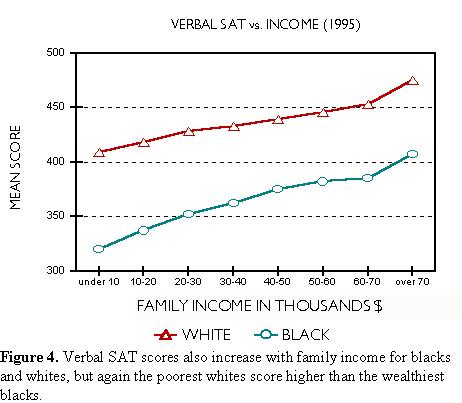
Figure 3 shows how math SAT scores increase with family income for both whites and blacks….However, black students from families earning more than $70,000 (1995 dollars) score lower than white students whose families earned less than $10,000. Figure 4 shows more of the same for the verbal SAT. Here too, the wealthiest blacks score below the poorest whites. (Complete data can be found in Appendix B.)


For more, we go to the abstract of Anne Case and Christine Paxson’s NBER Working Paper No. 12466 (“Stature and Status: Height, Ability, and Labor Market Outcomes,” August 2006):

On average, taller people earn more because they are smarter. As early as age 3 — before schooling has had a chance to play a role — and throughout childhood, taller children perform significantly better on cognitive tests. The correlation between height in childhood and adulthood is approximately 0.7 for both men and women, so that tall children are much more likely to become tall adults. As adults, taller individuals are more likely to select into higher paying occupations that require more advanced verbal and numerical skills and greater intelligence, for which they earn handsome returns. Using four data sets from the US and the UK, we find that the height premium in adult earnings can be explained by childhood scores on cognitive tests. Furthermore, we show that taller adults select into occupations that have higher cognitive skill requirements and lower physical skill demands.

Finally, on the intra-national level, there is Jay L. Zagorsky’s paper, “Do you have to be smart to be rich? The impact of IQ on income, wealth, and financial distress.” (The paper, which has received much publicity, is still “in press” at the journal, Intelligence.) Zagorsky confirms the positive relationship between IQ and income but then, anomalously, posits no relationship between IQ and wealth (i.e., net worth):

How important is intelligence to financial success? Using the NLSY79, which tracks a large group of young U.S. baby boomers, this research shows that each point increase in IQ test scores raises income by between $234 and $616 per year after holding a variety of factors constant. Regression results suggest no statistically distinguishable relationship between IQ scores and wealth. Financial distress, such as problems paying bills, going bankrupt or reaching credit card limits, is related to IQ scores not linearly but instead in a quadratic relationship. This means higher IQ scores sometimes increase the probability of being in financial difficulty.

How could IQ positively affect income but not wealth, given that (for most of us) wealth is derived from income? Zagorsky doesn’t know, and admits as much; all he offers are non-quantitative guesses. Many others have made much of Zagorsky’s “findings” (envious Leftists, for the most part), but I have not yet found a critique of it by an academic economist. (It may be too soon for that; the paper was published only a few months ago.)

Here are some of my reactions to the paper. To begin with, IQ, wealth, and income are highly correlated, as you might expect. This is from Zagorsky’s paper:
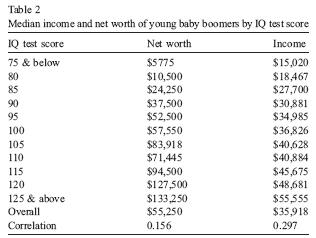
The correlations at the bottom of the table are Zagorsky’s stated correlations between between IQ and net worth and IQ and income, respectively. Those correlations are for the entire data set (N=7403). But the correlations for the data given in table are as follows:

IQ and net worth — 0.981
IQ and income — 0.984
Net worth and income — 0.970

The point is that the low correlations reported by Zagorsky are, in fact, significant. There is a lot of “noise” in the data, but the underlying trends are what you would expect. That leads me to suspect that Zagorsky set out to find what he found. Here are some of my concerns and objections about what he found and how he found it:

  • There is the obvious anomaly in table 2, at the cell represented by IQ 110, where (a) net worth is lower than at IQ 105 and (b) income is barely higher than at IQ 105. How could that be if there are about 700 for that IQ cell, as one would expect given 11 IQ cells and a sample size >700?
  • For married persons, Zagorsky divided family income and wealth by two, so as to avoid a “bias” toward married persons. What that does, of course, is bias the results toward single persons, who generally earn less and have less wealth than married persons. (See, for example, the correlations for “ever married” and “divorced” in table 1 of the paper.) The income and wealth of a married person is his or her income and wealth, legal fictions aside. Family income and wealth is higher but not fully accounted for because the income and wealth contributed by a “non-working” spouse generally goes unrecognized. Dividing the income and wealth of married persons in half is a shady trick and/or an indication of Zagorsky’s incompetence.
  • In any event, Zagorsky wasn’t satisfied with the obviously strong relationships between IQ, income and wealth, so he used regression analysis to “control” for other factors other than income that might determine wealth. In the end, Zagorsky simply runs regression after regression, most of them meaningless because he uses the “kitchen sink” style of analysis: throwing in every variable at hand (e.g., siblings, ever married, ever divorced, heavy smoker, light smoker, and self-esteem(?)). It is regression analysis at its worst: a data-mining fishing expedition, pure and simple.
  • Where Zagorsky reports the results of regressions on a limited number of (mostly) relevant variables (table 3), the regression that best fits the data (highest r-squared) yields a positive coefficient on IQ.
  • Zagorsky draws largely on self-reported survey data (a major weakness, in itself) for persons aged 40 to 47 years. That is, Zagorsky’s sample represents persons who, for the most part, are a decade or three from their peak earnings and wealth. And persons with higher IQs will tend to accumulate wealth more rapidly than those with lower IQs because (a) they will have learned more from their past mistakes and (b) over a decade or three wealth usually grows at a rate that is closer to exponential than linear (compound interest, stocks for the long run, and all that).
  • Finally, it is clear that Zagorsky is in over his head. He is not an economist or statistician but, rather, some kind of sociologist. His home base is Ohio State’s Center for Human Resource Research. Some of his other research (if you can call it that) undermines the so-called findings that I have summarized here.

In sum, Zagorsky’s paper is junk. I felt obliged to acknowledge it because the “finding” about IQ and wealth garnered a lot of attention when the paper was published earlier this year.
Intelligence and Income: International Differences
I return to Rushton’s review of Lynn’s Race Differences: An Evolutionary Analysis:

Lynn’s book…tak[es] a global perspective and consists of a review more than 500 studies published world wide from the beginning of the twentieth century up to the present. He devotes a chapter to each of ten races, differentiated by Cavalli-Sforza, Menozzi and Piazza (1994) into “genetic clusters”, which he regards as a transparent euphemism for races.

His conclusions are that the East Asians (Chinese, Japanese and Koreans) have the highest mean IQ at 105. These are followed by the Europeans (IQ 100). Some way below these are the Inuit (Eskimos) (IQ 91), South East Asians (IQ 87), Native American Indians (IQ 87), Pacific Islanders (IQ 85), South Asians and North Africans (IQ 84). Well below these come the sub-Saharan Africans (IQ 67) followed by the Australian Aborigines (IQ 62). The least intelligent races are the Bushmen of the Kalahari desert together with the Pygmies of the Congo rain forests (IQ 54).

After the ten chapters setting out the evidence for each of the ten races there follows a chapter on the reliability and validity of the measures. These show that the studies have high reliability in the sense that different studies of racial IQs give closely similar results. For instance, East Asians invariably obtain high IQs, not only in their own native homelands but in Singapore, Malaysia, Hawaii and North America. To establish the validity of the racial IQs he shows that they have high correlations with performance in the international studies of achievement in mathematics and science. Racial IQs also have high correlations with national economic development, providing a major contribution to the problem of why the peoples of some nations are rich and others poor. He argues further that the IQ differences between the races explain the differences in achievement in making the Neolithic transition from hunter-gathering to settled agriculture, the building of early civilizations, and the development of mature civilizations during the last two thousand years.

Lynn tackles the problem of the environmental and genetic determinants of race differences in intelligence and concludes that these contribute about equally to the phenotypic differences. He argues that the consistency of racial IQs in many different locations can only be explained by powerful genetic factors. He works out the genetic contribution in most detail for the sub-Saharan Africans. His argument is that sub-Saharan Africans in the United States experience the same environment as whites, as regards determinants of intelligence. He argues that they have as good nutrition as whites, as shown by their having the same average height in studies going back to World War 1, and they have approximately the same education as whites. He presents evidence that blacks in the southern states have very little white ancestry and have an IQ of about 80, and that proposes that this can be adopted as the genotypic IQ of blacks, i.e. the IQ that blacks attain when they are reared in the same environment as whites. The IQ of blacks in sub-Saharan Africa is a good deal lower at 67. Hence, the adverse environment in sub-Saharan Africa, which he regards as consisting principally of poor nutrition and health, contributes about 13 IQ points to the low IQ in sub-Saharan Africa. Lynn’s estimate is not too different from that advanced in 1969 by Jensen to the effect that about two thirds of the low IQ of blacks in the United States is attributable to genetic factors, and the more recent estimate of Rushton and Jensen (2005) that the figure is around 80 percent. Lynn has (unsurprisingly for those familiar with his work) put a bit more weight on the genetic factor.

Lynn (with Tatu Vanhannen) had earlier (2002) written IQ and the Wealth of Nations (summary and criticisms, here). That book seems to be an outgrowth of a Lynn-Vanhannen article in The Mankind Quarterly (“National IQ and Economic Development: A Study of Eighty-One Developing Nations,” Summer 2001). (For corroboration of Lynn and Vanhannen’s findings about the positive influence of IQ on national output, see Garrett Jones and W. Joel Schneider’s “Intelligence, Human Capital, and Economic Growth: A Bayesian Averaging of Classical Estimates (BACE) Approach,” June 2005.)
Gerhard Meisenberg, writing in “IQ Population Genetics: It’s Not as Simple as You Think” (The Mankind Quarterly, Winter 2003), offers a comprehensive view of the evolutionary causes of IQ differences across geographic regions and the effects of those differences on GDP. Meisenberg draws on the Lynn-Vanhannen data and many other sources. Meisenberg says that

[s]ome scholars, most notably Richard Lynn and Philippe Rushton, propose climate and ecology as selective forces. According to Lynn, the dependence on big-game hunting in northern climates necessitated complex social organization with efficient cooperation and intelligent planning, while tropical populations could always fall back on cognitively undemanding food gathering (Lynn, 1991).

Rushton emphasizes the need for close family ties and high parental investment in harsh climates. While most childhood mortality in the tropics was caused by uncontrollable endemic diseases, most childhood mortality in the arctic was due to the predictable challenges of seasonal food shortages and the rigors of the climate. These challenges demanded intelligent planning in addition to stable families (Rushton, 1995).

These theories postulate that physical and cognitive race differences evolved at roughly the same time, starting about 100,000 years ago when modern humans first ventured out of the tropics and into the inhospitable wastelands of central and northern Asia. Thus both Lynn and Rushton predict that intelligence genes cluster with climate-selected physical traits such as skin color. Both make the specific prediction that intelligence is highest in Mongoloids, lowest in Negroids, and intermediate in Caucasoids.

This prediction is borne out by the data in Table 1. The average IQ is 97.1 for Mongoloids, 93.9 for Caucasoids, and 69.6 for Negroids. IQ also correlates with latitude (Pearson’s r = 0.7559) and per-capita GDP (r = 0.7348). However, in multiple regression models with either latitude or GDP or both as copredictors of IQ, race remains a statistically significant predictor at the P

La Griffe du Lion has solved the puzzle. First, some background. La Griffe’s analysis of March 2002, highlights the “puzzle”:

In Figure 2, the [Lynn-Vanhannen] data [table here] is [sic] divided into contributions from four groups: blacks, (European) whites, East Asians and “others.” I did not include the outliers: South Africa, Barbados, Qatar and China.
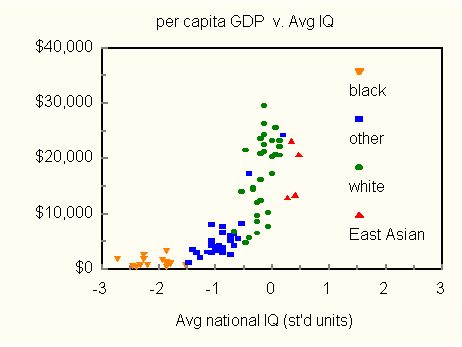
Figure 2. Per capita GDP by racial group. “White” here means European white; “East Asian” means the racially homogenous polities: Taiwan, South Korea, Hong Kong, and Japan.

La Griffe, in a later post (May 2004) addresses the seeming anomaly in the relationship between IQ and GDP. As shown in the figure directly above, four East Asian (or Northeast Asian) countries (Hong Kong, South Korea, Japan, and Taiwan), which have the highest average IQs, do not have the highest per capita GDPs. The short of it is this: GDP is best explained by verbal IQ, as opposed to a measure of IQ that encompasses both verbal and quantitative skills. Thus figure 7:
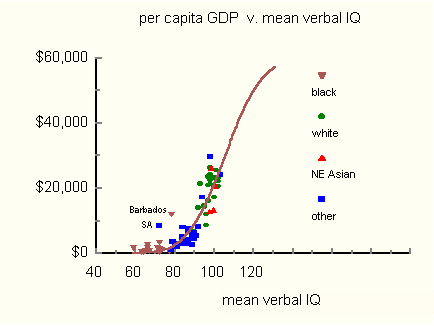
La Griffe observes that the IQ of (North)east Asians

is bifurcated. NE Asians have the highest IQ of all peoples other than Ashkenazim. They owe that superior IQ, however, to extraordinary visuospatial ability, which, despite verbal shortcomings, lifts their IQ above that of Europeans….

Among the races, only NE Asians and Amerindians exhibit this particular kind of verbal-nonverbal cognitive split. For other races verbal and general IQ averages have similar values, making the distinction between the two transparent to smart fraction theory. In the 12 studies reporting both general and verbal IQ for NE Asians, the general-verbal gap averaged 6.5 IQ points….

[T]he spectacular visuospatial ability of NE Asians, while accounting for their high [overall] IQ scores, does not necessarily make them good capitalists. Hunting strategies have little to do with wealth production. And a new tool, irrespective of point of origin, is now soon available worldwide. The structure of NE Asian intelligence did not come about in response to pressures to be attorneys or editors or production managers or copywriters or salesmen or programmers or systems analysts or insurance adjusters or purchasing agents or account executives.

In sum, IQ strongly determines both personal income and, therefore, per capita GDP. Verbal IQ turns out to be an important (negative) determinant of income in those (few) cases where it is a relatively weak component of overall IQ.

But what about the influence of income on IQ? Let’s return to Meisenberg’s article:

The massive rise of IQ that took place in many countries over the past century shows conclusively that environmental effects can have a powerful effect on the average intellectual level of large populations. Presumably one or another aspect of “standard of living” is responsible for this secular trend: education, nutrition, health care, mass media, or, most likely, a combination of all of these.

Gross domestic product adjusted for purchasing power (GDP in Table 1) is an indicator for the population’s “standard of living”. If a high standard of living does indeed raise IQ test performance, then GDP should be an independent predictor of national IQ even when the effects of race and latitude are partialled out.

When race, latitude and GDP are used as co-predictors, GDP does indeed have an independent effect in predicting national IQ (P = 0.0007). In this model, race and latitude remain powerful independent predictors, each with P Flynn effect [link added: ED] these results suggest that the causal arrow points both ways. High intelligence produces a high standard of living, which in turn raises intelligence even more. Thus intelligence and economic development are mutually reinforcing in a positive feedback loop….

This feedback loop explains…the rise in mental test performance that has become known as the Flynn effect.

This feedback loop between intelligence and standard of living can explain the great magnitude of the IQ differences between nations. It predicts that even in cases where genetic differences affecting mental ability are small, the observed phenotypic differences become amplified because the slightly more gifted populations achieve a higher standard of living which raises their measured intelligence even more, which in turn raises their standard of living yet further. Similar “amplifier effects” have previously been proposed as explanations for the Flynn effect (Dickens and Flynn, 2001).

There you have it: The smarter get richer and the richer get smarter, not at the expense of the poorer and not-as-smart but by virtue of their genes and the material advantages afforded by those genes. Forceful transfers of income and wealth from the smarter and richer to the not-so-mart and poorer might be helpful to the latter — but more likely not, as I argue earlier. But such transfers definitely diminish the ability of the smarter and richer to help the not-so-smart in more lastingly productive ways: through technological advancement, job creation, mutually beneficial trade, and well-targeted charity.
CONCLUSION
Redistribution in an effort to make us “more equal” is not only counterproductive and unfair, it is futile. Or if not entirely futile, largely wasteful. All human beings (or at least those who are citizens and lawful residents of the U.S.) deserve equal rights. But the equal rights they deserve are the negative rights of the original Constitution, not the positive rights sought by generations of so-called liberals and progressives. There is nothing “liberal” or “progressive” (in the root meanings of those words) about redistribution.
Some related posts:
The Cost of Affirmative Action
Affirmative Action: A Modest Proposal
Race, Intelligence, and Affirmative Action
Affirmative Action: Two Views from the Academy
Affirmative Action, One More Time
Much Food for Thought
After the Bell Curve
A Footnote . . .
The Main Causes of Prosperity
Why Class Warfare Is Bad for Everyone
Fighting Myths with Facts
Debunking More Myths about Income Inequality
A Century of Progress?
Socialist Calculation and the Turing Test
Taxes, Charitable Giving, and Republicanism
Productivity Growth and Tax Cuts
Zero-Sum Thinking
Liberty, General Welfare, and the State
The Causes of Economic Growth
Republicanism, Economic Freedom, and Charitable Giving
The Last(?) Word about Income Inequality
Status, Spite, Envy, and Income Redistribution
Things to Come
__________
* The more controversial scientists whose work I sample here are Charles Murray, J. Phillipe Rushton, Richard Lynn, and Napoleon Chagnon.
Murray is controversial mainly for The Bell Curve, which brought to a wide audience the large body of long-standing evidence of persistent inter-racial differences in IQ. Rushton and Lynn are controversial because of their findings on race, gender, and intelligence, and because of their affiliation with the Pioneer Fund. The Fund’s roots and some of its current connections are tainted with the label “white supremacist.” The Fund (website here) has responded to those allegations. Whether Rushton, Lynn, and others who produce similar research are white supremacists is beside the question of the validity of their research. Judge for yourself.
Chagnon is controversial for other reasons, namely the ethics (or purported lack thereof) in his field work. (For Chagnon’s statements about the controversy, go here. See also Steven Malanga’s review of Chagnon’s Noble Savages, “Welcome to the Jungle,” City Journal,  April 13, 2014.) In the “small world” department, I note that Chagnon hails from the village where my maternal grandparents raised ten children. The doctor who delivered many of those children bore the name Napoleon Chagnon. The sketchy biographical information about the anthropologist (p. 6, here) indicates that he was not the son of the medical doctor, but given the village’s small population (perhaps 500 when the anthropologist was born), it seems likely that he was related to and named for the medical doctor (a grandson, perhaps). And it was in honor of “old Doc Chagnon” that my maternal grandparents chose Napoleon as the middle name of the tenth and last of their children.
More from the Apocalyptic Left

This article in the current issue of Newsweek carries the subhed “If humans were evacuated, the Earth would flourish.” The final graph of the article puts the idea in perspective: “Too bad there’s no one there to see it.”

Actually, the central figure of the piece — one Alan Weisman — proposes more than evacuation. He’s trying to organize a voluntary human extinction movement. Weisman’s Leftist pedigree is quite evident in his affiliation with Homelands Productions.

Weisman is an extreme example of what I said here:

The emphasis on social restraints — to a Leftist… — means social engineering writ large. He wants a society that operates according to his strictures. But society refuses to cooperate, and so he conjures historically and scientifically invalid explanations for the behavior of man and nature. By doing so he is able to convince himself and his fellow travelers that the socialist vision is the correct one. He and his ilk cannot satisfy their power-lust in the real world, so they retaliate by imagining a theoretical world of doom. It is as if they walk around under a thought balloon which reads “Take that!”

Weisman isn’t content to foresee the apocalypse. He wants to rush toward it and embrace it.

A Case in Point

I wrote yesterday about the arrogance that underlies the redistributive urge:

It is liberals who empower the state to dictate the redistribution of income, even though redistribution is a violation of the very autonomy that liberals claim to value. Liberals are willing and ready to draw arbitrary lines between those who (in their view) deserve more income and those who deserve less of it. And liberals are more than willing and ready to use the power of the state to enforce their arbitrariness.

By the same token, liberals are unwilling to allow free institutions to determine who fares well and who fares poorly. And their unwillingness to do so undermines the ability of those free institutions to enable the “cold/sick/hungry/stupid/isolated” to better their lot by their own efforts, and to care for those who are unable to do so.

My only regret is the exclusive use of “liberals.” The arrogant attitude that “no one deserves to be so rich” extends beyond liberals. A good case in point is Sen. Chuck Grassley (R-IA). According to an article in the current issue of Newsweek, Grassley

has a profound frustration with superrich businesses and corporations that do not pay their fair share of taxes. Now the senior senator from Iowa is fighting to eliminate what he sees as a giant tax loophole by co-sponsoring legislation that would raise the tax rates (from 15 to 35 percent) on publicly traded partnerships like the private-equity giant Blackstone. To Grassley, the bill would help prevent ultrarich financiers from conspiring with their lawyers to “screw the taxpayer.” To his opponents, it’s a wrong-headed means of stunting economic growth.

Wrong-headed is right. (See below for a sample of the consequences of “soaking” the “super rich.”)

The Newsweek piece about Grassley is a sidebar to another article in the same issue of Newsweek, namely, “Taxing the Super Rich.” From the lede:

In Wall Street’s pecking order the partners in private-equity firms are the true aristocrats…Global in reach, able to marshal billions to buy big companies…Private-equity partners are not just in it for the money (though the successful ones make tons of it), but for the power to reshape whole industries. Unlike corporate CEOs, who are shackled by the short-term focus of shareholders, private-equity managers can swoop in and transform a troubled industry to create efficiency and growth. [Emphasis added: ED]

But that isn’t enough for the class-warfare crowd. Returning to the article:

Ever since the rise of the populists in the late 1800s, lawmakers have periodically threatened to soak the rich. Usually, these movements fizzle, partly because Americans hope that they, too, might one day become rich, and partly because there are good economic arguments against discouraging investment and the accumulation of wealth. But from time to time comes a tipping point. In the early 20th century, the Progressive Movement managed to impose a federal income tax, partly in reaction to the vast fortunes made during the late-19th-century Gilded Age.

Those vast fortunes were made because those who made them were responsible for the rapid economic growth of the late 1800s. Productivity rose so rapidly during that era that prices fell, even as the economy grew.

As for the fruits of the Progressive Movement — which imposed a federal income tax and punitive anti-trust and regulatory policies — read this, in which I point out:

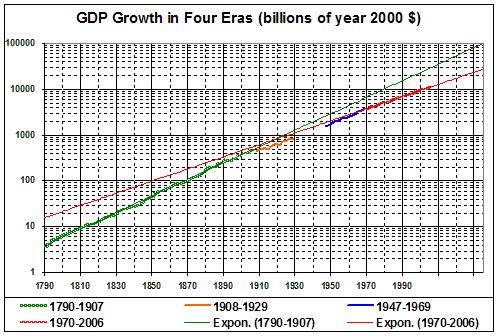
  • Had the economy continued to grow at the rate of 1790-1907 (the era of laissez-faire, more or less), real GDP in 2035 would be $107 trillion (in year 2000 dollars).
  • If the economy continues to grow at the rate of 1970-2005 (the era of entrenched big government), real GDP in 2035 will be $27 trillion (in year 2000 dollars).
  • Thus the average American will “enjoy” about one-fourth the real output that would be his absent big government.

We owe the sharp drop in economic growth after 1907 to the Progressive Movement. The great-grandchildren of last century’s “progressives” haven’t seen enough. In their ignorance and arrogance, the wish to redouble our economic pain by “soaking” the “super rich” whose efforts — as even Newsweek admits — create efficiency and growth.

Related post: More Commandments of Economics (see #13)

Positive Rights and Cosmic Justice: Part III

The prologue is here, part I is here, and part II is here. This post focuses on the redistribution of income and wealth, specifically, its counterproductive effects and its roots in class warfare and “liberal” arrogance.

INTRODUCTION

In a libertarian regime, everyone is entitled to negative rights: the free enjoyment of one’s own life, liberty, and property as long as one does no harm to others. With negative rights there is no taking from anyone else, except to underwrite those state functions (justice and defense) that protect negative rights. (An extreme libertarian — i.e., anarcho-capitalist — would say that the functions of justice and defense can be provided through voluntary contractual relationships.)

Positive rights, on the other hand, are assigned selectively by a regime that takes from some and gives to others. How much the “donees” receive from the “donors” depends only on the dictates of those who create and enforce postive rights, namely, paternalists (usually “liberals”) and power-seeking politicians.

Joe Miller (Bellum et Mores) is a liberal who supports positive rights:

…I still hold on to one core insight of liberalism: respect for autonomy means more than just non-interference. I can have all sorts of freedoms from various things, but those freedoms don’t mean a damn thing if I’m too cold/sick/hungry/stupid/isolated to exercise them. And I remain convinced that, at least for right now, the only way to ensure that everyone has the shelter, medicine, food, education, and access needed to enjoy his/her freedom is through some form of redistribution. Insisting that you redistribute part of your wealth is no more a violation of your autonomy than is insisting that you refrain from hitting me in the nose. Both hitting me in the nose and refusing to help those too poor to exercise their freedoms are violations of autonomy.

(I addressed the argument about autonomy in parts I and II.)

Believers in positive rights seek “cosmic justice” (though they may not realize it). What is cosmic justice? I like this example from Thomas Sowell’s speech, “The Quest for Cosmic Justice“:

A fight in which both boxers observe the Marquis of Queensberry rules would be a fair fight, according to traditional standards of fairness, irrespective of whether the contestants were of equal skill, strength, experience or other factors likely to affect the outcome– and irrespective of whether that outcome was a hard-fought draw or a completely one-sided beating.

This would not, however, be a fair fight within the framework of those seeking “social justice,” if the competing fighters came into the ring with very different prospects of success — especially if these differences were due to factors beyond their control….

In a sense, proponents of “social justice” are unduly modest. What they are seeking to correct are not merely the deficiencies of society, but of the cosmos. What they call social justice encompasses far more than any given society is causally responsible for. Crusaders for social justice seek to correct not merely the sins of man but the oversights of God or the accidents of history. What they are really seeking is a universe tailor-made to their vision of equality. They are seeking cosmic justice.

In an earlier post, “Rights and Cosmic Justice,” I wrote:

Those who seek cosmic justice are not content to allow individuals to accomplish what they can, given their genes, their acquired traits, their parents’ wealth (or lack of it), where they were born, when they live, and so on. Rather, those who seek cosmic justice cling to the Rawlsian notion that no one “deserves” better “luck” than anyone else. But “deserves” and “luck” are emotive, value-laden terms. Those terms suggest that there is some kind of great lottery in the sky, in which each of us participates, and that some of us hold winning tickets — which equally “deserving” others might just have well held, were it not for “luck.”

That is not what happens, of course. Humankind simply is varied in its genetic composition, personality traits, accumulated wealth, geographical distribution, etc. Consider a person who is born in the United States of brilliant, wealthy parents — and who inherits their brilliance, cultivates his inheritance (mental and monetary), and goes on to live a life of accomplishment and wealth, while doing no harm and great good to others. Such a person is neither “lucky” nor less “deserving” than anyone else. He merely is who he is, and he does what he does. There is no question of desert or luck.

As Anthony de Jasay writes in “Risk, Value, and Externality,”

Stripped of rhetoric, an act of social justice (a) deliberately increases the relative share . . . of the worse-off in total income, and (b) in achieving (a) it redresses part or all of an injustice. . . . This implies that some people being worse off than others is an injustice and that it must be redressed. However, redress can only be effected at the expense of the better-off; but it is not evident that they have committed the injustice in the first place. Consequently, nor is it clear why the better-off should be under an obligation to redress it….

There is the view, acknowledged by de Jasay, that the better-off are better off merely because of luck. But, as he points out,

Nature never stops throwing good luck at some and bad luck at others, no sooner are [social] injustices redressed than some people are again better off than others. An economy of voluntary exchanges is inherently inegalitarian….Striving for social justice, then, turns out to be a ceaseless combat against luck, a striving for the unattainable, sterilized economy that has built-in mechanisms….for offsetting the misdeeds of Nature.

Most seekers of cosmic justice simply claim that they want only what is “fair” for those who “deserve better.” They overlook or simply choose to ignore the evidence that the quest for cosmic justice harms those whom it is intended to benefit. I address that matter in the section “Does Redistribution Work?.”

Then there are those who claim that redistribution can be made to work because it is possible to calibrate well-being across individuals, thereby maximizing “social welfare.” I address that claim in the section “The Roots of Redistribution: Class Warfare and Arrogance.”

DOES REDISTRIBUTION WORK?

The redistribution of income (and thus of wealth) is an integral function of the regulatory-welfare state (i.e., big government). Redistribution not only harms those who are taxed for that purpose but it also does not lastingly help its intended beneficiaries. In fact, it works to their detriment in the long run.

Liberals are unable to grasp that reality because they, more than most Americans, suffer from economic ignorance. Because of economic ignorance, liberals are unable to grasp the subtle, corrosive effects of big government on those things that drive economic progress: invention, innovation, entrepreneurship, the saving that funds those activities, and the hard work that enables the rest.

We Americans are far better off materially than our antecedents of a century ago — but very few of us (especially liberals) understand how much better off we would in the absence of big government. In this post, for example, I assessed how much worse off Americans will be a generation hence because of big government. The bottom line:

  • Had the economy continued to grow at the rate of 1790-1907 (the era of laissez-faire, more or less), real GDP in 2035 would be $107 trillion (in year 2000 dollars).
  • If the economy continues to grow at the rate of 1970-2005 (the era of entrenched big government), real GDP in 2035 will be $27 trillion (in year 2000 dollars).
  • Thus the average American will “enjoy” about one-fourth the real output that would be his absent big government.
  • And more than 50 percent of that greatly diminished output will be taxed to support the state’s regulatory mechanisms and the growing numbers of persons (especially the elderly) who have become dependent on the state.

In sum, redistribution does not work. As part of liberalism’s “package deal” (tax, regulate, spend, and elect) it harms those whom it is supposed to help by undermining economic growth and thus depriving the “cold/sick/hungry/stupid/isolated” of jobs and (for those who simply cannot support themselves) vast amounts of voluntary charity.

The astute reader will have noticed that I have not mentioned programs that are designed to favor particular groups. The most intrusive and controversial of such programs is affirmative action, which is simply an indirect form of redistribution. All I need say about affirmative action I have said here, here, here, here, and here. The bottom line: Affirmative action costs us dearly.

The astute reader will have noticed, also, that I have not mentioned the issue of dependency on the welfare state. There is little to say but this: A guarantee of income (or income-in-kind benefits) for not working is a disincentive to better one’s self through work. Dependency on the welfare state is — and has been — so well recognized as a real and destructive force that even Bill Clinton signed welfare reform into law (the Personal Responsibility and Work Opportunity Reconciliation Act of 1996). And that law has worked.

THE ROOTS OF REDISTRIBUTION: CLASS WARFARE AND ARROGANCE

Liberals wage class warfare on behalf of the “cold/sick/hungry/stupid/isolated” and any “oppressed” or “disadvantaged” group (i.e., one that is not white, male, employed without benefit of affirmative action, law-abiding, and heterosexual). It is a wonder that Jews remain, for the most part, in the liberal camp, but that habitual tendency may arise from liberal guilt (see below).

Liberal politicians are abetted in their cause by the votes that they attract from those groups on whose behalf they wage class warfare. Liberals and their constituencies, for the most part, do not understand the undesirable economic consequences of redistribution. There are many, of course, who simply choose not to understand — choosing class warfare over reason.

It is strange that liberals can claim to believe in the benefits of intellectual liberty (the competition of ideas) but not in the benefits of economic liberty. Liberals’ token adherence to intellectual liberty often is hypocritical. (Consider campus speech codes, for example.) In any event:

  • Liberals prize talk (especially when it is their kind of talk). But talk is cheap. Economic achievement requires action, not talk. The liberal imagination cannot value that which it does not understand.
  • Rich liberals either don’t understand how they came to be rich (if they did so on their own) and/or they feel guilty about their wealth. They are therefore quite willing to infringe the autonomy of others (through taxation) in the service of their ignorance and their consciences.
  • Liberals, who claim to prize autonomy, are nevertheless quite willing to tell others how to lead their lives. Witness the decades of regulation and taxation imposed upon Americans by “compassionate” liberals.
  • Liberals are quite willing to decide precisely who is deserving of “compassion” and who is not. That is, they (and only they) are fit to decide where to draw the dividing lines between those who are “too cold/sick/hungry/stupid/isolated” and those who are not.

In other words, liberals are strong believers in positive rights and, therefore, dispensers of cosmic justice. It is liberals who empower the state to dictate the redistribution of income, even though redistribution is a violation of the very autonomy that liberals claim to value. Liberals are willing and ready to draw arbitrary lines between those who (in their view) deserve more income and those who deserve less of it. And liberals are more than willing and ready to use the power of the state to enforce their arbitrariness.

By the same token, liberals are unwilling to allow free institutions to determine who fares well and who fares poorly. And their unwillingness to do so undermines the ability of those free institutions to enable the “cold/sick/hungry/stupid/isolated” to better their lot by their own efforts, and to care for those who are unable to do so.

Some proponents of positive rights (e.g., Joe Miller) nevertheless defend their position by asserting that they are not drawing arbitrary lines between those who deserve more and those who deserve less. For it is possible (according to Joe, among others) to make valid interpersonal comparisons of utility (hereafter interpersonal utility comparisons, or IUCs). The implication is that the ability to make valid IUCs enables someone (them? bureaucrats? politicians?) to make valid judgments about how to redistribute income so as to foster the maximization of a social welfare function (SWF), that is, to exact cosmic justice. (Joe does not refer to the SWF, but there is no point in making IUCs unless it is for the purpose of increasing the value of the SWF.)

The validity of the SWF, then, depends on these assumptions:

  • It is possible to make interpersonal utility comparisons (IUCs), that is, to determine whether and when it hurts X less than it benefits Y when the state takes a dollar from X and gives it to Y.
  • Having done that, the seekers of cosmic justice are able to conclude that the Xs should be forced to give certain amounts of their income to the Ys.
  • Making the Xs worse off doesn’t, in the longer run, also make the Ys worse off than they would have been absent redistribution. (This critical assumption is flat wrong, as discussed above.)

All of this is arrogant moonshine. Yes, one may safely assume that Y will be made happier if you give him more money or the things that money can buy. So what? Almost everyone is happier with more money or the things it can buy. (I except the exceptional: monks and the like.) And those who don’t want the money or the things it can buy can make themselves happier by giving it away.

What one cannot know and can never measure is how much happier more money makes Y and how much less happy less money makes X. Some proponents of IUCs point to the possibility of measuring brain activity, as if such measurement could or should be made — and made in “real time” — and as if such measurements could somehow be quantified. We know that brains differ in systematic ways (as between men and women, for instance), and we know a lot about the ways in which they are different, but we do not know (and cannot know) precisely how much happier or less happy a person is made — or would be made — by a change in his income or wealth. Happiness is a feeling. It varies from person to person, and for a particular person it varies from moment to moment and day to day, even for a given stimulus. (For more about the impossibility of making IUCs, see these posts by Glen Whitman of Agoraphilia. For more about measuring happiness, see these posts by Arnold Kling of EconLog.)

One answer to such objections is that an individual’s utility must diminish at the margin. (After all, diminishing marginal utility, DMU, is a key postulate of microeconomic theory.) Therefore, the Xs of the world must be “sated” by having “so much” money, whereas the Ys remain relatively “unsated.”

If that were true, why would Bill Gates, Warren Buffet, and partners in Wall Street investment banks (not to mention most of you who are reading this) seek to make more money and amass more wealth? Perhaps the likes of Gates and Buffet do so because they want to engage in philanthropy on a grand scale. But their happiness is being served by making others happy through philanthropy; the wealthier they are, the happier they can make others and themselves.*

Most of us, I suspect, simply become happier as we accrue wealth because. But how much wealth is “enough” for one person? I cannot answer that question for you; you cannot answer it for me. (I may have a DMU for automobiles, cashew nuts, and movies, but not for wealth, in and of itself.) And that’s the bottom line: However much we humans may have in common, each of is happy (or unhappy) in his own way and for his own peculiar reasons.

In any event, even if individual utilities (states of happiness) could be measured, there is no such thing as the social welfare function: X’s and Y’s utilities are not interchangeable. Taking income from X makes X less happy. Giving some of X’s income to Y may make Y happier (in the short run), but it does not make X happier. It is the height of arrogance for anyone — liberal, fascist, communist, or whatever — to assert that making X less happy is worth it if it makes Y happier.

CONCLUSION

There is a liberal urge to exact cosmic justice through positive rights — primarily redistribution in various forms. But redistribution harms those whom it is intended to help because it curtails economic growth and discourages work.

The urge to exact cosmic justice arises from arrogance, that is, from a penchant for dictating economic outcomes (and social relationships) that cannot be justified by pseudo-scientific appeals to IUCs and the SWF.

If there is anything unjust or unfair in this world, it is the effort to exact cosmic justice. Robert Nozick put it this way in Anarchy, State, and Utopia:

We are not in the position of children who have been given portions of pie by someone who now makes last-minute adjustments to rectify careless cutting. There is no central distribution, no person or group entitled to control all the resources, jointly deciding how they are to be doled out. What each person gets, he gets from others who give to him in exchange for something, or as a gift. In a free society, diverse persons control different resources, and new holdings arise out of the voluntary exchanges and actions of persons. (Quoted by Gregory Mankiw in “Fair Taxes? Depends on What You Mean by Fair,” The New York Times, July 15, 2007.)

The urge to exact cosmic justice is more than harmful and arrogant. It is futile, as I will explain in part IV.

Other related posts:
Why Class Warfare Is Bad for Everyone
Fighting Myths with Facts
Debunking More Myths of Income Inequality
Socialist Calculation and the Turing Test
The Social Welfare Function
Taxes, Charitable Giving, and Republicanism
Ten Commandments of Economics
More Commandments of Economics
Zero-Sum Thinking
On Income Inequality
The Causes of Economic Growth
The Last(?) Word about Income Inequality
Democrats: The Anti-People People
Median Household Income and Bad Government

__________
* I want to underscore the essential difference between government-enforced charity and voluntary charity. Government-enforced charity may make liberals happier, and it may make Ys happier (in the short run), but it does not make Xs happier (except for liberal Xs who actually enjoy paying taxes as well as controlling others’ lives). Acts of voluntary charity, on the other hand, make the donors happier. That such acts (might) also make the donees happier is incidental.

It may seem that I am arguing for a position known as psychological egoism (PE), which Joe Miller summarizes (here) thusly: “PE maintains that, as a matter of fact, all human beings are always selfish.” Joe goes on to argue that PE is a false concept. He proffers altruism as the alternative; that is, people actually do unselfish things, things that make them worse off. I will not revisit all of the arguments pro and con PE and altruism, there is plenty of food for thought in Joe’s post, my first comment on the post, and this paper by Keith Burgess-Jackson.

I come down here:

There is no essential difference between altruism, defined properly, and the pursuit of self-interest, even if that pursuit does not “seem” altruistic. In fact, the common belief that there is a difference between altruism and the pursuit of self-interest is one cause of (excuse for) purportedly compassionate but actually destructive government intervention in human affairs.

And here:

The implication of calling another person’s act a “sacrifice” [i.e., altruistic] is that someone can get into that person’s mind and determine whether the act was a gain or a loss for the person. I say that someone must be able to get into the person’s mind because I don’t know how else you one determines whether or not an act is altruistic unless (a) one takes the person’s word for it or (b) one assembles a panel of judges, each of whom holds up a card that says “altruistic” or “selfish” upon the completion of an a particular act.

To illustrate my point I resort to the following bits of caricature:

1. Suppose Mother Teresa’s acts of “self-sacrifice” were born of rebellion against parents who wanted her to take over their business empire. That is, suppose Mother Teresa derived great satisfaction in defying her parents, and it is that which drove her to impoverish herself and suffer many hardships. The more she “suffered” the more her parents suffered and the happier she satisified her personal values.

2. Suppose Bill Gates really wanted to become a male version of Mother Teresa but his grandmother — on her deathbed — said “Billy, I want you to make the world safe from the Apple computer.” So, Billy went out and did that, for his grandmother’s sake, even though he really wanted to be the male Mother Teresa. Then he wound up being immensely wealthy, much to his regret. But “Billy” obviously put his affection for or fear of his grandmother above his desire to become a male version of Mother Teresa. He satisfied his personal values.

Now, tell me, who is the altruist, my fictional Mother Teresa or my fictional Bill Gates? You might now say Bill Gates. I would say neither; each acted in accordance with her and his personal values. One might call the real Mother Teresa altruistic because her actions seem altruistic, in the common meaning of the word. But one can’t say (for sure) why she took those actions. Don’s definition of altruism nevertheless requires such knowledge. Suppose the real Mother Teresa acted as she did not only because she wanted to help the poor but also because she sought spiritual satisfaction or salvation. Would that negate her acts? No, her acts would still be her acts, but we would understand them as acts arising from her values. That’s the best we can do absent the ability to read minds.

My argument rests on the proposition that human actions are, by definition, driven by the service of personal values, which come to us in many and mysterious (but not supernatural) ways. As a consequentialist, I prefer to look at results, not motivations. (“The road to hell,” and all that.) I eschew terms like altruism and egoism because they imply that a given result is somehow better if it’s “properly” motivated. A result is a result.

And redistribution yields very bad results, indeed.

Metaethical Moral Relativism: Is It Valid?

I recently quoted this definition of Methaethical Moral Relativism (MMR):

The truth or falsity of moral judgments, or their justification, is not absolute or universal, but is relative to the traditions, convictions, or practices of a group of persons.

I found the definition useful, regardless of the validity of MMR. I now address its validity.

The “traditions, convictions, or practices of a group of persons” are not ends in themselves. Rather, they are (or were originally) aimed at the attainment of a “greater good” — a moral imperative — which is (or was) served by such traditions, convictions, or practices.

The moral impetus for those traditions, convictions, or practices becomes tenuous with the passage of time. As the generations roll by, the members of a group turn their focus from the original moral imperative to the traditions, convictions, or practices that once served it. That is to say, the group’s morality becomes rote.
Because of this rote morality, the moral framework of the group becomes falsely identified with its particular traditions, convictions, or practices. (A good analogy can be found in the widespread practice of celebrating the Fourth of July without giving more than a moment’s thought — then or during the rest of the year — to the struggle for independence or to the meaning of liberty.)

MMR is valid only to the extent that there is no moral imperative that cuts across groups of persons: nations, races, ethnicities, clans, tribes, religions, political parties, and the like. (I disregard — for the moment — exceptions to the rule, that is, sociopaths, who (a) are likely to be found in any group of more than a few members, (b) quite often force or connive their way into positions of power (it goes with sociopathy), and (c) surround themselves with sociopathic henchmen.)

The crucial issue, then, is the existence (or non-existence) of a universal moral imperative, one that is common to the people (if not to the leaders) of nations, races, ethnicities, clans, tribes, religions, and the like. Kant would say that there is such an imperative, his categorical imperative (in its first formulation): “Act only according to that maxim whereby you can at the same time will that it should become a universal law.” [1]

Kant’s categorical imperative, however, is a Platonic universal: something that just is, a deontological duty. Kant, himself, distinguishes it from The Golden Rule, which (because of its commonality to so many forms of religion and philosophy) can be understood as a man-made utilitarian or consequentialist command. The Zoroastorian version, for example goes: “”Whatever is disagreeable to yourself do not do unto others.”

Why is The Golden Rule utilitarian or consequentialist? Because people have learned — from experience over the eons — that if most everyone follows the command to “do unto others as you would have them do unto you,” most everyone will benefit from doing so. One’s self-restraint with respect to others encourages (almost all) others to practice self-restraint toward one’s self. The Golden Rule does not apply to rule-breakers, who must face consequences (or one kind or another) for their rule-breaking. (That there are rule-breakers only underscores the humanness of The Golden Rule.)

Now, to answer the question of the title: Metaethical Moral Relativism, as defined above, is neither neither a valid concept nor an invalid one; it is an irrelevant concept. It treats different groups as if they had different moral imperatives. By and large, they do not; most groups (or, more exactly, most of their members) have the same moral imperative: The Golden Rule.

There are, of course, groups that seldom if ever observe The Golden Rule. Such groups are ruled by force and fear, and they deny voice and exit to their members. The rulers of such groups are illegitimate because they systematically try to suppress observance of The Golden Rule, which is deep-seated in human nature. Other groups may therefore justly seek to oust and punish those despotic rulers.

There is a relevant — but logically and factually invalid — form of Metaethical Moral Relativism:

The United States is imperfect. It is, therefore, no better than its enemies.

Such is the relativism we see in those who excuse despotic, murderous regimes and movements because “we asked for it” or “we are no better than they are” or “war is never the answer” or “one man’s terrorist is another man’s freedom fighter” or “terrorists deserve the protections of the Geneva Convention.” That kind of relativism empowers the very despots and terrorists whose existence is an affront to The Golden Rule.

Mindsets

Authoritarian (i.e., “liberal,” fascist, or communist): The greater good (“social welfare”) lies in the conformity of all (elites excepted, of course) to rules set down by elites.

Conservative: The greater good lies in conformity to well-established traditions — modes of living together that have stood the test of time. Such norms must arise from society and not be imposed on it by elites, though leaders will arise whose wisdom and foresight helps to shape constructive changes in social norms.

Libertarian: There is no greater good; the welfare of individuals cannot be summed. Neither elites nor traditions should dictate how individuals choose to live, as long as they do not harm others by their choices. Individuals may choose to adopt broadly accepted social norms, but only insofar as those norms are consistent with their own (harmless) behavioral preferences.

Conservative libertarian: There is no greater good, but individuals are generally better off if they respect social norms that have stood the test of time. To violate those norms willy-nilly (as a libertarian would do) or to efface those norms through fiat (as an authoritarian would do) is to undo the bonds of trust that enable peaceful and prosperous coexistence and mutual self-defense of that modus vivendi.

Things to Come

Revised, 09/24/07

Arnold Kling observes, in an article in the June 1 edition of TCS Daily, that

[according to The Forgotten Man by Amity Shlaes, Franklin] Roosevelt’s vaunted brain trust was divided as well as misguided. Some shared an outlook that one might trace back to Jefferson and Jackson, of hostility toward Wall Street finance and concentrated economic power. They wanted to break up large businesses and create a level playing field for the common man.

Others, however, were ready to embrace bigness. This group held that a modern economy was characterized by great economies of scale. They viewed laissez-faire capitalism as “horse-and-buggy economics.” They saw a future of collectivization and central planning. For this group, Italy and the Soviet Union represented successful role models.

Roosevelt turned to his populist advisers for campaign rhetoric and for tax proposals that would punish wealthy individuals and large corporations. But most of the New Deal, including the alphabet-soup agencies like the NRA and the TVA, reflected the influence of the collectivist-planners.

In the June 26 edition of TCS Daily, Kling predicts that

[t]he Democratic Party base does not want to see a rerun of President Clinton’s budget-balancing approach. They are looking instead at Franklin Roosevelt [the New Deal] and Lyndon B. Johnson [the Great Society] as models for the next Administration. In addition to socialized medicine, they want major new initiatives and dramatic spending increases in anti-poverty programs, education, and so on. They are not willing to be thwarted by questions about where the money might come from to pay for this….

My prediction is that we will see tax increases on estates, high incomes, and other popular targets….

If the economy remains strong, so that tax revenues are healthy, then the big spenders probably will get a lot of their wish list, such as government day-care programs, more money to throw down the public school drain, and job training programs. The only thing that can stop the next wave of taxpayer-funded feel-goodism would be a recession in 2008-2009.

Kling is right about Roosevelt, the Democrat Party, and the likely outcome of the 2008 election. Moreover, the economy is likely to remain strong — or to seem as if it remains strong — thus opening the way to a further expansion of the New Deal-Great Society. What will go unheeded is the insidious long-term effect of Rooseveltian-Johnsonian policies on the economy. As I wrote here and here,

  • Real GDP (in year 2000 dollars) was about $10.7 trillion in 2004.
  • If government had grown no more meddlesome after 1906 [when the modern regulatory state began, under the first Roosevelt], real GDP might have been $18.7 trillion….
  • That is, real GDP per American would have been about $63,000 (in year 2000 dollars) instead of $36,000.
  • That’s a deadweight loss to the average American of more than 40 percent of the income he or she might have enjoyed, absent the regulatory-welfare state.*
  • That loss is in addition to the 40-50 percent of current output which government drains from the productive sectors of the economy.

A principal result of economic ignorance is an inability to grasp the subtle, corrosive effects of big government on those things that drive economic progress: invention, innovation, entrepreneurship, the saving that funds those activities, and the hard work that makes possible the rest. Americans of today are far better off materially than Americans of a century ago — but very few Americans (and policymakers) understand how much better off they would be had they not clamored for (and delivered) bigger government.

Now, the question is how much worse off Americans will be a generation hence. To answer that question, I revisited the estimates of real GDP that underlie my earlier work. I used the new estimates in the following chart, dividing the data into four eras (described below) and indicating the exponential trends for two eras (1790-1907, 1970-2006).

This graph is based on new estimates of real GDP from Louis D. Johnston and Samuel H. Williamson, “The Annual Real and Nominal GDP for the United States, 1790 – Present.” Economic History Services, URL : http://eh.net/hmit/gdp/. The new estimates cover the period through 2006 (vice 2003 in my earlier work). On re-examining the data, I decided that 1907 (vice 1906) was the last year of the laissez-faire era; that is, the effects of TR’s anti-business policies did not begin to affect GDP growth seriously until 1908.

The four distinct eras and the annual rate of growth in real GDP during each of them:

  • 1790-1907: laissez-faire reigns (more or less) — 4.3% growth
  • 1908-1929: even though the peacetime tax burden remains about 10 percent of GDP, the modern regulatory state emerges — 3.3% growth
  • 1947-1969: post-Depression/post-WWII recovery underwrites the extension of the New Deal to the Great Society, imposing a heavier burden of taxation and regulation — 4.2% growth
  • 1970-2006: New Deal-Great Society policies are entrenched and extended through greater regulatory control of economic activity and an even greater tax burden — 3.1% growth

(I have omitted 1930-1946 because the GDP figures for World War II grossly overstate the value of goods and services available to the civilian population and (falsely) suggest a high rate of growth for era.)

For more about the effects of taxation and regulation on GDP growth, and the failure of the New Deal to bring the country out of the Great Depression, go here and here.

The bottom line (all GDP estimates are in year 2000 dollars):

  • Had the economy continued to grow after 1907 at the 1790-1907 rate, real GDP in 2006 would have been $32 trillion, vice the actual value of $11 trillion.
  • Thus my earlier work, linked above, vastly understates the deadweight loss owed to big government: I had estimated that loss at 40 percent of potential GDP; it was, in fact, about two-thirds of potential GDP.
  • Had the economy continued to grow after 1907 at the 1790-1907 rate, real GDP in 2035 (a generation hence) would be $108 trillion (in year 2000 dollars).
  • If the economy continues to grow at the 1970-2006 rate, real GDP in 2035 will be $30 trillion (in year 2000 dollars).
  • However, growth is very likely to be less than 3.1% annually, given the advent of a new New Deal-Great Society under a new, anti-business, pro-regulation Democrat regime.
  • Thus the average American will “enjoy” (at best) about 28 percent of the income that would be his absent the advent of the regulatory-welfare state.

That — I am sorry to say — is the shape of things to come economically.

I have discussed, in these posts, the shape of things to come socially.

The Real Threat to Liberty . . .

. . . is this, not this.

I Told You So

Here.

A Provisional Summing Up

Liberty arises from mutual respect and forbearance. Those who would live in liberty therefore bear a super-contractual obligation — a societal obligation. It is an obligation to treat others as those others would be treated, in the expectation that those others will reciprocate that respect and forbearance.

State power erodes the societal bonds upon which liberty depends. The possibility of attaining gratification through the exercise of state power tempts us to use the power of the state to treat others coercively. As subjects of the state we develop the habit of looking to the state for guidance about proper behavior, instead of consulting our consciences and our fellow men.

One misuse of state power leads to another, eventually destroying the fragile bonds of mutual respect and forbearance that undergird liberty. We have followed this slippery slope in America. Our slide into statism began in earnest with with Teddy Roosevelt’s “Square Deal,” accelerated with Franklin Roosevelt’s “New Deal,” and has been compounded since through the steady accretion of power by the central government.

People Are Idiots

The proof is found in the lede of an AP story:

People overwhelmingly support two of the Democrats’ top goals — increasing the minimum wage and making it easier to buy prescription drugs from other countries….

Increasing the minimum wage will hurt the class of persons it is intended to help. There will be fewer jobs (or worse working conditions) for those unskilled workers who now seek employment, and even fewer jobs for succeeding generations of unskilled workers.

Making it easier to buy prescription drugs from other countries will result in (a) fraudulent sales of inferior substitutes and (b) less R&D by American drug companies. Those results will harm the consumers of drugs.

As I say, people are idiots.

Throw the Rascals In

The outcome of yesterday’s elections can be summed up in the phrase “throw the rascals in.” That’s, of course, an ironic variation on the usual expression of voter dissatisfaction with incumbents, which is to “throw the rascals out.”

A marginal minority of voters having “thrown the rascals in,” all Americans now face at least two years of Democrat control of the House (and probably the Senate), from which will emanate efforts to

  • raise taxes
  • “solve” the nature-made problem of global warming
  • “solve” the non-existent “crisis” in health care by passing measures that will drive health-care providers out of business and deter drug companies from investing in research and development
  • duck the very real crisis in entitlement spending
  • otherwise try to legislate and regulate the conditions of our existence in ways that penalize hard work, law-abidingness, entrepreneurship, and the accidents of having been born white and/or male and/or straight and/or of American-born parents —
  • all while trying to surrender to our enemies by giving up the fight abroad and by granting them the same constitutional rights as the very Americans whom they are trying to kill.

The only silver lining in this very dark cloud is that President Bush can — if he is willing — wield the veto pen. Two years of gridlock would indeed be a blessing, for the federal government might actually do less to screw up our lives and the lives of our progeny. But I do fear for the war effort, especially because our enemies undoubtedly have been emboldened by the prospect of a Congress that is controlled by an anti-war faction. And I also fear that President Bush, facing a hostile Senate, will be unable to appoint constitutionalists to succeed Justices John Paul Stevens and Ruth Bader Ginsburg, both of whom are likely to postpone retirement in the hope that Bush is succeeded by a Democrat.

I am as worried about the future of the country as I was — justifiably — when Jimmy Carter won the election of 1976. My only hope is that the Leftist agenda of congressional Democrats will frighten Americans and induce an electoral backlash that brings pro-defense, small-government Republicanism to power in 2008. All we need are some small-government Republicans.

More Quick Takes

World Climate Report reproduces this graphic:

Read the whole post. Then read this, and follow the links. See also this piece by Debra Saunders.

* * *

Donald Boudreaux explains, once again, why making healthcare a “right” will only make it more expensive and harder to come by.

* * *

Selwyn Duke’s “The Fascists among Us,” at The American Thinker, reminds me of my post, “Calling a Nazi a Nazi.” P.S. There’s also Thomas Sowell’s “Can we talk?” at Townhall.com.

* * *

Related to that, there’s wide support among Democrats — those “tolerant” people — for the “outing” of gay Republicans. (See this post at Patterico’s Pontifications.) It’s the old Leftist double standard: The only good gay is a Democrat gay; Bill Clinton couldn’t have been guilty of sexual harrassment because his “heart was in the right place”; the only “stolen” elections are those won by Republicans, even though Democrats are past masters at the art of stealing elections; etc., etc., etc.

* * *

Speaking of Democrats, read this post by Ed Lasky at The American Thinker, which opens thusly: “Jihadists admit they are killing for the the camera and for the Democrats.”

* * *

Tyler Cowen (Marginal Revolution) asks “Why hasn’t Mexico done better?” Perhaps because it’s not populated by immigrants from the British Isles and Northern Europe, and their descendants, whose political and economic leadership brought liberty and prosperity to the United States.

Quick Takes

Pejman Yousefzadeh, writing at RedState, quotes Bill Clinton on the estate tax:

They [opponents of the tax] may think I should be able to give Chelsea every nickel, but I don’t.

Hey, Willie, no one’s forcing you to give Chelsea every nickel. But why should those who wish to leave every nickel to their children be denied the right to do so, on your say-so? It’s all about you — as usual — isn’t it?

* * *

Tim Lynch, of Cato-at-Liberty, writes about the power of a president to declare a person an “enemy combatant.” He concludes:

Mr. Bush (and his successors) can now bypass the judiciary by simply issuing an “enemy combatant” order. That means the liberty of every American rests upon nothing more than the grace of the White House (actually lower level bureaucrats). Some may shrug and say “This is war. Captured terrorists don’t belong in fancy hotels. Heck, some harmless drug offenders might be raped or stabbed in a U.S. prison.”

True enough, but isn’t that like saying “Yes, the casualties are mounting in Iraq, but so what. Didn’t ya know the U.S. lost 6,821 Marines at Iwo Jima, a single battle?” My point is that we ought to be careful about how we intend to assess the actions of the government. Let’s strive to keep the government limited and to minimize casualties, mistakes, and injustices.

Reasonable enough, as far as it goes. But it doesn’t go far enough. Lynch — as is the wont of anti-war libertarians — omits from his list of criteria perhaps the most important one: the defense of Americans and their interests. Those are the proper objects of war, against which “keep[ing] the government limited and . . . minimiz[ing] casualties, mistakes, and injustices” must be weighed.

Every president has the power (constitutional or not) to do great harm to the people. In the end, the liberty of the people depends very much upon presidential restraint. That President Bush has declared as enemy combatants only a few American citizens — who demonstrably were enemy combatants — should be reassuring, not alarming.

* * *

The attention-grabbing headline from Reuters:

U.K. army chief says troops should leave Iraq

Buried in the story:

Hours after Dannatt’s [the Army chief’s] interview appeared, he made radio and television appearances to calm the political storm. He said his remarks were taken out of context but he did not deny them.

“It was never my intention to have this hoo ha, which people have thoroughly enjoyed overnight, trying to suggest there is a chasm between myself and the prime minister,” he told BBC radio.

British troops were targets in some places, but were beneficial in others, he said and insisted he was not proposing an immediate withdrawal. “I’m a soldier. We don’t do surrender … We’re going to see this through,” he said.

But he added: “I’ve got an army to look after which is going to be successful in current operations. But I want an army in five years time and 10 years time. Don’t let’s break it on this one. Lets keep an eye on time.”

Britain has launched a large new operation in Afghanistan this year, and commanders have acknowledged that they had hoped they could reduce their force in Iraq faster. Generals have said they now hope to cut their force in Iraq in half by the middle of next year. They have turned over control of two of the four provinces they patrol to Iraqis. “We’re going to complete that process and … the number of troops deployed there will reduce,” Dannatt said.

Contrary to the hype of the anti-war-no-matter-what claque, the general is not a cut-and-run type.

Liberal Claptrap

Hot on the heels of Markos Moulitsas‘s oxymoronical “The Case for the Libertarian Democrat,” comes Geoffrey R. Stone‘s “What It Means to Be a Liberal.” I will say no more about Moulitsas’s emission because it has been thoroughly disassembled and left in ruins by many a thoughtful person (e.g., Arnold Kling, writing at TCS Daily; Megan McArdle (a.k.a. Jane Galt) of Asymmetrical Information; and Ilya Somin of The Volokh Conspiracy).

I will therefore focus on Prof. Stone’s excrescence, which is more than a straightforward exposition of liberalism. It is, rather, a smug display of a typical liberal’s deluded belief that liberals — almost exclusively — actually care about and advance the welfare of their fellow human beings. It is calculated to build up liberalism by tearing down conservativism and libertarianism, which is hardly good salesmanship. But it’s what I expect of Stone, whose views I have encountered and written about before. In “Killing Free Speech in Order to Save It” I wrote:

Stone is a colleague of Cass Sunstein, a fellow traveler on the road to thought control. . . .

[I]n the world of Sunstein and Stone, we can — and must — legislate and regulate our way to a “tolerant society.” Hah! Notice how well it worked when forced busing was used to integrate schools?

Stone, slippery lawyer that he is, doesn’t give a hoot about Klansmen. What he really wants is to make it illegal for employers to fire anyone for saying anything that seems critical of government policy (Republican policy, in particular). When that’s done, he can take up the cudgels for the Dixie Chicks and go after radio stations that refuse to play their songs.

What Sunstein and Stone mean by “free speech” is “forced listening.” Reminds me of the brainwashing scene in the movie 1984. They’ll like the results as long as they get to play Big Brother. . . .

What Stone and his ilk don’t seem to understand (or choose to ignore) is that government involvement (choosing sides) warps the public debate. For every employer who fires a critical employee and for every popular right-wing talk-show host there are legions of protestors and political opponents whose messages the mainstream media amplify, with gusto. That’s the marketplace of ideas in action. Or do Stone and his ilk favor the suppression of the mainstream media? I doubt it very much. They’re just looking for a pseudo-legal justification for the suppression of speech they don’t like. . . .

[I]f you really favor free speech, you favor it for everyone, not just the lefties favored by Stone.

This is the same Stone who, in the essay I am about to skewer, says that “It is liberals who have championed and continue to champion . . . a more vibrant freedom of speech.” Well, yes, as long as it’s speech that liberals favor. (Consider the recent contretemps at Columbia University and the systematic suppression of speech at liberal-dominated universities, which FIRE documents so well.) Hypocrisy, thy name is liberalism.

Now, on to Stone’s essay about liberalism, in which he “tr[ies] to articulate 10 propositions that seem to [him] to define ‘liberal’ today.” I won’t regurgitate the entire essay, or even the fulsome defense Stone makes of each of his ten propositions. (Masochists may read the whole mess by following the link above.) I will simply reproduce the nub of each of Stone’s propositions and then dispatch it quickly, but mercilessly.

1. . . . individuals should doubt their own truths and consider fairly and open-mindedly the truths of others.

Americans should doubt the truth of their commitment to the freedoms of speech, religion, and the press (for example) and consider for more than a moment the “truths” of fascism, communism, and Islamism? What utter, open-minded empty-headed nonsense.

2. . . . individuals should be tolerant and respectful of difference.

What he means, of course, is that (to take just a few examples) free speech, property rights, and freedom of association should be suppressed for the sake of “diversity,” as long as the suppression is directed at conservative-libertarian, straight, white males who don’t teach at or attend universities.

3. . . . individuals have a right and a responsibility to participate in public debate.

See above for my take on Stone’s commitment to free speech.

4. . . . “we the people” are the governors and not the subjects of government, and that government must treat each person with that in mind.

When “we the people” are, in fact, the “governors” they do a very good job of of treating as pariahs and enemies those who oppose the liberal socialistic agenda. Quintessential examples are Teddy and Franklin Roosevelt’s characterizations of the very businessmen who brought prosperity to Americans as “malefactors of great wealth” and “economic royalists,” thus legitimating the class warfare that liberals wage to this very day.

5. . . . government must respect and affirmatively safeguard the liberty, equality and dignity of each individual.

Such thinking leads to the conclusion that “it is better that ten guilty persons escape than that one innocent suffer,” as the saying goes. Balderdash! And more balderdash! As for “respecting” and “affirmatively safeguarding” the liberty, equality, and dignity of each and every individual, see my comments about propositions 2, 3, and 4.

6. . . .
government has a fundamental responsibility to help those who are less fortunate.

Stone means, of course, that government should redistribute income and wealth from those who have earned it to those who have not, to the detriment of all. (See this and this for more.)

7. . . .
government should never act on the basis of sectarian faith.

That is, laws should not be motivated by the moral precepts of religion. Which, of course, rules out laws against murder, theft, rape, and so on. So much for the “dignity of each individual.” But, of course, “it is better that ten guilty persons escape” so that innocent individuals can suffer the consequences.

8. . . . courts have a special responsibility to protect individual liberties.

What Stone means to say is that courts — not legislatures — should make law, as long it is law that advances the liberal agenda.

9. . . . government must protect the safety and security of the people. . . .

Unless, of course, government acts to prevent terrorism. (See this post and follow the links therein.)

10. . . . government must protect the safety and security of the people, without unnecessarily sacrificing constitutional values. violating terrorists’ “rights.”

ADDENDUM: Read “Hard Truths for Soft Liberal Heads,” by John Hawkins; “What Does a Liberal Believe?,” by Johnathan Cohen; and “A Dialogue with a Liberal,” by Arnold Kling. See also these earlier Liberty Corner posts:

Ten-Plus Commandments of Liberalism, er, Progressivism
Libertarian-Conservatives Are from the Earth, Liberals Are from the Moon
Liberals and the Rule of Law
Thoughts That Liberals Should Be Thinking
More Thoughts That Liberals Should Be Thinking
The Liberal Mindset

Positive Rights and Cosmic Justice: Part II

In Part I, I addressed Joe Miller’s defense of positive rights — or positive freedom, to use Joe’s term for what is really a justification for the redistribution of income and wealth. Joe has since posted another defense of positive freedom, which he sums up thusly:

I might even go so far as to hold that positive freedom is more important than theoretical (or, in philosopher-speak, negative) freedom. This is not to say that I don’t value negative freedom; rather, positive freedom entails negative freedom. After all, I can have X as a member of the set of things I can actually do if and only if no one is using a gun (whether figurative or literal) to prevent me from doing X.

Why positive freedom rather than negative? Or rather, why positive freedom rather than only negative? I’m not sure that I’ve anything more than a deep-seated intuition. It strikes me as somehow empty and hollow to walk up to someone wasting away from disease and say, “Hey, you know, you’re free to do anything you’d like.” . . .

As with any sort of fundamental disagreement over basic terms, this one has serious implications. One of those implications is that liberals and libertarians often talk past one another. In academic philosophy, for example, the term “autonomy” is used to refer to positive freedom. Libertarians, however, frequently use the term, “autonomy” as a synonym for negative freedom. Because we use the term in different ways, liberals and libertarians often end up with the frustrating feeling of having beaten their respective heads against the wall when they interact.

When I say, “Of course redistribution is consistent with autonomy,” I mean that it’s consistent with a notion of positive freedom. Forcing you to give your money to someone else is no different from forcing you to stop hitting the person. Failure to provide certain of his basic needs is exactly as wrong as clubbing him over the head. Both violate his autonomy.

To which the libertarian responds, “Redistribution is obviously a violation of autonomy. After all, you’re using a gun to force someone to give up his money. How could that not be a violation of his autonomy.”

The fact is, both claims are right. But they are both right only because the interlocuters are, in effect, equivocating on the word “autonomy”. If the term means positive freedom, then the liberal is right. If autonomy means only negative freedom, then the libertarian is right.

Joe hasn’t really advanced his earlier argument. Rather, he has restated it, but in a way that better exposes its flaws. Here is Joe’s argument, with all of its assumptions made explicit:

1. Autonomy is necessary in order to do as one will toward one’s ends, though one may not do harm to others in the service of those ends.

2. Autonomy is not possible unless one possesses some minimal degree of health, wealth, income, etc. “Minimal” must be defined by someone, of course, and liberals stand ready to do the job.

3. But autonomy is not served by having too much wealth or income — or the things they can buy, such as health. “Too much” must be defined by someone, of course, and liberals stand ready to do that job, as well. (This is how liberals, in general, square their lip service to the harm principle with the actual doing of harm in the name of autonomy — which is done by taking wealth and income from some persons and giving it to others.)

4. Liberals’ arrogant willingness to play at being gods — by defining “minimal” and “too much,” and by ignoring the harm done to some for the benefit of others — rests on these deeper (and usually unacknowledged) assumptions:

  • One person’s well-being can be measured against another person’s well-being through interpersonal comparisons of utility.
  • There is a kind of cosmic justice — or social welfare function — that is advanced by harming some persons for the benefit of other persons. That is, a benefit cancels a harm — at least when the benefit and harm are decided by liberals.
  • Taking wealth and income from those who have “too much” does not, on balance, harm those who have “too little” by dampening economic growth and voluntary charity. (That it does do those things is a point I will address in a later part of this series.)

(The first and second assumptions enable Joe to assert that “positive freedom entails negative freedom.” To Joe, there is one big “welfare pie” in sky, in which we all somehow share — despite the obvious fact that A is made worse off when some of his wealth or income is confiscated and given to B.)

5. Given the foregoing, liberals see it as necessary and desirable to redistribute wealth and income from persons who have “too much” to persons who have “too little” — or “too little” of the things that wealth and income can buy. Otherwise, those who have “too little” wealth or income (or the things they can buy) would enjoy only “theoretical” freedom. But the use of the word “theoretical” is a rhetorical trick, a bit of verbal sleight-of-hand. It implies, without proof, that anyone who does not enjoy a certain “minimal” state of health, wealth, etc. — as “minimal” is defined by a liberal — simply lacks the wherewithal to strive toward ends that he or she values. And that brings us back to point 1.

The liberal argument for redistribution, therefore, is really a circular argument intended to justify liberals’ particular sense of fitting outcomes. Liberalism is paternalism run rampant, with these implications and consequences:

  • Everyone is both a potential beneficiary of and contributor to positive freedom. Whether one becomes a beneficiary or contributor depends on liberals’ arbitrary and capricious criteria for deservingness.
  • Liberal control of the apparatus of the state therefore results in myriad abuses of state power in the name of “compassion” — cheap compassion paid for by taxpayers, to be sure.
  • On the whole and over the long run — the effect of liberalism is to harm rather than help its intended beneficiaries.

I will say more in later parts of this series about the impossibility of cosmic justice and the harm done by liberalism to those whom it patronizes.

Related post: Rights and “Cosmic Justice”

Apropos Paternalism

Will Wilkinson, in a TCS Daily review of John Cassidy’s New Yorker article about neuronomics, writes:

Paternalism is the use of coercion to force people to do or refrain from something against their will for their own good. Liberals of all stripes generally reject paternalism for reasons most lucidly laid out in J.S. Mill’s masterpiece On Liberty. First, we assume the individual is the best judge of her own good. Second, whether or not the individual is the best judge of her own good, we rightly doubt that another individual (or assembly thereof) has the legitimate moral authority to substitute their judgment for the individual’s by force — especially in light of widespread disagreement about the nature of a good life. Third, truth is hard to come by, and none of us can be fully certain we’ve pinned it down. Allowing people to act on diverse opinions about morality (or rationality) broadens the search for truth about good lives by setting up a decentralized system of social laboratories where experiments in living succeed or fail in plain view. So, unless an action harms somebody else, people should be at liberty to satisfy their preferences, whether saintly or sinful, coolly rational or impulsively emotional.

The conceit of the new paternalism is that the state isn’t going to be in the business of telling us which beliefs and desires we are allowed to act on, but will simply nudge people into doing what we wanted to do anyway, but couldn’t manage by ourselves. The idea is that there are things we want to do, but, due to some foible of mind, we are unable to do it without a little outside help. . . .

Some of the new so-called “soft” paternalistic measures, such as employers helping workers to increase their rate of savings by requiring them to opt out of, rather than opt into, a retirement plan aren’t paternalistic in any sense; that’s a part of a fully voluntary labor contract. [ED: This is not true when government, through tax incentives, encourages the widespread adoption by employers of such practices.] And policies like increasing the taxes on cigarettes or fatty foods in order to discourage potentially harmful consumption choices, are straightforwardly paternalistic in the old sense, requiring a one-size-fits-all value judgment about how much and for what reason we should consume certain goods.

Those kinds of judgments aren’t the proper work of government. In any case, if you really think people make systematic “mistakes” in judgment and choice, there is no reason to believe that democratic voters — who have less at stake when casting their ballots than when choosing what to have for lunch — will be especially good at populating the government with Spock-like rational legislators interested in tweaking cognition through expertly targeted policy rather than with well-coiffed primates interested in hoarding status and power.

As Michael Munger puts it, in an essay at The Library of Economics and Liberty,

The boundary we fight over today divides what is decided collectively for all of us from what is decided by each of us. You might think of it as a property line, dividing what is mine from what is ours. And all along that property line is a contested frontier in a war of ideas and rhetoric.

For political decisions, “good” simply means what most people think is good, and everyone has to accept the same thing. In markets, the good is decided by individuals, and we each get what we choose. This matters more than you might think. I don’t just mean that in markets you need money and in politics you need good hair and an entourage. Rather, the very nature of choices, and who chooses, is different in the two settings. P.J. O’Rourke has a nice illustration of the way that democracies choose.

Imagine if all of life were determined by majority rule. Every meal would be a pizza. Every pair of pants, even those in a Brooks Brothers suit, would be stone-washed denim. Celebrity diets and exercise books would be the only thing on the shelves at the library. And—since women are a majority of the population, we’d all be married to Mel Gibson. (Parliament of Whores, 1991, p. 5).

O’Rourke was writing in 1991. Today, we might all be married to Ashton Kutcher, instead. But you get the idea: Politics makes the middle the master. The average person chooses not just for herself, but for everyone else, too. . . .

The thing to keep in mind is that market processes, working through diverse private choice and individual responsibility, are a social choice process at least as powerful as voting. And markets are often more accurate in delivering not just satisfaction, but safety. We simply don’t recognize the power of the market’s commands on our behalf. As Ludwig von Mises famously said, in Liberty and Property, “The market process is a daily repeated plebiscite, and it ejects inevitably from the ranks of profitable people those who do not employ their property according to the orders given by the public.”

Paternalism — when it is sponsored or enforced by government — deprives us of the ability to think for ourselves, to benefit from our wise decisions, and to learn from our mistakes. It all adds up to regress, not progress.

Related posts:
The Rationality Fallacy
Libertarian Paternalism
A Libertarian Paternalist’s Dream World
The Short Answer to Libertarian Paternalism
Second-Guessing, Paternalism, Parentalism, and Choice
Another Thought about Libertarian Paternalism
Back-Door Paternalism
Another Voice Against the New Paternalism
A Further Note about “Libertarian” Paternalism

A Democrat House?

Many conservative/libertarian voices are saying that a Democrat-controlled House of Representatives would be a good thing. (See this and this, for example.) It’s the gridlock theory, you see. With a divided Congress, the GOP’s recently found big-spending ways will be stymied. Moreover, voters’ rejection of the GOP will send a message to the GOP: stop your big-spending ways.

I believe none of it. First, if Democrats control the House the bills passed there will be even more profligate than the ones now being passed by a GOP-controlled chamber. Second, the Senate — which is dominated by Democrats and RINOs — will gladly move in the direction of greater profligacy. Third, I don’t expect President Bush to start brandishing the veto pen that he has wielded only once in almost six years.

Positive Rights and Cosmic Justice: Part I

Negative rights — one’s free enjoyment of life, liberty, and property as long as one does no harm to others — are for all, in a regime that honors and protects such rights. With negative rights there is no involuntary taking from some to give to others, except to underwrite those state functions (justice and defense) that protect negative rights. (As for the necessity and inevitability of the state, read this, this, and the posts linked to therein.)

Postive rights, on the other hand, are assigned selectively by a regime that takes from some and gives to others, not just to provide for justice and defense but also to dispense “social justice” to those who are deemed “deserving” of it. How much the “donees” receive from the “donors” depends only on the dictates of those who are in charge of the regime.

Joe Miller (Bellum et Mores) supports positive rights:

. . . I still hold on to one core insight of liberalism: respect for autonomy means more than just non-interference. I can have all sorts of freedoms from various things, but those freedoms don’t mean a damn thing if I’m too cold/sick/hungry/stupid/isolated to exercise them. And I remain convinced that, at least for right now, the only way to ensure that everyone has the shelter, medicine, food, education, and access needed to enjoy his/her freedom is through some form of redistribution. Insisting that you redistribute part of your wealth is no more a violation of your autonomy than is insisting that you refrain from hitting me in the nose. Both hitting me in the nose and refusing to help those too poor to exercise their freedoms are violations of autonomy.

Joe is far from alone in his views, of course. His co-believers are legion. Consider, for example, George Lakoff (about whom I have written here). Lakoff, too, is a proponent of positive rights, which he propounds in Whose Freedom?: The Battle over America’s Most Important Idea. Anthony Dick, writing at NRO Online, reviews Lakoff’s book:

“Freedom is being able to achieve purposes,” [Lakoff] writes, “either because nothing is stopping you or because you have the requisite capacities, or both.” He elaborates with a barrage of italics: “Freedom is the freedom to go as far as you can in life, to get what you want in life, or to achieve what you can in life.” This, he explains, means that freedom has a significant positive component: “Freedom requires not just the absence of impediments to motion but also the presence of access. . . . Freedom may thus require creating access, which may involve building.” What Lakoff is describing, in other words, is a type of “positive freedom,” in the sense that it requires the provision of certain goods and services to citizens to ensure that they have the capacity to achieve their goals. On this view, you aren’t “free” unless you have been provided with what you need in order to be successful. . . .

Lakoff’s conception of freedom is thus in direct conflict with that of the Founders. When government seeks to provide entitlements for some in the name of “positive freedom,” it must necessarily interfere in the lives of others. This is because all government action is predicated on taxation and coercion, which by definition entail infringements on liberty. The state can’t give a welfare check to one person without taking money from someone else; it can’t fund a Social Security system without forcing people to pay into it.

People who don’t have food or health care or education have not been deprived of freedom. What they lack is not freedom but material goods and services. This is a matter of vocabulary, not ideology. The court of common word usage simply rejects Lakoff’s claim that being free means having the capacity to achieve one’s aims.

Roger Scruton, in the “Philosophical Appendix” of his The Meaning of Conservatism, says this:

What, then, is meant by the ‘freedom of the individual’? I shall distinguish two kinds of liberal answer to this question, which I shall call, respectively, ‘desire based’ and ‘autonomy based’ liberalism. The first argues that people are free to the extent that they can satisfy thier desires. The modality of ths ‘can’ is, of course, a major problem. More importantly, however, such an answer implies nothing about the value of freedom, and to take it as the basis for political theory is to risk the most absurd conclusions. By this criterion the citizens of Huxley’s Brave New World offer a paradigm of freedom: for they live in a world designed expressly for the gratification of their every wish. A desire-based liberalism could justify the most abject slavery — provided only that the slaves are induced, by whatever method, to desire their own condition.

Joe’s formulation could be dismissed simply by noting — as does Anthony Dick — the contradiction inherent in the concept of positive rights. It is simply illogical to say that “Insisting that you redistribute part of your wealth is no . . . violation of your autonomy.” Such insistence, at the behest of the state, can be nothing other than a violation of “your autonomy,” that is, the autonomy of the person whose wealth (or income) is being redistributed. Joe’s formulation also could be dismissed simply by noting — as Roger Scruton suggests — that an agenda of positive rights means that the state can enslave (or at least enthrall) its subjects by dictating the conditions of their existence.

But I will not simply dismiss Joe’s formulation of positive rights with those two observations, acute as they may be. Joe’s formulation demands a more thorough response because it challenges the emotions in its appeal to the “cold/sick/hungry/stupid/isolated.” I will make that more thorough response in Part II, where I will make the connection between positive rights and “cosmic justice,” upon which I have touched here.

Academic Fools

AP story:

Harvard dean defends Khatami invitation

CAMBRIDGE, Mass. – The dean of Harvard University’s John F. Kennedy School of Government defended the decision to invite former Iranian President Mohammad Khatami to speak on the eve of the anniversary of the Sept. 11 terror attacks.

“Do we listen to those that we disagree with, and vigorously challenge them, or do we close our ears completely?” Dean David Ellwood said in an interview published Thursday in The Boston Globe.

This is an excellent example of what passes for rational thought in the academy.

What Dean Ellwood says, in effect, is this: We should listen to an armed thug who is preparing to attack us because if we listen we might learn something. Right! What we’ll “learn” is that the armed thug really isn’t preparing to attack us — just before he does that very thing.

It should come as no surprise to academicians of Ellwood’s ilk (which seems to be most of them) that non-academicians take them for deluded fools, dupes, and Leftists who prefer despotism to freedom. For that is what they are.