Status, Spite, Envy, and Income Redistribution

Andrew Roth of The Club for Growth summarizes the current blogospheric debate about income redistribution. Will Wilkinson (The Fly Bottle) adds what I think is the clincher. Go. Read.

(My views about income inequality and redistribution are captured in the preceding post and the various posts linked to therein.)

Democrats: The Anti-People People

From a story by Jim Kouri at The National Ledger:

The continuous demonizing and vilifying of Wal-Mart Stores by Democrat Party officials is not working to turn Americans against the enormously successful US retailer, according to a recent poll. It may actually be hurting some Democrat politicians who are trying to hide their liberal-left agenda.

Wal-Mart spokeswoman Sarah Clark on Friday released the following statement on a new poll conducted by the Pew Research Center for the People & the Press:

“This poll is the latest proof that politicians will turn off most voters by attacking Wal-Mart and that the attacks themselves are not working. America’s working families want to decide for themselves where to work and where to shop.

“The numbers make it clear that America’s working families value Wal-Mart’s job opportunities, savings, and the benefits we provide the communities we serve. By attacking Wal-Mart, politicians show they are out of touch with working families.

“Working families support Wal-Mart because the company creates tens of thousands of jobs each year, provides health care for as little as $11 per month, and because economic studies verify that Wal-Mart saves American families $2300 a year.”

Here’s the moral, in a nutshell, for those Democrats who are open to reason: Wal-Mart provides jobs for low-income families; Wal-Mart offers low prices to low-income families. When politicians hurt Wal-Mart, they hurt low-income families. Get it? Republicans do.

Related: See this post by Donald Boundreaux, whom I sometimes chide for his radical libertarianism. When sticks to economics he is first rate.

What I Said . . .

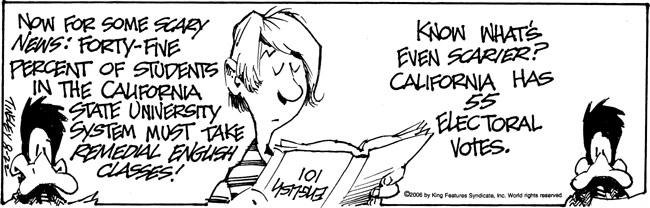
. . . here, Mallard Fillmore underscores:

If Liberty Depends on Democracy, We’re Doomed to Slavery

Seven dwarfs more famous than US judges: poll

NEW YORK (Reuters) – Three quarters of Americans can correctly identify two of Show White’s seven dwarfs while only a quarter can name two Supreme Court Justices, according to a poll on pop culture released on Monday.

Democracy is “Government by the people, exercised either directly or through elected representatives.” LIberty is “Freedom from unjust or undue governmental control.” Yet, as we know very well, “the people’s representatives” have piled one and another form of unjust and undue governmental control on us since the advent of TR and his cousin, FDR.

The conflation of “democracy” and “liberty” must stop. They are most decidedly not the same thing.

An Ideal World

Revised in response to the astute comment by the proprietor of the late, lamented Occam’s Carbuncle.

Thomas Hobbes argued that anarchy would lead to a human condition that is “solitary, poor, nasty, brutish, and short.” If the Gore-Moore-Sheehan axis of stupidity were to prevail, our lives would be collective, poor, primitive, submissive, stupid, and short.

How so? Gore, Moore, Sheehan, and their ilk — that is to say, what remains of the Democrat Party and those to its left — subscribe to an Alice-in-Wonderland view of reality, in which

  • the state knows best (as long as they control the state). (Collective)
  • it is fitting and proper to thwart endeavor and punish success through regulation and taxation. (Poor)
  • technological regress is not too small a price to pay for environmental extremism. (Primitive)
  • our enemies are merely persons with a different world-view, and peace is won by wishing for it, not fighting for it. (Submissive)
  • such things are believed. (Stupid)

Our lives, therefore, would be short because we are poor, primitive, and submissive, and stupid.

What to Do about Liberal Error

A thoughtful reader, who describes himself as a liberal, ends an e-mail with this suggestion:

Instead of berating the media and pointing figures, conservative groups should promote young conservatives to consider careers outside banking, finance, medicine, business and law.

My first reaction is that “berating” and “finger pointing” — aimed at specific journalistic (and academic) instances of error and propagandizing — are a necessary part of the “dialogue” that informs public opinion. It would be a dereliction of duty on the part of conservative-libertarian commentators not to identify and chastise journalistic and academic half-truths, untruths, and improprieties. True, some conservative-libertarian commentators go over the top, just as do some of their liberal counterparts. Neither of the extremes, I think (I hope), is very influential because their excesses are so obvious, their stridency so off-putting. They seem to spend most of their time and energy in talking to each other and working themselves into a rage. If an occasional spark of light emerges from the volumes of heat they generate . . . well, that’s why we have freedom of speech.

But I do agree that more young conservatives and libertarians should be encouraged to take up careers in professions dominated by liberals. There is, to some extent, a temperamental barrier. Some professions (e.g., the dramatic arts) seem to attract few persons of a conservative or libertarian bent. (Hollywood conservatives and libertarians, where you can find them, are notable for their rarity, as are academic conservatives and libertarians.) But there are conservative-libertarian enclaves in academia and journalism. A question then arises as to whether conservatives and libertarians should (a) expand those enclaves, as a draw for aspiring young conservatives and libertarians; (b) encourage the entry of young conservatives and libertarians into the liberal enclaves (by dint of talent and training, of course); or (c) do both.

I think (c) is the right answer. That is, there should be identifiably conservative-libertarian media outlets and academic outposts, and conservative-libertarians should compete with liberals on their own turf, to the extent that they are able to “infiltrate” traditional bastions of liberalism.

But it is incumbent on conservatives and libertarians to attack liberal error, as it arises. The attack, to be effective, must be factual and logical, not merely rhetorical.

The First Roosevelt

Bryan Caplan notes that

Time has put Teddy Roosevelt on the cover of its 5th Annual Special Issue, and the coverage stretches the limits of sycophancy. It reminds me of my high school history textbook, which praised any President who backed new regulations or started a war.

Thomas Sowell weighs in:

Theodore Roosevelt was indeed a landmark figure in the development of American politics and government, but in a very different sense from the way he is portrayed in Time magazine. In fact, the way that Theodore Roosevelt has been celebrated by many in the media and among the intelligentsia tells us more about them than about the first President Roosevelt. . . .

According to Time magazine, TR believed that “government had the right to moderate the excesses of free enterprise.” Just what were these excesses? According to Time, “poverty, child labor, dreadful factory conditions.”

All these things were attributed to the growth of industrial capitalism — without the slightest evidence that any of them was better before the growth of industrial capitalism. Nothing is easier than to imagine some ideal past or future society or to imagine that the net result of government intervention is bound to be a plus.

Sowell goes on to put the boot into that belief.

My own views about TR’s influence on America can be found in two posts. Here I point to the beginnings of the regulatory-welfare state during TR’s presidency (1901-9):

What happened around 1906? First, the regulatory state began to encroach on American industry with the passage of the Food and Drug Act and the vindictive application of the Sherman Antitrust Act, beginning with Standard Oil (the Microsoft of its day).

And here — in my antidote to standard history texts for schoolchildren — I have more to say about the First Roosevelt; for example:

Roosevelt was an “activist” President. Roosevelt used what he called the “bully pulpit” of the presidency to gain popular support for programs that exceeded the limits set in the Constitution. Roosevelt was especially willing to use the power of government to regulate business and to break up companies that had become successful by offering products that consumers wanted. Roosevelt was typical of politicians who inherited a lot of money and didn’t understand how successful businesses provided jobs and useful products for less-wealthy Americans.

It ran in the family.

Ms. Pelosi’s Inadvertent Wisdom

Nancy Pelosi, leader of the minority party of the U.S. House of Representatives, opines:

Congress is Recessing While the Urgent Needs of Americans Remain Unmet

Until There Is an Increase in Minimum Wage, We Will Not Support Raise in Congressional Salaries

We Must Pass Comprehensive Legislation That Will Protect Our Veterans and Their Private Information

The good news is that while Congress is in recess it cannot pass laws that make it harder for Americans to meet their urgent needs through hard work, innovation, and entrepreneurship — all of which Congress discourages through taxation and regulation. (Note to Congress: Take a longer vacation. I’ll call you when I need you.)

The other good news is that Congress may not increase the minimum wage — in which case I expect Ms. Pelosi to be a woman of her word about congressional salaries. (Note to Congress: If you’re going to take longer vacations, why should I give you a raise?)

The even better news is that Ms. Pelosi cares about persons who have served in the armed forces. (Or is it that she’s just a cynical, vote-pandering, Bush-bashing pol? You decide.) The fact that there already are laws against theft and fraud would never stop a Congress-critter from seeking to pass a new law.

Finally, there’s this, from Kim Priestap at Wizbang!:

Nancy Pelosi is thrilled that terrorists’ rights are protected

Oops, that’s not wisdom, is it? Well, neither was the rest of it.

More "Crunchy Cons"

I linked yesterday to several posts, reviews, and articles about “Crunchy Cons” (the cult) and Crunchy Cons (the book). Matt Peterson of The Claremont Institute points me to a book review that I had not seen. It’s by Douglas Jeffrey, and it appears in the Summer 2006 issue of The Claremont Review of Books. It’s also available online, here. I commend the review. Here’s a taste:

In appearing to promote an extension of the social safety net to guarantee the ability to home-school, he [Rod Dreher, the author of Crunchy Cons] does not acknowledge, much less engage, the considerable scholarship over the past 40 years suggesting that the welfare state has proved destructive of the family, both here and (more dramatically) in parts of Western Europe. Nor does he betray cognizance of the school-choice movement into which Milton Friedman and others have poured so much effort in recent decades. The irresponsibility that plagues this book reaches one of its crescendos when he writes: “What kind of an economy should we have, then? I don’t know; I’m a writer, not an economist” (emphasis added).

Sunday Grab Bag

These are some things I’ve bookmarked in the past month. The subjects are global warming, rooting for the other side, and “Crunchy Cons.”

Arnold Kling has had more to say about global warming:

Much, much more of the human activity that would cause global warming has occurred in the last 20 years than took place between 1900 and 1940. Also, much, much more of the greenhouse gas layer on earth consists of either water vapor or pre-industrial levels of carbon dioxide.

Thus, the link between human activity and global warming depends not on simple, obvious relationships in the data. It depends entirely on climate models of how these tiny (relative to the overall volume of greenhouse gases) human activities produce “feedback loops” on the rest. They are models of how much less than one percent of a phenomenon affects the entire phenomenon. They are much more faith-based than empirical.

It is possible that the models underestimate human-caused global warming. However, I believe that this is far less likely than that they over-estimate the human causal factor.

I believe that average temperatures have been rising. I have no reason to believe that they will stop rising. However, the most sensible position an empiricist can take is that human activity is not going to make much difference to global warming, one way or the other.

(An archive of related posts by Kling is here.)

Mike Rappaport wrote about the immorality of rooting for the other side:

[T]he more important point from [Michael Barone’s] article is how strong a case he makes for the moral impropriety of the Democrats’ behavior. Here is Barone’s description [redacted by LC]:

A substantial part of the Democratic Party, some of its politicians and many of its loudest supporters do not want America to succeed in Iraq. . . .

Successes are discounted, setbacks are trumpeted, the level of American casualties is treated as if it were comparable to those in Vietnam or World War II. Allegations of American misdeeds are repeated over and over; the work of reconstruction and aid of American military personnel and civilians is ignored.

In all this they have been aided and abetted by large elements of the press. . . .

. . . One or two instances of American misconduct are found equal in the balance to a consistent and premeditated campaign of barbarism.

. . . I am not saying that all critics of the war or the Bush Administration fall into this camp. There are many legitimate criticisms of the war. But such legitimate criticisms do not include rooting for the other side — including rooting that one does internally but does not admit to most other people.

There was plenty of this during the Cold War, which was reprehensible enough, but at least those people had convinced themselves that communism was not really bad. Few on the left believe that Islamo Facism is desirable.

There was plenty of rooting for the other side during the Vietnam War, as well. And look where it got us. An (initially) unnecessary war was (unnecessarily) lost, and thus America continued its downward spiral into defeatism, from which it has yet to recover fully.

Related to that, read this, by Austin Bay, about the publication by The New York Times and other papers of classified information about the war on terror. Bay concludes:

[S]ome headlines hurt – they damage our government’s Job One: national security. Perhaps the Times’ editors don’t believe we are engaged in a global counter-terror war against Islamo-fascism. We are. At one time there was hole in south Manhattan they could not ignore. . . . For America’s economic and media elites the war has been easy. . . . The US military has served with great distinction, despite major media attempts to “My Lai” Abu Ghraib and now Haditha. Moral compromise in war is inevitable; compromising legitimate intellgence operations is not. History may well conclude this is a war that didn’t need America’s media elites, and perhaps that suspicion curdles the gut of a couple of New York Times bigshots.

Jeffrey Tucker reviewed Rod Dreher’s book Crunchy Cons. Here are excerpts of Tucker’s review:

Dreher seems untroubled by serious issues of economics and politics. He has not put much thought into the political or the economic implications of what he writes. He is not the slightest bit curious about what his vision for his life and yours means for society at large. Though he imagines himself as a rebel against mass consumption, he seems completely unaware that he is purchasing his lifestyle choice just like everyone else, and that the market he loathes is precisely what makes his choice possible.

For those who haven’t read about this new approach to conservative living, here is a quick primer. Dreher follows in a long line of writers dating back to the Industrial Revolution — and a certain strain of post WW2 conservative writers — who loath consumer culture, believe that mass production for the masses is sheer corruption, that free trade is deracinating us all from praiseworthy national attachments, that machines destroy souls, and that capitalism is the enemy of faith because it fuels change and progress. Dreher reports with disgust that America has become one big shopping mall populated by people driven by spiritually barren materialist motives who buy buy buy goods and services of shoddy quality to feed their frenzied desire to live decadently while eschewing friends, community, family, and faith.

And make no mistake: it is the free market that is his target. He even says that “the place of the free market in society” is precisely where he departs with regular conservatives (who he wrongly assumes love the market).

We should go another way, says he. We should cook at home, turn off the television, have kids, educate them at home, buy organic veggies, eat free-range chickens, bike not drive, buy from small shops and never Wal-Mart, live in cottages rather than gated communities, buy old homes and fix them up, and you know the rest of the story. . . .

It never occurs to the author that his crunchy way of living is a consumable good — nay, a luxury good — made possible by the enormous prosperity that permit intellectuals like him to purport to live a high-minded and old-fashioned lifestyle without the problems that once came with pre-capitalist living. . . .

[W]hat we have here is a grab bag of weakly argued policies to support his particular lifestyle, which he is not content to live on his own but rather wants to see legislated as a national program. Never mind whether any of this stuff is consistent or what the consequences would be.

For more about “Crunchy Conservatism,” try these links, which I’ve been hoarding:

The “Crunchy Con” manifesto

A (defunct) blog by and about “Crunchy Cons”

Three posts at Right Reason (here, here, and here)

A review of Crunchy Cons at RedState

A three-part series at The Remedy (here, here, and here) about how “Crunchies seem to misunderstand the relation and distinction between politics and culture; they seem to misunderstand the true principles and ends of the American regime in which they live.”

Those UN Gun Grabbers and the Second Amendment

Michelle Malkin joins the list of bloggers and other who are alarmed by the upcoming UN conference on global gun control. She points to a release by the Second Amendment Foundation, which includes this:

The U.N. Conference on Global Gun Control, scheduled June 24- July 7, poses a direct threat to our constitutionally-protected individual right to keep and bear arms, said Alan Gottlieb, founder of the Second Amendment Foundation (SAF). Gottlieb will attend the conference, but he suggests that this may be an opportune time for Congress and the White House to reconsider this nation’s level of financial support for an international organization that now wants to write a treaty that specifically attacks a cornerstone of our federal constitution, and the lynchpin to our liberty. . . .

“Yet, as we celebrate our 230th anniversary, global anti- gunners, under the guise of reviewing a U.N. program of action on small arms and light weapons, want to create a binding international agreement that could supersede our laws and constitution,” Gottlieb said. “We have done much for the U.N. and in return, the organization has hosted despots, tyrants and dictators whose record of human rights abuses, aggression and genocide speaks for itself. And now comes an attack on our constitution, on our national holiday.

Gottlieb and other defenders of Americans’ right to bear arms are justifiably alarmed by the UN’s blatant anti-Americanism, of which the upcoming conference is but the latest manifestation.

It is my view, however, that the U.S. cannot effectively amend the Constitution and do away with the right to bear arms simply by virtue of its membership in the UN. I have made that point in connection with our right to declare war regardless of the UN’s position on such a declaration. (See this, this, and this.) The same logic applies to the Second Amendment.

I am not counseling complacency in the face of enemies abroad and dupes at home. I am saying that — in the end and given the right Supreme Court (which we probably have on this issue) — the Second Amendment will survive.

Carnival of Links

Tomorrow I will post Carnival of Liberty XLIX. While you’re waiting for that, try these:

Cornel West’s Favorite Communist
, by David Horowitz (FrontPageMag.com)

Guest workers aren’t cheap; they’re expensive, by Phyllis Schlafly (Townhall.com)

Clinton Links GOP Policies to More Storms (wrongly, of course), from the Associated Press (via Breitbart.com)

A review of Not Even Wrong: The Failure of String Theory and the Continuing Challenge to Unify the Laws of Physics, by John Cornwell (Times Online)

Libertarianism and Poverty
, by Arnold Kling (TCS Daily)

Coulter clash on LI, at Newsday

Favorite passage:

New York Sen. Hillary Rodham Clinton called the book a “vicious, mean-spirited attack,” and said, “Perhaps her book should have been called ‘Heartless.'”

Coulter responded to Clinton on the radio show yesterday: “I think if she’s worried about people being mean to women she should have a talk with her husband.”

(More here and here.)

Why Do We Spend So Much on Defense?, by Justin Logan (Cato@Liberty)

Answer: Because, in addition to fighting terrorists, which you wrongly think can be done on the cheap, we must be prepared to ensure that the next generation of ambitious regimes (e.g., Russia) doesn’t try to pull a “Munich” on us. That’s why, you libertarian nay-sayer.

Starving the Beast, by Greg Mankiw (Greg Mankiw’s Blog)

See especially this linked article. See also my post, Starving the Beast, Updated.

More Saddam Terrorist Ties Discovered, by Lorie Byrd (Wizbang!)

Next: WMD. Bush lied?

Motives, by Don Boudreaux (Cafe Hayek)

Haditha: Backtrack Baby, Backtrack
, by Mary Katharine Ham (Hugh Hewitt)

Why I cannot trust the Democrats
, by Jon Henke (QandO)

Just Say When

Left-wing dingbat Jeralyn Merritt has a problem with the successful anti-terrorist operation that led to the death of Abu Musab al-Zarqawi:

It was an act of retaliatory terrorism. By our government. And I don’t want it to be in my name. Even if he was, as we’re told, the devil incarnate. Violence begets violence. It’s time for the war and the killing to stop.

I guess she wouldn’t want U.S. forces to rescue her if she were being held by terrorists, if it meant that terrorists had to die as a result.

If you bother to read Merritt’s post, you must also read this one.

Cosmic Justice

Personal characteristics should have nothing to do with one’s fundamental rights as a citizen — the peaceful enjoyment of life, liberty, and property — and should affect a person’s procedural rights (e.g., voting) only in an effort to ensure that those rights are exercised responsibly. The right to vote, for example, is circumscribed to take into account

  • the attainment of mature judgment, as best as can be determined by a voter’s age (though 18 is hardly an age of mature judgment, and 30 would be closer to the mark)
  • a stake in the acts of government (though mere citizenship used not be be qualifying, it certainly is better than residence without citizenship); and
  • demonstrated respect for the rule of law (imprisoned felons cannot vote in any State but Vermont or Maine).

“Positive” governmental acts, that is, acts of intervention in private affairs, ought to be similarly neutral and minimally discriminatory. To the extent that such acts are necessary (e.g., taxation for the purpose of funding the common defense), they should be designed so as not to create dependence on government or to stifle initiative by penalizing success, and especially not to distort voluntary social and economic relationships.

Why? Because it is through those relationships that we signal each other to inculcate and elicit wanted behaviors, and to discourage unwanted behaviors. Those relationships and signals become less effective when government goes beyond the assurance of fundamental rights and the minimal administration of procedural rights, that is, when government abandons neutrality.

“Neutral government” is an oxymoron, of course. For example, government has at various times enforced slavery and racial segregation, denied voting rights on the basis of race and gender, and — more recently — enabled the suppression of political speech (through campaign finance “reform” and speech codes at public universities) and foisted racial discrimination (i.e., affirmative action) on private places of employment.

Affirmative action is one of those policies (like progressive taxation and tax-funded disaster relief) that has arisen from a misguided “quest for cosmic justice” (to use Thomas Sowell’s term). Those who seek cosmic justice are not content to allow individuals to accomplish what they can, given their genes, their acquired traits, their parents’ wealth (or lack of it), where they were born, when they live, and so on. Rather, those who seek cosmic justice cling to the Rawlsian notion that no one “deserves” better “luck” than anyone else. But “deserves” and “luck” are emotive, value-laden terms. Those terms suggest that there is some kind of great lottery in the sky, in which each of us participates, and that some of us hold winning tickets — which equally “deserving” others might just have well held, were it not for “luck.”

That is not what happens, of course. Humankind simply is varied in its genetic composition, personality traits, accumulated wealth, geographical distribution, etc. Consider a person who is born in the United States of brilliant, wealthy parents — and who inherits their brilliance, cultivates his inheritance (mental and monetary), and goes on to live a life of accomplishment and wealth, while doing no harm and great good to others. Such a person is neither “lucky” nor less “deserving” than anyone else. He merely is who he is, and he does what he does. There is no question of desert or luck.

Such reasoning does not dissuade those who seek cosmic justice, which seems to be almost everyone. It’s probably a good chunk of the “80 percent,” who envy the other “20 percent,” that is, those persons whose brains, talent, money, and/or drive yield them a disproportionate — but not unwarranted — degree of fortune, fame, and power. But among the seekers of cosmic justice also are many of the “20 percent,” that is, the rich, famous, and powerful who hypocritically use government to enforce their notions of what is “right.”

Our law-makers are, for the most part, seekers of cosmic justice. And they accrue power by appealing to their fellow seekers of cosmic justice. Thus they have saddled us with progressive taxation, affirmative action, and a plethora of other disincentivizing, relationship-shattering, signal-distorting policies. It is supremely ironic that those policies have made all of us (except perhaps thieves) far worse off than we would be if government were to get out of the cosmic justice business.

Republicanism, Charitable Giving, and Economic Freedom

Thanks to Mike Rappaport (The Right Coast), I found the most recent edition of the Economic Freedom Index for each of the 50 United States. I then created this graphic:The lower the index, the greater the degree of economic freedom enjoyed by the residents of a State.

It’s not surprising to find that Republican-leaning States enjoy more economic freedom than Democrat-leaning States. Whatever Bush is — or isn’t — with respect to “big government,” persons who vote Republican tend to favor a greater degree of laissez-faire than persons who vote Democrat. (In fact, Bush’s record, properly interpreted, is on a par with that of other post-Great Society presidents. It isn’t worse, as some pundits would have you believe.)

Residents of Red States not only enjoy more economic freedom (e.g., lower tax rates), they also are more open-handed than residents of Blue States when it comes to charity. That is, they not only talk about the value of voluntarism, they do something about it. So-called “Republican greed” isn’t “greed,” it’s a legitimate desire to decide for one’s self how best to apply the fruit’s of one’s labor. Democrats would nevertheless persist in calling Republicans “greedy,” but by the standard of charitable giving, “greed” is a Democrat trait:Details and sources are given in this post, where I wrote:

[G]iven the same tax burden — Red States outstrip Blue States in charitable giving…. [T]here is a strong negative relationship between taxes and charitable giving. It doesn’t show up in the data for the Blue States, which are almost uniformly parsimonious when it comes to charitable giving, but it’s definitely there in the case of the Red States. For all States (with the exception of Wyoming, the far “outlier” at the top of the graph), a linear regression yields a one-to-one negative relationship between the tax burden and charitable giving; that is, for every 1 percentage point rise in the tax burden, after-tax charitable giving drops by 1 percentage point.

I draw two conclusions:

  • There is a significant, positive relationship between Republicanism and charitable giving….
  • Taxes crowd out charity (no surprise)….

Krugman and Monopoly

Paul Krugman reviews David Warsh’s Knowledge and the Wealth of Nations. In the course of the review Krugman asserts that

for the invisible hand to work properly, there must be many competitors in each industry, so that nobody is in a position to exert monopoly power. Therefore, the idea that free markets always get it right depends on the assumption that returns to scale are diminishing, not increasing.

Krugman’s agenda, of course, is to make the case for government regulation of industry, generally, and antitrust prosecutions, specifically. His unstated premise is that the phenomenon of increasing returns to scale is widespread — even though it is not, as evidenced by the wealth of industries in which there are many competitors. More fundamentally than that, Krugman clings to the notion that monopoly is bad, either out of ignorance or anti-business malice (certainly the latter but possibly both). Monopoly is not only not bad, it is good — as I have explained here.

What’s most interesting about Krugman’s review is his failure to discuss the federal government, which holds a legal monopoly on the governance of the United States, which it has perpetuated through the use and threat of force. Does the federal government exhibit increasing returns to scale? I say yes, given that the addition of a few buildings, some bureaucrats, and a handful of regulations adds disproportionately to the federal government’s stranglehold on the economy. Krugman, were he consistent, would call for the breakup of the federal government, just as he is longing to call for the breakup of successful businesses that actually produce things of value.

(Thanks to AnalPhilosopher for the pointer to Krugman’s trash.)

The Romney Plan: Part II

I wrote a few weeks ago about the new health-care scheme in Massachusetts. It’s worse than I thought. Arnold Kling, writing at Cato-at-liberty, quotes

Betsy McCaughey [who] digs into some of the details on the effects on business of Massachusetts’ brave, new health insurance experiment:

Say, for example, you open a restaurant and don’t provide health coverage. If the chef’s spouse or child is rushed to the hospital and can’t pay because they don’t have insurance, you — the employer — are responsible for up to 100% of the cost of that medical care. There is no cap on your obligation. Once the costs reach $50,000, the state will start billing you and fine you $5,000 a week for every week you are late in filling out the paperwork on your uncovered employees (Section 44). These provisions are onerous enough to motivate the owners of small businesses to limit their full-time workforce to 10 people, or even to lay employees off.

What else is surprising about this new law? Union shops are exempt (Section 32).

The next step should be the repeal of the Massachusetts plan because it is bad medicine for the people of Massachusetts. It will cut employment and wages, while driving up the cost of health care. Most of the intended beneficiaries of the plan will suffer as a result.

Given the perverse political climate of Massachusetts, the next step probably will be the State’s seizure of health-care services. The State will disclaim responsibility for the failure of its plan. Instead, it will pin the blame on the private sector, and the gullible public will swallow the story. The State will then declare itself the single payer of health-care costs, effectively creating a State-run health-care system. Welcome to Canada.

Related posts:
Fear of the Free Market — Part I
Fear of the Free Market — Part II
Fear of the Free Market — Part III
Free-Market Healthcare
Where’s Substantive Due Process When You Need It?
The Romney Plan

"Dangerous Dan" McCain

My reference is to the title character of Robert Service’s poem, “The Shooting of Dan McGrew.” But John McCain is far more dangerous than any Klondike gunslinger, because McCain would use (and has used) the power of government to suppress speech in the name of “clean government.”

Many bloggers have picked up on McCain’s latest outrageous utterance:

He [Michael Graham] also mentioned my abridgement of First Amendment rights, i.e. talking about campaign finance reform….I know that money corrupts….I would rather have a clean government than one where quote First Amendment rights are being respected, that has become corrupt. If I had my choice, I’d rather have the clean government.

But no blogger whom I have read has gone to the heart of “Dangerous Dan” McCain’s twisted agenda. When speech is suppressed in the name of “clean government,” the essential element of “clean government” — namely, competition for control — is removed.

McCain and his ilk like to pretend that money “buys” politicians. Money may buy criminal acts — such as those committed by Duke Cunningham — but those acts are easilty dealt with as matters of criminality. In the main, money only “buys” politicians to the extent that it helps to elect those politicians whose views are already attuned to the views of their contributors.

Incumbents already have been “bought” in the sense that their success has been abetted by like-minded supporters. The best way to keep incumbents “honest” is to ensure that they face strong challenges at election time. But the power of incumbency requires that challengers have access to more money than incumbents. McCain will have none of that because his real agenda is to make it difficult for challengers to raise enough money to defeat incumbents. It’s a power-grab, pure and simple.

It should be obvious to anyone who thinks about it for more than a nanosecond that “Dangerous Dan” McCain — that arrogant hypocrite — is opposed to free speech and “clean government.” His twisted agenda is to suppress potential challenges to the power of incumbency.

Disposing of a Few Idiocies

Late Friday afternoon, fresh from a nap after a delightful lunch at a lakeside restaurant. I can muster only a few quick comments.

Dale Carpenter, writing at The Volokh Conspiracy, asks “Why So Few Gay Marriages?” He fails to suggest the main reason: “Gayness” is mostly about sex, not about lifetime bonding centered mainly around children.

Publius (with a little “p”), of legal fiction, chastises Americans for their obliviousness to history. His aim — which he disavows, of course — is to suggest that Americans are somehow responsible for Islamic terrorism because of their ignorance of the “villainy” of (some of) their European ancestors during the Crusades. According to publius, Americans’ obliviousness to history also blinds them to the fact that America’s efforts to “export democracy” have been failures, though he somehow fails to mention Germany and Japan. Nor does he acknowledge that our real aim in the Middle East isn’t so much to export democracy as it is to establish friendly regimes that are (at least) not oppressive.

Publius goes on to say that “Americans just haven’t had to internalize defeat, loss, and humiliation in the same way that other people have.” But in the next paragraph he contradicts himself by acknowledging “two [sizeable] groups of people in America that do have a collective consciousness of resentment . . . white Southerners and blacks. Say what you will about both groups, they don’t forget.” I’m not sure whether little “p” objects to the defeat of the Confederacy or to the failure of the effort to remove all freed slaves to Liberia.

Come the Millenium . . .

. . . or Nirvana, or the Left’s day-dream . . . and the price of gasoline will be pegged by the government at $1.00 a gallon, everyone will have free access to a state-run healthcare system, and everyone (but the intelligentsia and commissars, of course) will be paid the same “living wage” regardless of differences in what they do or how well they do it. The result? Gas will be available only on the black market, there will be less healthcare (and what there is will be lousy), and the American standard of living will be reduced to a depth not reached during the Great Depression. But Leftists, naifs (that’s most Americans), and power-crazed politicians will be happy — because government is doing something!