More from Fringe Watch

Fringe Watch has a third post about the Neo-Conned series of anti-war books, published by John Sharpe (through his IHS Press/Light in the Darkness imprint). The third installment focuses on Derek Holland and Roberto Fiore, noted “extreme nationalists,” and their ties to Sharpe. Some members of the anarcho-libertarian contingent at LewRockwell.com (“anti-state, anti-war, pro-market”) have contributed to and touted the Neo-Conned books (see here, here, and here). That is disturbing, given the provenance of the Neo-Conned series. Here, with permission, is what Fringe Watch has to say about Holland, Fiore, and Sharpe:

John Sharpe’s Ties to Holland and Fiore

In my last post I looked at the anti-Semitic propaganda of John Sharpe, whose IHS Press has published two anti-war books: Neo-Conned and Neo-Conned Again!, which are being heavily promoted in paleo-conservative and paleo-liberterian circles by the uninformed.

My own experience bears directly on this subject. Starting in the 1980s, I became acquainted with the British National Front (NF), the premier “revolutionary nationalist” and racialist movement before its implosion in 1989. Out of that collapse emerged an even more radical outfit called the International Third Position (ITP) headed by Derek Holland and Roberto Fiore.

Both Holland and Fiore have received considerable treatment in works on European extremist nationalism, including Fascism: A History by Roger Eatwell (1997) and Black Sun: Aryan Cults, Esoteric Nazism and the Politics of Identity by Nicholas Goodrick-Clarke (2002).

As Chairman of the NF, and later the ITP’s chief ideologue, Holland exerted a decisive influence. He authored The Political Soldier, which is the Koran of militant nationalists throughout Europe. In many places it invokes the imagery of Muslism fanatics as nationalist “martyrs.” He has been a supporter of radical Arab regimes, visiting Libya in 1988 and Iraq in 1990 (photo and information on the Libyan trip is available online).

Given these credentials it is hardly surprising that Holland should back the Neo-Conned anti-war series as a director of IHS Press. Some people may be misled by the fact that Holland now operates under his Irish Gaelic name, Deric O’Huallachain (having relocated to Ireland from the UK a few years ago). However, earlier copies of the Virginia SCC certificate for IHS Press shows it as Derek Holland.

From the moment that IHS Press was established in 2001, people expressed concern, but were reassured (as was this writer) that Holland had put his extremism “behind him.” Apparently that didn’t stop him from being guest speaker at the February 2002 racial nationalist Nationaldemokratisk Ungdom (NDU) in Sweden. In March of that year the German neo-nazi Deutsche Stimme (German Voice) featured his essay, “Theory and Strategy: The Path of the Political Soldier.” An overnight transition from political radicalism to religious orthodoxy seems improbable. And his activities in Ireland have covered as recently as 2005 in the Brandsma Review.

Roberto Fiore, Holland’s close collaborator, was a member of the political wing of the Armed Revolutionary Nuclei which claimed responsibility for the 1980 Bologna bomb attack which claimed 85 lives. In 1997 Fiore came out of hiding in the UK to head the openly fascist Forza Nuova party in Italy.

What is the link to Neo-Conned? Fiore, as part of the ITP, helped set up the St. George Educational Trust (more here) which is the UK counterpart to, and collaborator with, Sharpe’s pseudo-Catholic Legion of St. Louis.

A Dissonant Vision

I noted, way back on June 8, 2004, Thomas Sowell’s A Conflict of Visions: Ideological Origins of Political Struggles. There, at the end of chapter 2, Sowell explains that

[t]he dichotomy between constrained and unconstrained visions is based on whether or not inherent limitations of man are among the key elements included in each vision….These different ways of conceiving man and the world lead not merely to different conclusions but to sharply divergent, often diametrically opposed, conclusions on issues ranging from justice to war.

Thus, in chapter 5, Sowell writes:

The enormous importance of evolved systemic interactions in the constrained vision does not make it a vision of collective choice, for the end results are not chosen at all — the prices, output, employment, and interest rates emerging from competition under laissez-faire economics being the classic example. Judges adhering closely to the written law — avoiding the choosing of results per se — would be the analogue in law. Laissez-faire economics and “black letter” law are essentially frameworks, with the locus of substantive discretion being innumerable individuals.

By contrast,

those in the tradition of the unconstrained vision almost invariably assume that some intellectual and moral pioneers advance far beyond their contemporaries, and in one way or another lead them toward ever-higher levels of understanding and practice. These intellectual and moral pioneers become the surrogate decision-makers, pending the eventual progress of mankind to the point where all can make moral decisions.

That observation helps to explain why persons who hew to the unconstrained vision — liberals, that is — also have become apocalyptic in their outlook: the environmentwill kill us, our food is poisonous, defense is a military-industrial plot, we’re running out of oil, we can’t defeat terrorism, etc., etc., etc. I will make the connection below but, first, let’s hear from Joe Kaplinsky, who reviews a book full of such apocalyptic tripe — James Howard Kunstler’s, The Long Emergency: Surviving the Converging Catastrophes of the Twenty-First Century (bolded emphasis added by me):

As recently as a decade ago it was unusual to encounter books predicting the imminent collapse of civilisation and probable extinction of the human race. . . . Today such works are common. The core elements of the litany are predictable: climate change, disease, terrorism, and an-out-of-control world economy. Other elements such as killer asteroids, nanotechnology or chemical pollution can be added according to taste.

James Howard Kunstler’s The Long Emergency: Surviving the Converging Catastrophes of the Twenty-First Century clearly fits the genre. While not neglecting any of the usual suspects, Kunstler builds his litany around the increasingly fashionable panic over oil depletion. The Long Emergency has received a warm welcome, featuring on the front covers of both the leftish British publication the New Statesman and Pat Buchanan’s old-right American Conservative.

The picture of the future put forward in The Long Emergency is truly grim. The best-case scenario is a mass die-off followed by a forced move back to the land, complete with associated feudal relations. As the title implies, this is to be an ongoing state rather than a crisis to be overcome . . . .

The successes of science and the Enlightenment present a conundrum for green pessimists. How to explain away the failed predictions of collapse from Malthus on, through to Paul Ehrlich and the Club of Rome in the 1970s?

. . . Conceding that Malthus may have got his facts wrong here, Kunstler wants to rehabilitate Malthus’ larger point: a focus on mechanisms of social restraint as a counterpoint against the claims of Enlightenment optimists such as Godwin and Condorcet. . . .

Kunstler also puts forward a second explanation for the successful economic growth of the twentieth century: oil. ‘Malthus was certainly correct, but cheap oil has skewed the equation over the past hundred years’, he says. He claims that oil, and fossil fuels more broadly, have been responsible for the gains of the twentieth century, from agriculture to medicine to transport.

Furthermore, Kunstler claims that this was a one-shot deal. Having used up our oil he thinks we are about to descend back into Malthusianism – for which we are worse prepared, because we have invested so much economically and psychologically in a modern world that is unsustainable. Our past progress, he thinks, is only setting ourselves up for a fall. He calls suburbia and the motorcar the ‘greatest misallocation of resources in history’.

The deeper theme of The Long Emergency is not oil so much as human powerlessness. The projection of all the products of human resourcefulness on to fossil fuels is only one example of this. Another example is disease. . . .

Kunstler’s discussion of emerging diseases is headed ‘Nature Bites Back’. Such a notion endows Nature with intentions, interests, and intrinsic moral value. Yet without pausing to defend such implausible assumptions, Kunstler ploughs straight on: in ‘response to unprecedented habitat destruction by humans and invasion of the wilderness, the Earth itself seems to be sending forth new and much more lethal diseases, as though it has a kind of protective immune system with antibody-like agents aimed with remarkable precision at the source of the problem: Homo Sapiens.’

Human beings are pushed to one side, as puppets or parasites, while nature is endowed with superhuman powers. It is this process which transforms any of the difficulties we face from problems to be solved into warnings of apocalypse to come.

The most striking example of the sense of powerlessness is as it applies to Kunstler himself. He has long argued against suburbia and the car, in favour of a ‘New Urbanism’. In places it is perhaps possible to read The Long Emergency as a revenge fantasy. Embittered at his inability to convince others that they should change their ways, Kunstler takes refuge under the wing of Nature’s avenging angel. He can be ignored (he attributes this to a psychological flaw in his detractors); the inhuman laws of nature cannot. . . .

The global economy, or perhaps even any economy based on monetary exchange, is apparently an ‘hallucination’. Only a low-energy, local economy in which we are in touch with the land, claims Kunstler, can avoid the destructive effects of entropy. . . .

. . . But entropy doesn’t have any mystical qualities. It is a thermodynamic variable like any other. There is no more reason to connect a breakdown of civilisation with an increase in entropy than with, say, an increase in atmospheric pressure or the Earth’s magnetic field. Kunstler’s discussion of this topic is plain and simple pseudoscience.

His underlying argument about human powerlessness also cannot stand. In abolishing old problems, progress brings new problems. How could it not? The new problems can sometimes appear larger than the old, existing on a global scale. But this just arises from human society operating on a global scale, which carries with it the benefits of global cooperation, trade and travel. History shows that exchanging older problems for newer, sometimes greater, ones has been a good bargain.

The capacity to solve problems expands faster than the problems themselves. It is harder to defend a modern city – with skyscrapers, highways, and energy infrastructure – against a flood or an earthquake. But alongside the technologies that enabled us to build modern cities we have created solutions that make them resilient to natural disasters. That is why life is better in the more developed parts of the world.

While it is always possible that we will stumble at the next hurdle, science confirms that we have a good chance of flourishing in the future, too. The core of The Long Emergency is the anxiety that problems will outweigh solutions. It is summed up by Kunstler’s complaint that by following the path of progress humanity is continually setting itself an exam. Alienated from progress he has no answers himself and fears we are relying on a few techno-geeks to come up with a fix. He is haunted by the question, what if we fail?

This question assumes overwhelming significance for Kunstler because he seems to believe we must fail. A more reasoned approach balances it against two other questions. What if we succeed? Everything worthwhile in human culture and civilisation has come from such successes. What if we do not try?

The emphasis on social restraints — to a Leftist of Kunstler’s ilk — means social engineering writ large. He wants a society that operates according to his strictures. But society refuses to cooperate, and so he conjures historically and scientifically invalid explanations for the behavior of man and nature. By doing so he is able to convince himself and his fellow travelers that the socialist vision is the correct one. He and his ilk cannot satisfy their power-lust in the real world, so they retaliate by imagining a theoretical world of doom. It is as if they walk around under a thought balloon which reads “Take that!”

More Innumeracy and Illogic from the Left

TomPaine.com, a leftist blog, features a “Daily Indicator,” Here’s today’s:

Percent of physicians accepting new Medicare patients, despite congressional cuts to Medicare reimbursement fees: 73

The link is to a Yahoo! News article about the findings of a study which

suggests that doctors would not quit seeing Medicare patients if Congress had gone ahead with a proposed 4.4 cut in reimbursement rates in 2006. . . .

Presumably, “Paine” thinks that such findings attest to the benefits of regulation in general and socialized medicine in particular. The study’s clear implication, however, is that Medicare overpays doctors. That’s unsurprising, given the tendency of regulatory bodies to identify with the industries and professions they are supposed to regulate.

John Sharpe’s Legion of St. Louis

Fringe Watch has posted “John Sharpe’s Legion of St. Louis.” This is the second Fringe Watch post about Neo-Conned series of anti-war books, published by John Sharpe (through his IHS Press/Light in the Darkness affiliate). It seems that Sharpe has ties to anti-Semitic, anti-American extremist politics. It is disconcerting therefore, to find that some members of the anarcho-capitalist contingent at LewRockwell.com (“anti-state, anti-war, pro-market”) have contributed to and touted the Neo-Conned books (see here, here, and here). They have let their opposition to the present war blind them to the agenda that animates the Neo-Conned books. Here, with permission, is “John Sharpe’s Legion of St. Louis”:

John Sharpe’s Legion of St. Louis

In my last entry I revealed the disturbing extremist connections of John Sharpe’s IHS Press, publisher of two anti-war books: Neo-Conned and Neo-Conned Again!. If it is argued that we “can’t shoot the messenger” it is also true that we needn’t believe the messenger when he cites dubious authorities.

This is not about Mr. Sharpe’s political past. It is about his political present. And while otherwise respectable individuals (deceived by Mr. Sharpe) have contributed to IHS Press volumes, the fact remains that neo-fascist propagandists, with whom Sharpe collaborates, have adopted an “entryist” Marxist-style means of infiltrating conservative circles to their own advantage – and the obvious disadvantage of their unwitting allies. For now, we’ll concentrate on the hard evidence of John Sharpe as a far-right mole.

Sharpe heads up the Legion of St. Louis (LSL), though his name no longer appears on the site. But it can be verified from other sources, such as this article published in 2002. On the LSL booklist page we find the following for sale:

1) Henry Ford’s International Jew, a pseudo-historical study in anti-Semitism used by Hitler and other extremists to justify their conspiratorial view of Jews and, ergo, their desire to eliminate them.

2) The New Unhappy Lords, the “Mein Kampf” of British neo-fascism by A. K. Chesterton. Chesterton founded the racialist National Front, which was the direct predecessor of groups involved in the establishment of the Legion of St. Louis and IHS Press.

3) Strange Gods of Judaism by the conspiracy-obsessed Michael A. Hoffman II. Mr. Hoffman is a veteran of American neo-nazism and a promoter of Holocaust revisionism. For a sampling of Hoffman’s rhetoric, see “The White Separatist FAQ.”

While John Sharpe’s proclivities have yet to receive widespread coverage, they are documented by Searchlight magazine (“Faith-based fascists bridging the waters“) – a UK liberal source, as well as the conservative Irish Catholic journal The Brandsma Review.

If that’s not enough, consider the absurdities posted by Mr. Sharpe in the wake of the 9/11 terror attacks (the LSL news page). He sounds more like Michael Moore than an advocate of traditional conservatism. There is the assertion that “America wasn’t attacked. America isn’t the World Trade Center, nor is it the Pentagon. At least those things don’t represent our America, nor should they for our readers.” Sharpe made the presumptuous claims early on that Bin Ladin had nothing to do with the attacks – a point that not even al Qaeda debates now. If you’re Mr. Sharpe, it seems anything’s better than the mainstream media…. Unfortunately, as with his Neo-Conned series, it’s a false alternative – an ideological equivalent of “out of the frying pan and into the fire.”

Lew-nacy

Apropos “Neo-Nazi Conned?“: LewRockwell.com has a department called “The Peace Archive,” which features writings by many obscure loonies and such eminent ones as Pat Buchanan, Bobby (Klansman) Byrd, and Cindy Sheehan. Strange bedfellows, indeed, for a staunch anti-statist. Lew, your desperation is showing.

The Real Con Job

Fringe Watch has posted “The Real Con Job: John Sharpe’s ‘Anti-War’ Series.” The subject of the post is the Neo-Conned series of anti-war books, published by John Sharpe (through his IHS Press/Light in the Darkness affiliate). As documented in the Fringe Watch posts, Sharpe has ties to anti-Semitic, anti-American extremist politics. It is disconcerting therefore, to find that some members of the anarcho-capitalist contingent at LewRockwell.com (“anti-state, anti-war, pro-market”) have contributed to and touted the Neo-Conned books (see here, here, and here). They have let their opposition to the present war blind them to the agenda that animates the Neo-Conned books. Here, with permission, is “The Real Con Job”:

The Real Con Job: John Sharpe’s “Anti-War” Series

On November 9, 2005, LewRockwell.com posted “ The Case Against This Monstrous War,” a glowing endorsement of two anti-war books: Neo-Conned and Neo-Conned Again!. They are put out by the IHS Press, under its Light in the Darkness imprint. As the review opines, IHS “has assembled one of the most impressive lineups of scholars and commentators. . . ever seen on any subject.” The bi-partisan authorship spans the entire political range from paleo-conservative Pat Buchanan to Marxist Noam Chomsky. Some contributors are entirely reputable. However, beneath the superficial respectability of IHS Press there lies a web of connections that conservatives should find disturbing.

The problem with the Neo-Conned series is more than impassioned rhetoric, it’s a matter of caveat emptor. Unsavory politics lurk beneath the surface. Consider that the founder, CEO, and editor of IHS Press is John Sharpe. The following points should send off alarm bells among his target conservative audience:

1) John Sharpe has a long record of sympathy with anti-American Arab regimes and tries to downplay the horror of 9/11 by blaming it on Israel and the US itself.

2) He promotes socialist/leftist economic theories, through the works of IHS Press’ Sheffield Hallam University Press series and the works of the eccentric British “guild socialist” Arthur Penty.

3) He disseminates anti-Semitic publications through a subsidiary called the Legion of St. Louis (LSL).

If it is thought that this last charge is an exaggeration, consider Mr. Sharpe’s argument for “sane” anti-Semitism:

Finally, let us not fear the epithet “anti-Semite” as it is used by the enemies of the Faith and of the West. . . . [W]e all then have the courage to respond with the words of Fr. Fahey: “In that sense, every sane thinker must be an anti-Semite” (“Judaism and the Vatican,” The Angelus, June 2003).

The LSL is an ostensibly Catholic organization which pitches to traditionalists. But a perusal of the Legion’s eclectic offering of books turns up such titles as The International Jew (admired by Adolf Hitler), the writings of British fascist A.K. Chesterton and an anti-Jewish screed by self-proclaimed “white separatist” Michael Hoffman.

To sum up, this exposé is not meant to discuss the merits of the Iraq War. Whatever one’s views, it is possible to be concerned about ideological radicals exploiting sensitive issues for their own benefit. What is the upshot? First, political radicals (tied to neo-Nazis) gain the credibility they have long coveted by collaboration with well-known and respected individuals. Second, dissenting conservatives, understandably scandalized by the insanity of mainstream culture, are sidetracked from their real work and are ethically compromised.

Authoritarianism and Adolescence on the Left

Dr. Helen writes today about the inverse authoritarian personality:

I have spent some interesting hours reading [in Roots of Radicalism: Jews, Christians, and the Left] about studies done with Jewish and Christian leftist radicals in the 1970’s and 80’s. Please bear the age of these studies in mind when I talk about some of the information I gleaned from the book. Yes, this is old stuff but I think in discussing some of the traits of radicals on the left, much of it still holds true. I do not believe these traits are necessarily pathological–but they are descriptive in helping to understand those who follow extreme left-leaning thought. . . .

The authors of the book, Stanley Rothman & S. Robert Lichter spend chapters discussing how the same conflicts that underlie the authoritarian can be turned inside out. “The traditional authoritarian deflects his hidden hostilities onto outsiders and outgroups. The inverse (my italics) authoritarian unleashes his anger directly against the powers that be while taking the side of the world’s ‘victims’ and ‘outcasts.'” The authors ask an important question about the inverse authoritarian: “Was it not possible that the ‘liberated generation’ was bound to potentially dangerous unconscious personality dynamics no less than its forebears?” . . .

Without going into too much detail, here are a few other things they found. Conservatives–particularly Jewish Conservatives–were found to be lowest on the need to feel powerful, followed by liberals but the need to feel powerful rose sharply among the New Left radical group–it was especially high in the Jewish radicals. Jewish conservatives, liberals, and radicals were all more affiliative (defined as a concern to establish, maintain and restore positive emotional relationships) than their non-Jewish counterparts.

What I carried away from the book is that there is no difference in the rigidity between fighting against outsiders or outgroups and fighting against the establishment—both are a form of rebellion that is based not on what is right, but on how one chooses to rebel. Basing politics and policy on how they fullfill our need for power, affiliation or hostility cannot be the best way of deciding what is right for our country.

Dr. Helen is a Ph.D. psychologist. I’m a mere observer of the human condition, which led me to write this some months ago:

Persons of the Left simply are simply unthinking, selfish adolescents who want what they want, regardless of the consequences for others. The Left’s stance on abortion should be viewed as just one more adolescent tantrum in a vast repertoire of tantrums.

Indeed.

Ethics and the Socialist Agenda

UPDATE BELOW, 12/29/05

From a story in the L.A. Times (get an ID and password from bugmenot.com):

“This letter is for yourself alone,” [reads a letter written by Upton Sinclair to his attorney on Sept. 29, 1929]. “Stick it away in your safe, and some time in the far distant future the world may know the real truth about the matter. I am here trying to make plain my own part in the story.”

The story was “Boston,” Sinclair’s 1920s novelized condemnation of the trial and execution of Nicola Sacco and Bartolomeo Vanzetti, Italian immigrants accused of killing two men in the robbery of a Massachusetts shoe factory.

Prosecutors characterized the anarchists as ruthless killers who had used the money to bankroll antigovernment bombings and deserved to die. Sinclair thought the pair were innocent and being railroaded because of their political views.

Soon Sinclair would learn something that filled him with doubt. During his research for “Boston,” Sinclair met with Fred Moore, the men’s attorney, in a Denver motel room. Moore “sent me into a panic,” Sinclair wrote in the typed letter that Hegness found at the auction a decade ago.

“Alone in a hotel room with Fred, I begged him to tell me the full truth,” Sinclair wrote. ” … He then told me that the men were guilty, and he told me in every detail how he had framed a set of alibis for them.” . . .

Upton Beall Sinclair was a giant of the nation’s Progressive Era, a crusading writer and socialist who championed the downtrodden and persecuted. President Theodore Roosevelt, who pushed through the nation’s first food-purity laws in response to “The Jungle,” coined the name for Sinclair’s craft: muckraker. . . .

“I faced the most difficult ethical problem of my life at that point,” [Sinclair] wrote to his attorney. “I had come to Boston with the announcement that I was going to write the truth about the case.”

Other letters tucked away in the Indiana archive illuminate why one of America’s most strident truth tellers kept his reservations to himself. . . .

He also worried that revealing what he had been told would cost him readers. “It is much better copy as a naïve defense of Sacco and Vanzetti because this is what all my foreign readers expect, and they are 90% of my public,” he wrote to Minor.

It surpriseth me not. Sinclair was a role model for today’s Left-leaning media. What other lies did Sinclair tell in order to advance the “progressive” (i.e., socialist) cause?

UPDATE: This is from a post by Eugene Volokh at The Volokh Conspiracy:

The ACLU’s founding director and likely most influential official, Roger Baldwin, had long been an admitted supporter of communism as an economic system, and on balance an apologist for the Soviet Union. Though he criticized the Soviets at times, he had also praised the USSR as on balance a haven for liberty. His true break with the Soviets (which ultimately brought him around to pretty vociferous anti-Communism) came not with Stalin’s ascent, not with the Ukrainian famine, not with the Terror and the show trials — he defended the Soviets even after that — but only in 1939, with the Molotov-Ribbentrop pact.

On top of that, Baldwin was on the record as having said that his commitment to civil liberties for supposed reactionaries was sheerly instrumental, just a tool for advancing the cause of communism. His struggle for free speech, he said, was just incidental to the class struggle, a useful tactic for furthering communist goals. When the working class took over, the resulting regime should be supported by any means necessary, including dictatorship. Dictatorship and suppression of civil liberties would be necessary to get to a socialist society, so such suppression is justified. That was the position of the founding director of the ACLU.

Where You Stand Depends on Where You Sit

The American Left might have a different attitude toward preemptive defense, surveillance, aggressive interrogation, “secret” prisons, and the Patriot Act if it took the threat seriously. That’s the point I take from a post by David Bernstein at The Volokh Conspiracy:

. . . I predict that Israel will strike Iran within the next few months, with the goal of disrupting or terminating Iran’s nuclear program. . . . I just returned from Israel, and I found a remarkable consensus in favor of doing whatever is necessary to stop Iran (a consensus no doubt solidified by Iranian threats to annihilate Israel, and recent vicious anti-Semitism emanating from the highest rank of the Iranian government). One leftist member of my wife’s family told me that the IDF will do whatever is necessary. When I expressed concern that Iran will retaliate through Hizbullah, he replied that the Lebanese government will stop any large-scale retaliation, or the ramifications will be disastrous in and for Beirut. Other leftists of my acquaintance were equally inclined to support vigorous action against Iran, and equally confident of the government’s ability to manage the situation. Given that the anti-Iranian consensus is so solid even on the Left, I would be very surprised if the Israeli government fails to follow through on its promise to prevent Iran from acquiring atomic weapons–assuming, of course, that Iran isn’t stopped by other international forces.

The American Left of today resembles the Left of the 1930s. In spite of 9/11 and the bombings in Madrid and London, the Left still refuses to acknowledge the threat to America and America’s well-being. Peace in our time will come simply by wishing for it.

The Pathology of Academic Leftism

Daniel B. Klein (George Mason University) and Charlotta Stern (University of Stockholm) delve deeper than the obvious fact that most academics are persons of the left. From the summary of Klein and Stern’s paper, “Narrow-Tent Democrats and Fringe Others: The Policy Views of Social Science Professors” (pp. 43-5 in the pdf version):

. . . .

• The Democratic domination has increased significantly since 1970. Republicans are being eliminated. . . .

• The Democrats not only dominate, but they have a narrow tent. Whereas the Republicans usually have diversity on an issue, the Democrats very often have a party line. It is clear that there is significantly more diversity under the Republican tent.

• On the whole, the Democrats and Republicans are quite statist.

• Economists are measurably less statist, but most of them are still quite statist.

• Economists show the least consensus on policy issues. The differences between Democrats and Republicans are largest in economics, and the standard deviations are largest. . . .

• Younger professors tend to be slightly less statist than older professors.

• We find strong evidence that Republican scholars are more likely to be sorted out of academia.

• Voting D[emocrat] is significantly correlated with having Democratic parents, being employed in academia, being an anthropologist or sociologist, having statist policy views, and having a more recent degree. . . .

• Simple measures show that the libertarians are quite exceptional. The minimum of the dissimilarities between them and any other group is greater than the maximum of dissimilarity between any pair of other groups.

The “liberal versus conservative” formulation of American politics omits the libertarians from the landscape. . . . If freedom is a core political value, then there is something very wrong with a formulation that omits the ideology most aligned with that value.

Well, freedom is not a core political value for most of today’s social-science academics, as Klein and Stern amply demonstrate.

The Media’s Measurable Bias

REVISED, 10:30 AM

The University of California toutsA Measure of Media Bias” (Quarterly Journal of Economics, Vol. 120, No. 4), by Tim Groseclose of UCLA and Jeffrey Milyo of the University of Missouri:

Abstract: We measure media bias by estimating ideological scores for several major media outlets. To compute this, we count the times that a particular media outlet cites various think tanks and policy groups, then compare this with the times that members of Congress cite the same groups. Our results show a strong liberal bias: all of the news outlets we examine, except Fox News’ Special Report and the Washington Times, received scores to the left of the average member of Congress. Consistent with claims made by conservative critics, CBS Evening News and the New York Times received scores far to the left of center. The most centrist media outlets were PBS NewsHour, CNN’s Newsnight, and ABC’s Good Morning America; among print outlets, USAToday was closest to the center. All of our findings refer strictly to news content; that is, we exclude editorials, letters, and the like. . . .

Our results show a strong liberal bias. All of the news outlets except Fox News’ Special Report and the Washington Times received a score to the left of the average member of Congress. And a few outlets, including the New York Times and CBS Evening News, were closer to the average Democrat in Congress than the center. These findings refer strictly to the news stories of the outlets. That is, we omitted editorials, book reviews, and letters to the editor from our sample. . . .

To compute our measure, we count the times that a media outlet cites various think tanks and other policy groups. We compare this with the times that members of Congress cite the same think tanks in their speeches on the floor of the House and Senate. By comparing the citation patterns we can construct an ADA score for each media outlet. . . .

Over this period [1995-99] the mean score of the Senate (after including phantom D.C. senators and weighting by state population) varied between 49.28 and 50.87. The mean of these means was 49.94. The similar figure for the House was 50.18. After rounding, we use the midpoint of these numbers, 50.1, as our estimate of the adjusted ADA score of the centrist United States voter. . . .

I would consider an ADA score below 40 to be unbiased, that is, anchored in a correct understanding of how the world works and ought to work. I base that criterion on the ADA scores of legislators who cite think tanks. Consider, from Table I of the Groseclose-Milyo paper, the following average ADA scores for legislators who cite nonsectarian conservative-libertarian think tanks: American Conservative Union 32.0; American Enterprise Institute, 36.6; Americans for Tax Reform, 18.7; Cato Institute 36.3; Citizens Against Government Waste, 36.3; Heritage Foundation, 20.0; Hoover Institution, 36.5; Hudson Institute, 25.3; National Federation of American Businesses, 26.8; National Taxpayers Union, 34.3.

The following table highlights ADA scores for selected legislators and gives the average ADA scores for Democrats and Republicans (in boldface). The average scores indicate that Congress’s polarization is as real as the media’s leftward bias.

TABLE II
Average Adjusted ADA Scores of Legislators

Legislator – Average score
Maxine Waters (D-CA) – 99.6
Ted Kennedy (D-MA) – 88.8
John Kerry (D-MA) – 87.6
average Democrat – 84.3
Tom Daschle (D-SD) – 80.9
Joe Lieberman (D-CT) – 74.2
Constance Morella (R-MD) – 68.2
Ernest Hollings (D-SC) – 63.7
John Breaux (D-LA) – 59.5
Christopher Shays (R-CT) – 54.6
Arlen Specter (R-PA) – 51.3
James Leach (R-IA) – 50.3
Howell Heflin (D-AL) – 49.7
Tom Campbell (R-CA) – 48.6
Sam Nunn (D-GA) – 48.0
Dave McCurdy (D-OK) – 46.9
Olympia Snowe (R-ME) – 43.0
Susan Collins (R-ME) – 39.3
Charlie Stenholm (D-TX) – 36.1
Rick Lazio (R-NY) – 35.8
Tom Ridge (R-PA) – 26.7
Nathan Deal (D-GA) – 21.5
Joe Scarborough (R-FL) – 17.7
average Republican – 16.1
John McCain (R-AZ) – 12.7
Bill Frist (R-TN) – 10.3
Tom Delay (R-TX) – 4.7

Now for the bottom line. Recall that the following scores are based on news content — not editorials, book reviews, or letters the editor — thus the seemingly anomalous results for the Drudge Report and Wall Street Journal.

TABLE IV
Rankings Based on Distance from Center

Rank – Media outlet – Estimated ADA score
1 – Newshour with Jim Lehrer – 55.8
2 – CNN NewsNight with Aaron Brown – 56.0
3 – ABC Good Morning America – 56.1
4 – Drudge Report – 60.4
5 – Fox News’ Special Report with Brit Hume – 39.7
6 – ABC World News Tonight – 61.0
7 – NBC Nightly News – 61.6
8 – USA Today – 63.4
9 – NBC Today Show – 64.0
10 – Washington Times – 35.4
11 – Time Magazine – 65.4
12 – U.S. News and World Report – 65.8
13 – NPR Morning Edition – 66.3
14 – Newsweek – 66.3
15 – CBS Early Show – 66.6
16 – Washington Post – 66.6
17 – LA Times – 70.0
18 – CBS Evening News – 73.7
19 – New York Times – 73.7
20 – Wall Street Journal – 85.1

Only the Washington Times and Fox News, with ADA scores below 40, meet my criterion for objectivity. The rest are biased to the left by varying degrees, but none of them comes close to objectivity. That is not news, of course. As Groseclose and Milyo note,

[s]urvey research has shown that an almost overwhelming fraction of journalists are liberal. For instance, Elaine Povich [1996] reports that only seven percent of all Washington correspondents voted for George H.W. Bush in 1992, compared to 37 percent of the American public. Lichter, Rothman and Lichter, [1986] and Weaver and Wilhoit [1996] report similar findings for earlier elections. More recently, the New York Times reported that only eight percent of Washington correspondents thought George W. Bush would be a better president than John Kerry. This compares to 51 percent of all American voters. David Brooks notes that for every journalist who contributed to George W. Bush’s campaign, another 93 contributed to Kerry’s campaign.

And it shows up in their reportage. So much for “objective journalism.”

Three Truths for Central Planners

1. When more money doesn’t provide more happiness (call it satisfaction or utility, if you will), people stop trying to earn more money. Until then, more money, by definition, buys more happiness.

2. It is impossible to make interpersonal utility comparisons which show that taking money from the rich and giving it to the poor increases the total sum of happiness. There is no such thing as a social welfare function. Those who think there is such a thing must be willing to submit to robbery by poorer persons.

3. There is no such thing as “the economy”; there are crude aggregate measures of economic activity by individuals and firms. Therefore, leisure per se isn’t “bad” for “the economy.” After all, leisure (when sought) adds to the utility of the person who obtains it. The only time leisure is bad is when someone is taxed to support someone else’s leisure.

Whose Liberties Are We Fighting For?

A few weeks ago the media disclosed “secret” prisons overseas, where the CIA apparently has been holding baddies. That disclosure will lead to “investigations,” which probably will lead to the end of the “secret” prison program.

In the past few days we have had:

  • the disclosure of selective, warrantless NSA intercepts authorized in the aftermath of 9/11
  • a “victory” for those who oppose the use of torture, apparently under any condition
  • the Senate’s refusal (thus far) to extend a few provisions of the Patriot Act that are set to expire December 31.

What we have here is a concerted effort to hinder the U.S. government’s efforts to detect and thwart terrorist plots. All of this sensitivity about “civil liberties” (including the “liberties” of our enemies) reminds me of the complacency that we felt before 9/11.

What will it take to shake us from that complacency? You know what it will take: a successful terrorist attack in the U.S. that might have been prevented had the media and “civil libertarians” not been so successful in their efforts to protect “civil liberties.”

If the media and “civil libertarians” really cared about civil liberties they would not be in favor of vast government programs that suppress social and economic freedoms. They are the enemies of liberty, and — thanks to them — innocent Americans probably will die.

The legitimate function of the state is to protect its citizens from predators and parasites, it is not — as the left and its dupes would have it — to protect predators and parasites.

A 32-Year Error

An otherwise spot-on post about 12/12 Democrats* opens with this chronological error:

Today marks the fifth anniversary of the birth of the wing of the Democratic Party which now controls the party apparatus. And while the leaders of that wing do not speak all Democrats, they have become the face (and voice) of the Democratic Party in President George W. Bush’s second term.

The Democrat Party began its veer to the hard left in 1968, with Eugene McCarthy’s anti-war candidacy. McCarthy didn’t win the party’s nomination that year, but his strong showing made reflexive anti-war rhetoric a respectable staple of Democrat discourse.

The Democrats proceeded in 1972 to nominate George McGovern, who seems moderate only by contrast with Ramsey Clark and Michael Moore. Since McGovern’s ascendancy, the left-wing nuts generally have dominated the party — in voice if not in numbers. Nominees since McGovern: Carter (a latter-day Tokyo Rose), Mondale (Carter’s one-term accomplice), Dukakis, Clinton, Gore, and Kerry — all well to the left of the mainstream (to borrow some Democrat rhetoric). Bill Clinton (of the failed plan to socialize health care) became a moderate only because he faced Republican majorities in Congress. Clinton lately has been showing his true colors.
__________
* The U.S. Supreme Court decided Bush v. Gore on December 12, 2000, thus setting off five years of Bush-hatred on the left.

We Have Met the Enemy . . .

. . . and he is [some of] us. (Apologies to the late Walt Kelly.)

UPDATED BELOW (12/15/05 @ 5:06 p.m.)

Brendan O’Neill, writing at Spiked, opines that bin Laden’s script is written in the West:

Why has Verso brought out a book [link added] of bin Laden’s statements and why is it being treated so seriously, complete with a promotional push in Waterstone’s in Piccadilly, one of the biggest bookstores in Europe? . . . . Is it that the dumbing down of public life is now so complete that even a loon like bin Laden can get five stars from literary pundits for saying things like ‘kill the Americans and seize their money wherever and whenever [you] find them’ (December 1998) and ‘My kidneys are all right’ (November 2001)?

I think there’s more to it than that. I reckon the reason why some commentators in the West seem drawn to bin Laden’s prose is because at times – and I’m not going to beat around the bush here – he sounds an awful lot like them. Seriously, it is uncanny. What comes across most clearly in this 10 years’ worth of rants is the extent to which bin Laden borrows and steals from Western media coverage to justify his nihilistic actions. From his cynical adoption of the Palestinian issue to his explanations for why he okayed 9/11 to his opposition to the American venture in Iraq, virtually everything bin Laden says is a rip-off of arguments and claims made in the mainstream media over here. He has taken the justifications offered by left-leaning pundits for al-Qaeda’s existence and actions (in the words of one commentator: ‘There is a simple reason why they attack the US: American imperialism’) and made them his own (2). And now these pundits have returned the favour by giving him his own book and glowing reviews to boot. It is the unholiest of marriages. . . .

Take Palestine. It is widely assumed that al-Qaeda’s violence is primarily motivated by Israel’s oppression of the Palestinians and will continue until that issue is resolved. Yet bin Laden’s nods to Palestine over the past 10 years tell a different story.

. . . Bruce Lawrence, editor of this collection, has given bin Laden’s first major public pronouncement – made on 29 December 1994 – the heading ‘The betrayal of Palestine’; but when you read it, Palestine is cynically mentioned as part of bin Laden’s spat with Saudi rulers. . . .

Bin Laden sounds like a spoilt middle-class brat sticking two fingers up at his family and former friends (he was once close to various Saudi rulers) for getting all money-obsessed, dude. In fact, that’s exactly what he is: the son of a Saudi billionaire who in the 1970s made a fortune from running one of daddy’s construction firms and drove a white Chrysler, but then went all religious and decided that capitalism is not very nice. If he’d been born in the Home Counties instead of Riyadh, he would probably have been one of those Eton-educated types who turn their backs on privilege and piss off their parents by becoming smelly hippies who smash up McDonald’s. . . .

. . . Even when bin Laden’s statements are liberally peppered with references to Palestine (as often they are), he only mentions it opportunistically and symbolically; there is no real or practical input into Palestinian politics. In 2001, his second-in-command Ayman al-Zawahiri said: ‘The fact that must be acknowledged is that the issue of Palestine is the cause that has been firing up the feelings of the Muslim nation from Morocco to Indonesia for the past 50 years.’

Likewise, bin Laden’s justifications for 9/11 are continually moulded and shaped by Western media coverage. At first – on 28 September 2001 – he disavows responsibility for the attacks, instead trying to pin the blame on some dastardly conspiracy within America itself. . . . Then there are intelligence agencies in the US, which require billions of dollars of funds from the Congress and the government every year. . . .

A secret government that may have executed the attacks itself in order to get more funding for foreign wars of intervention…sound familiar? Bin Laden could have lifted these explanations from any number of blogs or conspiracy sites that swung into action in the days and weeks after 9/11. Later he claims that 9/11 was in retaliation for Palestine (see above). Later still, he starts banging on about 9/11 as part of a bigger ‘plan to bleed America to the point of bankruptcy, with God’s will’. And guess how he tries to prove that this plan has been a success? Yes, by once again pilfering Western media coverage. On 21 October 2001, he says:

‘I say that the events that happened on 11 September are truly great events by any measure…. The daily income of the American nation is $20 billion. The first week [after the attack] they didn’t work at all as a result of the psychological shock of the attack, and even today some still don’t work because of it. So if you multiply $20 billion by one week, it comes to $140 billion…. The cost of building and construction losses? Let us say more than $30 billion. So far they have fired or liquidated more than 170,000 employees from airline companies, including airfreight companies and commercial airlines…. One of the well-known American hotel companies, Intercontinental, has fired 20,000 employees, thanks to God’s grace….’

And on it goes. Can you see what bin Laden is doing here? He has not been ‘wonderfully briefed’ by al-Qaeda’s resident economist, if it has such a thing; rather, he is cherry-picking from the various scare stories and predictions of doom – and indeed real job losses – that were splashed across the media in the immediate aftermath of 9/11 and claiming ownership of them, as if they were all part of his plot. . . . He attempts to attach meaning to his nihilistic assault retrospectively – first by borrowing the Palestine explanation from Western commentators, and then by citing the economic handwringing that also was widespread in the Western media. . . .

Bin Laden’s parroting of Western views is most stark in his later statements about Iraq. Here, he sounds like a cross between Michael Moore and Robert Fisk, with a bit of Koran-bashing thrown in for good measure. In a statement dated 29 October 2004, one bit in particular made me laugh: bin Laden seems to suggest that the weapons inspectors in Iraq should have been given more time before the rush to war! He says:

‘…American thinkers and intellectuals warned Bush before the war that everything he needed to guarantee America’s security by removing weapons of mass destruction – assuming they existed – was at his disposal, that all countries were with him when it came to inspections, and that America’s interest did not require him to launch into a groundless war with unknown repercussions. But the black gold blinded him and he put his own private interests ahead of the American public interest….’

The above statement is like a microcosm of the trendy liberal argument against the war in Iraq: we should have let the weapons inspectors continue their job (bin Laden for Blix!) but because Bush is so addicted to oil (the ‘black gold’) he went ahead with the war anyway. Bin Laden even worries about the war having ‘unknown repercussions’, an echo of debates in the West about the unpredictability of war in Iraq and the concern that it might make all of us less rather than more safe. No wonder bin Laden namechecks ‘American thinkers and intellectuals’ – he got his political position on Iraq directly from them.

By the time of Iraq, bin Laden – who started out as a Saudi obsessive who wanted to make Saudi society even more chokingly religious – has become a fully-fledged Bush-basher, virtually indistinguishable from a new generation of journos and bloggers who see Bush as the most evil president ever and Iraq as the wickedest war of all time (they have short historical memories). He rants that ‘this war is making billions of dollars for the big corporations, whether it be those who manufacture weapons or reconstruction firms like Halliburton and its offshoot and sister companies’. Halliburton has, of course, become the bete noir of the anti-capitalist-cum-anti-war movement. Bin Laden says: ‘It is all too clear, then, who benefits most from stirring up this war and bloodshed: the merchants of war, the bloodsuckers who direct world policy from behind the scenes.’ This is also a popular idea on today’s anti-war left: that a wicked cabal led by Paul Wolfowtiz and Dick Cheney (both of whom have big business links) is leading America to war. (Indeed, I tried my best to find some differences between that sentence uttered by bin Laden and this one uttered by anti-Bush actor Woody Harrelson – ‘the epidemic of all human rights violations all stems from the same sick source, and that is The Beast: these giant frigging industries that control the body politic, our society and certainly our economy’ – but I had no luck.) . . .

In [a] statement ( . . . on 29 October 2004) bin Laden chastises Bush for leaving ‘50,000 of his citizens in the two towers to face this great horror on their own’, because he considered ‘a little girl’s story about a goat and its butting [to be] more important than dealing with aeroplanes and their butting into skyscrapers’. What is he rabbiting on about? You’ll know if you’ve seen, or read about, Michael Moore’s film Fahrenheit 9/11, which opens with painful footage of Bush reading a story called ‘My Pet Goat’ to a classroom of kids on the morning of 9/11 while the planes hit the twin towers. Maybe bin Laden watched a pirate DVD of Fahrenheit 9/11; maybe he just read about the opening scene somewhere on the web. Either way, he seems yet again to borrow from an anti-Americanism that has its origins in the West. . . .

In a nutshell, bin Laden steals from and quotes Western commentators in his justifications for al-Qaeda violence, and then Western commentators re-quote bin Laden’s rehashing of their own arguments as evidence that al-Qaeda is a rational political organisation. Talk about a vicious cycle. In the process, some commentators get dangerously close to being apologists for al-Qaeda. In the introduction to this collection, editor Bruce Lawrence asks ‘Should bin Laden…be described as a contemporary anti-imperialist fighter adaptive to the Information Age?’ He answers his own question by quoting Michael Mann (whom he describes as ‘one of the most level-headed of sociologists’). Mann says: ‘Despite the religious rhetoric and the bloody means, bin Laden is a rational man. There is a simple reason why he attacked the US: American imperialism. As long as America seeks to control the Middle East, he and people like him will be its enemy.’

What these commentators don’t seem to realise is that they provided bin Laden with the cloak of rationality and political reasoning. Their own arguments, often cynically made, about al-Qaeda being an understandable (if bloody and murderous) response to American imperialism have been co-opted – explicitly so – by bin Laden. . . .

Instead of exposing the glaring contradictions in bin Laden’s statements – all the better to undermine al-Qaeda’s violent outbursts and put the real case for a Palestinian homeland and an end to Western intervention in the Middle East – too many on the left read meaning and consistency into his statements, projecting their own political prejudices on to the ranting of a bearded man in a cave. As a result, what is in truth a disparate nihilistic campaign, an incoherent lashing out against modernity, is given the cloth of ‘anti-imperialism’ with which to dress up its crimes.

. . . This collection of bin Laden’s statements reveals that al-Qaeda is the bastard child of a fearmongering right and an opportunistic left.

Enough said, except to point you to some related posts:

Getting It Wrong: Civil Libertarians and the War on Terror (A Case Study) (05/18/04)
The Illogic of Knee-Jerk Privacy Adocates (10/06/04)
Treasonous Blogging? (03/05/05)
Absolutism (03/25/05)
Shall We All Hang Separately? (08/13/05)
Foxhole Rats (08/14/05)
Treasonous Speech? (08/18/05)
Foxhole Rats, Redux (08/22/05)
The Faces of Appeasement (11/19/05)

UPDATE: There is one more thing to say: This woman typifies the enemy within. She hates America because it isn’t perfect and isn’t “run” the way she’d like to run it. Typical adolescent, leftist whining. I’m sick of it.

Mr. Clinton’s Magic Economic Machine

UPDATED BELOW

AP reports on a speech made by the erstwhile president to an audience in Montreal:

With a “serious disciplined effort” to develop energy-saving technology, he said, “we could meet and surpass the Kyoto targets in a way that would strengthen and not weaken our economies.”

A free “serious disciplined effort” to develop energy-saving technology? Followed by the free replacement of existing technology?

Well, perhaps the effort could be powered by Clinton’s hot air, which is the only sign of warming — global or otherwise — in Montreal these days.

UPDATE: Follow the money. Always a good bet when it comes to the Clintons. Not that there’s anything wrong with money, but the things some people are willing to do for it . . .

(Hat tip to EconoPundit)

A Little Putdown of Politically Correct Shopping

UPDATED BELOW

The current anti-Wal-Mart propoganda drive by unions and various “liberal” groups reminds me of my decision a few months ago to keep my Sam’s Club membership and drop my Costco membership. A few trips to Costco were enough to convince me that Sam’s Club suits my needs, and at better prices. Why pay two annual membership fees when one will do?

Why shouldn’t I shop at Sam’s Club? It’s a slave-free zone. I haven’t seen good squads dragging unwilling people in from the streets to work at Sam’s Club. I haven’t seen any Sam’s Club employees caged in their work areas. But maybe Sam’s Club is hiding all of that from public view. Perhaps there are secret prisions in Arkansas where they send Sam’s Club employees who try to resign for higher wages and benefits elsewhere. Yep. And labor union leaders are paid the same wages as the workers they represent.

P.S. On a related note, I have a word of advice for people who work in “one company towns” (e.g., regions centered around auto manufacturing). That word of advice is this: Leave. I should qualify that: You should have saved some money, figured out where you’d be better off, and gone there. You could see the handwriting on the wall; it’s been there for decades.

But whatever you do, don’t blame me for your woes. It’s not my fault that you live where you live. Blame your parents and blame yourself. Don’t take it out on me by demanding some kind of government bailout when your company goes belly up because you unionized it. If most consumers don’t want to buy what you make, why should they have to subsidize your remaining customers’ purchases of your inferior products? Why should I pay you to stay on the job if your State and local governments have enacted so many taxes and regulations that new companies don’t want to move into your “town” and hire you?

As I said: Leave. Your ancestors probably crossed the Atlantic to get here. You don’t have to go that far, and you can do it in a style to which your ancestors were not accustomed.

UPDATE (RE WAL-MART): Cafe Hayek points to a scholarly paper about the economic benefits of Wal-Mart and the like. Here’s the abstract (emphasis added):

Consumers often benefit from increased competition in differentiated product settings. In this paper we consider consumer benefits from increased competition in a differentiated product setting: the spread of non-traditional retail outlets. In this paper we estimate consumer benefits from supercenter entry and expansion into markets for food. We estimate a discrete choice model for household shopping choice of supercenters and traditional outlets for food. We have panel data for households so we can follow their shopping patterns over time and allow for a fixed effect in their shopping behavior. We find the benefits to be substantial, both in terms of food expenditure and in terms of overall consumer expenditure. Low income households benefit the most.

Labor unions don’t care about low-income households. They care about jacking up the wages and benefits of their members at the expense of low-income households.

Taxes, Charitable Giving, and Republicanism

I wrote recently about the apparent superiority of Red States over Blue States when it comes to charitable giving. Subsequent posts by Stephen Bainbridge and Gail Heriot prompted me to look more closely at the numbers behind the numbers that I cited.

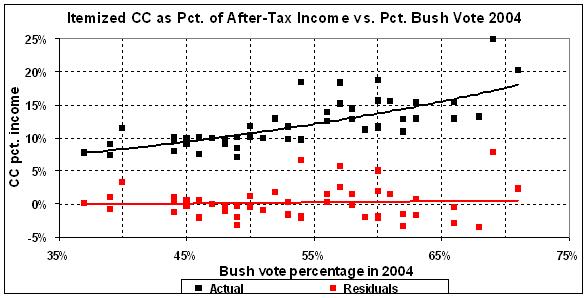
I went to Generosity Index at the Catalogue for Philanthropy, where I found the underlying data about itemized charitable contributions vs. income, by State. The measure of income used to compute the Generosity Index is adjusted gross income. To get a truer picture of the propensity to give to charity, I converted adjusted gross income to after-tax income by calculating and applying an effective tax rate for each State based on its Tax Freedom Day (detailed data here). With that result in hand I calculated each State’s average itemized charitable contributions as a percentage of average after-tax income. I plotted that statistic against the percentage of votes cast for Bush in 2004, by State.

The relationship between after-tax giving and Bush votes is indicated by the black plot points in the following graph:

The best regression fit for the relationship between after-tax charitable giving and Bush votes is an exponential (the black line):

Itemized charitable contributions as percentage of after-tax income =
0.0304e^2.5026 x (percentage of votes cast for Bush in 2004)
R-squared = 0.59

The exponential fit indicates that the rate of after-tax giving accelerates as the percentage of Bush votes increases. Moreover, the fit — as good as it is — understates the rate of acceleration, as can be seen by inspecting the residuals (the differences between the regression estimates and the actual data), which are plotted in red. Note that the four largest residuals are positive (that is, the equation underestimates charitable giving) and represent pro-Bush States, with vote percentages of 54, 57, 60, and 69.

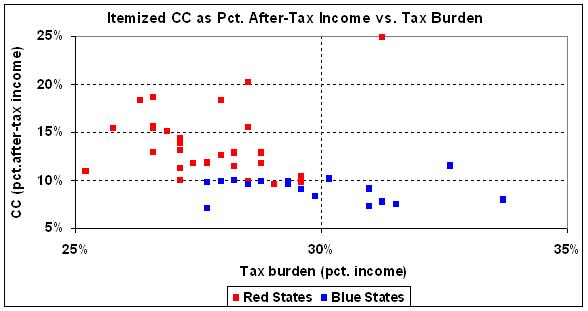
You might think that the higher rate of giving among Red States is the result of lighter tax burdens in those States. It is true that Red States generally have lighter tax burdens than Blue States, as the following graph attests:

But you can see readily that — given the same tax burden — Red States outstrip Blue States in charitable giving. You can see, also, that there is a strong negative relationship between taxes and charitable giving. It doesn’t show up in the data for the Blue States, which are almost uniformly parsimonious when it comes to charitable giving, but it’s definitely there in the case of the Red States. For all States (with the exception of Wyoming, the far “outlier” at the top of the graph), a linear regression yields a one-to-one negative relationship between the tax burden and charitable giving; that is, for every 1 percentage point rise in the tax burden, after-tax charitable giving drops by 1 percentage point.

I draw two conclusions:

  • There is a significant, positive relationship between Republicanism and charitable giving, as indicated by both graphs.
  • Taxes crowd out charity (no surprise), as indicated by the second graph.

Oh, *That* Liberal Media

Suspect Arrested in Wash. Mall Shootings. So says the headline on the AP story, which tells us that

The gunman came out of the Sam Goody music store without a gun and surrendered to the SWAT team. . . .

Suspect, my foot. That’s like saying Mohammed Atta was a suspect in the 9/11 attacks, or that Osama bin Laden is suspected of having ordered the attacks. The headline should read Gunman Arrested in Wash. Mall Shootings.

The press plays nice with known criminals, then uses its headlines and editorials news stories to convict its political opponents (i.e., conservatives) of evil motives, malfeasance, and incompetence. All in a day’s work.

Red vs. Blue Charity

From Yahoo! News:

“We believe that generosity is a function of how much one gives to the ability one has to give,” said Martin Cohn, a spokesman for the Catalogue for Philanthropy, a Boston-based nonprofit that publishes a directory of nonprofit organizations.

Using that standard, the 10 most generous states were, in descending order, Mississippi, Arkansas, South Dakota, Oklahoma, Tennessee, Alabama, Louisiana, Utah, South Carolina and West Virginia.

The 10 stingiest, starting from the bottom, were New Hampshire, Massachusetts, New Jersey, Rhode Island, Wisconsin, Connecticut, Minnesota, Colorado, Hawaii and Michigan.

Some New Englanders, of course, don’t like the result, so they have concocted their own measures of charitableness. But the Catalogue’s method strikes me as right. And what does it tell us? This:

Most Generous States (ranked from most-to-less generous; percentage of popular vote for Bush in 2004 in parentheses)

Mississippi (60%)
Arkansas (54%)
South Dakota (60%)
Oklahoma (66%)
Tennessee (57%)
Alabama (63%)
Louisiana (57%)
Utah (71%)
South Carolina (58%)
West Virginia (56%)

Least Generous States (ranked from least-to-more generous; percentage of popular vote for Bush in 2004 in parentheses)

New Hampshire (49%)
Massachusetts (37%)
New Jersey (46%)
Rhode Island (39%)
Wisconsin (49%)
Connecticut (44%)
Minnesota (48%)
Colorado (53%)
Hawaii (45%)
Michigan (48%)

So much for those mean-spirited, Bible-thumping Republicans.