The Faces of Appeasement

UPDATED TWICE, BELOW

Three members of the U.S. House of Representatives voted “yes” on H. Res. 571 (“Expressing the sense of the House of Representatives that the deployment of United States forces in Iraq be terminated immediately”):

U.S. Representative Cynthia McKinney, 4th District of Georgia

U.S. Representative José E. Serrano, 16th District of New York

U.S. Representative Robert Wexler, 19th District of Florida

Six other Democrats voted “present” — which I take to be “yes” in a whisper. Those Democrats are:

Michael Capuano, Massachusetts 8th
William Clay Jr., Missouri 1st
Maurice Hinchey, New York 22nd
James McDermott, Washington 7th
Jerrold Nadler, New York 8th
Major Owens, New York 11th

Many other Democrats — including one John Murtha (Pennsylvania 12th) — would like to have voted “yes” but claimed that they voted “no” because the resolution was a Republican “trap.” Well, yes, it was a trap. You could vote “yes” and reveal yourself as an appeaser or you could vote “no” and send the enemy the right message: America is not about to back away from the Middle East.

UPDATE: Professor Bainbridge, an avowed conservative and quasi-Republican, takes issue with what he calls the GOP’s “stunt”:

So the House GOP pulled off its little stunt last night, winning by havings its own proposal for immediate withdrawal from Iraq voted down 403-3. . . .

Alternatively, the House GOP could have been honest and given Murtha an up-or-down vote on what he actually proposed:

  • To immediately redeploy U.S. troops consistent with the safety of U.S. forces.
  • To create a quick reaction force in the region.
  • To create an over- the- horizon presence of Marines.
  • To diplomatically pursue security and stability in Iraq.

1. There’s no practical difference between immediate withdrawal and “redeployment” consistent with the safety of U.S. forces. We know what “redeployment” really means, and who would think that a withdrawal that might begin immediately would be accomplished without an effort to ensure the safety of the withdrawing forces?

2. A quick-reaction force to do what? If it isn’t necessary to have troops in Iraq, why would we need to have them elsewhere in the region?

3. Ditto for those over-the-horizon Marines.

4. Pursuing diplomacy with thugs is a pipe dream. Ask Neville Chamberlain. Ask Ariel Sharon. Diplomacy is best pursued by talking softly, carrying a big stick, and using it as necessary.

The enemy will have noticed that Murtha’s proposal would effectively withdraw American forces from combat with no assurance that they would return. The enemy will have noticed that Murtha’s proposal says nothing about actually ensuring the security of Iraq. It’s a poll-driven plea for the withdrawal of U.S. forces, whether or not the job is done and regardless of the consequences for Iraqis or for the rest of the Middle East.

Not only is Bainbridge naïve about Murtha’s proposal, he’s also naïve about the need for the GOP to do precisely what it did, given the din of defeatist rhetoric coming from Democrats and knee-jerk anti-war factions in the U.S. The House leadership cleverly delivered a message to the enemy: No matter what you hear to the contrary, we’re not bugging out of Iraq.

Some may call it a trap; some may call it a stunt; I call it a job well done.

UPDATE 2: Patterico and Dafydd ab Hugh agree with me.

It’s All Truman’s Fault

Harry Truman showed the world that America had lost its will to win. And so, we have gone from Korea, to Vietnam, to Lebanon, to Gulf War I, to Somalia, and — now, it seems — to Iraq. I must quote myself:

Vietnam was the wrong war, in the wrong place, at the wrong time. But once we had committed our forces there, we should have fought to win, regardless of the amount of force required for victory. Why? Because our ignominious withdrawal from Vietnam changed the national psyche — especially coming as it did within a generation of the stalemate in Korea. As a result of Vietnam, we went from believing that we could win any war we set our minds to win to believing that there wasn’t a war worth fighting.

Our (incomplete) victory in the Gulf War of 1991 came so quickly and at so little cost that it didn’t really reinvigorate America’s military self-confidence. Our 1999 bombing campaign in Kosovo succeeded only in showing our willingness to win a quick victory (if it was that) in a situation that posed little or no threat to American forces.

On the other hand, the new, defeatist American psyche — which most of the mainstream press has been striving for 30 years to perpetuate — manifested itself in our abrupt withdrawals from Lebanon (1983) and Somalia (1993) after the public saw “too many” body bags. Then there was our legalistic response to the 1993 World Trade Center bombing and our tepid military response to the 1998 bombings of the U.S. embassies in Kenya and Tanzania. The sum total of American actions in 1983, 1993, and 1998 — coupled with the obvious ascendancy of American defeatism — surely led Osama bin Laden to believe that he could accomplish his aims through a few spectacular terrorist attacks within the U.S., and the threat of more such attacks.

Thus, although we may be having a hard time in Iraq — and the hard time may continue for a while — we cannot back down. We must redouble our efforts to quell the insurgency and to build a stable Iraq. To do otherwise would be to admit that the American psyche remains defeatist. It would invite our enemies and potential enemies to take bold actions — if not directly against us, then against our interests around the world. We would find it harder and harder to fight back, diplomatically and militarily, against increasingly emboldened enemies and rivals — even if we had the will to fight back. Vital resources would become exorbitantly expensive to us, if we did not lose access to them altogether. America’s economic and military might would descend together, in a death spiral, and with them — very likely — the remnants of domestic civility.

And that is how bin Laden will destroy America, if he can. And that is why we must persevere in Iraq.

Oxymorons at Work

AP headline: Hawkish Democrat Calls for Iraq Pullout

Well, he (Rep. John Murtha, D-Pa.) might once have been hawkish about something. But when he called for a pullout he lost his standing as a putative hawk. The headline is an oxymoron, except to the morons at AP.

The correct headline: Formerly Reputed Hawk Revealed As Typical Democrat Appeaser

Political Taxonomies

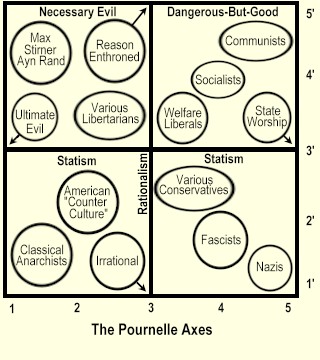
Thanks to a comment by Mr. Meval on a post at Catallarchy, I found this:

My own, simpler, taxonomy — which anarcho-capitalists will reject — looks like this:

• Anarchy — “might makes right” without an effective state to referee the fight

• Libertarianism — the minimal state for the protection of life, property, and liberty

• Communitiarianism — the regulation of private institutions to produce “desirable” outcomes in such realms as income distribution, health, safety, education, and the environment

• Statism — outright state control of most institutions, reached either as an extension of communitarianism or via post-statist anarchy or near-anarchy, as in Stalin’s Russia, Hitler’s Germany, and Mao’s China.

Joe Stiglitz, Ig-Nobelist

Economist Joseph Stiglitz (a.k.a. Paul Krugman plus Nobel prize) recently reviewed Benjamin Friedman’s The Moral Consequences of Economic Growth. Stiglitz delivers many outrageous ideas, not the least outrageous of which is this:

Inequality did seem to fall in the United States after the Great Depression, but in the last 30 years it has increased enormously.

Inequality seems to go with economic growth — as Stiglitz admits. But he prefers equality and lower incomes for all to inequality and higher incomes for all. He has no regard for those whose talents and entrepreneurship fuel growth and help to make everyone better off. That’s probably why he’s an academic.

Then there is this:

The question should be, are there policies that can promote what might be called moral growth — growth that is sustainable, that increases living standards not just today but for future generations as well, and that leads to a more tolerant, open society? Also, what can be done to ensure that the benefits of growth are shared equitably, creating a society with more social justice and solidarity rather than one with deep rifts and cleavages of the kind that became so apparent in New Orleans in the aftermath of Hurricane Katrina?

This is absurd talk coming from a so-called economist. He must have learned his economics at the knee of Karl Marx. Aside from enforcing laws against force and fraud, government should simply get out of the way. Markets thrive without government intervention. Markets are the essence of cooperation. Markets are inherently “tolerant” and “open” because the pursuit of self-interest (profit) requires service to the interests of others. Markets ensure equitable sharing of the benefits of growth by incentivizing and rewarding contributions to growth. A society of free markets and limited government would not have fostered the conditions that led to New Orleans’s poverty and rank dependence on incompetent government.

But Stiglitz continues undaunted by the ghost of Adam Smith:

As the income distribution becomes increasingly skewed, with an increasing share of the wealth and income in the hands of those at the top, the median falls further and further below the mean. That is why, even as per capita GDP has been increasing in the United States, U.S. median household income has actually been falling.

Left-wingers like to talk about the “skewed” distribution of income, but they don’t like to talk about the fact that there is considerable mobility across that distribution. As I wrote here, for example,

at the end of the 20th century, only about 15 percent of the households (3 million of 21 million) then in the bottom quintile had been there for a generation.

(See also this post and this one.) Moreover, Stiglitz views household income selectively. Instead of looking at the long-term trend, which clearly is upward, he focuses on recent, recession-related data. Here is the big picture:


Source: Census Bureau. See Figure 5, at this link.

Stiglitz, of course, likes to invoke the usual Left-wing bugbears, as if the bottom line (rising real income) were irrelevant. Thus he alludes to the poverty rate, which in fact is in long-term decline; job security, a nebulous scare-term that somehow cancels out rising real income and the 20-year decline in the unemployment rate, which is now well below the average for 1948-2004; the percentage of persons without health insurance, which has risen somewhat since 1987, probably due to immigration and government mandates that have raised the cost of health insurance; and so on.

Now Stiglitz mounts a direct assault on Adam Smith:

In a market economy with imperfect and asymmetric information and incomplete markets — which is to say, every market economy — the reason that Adam Smith’s invisible hand is invisible is that it does not exist. Economies are not efficient on their own. This recognition inevitably leads to the conclusion that there is a potentially significant role for government.

Of course nothing is perfect, except in the mind of a delusional economist or engineer. The price of perfection is too high: perfection is inefficient and stagnant. But Stiglitz doesn’t want to talk about that; he wants to talk about how the visible, heavy hand of government can do to us what we refuse to do to ourselves. He doesn’t want to talk about the very high cost of government intervention in markets, which I have documented here. That high cost includes the direct cost of government — which, including welfare programs, now amounts to 40-50 percent of GDP — and the incentive-dampening costs of taxation and regulation — which, over the past 100 years, have slashed GDP to about 60 percent of its potential level.

Finally, Stiglitz offers this bit of “evidence” for the superior wisdom of government:

There is, for instance, a greater role for government in promoting science and technology than Friedman seems to suggest. A report by the Council of Economic Advisers (conducted when I was its chair) found that the returns on public investment in science and technology were far higher than for private investment in these areas and than for conventional investment in plant and equipment.

I wonder how it was that Stiglitz, as chairman of the Council, was able to sponsor a report that came to such pro-government conclusions? (Just asking.) Actually, Stiglitz misrepresents the findings of the study to which he refers. The study (as cited here) actually found

the private rate of return of R&D to be between 10 and 40 percent, while the social rate of return ranged from about 20 to 140 percent.

(An analysis with similar results can be found here. The following critique applies to all such studies.)

What we have here are apples and cucumbers. The private rate of return to R&D is the additional profit that results from additional investments in R&D. The social rate of return to R&D is the gain in consumption (GDP) that results from additional government investments in R&D. Thus, according to Stiglitz’s study, if a corporation invests a dollar in R&D, it can expect that dollar to return a profit of between 10 and 40 cents a year, whereas a dollar of government R&D enables an future increase in consumption (additional GDP) of between 20 cents and $1.40 per year. However, a corporation’s profit is net of something, namely its sales. If a corporate investment of $1 is to yield a profit of 10 to 40 cents a year, it must generate additional sales (additional GDP) of considerably more than 10 to 40 cents a year.

To convert the apple of private R&D to the cucumber of government R&D we must convert after-tax profits to the equivalent amount of GDP required to generate those profits. Drawing on National Income and Product Accounts Table 1.15 (Price, Costs, and Profit Per Unit of Real Gross Value Added of Nonfinancial Domestic Corporate Business) for 1929-2004, I find the mean and median after-tax profit of nonfinancial corporations to be have been 7.7 percent of value-added for that period.* Thus, over the long haul, every dollar of profit represents about $13 in additional GDP. Applying that ratio, we get a valid comparison of the returns to private and government R&D:

  • The private rate of return to R&D, in terms of additional GDP, is between 130 and 520 percent.
  • The so-called social rate of return (i.e. return to government R&D, in terms of additional GDP) ranged from about 20 to 140 percent.

The true private rate of return to R&D is about 4 to 6 times that of the government rate of return. What else would one expect, knowing that the private sector responds to the signals sent by consumers while government just makes it up as it goes along?

I hereby nominate Joe Stiglitz for the Perpetual Ig-Nobel Prize in Left-Wing Economics.
__________
* The profit rate for 1999-2003 dropped below the long-term mean and median. That wouldn’t bother Stiglitz, of course. He seems to believe that government, not business, is mainly responsible for economic growth, and that corporate poverty is somehow good for people, when just the opposite is true.

Don’t Just Take My Word for It

For what? For the wrongness of Roe v. Wade. Of course, many legal scholars have been saying the same thing for years. It just happens that I came to see the wrongness of Roe v. Wade on my own, not by cribbing from what those scholars have said. But vindication is always sweet, and I must share the experience. I just came across a piece at FindLaw by Edward Lazarus, who is “pro-choice” and who clerked for the late Justice Blackmun (who opined for the Court in Roe). Among other things, Lazarus has this to say:

What, exactly, is the problem with Roe? The problem, I believe, is that it has little connection to the Constitutional right it purportedly interpreted. A constitutional right to privacy broad enough to include abortion has no meaningful foundation in constitutional text, history, or precedent – at least, it does not if those sources are fairly described and reasonably faithfully followed.

My argument, precisely.

There are other prominent legal scholars — pro- and anti-abortion — who agree that Roe v. Wade was decided wrongly, though sometimes for other reasons. For a roundup of such views, see this.

Wait . . . there’s more. I wrote here that

Roe v. Wade is nothing more than an illogical, ill-founded, politically expedient position staked out by seven justices who were caught in the tide of “personal liberation.” That tide, which rose in the 1960s and has yet to fully recede, is powered by the perverse belief that liberty is to be found in license.

William Saletan, writing at Legal Affairs, in a review of Linda Greenhouse’s Becoming Justice Blackmun, says this:

Was [Blackmun] a feminist crusader? Or was he, as his files suggest, more of an old-fashioned conservative? At his retirement ceremony two decades after Roe, Blackmun portrayed the case as a pioneering advance in a difficult climate, “a step that had to be taken as we go down the road toward the full emancipation of women.”

Enough said.

Oh, *That* Privacy Right

I have written here and here, for example, about the “right to privacy” conjured in Roe v. Wade and its precedents. Of course, judge-made rights can be overturned as quickly as judges want to overturn them. Tom Smith of The Right Coast explains:

Skeptics about Roe v. Wade have long railed about the invention of a right of sexual privacy by the US Supreme Court in that controversial case. Where was that controversial right supposed to come from? Sex, let alone abortion, is mentioned nowhere in the Constitution. Yet find such a right the Court did. Legal scholars wondered, as well they might, where such a right, once invented, would find its limit. Does the right of sexual privacy imply a right to gay marriage? To any form of sexual conduct, no matter how alarming?

Now, in a bold decision positively reeking of integrity, Judge Stephen Reinhardt has laid down the law, finally proclaiming that this murky right goes so far, but no further. Strict constructionists everywhere may breathe a sigh of relief. How ironic, and indeed inspirational, it is that this paradoxical opinion comes from a judge some brand as among the most liberal and activist on the ever amusing Ninth Circuit.

The case arose when irate parents objected to the Palmdale School District’s giving their children, including first graders, a questionaire including sexually explicit questions, along the lines of whether the children played with their “private parts”, had sexual feelings, and so on. Parents asserted a constitutional right not to have the school introduce young children, many of whom do not yet know where babies come from, to concepts such as masturbation, sexual abuse, and sex generally. However foolish the notion may be that parents should want to shield first graders from intrusive sexual investigation, one can understand how, in a world of expansive conceptions of sexual privacy, they could have imagined they had such a ridiculous privilege. But no more. They have been educated, as harshly as their children, by the Ninth Circuit. . . .

This is really an important lesson for everyone interested in constitutional law. We frequently jump to the conclusion that words like “privacy” mean what they mean in ordinary contexts. But this is not so. “Privacy” does not mean such things as a family exercising control over whether state employees ask their six year olds about their private parts and whether they ever touch them. (After all, what possible motive could a teacher have for posing such a question, other than a benign one? What possible dangers could such questions pose?) It means something much more complicated than that. Thus, the right to privacy includes the right to choose to terminate the life-like process of an otherwise about-to-be-born non-person person-like post-fetal entity, but not to control the early education of such entity in its early stages of personhood, once that small person or near-person has been put into the hands of the state educational system. That is, to strip the point of its many deeply intriguing nuances, you may kill the thing, but not control its education; the former is privacy, the latter is not.

The lesson is this: Judges will find rights where it’s convenient to find rights and they will repudiate rights where such rights might get in the way of the outcomes they want to achieve.

If only Judge Reinhardt’s “principled” view of privacy had been understood by the U.S. Supreme Court in 1965 (Griswold v. Connecticut) and 1973 (Roe v. Wade).

The Left’s Double Standard on Harriet Miers

John Podesta, formerly a chief of staff to Bill Clinton and now a member of the Left’s traveling pack of attack dogs (same thing), writes at Think Progress:

Harriet Miers’ nomination fell victim to a right-wing double standard.

In his confirmation hearing, John Roberts affirmed the right to privacy, agreed with the conclusion of Griswold, and told the Judiciary Committee that he considered Roe v. Wade ““settled as a precedent.””

There is much in Harriet Miers’’ record to suggest she fell to the right of Roberts’ on the question of abortion rights. She does not consider Griswold settled law and had a record of supporting anti-choice causes.

John Roberts was enthusiastically embraced by right-wing conservatives eager to overturn Roe v. Wade. Harriet Miers was vilified by the exact same people.

Harriet Miers’’ nomination has always been controversial, but it was not until comments from a 1993 speech surfaced where she said she believed in ““self-determination” that Miers was presumably forced to withdraw.

It is clear that, absent an unambiguous pledge to overturn Roe, the right holds women nominees to a different standard. They do it because they fear a woman justice will feel empathy towards other women making the agonizing choice of whether to have an abortion. They fear that a woman justice would not be willing to use criminal sanctions to regulate other women’s decisions.

No nominee should be subject to a litmus test, especially one that discriminates based on gender.

Podesta’s hypocrisy knows no bounds. Imagine the impossible: Podesta on the talk-show circuit defending Harriet Miers’s nomination because of her seemingly inconsistent views about abortion and her disdain for Griswold v. Connecticut.

The double standard on display is that of the Left, which prefers the litmus test of “diversity” to the litmus test of competence. Most conservatives who were outraged about Miers were outraged long before Miers’s ramblings about “self determination” came to light. And they were outraged because of Miers’s evident faults: little or no relevant legal experience, a muddled mind. In sum, conservatives put quality above diversity.

Such a concept would never cross the mind of a John Podesta, whose lack of interest in Miers’s judicial qualifications is exceeded only by his cynical delight in conservative-bashing.

(Thanks to SCOTUSblog for the pointer.)

States’ Rights and Skunks

In light of the preceding post, I want to make it perfectly clear that I favor States’ rights — as long as States’ rights advance liberty. The Left (Stevens-Souter-Ginsburg-Breyer) wing of the Supreme Court has no such agenda. The Court’s Left wing has as its main agenda the advancement of governmental power. Anyone who applauds the Left wing’s accidental embrace of States’ rights (as in Kelo) might as well applaud the Dixiecrat wing of the Democrat Party for its cynical embrace of States’ rights in the defense of state-enforced segregation and denial of voting rights.

When it comes to the advancement of liberty, it is only fitting and proper to deploy every legal argument at one’s disposal — as I have tried to do in the preceding post. The old saying goes that you can’t win a peeing contest with a skunk (i.e., the Left wing of the Supreme Court). My version goes like this: Sometimes you can’t avoid a peeing contest with a skunk; that’s when you stand back a safe distance and blast it with a fire hose.

When it comes to the defense of liberty, a timid bow to States’ rights is no virtue and an attack on States’ rights isn’t always a vice.

Global Warming and the Liberal Agenda

So Mars is getting warmer, without human activity. It’s more evidence that the apparent warming of Earth’s climate is due mainly to phenomena over which humans have no control.

The rush by many scientists and all hair-shirted liberals, anti-capitalists, and inveterate doomsayers to blame global warming on human activity arises from a predisposition to think of economic motives as “greedy” and “evil.” But it is the “greedy” and “evil” pursuit of profit and self-interest that lifts individuals out of poverty, leads to cures for disease, and generally makes life more livable.

In sum, the pursuit of profit and self-interest advances liberals’ proclaimed agenda. But liberals have been blinded to that fact by their own guilt, ignorance, and anti-capiltalist rhetoric. That many liberals are also hypocritical beneficiaries of the system they claim to despise should not go unmentioned, either.

Related posts:

Climatology (07/16/04)
Global Warming: Realities and Benefits (07/18/04)
Scientists in a Snit (08/14/04)
Another Blow to Climatology? (08/21/04)
Bad News for Politically Correct Science (10/18/04)
Another Blow to Chicken-Little Science (10/27/04)
Bad News for Enviro-Nuts (11/27/04)
The Hockey Stick Is Broken (01/31/05)
Science in Politics, Politics in Science (05/11/05)
Hurricanes and Global Warming (09/24/05)

More Thoughts That Liberals Should Be Thinking

Continued from this post:

If pornography degrades women and discrimination demeans minorities, gay marriage must diminish heterosexual marriage and its civilizing influence.

Taxes are not the price we pay for civilization. Taxes are the price we pay because liberal policies undermine the natural order to be found in free markets and voluntary associations.

If the execution of criminals is “immoral,” what does that say about the execution of unborn innocents?

Consider the Children

I have written before about the hidden cost of government programs that encourage mothers to work outside the home:

The twentieth century was a time of great material progress. And we know that there would have been significantly greater progress had the hand of government not been laid so heavily on the economy. But what we don’t know is the immeasurable price we have paid — and will pay — for the exodus of mothers from the home. We can only name that price: greater incivility, mistrust, fear, property loss, injury, and death.

I focused on the economic evidence. But there’s direct evidence of the harm caused by pushing mothers out of the home. First, there’s this:

Researchers tracked the reaction of 70 toddlers in Berlin to their separation from their parents and homes.

They found stress levels were still raised months after beginning child care – even though outward signs of distress had stopped.

“For most toddlers the initiation of daycare is a major stress,” writes report co-author Michael Lamb.

The study of children’s reaction to leaving home casts light on a question that will have been asked by many working parents: “Do children really worry about being away from their parents?”

The answer from this study suggests that children do experience increased stress. . . .

And, more tellingly, there’s this:

A study, the results of which were reported in The [UK] Independent yesterday, indicates that toddlers who are looked after by their mothers develop significantly better than those cared for by nurseries, childminders or relatives.

The report, presented by Penelope Leach, president of the National Childminders’ Association and one of the co-authors, shows that toddlers given nursery care fared worst of all. According to The Independent these children “exhibited higher levels of aggression and were inclined to become more compliant, withdrawn or sad.” Those under the care of relatives fared somewhat better.

The research, which involved 1,200 children and their families in the London and Oxfordshire area, showed that “youngsters looked after by childminders and nannies came second in terms of their development to those who stayed at home with mother.”

The report confirms other studies that show that young children develop best when in the care of a parent, usually the mother, in a loving environment. The report also showed that institutionalized daycare, as proposed by many governments, is detrimental to the development of toddlers.

Society is nothing without civility. Government efforts to push mothers out of the home are nothing less than a crime against society.

(Thanks for my daughter-in-law for the lead.)

Related posts:

I Missed This One (08/12/04)
A Century of Progress? (01/30/05)
Feminist Balderdash (02/19/05)
Libertarianism, Marriage, and the True Meaning of Family Values (04/06/05)
Judge Roberts and Women (08/19/05)

Thoughts That Liberals Should Be Thinking

If women are the same as men, except for certain anatomical features, there’s no reason to favor women candidates for office because they might possess more “compassion.”

If a woman’s place is outside the home, whose place is inside the home, where children need the kind of moral education best given by a parent?

Excluding the inculcation of immoral socialistic ideals, public schools cannot venture very far into moral guidance without offending someone’s “sensibilities.” Nor can public schools enforce moral guidance with a quick swat.

And what’s wrong with a quick swat as a way of imprinting a moral lesson? It’s a lot more effective than “Joshua, I’m telling you for the last (100th) time not to do that.”

If the black poor are poor because they’ve been “kept down” by discrimination, then affirmative action isn’t of much use to them, except as a way of victimizing whites. (Moral lesson: Two wrongs don’t make a right.)

If the black poor are poor in spite of generations of welfare programs aimed at them, perhaps the problem is that such programs have created a form of dependency that destroys initiative.

If, as Thomas Sowell argues, “black” (redneck) culture is largely responsible for both the perpetuation of black poverty and racial prejudice, doesn’t that make a strong case for “acting white” instead of clinging to a culture that isn’t even authentically “black”?

And where’s the “compassion” for poor, inner-city blacks when they cannot obtain a better education through school vouchers because of resistance to vouchers by their own “educators” and white “liberals” in adjacent suburbs?

If it’s good to have racial and ethnic diversity in housing and jobs, why isn’t it good to have intellectual diversity (a.k.a. free speech) on campuses?

Homosexuality has driven many Catholic priests to molest boys. The Church wants to protect boys by banning the ordination of homosexuals. Liberals must choose between their reflexive defense of homosexuals and their purported desire to protect children.

That purported desire should also cause them to rethink where they want mothers to spend their days and where they want children to go to school.

Like a Fish in Water

A.O. Scott of The New York Times wants to prove that the myth of a liberal movie industry is dead. How? By citing two current box-office hits, Just Like Heaven and The Exorcism of Emily Rose, and a few other recent films that are putatively conservative or libertarian in outlook. In “Reading Hollywood, from Left to Right” (Sept. 25, 2005), Scott asserts that

the studios themselves, especially after the stunning success of Mel Gibson’s independently financed “The Passion of the Christ,” have tried to strengthen their connection with religious and social conservatives, who represent not only a political constituency but a large and powerful segment of the market.

All this tells me is that Hollywood is interested in making money, which is fair enough. (Unlike Hollywood hypocrites who make big money with movies that criticize making big money, I don’t begrudge the money Hollywood makes.) But Scott’s assertion says nothing about the determinedly Leftish politics of most Hollywood stars and big-wigs.

Scott’s evidence for the demise of Leftism in Hollywood is the supposed pro-life stance of Just Like Heaven, which apparently has a slapstick finale; an appeal to open-mindedness about religion, which is evidently the message to be taken from The Exorcism. . . ; Mel Gibson’s surprisingly successful The Passion of the Christ, which I recall being anathema to Hollywood before it became a hit; and a rather dumb action-hero animation known as The Incredibles, which I found to be an inferior version of Superman, Captain Marvel, and Batman comic books. And that’s about it, out of the hundreds of movies churned out by Hollywood and the so-called independent studios in the past few years.

Scott’s problem is that, like most liberals, he can’t see the liberalism that surrounds him because it’s his natural milieu. He’s like a fish in water who has been shocked by a small infusion of additional oxygen. It’s not enough to affect his environment significantly, but it causes a brief spasm of alarm.

The FEC and Bloggers: Stay Tuned

McQ of QandO says: “In between the bookend hurricanes, the FEC still has bloggers in its focus.” In the linked story, Federal Election Commission vice-chairman Michael Toner

argued that political activity on the Internet fails to meet the campaign finance law’s threshold to stop corruption or the appearance of corruption. Toner urged Congress to pass a law that pre-empts the court’s action and ensures that the Internet remains exempt from campaign finance rules.

But

Scott E. Thomas, the FEC [chairman], said his agency’s original exemption for the Internet was a mistake and the FEC should come up with rules for Internet campaign ads in light of the $14 million spent on Internet ads in the 2004 campaign.

Thomas said Congress should hold off on any legislation until the FEC acts.

Another commissioner, Ellen Weintraub, said the agency preferred a “less is more” approach.

“This is appropriate because the focus of the FEC is campaign finance,” she said. “We are not the speech police.”

Glad to hear it, but the FEC is currently acting under an order from U.S. District Court Judge Colleen Kollar-Kotelly, which struck down the FEC regulations that had allowed those advertising on the Internet to avoid many of the requirements of McCain-Feingold. And so, if the judge has her way and you say anything positive about a candidate, or negative about the candidate’s opponent, you might be found to have given a campaign contribution in kind to the candidate. Then the FEC could have its way with you.

Thanks a bunch, judge. Also thanks a bunch to U.S. Reps. Christopher Shays and Marty Meehan, who brought the suit against the FEC, and to those great defenders of freedom of speech, Sens. John McCain and Russ Feingold, who filed an amicus brief in support of Shays and Meehan. What those paragons of liberty and their brethren in Congress want is for all of us to shut up, because silence favors incumbents.

What should happen is this: When the U.S. Supreme Court has its full complement of justices, some persons with standing (bloggers among them) would file a challenge McCain-Feingold. The challenge by Senator Mitch McConnell failed in part because he was deemed to lack standing, but it failed mainly because of the Court’s balance. Chief Justice Rehnquist wasn’t a wholly reliable support of free speech; Justice O’Connor is even less so. Two new justices, Roberts and ?, could swing the balance back toward freedom of speech.

But no matter how it comes out, they’ll have to pry this blog from my cold, dead hands.

Liberals and the Rule of Law

Liberals never quit. They defended Clinton because his “heart was in the right place” when it came to women, even though he was blatantly guilty of the anti-feminist sin of sexual predation. Republicans cried “rule of law,” but Democrats weren’t buying it, because Clinton — the sexual predator — was their man. In other words, liberals believe in neither the rule of law nor in any principle that can’t be sacrificed to their agenda of the moment, whether it’s keeping a law-breaking president in the White House or stealing an election by interpreting hanging chads.

Now comes Dahlia Lithwick of Slate to tell us why Judge John Roberts isn’t fit to be Chief Justice:

All afternoon, witnesses have been testifying back and forth about John Roberts. His supporters call him brilliant and kind and diligent and principled. His detractors mostly say he doesn’t get it. . . .

Back and forth the witnesses go—Roberts is great/Roberts doesn’t get it—never really acknowledging that they are not disagreeing; that it’s possible to be kind and smart and to believe in the rule of law and also not to get it.

Because the “it” in question has nothing to do with the rule of law. It’s about something I might call “law-plus”—the idea that the rule of law, in and of itself, has not always made this country fair. . . .

John Roberts isn’t a fan of law-plus. In fact, the unbounded nature of judicial power under law-plus is probably what drove him into the boiler room of the Reagan administration in the first place. Time and again he scolds the senators: If you want your statute to provide money damages, write it that way; if you want your legislation to implicate interstate commerce, write it that way. For Roberts, it is not the courts’ responsibility to make statutes effective. It is not even the courts’ responsibility to make the world fair. . . .

The problem isn’t whether John Roberts can be principled and fair on a thoroughly passive court. I’m sold on that. It’s whether a thoroughly passive court can ever truly be principled and fair.

In sum, the law be damned, just give us what we want and call it “fair.”

Rejection of the rule of law, which is what Lithwick and her ilk openly propound, means that no one knows what the rules are and that government can do anything it wants. If a judge says it’s right to take property away from homeowners and give it to developers, that’s “fair.” If a judge says that it’s right to discriminate against white persons because they aren’t black, that’s “fair.” Fair to whom? Fair to whomever liberals want to favor on any given day: Bill Clinton, developers, blacks upon whose votes they count, and on and on.

In the end, the liberal schema leaves all of us adrift, except for those in the inner circle, who are clued in from day to day as to what’s considered fair. The rest of us — black and white, rich and poor, rural and urban, religious and irreligious — must muddle along wondering what twist the law is going to take today. Will it follow the Constitution and laws made pursuant to the Constitution, or will it veer off in a new direction, favoring the liberal community’s cause du jour and leaving the rest of us in the lurch — without the education for which we are qualified, without the job for which we are qualified, and without the home in which we had hoped to spend our remaining years.

If you don’t like the law, get the legislature to change it, or get the legislature and the people to amend the constitutional meta-law. That’s too hard for liberals, who prefer a “fair” judge who will simply change the law without the bother of legislating and amending. And why is that? Because liberals know that in many instances they wouldn’t get what they want. And, guess what, that wouldn’t be “fair.”

You see, “fairness” is a shell game. And the owner of the game always wins. That’s the liberal agenda. To win, and screw anyone who gets in the way. “Fairness” is fair only to liberals, and that’s the way they want it.

So the next time a liberal tells you “it’s only fair,” ask “fair to whom?”

Whose Incompetence Do You Trust?

So you think government is to be trusted to “get the job done”? Are you less certain, in the aftermath of Katrina? Well, even if you’re not certain, you can bet that many other remain certain that government is still to be trusted, if it’s given more money or put it in the hands of the right party. I think not.

FDR’s administration might have foreseen the vastly expensive and intrusive central government that grew out of its anti-Depression efforts. But whether or not FDR’s administration foresaw the regulatory-welfare state, its “experiments” on the American people shouldn’t have been trusted.

FDR’s administration wasn’t to be trusted to foresee and prevent the attack on Pearl Harbor, when a successful defense of Pearl Harbor might have deterred the Japanese and hastened victory in Europe. (The U.S., rightly, would have at some point come to the aid of Great Britain.)

Truman’s administration wasn’t to be trusted to foresee and prevent the invasion of South Korea, which led to a costly and inconclusive war and demonstrated, for the first time, a lack of military resolve (Truman’s willingness to accept the status quo ante). Thus it should have come as no surprise that the USSR was emboldened to tighten its grip on Eastern Europe and to squash the 1956 uprising in Hungary.

Eisenhower’s administration wasn’t to be trusted to foresee that the Bay of Pigs invasion, which the Kennedy administration botched, would make Castro more popular in Cuba. The botched invasion pushed Castro closer to the USSR, which led to the Cuban missile crisis.

JFK’s inner circle was unwilling to believe that Soviet missile facilities were enroute to Cuba, and therefore unable to act before the facilities were installed. JFK’s subsequent unwillingness to attack the missile facilities made it plain to Kruschev that the the Berlin Wall (erected in 1961) would not fall and that the U.S. would not risk armed confrontation with the USSR (conventional or nuclear) for the sake of the peoples behind the Iron Curtain. Thus the costly and tension-ridden Cold War persisted for almost another three decades.

LBJ’s administration wasn’t to be trusted to foresee the consequences of the incremental application of military power in Vietnam, which led to the enemy’s eventual victory. Worse for the U.S., the Vietnam experience became a rallying point for the anti-war Left, which continues to undermine the defense of American interests.

Nixon’s administration wasn’t to be trusted, period.

Carter’s administration wasn’t to be trusted to foresee how its feeble, futile, and belated effort to rescure the Americans held hostage in Iran would encourage Islamic terrorists. Ditto for the Reagan administration’s willingness to cut and run after the bombing of the Marine Corps barracks in Lebanon, for the Clinton Administration’s similar bug-out after the massacre of U.S. troops in Somalia, and for the Clinton administration’s feeble, legalistic responses to the bombing of the World Trade Center and the bombings U.S. embassies in Africa.

Bush I’s administration wasn’t to be trusted to foresee that the failure to remove Saddam and install a friendly Iraqi government in 1991 would eventually require us to start from scratch, after Saddam and his party had had time to plan for a post-invasion insurrection.

Bush II’s adminstration wasn’t to be trusted to go where the Clinton administration had failed to go, that is, to anticipate and prevent the long-planned attacks of September 11, 2001.

Government incompetence is nothing new under the sun. It just seems new to hundreds of millions of naïve Americans, who want to believe that government, which usually fails to anticipate rather predictable and often manipulable human enemies (and fails to defeat them except when it wages all-out war), will magically become competent when it comes to dealing with implacable nature, in all its variety — the usual log-rolling, pork-barreling, and graft notwithstanding.

But of course, the sudden emergence of governmental competence is precisely what most Americans want to believe in. (It’s the main theme of every presidential election.) And so we will end up throwing more money at the problem, to little avail and without regard for the viable alternative. That alternative is to let people decide for themselves what risks are important to them, and to let them decide how to spend their money (cooperatively, as they wish) in preparation for those risks.

We should trust the collective wisdom of people acting cooperatively in their own interest, through markets, to protect and preserve their lives and property. We should not trust the amply demonstrated incompetence of government, which suppresses the collective wisdom of markets and replaces it with the collective misjudgments of politicians and bureaucrats, whose main interest is to protect and preserve their power and perquisites.

(For more, see this post at ParaPundit, and this one. Then there’s this one, and several others, at Capital Freedom. And don’t forget Catallarchy, which has plenty, just scroll down.)

Know Thine Enemy

Today the 4th Circuit Court of Appeals issued this spot-on opinion in the case of José Padilla. Briefly, Padilla is the wannabe dirty bomber who was captured in Chicago three years ago after having fought against U.S. forces in Afghanistan.

Lyle Benniston, writing at SCOTUSblog, says:

The ruling . . . did not go as far as the Administration had asked. The Court did not rely upon the President’s claim that he has “inherent authority” as Commander in Chief to order the designation and detention of terrorist suspects. Rather, it relied only on the resolution Congress passed in the immediate aftermath of the terrorist attacks of Sept. 11, 2001, authorizing the President to respond. The Supreme Court similarly avoided the “inherent authority” claim when it upheld detention of citizens captured in foreign battle zones in its decision in Hamdi v. Rumsfeld — so far, the only other case of detention of a citizen named as an “enemy combatant.”

The Circuit Court commented: “Like Hamdi, Padilla associated with forces hostile to the United States in Afghanistan….And, like Hamdi, Padilla took up arms against United States forces in that country in the same way and to the same extent as did Hamdi….Because, like Hamdi, Padilla is an enemy combatant, and because his detention is no less necessary than was Hamdi’s in order to prevent his return to the battlefield, the President is authorized by the AUMF [Authorization for Use of Military Force Joint Resolution] to detain Padilla as a fundamental incident to the conduct of war.”

That the ruling did not go as far as the administration asked doesn’t alter the fact that the ruling was a victory for the administration, and for Americans. After all, Padilla’s counsel raised four arguments for Padilla’s release, all of which failed. Lawyers don’t lose when they lose some of their arguments, they lose only when they lose all of their arguments.

Judge J. Michael Lutting wrote for the three-judge panel. I applaud his ability (and that of his confreres) to see through the legal cant and get it right: An enemy of the United States is an enemy of the United States, even if he happens to be a U.S. citizen. To put it another way, not all non-citizens are enemies of the United States, but some citizens — not just Hamdi and Padilla — are enemies of the United States.

I Hate to Kick a Guy When He’s Already Down . . .

. . . but Steven Edwards of Wired News cannot be excused for his support of the Christopher Reeve Paralysis Act, even though Edwards is paralyzed from the shoulders down. His condition gives him no special standing to hijack taxpayers’ money. Let’s begin with this, from Edwards (whose material I italicize below):

With all the noise over stem-cell research, few people seem to have heard about or understood the importance of the Christopher Reeve Paralysis Act. This noncontroversial bill would improve the collaboration and coordination of federally funded paralysis research. . . .

If it’s noncontroversial, why is it “languishing” in Congress (Edwards’s term)?

Once you read the Paralysis Act, it’s almost impossible to oppose it. . . .

Impossible, eh? I guess that’s why it’s sailing through Congress. Or perhaps members of Congress can’t read — which is a possibility.

I believe embryonic stem cells hold tremendous promise as a research tool, and I support such research. . . .

As do I, on both counts, though I have strong reservations about the creation of life in order to destroy it. Such actions are on the slippery slope toward state control of human destiny. (Go here for more on that score.)

In any event, if a thing is worth doing, the private sector will do it, and do it better than government. (I exempt justice and defense only because of the danger that warlords might arise — or get stronger than they are.)

The Stem Cell Research Enhancement Act would loosen restrictions on federal funding of embryonic stem-cell research and establish guidelines giving infertile couples the option of donating their cryopreserved embryos for the specific purpose of deriving new embryonic stem-cell lines that would be eligible for federally funded research.

Loosening restrictions on federal funding is precisely the problem — and it doesn’t matter to me what’s being restricted. It could be free applie pie for all on Mothers’ Day and I would still oppose it. Why? Because it puts politicians and bureaucrats in charge of deciding how we should spend our money. Yes, it’s our money, not theirs, and decidely not Steven Edwards’s.

Many people have many different kinds of health problems. And those people are hurt when government hijacks their money just because some celebrity (or former president) happened to suffer from a particular disability or disease. Or do you believe in free lunches, Santa Claus, and the tooth fairy, Mr. Edwards?

My Labor Day Message

I posted this on Labor Day 2004. I stand by it.

Labor Day gives most workers a day off. That’s good because an extra day off now and then is a pause that refreshes. A longish trek to a park or a beach on a hot day with a car full of kids isn’t a refreshing way to spend Labor Day, but those workers who spend the day at home, perhaps reading a book and listening to music, will find their souls somewhat restored.

Now let us consider the significance of Labor Day as a holiday. According to Wikipedia:

The origins of Labor Day can be traced back to the Knights of Labor in the United States, and a parade organized by them at that time on September 5, 1882 in New York City. In 1884 another parade was held, and the Knights passed resolutions to make this an annual event. Other labour organizations (and there were many), but notably the affiliates of the International Workingmen’s Association who were seen as a hotbed of socialists and anarchists, favoured a May 1 holiday. With the event of Chicago’s Haymarket riots in early May of 1886, president Grover Cleveland believed that a May 1 holiday could become an opportunity to commemorate the riots. But fearing it may strengthen the socialist movement, he quickly moved in 1887 to support the position of the Knights of Labor and their date for Labor Day. The date was adopted in Canada in 1894 by the government of Prime Minister John Thompson, although the concept of a Labour Day actually originated with marches in both Toronto and Ottawa in 1872. On the other hand, socialist delegates in Paris in 1889 appointed May 1 as the official International Labour Day.

Labor Day has been celebrated on the first Monday in September in the United States and Canada since the 1880s. The September date has remained unchanged, even though the two governments were encouraged to adopt May 1 as Labor Day, the date celebrated by the majority of the world. Moving the holiday, in addition to violating U.S. tradition, could have been viewed as aligning U.S. labor movements with internationalist sympathies.

In summary (for those of you who didn’t grow up in the North), Labor Day is an invention of organized labor, and the historical roots of organized labor are socialistic.

Labor Day also serves to remind us of one of the “monuments” of FDR’s New Deal (quoting again from Wikipedia):

The National Labor Relations Act of 1935 (or Wagner Act) protects the rights of workers in the private sector of the United States to organize unions, to engage in collective bargaining over wages, hours, and terms and conditions of employment, and to take part in strikes and other forms of concerted activity in support of their demands….

In the first few years of the Wagner Act, however, many employers simply refused to recognize it as law. The United States Supreme Court had already struck down a number of other statutes passed during the New Deal on the grounds that Congress did not have the constitutional authority to enact them under its power to regulate interstate commerce. Most of the initial appellate court decisions reached the same conclusion, finding the Act unconstitutional and therefore unenforceable. It was not until the Supreme Court upheld the constitutionality of the statute in 1937 in National Labor Relations Board v. Jones & Laughlin Steel Corp. that the Wagner Act became law in practical terms as well.

Thus Labor Day, in its way, commemorates legislative and judicial infamy. The Wagner Act, at one stroke, deprived business owners of their property rights and thus discouraged investment and business formation; invalidated the freedom of employers to contract with employees on terms acceptable to employers as well as employees; caused artificially high wages and benefits that harmed American workers by making American industry less and less competitive with foreign industry; and set the stage for the use of the Commerce Clause as an excuse for the federal government’s interference in all aspects of business.

So, if you are a worker, enjoy your Labor Day holiday, but don’t thank organized labor or the New Deal for your material blessings.