Affirmative Action: Two Views from the Academy

First comes Michael Bérubé, a professional academic who is evidently bereft of experience in the real world. His qualifications for writing about affirmative action? He teaches undergraduate courses in American and African-American literature, and graduate courses in literature and cultural studies. He is also co-director of the Disability Studies Program, housed in the Rock Ethics Institute at Penn State.

Writing from the ivory tower for the like-minded readers of The Nation (“And Justice for All“), Bérubé waxes enthusiastic about the benefits of affirmative action, which — to his mind — “is a matter of distributive justice.” Bérubé, in other words, subscribes to “the doctrine that a decision is just or right if all parties receive what they need or deserve.” Who should decide what we need or deserve? Why, unqualified academics like Bérubé, of course. Fie on economic freedom! Fie on academic excellence! If Bérubé and his ilk think that a certain class of people deserve special treatment, regardless of their qualifications as workers or students, far be it from the mere consumers of the goods and services of those present and future workers to object. Let consumers eat inferior cake….

Click here to read the full post.

No Way Out?

The three branches of the federal government, individually and severally, have been harassing the Constitution since 1789, and raping it since the New Deal. When the legislative and executive branches aren’t conspiring to infuse new meaning into the Constitution, the judicial branch seems to take up the slack. What to do?

Secede and form a more libertarian union? Secession is an appealing idea (for Red-Staters), if an unrealistic one. There is the idea of “taking over” a State in order to create a haven of liberty, but that idea — propounded by the Free State Project — seems to be going nowhere. And besides, what’s the good of taking over a State when the central government already has usurped most of the powers of the States and many of the liberties of their citizens?

Nullify disagreeable statutes and court rulings? That’s been tried, but it’s no more likely to succeed than secession. Anyway, nullification is a recipe for legal chaos. It would yield lucrative, lifetime employment for yet another army of lawyers, who would advise individuals and businesses with interests in several States as to their rights and obligations, and who would represent those individuals and businesses in endless litigation.

Strip courts of jurisdiction or invoke the doctrine of departmentalism? Those might be good solutions if courts were the only problem. But jurisdiction stripping and departmentalism, to the extent they’re constitutionally valid, leave us defenseless against legislative and executive fiat. The courts aren’t entirely useless, it’s just that you never when they’re going to stop the rape of the Constitution or join in.

Promote federalism? Well, that’s where the Supreme Court could help the cause of liberty. But to get there, the president must nominate the right judges and the Senate must confirm them. I don’t think that the left is really ready to accept devolution of power to the States (even to Blue States), especially if it seems likely that a federalism-minded Supreme Court would overturn Roe v. Wade.

That’s my list of not-so-serious and serious options for restoring the law to something resembling the meaning of the Constitution. Promoting federalism seems the most promising option, but it requires an unlikely (unholy?) alliance between left and right.

An Emerging Left-Right Consensus?

Timothy Sandefur, in his recent response to this post, said:

Now that Dole and the Bushes have almost perfected the elimination of the Goldwater faction of the GOP…there is an ever-diminishing role for us [libertarians] in that party. Some large libertarian segments, most notably Reason magazine, have simply given up on the right wing, and are overtly courting the left, hoping that social issues will draw the left into greater embrace of economic freedom. I’m really not sure whether that strategy will work—I think the left is as resolutely hostile to individualism as the conservatives are—but do we really have anything to lose? “Libertarian” has become an epithet within the controlling faction of the Republican Party. I for one am sick of it, and were it not for the war, as I’ve said, I would have voted Democrat this year. And I suspect at least some leftists will be drawn to our side if we tell our story right: if we show that the liberation of previously oppressed people must include economic liberty….

Perhaps Mr. Sandefur is on to something. Here’s Jonah Goldberg, writing at NRO yesterday:

Federalism! It’s not just for conservatives anymore! That’s right. All of a sudden, liberals have discovered federalism and states’ rights. I discovered this while listening to a recent episode of NPR’s Talk of the Nation, in which host Neal Conan and various callers discussed the idea as if some lab had just invented it….It’s not surprising that liberals would suddenly be interested in federalism, given that a sizable fraction of them think George Bush is an evangelical mullah, determined to convert America to his brand of Christianity. As conservatives have known for decades, federalism is the defense against an offensive federal government….

The problem with the last half-century of public policy is that liberals have abused the moral stature of the civil rights struggle to use the federal government to impose their worldview — not just on racial issues but on any old issue they pleased. But now, all of a sudden, because they can’t have their way at the federal level anymore, the incandescently brilliant logic of federalism has become apparent: Liberals in blue states can live like liberals! Wahoo! (Whereas, according to liberals, conservatives could never have been sincere when they talked about states’ rights; surely, they meant only to “restore Jim Crow” or some such.)

The bad news, alas, is that conservative support for federalism has waned at exactly the moment they could have enshrined the ideal in policy. Just this week, the Bush administration argued against California’s medical-marijuana law. Bush is also moving ahead toward a constitutional prohibition on gay marriage (which many conservatives, including National Review, support). After decades of arguments that Washington should stay out of education, Bush has made it his signature domestic issue.

It’s not that the White House doesn’t have good arguments for its policies. But it is impossible to restore federalism unless you start by allowing states to make decisions you dislike. Otherwise, it’s not federalism, it’s opportunism.

If large numbers of liberals (or leftists, as I prefer) begin to understand that a powerful federal government can do things they don’t like — as well as things they like — those leftists might just get on board with federalism. I imagine there are still enough pro-federalism conservatives out there to forge a formidable, pro-federalism coalition.

Now, federalism isn’t libertarianism, by any means. Some States might have strict gun-control laws and other States might have none at all, for example. But, to the extent that individual States can’t repeal the Bill of Rights and related law, federalism strikes me as a good second-best to the present regime, in which Washington seems willing and able to micro-manage almost all social and economic activity.

As I wrote here:

Libertarian purists argue that government should have almost no power. Libertarian pragmatists argue that government power should be devolved to the lowest practical level. The pragmatists’ case is the better one, given that the urge to regulate social and economic practices is especially strong where people (and votes) are concentrated….

…City dwellers prefer more government because they “need” more; country folk feel less “need” for government because they don’t rub up against each other as much as city dwellers.

Thus the ultimate argument for devolution: Push government functions to the lowest practical level and allow citizens to express their preferences by voting with their feet.

To extend the caricature, those who like guns and oppose abortion can move to Texas, and those who hate guns and approve abortion can move to New York. A typical Austinite (which I am not) might prefer New York’s policies but Austin’s weather. Well, it’s a tough choice, but at least it’s a choice.

ADDENDUM: Jesse Walker, writing at Tech Central Station on November 8 (“The War Between the Statists“) offered this bit of wisdom about federalism:

…The authoritarian conservative wants to maintain the old taboos. The authoritarian liberal wants to introduce some new ones, and he’s had a lot more success. The religious right may despise homosexuality and pornography, but the gay movement is thriving, despite last week’s losses, and porn is more freely available than ever before.

The liberal puritans, by contrast, are riding high in the media and in the courts. For many Americans, the Democrats are the party that hates their guns, cigarettes, and fatty foods (which is worse: to rename a french fry or to take it away?); that wants to impose low speed limits on near-abandoned highways; that wants to tell local schools what they can or can’t teach. There is no party of tolerance in Washington — just a party that wages its crusades in the name of Christ and a party that wages its crusades in the name of Four Out Of Five Experts Agree.
Sometimes they manage to work together. I say fie on both.


Since Election Day, a series of satiric proposals for blue-state secession have been floating around the Internet. Here’s an idea for liberals looking for a more realistic political project: Team up with some hard-core conservatives and make a push for states’ rights and local autonomy. If you have to get the government involved in everything under the sun, do it on a level where you’ll have more of a popular consensus. Aim for a world where it won’t matter what Washington has to say about who can marry who and whether they can smoke after sodomy….

Reality and Public Schools

In my previous post here I commented on two of Timothy Sandefur’s posts (here and here) about creationism vs. evolution. I closed my post by asking: “Who defines reality, and who decides to confront us with it? The state?” Mr. Sandefur responds thusly:

…Reality is not “defined” by some entity standing outside of it and determining its contents; it simply is. It is discovered, and observed, by all of us—some more skillfully and carefully than others….

All right, then, who decides which of us is the more skillful and careful observer of reality? It shouldn’t be the state. (I believe that Mr. Sandefur and I are firmly agreed on that point.) But, we do have government-run schools, and they do dominate education in the United States. Perforce, it is those schools, in their vast inadequacy, that decide what to teach as “reality.”

I share Mr. Sandefur’s concern that proponents of “intelligent design” would use the state to compel the teaching of ID as an alternative to evolution. But government schools that teach evolution are also the schools that teach a lot of things that skillful observers like Mr. Sandefur and I do not recognize as truth — things that might be wrapped up in the phrase “government as ultimate problem-solver.”

Now, I do not mean to suggest that government schools might just as well go for broke and teach more untruth by adding ID to their curricula. What I mean to suggest is that government schools already teach — and have long taught — ideas that are far more subversive of liberty and the pursuit of happiness than ID.

I find the belief in creationism far less threatening than the widespread belief in government as ultimate problem-solver. That is why, given the limited amount of time I have for blogging, I tend to shoot at the left and ignore the right.

Who Defines Reality?

On reading Timothy Sandefur’s recent posts about creationism vs. evolution (here and here), I’m prompted to ask who is the “we” who decides what to teach? Toward the end of the post linked second above, Mr. Sandefur says this about the teaching of evolution:

I believe that all men are created equal, and that they deserve to be treated like responsible adults—which means, confronted with the reality, and charged with the obligation to recognize it, or evade it and bear the consequences….

Who defines reality, and who decides to confront us with it? The state?

Ain’t Quasi-Federalism Wonderful?

Admittedly, the central government has usurped a lot of power that rightly belongs to the States — not to mention a lot of rights that rightly belong to citizens. There is, nevertheless, a difference between Red and Blue States when it comes to economic freedom. And people can vote with their feet by moving from Blue to Red, which has been happening for quite a while.

One result of that movement is the apparent “polarization” of American politics, which bleeding-heart journalists and leftists (who are on the losing side of the “polarization”) always portray as a bad thing. See, for example, this article (registration required), which includes these deep thoughts (with my comments in brackets):

The continuing polarization is self-perpetuating, experts noted. As communities become more homogeneous, minority points of view are heard less often [they can always move], and majorities can become more extreme in their thinking [i.e., less tolerant of income redistribution and regulatory repression]….

“There is a huge transformation of our society — the way people are moving around the country [now you’ve got it] and what’s happening in the economy — that is reverberating politically in lots of different ways,” Greenberg said. “But any party or individual politician has very little control over these trends” [thank goodness].

If the left could have its way, it would gerrymander the distribution of the population to create more Blue States.

You want to see “polarization”? Go back to 1861.

Peter Singer’s Fallacy

Peter Singer — the Ira W. DeCamp Professor of Bioethics at the University Center for Human Values of Princeton University, a proponent of animal rights, and a bête noire of the right — says this about his ethical position:

…I approach each issue by seeking the solution that has the best consequences for all affected. By ‘best consequences’, I understand that which satisfies the most preferences, weighted in accordance with the strength of the preferences. Thus my ethical position is a form of preference-utilitarianism….

Which his source defines as a

[m]oral theory according to which the good consists in the satisfaction of people’s preferences, and the rightness of an action depends directly or indirectly on its being productive of such satisfaction. Like other kinds of consequentialism, the theory has satisficing and maximising variants. The latter are the more common ones: the more people get what they want, the better. Syn. preference consequentialism

And “consequentialism” encompasses such concepts as these:

…On the “total view”, an increase of the total number of people is an improvement (other things being equal), as long as the additional individuals have a positive welfare or happiness score, however marginal. On the “average view”, the important thing is to seek to increase average pleasure, happiness, welfare, or the like. A situation in which there are a larger number of people would not be better (other things being equal) if the average welfare remained the same.”

That is to say, Singer sets himself up as an omniscient arbiter and weigher of the preferences of billions of individual humans (and other animals), in the belief that he has a formula for determining “the greatest good of the greatest number.” That is a bankrupt formula, as I have written:

…It’s patently absurd to think of measuring individual degrees of happiness, let alone summing those measurements. Suppose the government takes from A (making him miserable) and gives to B (making him joyous). Does B’s joyousness cancel A’s misery? Only if you’re B or a politician who has earned B’s support by joining in the raid on A’s bank account.

Something like “the greatest good for the greatest number” can come about only in a representative democracy, where political bargaining about legitimate government functions leads to a compromise that’s satisfactory to most members of the body politic. An example would be an agreement to have a defense budget of a certain size and to authorize (or not) the use of the armed forces for a particular defensive objective….

Peter Singer joins Cass Sunstein on my list of “respectable” thinkers who seductively espouse serfdom in the name of freedom. (For my take on Sunstein, go here, here, here, here , here, and here.)

Delicious Thoughts about Federalism

A recent post by publius at Legal Fiction (a regressive blog) includes these tidbits (with my comments in brackets):

…From the New Deal on, the courts allowed the legislature to have the final say-so on whether a given law was related to interstate commerce. Maybe the legislature was right, maybe it was wrong – but it was the final arbiter. In the 1990s, the Rehnquist Court (for the first time in over half a century) [unthinkable!] found that a congressionally enacted law did not relate to interstate commerce and was therefore unconstitutional. [Imagine that!] The Court ruled that the law was outside the Article I enumerated powers in a case called Lopez and later in a case called Morrison….

But here’s what was really going on. Lopez and Morrison were less about enumerated powers and more about increasing the power of the judiciary…. [Actually it was about exercising the judiciary’s constitutional power. See below.]

So here’s what’s coming – and this will be the “first front” against the New Deal’s legislatively-enacted regulatory state. [That’s an almost-accurate description, but don’t forget the judiciary’s acquiescence.] If Republicans keep appointing judges, the number of laws found to be outside of the commerce power and Article I will grow. [One hopes.] In the beginning, they will be politically appealing decisions such as striking down federal laws banning medicinal marijuana. [You wish!] But with the principle firmly established, the courts will move on to bigger game. Though I doubt any of them will have the guts [a Republicans-are-racist slur] to declare the Civil Rights Act unconstitutional (it was enacted under the commerce power), they could very well strike down the entire environmental regulatory regime. Jeffrey Rosen (via Kevin Drum) recently wrote an excellent article that outlined just how much the administrative state could be threatened.

In short, the greatest danger from a Bush Court is not the overruling of Roe v. Wade but the overruling of the post-New Deal regulatory state.

That’s 100% correct. Rosen also makes the astute observation that, just like in the political sphere, conservatives scream about social issues like abortion to distract Americans from the economic consequences of approving Republican judges. But Rosen misses an essential point. Things like the EPA and the Endangered Species Act and anti-discrimination laws and workplace protections were all legislatively approved by democratic majorities. [So what, if they aren’t constitutional.] Conservatives cannot get a political majority to overturn the Clean Air Act, so they’re systematically stocking the judiciary with judges who will. It’s exactly what Bork was talking about, except that the judges are thwarting the political process in the economic and regulatory arena as opposed to the social arena. You can see how it works – Lopez and Morrison shift the power to the judiciary to be the final arbiters. [No, the Constitution does that.] Once that principle is established, GOP judges will start using that power to strike down the regulatory state. [Right on!]

So that’s the first front of the battle-to-come. The second front is a revival of Lochner. This is less likely, but as I explained earlier this week, Lochner revivals are stirring. For non-lawyers, just remember what I said yesterday. The Constitution is an obstacle course of sorts. If a law gets through the Article I obstacles, it must then not violate any other part of the Constitution. What a new Lochner would do would be to establish a new obstacle in the form of a “right to economic freedom” that could not be unreasonably infringed upon.

Here’s how this would work. Currently, if you argue that a given law violates your economic freedom (or economic due process rights or equal protection rights), it is reviewed under a “rational basis” test. That’s legalese for “anything goes.” The big point here is that, since the New Deal, courts have decided that the legislature (and not judges) should have the final say-so on the wisdom of an economic law or regulation. [As if the New Deal supplanted the Constitution.]

A new Lochner (or even a new watered-down version of Lochner) would increase the “scrutiny” applied to economic regulations. [Actually, Lochner is bad law; the same result can and should be achieved through the contracts clause, as explained here.] More regulations would be struck down on the grounds that they infringe upon people’s economic freedoms. [True.] But the big point, once again, is that such a move would shift power from the legislature to the judiciary. Judges, and not legislatures, would be the final arbiter of what economic laws are acceptable…. [True, and proper, according to the Constitution.]

If this happened, judges would be thwarting the [unconstitutional] will of the democratic majorities in order to enact their own minority political preferences [actually, their preference for constitutional laws].

If this is all too confusing, here’s the big point. Much of the conservative judiciary has adopted a judicial philosophy that is strikingly anti-democratic [read, anti-socialist and pro-constitutional] in the economic sphere. This philosophy – if enacted – would shift the power to judge economic regulations from the legislature to the judiciary….[What a novel concept: The power to judge would reside in the judiciary. And it would be the power to judge the legislation that authorizes regulations, as well as the conformity of regulations to legislation.]

Now, publius is clearly antagonistic to the idea of judicial supremacy — even though, within the confines of the three branches of the federal government, the judiciary is necessarily supreme. (See here, here, here, and here.) Moreover, publius is clearly antagonistic to the idea that the power of Congress should be confined to the powers enumerated in the Constitution — even though that is plainly what the Framers intended. (See here, here, here, here, and here, for example.)

Given publius‘s leanings I am especially heartened by his or her forebodings as to the demise of the regulatory state. If a conservative or libertarian were predicting that demise, I would say that he or she was smoking a controlled substance (though it wouldn’t bother me). But publius‘s prediction fills me with hope because it comes from the keyboard of someone who clearly begrudges it.

Calling a Thing What It Is

Thomas Lifson of The American Thinker proposes “regressive” as the proper name for the political tendency known as “liberal” or “progressive”.

I concur, with the proviso that we call the party to which most regressives belong by its right name: the Eeyore Party.

The Greatest Good of the Greatest Number?

I don’t know what that means, but it can’t refer to something like a quotient of national (or global) happiness. It’s patently absurd to think of measuring individual degrees of happiness, let alone summing those measurements. Suppose the government takes from A (making him miserable) and gives to B (making him joyous). Does B’s joyousness cancel A’s misery? Only if you’re B or a politician who has earned B’s support by joining in the raid on A’s bank account.

Something like “the greatest good for the greatest number” can come about only in a representative democracy, where political bargaining about legitimate government functions leads to a compromise that’s satisfactory to most members of the body politic. An example would be an agreement to have a defense budget of a certain size and to authorize (or not) the use of the armed forces for a particular defensive objective.

But representative democracy has adopted modern liberalism’s conception of the greatest good for the greatest number, which is to tell us how we should live our lives — for our own good, of course. It’s busy-body government. It may yield the greatest psychic good to those who make the rules, but it yields untold economic harm to almost everyone, including those who make the rules. (See the preceding post.)

The True Cost of Government: An Addendum

Five months ago, in “The True Cost of Government,” I wrote this:

Americans are far less prosperous than they could be, for three reasons:

• Government uses resources that would otherwise be used productively in the private sector (19 percent of GDP in 2003).

• Government discourages work and innovation by taxing income at progressive rates and by transferring income from the productive to the non-productive (12 percent of GDP for recipients of Social Security, Medicare, Medicaid, etc., in 2003).

• Government regulation stifles innovation and raises the cost of producing goods and services (a net loss of 16 percent of GDP in 2003)….

I noted that

the regulatory state began to encroach on American industry with the passage of the Food and Drug Act and the vindictive application of the Sherman Antitrust Act, beginning with Standard Oil (the Microsoft of its day). There followed the ratification of Amendment XVI (enabling the federal government to tax incomes); World War I (a high-taxing, big-spending operation); a respite (the boom of the 1920s, which was owed to the Harding-Coolidge laissez-faire policy toward the economy); and the Great Depression and World War II (truly tragic events that imbued in the nation a false belief in the efficacy of the big-spending, high-taxing, regulating, welfare state).

The Great Depression also spawned the myth that good times (namely the Roaring ’20s) must be followed by bad times, as if good times are an indulgence for which penance must be paid. Thus the Depression often is styled as a “hangover” that resulted from the “partying” of the ’20s, as if laissez-faire — and not wrong-headed government policies — had caused and deepened the Depression.

I should have noted, also, the debilitating effect of labor unionism, which received the imprimatur of the federal government in the 1930s. An article by Thomas E. Woods includes this estimate of the economic effects of unionism:

The ways in which labor unionism impoverishes society are legion, from the distortions in the labor market…to union work rules that discourage efficiency and innovation. The damage that unions have inflicted on the economy in recent American history is actually far greater than anyone might guess. In a study published jointly in late 2002 by the National Legal and Policy Center and the John M. Olin Institute for Employment Practice and Policy, economists Richard Vedder and Lowell Gallaway of Ohio University calculated that labor unions have cost the American economy a whopping $50 trillion over the past 50 years alone.

That is not a misprint. “The deadweight economic losses are not one-shot impacts on the economy,” the study explains. “What our simulations reveal is the powerful effect of the compounding over more than half a century of what appears at first to be small annual effects.” Not surprisingly, the study did find that unionized labor earned wages 15 percent higher than those of their nonunion counterparts, but it also found that wages in general suffered dramatically as a result of an economy that is 30 to 40 percent smaller than it would have been in the absence of labor unionism….

Woods’s article lays out the argument against unionism at length. I highly recommend it.

Nicely Observed

DJ Drummond at PoliPundit.com says:

…Pick any Left-leaning blog, and what you’ll find is a strict two-level code; Liberals must be praised, and Conservatives damned. While some Right-leaning blogs are also guilty of this, in the main Conservatives prefer to use facts, and are respectful of dissent, even when it is unreasonable….

That jibes with my experience. In the months before the election I regularly visited several of the most popular left-wing blogs (e.g., Eschaton and Daily Kos). They were filled with vile, foul-mouthed expressions of hatred for GWB. Their supporting “facts” — when they pretended to have any — were on a par with Dan Rather’s forgeries.

Yes, conservative and libertarian blogs carried (and still carry) a lot of sniping at the Left (not to mention some righteous gloating). But conservative and libertarian blogs do rely mainly on facts and logic to make their points. Moreover, conservative and libertarian blogs — quite in keeping with the generally forward-looking and optimistic nature of today’s conservatives and libertarians — have moved on to new subjects, while the Left remains mired in its hatred of Bush and those who elected him.

Escalating the Netwar

Douglas Hanson, in “Netwar: The first battles” at The American Thinker, lays down some heavy fire on the Left and the press:

…A recent unclassified study by the Army’s Intelligence and Security Command predicted, in a conceptual sense, what we have witnessed in the information war during the [recent] political campaign. In concert with the guerilla war in Iraq against Coalition forces, the leadership of global Islamofascism has executed a well thought-out IW campaign, since they realize that the armed forces of Western civilization cannot be defeated on the battlefield….

Al Qaeda (AQ) understands well the concepts of information warfare (IW). They not only want to achieve information dominance, but also understand that Psychological Operations (PSYOPs) are a critical part of IW, so that they can influence the target population’s emotions and objective reasoning. But IW is normally waged within the confines of the theater of war and consists of targeting the enemy’s command and control apparatus and attempting to influence his soldiers involved in the fight. The new IW is different.

If AQ wants to target a civilian population beyond its normal area of influence, that is, outside of the Middle East and Central Asia, it must establish its own network of groups who share in AQ’s goals and objectives, and capitalize on the efforts of independent actors whose own goals and activities also unwittingly serve AQ’s ends. Simply put, AQ understands and practices Netwar, which according to the Army Intelligence and Security Command study is,

Information-related conflict at a grand level between nations or societies. It means trying to disrupt or damage what a target population knows or thinks it knows about itself and the world around it. A Netwar may focus on public or elite opinion, or both [emphasis mine]. It may involve diplomacy, propaganda and psychological campaigns, political and cultural subversion, deception of or interference with local media, infiltration of computer networks and databases, and efforts to promote dissident or opposition movements across computer networks.

The Netwar battlefield is not confined to the internet, it involves using the entire array of communication and information infrastructure of “open societies” to achieve victory over the US and the Coalition. Misdirection is a key tactic. Understand that the Islamofascists have, in fact, chosen Iraq as the key physical battlefield for the global jihad. This is why they have staked their Netwar campaign on operations to portray Operation Iraqi Freedom as a “distraction” from the War on Terror. We are hurting them badly, and they want the American left, the EU, the UN, and other actors of the so-called international community to make it stop….

…An average of polling data just before the election was showing a Bush victory, and the new video of Osama Bin Laden, promising peace and prosperity to Blue states and death and destruction to Red states, certainly didn’t help matters for the Democrats. If one listened closely to some of bin Laden’s words, a reasonable person might ask if he were parroting the talking points of the DNC. Clearly, this was bin Laden’s last ditch attempt at PSYOPs on the American electorate. Most Americans thankfully took it as a challenge, and concluded that we were not going to be dissuaded from our decision by threats. John Kerry, after thinking about it for more than a week following his defeat, blamed the bin Laden tape for his loss….

This last year has witnessed just the beginning of intense fights in the ongoing Netwar. After all, it’s the only hope for the terrorists’ cause. The outcome of our Armed Forces conventional battles against Islamofascism will never be in doubt, but the Netwar battles in the ether are just as critical in fighting the War on Terror….

Strong stuff. Stronger stuff omitted. Hanson goes over the top in practically accusing the Left and the press of complicity with the enemy. But there’s certainly nothing wrong with pointing out that the Left and the press, at times, advance the enemy’s cause. Free speech works in both directions.

Let ‘Em Secede

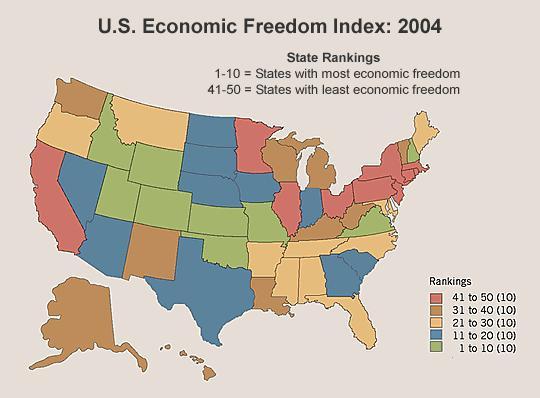
Pejman Yousefzadeh, writing at Tech Central Station, has a roundup of post-election reaction from the Left. I especially like the idea of Blue-State secession (though its proponents should check out Texas v. White). The secessionists would like to join their ideologically compatible neighbour to the north, with this result (my editing):

P.S. Note the correlation between “Freeland” and States with the best scores on the index of economic freedom (green, blue, and tan in the chart below):

(Thanks to Let’s Try Freedom for the pointer to the index.)

The Next Big Financial Disaster

From Arnold Kling at EconLog (quoting the Wall Street Journal):

Congress and the White House produced a big, fat bailout for the most financially shaky companies, and some of those same companies are now joining the queue to dump their liabilities on the feds. Meanwhile, PBGC’s [Pension Benefit Guaranty Corporation] deficit was left to balloon, as it now has — by $12 billion with 155 company plans terminating.

Kling adds:

A friend who once did consulting for the PBGC says that its policies are completely irrational. It tells companies with overfunded pension plans that they can take every dollar of overfunding out the plans, and it tells companies with underfunded plans that it will bail them out. There is no risk-based pricing or other incentive mechanism to make companies want to maintain sound plans. He says that it makes the pre-S&L-crisis FSLIC seem well-run by comparison.

Will politicians never learn that the best way to help individuals and businesses avoid poverty and financial ruin is to make them responsible for the consequences of their own decisions? Apparently not.

Flooding the Moral Low Ground

A few posts ago I observed that “pro-abortion extremists have captured the moral low ground in the battle over abortion rights,” after opining that “animals are more important than human fetuses” to the Left. But the Left’s moral decay is evident in other ways.

The Left caricatures black Republicans — that is blacks who choose not align themselves unthinkingly with the party of liberal condescension — as something like “Aunt Jemimas” and “Uncle Toms”.

The Left views non-Western cultures as incapable of embracing democracy. Yet, the Left is incapable of accepting a democratic outcome in the United States, preferring instead to think of the majority as religious fanatics, cretins, and “Hitlers”.

The Left would abandon the Middle East to Osama bin Laden and other terrorist thugs, all the while complaining about the high price of oil. One wonders where the Left will stand when we face down (or take down) Syria, Iran, and North Korea.

The Left claims to “support the troops” but shows it by spitting on them, just as it shows its true disdain for democracy by its thuggish behavior at political events.

The affluent Left (that is, much of it) shows its arrogance toward “inferiors” by opposing school vouchers and the privatization of Social Security, because the “masses” must be told how to mange their own affairs.

The Left profits from free-market capitalism — then spends some of the profits to promote “enlightened” government regulation of those same markets.

The list could go on and on. But the moral bankruptcy of the Left has become so evident — outside the media, academia, and other Leftish circles — that it’s only a matter of time before the political tide turns against the Left — and rolls over it.

Handicapping National Politics

Catherine Seipp says:

One of the election lessons for Democrats is that while the Left doesn’t understand the Right, the Right can’t help but understand the Left, because the Left is in charge of pop culture. Urban blue staters can go their entire lives happily innocent of the world of church socials and duck hunting and Boy Scout meetings, but small-town red staters are exposed to big-city blue-state values every time they turn on the TV.

Not only that, but the Left is mainly in charge of the news — though talk radio manages to apply some corrective spin.

In spite of the Left’s dominance of pop culture and the news media, Red manages to eke out victories over Blue. Amazing.

Defining Liberalism

John Gray, in a rather unfocused review of Mark Garnett’s The Snake That Swallowed Its Tail, asserts that

even though we are all liberal, there is no agreement about what liberalism means. Some people will tell you that the core liberal value is personal liberty, but others insist it is equality. Some say that liberal values require multiculturalism, while others believe they demand a common culture based on personal autonomy. For some, liberalism is a strictly political theory that applies only to the structure of the state. For others, it is a whole way of life.

These are not just minor differences. They extend to the basic concepts of liberalism itself and to the underlying philosophical beliefs in line with which they are interpreted. If some liberals see freedom as mere absence of interference, others view it as a positive ability to act. For some liberal thinkers, justice requires protecting private property; for others, it means redistribution….

A person who cannot see the difference between process and outcome has no business reviewing a book about political philosophy. He needs a massive injection of Hayek — stat!

Reality-Based Blogging?

Many left-wing blogs — especially those of the virulently anti-Bush variety (but I repeat myself) — took to calling themselves “reality based.” Now comes the dawn, sort of. Here’s Pandragon:

[W]e need to get real. I can’t tell you how optimistic I was going into this election, though, looking back, there doesn’t seem to have been a reason for quite such a sunny view. But I, like most of us, fell for the echo chamber. Daily Kos, MyDD, Steve Soto, Pandagon, and all the other blogs are run by good people with positive intentions, but if they’re you’re primary source for information, you’re outlook is perverted by an overwhelming amount of good news and a general disdain for the factual accuracy of bad news. It perverts your perspective and, because the sample group is so totally different than most of America, it begins to twist your political predictions and assumptions of what works….

But he doesn’t really “get it”:

…We didn’t lose this [because] of terror or Iraq or the economy, we lost it on values and wedge issue shit. In the end, Rove was right to spend years playing to his base, and we were wrong to go after the center….

So, the left (at least this particular segment of the left) wants the Democrat Party to win by going further to the left. Somehow, I don’t think that’ll work. Nor do I think that Bill Clinton — who is the closest thing the Democrats have to a leader — will allow it to happen.

So much for reality-based blogging.

UPDATE:

Oh, I just found some. But it wasn’t on the left. Here’s Gerard Vanderluen, quoting his own post of July 29, 2004:

There are millions and millions of citizens who are registered as Democrats and who talk the Democrat talk but do not always walk the Democrat walk when push comes to shove. You might be in a union — Trade, Government, Teachers, etc. — that could harm you if you announced for Bush. You might be in a family with deep Democratic roots. You might be a member of a minority in which you would be ostracised if you confessed you would vote for Bush. You might be of a sexual persuasion where you’re chances of dates would be severely curtailed if you said you were voting for Bush. You might be working in an office or in a career where you chances for advancement might be crippled if you voted for Bush. You might be at a school where even your grades would be impacted if you said you were voting for Bush.

In short there are hundreds of situations in which millions of people find themselves where a declared preference for Bush would not be a wise thing to announce. Much better to simply nod vaguely and stay out of the way of any negative consequences. The idea that everybody is going to vote the way they say they will is very oversold, particularly by the media or the pollsters who have a vested interest in declaring the race “tight.” The “stealth vote” is especially relevant in an election where the single most pressing question that will come into a voter’s mind after the curtains close behind him or her and they stand ready to vote is: “What’s it going to be? Issue X, Y, Z, or my life?”

Sensible people, no matter what they may or may not say, choose life. And sensible people know that that is what this election is about.

Now, that’s much closer to reality than anything I’ve seen from the left today.

Absolute Rubbish

spiked announces that it is

kickstarting a major debate on the aftermath of the US election – exploring its impact in America and internationally, on everything from war and peace to science and environmentalism.

The first installment (same link) includes this bit of sneering nonsense, among others of its ilk:

Norman Levitt

A glance at the electoral map tells the essential story. America is a deeply fissured society. The post-Second World War ‘Era of Good Feeling’, with its universal consensus that one was singularly lucky to be living in the USA, has disintegrated. Two cultures glare balefully at each other with an antagonism that goes far beyond party politics. Ironically, the events of 9/11 and their sequel have catalysed, rather than retarded, the hardening of mutual distrust into mutual detestation.

The two factions might usefully be called ‘Nativist’ and ‘Cosmopolitan’. The former – Bush country on your map – is fiercely nostalgic for a perhaps imaginary nineteenth-century ethos. It is undereducated, superstitious, saturated with religious zeal, puritanical, chauvinist, xenophobic, and easily seduced by platitudes into supporting the very politicians who, in reality, bleed its people white. The latter – Kerry country – is reasonably well-read, articulate, analytical, sceptical of religion and other blind enthusiasms, tolerant of cultural difference and individual eccentricity, and sensitive to the fact that there is a real world beyond America’s borders.

The apparent re-election of the half-wit favorite son of the Nativists obviously deepens the gloom of the Cosmopolitans (but even a Kerry victory wouldn’t have effaced it). An unprecedented number of Americans now daydream, at least, about the possibility of living somewhere else, somewhere where Yahoos don’t abound. The scientific community is especially alienated.

America’s vaunted prosperity is now threatened by decay – not mere numinous psychological malaise, but concrete, physical degradation of infrastructure, concomitant with the paralysis of American society’s ability to renew and innovate on an appropriate scale. Europe, all in all, is a much more hopeful place. One wonders, then, whether a reverse brain-drain might eventually develop, with American scientists and intellectuals migrating, in serious numbers, eastward across the Atlantic, leaving the Nativist barbarians to deal with the growing mess.

Norman Levitt is professor of mathematics at Rutgers University and author of Prometheus Bedeviled: Science and the Contradictions of Contemporary Culture.

So, I am a Red-State “nativist,” am I? Mmmm…not a bad description, except for the fact that I’m not undereducated, superstitious, saturated with religious zeal, puritanical, chauvinist, xenophobic, and easily seduced by platitudes. In fact, I’m a “Cosmopolitan”: well-read, articulate, analytical, skeptical of religion and other blind enthusiasms, tolerant of cultural difference and individual eccentricity, and sensitive to the fact that there is a real world beyond America’s borders. That’s why I — and many, many others like me who also supported Bush’s re-election — detest (yes “detest”) the shallowness of Levitt and his like. Blinded by their hatred of those who simply refuse to accept the superiority of their judgments and values, they resort to childish name-calling.

I believe what I believe — about the robustness of America’s political system and economy (freighted as they are by taxation, regulation, and agenda-ridden science), the essential corruptness of most foreign regimes, and the wisdom of an aggressive defense posture — precisely because I am well-read, articulate, analytical, tolerant (but not a dupe to political correctness), and knowledgeably realistic about the world beyond America’s borders.

Levitt and his like simply cannot abide the fact that are many, many more like me who have the gall — the very gall — to think instead of mindlessly swallowing and regurgitating their proscribed vision of collectivist anti-Americanism. They huddle in mutually reinforcing packs, stoking their egos and flaunting their imaginary superiority, but lacking the curiosity and imagination to understand anything that doesn’t conform to their vision. They epitomize

…the idiot who praises, with enthusiastic tone,
All centuries but this, and every country but his own….
[Gilbert & Sullivan, The Mikado]

Norman, you’ve got it wrong when you accuse me and my intellectual allies of nostalgia “for a perhaps imaginary nineteenth-century ethos.” We’re not nostalgic for anything but a return to something America once had but has lost because of left-wing Yahoos like you: the greater measure of economic and political liberty that made America a place its citizens would rush to defend. Only, this time, we want that economic and political liberty for all Americans.