Property Rights with a Vengeance

From The New York Times:

Property Rights Law May Alter Oregon Landscape

By FELICITY BARRINGER

Published: November 26, 2004

PORTLAND, Ore., Nov. 20 – Over the past three decades, Oregon has earned a reputation for having the most restrictive land-use rules in the nation. Housing was grouped in and near the cities, while vast parcels of farmland and forests were untouched by so much as a suburban cul-de-sac.

Environmentalists and advocates for “smart growth” cheered the ever-growing list of rules as visionary, while some landowners, timber companies and political allies cried foul.

But in a matter of days, the landowners will get a chance to turn the tables. Under a ballot measure approved on Nov. 2, property owners who can prove that environmental or zoning rules have hurt their investments can force the government to compensate them for the losses – or get an exemption from the rules.

Supporters of the measure, which passed 60 percent to 40 percent, call it a landmark in a 30-year battle over property rights….

Whatever the benefits of Oregon’s land-use rules, Mr. Day added, “the people paying the cost are property owners.”…

Both sides expect the measure to survive judicial scrutiny, and the state and local governments are to start fielding claims on Dec. 2. If claims are found to be valid and the government will not or cannot pay, it must instead waive any restrictions that went into force after the owners – or their parents or grandparents – acquired the land….

Liberty and property rights: inextricable values.

Libertarian Name-Calling

UPDATED 11/25/04

There’s a bit of a dust-up about whether libertarians are really liberals of the original variety. Will Wilkinson at Crescat Sententia has the story:

John Phillips, a Ph.D. student in political theory at Brown, has some interesting thoughts on Samuel Freeman’s arguments that libertarians aren’t bona fide liberals.

Here’s my take: If libertarianism just is the view that the state has no legitimacy and that agents of the state have no justifiable moral permission to use their powers of coercion AND the very concept of liberalism contains (in the Kantian sense) the idea of state legitimacy and permissible coercion by state agents, well, then of course libertarianism isn’t a kind of liberalism.

But I don’t think a political conception has to deny the legitimacy of the state or permissible coercion by state agents to count as libertarian. People think that I am a libertarian because I think that the state should be very small and limited in its powers, not that I think that there should be no state, or that coercion is never justified. There are, of course, libertarians who think coercion is never justified, and so conclude that there should be no state, but that’s just the content of one conception of ‘libertarianism.’ That’s not the concept. Negative income tax Friedmanites are also libertarians. Additionally, I don’t think the connection between liberalism and state legitimacy, coercion, etc., is anything close to analytic. If there is an anarchic social order that fulfills substantive liberal ideals better than a state-based order, then that order should count as liberal.

I don’t think that a view about the conferral of legitimacy on state coercion through democratic means is a part of the substantive content of the concept of liberalism, although it is obviously a huge part of liberal conceptions such as Freeman’s. Coercive democracy, in my view, is, at best, a contingent means to liberal ends. At far less than its worst, it is inconsistent with liberal ends.

Timothy Sandefur at Freespace has an Objectivist take:

…I associate liberalism with “dynamism” as the term is used in The Future And Its Enemies, and I would define the term as referring to the political view that individuals should be liberated from the coercive restraints imposed by others, as I explained in an old post on “What is Libertarianism.”

But dividing libertarianism from liberalism is probably misleading and unhelpful, something like dividing Christians from Catholics. There are certainly non-Catholics who would regard Catholics as not real Christians, but the Catholics would hardly concur. But on the other hand, as a hardline “classical liberal,” I regard the paleoconservatives who masquerade as libertarians over at Lew Rockwell.com to be a bunch of frauds, and not real libertarians, on the grounds that a true libertarian should put individual liberty as the primary political goal, while they believe that if one person wishes to enslave another, no third man may interfere. The problem is not that they’re libertarians while we’re liberals or something like that. It’s that we libertarians are liberals, while they are really conservatives who don’t like the drug laws. (But, of course, if some foreign dictator wished to have drug laws, that would be fine with them.)

Unfortunately, “liberal” and “liberalism” have long since come to be identified with a world-view that has nothing to do with classical liberalism or libertarianism (of any stripe). It’s a statist and internally inconsistent world-view that goes something like this: I believe in individual liberty (i.e., the right to do as I please with my money and my life), but the world will be a much better place if government does certain things to restrict and even undermine freedom (e.g., ban smoking, take money from those who earn it and give money to those who don’t, force children to go to inferior schools by taxing their parents for the privilege, spend less on defense, negotiate with enemies who have amply demonstrated their bad faith).

I know that it’s de rigeur for libertarians to call themselves liberals (of the classical variety), but I will not call myself one. Given the bad connotations of “liberal” and “liberalism” , I’d rather call myself a “misogynistic homophobe” or a “tree-hugging enviro-nut” — neither of which am I.

UPDATE:

Wilkinson has more to say:

I want to clarify that the post below [quoted above: ED] on the question, Are Libertarians Liberals?, was a spontaneous riff off what John Phillips was saying, and not a considered response to the Samuel Freeman paper John was thinking about. John’s post conjured a phantom interlocuter who I decided to argue against. Now that I’ve looked again at the Freeman essay (“Illiberal Libertarians” in Philosophy & Public Affairs 30, no. 2), I see that most of what I said doesn’t apply to Freeman’s particular argument. Freeman reserves the label ‘libertarian’ for natural rights anarchists and minimal statists such as Nozick, Rothbard, and Rand. He labels Hayek, Buchanan, and Friedman as ‘classical liberals.’ And classical liberals, along with Freeman’s ‘high liberals’, are naturally enough kinds of liberals. He’s arguing, among other things, that natural rights anarchists and minarchists have no room for an account of legislative authority or political legitimacy, which he takes to be necessary conditions of liberalism.

I’ll say more about Freeman’s very interesting (and long!) paper later. But for now let me say I think there is (a) some tendentiousness or at least arbitrariness in the way Freeman decides to characterize the nature of liberalism, (b) perhaps room for legislative authority for some natural rights minimal statists, (c) more complexity in the minarchist’s notion of contracting and the adjudicatory function of state courts than Freeman makes it out, which may solve most of the problems he thinks you get without legislative authority, and (d) confusion in the way he attempts to apply the idea of the “political” to anarchists.

In any case, in Freeman’s terms, I am a classical liberal, not a libertarian, my current views being a frothy stew of Hayek, Buchanan, Coase, Schelling, Rawls, Gauthier, Vernon Smith, and Douglass North. But in the vernacular that just makes me a libertarian.

Me too.

“Natural rights anarchists” and “minarchists” should call themselves just that. As the saying goes, liberty isn’t anarchy. Therefore, anarchism isn’t libertarianism.

UPDATE:

Tom W. Bell at Agoraphilia has a somewhat different take:

…I will not…agree to let [leftists] appropriate “liberal.” The derivation and near-universal meaning of that word—in nearly every time and place except contemporary, casual U.S. speech—reserves “liberal” for people who regard liberty as a paramount value. Leftists, because they disparage economic freedom and property rights, manifestly do not.

We have very accurate and fair labels for people who think that civil liberties exist independent of and merit more respect than economic liberties. We can call those people “leftist” or “left-wing.” Moreover, we should not call them “liberal,” a term that they neither deserve nor that they always welcome.

I am not sure that true liberals will ever be able to reclaim their rightful name. At a minimum, though, they can and should deny the term to illiberals. It would represent a great step forward if, when someone in the U.S. used “liberal,” they had immediately to address the question, “Do you mean ‘left-wing’ or do you mean ‘libertarian’?” We should thus aim, at least at first, to cast “liberal” into a linguistic no-man’s-land. Reconquering that lost semantic territory can come later….

“Liberal” and “liberalism” are beyond salvation. From now on, I’ll stick with “leftist” and “the left” when I refer to regressives and their agenda. That includes so-called moderate Democrats, who have revealed their disdain for liberty by belonging to the party of Social Security, Medicare, unionism, and affirmative action.

As I Was Saying

UPDATED TWICE

Ryan Sager, writing at Tech Central Station says, “Libertarians need to get serious about foreign policy.” Sager goes on to say:

Libertarianism, in and of itself, does not in any way limit its adherents to a minimalist approach to foreign policy — i.e. using the least amount of force possible to respond only to the most imminent of threats.

Check out Sager’s piece. While you’re at it, take at look at something I wrote, in the same vein, back in June.

UPDATE (11/19/04):

Here’s everything I’ve written on the subject of libertarianism and defense:

Libertarian Nay-Saying on Foreign and Defense Policy

Libertarian Nay-Saying on Foreign and Defense Policy, Revisited

Libertarianism and Pre-emptive War: Part I

Right On! For Libertarian Hawks Only

Understanding Libertarian Hawks

More about Neolibertarianism

More about Libertarian Hawks and Doves

Defense, Anarcho-Capitalist Style

UPDATE (11/25/04):

Maxwell Borders ( Jujitsui Generis), responding to a critique by Justin Logan of Sager’s piece, says:

…The burden of proof is not on Ryan Sager to show why he thinks one nation is justified in invading another. The burden of proof is on Justin Logan to show why any nation should not do what it perceives to be in its interests….

Amen.

Good Advice for Libertarians

Read this piece by Max Borders at Tech Central Station.

And this post at Borders’s blog, Jujitsui Generis.

The Case for Devolved Government

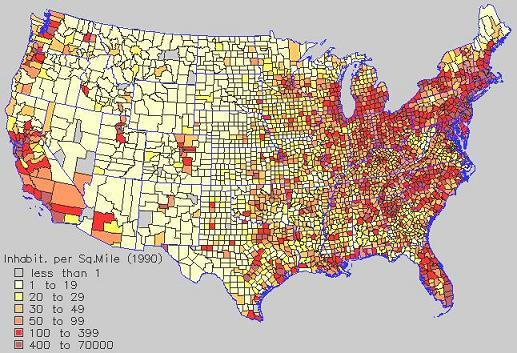
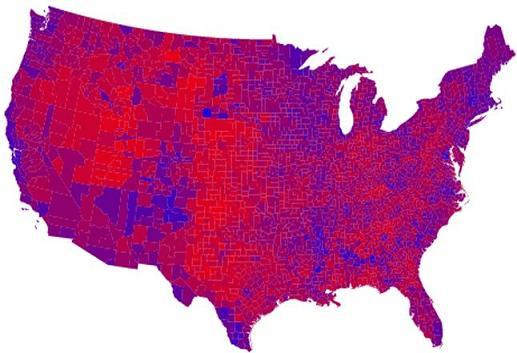
Libertarian purists argue that government should have almost no power. Libertarian pragmatists argue that government power should be devolved to the lowest practical level. The pragmatists case is the better one, given that the urge to regulate social and economic practices is especially strong where people (and votes) are concentrated. Consider the following graphics:


Shades of purple indicate the spectrum of election preferences within counties. The deeper the shade of purple the higher the proportion of votes cast for Kerry.


Counties shaded pink, red, and purple have the highest population density.

Comes as no surprise does it? Nor does it matter if the urban-rural split reflects a difference in “values” or traditions. A fact is a fact. City dwellers prefer more government because they “need” more; country folk feel less “need” for government because they don’t rub up against each other as much as city dwellers.

Thus the ultimate argument for devolution: Push government functions to the lowest practical level and allow citizens to express their preferences by voting with their feet.

(Thanks to Patrick Cox at Tech Central Station for the maps.)

Absolute Rubbish

spiked announces that it is

kickstarting a major debate on the aftermath of the US election – exploring its impact in America and internationally, on everything from war and peace to science and environmentalism.

The first installment (same link) includes this bit of sneering nonsense, among others of its ilk:

Norman Levitt

A glance at the electoral map tells the essential story. America is a deeply fissured society. The post-Second World War ‘Era of Good Feeling’, with its universal consensus that one was singularly lucky to be living in the USA, has disintegrated. Two cultures glare balefully at each other with an antagonism that goes far beyond party politics. Ironically, the events of 9/11 and their sequel have catalysed, rather than retarded, the hardening of mutual distrust into mutual detestation.

The two factions might usefully be called ‘Nativist’ and ‘Cosmopolitan’. The former – Bush country on your map – is fiercely nostalgic for a perhaps imaginary nineteenth-century ethos. It is undereducated, superstitious, saturated with religious zeal, puritanical, chauvinist, xenophobic, and easily seduced by platitudes into supporting the very politicians who, in reality, bleed its people white. The latter – Kerry country – is reasonably well-read, articulate, analytical, sceptical of religion and other blind enthusiasms, tolerant of cultural difference and individual eccentricity, and sensitive to the fact that there is a real world beyond America’s borders.

The apparent re-election of the half-wit favorite son of the Nativists obviously deepens the gloom of the Cosmopolitans (but even a Kerry victory wouldn’t have effaced it). An unprecedented number of Americans now daydream, at least, about the possibility of living somewhere else, somewhere where Yahoos don’t abound. The scientific community is especially alienated.

America’s vaunted prosperity is now threatened by decay – not mere numinous psychological malaise, but concrete, physical degradation of infrastructure, concomitant with the paralysis of American society’s ability to renew and innovate on an appropriate scale. Europe, all in all, is a much more hopeful place. One wonders, then, whether a reverse brain-drain might eventually develop, with American scientists and intellectuals migrating, in serious numbers, eastward across the Atlantic, leaving the Nativist barbarians to deal with the growing mess.

Norman Levitt is professor of mathematics at Rutgers University and author of Prometheus Bedeviled: Science and the Contradictions of Contemporary Culture.

So, I am a Red-State “nativist,” am I? Mmmm…not a bad description, except for the fact that I’m not undereducated, superstitious, saturated with religious zeal, puritanical, chauvinist, xenophobic, and easily seduced by platitudes. In fact, I’m a “Cosmopolitan”: well-read, articulate, analytical, skeptical of religion and other blind enthusiasms, tolerant of cultural difference and individual eccentricity, and sensitive to the fact that there is a real world beyond America’s borders. That’s why I — and many, many others like me who also supported Bush’s re-election — detest (yes “detest”) the shallowness of Levitt and his like. Blinded by their hatred of those who simply refuse to accept the superiority of their judgments and values, they resort to childish name-calling.

I believe what I believe — about the robustness of America’s political system and economy (freighted as they are by taxation, regulation, and agenda-ridden science), the essential corruptness of most foreign regimes, and the wisdom of an aggressive defense posture — precisely because I am well-read, articulate, analytical, tolerant (but not a dupe to political correctness), and knowledgeably realistic about the world beyond America’s borders.

Levitt and his like simply cannot abide the fact that are many, many more like me who have the gall — the very gall — to think instead of mindlessly swallowing and regurgitating their proscribed vision of collectivist anti-Americanism. They huddle in mutually reinforcing packs, stoking their egos and flaunting their imaginary superiority, but lacking the curiosity and imagination to understand anything that doesn’t conform to their vision. They epitomize

…the idiot who praises, with enthusiastic tone,
All centuries but this, and every country but his own….
[Gilbert & Sullivan, The Mikado]

Norman, you’ve got it wrong when you accuse me and my intellectual allies of nostalgia “for a perhaps imaginary nineteenth-century ethos.” We’re not nostalgic for anything but a return to something America once had but has lost because of left-wing Yahoos like you: the greater measure of economic and political liberty that made America a place its citizens would rush to defend. Only, this time, we want that economic and political liberty for all Americans.

Restore Free Speech

The L.A. Times reports:

Stung by a radio campaign to oust veteran Rep. David Dreier, the National Republican Congressional Committee has filed a federal elections complaint. It contends that an ongoing campaign by a pair of radio talk-show hosts represents an illegal contribution to Dreier’s opponent.

That’s the Incumbent Protection Act — also known as the Bipartisan Campaign Reform Act (BCRA) — in action.

Who’s Got the Brains?

An article at Wired News asks “Dems, GOP: Who’s Got the Brains?” The gist of the article, if you read it closely, is that Dems tend to be more emotional than Republicans. As for who’s smarter, I answered that question when I wrote “The Right Is Smarter Than the Left.”

The Illogic of Helmet Laws

Liberals love laws that require bicyclists and motorcyclists to wear safety helmets. The usual reasons:

1. Taxpayers defray the cost of emergency services that go to the scene of accidents.

2. The failure to use helmets results in higher health-care costs and, thus, higher health-insurance premiums.

Proposition number 1 isn’t universally true. But even if it were, so what? Accidents aren’t caused by the use or non-use of helmets. Almost any accident involving a bicyclist or motorcyclist will require emergency services, whether or not the rider incurs a head injury.

Proposition number 2 overlooks the fact that non-helmeted riders are less likely to require prolonged, expensive care — because they’re likely to die more quickly than helmeted riders.

That brings us to the real proposition — number 3: Bicyclists and motorcyclists should wear helmets for their own good. The insistence on helmet laws is simply another liberal pretext for telling others how to lead their lives.

Here’s a deal for helmet-loving liberals. If you’re a bicyclist (likely) or motorcyclist (unlikely), you can wear a helmet if you want to. In return, non-liberal bicyclists and motorcyclists will agree that you don’t have to sport an American flag on your helmet.

Ballots for the Intelligent

Regarding the purportedly confusing Ohio absentee ballots, Eugene Volokh says:

…I think well-designed ballots should be understandable even by people of below average intelligence — there are quite a few voters like that, and one doesn’t want them to be confused, either. More to the point, ballots should be understandable by people who are intelligent but who are distracted, or who don’t invest much time in following directions closely….

Why should we tailor ballots to fit the needs of those who are stupid or distracted? If you’re too dumb or distracted to understand a ballot, you shouldn’t be voting. The loss of liberty can be traced to too much democracy (see here and here). Complex ballots might be an antidote for excessive democracy.

I Know What Some of You Are Thinking…

…about this story:

Court: Terror Fears Can’t Curb ‘Liberty’

Sat Oct 16, 7:06 PM ET

By C.G. WALLACE, Associated Press Writer

ATLANTA – Fear of a terrorist attack is not sufficient reason for authorities to search people at a protest, a federal appeals court has ruled, saying Sept. 11 “cannot be the day liberty perished.”

A three-judge panel of the 11th U.S. Circuit Court of Appeals (news – web sites) ruled unanimously Friday that protesters may not be required to pass through metal detectors when they gather next month for a rally against a U.S. training academy for Latin American soldiers.

Authorities began using the metal detectors at the annual School of the Americas protest after the 2001 terrorist attacks, but the court found that practice to be unconstitutional….

But it’s not nice to say it in a blog. Curb your enthusiasm.

Due Process of Law

Jeff Jarvis asks “Would you go to jail for your weblog?” It’s a long post about the case of Judith Miller of The New York Times, who’s been jailed for contempt in her refusal to name sources in the Valerie Plame case. Jarvis wants to make Miller’s plight into a First Amendment case. It’s not that at all, as I said in my comment to Jarvis’s post:

There’s no freedom of speech or freedom of the press issue here. What’s at stake is due process of law, and that’s what Miller and her ilk are trying to subvert.

Someone — presumably a government official — may have committed a crime. The press has no right to thwart the investigation of a crime.

For Libertarian Hawks

Tim Sandefur at Freespace skewers the (eponymous?) Libertarian Jackass:

The Ass is one of these Doughface Libertarians who believe that the only time the military should engage in anything is when the enemy is marching through the streets of Los Angeles (even then he would most likely accuse America of having instigated the attack by daring to refuel its Air Force planes over the Indian Ocean.)

Read the whole thing.

Oh, Canada; Oh, America

Yesterday, Alan at Occam’s Carbuncle noted this Volokh Conspiracy post about the state of free speech in Canada. Today he has more to say about the state of affairs in Canada:

…Clearly, most Canadians do not share my aversion to the Liberal brand of pernicious quasi-socialism, a system of government whereby the state assumes the burden of individual conscience and acts as overweaning bookkeeper to the populace, while maintaining the facade of prosperity, freedom and justice via creaking centrally planned and controlled core institutions like medicare and the Supreme Court. To me, the disadvantages of such a system are immediately evident. They are evident in the grotesquely high taxes I pay, in the minutiae of invasive regulations that pervade our lives, in the institutional rot of our government, in the systematic destruction of our once proud military, in the contempt for the public purse now increasingly coming to light….Reason, patriotism, tempered strength, honesty, love of freedom, a firm grounding in the very best from our history; these are the qualities that will be necessary to stem the socialist tide in this country. Socialism is, at its root, born of a dim, fearful view of life as a never ending series of risks to be averted. We, as libertarians and conservatives, need to help people to wake up to the idea of life as a continuous stream of opportunity.

Substitute “Americans” for “Canadians” and “Democrat” for “Liberal” and what Alan says is wholly applicable to the U.S. We’re just a few strides behind Canada on the road to serfdom.

I agree fully with Alan’s idea that libertarians and conservatives must sell people on the advantages of liberty. It’s necessary, at times, to attack and expose the idiocies of the left. But we must also make it clear that libertarianism and old-fashioned, small-government conservatism are positive philosophies — philosophies based on the principle that people are better off when they rely on themselves instead of “big brother”.

Libertarian Twaddle about the Death Penalty

In the middle of a post about the Supreme Court’s consideration of the death penalty for juveniles, McQ at QandO says:

…I am against the death penalty, have been for years. Yes I know all the arguments for to include the emotional ones. I simply don’t accept them as valid. My objection is based in man’s right to life, and unlike Jon, I feel it is inherent (man qua man) and therefore inviolable by all, to include the state. In essence I believe the state does to the murderer precisely that for which it is punishing the murderer….

By that logic, we shouldn’t have armed forces and use them to kill our enemies. As I have said:

…I don’t care whether or not capital punishment deters homicide. [Though it does, as the post explains.] Capital punishment is the capstone of a system of justice that used to work quite well in this country because it was certain and harsh. There must be a hierarchy of certain penalties for crime, and that hierarchy must culminate in the ultimate penalty if criminals and potential criminals are to believe that crime will be punished. When punishment is made less severe and less certain — as it was for a long time after World War II — crime flourishes and law-abiding citizens become less secure in their lives and property.

The state doesn’t do to the murderer that for which it is punishing the murderer. It does to the murderer that which the murderer shouldn’t have done, as a lesson to other would-be murderers, and as a way of ensuring that that murderer won’t murder again. Similarly, the state deprives other criminals of freedom (but not life) for doing what they shouldn’t have done, and as a way of keeping them away from the rest of us for a while. Or does McQ object to depriving criminals of their freedom? After all, freedom is right up there with the right to life in the pantheon of libertarian values. Oh, and what about abortion?

Related posts:
Does Capital Punishment Deter Homicide?
Crime and Punishment
Abortion and Crime
Saving the Innocent?
Saving the Innocent?: Part II
More on Abortion and Crime
More Punishment Means Less Crime
More About Crime and Punishment
More Punishment Means Less Crime: A Footnote
Clear Thinking about the Death Penalty
Let the Punishment Fit the Crime
Another Argument for the Death Penalty
Less Punishment Means More Crime
Crime, Explained

Arrgh, I Hate Being Right All the Time

Just a month ago I posted this:

Time to Regulate the Blogosphere?

That thought must have crossed the minds of some highly placed Democrat sympathizers in the “mainstream” media when the blogosphere started shredding the threadbare remnants of Dan Rather’s reputation for honest reporting. But the blogosphere is protected by the First Amendment, isn’t it?

There’s stark evidence that the blogosphere can be regulated, if the feds want to do it. Look at the airwaves, which the feds seized long ago, and which the feds censor by intimidation. Look at the ever-tightening federal control of political speech, which has brought us to McCain-Feingold. It’s all in the name of protecting us, of course….

Well, today Vodkapundit points to this AP story at myway:

FEC May Regulate Web Political Activity

Oct 13, 7:55 AM (ET)

By SHARON THEIMER

WASHINGTON (AP) – With political fund raising, campaign advertising and organizing taking place in full swing over the Internet, it may just be a matter of time before the Federal Election Commission joins the action. Well, that time may be now.

A recent federal court ruling says the FEC must extend some of the nation’s new campaign finance and spending limits to political activity on the Internet.

Long reluctant to step into online political activity, the agency is considering whether to appeal.

But vice chairwoman Ellen Weintraub said the Internet may prove to be an unavoidable area for the six-member commission, regardless of what happens with the ruling.

“I don’t think anybody here wants to impede the free flow of information over the Internet,” Weintraub said. “The question then is, where do you draw the line?”…

Hey, Ms. Weintraub, you’ll have to pry my blog out of my cold, dead hands.

Favorite Posts: Academic Freedom and Freedom of Speech

Speaking of Hobbesian Libertarianism…

…as I did in the preceding post, reminds me of an e-mail from a reader who read my post about “Hobbesian Libertarianism” and followed a link in that post to one about “The Origin of Rights and the Essence of Modern Libertarianism.” The reader said:

You use the term, “modern,” to distinguish one version of libertarianism from…what? Is there an antediluvian libertarianism? Is there a

non-Hobbesean [sic] libertarianism that advocates positive rights?…

I don’t mean to nit-pick; I just don’t understand the point you’re making.

To which I replied

Libertarianism as we know it today (i.e., “modern” libertarianism) is the cumulative product of centuries of thought. It didn’t fall out of the sky as “libertarianism.” Yet, Mill, for example, was more or less a libertarian, even though he didn’t use that term. So, I’m using the term “modern” to distinguish the “mature” modern version of libertarianism from its less developed antecedents, which went by other names. That’s all. Nothing deeper.

Cute, But No Cigar

A friend brought this quotation to my attention:

Conservative pundit Andrew Sullivan worries that Bush “is fusing Big Government liberalism with religious right moralism. It’s the nanny state with more cash.”

The quotation is from a piece by Dough Bandow at Salon.com: “Why conservatives must not vote for Bush.”

Actually, I’ve dealt with this before (here):

I wouldn’t make too much of Bandow’s supposed conservatism. In fact, he’s one of the “holier-than-thou” brigade of deluded professional libertarians (a senior fellow at the Cato Institute) who prize ideological purity above all else. He’s too high and mighty to give his endorsement to a mere mortal like Bush. He’s waiting for the libertarian messiah to come in from the desert.

I’ll go further and say that Bandow is a “don’t shoot until you see the whites of their eyes” libertarian. Don’t get me wrong, I love Cato’s brand of economics (with some exceptions), but its view of foreign and defense policy is a mix of pre-World War II isolationism and appeasement.

Me, I’m no conservative either, just a Hobbesian libertarian who’s inclined to vote for the lesser of two evils rather than waste a vote on a nutcase like Michael Badnarik, the Libertarian Party’s candidate for president.

A Left-Winger Grasps at Libertarian Straws, and Misses

Kos is all excited because he stumbled onto a Cato Institute paper that purports to show the advantages of divided government: lower spending and less chance of going to war. I guess it’s the war part that Kos has latched onto. Surely he’s not for less government spending, and surely he favors divided government (Kerry in the White House, Republicans in Congress) only as a way station toward undivided, all-Democrat government.

Be that as it may, I long ago debunked the Cato paper in question, as well as a later, more detailed analysis along the same lines. My take:

There is a very strong — almost perfect — relationship between real nondefense spending and the unemployment rate for the years 1969 through 2001, that is, from the Nixon-Ford administration through the years of Carter, Reagan, Bush I, and Clinton. Using a linear regression with five pairs of observations, one pair for each administration, I find that the percentage change in real nondefense spending is a linear function of the change in the unemployment rate….

[equation here]

In words, the work of the New Deal and Fair Deal had been capped by the enactment of the Great Society in the Kennedy-Johnson era. The war over domestic spending was finished, and the big spenders had won. Real nondefense spending continued to grow, but more systematically than it had from 1933 to 1969. From 1969 through 2001, each administration (abetted or led by Congress, of course) increased real nondefense spending according to an implicit formula that reflects the outcome of political-bureaucratic bargaining. It enabled the beast to grow, but at a rate that wouldn’t invoke images of a new New Deal or Great Society.

Divided government certainly hampered the ability of Republican administrations (Nixon-Ford, Reagan, Bush I) to strangle the beast, had they wanted to. But it’s not clear that they wanted to very badly. Nixon was, above all, a pragmatist. Moreover, he was preoccupied by foreign affairs (including the extrication of the U.S. from Vietnam), and then by Watergate. Ford was only a caretaker president, and too “nice” into the bargain. Reagan talked a good game, but he had to swallow increases in nondefense spending as the price of his defense buildup. Bush I simply lacked the will and the power to strangle the beast.

Bureaucratic politics also enters the picture. It’s hard to strangle a domestic agency once it has been established. Most domestic agencies have vocal and influential constituencies, in Congress and amongst the populace. Then there are the presidential appointees who run the bureaucracies. Even Republican appointees usually come to feel “ownership” of the bureaucracies they’re tapped to lead.

What happened before 1969?

The beast — a creature of the New Deal — grew prodigiously through 1940, when preparations for war, and war itself, brought an end to the Great Depression. Real nondefense spending grew by a factor of 3.6 during 1933-40. If the relationship for 1969-2001 had been in effect then, real nondefense spending would have increased by only 10 percent.

Truman and the Democrats in control of Congress were still under the spell of their Depression-inspired belief in the efficacy of big government and counter-cyclical fiscal policy. The post-war recession helped their cause, because most Americans feared a return of the Great Depression, which was still a vivid memory. Real nondefense spending increased 2.8 times during the Truman years. If the relationship for 1969-2001 had been in effect, real nondefense spending would have increased by only 20 percent.

The excesses of the Truman years caused a backlash against “big government” that the popular Eisenhower was able to exploit, to a degree, in spite of divided government. Even though the unemployment rate more than doubled during Ike’s presidency, real domestic spending went up by only 9 percent. That increase would have been 28 percent if the relationship for 1969-2001 had been in effect. But even Ike couldn’t resist temptation. After four years of real cuts in nondefense spending, he gave us the interstate highway program: another bureaucracy — and one with a nationwide constituency.

The last burst of the New Deal came in the emotional aftermath of Kennedy’s assassination and Lyndon Johnson’s subsequent landslide victory. Real nondefense spending in the Kennedy-Nixon years rose by 56 percent, even though the unemployment rate dropped by 48 percent during those years. The 56 percent increase in real spending would have been only 8 percent if the 1969-2001 relationship had applied.

As for Bush II, through the end of 2003 he was doing a bit better than average, by the standards of 1969-2001 — but not significantly better. He now seems to have become part of the problem instead of being the solution. In any event, the presence of the federal government has become so pervasive, and so important to so many constituencies, that any real effort to strangle the beast would invoke loud cries of “meanie, meanie” — cries that a self-styled “compassionate conservative” couldn’t endure.

Events since 1969 merely illustrate the fact that the nation and its politicians have moved a long way toward symbiosis with big government. The beast that frightened conservatives in the 1930s, 1940s, and 1950s has become a household pet, albeit one with sharp teeth. Hell, we’ve even been trained to increase his rations every year.

Tax cuts won’t starve the beast — Friedman, Becker, and other eminent economists to the contrary. But tax increases, on the other hand, would only stimulate the beast’s appetite.

The lesson of history, in this case, is that only a major war — on the scale of World War II — might cause us to cut the beast’s rations. And who wants that?

Hobbesian Libertarianism

I’ve latched onto the term neolibertarian, which was coined at QandO. I think a neolibertarian might also be called a Hobbesian libertarian.

Wikipedia summarizes Hobbes’s views on the state of nature:

The seventeenth century English philosopher, Thomas Hobbes, is famous for presenting a sort of useful fiction in political philosophy, which has come to be called the state of nature. Hobbes himself does not use this term in Leviathan: he describes it as a “warre, as is of every man, against every man” (bellum omnium contra omnes).

The state of nature is presented as the condition humanity would be in if government did not exist….

Hobbes does not base his argument on the historical existence of such a state.

Hobbes believed that human beings in the state of nature would behave “badly” towards one another (“badly” in the sense of the morality that we would commonly apply: but Hobbes argued that people had every right to defend themselves by whatever means, in the absence of order). Famously, he believed that such a state would lead to a “war of every man against every man” and make life “solitary, poor, nasty, brutish, and short.” Hobbes’s negative view of human character was shaped at least in part by the Christian doctrines of original sin and total depravity; the Christian tradition is generally at one with Hobbes in supporting the need for government. However, Hobbes would strongly disagree with the Christian view of the innate, inherent, and inescapable sinfulness of human beings: in Hobbes’s view, these problems are soluble by good government. As he incisively stated in its “De cive. Epistola dedicatoria“, borrowing a well known aphorism from Plautus’s Asinaria: “homo homini lupus” (man is wolf to man).

Hobbes’s view was challenged in the eighteenth century by Jean-Jacques Rousseau, who affirmed instead that people in a state of nature would be born good; their bad habits are the products of civilization, and specifically social hierarchies, property, and markets. Rousseau’s view underlines much of the Romantic period’s political thinking, including the thought of Karl Marx.

John Locke, who is thought to have been a greater influence than Hobbes on Jefferson and the other Founders, was more Rousseauvian in his view of human nature, according to infoplease:

…Contradicting Thomas Hobbes, Locke believed that the original state of nature was happy and characterized by reason and tolerance. In that state all people were equal and independent, and none had a right to harm another’s “life, health, liberty, or possessions.” The state was formed by social contract because in the state of nature each was his own judge, and there was no protection against those who lived outside the law of nature. The state should be guided by natural law.

Rights of property are very important, because each person has a right to the product of his or her labor. Locke forecast the labor theory of value. The policy of governmental checks and balances, as delineated in the Constitution of the United States, was set down by Locke, as was the doctrine that revolution in some circumstances is not only a right but an obligation….

It is evident that the “state of nature” is more like Hobbes’s “warre, as is of every man, against every man” than it is like Locke’s state of “reason and tolerance.” Merge that understanding with Lockean rights (though they flow from experience and not from a Platonic ideal); throw in a Hobbesian government to secure those hard-won rights; stir in Adam Smith, John Stuart Mill, and Friedrich A. Hayek; and you have modern libertarianism — or, better yet, neolibertarianism.