A Political Compass: Locating the United States

This post builds on “A Political Compass” and its predecessor, “The Inevitability of the Communitarian State, or What’s a Libertarian to Do?” I apply the concept of the political compass to assess, harshly but realistically, our present location. Most of the links herein point to supporting posts at Liberty Corner.

Introduction

The left-right, liberal-conservative taxonomies of the political spectrum are inadequate because they are linear and lacking in subtlety. The political spectrum is more usefully thought of as a compass, with anarchy, libertarianism, communitarianism, and statism as its four main directions.

In the history of the United States, the compass’s needle has swung from a point near libertarianism, through communitarianism, and toward statism.

To change the metaphor, the tide of communitarianism — which began to swell around the turn of the twentieth century — rose inexorably to engulf the United States in the aftermath of the Great Depression and World War II. The tide has continued to rise, slowly and silently engulfing us in statism.

But let us begin with anarchy, the point of the compass that, thankfully, we have not visited.

Anarchy

According to anarchists (or anarcho-libertarians, as I call them), an individual’s freedom of action should be limited only by (a) voluntary observance of social norms and (b) contracts (enforced by third parties) that bind the members of a group to observe certain restraints and to pay certain penalties for failing to observe those restraints. Who keeps the third parties honest? Who arbitrates inter-group disputes in cases where the different groups clearly have different norms, interests, or objectives? What happens when a person or faction within a group or a faction outside any group attains superior force and decides to employ that force in the service of its norms, interests, or objectives. (See this and this for more in that vein.)

Anarchy, in other words, boils down to “might makes right,” even though its adherents would like it to be otherwise.

We in the United States have been spared anarchy. Our founding experience, in fact, held the promise of libertarianism.

Libertarianism

Given the inconsistency of anarchy with liberty (for liberty cannot thrive where might makes right), we turn to the only political arrangement that (if it is nurtured) can assure liberty, namely, minarchy.

Rights and liberty, it must be understood, are not Platonic abstractions; they are, rather, social phenomena. They are the best “deal” we can make with those around us — the set of compromises that define acceptable behavior, which is the boundary of liberty. Those compromises are not made by a philosopher-king but through an evolving consensus about harms — a consensus that flows from reason, experience, persuasion, and necessity.

Minarchism is true libertarianism because it provides a minimal state for the protection of the lives, liberty, and property of those who adhere to it; a state that otherwise remains neutral with respect to its adherents’ affairs; a state that does not distort the wisdom embedded in tradition, that is, in voluntarily evolved social norms; a state that is nevertheless sufficiently powerful to protect its willing adherents‘ interests from predators, within and without.

Minarchy, unlike anarchy, is possible, given sufficient luck and vigilance. As I wrote here,

[t]here must…be an overarching, non-market institution which enables markets to operate efficiently, that is, to reach outcomes that are seen as beneficial by all those willingly operate within markets. The necessary supervening institution is the minimal state (a minarchy) that is vested with enough authority to protect market participants from force and fraud, but not so much authority so as to enable its interference with market outcomes.

Only a wise (and rare) élite can establish such a state. The existence of such an élite — and its success in establishing a lasting minarchy — depends on serendipity, determination, and (yes) even force. That we, in the United States, came close (for a time) to having such a minarchy was due to historical accident (luck). We had just about the right élite at just about the right time, and the élite‘s wisdom managed to prevail for a while.

The dichotomy between anarcho-capitalism and minarchy is a false one. The true dichotomy is between minarchy and warlordism (which follows from anarchy).

That we have moved on to something worse than minarchy is not proof of the superiority of anarcho-capitalism. It is, rather, proof that our luck ran out.

For the 100-plus years between the ratification of the Constitution and the rise of the first Roosevelt, we had something close to minarchy here in the United States: a “night watchman” state of limited powers, standing guard over a collection of quasi-independent States. The people of those States (all of them, since the Civil War) were free — in the world of reality that lies beyond the ken of anarchists — to choose the most amenable State and locality in which to make the best possible “deal” for themselves.

We had nothing to fear but…that the minimal state would exceed its charter and descend into

Communitiarianism

Communitarianism is the regulation by the state of private institutions for the purpose of producing certain outcomes desired by controlling élites (e.g., income redistribution, “protection” from learning by our mistakes, “protection” from things deemed harmful by the worrying classes, and “social (or cosmic) justice“). Such outcomes, contrary to their stated purposes, are unwise, inefficient, and harmful to their intended beneficiaries.

Communitarianism is the stage that we passed through as our “luck ran out.” Which is to say, our vigilance faltered and we succumbed to the ruinous despotism of democracy: the voterenabled substitution of state-imposed and state-endorsed behavioral norms for socially evolved ones — always in the name of “liberality” or “progress.”

The communitarian state simply is too seductive. It co-opts its citizens through progressive corruption: more spending and regulation, to curry favor with certain voting blocs, higher taxes to fund more spending and to perpetuate the regulatory mechanisms of the state; still more taxation, spending, and regulation; and so on.

Each voting bloc insists on sustaining its benefits, and increasing them at every opportunity, for one of three reasons. Many voters actually believe that the largesse of the communitarian state is free to them, and some of them are right (but only for the short run). Other voters know better, but they grab what they can get because others will grab it if they don’t. Then there are those voters (and well-heeled political contributors) who exude noblesse oblige toward the “less fortunate” and “oppressed.” Such voters (and contributors), who now are predominant among the very-to-super rich, view the paying of taxes as a sacred duty (even a privilege), and consider the state a massive charitable and social-leveling organization.

Whatever the motivation for the communitarian state, those who vote for it and those who enable it through their political contributions are profoundly irrational. This irrational, communitarian urge began to dominate American politics with the rise of the first Roosevelt. Our descent into full-blown communitarianism was hastened by the Great Depression, a government-made and government-prolonged tragedy, exploited (then and now) by the proponents of communitarianism and statism.

Statism

We were, for decades, poised on the brink of the abyss of statism, which is outright state control of most social and economic institutions (e.g., medicine, notably but far from exclusively). I have concluded that we have gone over the brink and slid, silently and docilely, into the abyss.

Statism may be reached either as an extension of communitarianism or via post-statist anarchy or near-anarchy, as in Stalin’s Russia, Hitler’s Germany, and Mao’s China. We have come to statism via communitarianism, which leads inevitably to statism because the appetite for largesse is insatiable, as is the desire (in certain circles) to foster “social (or cosmic) justice.”

I was once optimistic that our transition to all-out statism would lead, in turn, to overthrow of statism:

[S]tatism is an easier target for reform than communitarianism. The high price of statism becomes obvious to more voters as more facets of economic and personal behavior are controlled by the state. In other words, statism’s inherent weakness is that it creates more enemies than communitarianism.

That weakness becomes libertarians’ opportunity. Persistent, reasoned eloquence in the cause of liberty may, at last, slow the rise of statism and hasten its rollback. And who knows, perhaps libertarianism will gain adherents as the rollback gains momentum.

My optimism has vanished, as I have come to understand that politicians their enablers (voters and contributors) are profoundly irrational. They prefer statism to liberty, regardless of what they say. They (most of them) mean to be benign, but statism is not benign. Statism may seem benign — as it does to Europeans, for example — but it is dehumanizing, impoverishing, and — at bottom — destructive of the social fabric upon which liberty depends.

Conclusion

Our statism is better-disguised than Europe’s, but it is there, in the insidious, voter-supported machinery of government that has caused us to be so heavily regulated and legislated by so many federal, State, and local agencies. Try to think of an aspect of your life — what you can do, what you can buy, what you can afford to buy, the income you earn as an employer or employee, and so on — that is not dictated by government, either directly or through taxation and regulation. As you think about your life, consider these things:

  • how zoning and building codes affect the cost, location, and specifications of your dwelling
  • how licensing and zoning affect the numbers and types of businesses that offer the goods and services you seek
  • the availability (or non-availability) to you of beneficial drugs because of testing mandates that result in more death and illness, not less
  • limitations on the numbers and types of doctors and other health-care providers from which you can choose
  • where you may smoke (even if the venue is private property)
  • whether or not you may own and carry a firearm with which to defend yourself
  • the security of your property from arbitrary seizure by government
  • the provision of myriad government “social services” (e.g, bike trails and nature preserves for yuppies, hippies, and tree-huggers) for which you have no need but for which you are nevertheless taxed because such services have voting constituencies and politicians who benefit from catering to those constituencies
  • relatedly, the provision of so-called federal money to your State and local governments, which money comes from taxes imposed by the federal government, over which you have even less control than you do of your State and local governments
  • the number, location, and characteristics of highways (which often are built as pork-barrel projects), none of which monitor or restrict the of entry or incompetent, drunk, or cell-phone-using drivers (as could be the case with private highways for selective users who are willing to pay the price to be able to drive sanely and safely)
  • the failure of government to defend you adequately against enemies and likely enemies, foreign and domestic, so that it may fund “social services” and cosset criminals
  • the number of public-utility providers who can serve you, and the rates that they may charge you
  • the persons whom you (or your employer) may hire, fire, and promote — almost regardless of their credentials and performance, and certainly regardless of how they affect your performance (or your employer’s ability to continue your employment)
  • the benefits that you (or your employer) must provide employees, regardless of the effect of such mandates on your ability (or that of your employer) to start or stay in business
  • how much you may contribute to a political campaign, and what may be said on the air about an upcoming election
  • the provision of “government” funding to political campaigns
  • the provision of your tax dollars to “scholars” who scoff at your morality and propound schemes to further regulate and impoverish you
  • whether, how, and where your children must be schooled

The list could go on and on. But you get the idea — I hope.

If you believe in the necessity of the things I have listed, and believe that you are better off because of them, you haven’t been paying attention — or you are an enabler of statism.

A bit of taxation here and a bit of regulation there, and before you know it you are living under the thumb of the state.

A Concurring Opinion

The opinion is by Steve Boriss (The Future of News), and it’s about Cass Sunstein and his twisted view of the First Amendment.

I have similar things to say about Sunstein and “unfree speech.” Here I quote the gist of Sunstein’s argument for “unfree speech” (which he offers in the name of freedom, of course). And here I subject him to an (imaginary) interview about his proposal.

Parents and the State

Timothy Sandefur (Freespace) has it almost right:

[T]he danger of allowing the state to control such decisions [whether a child must have a blood test] is far greater than the threat here [to public health]…. Give the state the power to take children away from parents for the children’s own good, and you have opened a door to the persecution of religious minorities….

Not to mention the denial of the right of parents to educate their children in private schools or at home, as the parents see fit.

But…I wonder if Sandefur means that the state should never have the power to take children from their parents, for the good of the children. Never? Not even in the case of children who are abused persistently?

It’s true that, in such cases, intervention by other parties (e.g., friends, family, church) would be preferable to intervention by the state, given the state’s power (and demonstrated ability) to act peremptorily and capriciously. But, given the dearth of private intervenors (because the state has so deeply sundered the social fabric), we are forced to rely on the state as the intervenor of last resort.

Why Would We Want to Do That?

Ilya Somin asks “can we make the Constitution more democratic?” His answer seems to be “why would we want to do that?” Right answer. Here’s why:
Democracy vs. Liberty
Something Controversial
Liberty, Democrarcy, and Voting Rights
More about Democracy and Liberty
Yet Another Look at Democracy
Conservatism, Libertarianism, Socialism, and Democracy
If Liberty Depends on Democracy, We’re Doomed to Slavery
Democracy and the Irrational Voter
The Ruinous Despotism of Democracy

Psychology and Libertarianism

I wrote here about “the Big Five personality traits,”

five broad factors or dimensions of personality discovered through empirical research (Goldberg, 1993). These factors are Neuroticism, Extraversion, Agreeableness, Conscientiousness, and Openness to Experience.

My scores and my analysis of them:

Extraversion — 4th percentile
Agreeableness — 4th percentile
Conscientiousness — 99th percentile
Emotional stability — 12th percentile
Openness — 93rd percentile

Note that “emotional stability” is also called “neuroticism,” “a tendency to experience unpleasant emotions easily, such as anger, anxiety, depression, or vulnerability.” My “neuroticism” doesn’t involve anxiety, except to the extent that I am super-conscientious and, therefore, bothered by unfinished business. Nor does it involve depression or vulnerability. But I am easily angered by incompetence, stupidity, and carelessness. There is far too much of that stuff in the world, which explains my low scores on “extraversion” and “agreeableness.” “Openness” measures my intellectual openness, of course, and not my openness to people.

(You can test yourself by going here.)

Those scores — coupled with my introspective bent (typical of an INTJ) — led me to ask myself if I display the symptoms of Asperger Syndrome or High Functioning Autism, which the Autism Research Centre describes thusly:

Asperger Syndrome (AS), a subgroup conceptualised as part of the autistic spectrum, shares the features of autism but without the associated learning difficulties (normal or even above average IQ) and without any language delay.

Are AS (Asperger Syndrome) or HFA (High Functioning Autism) disabilities?

  • Both can be thought of as a personality style in which the individual does not ‘tune in’ naturally to people and is more attracted by objects, systems, and how things work
  • Both involve strengths in attention to detail, and can be associated with talent in areas such as mathematics, science, fact-collecting or rule-based subjects
  • Both are disabilities only in environments where the individual is expected to be both sociable and a good communicator

What is the difference between AS and HFA?

Both share:

  • Abnormalities in social development
  • Abnormalities in communicative development
  • The presence of unusual and strong, narrow repetitive behaviours (sometimes called obsessions)
  • Average or above average intelligence (IQ)

But in HFA there is language delay; in AS there is not.

AS is more likely than HFA; I began talking quite early.

Do I have AS? To answer that question, without going to a psychologist, I self-administered the Autism Quotient (AQ), scored my answers, and read these two papers:

M. Woodbury-Smith, J. Robinson and S. Baron-Cohen, (2005)
Screening adults for Asperger Syndrome using the AQ : diagnostic validity in clinical practice
Journal of Autism and Developmental Disorders 35:331-335 S. Baron-Cohen, S. Wheelwright, R. Skinner, J. Martin and E. Clubley, (2001)

The Autism Spectrum Quotient (AQ) : Evidence from Asperger Syndrome/High Functioning Autism, Males and Females, Scientists and Mathematicians
Journal of Autism and Developmental Disorders 31:5-17

(Links to AQ, scoring key, and papers are here.)

What does my AQ score of 32 (out of 50) indicate? According to the second of the papers listed above,

A score of 32+ appears to be a useful cut-off for distinguishing individuals who have clinically significant levels of autistic traits. Such a high score on the AQ however does not mean an individual has AS or HFA, since a diagnosis is only merited if the individual is suffering a clinical level of distress as a result of their autistic traits. As shown in the subsample of students in Group 3 above, 80% of those scoring 32+ met DSM-IV criteria for HFA, but did not merit a diagnosis as they were not suffering any significant distress.

Hey, no distress, no AS or HFA. I’m just your typical, weird, leave-me-alone kind of conservative libertarian.

But, being introspective, I recognize my weirdness and understand that it is a poor foundation on which to build a political philosophy. That is why I scoff at anarcho-libertarians, whose solipsism leads them to believe in a never-never land of contractualism, “untainted” by broadly accepted and long-evolved social norms. (More about contractualism in a future post.)

Affirmative Action for Conservatives and Libertarians?

Greg Mankiw and Ilya Somin raise the issue. Mankiw says:

Question to think about: If right-wingers are underrepresented in universities relative to the population and discriminated against by the left-wing majority, as Larry suggests, should there be affirmative action for right-leaning academics? It seems that, on principle, those on the left (who favor affirmative action to promote diversity and correct past injustice) should endorse such a university policy, and those on the right (who more often oppose affirmative action) would be against.

Somin comments:

The underrepresentation of conservatives (and, I would add, libertarians) is almost certainly not all due to ideological discrimination. But evidence suggests that discrimination is probably at least a part of the story. In this excellent Econlog post, economist Bryan Caplan explained why ideological discrimination is more likely to flourish in academia than in most other employment markets. Even aside from discrimination, the ideological homogeneity of much of academia causes a variety of problems, such as reducing the diversity of ideas reflected in research, skewing teaching agendas, and generating the sorts of “groupthink” pathologies to which ideologically homogenous groups are prone.

However, whether or not [ideological] discrimination is the cause of the problem, affirmative action for conservative academics (or libertarian ones) is a poor solution. Among other things, it would require universities to define who counts as a “conservative” for affirmative action purpose, a task that they aren’t likely to do well. Affirmative action for conservatives would also give job candidates an incentive to engage in deception about their views in the hopes of gaining professional advancement. Moreover, conservative professors hired on an affirmative basis despite inferior qualifications would find it difficult to get their ideas taken seriously by colleagues and students. They might therefore be unable to make a meaningful contribution to academic debate – the very reason why we want to promote ideological diversity in hiring to begin with.

Somin’s argument is correct, as far as it goes. I would add this: Left-dominated disciplines (primarily the so-called liberal arts) will become less and less rewarding, relative to other (non-ideological) disciplines) as they become less and less relevant, economically. Left-dominated disciplines, therefore, will attract (proportionally) fewer and fewer students — because students (especially grad students) tend to go where the money is. As a result, the number of faculty supported by such disciplines will shrink (relatively, if not absolutely), and the academic influence of Leftists will diminish (relatively, if not absolutely).

In other words, the market will take care of the problem, albeit over a longish period of time. Market signals will influence tax-funded universities, as well as private ones, because tax-funded universities do compete with each other and with private ones for the “best and the brightest” students.

Anarchy, Minarchy, and Liberty

David Friedman asserts that the

market for law in an anarcho-capitalist society will tend to produce economically efficient law for reasons related, but not identical, to the reasons that other markets tend to produce efficient outcomes. Libertarians believe that freedom works, that libertarian law is closely, if not perfectly, correlated with efficient law. If that belief is correct, there will be a strong tendency for the market for law to generate libertarian law.

So far as I know, no comparable argument exists for the minarchist side of the debate, no good reason, short of assuming that everyone has become a libertarian, to expect law produced by political mechanisms to be either efficient or libertarian.

Friedman’s argument in favor of anarcho-capitalism contains a fatal flaw: Markets are unlikely to work in the absence of a supervening rule of law if — as is likely — there are predators who are unwilling to participate in markets and powerful enough to dictate non-market outcomes.

There must, therefore, be an overarching, non-market institution which enables markets to operate efficiently, that is, to reach outcomes that are seen as beneficial by all those willingly operate within markets. The necessary supervening institution is the minimal state (a minarchy) that is vested with enough authority to protect market participants from force and fraud, but not so much authority so as to enable its interference with market outcomes.

Only a wise (and rare) élite can establish such a state. The existence of such an élite — and its success in establishing a lasting minarchy — depends on serendipity, determination, and (yes) even force. That we, in the United States, came close (for a time) to having such a minarchy was due to historical accident (luck). We had just about the right élite at just about the right time, and the élite’s wisdom managed to prevail for a while.

The dichotomy between anarcho-capitalism and minarchy is a false one. The true dichotomy is between minarchy and warlordism (which follows from anarchy).

That we have moved on to something worse than minarchy is not proof of the superiority of anarcho-capitalism. It is, rather, proof that our luck ran out.

Pascal’s Wager, Morality, and the State

David Friedman addresses Pascal’s wager:

Pascal famously argued that, as long as there was any probability that God existed, a rational gambler should worship him, since the cost if he did exist and you failed to worship him was enormously greater than the cost if it went the other way around.

A variety of objections can be made to this, most obviously that a just God would reject a worshiper who worshiped on that basis.

That is my view, also. But Friedman goes on to say that he has “a variant on the argument” that he “find[s] more persuasive.” Thus:

The issue is not God but morality. Most human beings have a strong intuition that some acts are good and some bad–that one ought not to steal, murder, lie, bully, torture, and the like. Details of what is covered and how it is defined vary a good deal, but the underlying idea that right and wrong are real categories and one should do right and not wrong is common to most of us.

There are two categories of explanation for this intuition. One is that it is a perception–that right and wrong are real, that we somehow perceive that, and that our feel for what is right and what is wrong is at least very roughly correct. The other is that morality is a mistake. We have been brainwashed by our culture, or perhaps our genes, into feeling the way we do, but there is really no good reason why one ought to feed the hungry or ought not to torture small children.

Suppose you are uncertain which of the two explanations is correct. I argue that you ought to act as if the first is. If morality is real and you act as if it were not, you will do bad things–and the assumption that morality is real means that you ought not to do bad things. If morality is an illusion and you act as if it were not, you may miss the opportunity to commit a few pleasurable wrongs–but since morality correlates tolerably well, although not perfectly, with rational self interest, the cost is unlikely to be large.

I think this version avoids the problems with Pascal’s. No god is required for the argument–merely the nature of right and wrong, good and evil, as most human beings intuit them. And, by the morality most of us hold, the fact that you are refraining from evil because of a probabilistic calculation does not negate the value of doing so–you still haven’t stolen, lied, or whatever. One of the odd features of our intuitions of right and wrong is that they are not entirely, perhaps not chiefly, judgements about people but judgements about acts.

Friedman actually changes the subject from Pascal’s wager (why one should believe in God) to the basis of morality. As I say above, I agree with Friedman’s observation about Pascal’s wager: God might well reject a cynical believer.

But it seems to me that Pascal’s wager has nothing much to do with the origin of morality. Not all worshipers are moral; not all moral persons are worshipers.

Moreover, Friedman overlooks two important (and not mutually exclusive) explanations of morality. The first is empathy; the second is consequentialism.

We (most of us) flinch from doing things to others that we would not want done to ourselves. Is that because of inbred (“hard wired”) empathy? Or are we conditioned by social custom? Or is the answer “both”?

If inbred empathy is the only explanation for self-control with regard to other persons, why is it that our restraint so often fails us in interactions with others are fleeting and/or distant? (Think of aggressive driving and rude e-mails, for just two examples of unempathic behavior.) Empathy, to the extent that it is a real and restraining influence, seems most to work best (but not perfectly) in face-to-face encounters, especially where the persons involved have more than a fleeting relationship.

If behavior is (also) influenced by social custom, why does social custom favor restraint? Here is where consequentialism enters the picture.

We are taught (or we learn) about the possibility of retaliation by a victim of our behavior (or by someone acting on behalf of a victim). In certain instances, there is the possibility of state action on behalf of the victim: a fine, time in jail, etc. So we are taught (or we learn) to restrain ourselves (to some extent) in order to avoid punishments that flow directly and (more or less) predictably from our unrestrained actions.

More deeply, there is the idea that “what goes around comes around.” In other words, bad behavior can beget bad behavior, whereas good behavior can beget good behavior. (“Well, if so-and-so can get away with X, so can I.” “So-and-so is rewarded for good behavior; it will pay me to be good, also.” “If so-and-so is nice to me, I’ll be nice to him so that he’ll continue to be nice to me.”)

Why do we care that “what goes around comes around”? First, we humans are imitative social animals; what others do — for good or ill — cues our own behavior. Second, there is an “instinctive” (taught/learned) aversion to “fouling one’s own nest.”

Unfortunately, our aversion to nest-fouling weakens as our interactions with others become more fleeting and distant — as they have done since the onset of industrialization, urbanization, and mass communication. Bad behavior then becomes easier because its consequences are less obvious or certain; it becomes a model for imitation and, perhaps, even a norm. Good behavior then flows from the fear of being retaliated against, not from socialized norms, or even from fear of state action. Aggression — among the naturally aggressive — becomes more usual.

And so we become ripe for rule by a “protective” state, and by rival warlords if the state fails to protect us.

Rothbard: Sometimes Right

Here, for instance. (See this related post of mine.)

Compare and Contrast, Again

In praise of Kay S. Hymowitz’s realism about the limits of libertarianism, I say in “Compare and Contrast” that

Good things don’t just happen, they must be made to happen. If they are not, bad things will prevail because the anti-social aspects of human nature — dominance, enviousness, and aggressiveness — outweigh the pro-social ones.

Hymowitz’s “libertarian” critics (e.g., Ilya Somin), just don’t get it. Somin thusly ends a post about Hymowitz’s response to his critique of her stance on libertarianism:

Hymowitz concludes her response by criticizing what she calls the libertarian “tendency to view individual personal liberty as The Good that should swallow up all others.” In reply, I can only reiterate a point I made in my critique of her original essay: believing that protecting liberty is the highest or even the sole legitimate purpose of government does not require libertarians to conclude that it is the highest good for all institutions. Still less does it commit us to believing that it is a good that “swallows up all others.” To the contrary, libertarians have long contended that liberty actually facilitates the achievement of other important values and does so far more effectively than government coercion.

What Somin (and other so-called libertarians) fail to understand is this: Liberty doesn’t just happen; it is not innate in human nature.

The true choice is not between liberty and government coercion, it is between ordered liberty, in which government does not (by omission or commission) undermine morality, and social dissolution, in which it does precisely that.

It is quite clear that we have been, for quite some time, in a state of government-condoned and government-sponsored social dissolution. As civil society dissolves, government takes over its functions, in ways that no self-styled libertarian could possibly endorse.

The key defect of libertarian absolutism (of the kind preached by Somin et al.) is its adherents’ blindness to its consequences. They cannot seem to grasp the fact that wanting liberty and having it are two different things. They are fixated on “what ought to be” and blind to “what is possible,” given human nature.

Related posts:
A Century of Progress?
The Case against Genetic Engineering
Eugenics
Social Norms, State Action, and Liberty
A Critique of Extreme Libertarianism
Anarchistic Balderdash
The Meaning of Liberty

The Political Case for Traditional Morality

Lee Harris makes it, in “Drug Addiction and the Open Society,” at The New Atlantis. Here is one of many telling passages:

Herein may well lie one of the great advantages that highly authoritarian forms of government have over open and liberal society. They are in a position to crack down on social epidemics, like drugs, in ways that are far more effective, because far more brutal, than any option available to societies like Dalrymple’s England or DeGrandpre’s America. If so, what a fascinating paradox to present to Mr. Mill—those societies that most closely followed his “simple universal principle” could eventually be undone by their excess of liberty; in which case, the epitaph of the open society might well be taken from Dalrymple’s assessment of the addicts he dealt with in the British slum: “Freedom was bad for them, because they did not know what to do with it.”

Moral anarchy is fertile ground for totalitarianism.

Related posts:
The Meaning of Liberty
Social Norms, State Action, and Liberty

Compare and Contrast

On the one hand, we have Bryan Caplan’s naïve anarcho-libertarianism:

I…think that the best way for Americans to reduce the risk of terrorist attacks on Americans is to imitate the Swiss by minding our own business. Or to be more blunt, the U.S. should buy peace in the Middle East and elsewhere the same way that Britain, France, Holland, Belgium, and Portugal bought peace with their colonies after World War II: leave them to their own devices.

So, we mind our own business and terrorists do what, reciprocate? Hah!

On the other hand, we have Kay S. Hymowitz’s realism about the limits of libertarianism:

A libertarian, according to Brian Doherty, “has to believe” that “the instincts and abilities for liberty . . . are innate,” that we possess “an ability to fend for ourselves in the Randian sense and to form spontaneous orders of fellowship and cooperation in the Hayekian sense.” But this view of the relationship between the individual and society is profoundly and demonstrably false, especially when applied to the family.

Children do not come into the world respecting private property. They do not emerge from the womb ready to navigate the economic and moral complexities of an “age of abundance.” The only way they learn such things is through a long process of intensive socialization–a process that we now know, thanks to the failed experiments begun by the Aquarians and implicitly supported by libertarians, usually requires intact families and decent schools.

Libertarianism did not have to take this unfortunate turn. Ludwig von Mises himself warned that the attempt (of socialists) to undermine the family was a ploy to strengthen the state. Hayek, too, grasped the family’s role in upholding the free market. Coming of age in Europe around the time of World War I, he stressed the state’s inefficiency but also warned, more generally, of the limits of human reason. “Hayek’s economics was rooted in man’s ignorance,” Mr. Doherty writes; so were his political views, which included both an enthusiasm for freedom and a Burkean respect for customs and institutions.

It is difficult to say why this aspect of libertarianism has faded away, but the sociologist Seymour Martin Lipset once provided a partial answer. In Europe and elsewhere, he observed, modern radicals have tended to be of a Marxist, collectivist bent; in America, with its peculiar Lockean legacy and Jeffersonian ideals, radicals have gone to the other extreme, searching for absolute freedom. It is a quest that has left little room for the confining demands of family and other unchosen social bonds.

Good things don’t just happen, they must be made to happen. If they are not, bad things will prevail because the anti-social aspects of human nature — dominance, enviousness, and aggressiveness — outweigh the pro-social ones.

Related posts:
Social Norms, State Action, and Liberty
Anarchistic Balderdash
The Meaning of Liberty

A Mini-Fest of Links

It’s time to disgorge some of the links that I’ve been hoarding.

First up is Arnold Kling’s “Religion, Government, and Civil Society.” I had missed it because it was published in February of this year, when I was neither blogging nor reading blogs. Kling compresses much wisdom into a relatively short essay. (For my views on the importance of civil society — as opposed to statism — read “On Liberty” in the sidebar and go here.)

Relatedly, here is Tyler Cowen’s post about philanthropy. (I hereby apologize for having thought bad thoughts about Cowen.)

Next is a piece (reproduced here) by Douglas Kmiec about the (now-stayed) ruling by an Iowa judge, in which he struck down Iowa’s defense-of-marriage act. That is to say, the judge ruled in favor of same-sex marriage. (My views on the subject are in this post, among others.)

“Crunchy cons” — love ’em or hate ’em — always stir the pot. Here are two posts by Mr. Crunchy Con himself, Rod Dreher. It seems, on the surface, that Dreher is a “civil societarian,” as Arnold Kling defines it. But do not be deceived by the reasonable tone of Dreher’s posts (linked above). Dreher is, in fact, a pseudo-civil-societarian with a statist agenda. For more on that, go back and read this post (toward the bottom) and this one.

I wrote recently about “The Slippery Slope of Constitutional Revisionism.” The U.S. may not have traveled as far down the slope toward vicious statism as has the U.K. But it could do so, quite easily. Let this be a warning to you.

The Slippery Slope of Constitutional Revisionism

In “The Erosion of the Constitutional Contract,” I attribute the accretion of government power to the misapplication of four elements of the U.S. Constitution:

  • the phrase “promote the general welfare” in the Preamble [and in Article I, Section 8, Clause 1]. This was a desired result of the adoption of the Constitution, not an edict to redistribute income and wealth [or an unbounded power to tax and spend].
  • the power of Congress “to regulate commerce…among the several states [Article I, Section 8, Clause 3].” This power was meant to prevent the States from restricting or distorting the terms of trade across their borders, not to enable the federal government to dictate what is traded, how it is made, or how businesses operate.
  • the authority of Congress “[t]o make all Laws which shall be necessary and proper for carrying into execution the foregoing powers, and all other powers vested by this Constitution in the Government of the United States, or in any department or officer thereof [Article I, Section 8, Clause 18].” The words “necessary and proper” have been wrenched out of their context and used to turn the meaning of this clause upside down. It was meant to limit Congress to the enactment of constitutional legislation, not to give it unlimited legislative authority.
  • the “equal protection” clause of Amendment XIV: “…nor shall any State…deny to any person within its jurisdiction the equal protection of the laws.” Amendment XIV was meant to secure the legal equality of those former slaves whose freedom had been secured by Amendment XIII. Amendment XIV became, instead, the basis for Supreme Court decisions and federal laws and regulations that have given special “rights” to specific, “protected” groups by curtailing the constitutional rights of the many who cannot claim affiliation with one or another of the “protected” groups. As the proponents of such groups might ask, is it fair?

Here, with the help of Wikipedia, I sketch our path down the slippery slope to our present state, which I once captured in these questions:

If liberty is so bounteous, why don’t we enjoy it in full? Why are our lives so heavily regulated and legislated by so many federal, State, and local agencies at such a high cost? What happened to the promise of liberty given in the Declaration of Independence and Constitution?

Our way down the slope has been led, of course, by the U.S. Supreme Court. I restrict the following quotations from Wikipedia to historically accurate background material and summaries of the Court’s actions. My notes and comments are in brackets and initialed LC.

The General Welfare Clause (a.k.a. the Taxing and Spending Clause)

Two theories of the taxing power have been advocated by constitutional scholars: (A) the narrower Madisonian view that taxation must be tied to one of the other specifically enumerated powers such as regulating commerce or providing for the military, and (B) the broader Hamiltonian view that taxation is a separately enumerated, independent power, and that Congress may tax and spend in any way that will benefit the general welfare….

[The Madisonian view was] overturned in United States v. Butler, 297 U.S. 1 (1936)[3]. In that case the Court held that the power to tax and spend is an independent power; that is, that the Taxing and Spending Clause gives Congress power it might not have anywhere else. [See also the history of Social Security, which cites other instances — most notably, the passage of the Social Security Act — in which the Court conveniently adapted its tune to the times, as if Madison’s long-prevailing view of the “tax and spend clause” had been a mere whim of the Court. John Eastman, in “Restoring the General to the General Welfare Clause,” argues at length and convincingly “that the blank check interpretation given to the clause since Butler simply cannot be squared with the original understanding of either Hamilton or Madison.”: LC.]

The modern Supreme Court has interpreted this clause to give Congress a plenary power to impose taxes and to spend money for the general welfare, including the power to force the states to abide by national standards by threatening to withhold federal funds. See South Dakota v. Dole, 483 U.S. 203 (1987)[4]. [I need say no more: LC.]

The Commerce Clause

In Gibbons v. Ogden (1824), Chief Justice John Marshall ruled that….[contrary to Amendment X: LC] “[T]he power of Congress does not stop at the jurisdictional lines of the several states. It would be a very useless power if it could not pass those lines.”…

In Swift v. United States (1905), the Court ruled that the clause covered meatpackers; although their activity was geographically “local,” they had an important effect on the “current of commerce” and thus could be regulated under the Commerce Clause….

The clause was the subject of conflict between the U.S. Supreme Court and the Administration of Franklin D. Roosevelt in 1935-37 when the Court struck down several of the President’s “New Deal” measures on the grounds that they encroached upon intrastate matters. After winning the 1936 election, FDR proposed a plan to appoint an additional justice for each unretired Justice over 70. Given the age of the current justices this permitted a court population of up to 15….

There was widespread opposition to this “court packing” plan, but in the end the New Deal did not need it to succeed. In what became known as “the switch in time that saved nine,” Justice Owen Josephus Roberts and Chief Justice Charles Evans Hughes switched sides in 1937 and, in National Labor Relations Board v. Jones & Laughlin Steel Corporation, upheld the National Labor Relations Act, which gave the National Labor Relations Board extensive power over unions across the country.

In 1941 the Court upheld the Fair Labor Standards Act which regulated the production of goods shipped across state lines. In Wickard v. Filburn, (1942) the Court upheld the Agricultural Adjustment Act, stating that the act of growing wheat on one’s own land, for one’s own consumption, affected interstate commerce, and therefore under the Commerce Clause was subject to federal regulation….

The wide interpretation of the scope of the commerce clause continued following the passing of the Civil Rights Act of 1964, which aimed to prevent business from discriminating against black customers. In Heart of Atlanta Motel v. United States (1964), the Court ruled that Congress could regulate a business that served mostly interstate travelers; in Katzenbach v. McClung (1964) the Court ruled that the federal government could regulate Ollie’s Barbecue, which served mostly local clientele but sold food that had previously moved across state lines; and in Daniel v. Paul (1969), the Court ruled that the federal government could regulate a recreational facility because three out of the four items sold at its snack bar were purchased from outside the state….

Many described the Rehnquist Court’s commerce clause cases [links added: LC] as a doctrine of “new federalism”. The outer limits of that doctrine were delineated by Gonzales v. Raich (2005), in which Justices Scalia and Kennedy departed from their previous positions as parts of the Lopez and Morrison majorities to uphold a federal law regarding marijuana. The court found the federal law valid, although the marijuana in question had been grown and consumed within a single state, and had never entered interstate commerce. [Thus giving Congress the power to regulate anything done anywhere within the United States: LC.]

The Necessary and Proper Clause

Strict constructionists interpret the clause to mean that Congress may make a law only if the inability to do so would cripple its ability to apply one of its enumerated powers (“foregoing powers”). Others argue that the elastic clause expands the authority of Congress to all areas tangentially related to one of its enumerated powers. It is often known as the elastic clause because of the great amount of leeway in interpretation it allows….

In McCulloch v. Maryland [1819],…the court held that because the Congress has the power to control national economic policy [a power not specified or enumerated in the Constitution: LC], creating a national bank is necessary and proper to carry out its duties….

The clause has been paired with the commerce clause to provide the constitutional basis for a wide variety of laws. For example, Congress may make it a crime to transport a kidnapped person across state lines, because the transportation would be an act of interstate activity over which the Congress has power. A series of Supreme Court decisions resulting in the desegregation of private businesses, such as hotels and restaurants, were supported on the basis that these business establishments, although not directly engaged in interstate commerce, no doubt had an effect on it. Since the New Deal the Supreme Court has been reluctant to limit the scope of authority allowed under the combination of these clauses. United States v. Lopez was the first modern case finding limits to Congress’s authority in this regard. [Those limits were short-lived, as discussed in the last paragraph of the section on the Commerce Clause: LC.]

The Equal Protection Clause

[T]he Equal Protection Clause, along with the rest of the Fourteenth Amendment, marked a great shift in American constitutionalism. Before the enactment of the Fourteenth Amendment, the Bill of Rights protected individual rights only from invasion by the federal government. After the Fourteenth Amendment was enacted, the Constitution also protected rights from abridgement by state governments, even including some rights that arguably were not protected from abridgement by the federal government. In the wake of the Fourteenth Amendment, the states could not, among other things, deprive people of the equal protection of the laws. What exactly such a requirement means, of course, has been the subject of great debate; and the story of the Equal Protection Clause is the gradual explication of its meaning [and the gradual corruption of its meaning: LC].

The next important post[-Civil W]ar case was the Civil Rights Cases (1883), in which the constitutionality of the Civil Rights Act of 1875 was at issue. The Act provided that all persons should have “full and equal enjoyment of … inns, public conveyances on land or water, theatres, and other places of public amusement.” In its opinion, the Court promulgated what has since become known as the “State Action Doctrine,” which limits the guarantees of the equal protection clause only to acts done or otherwise “sanctioned in some way” by the state….

The Supreme Court has [ruled] that the equal protection clause itself does not forbid policies which lead to racial disparities, but that Congress may by legislation prohibit such policies. [What the Court taketh away with one hand it giveth back with the other: LC.]

Take, for example, Title VII of the Civil Rights Act of 1964, which forbids job discrimination on the basis of race, national origin, sex or religion. Title VII applies both to private and to public employers. (While Congress applied Title VII to private employers using its interstate commerce power, it applied Title VII to public employers under its power to enforce the Fourteenth Amendment…. [What Congress cannot do under one judicially created loophole it can do under another: LC.]

Although the Supreme Court had ruled in Nixon v. Herndon (1927) that the Fourteenth Amendment prohibited denial of the vote based on race, the first modern application of the Equal Protection Clause to voting law came in Baker v. Carr (1962), where the Court ruled that the districts that sent representatives to the Tennessee state legislature were so malapportioned (with some legislators representing ten times the number of residents as others) that they violated the Equal Protection Clause. This ruling was extended two years later in Reynolds v. Sims (1964), in which a “one man, one vote” standard was laid down: in both houses of state legislatures, each resident had to be given equal weight in representation. [Thus undoing arrangements that the Framers implicitly accepted when they guaranteed each State a republican form of government: LC.]

It may seem counterintuitive that the equal protection clause should provide for equal voting rights; after all, it would seem to make the Fifteenth Amendment and the Nineteenth Amendment redundant. Indeed, it was on this argument, as well as on the legislative history of the Fourteenth Amendment, that Justice John M. Harlan (the grandson of the earlier Justice Harlan) relied in his dissent from Reynolds. Harlan quoted the congressional debates of 1866 to show that the framers did not intend for the Equal Protection Clause to extend to voting rights….[But a majority of the Court is not to be persuaded by the logic and meaning of the Constitution when it has a result to accomplish: LC.]

And so it goes, down the slippery slope of constitutional revisionism toward a dystopian future, in which Congress may recklessly (but with impunity) herd us into absolute, collectivist conformity. What has been done by the Supreme Court is likely to remain done, given stare decisis. And so what has been done will become precedent for the few remaining leaps down the slippery slope. Dystopia, we’re almost there!

Related post: Slopes, Ratchets, and the Death Spiral of Liberty (among many others in the category Constitution – Courts – Law – Justice)

Social Norms, State Action, and Liberty

Only a benighted anarchist can believe that liberty consists in doing as one pleases, period. That belief, as I explain here, is antithetical to liberty.

The question then becomes this: When and how are restraints on behavior consistent with liberty? True liberty exists where restraints come in the form of voluntarily evolved social norms, which (and only which) the state enforces, and where there is voice and exit. (The preceding sentence encapsulates the argument of a series of posts, collected here.)

Therefore — I say provocatively — the discriminatory actions of whites toward blacks (and vice versa) may be consistent with liberty, though such actions are not necessarily libertarian, as I will come to. Why “consistent with”? Because many whites have adopted, voluntarily, a social norm which has led them to discriminate against blacks (and vice versa). But…discrimination is (obviously) anti-libertarian when it extends to slavery. Moreover, state-enforced discrimination is anti-libertarian because it does not allow for acts of non-discrimination by those who choose not to discriminate.

By the same token, if discrimination (absent slavery) is practiced widely, but voluntarily, it is libertarian. As I say here,

regardless of how many citizens agree on a particular subject, that agreement is not tantamount to state action if the subject lies outside the power granted the state. Enforcement of an extra-constitutional collective agreement rests on the voluntary submission of citizens to that agreement. The same citizens who entered the collective agreement may dissolve it piecemeal by abandoning it, one or a few at a time, whereas they cannot similarly revoke a power specifically granted the state.

I bring this up because I am weary of “anti-discrimination” measures — extant and proposed — all which have the stated aim of “protecting” various groups based on their color, ethnicity, gender, sexual orientation, and so on. Such measures, because they are (or would be) state-enforced, are anti-libertarian. The wrong of state-enforced discrimination against blacks does not make right any form of state-enforced discrimination for blacks — or women or any other group. Such discrimination, when you think about it for less than a minute, is state-enforced discrimination against someone. Several wrongs do not justice make.

Continuing, from above,

I conclude that the state has no business telling its citizens how they may or may not carry their racial [or other group-related] attitudes into the conduct of their affairs, as long as that conduct is passive — that is, as long as it takes such forms as not buying from, hiring, or otherwise associating with members of certain groups…[W]e have gone far beyond the abolition of slavery and the granting of equal civil rights. We have practically repudiated freedom of association, we have severely undermined property rights, and — more lately with speech codes and hate-crime laws — we have entered an early stage of thought policing.

Not to mention Euro-style behavior control.

For many, many, related posts, go to:
Affirmative Action – Immigration – Race
Constitution – Courts – Law – Justice
Leftism- Statism – Democracy
Liberty – Libertarianism – Rights
Self-Ownership… – Gender – Etc.

Anarchistic Balderdash

Writing at Ludwig von Mises Institute, F.A. Harper says:

Liberty is the absence of coercion of a human being by any other human being; it is a condition where the person may do whatever he desires, according to his wisdom and conscience.

This means that to have liberty one must be free without qualification or modification, so far as his social relationships are concerned. Nature will still impose its restrictions on him, of course; but his fellow men shall impose none.

In order to bring this definition more clearly into focus, consider as an alternative a definition which seems to be the only possible one to be selected in its stead:

Liberty is a condition where the person must do whatever another person desires that he shall do, according to the other person’s wisdom and conscience.

This is the sole alternative, because for any one act under consideration there are only two possibilities:

  1. you determine what you shall do, or
  2. you are prohibited from determining what you shall do.

The last of these two possibilities means that some other person or persons will decide what you shall do, and force you to do it. That seems to be a definition of slavery rather than of liberty, and therefore I must reject it. And since there is no other alternative — since a person must act voluntarily by his own wisdom and conscience or involuntarily according to the mandate of another person — the first definition seems to me to be the only tenable one.

Harper’s proposed definition fails a simple test of logic. Imagine a population of three entities: A, B, and C. (Three is a more problematic number than two, as I’ll show.) Suppose that A, B, and C covet each other’s possessions and that each might, as a result, murder the others to gain their possessions. After all, Harper’s definition of liberty would allow them to do just that. Thus the logical fallacy in Harper’s definition:

  • If A kills B, B is no longer able to do as he wishes. Similarly with B and C, C and A, or any combination of two against one or one against two.
  • It follows that neither A, nor B, nor C enjoys liberty. Why? Because, even though each is free to do as he wishes without regard for the others, that very freedom stands to deprive each of his life.
  • Without life, liberty — the freedom to do entirely as one wishes (in Harper’s definition) — is a nullity.

What about Harper’s “sole alternative,” which is “where the person must do whatever another person desires that he shall do”? Harper, in his zeal to propound anarchy, omits the real alternative, the one that flows from my negation of Harper’s definition of liberty:

  • A, B, and C — knowing that it is dangerous to each of them to allow the others to live by Harper’s definition of liberty — agree that (among other things) murder is a forbidden activity, and that one may not murder another except in self-defense. (They further agree as to the ways and means of enforcing their prohibition of murder, of course.)
  • That is liberty, for it enables each of them to live and, therefore, to “pursue happiness” within their respective means.

What if A and B agree, honorably, not to kill each other, whereas C “leaves his options open”? It then behooves A and B to reach a further agreement, which is that they will defend each other against C. (This is analogous to the decision of the original States to adopt the Constitution because it bound each of them to provide men, matériel, and money for the defense of all of them.) A and B therefore agree to live in liberty (the liberty of self-restraint and mutual defense), whereas C stands outside that agreement. He has forfeited the liberty of self-restraint and mutual self-defense. How so? A and B, knowing that C has “left his options open,” might honorably kill or imprison C when they have good reason to believe that C is planning to kill them or acquire the means to kill them.

It boils down to this: Liberty requires mutual restraint, tacitly or explicitly agreed, which is based on self-interest. Liberty is not a condition in which one may “do whatever he desires, according to his wisdom and conscience.” Nor is liberty a condition in which a “person must do whatever another person desires that he shall do, according to the other person’s wisdom and conscience.” It is, rather, a condition in which each person adheres to agreed rules of behavior, rules that serve his interest as well as the interests of others.

Now, Harper might say that the liberty of mutual restraint is consistent with his statement that

[l]iberty as I have defined it does not preclude as guidance for one’s acts any form or degree of advice and influence, if voluntarily accepted, which, originates elsewhere than within himself. This guidance might be religious influences, evidence from historical records, scientific knowledge, the advice of another person, or even processes of mental telepathy or clairvoyance or insight from mystical origins, to whatever extent these may occur. If willingly accepted, the act resulting from such influences is as much an act of liberty as would be any other.

But I am talking about more than “advice and influence…voluntarily accepted” as “guidance for one’s acts.” I am talking about liberty as the result of mutual restraint (tacit or explicit). Such restraint is no more voluntary than, say, eating; it is necessary to the preservation of life and, therefore, of liberty. (You may choose to fast or to kill, but you may do neither with impunity, for very long.) of In a society of liberty, those who do not abide by the edict of mutual restraint stand to forfeit their own liberty.

Related posts:
The Meaning of Liberty
Libertarianism and Preemptive War: Part I
Libertarianism and Preemptive War: Part II

Related reading: Arnold Kling, writing at EconLog about this exchange at Cato Unbound.

Timely Material

Apropos yesterday’s post, “Positive Rights and Cosmic Justice: Part IV,” today I came across these pieces:

In “The downside of diversity,” at The Boston Globe, Michael Jonas reports on a study by Harvard political scientist Robert Putnam (“E Pluribus Unum: Diversity and Community in the Twenty-first Century,” The 2006 Johan Skytte Prize Lecture Scandinavian Political Studies 30 (2), 137–174.). Putnam, according to Jonas,

has found that the greater the diversity in a community, the fewer people vote and the less they volunteer, the less they give to charity and work on community projects. In the most diverse communities, neighbors trust one another about half as much as they do in the most homogenous settings. The study, the largest ever on civic engagement in America, found that virtually all measures of civic health are lower in more diverse settings.

John Leo, writing at City Journal (“Bowling with Our Own“), first discusses Putnam’s findings; e.g.:

Putnam’s study reveals that immigration and diversity not only reduce social capital between ethnic groups, but also within the groups themselves. Trust, even for members of one’s own race, is lower, altruism and community cooperation rarer, friendships fewer. The problem isn’t ethnic conflict or troubled racial relations, but withdrawal and isolation. Putnam writes: “In colloquial language, people living in ethnically diverse settings appear to ‘hunker down’—that is, to pull in like a turtle.”…

Neither age nor disparities of wealth explain this result. “Americans raised in the 1970s,” he writes, “seem fully as unnerved by diversity as those raised in the 1920s.” And the “hunkering down” occurred no matter whether the communities were relatively egalitarian or showed great differences in personal income. Even when communities are equally poor or rich, equally safe or crime-ridden, diversity correlates with less trust of neighbors, lower confidence in local politicians and news media, less charitable giving and volunteering, fewer close friends, and less happiness….

Leo then discusses the fact that Putnam had delayed announcing his findings:

Putnam has long been aware that his findings could have a big effect on the immigration debate. Last October, he told the Financial Times that “he had delayed publishing his research until he could develop proposals to compensate for the negative effects of diversity.” He said it “would have been irresponsible to publish without that,” a quote that should raise eyebrows. Academics aren’t supposed to withhold negative data until they can suggest antidotes to their findings…

Though Putnam is wary of what right-wing politicians might do with his findings, the data might give pause to those on the left, and in the center as well. If he’s right, heavy immigration will inflict social deterioration for decades to come, harming immigrants as well as the native-born. Putnam is hopeful that eventually America will forge a new solidarity based on a “new, broader sense of we.” The problem is how to do that in an era of multiculturalism and disdain for assimilation.

Myron Magnet, also writing at City Journal (“In the Heart of Freedom, in Chains“), addresses “elite hypocrisy, gangsta culture, and failure in black America.” Magnet asks

how can there still exist a large black urban underclass imprisoned in poverty, welfare dependency, school failure, nonwork, and crime? How even today can more black young men be entangled in the criminal-justice system than graduate from college? How can close to 70 percent of black children be born into single-mother families, which (almost all experts agree) prepare kids for success less well than two-parent families?

And answers:

The legacy of slavery and racism isn’t the reason, economist Thomas Sowell has long argued [link added]….

Beginning around 1964, the rates of black high school graduation, workforce participation, crime, illegitimacy, and drug use all turned sharply in the wrong direction. While many blacks continued to move forward, a sizable minority solidified into an underclass, defined by self-destructive behavior that all but guaranteed failure.

What was going on in the mid-sixties that could explain such a startling development? Political scientist Charles Murray gave the first answer to that question: welfare benefits sharply rose just at that moment. Offering more purchasing power than a minimum-wage job, the dole, he argued, provided an economic incentive for women to have out-of-wedlock babies and for their boyfriends to live off their welfare payments, too.

A decade after Murray, I suggested that, though welfare was part of the answer, the real explanation was larger. It was cultural, not economic. Begun by the elites, vast changes reshaped mainstream attitudes in the 1960s. Sex became fine outside marriage, and illegitimacy lost its stigma. Drugs were cool; social authority and tradition weren’t. America was deemed a racist, unjust society that victimized and impoverished blacks, who could rarely better their condition and who therefore deserved generous welfare benefits as reparations for past and present oppression. If blacks committed crime, the system that drove them to it, out of poverty or as an act of protest, was at fault: we shouldn’t blame the victim, as the saying went—meaning the poor criminal, not his prey. Since people shape their actions according to the ideas and beliefs they hold, when these new attitudes reached the inner cities, what could result but an epidemic of social dysfunction?

(Regarding the importance of social “signaling” — and the blocking or reinforcement of it by the state — read this, this, this, this, and this.)

Finally, here’s Tyler Cowen of Marginal Revolution, writing about

Charles Karelis’s truly intriguing The Persistence of Poverty: Why the Economics of the Well-Off Can’t Help the Poor….

It can make more sense to give money to people on the verge of leaving poverty, rather than people deeply mired in poverty. The former transfer will get people onto “normal” marginal utility curves, but the deeply poor will just squander their new wealth, as it doesn’t much alleviate their unhappiness.

That’s today’s food for thought.

Postive Rights and Cosmic Justice: Part IV

I have published at Liberty Corner II a very long post: “Positive Rights and Cosmic Justice: Part IV.” Here is the bottom line:

Redistribution in an effort to make us “more equal” is not only counterproductive and unfair, it is futile. Or if not entirely futile, largely wasteful. All human beings (or at least those who are citizens and lawful residents of the U.S.) deserve equal rights. But the equal rights they deserve are the negative rights of the original Constitution, not the positive rights sought by generations of so-called liberals and progressives. There is nothing “liberal” or “progressive” (in the root meanings of those words) about redistribution.

I back that up with a long, substantiated argument. Go there and read.

Positive Rights and Cosmic Justice: Part IV

The prologue is here, part I is here, part II is here, and part III is here. In this post — probably the last in the series — I argue that cosmic justice (a.k.a. redistributionism) is largely futile. Those who are created less-than-equal — with respect to the attributes that yield material success — cannot be made equal by handouts, “head starts,” or affirmative action. UPDATE: For a long, well-substantiated survey about the validity of intelligence as a concept, the validity of race as a concept, persistent differences in IQ between races, and related matters, go here.
BACKGROUND
I say in Part II that

[l]iberals’ arrogant willingness to play at being gods [i.e., meting out cosmic justice through redistributionism]…rests on these deep[] (and usually unacknowledged) assumptions:

  • One person’s well-being can be measured against another person’s well-being through interpersonal comparisons of utility.
  • There is a kind of cosmic justice — or social welfare function — that is advanced by harming some persons for the benefit of other persons. That is, a benefit cancels a harm — at least when the benefit and harm are decided by liberals.
  • Taking wealth and income from those who have “too much” does not, on balance, harm those who have “too little” by dampening economic growth and voluntary charity….

(The first and second assumptions enable [liberal redistributionists] to assert that “positive freedom entails negative freedom.” To [liberal redistributionists], there is one big “welfare pie” in sky, in which we all somehow share — despite the obvious fact that A is made worse off when some of his wealth or income is confiscated and given to B.)
…Given the foregoing, liberals see it as necessary and desirable to redistribute wealth and income from persons who have “too much” to persons who have “too little” — or “too little” of the things that wealth and income can buy. Otherwise, those who have “too little” wealth or income (or the things they can buy) would enjoy only “theoretical” freedom. But the use of the word “theoretical” is a rhetorical trick, a bit of verbal sleight-of-hand. It implies, without proof, that anyone who does not enjoy a certain “minimal” state of health, wealth, etc. — as “minimal” is defined by a liberal — simply lacks the wherewithal to strive toward ends that he or she values….
The liberal argument for redistribution, therefore, is really a circular argument intended to justify liberals’ particular sense of fitting outcomes.

A “liberal” (or “progressive”) would be quick to proclaim that most of the poor are not poor simply for lack of wherewithal (i.e., education and training); rather, they are victims of discrimination based on race, ethnicity, or gender. That is, they are “trapped by the system,” and it is the duty of liberals to rectify the system’s wrongs.
TOUGH QUESTIONS, UNPOPULAR ANSWERS
But are the poor (and other groups favored by liberals) really trapped by the system, that is, by prejudicial discrimination? Or are they generally lacking in wherewithal because they are trapped by their genetic and cultural inheritance? If the latter, as I argue here, the quest for cosmic justice through redistribution is counterproductive, largely futile, and unfair. How so?
The quest for cosmic justice through redistribution is counterproductive for three reasons

  • Redistribution is like giving a person a fish instead of teaching him how to fish; if he becomes dependent on the handout he is less likely to better himself, within the scope of his ability.
  • Because redistribution reduces the rewards that accrue to superior achievement it leads to a lower rate of economic growth — to the detriment of all, including those for whom liberals’ hearts bleed. (For more about the counterproductive effects of redistribution, see this, this, and this.)
  • The lowering of rewards for superior achievement (i.e., taxation) reduces voluntary charity. And yet it is voluntary charity that is most likely to help those in need better themselves. Why? Because voluntary donors, operating through truly non-governmental organizations (i.e., not the Red Cross, United Way, and their ilk) are personally committed to — and vigilant about — the effective use of their contributions.

The quest is largely futile because — contrary to liberal rhetoric and political correctness (which are much the same thing) — all races, ethnic groups, and genders are not equal when it comes to mental and behavioral inheritance. (Races, ethnic groups, and genders differ broadly in their mental and behavioral traits, but each race, ethnic group, and gender is not And it is one’s mental and behavioral inheritance that largely determines one’s income. homogeneous, even though liberals like to treat them as if they were.) Redistribution — in any form (e.g., welfare payments, preferential hiring and promotion of “protected” groups) — does not offset the “barriers” of race, ethnicity, and gender because, in the main, it cannot do so. Because liberals will not admit the futility of redistribution they are bound to redouble and perpetuate it, as they have done for more than 70 years.
As to the unfairness of redistribution, I think Anthony de Jasay hits it on the head in “Risk, Value, and Externality“:

Stripped of rhetoric, an act of social justice (a) deliberately increases the relative share….of the worse-off in total income, and (b) in achieving (a) it redresses part or all of an injustice….This implies that some people being worse off than others is an injustice and that it must be redressed. However, redress can only be effected at the expense of the better-off; but it is not evident that they have committed the injustice in the first place. Consequently, nor is it clear why the better-off should be under an obligation to redress it….

For more about the counterproductive and unfair nature of redistribution, see parts II and III (linked above). My focus, from here on, is the essential futility of the redistrutionist urge.
BEGINNING AT THE BEGINNING
Hypotheses
The rest of this post summarizes some of the evidence that is available with respect to relationships between genes, intelligence, and behavior. Much of the evidence is controversial not because it is false but because (a) some of its authors are controversial* and (b) it tells a politically incorrect story:

  • There are heritable differences in behavior and intelligence.
  • Those differences show up in education and income.
  • Those differences run (generally) along the lines of race, ethnicity, and gender.

Those who deny such evidence do so, I believe, because their political leanings preclude objectivity. They are committed to the dispensation of cosmic justice in the service of “equality.” They are therefore committed to the enforcement of discrimination in favor of certain classes of persons. Their first, loudest, and everlasting reaction to evidence which indicates that races, ethnic groups, and genders are not created equal when it comes to income-producing aptitudes is to cry “racism” and “sexism.”
Disclaimer
Thus this anticipatory disclaimer:

I anticipate — and reject — accusations that I am a racist and a misogynist. A racist is “a person with a prejudiced belief that one race is superior to others.” A misogynist hates women. I hew to neither trait.
I am very far from being a woman-hater; women are (among other things) essential to civil society, without which liberty is impossible (e.g., see this). More generally, I do not believe that a particular race, ethnic group, or gender is a superior one — in the sense of being entitled to a position of power over other races or ethnic groups or another gender. I do believe, based on evidence of the kind I sample below, that there are very real, measurable, and persistent differences in aptitudes across races, ethnic groups, and genders, and that those differences underlie persistent differences in the average incomes earned by various races, ethnic groups, and genders.
My belief is based not on prejudice: “an adverse judgment or opinion formed beforehand or without knowledge or examination of the facts.” I was once a prejudiced (i.e., ignorant) liberal, a believer in cosmic justice. Facts, experience, and reason have led me away from that benighted persuasion.
The careful reader will observe that the evidence I sample here most decidedly does not support any claim of “white supremacy.” White supremacy in the United States involves the presumption that whites are superior to blacks. But there is more to it than that. White supremacy also encompasses anti-Semitism and prejudice against such “non-white” groups as Arabs and Asians. Moreover, white supremacists in the United States usually are anti-Catholic, and they consider persons of Eastern and Southern European origin to be of inferior stock. The IQ measures I cite here decidedly favor Ashkenazi Jews and East Asians over the particular kinds “whites” favored by white supremacists (e.g., the “Herrenvolk“).

Intelligence, a Central Concept
I should now elaborate on the concept of intelligence — in particular, IQ or “general intelligence” — and its importance in the context of this post. I do not deny the possibility of “multiple intelligences.” But, for the purpose of this post, the relevant kind of intelligence is

a property of mind that encompasses many related abilities, such as the capacities to reason, plan, solve problems, think abstractly, comprehend ideas and language, and learn….

Despite the variety of concepts of intelligence, the most influential approach to understanding intelligence (i.e., with the most supporters and the most published research over the longest period of time) is based on psychometric testing. Such intelligence quotient (IQ) tests include the Stanford-Binet, Raven’s Progressive Matrices, the Wechsler Adult Intelligence Scale and the Wechsler-Bellevue.

All forms of IQ tests correlate highly with one another. The traditional view is that these tests measure g or “general intelligence factor“. g can be derived as the principal factor using the mathematical method of factor analysis.

Why is IQ the relevant kind of intelligence? Arnold Kling explains:

[T]he reality is that the intelligences that feed into IQ are what drive economic success. I have an unwritten essay on the meadow and the food court. It’s a way of capturing Gregory Clark’s economic history in a metaphor.
In a meadow economy, the human race is a grazing herd. The naturalists are the ones who eat the best. This was the economy up until about 1800 everywhere, and it still applies in the underdeveloped world today.
In the West since 1800, we’ve been moving to the food court economy, where we use complex recipes and convoluted trading mechanisms to translate basic ingredients into fancy consumption goods. Overall, most of the value nowadays is in the recipes, not in the ingredients.

SAMPLES OF THE EVIDENCE
Nature Outweighs Nurture
Bruce Sacerdote’s “What Happens When We Randomly Assign Children to Families?” (October 2004) directly addresses the issue of nature versus nurture. Wading through the statistics, we come to this key conclusion:

[T]ransmission of education and income for adoptees is much less strong than for non-adoptees. Hence, by definition, either initial endowments [i.e., genetically transmitted traits] or the interaction between family environment and initial endowments must be driving a large portion of the transmission of income and education to children.

In sum, according to “Nature versus nurture” at Wikipedia,

[e]vidence suggests that family environmental factors may have an effect upon childhood IQ, accounting for up to a quarter of the variance. On the other hand, by late adolescence this correlation disappears, such that adoptive siblings are no more similar in IQ than strangers.[5] Moreover, adoption studies indicate that, by adulthood, adoptive siblings are no more similar in IQ than strangers (IQ correlation near zero), while full siblings show an IQ correlation of 0.6. Twin studies reinforce this pattern: monozygotic (identical) twins raised separately are highly similar in IQ (0.86), more so than dizygotic (fraternal) twins raised together (0.6) and much more than adoptive siblings (~0.0). [6] Consequently, in the context of the “nature versus nurture” debate, the “nature” component appears to be much more important than the “nurture” component in explaining IQ variance in the general adult population of the United States.

Cultural Differences That Influence Income Are Heritable
I turn now to Nicholas Wade of The New York Times, whose International Herald Tribune article (“Cultural Differences: A DNA Link?,” March 2006) suggests that an

explanation for such long- lasting character traits [as social interdependence] may be emerging from the human genome. Humans have continued to evolve throughout prehistory and perhaps to the present day, according to a new analysis of the genome reported last week by Jonathan Pritchard, a population geneticist at the University of Chicago.
So human nature may have evolved as well.
If so, scientists and historians say, a fresh look at history may be in order. Evolutionary changes in the genome could help explain cultural traits that last over many generations as societies adapted to different local pressures….
In a study of East Asians, Europeans and Africans, Pritchard and his colleagues found 700 regions of the genome where genes appear to have been reshaped by natural selection in recent times. In East Asians, the average date of these selection events is 6,600 years ago….
Some of the genes are active in the brain and, although their role is not known, may have affected behavior….
Some geneticists believe the variations they are seeing in the human genome are so recent that they may help explain historical processes.
“Since it looks like there has been significant evolutionary change over historical time, we’re going to have to rewrite every history book ever written,” said Gregory Cochran, a population geneticist at the University of Utah.
“The distribution of genes influencing relevant psychological traits must have been different in Rome than it is today,” he added. “The past is not just another country but an entirely different kind of people.”
John McNeill, a historian at Georgetown University in Washington, said “it should be no surprise to anyone that human nature is not a constant” and that selective pressures have probably been stronger in the last 10,000 years than at any other epoch in human evolution….
The political scientist Francis Fukuyama has distinguished between high-trust and low-trust societies, arguing that trust is a basis for prosperity. Since his 1995 book on the subject, researchers have found that oxytocin, a chemical active in the brain, increases the level of trust, at least in psychological experiments.
Oxytocin levels are known to be under genetic control in other mammals.
It is easy to imagine that in societies where trust pays off, generation after generation, the more trusting individuals would have more progeny and the oxytocin-promoting genes would become more common in the population.
If conditions should then change, and the society be engulfed by strife and civil warfare for generations, oxytocin levels might fall as the paranoid produced more progeny.
Napoleon Chagnon for many decades studied the Yanomamo, a warlike people who live in the forests of Brazil and Venezuela. He found that men who had killed in battle had three times as many children as those who had not. Since personality is heritable, this would be a mechanism for Yanomamo nature to evolve and become fiercer than usual.
Since the agricultural revolution, humans have to a large extent created their own environment. But that does not mean the genome has ceased to evolve. The genome can respond to cultural practices as well as to any other kind of change.
Northern Europeans, for instance, are known to have responded genetically to the drinking of cow’s milk, a practice that began in the Funnel Beaker Culture that thrived 5,000 to 6,000 years ago. They developed lactose tolerance, the unusual ability to digest lactose in adulthood….
The most recent example of a society’s possible genetic response to its circumstances is one advanced by Cochran and Henry Harpending, an anthropologist at the University of Utah.
In an article last year they argued that the unusual pattern of genetic diseases found among Ashkenazi Jews (those of Central and Eastern Europe) was a response to the demands for increased intelligence imposed when Jews were largely confined to the intellectually demanding professions of money lending and tax collection.
Though this period lasted only from A.D. 900 to about 1700, it was long enough, the two scientists argue, for natural selection to favor any variant gene that enhanced cognitive ability….
But the variant genes common among the Ashkenazi do not protect against any known disease. In the Cochran and Harpending thesis, the genes were a response to the demanding social niche into which Ashkenazi Jews were forced and the nimbleness required to be useful to their unpredictable hosts.
No one has yet tested the Cochran-Harpending thesis, which remains just an interesting, though well worked out, conjecture. But one of its predictions is that the same genes should be targets of selection in any other population where there is a demand for greater cognitive skills. That demand might have well have arisen among the first settled societies where people had to deal with the quite novel concepts of surpluses, property, value and quantification.
And indeed Pritchard’s team detected strong selection among East Asians in the region of the gene that causes Gaucher’s disease, one of the variant genes common among Ashkenazim.

Intelligence and Race
To this point I have reviewed evidence that nature (i.e., genetic inheritance) generally outweighs nurture (i.e., environmental factors) in determining intelligence and income. Also, I have reviewed evidence that suggests the heritability of certain cultural traits (e.g., the kind of group solidarity that leads to economic betterment). Consider, now, some evidence about intelligence as it relates directly to race.

From “Race and Intelligence” at Wikipedia:

The modern controversy surrounding intelligence and race focuses on the results of IQ studies conducted during the 20th century, mainly in the United States and some other industrialized nations. In almost every testing situation where tests were administered and evaluated correctly, the mean IQ of Blacks was approximately one standard deviation below that of Whites. [That is, the average white person has an IQ higher than about two-thirds of all black persons: ED.]….

It is a matter of debate whether IQ differences between races in the U.S. are…entirely environmental or…partly genetic. Several published consensus statements agree that the large differences between the average IQ scores of Blacks and Whites in the U.S. cannot be attributed to biases in test construction, nor can they be explained just by simple differences in socio-economic status, however they are still well with in the range that may be attributed to other environmental factors….

But are inter-racial IQ differences “well within the range that may be attributed to…environmental factors”? Charles Murray, writing in Commentary about two years ago (article now behind paywall), reviews what had been learned about gender, race, and IQ since the publication of his (and the late Richard Herrnstein’s) The Bell Curve (1994). As for race, Murray reviews the evidence at length and concludes

that we know two facts beyond much doubt. First, the conventional environmental explanation of the black-white difference [in IQ] is inadequate. Poverty, bad schools, and racism, which seem such obvious culprits, do not explain it. Insofar as the environment is the cause, it is not the sort of environment we know how to change, and we have tried every practical remedy that anyone has been able to think of. Second, regardless of one’s reading of the competing arguments, we are left with an IQ difference that has, at best, narrowed by only a few points over the last century. I can find nothing in the history of this difference, or in what we have learned about its causes over the last ten years, to suggest that any faster change is in our future.

John J. Ray, an Australian psychometrician, observes that

[McElwain and Kearney] constructed a test that WAS biased — but biased towards blacks rather than towards whites. They included in their test (the Queensland Test or QT) only those items that blacks responded well to and which actually could be shown to be valid predictors of problem solving performance among blacks. In effect, blacks constructed the test themselves — by providing the responses used to select the individual questions within the test.

But you know what happened, don’t you? On a test intrinsically biased against them, whites still greatly outperformed blacks. So there really is an underlying difference between blacks and whites. The difference is not just the result of naively constructed tests.

Some (e.g., Thomas Sowell) have argued that the persistence of the inter-racial IQ gap is owed to black culture — “black redneck” culture, in Sowell’s words. But, as I say here,

[i]f “black redneck” culture is the cause of the inter-racial gap in IQ, and if blacks choose to perpetuate the “black redneck” culture, then the perpetuation of the IQ gap might as well be genetic. For, it will be the result of blacks’ self-imposed servitude to the forces of ignorance.

And it well may be that the “black redneck” culture has become a genetically heritable trait.

Finally, on this topic, let us hear again from Rushton. In a review of Lynn’s book, Race Differences in Intelligence: An Evolutionary Analysis (2006), he says:

Lynn’s book represents the culmination of more than a quarter of a century’s work on race differences in intelligence. It was in 1977 that he first ventured into this field – some would say minefield – with the publication of two papers on the IQ in Japan and Singapore. Both showed that the East Asians obtained higher means than white Europeans in the United States and Britain….

His conclusions are that the East Asians (Chinese, Japanese and Koreans) have the highest mean IQ at 105. These are followed by the Europeans (IQ 100). Some way below these are the Inuit (Eskimos) (IQ 91), South East Asians (IQ 87), Native American Indians (IQ 87), Pacific Islanders (IQ 85), South Asians and North Africans (IQ 84). Well below these come the sub-Saharan Africans (IQ 67) followed by the Australian Aborigines (IQ 62). The least intelligent races are the Bushmen of the Kalahari desert together with the Pygmies of the Congo rain forests (IQ 54).

After the ten chapters setting out the evidence for each of the ten races there follows a chapter on the reliability and validity of the measures. These show that the studies have high reliability in the sense that different studies of racial IQs give closely similar results. For instance, East Asians invariably obtain high IQs, not only in their own native homelands but in Singapore, Malaysia, Hawaii and North America. To establish the validity of the racial IQs he shows that they have high correlations with performance in the international studies of achievement in mathematics and science. Racial IQs also have high correlations with national economic development, providing a major contribution to the problem of why the peoples of some nations are rich and others poor. He argues further that the IQ differences between the races explain the differences in achievement in making the Neolithic transition from hunter-gathering to settled agriculture, the building of early civilizations, and the development of mature civilizations during the last two thousand years.

Lynn tackles the problem of the environmental and genetic determinants of race differences in intelligence and concludes that these contribute about equally to the phenotypic differences. He argues that the consistency of racial IQs in many different locations can only be explained by powerful genetic factors….

He elaborates the argument he has advanced over the last fifteen years that the race differences in intelligence have evolved as adaptations to colder environments as early humans migrated out of Africa. In North Africa and South Asia, and even more in Europe and Northeast Asia, these early humans encountered the problems of having to survive during cold winters when there were no plant foods and they had to hunt big game to survive. They also had to solve the problems of keeping warm. These required greater intelligence than was needed in tropical and semi-tropical equatorial Africa where plant foods are plentiful throughout the year….His analysis relating race differences in intelligence to exposure to low winter temperatures has recently been independently corroborated by Templer and Arikawa (2005)….

To the arguments presented by Jensen (1998) for a substantial genetic determination of the difference in intelligence between blacks and whites in the United States, Lynn adds a more general one. He advances the general principle of evolutionary biology that wherever subspecies, strains or races have evolved in different environments they invariably develop differences in all characteristics for which there is genetic variation as a result of mutations occurring in some subspecies and of adaptations to different environments, and asserts that intelligence cannot be an exception. He concludes witheringly that:

“The position of environmentalists that over the course of some 100,000 years peoples separated by geographical barriers in different parts of the world evolved into ten different races with pronounced genetic differences in morphology, blood groups and the incidence of genetic diseases, and yet have identical genotypes for intelligence, is so improbable that those who advance it must either be totally ignorant of the basic principles of evolutionary biology or else have a political agenda to deny the importance of race. Or both.”

Intelligence and Gender

On to the gender gap in IQ. There is a male-female gap, in favor of males, but it is much smaller than the black-white gap. In “Sex differences on the progressive matrices: A meta-analysis,” Intelligence, September-October 2004) Richard Lynn and Paul Irwing report this:

A meta-analysis…of 57 studies of sex differences in general population samples on [Raven’s] Progressive Matrices….showed that there is no difference among children aged 6–14 years, but that males obtain higher means from the age of 15 through to old age. Among adults, the male advantage is…equivalent to 5 IQ points. These results disconfirm the frequent assertion than there are no sex differences on the progressive matrices and support a developmental theory that a male advantage appears from the age of 15 years….

Given that [an] increasing female advantage in educational achievement coexists with somewhat lower scores among adult women on the progressive matrices, it can be inferred that there are other factors predominantly possessed by women that facilitate this achievement. Possibly, this may be stronger work motivation. Thus, it has been found in the United States that women obtain lower mean scores on the SAT-M [Scholastic Aptitude Test for Mathematics] but they did not obtain lower math grades (Wainer & Steinberg, 1992). The most probable explanation is that women’s stronger work motivation compensates for their lower test scores.

Rushton and Douglas N. Jackson confirm the male-female IQ gap in “Males have greater g: Sex differences in general mental ability from 100,000 17- to 18-year olds on the Scholastic Assessment Test” (Intelligence, September-October 2006). This is from the abstract:

In this study we found that 17- to 18-year old males averaged 3.63 IQ points higher than did their female counterparts on the 1991 Scholastic Assessment Test (SAT). We analysed 145 item responses from 46,509 males and 56,007 females (total N=102,516) using a principal components procedure. We found (1) the g factor [general intelligence] underlies both the SAT Verbal (SAT-V) and the SAT Mathematics (SAT-M) scales with the congruence between these components greater than 0.90; (2) the g components predict undergraduate grades better than do the traditionally used SAT-V and SAT-M scales; (3) the male and the female g factors are congruent in excess of .99; (4) male–female differences in g have a point-biserial effect size of 0.12 favoring males (equivalent to 3.63 IQ points); (5) male–female differences in g are present throughout the entire distribution of scores; (6) male–female differences in g are found at every socioeconomic level; and (7) male–female differences in g are found across several ethnic groups. We conclude that while the magnitude of the male–female difference in g is not large, it is real and non-trivial.

Jennifer Roback Morse, writing at Townhall.com on the concept of male-female equality, adds this:

Cambridge professor of Psychology and Psychiatrist Simon Baron-Cohen [who] reports on numerous studies that have found differences in skill levels between men and women. In his book, The Essential Difference: the Truth about the Male and Female Brain, Dr. Baron-Cohen explains that sex differences in math have been documented in children as young as seven years old. And when you look at the different aspects of math, an even more interesting fact emerges. There is no difference in the ability to calculate, or the “primary mathematical abilities.” The difference shows up in the “secondary abilities,” such as geometry, spatial relationships and problem-solving.
For instance, boys tend to perform better than girls at a test called the Mental Rotation Test. The examiner shows someone two shapes and asks whether they are mirror images of each other. This ability to visualize a shape even when rotated in space helps in a whole variety of other skills, including building things from plans, interpreting schematic drawings, tying knots or reading maps.

That is to say, males generally outperform females in key dimensions of intelligence, such as the capacity to reason, solve problems, and think abstractly. Why? Because male and female brains differ in fundamental ways. To put it another way, the female genome produces a somewhat different brain structure than that of the male genome.

Intelligence and Income: Intra-National Differences
Intelligence correlates with income and race on two levels: intra-nationally (within the U.S.) and internationally. Looking at the U.S., let us begin here:

Relation between IQ and earnings in the U.S.
IQ <75 75–90 90–110 110–125 >125
Age 18 2,000 5,000 8,000 8,000 21,000
Age 26 3,000 10,000 16,000 20,000 42,000
Age 32 5,000 12,400 20,000 27,000 48,000
Values are the average earnings (1993 US Dollars) of each IQ sub-population.

Next, consider this, from La Griffe du Lion, writing in March 2000:

Figure 3 shows how math SAT scores increase with family income for both whites and blacks….However, black students from families earning more than $70,000 (1995 dollars) score lower than white students whose families earned less than $10,000. Figure 4 shows more of the same for the verbal SAT. Here too, the wealthiest blacks score below the poorest whites. (Complete data can be found in Appendix B.)

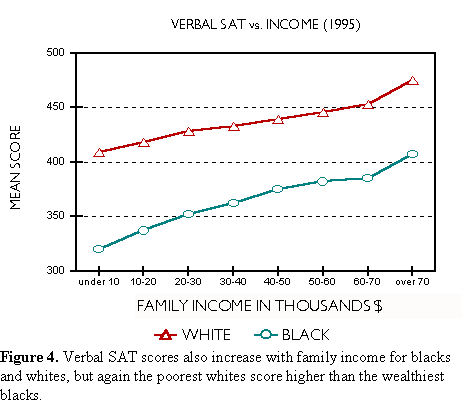

For more, we go to the abstract of Anne Case and Christine Paxson’s NBER Working Paper No. 12466 (“Stature and Status: Height, Ability, and Labor Market Outcomes,” August 2006):

On average, taller people earn more because they are smarter. As early as age 3 — before schooling has had a chance to play a role — and throughout childhood, taller children perform significantly better on cognitive tests. The correlation between height in childhood and adulthood is approximately 0.7 for both men and women, so that tall children are much more likely to become tall adults. As adults, taller individuals are more likely to select into higher paying occupations that require more advanced verbal and numerical skills and greater intelligence, for which they earn handsome returns. Using four data sets from the US and the UK, we find that the height premium in adult earnings can be explained by childhood scores on cognitive tests. Furthermore, we show that taller adults select into occupations that have higher cognitive skill requirements and lower physical skill demands.

Finally, on the intra-national level, there is Jay L. Zagorsky’s paper, “Do you have to be smart to be rich? The impact of IQ on income, wealth, and financial distress.” (The paper, which has received much publicity, is still “in press” at the journal, Intelligence.) Zagorsky confirms the positive relationship between IQ and income but then, anomalously, posits no relationship between IQ and wealth (i.e., net worth):

How important is intelligence to financial success? Using the NLSY79, which tracks a large group of young U.S. baby boomers, this research shows that each point increase in IQ test scores raises income by between $234 and $616 per year after holding a variety of factors constant. Regression results suggest no statistically distinguishable relationship between IQ scores and wealth. Financial distress, such as problems paying bills, going bankrupt or reaching credit card limits, is related to IQ scores not linearly but instead in a quadratic relationship. This means higher IQ scores sometimes increase the probability of being in financial difficulty.

How could IQ positively affect income but not wealth, given that (for most of us) wealth is derived from income? Zagorsky doesn’t know, and admits as much; all he offers are non-quantitative guesses. Many others have made much of Zagorsky’s “findings” (envious Leftists, for the most part), but I have not yet found a critique of it by an academic economist. (It may be too soon for that; the paper was published only a few months ago.)

Here are some of my reactions to the paper. To begin with, IQ, wealth, and income are highly correlated, as you might expect. This is from Zagorsky’s paper:
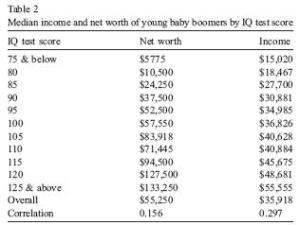
The correlations at the bottom of the table are Zagorsky’s stated correlations between between IQ and net worth and IQ and income, respectively. Those correlations are for the entire data set (N=7403). But the correlations for the data given in table are as follows:

IQ and net worth — 0.981
IQ and income — 0.984
Net worth and income — 0.970

The point is that the low correlations reported by Zagorsky are, in fact, significant. There is a lot of “noise” in the data, but the underlying trends are what you would expect. That leads me to suspect that Zagorsky set out to find what he found. Here are some of my concerns and objections about what he found and how he found it:

  • There is the obvious anomaly in table 2, at the cell represented by IQ 110, where (a) net worth is lower than at IQ 105 and (b) income is barely higher than at IQ 105. How could that be if there are about 700 for that IQ cell, as one would expect given 11 IQ cells and a sample size >700?
  • For married persons, Zagorsky divided family income and wealth by two, so as to avoid a “bias” toward married persons. What that does, of course, is bias the results toward single persons, who generally earn less and have less wealth than married persons. (See, for example, the correlations for “ever married” and “divorced” in table 1 of the paper.) The income and wealth of a married person is his or her income and wealth, legal fictions aside. Family income and wealth is higher but not fully accounted for because the income and wealth contributed by a “non-working” spouse generally goes unrecognized. Dividing the income and wealth of married persons in half is a shady trick and/or an indication of Zagorsky’s incompetence.
  • In any event, Zagorsky wasn’t satisfied with the obviously strong relationships between IQ, income and wealth, so he used regression analysis to “control” for other factors other than income that might determine wealth. In the end, Zagorsky simply runs regression after regression, most of them meaningless because he uses the “kitchen sink” style of analysis: throwing in every variable at hand (e.g., siblings, ever married, ever divorced, heavy smoker, light smoker, and self-esteem(?)). It is regression analysis at its worst: a data-mining fishing expedition, pure and simple.
  • Where Zagorsky reports the results of regressions on a limited number of (mostly) relevant variables (table 3), the regression that best fits the data (highest r-squared) yields a positive coefficient on IQ.
  • Zagorsky draws largely on self-reported survey data (a major weakness, in itself) for persons aged 40 to 47 years. That is, Zagorsky’s sample represents persons who, for the most part, are a decade or three from their peak earnings and wealth. And persons with higher IQs will tend to accumulate wealth more rapidly than those with lower IQs because (a) they will have learned more from their past mistakes and (b) over a decade or three wealth usually grows at a rate that is closer to exponential than linear (compound interest, stocks for the long run, and all that).
  • Finally, it is clear that Zagorsky is in over his head. He is not an economist or statistician but, rather, some kind of sociologist. His home base is Ohio State’s Center for Human Resource Research. Some of his other research (if you can call it that) undermines the so-called findings that I have summarized here.

In sum, Zagorsky’s paper is junk. I felt obliged to acknowledge it because the “finding” about IQ and wealth garnered a lot of attention when the paper was published earlier this year.
Intelligence and Income: International Differences
I return to Rushton’s review of Lynn’s Race Differences: An Evolutionary Analysis:

Lynn’s book…tak[es] a global perspective and consists of a review more than 500 studies published world wide from the beginning of the twentieth century up to the present. He devotes a chapter to each of ten races, differentiated by Cavalli-Sforza, Menozzi and Piazza (1994) into “genetic clusters”, which he regards as a transparent euphemism for races.

His conclusions are that the East Asians (Chinese, Japanese and Koreans) have the highest mean IQ at 105. These are followed by the Europeans (IQ 100). Some way below these are the Inuit (Eskimos) (IQ 91), South East Asians (IQ 87), Native American Indians (IQ 87), Pacific Islanders (IQ 85), South Asians and North Africans (IQ 84). Well below these come the sub-Saharan Africans (IQ 67) followed by the Australian Aborigines (IQ 62). The least intelligent races are the Bushmen of the Kalahari desert together with the Pygmies of the Congo rain forests (IQ 54).

After the ten chapters setting out the evidence for each of the ten races there follows a chapter on the reliability and validity of the measures. These show that the studies have high reliability in the sense that different studies of racial IQs give closely similar results. For instance, East Asians invariably obtain high IQs, not only in their own native homelands but in Singapore, Malaysia, Hawaii and North America. To establish the validity of the racial IQs he shows that they have high correlations with performance in the international studies of achievement in mathematics and science. Racial IQs also have high correlations with national economic development, providing a major contribution to the problem of why the peoples of some nations are rich and others poor. He argues further that the IQ differences between the races explain the differences in achievement in making the Neolithic transition from hunter-gathering to settled agriculture, the building of early civilizations, and the development of mature civilizations during the last two thousand years.

Lynn tackles the problem of the environmental and genetic determinants of race differences in intelligence and concludes that these contribute about equally to the phenotypic differences. He argues that the consistency of racial IQs in many different locations can only be explained by powerful genetic factors. He works out the genetic contribution in most detail for the sub-Saharan Africans. His argument is that sub-Saharan Africans in the United States experience the same environment as whites, as regards determinants of intelligence. He argues that they have as good nutrition as whites, as shown by their having the same average height in studies going back to World War 1, and they have approximately the same education as whites. He presents evidence that blacks in the southern states have very little white ancestry and have an IQ of about 80, and that proposes that this can be adopted as the genotypic IQ of blacks, i.e. the IQ that blacks attain when they are reared in the same environment as whites. The IQ of blacks in sub-Saharan Africa is a good deal lower at 67. Hence, the adverse environment in sub-Saharan Africa, which he regards as consisting principally of poor nutrition and health, contributes about 13 IQ points to the low IQ in sub-Saharan Africa. Lynn’s estimate is not too different from that advanced in 1969 by Jensen to the effect that about two thirds of the low IQ of blacks in the United States is attributable to genetic factors, and the more recent estimate of Rushton and Jensen (2005) that the figure is around 80 percent. Lynn has (unsurprisingly for those familiar with his work) put a bit more weight on the genetic factor.

Lynn (with Tatu Vanhannen) had earlier (2002) written IQ and the Wealth of Nations (summary and criticisms, here). That book seems to be an outgrowth of a Lynn-Vanhannen article in The Mankind Quarterly (“National IQ and Economic Development: A Study of Eighty-One Developing Nations,” Summer 2001). (For corroboration of Lynn and Vanhannen’s findings about the positive influence of IQ on national output, see Garrett Jones and W. Joel Schneider’s “Intelligence, Human Capital, and Economic Growth: A Bayesian Averaging of Classical Estimates (BACE) Approach,” June 2005.)
Gerhard Meisenberg, writing in “IQ Population Genetics: It’s Not as Simple as You Think” (The Mankind Quarterly, Winter 2003), offers a comprehensive view of the evolutionary causes of IQ differences across geographic regions and the effects of those differences on GDP. Meisenberg draws on the Lynn-Vanhannen data and many other sources. Meisenberg says that

[s]ome scholars, most notably Richard Lynn and Philippe Rushton, propose climate and ecology as selective forces. According to Lynn, the dependence on big-game hunting in northern climates necessitated complex social organization with efficient cooperation and intelligent planning, while tropical populations could always fall back on cognitively undemanding food gathering (Lynn, 1991).

Rushton emphasizes the need for close family ties and high parental investment in harsh climates. While most childhood mortality in the tropics was caused by uncontrollable endemic diseases, most childhood mortality in the arctic was due to the predictable challenges of seasonal food shortages and the rigors of the climate. These challenges demanded intelligent planning in addition to stable families (Rushton, 1995).

These theories postulate that physical and cognitive race differences evolved at roughly the same time, starting about 100,000 years ago when modern humans first ventured out of the tropics and into the inhospitable wastelands of central and northern Asia. Thus both Lynn and Rushton predict that intelligence genes cluster with climate-selected physical traits such as skin color. Both make the specific prediction that intelligence is highest in Mongoloids, lowest in Negroids, and intermediate in Caucasoids.

This prediction is borne out by the data in Table 1. The average IQ is 97.1 for Mongoloids, 93.9 for Caucasoids, and 69.6 for Negroids. IQ also correlates with latitude (Pearson’s r = 0.7559) and per-capita GDP (r = 0.7348). However, in multiple regression models with either latitude or GDP or both as copredictors of IQ, race remains a statistically significant predictor at the P

La Griffe du Lion has solved the puzzle. First, some background. La Griffe’s analysis of March 2002, highlights the “puzzle”:

In Figure 2, the [Lynn-Vanhannen] data [table here] is [sic] divided into contributions from four groups: blacks, (European) whites, East Asians and “others.” I did not include the outliers: South Africa, Barbados, Qatar and China.
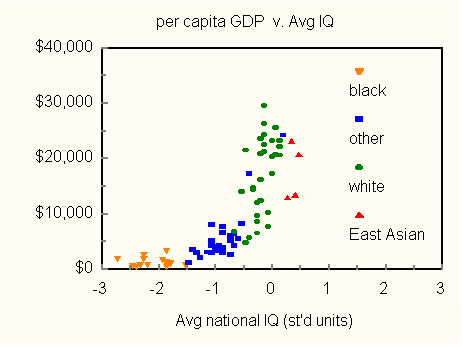
Figure 2. Per capita GDP by racial group. “White” here means European white; “East Asian” means the racially homogenous polities: Taiwan, South Korea, Hong Kong, and Japan.

La Griffe, in a later post (May 2004) addresses the seeming anomaly in the relationship between IQ and GDP. As shown in the figure directly above, four East Asian (or Northeast Asian) countries (Hong Kong, South Korea, Japan, and Taiwan), which have the highest average IQs, do not have the highest per capita GDPs. The short of it is this: GDP is best explained by verbal IQ, as opposed to a measure of IQ that encompasses both verbal and quantitative skills. Thus figure 7:
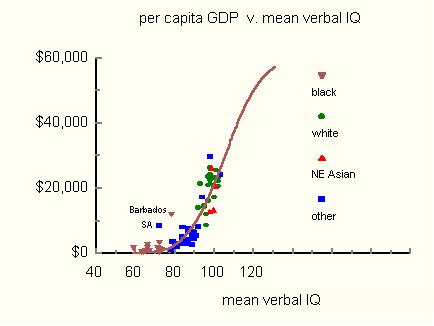
La Griffe observes that the IQ of (North)east Asians

is bifurcated. NE Asians have the highest IQ of all peoples other than Ashkenazim. They owe that superior IQ, however, to extraordinary visuospatial ability, which, despite verbal shortcomings, lifts their IQ above that of Europeans….

Among the races, only NE Asians and Amerindians exhibit this particular kind of verbal-nonverbal cognitive split. For other races verbal and general IQ averages have similar values, making the distinction between the two transparent to smart fraction theory. In the 12 studies reporting both general and verbal IQ for NE Asians, the general-verbal gap averaged 6.5 IQ points….

[T]he spectacular visuospatial ability of NE Asians, while accounting for their high [overall] IQ scores, does not necessarily make them good capitalists. Hunting strategies have little to do with wealth production. And a new tool, irrespective of point of origin, is now soon available worldwide. The structure of NE Asian intelligence did not come about in response to pressures to be attorneys or editors or production managers or copywriters or salesmen or programmers or systems analysts or insurance adjusters or purchasing agents or account executives.

In sum, IQ strongly determines both personal income and, therefore, per capita GDP. Verbal IQ turns out to be an important (negative) determinant of income in those (few) cases where it is a relatively weak component of overall IQ.

But what about the influence of income on IQ? Let’s return to Meisenberg’s article:

The massive rise of IQ that took place in many countries over the past century shows conclusively that environmental effects can have a powerful effect on the average intellectual level of large populations. Presumably one or another aspect of “standard of living” is responsible for this secular trend: education, nutrition, health care, mass media, or, most likely, a combination of all of these.

Gross domestic product adjusted for purchasing power (GDP in Table 1) is an indicator for the population’s “standard of living”. If a high standard of living does indeed raise IQ test performance, then GDP should be an independent predictor of national IQ even when the effects of race and latitude are partialled out.

When race, latitude and GDP are used as co-predictors, GDP does indeed have an independent effect in predicting national IQ (P = 0.0007). In this model, race and latitude remain powerful independent predictors, each with P Flynn effect [link added: ED] these results suggest that the causal arrow points both ways. High intelligence produces a high standard of living, which in turn raises intelligence even more. Thus intelligence and economic development are mutually reinforcing in a positive feedback loop….

This feedback loop explains…the rise in mental test performance that has become known as the Flynn effect.

This feedback loop between intelligence and standard of living can explain the great magnitude of the IQ differences between nations. It predicts that even in cases where genetic differences affecting mental ability are small, the observed phenotypic differences become amplified because the slightly more gifted populations achieve a higher standard of living which raises their measured intelligence even more, which in turn raises their standard of living yet further. Similar “amplifier effects” have previously been proposed as explanations for the Flynn effect (Dickens and Flynn, 2001).

There you have it: The smarter get richer and the richer get smarter, not at the expense of the poorer and not-as-smart but by virtue of their genes and the material advantages afforded by those genes. Forceful transfers of income and wealth from the smarter and richer to the not-so-mart and poorer might be helpful to the latter — but more likely not, as I argue earlier. But such transfers definitely diminish the ability of the smarter and richer to help the not-so-smart in more lastingly productive ways: through technological advancement, job creation, mutually beneficial trade, and well-targeted charity.
CONCLUSION
Redistribution in an effort to make us “more equal” is not only counterproductive and unfair, it is futile. Or if not entirely futile, largely wasteful. All human beings (or at least those who are citizens and lawful residents of the U.S.) deserve equal rights. But the equal rights they deserve are the negative rights of the original Constitution, not the positive rights sought by generations of so-called liberals and progressives. There is nothing “liberal” or “progressive” (in the root meanings of those words) about redistribution.
Some related posts:
The Cost of Affirmative Action
Affirmative Action: A Modest Proposal
Race, Intelligence, and Affirmative Action
Affirmative Action: Two Views from the Academy
Affirmative Action, One More Time
Much Food for Thought
After the Bell Curve
A Footnote . . .
The Main Causes of Prosperity
Why Class Warfare Is Bad for Everyone
Fighting Myths with Facts
Debunking More Myths about Income Inequality
A Century of Progress?
Socialist Calculation and the Turing Test
Taxes, Charitable Giving, and Republicanism
Productivity Growth and Tax Cuts
Zero-Sum Thinking
Liberty, General Welfare, and the State
The Causes of Economic Growth
Republicanism, Economic Freedom, and Charitable Giving
The Last(?) Word about Income Inequality
Status, Spite, Envy, and Income Redistribution
Things to Come
__________
* The more controversial scientists whose work I sample here are Charles Murray, J. Phillipe Rushton, Richard Lynn, and Napoleon Chagnon.
Murray is controversial mainly for The Bell Curve, which brought to a wide audience the large body of long-standing evidence of persistent inter-racial differences in IQ. Rushton and Lynn are controversial because of their findings on race, gender, and intelligence, and because of their affiliation with the Pioneer Fund. The Fund’s roots and some of its current connections are tainted with the label “white supremacist.” The Fund (website here) has responded to those allegations. Whether Rushton, Lynn, and others who produce similar research are white supremacists is beside the question of the validity of their research. Judge for yourself.
Chagnon is controversial for other reasons, namely the ethics (or purported lack thereof) in his field work. (For Chagnon’s statements about the controversy, go here. See also Steven Malanga’s review of Chagnon’s Noble Savages, “Welcome to the Jungle,” City Journal,  April 13, 2014.) In the “small world” department, I note that Chagnon hails from the village where my maternal grandparents raised ten children. The doctor who delivered many of those children bore the name Napoleon Chagnon. The sketchy biographical information about the anthropologist (p. 6, here) indicates that he was not the son of the medical doctor, but given the village’s small population (perhaps 500 when the anthropologist was born), it seems likely that he was related to and named for the medical doctor (a grandson, perhaps). And it was in honor of “old Doc Chagnon” that my maternal grandparents chose Napoleon as the middle name of the tenth and last of their children.

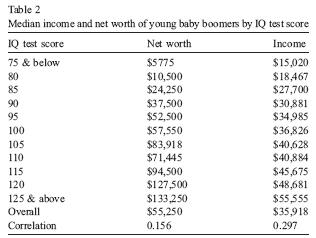
The Golden Rule, for Libertarians

Permissible acts should coincide with responsible acts. Responsible acts are those that you would have done unto you or the consequences of which you would have done unto you.

You must, in other words, consider

  • the immediate effect of an act on others, and
  • its long-term effect on yourself or others,
  • including its effect on the social and legal restraints that now prevent (or deter) others from doing harm to yourself or others.

Recent related posts:
Metaethical Moral Relativism: Is It Valid?
A Critique of Extreme Libertarianism
Libertarian Whining about Cell Phones and Driving
Eugenics