Enough of Amateur Critics

UPDATED TWICE, BELOW

It’s ludicrous that hundreds of pundits, thousands of politicians, and millions of citizens with little or no experience in the planning and direction of complex operations are judging the performance of various governments in the preparation for and aftermath of Hurricane Katrina. All that these uninformed pundits, politicians, and citizens could know for a fact is that a major hurricane hit an area that hadn’t been hit by a stronger hurricane in 36 years. They could also know that Louisiana has been struck by lesser hurricanes about once every three years. And, finally, they could know (if they had been paying close attention to federal, state, and local machinations over many decades) that New Orleans was nevertheless ill-prepared for a major hurricane for many reasons that long predate the ascension of the current federal, state, and city administrations. Knowing only those facts (if they indeed know them), these “experts” nevertheless leap to the conclusion that “someone” must be to blame for this, that, and the other aspect of the disaster in New Orleans because, well, “someone” must be to blame.

I daresay that I know a lot more than most of the armchair critics about the planning and direction of complex operations. I have been immersed, at various times, in the planning and construction of a house, the planning and construction of major renovations and additions to a house, and — of most relevance — the design of and negotiation of a lease for a 200,000 square-foot office building. The office building was not just a partitioned shell, but one designed to incorporate state-of-the art modular furniture (not in cubicles, but in private offices), a variety of computing and telecommunications facilities, many special security features, conference facilities, food-preparation areas, libraries, and on and on. But that’s not all. At the company for which I planned the office building, I also had a broader portfolio of responsibilities, including the provision of physical and information security, financial and contractual management, the operation of central and distributed computing services, and the administration of personnel services in compliance with an array of federal, state, and local laws and regulations.

Now, one of the main lessons that I learned from my years of planning and directing complex operations is the following: Success has many parents; failures and setbacks have but one, the person on the spot. Yet, the person on the spot almost never starts with a clean slate or gets to run in a clear field. The person on the spot always operates within many constraints (e.g., budgets, traditions, and expectations). The person on the spot can never anticipate every contingency (especially the contingency that disrupts a plan). And, no matter the competence of the person on the spot, it takes time, effort, and (often) additional resources to regroup when a plan has been disrupted by reality.

There may be obvious instances of incompetent performance in the aftermath of Katrina; Mayor Nagin, Governor Blanco, and former FEMA director Mike Brown are obvious candidates for Bumbler of the Year. But the armchair critics on the sidelines are looking beyond the obvious bumblers and second-guessing the performance of various government entities from nothing more than pure, unadulterated ignorance: ignorance of the long and complex history of political and budgetary bargains that led to the state of New Orleans’s defenses against Katrina; ignorance of the political and budgetary bargains that led to the state of readiness on the part of various responders; ignorance of the difficulty of developing complex plans for events that will never unfold according to plan; ignorance of the hard fact that no plan survives “first contact with the enemy” (Katrina, in this case); ignorance of the amount of time, effort, and resources it takes to recover from the kinds of setbacks that are inevitable in a complex and chaotic operation; and, finally, ignorance of what was possible in the first place, given all of the foregoing complexities. Just to say that the preparations for and response to Katrina were inadequate — which is about all that most of the second-guessers really have to say — is, in a word, inadequate.

Well, I’ve had more than enough of second-guessers in my career. I got the job done in spite of them, but I long ago grew sick and tired of listening to them. So, I’ll not waste any more of my time reading what the second-guessers have to say about Katrina. And, as qualified as I might be to second-guess the second-guessers, there’ll be no more second-guessing from me, on this subject.

P.S. But, Columbo-like, I must add something on my way out. You’ve probably noticed that most of the armchair critics are animated by Bush-hate. That’s a fact which trumps their laughable “expertise,” which is on a par with William Jennings Bryan’s expertise in evolution.

As for Bush, he is now apologizing for failures on the part of the feds, which is fair enough to the extent that there were actual failures to do the right thing when confronted with actual events and armed with the proper tools with which to respond to those events. But what’s really going on, in my view, is that Bush is throwing his critics a crumb. He has nothing to lose by doing so (the haters will still hate him), and much to gain from those in the middle who will credit him for “taking responsibility” — whatever that Clintonesque term means when one cannot be fired, fined, or jailed for one’s actions.

P.P.S. Let me make it perfectly clear that I am not apologizing for the Bush administration, or any other government entity. I’m just explaining how it is that few — if any — of those who are bashing government’s response to Katrina have any basis for doing so, other than a desire to seem appropriately wise and/or indignant. Moreover, though it might be possible for government to have done better than it has done, it could not have done as well as private citizens and business owners, had they been allowed to keep their tax dollars and use them to prepare for and recover from Katrina. For more on that score, see these posts:

Katrina’s Aftermath: Who’s to Blame?
(09/01/05)
“The Private Sector Isn’t Perfect” (09/02/05)
A Modest Proposal for Disaster Preparedness (09/07/05)
No Mention of Opportunity Costs (09/08/05)
Whose Incompetence Do You Trust? (09/10/05)
An Open Letter to Michael Moore (09/13/05)
Guilty Until Proven Innocent

Excerpt of an e-mail from the law firm of McGuireWoods (“No Good Deed Goes Unpunished? Seventh Circuit Rules That No Adverse ‘Employment’ Action is Necessary to Sustain Title VII Retaliation Claims”):

Executive Secretary, Chrissy Washington worked for the Illinois Department of Revenue on a flexible schedule from 7 a.m. to 3 p.m., instead of the standard 9-5 schedule, allowing her to care for her son with Down Syndrome. When some of her duties were reassigned to others, she filed charges with state and federal agencies alleging race discrimination. Subsequently, a senior manager required that she work from 9 to 5, and when she refused, her position was abolished. Washington was assigned to another Executive Secretary post with a different supervisor and was required to apply anew for a flextime schedule, which was refused. Washington maintained that it was her prior discrimination charge that led supervisors to rescind the flextime schedule on which her son depended. . . .

. . . [The Seventh Circuit Court of Appeals] concluded (with a highly entertaining reference to the comic strip Dilbert) that where an employer retaliates for protected activity by exploiting an employee’s known vulnerability, such as Washington’s reliance on flextime to care for her disabled son, the action can be a material change sufficient to sustain a retaliation claim under Title VII [of the Civil Rights Act of 1964]. The standard for materiality, the court noted, is whether the employer’s action has the “potential” to dissuade an employee (and, by logical extension, other employees) from pursuing her rights under Title VII.

Although this opinion does not reflect a uniform view among the jurisdictions on the ultimate issue, it should serve to alert employers to some of the potential problems that can arise from the implementation of flextime schedules and other employee-friendly initiatives. The court clearly says that once these admittedly optional benefits are in place for an employee, their removal can serve as a basis for retaliation claims.

Lesson 1: A benefit, once bestowed, can become an entitlement.

Lesson 2: An employee who has filed an Equal Employment Opportunity (EEO) claim against an employer may became immune to otherwise defensible business decisions by that employer.

As my HR director used to say whenever a disgruntled employee or former employee filed an EEO claim: “We (the company) are guilty until proven innocent.” Because that’s how the EEO racket works.

A Familiar Story

Today’s Dilbert reminds me of my (former) pointy-haired boss, the analytic paralytic:

"Giving Back to the Community"…

…rankles every time I read or hear it. Generally, a person whose income isn’t derived from tax dollars already has “given back” by providing goods and services that are valued by the persons who receive and pay for those goods and services.

It’s another story if a person works for a tax-supported institution, as did I for 30 years…

In the latter years of my employment at a defense think-tank, our CEO established a “community service” program so that we well-paid, mostly white, professionals could “give back to the community.” The “community” to which we gave “service” was not well-paid, mostly white, or professional, of course.

I am confident that the targets of our beneficence paid only a minuscule fraction of the taxes that funded our nicely appointed offices, high salaries, and generous benefits. “Giving back” to the “community” that actually supported us would have involved mowing lawns, tutoring, and babysitting for mostly white, middle- and upper-income Americans in other parts of the D.C. area than the one selected by our CEO as the “community” to which we would “give back.”

If the services we provided in exchange for our splendid offices, salaries, and benefits had been worth what taxpayers were paying for them, there would have been no need for us to “give back” to any community. Taxpayers would have received their money’s worth, and that would have been that.

Our CEO either felt guilty about his huge office, high salary, and princely benefits or he thought that our think-tank wasn’t giving taxpayers fair value for their money. As he would have been the last person in the United States to admit that we weren’t delivering fair value, I can only conclude that his yearning to “give back” to the community arose from feelings of guilt, which he projected onto his employees. For, even as he was pressing us to “give back,” he constantly sought to justify the spending of more tax dollars on better accommodations and higher compensation for himself and the rest of us.

Feelings of guilt aren’t confined to those who feed at the public trough, of course. CEOs and senior executives of large corporations have a good thing going for themselves — which they owe to their chummy relations with boards of directors — and they know it. Thus the impetus for private-sector “giving back.”

In summary, “giving back to the community” is either an unnecessary act — because “the community” already has received fair value for its money — or it is emblematic of guilt. In the first instance, “giving back” is really an act of charity. In the second instance, “giving back” is really a false act of contrition and an inadequate, misdirected form of compensation for executive avarice.

Can You Throw a Curveball?

Throwing a curveball is easy, just do as it says here. Well, try doing it until you really know how to do it, that is, until your brain and muscles work together in just the right way. Which may never happen, or happen very often, no matter how many articles you read or how much you practice.

The moral of the story is simple: Don’t presume to know how things work until you’ve actually done them yourself.

That’s why I don’t trust a politician who hasn’t put his own money at risk in a business on which his livelihood depends. Such a politician has no real idea of the debilitating effects of taxation and regulation on the entrepreneurial spirit, job creation, and employee compensation.

That’s why I don’t trust a politician who thinks that fallible human beings can magically solve problems when they become government employees.

That’s why I don’t trust a politician to do the right thing when it comes to dealing with a tragedy like the Schiavo case if that politician hasn’t faced the death of a loved one whose life might yet be saved.

Full disclosure:

  • In my days of playing catch, which I did seriously for many years, I seldom broke off a good curveball even though I could throw fast, far, and with good control.
  • I have owned and operated a business into which I poured a substantial portion of my savings and which was the sole source of income for my family and me.
  • I worked in and closely with the federal government for 32 years.
  • I have a child whose life was in mortal danger but was saved by a timely operation, from which he has long since recovered fully.

Analysis Paralysis

During the late presidential campaign I observed of John Kerry:

The difference between Kerry and Bush isn’t experience, it’s temperament. I worked for a Kerry-like CEO — always asking questions, probing answers, asking more questions, ad infinitum. He always postponed decisions as long as possible, not because he lacked the facts but because he had confused himself with the facts. He sought facts for their own sake, not because they would help him plot the best path toward a specific goal. He was almost purely inductive, hoping to find his principles in a morass of information.

That’s how Kerry, with his limitless flip-flopping, has struck me — a man without principles who hopes to discover them in the next piece of information that he receives….

To change metaphors: You don’t advance the ball down the field by counting the laces on it. You advance the ball down the field by knowing where the goal is and then choosing the plays that will help you reach it. Kerry knows how many laces there are. Bush figures out where to throw the ball, and all Kerry knows how to do is carp like an armchair quarterback when some of the passes aren’t caught.

I was reminded of that passage by this one, from an essay by Larry McMurtry:

A compulsion to over-informedness is most apt to occur in individuals who have been arrested at a graduate school level of development; it is an intellectual infirmity, rather than a sign of health, and is so common now that it perhaps deserves to be elevated to the status of a syndrome: the Star-Pupil syndrome. If the desire to shine as a pupil is sustained too long it can cause even the most committed worker to work badly. [Film Flam: Essays on Hollywood, “Movie Tripping: My Own Rotten Film Festival,” p. 204.]

That is why, in my experience, persons who have acquired a Ph.D. — or who lack one but work in a “learned institution” — tend to count the laces on the football instead of trying to advance it down the field.

Shakespeare said it best, in Hamlet (Act III, Scene 1):

And thus the native hue of resolution
Is sicklied o’er with the pale cast of thought,
And enterprises of great pith and moment
With this regard their currents turn awry,
And lose the name of action.

The Pointy-Haired Boss

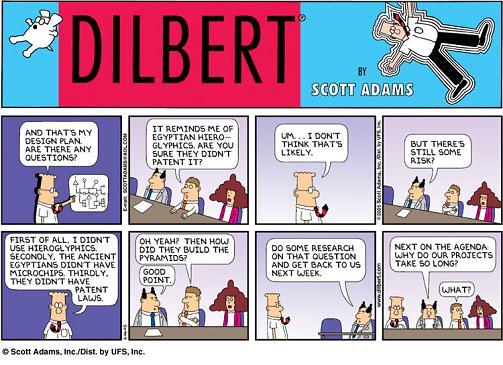
Today’s Dilbert reminds me of a former boss, who insisted — without qualfication — that change is good.

What’s truly eerie is that the same former boss also scored 10 out of 10 on my test of (poor) management skills:

Are you a CEO or senior manager in a corporate bureaucracy? Want to know how you stack up against your peers? Select your personal management traits from the following list, then tally your score and check it against the scale at the end of the list.

1. Flaunt the privileges of rank: Spend on frills and perks even as you’re down-sizing.

2. Flout the rules you expect others to obey.

3. Put off hard decisions as long as possible so that rumors can grow wildly on the grapevine.

4. Pepper your staff with meaningless projects and pointless questions — hire consultants to give you the “straight scoop.”

5. Hire outsiders for senior management positions and create make-work jobs for your cronies.

6. Keep your door open to whiners and let them second-guess your managers’ decisions.

7. Promise vision but deliver pap.

8. Talk teamwork but don’t let anyone in on your game plan — keep ’em all guessing.

9. Talk empowerment but micro-manage.

10. Keep your board in the dark, except when you turn on the rosy spotlights.

Score of 0: You lie to yourself all the time; see a psychiatrist.

Score of 1-3: You sleep a lot during the day; see a physician.

Score of 4-6: You’re a normal boss, which isn’t necessarily good news.

Score of 7-9: You could give Donald Trump a run for his money.

Score of 10: So you’re the model for Dilbert’s pointy-haired boss!

Cabinetry

Bret Stephens, writing at OpinionJournal (“What Is a Cabinet For?“), captures the “conventional wisdom” about Bush’s cabinet appointments in this paragraph:

“Now that Condoleezza Rice has been nominated to be the next secretary of state,” the New York Times editorializes, “the whole world seems to be noticing that George Bush is stuffing his second-term cabinet with yes men and women. It’s worrisome. . . .” David Gergen, former wise man of Public Broadcasting, frets that Mr. Bush is “closing down dissent and centralizing power in a few hands.” Andrew Sullivan, in his column for the London Times, bemoans the cast of “flunkies” and “servants rather than peers” around the president. “Fierce loyalty is a prerequisite for serving Bush,” writes the disapproving Mr. Sullivan.

Allow me to speak from experience in the matter of appointing lieutenants. A leader must be confident that he and his lieutenants have common goals. A leader expects his lieutenants to give thoughtful, candid advice, but to give it privately and not leak it to the press in an effort to embarrass the leader or to shape policy. Sharing common goals and giving candid advice, privately, isn’t a sign of blind obedience in a lieutenant, it’s a sign of loyalty, in the best sense of the word. The alternative to the good kind of loyalty is disfunction and disarray — but perhaps that’s what the pundits want.

Experience gives the best proof of loyalty. That’s why good leaders tend to select lieutenants whom they have come to know and trust. Bush isn’t the first leader to select his lieutenants from a trusted, inner circle. Nor will he be the last.

But all of this is lost on reporters and pundits who have never managed anything bigger than an editorial page or a blog.

That’s It, in a Nutshell

Timothy Sandefur at Freespace has a good post about acting in the face of imperfect information. The summation:

Again, the question is not as much whether, knowing what we know now, Iraq was a good idea. The question is what sort of decisions we should make when we don’t know very much — should we wait, and run the risk of letting a disastrous terrorist attack occur — or should we take the risk of acting on imperfect information? In the case of Iraq, the President made the right decision because, in addition to the imperfect information, we at least knew that we would not be doing a bad thing getting rid of Hussein….The question is not whether war is a good thing or a bad thing. The question is not whether the Vice President is part of an evil capitalist conspiracy to exploit the proletarians in Iraq. The question is not even whether Bush’s domestic policies are good for the country, which they almost invariably are not. The question is what sort of mentality should we have toward undeniably dangerous states in the future. The answer to that, I think, is that we should be willing to attack even on the basis of imperfect information regarding a potential threat.

Not to put words in Sandefur’s mouth, but here’s my take: It’s better to be wrong than dead — even at the risk of being proved dead wrong after the fact.

Determination

That’s the title of a piece by Thomas Lifson at The American Thinker. Some key points:

…America’s strategic vision and will to use force are also hugely important to the tyrants who oppose us. Ask Colonel Gadhafi of Libya, who has voluntarily surrendered his nuclear arms program. Strangely enough, Senator Kerry has nothing to say about this when denouncing Iraq as the wrong war, in the wrong place, at the wrong time.

Contrary to what Americans are being told relentlessly, our forces in Iraq are not posted there to serve as targets for Islamist terrorists. Nor are they present in Iraq solely to ensure the transition of that country into a democratic state – a project which will take years, even decades to accomplish fully. That mission is extremely important, to be sure.

The American forces in Iraq are also a forward deployment in the War on Terror – a signal of the utter seriousness placed on removing the bases from which terrorists operate. As President Bush’s re-election is looking more probable, people like Assad are realizing that they are not to be granted relied from this pressure by a verdict of the American electorate….

Students of the history of warfare realize that as the enemy is facing defeat, casualties often mount, as desperation attacks are carried out, in the consciousness that the only alternative is capitulation. In World War II, consider the awful toll in American blood paid in the Battle of the Bulge, the invasion of Okinawa, and in the Kamikaze suicide attacks on American aircraft carriers. The escalation in casualties was not an indicator of defeat or a “quagmire.”…

Determination is what it’s all about. We can stay the course and tighten the noose around the necks of terrorists and their sponsors, or we can retire to the illusory safety of our homeland and allow the enemy to capture the Middle East, make nuclear weapons, and train terrorists with impugnity.

Determination is what wins wars and keeps the peace.

Determination is a character trait. Some have it; many don’t.

I speak from experience. I know the determination it takes to achieve a strategic objective. I succeeded in moving my company out of the second-rate quarters we were forced to take, in a political deal, and into first-rate quarters. It took 12 years, and it happened only because I was determined to make it happen, in spite of considerable internal opposition and diffidence on the part of my CEO.

Determination on the part of Democrats is what changed the dominant economic system in the United States from something like laissez-faire capitalism to something much more like socialism. If only Democrats had the same determination to win the war on terror.

Hemibel Thinking

Don’t go away. Stick around for some useful insights about social-science research.

First, what is “hemibel thinking”? Philip M. Morse and George E. Kimball, pioneers in the field of military operations research, wrote in their classic Methods of Operations Research (1951) that the

successful application of operations research usually results in improvements by factors of 3 or 10 or more….In our first study of any operation we are looking for these large factors of possible improvement….They can be discovered if the [variables] are given only one significant figure,…any greater accuracy simply adds unessential detail.

One might term this type of thinking “hemibel thinking.” A bel is defined as a unit in a logarithmic scale corresponding to a factor of 10. Consequently a hemibel corresponds to a factor of the square root of 10, or approximately 3.

This is science-speak for the following proposition: Things are rarely clear cut in the “real” world, especially in the realm of human behavior, where there’s a lot of uncertainty about which events contribute to particular outcomes, about the relative importance of those events, and about the appropriate numerical values to assign to them. Anyone who aspires to be a social scientist, should therefore be humble about claiming precision for quantitative estimates that are probably very imprecise.

Exhibit A: Prof. Ray Fair’s macroecnomic model of the U.S. It consists of 131 equations, each of which has several independent variables. No wonder Fair’s model, in its various incarnations, has done such a lousy job of forecasting changes in real GDP.

You might say that Fair’s model is an extreme case. There are, after all, many simpler models in the social sciences. Yes, but all models in the social sciences rely on inevitably imprecise estimates of the events arising from human behavior — even when those events are economic ones. Indeed, many social-science models are incomplete because many crucial events are unknown, unquantifiable, or both. In the case of the minimum wage, about which I have written recently, a professional economist echoes my views.

Hemibel thinking takes on great importance in light of the imprecision inherent in complex social-science models. Consider a model with only 10 variables. Even if the model doesn’t omit crucial variables, its results must be taken with large doses of salt. An error of about 25 percent in the value of each variable can produce a result that is off by a factor of 10; an error of about 12 percent in the value of each variable can produce a result that is off by a factor of 3 (a hemibel). (By the way, if you think that social-science data aren’t that bad, you haven’t seen how such data are collected and reported.) Of course, the errors might (miraculously) be offsetting, but don’t bet on it. It’s not that simple: Some errors will be large and some errors will be small (but which are which), and the errors may lie in either direction (but in which direction?).

So, the next time you read about research that purports to “prove” or “predict” such-and-such about a social phenomenon — the effect of the minimum wage on employment, the influence of “nature” vs. “nurture” in child-rearing, the inflationary effect of government deficits — take a deep breath and ask yourself “does this make sense?”

Strategic Vision

Washington’s strategic vision was to break free of British rule. He persevered and the newborn United States survived to childhood.

Lincoln’s strategic vision was to preserve the Union and the ideals of the Declaration of Independence. He persevered and the Union passed tumultuously from adolescence to vigorous adulthood.

Roosevelt’s strategic vision was to cure the adult nation of its Depression. His apparent success — which was owed in fact to a horrific war — sapped the nation’s vigor by leading it into long-term dependence on government.

Reagan’s strategic vision was to cure the nation of its dependence on government, to restore it vigorous adulthood. He failed because the nation’s addiction was too strong to be broken by a mere president, unaided by Congress.

Clinton’s strategic vision — pursued from his adolescence — was to become president. He persevered and the nation sank deeper into senile dependence on government.

Some Management Tips

Are you a CEO or senior manager in a corporate bureaucracy? Want to know how you stack up against your peers? Select your personal management traits from the following list, then tally your score and check it against the scale at the end of the list.

1. Flaunt the privileges of rank: Spend on frills and perks even as you’re down-sizing.

2. Flout the rules you expect others to obey.

3. Put off hard decisions as long as possible so that rumors can grow wildly on the grapevine.

4. Pepper your staff with meaningless projects and pointless questions — hire consultants to give you the “straight scoop.”

5. Hire outsiders for senior management positions and create make-work jobs for your cronies.

6. Keep your door open to whiners and let them second-guess your managers’ decisions.

7. Promise vision but deliver pap.

8. Talk teamwork but don’t let anyone in on your game plan — keep ’em all guessing.

9. Talk empowerment but micro-manage.

10. Keep your board in the dark, except when you turn on the rosy spotlights.

Score of 0: You lie to yourself all the time; see a psychiatrist.

Score of 1-3: You sleep a lot during the day; see a physician.

Score of 4-6: You’re a normal boss, which isn’t necessarily good news.

Score of 7-9: You could give Donald Trump a run for his money.

Score of 10: So you’re the model for Dilbert’s pointy-haired boss!