Worth Revisiting

I sometimes use Site Meter to determine which of the posts at this blog have been of special interest to visitors. Pleasantly surprised am I to find that “Science, Axioms, and Economics” has been drawing some traffic. I consider it to be among Liberty Corner‘s best offerings.

Friday’s Best Reading

Links and excerpts:

The Laffer Curve Straw Man,” by Daniel Mitchell (Cato-at-Liberty)

The real issue is whether certain changes in tax policy will have some impact on economic activity. If an increase (decrease) in tax rates changes behavior and causes a reduction (increase) in taxable income, then revenues will not rise (fall) as much as “static” revenue-estimating models would predict. This is hardly a radical concept, and evidence of Laffer-Curve effects is very well established in the academic literature.

Sociologists Discover Religion,” by Heyecan Veziorglu (campusreportonline.net)

Associate Professor Dr. Jeffrey Ulmer from Pennsylvania State University examines the degree to which religiosity increases self-control. He points out that religious observance builds self-control and substance use is lower in stronger moral communities.

Eminent Scientist Censored for Truth-Telling [about genes and IQ],” by John J. Ray (Tongue Tied 3)

…There is no inconsistency in saying that blacks as a whole are less intelligent while also acknowledging that some individual blacks are very intelligent. What is true of most need not be true of all.

Scientists have spent decades looking for holes in the evidence [Dr. James] Watson [of DNA fame] was referring to but all the proposed “holes” have been shown not to be so. There is NO argument against his conclusions that has not been meticulously examined by skeptics already. And all objections have been shown not to hold up. There is an introduction to the studies concerned here.

Some commentators have mentioned that old Marxist propagandist, Stephen Jay Gould, as refuting what Watson said. Here is just one comment pointing out what a klutz Gould was. And for an exhaustive scientific refutation of Gould by an expert in the field, see here. [Highly recommended: LC.] Gould’s distortions of the facts really are quite breathtaking.

Hanson Joins Cult,” by Robin Hanson (Overcoming Bias)

Rumors of a weird cult of “Straussians” obsessed with hidden meanings in classic texts have long amused me. Imagine my jaw-dropping surprise then to read an articulate and persuasive Straussian paper by Arthur Melzer in the November Journal of Politics:

Leo Strauss…argued that, prior to the rise of liberal regimes and freedom of thought in the nineteenth century, almost all great thinkers wrote esoterically: they placed their most important reflections “between the lines” of their writings, hidden behind a veneer of conventional pieties. They did so for one or more of the following reasons: to defend themselves from persecution, to protect society from harm, to promote some positive political scheme, and to increase the effectiveness of their philosophical pedagogy….

Melzer convinced me with data:

By now we have seen a good number of explicit statements by past thinkers acknowledging and praising the use of esoteric writing for pedagogical purposes. What is perhaps even more striking in this context is that I have been unable to find any statements, prior to the nineteenth century, criticizing esotericism for the aforementioned problem, or indeed for any other.

This great transition is my best bet for the essential change underlying the industrial revolution:

In The Flight from Ambiguity, the distinguished sociologist Donald Levine writes: “The movement against ambiguity led by Western intellectuals since the seventeenth century figures as a unique development in world history. There is nothing like it in any premodern culture known to me”. This remarkable transformation of our intellectual culture was produced by a variety of factors, but most obviously by the rise of the modern scientific paradigm of knowledge which encouraged the view that, in all fields, intellectual progress required the wholesale reform of language and discourse, replacing ordinary parlance with an artificial, technical, univocal mode of communication

Modern growth began when enough intellectuals gained status not from ambiguity but from clarity, forming a network of specialists exchanging clear concise summaries of new insights.

Achilles and the Tortoise: A False Paradox

According to Aristotle (restating Zeno):

In a race, the quickest runner [Achilles] can never overtake the slowest [Tortoise], since the pursuer must first reach the point whence the pursued started [i.e. the pursued has a head start], so that the slower must always hold a lead.

Can anyone really believe that Achilles fails to catch the Tortoise? Yes. See this, this, this, and this, for example.

To show what’s wrong with Aristotle’s analysis, I begin with an example:

  • Achilles (A), a quasi-god with a tricky tendon, runs at a mortal speed of 15 miles an hour (a 4-minute miler, he).
  • Tortoise (T) “runs” at a speed of 1 mile an hour. (I exaggerate for simplicity of illustration.)
  • If A gives T a 15-mile lead, A reaches T’s starting point in 1 hour. T has, in that hour, moved ahead by 1 mile.
  • A covers that mile in 1/15 of an hour, in which time T has moved ahead by 1/15 of a mile.
  • A runs the 1/15 of a mile in 16 seconds, in which time T has moved ahead by another 23.47 feet.
  • And so on.
  • Therefore, A can never catch T.

What’s the catch? It’s verbal sleight-of-hand, much like the “proof” that 1 + 1 = 3. We know that A must be able to catch T, but we are trapped in a fallacious argument which seems to prove that A can’t catch T.

The trick lies in the presentation of A’s and T’s movements as occurring alternately instead of simultaneously. A is always described as going to where T was, not to where T will be when A catches him.

Such reasoning contradicts what we know of reality. Fast runners often catch (relatively) slow runners on the football field. The best sprinter on any high-school track team could give me a 25-yard head start and beat me to the finish line of a 100-yard dash. And so on.

When a real A catches a real T, the real A does so by covering a greater distance than the real T, but the real A covers that distance by running for exactly the same length of time as the real T runs. Along the way, A will pass points already passed by T, but A will not pause at any of those points and allow T to move a bit farther ahead — which is the trick that lies behind the Aristotelian “proof” of A’s inability to catch T.

Going back to the example (A runs 15 miles an hour, etc.), we can determine when and where A catches T simply by describing the race correctly:

  • A’s time (in hours) x A’s velocity (in miles per hour) = A’s distance (in miles).
  • If A catches T, T’s time = A’s time; T’s distance (including his head start) = A’s distance.
  • Therefore, when A has run for 15/14 hours at 15 miles an hour he has covered a distance of 225/14 miles (16 and 1/14 miles).
  • In that same 15/14 hours, T (moving at 1 mile an hour) has covered a distance of 1-1/14 mile.
  • Adding the distance T has traveled in 15/14 hours to T’s head start of 15 miles, we see that T is, at the end of those 15/14 hours, exactly 16-1/4 miles from A’s starting point.
  • In sum, A catches T after both have been running for 15/14 hours, and at a distance of 16-1/4 miles from A’s starting point.
  • A, having caught T, then moves farther ahead of him with each stride because A is running at 15 miles an hour, whereas T is moving at only 1 mile and hour.
  • Therefore, it is true that T, having been caught and surpassed by A, can never catch A as long as A and T continue to run at their respective velocities of 15 miles an hour and 1 mile an hour.

Generally, if A is able to overtake T at time t and distance d (from A’s starting point):

ta = tt = t, where ta is A’s time since the start of the race and tt is T’s time since the start of the race
da = dt = d, where da is A’s distance from his starting point and dt is T’s distance from A’s starting point, which include’s T’s head start: h
da = (va)(t), where va is A’s speed
dt = h + (vt)(t), where vt is T’s speed

If da = dt = d:

(va)(t) = h + (vt)(t)
(va)(t) – (vt)(t) = h
(vavt)(t) = h
t = h/(vavt)

Having solved this equation for t — given h, va, and vt — it is then trivial to solve the equations for da and dt, and to show that both yield the same result, which is d.

Meaningful values can be found for t and d only if va > vt. Otherwise, t and d take meaningless negative values. This null possibility means that the answer “A catches T” is not assumed in the algebraic statement of the problem; that is, the algebraic formulation given here is not a circular proof of A’s ability to catch T.

Pascal’s Wager, Morality, and the State

David Friedman addresses Pascal’s wager:

Pascal famously argued that, as long as there was any probability that God existed, a rational gambler should worship him, since the cost if he did exist and you failed to worship him was enormously greater than the cost if it went the other way around.

A variety of objections can be made to this, most obviously that a just God would reject a worshiper who worshiped on that basis.

That is my view, also. But Friedman goes on to say that he has “a variant on the argument” that he “find[s] more persuasive.” Thus:

The issue is not God but morality. Most human beings have a strong intuition that some acts are good and some bad–that one ought not to steal, murder, lie, bully, torture, and the like. Details of what is covered and how it is defined vary a good deal, but the underlying idea that right and wrong are real categories and one should do right and not wrong is common to most of us.

There are two categories of explanation for this intuition. One is that it is a perception–that right and wrong are real, that we somehow perceive that, and that our feel for what is right and what is wrong is at least very roughly correct. The other is that morality is a mistake. We have been brainwashed by our culture, or perhaps our genes, into feeling the way we do, but there is really no good reason why one ought to feed the hungry or ought not to torture small children.

Suppose you are uncertain which of the two explanations is correct. I argue that you ought to act as if the first is. If morality is real and you act as if it were not, you will do bad things–and the assumption that morality is real means that you ought not to do bad things. If morality is an illusion and you act as if it were not, you may miss the opportunity to commit a few pleasurable wrongs–but since morality correlates tolerably well, although not perfectly, with rational self interest, the cost is unlikely to be large.

I think this version avoids the problems with Pascal’s. No god is required for the argument–merely the nature of right and wrong, good and evil, as most human beings intuit them. And, by the morality most of us hold, the fact that you are refraining from evil because of a probabilistic calculation does not negate the value of doing so–you still haven’t stolen, lied, or whatever. One of the odd features of our intuitions of right and wrong is that they are not entirely, perhaps not chiefly, judgements about people but judgements about acts.

Friedman actually changes the subject from Pascal’s wager (why one should believe in God) to the basis of morality. As I say above, I agree with Friedman’s observation about Pascal’s wager: God might well reject a cynical believer.

But it seems to me that Pascal’s wager has nothing much to do with the origin of morality. Not all worshipers are moral; not all moral persons are worshipers.

Moreover, Friedman overlooks two important (and not mutually exclusive) explanations of morality. The first is empathy; the second is consequentialism.

We (most of us) flinch from doing things to others that we would not want done to ourselves. Is that because of inbred (“hard wired”) empathy? Or are we conditioned by social custom? Or is the answer “both”?

If inbred empathy is the only explanation for self-control with regard to other persons, why is it that our restraint so often fails us in interactions with others are fleeting and/or distant? (Think of aggressive driving and rude e-mails, for just two examples of unempathic behavior.) Empathy, to the extent that it is a real and restraining influence, seems most to work best (but not perfectly) in face-to-face encounters, especially where the persons involved have more than a fleeting relationship.

If behavior is (also) influenced by social custom, why does social custom favor restraint? Here is where consequentialism enters the picture.

We are taught (or we learn) about the possibility of retaliation by a victim of our behavior (or by someone acting on behalf of a victim). In certain instances, there is the possibility of state action on behalf of the victim: a fine, time in jail, etc. So we are taught (or we learn) to restrain ourselves (to some extent) in order to avoid punishments that flow directly and (more or less) predictably from our unrestrained actions.

More deeply, there is the idea that “what goes around comes around.” In other words, bad behavior can beget bad behavior, whereas good behavior can beget good behavior. (“Well, if so-and-so can get away with X, so can I.” “So-and-so is rewarded for good behavior; it will pay me to be good, also.” “If so-and-so is nice to me, I’ll be nice to him so that he’ll continue to be nice to me.”)

Why do we care that “what goes around comes around”? First, we humans are imitative social animals; what others do — for good or ill — cues our own behavior. Second, there is an “instinctive” (taught/learned) aversion to “fouling one’s own nest.”

Unfortunately, our aversion to nest-fouling weakens as our interactions with others become more fleeting and distant — as they have done since the onset of industrialization, urbanization, and mass communication. Bad behavior then becomes easier because its consequences are less obvious or certain; it becomes a model for imitation and, perhaps, even a norm. Good behavior then flows from the fear of being retaliated against, not from socialized norms, or even from fear of state action. Aggression — among the naturally aggressive — becomes more usual.

And so we become ripe for rule by a “protective” state, and by rival warlords if the state fails to protect us.

Yet More Evidence against Anthropogenic Global Warming

Here and here. The first item is interesting mainly for what it reveals about global-warming zealots. The second article offers strong, scientific evidence of the key role of cosmic radiation, which is influence by solar activity and the galactic position of the solar system.

See, also, this and this.

P.S. There’s a related piece, here, on the high cost of minimal reductions in CO2 emissions.

P.P.S. My son adds this quotation, from Evelyn Waugh’s Love Among the Ruins:

Despite their promises at the last Election, the politicians had not
yet changed the climate.

Collegiate Crap-ola

When I was a freshman in college, Voltaire was held up as an exemplar of wit and clear thinking. This is Voltaire, at (perhaps) his best, that is to say, his worst:

“The Bible,” sighed Voltaire. “That is what fools have written, what imbeciles command, what rogues teach, and young children are made to learn by heart.”

This nonsensical generalization bears scant resemblance to the truth. (It does not, for instance, credit the civilizing influence of the Bible, as it is conveyed through Judaism and Christianity.) Voltaire’s statement is nothing more than propaganda for anti-religionism.

It is no wonder that so many young minds were irretrievably corrupted by their exposure to the “heroes” of collegiate “open-mindedness.” I was corrupted for a while, but I began to see the world as it is, not as Voltaire and his ilk would have it seem.

More Evidence Against Anthropogenic Global Warming

Add “Scientists Counter AP Article Promoting Computer Model Climate Fears” and “Questioning 20th Century Warmth” to what I say in “Warmism: The Myth of Anthropogenic Global Warming.” The second item is especially damaging to warmist hysteria.

P.S. See also “A Whole New World: Climate Change Debate Could Be Changing,” here.

Re: Climate "Science"

There’s this (via John Ray):

The authors compared, for the overlapping time frame 1962-2000, “the estimate of the northern hemisphere mid-latitude winter atmospheric variability within the available 20th century simulations of 19 global climate models included in the Intergovernmental Panel on Climate Change [IPCC] 4th Assessment Report” with “the NCEP-NCAR and ECMWF reanalyses,” i.e., compilations of real-world observations produced by the National Center for Environmental Prediction (NCEP), in collaboration with the National Center for Atmospheric Research (NCAR), and by the European Center for Mid-Range Weather Forecast (ECMWF)….

Quoting…the scientists who performed the model tests, “this study suggests caveats with respect to the ability of most of the presently available climate models in representing the statistical properties of the global scale atmospheric dynamics of the present [our italics] climate and, a fortiori [“all the more,” as per Webster’s Dictionary], in the perspective of modeling [future] climate change.” Indeed, it gives one pause to question most everything the models might suggest about the future.

And this:

It is difficult to understand how scientific forecasting could be conducted without reference to the research literature on how to make forecasts. One would expect to see empirical justification for the forecasting methods that were used. To provide forecasts of climate change that are useful for policy-making, one would need to prepare forecasts of (1) temperature changes, (2) the effects of any temperature changes, and (3) the effects of feasible proposed policy changes. To justify policy changes based on climate change, policy makers need scientific forecasts for all three forecasting problems and they need those forecasts to show net benefits flowing from proposed policies. If governments implement policy changes without such justification, they are likely to cause harm to many people….

Based on our literature searches, those forecasting long-term climate change have no apparent knowledge of evidence-based forecasting methods….

P.S. See also this post at World Climate Report.

Related post: “Warmism”: The Myth of Anthropogenic Global Warming

It’s the Little Things That Count

From World Science:

A re­nowned sci­ent­ist has backed off a find­ing that he, joined by oth­ers, long touted as ev­i­dence for what they called a prov­en fact: that ra­cial dif­fer­ences among peo­ple are im­ag­i­nary.

That idea—en­trenched to­day in ac­a­dem­ia, and of­ten used to cast­i­gate schol­ars who study race—has drawn much of its sci­en­tif­ic back­ing from a find­ing that all peo­ple are 99.9 per­cent ge­net­ic­ally alike.

But ge­net­icist Craig Ven­ter, head of a re­search team that re­ported that fig­ure in 2001, backed off it in an an­nounce­ment this week. He said hu­man varia­t­ion now turns out to be over sev­en times great­er than was thought, though he’s not chang­ing his po­si­tion on race.

Some oth­er sci­ent­ists have dis­put­ed the ear­li­er fi­gure for years as un­der­est­i­mat­ing hu­man va­ri­ation. Ven­ter, in­stead, has cit­ed the num­ber as key ev­i­dence that race is im­ag­i­nary. He once de­clared that “no se­ri­ous schol­ar” doubts that, though again, some re­cent stud­ies have con­tra­dicted it.

Whether people are 99.9 percent alike, 99 percent alike, or 9 percent alike isn’t (or shouldn’t be) the question. The question is: What are the systematic differences between groups of people, and how do those differences reveal themselves in such things as intelligence, physical skills, and culture?

Suppose that I (a white male of French-English-Scots-Irish-German descent) possess a genome that is, in 99.995 percent of its particulars, the same as that of, say, Frankie Frisch (a Hall of Famer who was, in his prime, about my height and weight). Why couldn’t I have become a Hall of Famer like Frisch? I had good upper body strength, could run fast, had good hand-eye coordination, could throw far and accurately, etc. I have loved baseball since I was about six years old, and — as an adolescent — played PONY Baseball to the best of my ability.

But my ballplaying ability was (and is) limited by an eye condition that keeps me from focusing well enough to hit a baseball, unless it is thrown rather slowly by the standards of professional baseball. The condition also hinders my ability to track a fly ball. (I am hopeless when it comes to tracking a golf shot of mine that travels more than about 150 yards.) Eyeglasses help, but not enough. Contact lenses are out of the question, given the nature of my condition.

So, perhaps one gene out of the 20,000-25,000 in my genome kept me from becoming a professional ballplayer — possibly even a Hall of Famer. What’s one gene? Well, if I possess 20,000 genes, then I probably have 99.995 percent of the genes required to a good-to-great ballplayer. But what counts, in this case, is that other 0.005 percent.

Related post: Positive Rights and Cosmic Justice: Part IV

Sets: A Physical Perspective

Maverick Philosopher, in the third of a series of related posts, avers that

the following situation is conceivable: only two physical objects exist, two iron spheres, say. Now what I said earlier implies that, given two physical objects, there exists ‘automatically’ the set consisting of them. By ‘automatically,’ I mean that the existence of the spheres is logically sufficient for the existence of the set consisting of them. There is no need for any (finite) mind to collect them into a unity. So if a is one sphere and b the other, and if the situation we are envisaging is to be possible, then a third item must also exist, namely, {a, b}.

MP may be right, philosophically, but I prefer a physical interpretation:

  • There are only two physical objects: iron spheres a and b.
  • The description of the spheres (e.g., “physical objects” and “iron”) is an abstraction. (That it is an abstraction in the mind of an observer who also exists is a complication outside the scope of this analysis.)
  • The spheres, in fact, are collections of matter-energy in a specific state; there is more to than them meets the naked eye.
  • By definition, the spheres comprise all of the matter-energy in existence.
  • The universe comprises all of the matter-energy in existence.
  • Therefore, “universe” (the set {a, b} in MP‘s analysis) is simply an abstraction of a higher order than “iron sphere,” just as “iron sphere” is an abstraction of a higher order than the particular state of matter-energy that produces an iron sphere.

What we have, then, is not three things but one thing: a universe of matter-energy that may be perceived in many ways, for example:

  • as a whole, which comprises the things that it comprises, however those things may be described
  • the coherent bits of matter-energy that are perceptible as iron spheres by the naked eye
  • more discrete forms matter-energy that are perceptible as sub-atomic particles, given the proper scientific apparatus.

Alternatively (but equivalently), we have many, many things (the various and sundry forms taken by matter-energy), which may be abstracted into such things as iron spheres and the universe.

What we don’t have is three things: a, b, and the set {a, b}. Rather, a and b (and their constituent bits of matter-energy) are within {a, b}, not apart from it as separate things.

ADDENDUM (1:35 p.m. CT): An analogy can be found in the visible surface of a TV screen. That surface is the universe of the hundreds of thousands or millions of pixels it comprises. That surface also is the universe of the discernible shapes it comprises. Those discernible shapes are composed of pixels, but the pixels are not discernible without magnification. The visible surface of the TV screen, the shapes on it, and the pixels that compose the shapes are different abstractions of the same thing, not different things.

A Reminder

UPDATED (09/02/07)

CNN to the contrary, religion doesn’t kill people. People kill people:

Why single out a belief in God as a cause of violence? What about the “religion of the state” or the “cult of personality” as practiced under Hitler, Stalin, Mussolini, Mao, and Saddam Hussein, among many others of their ilk?

Violence comes from humans. God — or, more precisely, religion — is but one excuse for violence. There are many other excuses….

In fact, religion fosters cooperative behavior and generosity toward strangers, which is probably why Red-Staters are more generous givers than Blue-Staters. Religious belief, true or not, seems to be a beneficial evolutionary adaptation that, on the whole, causes believers to live more positive and productive lives than non-believers.

The influence of religion on human behavior is asymmetrical because the anti-social aspects of human nature — dominance, enviousness, and aggressiveness — outweigh the pro-social ones. That is to say, religion is a counterweight to our natural anti-social impulses, which would (and do) dominate our pro-social ones in the absence of religion.

UPDATE: Thanks to John Ray’s Political Correctness Watch I found this article about the study which finds that religion fosters cooperative behavior and generosity toward strangers.

"Warmism": The Myth of Anthropogenic Global Warming

“Warmism” is the belief that the warming trend which began in the latter half of the twentieth century (a.k.a. “global warming”) is mainly an artifact of human activity. Warmism is a “religious” and political cause; it is not based on “scientific consensus.” (Science and consensus are antithetical, anyway.) I will not venture to summarize here the mountain of evidence against warmism. (Links to some of the evidence are here, in the section headed Climate Change.) I will focus, instead, on

  • “smoking gun” evidence against warmism
  • alternative and compelling explanations of the warming phase that we have been through, but which may be about to end.

(Some of the graphs that support my argument may be hard to read. To enlarge a graph, just right-click on it and select “open link in a new tab.”)

I begin with Steve McIntyre’s post about the “spaghetti graph,” which purports to show various estimates of changes in the temperature of the Northern Hemisphere since about 900 A.D. In fact, only three of the twelve series plotted in the “spaghetti graph” go back as far a 900 A.D.. And only one of those — the Moberg series — goes back as far as 1 A.D. Here, I splice NASA’s estimates of Northern Hemisphere temperatures to the Moberg series and compare the result to the world’s population (a proxy for “human activity”):

Notes and sources: The values on the x-axis are years A.D. The temperature anomalies (variations in degrees C from the mean for a base period) are plotted in 50-year intervals, except that the first year in the Moberg series (linked above) is 1 A.D. I re-indexed the Moberg series to give it a value of 1 in 1 A.D. (The underlying index is based on the mean value for 1961-90.) I re-indexed NASA’s estimates of temperatures in the Northern Hemisphere for 1900, 1950, and 2000 to make the value for 1900 coincide with the value of the re-indexed Moberg series in that year. I indexed population estimates to a value of 1 in year 1 A.D. Population estimates for selected years from 10000 B.C. through 1950 A.D. are taken from “Historical Estimates of World Population” (U.S. Census Bureau). I averaged the “summary” values from that source to obtain estimates for the years plotted from 1 A.D. through 1900 A.D. I took population estimates for 1950 and 2000 from “Total Midyear Population of the World: 1950-2050” (U.S. Census Bureau).

Oops! First, temperatures rise while population falls; next, population rises while temperatures fall; finally, late in the twentieth century, temperatures rise while population rises. Well, perhaps it takes a while (centuries?) for human activity to affect Earth’s temperature. Perhaps, for a long time, there were simply “too few” humans and too little of the “wrong kinds” of human activities. That is the story that “warmists” would like us to believe, though they concocted that story only after seizing upon the apparent relationship between human activity (i.e., the satisfaction of wants through economic endeavor) and the warming trend of the late twentieth century. Let us turn to that relationship.

Taking population as a proxy for the kind of human activity that generates carbon dioxide emissions — the chief culprit in the “greenhouse” theory of global warming — one would expect temperatures to rise with population. And so, it seems, they have — in the recent past:

Notes and sources: Again, the x-axis represents years A.D. I re-indexed NASA’s estimates of U.S. and global temperature anomalies (base period 1951-80) to equal 1 in 1880 A.D. (I used the global series that represents only meteorological stations, though I suspect its validity, given the disparity in the U.S. and global trends. That disparity cannot be explained simply by the fact that the U.S. represents only two percent of Earth’s surface, as Steve McIntyre points out in these three postsUPDATES: plus this more recent one, and this and this one.) I drew estimates of sunspot activity from this NOAA source, and indexed them so that the value for 1880 equals 1. The sources for population estimates are as above, except that I estimated the value for 1880 by interpolation from the values for 1850 and 1900. I then indexed the population series so that the value for 1880 equals 1. Population is a proxy for carbon-dioxide emissions, though there hasn’t been a one-to-one relationship between population and emissions of carbon dioxide since 1980 (at least), according to the National Energy Administration’s “World Energy Use and Carbon Dioxide Emissions: 1980-2001.” (See the figure on page 13 and related text.) It seems that population has been growing faster than carbon dioxide emissions: 1.6 percent a year as against 1.2 percent a year.

Oops, again! It seems that temperatures not only have risen with population since the 1960s or 1970s, but also have risen with solar activity. Solar activity (inversely) affects the level of cosmic radiation reaching Earth; cosmic radiation, in turn, (directly) affects cloud formation; and cloud formation, in turn, (inversely) affects temperatures. (See this for an explanation.) In sum, more solar activity means higher temperatures, but it takes about seven years for changes in solar activity to be reflected in temperature changes. (See this.)

It should be quite evident by now that the warming trend of the past thirty-odd years merely coincides with the rise in human activity (as measured by population) but is not explained by the “greenhouse” effect that supposedly arises from human activity. (The “greenhouse” effect is in fact a physically impossible phenomenon, according to this source). There are alternative and compelling alternative explanations for the warming trend, including the influence of solar activity summarized above, as well as alternative (and far less alarming) estimates of the likely rise in temperatures over the next several decades. (Again, for more on such matters, go to the Climate Change section of this page).

The nail in the coffin of warmism — as far as I am concerned — is the fact that the present warm period is a mere blip on Earth’s temperature chart. Consider, for example, the following reconstruction of temperatures in the Northern Hemisphere for the past 11,000 years (the red-blue curve):

Source: “Climate Patterns in Northern Finnoscandia during the Last Millenium” (figure 6).

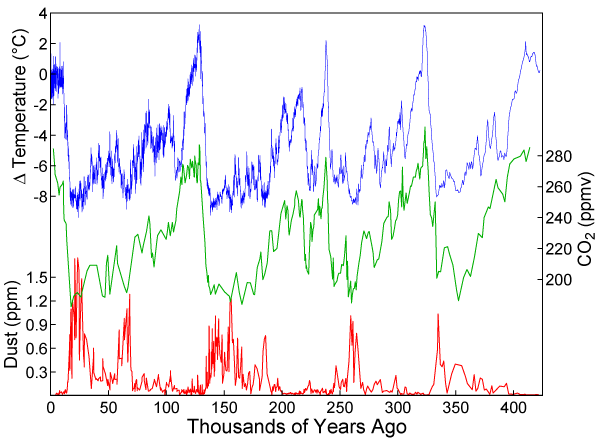
Two articles on paleoclimatology at Wikipedia accurately reflect what I have read elsewhere about long-run climate change. It takes only two figures to put things in perspective. First, a reconstruction of ice-core temperatures (blue line) at Vostok, Antarctica (the present is at the left):

Source: This figure from “Paleoclimatology” at Wikipedia.

The next chart shows that the current cyclical era began about 500,000 years ago. (The present is at the right in this graph.) The expansion of the time scale from 10,000 years ago to the present puts the present warm spell in perspective. It is not extraordinarily warm, by any standard. It is, rather, only a small segment of a the “spike” that typically signals the end (or beginning) of a 120,000-year cycle. The present spike has thus far lasted about 10,000 years, a mere blink of the eye in geological time. It does not look like a spike in the graph because of the expansion of the time scale for the period from 10,000 years ago to the present.

Source: This figure from “Geologic Temperature Record” at Wikipedia.

Two complementary theories explain climate change. First, there are

Milankovitch cycles…the collective effect of changes in the Earth‘s movements upon its climate, named after Serbian civil engineer and mathematician Milutin Milanković. The eccentricity, axial tilt, and precession of the Earth’s orbit vary in several patterns, resulting in 100,000 year ice age cycles of the Quaternary glaciation over the last few million years. The Earth’s axis completes one full cycle of precession approximately every 26,000 years. At the same time, the elliptical orbit rotates, more slowly, leading to a 21,000 year cycle between the seasons and the orbit. In addition, the angle between Earth’s rotational axis and the normal to the plane of its orbit changes from 21.5 degrees to 24.5 degrees and back again on a 41,000 year cycle. Currently, this angle is 23.44 degrees.

Then, as outlined above, there is the varying influence of solar activity on cosmic radiation as the Solar System traverses the Milky Way. This is from an article (“The Real Deal?“) in the National Post:

Astrophysicist Nir Shariv, one of Israel’s top young scientists, describes the logic that led him — and most everyone else — to conclude that SUVs, coal plants and other things man-made cause global warming.

Step One Scientists for decades have postulated that increases in carbon dioxide and other gases could lead to a greenhouse effect.

Step Two As if on cue, the temperature rose over the course of the 20th century while greenhouse gases proliferated due to human activities.

Step Three No other mechanism explains the warming. Without another candidate, greenhouses gases necessarily became the cause.

Dr. Shariv, a prolific researcher who has made a name for himself assessing the movements of two-billion-year-old meteorites, no longer accepts this logic, or subscribes to these views. He has recanted: “Like many others, I was personally sure that CO2 is the bad culprit in the story of global warming. But after carefully digging into the evidence, I realized that things are far more complicated than the story sold to us by many climate scientists or the stories regurgitated by the media.

“In fact, there is much more than meets the eye.”

Dr. Shariv’s digging led him to the surprising discovery that there is no concrete evidence — only speculation — that man-made greenhouse gases cause global warming. Even research from the Intergovernmental Panel on Climate Change– the United Nations agency that heads the worldwide effort to combat global warming — is bereft of anything here inspiring confidence. In fact, according to the IPCC’s own findings, man’s role is so uncertain that there is a strong possibility that we have been cooling, not warming, the Earth. Unfortunately, our tools are too crude to reveal what man’s effect has been in the past, let alone predict how much warming or cooling we might cause in the future.

All we have on which to pin the blame on greenhouse gases, says Dr. Shaviv, is “incriminating circumstantial evidence,” which explains why climate scientists speak in terms of finding “evidence of fingerprints.” Circumstantial evidence might be a fine basis on which to justify reducing greenhouse gases, he adds, “without other ‘suspects.’ ” However, Dr. Shaviv not only believes there are credible “other suspects,” he believes that at least one provides a superior explanation for the 20th century’s warming.

“Solar activity can explain a large part of the 20th-century global warming,” he states, particularly because of the evidence that has been accumulating over the past decade of the strong relationship that cosmic- ray flux has on our atmosphere. So much evidence has by now been amassed, in fact, that “it is unlikely that [the solar climate link] does not exist.”

The sun’s strong role indicates that greenhouse gases can’t have much of an influence on the climate — that C02 et al. don’t dominate through some kind of leveraging effect that makes them especially potent drivers of climate change. The upshot of the Earth not being unduly sensitive to greenhouse gases is that neither increases nor cutbacks in future C02 emissions will matter much in terms of the climate.

Even doubling the amount of CO2 by 2100, for example, “will not dramatically increase the global temperature,” Dr. Shaviv states. Put another way: “Even if we halved the CO2 output, and the CO2 increase by 2100 would be, say, a 50% increase relative to today instead of a doubled amount, the expected reduction in the rise of global temperature would be less than 0.5C. This is not significant.”

The evidence from astrophysicists and cosmologists in laboratories around the world, on the other hand, could well be significant. In his study of meteorites, published in the prestigious journal, Physical Review Letters, Dr. Shaviv found that the meteorites that Earth collected during its passage through the arms of the Milky Way sustained up to 10% more cosmic ray damage than others. That kind of cosmic ray variation, Dr. Shaviv believes, could alter global temperatures by as much as 15% –sufficient to turn the ice ages on or off and evidence of the extent to which cosmic forces influence Earth’s climate.

In another study, directly relevant to today’s climate controversy, Dr. Shaviv reconstructed the temperature on Earth over the past 550 million years to find that cosmic ray flux variations explain more than two-thirds of Earth’s temperature variance, making it the most dominant climate driver over geological time scales. The study also found that an upper limit can be placed on the relative role of CO2 as a climate driver, meaning that a large fraction of the global warming witnessed over the past century could not be due to CO2 — instead it is attributable to the increased solar activity.

Finally, there is this compelling evidence against warmism (from “Look to Mars for the Truth on Global Warming,” also in the National Post):

“One explanation could be that Mars is just coming out of an ice age,” NASA scientist William Feldman speculated after the agency’s Mars Odyssey completed its first Martian year of data collection. “In some low-latitude areas, the ice has already dissipated.” With each passing year more and more evidence arises of the dramatic changes occurring on the only planet on the solar system, apart from Earth, to give up its climate secrets.

NASA’s findings in space come as no surprise to Dr. Habibullo Abdussamatov at Saint Petersburg’s Pulkovo Astronomical Observatory. Pulkovo — at the pinnacle of Russia’s space-oriented scientific establishment — is one of the world’s best equipped observatories and has been since its founding in 1839. Heading Pulkovo’s space research laboratory is Dr. Abdussamatov, one of the world’s chief critics of the theory that man-made carbon dioxide emissions create a greenhouse effect, leading to global warming.

“Mars has global warming, but without a greenhouse and without the participation of Martians,” he told me. “These parallel global warmings — observed simultaneously on Mars and on Earth — can only be a straightline consequence of the effect of the one same factor: a long-time change in solar irradiance.”

The sun’s increased irradiance over the last century, not C02 emissions, is responsible for the global warming we’re seeing, says the celebrated scientist, and this solar irradiance also explains the great volume of C02 emissions.

“It is no secret that increased solar irradiance warms Earth’s oceans, which then triggers the emission of large amounts of carbon dioxide into the atmosphere. So the common view that man’s industrial activity is a deciding factor in global warming has emerged from a misinterpretation of cause and effect relations.”

Dr. Abdussamatov goes further, debunking the very notion of a greenhouse effect. “Ascribing ‘greenhouse’ effect properties to the Earth’s atmosphere is not scientifically substantiated,” he maintains. “Heated greenhouse gases, which become lighter as a result of expansion, ascend to the atmosphere only to give the absorbed heat away.”

The real news from Saint Petersburg — demonstrated by cooling that is occurring on the upper layers of the world’s oceans — is that Earth has hit its temperature ceiling. Solar irradiance has begun to fall, ushering in a protracted cooling period beginning in 2012 to 2015. The depth of the decline in solar irradiance reaching Earth will occur around 2040, and “will inevitably lead to a deep freeze around 2055-60” lasting some 50 years, after which temperatures will go up again.

To paraphrase Shakespeare: The warming, dear reader, is not in ourselves, but in our stars.

Related posts:
Re: Climate “Science”
More Evidence against Anthropogenic Global Warming
Yet More Evidence against Anthropogenic Global Warming
Anthropogenic Global Warming Is Dead, Just Not Buried Yet

Related reading:
A 2000-Year Temperature Reconstruction Based on Non-Treering Hypotheses (in which the Medieval Warm Period looms much larger than the current warm spell and the irrelevance of tree-ring data is explained)
Aliens Cause Global Warming and other speeches by Michael Crichton
Are Carbon Emissions the Cause of Global Warming ? (No. Moreover, global warming has reversed.)
Climate Audit (a blog by Steve McIntyre of the M&M project — see below — and a comprehensive resource for those interested about the science of global warming, as opposed to the religion of it)
Climate Change Chaos (two posts about alternative explanations of “global warming”)
Climate Change 2007: Climate Change Impacts, Adaptation, and Vulnerabilities (IPCC’s latest contribution to the scare about global warming)
Climate Patterns in Northern Fennoscandia during the Last Millenium (the present episode as a blip in Finnish temperature patterns dating back 7,640 years)
Climate Warming Is Naturally Caused and Shows No Human Influence
Clouding the Issue (the effect of the “Asian Brown Cloud” on “global warming”)
Cool Heads Required (Spiked! survey article about climate change)
A Consensus about Consensus
Consensus, What Consensus? Among Climate Scientists the Debate Is Not Over
Cosmoclimatology: A New Theory Emerges (Henrik Svensmark‘s theory of climate change as being caused mainly by the level of cosmic radiation reaching Earth; supported by this article; criticized in Lockwood and Frohlich’s paper, which is debunked here in a cached article that I have downloaded in case it disappears)
Datasets & Images (main page for NASA temperature data: U.S., northern hemisphere, various latitude bands, an global)
Falsification of the Atmospheric CO2 Greenhouse Effects within the Frame of Physics (in which two scientists explain that the so-called greenhouse effect violates the laws of physics)
Greenie Watch (a blog by John Ray in which he reprints articles debunking “warmism” and other enviro-nut causes)
Global Warming’s Silver Lining
Heat Capacity, Time Constant, and Sensitivity of Earth’s Climate System (a downward re-estimate of the likely change in Earth’s temperature, summarized here by John Ray)
Heretical Thoughts about Science and Society (an essay by noted physicist Freeman Dyson, in which he factually and logically dissects global-warming alarmism)
The Iris Opens Again? (a post about research into the cyclical relationship between clouds, warming, and cooling)
Let’s Be Honest about the Real Consensus
Let’s Look on the Sunny Side (Timesonline article about the sun and global warming)
M&M Project Page (summaries of and links to scientific analyses that refute the “hockey stick” paradigm upon which the global-warming scare rests)
New Peer-Reviewed Scientific Studies Chill Global Warming Fears (annotated bibliography, released by the ranking minority member of the U.S. Senate Committee on Environment and Public Works)
Peter Huber And Mark Mills On Our Energy Future
The Real Deal? (introductory article about cosmoclimatology, with links to 10 other articles on various aspects of “warmism”)
A Report from the Global Warming Battlefield
Scientific Forecasts vs. Forecasts by Scientists (documentation of the fact that the climate models that support “warmism” based on opinion, not evidence)
Tellus More about Hurricanes (a post at World Climate Report about three journal articles on the relationship between “global warming” and hurricanes)
Trouble in Climate-Model Paradise (how climate models used to project warming trends significantly underestimate precipitation)

Warming, Anyone?

From my “Resources” page, an updated section on climate change:

Aliens Cause Global Warming and other speeches by Michael Crichton
Climate Audit (a blog by Steve McIntyre of the M&M project — see below — and a comprehensive resource for those interested about the science of global warming, as opposed to the religion of it)
Climate Change Chaos (two posts about alternative explanations of “global warming”)
Climate Change 2007: Climate Change Impacts, Adaptation, and Vulnerabilities (IPCC’s latest contribution to the scare about global warming)
Climate Patterns in Northern Fennoscandia during the Last Millenium (the present episode as a blip in Finnish temperature patterns dating back 7,640 years)
Clouding the Issue (the effect of the “Asian Brown Cloud” on “global warming”)
Cool Heads Required (Spiked! survey article about climate change)
A Consensus about Consensus
Consensus, What Consensus? Among Climate Scientists the Debate Is Not Over
Cosmoclimatology: A New Theory Emerges (Henrik Svensmark‘s theory of climate change as being caused mainly by the level of cosmic radiation reaching Earth; supported by this article; criticized in Lockwood and Frohlich’s paper, which is debunked here in a cached article that I have downloaded in case it disappears)
Datasets & Images (main page for NASA temperature data: U.S., northern hemisphere, various latitude bands, an global)
Falsification of the Atmospheric CO2 Effects within the Frame of Physics (in which two scientists explain that the so-called greenhouse effect violates the laws of physics)
Greenie Watch (a blog by John Ray in which he reprints articles debunking “warmism” and other enviro-nut causes)
Global Warming’s Silver Lining
Heat Capacity, Time Constant, and Sensitivity of Earth’s Climate System (a downward re-estimate of the likely change in Earth’s temperature, summarized here by John Ray)
Heretical Thoughts about Science and Society (an essay by noted physicist Freeman Dyson, in which he factually and logically dissects global-warming alarmism)
The Iris Opens Again? (a post about research into the cyclical relationship between clouds, warming, and cooling)
Let’s Be Honest about the Real Consensus
Let’s Look on the Sunny Side (Timesonline article about the sun and global warming)
M&M Project Page (summaries of and links to scientific analyses that refute the “hockey stick” paradigm upon which the global-warming scare rests)
New Peer-Reviewed Scientific Studies Chill Global Warming Fears (annotated bibliography, released by the ranking minority member of the U.S. Senate Committee on Environment and Public Works)
Peter Huber And Mark Mills On Our Energy Future
A Report from the Global Warming Battlefield
Scientific Forecasts vs. Forecasts by Scientists (documentation of the fact that the climate models that support “warmism” based on opinion, not evidence)
Tellus More about Hurricanes (a post at World Climate Report about three journal articles on the relationship between “global warming” and hurricanes)
Trouble in Climate-Model Paradise (how climate models used to project warming trends significantly underestimate precipitation)

The End of Global Warming

Here:

[W]e have been unable to find a scientific forecast to support the currently widespread belief in “global warming.”

Religion As Beneficial Evolutionary Adaptation

I have written thrice (here, here, and here) about Richard Dawkins’s apoplectic views on religion. Dawkins — in a nutshell — views religion as a bad thing because, in his view, (a) many bad things are done its name and (b) it is anti-scientific. Now, (a) does not prove that religion causes people to do bad things (people just do bad things), nor does (b) prove that religion is anti-scientific (many religious persons are and have been excellent scientists).

Now comes an article by David Sloan Wilson (“Beyond Demonic Memes: Why Richard Dawkins Is Wrong about Relgion,” eSkeptic.com, July 4, 2007). Wilson, an evolutionary biologist and professor of anthropology and biology at Binghamton University, assesses Dawkins’s The God Delusion. Wilson begins:

Richard Dawkins and I share much in common. We are both biologists by training who have written widely about evolutionary theory. We share an interest in culture as an evolutionary process in its own right. We are both atheists in our personal convictions who have written books on religion. In Darwin’s Cathedral [link added: ED] I attempted to contribute to the relatively new field of evolutionary religious studies. When Dawkins’ The God Delusion was published I naturally assumed that he was basing his critique of religion on the scientific study of religion from an evolutionary perspective. I regret to report otherwise. He has not done any original work on the subject and he has not fairly represented the work of his colleagues. Hence this critique of The God Delusion and the larger issues at stake.

Later, after summarizing his points of agreement with Dawkins, Wilson turns to the evidence for religion as an evolutionary adaptation that helps groups to survive and thrive. He observes, for example, that

On average, religious believers are more prosocial than non-believers, feel better about themselves, use their time more constructively, and engage in long-term planning rather than gratifying their impulsive desires. On a moment-by-moment basis, they report being more happy, active, sociable, involved and excited. Some of these differences remain even when religious and non-religious believers are matched for their degree of prosociality. More fine-grained comparisons reveal fascinating differences between liberal vs. conservative protestant denominations, with more anxiety among the liberals and conservatives feeling better in the company of others than when alone. Religions are diverse, in the same way that species in ecosystems are diverse. Rather than issuing monolithic statements about religion, evolutionists need to explain religious diversity in the same way that they explain biological diversity.

Wilson writes, later in the article, that

In Darwin’s Cathedral, I initiated a survey of religions drawn at random from the 16-volume Encyclopedia of World Religions, edited by the great religious scholar Mircia Eliade. The results are described in an article titled “Testing Major Evolutionary Hypotheses about Religion with a Random Sample,” which was published in the journal Human Nature and is available on my website. The beauty of random sampling is that, barring a freak sampling accident, valid conclusions for the sample apply to all of the religions in the encyclopedia from which the sample was taken. By my assessment, the majority of religions in the sample are centered on practical concerns, especially the definition of social groups and the regulation of social interactions within and between groups. New religious movements usually form when a constituency is not being well served by current social organizations (religious or secular) in practical terms and is better served by the new movement. The seemingly irrational and otherworldly elements of religions in the sample usually make excellent practical sense when judged by the only gold standard that matters from an evolutionary perspective — what they cause the religious believers to do.

What religions do (on the whole) is to cause their adherents to live more positive and productive lives, as Wilson notes in the passage quoted earlier.

Now, this says nothing one way or the other about the truth of religious belief. But it does underscore the irrationality and unscientific nature of the virulent anti-religious emissions of Richard Dawkins and his ilk. Religion is, in the main, a beneficial social institution.

Atheism, Religion, and Science Redux

In which I expose the intellectual sloppiness (or chicanery) of strident atheists in general and Richard Dawkins (noted scientist and virulent anti-religionist) in particular.

UPDATED 07/02/07 (addendum at the end of the post)

I posit this range of possible positions about God (from “Atheism, Religion, and Science“):

A. I believe that there is a God; that is, an omniscient, omnipotent being who created the universe, and who remains involved in the events of the universe, including the lives of humans. (Theism)

B. I believe that there is some kind of force or intelligence created the universe, but that force or intelligence has since had no involvement in the universe. (Deism)

C. I believe that there is no God, force, or intelligence of the kind posited in A or B. (Strong atheism)

D.1. I choose not to believe in a God, force, or intelligence of the kind posited in A or B, even though His or its existence cannot be proved or disproved. (Weak atheism)

D.2. I choose to believe in a God, force, or intelligence of the kind posited in A or B, even though His or its existence cannot be proved or disproved. (Weak theism or deism)

E. I take no position on the existence of a God, force, or intelligence of the kind posited in A or B because His or its existence can never be proved or disproved. (Agnosticism)

None of those statements implies a position about religion; thus:

A. A theist need not adhere to a religion. A theist might, for example, believe that religions have their roots in myth, superstition, power-seeking — or some combination of these — and that they too often foment evil. But a theist may nevertheless believe that the existence of the universe and (at least some) documented events or natural phenomena are consistent with the possibility of an intervening Creator. Such a theist would be a “believer,” even though not affiliated with an organized religion.

B. A deist need not adhere to a religion. A deist might, for example, believe that all religions have their roots in myth, superstition, power-seeking — or some combination of these — and that they too often foment evil. But a deist may nevertheless believe that the existence of the universe is owed to an intelligent Creator. Such a deist would be a “believer,” even though not affiliated with an organized religion.

C. Strong atheism and religious adherence — seemingly contradictory positions — can be found in the same person under certain circumstances. Such a person doesn’t accept the religious doctrines that proclaim God’s existence or demand that he be obeyed and worshiped. Such a person does believe, however, that certain religious traditions are valuable socializing influences which should be perpetuated; that is, his reasons for adherence might be called “non-religious.”

D.1. A weak atheist, like a strong one, may adhere to a religion for “non-religious” reasons.

D.2. A weak theist or deist, like his strong counterpart, might be a “believer” while rejecting organized religion.

E. An agnostic might adhere to a religion because he is “hedging his bets” or because he, like some atheists, values the “non-religious” benefits of religion. Contrarily, an agnostic might spurn religion because, like some theists and deists, he believes that religions have their roots in myth, superstition, power-seeking — or some combination of these — and that they too often foment evil.

It should now be obvious that one’s views about God and one’s views about religion are entirely separable.
Atheists — like some theists, deists, and agnostics — may reject religion because it is founded on myth, superstition, power-seeking — or some combination of these — or because it too often foments evil. But the rejection of religion neither proves nor disproves the existence of God. God exists (or not) regardless of the origins of religion, its value, or one’s beliefs about the existence of God.

Think of it this way: An atheist who rejects the idea of God because he rejects religion is (unwittingly perhaps) guilty of making this kind of circular argument:

  1. There can be no God if religion is based on myth, superstition, power-seeking — or some combination of these — and is sometimes conducive to evil.
  2. Religion (in the atheists’ view) is based on myth, superstition, power-seeking — or some combination of these — and is sometimes conducive to evil.
  3. Therefore, there is no God.

Yes, the conclusion follows from the premises, but only because the conclusion is assumed in the first premise. Such reasoning is a type of logical fallacy known as “begging the question.” One’s disbelief in the existence of God or the possibility of God’s existence does not disprove God’s existence or the possibility of God’s existence.

There are multitudes (e.g., many theists, even more deists, and most agnostics) who — preferring not to beg the question — accept the existence of God, or the possibility of the existence of God, even though they reject religion. They understand (perhaps intuitively) that the atheist who rejects God because he rejects religion is guilty of begging the question.

There are, nevertheless, strident atheists (strong, vociferously virulent atheists) who believe that their arguments against religion somehow bear on the question of God’s existence. Christopher Hitchens — a non-scientist — is an exemplar of this brand of strident atheism. Hitchens and his ilk disdain religion for one reason or another (sometimes validly), which (invalidly) leads them to pronounce that there is no God. They simply adopt atheism as a matter of faith. Atheism is their religion.

What about scientists who are strident atheists, and who claim not to be “religious” atheists but scientific ones? An exemplar of that breed is Richard Dawkins, a noted British ethologist, evolutionary biologist, and popular science writer who holds the Charles Simonyi Chair for the Public Understanding of Science at Oxford University. In spite of all that, Dawkins is guilty of the same kind of unscientific (and illogical) thinking as that of non-scientists like Hitchens.

Dawkins — like Hitchens and his ilk — is virulently anti-religious. But Dawkins tries to deny his “religious” atheism by asserting that the question of God’s existence is a scientific one.

Dawkins expresses his hostility to religion in A Devil’s Chaplain (inter alia), where he latches onto “Russell’s teapot“:

The reason organized religion merits outright hostility is that, unlike belief in Russell’s teapot,[“] religion is powerful, influential, tax-exempt and systematically passed on to children too young to defend themselves. Children are not compelled to spend their formative years memorizing loony books about teapots. Government-subsidized schools don’t exclude children whose parents prefer the wrong shape of teapot. Teapot-believers don’t stone teapot-unbelievers, teapot-apostates, teapot-heretics and teapot-blasphemers to death. Mothers don’t warn their sons off marrying teapot-shiksas whose parents believe in three teapots rather than one. People who put the milk in first don’t kneecap those who put the tea in first. [Quoted here.]
__________
* A hypothetical, undetectable object in space, the existence of which cannot be disproved. The teapot (in Russell’s view) is analogous to God: ED.

Dawkins, like other strident atheists, is guilty of citing instances of evil committed in the name of (but not necessarily because of) religion, and then generalizing from those instances to the conclusion that he wishes to reach: Religion is evil because it is the cause of much evil. Dawkins, like other strident atheists, simply chooses to ignore all the good that is done in the name of (and even because of) religion (e.g., the humanitarian works of myriad Christian groups through the ages; the rescue of Jews from the Holocaust by many Christians — including Pope Pius XII). Or perhaps Dawkins — unscientifically — assumes that the evil outweighs the good. In any case, Dawkins’s anti-religious prejudices are evident.

Dawkins attacks religion because religion is founded on God — if not by God — and Dawkins simply doesn’t want to believe in God. His “faith” consists of a unfounded disbelief in God — and he admits it:

I believe, but I cannot prove, that all life, all intelligence, all creativity and all “design” anywhere in the universe, is the direct or indirect product of Darwinian natural selection. It follows that design comes late in the universe, after a period of Darwinian evolution. Design cannot precede evolution and therefore cannot underlie the universe. [Emphasis added.]

But Dawkins never ceases in his quest to disprove God “scientifically.” Here are some relevant passages from a recent colloquy between Dawkins and eminent physicist Lawrence Krauss (“Should Science Speak to Faith,” ScientificAmerican.com, June 19, 2007):

Dawkins: …I agree with you [Krauss] that it might be surprisingly hard to detect, by observation or experiment, whether we live in a god-free universe or a god-endowed one. Nevertheless, I still maintain that there is a cogent sense in which a scientist can discuss the question. There still is a sense in which we can have an interesting and illuminating scientific discussion about whether X is the case, even if we can’t demonstrate it one way or the other by observation or experiment. How can I argue this and still claim to be doing science?

In The God Delusion, I made the distinction between two kinds of agnosticism. Permanent Agnosticism in Principle (PAP) is exemplified by that philosophical chestnut, “Do you see red the way I see red, or might your red be my green or some completely different hue (‘sky-blue-pink’) that I cannot imagine?” Temporary agnosticism in practice (TAP) refers to things that we cannot (or cannot yet) know in practice but nevertheless have a true scientific reality in a way that the ‘sky-blue-pink’ conundrum does not. Bertrand Russell’s hypothetical orbiting teapot might be an example. Some people think the question of God’s existence is equivalent to ‘sky-blue-pink’ (PAP), and they wrongly deduce that his existence and non-existence are equiprobable alternatives. I think we should be TAP agnostic about God, and I certainly don’t think the odds are 50/50.

Statements such as ‘There are (or are not) intelligent aliens elsewhere in the universe’ are clearly TAP statements insofar as we are talking about the observable universe this side of our event horizon. At any time, a flying saucer or a radio transmission could clinch the matter in one direction (it can never be clinched in the other). What, though, of statements about the existence of intelligent aliens in those parts of the universe that are beyond our event horizon, where the galaxies are receding from us so fast that information from them can never in principle reach us because of the finite speed of light? In this case, at least according to the physicists I have read, the aliens would forever be undetectable by any means whatever. On the face of it, therefore, we would have to be PAP agnostic about them, not just TAP agnostic.

Yet I would resent it as a scientist, not just as a person, if you tried to rule out any scientific discussion of aliens beyond our event horizon, on the grounds that it is beyond the reach of empirical test (PAP). Suppose we take the Drake equation for calculating the odds of alien intelligences existing, and apply it to the whole universe rather than just our galaxy. Clearly it will yield very different results depending on whether we hold to a finite or infinite model of the universe. Those two models of the universe are discriminable by empirical evidence, and that empirical evidence would therefore have some bearing on the probability of alien life existing somewhere in the universe. Hence the probability of alien life is a question of TAP rather than PAP agnosticism, even though direct empirical experience of the aliens might be impossible. It is not obvious to me that gods are beyond such probability estimates, any more than aliens are. And a probability estimate is the limit of my aspiration.

What Dawkins wants us to accept is this: He is a scientist; therefore, any speculation on his part about the existence (or non-existence) of God is scientific if it is couched in the language of science (however devoid of empirical content). That is, of course, pure balderdash.

Science — the accumulation, interpretation, and organization of knowledge — may benefit from speculation, if speculation yields testable hypotheses. But the analysis suggested by Dawkins is nothing more than speculation. It does not and cannot advance our knowledge regarding the existence or non-existence of God. An article in Wikipedia says this about the Drake equation:

The Drake equation (rarely also called the Green Bank equation or the Sagan equation) is a famous result in the speculative fields of exobiology, astrosociobiology and the search for extraterrestrial intelligence.

This equation was devised by Dr Frank Drake (now Emeritus Professor of Astronomy and Astrophysics at the University of California, Santa Cruz) in the 1960s in an attempt to estimate the number of extraterrestrial civilizations in our galaxy with which we might come in contact. The main purpose of the equation is to allow scientists to quantify the uncertainty of the factors which determine the number of extraterrestrial civilizations. [Emphasis added.]

The Drake equation says nothing about the actual possibility of extraterrestrial civilizations — or of God — as Krauss explains in response to Dawkins:

First, I have to say that I have nothing against trying to think about phenomena that might never be directly measurable. I do this all the time in my work in cosmology, where I consider the possibilities of other causally disconnected universes. Of course I do this to see if I can resolve outstanding puzzles in the physics of our universe. If this approach turns out not to work, then I find the issue less interesting. I also agree with you that probabilities are important, but I think your example of the Drake equation is quite relevant here, but perhaps not in the way you intended. First of all, the Drake Equation is really applied locally, within our galaxy. If the probabilities turn out to be small that there is more than one intelligent life form in our galaxy, I think most astrophysicists will not be particularly interested in worrying about the civilizations that might exist in other galaxies but which will be forever removed from us. But more important is that fact that the probabilities associated with the Drake equation are almost all so poorly known that the equation really hasn’t driven much useful research. Varying each of the conditional probabilities in the equations by an order of magnitude or so, one can derive results that either argue strongly in favor of extraterrestrial intelligence, or strongly against it. The proof is likely to come from empirical searches. As bad as this is, I would argue it is far worse when attempting to quantify probabilities for the existence of divine intelligence or purpose in the universe.

Krauss is being too kind to Dawkins. Or, perhaps I should say that Krauss skewers Dawkins politely. One can hypothesize until the cows come home, but hypothesizing about phenomena that cannot be quantified empirically is not science. It’s nothing more than college-dorm bull-sh*****g with a veneer of (pseudo) scientific precision. It is an appeal to authority — the authority of (in this case) an eminent scientist. But it is an appeal founded on two pre-conceived ideas: There is no God. Religion is evil.

There is no “probability” that God exists, as Dawkins would have it. God either does or does not exist. And the existence of God is a question beyond the grasp of science. To use Dawkins’s terms, the question of God’s existence is permanently agnostic in principle (PAP); intellectual sleight-of-hand cannot convert it to a question that is temporarily agnostic in practice (TAP). Whatever we might know (or suspect) about the foundations of religion and its influence on human behavior has no bearing on the question of God’s existence.

Related posts:
Same Old Story, Same Old Song and Dance
Atheism, Religion, and Science
The Limits of Science
Beware of Irrational Atheism
The Creation Model
Evolution and Religion
Science, Evolution, Religion, and Liberty
Science, Logic, and God
The Universe . . . . Four Possibilities

ADDENDUM

After publishing this post, I came across a post by Keith Burgess-Jackson that led me to this article by Thomas Nagel (B.Phil., Oxford; Ph.D., Harvard; University Professor, professor of law, and professor of philosophy at New York University). Among many other things, Nagel has this to say about Dawkins’s efforts to make atheism seem scientific:

The theory of evolution through heritable variation and natural selection reduces the improbability of organizational complexity by breaking the process down into a very long series of small steps, each of which is not all that improbable. But each of the steps involves a mutation in a carrier of genetic information—an enormously complex molecule capable both of self-replication and of generating out of surrounding matter a functioning organism that can house it. The molecule is moreover capable sometimes of surviving a slight mutation in its structure to generate a slightly different organism that can also survive. Without such a replicating system there could not be heritable variation, and without heritable variation there could not be natural selection favoring those organisms, and their underlying genes, that are best adapted to the environment.

The entire apparatus of evolutionary explanation therefore depends on the prior existence of genetic material with these remarkable properties. Since 1953 we have known what that material is, and scientists are continually learning more about how DNA does what it does. But since the existence of this material or something like it is a precondition of the possibility of evolution, evolutionary theory cannot explain its existence. We are therefore faced with a problem analogous to that which Dawkins thinks faces the argument from design: we have explained the complexity of organic life in terms of something that is itself just as functionally complex as what we originally set out to explain. So the problem is just pushed back one step: how did such a thing come into existence?…

The fear of religion leads too many scientifically minded atheists to cling to a defensive, world-flattening reductionism. Dawkins, like many of his contemporaries, is hobbled by the assumption that the only alternative to religion is to insist that the ultimate explanation of everything must lie in particle physics, string theory, or whatever purely extensional laws govern the elements of which the material world is composed….

It is natural to try to take any successful intellectual method [i.e., modern science] as far as it will go. Yet the impulse to find an explanation of everything in physics has over the last fifty years gotten out of control. The concepts of physical science provide a very special, and partial, description of the world that experience reveals to us. It is the world with all subjective consciousness, sensory appearances, thought, value, purpose, and will left out. What remains is the mathematically describable order of things and events in space and time.

…The reductionist project usually tries to reclaim some of the originally excluded aspects of the world, by analyzing them in physical—that is, behavioral or neurophysiological—terms; but it denies reality to what cannot be so reduced. I believe the project is doomed—that conscious experience, thought, value, and so forth are not illusions, even though they cannot be identified with physical facts….

We have more than one form of understanding. Different forms of understanding are needed for different kinds of subject matter. The great achievements of physical science do not make it capable of encompassing everything, from mathematics to ethics to the experiences of a living animal.We have no reason to dismiss moral reasoning, introspection, or conceptual analysis as ways of discovering the truth just because they are not physics….

A religious worldview is only one response to the conviction that the physical description of the world is incomplete. Dawkins says with some justice that the will of God provides a too easy explanation of anything we cannot otherwise understand, and therefore brings inquiry to a stop. Religion need not have this effect, but it can. It would be more reasonable, in my estimation, to admit that we do not now have the understanding or the knowledge on which to base a comprehensive theory of reality.

Amen.

Einstein, Science, and God

I have written several times about the connection between science and faith. My views (links below) put me in excellent company. From “Einstein & Faith” (Time, April 5, 2007):

[Einstein] and his wife were at a dinner party in Berlin when a guest expressed a belief in astrology. Einstein ridiculed the notion as pure superstition. Another guest stepped in and similarly disparaged religion. Belief in God, he insisted, was likewise a superstition.

At this point the host tried to silence him by invoking the fact that even Einstein harbored religious beliefs. “It isn’t possible!” the skeptical guest said, turning to Einstein to ask if he was, in fact, religious. “Yes, you can call it that,” Einstein replied calmly. “Try and penetrate with our limited means the secrets of nature and you will find that, behind all the discernible laws and connections, there remains something subtle, intangible and inexplicable. Veneration for this force beyond anything that we can comprehend is my religion. To that extent I am, in fact, religious.”…

Shortly after his 50th birthday, Einstein also gave a remarkable interview in which he was more revealing than he had ever been about his religious sensibility. It was with George Sylvester Viereck….

[Viereck asked Einstein] Do you believe in God? “I’m not an atheist. I don’t think I can call myself a pantheist. The problem involved is too vast for our limited minds. We are in the position of a little child entering a huge library filled with books in many languages. The child knows someone must have written those books. It does not know how. It does not understand the languages in which they are written. The child dimly suspects a mysterious order in the arrangement of the books but doesn’t know what it is. That, it seems to me, is the attitude of even the most intelligent human being toward God. We see the universe marvelously arranged and obeying certain laws but only dimly understand these laws.”….

Einstein tried to express these feelings clearly, both for himself and all of those who wanted a simple answer from him about his faith. So in the summer of 1930, amid his sailing and ruminations in Caputh, he composed a credo, “What I Believe,”….”The most beautiful emotion we can experience is the mysterious. It is the fundamental emotion that stands at the cradle of all true art and science. He to whom this emotion is a stranger, who can no longer wonder and stand rapt in awe, is as good as dead, a snuffed-out candle. To sense that behind anything that can be experienced there is something that our minds cannot grasp, whose beauty and sublimity reaches us only indirectly: this is religiousness. In this sense, and in this sense only, I am a devoutly religious man.”…

[T]hroughout his life, Einstein was consistent in rejecting the charge that he was an atheist. “There are people who say there is no God,” he told a friend. “But what makes me really angry is that they quote me for support of such views.” And unlike Sigmund Freud or Bertrand Russell or George Bernard Shaw, Einstein never felt the urge to denigrate those who believed in God; instead, he tended to denigrate atheists. “What separates me from most so-called atheists is a feeling of utter humility toward the unattainable secrets of the harmony of the cosmos,” he explained.

In fact, Einstein tended to be more critical of debunkers, who seemed to lack humility or a sense of awe, than of the faithful. “The fanatical atheists,” he wrote in a letter, “are like slaves who are still feeling the weight of their chains which they have thrown off after hard struggle. They are creatures who–in their grudge against traditional religion as the ‘opium of the masses’– cannot hear the music of the spheres.”

Einstein later explained his view of the relationship between science and religion at a conference at the Union Theological Seminary in New York. The realm of science, he said, was to ascertain what was the case, but not evaluate human thoughts and actions about what should be the case. Religion had the reverse mandate. Yet the endeavors worked together at times. “Science can be created only by those who are thoroughly imbued with the aspiration toward truth and understanding,” he said. “This source of feeling, however, springs from the sphere of religion.” The talk got front-page news coverage, and his pithy conclusion became famous. “The situation may be expressed by an image: science without religion is lame, religion without science is blind.”

Related posts:
Atheism, Religion, and Science
The Limits of Science
Beware of Irrational Atheism
The Creation Model
Evolution and Religion
Science, Evolution, Religion, and Liberty
Science, Logic, and God
The Universe . . . . Four Possibilities

The Universe . . . Four Possibilities

UPDATED, BELOW

1. Everything just is — without an outside cause or overarching design. Scientists claim to find “laws” governing the behavior of matter, energy, time, and space. But such laws only partly explain the universe; there is no grand unifying theory of everything. And those laws are subject to change as science unveils new aspects of matter, energy, time, and space — as it does continuously.

2. Same as 1, but the sum of everything is a “cosmic consciousness,” akin to the consciousness that seems to emerge from the disparate parts of the brain. Being “in tune” with the cosmic consciousness is a “gift” that entitles its self-anointed recipients to pass judgment on the behavior of those lesser mortals whose actions are out of step with the cosmic consciousness.

3. Similar to 2, but instead of a “cosmic consciousness” there is a “cosmic balance.” The “right” balance is, of course, known only to the self-anointed high priests of environmentalism and animal rights. In their reckoning, human beings have no special place in the scheme of things, and may not even be a necessary part of the “right” balance. Their natural allies are those who deny the superiority of Western civilization, the importance of the Judeo-Christian tradition to the development of that civilization, and the particular importance of the Constitution of the United States (in its original meaning) as a bulwark of that civilization in one of its most secure bastions — the United States of America. Ironically, extreme libertarians (i.e., anarcho-capitalists, or market capitalists) and Objectivists (their close correlates) — both of which groups disdain the high priests of environmentalism and the enemies of Western civilization — also hew to a belief in a “cosmic balance,” given their insistence that rights are Platonic essences that simply exist without the benefit of human efforts to secure them through politics and war.

4. There is an external force or consciousness that brought everything into being. That force or consciousness may merely have set things in motion, or it may play a continuing role in some or all aspects of existence. The intentions of the external force or consciousness are known to religionists, by revelation and/or faith; science is inadequate to fathom those intentions or to prove that the universe conforms to an underlying “design.” Those who reject this fourth possibility as “unscientific” — that is, most scientists as well as the typical libertarian/Objectivist — can do so only by accepting one of the equally unscientific (i.e., untestable) possibilities outlined above.

To be continued . . . perhaps.

UPDATE

In “Existence and Creation” (May 20, 2011) I refine these four possibilities and add a fifth.

Generations

Here is a good summary of Generations: The History of American’s Future, 1589 to 2069, which I read 10-15 years ago. The authors’ historiographic technique consists of after-the-fact generalizations that lead them to conclude that there are four basic generational personalities, which occur in repetitive cycles. It is those cycles that dictate the course of American history — according to the authors.

The generational analysis is of dubious value, because of its reductionism. Human nature and history just aren’t that simple. But the analysis does provide a hook on which to hang a neat summary of American history. The book is worth reading for its unique perspective on that history, not for its pseudo-scientific explanation of it.

In Praise of Solitude

A remark by my son caused me to revisit Anthony Storr’s Solitude: A Return to the Self. Storr, in the book’s final paragraphs, summarizes his themes and conclusions:

This book began with the observation that many highly creative people were predominantly solitary, but that it was nonsense to suppose that, because of this, they were necessarily unhapppy or neurotic. Although man is a social being, who certainly needs interaction with others, there is considerable variation in the depth of the relationships which individuals form with each other. All human beings need interests as well as relationships; all are geared toward the impersonal as well as toward the personal….

The capacity to be alone was adumbrated as a valuable resource, which facilitated learning, thinking, innovation, coming to terms with change, and the maintenance of contact with the inner world of the imagination. We saw that, even in those whose capacity for making intimate relationships has been damaged, the development of creative imagination could exercise a healing function…. Man’s adaptation to the world is largely governed by the development of the imagination and hence of an inner world of the psyche which is necessarily at variance with the external world…. Throughout the book, it was noted that some of the most profound and healing psychological experiences which individuals encounter take place internally, and are only distantly related, if at all, to interaction with other human beings….

The epigraph of this chapter is taken from The Prelude. It is fitting that Wordsworth should also provide its end.

When from our better selves we have too long
Been parted by the hurrying world, and droop,
Sick of its business, of its pleasures tired,
How gracious, how benign, is Solitude.

Related post: IQ and Personality