The Climate Debate: A Postscript

In my most recent posts about the climate debate (here and here), I forgot to note a suppressed article about greenhouse gases, which has been rescued from oblivion and republished here and here. Some excerpts:

According to Vladimir Shaidurov of the Russian Academy of Sciences, the apparent rise in average global temperature recorded by scientists over the last hundred years or so could be due to atmospheric changes that are not connected to human emissions of carbon dioxide from the burning of natural gas and oil. . . .

Shaidurov has used a detailed analysis of the mean temperature change by year for the last 140 years and explains that there was a slight decrease in temperature until the early twentieth century. This flies in the face of current global warming theories that blame a rise in temperature on rising carbon dioxide emissions since the start of the industrial revolution. Shaidurov, however, suggests that the rise, which began between 1906 and 1909, could have had a very different cause, which he believes was the massive Tunguska Event, which rocked a remote part of Siberia, northwest of Lake Baikal on the 30th June 1908. . . .

Global warming is thought to be caused by the “greenhouse effect”. Energy from the sun reaches the earth’s surface and warms it, without the greenhouse effect most of this energy is then lost as the heat radiates back into space. However, the presence of so-called greenhouse gases at high altitude absorb much of this energy and then radiate a proportion back towards the earth’s surface. Causing temperatures to rise. . . .

[T]he most potent greenhouse gas is water, explains Shaidurov and it is this compound on which his study focuses. According to Shaidurov, only small changes in the atmospheric levels of water, in the form of vapour and ice crystals can contribute to significant changes to the temperature of the earth’s surface, which far outweighs the effects of carbon dioxide and other gases released by human activities. Just a rise of 1% of water vapour could raise the global average temperature of Earth’s surface more then 4 degrees Celsius.

The role of water vapour in controlling our planet’s temperature was hinted at almost 150 years ago by Irish scientist John Tyndall. Tyndall, who also provided an explanation as to why the sky is blue, explained the problem: “The strongest radiant heat absorber, is the most important gas controlling Earth’s temperature. Without water vapour, he wrote, the Earth’s surface would be ‘held fast in the iron grip of frost’.” Thin clouds at high altitude allow sunlight to reach the earth’s surface, but reflect back radiated heat, acting as an insulating greenhouse layer.

Water vapour levels are even less within our control than CO levels. According to Andrew E. Dessler of the Texas A & M University writing in ‘The Science and Politics of Global Climate Change’, “Human activities do not control all greenhouse gases, however. The most powerful greenhouse gas in the atmosphere is water vapour, he says, “Human activities have little direct control over its atmospheric abundance, which is controlled instead by the worldwide balance between evaporation from the oceans and precipitation.”

As such, Shaidurov has concluded that only an enormous natural phenomenon, such as an asteroid or comet impact or airburst, could seriously disturb atmospheric water levels, destroying persistent so-called ‘silver’, or noctilucent, clouds composed of ice crystals in the high altitude mesosphere (50 to 85km). The Tunguska Event was just such an event, and coincides with the period of time during which global temperatures appear to have been rising the most steadily – the twentieth century. There are many hypothetical mechanisms of how this mesosphere catastrophe might have occurred, and future research is needed to provide a definitive answer.

Read the whole thing. Also read John Ray’s Greenie Watch, where Ray posts daily updates about unscientific “science” in the service of the Left’s anti-humane agenda.

Related posts:
Climatology
Global Warming: Realities and Benefits
Words of Caution for the Cautious
Scientists in a Snit
Another Blow to Climatology?
Bad News for Politically Correct Science
Another Blow to Chicken-Little Science
Bad News for Enviro-nuts
The Hockey Stick Is Broken
Science in Politics, Politics in Science
Global Warming and Life
Words of Caution for Scientific Dogmatists
Hurricanes and Global Warming
Global Warming and the Liberal Agenda
Debunking “Scientific Objectivity”
Hurricanes and Glaciers
Remember the Little Ice Age?
Science’s Anti-Scientific Bent
A Possibly Useful Idiot
Science’s Anti-Scientific Bent

Richard Lindzen, Alred P. Sloan Professor of Atmospheric Science at MIT, writes about “Climate of Fear” at OpinionJournal:

Everything from the heat wave in Paris to heavy snows in Buffalo has been blamed on people burning gasoline to fuel their cars, and coal and natural gas to heat, cool and electrify their homes. Yet how can a barely discernible, one-degree increase in the recorded global mean temperature since the late 19th century possibly gain public acceptance as the source of recent weather catastrophes? And how can it translate into unlikely claims about future catastrophes? . . .

Global temperature has risen about a degree since the late 19th century; levels of CO2 in the atmosphere have increased by about 30% over the same period; and CO2 should contribute to future warming. These claims are true. However, what the public fails to grasp is that the claims neither constitute support for alarm nor establish man’s responsibility for the small amount of warming that has occurred. In fact, those who make the most outlandish claims of alarm are actually demonstrating skepticism of the very science they say supports them. It isn’t just that the alarmists are trumpeting model results that we know must be wrong. It is that they are trumpeting catastrophes that couldn’t happen even if the models were right as justifying costly policies to try to prevent global warming. . . .

So how is it that we don’t have more scientists speaking up about this junk science? It’s my belief that many scientists have been cowed not merely by money but by fear. An example: Earlier this year, Texas Rep. Joe Barton issued letters to paleoclimatologist Michael Mann and some of his co-authors seeking the details behind a taxpayer-funded analysis that claimed the 1990s were likely the warmest decade and 1998 the warmest year in the last millennium. Mr. Barton’s concern was based on the fact that the IPCC [Intergovernmental Panel on Climate Change] had singled out Mr. Mann’s work as a means to encourage policy makers to take action. And they did so before his work could be replicated and tested–a task made difficult because Mr. Mann, a key IPCC author, had refused to release the details for analysis. The scientific community’s defense of Mr. Mann was, nonetheless, immediate and harsh. The president of the National Academy of Sciences–as well as the American Meteorological Society and the American Geophysical Union–formally protested, saying that Rep. Barton’s singling out of a scientist’s work smacked of intimidation.

All of which starkly contrasts to the silence of the scientific community when anti-alarmists were in the crosshairs of then-Sen. Al Gore. In 1992, he ran two congressional hearings during which he tried to bully dissenting scientists, including myself, into changing our views and supporting his climate alarmism. Nor did the scientific community complain when Mr. Gore, as vice president, tried to enlist Ted Koppel in a witch hunt to discredit anti-alarmist scientists–a request that Mr. Koppel deemed publicly inappropriate. And they were mum when subsequent articles and books by Ross Gelbspan libelously labeled scientists who differed with Mr. Gore as stooges of the fossil-fuel industry. . . .

Alarm rather than genuine scientific curiosity, it appears, is essential to maintaining funding. And only the most senior scientists today can stand up against this alarmist gale, and defy the iron triangle of climate scientists, advocates and policymakers.

The phrase “scientific objectivity” conjures an image of the super-human scientist — devoid of ambition and dedicated only to “the truth.” Such beings are few and very far between.

Scientific objectivity is an emergent phenomenon; it is not something that resides in a person or group of persons. Scientific objectivity happens when there is an open presentation of and debate about the validity and meaning of putative facts. Science — which is done by flawed, biased humans — yields useful results only if all voices are heard, most especially the voices of dissent.

When the scientific “community” circles its wagons around a particular thesis, it’s a pretty good indication that the thesis has flaws which the “community” wishes to hide from public view. That is the opposite of objectivity.

Sir Isaac Newton said “If I have seen further it is by standing on ye shoulders of Giants.” The scientific “community” today seems to be populated heavily by pygmies.

P.S. On that note, read this piece by John Stossel.

Related posts:
Climatology
Global Warming: Realities and Benefits Words of Caution for the Cautious
Scientists in a Snit
Another Blow to Climatology?
Bad News for Politically Correct Science
Another Blow to Chicken-Little Science
Bad News for Enviro-nuts
The Hockey Stick Is Broken
Science in Politics, Politics in Science
Global Warming and Life
Words of Caution for Scientific Dogmatists
Hurricanes and Global Warming
Global Warming and the Liberal Agenda
Debunking “Scientific Objectivity”
Hurricanes and Glaciers
Weather Wisdom
Remember the Little Ice Age?

The Intellectual Life

Alanyzer posts a review of The Intellectual Life, by A.G. Sertillanges, O.P. Read the review, then buy the book. A faculty adviser gave me a copy about 45 years ago. I read it then, and re-read it many times before passing it along to my son. I think I’ll buy another copy and read it again.

Remember the "Little Ice Age"?

George Will does. As do I.

One Sunday morning in January or February of 1977, when I lived in western New York State, I drove to the news stand to pick up my Sunday Times. I had to drive my business van because my car wouldn’t start. (Odd, I thought.) I arrived at the stand around 8:00 a.m. The temperature sign on the bank across the street then read -16 degrees (Fahrneheit). The proprietor informed me that when he opened his shop at 6:00 a.m. the reading was -36 degrees.

That was the nadir of the coldest winter I can remember. The village reservoir froze in January and stayed frozen until March. (The fire department had to pump water from the Genessee River to the village’s water-treatment plant.) Water mains were freezing solid, even though they were 6 feet below the surface. Many homeowners had to keep their faucets open a trickle to ensure that their pipes didn’t freeze. And, for the reasons cited in Will’s article, many scientists — and many Americans — thought that a “little ice age” had arrived and would be with us for a while.

But science is often inconclusive and just as often slanted to serve a political agenda. (Also, see this.) That’s why I’m not ready to sacrifice economic growth and a good portion of humanity on the altar of global warming and other environmental fads.

Bare Ruined Choirs

Yesterday’s post about “Red-Brick Buildings” reminds me of “Memories of a Catholic Boyhood,” Chapter One of Garry Wills’s Bare Ruined Choirs.* There, Wills could be writing about my boyhood. I hasten to add that I don’t agree with Wills’s politics or his juvenile attitude toward the Church, the many traces of which I have excised from the following excerpts of his “Memories.”

We grew up different. There were some places we went; and others did not — into the confessional box, for instance. . . .

We “born Catholics,” even when we leave or lose our own church rarely feel at home in any other. The habits of childhood are tenacious, and Catholicism was first experienced by us as a vast set of intermeshed childhood habits — prayers offered, heads ducked in unison, crossings, chants, christenings, grace at meals, beads, altar, incense, candles . . . churches lit and darkened, clothed and stripped, to the rhythm of liturgical recurrences . . . .

One lived, then, in contact with something outside time — grace, sin, confession, communion, one’s own little moral wheel kept turning in the large wheel of seasons that moved endlessly, sameness in change and change in sameness, so was it ever, so would it always be . . . .

We came in winter, out of the dark into vestibule semidark, where peeled-off galoshes spread a slush across the floor. We took off gloves and scarves, hands still too cold to dip them in the holy water font. Already the children’s lunches, left to steam on the bare radiator, emanated smells of painted metal, of heated bananas, of bolgna and mayonnaise. . . .

Or midnight Mass — the first time one has been out so late . . . . The crib is dimmed-blue, suggesting Christmas night, and banked evergreen trees give off a rare outdoors odor inside the church . . . .

The bigger churches, with windows of a richly muddied color — fine gloom up behind the altar . . . .

Bells at the consecration . . . .

Certain things are not communicable. One cannot explain to others, or even to oneself, how burnt stuff rubbed on on the forehead could be balm for the mind. . . .

All these things were shared, part of community life, not a rare isolated joy, like reading poems. These moments belonged to a people, not to oneself. It was a ghetto, undeniably. But not a bad ghetto to grow up in.

Amen.
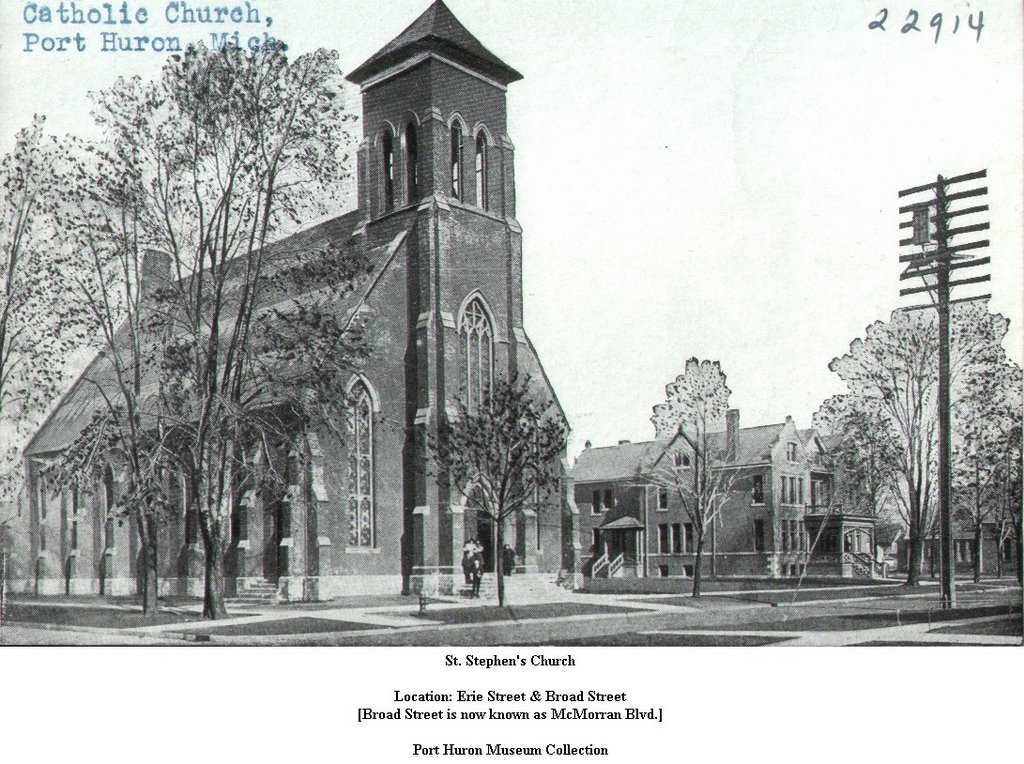
St. Stephen Church, where I was a parishoner in the late 1940s and early 1950s, occupied an entire block in my home town. Behind the church and rectory (left and right) was the school where I took catechism lessons on Saturday mornings.
__________
* Wills takes his title from a phrase in Shakespeare’s Sonnet 73:

That time of year thou mayst in me behold
When yellow leaves, or none, or few, do hang
Upon those boughs which shake against the cold,
Bare ruined choirs, where late the sweet birds sang.
In me thou see’st the twilight of such day
As after sunset fadeth in the west;
Which by and by black night doth take away,
Death’s second self, that seals up all in rest.
In me thou see’st the glowing of such fire,
That on the ashes of his youth doth lie,
As the death-bed, whereon it must expire,
Consumed with that which it was nourish’d by.
This thou perceiv’st, which makes thy love more strong,
To love that well, which thou must leave ere long.

Panic Attacks

I wasn’t panicking about bird flu, but many were. Now, there’s this (from Scientific American.com):

Bird Flu Resides Deep in Lungs, Preventing Human-to-Human Transmission

I predict that bird flu will go the way of man-made global warming: two (among many) instances of premature panic owed to the scientific-media herd mentality.

The tendency to panic about every dire possibility causes undue anxiety and plays into the hands of those who seek expensive and burdensome government “solutions” to problems. Will we ever learn? Probably not.

Weather Wisdom

Earlier today I read this subjective (and incorrect) assertion at Wired News:

The scientific evidence is now overwhelming that unchecked growth in fossil fuel use throughout the next half-century will produce a global climate catastrophe.

I was thinking about writing a post that lists all the debunking of the “evidence” of which I am aware. But World Climate Report comes to the rescue with data:

For over a century, a national network of “weather nerds” (for lack of a better term) have monitored backyard weather stations where they kept track of daily maximum and minimum temperature and precipitation using standardized instruments and measurement techniques. Called the U.S. Cooperative Observer Network (co-op for short), these data, which were submitted monthly for many decades on paper logs, were often used to fill in gaps from the more comprehensive observations taken by trained weather service employees at far fewer locations. But the utility of the co-op records to climate analysis was limited by their cumbersome, paper format. However, recently the interest in climate change spurred the government to digitize these paper records, thus adding many new stations to the existing network. With the addition of the co-op data, the number of stations from roughly 1890 to 1947 doubled or tripled relative to the previous baseline.

These updated records shed new light on the behavior of U.S. extremes. . . . The data since 1950 shows a clear positive trend that seems to be getting more extreme later in the record, with the last few years showing the greatest extremes. This fits very nicely with common journalistic sentiments that our climate is obviously in never-been-to-before territory. But inclusion of the pre-1950 data paints quite a different picture. Not only did the frequency of extremes vary markedly in the early 20th century days of very low greenhouse gas levels, but the frequency of extreme events in the late 1890s was at least comparable to that in our current climate. . . . [S]tatistical tests demonstrat[e] that the most recent period (1983-2004) was not statistically different from the earliest period (1895-1916) for many combinations of event severity and return period, although a few were significantly different. The bottom line here? The assumption that U.S. rainfall is clearly getting more extreme because of global warming is hardly obvious based on the new and improved record. . . .

The heat wave record . . . is dominated by the huge spike during the 1930s “Dust Bowl” era. In fact, the recent period is hardly noticeable in the longer-term context, even though the number of heat waves has increased recently compared to the cool summers of the 1960s and 1970s. . . .

If more cold waves are harbingers of global warming, then the peaks that dominated that 1980s have completely disappeared. And if we should expect fewer cold outbreaks, then how does one account for all the cold air outbreaks 1980s when the atmosphere had plenty of greenhouse gases? The cold wave record shows some interesting long-term variability but no obvious trend. . . .

The post at World Climate Report is much longer and includes some excellent charts. Read the whole thing.

Related posts:

Climatology
Global Warming: Realities and Benefits
Words of Caution for the Cautious
Scientists in a Snit
Another Blow to Climatology?
Bad News for Politically Correct Science
Another Blow to Chicken-Little Science
Bad News for Enviro-nuts
The Hockey Stick Is Broken
Science in Politics, Politics in Science
Global Warming and Life
Words of Caution for Scientific Dogmatists
Hurricanes and Global Warming
Global Warming and the Liberal Agenda
Debunking “Scientific Objectivity”
Hurricanes and Glaciers

What Is Time?

Robin Allott asks: “Is consciousness in time or time in consciousness?” That is, do we perceive a flow of events, which creates the impression of time? Or do we flow through a universe of timeless events — a coexistent past, present, and future — so that our flow creates the impression of time?

For more, read Allott’s article, “Time and Consciousness” or view the PowerPoint version.

Combinatorial Recreation

What’s that? It’s the term Einstein used to describe how a complex problem often is solved subconsciously while a person is engaged in a “mindless” diversion, or sleeping. I was reminded of the phenomenon by this post at FuturePundit.

Being Logical about Religion

See this.

Related posts:

Going Too Far with the First Amendment
Atheism, Religion, and Science
The Limits of Science
Three Perspectives on Life: A Parable
Beware of Irrational Atheism
The Creation Model
Religion and Personal Responsibility
Evolution and Religion
Speaking of Religion…
Words of Caution for Scientific Dogmatists
Science, Evolution, Religion, and Liberty
The Legality of Teaching Intelligent Design
Science, Logic, and God
Capitalism, Liberty, and Christianity

Hurricanes and Glaciers

Pat Michaels has a good piece at TCS Daily, which ends with this:

So what we have here are two stories making a lot of headlines — Greenland is melting and hurricanes are strengthening. Both things are true. And, again, looking at real data it is apparent that at this time they are both part of a natural cycle that has been going on for thousands of years.

And he has the numbers to back it up.

Related posts:

Climatology
Global Warming: Realities and Benefits
Words of Caution for the Cautious
Scientists in a Snit
Another Blow to Climatology?
Bad News for Politically Correct Science
Another Blow to Chicken-Little Science
Bad News for Enviro-nuts
The Hockey Stick Is Broken
Science in Politics, Politics in Science
Words of Caution for Scientific Dogmatists
Hurricanes and Global Warming
Global Warming and the Liberal Agenda
Debunking “Scientific Objectivity”

Debunking "Scientific Objectivity"

Alanyzer opens with this:

The first thing we must recognize is that the question of the nature of science is not a scientific question, but a philosophical one. . . .

. . . methodological naturalism [is] the claim that science can only appeal to natural causes as explanations. . . .

But there are some big problems with this appeal to methodological naturalism as an essential characteristic of science. Indeed, it sets up a dilemma that is likely to backfire on the scientific establishment. I’ll explain tomorrow in a follow-up post.

Here are portions of the follow-up post:

In yesterday’s post I gave some background on the Intelligent Design (ID) debate and noted that an increasingly popular move by the mainstream scientific establishment has been to stipulate that “science” requires methodological naturalism. In other words, the claim is that properly “scientific” explanations can only make reference to ‘natural’ laws and entities, the kinds of laws and entities that would presumably find inclusion in a completed form of physics. . . .

[T]his way of defining “science” is historically and philosophically arbitrary. Prior to the rise of Darwininsm and Comtean positivism in the 19th century, no one–not Galileo, not Newton, not Kepler, Boyle, you name it–would have thought to define “science” in terms of a commitment to methodological naturalism. Instead, beginning all the way back with Aristotle, the various sciences were defined in terms of the object of their study, not the types of explanatory entities they were allowed to invoke. . . .

Noted 19th-century logician, philosopher, and scientist Charles Sanders Peirce argued that to “block the road of inquiry” was to commit a cardinal sin against rationality. To “block the road of inquiry” is to set up a priori restrictions on where inquiry can go and on what kinds of answers it can reach. The reason why Peirce saw this as a sin against rationality was because it takes our focus off of truth and insulates certain ‘pet theories’ from potential refutation. It’s like saying “I’ve made up my mind about X, Y, and Z, and I refuse to countenance any evidence weighing against those opinions.” Such dogmatism, Peirce held, is antithetical to the spirit of science. Ironically, in the name of promoting genuine “science”, the mainstream scientific establishment wants to do the very thing that Peirce held to be fundamentally antithetical to science, i.e., block the road of inquiry. What they are saying, in effect, is that the only answers that will be tolerated are naturalistic answers.

Maverick Philosopher chimes in, with a “Fisking” of Daniel Dennett:

Dennett’s main point here is that belief in God and in an afterlife are epistemically on a par with belief in the Easter Bunny and black magic. . . . Few philosophers today would claim that that God and afterlife can be definitively proven. But no fair-minded person can deny that there are many powerful arguments in their support, and many powerful arguments against naturalism, and in particular, arguments against Dennett’s extreme version thereof.

What Dennett is suggesting, of course, is that religion is just a form of superstition. . . . It is also quite absurd to suggest that all the intelligent people — the brights — are on one side of the issue. . . .

Indeed, if one looks back through the history of philosophy, one sees that the greatest philosophers were theists of one sort or another, and that the atheists and materialists were second-string or worse. . . .

Another point that must be mentioned is Dennett’s tendentious and unclarified use of ‘supernatural.’ . . .

Is the supernatural perhaps that which violates the laws of nature? Is the supernatural the same as the miraculous? This may well be what Dennett has in mind. But God, unlike the Easter Bunny, Santa Claus, the Tooth Fairy and other Dennet favorites, need not be understood as violating any laws of nature. Think of a God that does not intervene miraculously in the workings of nature, but is merely the sustaining cause of the existence of nature. Then there would be a clear sense in which God would not be a supernatural being. Though outside of nature (and precisely because outside of nature) he would not violate any natural laws. Something not subject to natural laws cannot be said to violate them. . . .

At the very least, we need to know what ‘supernatural’ means to fully understand Dennett’s opposing of the naturalist brights to the supernaturalist dullards. Does it mean nonnatural, miraculous, or naturalistically inexplicable? If Dennett is using it as a bludgeon, as a portmanteau term of abuse, the way lefties use ‘fascist’ and ‘theocrat’ to tar their opponents, then that is contemptible.

Finally, Pat Michaels reminds us just how biased, venal, and opportunistic scientists can be:

Two recent events underscore how predictable is the distortion of global warming by those who gain from exaggeration. The events were the Montreal “Conference of the Parties” which had signed the United Nations’ Kyoto Protocol on global warming, and the fall meeting of the American Geophysical Union (AGU) in San Francisco. Both took place in early December.

The sheer volume of hype was impressive. Following are the headlines, along with the sources, generated on the afternoon of December 7, first from the Montreal UN conference. (University news sources are those that were eventually picked up in other stories). These were obtained from Google’s news search page.

•Global warming to halt ocean circulation (University of Illinois)

•Warming trend adds to hazard of Arctic trek (Salem OR News)

•Pacific islanders move to escape global warming (Reuters)

•Tuvalu: That sinking feeling (PBS)

•World weather disasters spell record losses in 2005 (Malaysia Star)

•Arctic peoples urge UN aid to protect cultures (Reuters)

•Threatened by warming, Arctic people file suit against US (AFP)

Next, from San Francisco:

•Ozone layer may take a decade longer to recover (New York Times)

•Earth is all out of new farmland (London Guardian)

•Forests could worsen global warming (UPI)

•Warming could free far more carbon from high arctic soil than earlier thought (University of Washington)

•Rain will take greater toll on reindeer, climate change model shows (University of Washington)

•Methane’s impacts on climate change may be twice previous estimates (NASA)

•Average temperatures climbing faster than thought in North America (Oregon State University)

How can things be so bad? . . .

Scientists compete with each other for finite resources, just like bankers and corporations. In this case, successful competitors are those who are rewarded by their universities or institutions. In all science, this means publishing research articles in the refereed scientific literature. That research costs tremendous amounts of money and there really is only one provider: Uncle Sam (i.e. you and me).

No one gets much of this pie by claiming that his or her issue may, in fact, be no big deal. Instead, any issue – take global warming, acid rain, and obesity as examples, must be portrayed in the starkest of terms. Everything is a crisis, and all the crises are competing with each other.

Similar logic applies in the policy arena. Remember that the job of policymakers is precisely that: to make policy, which does not get made unless whatever policy there might be is “absolutely necessary” to avoid certain doom.

Then, finally, what gets played on TV and in the papers? More crises. Near-death experiences sell newspapers and attract viewers. Those who question this need only look at ratings for The Weather Channel. Some people may remember that it used to be the station where you turned to for round-the-clock national and local weather. The ratings were in the tank.

Now, in prime time, you are more likely to see the twentieth re-run of how this tornado went over that house and how everyone almost died, usually with some pretty snappy home video. Or, just to get your attention for sure, a re-enactment of the sinking of an oil rig in a howling cyclone — re-enacted because everyone on board drowned. Ratings have boomed.

Perhaps it is dismaying that science has become as blatantly biased in the direction of tragedy as television. But, given the way we fund and reward science and scientists, it was inevitable, and global warming is only one of many of science’s predictable distortions.

In sum, many (most?) of today’s scientists adhere to a flawed scientific framework. And, even by the standards of that framework, many of today’s scientists are nothing more than charlatans.

Related posts:

Climatology
Global Warming: Realities and Benefits
Words of Caution for the Cautious
Scientists in a Snit
Another Blow to Climatology?
Bad News for Politically Correct Science
Another Blow to Chicken-Little Science
Same Old Story, Same Old Song and Dance
Bad News for Enviro-nuts
Going Too Far with the First Amendment
Atheism, Religion, and Science
The Limits of Science
Three Perspectives on Life: A Parable
Beware of Irrational Atheism
The Hockey Stick Is Broken
The Creation Model
The Thing about Science
Religion and Personal Responsibility
Science in Politics, Politics in Science
Global Warming and Life
Evolution and Religion
Speaking of Religion…
Words of Caution for Scientific Dogmatists
Science, Evolution, Religion, and Liberty
Hurricanes and Global Warming
The Legality of Teaching Intelligent Design
Global Warming and the Liberal Agenda
Science, Logic, and God
A Dissonant Vision

Economics: The "Democrat" Science

From “AEA [American Economics Association] Ideology,” by William A. McEachern (Econ Journal Watch, January 2006):

One way of summarizing the findings is by showing those populations with no Republican contributors, those populations with one Republican contributor, and those populations with two Republican contributors, as is done in Tables 1, 2, and 3. . . . Among the entire eligible set listed in the three tables, the overall tally is 182 Democrat contributors to 10 Republican contributors [among advisory board members, officers, editors, and contributors to the American Economic Review, AER Papers & Proceedings, Journal of Economic Literature, and Journal of Economic Perspectives]. Democrat contributors filled 182 of a possible 1,583 slots, or 11.5 percent. Republican contributors filled 10, or 0.6 percent. . . .

For the 2,000 AEA member sample, the ratio of Democrat-to-Republican donors was 5.1 to 1. . . .

What’s the harm of having extremely high Democrat-to-Republican contribution ratios among those involved with AEA publications, especially among the discretionary journals? The Association recognized the possible harm more than 80 years ago when the Certificate of Incorporation called for “perfect freedom of economic discussion.” Recall that campaign contributors are also more likely to be politically engaged in other ways. We should not expect editors, referees, authors, reviewers, and acknowledgees who have contributed to campaigns to just turn off that mindset in their dealings with the Association’s publications.

As an example of possible harm of a lopsided political representation, consider the absence of a Republican contributor among the 247 book reviewers with U.S. affiliations appearing in the Journal of Economic Literature in 2003 and 2004. A JEL review will likely be the most visible, if not the only, review some books will ever receive. Couldn’t the same political sensibilities that motivated a reviewer to contribute to Democrats also shape his or her assessment of a book? . . .

But loading the dice, however unintentionally, with 20 Democrat contributors and no Republican contributors seems unfair to some authors and unhealthy for the profession. . . .

Mark Bauerlein, a professor of English at Emory University and research director at the National Endowment for the Arts, has argued that:

Any political position that dominates an institution without dissent deteriorates into smugness, complacency and blandness. . . . Groupthink is an anti-intellectual condition, ironically seductive in that the more one feels at ease with compatriots, the more one’s mind narrows (2004). . . .

. . . The AEA claims to be the “organ of no party.” That is, of course, true de jure, but contributor ratios that favor Democrats 9.5 to 1 among regular AER authors and 38 to 1 among authors in remaining publications at least raise a question whether the Association is de facto an “organ of no party.”

Thus, we read this, by noted economist William J. Baumol (also from Econ Journal Watch, January 2006):

There are, actually, at least two very good reasons why the entrepreneur is virtually never mentioned in modern theory of the firm and distribution. The first is that innovation is an entirely heterogeneous output. Production of whatever was an invention yesterday is mere repetition today. So that entrepreneurial activities do not incorporate the homogeneous elements that lend themselves to formal mathematical description, let alone the formal optimization analysis that is the foundation of the bulk of micro theory.

The more critical explanation of the absence of the entrepreneur is that in mainstream economics the theory is generally composed of equilibrium models in which structurally nothing is changing. Equilibrium models exclude the entrepreneur by their very nature. . . .

That’s true, as far as it goes. But Baumol goes on to say this:

My conclusion is not that the neoclassical theory is wrong in excluding the entrepreneur, for it is dealing with subjects for which she is irrelevant. But that does not mean that no theory of entrepreneurship is needed. . . . It would, in my view, be as indefensible to require all micro writing to give pride of place to the entrepreneur as to exclude him universally. . . .

But universal exclusion condemns us to leave out of our discussions what I consider to be the most critical issues that should be examined (though not exclusively) in microeconomic terms: the determinants of innovation and growth and the means by which they can be preserved and stimulated. . . . Why have the relatively free-market economies in the past two centuries been able to outstrip, probably by more than an order of magnitude, the performance in terms of growth and innovation, of all other forms of economic organization? The answer is not merely matter of pandering to what Veblen called the economic researcher’s idle curiosity. Rather it is the missing underpinning for growth policy in both the developed and the developing world.

A somewhat less “Democrat” profession would try harder to account for entrepreneurship, without which economic growth would be impossible.

Is "Nothing" Possible?

Not according to the Maverick Philosopher, who writes:

1. Let S = Something exists and N = Nothing exists.
2. If N is possibly true, then S, which is true, and known to be true, is only contingently true.
Therefore
3. There are possible worlds in which S is false and possible worlds in which S is true. (By defn. of ‘contingently true’)
4. In the worlds in which S is true, something exists.
5. In the worlds in which S is false, it is also the case that something exists, namely, S. (For an item cannot have a property unless it exists, and so S cannot have the property of being false unless S exists)
Therefore
6. There is no possible world in which nothing exists.
Therefore
7. N is not possibly true, and necessarily something exists.

I think the Maverick slipped a fast one by us. Let’s try it my way:

1. Let S = Something exists and N = Nothing exists.
2. If N is possibly true, then S, which is true, and known to be true, is only contingently true.
3. Where N is possibly true, S must be false.
Therefore
4. There are possible worlds in which S is false and possible worlds in which S is true. (By defn. of ‘contingently true’)
5. In the possible worlds in which S is true, something exists.
6. In the possible worlds in which S is false, it is the case that nothing exists, because N is true where S is false. (For an item cannot have a property unless it exists, and so S cannot have the property of being true where N is true, because something cannot exist where nothing exists.)
Therefore
7. There is a possible world in which nothing exists.
Therefore
8. N is possibly true in a world that exists apart from our world, in which S is true.

My conclusion: “Nothing” is logically possible, but we can never experience it because (a) we live in a world where there is “something,” (b) it is impossible to live in a world where there is “nothing,” and (c) it is impossible to experience “nothing.” Therefore, a world of “nothing” is nothing more than a logically possible fantasy.

Ockham’s Razor in the Age of Statistics

In philosophy, ontology . . . is the most fundamental branch of metaphysics. It studies being or existence as well as the basic categories thereof—trying to find out what entities and what types of entities exist. Ontology has strong implications for the conceptions of reality. (From Wikipedia‘s article about “Ontology.”)

[O]ntological parsimony. . . is summed up in the famous slogan known as “Ockham’s Razor,” often expressed as “Don’t multiply entities beyond necessity.” Although the sentiment is certainly Ockham’s, that particular formulation is nowhere to be found in Ockham’s texts. Moreover, as usually stated, it is a sentiment that virtually all philosophers, medieval or otherwise, would accept; no one wants a needlessly bloated ontology. The question, of course, is which entities are needed and which are not. (From an article about “William of Ockam” at Stanford Encyclopedia of Philosophy.)

The question of which entities are needed and which are not is today an empirical one. If phenomenon “A” can be explained by the observed operation of factors X and Y, then factor Z should be not be introduced to the explanation unless doing so leads to an unambiguously better explanation of A. Determining whether or not the explanation is unambiguously better requires a robust test of the predictive powers of the two competing theories: the one with X and Y as predictors; the other with X, Y, and Z as predictors.

Ockham’s Razor, then, is a prudent, pre-statistical rule for choosing the preferred explanation of a phenomenon.

Religion and Liberty, P.S.

A few days ago I said:

One does not have to be a believer to understand the intimate connection between religion and liberty, about which I have written here and here. Strident atheists of Singer’s ilk like to blame religion for the world’s woes. But the worst abuses of humanity in the 20th century arose from the irreligious and anti-religious regimes of Hitler, Stalin, and Mao.

Ed Driscoll concludes an entry about post-religious Europe with this:

[P]ost-religious societies invariably do little more than replace one form of organized religion with another: an endlessly spiraling bureaucracy that does its best to stifle the believers–and everyone else.

‘Nuff said.

Peter Singer’s Agenda

Peter Singer, euthanasia enthusiast, is piggy-backing on the Schiavo fiasco. This is from WorldNetDaily:

During the next 35 years, the traditional view of the sanctity of human life will collapse under pressure from scientific, technological, and demographic developments, says controversial bio-ethics professor Peter Singer.


Princeton’s Peter Singer (Photo: The Age)

“By 2040, it may be that only a rump of hard-core, know-nothing religious fundamentalists will defend the view that every human life, from conception to death, is sacrosanct,” says Princeton University’s defender of infanticide. “In retrospect, 2005 may be seen as the year in which that position (of the sanctity of life) became untenable,” he writes in the fall issue of Foreign Policy.

Singer sees 2005’s battle over the life of Terri Schiavo as a key to this changing ethic.

The year 2005 is also significant, at least in the United States, for ratcheting up the debate about the care of patients in a persistent vegetative state,” says Singer. “The long legal battle over the removal of Terri Schiavo’s feeding tube led President George W. Bush and the U.S. Congress to intervene, both seeking to keep her alive. Yet the American public surprised many pundits by refusing to support this intervention, and the case produced a surge in the number of people declaring they did not wish to be kept alive in a situation such as Schiavo’s.”

He writes that by 2040, the Netherlands and Belgium will have had decades of experience with legalized euthanasia, and other jurisdictions will also have permitted either voluntary euthanasia or physician-assisted suicide for varying lengths of time.

“This experience will puncture exaggerated fears that the legalization of these practices would be a first step toward a new holocaust,” he explains. “By then, an increasing proportion of the population in developed countries will be more than 75 years old and thinking about how their lives will end. The political pressure for allowing terminally or chronically ill patients to choose when to die will be irresistible.”

The professor, who advocates killing the disabled up to 28 days after birth, was the subject of protests when he was hired in 1999 by Princeton, a school founded by the Presbyterian denomination. A group calling itself Princeton Students Against Infanticide issued a petition charging the Australian professor “denies the intrinsic moral worth of an entire class of human beings – newborn children.”

Singer also is known for launching the modern animal rights movement with his 1975 book “Animal Liberation,” which argues against “speciesism.” He insists animals should be accorded the same value as humans and should not be discriminated against because they belong to a non-human species.

Yes, people say that they don’t want to share Terri Schiavo’s fate. What many of them mean, of course, is that they don’t want their fate decided by a judge who is willing to take the word of a relative for whom one’s accelerated death would be convenient. Singer dishonestly seizes on reactions to the Schiavo fiasco as evidence that euthanasia will become acceptable in the United States.

Certainly, there are many persons who would prefer voluntary euthanasia to a fate like Terri Sciavo’s. But the line between voluntary and involuntary euthasia is too easily crossed, especially by persons who, like Singer, wish to play God. If there is a case to be made for voluntary euthanasia, Peter Singer is not the person to make it.

Singer gives away his Hitlerian game plan when he advocates killing the disabled up to 28 days after birth. Why not 28 years? Why not 98 years? Who decides — Peter Singer or an acolyte of Peter Singer? Would you trust your fate to the “moral” dictates of a person who thinks animals are as valuable as babies?

Would you trust your fate to the dictates of a person who so blithely dismisses religious morality? One does not have to be a believer to understand the intimate connection between religion and liberty, about which I have written here and here. Strident atheists of Singer’s ilk like to blame religion for the world’s woes. But the worst abuses of humanity in the 20th century arose from the irreligious and anti-religious regimes of Hitler, Stalin, and Mao.

(Thanks to my daughter-in-law for the link to the WorldNetDaily article.)

More related posts:

Peter Singer’s Fallacy
(11/26/04)
Science, Pseudo-Science . . . , a collection of links to other related posts
Self-Ownership, a collection of links to yet other related posts

Warming Thoughts on a Cold Day

Today’s high temperature in Austin is 30 degrees below normal. So much for global warming. Nevertheless, if global warming is irreversible — which I doubt — it comes with a silver lining:

“From a purely evolutionary point of view, warm periods have been exceptionally good to us. Cold periods have been the troublesome ages,” [according to Benny Peiser, a social anthropologist at Liverpool John Moores University]. The possible positive side effects of global warming have researchers like Peiser ready for changes to come.

Earth’s temperature is expected to rise 1.4 to 5.8 degrees Celsius between 1990 and 2100, according to the Intergovernmental Panel on Climate Change, or IPCC. One area where this warming could aid society is in terms of health.

In Britain alone, scientists estimate between 20,000 and 40,000 deaths a year are related to cold winter weather. A report (.pdf) from the United Kingdom’s Faculty of Public Health found that the number of cold-weather deaths increase by approximately 8,000 for every 1 degree Celsius the temperature falls. Peiser estimates there will be only 2,000 more deaths a year due to an equal rise in temperature, because humans adapt better to hot climates and can rely on air conditioning.

“And Britain isn’t even that cold of place in the world respectively,” said Peiser. . . .

. . . While Peiser admits the price of global warming will differ for every region of the world, “the benefits outweigh the costs by far,” he said.

This could be especially true in regions of Russia where the harsh winters can kill hundreds in a single city. . . .

Fred Singer, president of the Science & Environmental Policy Project, a group that has consistently voiced doubts about the veracity of global warming projections, thinks the IPCC report (.pdf) [which sees an economic loss for developing countries and mixed consequences for developed nations] is wrong because “it deals with only part of the problem.”

Singer agrees with conclusions of The Impact of Climate Change. The book finds that a moderate warming will have a positive economic impact on the agriculture and forestry sectors. Since carbon dioxide is used by plants to capture and store energy, there may be a fertilizing effect as levels of the gas rise. This, combined with longer growing seasons, fewer frosts and more precipitation, among other factors, could benefit some economic sectors.

Bring on global warming. I could use some of it today.

Related posts:

Climatology (07/16/04)
Global Warming: Realities and Benefits (07/18/04)
Scientists in a Snit (08/14/04)
Another Blow to Climatology? (08/21/04)
Bad News for Politically Correct Science (10/18/04)
Another Blow to Chicken-Little Science (10/27/04)
Bad News for Enviro-Nuts (11/27/04)
The Hockey Stick Is Broken (01/31/05)
Science in Politics, Politics in Science (05/11/05)
Hurricanes and Global Warming (09/24/05)
Global Warming and the Liberal Agenda (10/12/05)

Science, Logic, and God

Science rests on induction and deduction:

  • Induction is “the process of deriving general principles from particular facts or instances.” That is how scientific theories are developed, in principle. That is, a scientist begins with observations and devises a theory from them. Or a scientist may begin with an existing theory, note that new observations do not comport with the theory, and devise a new theory to fit all the observations, old and new.
  • Deduction is “the process of reasoning in which a conclusion follows necessarily from the stated premises; inference by reasoning from the general to the specific.” That is how scientific theories are tested, in principle. That is, a theory (a “stated premise”) should lead to certain conclusions (“observations”). If it does not, the theory is falsified. If it does, the theory lives for another day.

Scientists, being human, tend to forget the limits of their craft and venture where they are unqualified to venture as scientists. Many of them, for example, like to flaunt their scientific credentials while taking public positions about wars and global warming, as if their scientific credentials gave them special knowledge about such subjects. (War is a political issue. Global warming is an issue about which precious few scientists know very much, but that doesn’t stop those who know next to nothing about it from signing manifestos about it.)

One realm into which scientists often venture, with equally invalid effect, is the realm of theology. It seems that scientists can’t resist atheism, which is an utterly unscientific stance because it assumes an empirically untestable fact, namely, that there is no God.

At least one scientist has tried to work around the empirical obstacle to atheism by trying to prove with logic that there cannot be an omniscient God. After all, he probably said to himself, if God isn’t omniscient, then He’s not much to reckon with. Now, I have no problem with agnosticism (being an agnostic myself), which is perfectly defensible from a scientific viewpoint, but I do have a problem with scientists who try to sneak unscientific atheism into their science, so I must expose the error of this particular scientist’s ways.

John D. Barrow, an English astronomer, wrote a book called Impossibility: The Limits of Science and the Science of Limits (1997), which I recently began to reread. I encountered this on page 13:

We [pompous ass: ED] began this section by introducing the familiar idea of a god who is ominiscient: someone who knows everything. Ths possibility does not immediately ring alarm bells in our brains; it is plausible that such a being could exist. [Note that he says “plausible” and not “possible”: ED] Yet, when it is probed more closely one can show that omniscience of this sort creates a logical paradox and must, by the standards of human reason, therefore be judged impossible or be qualified in some way. To see this consider this test statement:

THIS STATEMENT IS NOT KNOWN TO BE TRUE BY ANYONE.

Now consider the plight of our hypothetical Omniscient Being (‘Big O’). Suppose first that this statement is true and Big O does not know it. Then Big O would not be omniscient. So, instead, suppose our statement is false. This means that someone must know the statement to be true; hence it must be true. So regardless of whether we assume at the outset that this statement is true or false, we are forced to conclude that it must be true! And therefore, since the statement is true, nobody (including Big O) can know that it is true. This shows that there must always be true statements that no being can know to be true. Hence thaer cannot be and Omniscient Being who knows all truths.

If that’s too convoluted for you, here’s a more straightforward version:

1. Statement X — which is either true or false — asserts that no one knows it (the statement) to be true. In plainer words than those used by Barrow:

X: NO ONE KNOWS THAT THIS STATEMENT IS TRUE.

2. If X is true (that is, if no one knows that X is true), and an omniscient God knows that X is true, then the omniscient God cannot be omniscient because the true statement is that no one knows of its truth. If no one knows of its truth, there cannot be an omniscient God.

3. If, however, X is false, then someone knows that X is true. And if X is true, no one knows that it is true. And if no one knows that it is true, there cannot be an omniscient God.

This is all verbal sleight of hand. Here’s the trick:

1. Barrow’s statement is really a variant of the Epimenides paradox: Epimenides was a Cretan who made one immortal statement: “All Cretans are liars.” Accepting, for the sake of argument, that Epimenides was a Cretan and that all Cretans are liars (all of the time), one reaches two contradictory conclusions:

a. If Epimenides was lying, as he must have been as a Cretan, then all Cretans are not liars.

b. But if all Cretans are not liars, then Epimenides was telling the truth, which is that all Cretans are liars.

2. One problem with the Epimenides paradox, as with Barrow’s statement, is its self-referentiality. This can be shown by restating it properly:

EPIMENIDES SAYS THAT ALL CRETANS ARE LIARS (ALL OF THE TIME).

EPIMENIDES IS A CRETAN.

THEREFORE, . . .

Therefore, nothing. Epimenides, as a Cretan, could not assert a possibly truthful statemtent about Cretans (“All Cretans are liars”) because he called himself a liar to begin with. Barrow’s statement is more obviously self-referential:

BARROW SAYS THAT THERE IS A STATEMENT “X” THAT IS NOT KNOWN BY ANYONE TO BE TRUE.

STATEMENT “X” IS “THAT THERE IS A STATEMENT THAT IS NOT KNOWN BY ANYONE TO BE TRUE.

THEREFORE, . . .

Therefore, according to Barrow, there is a statement X that says that it (statement X) is not known by anyone to be true. That’s all Barrow has “proved.”

2. Barrow’s statement suffers from more than self-referentiality. It is nonsense. It asserts that “this statement is not known to be true,” without specifying what it is about the statement that is not known to be true. A statement that purports to be either true or false has no meaning if it does not assert something that can be adjudged true or false.

3. But Barrow’s statement is worse than nonsense because it also asserts an unprovable fact, namely, that “this statement is not known to be true by anyone.” One can never know if a particular thing is not known by anyone.

Consider this equivalent piece of nonsense:

BARROW SAYS THAT THERE IS A STATEMENT X THAT IS NOT KNOWN BY ANYONE TO BE TRUE.

STATEMENT X IS JABBERWOCKY.

THEREFORE, THERE IS A STATEMENT X THAT IS JABBERWOCKY, AND WHICH BARROW SAYS IS NOT KNOWN BY ANYONE TO BE TRUE, ALTHOUGH SAYING THAT A STATEMENT IS JABBERWOCKY IS NONSENSE AND NOT A MATTER OF TRUTH OR FALSITY. AND SAYING THAT A STATEMENT IS NOT KNOWN BY ANYONE TO BE TRUE IS AN UNPROVABLE ASSERTION.

Barrow’s statement, in sum, is a piece of nonsense, deployed in an attempt to proved the unprovable (the non-existence of an omniscient God) through flawed (self-referential) logic, which hinges on an unprovable premise (“this statement is not known to be true by anyone”).

Barrow, in his anxiety to disprove the existence of an omniscient God, chose to doff his scientist’s hat and put on his atheist’s hat. As a scientist, Barrow should have known better than to try to prove the unprovable — or I should say, to disprove the undisprovable: the existence of an omniscient God.

Time Lost

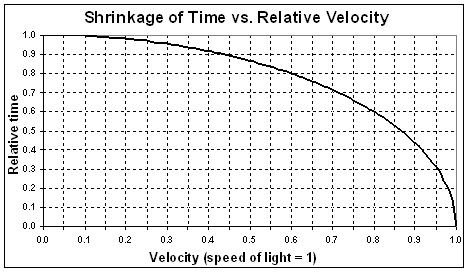
Have you ever felt that time was standing still. Well it was, if you were traveling at the speed of light. Otherwise, time simply slows down if you’re moving quickly away from a point of reference. By how much does time slow? It depends on how fast you’re going. The following chart depicts the relationship.

So, if you’re traveling “with” me through space (that is your velocity relative to mine is zero) your clock will advance at the same rate as (1 x) the rate at which my clock advances. If you’re moving steadily away from me at, say, one-half (0.5 x) the speed of light, your clock will advance at about 0.87 times the rate at which my clock advances. That is, when I look at my clock and see that an hour has passed since I last checked it, only about 52 minutes will have elapsed on your clock.

Just to put that in perspective, suppose you’re traveling at the rather brisk pace of 2,000 miles an hour (about 3 x the speed of sound). That’s about 3 millionths of the speed of light, at which rate your clock will advance at about 0.999999999996 times the rate of my clock. Hard to tell the difference, isn’t it?

That’s special relativity for you.