Global Warming and the Liberal Agenda

So Mars is getting warmer, without human activity. It’s more evidence that the apparent warming of Earth’s climate is due mainly to phenomena over which humans have no control.

The rush by many scientists and all hair-shirted liberals, anti-capitalists, and inveterate doomsayers to blame global warming on human activity arises from a predisposition to think of economic motives as “greedy” and “evil.” But it is the “greedy” and “evil” pursuit of profit and self-interest that lifts individuals out of poverty, leads to cures for disease, and generally makes life more livable.

In sum, the pursuit of profit and self-interest advances liberals’ proclaimed agenda. But liberals have been blinded to that fact by their own guilt, ignorance, and anti-capiltalist rhetoric. That many liberals are also hypocritical beneficiaries of the system they claim to despise should not go unmentioned, either.

Related posts:

Climatology (07/16/04)
Global Warming: Realities and Benefits (07/18/04)
Scientists in a Snit (08/14/04)
Another Blow to Climatology? (08/21/04)
Bad News for Politically Correct Science (10/18/04)
Another Blow to Chicken-Little Science (10/27/04)
Bad News for Enviro-Nuts (11/27/04)
The Hockey Stick Is Broken (01/31/05)
Science in Politics, Politics in Science (05/11/05)
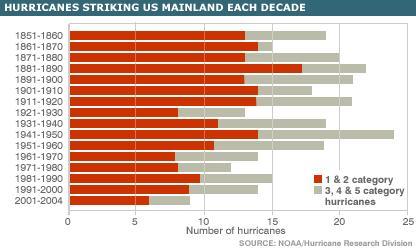
Hurricanes and Global Warming (09/24/05)

The Legality of Teaching Intelligent Design: Part II

A few days ago I wrote about a debate between Francis Beckwith and Douglas Laycock over at Legal Affairs Debate Club. Their topic: “Is Teaching Intelligent Design Illegal?” I concluded with this:

A fundamental illegality occurs when a public-school teacher is barred by law from teaching about a possible explanation for the existence of life. As it also says in the First Amendment: “Congress [and, by extension, all governmental bodies] . . . shall make no law abridging the freedom of speech. . . .” It seems to me that a general proscription by any legislative body or court of the teaching of intelligent design as a possibility would be in violation of the First Amendment.

Laycock’s latest entry in the debate nevertheless includes this observation:

Religious students can believe what they want about God’s role in directing or even bypassing natural explanations. The Constitution protects all such beliefs, but they are not scientific beliefs, and they are not beliefs that can be taught—or opposed—in the public schools. The science course can teach only the best available natural explanation; it must leave all questions about supernatural explanations to the private sector.

In sum, freedom of speech on the subject of evolution comes down to this: If it isn’t science, it can’t be taught. Says who? Several months ago, in “Going Too Far with the First Amendment,” I wrote this:

Think of the fine mess we’d be in if the courts were to rule against the teaching of intelligent design not because it amounts to an establishment of religion but because it’s unscientific. That would open the door to all sorts of judicial mischief. The precedent could — and would — be pulled out of context and used in limitless ways to justify government interference in matters where government has no right to interfere.

It’s bad enough that government is in the business of funding science — though I can accept such funding wheere it actually aids our defense effort. But, aside from that, government has no business deciding for the rest of us what’s scientific or unscientific. When it gets into that business, you had better be ready for a rerun of the genetic policies of the Third Reich.

Aside from advancing us down the slippery slope toward absolute statism, the argument that schools should be in the business of teaching only that which courts deem “scientific” is nothing short of fatuous. If schools were in the business of teaching only scientifically valid lessons in government, history, and economics, most of the textbooks that praise government intervention in the economic and social order would have to be burned, for there is abundant evidence of the wrongness of such teachings.

I’ll make a deal with Laycock and his band of merry pseudo-scientists: I’ll let you ban the teaching of ID in public schools if you’ll let me reciprocate by banning the teaching of socialism in public schools.

The Legality of Teaching Intelligent Design

Francis Beckwith of Right Reason has begun a debate with Douglas Laycock over at Legal Affairs Debate Club. Their topic: “Is Teaching Intelligent Design Illegal?” Laycock, in his reply to Beckwith’s opening salvo, says

[i]t is entirely lawful for public school teachers to say we know much less about a natural explanation for the origins of life than about a natural explanation for the evolution of different species once life begins. But it would be an important additional step, sounding more in religion than in science, for the teacher to say that therefore, an intelligent designer must have created the first living things.

I understand the First Amendment’s proscription of the establishment of religion. But I cannot for the life of me understand why it should be illegal for a public-school teacher to suggest that an intelligent designer might have created the first living things. Neither evolutionary theory nor any other branch of science can disprove the existence of an intelligent designer (or God, for that matter).

A fundamental illegality occurs when a public-school teacher is barred by law from teaching about a possible explanation for the existence of life. As it also says in the First Amendment: “Congress [and, by extension, all governmental bodies] . . . shall make no law abridging the freedom of speech. . . .” It seems to me that a general proscription by any legislative body or court of the teaching of intelligent design as a possibility would be in violation of the First Amendment.

Hurricanes and Global Warming

Two charts to reckon with, from BBC News online:

Enough of Altruism

This one’s for Don Watkins III of Anger Management, who has announced that he’s shuttering his blog and taking down his archives. (The links in this post to Don’s blog and posts may not be working by the time you read this.) I’ve been fiddling with this post for a few months, off and on, in the hope that Don would reply to it at Anger Management. Perhaps, if he has the time, he’ll acknowledge it at Diana Hsieh’s blog, where he promises to post occasionally.

A while back I posted “Redefining Altruism,” in which I said:

Altruism is defined as “the quality of unselfish concern for the welfare of others.” . . . A better definition of altruism would go like this:

Altruism is the quality of concern for the welfare of others, as evidenced by action. An altruistic act is intended, necessarily, to satisfy the moral imperatives of the person performing the act, otherwise it would not be performed. The self-interestedness of an act altruism does not, however, detract in the least from the value of such an act to its beneficiary or beneficiaries. By the same token, an act that may not seem to arise from a concern for the welfare of others may nevertheless have as much beneficial effect as a purposely altruistic act.

There is no essential difference between altruism, defined properly, and the pursuit of self-interest, even if that pursuit does not “seem” altruistic. In fact, the common belief that there is a difference between altruism and the pursuit of self-interest is one cause of (excuse for) purportedly compassionate but actually destructive government intervention in human affairs.

Don Watkins III of Anger Management had much to say about my post, including this:

Thomas is defending psychological egoism: the view that all actions are selfish, because the fact that a person chooses to do something shows that he valued it more than the other options available to him. He then uses this premise to try to reconcile altruism and self-interest.To grasp the fallacy on which psychological egoism is based, take a simpler case of the same error: those who argue that every action involves a sacrifice since, no matter what value one pursues, one is necessarily giving up or choosing not to pursue something else. A sacrifice, on this view, is anything a person gives up in exchange for something else. What epistemological fallacy is involved here? Uniting by non-essentials.

To define the concept “sacrifice” this way obfuscates two essentially different kinds of results: a gain and a loss. It says that trading a dollar for a penny is essentially the same as trading a penny for a dollar, since in both cases you gave something up in exchange for something else. What that definition evades is the fact that in one case you gained values from the exchange, while in the other case, you lost values.

If the purpose of a concept is to unite similar existents according to their essential characteristics, then any concept that does not distinguish between a gain and a loss is an invalid concept.

Properly speaking, to sacrifice is to surrender a higher value for a lower value or a non-value. A sacrifice is a loss. . . .

Thomas’‚’s error should now be apparent. By equating all chosen actions with self-interested actions, he is uniting essentially different units under a single concept: he is uniting those actions a man chooses for the purpose of sustaining his life and achieving his happiness, and those aimed at sacrificing his life and his happiness for others. He is uniting Mother Teresa and Bill Gates. Peter Keating and Howard Roark. They are all selfish, he says, because they all chose to take the actions they valued the most. . . .

Here is a proper, essentialized definition of altruism: “The basic principle of altruism is that man has no right to live for his own sake, that service to others is the only justification of his existence, and that self-sacrifice is his highest moral duty, virtue and value” (Ayn Rand, PWNI).

Advocates of the “everyone is selfish” doctrine do not deny that, under the pressure of the altruist ethics, men can knowingly act against their own long-range happiness. They merely assert that in some higher, undefinable sense, such men are still acting “selfishly.” A definition of “selfishness” that includes or permits the possibility of knowingly acting against one’s long-range happiness, is a contradiction in terms (“Isn’t Everyone Selfish?”, VOS, 69). . . .

What Thomas . . . is saying is that the good of others can be achieved by means of self-interested action, and so therefore there is no conflict between altruism and self-interest. But this misses the point: the good of others is not the standard of altruism, neither historically nor philosophically. Altruism means self-sacrifice, it means sacrificing oneself to others.

It is true, that if one lives selfishly, he will end up benefiting others, but this does not make him an altruist, any more than the fact that by sacrificing himself for others, the altruist gets a momentary sense of satisfaction makes him an egoist.

I am not defending psychological egoism, nor am I trying to reconcile psychological egoism and altruism. I reject the concept of psychological egoism because it’s just a label for behavior that seems to involve a “gain,” as Don would have it. I similarly reject the concept of altruism because it’s just a label for behavior that seems to involve a “loss,” as Don puts it. The problem with trying to separate egoism and altruism is that a person’s behavior arises from a single human mind. One cannot accept a “loss” without considering (even for a subconscious instant) the potential “gain,” and vice versa.

So, it seems to me that what I am talking about is the motivation of a person who commits a seemingly altruistic act, whereas Don is talking about some external force that seems to demand altruism of us. My mistake was to use the term “self-interest” as shorthand for that motivation. There is no “egoism” or “altruism,” there’s simply behavior that reflects an individual’s values, and which seeks to serve those values.

Let me make it clear that Don’s post isn’t a defense of altruism but of the concept of altruism against my denial that there is such a thing as altruism. In the essay linked to by Don, Rand makes it clear that she has no use for altruism:

As to altruism — it has never been alive. It is the poison of death in the blood of Western civilization, and men survived it only to the extent to which they neither believed nor practiced it. But it has caught up with them — and that is the killer which they now have to face and to defeat. That is the basic choice they have to make. If any civilization is to survive, it is the morality of altruism that men have to reject….

What is morality? It is a code of values to guide man’s choices and actions — the choices which determine the purpose and the course of his life. It is a code by means of which he judges what is right or wrong, good or evil.

What is the morality of altruism? The basic principle of altruism is that man has no right to live for his own sake, that service to others is the only justification of his existence, and that self-sacrifice is his highest moral duty, virtue and value.

Do not confuse altruism with kindness, good will or respect for the rights of others. These are not primaries, but consequences, which, in fact, altruism makes impossible. The irreducible primary of altruism, the basic absolute, is self-sacrifice — which means: self-immolation, self-abnegation, self-denial, self-destruction — which means: the self as a standard of evil, the selfless as the standard of the good.

Do not hide behind such superficialities as whether you should or should not give a dime to a beggar. That is not the issue. The issue is whether you do or do not have the right to exist without giving him that dime. The issue is whether you must keep buying your life, dime by dime, from any beggar who might choose to approach you. The issue is whether the need of others is the first mortgage on your life and the moral purpose of your existence. The issue is whether man is to be regarded as a sacrificial animal. Any man of self-esteem will answer: “No.” Altruism says: “Yes.”

Now there is one word — a single word — which can blast the morality of altruism out of existence and which it cannot withstand — the word: “Why?” Why must man live for the sake of others? Why must he be a sacrificial animal? Why is that the good? There is no earthly reason for it — and, ladies and gentlemen, in the whole history of philosophy no earthly reason has ever been given.

It is only mysticism that can permit moralists to get away with it. It was mysticism, the unearthly, the supernatural, the irrational that has always been called upon to justify it — or, to be exact, to escape the necessity of justification. One does not justify the irrational, one just takes it on faith. What most moralists — and few of their victims — realize is that reason and altruism are incompatible. And this is the basic contradiction of Western civilization: reason versus altruism. This is the conflict that had to explode sooner or later.

The real conflict, of course, is reason versus mysticism.

Rand gives altruism a life of its own — makes an evil totem of it — in order to oppose it. And that is where Don goes wrong: He insists that there is a separately identifiable thing called altruism. I am surprised that an Objectivist adheres to the notion that there is such a thing, for, as Rand says, “Reality exists as an objective absolute — facts are facts, independent of man’s feelings, wishes, hopes or fears.” Yet, in a reply to my comment on his post, Don said:

. . . The reason I define altruism as “self-sacrifice in the service of others” is because that is the fundamental characteristic that distinguishes altruism and egoism.

And altruism and egoism ARE distinct. They are distinct, because egoism doesn’t mean doing whatever you want to do. It means identifying the actual requirements of human life, and using your mind to enact those requirements. Altruism says that your concern must not be with your interests, but the interests of others. This makes self-sacrifice the crowning moral virtue of the altruist ethics.

And there’s the heart of the matter: Don Watkins separates and reifies egoism and altruism. He’s quite clear about the reification of altruism in a later post:

Sheldon Richman notes a peculiar criticism of Wal-Mart’s charity operations…they’re too selfish:

Consider this: Wal-Mart is the biggest corporate donor in the country. The Foundation Center says the Wal-Mart Foundation is second to none in contributing money to charitable causes, with annual donations totaling $120 million. If for no other reason, youÂ’d think this would win some plaudits from Wal-Mart’s critics — and you‚’d be wrong.

According to the National Committee for Responsive Philanthropy (NCRP), Wal-Mart‚’s efforts hardly qualify as charity at all. ‚“Unfortunately, their philanthropy is more about corporate advertising than it is about helping nonprofits or communities.” That‚’s how NCRP deputy director Jeffrey Krehely sees it. Anyone surprised?

That’s the naked face of altruism, friends. Altruism doesn’t demand you do good for others, it demands that you sacrifice yourself for others. Self-sacrifice, not the welfare of others, is the essential characteristic of altruism.

Altruism isn’t a force that operates outside us, it’s what we tend to call a certain kind of result when we see it. Don acknowledges that an act which seems to be “selfish” or egoistical” may benefit others, and that an act which seems “altruistic” may give its performer some “egoistical” satisfaction. In doing so, he almost gets it right: What we call “altruism” and “egoism” are simply manifestations of an integrated, internal decision process that thinks not in terms of “altruism” or “egoism” but in terms of serving one’s values.

If altruism exists, where does it come from? How does it operate on us? Is it social pressure, community norms, or the like? If that’s what it is, a person who is under pressure to commit a so-called altruistic act has the option of saying “no” to it. Whether or not a person says “no” to it, the person is making a choice about how best to serve his or her own values. If the person says “yes” and commits what seems to be an altruistic act, that person may seem to “sacrifice” something (e.g., a life, a fortune) but that sacrifice was the person’s choice. A “sacrifice” serves an end: the satisfaction of one’s personal values. Nothing more, nothing less.

The implication of calling another person’s act a “sacrifice” is that someone can get into that person’s mind and determine whether the act was a gain or a loss for the person. I say that someone must be able to get into the person’s mind because I don’t know how else you one determines whether or not an act is altruistic unless (a) one takes the person’s word for it or (b) one assembles a panel of judges, each of whom holds up a card that says “altruistic” or “selfish” upon the completion of an a particular act.

To illustrate my point I resort to the following bits of caricature:

1. Suppose Mother Teresa’s acts of “self-sacrifice” were born of rebellion against parents who wanted her to take over their business empire. That is, suppose Mother Teresa derived great satisfaction in defying her parents, and it is that which drove her to impoverish herself and suffer many hardships. The more she “suffered” the more her parents suffered and the happier she satisified her personal values.

2. Suppose Bill Gates really wanted to become a male version of Mother Teresa but his grandmother — on her deathbed — said “Billy, I want you to make the world safe from the Apple computer.” So, Billy went out and did that, for his grandmother’s sake, even though he really wanted to be the male Mother Teresa. Then he wound up being immensely wealthy, much to his regret. But “Billy” obviously put his affection for or fear of his grandmother above his desire to become a male version of Mother Teresa. He satisfied his personal values.

Now, tell me, who is the altruist, my fictional Mother Teresa or my fictional Bill Gates? You might now say Bill Gates. I would say neither; each acted in accordance with her and his personal values. One might call the real Mother Teresa altruistic because her actions seem altruistic, in the common meaning of the word. But one can’t say (for sure) why she took those actions. Don’s definition of altruism nevertheless requires such knowledge. Suppose the real Mother Teresa acted as she did not only because she wanted to help the poor but also because she sought spiritual satisfaction or salvation. Would that negate her acts? No, her acts would still be her acts, but we would understand them as acts arising from her values. That’s the best we can do absent the ability to read minds.

My argument rests on the proposition that human actions are, by definition, driven by the service of personal values, which come to us in many and mysterious (but not supernatural) ways. As a consequentialist, I prefer to look at results, not motivations. (“The road to hell,” and all that.) I eschew terms like altruism and egoism because they imply that a given result is somehow better if it’s “properly” motivated. A result is a result. What matters, to me, is whether the result advances liberty or infringes on it. What matters to others may be something else entirely.

Objectivism may offer a useful set of values for ordering one’s life. I have yet to find that it offers a good explanation of why we humans act as we do. Rand rejects mysticism, yet the reification of “altruism” is nothing if not mystical.

Science, Evolution, Religion, and Liberty

Excerpts of a long post at Liberty Corner II:

If a man will begin with certainties, he shall end in doubts, but if he will be content to begin with doubts, he shall end in certainties.

Francis Bacon (1561–1626),
British philosopher, essayist, statesman.
The Advancement of Learning, bk. 1, ch. 5, sct. 8 (1605).
(Source:
Bartleby.com)

Science begins with doubts — questions about the workings of the world around us — and moves bit by bit toward greater certainty, without ever reaching complete certainty. Philosophy and religion begin with certainties — a priori explanations about the workings of the world — and end in doubts because the world cannot be explained by pure faith or pure reason. But philosophy and religion can tell us how to live life morally, whereas science can only help us live life more comfortably, if that is what we wish to do.

Scientists — when they are being scientists — begin with questions (doubts), which lead them to make observations, and from those observations they derive theories about the workings of the universe or some aspect of it. Those theories can then be tested to see if they have predictive power, and revised when they are found wanting, that is, when new observations (facts) cast doubt on their validity. Scientific facts may sometimes be beyond doubt (e.g., the temperature at which water freezes under specified conditions), but scientific theories — which are generalizations from facts — are never beyond doubt. Or they never should be. . . .

Einstein stands as a paragon among scientists: unwilling to run with the herd, unwilling to “follow any fad or popular direction,” as Smolin puts it elsewhere in the essay quoted above. Now we seem to have herds of so-called scientists who cling to certain theories because those theories are popular and dominant. They may be great scientists — or hacks — who have come to a certain worldview and are loathe to abandon it, or they may be followers of renowned scientists who lack the imagination to see alternative explanations of phenomena. Whatever the case, a “scientist” who insists on the truth of his worldview has abandoned science for something that might as well be called religion or philosophy.

In the case of global warming, we’ve seen the herd instinct at work for many years. It has become an article of faith among academic and government scientists not only that global warming is due mainly to human activity but also that it is “bad.” . . .

Now we come to evolution. I have written elsewhere about the tendency of evolutionary biologists (and their hangers-on at places like The Panda’s Thumb) to act like priests of a secular religion. . . .

[T]he scientific consensus seems to be that any scientist who even entertains intelligent design (ID) as a supplementary explanation of the development of life forms has somehow become a non-scientist. . . .

I think it really boils down to this: Anti-ID scientists cannot prove that ID is unscientific; pro-ID scientists cannot prove that ID is anything more than a convenient explantion for currently unexplained phenomena. It’s the scientific (or non-scientific) version of a Mexican standoff. . . .

It is impossible to eliminate any explanation of the origin of life or the development of life forms, as long as that explanation doesn’t conflict with facts. Similarly, it is impossible to eliminate any explanation of the origin of the universe, as long as that explanation doesn’t conflict with facts. Staunch evolutionists — those who resist Creationism, intelligent design, or any other unfalsifiable or unfalsified explanation for the origin of the universe, the origin of life, or the development of life forms — are merely invoking their preferred worldview — not facts.

The best that science can do, under any foreseeable circumstances, is to investigate how life developed from the point in the known history of the universe at which there is evidence of life. But many (perhaps most) evolutionists and their hangers-on aren’t content to pursue that scientific agenda. . . .

Scientific elites and their hangers-on, like paternalists of all kinds, would like to tell us how to live our lives — for our own good, of course — because they think they have the answers, or can find them. (They would be benign technocrats, of course, unlike their counterparts in the old USSR.) And when they are thwarted, they get in a snit and issue manifestos.

But, as I said at the outset, science isn’t about how to live morally, it’s about how to live life more comfortably, if that is what we wish to do. To know how to live life morally we must turn to a philosophy that promotes liberty, and we must not reject the moral code of the Judeo-Christian tradition, in which one finds much support for liberty.

I’m very much for science, properly understood, which is the increase of knowledge. I’m very much against the misuse of science by scientists (and others) who invoke it to advance an extra-scientific agenda. Science, properly done, begins with doubts and ends in certainties, but those certainties extend only to the realm of observable, documented facts. Science has no claim to superiority over philosophy or religion in the extra-factual realm of morality.

I close by paraphrasing my son’s comment about my post on “Religion and Liberty“:

The basis of liberty is extra-scientific; thus the need for non-scientific moral institutions.


CLICK HERE TO READ THE FULL POST.

Science, Evolution, Religion, and Liberty

If a man will begin with certainties, he shall end in doubts, but if he will be content to begin with doubts, he shall end in certainties.

Francis Bacon (1561–1626),
British philosopher, essayist, statesman.
The Advancement of Learning, bk. 1, ch. 5, sct. 8 (1605).
(Source:
Bartleby.com)

Science begins with doubts — questions about the workings of the world around us — and moves bit by bit toward greater certainty, without ever reaching complete certainty. Philosophy and religion begin with certainties — a priori explanations about the workings of the world — and end in doubts because the world cannot be explained by pure faith or pure reason. But philosophy and religion can tell us how to live life morally, whereas science can only help us live life more comfortably, if that is what we wish to do.

Scientists — when they are being scientists — begin with questions (doubts), which lead them to make observations, and from those observations they derive theories about the workings of the universe or some aspect of it. Those theories can then be tested to see if they have predictive power, and revised when they are found wanting, that is, when new observations (facts) cast doubt on their validity. Scientific facts may sometimes be beyond doubt (e.g., the temperature at which water freezes under specified conditions), but scientific theories — which are generalizations from facts — are never beyond doubt. Or they never should be.

Consider Albert Einstein, arguably the greatest scientist who has yet lived. According to physicist Lee Smolin,

[a]lthough Einstein was . . . the discoverer of quantum phenomena, he became in time the main opponent of the theory of quantum mechanics. By his own account, he spent far more time thinking about quantum theory than he did about relativity. But he never found a theory of quantum physics that satisfied him. . . .

Quantum theory was not the only theory that bothered Einstein. Few people have appreciated how dissatisfied he was with his own theories of relativity. Special relativity grew out of Einstein’s insight that the laws of electromagnetism cannot depend on relative motion and that the speed of light therefore must be always the same, no matter how the source or the observer moves. . . . Special relativity was the result of 10 years of intellectual struggle, yet Einstein had convinced himself it was wrong within two years of publishing it. He rejected his theory, even before most physicists had come to accept it, for reasons that only he cared about. For another 10 years, as the world of physics slowly absorbed special relativity, Einstein pursued a lonely path away from it.

Why? The main reason was that he wanted to extend relativity to include all observers, whereas his special theory postulates only an equivalence among a limited class of observers—those who aren’t accelerating. A second reason was to incorporate gravity, making use of a new principle he called the equivalence principle. This postulates that observers can never distinguish the effects of gravity from those of acceleration so long as they observe phenomena only in their immediate neighborhood. By this principle [general relativity] he linked the problem of gravity with the problem of extending relativity to all observers. . . .

[I]n spite of the great triumph general relativity represented, Einstein did not linger long over it. For Einstein, quantum physics was the essential mystery, and nothing could be really fundamental that was not part of the solution to that problem. As general relativity didn’t explain quantum theory, it had to be provisional as well. It could only be a step towards Einstein’s goal, which was to find a theory of quantum phenomena that would agree with all the experiments, but satisfy his demand for clarity and completeness.

Einstein imagined for a time that such a theory could come from an extension of general relativity. Thus he entered into the final period of his scientific life, his search for a unified field theory. He sought an extension of general relativity that would incorporate electromagnetism, thereby wedding the large-scale world where gravity dominates with the small-scale world of quantum physics. . . .

[B]y the end of his life Einstein had to some extent abandoned his search for a unified field theory. He had failed to find a version of the theory that did what was most important to him, which is to explain quantum phenomena in a way that involved neither measurements nor statistics. In his last years he was moving on to something even more radical. He proposed to give up the idea that space and time are continuous. . . .

I think a sober assessment is that up until now, almost all of us who work in theoretical physics have failed to live up to Einstein’s legacy. His demand for a coherent theory of principle was uncompromising. It has not been reached—not by quantum theory, not by special or general relativity, not by anything invented since. Einstein’s moral clarity, his insistence that we should accept nothing less than a theory that gives a completely coherent account of individual phenomena, cannot be followed unless we reject almost all contemporary theoretical physics as insufficient. . . .

In my whole career as a theoretical physicist, I have known only a handful of colleagues of whom it can truly be said have followed Einstein’s path. They are driven, as Einstein was, by a moral need for clear understanding. In everything they do, these few strive continually to invent a new theory of principle that could satisfy the strictest demands of coherence and consistency without regard to fashion or the professional consequences. Most have paid for their independence in a harder career path than equally talented scientists who follow the research agendas of the big professors.

I have quoted Smolin at length because he reveals two key facets of Einstein, the scientist: a willingness to abandon a theory, and a stubbornness about challenging the conventional wisdom, even though its proponents were equally eminent scientists.

Einstein stands as a paragon among scientists: unwilling to run with the herd, unwilling to “follow any fad or popular direction,” as Smolin puts it elsewhere in the essay quoted above. Now we seem to have herds of so-called scientists who cling to certain theories because those theories are popular and dominant. They may be great scientists — or hacks — who have come to a certain worldview and are loathe to abandon it, or they may be followers of renowned scientists who lack the imagination to see alternative explanations of phenomena. Whatever the case, a “scientist” who insists on the truth of his worldview has abandoned science for something that might as well be called religion or philosophy.

In the case of global warming, we’ve seen the herd instinct at work for many years. It has become an article of faith among academic and government scientists not only that global warming is due mainly to human activity but also that it is “bad.” Dr. Roy Spencer, an atmospheric scientist, stands back from the fray in “Let’s Be Honest about the Real Consensus” (link added):

“Consensus” among scientists is not definitive, and some have even argued that in science it is meaningless or counterproductive. After all, even scientific “laws” have been disproved in the past (e.g. the Law of Parity in nuclear physics). Global warming is a process that can not be measured in controlled lab experiments, and so in many respects it can not be tested or falsified in the traditional scientific sense. Nevertheless, I’m willing to admit that in the policymakers’ realm, scientific consensus might have some limited value. But let’s be honest about what that consensus refers to: that “humans influence the climate”. Not that “global warming is a serious threat to mankind”.

Moreover, it’s certainly not clear that the scientific consensus about global warming is correct. (See, for example, this earlier post.)

Now we come to evolution. I have written elsewhere about the tendency of evolutionary biologists (and their hangers-on at places like The Panda’s Thumb) to act like priests of a secular religion. But just how firm is the ground on which their temple is built? Not all that firm, according to a recent report in ScienceDaily:

Contrary to inheritance laws the scientific world has accepted for more than 100 years, some plants revert to normal traits carried by their grandparents, bypassing genetic abnormalities carried by both parents.These mutant parent plants apparently have hidden templates containing genetic information from the preceding generation that can be transferred to their offspring, even though the traits aren’t evident in the parents, according to Purdue University researchers. This discovery flies in the face of the scientific laws of inheritance first described by Gregor Mendel in the mid-1800s and still taught in classrooms around the world today.

“This means that inheritance can happen more flexibly than we thought in the past,” said Robert Pruitt, a Purdue Department of Botany and Plant Pathology molecular geneticist. “While Mendel’s laws that we learned in high school still are fundamentally correct, they’re not absolute.

“If the inheritance mechanism we found in the research plant Arabidopsis exists in animals, too, it’s possible that it will be an avenue for gene therapy to treat or cure diseases in both plants and animals.”

The study is published in the March 24 issue of the journal Nature. . . .

Editor’s Note: The original news release can be found here.

Such findings don’t discredit evolutionary theory, but they do underscore two points:

  • Evolutionary theory is still very much in flux.
  • Prevailing scientific theories are never as secure as they seem to be — or as many of their adherents would like them to be.

Nevertheless, the scientific consensus seems to be that any scientist who even entertains intelligent design (ID) as a supplementary explanation of the development of life forms has somehow become a non-scientist. Consider the recent controversy surrounding Dr. Richard Sternberg, as described in The Washington Post of August 19:

Evolutionary biologist Richard Sternberg made a fateful decision a year ago.

As editor of the hitherto obscure Proceedings of the Biological Society of Washington, Sternberg decided to publish a paper making the case for “intelligent design,” a controversial theory that holds that the machinery of life is so complex as to require the hand — subtle or not — of an intelligent creator.

Within hours of publication, senior scientists at the Smithsonian Institution — which has helped fund and run the journal — lashed out at Sternberg as a shoddy scientist and a closet Bible thumper.

“They were saying I accepted money under the table, that I was a crypto-priest, that I was a sleeper cell operative for the creationists,” said Steinberg, 42 , who is a Smithsonian research associate. “I was basically run out of there.”

An independent agency has come to the same conclusion, accusing top scientists at the Smithsonian’s National Museum of Natural History of retaliating against Sternberg by investigating his religion and smearing him as a “creationist.”

The U.S. Office of Special Counsel, which was established to protect federal employees from reprisals, examined e-mail traffic from these scientists and noted that “retaliation came in many forms . . . misinformation was disseminated through the Smithsonian Institution and to outside sources. The allegations against you were later determined to be false.”

“The rumor mill became so infected,” James McVay, the principal legal adviser in the Office of Special Counsel, wrote to Sternberg, “that one of your colleagues had to circulate [your résumé] simply to dispel the rumor that you were not a scientist.” . . .

A small band of scientists argue for intelligent design, saying evolutionary theory’s path is littered with too many gaps and mysteries, and cannot account for the origin of life.

Most evolutionary biologists, not to mention much of the broader scientific community, dismiss intelligent design as a sophisticated version of creationism. . . .

Sternberg’s case has sent ripples far beyond the Beltway. The special counsel accused the National Center for Science Education, an Oakland, Calif.-based think tank that defends the teaching of evolution, of orchestrating attacks on Sternberg.

“The NCSE worked closely with” the Smithsonian “in outlining a strategy to have you investigated and discredited,” McVay wrote to Sternberg. . . .

Sternberg is an unlikely revolutionary. He holds two PhDs in evolutionary biology, his graduate work draws praise from his former professors, and in 2000 he gained a coveted research associate appointment at the Smithsonian Institution.

Not long after that, Smithsonian scientists asked Sternberg to become the unpaid editor of Proceedings of the Biological Society of Washington, a sleepy scientific journal affiliated with the Smithsonian. Three years later, Sternberg agreed to consider a paper by Stephen C. Meyer, a Cambridge University-educated philosopher of science who argues that evolutionary theory cannot account for the vast profusion of multicellular species and forms in what is known as the Cambrian “explosion,” which occurred about 530 million years ago.

Scientists still puzzle at this great proliferation of life. But Meyer’s paper went several long steps further, arguing that an intelligent agent — God, according to many who espouse intelligent design — was the best explanation for the rapid appearance of higher life-forms.

Sternberg harbored his own doubts about Darwinian theory. He also acknowledged that this journal had not published such papers in the past and that he wanted to stir the scientific pot.

“I am not convinced by intelligent design but they have brought a lot of difficult questions to the fore,” Sternberg said. “Science only moves forward on controversy.” . . .

When the article appeared, the reaction was near instantaneous and furious. Within days, detailed scientific critiques of Meyer’s article appeared on pro-evolution Web sites. “The origin of genetic information is thoroughly understood,” said Nick Matzke of the NCSE. “If the arguments were coherent this paper would have been revolutionary– but they were bogus.”

A senior Smithsonian scientist wrote in an e-mail: “We are evolutionary biologists and I am sorry to see us made into the laughing stock of the world, even if this kind of rubbish sells well in backwoods USA.”

An e-mail stated, falsely, that Sternberg had “training as an orthodox priest.” Another labeled him a “Young Earth Creationist,” meaning a person who believes God created the world in the past 10,000 years.

This latter accusation is a reference to Sternberg’s service on the board of the Baraminology Study Group, a “young Earth” group. Sternberg insists he does not believe in creationism. “I was rather strong in my criticism of them,” he said. “But I agreed to work as a friendly but critical outsider.” . . .

“I loathe careerism and the herd mentality,” [Sternberg says]. “I really think that objective truth can be discovered and that popular opinion and consensus thinking does more to obscure than to reveal.”

At the core of ID is the hypothesis of irreducible complexity, which is the subject of a Wikipedia article that also provides many links to various aspects of the controversy about irreducible complexity and ID. To quote from that article: “Irreducible complexity is not an argument that evolution does not occur, but rather an argument that it is incomplete.”

Is irreducible complexity an unscientific proposition (an unfalsifiable hypothesis), as many of its critics charge? And if it is a falsifiable hypothesis, where does it stand? The answers to those questions shift so rapidly that the best I can do here is quote from the Wikipedia article:

Some critics [of irreducible complexity], such as Jerry Coyne (professor of evolutionary biology at the University of Chicago) and Eugenie Scott (a physical anthropologist and executive director of the National Center for Science Education) have argued that the concept of irreducible complexity, and more generally, the theory of Intelligent Design is not falsifiable, and therefore, not scientific.

[Michael] Behe [a leading proponent of ID] argues that the theory that irreducibly complex systems could not have been evolved can be falsified by an experiment where such systems are evolved. For example, he posits taking bacteria with no flagella and imposing a selective pressure for mobility. If, after a few thousand generations, the bacteria evolved the bacterial flagellum, then Behe believes that this would refute his theory.

Other critics take a different approach, pointing to experimental evidence that they believe falsifies the argument for Intelligent Design from irreducible complexity. For example, Kenneth Miller cites the lab work of Barry Hall on E. coli, which he asserts is evidence that “Behe is wrong.”

The problem is that as every pro-ID hypothesis is falsified (assuming that it is, eventually), another pro-ID hypothesis can be produced. For, there must be a very large number of biological manifestations that have not yet been explained by documented facts. Until such documented facts are produced, a proper scientist would keep irreducible complexity on the table as a possible explanation of an unexplained manifestation. But I have noticed a tendency among die-hard evolutionists — those for whom evolution is a religion — to resort to the practice of extrapolating from documented facts to argue that evolution could explain such-and-such, if only the necessary facts weren’t inconveniently missing. In a word, they are cheaters. (For more, see this post.)

I think it really boils down to this: Anti-ID scientists cannot prove that ID is unscientific; pro-ID scientists cannot prove that ID is anything more than a convenient explantion for currently unexplained phenomena. It’s the scientific (or non-scientific) version of a Mexican standoff.

Where does that leave us? It leaves us here:

When you have eliminated all which is impossible, then whatever remains, however improbable, must be the truth. (“Sherlock Holmes” in The Adventure of the Blanched Soldier)

What are the possibilities with which we must begin? In addition to the evolution of evolutionary biology, there are these alternatives, taken from the Wikipedia article on irreducible complexity:

  • Intelligent Design, the argument that irreducible complexity occurs through the input of some “intelligent designer”. One example of an Intelligent Design theory is Creationism (although it can be argued that this begs the question, as it does not say how or what created the Creator, and, if no creator was necessary to create the Creator, why creators should be needed for all other entities).
  • Francis Crick‘s suggestion that life on Earth may have been seeded by aliens (although it can be argued that this begs the question, as it does not say how the alien life arose).

You may have noticed that the list conflates two entirely different issues. There is the question of how life arose — which, I submit, can only be a matter of faith or conjecture — and there is the question of how life has developed, regardless of how it arose — which can be a matter for scientific investigation. Therein lies the crux of the problem. It is impossible to eliminate any explanation of the origin of life or the development of life forms, as long as that explanation doesn’t conflict with facts. Similarly, it is impossible to eliminate any explanation of the origin of the universe, as long as that explanation doesn’t conflict with facts. Staunch evolutionists — those who resist Creationism, intelligent design, or any other unfalsifiable or unfalsified explanation for the origin of the universe, the origin of life, or the development of life forms — are merely invoking their preferred worldview — not facts.

The best that science can do, under any foreseeable circumstances, is to investigate how life developed from the point in the known history of the universe at which there is evidence of life. But many (perhaps most) evolutionists and their hangers-on aren’t content to pursue that scientific agenda. As Frederick Turner puts it:

In many cases it is clear that the beautiful and hard-won theory of evolution, now proved beyond reasonable doubt, is being cynically used by some — who do not much care about it as such — to support an ulterior purpose: a program of atheist indoctrination, and an assault on the moral and spiritual goals of religion. A truth used for unworthy purposes is quite as bad as a lie used for ends believed to be worthy. If religion can be undermined in the hearts and minds of the people, then the only authority left will be the state, and, not coincidentally, the state’s well-paid academic, legal, therapeutic and caring professions. If creationists cannot be trusted to give a fair hearing to evidence and logic because of their prior commitment to religious doctrine, some evolutionary partisans cannot be trusted because they would use a general social acceptance of the truth of evolution as a way to set in place a system of helpless moral license in the population and an intellectual elite to take care of them.

“Mainstream” evolutionists might be willing to consider alien origins, complexity theory, and quantum evolution, given the provenance of those theories. But those same evolutionists are unlikely to back down from their resistence to intelligent design. Why? Because ID threatens their underlying agenda, which — as Turner suggests — is the ascendancy of scientism, scientific elites, and the strident atheists who support them. Another case in point is the strong vein of resistance to the Big Bang theory, because it’s consistent with a Creation. (Sample the results of this Google search, for example.) The irony of it all is that atheism is an unscientific belief in an unfalsifiable proposition, namely, that there is no God. Moreover, if there is a God, He doesn’t need to rely on Big Bangs or other such pyrotechnics to work His will.

Am I going too far when I join Frederick Turner in his distrust of “evolutionary partisans”? I think not. Peruse The Panda’s Thumb, where, for example, one contributor posted approvingly of an article arguing that the teaching of intelligent design should be ruled unconstitutional because it is unscientific. As I wrote at the time,

[t]hink of the fine mess we’d be in if the courts were to rule against the teaching of intelligent design not because it amounts to an establishment of religion but because it’s unscientific. That would open the door to all sorts of judicial mischief. The precedent could — and would — be pulled out of context and used in limitless ways to justify government interference in matters where government has no right to interfere.

It’s bad enough that government is in the business of funding science — though I can accept such funding wheere it actually aids our defense effort. But, aside from that, government has no business deciding for the rest of us what’s scientific or unscientific. When it gets into that business, you had better be ready for a rerun of the genetic policies of the Third Reich.

Scientific elites and their hangers-on, like paternalists of all kinds, would like to tell us how to live our lives — for our own good, of course — because they think they have the answers, or can find them. (They would be benign technocrats, of course, unlike their counterparts in the old USSR.) And when they are thwarted, they get in a snit and issue manifestos.

But, as I said at the outset, science isn’t about how to live morally, it’s about how to live life more comfortably, if that is what we wish to do. To know how to live life morally we must turn to a philosophy that promotes liberty, and we must not reject the moral code of the Judeo-Christian tradition, in which one finds much support for liberty.

I’m very much for science, properly understood, which is the increase of knowledge. I’m very much against the misuse of science by scientists (and others) who invoke it to advance an extra-scientific agenda. Science, properly done, begins with doubts and ends in certainties, but those certainties extend only to the realm of observable, documented facts. Science has no claim to superiority over philosophy or religion in the extra-factual realm of morality.

I close by paraphrasing my son’s comment about my post on “Religion and Liberty“:

The basis of liberty is extra-scientific; thus the need for non-scientific moral institutions.

Further reading:
Evolution (Wikipedia article)
Intelligent Design (Wikipedia article)
Intelligent Design: A Special Report from History Magazine
The Little Engine That Could…Undo Darwinism (The American Spectator article)
Faith-Based Evolution (Tech Central Station article)
Darwin and Design: The Evolution of a Flawed Debate (Tech Central Station article)
Intelligent Decline, Revisited (Tech Central Station article)
The Real Intelligent Designers (Tech Central Station article)
Divine Evolution (Tech Central Station article)
The Case Against Intelligent Design (The New Republic article)
Discovery Institute (the leading proponents of ID)
The Talk.Origins Archive (a collection of articles and essays that explore the creationism/evolution controversy from a mainstream scientific perspective)
Show Me the Science (anti-ID by noted philosopher Daniel C. Dennett)
Intelligent Design Has No Place in the Science Curriculum (The Chronicle of Higher Education article)

Related posts:

Hemibel Thinking
(07/16/04)
Climatology (07/16/04)
Global Warming: Realities and Benefits (07/18/04)
Words of Caution for the Cautious (07/21/04)
Scientists in a Snit (08/04/04)
Another Blow to Climatology? (08/21/04)
Bad News for Politically Correct Science (10/18/04)
Another Blow to Chicken-Little Science (10/27/04)
Bad News for Enviro-Nuts (11/27/04)
Going Too Far with the First Amendment (01/01/05)
Atheism, Religion, and Science (01/03/05)
The Limits of Science (01/05/05)
Three Perspectives on Life: A Parable (01/15/05)
Beware of Irrational Atheism (01/22/05)
The Hockey Stick Is Broken (01/31/05)
The Creation Model (02/23/05)
The Thing about Science (03/24/05)
Religion and Personal Responsibility (04/08/05)
Science in Politics, Politics in Science (05/11/05)
Global Warming and Life (07/18/05)
Evolution and Religion (07/25/05)
Speaking of Religion (07/26/05)
Words of Caution for Scientific Dogmatists (08/19/05)
Religion and Liberty (08/25/05)

Religion and Liberty

Excerpts of a long post at Liberty Corner II:

Many libertarians — especially the strident atheists among them — are quick to say that religious morality is unnecessary because morality — standards of right and wrong — can be supplied by other sources: libertarianism, for example. There’s something to that, if you can bring yourself to believe that the gospel of Adam Smith, John Stuart Mill, and Friedrich Hayek could attract a much wider audience than its present, minuscule, market share.

For libertarianism to grow and thrive, it must be planted in fertile ground. As Jennifer Roback Morse wrote in “Marriage and the Limits of Contract,”

[l]ibertarians recognize that a free market needs a culture of law-abidingness, promise-keeping, and respect for contracts. . . . A culture full of people who violate their contracts at every possible opportunity cannot be held together by legal institutions, as the experience of post-communist Russia plainly shows.

Neither the state nor the stateless Utopia of anarcho-capitalist dreams can ensure a moral society, that is, one in which there is law-abidingness, promise-keeping, and respect for contracts. Where, then, do we turn for moral education? To the public schools, whose unionized teachers preach the virtues of moral relativism, big government, income redistribution, and non-judgmentalism (lack of personal repsonsibility)? I hardly think so.

That leaves us with religion, especially religion in the Judeo-Christian tradition. . . .

The weakening of Judeo-Christianity in America is owed to enemies within (established religions trying in vain to be “relevant”) and to enemies without (Leftists and nihilistic libertarians who seek every opportunity to denigrate religion). . . .

I believe that incessant attacks on religion have helped to push people — especially young adults — away from religion, to the detriment of liberty. It’s not surprising that modern liberals tend to be anti-religious, for they disdain the tenets of personal responsibility and liberty that are contained in the last six of the Ten Commandments. It is disheartening, however, when libertarians join the anti-religious chorus. They know not what they do when they join the Left in tearing down a bulwark of civil society, without which liberty cannot prevail.

Humans need no education in aggression and meddling; those come to us naturally. But we do need to learn to take responsibility for our actions and to leave others alone — and we need to learn those things when we are young. Public schools can’t foster that learning, nor can a relative handful of libertarians. Parents can do it, if they have the right background for it; that background is to be found in the Judeo-Christian tradition. Most importantly, children can learn for themselves, if they are raised in the Judeo-Christian tradition. . . .

Rather than join the Left in attacking the Judeo-Christian tradition, libertarians ought to accommodate themselves to it and even encourage its acceptance — for liberty’s sake. There is much to gain and — given the separation of church and state, which most religionists prefer — almost nothing to lose.

CLICK HERE TO READ THE FULL POST.

Religion and Liberty

Before you read the following post, you should know that I am an agnostic, not a person of religion. I was raised in the Roman Catholic faith but abandoned that faith more than two-thirds of a lifetime ago.

Many libertarians — especially the strident atheists among them — are quick to say that religious morality is unnecessary because morality — standards of right and wrong — can be supplied by other sources: libertarianism, for example. There’s something to that, if you can bring yourself to believe that the gospel of Adam Smith, John Stuart Mill, and Friedrich Hayek could attract a much wider audience than its present, minuscule, market share.

For libertarianism to grow and thrive, it must be planted in fertile ground. As Jennifer Roback Morse wrote in “Marriage and the Limits of Contract,”

[l]ibertarians recognize that a free market needs a culture of law-abidingness, promise-keeping, and respect for contracts. . . . A culture full of people who violate their contracts at every possible opportunity cannot be held together by legal institutions, as the experience of post-communist Russia plainly shows.

Neither the state nor the stateless Utopia of anarcho-capitalist dreams can ensure a moral society, that is, one in which there is law-abidingness, promise-keeping, and respect for contracts. Where, then, do we turn for moral education? To the public schools, whose unionized teachers preach the virtues of moral relativism, big government, income redistribution, and non-judgmentalism (lack of personal repsonsibility)? I hardly think so.

That leaves us with religion, especially religion in the Judeo-Christian tradition. As the Catholic Encyclopedia puts it:

The precepts [of the last six of the Commandments] are meant to protect man in his natural rights against the injustice of his fellows.

  • His life is the object of the Fifth;
  • the honour of his body as well as the source of life, of the Sixth;
  • his lawful possessions, of the Seventh;
  • his good name, of the Eighth;
  • And in order to make him still more secure in the enjoyment of his rights, it is declared an offense against God to desire to wrong him, in his family rights by the Ninth;
  • and in his property rights by the Tenth.

I am neither a person of faith nor a natural-rights libertarian, but I would gladly live in a society in which the majority of my fellow citizens believed in and adhered to the Ten Commandments, especially the last six of them. I reject the currently fashionable notion that religion per se breeds violence. In fact, a scholarly, non-sectarian paper offers good evidence that religiosity leads to good behavior:

. . . We will define religious activities as[:] (1) Attendance to religious activities, (2) Salience or importance of God to one’s self, (3) Denomination, (4) Frequency of prayer, (5) Bible studies, and (6) Religious activities outside of church. . . .

Some of the studies reported in this speculative review used multidimensional means of measuring religiosity with consistency. Of these reports nearly all found that that there was a significant negative correlation between religiosity and delinquency. This was further substantiated by studies using longitudinal and operationally reliable definitions. Of the early reports which were either inconclusive or found no statistical correlation, not one utilized a multidimensional definition or any sort of reliability factor. We maintain that the cause of this difference in findings stemmed from methodological factors as well as different and perhaps flawed research strategies that were employed by early sociological and criminological researchers.

The studies that we reviewed were of high research caliber and showed that the inverse relationship [between religiosity and delinquincy] does in fact exist. It therefore appears that religion is both a short term and long term mitigat[o]r of delinquency.

But a society in which behavior is guided by the Ten Commandments seems to be receding into the past. Consider these statistics, from InfoPlease: Between 1990 and 2001

  • the fraction of American adults claiming to belong to a Christian religion dropped from 86.4 percent to 76.7 percent, and
  • the fraction of American adults claiming to be of the Jewish faith dropped from 1.8 percent to 1.4 percent.

What’s noteworthy about those figures is the degree of slippage in a span of 11 years. The absolute values, of course, overstate the degree of adherence to formal religion because respondents tend to say the “right” thing, which (oddly enough) continues to be a profession of religious faith. If Bill Clinton (among others) can claim to be a “religious” person, who could not?

The good news is that most of the slippage in stated attendance is among the major, old-line denominations: the post-Vatican II Roman Catholic Church and the Baptists, Methodists, Lutherans, and Presbyterians. Those denominations, or large segments of them, have slid away from the Ten Commandments in order to be more “relevant” — thus evidently becoming less “relevant.”

The bad news is that claiming adherence to a religion and receiving religious “booster shots” through regular church attendance are two entirely different things. Consider this excerpt of the cover story (“In Search of the Spiritual“) in the August 29 – September 5 issue of Newsweek:

Of 1,004 respondents to the NEWSWEEK/Beliefnet Poll, 45 percent said they attend worship services weekly, virtually identical to the figure (44 percent) in a Gallup poll cited by Time in 1966. Then as now, however, there is probably a fair amount of wishful thinking in those figures; researchers who have done actual head counts in churches think the figure is probably more like 20 percent [link added: ED]. There has been a particular falloff in attendance by African-Americans, for whom the church is no longer the only respectable avenue of social advancement, according to Darren Sherkat, a sociologist at Southern Illinois University. The fastest-growing category on surveys that ask people to give their religious affiliation, says Patricia O’Connell Killen of Pacific Lutheran University in Tacoma, Wash., is “none.” But “spirituality,” the impulse to seek communion with the Divine, is thriving. The NEWSWEEK/Beliefnet Poll found that more Americans, especially those younger than 60, described themselves as “spiritual” (79 percent) than “religious” (64 percent). Almost two thirds of Americans say they pray every day, and nearly a third meditate.

But what does “spirituality” have to do with morality? Prayer and meditation may be useful and even necessary to religion, but they do not teach morality. Substituting “spirituality” for Judeo-Christian religiosity is like watching golf matches on TV instead of playing golf; a watcher can talk a good game but cannot play the game very well, if at all.

Historian Niall Ferguson, a Briton, writes about the importance of religiosity in “A loss of faith fans the fire of fanaticism“:

I am not sure British people are necessarily afraid of religion, but they are certainly not much interested in it these days. Indeed, the decline of Christianity — not just in Britain but across Europe — stands out as one of the most remarkable phenomena of our times.

There was a time when Europe would justly refer to itself as “Christendom.” Europeans built the Continent’s loveliest edifices to accommodate their acts of worship. They quarreled bitterly over the distinction between transubstantiation and consubstantiation. As pilgrims, missionaries and conquistadors, they sailed to the four corners of the Earth, intent on converting the heathen to the true faith.

Now it is Europeans who are the heathens. . . .

The exceptionally low level of British religiosity was perhaps the most striking revelation of a recent ICM poll [link added: ED]. One in five Britons claim to “attend an organized religious service regularly,” less than half the American figure. [In light of the relationship between claimed and actual church attendance, discussed above, the actual figure for Britons is probably about 10 percent: ED.] Little more than a quarter say that they pray regularly, compared with two-thirds of Americans and 95 percent of Nigerians. And barely one in 10 Britons would be willing to die for our God or our beliefs, compared with 71 percent of Americans. . . .

Chesterton feared that if Christianity declined, “superstition” would “drown all your old rationalism and skepticism.” When educated friends tell me that they have invited a shaman to investigate their new house for bad juju, I see what Chesterton meant. Yet it is not the spread of such mumbo-jumbo that concerns me as much as the moral vacuum that de-Christianization has created. Sure, sermons are sometimes dull and congregations often sing out of tune. But, if nothing else, a weekly dose of Christian doctrine helps to provide an ethical framework for life. And it is not clear where else such a thing is available in modern Europe.

Over the last few weeks [since the terrorist attacks of 7/7: ED], Britons have heard a great deal from Tony Blair and others about the threat posed to their “way of life” by Muslim extremists such as Muktar Said Ibrahim. But how far has their own loss of religious faith turned Britain into a soft target — not so much for the superstition Chesterton feared, but for the fanaticism of others?


Yes, what “way of life” is being threatened — and is therefore deemed worth defending — when people do not share a strong moral bond?

That the moral bond of Judeo-Christianity also has weakened on this side of the Atlantic is evidenced by the rising tide of “foxhole rats” in our midst: post-patriotic and undoubtedly anti-religious Leftists for whom America is just an arbitrary geopolitical entity.

The weakening of Judeo-Christianity in America is owed to enemies within (established religions trying in vain to be “relevant”) and to enemies without (Leftists and nihilistic libertarians who seek every opportunity to denigrate religion). Thus the opponents of religiosity seized on the homosexual scandals in the Catholic Church not to attack homosexuality (which would go against the attackers’ party line) but to attack the Church, which teaches that acts of the kind that were committed by a relatively small number of priests are, in fact, immoral.

Then there is the relentless depiction of Catholicism as an accomplice to Hitler’s brutality, about which my son writes in his review of Rabbi David G. Dalin’s The Myth of Hitler’s Pope: How Pius XII Rescued Jews from the Nazis:

Despite the misleading nature of the controversy — one which Dalin questions from the outset — the first critics of the wartime papacy were not Jews. Among the worst attacks were those of leftist non-Jews, such as Carlo Falconi (author of The Silence of Pius XII), not to mention German liberal Rolf Hochhuth, whose 1963 play, The Deputy, set the tone for subsequent derogatory media portrayals of wartime Catholicism. By contrast, says Dalin, Pope Pius XII “was widely praised [during his lifetime] for having saved hundreds of thousands of Jewish lives during the Holocaust.” He provides an impressive list of Jews who testified on the pope’s behalf, including Albert Einstein, Golda Meir and Chaim Weizmann. Dalin believes that to “deny and delegitimize their collective memory and experience of the Holocaust,” as some have done, “is to engage in a subtle yet profound form of Holocaust denial.”

The most obvious source of the black legend about the papacy emanated from Communist Russia, a point noted by the author. There were others with an axe to grind. As revealed in a recent issue of Sandro Magister’s Chiesa, liberal French Catholic Emmanuel Mounier began implicating Pius XII in “racist” politics as early as 1939. Subsequent detractors have made the same charge, working (presumably) from the same bias.

While the immediate accusations against Pius XII lie at the heart of Dalin’s book, he takes his analysis a step further. The vilification of the pope can only be understood in terms of a political agenda — the “liberal culture war against tradition.” . . .

Rabbi Dalin sums it up best for all people of traditional moral and political beliefs when he urges us to recall the challenges that faced Pius XII in which the “fundamental threats to Jews came not from devoted Christians — they were the prime rescuers of Jewish lives in the Holocaust — but from anti-Catholic Nazis, atheistic Communists, and… Hitler’s mufti in Jerusalem.”

I believe that incessant attacks on religion have helped to push people — especially young adults — away from religion, to the detriment of liberty. It’s not surprising that modern liberals tend to be anti-religious, for they disdain the tenets of personal responsibility and liberty that are contained in the last six of the Ten Commandments. It is disheartening, however, when libertarians join the anti-religious chorus. They know not what they do when they join the Left in tearing down a bulwark of civil society, without which liberty cannot prevail.

Humans need no education in aggression and meddling; those come to us naturally. But we do need to learn to take responsibility for our actions and to leave others alone — and we need to learn those things when we are young. Public schools can’t foster that learning, nor can a relative handful of libertarians. Parents can do it, if they have the right background for it; that background is to be found in the Judeo-Christian tradition. Most importantly, children can learn for themselves, if they are raised in the Judeo-Christian tradition.

Am I being hypcritical because I am unchurched and my children were not taken to church? Perhaps, but my religious upbringing imbued in me a strong sense of morality, which I tried — successfully, I think — to convey to my children. But as time passes the moral lessons we older Americans learned through religion will attenuate unless those lessons are taught, anew, to younger generations.

Rather than join the Left in attacking the Judeo-Christian tradition, libertarians ought to accommodate themselves to it and even encourage its acceptance — for liberty’s sake. There is much to gain and — given the separation of church and state, which most religionists prefer — almost nothing to lose.

Related posts:

More Things a Libertarian Can Believe In
(07/11/04)
Libertarian Conservative or Conservative Libertarian (07/29/04)
Hobbesian Libertarianism (10/08/04)
The State of Nature (12/05/04)
Libertarianism and Conservatism (12/05/04)
Going Too Far with the First Amendment? (01/01/05)
Atheism, Religion, and Science (01/03/05)
The Limits of Science (01/05/05)
Three Perspectives on Life: A Parable (01/15/05)
Beware of Irrational Atheism (01/22/05)
Judeo-Christian Values and Liberty (02/20/05)
The Creation Model (02/23/05)
Libertarianism, Marriage, and the True Meaning of Family Values (04/06/05)
Religion and Personal Responsibility (04/08/05)
Free Will: A Proof by Example? (04/09/05)
Where Conservatism and (Sensible) Libertarianism Come Together (04/19/05)
A Renewed Respect? (04/19/05)
Conservatism, Libertarianism, and Public Morality (04/25/05)
Evolution and Religion (07/25/05)
Moral Issues (07/26/05)
Shall We All Hang Separately? (08/13/05)
Foxhole Rats (08/14/05)
Words of Caution for Scientific Dogmatists (08/19/05)
Foxhole Rats, Redux (08/22/05)

Words of Caution for Scientific Dogmatists

Remember the aether? Remember phlogiston? There may be more:

Einsten’s general relativity theory superseded Newton’s because Newton’s was less complete. It now seems that Einstein’s theory may need some work.

There may be something to Lamarck’s pre-Darwinian theory of evolution.

Global warming probably isn’t unique to our time.

I admire science, and scientists who practice science. But I don’t admire scientists who adhere to certain dogmas because they are predisposed to those dogmas, or because they neatly fit a preferred worldview.

Speaking of Religion…

…here’s John Kay, a rather well-qualified economist, writing about “Bush’s lack of guilt on global warming“:

The debate [about global warming] has become so polarised that it is more and more difficult to pick one’s way through it. The best recent short guide to the issues I know was published on the eve of the Gleneagles summit by the Economic Affairs Committee of Britain’s House of Lords. The report is balanced in approach and conclusions, and has therefore received little attention. The most trenchant paragraphs describe the ways in which politics, science and advocacy have become entwined. The voices of people who know how little we know are routinely drowned by those who claim to know far more than they or we do….

Many of the people who express concern about climate change do not want a technological solution. Their concern is really an expression of guilt about materialism, distaste for capitalism and fear of technology. It is because Mr Bush does not experience any of these feelings that he is right on this issue.

In sum, it is hard for reason to be heard above the din of the Chorus of the Church of Liberal Guilt.

Technorati tag:

Evolution and Religion

It’s hard for me to distinguish between hard-core evolutionists and evangelists. Go to a pro-evolution site like The Panda’s Thumb, for example, and browse the posts and comments. There you will find a rather large dose of strident atheism. Hard-core evolutionists seem afraid that challenges to the theory of evolution will somehow lead to proof of the existence of God — a frightening prospect for them. They are, as Alex Tabarrok would put it, activists rather than scholars.

The late David Stove, a noted Australian philosopher, put it this way in “A New Religion“:

Dolphins and some other animals have lately turned out to be more intelligent than was formerly thought, and present-day computers are capable of some amazing things. Still, if the question is asked, what are the most intelligent and all-round-capable things on earth, the answer is obvious: human beings. Everyone knows this, except certain religious people. A person is certainly a believer in some religion if be thinks, for example, that there are on earth millions of invisible and immortal nonhuman beings which are far more intelligent and capable than we are.

But that is exactly what sociobiologists do think, about genes. Sociobiology, then, is a religion: one which has genes as its gods.

Yet this conclusion seems incredible. Was not religion banished from biological science a long time ago? Why, yes. And is not sociobiology a part of biological science (even if a very new part, and a controversial one)? No. Sociobiologists really are committed to genes being gods, as I will show in a moment….

According to the Christian religion, human beings and all other created things exist for the greater glory of God; according to sociobiology, human beings and all other living things exist for the benefit of their genes. The expression ‘their genes’ is probably not perfectly orthodox, from the strict sociobiological point of view; being rather too apt to suggest that genes are part of our equipment, whereas (according to sociobiology) we are part of theirs. All the same, the religious implication is unmistakable: that there exist, in us and around us, beings to whom we stand in the same humble relation as calculators, cars, and screwdrivers stand in to us….

Most people would like some religion to be true. This may seem strange, when you consider that every religion is and must be more or less terrifying. But then, there are various things which can outweigh terror. One of them is depression, and if religion is terrifying, atheism is depressing. It is an intensely depressing thought that the brightest and best things the universe has to show are certain members of our species….

Yet if the sociobiologists are right, science has actually now brought us what the human heart has always yearned for but never before achieved: knowledge of beings which, in virtue of their immense superiority to ourselves, are proper objects of our reverence and worship.

A bit later, in “So You Think You Area Darwinian?,” Stove wrote:

Most educated people nowadays, I believe, think of themselves as Darwinians. If they do, however, it can only be from ignorance: from not knowing enough about what Darwinism says. For Darwinism says many things, especially about our species, which are too obviously false to be believed by any educated person; or at least by an educated person who retains any capacity at all for critical thought on the subject of Darwinism.

Of course most educated people now are Darwinians, in the sense that they believe our species to have originated, not in a creative act of the Divine Will, but by evolution from other animals. But believing that proposition is not enough to make someone a Darwinian. It had been believed, as may be learnt from any history of biology, by very many people long before Darwinism, or Darwin, was born.

What is needed to make someone an adherent of a certain school of thought is belief in all or most of the propositions which are peculiar to that school, and are believed either by all of its adherents, or at least by the more thoroughgoing ones. In any large school of thought, there is always a minority who adhere more exclusively than most to the characteristic beliefs of the school: they are the ‘purists’ or ‘ultras’ of that school. What is needed and sufficient, then, to make a person a Darwinian, is belief in all or most of the propositions which are peculiar to Darwinians, and believed either by all of them, or at least by ultra-Darwinians.

I give below ten propositions which are all Darwinian beliefs in the sense just specified. Each of them is obviously false: either a direct falsity about our species or, where the proposition is a general one, obviously false in the case of our species, at least. Some of the ten propositions are quotations; all the others are paraphrases….

10. If variations which are useful to their possessors in the struggle for life ‘do occur, can we doubt (remembering that many more individuals are born than can possibly survive), that individuals having any advantage, however slight, over others, would have the best chance of surviving and of procreating their kind? On the other hand, we may feel sure that any variation in the least degree injurious would be rigidly destroyed.’

This is from The Origin of Species, pp. 80-81. Exactly the same words occur in all the editions.

Since this passage expresses the essential idea of natural selection, no further evidence is needed to show that proposition 10 is a Darwinian one. But is it true? In particular, may we really feel sure that every attribute in the least degree injurious to its possessors would be rigidly destroyed by natural selection?

On the contrary, the proposition is (saving Darwin’s reverence) ridiculous. Any educated person can easily think of a hundred characteristics, commonly occurring in our species, which are not only ‘in the least degree’ injurious to their possessors, but seriously or even extremely injurious to them, which have not been ‘rigidly destroyed’, and concerning which there is not the smallest evidence that they are in the process of being destroyed. Here are ten such characteristics, without even going past the first letter of the alphabet. Abortion; adoption; fondness for alcohol; altruism; anal intercourse; respect for ancestors; susceptibility to aneurism; the love of animals; the importance attached to art; asceticism, whether sexual, dietary, or whatever.

Each of these characteristics tends, more or less strongly, to shorten our lives, or to lessen the number of children we have, or both. All of them are of extreme antiquity. Some of them are probably older than our species itself. Adoption, for example is practised by some species of chimpanzees: another adult female taking over the care of a baby whose mother has died. Why has not this ancient and gross ‘biological error’ been rigidly destroyed?…

The cream of the jest, concerning proposition 10, is that Darwinians themselves do not really believe it. Ask a Darwinian whether he actually believes that the fondness for alcoholic drinks is being destroyed now, or that abortion is, or adoption – and watch his face. Well, of course he does not believe it! Why would he? There is not a particle of evidence in its favour, and there is a great mountain of evidence against it. Absolutely the only thing it has in its favour is that Darwinism says it must be so. But (as Descartes said in another connection) ‘this reasoning cannot be presented to infidels, who might consider that it proceeded in a circle’.

What becomes, then, of the terrifying giant named Natural Selection, which can never sleep, can never fail to detect an attribute which is, even in the least degree, injurious to its possessors in the struggle for life, and can never fail to punish such an attribute with rigid destruction? Why, just that, like so much else in Darwinism, it is an obvious fairytale, at least as far as our species is concerned.

(Simon Blackburn’s attempted refutation of this article was followed quickly by James Franklin’s successful defense of it.)

Stove wasn’t writing as a person of religion, for he evidently had no use for religion of any kind. Now, I don’t know about the religious views of Frederick Turner (a professor at the University of Texas-Dallas), but he is an evolutionist. Here’s what he has to say:

The evolutionists’ sin…is three sins rolled into one….


The third sin is…dishonesty. In many cases it is clear that the beautiful and hard-won theory of evolution, now proved beyond reasonable doubt, is being cynically used by some — who do not much care about it as such — to support an ulterior purpose: a program of atheist indoctrination, and an assault on the moral and spiritual goals of religion. A truth used for unworthy purposes is quite as bad as a lie used for ends believed to be worthy. If religion can be undermined in the hearts and minds of the people, then the only authority left will be the state, and, not coincidentally, the state’s well-paid academic, legal, therapeutic and caring professions. If creationists cannot be trusted to give a fair hearing to evidence and logic because of their prior commitment to religious doctrine, some evolutionary partisans cannot be trusted because they would use a general social acceptance of the truth of evolution as a way to set in place a system of helpless moral license in the population and an intellectual elite to take care of them.

And that is my issue with strident evolutionists of the ilk that frequent The Panda’s Thumb. They’re not only pushing evolution, they’re also pushing atheism — as if the two must be bound. The irony of their position is that atheism is unscientific: It is a belief in an untestable hypothesis, namely, that there is no God.

Scientists should be concerned with knowing the knowable. When they claim to know the unknowable they are simply worshiping a different god than the God of Creation.

Related posts:

Scientists in a Snit (08/04/04)
Atheism, Religion, and Science (01/03/05)
The Limits of Science (01/05/05)
Three Perspectives on Life: A Parable (01/15/05)
Beware of Irrational Atheism (01/22/05)
The Creation Model (02/23/05)
The Thing about Science (03/24/05)
Science in Politics, Politics in Science (05/11/05)

Technorati tag:

Global Warming and Life

Philip Stott, an emeritus professor of biogeography in the University of London, has much to say about global warming and the G8 summit in “Global warming: Common sense prevails,” at spiked!:

Since the Rio Conference in 1992, the Greens and their camp-following Guardianistas have tried, with Cromwellian zeal, to employ the threat of ‘global warming’ to induce Protestant guilt in us all, to cap growth, to change lifestyles, to attack the car, industry and the Great Satan of America. Now it is surely time to face the facts: there isn’t a snowflake-in-hell’s chance of this altering real life. Indeed, it would be disastrous for the developing world, the other plank of the G8 agenda, if it did. Without increasing demand in the countries of the North, there is no way in which the poorer countries of the South will be able to grow out of their poverty. The attempt to cap growth through the environmental proxy of ‘global warming’ is a sleight of hand too far. Luckily, it appears that the general public has no intention of being conned.

But the failure of the Greens is not just with the public. While playing the climate-change card at the G8 Summit, the final Gleneagles’ declaration shows that the leaders of the developed world have no intention of sacrificing growth and economic success for an ascetic ‘global warming’ religion.

First, there is the clear recognition that global energy demand is expected to grow by 60 per cent over the next 25 years, especially in China and India, and that this will require the maintenance and development of ‘secure, reliable and affordable energy sources’ that are fundamental to economic stability and development, because ‘rising energy demand poses a challenge to energy security given increased reliance on global energy markets’. The declaration also correctly acknowledges that around two billion people lack modern energy services. As the document states: ‘We need to work with our partners to increase access to energy if we are to support the achievement of the goals agreed at the Millennium Summit in 2000….

[W]hat I wrote recently in a letter published in the Daily Telegraph (2) was more true than I had imagined: ‘In the UK, “global warming” is a faith. Here the “science” is legitimised by the myth. This is something that even our august Royal Society has failed to grasp. Too many of us believe we are making an independent scientific assessment, when, in reality, we have subsumed Hume-scepticism to the demands of faith.

‘With respect to the science of climate change, the most fundamental question remains: “Can humans manipulate climate predictably?” Or, more scientifically: “Will cutting carbon dioxide emissions at the margin produce a linear, predictable change in climate?” The answer is “No”. In so complex a coupled, non-linear, chaotic system as climate, not doing something at the margins is as unpredictable as doing something. This is the cautious science; the rest is dogma.’

Economic imperatives prevail over “scientific correctness.”

Related posts:

Hemibel Thinking (07/16/04)
Climatology (07/16/04)
Global Warming: Realities and Benefits (07/18/04)
Words of Caution for the Cautious (07/21/04)
Scientists in a Snit (08/14/04)
Another Blow to Climatology? (08/21/04)
Bad News for Politically Correct Science (10/18/04)
Another Blow to Chicken-Little Science (10/27/04)
Bad News for Enviro-nuts (11/27/04)
The Hockey Stick Is Broken (01/31/05)
The Thing about Science (03/24/05)
Science in Politics, Politics in Science (05/11/05)

What Economics Isn’t

Economist Steven D. Levitt is co-author of Freakonomics and the Freakonomics blog with Stephen J. Dubner, a journalist who carries the writing burden. In an article at Slate, Levitt allows Dubner to say this:

What is economics, anyway? It’s not so much a subject matter as a sort of tool kit — one that, when set loose on a thicket of information, can determine the effect of any given factor.

Actually, that’s statistics, not economics. Economics is about understanding why and how resources are allocated among alternative uses, and why and how the course and level of economic activity is influenced by individuals, businesses, and governments. Statistics is but one tool in the economist’s tool kit.

Levitt’s confusion illustrates Arnold Kling’s point:

The most distinctive trend in economic research over the past hundred years has been the increased use of mathematics. In the wake of Paul Samuelson’s (Nobel 1970) Ph.D dissertation, published in 1948, calculus became a requirement for anyone wishing to obtain an economics degree. By 1980, every serious graduate student was expected to be able to understand the work of Kenneth Arrow (Nobel 1972) and Gerard Debreu (Nobel 1983), which required mathematics several semesters beyond first-year calculus….

The raising of the mathematical bar in graduate schools over the past several decades has driven many intelligent men and women (perhaps women especially) to pursue other fields. The graduate training process filters out students who might contribute from a perspective of anthropology, biology, psychology, history, or even intense curiosity about economic issues. Instead, the top graduate schools behave as if their goal were to produce a sort of idiot-savant, capable of appreciating and adding to the mathematical contributions of other idiot-savants, but not necessarily possessed of any interest in or ability to comprehend the world to which an economist ought to pay attention.

That is why I take most economists (Kling is an exception) with two grains of salt. One is for their dependence on mathematical techniques (including statistics). The second is for their belief that rationality is all about wealth maximization.

Science in Politics, Politics in Science

Here’s Will Saletan of Slate, writing about Intelligent Design (ID):

In September 1999, [John] Calvert founded the Intelligent Design Network to promote his mutant line of creationism. The next year, a political asteroid struck Kansas. Alarmed by the 1999 curriculum changes, voters went to the polls and wiped out the education board’s creationist majority. With the old species out of the way, the new one took over. In January 2001, as the newly constituted board reopened the curriculum standards, IDnet proposed revisions radically different from [those of the Creation Science Association for Mid-America (CSA)].

The board’s draft standards said, “The fossil record provides evidence of simple, bacteria-like life as far back as 3.8+ billion years ago.” CSA would have tried to remove that sentence. IDnet embraced it and proposed to add a prepositional phrase: “almost simultaneously with the postulated habitability of our earth.” This would underscore Calvert’s argument that life arose faster than randomness could account for. A few lines later, the board’s draft mentioned the fossil record, radioisotope dating, and plate tectonics. CSA would have fought all three references. IDnet affirmed them and asked only for a revision to limit their implications: “Certain aspects of the fossil record, the age of the earth based on radioisotope dating and plate tectonics are consistent with the Darwinian theory. However, this evidence is not inconsistent with the design hypothesis.”

Two years later, in a bioethics journal, Calvert and an IDnet colleague, biochemist William Harris, summarized the differences between Biblical creationism and ID. “Creation science seeks to validate a literal interpretation of creation as contained in the book of Genesis,” they explained. “An ID proponent recognizes that ID theory may be disproved by new evidence. ID is like a large tent under which many religious and nonreligious origins theories may find a home. ID proposes nothing more than that life and its diversity were the product of an intelligence with power to manipulate matter and energy.”

Last year, conservatives regained a narrow majority on the Kansas board. They’ve reopened the curriculum, but this time, CSA isn’t running the show. Calvert and Harris are. At last week’s hearings, Calvert presented 23 witnesses—– scientists, philosophers, and teachers — —to make the case for ID. A lawyer representing evolutionists asked the witnesses how old the earth was. Most affirmed the conventional geological estimate: 4.5 billion years. Only two stuck to the young-earth theory.

Essentially, ID proponents are gambling that they can concede evolutionist earth science without conceding evolutionist life science. But they can’t. They already acknowledge microevolution — —mutation and natural selection within a species. Once you accept conventional fossil dating and four billion years of life, the sequential kinship of species loses its implausibility. You can’t fall back on the Bible; you’ve already admitted it can’t always be taken literally. All you’re left with is an assortment of gaps in evolutionary theory — —how did DNA emerge, what happened between this and that fossil— — and the vague default assumption that an “intelligence” might fill in those gaps. Calvert and Harris call this assumption a big tent. But guess what happens to a tent without poles.

Perversely, evolutionists refuse to facilitate this collapse. They prefer to dismiss ID proponents as dead-end Neanderthals. They complain, legitimately, that Calvert and Harris are trying to expand the definition of science beyond “natural explanations.” But have you read the definition Calvert and Harris propose? It would define science as a continuous process of “observation, hypothesis testing, measurement, experimentation, logical argument and theory building to lead to more adequate explanations of natural phenomena.” Abstract creationism can’t qualify for such scrutiny. Substantive creationism can’t survive it. Or if it can, it should.

It’s too bad liberals and scientists don’t welcome this test. It’s too bad they go around sneering, as censors of science often have, that the new theory is too radical, offensive, or embarrassing to be taken seriously. It’s too bad they think good science consists of believing the right things. In the long view — —the evolutionary view— — good science consists of using evidence and experiment to find out whether what we thought was right is wrong. If they do that in Kansas, by whatever name, that’s all that matters.

The money quote: “It’s too bad [liberals and scientists] think good science consists of believing the right things.” Not all scientists think that way, but it’s obvious that many of them do. Politically correct science is dangerous science, for it can be used to “prove” that we ought to do things that are against our own best interest.

Consider this:

Our planet’s air has cleared up in the past decade or two, allowing more sunshine to reach the ground, say two studies in Science this week.

Reductions in industrial emissions in many countries, along with the use of particulate filters for car exhausts and smoke stacks, seem to have reduced the amount of dirt in the atmosphere and made the sky more transparent.

That sounds like very good news. But the researchers say that more solar energy arriving on the ground will also make the surface warmer, and this may add to the problems of global warming. More sunlight will also have knock-on effects on cloud cover, winds, rainfall and air temperature that are difficult to predict.

And this:

While researchers argue whether Earth is getting warmer and if humans are contributing, a heated debate over the global effect of sunlight boiled to the surface today.

And in this debate there is little data to go on.

A confusing array of new and recent studies reveals that scientists know very little about how much sunlight is absorbed by Earth versus how much the planet reflects, how all this alters temperatures, and why any of it changes from one decade to the next.

Determining Earth’s reflectance is crucial to understanding climate change, scientists agree.

And this:

Global warming has finally been explained: the Earth is getting hotter because the Sun is burning more brightly than at any time during the past 1,000 years, according to new research.

A study by Swiss and German scientists suggests that increasing radiation from the sun is responsible for recent global climate changes.

Dr Sami Solanki, the director of the renowned Max Planck Institute for Solar System Research in Gottingen, Germany, who led the research, said: “The Sun has been at its strongest over the past 60 years and may now be affecting global temperatures.

“The Sun is in a changed state. It is brighter than it was a few hundred years ago and this brightening started relatively recently – in the last 100 to 150 years.”…

Dr Bill Burrows, a climatologist and a member of the Royal Meteorological Society, welcomed Dr Solanki’s research. “While the established view remains that the sun cannot be responsible for all the climate changes we have seen in the past 50 years or so, this study is certainly significant,” he said.

“It shows that there is enough happening on the solar front to merit further research. Perhaps we are devoting too many resources to correcting human effects on the climate without being sure that we are the major contributor.”

And this:

Earth’s temperature is on the rise, researchers say, and environmental watchdogs are howling, hoping it’s not too late to avert negative effects that could range from melting icecaps to mass extinctions.

Some scientists, however, now think global warming is irreversible. In light of this sobering view, certain economists and scientists are searching for a silver lining. While the good news they find might not be global, some researchers believe the benefits of Earth’s warming will help compensate for the harmful consequences.

But global warming may in fact be a long-term cyclical phenomenon, and it may have little or nothing to do with human activity.

In spite of vast uncertainty about the causes and consequences of global warming, many scientists have joined the Luddites of the Left in their demand that we do something about global warming, namely, curtail economic activity and impoverish ourselves. Why? Because scientists are human, too. And many scientists, beneath a pretense to objectivity, are in fact Leftists who view global warming as a moral issue — it must be the consequence of our sinful embrace of capitalism and economic growth — and not as a series of unsettled scientific questions:

  • What actually causes global warming?
  • Is it permanent?
  • What might we be able to do about it, if anything?
  • Are its consequences, on balance, negative or positive — and for whom?

Why should we trust Left-wing scientists (or nonscientists) on the subject of evolution when we can’t trust them on the subject of climate?

A Renewed Respect?

In response to a post in which I was critical of Christopher Hitchens and Timothy Sandefur’s reactions to the death of Pope John Paul II, Sandefur wrote (in part):

I quite respect the Vatican for refusing to budge in the face of so much opposition from Catholics and others: it shows a level of integrity that few institutions today possess.

The elevation of “hard liner” Joseph Cardinal Ratzinger to the papacy must renew Sandefur’s respect for the Vatican, if not for religion and Catholicism, about which he said,

I think religion is wrong, and a massive force for evil in the world, and I think Catholicism perverts the doctrines of Christ and is deeply un-Christian.

That aside, he “entirely” believes

in the right of all Catholics to profess and practice their faith, and I have nothing at all against Catholics personally–—quite the opposite, I usually get along with Catholics better than with Protestants.

It must be their uncompromising views that he finds so attractive. (Just kidding, Timothy. Another post is unnecessary, though you may be hearing more from “Feddie” at Southern Appeal.)

Free Will: A Proof by Example? — Updated

Go here.

Free Will: A Proof by Example?

UPDATED BELOW (04/17/05)

Is there such a thing as free will, or is our every choice predetermined? Here’s a thought experiment:

Suppose I think that I might want to eat some ice cream. I go to the freezer compartment and pull out an unopened half-gallon of vanilla ice cream and an unopened half-gallon of chocolate ice cream. I can’t decide between vanilla, chocolate, some of each, or none. I ask a friend to decide for me by using his random-number generator, according to rules of his creation. He chooses the following rules:

  • If the random number begins in an odd digit and ends in an odd digit, I will eat vanilla.
  • If the random number begins in an even digit and ends in an even digit, I will eat chocolate.
  • If the random number begins in an odd digit and ends in an even digit, I will eat some of each flavor.
  • If the random number begins in an even digit and ends in an odd digit, I will not eat ice cream.

Suppose that the number generated by my friend begins in an even digit and ends in an even digit: the choice is chocolate. I act accordingly.

I didn’t inevitably choose chocolate because of events that led to the present state of my body’s chemistry, which might otherwise have dictated my choice. That is, I broke any link between my past and my choice about a future action.

I call that free will.

I suspect that our brains are constructed in such a way as to produce the same kind of result in many situations, though certainly not in all situations. That is, we have within us the equivalent of an impartial friend and an (informed) decision-making routine, which together enable us to exercise something we can call free will.

UPDATE: Sir James Jeans, near the end of Physics and Philosphy (1943), says this:

The classical physics seemed to bolt and bar the door leading to any sort of freedom of the will; the new [quantum] physics hardly does this; it almost seems to suggest that the door may be unlocked — if only we could find the handle. The old physics showed us a universe which looked more like a prison than a dwelling-place. The new physics shows us a universe which looks as though it might conceivably form a suitable dwelling-place for free men, and not a mere shelter for brutes — a home in which it may at least be possible for us to mould events to our deires and live lives of endeavour and achievement. (Dover edition, p. 216)

Even if our future behavior is tightly linked to our past and present states of being — and to events outside of us that have their roots in the past and present — those linkages are so complex that they are safely beyond our comprehension and control.

If nothing else, we know that purposive human behavior can make a difference in the course of human events. Given that, and given how little we know about the complexities of existence, we might as well have free will.

Religion and Personal Responsibility

Q. What do left-winger Christopher Hitchens and libertarian-Objectivist Timothy Sandefur have in common?

A. Some sort of “thing” about the late Pope John Paul II.

Here’s Hitchens:

Unbelievers are more merciful and understanding than believers, as well as more rational. We do not believe that the pope will face judgment or eternal punishment for the millions who will die needlessly from AIDS [presumably because of the Church’s teaching about the use of condoms: ED]….For us, this day is only the interment of an elderly and querulous celibate, who came too late and who stayed too long, and whose primitive ideology did not permit him the true self-criticism that could have saved him, and others less innocent, from so many errors and crimes.

And here’s Sandefur, who at least doesn’t lay a hypocritical claim to forgivingness:

This morning, I woke up and I thought, “Oh no! I need to know what’s going on with the dead body of an old Polish priest who’s spent the last quarter century telling people they’re going to hell for using condoms!” Fortunately, every single television channel and every single radio news report was available to give me that information. Yes, this just in—the Pope is still dead.

There’s a notion that Sandefur certainly subscribes to — one that Hitchens might also subscribe to when he’s sober enough to subscribe to anything — and that notion is personal responsibility. If you don’t agree with the teachings of the Roman Catholic faith, you can violate those teachings (with or without a clear conscience) or you can reject those teachings entirely and leave the Church. The choice is yours, not the Church’s.

I say that as someone who left the Church 70 percent of a lifetime ago. No one held a gun to my head and said “You must believe in and practice everything the Church teaches; you must remain in the Church.” No one is holding a gun to anyone else’s head either. People are taking — or failing to take — responsibility for themselves when they commit acts that cause them to die of a horrible disease. Those deaths are tragic, but they are not the Church’s fault.

But writers like Hitchens and Sandefur really have a different problem, I think, which comes across as “zero tolerance” for religiosity. As an agnostic, I find that kind of arrogance unseemly because it is an intellectually bankrupt position, as I have discussed in these posts:

Atheism, Religion, and Science

The Limits of Science

Beware of Irrational Atheism

The Creation Model

FOLLOWUP POST HERE

The Thing about Science

Just when you think you “know” something, you find out that you don’t:

Mendel’s Law May Be Flawed

Associated Press
11:22 AM Mar. 23, 2005 PT

Challenging a scientific law of inheritance that has stood for 150 years, scientists say plants sometimes select better bits of DNA in order to develop normally even when their predecessors carried genetic flaws.

The conclusion by Purdue University molecular biologists contradicts at least some basic rules of plant evolution that were believed to be absolute since the mid-1800s, when Austrian monk Gregor Mendel experimented with peas and saw that traits are passed on from one generation to the next. Mendelian genetics has been the foundation of both crop hybridization and the understanding of basic cell mutations and trait inheritance….

Scientists said the discovery raises questions of whether humans also have the potential for avoiding genetic flaws or even repairing them, although they said the actual proteins responsible for making these fixes probably would be different in plants….

“This means that inheritance can happen more flexibly than we thought,” said Robert Pruitt, the paper’s senior author.

Does this news vindicate the long-scorned Jean-Baptiste Pierre Antoine de Monet, Chevalier de Lamarck (1744-1829)? According to Wikipedia,

Lamarck is remembered today mainly in connection with a discredited theory of heredity, the “inheritance of acquired traits“, but Charles Darwin and others acknowledged him as an early proponent of ideas about evolution. In 1861, for example, Darwin wrote:

“Lamarck was the first man whose conclusions on the subject excited much attention. This justly celebrated naturalist first published his views in 1801. . . he first did the eminent service of arousing attention to the probability of all changes in the organic, as well as in the inorganic world, being the result of law, and not of miraculous interposition.”

Lamarck’s own theory of evolution was in fact based on the idea that individuals adapt during their own lifetimes and transmit traits they acquire to their offspring. Offspring then adapt from where the parents left off, enabling evolution to advance. As a mechanism for adaptation, Lamarck proposed that individuals increased specific capabilities by exercising them, while losing others through disuse. While this conception of evolution did not originate wholly with Lamarck, he has come to personify pre-Darwinian ideas about biological evolution, now called Lamarckism.

And so the wheel of science turns.