Tocqueville’s Prescience

I have added Joseph Epstein’s new book, Alexis de Tocqueville: Democracy’s Guide, to my Amazon.com wish list. My urge to own the book arises from a review in The American Spectator. The reviewer (Larry Thornberry) observes that

Tocqueville understood the constant conflict in democracies between liberty and equality, and the threat too much emphasis on the latter poses to the former. He recognized the emotion of envy behind much of the high-minded talk about equality, which he once described as “generally the wish that no one should be better off than oneself.”

Tocqueville saw the soft tyranny of the smothering paternalism that democracies can impose, and the bureaucracies they can build. He understood that too much centralization of government is a one-way street to despotism.

So true. So prescient.

With respect to “soft tyranny” or “soft despotism,” as it is generally called, I can only repeat myself:

Soft despotism is “soft” only in that citizens aren’t dragged from their houses at night and executed for imaginary crimes against the state — though they are hauled into court for not wearing seatbelts, for smoking in bars, and for various other niggling offenses to the sensibilities of nanny-staters.

Despite the absence of arbitrary physical punishment, soft despotism is despotism, period. It can be nothing but despotism when the state holds sway over your paycheck, your retirement plan, your medical care, your choice of associates, and thousands of other details of your life — from the drugs you may not buy to the kind of car you can’t drive, from where you can build a house to the features that your house must include.

“Soft despotism,” in other words, is too soft a term for the regime under which we live. I therefore agree with Tom Smith: “Fascism” is a good descriptor of our present condition, so I’ll continue to use it.

Quick Takes

1. Bryan Caplan, who is prone to wrong-headed generalizations, is at it again. He defends survey research (e.g., “how happy are you?”) by pointing out that all economic statistics are based on surveys — as if to equate subjective measures of happiness with objective (if not precise) measures of employment, unemployment, prices, etc., etc.

2. Caplan does himself one better when he argues for a “Consumer Satisfaction Standard.” He writes:

Most economists still cling to the Demonstrated Preference Standard: If A buys X, then X makes A better off by definition.

Actually, “most” economists (if I may speak for them) would say that at the time A buys X, he believes that buying X will make him better off. If A later suffers buyer’s remorse, that is simply the result of having acquired additional information that A can then apply to future decisions. Only a supremely naive economist (Caplan?) would believe that humans are perfectly prescient about the consequences of their decisions.

Unabashed, Caplan continues by offering the Consumer Satisfaction Standard (CSS):

[I]f A buys X, and would do so if he had the chance to make the decision over again, then X makes A better off.

The validity of the CSS rests on the assumption that the buyer somehow knows that buying something else (Y) instead of X would have made him happier. But the buyer can’t know that unless he actually buys Y and finds that he doesn’t suffer buyer’s remorse. This kind of imaginary second-guessing could go on forever.

3. I must give Caplan credit for challenging the addiction-as-disease school of psychology. He writes:

While I think that addictive behavior should be legal, it’s still irresponsible and emotionally abusive towards the people who care about you.   The addiction-as-disease story shifts the blame from where it belongs – the self-destructive addict – to family, friends, co-workers, employers, tax-payers, and other victims.  Calling bad behavior a “disease” may be merciful, but it’s unjust.

Bravo!

4. Megan McArdle, as usual, makes sense. Some of her predictions about Obamacare:

[A]t least one of the major funding sources, and possibly all of them, will be substantively repealed:  the Medicare cuts (except Medicare Advantage), the excise tax, and so forth.

This program will not reduce the rate of growth in medical costs by anything like 1.5% a year.

A fiscal crisis of some sort is quite likely by 2030, though not just because of this program.  But this program will make it worse, either by increasing the deficit directly, or by using up the low-hanging fruit that should have funded Medicare reform.

By 2030, there’s an 80% chance that the government will have imposed substantial price controls on pharma and other medical technology–and this will noticeably slow the rate of innovation.

5. Finally — and aptly — is a review of Thomas Sowell’s Intellectuals and Society. The reviewer, J.R. Nyquist, refers to the subjects of Sowell’s book as “Civilization’s Wrecking Crew.”  An excerpt:

. . . Sowell offers a detailed examination of those who carry today’s ideological equivalent of the Black Death. He defines the term “intellectual” as referring to those teachers and writers who chiefly deal in ideas, and are paid — by the media or the state — for batting ideas around. By focusing on intellectuals who are paid for intellectualizing, he is able to make a series of observations about their ideological tendencies, their lack of accountability, and their tendency to live outside the “real world.” . . . It is one of those sociological tragedies that intellectuals act as if “their special kind of knowledge of generalities can and should substitute for, and override, the mundane specific knowledge of others.” The intellectuals, as a class, tend to reject the first-hand knowledge of non-intellectuals as “prejudice” or “stereotypes.” Abstract formulas, adopted by the intelligentsia as dogma, are advanced as some kind of superior wisdom and used to undergird insane government policies that fly in the face of common sense. How else, indeed, has our Republic arrived at its present state?

Once established, the intellectual class continues to feed politicians and bureaucrats with ideas that point toward one solution: big government, interventionism, wealth redistribution, and other egalitarian absurdities. The country is pushed, inch by inch, toward an unnamed catastrophe. Who will name it? Who will stop the pushing? The intellectuals are feeding at the public trough, and they are entrenched. It seems that the rest of society is helpless to stop them.

To decry their push for “judicial activism” avails us nothing. If you stop them in the Supreme Court they will infect popular opinion and a new Congress will be elected. If they don’t elect Congress, they will elect a president. If they cannot act politically, they will take over the universities and bring out a generation of politically correct drones. Here we are not dealing with a particular set of abuses that can be fixed with appeals to democracy, Christianity, or legal reform. Here we are dealing with thousands of writers and professors who have, through some mysterious process, arisen from the lower depths, from the inner hell of a confused though fashionable relativism. The welfare state is their brainchild, and economic calamity is also theirs.

Civilization’s Wrecking Crew has been working overtime lately.

Obamacare

Rather than repeat myself, I refer you to these posts:

Rationing and Health Care
The Perils of Nannyism: The Case of Obamacare
More about the Perils of Obamacare
Health Care “Reform”: The Short of It

Good News?

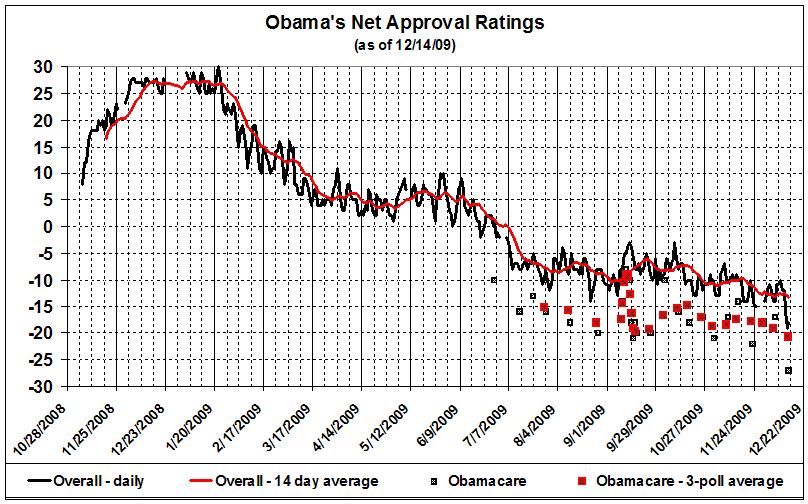
GRAPHIC UPDATED 12/14/09

What’s bad news for Obama is good news for the country. As I have said:

To hope that Obama fails is not to wish ill for the nation; to the contrary, it is to hope that Obama’s policies fail of realization because they are seen (rightly) as inimical to liberty and prosperity.

It is my sincere and fervent hope that the following trends portend good news for the liberty and prosperity of Americans:

Sources: Rasmussen Reports Daily Presidential Tracking Poll and Health Care Reform Poll. Overall net approval ratings represent the difference in the percentage of  respondents strongly approving and strongly disapproving of Obama (negative numbers mean net disapproval). Health care ratings represent the difference in the percentage of respondents strongly supporting and strongly opposing Obama’s health care “plan,” or what they take to be his plan. I use Rasmussen’s polling results because Rasmussen has a good track record with respect to presidential-election polling.

The Texas Marriage Canard

The left-o-sphere has resurrected the canard that the constitution of Texas bans all marriage. This canard rests on an incomplete reading of the following section of the constitution’s bill of rights:

Sec. 32.  MARRIAGE. (a) Marriage in this state shall consist only of the union of one man and one woman.

(b)  This state or a political subdivision of this state may not create or recognize any legal status identical or similar to marriage.

(Added Nov. 8, 2005.)

The lefties like to pull sub-section (b) out of context and claim that it stands alone. Why? Because section (b), taken out of context, can be used to scare “straights,” who might then agitate for the repeal of section 32. That would open the way for left-wing judges to decree that Texas must allow homosexual “marriage.” (Yes, there are left-wing judges in Texas, which still has a sizable Democrat minority.)

The lefties, in other words, are promoting their agenda through dishonesty. But what else is new?

Here is the correct reading of Section 32: Sub-section (a) defines marriage. Sub-section (b) spells out the implication of (a), which is to prohibit any form of “marriage” or something similar (e.g., “civil union”) that does not accord with the definition given in (a). The word “identical” in (b) should be understood to mean “equivalent,” that is, “having similar or identical effects” with respect to persons of the same sex.

Here is an analogy from mathematics:

(a) Only certain pairs of non-negative integers can be added to get the number 2, specifically: 1,1 and 0, 2.

(b) No other pair or pairs of non-negative integers can be added to get the number 2.

The framers of Section 32 might have chosen a better word than “identical,” but Section 32 clearly means what it was intended to mean: Texas recognizes no form of marriage, by any name, other than the union of one man and one woman.

End of discussion.

More about Paternalism

To complement my earlier post, “Beware of Libertarian Paternalists,” I offer the following links:

Pitfalls of Paternalism (Ilya Somin, The Volokh Conspiracy)

Hayek on the Use of Superior Expert Knowledge as a Justification for Paternalism (Ilya Somin, The Volokh Conspiracy)

The Knowledge Problem of New Paternalism (Mario Rizzo, ThinkMarkets)

Little Brother Is Watching You: The New Paternalism on the Slippery Slopes (Mario Rizzo, ThinkMarkets)

New Paternalism on the Slippery Slopes, Part I (Glen Whitman, Agoraphilia)

Be sure to read the posts and articles linked therein.

Health Care “Reform”: The Short of It

Congress and Obama will deliver unto us:

  • an entitlement program that promises “free” or “inexpensive” access to drugs and medical services;
  • higher prices for drugs and medical services, fueled by greater demand (thanks to the entitlement program) and shrinking supply (as more providers decline to accept government-set fees and red tape); and, therefore,
  • more expensive, and rationed, medical care.

The unthinkable alternative — and the only workable one — is to stimulate supply by deregulating the medical professions and the pharmaceutical industry.

In short, Obamacare will not work, unless government (a) nationalizes the drug industry and the medical professions and (b) drafts individuals into the medical professions, Soviet-style. Neither event is unimaginable, as evidenced by the enthusiasm with which  politicians have embraced the nationalization and regimentation of American financial institutions.

Of course, to suggest that Obamacare could be made to work through nationalization and regimentation is to suggest that nothing works unless it is run from Washington. That is precisely the belief held by Obama, most members of Congress, and far too many Americans.

UPDATE: Nationalization and regimentation will not take place immediately upon the enactment of Obamacare, but in response to its obvious objective: Drive private insurers out of business so that government is “forced” to step in, assume the role of the “single payer,” and effectively ration the delivery of prescription drugs and medical services. For an analysis of the slippery-slope mechanisms by which this will happen, see Mario Rizzo’s “Fast Track to the Single Payer.”

UPDATE 2: The chief actuary of the Centers for Medicare and Medicaid services confirms that Obamacare will drive costs up, not down.

Related posts:
Fear of the Free Market — Part I
Fear of the Free Market — Part II
Fear of the Free Market — Part III
Rationing and Health Care
The Perils of Nannyism: The Case of Obamacare
More about the Perils of Obamacare

Beware the Rare Event

Carl Bialik, “The Numbers Guy” at The Wall Street Journal, notes that

a 1-in-5.2 million shot came through in Bulgaria, as the same six winning numbers turned up in two consecutive drawings. And 18 Bulgarians profited by betting on recent history: They chose the winning combination of numbers from the drawing four days earlier — which hadn’t been selected by anyone the first time around — and split the pot.

The coincidence drew international news coverage and sparked a probe by a government-appointed commission. Bulgarian officials ultimately chalked it up to coincidence. . . .

The general principle . . . is that this would have happened eventually. There are lotteries in dozens of countries, and multiple ones within countries — scores in the U.S. alone. Many of these lotteries have had multiple drawings each week for decades. If there have been, say, a million lottery drawings, then a coincidence as unlikely as this one becomes more of a 1-in-5 yawn. That still means that any one player’s chances of winning the lottery are close to zero.

In short, regardless of less-than-amazing coincidences, it is a rare event to hold the winning number in a lottery.

People are drawn to coincidences of the kind described by Bialik
because the coincidences are rare events, as are celebrity scandals (as opposed to the relatively stable marriages of “ordinary” people), aircraft accidents that take 200 lives (as opposed to myriad uneventful flights), the acts of murderers and other violent criminals (as opposed to the relatively civilized behavior of most people), and so on.

A problem with rare events — “outliers” in the terminology of operations research — is that, despite their rarity, they attract a disproportionate share of public and political attention. They skew our perceptions of normality. A rare but notorious tragedy usually is followed by calls for government to “do something” to prevent future tragedies of similar kinds.

Consider, for example, the National Highway Traffic Safety Administration (NHTSA), the Occupational Safety and Health Administration (OSHA), and the Consumer Product Safety Commission (CPSC). All three agencies were established in 1970-72, in the wave of fear-mongering that followed the publication of Ralph Nader’s Unsafe at Any Speed. All three agencies were inspired by the occurrence of relatively rare events. And those occurrences had been in decline long before the establishment of NHTSA, OSHA, and CPSC.

I introduce in evidence Figures 1 and 2 of “Safety at Any Price?” by W. Kip Viscusi and Ted Gary (Regulation, Fall 2002, pp. 54-63), which indicate that unintentional injury deaths in the United States had been falling steadily, long before the advent of NHTSA, OSHA, and CPSC.* In 1928, the first year treated by the authors, the annual rate of unintentional injury deaths arising from accidents of all kinds was only about 80 per 100,000 persons; that is, about 8/100 of 1 percent of the population died of unintentionally inflicted injuries.  By 1960, the rate was only about 5/100 of 1 percent of the population, and by 1990 it was down to 3.5/100 of 1 percent of the population, where it has leveled off.

In other words, the incidence of fatal accidents declined faster before the establishment of NHTSA, OSHA, and CPSC than it has since. NHTSA, OSHA, and CPSC have had no demonstrable effect on the incidence of fatal accidents. Why? Because human beings tend to act responsibly, for the sake of self-preservation. When, on rare occasions, they fail to act responsibly — or their machinery fails them — they can be counted on to learn from their misfortunes and the misfortunes of others. And there is nothing new about learning from experience and applying that learning to improve our material possessions. Just ask a caveman.

What, then, is the role of NHTSA, OSHA, and CPSC? They are like cheerleaders who claim credit for their team’s victories because they cavort on the sidelines for the entertainment of the crowd. Cheerleaders notwithstanding, the team generally does what it was going to do, anyway, except when a cheerleader gets too close to the action and obstructs it. Sometimes a cheerleader’s obstruction accidentally benefits the cheerleader’s team; other times, it hurts the cheerleader’s team. There are three main differences between NHTSA, OSHA, and CPSC and cheerleaders. Cheerleaders (a) aren’t supposed to interfere with the players (and rarely do); (b) they provide their services relatively cheaply or free of charge; and (c) they are more attractive than most bureaucrats.

The occurrence of a rare event should be an occasion for noting that it is a rare event. It should not be an occasion for the creation of a costly, intrusive, and essentially ineffective regulatory agency or a sheaf of misguided regulations.

__________

* Figure 1 seems to show a general rise in the rate of deaths from motor vehicle accidents between 1945 and 1975. That increase  is explained by the growing use of automobiles. As shown in Figure 2 of the Viscusi-Gayer article, death rates per vehicle and per vehicle-mile had been dropping steadily until 1960, when those rates rose slightly for a few years before continuing to decline. For more about the long-term trend in deaths from motor-vehicle accidents, see this post, which also includes a discussion of the Peltzman effect: “the hypothesized tendency of people to react to a safety regulation by increasing other risky behavior, offsetting some or all of the benefit of the regulation.” There is more evidence for the Peltzman effect in this article.

The Incredible Shrinking Obama

Sizing Up Obama” (April 24, 2009):

On the one hand, we have FDR II, replete with schemes for managing our lives and fortunes.

On the other hand, we have Carter-Clinton II, ready to: kowtow to those who would bury us, create the illusion that peace will reign perforce, and act on that illusion by slashing the defense budget (thereby giving aid and comfort to our enemies).

Through the haze of smoke and glare of mirrors I see a youngish president exhorting us to “fear nothing but fear itself” while proclaiming “peace for our time,” as we “follow the yellow-brick road” to impotent serfdom.

The schemes persist, most notoriously (but not exclusively) in health care “reform,” about which Arnold Kling writes today:

What is misleading about statements (a) – (k) [taken from Obama’s speech on September 9] is that each of them referred to a plan that, strictly speaking, does not exist. As far as I know, the Obama Administration never submitted a plan to Congress. . . .

If you are going to repeatedly refer to “my plan” or “this plan” or “the plan I’m proposing,” then unless you have a plan you are lying. The only question is whether it is a little lie or a big one. Obviously, most people think it is only a small lie, or the President would have been called out on it. However, I think that health care policy is an area where there is too much temptation to promise results that are economically impossible to achieve. In that context, my opinion is that giving a speech in favor of a nonexistent plan is a really big lie.

Now — on the 70th anniversary of Stalin’s invasion of Poland — comes Obama’s decision to placate the Russians and insult our allies in Eastern Europe:

President Obama dismayed America’s allies in Europe and angered his political opponents at home today when he formally ditched plans to set up a missile defence shield in Poland and the Czech Republic.

The project had been close to the heart of Mr Obama’s predecessor, President Bush, who had argued before leaving office in January that it was needed to defend against long-range ballistic missile attacks from rogue states such as Iran and North Korea.

But it had hobbled relations with Russia, which considered it both a security threat and an unnecessary political provocation in its own backyard.

At a White House appearance today, Mr Obama confirmed that the defence shield envisaged by the Bush Administration, involving a radar base in the Czech Republic and interceptor rockets sited in Poland, was being abandoned. . . .

“The decision announced today by the Administration is dangerous and short-sighted,” the No 2 Republican in the Senate, Jon Kyl, said in a statement.

Mr Kyl said that the shift would leave the United States “vulnerable to the growing Iranian long-range missile threat” and would send a chilling message to former Soviet satellites who had braved Moscow’s anger to support the system.

“This will be a bitter disappointment, indeed, even a warning to the people of Eastern Europe,” said Mr Kyl, who pointed out that both Poland and the Czech Republic had sent troops to Iraq and Afghanistan. “Today the Administration has turned its back on these allies.”

Senator John McCain, Mr Obama’s defeated Republican White House rival in 2008, said he was “disappointed” with the decision and warned it could undermine US standing in Eastern Europe amid worries there of a resurgent Russia.

“Given the serious and growing threats posed by Iran’s missile and nuclear programmes, now is the time when we should look to strengthen our defences, and those of our allies,” he said in a statement.

“Missile defence in Europe has been a key component of this approach. I believe the decision to abandon it unilaterally is seriously misguided.”

The good news is that Americans seem to have wised up to the Obama scam:

Obama's net approval_090917Sources: Rasmussen Reports Daily Presidential Tracking Poll and Health Care Reform Poll. Overall net approval ratings represent the difference in the number of  respondents strongly approving and strongly disapproving of Obama (negative numbers mean net disapproval). Health care ratings represent the difference in the number of respondents supporting and opposing Obama’s health care “plan,” or what they take to be his plan.

The mini-wave of approval that followed Obama’s health-care speech on September 9 seems to have dissipated. Obama’s appeasement of Russia, if it becomes widely perceived as such, will only push his numbers further south.

The Perils of Nannyism: The Case of Obamacare

Nannyism is bad, even when it’s good. Suppose, for example, that Obamacare — as finally enacted by Congress — miraculously obtains the following impossible results:

  • No one who had insurance before Obamacare will find the cost of his insurance rising because (for example) the law stipulates that insurers must ignore pre-existing conditions and must cover certain previously uninsured conditions.
  • Everyone who is forced to buy insurance (or, alternatively, pay a tax penalty) will find that the additional cost is offset by insurance benefits.
  • The costs of subsidizing those who cannot afford insurance will be defrayed by eliminating “waste, fraud, and abuse” in Medicare, Medicaid, and various other government programs — “waste, fraud, and abuse” that has heretofore been tolerated because it is a natural concomitant of government programs and cannot be eliminated without eliminated the programs themselves.
  • Insurance subsidies will not be extended to illegal aliens, whose addition to the rolls would burden taxpaying citizens, even though Democrats relish the thought of converting those illegal aliens to Democrat-voting citizens.
  • The prices of various drugs and medical services will not change by more than they would have in the absence of Obamacare. That is to say, the extra demands generated by government mandates and the addition of some 47 million persons to the insurance rolls will somehow be met with additional supplies of drugs and medical services, despite the disincentives created by government control of drug prices and fees for various medical services (via the government-run insurance program).
  • There will be no rationing of medical care by government or government-approved bodies — no “death panels” — even though government control of medicine will choke off the provision of non-approved drugs and medical services.
  • The federal government’s budget deficits will not become larger than they would have been in the absence of Medicare. Nor will federal spending on Obamacare, Medicare, Medicaid, and Social Security swell to well more than 50 percent of GDP in a few generations, thus — in combination with necessarily higher taxes and the usual accretion of regulations — giving government almost absolute control of the American economy.
  • Because the federal government’s deficits will not rise any more than they would have in the absence of Obamacare, further tax hikes (above those already in store) will be unnecessary. It will especially unnecessary to further bleed “the rich,” whose incomes are an especially important source of funding for the business start-ups and capital formation that yield economic growth.
  • The federal government’s almost-absolute control of the American economy, accompanied inevitably by various social dictates favoring certain groups, will not complete the work of undermining true social cohesion (which is attained through voluntary associations), personal responsibility, and entrepreneurial initiative.
  • America, in short, will not be driven into the ranks of economically stagnant, morally bankrupt “social democracies” on the European model.

Given that those miracles occur — because Americans who care about such things have been promised (more or less) that they will occur — what could be wrong with Obamacare? Why are tens of thousands of Americans taking to the streets to protest it? Don’t they know a good deal when it’s offered to them?

Could it be that there are still millions of Americans who know instinctively and through observation (if not education) that those miracles will not occur? Could it be that those millions of Americans understand all too well that Obamacare will be just another well-intentioned program that paves our way to financial and bureaucratic hell?

Or could it be that millions of Americans value true liberty, the kind of liberty that is assured by the observance of social norms within a framework of government-protected negative rights? Is it possible that millions of Americans value true liberty and all it entails: the opportunity to make one’s own way in life, to make mistakes and learn from them, to choose from among alternative goods and services (including medical ones), and to choose even where the resulting choices may not be the “best” ones according to the calculations or preferences of academicians and bureaucrats?*

There’s the answer: Millions of Americans — even after decades of nannyism — simply want liberty because it is of value to them, in and of itself. (How unimaginably retro!) They prefer to decide for themselves what’s good for them, and are tired of having academicians, politicians, and bureaucrats make those decisions. In a phrase, they prefer liberty to nannyism.

(Related reading about “perfect” government oversight of economic affairs is here, here, and here. )

Related posts:
The Perils of Europeanism
Reclaiming Liberty throughout the Land
Secession
Secession Redux
A New (Cold) Civil War or Secession?
Fascism with a “Friendly” Face
Fascism and the Future of America
Selection Bias and the Road to Serfdom
Beware of Libertarian Paternalists
Monopoly: Private Is Better than Public
The Price of Government
Why Is Entrepreneurship Declining?
The Commandeered Economy
Rationing and Health Care
Law and Liberty
Rights, Liberty, the Golden Rule, and the Legitimate State
Parsing Political Philosophy

__________

* It is true, for example, that the portion of GDP going to medical goods and services has been rising, in part, because Americans want, and can afford, more and better medical goods and services. It is also true that prices of medical goods and services have risen, in part, because of government policies: the subsidization of consumption through Medicare, Medicaid, and the tax-favored treatment of employer-paid health insurance; the restriction of supply by the FDA and various licensing agencies, as discussed here, here, and here.)

Rights, Liberty, the Golden Rule, and the Legitimate State

A right, as opposed to a privilege, is capable of universal application within a polity. The only true rights, therefore, are liberty rights, which are negative rights. So-called positive rights are privileges, not rights.

Liberty rights are represented in the Founders’ trinity of “unalienable Rights“: “Life, Liberty, and the pursuit of Happiness.” These really constitute a unitary right, which I simply call liberty. The liberty right is unitary because liberty (as a separate right) is meaningless without life and the ability to pursue happiness. Thus we have this: rights ≡ liberty (rights and liberty are identical). The identity of rights and liberty is consistent with this definition of liberty:

3. A right or immunity to engage in certain actions without control or interference.

In essence, liberty consists of negative rights (the right not be attacked, robbed, etc.). Negative rights are true rights because they are capable of universal application: Leaving others alone (the essence of negative rights) costs each of us nothing and yields liberty for all.

Positive rights (the right to welfare benefits, a job based on one’s color or gender, etc.) are not rights, properly understood, because they are not capable of universal application: Taking from others (the requisite of positive rights) costs some of us something without an offsetting return. (Think, for example, of the redistributional effects of various taxes.) Positive rights cannot be had without engaging in actions that control or interfere with others. Positive rights are anti-libertarian privileges.

Liberty — rightly understood as the universal application of negative rights — is possible only when the Golden Rule is, in fact, the rule. The Golden Rule, which is the quintessential social norm, encapsulates a lesson learned over the eons of human coexistence. That lesson? If I desist from harming others, they (for the most part) will desist from harming me.

In civil society, exceptional behavior is dealt with by criticism and punishment (which may include ostracism). The exceptions usually are dealt with by codifying the myriad instances of the Golden Rule (e.g., do not steal, do not kill) and then enforcing those instances through communal action (i.e., justice and defense).

The exceptions that cannot be dealt with by civil society are the proper concern of the minimal state — one that is dedicated to the defense of its citizens from predators. But the state becomes illegitimate the moment it crosses the line from the enforcement of the Golden Rule (negative rights) to the granting of privileges (positive rights). For when the state does that, it is no longer dedicated to liberty.

Related posts:
Fascism with a “Friendly” Face
Democracy and Liberty
Inventing “Liberalism”
Parsing Political Philosophy
The Interest-Group Paradox
Utilitarianism vs. Liberty
The Principles of Actionable Harm
Law and Liberty
Negative Rights
Negative Rights, Social Norms, and the Constitution
A New (Cold) Civil War or Secession?
Civil War, Close Elections, and Voters’ Remorse
The Devolution of American Politics from Wisdom to Opportunism

The Commandeered Economy

Revised and updated, here.


A New (Cold) Civil War or Secession?

Max Borders writes:

. . . Toleration and open discourse is, well, no longer tolerated. We are slowly becoming a place of mere de jure free speech. And even that is being eroded by the day. I have to blame so-called “progressives” the most for this. They are people for whom the end justifies the means. So any lip-service they occasionally pay to civil liberties is but a tool of convenience to be employed on the way to getting things their way. A new cold civil war is emerging.

There is much truth in that. But I would go further.

Thanks to the lethal combination of left-statist demagoguery and voter irrationality, Americans are, among other things, saddled with

  • the destruction of civilizing social norms, together with a high threshold of tolerance for criminals and a concomitant softness on matters of national defense
  • the continuing nationalization of medical care, which began in earnest with Medicare and continues in the guise of Obamacare (with all of its potential for bureaucratic abuses of power)
  • severe restrictions on economic output in order to satisfy the dictatorial urge to puritanism that lies behind the “warming” industry

As I have said,

[t]hese encroachments . . . are morally illegitimate because their piecemeal character has robbed Americans of voice and mooted the exit option. And so, we have discovered — too late — that we are impotent hostages in our own land.

I am reminded of these words:

We hold these truths to be self-evident, that all men are created equal, that they are endowed by their Creator with certain unalienable Rights, that among these are Life, Liberty and the pursuit of Happiness.–That to secure these rights, Governments are instituted among Men, deriving their just powers from the consent of the governed, –That whenever any Form of Government becomes destructive of these ends, it is the Right of the People to alter or to abolish it, and to institute new Government, laying its foundation on such principles and organizing its powers in such form, as to them shall seem most likely to effect their Safety and Happiness. Prudence, indeed, will dictate that Governments long established should not be changed for light and transient causes; and accordingly all experience hath shewn, that mankind are more disposed to suffer, while evils are sufferable, than to right themselves by abolishing the forms to which they are accustomed. But when a long train of abuses and usurpations, pursuing invariably the same Object evinces a design to reduce them under absolute Despotism, it is their right, it is their duty, to throw off such Government, and to provide new Guards for their future security.

What we need is not a civil war — cold or hot — but a serious movement toward secession:

The legal basis for the perpetuation of the United States disappears when the federal government abrogates the Constitution. Given that the federal government has long failed to honor Amendment X [among many other parts of the Constitution], there is a prima facie case that the United States no longer exists as a legal entity. Secession then becomes more than an option for the States: It becomes their duty, both as sovereign entitities and as guardians of their citizens’ sovereignty.

See “The Constitution: Myths and Realities“.

Negative Rights, Social Norms, and the Constitution

In a recent post about negative rights, I quote Randy Barnett, who explains that such “rights that define the space within which people are free to choose how to act.” Well, not quite.

Think about it. A libertarian regime would protect these negative rights:

  • freedom from force and fraud (including the right of self-defense against force)
  • property ownership (including the right of first possession)
  • freedom of contract (including contracting to employ/be employed)
  • freedom of association and movement.

But those rights enclose a cavernous “space,” within which human behavior can find many self-destructive outlets unless it is shaped by social norms — socially evolved rules (as opposed to government-dictated ones) which delineate morally and socially acceptable behavior. Think of the ways in which your present behavior is shaped by the moral lessons of your childhood and by your experiences as a child, student, spouse, parent, friend, co-worker, neighbor, church member, club member, team member, and the like.

In sum, negative rights are meaningless absent a framework of social norms that is consistent with negative rights and which directs behavior along constructive paths. Conversely, constructive social norms are undermined where government fails to protect negative rights or actively denies them. There is, for example, no right of freedom from force in a community where violence is the norm and government is unable to protect residents from violence; there is no right of property ownership in a community where government seizes property as it sees fit to do so; there is no right of freedom of movement for slaves; and so on. (Obviously, I am referring to rights as they are actually enjoyed, not “natural” rights.)

In the United States, the history of negative rights parallels the history of the Constitution:

The original Constitution protected the rights to life, liberty, and property against infringement by the federal government in two ways. First and foremost, Congress was not given a general legislative power but only those legislative powers “herein granted,” referring to those powers enumerated in Article I, section 8. It is striking how these powers avoid expressly restricting the rightful exercise of liberty. The power “to raise and support armies” does not include an express power of conscription, which would interfere with the property one has in one’s own person. The power to establish the post office does not expressly claim a power to make the government post office a monopoly, which would interfere with the freedom of contract of those who wish to contract with a private mail company of the sort founded by Lysander Spooner. (By contrast, the Articles of Confederation did accord the power in Congress to establish a postal monopoly.)…

Two years after its enactment, the Constitution was amended by the Bill of Rights. These ten amendments included several express guarantees of such liberties as the freedom of speech, press, assembly, and the right to keep and bear arms. The Bill of Rights barred takings for public use without just compensation. It provided additional procedural assurances that the laws would be applied accurately and fairly to particular individuals.
All of the rights enumerated in the Bill of Rights are consistent with modern libertarian political philosophy. And to this list of rights was added the Ninth Amendment that said, “The enumeration in the Constitution of certain rights shall not
be construed to deny or disparage others retained by the people.” In this way, even liberty rights that were not listed were given express constitutional protection. Finally, the Tenth Amendment reaffirmed that Congress could exercise only those
powers to which it was delegated “by this Constitution.”…

While the Thirteenth Amendment’s ban on involuntary servitude expanded the Constitution’s protection of individual liberty against abuses by states, it was the Fourteenth Amendment that radically altered the federalism of the original
Constitution. For the first time, Congress and the courts could invalidate any state laws that “abridge[d] the privileges or immunities of citizens of the United States.” The original meaning of “privileges or immunities” included the same natural rights retained by the people to which the Ninth Amendment referred, but also the additional enumerated rights contained in the Bill of Rights. The Due Process Clause of the Fourteenth Amendment placed a federal check on how state laws are applied to particular persons, while the Equal Protection Clause imposed a duty on state executive branches to extend the protection of the law on all persons without
discrimination. (Randy Barnett, “Is the Constitution Libertarian?,” p. 14-17)

However,

the Supreme Court has upheld countless federal laws restricting
liberty, primarily under the power of Congress “to regulate commerce . . . among the several states” combined with an open-ended reading of the Necessary and Proper Clause. Further it has upheld the power of Congress to spend tax revenue for purposes other than “for carrying into execution” its enumerated powers, thereby exceeding the scope of the Necessary and Proper Clause….

Beginning in the 1930s, the Supreme Court . . . adopted a presumption of constitutionality whenever a statute restricted unenumerated liberty rights. In the 1950s it made this presumption effectively irrebuttable. Now it will only protect those liberties that are listed, or a very few unenumerated rights such as the right of privacy. (op. cit., pp. 15, 17-18)

What the law giveth, the law taketh away. The power of the States, individually, to trample negative rights has been supplanted by the far greater power of the central government to trample negative rights.

Generally, negative rights are trampled by every government enactment that does more than protect negative rights.  Which is to say that most government enactments deny negative rights; for example, they

  • compel the surrender of income to government agencies for non-protective purposes (violating freedom from force and property ownership)
  • compel the transfer of income to persons who did not earn the income (violating freedom from force and property ownership)
  • direct how business property may be used, through restrictions on the specifications to which goods must be manufactured (violating property ownership)
  • force the owners of businesses (in non-right-to-work-States) to recognize and bargain with labor unions (violating property rights and freedom of contract)
  • require private businesses to hire certain classes of persons (“protected groups”) and undertake additional expenses for the “accommodation” of handicapped persons (violating property rights and freedom of contract)
  • require private businesses to restrict or ban smoking (violating property rights and freedom of association)
  • mandate attendance at tax-funded schools and the subjects taught in those schools, even where those teachings run counter to the moral values that parents are trying to inculcate (violating freedom from force and freedom of association)
  • limit political speech through restrictions on political contributions and the publication of political advertisements (violating freedom from force and freedom of association).

Such enactments also trample social norms. First, and fundamentally, they convey the message that government, not private social institutions, is the proper locus of moral instruction and interpersonal mediation. Persons who seek special treatment (privileges, a.k.a. positive rights) learn that they can resort to government for “solutions” to their “problems,” which encourages other persons to do the same thing, and so on. In the end — which we have not quite reached — social institutions lose their power to instruct and mediate, and become merely sources of solace and entertainment.

More specifically, government enactments have

  • engendered disrespect for life by authorizing abortion
  • legitimated lewd, lascivious, inconsiderate, and violent behavior in the name of “freedom of expression” and “freedom of speech,” even while distancing children from the moral lessons of religion by declaring freedom from religion where the Constitution only prohibits government establishment of religion
  • undermined the role of the family as a central civilizing force by encouraging the breakup of families (welfare rules, easy divorce)
  • usurped the authority of parents by usurping their authority to instill moral values (as mentioned above)
  • encouraged the absence of mothers from the home through subsidized day-care and “affirmative action”
  • engendered disrespect for constructive economic behavior by rewarding shiftlessness (welfare) and penalizing success (progressive income tax, the “death tax,” etc.)
  • shifted the burden of care for the elderly from families to “society” (i.e., taxpayers) through Social Security, Medicare, and Medicaid, thus teaching the wrong lessons about the value of life and respect for old persons.

I could go on and on, but I hope that I have made my point: Politicians — in their zeal to pander to special interests — have damaged the general interest through their disregard of negative rights and the framework of civilizing norms that transforms negative rights into constructive behavior.

How could this have happened? Here is my explanation:

The Framers underestimated the will to power that animates office-holders. The Constitution‘s wonderful design — horizontal and vertical separation of powers — which worked rather well until the late 1800s, cracked under the strain of populism, as the central government began to impose national economic regulation at the behest of muckrakers and do-gooders. The Framers’ design then broke under the burden of the Great Depression, as the Supreme Court of the 1930s (and since) has enabled the central government to impose its will at will. The Framers’ fundamental error can be found in Madison’s Federalist No. 51. Madison was correct in this:

. . . It is of great importance in a republic not only to guard the society against the oppression of its rulers, but to guard one part of the society against the injustice of the other part. Different interests necessarily exist in different classes of citizens. If a majority be united by a common interest, the rights of the minority will be insecure. . . .

But Madison then made the error of assuming that, under a central government, liberty is guarded by a diversity of interests:

[One method] of providing against this evil [is] . . . by comprehending in the society so many separate descriptions of citizens as will render an unjust combination of a majority of the whole very improbable, if not impracticable. . . . [This] method will be exemplified in the federal republic of the United States. Whilst all authority in it will be derived from and dependent on the society, the society itself will be broken into so many parts, interests, and classes of citizens, that the rights of individuals, or of the minority, will be in little danger from interested combinations of the majority.

In a free government the security for civil rights must be the same as that for religious rights. It consists in the one case in the multiplicity of interests, and in the other in the multiplicity of sects. The degree of security in both cases will depend on the number of interests and sects; and this may be presumed to depend on the extent of country and number of people comprehended under the same government. This view of the subject must particularly recommend a proper federal system to all the sincere and considerate friends of republican government, since it shows that in exact proportion as the territory of the Union may be formed into more circumscribed Confederacies, or States oppressive combinations of a majority will be facilitated: the best security, under the republican forms, for the rights of every class of citizens, will be diminished: and consequently the stability and independence of some member of the government, the only other security, must be proportionately increased. . . .

Madison then went on to contradict what he said in Federalist No. 46 about the States being a bulwark of liberty:

It can be little doubted that if the State of Rhode Island was separated from the Confederacy and left to itself, the insecurity of rights under the popular form of government within such narrow limits would be displayed by such reiterated oppressions of factious majorities that some power altogether independent of the people would soon be called for by the voice of the very factions whose misrule had proved the necessity of it. In the extended republic of the United States, and among the great variety of interests, parties, and sects which it embraces, a coalition of a majority of the whole society could seldom take place on any other principles than those of justice and the general good; whilst there being thus less danger to a minor from the will of a major party, there must be less pretext, also, to provide for the security of the former, by introducing into the government a will not dependent on the latter, or, in other words, a will independent of the society itself. It is no less certain than it is important, notwithstanding the contrary opinions which have been entertained, that the larger the society, provided it lie within a practical sphere, the more duly capable it will be of self-government. And happily for the REPUBLICAN CAUSE, the practicable sphere may be carried to a very great extent, by a judicious modification and mixture of the FEDERAL PRINCIPLE.

Madison understood that a majority can tyrannize a minority. He understood that the States are better able to prevent the rise of tyranny if the powers of the central government are circumscribed. But he then assumed that the States themselves could not resist tyranny within their own borders. Madison overlooked the importance of exit as the ultimate check on tyranny. He assumed that, in creating a new central government with powers greatly exceeding those of the Confederacy, a majority of States would not tyrannize the minority and that minorities with overlapping interests would not concert to tyrannize the majority. Madison was so anxious to see the Constitution ratified that he oversold himself and the States’ ratifying conventions on the ability of the central government to hold itself in check. Thus the Constitution was lamentably silent on nullification and secession.

What has been done by presidents, Congresses, and courts will be very hard to undo. Too many interests are vested in the regulatory-welfare state that has usurped the Framers’ noble vision. Democracy (that is, vote-selling) and log-rolling are more powerful than words on paper. Even a Supreme Court majority of “strict constructionists” probably would decline to roll back the New Deal and most of what has come in its wake.

The Best and Worst of Times

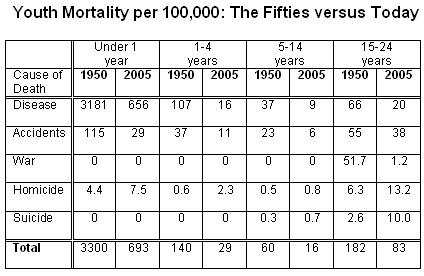
Bryan Caplan presents the following table:

youth-mortality-2005-vs-1950

Caplan’s commentary:

Overall, today is much safer than 1950.  That’s probably no surprise to anyone who knows basic economic history.  What’s particularly interesting is that safety gains are especially large for younger kids.  The mortality rate for kids under 5 was almost five times greater in 1950, 3.7 times greater for kids 5-14, and 2.2 times greater for 15-24 year olds.

I suspect that many people will object, “Yes, but if you break the results down by cause of death, modernity is worse in both homicide and suicide – two out of the five categories.”  My reply: All modernity has done is roughly double two vivid near-zero risks.  In exchange, we are vastly safer from the formerly quantitatively fearsome risks of disease, accidents, and war.

Bottom line: Modernity delivers the children’s paradise that the fifties only promised.  Maybe the nation’s parents should try turning off their televisions for a minute of gratitude that they aren’t Ward and June Cleaver?

Caplan’s conclusions are foolish because he reifies “modernity” (an abstraction without causal or explanatory power) and aggregates mortality rates that, individually, stand for separate and distinct phenomena:

  • advances in medical science (thus lower mortality from disease)
  • safer household products, machinery, and automobiles (thus lower mortality from accidents)
  • vastly different conditions of war (intense, head-to-head combat along “front lines” in Korea vs. sporadic operations against/attacks from guerrillas in Afghanistan and Iraq)
  • greater lawlessness among teens and young adults (thus a higher death-from-homicide rate among 15-24 year olds)
  • greater anomie among teens and young adults (thus a higher death-from suicide rate among 15-24 year olds)

War is a trendless phenomenon, and shouldn’t be included in Caplan’s statistics. For 15-24 year olds, then, the relevant mortality rate is 82 persons per 100,000 in 2005, as against 130 per 100,000 in 1950. But what we really see is a mix of change for the better and change for the worse, and the two can’t be combined to suggest overall change for the better.  There is progress of one kind — scientific and engineering advancement — and regress of another kind — greater alienation of young adults from traditional moral strictures against violence to others and oneself.

Why have young adults become less respectful of others and themselves in the past half-century? Consider these influences:

  • “Entertainment” has become more violent, and graphically so. Compare today’s films and TV shows with those of yesteryear, today’s rap “music” with the tepid tunes of the early 1950s, and today’s computer and video “games” with pinball.
  • Under the onslaught of social engineering by government (e.g., sex education in schools, welfare “rights,” easy divorce, and day-care subsidies) family life has become less coherent and the role of parents has become less central in the guidance of children. Increasingly, mothers are absent (at work), and fathers are absent (period).
  • Even in two-parent homes, parents have less time for their children because they (the parents) are caught up in the pursuit of material goods. Parents try to compensate for their physical and spiritual absence by spoiling their children with material goods, which merely signals to children the primacy of material things over humane values.

The predictable result of these influences is disregard for others and oneself. This disregard manifests itself not only in homicide and suicide but also in substance abuse, wanton sex, venereal disease, and abortion or — almost as bad — the bearing of “unwanted” children who then become targets of abuse.

Unlike Caplan, I see a less-than-half-full glass in the mortality-rate trends. Scientific and engineering advances are all very well, but they cannot prevent or offset the decline of America into hedonism and violence. As the descent becomes more obvious to politicians, they will seize the opportunity to “save” us through various draconian measures, just as they would save us from the pleasures of smoking, a natural cycle of “global warming,” the right to defend ourselves, and on and on.

Negative Rights

Go here for a comprehensive treatment of negative rights, rights in general, and liberty.

Law and Liberty

Law comprises the rules which circumscribe human behavior. Law in the United States is mainly an amalgam of two things:

  • widely observed social norms that have not yet been undermined by government
  • governmental decrees that shape behavior because they (a) happen to reflect social norms or (b) are backed by a credible threat of enforcement.

Law — whether socially evolved or government-imposed — is morally legitimate only when it conduces to liberty; that is, when

  • it applies equally to all persons in a given social group or legal jurisdiction
  • an objector may freely try to influence law (voice)
  • an objector may freely leave a jurisdiction whose law offends him (exit).

Unequal treatment means the denial of negative rights on some arbitrary basis (e.g., color, gender, income). As long as negative rights are not denied, then a norm of voluntary discrimination (on whatever basis) is a legitimate exercise of the negative right to associate with persons of one’s choosing, whether as a matter of personal or commercial preference (the two cannot be separated). True liberty encompasses social distinctions, which are just as much the province of “minorities” and “protected groups” as they are of the beleaguered white male of European descent, whose main sin seems to have been the creation of liberty and prosperity in this country.

Law is not morally legitimate where equal treatment, voice, or exit are denied or suppressed by force or the threat of force. Nor is law morally legitimate where incremental actions of government (e.g., precedential judicial rulings) effectively deny voice and foreclose exit as a viable option.

If government-made law ever had moral legitimacy in the United States, the zenith of its legitimacy came in 1905:

[T]he majority opinion in [Lochner v. New York] came as close as the Supreme Court ever has to protecting a general right to liberty under the Fourteenth Amendment. In his opinion for the Court, Justice Rufus Peckham affirmed that the Constitution protected “the right of the individual to his personal liberty, or to enter into those contracts in relation to labor which may seem to him appropriate or necessary for the support of himself and his family.” (Randy Barnett,  “Is the Constitution Libertarian?,” p. 5)

But:

Beginning in the 1930s, the Supreme Court reversed its approach in Lochner and adopted a presumption of constitutionality whenever a statute restricted unenumerated liberty rights. [See O’Gorman & Young, Inc. v. Hartford Fire Ins. Co. (1931).] In the 1950s it made this presumption effectively irrebuttable. [See Williamson v. Lee Optical of Oklahoma (1955).] Now it will only protect those liberties that are listed, or a very few unenumerated rights such as the right of privacy. But such an approach violates the Ninth Amendment’s injunction against using the fact that some rights are enumerated to deny or disparage others because they are not. (Barnett, op. cit, pp. 17-18)

This bare outline summarizes the governmental acts and decrees that stealthily expanded and centralized government’s power and usurped social norms. The expansion and centralization of power occurred in spite of the specific limits placed on the central government by the original Constitution and the Tenth Amendment, and in spite of the Fourteenth Amendment. These encroachments on liberty are morally illegitimate because their piecemeal character has robbed Americans of voice and mooted the exit option. And so, we have discovered — too late — that we are impotent captives in our own land.

Voice is now so circumscribed by “settled law” that there is a null possibility of restoring Lochner and its ilk. Exit is now mainly an option for the extremely wealthy among us. (More power to them.) For the rest of us, there is no realistic escape from illegitimate government-made law, given that the rest of the world (with a few distant exceptions) is similarly corrupt.

As Thomas Jefferson observed in 1774,

Single acts of tyranny may be ascribed to the accidental opinion of a day; but a series of oppressions, begun at a distinguished period and pursued unalterably through every change of ministers, too plainly prove a deliberate, systematic plan of reducing [a people] to slavery.

Having been subjected to a superficially benign form of slavery by our central government, we must look to civil society and civil disobedience for morally legitimate law. Civil society, as I have written, consists of

the daily observance of person X’s negative rights by persons W, Y, and Z — and vice versa…. [Civil society is necessary to liberty] because it is impossible and — more importantly — undesirable for government to police everyone’s behavior. Liberty depends, therefore, on the institutions of society — family, church, club, and the like — through which individuals learn to treat one another with respect, through which individuals often come to the aid of one another, and through which instances of disrespect can be noted, publicized, and even punished (e.g., by criticism and ostracism).

That is civil society. And it is civil society which … government ought to protect instead of usurping and destroying as it establishes its own agencies (e.g., public schools, welfare), gives them primary and even sole jurisdiction in many matters, and funds them with tax money that could have gone to private institutions.

When government fails to protect civil society — and especially when government destroys it — civil disobedience is in order. If civil disobedience fails, more drastic measures are called for:

When I see the worsening degeneracy in our politicians, our media, our educators, and our intelligentsia, I can’t help wondering if the day may yet come when the only thing that can save this country is a military coup. (Thomas Sowell, writing at National Review Online, May 1, 2007)

In Jefferson’s version,

when wrongs are pressed because it is believed they will be borne, resistance becomes morality.

Rationing and Health Care

Peter Singer — utilitarian extraordinaire , spokesman for involuntary euthanasia, and advocate of infanticide — recently shared with millions of rapt readers his opinions about why and how health care must be rationed: “Why We Must Ration Health Care,” The New York Times Magazine, July 15, 2009. Given Singer’s penchant for playing God, the “we” of his title could be an imperial one, but — in this instance — it is an authoritarian one.

Singer is among the many “public intellectuals” (some of them Nobelists) who believe in an omniscient, infallible government, provided — of course — that it does things unto the rest of us the way that they (the “intellectuals”) would have them done. And, like most of those “intellectuals,” Singer is dead wrong in his assertions about how to “solve” the “health care problem,” because his underlying premises and “logic” are dead wrong.

I begin with Singer’s central thesis:

Health care is a scarce resource, and all scarce resources are rationed in one way or another. In the United States, most health care is privately financed, and so most rationing is by price: you get what you, or your employer, can afford to insure you for.

Those two sentences are replete with inaccuracy and error:

  • There is no such thing as “health care”; the term is a catch-all for a wide variety of goods and services, ranging from the self-administration of generic aspirin to complex, delicate neurological surgery.
  • In any event, “health care” is not a “resource,” its various forms are economic goods (i.e., products and services), the production of which requires the use of resources (e.g., the time of trained nurses and doctors, the raw materials and production facilities used in drug manufacture).
  • Economic goods are not rationed by price; price facilitates voluntary transactions between willing buyers and sellers in free markets. Rationing is what happens when a powerful authority (usually a government) steps in to dictate the organization markets, the specifications of goods, and — more extremely — who may but what goods and at what prices (though dictated prices are essentially meaningless because they do not perform the signaling function that they do in free markets).
  • Much “health care” in the United States is privately financed, to the extent that most Americans buy and self-administer products like aspirin, antihistamines, cough medicine, band-aids, etc., and some (though relatively few) Americans buy medical products and services without the benefit of insurance. But much “health care” is not privately financed, because — as Singer soon notes — there is a substantial taxpayer subsidy for employer-sponsored insurance programs. There are various other taxpayer subsidies and government restraints  (e.g., Medicare, Medicaid, government-funded research of diseases and medicines, FDA approval of most kinds of medications and personal-care products).

The slipperiest of Singer’s facile statements is his characterization of what happens in free markets as “rationing,” thus lending back-handed legitimacy to true rationing, which is brute-force interference by government in what is really a personal responsibility: caring for one’s health. For it has somehow come to be common currency that “health care” is a “right,” something that government ought to do for us, instead of something that we ought to do for ourselves. (After all, we do live in an age of “positive rights,” which come at a high cost to everyone, including those who seek them.)

Most Americans are, however, enmeshed in a Catch-22 situation. They have less money to provide for themselves because it has been taken from them by government, to provide for others. But Singer deems the provision inadequate:

In the public sector, primarily Medicare, Medicaid and hospital emergency rooms, health care is rationed by long waits, high patient copayment requirements, low payments to doctors that discourage some from serving public patients and limits on payments to hospitals.

Singer’s “solution” is to make things worse:

The case for explicit health care rationing in the United States starts with the difficulty of thinking of any other way in which we can continue to provide adequate health care to people on Medicaid and Medicare, let alone extend coverage to those who do not now have it.

How will outright rationing entice doctors and hospitals to provide services that they are now unwilling to provide? If doctors leave the medical profession, and new doctors enter at reduced rates, what would Singer do? Begin drafting students into medical schools? What about hospitals that refuse to conform? Would they be nationalized, along with their nurses, orderlies, etc.?

What a pretty picture: Soviet-style medicine here in the U.S. of A. Yet that it precisely where outright rationing will lead if the politburo in Washington sees a shrinking supply of doctors, hospitals, and other medical providers — as it will. Most politicians do not know how to do less. When they create a mess, their natural inclination is to do more of what they did to cause the mess in the first place.

Singer, naturally, appeals to the authority of just such a politician:

President Obama has said plainly that America’s health care system is broken. It is, he has said, by far the most significant driver of America’s long-term debt and deficits. It is hard to see how the nation as a whole can remain competitive if in 26 years we are spending nearly a third of what we earn on health care, while other industrialized nations are spending far less but achieving health outcomes as good as, or better than, ours.

Well, if BO says it, it must be true, n’est-ce pas? The “system” is broken because government established Medicare and Medicaid, back in the days of LBJ’s “Great Society.”  Those two programs have “only” four fatal flaws:

  • They take money from taxpayers, who therefore are less able to provide for themselves.
  • They grant beneficiaries “free” or low-cost access to medical services, thus bloating the demand for those services and causing their prices to rise. (The subsidy of employer-sponsored health insurances has the same effect.)
  • They involve promises of access to medical services that cannot be redeemed by the paltry Medicare tax rate — thus the prospect of balooning deficits, leading to (a) higher interest rates and/or (b) higher taxes on (you guessed it) “the rich.”
  • “The rich,” who finance economic growth, will flee these shore (or their money will), and the deficits will grow larger as tax revenues fall.

Another natural inclination of politicians is to deplore the messes caused by other politicians, and then to do something to make the messes worse. In this instance, BO itches to trump LBJ.

But, of course, this time will be different — it will be done right:

Rationing health care means getting value for the billions we are spending by setting limits on which treatments should be paid for from the public purse. If we ration we won’t be writing blank checks to pharmaceutical companies for their patented drugs, nor paying for whatever procedures doctors choose to recommend. When public funds subsidize health care or provide it directly, it is crazy not to try to get value for money. The debate over health care reform in the United States should start from the premise that some form of health care rationing is both inescapable and desirable. Then we can ask, What is the best way to do it?

So, instead of insurance companies — which at least compete with each other to offer subscribers affordable and attractive lineups of providers and drug formularies — our choices will be dictated by all-wise bureaucrats. Lovely!

Singer defends the bureaucrats, as long as they do it his way, of course. He begins with NICE:

…Britain’s National Institute for Health and Clinical Excellence…. generally known as NICE, is a government-financed but independently run organization set up to provide national guidance on promoting good health and treating illness…. NICE had set a general limit of £30,000, or about $49,000, on the cost of extending life for a year….

There’s no doubt that it’s tough — politically, emotionally and ethically — to make a decision that means that someone will die sooner than they would have if the decision had gone the other way….

Governments implicitly place a dollar value on a human life when they decide how much is to be spent on health care programs and how much on other public goods that are not directed toward saving lives. The task of health care bureaucrats is then to get the best value for the resources they have been allocated….

As a first take, we might say that the good achieved by health care is the number of lives saved. But that is too crude. The death of a teenager is a greater tragedy than the death of an 85-year-old, and this should be reflected in our priorities. We can accommodate that difference by calculating the number of life-years saved, rather than simply the number of lives saved. If a teenager can be expected to live another 70 years, saving her life counts as a gain of 70 life-years, whereas if a person of 85 can be expected to live another 5 years, then saving the 85-year-old will count as a gain of only 5 life-years. That suggests that saving one teenager is equivalent to saving 14 85-year-olds. These are, of course, generic teenagers and generic 85-year-olds….

Health care does more than save lives: it also reduces pain and suffering. How can we compare saving a person’s life with, say, making it possible for someone who was confined to bed to return to an active life? We can elicit people’s values on that too. One common method is to describe medical conditions to people — let’s say being a quadriplegic — and tell them that they can choose between 10 years in that condition or some smaller number of years without it. If most would prefer, say, 10 years as a quadriplegic to 4 years of nondisabled life, but would choose 6 years of nondisabled life over 10 with quadriplegia, but have difficulty deciding between 5 years of nondisabled life or 10 years with quadriplegia, then they are, in effect, assessing life with quadriplegia as half as good as nondisabled life. (These are hypothetical figures, chosen to keep the math simple, and not based on any actual surveys.) If that judgment represents a rough average across the population, we might conclude that restoring to nondisabled life two people who would otherwise be quadriplegics is equivalent in value to saving the life of one person, provided the life expectancies of all involved are similar.

This is the basis of the quality-adjusted life-year, or QALY, a unit designed to enable us to compare the benefits achieved by different forms of health care. The QALY has been used by economists working in health care for more than 30 years to compare the cost-effectiveness of a wide variety of medical procedures and, in some countries, as part of the process of deciding which medical treatments will be paid for with public money. If a reformed U.S. health care system explicitly accepted rationing, as I have argued it should, QALYs could play a similar role in the U.S.

Here we have utilitarianism rampant on a field of fascism. Given that (in Singer’s mind) “we” must nationalize medicine (i.e., ration “health care”), “we” must do it right. To do it right, “we” must weigh human life on a scale of Singer’s devising, and not on the scale of our individual preferences. For Singer knows all! And government knows all, as long as it operates according Singer’s calculus of deservingness.

And why must “we” ration health care? Singer invokes a familiar statistic:

In the U.S., some 45 million do not [have health insurance], and nor are they entitled to any health care at all, unless they can get themselves to an emergency room.

Who are those legendary 45 (or 47) million persons? Are they entirely bereft of medical attention? Here are some answers to those questions, from June and Dave O’Neil’s “Who are the Uninsured? An Analysis of America’s Uninsured Population, Their Characteristics and Their Health“:

Each year the Census Bureau reports its estimate of the total number of adults and children in the U.S. who lacked health insurance coverage during the previous calendar year. The number of Americans reported as uninsured in 2006 was 47 million, which was close to 16 percent of the U.S. population… This number has come to have a large impact on the debate over healthcare reform in the United States. However, there is a great deal of confusion about the significance of the uninsured numbers.

Many people believe that the number of uninsured signifies that almost 50 million Americans are without healthcare simply because they cannot afford a health insurance policy and as a consequence, suffer from poor health, and premature death. However this line of reasoning is based on a distorted characterization of the facts….

More careful analysis of the statistics on the uninsured shows that many uninsured individuals and families appear to have enough disposable income to purchase health insurance, yet choose not to do so, and instead self-insure. We call this group the “voluntarily uninsured” and find that they account for 43 percent of the uninsured population. The remaining group—the “involuntarily uninsured”—makes up only 57 percent of the Census count of the uninsured. A second important point is that while the uninsured receive fewer medical services than those with private insurance, they nonetheless receive significant amounts of healthcare from a variety of sources—government programs, private charitable groups, care donated by physicians and hospitals, and care paid for by out-of-pocket expenditures. Third, although the involuntarily uninsured by some estimates appear to have a significantly shorter life expectancy than those who are privately insured or voluntarily uninsured, it is difficult to establish cause and effect. We find that differences in mortality according to insurance status are to a large extent explained by factors other than health insurance coverage—such as education, socioeconomic status, and health-related habits like smoking…..

The results [of a regression analysis] vividly show the importance of controlling for characteristics that are strongly related to health status and health outcomes and are also strongly related to insurance status. The unadjusted gross difference in mortality risk between those with private insurance and the involuntarily uninsured was -0.113 or 11 percentage points. After adding to the model all characteristics, including the variable indicating fair/poor health status (M3), we find that the differential in the mortality risk between those with private insurance and those who are involuntarily uninsured is reduced to -0.029, a 2.9 percentage point difference.

The unadjusted differential between the privately insured and the voluntarily uninsured … was small—only 3.3 percentage points—because the characteristics of the two groups are fairly similar. That differential becomes even smaller after controlling for measurable differences in characteristics. Thus … the mortality rate of the voluntarily uninsured is only 1.7 percentage points below that of the privately insured….

In summary, we find as have others, that lack of health insurance is not likely to be the major factor causing higher mortality rates among the uninsured. The uninsured—particularly the involuntarily uninsured—have multiple
disadvantages that in themselves are associated with poor health.

(See also The Henry J. Kaiser Family Foundation’s The Uninsured: A Primer, Supplemental Data Tables, October 2008.)

In summary, the so-called crisis in “health care” is a figment of fevered imaginations. To the extent that medical care and medications are more costly than they “should” be, it is because of government interference: restrictions on the entry of doctors and other providers (thanks to the lobbying efforts of the AMA — the doctors’ “union” — and similar organizations; long and often deadly FDA approval procedures for new drugs; subsidies for employer-provided health insurance; and the establishment of Medicare and Medicaid.

The obvious solution to the “crisis” — obvious to anyone who isn’t wedded to the religion of big government — is to get government out of medicine. But that won’t happen because the “crisis” is yet another excuse for politicians and pundits (like Singer, and worse) to dictate the terms and conditions of our lives. Unfortunately, too many voters are susceptible to the siren call of government action. Such voters are more than ready to elect politicians who promise to “do something” about trumped-up crises — be they crises of “health care,” “global warming,”

What will happen with the current “crisis”? The result will be something less destructive than BO’s preferred result, which would effectively nationalize medicine in the United States by making all providers and drug companies beholden to a single payer (i.e., government) and leveling the quality of medical care to a mediocre standard through mandatory participation in the nationalized scheme. But the result, whatever it is, will be destructive:

  • Costs will rise.
  • Many providers will quit providing, and fewer new providers will replace them, unless they are enticed by tax-funded subsidies.
  • Drug companies will develop fewer new drugs, unless they are co-opted by tax-funded subsidies.
  • “The rich” will be forced to bear a disproportionate share of the cost of making things worse. And so, “the rich” will have less wherewithal with which to stimulate economic growth, and less inclinations to do so (in the United States, at least).

Politicians being politicians, the resulting mess will have only one obvious solution: outright nationalization of medicine in the U.S. (The politburo, of course, will enjoy a separate and distinctly superior brand of taxpayer-funded medical care.)

And then we will have become thoroughly European.

Does the Minimum Wage Increase Unemployment?

Yes!

I have not a shred of doubt that the minimum wage increases unemployment, especially among the most vulnerable group of workers: males aged 16 to 19.

Anyone who claims that the minimum wage does not affect unemployment among that vulnerable group is guilty of (a) ingesting a controlled substance,  (b) wishing upon a star, or — most likely — (c) indulging in a mindless display of vicarious “compassion.”

Economists have waged a spirited mini-war over the minimum-wage issue, to no conclusive end. But anyone who tells you that a wage increase that is forced on businesses by government will not lead to a rise in unemployment is one of three things: an economist with an agenda, a politician with an agenda, a person who has never run a business. There is considerable overlap among the three categories.

I have run a business, and I have worked for the minimum wage (and less). On behalf of business owners and young male workers, I am here to protest further increases in the minimum wage. My protest is entirely evidence-based — no marching, shouting, or singing for me. Facts are my friends, even if they are inimical to Left-wing economists, politicians, and other members of the reality-challenged camp.

I begin with  time series on unemployment among males — ages 16 to 19 and 20 and older — for the period January 1948 through June 2009. (These time series are available via this page on the BLS website.) If it is true that the minimum wage targets younger males, the unemployment rate for 16 to 19 year-old males (16-19 YO) will rise faster or decrease less quickly than the unemployment rate for 20+ year-old males (20+ YO) whenever the minimum wage is increased. The precise change will depend on such factors as the propensity of young males to attend college — which has risen over time — and the value of the minimum wage in relation to prevailing wage rates for the industries which typically employ low-skilled workers. But those factors should have little influence on observed month-to-month changes in unemployment rates.

I use two methods to estimate the effects of minimum wage on the unemployment rate of 16-19 YO: graphical analysis and linear regression.

I begin by finding the long-term relationship between the unemployment rates for 16-19 YO and 20+ YO. As it turns out, there is a statistical artifact in the unemployment data, an artifact that is unexplained by this BLS document, which outlines changes in methods of data collection and analysis over the years. The relationship between the two time series is stable through March 1959, when it shifts abruptly. The markedness of the shift can be seen in the contrast between figure 1, which covers the entire period, and figures 2 and 3, which subdivide the entire period into two sub-periods.

090725_Minimum wage and unemployment_fig 1

090725_Minimum wage and unemployment_fig 2

090725_Minimum wage and unemployment_fig 3

For the graphical analysis, I use the equations shown in figures 2 and 3 to determine a baseline relationship between the unemployment rate for 20+ YO (“x”) and the unemployment rate for 16-19 YO (“y”). The equation in figure 2 yields a baseline unemployment rate for 16-19 YO for each month from January 1948 through March 1959; the equation in figure 3, a baseline unemployment rate for 16-19 YO for each month from April 1959 through June 2009. Combining the results, I obtain a baseline estimate for the entire period, January 1948 through June 2009.

I then find, for each month, a residual value for unemployment among 16-19 YO. The residual (actual value minus baseline estimate) is positive when unemployment among 16-19 YO is higher than expected, and negative when 16-19 YO unemployment is lower than expected. Again, this is unemployment of 16-19 YO relative to 20+ YO. Given the stable baseline relationships between the two unemployment rates (when the time series are subdivided as described above), the values of the residuals (month-to-month deviations from the baseline) can reasonably be attributed to changes in the minimum wage.

For purposes of my analysis, I adopt the following conventions:

  • A change in the minimum wage  begins to affect unemployment among 16-19 YO in the month it becomes law, when the legally effective date falls near the start of the month. A change becomes effective in the month following its legally effective date when that date falls near the end of the month. (All of the effective dates have thus far been on the 1st, 3rd, 24th, and 25th of a month.)
  • In either event, the change in the minimum wage affects unemployment among 16-19 YO for 6 months, including the month in which it becomes effective, as reckoned above.

In other words, I assume that employers (by and large) do not anticipate the minimum wage and begin to fire employees before the effective date of an increase. I assume, rather, that employers (by and large) respond to the minimum wage by failing to hire 16-19 YO who are new to the labor force. Finally, I assume that the non-hiring effect lasts about 6 months — in which time prevailing wage rates for 16-19 YO move toward toward (and perhaps exceed) the minimum wage, thus eventually blunting the effect of the minimum wage on unemployment.

I relax the 6-month rule during eras when the minimum wage rises annually, or nearly so. I assume that during such eras employers anticipate scheduled increases in the minimum wage by continuously suppressing their demand for 16-19 YO labor. (There are four such eras: the first runs from September 1963 through July 1971; the second, from May 1974 through June 1981; the third, from May 1996 through February 1998; the fourth, from July 2007 to the present, and presumably beyond.)

With that prelude, I present the following graph of the relationship between residual unemployment among 16-19 YO and the effective periods of minimum wage increases.

090725_Minimum wage and unemployment_fig 4

The jagged, green and red line represents the residual unemployment rate for 16-19 YO. The green portions of the line denote periods in which the minimum wage is ineffective; the red portions of the line denote periods in which the minimum wage is effective. The horizontal gray bands at +1 and -1 denote the normal range of the residuals, one standard deviation above and below the mean, which is zero.

It is obvious that higher residuals (greater unemployment) are generally associated with periods in which the minimum wage is effective; that is, most portions of the line that lie above the normal range are red. Conversely, lower residuals (less unemployment) are generally associated with periods in which the minimum wage is ineffective; that is, most portions of the line that lie below the normal range are green. (Similar results obtain for variations in which employers anticipate the minimum wage increase, for example, by firing or reduced hiring in the preceding 3 months, while the increase affects employment for only 3 months after it becomes law.)

Having shown that there is an obvious relationship between 16-19 YO unemployment and the minimum wage, I now quantify it. Because of the distinctly different relationships between 16-19 YO unemployment and 20+ YO unemployment in the two sub-periods (January 1948 – March 1959, April 1959 – June 2009), I estimate a separate regression equation for each sub-period.

For the first sub-period, I find the following relationship:

Unemployment rate for 16-19 YO (in percentage points) = 3.913 + 1.828 x unemployment rate for 20+ YO + 0.501 x dummy variable for minimum wage (1 if in effect, 0 if not)

Adjusted R-squared: 0.858; standard error of the estimate: 9 percent of the mean value of 16-19 YO unemployment rate; t-statistics on the intercept and coefficients: 14.663, 28.222, 1.635.

Here is the result for the second sub-period:

Unemployment rate for 16-19 YO (in percentage points) = 8.940 + 1.528 x unemployment rate for 20+ YO + 0.610 x dummy variable for minimum wage (1 if in effect, 0 if not)

Adjusted R-squared: 0.855; standard error of the estimate: 6 percent of the mean value of 16-19 YO unemployment rate; t-statistics on the intercept and coefficients: 62.592, 59.289, 7.495.

On the basis of the robust results for the second sub-period, which is much longer and current, I draw the following conclusions:

  • The baseline unemployment rate for 16-19 YO is about 9 percent.
  • Unemployment around the baseline changes by about 1.5 percentage points for every percentage-point change in the unemployment rate for 20+ YO.
  • The minimum wage, when effective, raises the unemployment rate for 16-19 YO by 0.6 percentage points.

Therefore, given the current number of 16 to 19 year old males in the labor force (about 3.3 million), some 20,000 will lose or fail to find jobs because of yesterday’s boost in the minimum wage. Yes, 20,000 is a small fraction of 3.3 million (0.6 percent), but it is a real, heartbreaking number — 20,000 young men for whom almost any hourly wage would be a blessing.

But the “bleeding hearts” who insist on setting a minimum wage, and raising it periodically, don’t care about those 20,000 young men — they only care about their cheaply won reputation for “compassion.”

UPDATE (09/08/09):

A relevant post by Don Boudreaux:

Here’s a second letter that I sent today to the New York Times:

Gary Chaison misses the real, if unintended, lesson of the Russell Sage Foundation study that finds that low-skilled workers routinely keep working for employers who violate statutory employment regulations such as the minimum-wage (Letters, September 8).  This real lesson is that economists’ conventional wisdom about the negative consequences of the minimum-wage likely is true after all.

Fifteen years ago, David Card and Alan Krueger made headlines by purporting to show that a higher minimum-wage, contrary to economists’ conventional wisdom, doesn’t reduce employment of low-skilled workers.  The RSF study casts significant doubt on Card-Krueger.  First, because the minimum-wage itself is circumvented in practice, its negative effect on employment is muted, perhaps to the point of becoming statistically imperceptible.  Second, employers’ and employees’ success at evading other employment regulations – such as mandatory overtime pay – counteracts the minimum-wage’s effect of pricing many low-skilled workers out of the job market.

Sincerely,
Donald J. Boudreaux

The Cell-Phone Scourge

Today’s edition of The New York Times carries an article by Matt Richtel, “U.S. Withheld Data on Risks of Distracted Driving.” Richtel writes (in part):

In 2003, researchers at a federal agency proposed a long-term study of 10,000 drivers to assess the safety risk posed by cellphone use behind the wheel.

They sought the study based on evidence that such multitasking was a serious and growing threat on America’s roadways.

But such an ambitious study never happened. And the researchers’ agency, the National Highway Traffic Safety Administration, decided not to make public hundreds of pages of research and warnings about the use of phones by drivers — in part, officials say, because of concerns about angering Congress.

On Tuesday, the full body of research is being made public for the first time by two consumer advocacy groups, which filed a Freedom of Information Act lawsuit for the documents. The Center for Auto Safety and Public Citizen provided a copy to The New York Times, which is publishing the documents on its Web site….

“We’re looking at a problem that could be as bad as drunk driving, and the government has covered it up,” said Clarence Ditlow, director of the Center for Auto Safety…..

The highway safety researchers estimated that cellphone use by drivers caused around 955 fatalities and 240,000 accidents over all in 2002.

The researchers also shelved a draft letter they had prepared for Transportation Secretary Norman Y. Mineta to send, warning states that hands-free laws might not solve the problem.

That letter said that hands-free headsets did not eliminate the serious accident risk. The reason: a cellphone conversation itself, not just holding the phone, takes drivers’ focus off the road, studies showed.

The research mirrors other studies about the dangers of multitasking behind the wheel. Research shows that motorists talking on a phone are four times as likely to crash as other drivers, and are as likely to cause an accident as someone with a .08 blood alcohol content.

The three-person research team based the fatality and accident estimates on studies that quantified the risks of distracted driving, and an assumption that 6 percent of drivers were talking on the phone at a given time. That figure is roughly half what the Transportation Department assumes to be the case now.

More precise data does not exist because most police forces have not collected long-term data connecting cellphones to accidents. That is why the researchers called for the broader study with 10,000 or more drivers.

“We nevertheless have concluded that the use of cellphones while driving has contributed to an increasing number of crashes, injuries and fatalities,” according to a “talking points” memo the researchers compiled in July 2003.

It added: “We therefore recommend that the drivers not use wireless communication devices, including text messaging systems, when driving, except in an emergency.”

It comes as no news to any observant person that using a cell-phone of any kind can be a dangerous distraction to a driver. Richtel cites some of the previous work on the subject, work that I have cited in earlier posts about the cell-phone scourge. (See, especially, “Cell Phones and Driving, Once More” and its addendum.)

Richtel’s piece underscores the dangers of driving while using a cell phone. It also — perhaps unwittingly — underscores the misfeasance and malfeasance that are typical of government. I say unwittingly because TNYT has a (selective) bias toward government: nanny-ism = good; defense and justice = bad. In this case, the Times finds government in the wrong because it hasn’t been nanny-ish enough.

The Times to the contrary, government has but one legitimate role: to protect citizens from harm. I have no objection to laws banning cell-phone use by drivers, even though — at first blush — such laws might seem anti-libertarian. So-called libertarians who defend driving-while-cell-phoning are merely indulging in the kind of posturing that I have come to expect from the cosseted solipsists who, unfortunately, have come to dominate — and represent — what now passes for libertarianism.

Such “libertarians” to the contrary, liberty comes with obligations. One of those obligations is the responsibility to act in ways that do not harm others. (Another obligation is to defend liberty, or to pay taxes so that others can defend it on your behalf.) The “right” to drive does not include the “right” to drive while drunk or distracted. In sum, a ban on cell-phone use by drivers is entirely libertarian. As I have said,

for the vast majority of drivers there is no alternative to the use of public streets and highways. Relatively few persons can afford private jets and helicopters for commuting and shopping. And as far as I know there are no private, drunk-drivers-and-cell-phones-banned highways. Yes, there might be a market for those drunk-drivers-and-cell-phones-banned highways, but that’s not the reality of here-and-now.

So, I can avoid the (remote) risk of death by second-hand smoke by avoiding places where people smoke. But I cannot avoid the (less-than-remote) risk of death at the hands of a drunk or cell-phone yakker. Therefore, I say, arrest the drunks, cell-phone users, nail-polishers, newspaper-readers, and others of their ilk on sight; slap them with heavy fines; add jail terms for repeat offenders; and penalize them even more harshly if they take life, cause injury, or inflict property damage.