Beware of Libertarian Paternalists

I have written extensively about paternalism of the so-called libertarian variety. (See this post and the posts linked therein.) Glen Whitman, in two recent posts at Agoraphilia, renews his attack on “libertarian paternalism,” the main proponents of which are Cass Sunstein and Richard Thaler (S&T). In the first of the two posts, Whitman writes:

[Thaler] continues to disregard the distinction between public and private action.

Some critics contend that behavioral economists have neglected the obvious fact that bureaucrats make errors, too. But this misses the point. After all, wouldn’t you prefer to have a qualified, albeit human, technician inspect your aircraft’s engines rather than do it yourself?

The owners of ski resorts hire experts who have previously skied the runs, under various conditions, to decide which trails should be designated for advanced skiers. These experts know more than a newcomer to the mountain. Bureaucrats are human, too, but they can also hire experts and conduct research.Here we see two of Thaler’s favorite stratagems deployed at once. First, he relies on a deceptively innocuous, private, and non-coercive example to illustrate his brand of paternalism. Before it was cafeteria dessert placement; now it’s ski-slope markings. Second, he subtly equates private and public decision makers without even mentioning their different incentives. In this case, he uses “bureaucrats” to refer to all managers, regardless of whether they manage private or public enterprises.

The distinction matters. The case of ski-slope markings is the market principle at work. Skiers want to know the difficulty of slopes, and so the owners of ski resorts provide it. They have a profit incentive to do so. This is not at all coercive, and it is no more “paternalist” than a restaurant identifying the vegetarian dishes.

Public bureaucrats don’t have the same incentives at all. They don’t get punished by consumers for failing to provide information, or for providing the wrong information. They don’t suffer if they listen to the wrong experts. They face no competition from alternative providers of their service. They get to set their own standards for “success,” and if they fail, they can use that to justify a larger budget.

And Thaler knows this, because these are precisely the arguments made by the “critics” to whom he is responding. His response is just a dodge, enabled by his facile use of language and his continuing indifference – dare I say hostility? – to the distinction between public and private.

In the second of the two posts, Whitman says:

The advocates of libertarian paternalism have taken great pains to present their position as one that does not foreclose choice, and indeed even adds choice. But this is entirely a matter of presentation. They always begin with non-coercive and privately adopted measures, such as the ski-slope markings in Thaler’s NY Times article. And when challenged, they resolutely stick to these innocuous examples (see this debate between Thaler and Mario Rizzo, for example). But if you read Sunstein & Thaler’s actual publications carefully, you will find that they go far beyond non-coercive and private measures. They consciously construct a spectrum of “libertarian paternalist” policies, and at one end of this spectrum lies an absolutely ban on certain activities, such as motorcycling without a helmet. I’m not making this up!…

[A]s Sunstein & Thaler’s published work clearly indicates, this kind of policy [requiring banks to offer “plain vanilla” mortgages] is the thin end of the wedge. The next step, as outlined in their articles, is to raise the cost of choosing other options. In this case, the government could impose more and more onerous requirements for opting out of the “plain vanilla” mortgage: you must fill out extra paperwork, you must get an outside accountant, you must have a lawyer present, you must endure a waiting period, etc., etc. Again, this is not my paranoid imagination at work. S&T have said explicitly that restrictions like these would count as “libertarian paternalism” by their definition….

The problem is that S&T’s “libertarian paternalism” is used almost exclusively to advocate greater intervention, not less. I have never, for instance, seen S&T push for privatization of Social Security or vouchers in education. I have never seen them advocate repealing a blanket smoking ban and replacing it with a special licensing system for restaurants that want to allow their customers to smoke. If they have, I would love to see it.

In their articles, S&T pay lip service to the idea that libertarian paternalism lies between hard paternalism and laissez faire, and thus that it could in principle be used to expand choice. But look at the actual list of policies they’ve advocated on libertarian paternalist grounds, and see where their real priorities lie.

S&T are typical “intellectuals,” in that they presume to know how others should lead their lives — a distinctly non-libertarian attitude. It is, in fact, a hallmark of “liberalism.” In an earlier post I had this to say about the founders of “liberalism” — John Stuart Mill, Thomas Hill Green, and Leonard Trelawney Hobhouse:

[W]e are met with (presumably) intelligent persons who believe that their intelligence enables them to peer into the souls of others, and to raise them up through the blunt instrument that is the state.

And that is precisely the mistake that lies at heart of what we now call “liberalism” or “progressivism.”  It is the three-fold habit of setting oneself up as an omniscient arbiter of economic and social outcomes, then castigating the motives and accomplishments of the financially successful and socially “well placed,” and finally penalizing financial and social success through taxation and other regulatory mechanisms (e.g., affirmative action, admission quotas, speech codes, “hate crime” legislation”). It is a habit that has harmed the intended beneficiaries of government intervention, not just economically but in other ways, as well….

The other ways, of course, include the diminution of social liberty, which is indivisible from economic liberty.

Just how dangerous to liberty are S&T? Thaler is an influential back-room operator, with close ties to the Obama camp. Sunstein is a long-time crony and adviser who now heads the White House’s Office of Information and Regulatory Affairs, where he has an opportunity to enforce “libertarian paternalism”:

…Sunstein would like to control the content of the internet — for our own good, of course. I refer specifically to Sunstein’s “The Future of Free Speech,” in which he advances several policy proposals, including these:

4. . . . [T]he government might impose “must carry” rules on the most popular Websites, designed to ensure more exposure to substantive questions. Under such a program, viewers of especially popular sites would see an icon for sites that deal with substantive issues in a serious way. They would not be required to click on them. But it is reasonable to expect that many viewers would do so, if only to satisfy their curiosity. The result would be to create a kind of Internet sidewalk, promoting some of the purposes of the public forum doctrine. Ideally, those who create Websites might move in this direction on their own. If they do not, government should explore possibilities of imposing requirements of this kind, making sure that no program draws invidious lines in selecting the sites whose icons will be favoured. Perhaps a lottery system of some kind could be used to reduce this risk.

5. The government might impose “must carry” rules on highly partisan Websites, designed to ensure that viewers learn about sites containing opposing views. This policy would be designed to make it less likely for people to simply hear echoes of their own voices. Of course, many people would not click on the icons of sites whose views seem objectionable; but some people would, and in that sense the system would not operate so differently from general interest intermediaries and public forums. Here too the ideal situation would be voluntary action. But if this proves impossible, it is worth considering regulatory alternatives. [Emphasis added.]

A Left-libertarian defends Sunstein’s foray into thought control, concluding that

Sunstein once thought some profoundly dumb policies might be worth considering, but realized years ago he was wrong about that… The idea was a tentative, speculative suggestion he now condemns in pretty strong terms.

Alternatively, in the face of severe criticism of his immodest proposal, Sunstein merely went underground, to await an opportunity to revive his proposal. I somehow doubt that Sunstein, as a confirmed paternalist, truly abandoned it. The proposal certainly was not off-the-cuff, running to 11 longish web pages.  Now, judging by the bulleted list above, the time is right for a revival of Sunstein’s proposal. And there he is, heading the Office of Information and Regulatory Affairs. The powers of that office supposedly are constrained by the executive order that established it. But it is evident that the Obama adminstration isn’t bothered by legal niceties when it comes to the exercise of power. Only a few pen strokes stand between Obama and a new, sweeping executive order, the unconstitutionality of which would be of no import to our latter-day FDR.

It’s just another step beyond McCain-Feingold, isn’t it?

Thus is the tyranny of “libertarian paternalism.” And thus does the death-spiral of liberty proceed.

Why Is Entrepreneurship Declining?

Jonathan Adler of The Volokh Conspiracy addresses evidence that entrepreneurial activity is declining in the United States, noting that

The number of employer firms created annually has declined significantly since 1990, and the numbers of businesses created and those claiming to be self-employed have declined as well.

Adler continues:

What accounts for this trend? [The author of the cited analysis] thinks one reason is “the Wal-Mart effect.”

Large, efficient companies are able to out-compete small start-ups, replacing the independent businesses in many markets. Multiply across the entire economy the effect of a Wal-Mart replacing the independent restaurant, grocery store, clothing store, florist, etc., in a town, and you can see how we end up with a downward trend in entrepreneurship over time.

That may be true. It seems to me that another likely contributor is the increased regulatory burden. It is well documented that regulation can increase industry concentration. Smaller firms typically bear significantly greater regulatory costs per employee than larger firms (see, e.g., this study), and regulatory costs can also increase start-up costs and serve as a barrier to entry. While the rate at which new regulations were adopted slowed somewhat in recent years at the federal level (see here), so long as the cumulative regulatory burden increases, I would expect it to depress small business creation and growth.

Going further than Adler, I attribute the whole sorry mess to the growth of government over the past century. And I fully expect the increased regulatory and tax burdens of Obamanomics to depress innovation, business expansion, business creation, job creation, and the rate of economic growth. As I say here,

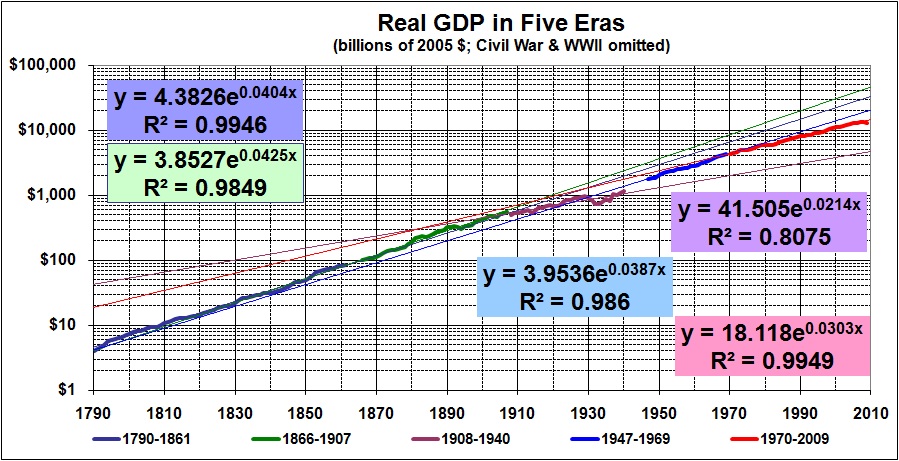
Had the economy of the U.S. not been deflected from its post-Civil War course [by the advent of the regulatory-welfare state around 1900], GDP would now be more than three times its present level…. If that seems unbelievable to you, it shouldn’t: $100 compounded for 100 years at 4.4 percent amounts to $7,400; $100 compounded for 100 years at 3.1 percent amounts to $2,100. Nothing other than government intervention (or a catastrophe greater than any we have known) could have kept the economy from growing at more than 4 percent.

What’s next? Unless Obama’s megalomaniac plans are aborted by a reversal of the Republican Party’s fortunes, the U.S. will enter a new phase of economic growth — something close to stagnation. We will look back on the period from 1970 to 2008 [when GDP rose at an annual rate of 3.1 percent] with longing, as we plod along at a growth rate similar to that of 1908-1940, that is, about 2.2 percent. Thus:

  • If GDP grows at 2.2 percent through 2108, it will be 58 percent lower than if we plod on at 3.1 percent.
  • If GDP grows at 2.2 percent for through 2108, it will be only 4 percent of what it would have been had it continued to grow at 4.4 percent after 1907.

The latter disparity may seem incredible, but scan the lists here and you will find even greater cross-national disparities in per capita GDP. Go here and you will find that real, per capita GDP in 1790 was only 3.3 percent of the value it had attained 201 years later. Our present level of output seems incredible to citizens of impoverished nations, and it would seem no less incredible to an American of 201 years ago. But vast disparities can and do exist, across nations and time. We have every reason to believe in a sustained growth rate of 4.4 percent, as against one of 2.2 percent, because we have experienced both.

Selection Bias and the Road to Serfdom

Office-seeking is about one thing: power. (Money is sometimes a motivator, but power is the common denominator of politics.) Selection bias, as I argue here, deters office-seeking and voting by those (relatively rare) individuals who oppose the accrual of governmental power. The inevitable result — as we have seen for decades and are seeing today — is the accrual of governmental power on a fascistic scale.

Selection bias

most often refers to the distortion of a statistical analysis, due to the method of collecting samples. If the selection bias is not taken into account then any conclusions drawn may be wrong.

Selection bias can occur in studies that are based on the behavior of participants. For example, one form of selection bias is

self-selection bias, which is possible whenever the group of people being studied has any form of control over whether to participate. Participants’ decision to participate may be correlated with traits that affect the study, making the participants a non-representative sample. For example, people who have strong opinions or substantial knowledge may be more willing to spend time answering a survey than those who do not.

I submit that the path of politics in America (and elsewhere) reflects a kind of self-selection bias: On the one hand, most politicians run for office in order to exert power. On the other hand, most voters — believing that government can “solve problems” or one kind or another — prefer politicians who promise to use their power to “solve problems.” In other words, power-seekers and their enablers select themselves into the control of government and the receipt of its (illusory) benefits.

Who is self-selected “out”? First, there are libertarian* office-seekers — a rare breed — who must first attain power in order to curb it. Self-selection, in this case, means that individuals who eschew power are unlikely to seek it in the first place, understanding the likely futility of their attempts to curb the power of the offices to which they might be elected. Thus the relative rarity of libertarian candidates.

Second, there are libertarian voters, who — when faced with an overwhelming array of power-seeking Democrats and Republicans — tend not to vote. Their non-voting enables non-libertarian voters to elect non-libertarian candidates, who then accrue more power, thus further discouraging libertarian candidacies and driving more libertarian voters away from the polls.

As the futility of libertarianism becomes increasingly evident, more voters — fearing that they won’t get their “share” of (illusory) benefits — choose to join the scramble for said benefits, further empowering anti-libertarian candidates for office. And thus we spiral into serfdom.

HAPPY INDEPENDENCE DAY!

__________
* I use “libertarian” in this post to denote office-seekers and voters who prefer a government (at all levels) whose powers are (in the main) limited to those necessary for the protection of the people from predators, foreign and domestic.

The Indivisibility of Economic and Social Liberty

John Stuart Mill, whose harm principle I have found wanting, had this right:

If the roads, the railways, the banks, the insurance offices, the great joint-stock companies, the universities, and the public charities, were all of them branches of government; if in addition, the municipal corporations and local boards, with all that now devolves on them, became departments of the central administration; if the employees of all these different enterprises were appointed and paid by the government, and looked to the government for every rise in life; not all the freedom of the press and popular constitution of the legislature would make this or any other country free otherwise in name.

From On Liberty, Chapter 5

Friedrich A. Hayek put it this way:

There is, however, yet another reason why freedom of action, especially in the economic field that is so often represented as being of minor importance, is in fact as important as the freedom of the mind. If it is the mind which chooses the ends of human action, their realization depends on the availability of the required means, and any economic control which gives power over the means also gives power over the ends. There can be no freedom of the press if the instruments of printing are under the control of government, no freedom of assembly if the needed rooms are so controlled, no freedom of movement if the means of transport are a government monopoly, etc. This is the reason why governmental direction of all economic activity, often undertaken in the vain hope of providing more ample means for all purposes, has invariably brought severe restrictions of the ends which the individuals can pursue. It is probably the most significant lesson of the political developments of the twentieth century that control of the material part of life has given government, in what we have learnt to call totalitarian systems, far?reaching powers over the intellectual life. It is the multiplicity of different and independent agencies prepared to supply the means which enables us to choose the ends which we will pursue.

From part 16 of Liberalism
(go here and scroll down)

Fascism and the Future of America

Many commentators, including me, have said that our government is either fascistic or well on its way to being fascistic. What I mean when I refer to fascism in America — and what most commentators mean — is this:

[A] system in which the government leaves nominal ownership of the means of production in the hands of private individuals but exercises control by means of regulatory legislation and reaps most of the profit by means of heavy taxation. In effect, fascism is simply a more subtle form of government ownership than is socialism.

The central point is the scope of government power, which in recent months has gone from big to bigger, with the threat of becoming biggest.

Whether the United States has, at last, descended into full-blown fascism (as defined above) is less important a question than whether and how we might ascend to a better place. I will visit the possible future after assessing our present condition and its causes.

FASCISM OR SOFT DESPOTISM?

Soft despotism is simply a more polite term than fascism (or socialism) for pervasive government control of our affairs:

Soft despotism is a term coined by Alexis de Tocqueville describing the state into which a country overrun by “a network of small complicated rules” might degrade. Soft despotism is different from despotism (also called ‘hard despotism’) in the sense that it is not obvious to the people. Soft despotism gives people the illusion that they are in control, when in fact they have very little influence over their government. (Source: Wikipedia.)

Soft despotism is “soft” only in that citizens aren’t dragged from their houses at night and executed for imaginary crimes against the state — though they are hauled into court for not wearing seatbelts, for smoking in bars, and for various other niggling offenses to the sensibilities of nanny-staters.

Despite the absence of arbitrary physical punishment, soft despotism is despotism, period. It can be nothing but despotism when the state holds sway over your paycheck, your retirement plan, your medical care, your choice of associates, and thousands of other details of your life — from the drugs you may not buy to the kind of car you can’t drive, from where you can build a house to the features that your house must include.

“Soft despotism,” in other words, is too soft a term for the regime under which we live. I therefore agree with Tom Smith: “Fascism” is a good descriptor of our present condition, so I’ll continue to use it.

THE CAUSES OF OUR PRESENT CONDITION

In spite of my preference for “fascism” to describe our present system of governance, I do concede an advantage to Tocqueville’s usage: It suggests the mechanism by which we got to where we are, that is, “overrun by ‘a network of small complicated rules’.” (Well, the rules aren’t small, but we are overrun by a network of them.) By “we” I don’t mean to imply concerted action on the part of the whole populace. There is a more insidious mechanism at work, which I call the interest-group paradox:

Pork-barrel legislation exemplifies the interest-group paradox in action, though the paradox encompasses much more than pork-barrel legislation. There are myriad government programs that — like pork-barrel projects — are intended to favor particular classes of individuals. Here is a minute sample:

  • Social Security, Medicare, and Medicaid, for the benefit of the elderly (including the indigent elderly)
  • Tax credits and deductions, for the benefit of low-income families, charitable and other non-profit institutions, and home buyers (with mortgages)
  • Progressive income-tax rates, for the benefit of persons in the mid-to-low income brackets
  • Subsidies for various kinds of “essential” or “distressed” industries, such as agriculture and automobile manufacturing
  • Import quotas, tariffs, and other restrictions on trade, for the benefit of particular industries and/or labor unions
  • Pro-union laws (in many States), for the benefit of unions and unionized workers
  • Non-smoking ordinances, for the benefit of bar and restaurant employees and non-smoking patrons….

You may believe that a particular program is worth what it costs — given that you probably have little idea of its direct costs and no idea of its indirect costs. The problem is that millions of your fellow Americans believe the same thing about each of their favorite programs….

It is the interest-group paradox which has brought us to our present condition. Since the advent of American fascism in the New Deal, both of the major parties have vied for votes by promising more things to more interest groups. Many interest groups have been mollified, if not satisfied, but most of their members — not to mention the vast, silent minority of unrepresented voters — have in fact been made worse off because the price of their mollification is the mollification of other interest groups.

Thus we have become freighted with massive tax and regulatory burdens. The cumulative effect of the twin burdens is astoundingly large, and is likely to grow under the present regime:

Had the economy of the U.S. not been deflected from its post-Civil War course [by the advent of the regulatory-welfare state around 1900], GDP would now be more than three times its present level…. If that seems unbelievable to you, it shouldn’t: $100 compounded for 100 years at 4.4 percent amounts to $7,400; $100 compounded for 100 years at 3.1 percent amounts to $2,100. Nothing other than government intervention (or a catastrophe greater than any we have known) could have kept the economy from growing at more than 4 percent.

What’s next? Unless Obama’s megalomaniac plans are aborted by a reversal of the Republican Party’s fortunes, the U.S. will enter a new phase of economic growth — something close to stagnation. We will look back on the period from 1970 to 2008 [when GDP rose at an annual rate of 3.1 percent] with longing, as we plod along at a growth rate similar to that of 1908-1940, that is, about 2.2 percent. Thus:

  • If GDP grows at 2.2 percent through 2108, it will be 58 percent lower than if we plod on at 3.1 percent.
  • If GDP grows at 2.2 percent for through 2108, it will be only 4 percent of what it would have been had it continued to grow at 4.4 percent after 1907.

The latter disparity may seem incredible, but scan the lists here and you will find even greater cross-national disparities in per capita GDP. Go here and you will find that real, per capita GDP in 1790 was only 3.3 percent of the value it had attained 201 years later. Our present level of output seems incredible to citizens of impoverished nations, and it would seem no less incredible to an American of 201 years ago. But vast disparities can and do exist, across nations and time. We have every reason to believe in a sustained growth rate of 4.4 percent, as against one of 2.2 percent, because we have experienced both.

These numbers are only a proxy for the loss of liberty associated with the massive growth of government in the U.S. Economic stagnation is the inevitable outcome of punitive taxes and burdensome regulations, all adopted in the name of one or another “good” cause. Those who cannot stand to see others rise above them are doomed to suffer the consequences of leveling, unless they happen to be co-conspirators in the erection of the fascistic state (or whatever you want to call it).

ANOTHER VIEW OF HOW WE GOT HERE, AND WHERE WE’RE HEADED

James V. DeLong, in a recent article (“The Coming of the Fourth American Republic,The American, April 9, 2009), advances a similar view as to the causes of our present condition:

[T[he New Deal … radically revised the role of government. The process of economic growth was tumultuous, and the losers and dislocated were constantly appealing against the national political commitment to “let us do.” The crisis of the Great Depression provided a great opportunity, and it was seized. Starting in the 1930s, the theoretical limitations on the authority of governments—national or state—to deal with economic or welfare issues were dissolved, and in the course of fighting for this untrammeled power governments eagerly accepted responsibility for the functioning of the economy and the popular welfare.

…Remaining limits on governmental authority were eliminated by the dialectic of the civil rights revolution, in which the federal power over commerce was expanded to meet moral imperatives, and the new standards were then fed back into regulation of commerce.

Inherent in the expansion of governmental power was the complicated question of how this unbridled power would be exercised. As the reach of any institution expands, especially anything as cumbersome as a government, it becomes impossible for the institution as a whole to exercise its power. Delegation to sub-units is necessary: to agencies, legislative committees and subcommittees, even private groups.

The obvious issue is how these subunits are controlled and directed. The theoretical answer had been provided by the Progressive movement (the real one of the early 20th century, not the current faux version). Much of the Progressive movement’s complaint was that special interests, often corporate, captured the governmental process, and its prescriptions were appeals to direct democracy or to administrative independence and expertise on the theory that delegation to technocrats could achieve the ideal of “the public interest.”

The real-world answer imposed by the New Deal and its progeny turned out to be special interest capture on steroids. Control comes to rest with those with the greatest interest or the most money at stake, and the result was the creation of a polity called “the Special Interest State” or, in Cornell University Professor Theodore Lowi’s terms, “Interest Group Liberalism.” Its essence is that various interest groups seize control over particular power centers of government and use them for their own ends.

It is this combination of plenary government power combined with the seizure of its levers by special interests that constitutes the polity of the current Third American Republic. The influence of “faction” and its control had been a concern since the founding of the nation, but it took the New Deal and its acolytes to decide that control of governmental turf by special interests was a feature, not a bug, a supposedly healthy part of democratic pluralism.

In DeLong’s analysis, the First American Republic, which lasted until the Civil War, was  the “alliance-of-[S]tates polity.” In the Second American Republic, following the victory of the Unionist cause in the Civil War,

sovereignty belong[ed] to the nation first and the [S]tate second, and … the nation rather than the [S]tate claim[ed] a citizen’s primary loyalty…. The shift [from the First Republic] was traumatic and took decades to complete, but eventually the [S]tates became largely instruments of federal policy, except for a few areas in which conformity is unnecessary or special interests have managed to preserve [S]tate autonomy for their own purposes.

What lies beyond the Third Republic’s special-interest state? According to DeLong, it goes like this:

This Third Republic has had a good run. It was wobbling in the late 1970s, but got bailed out by a run of good luck—Reagan; the fall of the USSR; the computer and information revolution; the rise of the Asian Tigers and the “BRICs”; the basic dynamism and talent of the American people—that kept the bicycle moving and thus upright.

It could continue. It is characteristic of political arrangements that they go on long after an observer from Mars might think that surely their defects are so patent that they have exhausted their capacity for survival…. The culture, the people, are astonishingly creative and productive, and may demonstrate a capacity to keep the bicycle moving faster than the demands of the Special Interest State can throw sand in the gears.

But it is more likely that the Special Interest State has reached a limit.

This may seem a dubious statement, at a time when the ideology of total government is at an acme, but it is not unusual for decadent political arrangements to blaze brightly before their end. Indeed, the total victory of the old arrangements may be crucial to bringing into being the forces that will overthrow it. In some ways, the grip of the aristocracy on 18th-century France tightened in the decades leading up to 1789, and the alliance-of-states idea could have lasted a while longer had the Confederacy not precipitated the crisis. So the utter triumph of the Special Interest State over the past 15 years, and particularly in the recent election, looks like the beginning of its end.

A catalogue of its insoluble problems includes:

Sheer size. The usual numbers concerning the size of government in the United States are that the Feds spend about 20 percent of GNP and other levels of government at least another 16 percent. These do not reflect the impact of tax provisions, regulations, or laws, however, so an accurate estimate of how much of the national economy is actually disposed of by the government is impossible. Whatever it is, it is growing apace, and the current administration is determined to increase it considerably.

Responsibility. As the government has grown in size and reach, it has justified its claims to power by accepting ever more responsibility for the economy and society. Failure will result in rapid loss of legitimacy and great anger…. And as the government’s reach extends, any chance that it will meet its self-proclaimed responsibilities declines.

Lack of any limiting principles. There is no limit on the areas in which special interests will now press for action, nothing that is regarded as beyond the scope of governmental responsibility and power. Furthermore, special interests are not limited, cynically trying to get an undeserved economic edge or subsidy…. Inevitably, special interests try to convert themselves into moral entitlements to convince others to agree to their claims. The problem is that many have convinced themselves, which means that no half loaf satisfies. The grievance remains sharp, and compromise immoral….

Conflicts. The Special Interest State could get along quite well when it simply nibbled at the edges of the society and economy, snipping off a benefit here and there, and when the number of victorious interests was limited. But the combination of moral entitlement, multiplication of claimants, and lack of limits on each and every claim is throwing them into conflict, and rendering unsustainable the ethic of the logrolling alliances that control it.

The guiding principle is that no member of the alliance will challenge the claims of any fellow member. But this principle has a limit, in that unlimited claims cannot help but impinge eventually on each other….

We are in a crisis of legitimacy. The concept of legitimacy, the right to rule, is the single most important factor in political life. The particulars of how it is gained and lost are infinitely varied, according to the culture and history of the polity….

In the United States, legitimacy is conferred by elections, but it is not total. Through the ages, the basic question mark about democracy as a form of government has been that 51 percent of the electorate can band together to oppress the minority—“the tyranny of the majority” is a valid concern. To address it, the United States has a formal written Constitution to guarantee basic rights, but it also has an unwritten constitution that sets limits on how far the winners can push their victories….

Over the past few years, political winners have become increasingly aggressive, culminating in President Obama’s recent “We won” as an assertion of an unlimited mandate. Losers have become increasingly restive, ready to attack the legitimacy of the winners’ victory….

[I]f each party is regarded by the other as a principle-free alliance of special interests, eager to claim the government so as to loot the other side, then a large chunk of legitimacy is lost. All that remains of that concept depends on the government’s ability to deliver overall economic prosperity and national defense, and if the rulers falter in either of these realms, they will receive no slack. Nor should they.

Given these trajectories, and the lack of any mechanisms for altering them, it is hard to see how the polity of the Third Republic can continue, and, as former Council of Economic Advisers Chairman Herbert Stein said: “If something cannot go on forever, it will stop.” The question is whether the landing will be hard or soft….

[I]t is difficult to see any self-correcting mechanisms in the Special Interest State. Quite the reverse; the incentives all seem to be pushing the accelerator rather than the brake….

So what will the Fourth American Republic look like, and how will it come about? The answers are shrouded in the mists of a highly plastic future, and depend to a large extent on the outcome of the current economic crisis. If that grows severe, the change will be quick and explosive. As noted, an American government that presides over a depression will immediately lose the Mandate of Heaven—the Lady will reclaim the sword.

If this immediate crisis is alleviated, then change may have to await the next one, which will certainly come as more and more sand gets thrown in the gears of the Special Interest State and the bicycle eventually stops….

Two possibilities for change seem most promising. The first is a third political party that explicitly repudiates the present course and requires that its members eschew the legitimacy of the Special Interest State. This would require a certain almost religious fervor, but the great tides of history and politics are always religious in nature, so that is no bar.

This second would be more bottom-up. The Constitution has a residue of the original alliance-of-[S]tates polity that has never been used. Two-thirds of the [S]tate legislatures can force Congress to call a constitutional convention, and the results of that enterprise can then be ratified by three-quarters of the [S]tates. So reform efforts could start at the grassroots and coalesce around [S]tates until two-thirds of them decide to march on the Capitol….

IS THERE LIFE BEYOND FASCISM?

In my view, the Third Republic is unlikely to end soon, unless:

  • Obama’s “stimulus” policies — including his efforts to nationalize a large part of the auto industry and all of the health-care industry — fail spectacularly (e.g., we slip deeper into recession, there is a massive backlash against health-care nationalization).
  • Obama continues to follow the path of accommodation and appeasement in foreign and defense policy, and the United States suffers a devastating setback (e.g., a terrorist attack on the scale of 9/11 or worse). (The setback need not be a direct result Obama’s policies; it would nevertheless be perceived as such.)
  • One of the preceding occurs on the watch of Obama’s successor — presumably a Democrat, if Obama doesn’t fall on his sword.

Absent a débâcle, the special-interest state will not run its course until some of its main constituencies turn from cooperation to conflict — which they will do when their collective greed for an ever-larger share of an ever-weakening economy turns them against each other.

There is a temptation — perhaps born of conflict-avoidance or a fear of seeming callous — to hope against débâcle and for a graceful dénouement. But there will be no graceful dénouement, just a long, messy descent into harder times, harder despotism, and perhaps even subjugation by an coalition of opportunistic enemies. So, for the sake of my grandchildren, I hope for an early débâcle.

Utilitarianism vs. Liberty

This post has moved.


A Bargain with the Devils of “Liberalism”

I have said many times that government should (a) stay in the marriage business and decline to honor homosexual “marriage,” and (b) reverse Roe v. Wade to allow the criminalization of abortion. My views are distilled here, where I say that

“rights” like abortion and homosexual “marriage” [are] government-imposed social innovations with potentially harmful consequences for civil society. If social custom, as embodied in legislative acts, rejects such things as abortion and homosexual “marriage,” it does so because those things undermine the fabric of society — the bonds of mutual respect, mutual trust, and mutual restraint that enable a people to live and work together in peace.

I am still against homosexual “marriage” and abortion, but I am willing to trade my support of government involvement in both matters for the cessation of government action in a multitude of other matters. Now, if I could persuade the other several million opponents of homosexual “marriage” and abortion to do the same, here is the deal we would offer:

We, the nation’s right-minarchists and right-statists, are willing to accept the possibility that some states will allow homosexual “marriage” and abortion. We are willing to do so, and end our attempts to regulate homosexual “marriage” and abortion at the federal level, if you, the nation’s left-minarchists and left-statists, will accede to the following conditions:

  • Eliminate all federal departments, and their functions, excepting justice, defense, state, and treasury.
  • Roll back all regulatory enactments and enabling laws to their status as of 1900.
  • Do the same with the federal tax code.
  • Except for the core federal functions of justice (in truly federal matters), defense, and foreign policy (which ought to serve our defense needs), devolve all federal functions to the States. (“Homeland security” is properly a  defense function, as are matters having to do with veterans’ benefits.)
  • The citizens of each State, through their legislatures and other avenues consistent with republicanism, shall determine questions such as access to marriage (if it remains in the purview of a State) and abortion, as well as such other matters as agricultural policy, regulation of commerce, provision of education, energy policy, justice (intra-State), health care regulation and subsidies, housing subsidies, labor policies, the disposition and use of public lands, urban affairs and transportation (including agreements with neighboring States about the construction and maintenance of highways and other means of transportation), and welfare (including State-level equivalents of Social Security, Medicare, and Medicaid).

I wouldn’t expect left-minarchists to want States in the driver’s seat on marriage and abortion. Nor are left-statists likely to give up on the idea of pressing every citizen into the same, Washington-dictated mold. But left-minarchists might be attracted by the opportunity for some States to offer their citizens more liberty. And left-statists might be willing to accept certain victory for dictatorial “liberalism” in many States, especially as they hail from the States most likely to give them all the “liberalism” they can stand.

I, for one, would welcome the opportunity to live in a State that rejects homosexual “marriage” and abortion, along with the imprisoning, impoverishing baggage of modern “liberalism.” Surely, there would be at least a dozen to choose from, right off the bat.

Why would I be willing to allow some States to legalize homosexual “marriage” and abortion if I am so strongly against those two things. One way of looking at it is this: The world is never going to be perfect, so you make the best you can of it. In this case, making the best of it allows some States to swim against the tide homosexual “marriage” and abortion.

It is likely that those same States, freed from the shackles of Washington, would take other actions to restore civil society and thus advance liberty. I suspect that the policies of those States would be so popular that other States would follow suit to avoid massive emigration and its result: a fiscal death spiral, à la Michigan.

Gains from Trade

I’ve been pondering a bunch of recent posts about international trade by Keith Burgess-Jackson. The posts (dated from March 11, 2009, to June 8, 2009) are at KBJ’s eponymous blog. In the posts, KBJ attacks international trade (or some of it), because (in his view) it affects certain aspects of life in the United States.

I’ve read and re-read the various posts, trying to make sense of them. But I have been unable to do so so because, at every turn, I am confronted by flawed logic and unfounded assertions. I’m left in awe at the chutzpah of a tenured associate professor of philosophy (with a law degree, to boot) who commits the kinds of errors for which (I hope) he would chastise his students.

Anyway, to begin at the beginning, there’s this (March 11):

Free trade has been, and will continue to be, a disaster for this country.

A “disaster for this country” would be an event (or a related set or sequence of events) that inflicts unmitigated harm on great masses of Americans. The Great Depression was a “disaster for this country,” as was 9/11. How is “free trade” a “disaster for this country” when, thanks to the lowering of barriers to trade, but not their abandonment (thus “free trade”), millions of Americans now own better automobiles, electronic gadgets, and other goodies than they had access to before “free trade.” Not only that, but they have been able to purchase those goodies to which they had access before “free trade” at lower real prices than in the days before “free trade.” On top of that, millions of Americans make a better living than than they did before “free trade” because of their employment in industries that became stronger or rose up because of “free trade.”

Okay, so KBJ issues a qualified version on March 12:

Dr John J. Ray, my polymathic friend Down Under, replies to my post about free trade. I should clarify my stance. I’m not saying there should be no trade. That would be crazy. I’m saying that we Americans should protect certain of our industries, such as steel and automobiles. Yes, there is a price to be paid for these protectionist measures, but I, like Pat Buchanan, deem it a price worth paying.

Having recognized that “free trade” may be good for many Americans, KBJ now wants to protect certain industries. But why? KBJ doesn’t say. And I’m at a loss to guess the answer. After all, if we protect an industry we are, in effect, subsidizing those who earn a living in that industry, from the loftiest chairman of the board to the lowliest floor sweeper. Why should Americans be forced, for example, to subsidize people who work for GM and Chrysler when “Japanese” auto makers employ Americans who also make cars?  Even if GM and Chrysler were to go out of business, there would still be an American auto industry — one whose “Big Three” would be Ford, Toyota, and Honda. I’m not so sure about Ford, but Toyota, Honda, and other “Japanese” makes have proved more than adequate to the task of delivering well-made autos at reasonable prices.

I would make the same argument even if “Japanese” cars truly were Japanese, from topsail to keel and stem to stern. Even then, it would not be entirely a question of favoring certain Japanese at the expense of certain Americans. It would also be a question of favoring certain Americans (those employed by auto companies of any stripe) over other Americans (those who would prefer Japanese autos for various reasons, not least of which is value for the dollar). KBJ seems to acknowledge as much in a post of March 16, where he gives a bit more ground:

Free trade is efficient, in the sense that it increases (or even maximizes) aggregate material welfare. The key words are “aggregate” and “material.” As for the first of these words, free trade produces losers as well as gainers. The gainers could compensate the losers, but they are not made to do so. I’m concerned about the losers. In other words, I care about justice (how the pie is distributed) as well as efficiency (how big the pie is). As for the second word, there is more to life than material welfare. Free trade has bad effects on valuable nonmaterial things, such as community, culture, tradition, and family. As a conservative, I care very much about these things.

There’s more of the same on March 17:

Here is a video that explains how free trade increases (or even maximizes) aggregate material welfare. Notice that there is no mention of two things that matter to conservatives: (1) how the increase is distributed; and (2) how free trade affects nonmaterial welfare.

KBJ focuses on American losers, but there are many, many American gainers from free trade, as discussed above. Are their communities, cultures, traditions, and families of no import to KBJ? It would seem so. On what basis does he prefer some Americans to others? Or, to put it more crudely, who died and left KBJ, Pat Buchanan, and their ilk in charge of defending the Rust Belt?

And why should we care whether autos and steel are made in the U.S.? Is it a matter of national pride? What price pride? Whatever the price, it seems that KBJ, Pat Buchanan, and their ilk are willing for millions of Americans to pay it.

Maybe it’s a question of national defense — the bogeyman that is so often conjured in relation to our supposed dependence on foreign oil. Just as those “Arabs” might cut off our oil (though to do so would be to risk our wrath and their wealth), perhaps the Russians, Chinese, or Hottentots will someday amass so much military power that they can cut off all our imports, leaving us poor and powerless — inasmuch as we would no longer possess an industrial base to mobilize for war.

So, maybe their reasoning goes like this: America would be (has been?) deprived of significant chunks of its industrial base by the migration of manufacturing overseas (ignoring the fact that auto-making has migrated mainly from one part of the U.S to other parts of the U.S., while the U.S. remains the number 3 steel-making country in the world). And if our industrial base disappears, we won’t be able to mobilize for a prolonged war — one that would require more military stuff than our puny (hah!) industrial base would be capable of emitting. But our industrial base isn’t disappearing, it’s just becoming smaller in relation to our service sector and far less labor-intensive (i.e., more labor-productive) than it used to be (thus the “loss” of manufacturing jobs over time). See, for example, these Federal Reserve graphs of U.S. industrial capacity and production from the mid-1960s to the present. (The main page is here.) In spite of dips related to recessions, the trends are upward.

Getting back to the question of defense, we already have much larger conventional forces and stockpiles of parts and munitions in relation to the forces and stockpiles of our potential enemies than was the case before we entered WWII. If that demanding war is the benchmark for preparedness, then we have plenty of time to convert existing industrial facilities to war production, and to build new war-production facilities. In any event, you would think that the prospect of a major conventional war would become evident in ample time for mobilization, despite the periodic decimation of our intelligence services.

If unpreparedness for a major conventional war is the bogeyman that haunts the dreams of KBJ and company, their real fear can’t be the loss of our industrial base because of “free trade,” inasmuch as we haven’t lost our industrial base and show no signs of doing so. No, their real fear must be the caliber of our political leaders. Sell-outs will sell us out even when we have strong defenses and the wherewithal to build and maintain those defenses, as we have learned in the decades since the Vietnam War, which devastated our resolve to deal with military problems militarily. Those decades were punctuated only briefly by Reagan’s defense buildup, Bush I’s mistakenly truncated Gulf War, and Bush II’s hamstrung war in Iraq. We are now preparing for future wars (not!) and fighting current ones (while retreating) on terms dictated by an obstructive Congress (one of whose members was our new, Chamberlainesque president), an over-reaching Supreme Court, and other Leftists (to call them American Leftists would be an insult to America). But none of that has anything to do with “free trade.”

Returning to the issue at hand, KBJ seems to ignore the fundamental fact of life that human beings try to better their lot in ways that often, and inescapably, result in change. Human beings do want economic progress, and they have proved that they are willing, at times, to pay for in in “nonmaterial ways,” that is, by allowing it do affect “community, culture, tradition, and family.”

But that fact has never kept sentimentalists from decrying the loss of the “good old days.” KBJ’s tune is an old one, a version of which goes “How ya gonna keep ’em down on the farm after they seen Paree?”

Perhaps (in KBJ’s view) it was a mistake for early man to have discovered fire-making, which undoubtedly led to new communal alignments, cultural totems, traditions, and even familial relationships. Methinks, in short, that KBJ has been swept away by a kind of self-indulgent romanticism for a past that was not as good as we remember it. (I’ve been there and done that, too.)

If “nonmaterial things” are so important, one wonders why KBJ ever left Michigan. And if he left Michigan for good reasons, as I’m sure he did, why is it bad for others to leave Michigan for the promise of warmth and employment? If “nonmaterial things” are so important, college attendance between ages 18 and 22 ought to be outlawed, for that is where (college) and when (18 to 22 years of age) large portions of the populace lose their attachment to “community, culture, tradition, and family.”

Anyway, how is it that economic dislocation — gradual as it is when an industry shifts its locus from one region to another — devastates “community, culture, tradition, and family”? If there has been any devastation of “community, culture, tradition, and family” in the Rust Belt — where auto- and steel-making once were dominant industries — it has been going on for decades, due to the combined influences of higher education; mobility (as the young seek greener pastures and the old seek warmer climes); the rise of impersonal entertainment and forms of communication (in lieu of family togetherness); and the natural breakdown of old-country cultures and traditions, as generation succeeds generation.

Shifting gears: On March 19, KBJ says this:

Those of you who consider yourselves conservative but support free trade might want to reconsider. The editorial board of the New York Times supports free trade. So does Barack Obama. So do the Clintons. So does Paul Krugman.

KBJ’s (risible) implication seems to be this: Something can’t be good if your political enemies think it’s good; or, you can’t really be a conservative if you agree with certain scurrilous liberals on a particular issue. By such reasoning, I wonder that KBJ can be against “free trade” when its opponents include Leftists:

I’m with Dennis Kucinich on free trade. (March 24)

On March 25, KBJ merely rehashes earlier posts:

There is no mention in this New York Times story of why people are losing their jobs. Can you say “free trade”? Jobs are being outsourced to China and other parts of the world, where labor is cheap. What good are cheap goods if you don’t have a job? Free trade will be the death of the West. A hundred years from now, if the West survives that long, people will look back at this time as the time of idiocy.

There’s more of the same old stuff on March 26, along with a couple of new assertions:

The editorial board of the New York Times is adamantly opposed to “protectionism.” In other words, it adamantly supports free trade. Note the reason given. The board—which is composed of cosmopolitans—is concerned about poor people in other countries. Free trade raises the standard of living for nonAmericans at the expense of Americans, many of whom are suffering terribly as a result of lost jobs, which adversely affects not just them but their families and communities. Free trade is a worldwide leveler of wealth. This is why conservatives (as opposed to libertarians) oppose free trade. In their view, Americans come first. Cosmopolitan progressives and libertarians support free trade, albeit for different reasons. The former support it because it redistributes wealth from rich nations to poor nations. The latter support it because they worship individual liberty. Free trade has been a boon to wealthy American entrepreneurs, who now have a worldwide pool of cheap labor. It has devastated working-class and middle-class Americans.

The notion that “[‘free trade’] redistributes wealth from rich nations to poor nations” is completely devoid of logical and empirical content. “Free trade” works because there are gains to all participants. If that weren’t the case, Americans wouldn’t buy foreign goods and foreigners wouldn’t buy American goods. Moreover, “free trade” has been a boon to American consumers and workers (though not always the workers KBJ seems to be worried about). To the extent that “wealthy American entrepreneurs” have gained from “free trade,” it’s because they’ve risked their capital to create jobs (in the U.S. and overseas) that have helped people (in the U.S. and overseas) attain higher standards of living. The “worldwide pool of cheap labor” is, in fact, a worldwide pool of willing labor, which earns what it does in accordance with the willingness of Americans (and others) to buy its products.

Finally, on June 8, KBJ says:

Europeans are starting to see the folly of free trade.

Actually, if you read the article, you’ll find that it portrays Europeans as wrong-headedly provincial — just like KBJ and company.

I may have left out a post or two, but I hope that, by now, you get the idea. “Free trade” helps Americans — perhaps not always the Rust-Belt Americans KBJ seems to be fixated on.

It might surprise KBJ to know that everyone’s income can grow, and grow faster, because of trade — not in spite of it. Foreigners earn more now than they used to, in part, because they are employed in more productive pursuits than they were before “globalization.”  The more foreigners earn, the more American-produced products they buy. Many of those same foreigners also help to underwrite our government’s deficits, thus reducing Americans’ taxes.

If “free trade” is such a bad thing, I wonder if KBJ buys anything that’s not made in Texas, where he lives. Trade between the States, after all, is about as “free” as it gets (except when government bans something, of course). Suppose Texas were to be annexed suddenly by Mexico. Would KBJ immediately boycott everything that’s made in the remaining 49 States? Would it have suddently become unclean?

Opposition to “free trade” — of the kind voiced by KBJ and company — is pure, unadulterated, mindless yahooism. It has no more validity than rooting for, say, the University of Texas Longhorns just because you live in Austin (as I do). People who have not the slightest connection with UT can be seen wearing burnt orange (UT’s colors for those of you who are blissfully unaware) and celebrating drunkenly after UT victories. It just makes me want to puke. And so does anti-international trade yahooism, which is like rooting for union-dominated firms like GM and Chrysler, which we are now subsidizing to the nth degree. (I’ll bet that makes KBJ puke.)

Putting an end to “free trade” would make Americans poorer, not richer. And I doubt that it would do anything to halt the natural evolution of “community, culture, tradition, and family” away from the forms sentimentalized by KBJ and toward entirely new but not necessarily inferior forms.

The biggest threat to “community, culture, tradition, and family” lies in the non-evolutionary imposition of new social norms bythe Left. That’s where the ire of KBJ and company should be directed.

Utilitarianism, “Liberalism,” and Omniscience

Utilitarianism is sort of under debate in the blogosphere (see here). But all the hifalutin’ philosophising misses the main point about utilitarianism: Those who practice it are arrogant pretenders to omniscience.

The appeal of utilitarianism rests on two mistaken beliefs:

  • There is such a thing as social welfare.
  • Transferring income and wealth from the richer to the poorer enhances social welfare because redistribution helps the poorer more than it hurts the richer.

Having disposed elsewhere of the second belief, I here address the first one.

The notion of a social welfare function arises from John Stuart Mill’s utilitarianism, which is best captured in the phrase “the greatest good for the greatest number” or, more precisely “the greatest amount of happiness altogether.” From this facile philosophy grew the patently ludicrous idea that it might be possible to quantify each person’s happiness, sum those values, and arrive at an aggregate measure of total happiness for everyone.

Utilitarianism, as a philosophy, has gone the way of Communism: It is discredited, but many people still cling to it under other names — “social welfare” and “social justice” being perennial favorites among the “liberal” intelligentsia.

How can supposedly rational “liberals” imagine that the benefits accruing to some persons (unionized employees of GM and Chrysler, urban developers, etc.) cancel the losses of other persons (taxpayers, property owners, etc.)? There is no realistic worldview in which A’s greater happiness cancels B’s greater unhappiness; never the twain shall meet.  The only way to “know” that A’s happiness cancels B’s unhappiness is to put oneself in the place of an omniscient deity — to become, in other words, an accountant of the soul.

It seems to me that “liberals” (most of them, anyway) reject God because to acknowledge Him would be to admit their own puniness and venality.

Modernism in the Arts and Politics

David Friedman has a theory about the “modern” movement:

Suppose you are the first city planner in the history of the world. If you are very clever you come up with Cartesian coordinates, making it easy to find any address without a map, let alone a GPS—useful since neither GPS devices nor maps have been invented yet.

Suppose you are the second city planner. Cartesian coordinates have already been done, so you can’t make your reputation by doing them again. With luck, you come up with some alternative, perhaps polar coordinates, that works almost as well.

Suppose you are the two hundred and ninetieth city planner in the history of the world. All the good ideas have been used, all the so-so ideas have been used, and you need something new to make your reputation. You design Canberra. That done, you design the Combs building at ANU, the most ingeniously misdesigned building in my personal experience, where after walking around for a few minutes you not only don’t know where you are, you don’t even know what floor you are on.

I call it the theory of the rising marginal cost of originality—formed long ago when I spent a summer visiting at ANU.

It explains why, to a first approximation, modern art isn’t worth looking at, modern music isn’t worth listening to, and modern literature and verse not worth reading. Writing a novel like one of Jane Austen’s, or a poem like one by Donne or Kipling, only better, is hard. Easier to deliberately adopt a form that nobody else has used, and so guarantee that nobody else has done it better.

In other words, if you can’t readily do better than your predecessors, you take the easy way out by doing something different — ugly as it may be. And you call it “progress.” As I wrote here:

In the early decades of the twentieth century, the visual, auditory, and verbal arts became an “inside game.” Painters, sculptors, composers (of “serious” music), choreographers, and writers of fiction began to create works not for the enjoyment of audiences but for the sake of exploring “new” forms. Given that the various arts had been perfected by the early 1900s, the only way to explore “new” forms was to regress toward primitive ones — toward a lack of structure…. Aside from its baneful influence on many true artists, the regression toward the primitive has enabled persons of inferior talent (and none) to call themselves “artists.” Thus modernism is banal when it is not ugly.

Painters, sculptors, etc., have been encouraged in their efforts to explore “new” forms by critics, by advocates of change and rebellion for its own sake (e.g., “liberals” and “bohemians”), and by undiscriminating patrons, anxious to be au courant. Critics have a special stake in modernism because they are needed to “explain” its incomprehensibility and ugliness to the unwashed.

The unwashed have nevertheless rebelled against modernism, and so its practitioners and defenders have responded with condescension, one form of which is the challenge to be “open minded” (i.e., to tolerate the second-rate and nonsensical). A good example of condescension is heard on Composers Datebook, a syndicated feature that runs on some NPR stations. Every Composers Datebook program closes by “reminding you that all music was once new.” As if to lump Arnold Schoenberg and John Cage with Johann Sebastian Bach and Ludwig van Beethoven.

All music, painting, sculpture, dance, and literature was once new, but not all of it is good. Much (most?) of what has been produced since 1900 is inferior, self-indulgent crap.

As it was in the arts, so it was in politics. Yes, there was sleaze before 1900, and plenty of it. But presidents, members of Congress, and justices of the Supreme Court generally remained faithful to the Constitution, especially its restraints on the power of the federal government. Then along came populism and “progressivisism” — the twin pillars of political modernism in the United States — and down went liberty and prosperity.

Monopoly: Private Is Better than Public

In this discursive post, I use the economic concept of perfect competition as a starting point from which to defend monopoly and to expose the folly and futility of governmental intervention in markets.

PERFECT COMPETITION AS A BOGUS STANDARD

I learned, in the standard microeconomics of my college days, that perfect competition is preferred to these three alternatives:

  • imperfect competition, where there is some degree of product differentiation (real or perceived)
  • oligopoly, where a particular product or service is sold by only a few firms (“product or service” is hereafter called “good,” in keeping with economic jargon)
  • monopoly, where there is only one seller of a particular good.

The theoretical superiority of perfect competition rests on the belief that, compared with the alternatives, it yields the greatest output of goods and, therefore, the greatest degree of satisfaction to consumers; that is, perfect competition maximizes “social welfare.”

The standard analysis has many problems, the most fundamental of which is the observation selection effect. The observer, in this case, is the economist who views the world through the lenses of economic efficiency and “social welfare.”

The construct of economic efficiency involves gross generalizations about economic reality, which are based on ideal firms in an ideal world, not on the behavior of real firms in the messy world of reality. The construct, in other words, sets up an ideal world of perfect competition, divergences from which are judged less than optimal — as if unavoidable, real-world divergences are less valid than the perfections of an imaginary construct. (This is an instance of a Nirvana fallacy, “the logical error of comparing actual things with unrealistic, idealized alternatives.”)

Then there is “social welfare,” which perfect competition is purported to maximize. “Social welfare” is in fact a fictitious device whereby the person who invokes it assumes (implicitly if not explicitly) that the happiness of individuals can be summed, and that he knows just how to do it. The predictable result of “social arithmetic” is a call for some kind of governmental action that effectively redistributes income; for example:

  • Affirmative action, on balance, redistributes income from shareholders, consumers, and more-qualified workers to less-qualified workers.
  • Progressive taxation redistributes income from persons who earn a lot of money (the job-creators of the economy) to persons who earn less money. It also drives out high earners, to the detriment of the rest of us.
  • Trust-busting (which is of particular interest here) amounts to a redistribution of income from the owners of a oligopolistic or monopolistic firm to consumers.

“Social welfare,” in other words, is a phony excuse for playing God — a variant of the Nirvana fallacy. (For more, see this, this, and this.)

HOW GOVERNMENT INTERVENTION DOES MORE HARM THAN GOOD

Why is it not a good thing for government to act in ways that redistribute income from the owners of firms to consumers? There are several reasons, beginning with the artificiality of perfect competition (or something like it) as a model of how markets ought to be organized.

Then, there is the arrogance of a mindset that judges consumers to be more deserving that the owners of businesses — owners who staked a lot of money (and created jobs) on business ventures that might have gone sour (and often do). Is it possible that trust-busting discourages business (and job) formation? You can bet on it.

Related to that, it is necessary to remember that business owners are humans, too — 160 years of communist-populist-“progressive“-“liberal” rhetoric to the contrary notwithstanding. Business owners’ desire for profit is no less legitimate than consumers’ desire for low prices. Government is in the business of penalizing oligopolistic and monopolistic business owners not only because economists have set up a false standard (perfect competition or something like it), but also because the act of penalizing appeals to the envy of many voters and interest groups toward persons with legitimately high incomes. Trust-busting is neither logically nor morally admirable.

It is true that not all industries lend themselves to perfect competition or something like it, but it is neither necessary nor desirable to regulate firms in industries that are characterized by oligopoly and monopoly. (pace Paul Krugman). Oligopoly and monopoly are not iron-clad. Consumers have alternatives: If the price of X is “too high” they can (and will) buy more of Y and Z; if the price of X rises a lot, relative to the prices of Y and Z, the producer of X is likely to find himself with a direct competitor. In the alternative, more consumers will abandon X in favor of Y and Z.

TWO EMOTION-LADEN CASES

What about situations in which there seem to be no ready substitutes for a particular good? Lurking behind this question are fears of private monopolies controlling the supplis of water and medical goods. The case of medical goods is more straightforward, so I will deal with it before considering the supply of water.

Medicine

The supply of medical goods already is artificially low because of government, not in spite of it. Who licenses doctors and grants the A.M.A. a near-monopoly on the accreditation of medical schools? Who licenses and regulates hospitals? Who approves drugs and licenses pharmacists? The list of questions could go on and on, but the answer is always the same: government.

The average person will react along these lines: “Government has to be involved in the provision of medical goods, otherwise we would be taking our lives in our hands every time we go to a doctor or a hospital, and every time we use a drug.” I respond as follows:

The main effect of government regulation of certain goods (including medical ones) is to raise the cost of those goods by imposing costs on their providers and effectively barring additional providers from setting up shop. This unseen cost means that Americans consumer fewer medical goods than they would if government weren’t imposing costs on providers and barring prospective providers. (There is an argument that Americans, on balance, consume more medical goods than necessary because of Medicare, Medicaid, and tax-exempt, employer-subsidized health insurance. But given those distortions, it is true that regulation raises costs and restricts entry.) Is it possible that the net effect of regulations is to make Americans worse off rather than better off? A good case can be made for that proposition. (See this, this, and this.) The case of medical goods exemplifies Bastiat’s axiom that

a law produces not only one effect, but a series of effects. Of these effects, the first alone is immediate; it appears simultaneously with its cause; it is seen. The other effects emerge only subsequently; they are not seen; we are fortunate if we foresee them.

Water: The Hardest Case

No Inherent Need for Government Intervention

If the debate about government’s role in medicine evokes much emotion and little reason, any discussion of privatizing the water supply is certain to elicit the rawest of emotions: fear. A typical reaction goes like this: “If government doesn’t provide our water, greedy speculators will corner the market and we’ll all be at their mercy.” It is hard to imagine such a reaction in the 1800s, when a large fraction of the population lived in rural areas, where most water came from privately owned wells or was taken, by private means, from rivers and lakes. Government doesn’t have to provide water, and if it couldn’t stop a you from drilling a well in your backyard (which it can, thanks to its “police power”) many urbanites and suburbanites might be able to supply their own water.

In any event, there is no inherent reason for government to supply water. The simple fact is that “municipal water works” has acquired the totemic status of “public schools.” Both institutions have become so embedded that private alternatives (on a large scale) were unthinkable, until (in the case of public schools) failure became so obvious that it could no longer be ignored. (That the dominant solution to the failure of public schools is to throw more money at them is neither a negation of their failure nor of the widespread perception of failure.)

Scenario 1: “Accidental” Private Monopoly

Given that there is no inherent reason for government to provide water, I begin the analysis of water monopolies with the following hypothetical:

We have with a small, settled community of 25 homes, in which every home has a well (and has had one for generations). It is accepted by all members of the community that each homeowner is the owner of his well; that is, wells are not communal property. Further, every well provides an ample amount of water for such purposes as drinking, bathing, cooking, watering lawns and gardens, washing cars, etc.

Suddenly, because of some unforeseeable geological change, every well but one runs dry. And the owners of the  24 homes without functioning wells (the unlucky 24″) have no immediate or easy recourse to another source of water — a spring, stream, or lake — because there are none within a day’s drive of the community. The only convenient source of water is the 25th  home (“lucky 25”), whose well  seems to provide more than enough water for its owner — enough, in fact, to meet the drinking, bathing, and cooking needs of the “unlucky 24.”

Issues Arising from Scenario 1

How should the “unlucky 24” cope with the near-term problem of obtaining water for drinking, bathing, and cooking? Suppose that they have two practical options:

  • Appeal to “lucky 25” by offering him a price for water that would just cover the cost of providing it (electricity, pump repairs/replacements, etc.).
  • Buy water in large quantities from an out-of-area vendor — at a much higher price than they would offer “lucky 25.”

“Lucky 25,” the accidental water monopolist, has the following options:

  • Accept the offer made by the “unlucky 24.”
  • Make a counter-offer by setting a price that is somewhere between the offer made by the “unlucky 24” and the cost, to them, of buying water from an out-of-area vendor.
  • Refuse to sell water to the “unlucky 24,” for one of the following reasons: (1) It is his right to do so. (2) He doesn’t want to be in the water-selling business, with its attendant distractions. (3) He fears that drawing significantly greater amounts of water from his well will cause it to run dry.

(You should understand that this is a law-abiding community whose residents are respectful of  property rights — unlike the typical government — so that the water monopolist doesn’t have to worry about defending his well and himself against a mob.)

I daresay that the average reader would expect “lucky 25” to accept the offer made by the “unlucky 24.” But why should the accidental water monopolist accept the offer? He might, out of compassion, help the “unlucky 24” while they make other arrangements. But his help would be given out of compassion, not obligation.

The Permissibility of “Good Luck”

Yes, the water monopolist may have been “lucky” with respect to water, but perhaps he has been “unlucky” in other respects. Why, if “luck” determines one’s obligations to others, shouldn’t the water monopolist’s neighbors compensate him for his episodes of “bad luck” — the dog that was hit by a car, the underground stream which provides him ample water but threatens to undermine the foundation of his house, an errant wife, incorrigible children, etc.? Must “good luck” be penalized or paid for, as an act of “social justice”?

The answer is “no.” Anthony de Jasay explains, in “Economic Theories of Social Justice: Risk, Value, and Externality“:

Stripped of rhetoric, an act of social justice (a) deliberately increases the relative share … of the worse-off in total income, and (b) in achieving (a) it redresses part or all of an injustice…. This implies that some people being worse off than others is an injustice and that it must be redressed. However, redress can only be effected at the expense of the better-off; but it is not evident that they have committed the injustice in the first place. Consequently, nor is it clear why the better-off should be under an obligation to redress it….

Since Nature never stops throwing good luck at some and bad luck at others, no sooner are [social] injustices redressed than some people are again better off than others. An economy of voluntary exchanges is inherently inegalitarian…. Striving for social justice, then, turns out to be a ceaseless combat against luck, a striving for the unattainable, sterilized economy that has built-in mechanisms…for offsetting the misdeeds of Nature.

Scenario 2: Deliberate Water Monopoly

Suppose, now, that our water monopolist came by his monopoly in an entirely different way — a way that (to most of us) seems to draw on entrepreneurship, not “luck.” Suppose that he (and he alone) drilled a well for the purpose of selling water to his neighbors, whom (he knows and they know) cannot (and never could) find water under their properties. What should the water monopolist charge his neighbors for water? Just as much as they are willing to pay, of course. Is there anything immoral in that? If there is, why is it not immoral for an auto dealer to sell you a car for just as much as you are willing to pay, even if you need that car in order to earn a living?

Why should the water monopolist (or car dealer or anyone else) be forced by a legalized mob (i.e., government) to sell his product for a prescribed price, when he is the person who took the financial risk of drilling a well, not knowing for certain that he would strike water, at what rate it would flow, how long it would flow at that rate, and whether another source of water might materialize because of unforeseeable geological or climatological changes?

The answer to the question is found in emotion, not reason. Emotionally, we hold water to be more precious than, say, automobiles. Yet, many persons consume a lot of water for what might be called non-essential reasons (e.g., watering lawns, washing cars, filling swimming pools), and many persons need cars in order to earn a living. Water, stripped of its emotional baggage, isn’t a sacred commodity; it is merely a commodity that has different prices in different places.

Which brings us to the essential question: Who should supply water?

Why a Government Monopoly Is Worse

Perhaps government should be in the business of telling everyone what kind of cars they can have (or not have). (Not far-fetched, admittedly.) Well, then, perhaps government should be in the business of telling us whom to marry, how many children to have, where to live, etc., etc., etc. If that’s an unappealing prospect, why step down the slippery slope toward it by allowing government to dictate the price of water, as it does by controlling most of the nation’s water supply through municipal and regional water authorities?

What can government do that entrepreneurs cannot? The answer is nothing, except to set prices for water that are unlikely to correspond to the prices that would be set by voluntary transactions between private sellers and their customers. Government monopolies prohibit entry where entry would be possible, for example, along large rivers and around large lakes.

Government monopolies cannot respond quickly, if at all, to changes in costs and variations in demand. The prices set by government monopolies must therefore result in the subsidization of some consumers who would be willing to pay more for their water by taxpayers and/or other consumers who are paying more than they would pay if there were private, competing suppliers of water.

What about the poor persons who, without subsidization, could not afford water for drinking, bathing, and cooking, unless they were to forgo other necessities (e.g., medical care)? So, the market for water should be monopolized by government and the price of water should be distorted for the sake of a relatively small fraction of the population? It would be better to rely on (a) private charity and (if you insist) (b) tax-funded vouchers for the purchase of water.

Scenario 3: Government vs. Private Pricing

Which leads to the next objection to the privatization of the water supply (which was mostly private for a long time in the United States). It goes like this: “Water monopolists would bleed their customers dry; they would conspire to control the supply of water and charge whatever the market will bear.”

To test those assertions, let us consider the extreme case in which the residents of a mountainous area have only one potential source of water (other than rain), which is a river that flows through the area. Suppose “greedy speculator” buys the land surround the river’s source and dams the river, at a place on his land. (I am  ignoring, for purposes of this post, the state of the law regarding such a practice.) “Greedy speculator” then pays for the installation of water pipes to various of his customers, meters their use of water, and charges them (perhaps at different rates) in such a way as to maximize his profit.

If you have been following along, you will have realized that there’ is no difference between “greedy speculator” and government, where it declares a local monopoly on the supply of water. There is, of course, a degree of (misplaced) trust in government, that is, trust that will “do the right thing,” which means robbing Peter to pay Paul. That trust amounts to nothing more than wishful thinking about government and misconceptions about the benefits of private action, spurred by the prospects of profit.

In the case of water, for example, government may not build enough capacity (to the detriment of consumers), it may build too much capacity (at the expense of taxpayers), or it may fail to keep its system in good repair (to the detriment of consumers). Private, unregulated providers, in the more usual instances where some degree of competition is possible, can respond more quickly than government to rises in demand, are less likely than government to overbuild, and are more likely than government to keep their systems in good repair.

But the provision of water a natural monopoly, is it not? That question (with its the implied answer: “yes”) arises from the belief that there is no room in a market for more than one supplier where an extensive infrastructure must be duplicated (as in the case of water plants and supply pipes). There are market solutions to such seemingly insurmountable problems, although — in the cases of electricity, natural gas, and cable TV — their implementation generally has been botched by regulatory incompetence and intent.

How could there be competition in a market for water? Consider the extreme case of “greedy speculator” who buy the land from which a river rises, and dams the river. If he sets the price of water too high, three things could happen:

  • Some residents self-ration, reducing or eliminating the use of water for such things as watering lawns, washing cars, and filling swimming pools. (Remember, my example involves a “speculator” who is interested in making a reasonable return on a large investment, which requires that he set up shop in place that isn’t destitute.)
  • Some residents leave the area for places where their total cost of living, relative to income, is lower than it becomes after “greedy speculator” sets up shop.
  • Competition arrives in the form of a supplier who hauls water in large tank trucks and installs a water storage tank for each of the homes and businesses that subscribe to his service.

Lo and behold, “greedy speculator” forestalls competition, and perhaps some departures from the area, by setting his price “just high enough.” Is that fair?

Still No Role for Government

Well, ask yourself if it’s fair of government to keep a private individual from earning a profit by providing a product of value to consumers, or to restrict that profit in the “public interest.” Ask yourself if it is fair that such practices on the part of government lead to a general reduction in the willingness of entrepreneurs to establish and expand job- and growth-producing businesses of all kinds. (Remember “that which is not seen.”) Ask yourself if it is fair of government to circumvent the private sector and provide taxpayer-subsidized goods and services to the residents of an area, just because it lacks “good” supplies of water or electricity, or just because it is frequently and predictably devastated by fires, floods, hurricanes, or tornadoes. Ask yourself if it is fair of government to provide taxpayer-funded insurance against predictable natural disasters when private insurers won’t do so — with the result that the areas prone to natural disasters remain heavily inhabited, at taxpayers’ expense.

In other words, private action — however competitive or uncompetitive — alleviates a host of problems. Government action tends to exacerbate those problems, and to create unforeseen (and unseen) ones.

CONCLUSION

It is written nowhere (but in the imaginations of statists) that government owes us a green lawn, a residence on a flood plain, or anything else but protection from predators, foreign and domestic. As soon as government strays beyond its proper role, it begins to corrupt civil society and its essential mechanisms, which include free markets.

One of the ways in which government strays is to interfere in markets and to provide services that can be and should be provided through markets. Government — at the behest of politicians, bureaucrats, academicians, and meddlers-at-large — interferes in markets and sometimes becomes a provider on the pretext that certain markets (most of them, it seems) are insufficiently competitive or otherwise have “failed” because they fall short of measures of perfection devised by — you guessed it — politicians, bureaucrats, academicians, and meddlers-at-large.

Government intervention in markets exacts a very high price, in liberty and material goods. It strips us of the ability to do for ourselves what we think needs to be done — as opposed to what some politician, other meddler, or “aggrieved” group believes we ought to do or have done to us. It strips us — even the poorest among us — of the means to do for ourselves that which we need to do. It strips us — even the poorest among us — of the fruits of those labors which are permitted to us.  The degree of theft is so vast as to be unimaginable, but unseen and therefore (mostly) unlamented.

The bottom line: Private monopolies are superior to public ones, and should not be persecuted or prosecuted. Government monopolies are for the benefit of politicians, bureaucrats, academicians, meddlers-at-large, and the the majority of citizens who have been conned into believing that government action is preferable to private action.

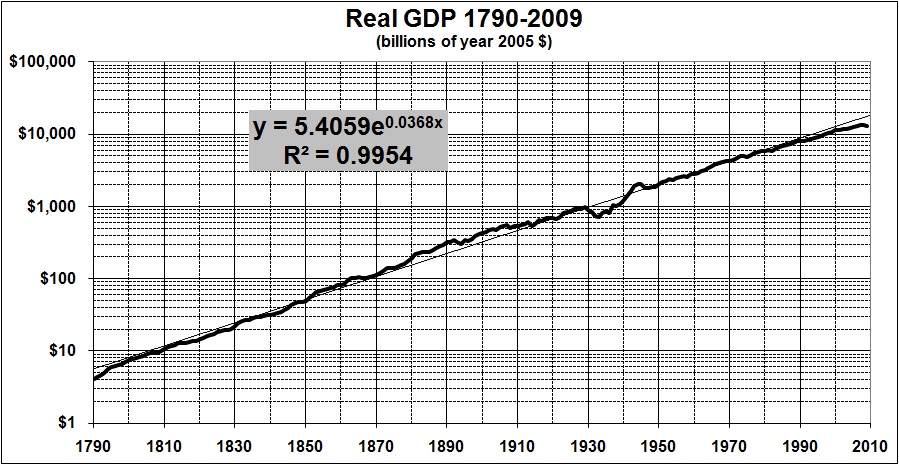
The Price of Government

UPDATED on 04/17/10, to include GDP estimates for 2009 and slight revisions to GDP estimates for earlier years. The bottom line remains the same: The price of government is exorbitant.

he federal government is mounting an economic intervention on a scale unseen since World War II. The excuse for this intervention is that without it the present recession will turn into a full-blown depression. Yet, with the Democrats’ and RINOs’ “stimulus” barely underway, the economy already shows signs of rebounding from an economic dip that bears no comparison with the calamitous gulch that was the Great Depression.

Despite the horror stories about a financial meltdown, what we have experienced since late 2007 is not much more than the downside of a typical, post-World War II business cycle. (For more on that score, see this post — especially the third graph and related discussion.) Would it have been worse were all failing financial institutions allowed to fail? I doubt it. Hard, fast failure leaves in its wake opportunities for the organization of new ventures by investors who still have money (and there are plenty of them). But those same investors are being shouldered out and scared off by Obama’s schemes for nationalization, taxation, regulation, and redistribution.

What we are seeing is the continuation of a death-spiral that began in the early 1900s. Do-gooders, worry-warts, control freaks, and economic ignoramuses see something “bad” and — in their misguided efforts to control natural economic forces (which include business cycles) — make things worse. The most striking event in the death-spiral is the much-cited Great Depression, which was caused by government action, specifically the loose-tight policies of the Federal Reserve, Herbert Hoover’s efforts to engineer the economy, and — of course — FDR’s benighted New Deal. (For details, see this, and this.)

But, of course, the worse things get, the greater the urge to rely on government. Now, we have “stimulus,” which is nothing more than an excuse to greatly expand government’s intervention in the economy. Where will it lead us? To a larger, more intrusive government that absorbs an ever larger share of resources that could be put to productive use, and counteracts the causes of economic growth.

Can we measure the price of government intervention? I believe that we can do so, and quite easily. The tale can be told in three graphs, all derived from constant-dollar GDP estimates available here. The numbers plotted in each graph exclude GDP estimates for the years in which the U.S. was involved in or demobilizing from major wars, namely, 1861-65, 1918-19, and 1941-46. GDP values for those years — especially for the peak years of World War II — present a distorted picture of economic output. Without further ado, here are the three graphs:

The trend line in the first graph indicates annual growth of about 3.7 percent over the long run, with obviously large deviations around the trend. The second graph contrasts economic growth through 1907 with economic growth since: 4.2 percent vs. 3.6 percent. But lest you believe that the economy of the U.S. somehow began to “age” in the early 1900s, consider the story implicit in the third graph:

  • 1790-1861 — annual growth of 4.1 percent — a booming young economy, probably at its freest
  • 1866-1907 — annual growth of 4.3 percent — a robust economy, fueled by (mostly) laissez-faire policies and the concomitant rise of technological innovation and entrepreneurship
  • 1908-1929 — annual growth of 2.2 percent — a dispirited economy, shackled by the fruits of “progressivism” (e.g., trust-busting, regulation, the income tax, the Fed) and the government interventions that provoked and prolonged the Great Depression (see links in third paragraph)
  • 1970-2008 — annual growth of 3.1 percent —  an economy sagging under the cumulative weight of “progressivism,” New Deal legislation, LBJ’s “Great Society” (with its legacy of the ever-expanding and oppressive welfare/transfer-payment schemes: Medicare, Medicaid, a more generous package of Social Security benefits), and an ever-growing mountain of regulatory restrictions.

Had the economy of the U.S. not been deflected from its post-Civil War course, GDP would now be about three times its present level. (Compare the trend lines for 1866-1907 and 1970-2008.) If that seems unbelievable to you, it shouldn’t: $100 compounded for 100 years at 4.3 percent amounts to $6,700; $100 compounded for 100 years at 3.1 percent amounts to $2,100. Nothing other than government intervention (or a catastrophe greater than any we have known) could have kept the economy from growing at more than 4 percent.

What’s next? Unless Obama’s megalomaniacal plans are aborted by a reversal of the Republican Party’s fortunes, the U.S. will enter a new phase of economic growth — something close to stagnation. We will look back on the period from 1970 to 2008 with longing, as we plod along at a growth rate similar to that of 1908-1940, that is, about 2.2 percent. Thus:

  • If GDP grows at 2.2 percent through 2109, it will be 58 percent lower than if we plod on at 3.1 percent.
  • If GDP grows at 2.2 percent for through 2109, it will be only 4 percent of what it would have been had it continued to grow at 4.3 percent after 1907.

The latter disparity may seem incredible, but scan the lists here and you will find even greater cross-national disparities in per capita GDP. Go here and you will find that real, per capita GDP in 1790 was only 4.6 percent of the value it had attained 218 years later. Our present level of output seems incredible to citizens of impoverished nations, and it would seem no less incredible to an American of 1790. In sum, vast disparities can and do exist, across nations and time. We have every reason to believe in the possibility of a sustained growth rate of 4.4 percent, as against one of 2.2 percent, because we have experienced both.

We should look on the periods 1908-1940 and 1970-2009 as aberrations, and take this lesson from those periods: Big government inflicts great harm on almost everyone (politicians and bureaucrats being the main exceptions), including its intended beneficiaries. Such is the price of government when it does more than “establish Justice, insure domestic Tranquility, [and] provide for the common defence” in order to “promote the general Welfare, and secure the Blessings of Liberty to ourselves and our Posterity.”

Civil Society and Homosexual “Marriage”

THE IMPORTANCE OF CIVIL SOCIETY

The liberty to live a peaceful, happy, and even prosperous life depends on civil society: the daily observance of person X’s negative rights by persons W, Y, and Z — and vice versa. That is so because it is impossible and — more importantly — undesirable for government to police everyone’s behavior. Liberty depends, therefore, on the institutions of society — family, church, club, and the like — through which individuals learn to treat one another with respect, through which individuals often come to the aid of one another, and through which instances of disrespect can be noted, publicized, and even punished (e.g., by criticism and ostracism).

That is civil society. And it is civil society which, many minarchists aver, government ought to protect instead of usurping and destroying as it establishes its own agencies (e.g., public schools, welfare), gives them primary and even sole jurisdiction in many matters, and funds them with tax money that could have gone to private institutions. Moreover, some minarchists aver that government ought to tolerate a broad range of accepted behaviors across the various institutions of civil society, as long as government also protects the negative rights of association and exit: the right to associate with persons of one’s choosing, and the right to live and work where one prefers.

The centrality of family, church, club, and the like, to civil society reflects a fundamental fact of the human condition: We tend to care more for those who are close to us than we do for those who are unrelated to us by blood or a direct social bond of some kind. Charity and civilization begin at home.

HOW HOMOSEXUAL “MARRIAGE” THREATENS CIVIL  SOCIETY

I turn to Jennifer Roback Morse’s article “Marriage and the Limits of Contract“:

Marriage is a naturally occurring, pre-political institution that emerges spontaneously from society. Western society is drifting toward a redefinition of marriage as a bundle of legally defined benefits bestowed by the state. As a libertarian, I find this trend regrettable. The organic view of marriage is more consistent with the libertarian vision of a society of free and responsible individuals, governed by a constitutionally limited state…..

My central argument is that a society will be able to govern itself with a smaller, less intrusive government if that society supports organic marriage rather than the legalistic understanding of marriage….

The new idea about marriage claims that no structure should be privileged over any other. The supposedly libertarian subtext of this idea is that people should be as free as possible to make their personal choices. But the very nonlibertarian consequence of this new idea is that it creates a culture that obliterates the informal methods of enforcement. Parents can’’t raise their eyebrows and expect children to conform to the socially accepted norms of behavior, because there are no socially accepted norms of behavior. Raised eyebrows and dirty looks no longer operate as sanctions on behavior slightly or even grossly outside the norm. The modern culture of sexual and parental tolerance ruthlessly enforces a code of silence, banishing anything remotely critical of personal choice. A parent, or even a peer, who tries to tell a young person that he or she is about to do something incredibly stupid runs into the brick wall of the non-judgmental social norm….

No libertarian would claim that the presumption of economic laissez-faire means that the government can ignore people who violate the norms of property rights, contracts, and fair exchange. Apart from the occasional anarcho-capitalist, all libertarians agree that enforcing these rules is one of the most basic functions of government. With these standards for economic behavior in place, individuals can create wealth and pursue their own interests with little or no additional assistance from the state. Likewise, formal and informal standards and sanctions create the context in which couples can create marriage with minimal assistance from the state….

Some libertarians seem to believe that marriage is a special case of free association of individuals. I say the details of this particular form of free association are so distinctive as to make marriage a unique social institution that deserves to be defended on its own terms and not as a special case of something else.

One side in this dispute is mistaken. There is enormous room for debate, but there ultimately is no room for compromise….We will be happier if we try to discover the truth and accommodate ourselves to it, rather than try to recreate the world according to our wishes….

Being free does not demand that everyone act impulsively rather than deliberately. Libertarian freedom is the modest demand to be left alone by the coercive apparatus of the government. Economic liberty, and libertarian freedom more broadly, is certainly consistent with living with a great many informal social and cultural constraints….

We now live in an intellectual, social, and legal environment in which the laissez-faire idea has been mechanically applied to sexual conduct and married life. But Rousseau-style state-of-nature couplings are inconsistent with a libertarian society of minimal government. In real, actually occurring societies, noncommittal sexual activity results in mothers and children who require massive expenditures and interventions by a powerful government….

When…Friedrich Hayek championed the concept of spontaneous order, he helped people see that explicitly planned orders do not exhaust the types of social orders that emerge from purposeful human behavior. The opposite of a centrally planned economy is not completely unplanned chaos, but rather a spontaneous order that emerges from thousands of private plans interacting with each according to a set of reasonably transparent legal rules and social norms.

Likewise, the opposite of government controlling every detail of every single family’’s life is not a world in which everyone acts according to emotional impulses. The opposite is an order made up of thousands of people controlling themselves for the greater good of the little society of their family and the wider society at large….

Libertarians recognize that a free market needs a culture of law-abidingness, promise-keeping, and respect for contracts. Similarly, a free society needs a culture that supports and sustains marriage as the normative institution for the begetting, bearing, and rearing of children. A culture full of people who violate their contracts at every possible opportunity cannot be held together by legal institutions, as the experience of post-communist Russia plainly shows. Likewise, a society full of people who treat sex as a purely recreational activity, a child as a consumer good and marriage as a glorified roommate relationship will not be able to resist the pressures for a vast social assistance state. The state will irresistibly be drawn into parental quarrels and into providing a variety of services for the well-being of the children….

The libertarian preference for nongovernmental provision of care for dependents is based upon the realization that people take better care of those they know and love than of complete strangers. It is no secret that people take better care of their own stuff than of other people’s. Economists conclude that private property will produce better results than collectivization schemes. But a libertarian preference for stable married-couple families is built upon more than a simple analogy with private property. The ordinary rhythm of the family creates a cycle of dependence and independence that any sensible social order ought to harness rather than resist.

We are all born as helpless infants, in need of constant care. But we are not born alone. If we are lucky enough to be born into a family that includes an adult married couple, they sustain us through our years of dependence. They do not get paid for the work they do: They do it because they love us. Their love for us keeps them motivated to carry on even when we are undeserving, ungrateful, snot-nosed brats. Their love for each other keeps them working together as a team with whatever division of labor works for them.

As we become old enough to be independent, we become attracted to other people. Our bodies practically scream at us to reproduce and do for our children what our parents did for us. In the meantime, our parents are growing older. When we are at the peak of our strength, stamina, and earning power, we make provision to help those who helped us in our youth.

But for this minimal government approach to work, there has to be a family in the first place. The family must sustain itself over the course of the life cycle of its members. If too many members spin off into complete isolation, if too many members are unwilling to cooperate with others, the family will not be able to support itself. A woman trying to raise children without their father is unlikely to contribute much to the care of her parents. In fact, unmarried parents are more likely to need help from their parents than to provide it….

Marriage is the socially preferred institution for sexual activity and childrearing in every known human society. The modern claim that there need not be and should not be any social or legal preference among sexual or childrearing contexts is, by definition, the abolition of marriage as an institution. This will be a disaster for the cause of limited government. Disputes that could be settled by custom will have to be settled in court. Support that could be provided by a stable family must be provided by taxpayers. Standards of good conduct that could be enforced informally must be enforced by law….

The advocates of the deconstruction of marriage into a series of temporary couplings with unspecified numbers and genders of people have used the language of choice and individual rights to advance their cause. This rhetoric has a powerful hold over the American mind. It is doubtful that the deconstruction of the family could have proceeded as far as it has without the use of this language of personal freedom.

But this rhetoric is deceptive. It is simply not possible to have a minimum government in a society with no social or legal norms about family structure, sexual behavior, and childrearing. The state will have to provide support for people with loose or nonexistent ties to their families. The state will have to sanction truly destructive behavior, as always. But destructive behavior will be more common because the culture of impartiality destroys the informal system of enforcing social norms.

It is high time libertarians object when their rhetoric is hijacked by the advocates of big government. Fairness and freedom do not demand sexual and parental license. Minimum-government libertarianism needs a robust set of social institutions. If marriage isn’t a necessary social institution, then nothing is. And if there are no necessary social institutions, then the individual truly will be left to face the state alone. A free society needs marriage.

Moreover, it is clear that the kind of marriage a free society needs is heterosexual marriage, which — as Morse explains — is a primary civilizing force.

AN ENLIGHTENED LIBERTARIAN STANCE

I therefore reject the unrealistic and ill-considered position that the state ought to stay out of “the marriage business.” I embrace, instead, the realistic, consequentialist position that the state ought to uphold society’s long-standing recognition of the special status of heterosexual marriage by refusing legal recognition to other forms of marriage. That is, the state should refuse to treat marriage as if it were mainly (or nothing but) an arrangement to acquire certain economic advantages or to legitimate relationships that society, in the main, finds illegitimate.

The alternative is to advance further down the slippery slope toward societal disintegration and into the morass of ills which accompany that disintegration. (We have seen enough societal disintegration and costly consequences since the advent of the welfare state to know that the two go hand in hand.) The recognition of homosexual marriage by the state — though innocuous to many, and an article of faith among most libertarians and “liberals” — is another step down that slope. When the state, through its power to recognize marriage, bestows equal benefits on homosexual marriage, it will next bestow equal benefits on other domestic arrangements that fall short of traditional, heterosexual marriage. And that surely will weaken heterosexual marriage, which is the axis around which the family revolves. The state will be saying, in effect, “Anything goes. Do your thing. The courts, the welfare system, and the taxpayer — above all — will pick up the pieces.” And so it will go.

Moreover, as sure as the sun sets in the west, the state will begin to apply the equal protection clause of the Fourteenth Amendment in order to protect homosexual “marriage” from its critics. Acting under the rubric of “civil rights” — and  in keeping with the way that anti-discrimination laws have been applied to date — the state will deal harshly with employers, landlords, and clergy who seem to discriminate against homosexual “marriage” and its participants.

Many will dismiss consequential arguments against homosexual “marriage” by asserting that the state’s refusal to legitimate homosexual marriage simply isn’t “fair.” In return, I will ask this:

Unfair to whom, to the relatively small number of persons who seek to assuage their pride or avoid paying a lawyer to document the terms of their relationship, or generally unfair to members of society (of all sexual proclivities), whose well-being is bound to suffer for the sake of homosexual pride or cost-avoidance?

As a practicing minarchist, I would rather have the state stay out of “the marriage business.”  But given that the state is already in that business — and is unlikely to get out of it — the next-best outcome is for the state to uphold societal norms instead of bowing to the preferences of the gay lobby and its influential supporters.

Faced with a choice between libertarian shibboleth and libertarian substance, I have chosen substance. I now say: Ban homosexual marriage and avoid another step down the slippery slope toward incivility and bigger government.

Freedom of Will and Political Action

INTRODUCTION

Without freedom of will, human beings could not make choices, let alone “good” or “bad” ones. Without freedom of will there would be no point in arguing about political philosophies, for — as the song says — whatever will be, will be.

This post examines freedom of will from the vantage point of indeterminacy. Instead of offering a direct proof of freedom of will, I suggest that we might as well believe as if and act as though we possess it, given our inability to delve the depths of the physical universe or the human psyche.

Why focus on indeterminacy? Think of my argument as a variant of Pascal’s wager, which can be summarized as follows:

Even though the existence of God cannot be determined through reason, a person should wager as though God exists, because so living has everything to gain, and nothing to lose.

Whatever its faults — and it has many — Pascal’s wager suggests a way out of an indeterminate situation.

The wager I make in this post is as follows:

  • We cannot discern the deepest physical and psychological truths.
  • Therefore, we cannot say with certainty whether we have freedom of will.
  • We might as well act as if we have freedom of will; if we do not have it, our (illusory) choices cannot make us worse off, but if we do have it our choices may make us better off.

The critical word in the conclusion is “may.” Our choices may make us better off, but only if they are wise choices. It is “may” which gives weight to our moral and political choices. The wrong ones can make us worse off; the right ones, better off.

PHYSICAL INDETERMINACY

Our Inherent Limitations as Humans

I begin with the anthropic principle, which (as summarized and discussed here),

refers to the idea that the attributes of the universe must be consistent with the requirements of our own existence.

In fact, there is no scientific reason to believe that the universe was created in order that human beings might exist. From a scientific standpoint, we are creatures of the universe, not its raison d’etre.

The view that we, the human inhabitants of Earth, have a privileged position is a bias that distorts our observations about the universe. Philosopher-physicist-mathematician Nick Bostrom explains the bias:

[T]here are selection effects that arise not from the limitations of some measuring device but from the fact that all observations require the existence of an appropriately positioned observer. Our data is [sic] filtered not only by limitations in our instrumentation but also by the precondition that somebody be there to “have” the data yielded by the instruments (and to build the instruments in the first place). The biases that occur due to that precondition … we shall call … observation selection effects….

Even trivial selection effects can sometimes easily be overlooked:

It was a good answer that was made by one who when they showed him hanging in a temple a picture of those who had paid their vows as having escaped shipwreck, and would have him say whether he did not now acknowledge the power of the gods,—‘Aye,’ asked he again, ‘but where are they painted that were drowned after their vows?’ And such is the way of all superstition, whether in astrology, dreams, omens, divine judgments, or the like; wherein men, having a delight in such vanities, mark the events where they are fulfilled, but where they fail, though this happens much oftener, neglect and pass them by. (Bacon 1620)

When even a plain and simple selection effect, such as the one that Francis Bacon comments on in the quoted passage, can escape a mind that is not paying attention, it is perhaps unsurprising that observation selection effects, which tend to be more abstruse, have only quite recently been given a name and become a subject of systematic study.

The term “anthropic principle” … is less than three decades old. There are, however, precursors from much earlier dates. For example, in Hume’s Dialogues Concerning Natural Religion, one can find early expressions of some ideas of anthropic selection effects. Some of the core elements of Kant’s philosophy about how the world of our experience is conditioned on the forms of our sensory and intellectual faculties are not completely unrelated to modern ideas about observation selection effects as important methodological considerations in theory-evaluation, although there are also fundamental differences. In Ludwig Boltzmann’s attempt to give a thermodynamic account of time’s arrow …, we find for perhaps the first time a scientific argument that makes clever use of observation selection effects…. A more successful invocation of observation selection effects was made by R. H. Dicke (Dicke 1961), who used it to explain away some of the “large-number coincidences”, rough order-of-magnitude matches between some seemingly unrelated physical constants and cosmic parameters, that had previously misled such eminent physicists as Eddington and Dirac into a futile quest for an explanation involving bold physical postulations.

The modern era of anthropic reasoning dawned quite recently, with a series of papers by Brandon Carter, another cosmologist. Carter coined the term “anthropic principle” in 1974, clearly intending it to convey some useful guidance about how to reason under observation selection effects….

The term “anthropic” is a misnomer. Reasoning about observation selection effects has nothing in particular to do with homo sapiens, but rather with observers in general…

We humans, as the relevant observers of the physical world, can perceive only those patterns that we are capable of perceiving, given the wiring of our brains and the instruments that we design with the use of our brains. Because of our inherent limitations, the limitations that our limitations impose on our instruments, and the inherent limitations of the instruments, we may never be able to see all that there is to see in the universe, even in that part of the universe which is close at hand.

We may never know, for example, whether physical laws change or remain the same in all places and for all time. We may never know (as a matter of scientific observation) how the universe originated, given that its cause(s) (whether Divine or otherwise) may lie outside the boundaries of the universe.

Implications for the Physical Sciences

It follows that the order which we find in the universe may bear no resemblance to the real order of the universe. It may simply be the case that we are incapable of perceiving certain phenomena and the physical laws that guide them, which — for all we know — may change from place to place and time to time.

A good case in point involves the existence of God, which many doubt and many others deny. The doubters and deniers are unable to perceive the existence of God, whereas many believers claim that they can do so. But the inability of doubters and deniers to perceive the existence of God does not disprove God’s existence, as an honest doubter or denier will admit.

It is trite but true to say that we do not know what we do not know; that is, there are unknown unknowns. Given our limitations as observers, the universe likely contains many unknown unknowns that will never become known unknowns.

Given our limitations, we must make do with our perceptions of the universe. Making do means that we learn what we are able to learn (imperfectly) about the universe and its components, and we then use our imperfect knowledge to our advantage wherever possible. (A crude analogy occurs in baseball, where a batter who doesn’t understand why a curveball curves is nevertheless able to hit one.)

THE INDETERMINACY OF HUMAN BEHAVIOR

The tautologous assumption that individuals act in such a way as to maximize their happiness tells us nothing about political or economic outcomes. (The assumption remains tautologous despite altruism, which is nothing more than another way of enhancing the happiness of altruistic individuals.) We can know nothing about the likely course of political and economic events until we know something about the psychological drives that shape those events. Even if we know something (or a great deal) about psychological drives, can we ever know enough to say that human behavior is (or is not) deterministic? The answer I offer here is “no.”

A Conflict of Visions

Economic and political behavior depends greatly on human psychology. For example, Thomas Sowell, in A Conflict of Visions, posits two opposing visions: the unconstrained vision (I would call idealism) and the constrained vision (which I would call realism). At the end of chapter 2, Sowell summarizes the difference between the two visions:

The dichotomy between constrained and unconstrained visions is based on whether or not inherent limitations of man are among the key elements included in each vision…. These different ways of conceiving man and the world lead not merely to different conclusions but to sharply divergent, often diametrically opposed, conclusions on issues ranging from justice to war.

Thus, in chapter 5, Sowell writes:

The enormous importance of evolved systemic interactions in the constrained vision does not make it a vision of collective choice, for the end results are not chosen at all — the prices, output, employment, and interest rates emerging from competition under laissez-faire economics being the classic example. Judges adhering closely to the written law — avoiding the choosing of results per se — would be the analogue in law. Laissez-faire economics and “black letter” law are essentially frameworks, with the locus of substantive discretion being innumerable individuals.

By contrast,

those in the tradition of the unconstrained vision almost invariably assume that some intellectual and moral pioneers advance far beyond their contemporaries, and in one way or another lead them toward ever-higher levels of understanding and practice. These intellectual and moral pioneers become the surrogate decision-makers, pending the eventual progress of mankind to the point where all can make moral decisions.

Digging Deeper

Sowell’s analysis is enlightening, but not comprehensive. The human psyche has many more facets than political realism and idealism. Consider the “Big Five” personality traits:

In psychology, the “Big Five” personality traits are five broad factors or dimensions of personality developed through lexical analysis. This is the rational and statistical analysis of words related to personality as found in natural-language dictionaries.[1] The traits are also referred to as the “Five Factor Model” (FFM).

The model is considered to be the most comprehensive empirical or data-driven enquiry into personality. The first public mention of the model was in 1933, by L. L. Thurstone in his presidential address to the American Psychological Association. Thurstone’s comments were published in Psychological Review the next year.[2]

The five factors are Openness, Conscientiousness, Extraversion, Agreeableness, and Neuroticism (OCEAN, or CANOE if rearranged). Some disagreement remains about how to interpret the Openness factor, which is sometimes called “Intellect.” [3] Each factor consists of a cluster of more specific traits that correlate together. For example, extraversion includes such related qualities as sociability, excitement seeking, impulsiveness, and positive emotions.

The “Big Five” model is open to criticism, but even assuming its perfection we are left with an unpredictable human psyche. For example, I tested myself (here), with the following results:

Extraversion — 4th percentile
Agreeableness — 4th percentile
Conscientiousness — 99th percentile
Emotional stability — 12th percentile
Openness — 93rd percentile

(NOTE: “Emotional stability” is also called “neuroticism,” “a tendency to experience unpleasant emotions easily, such as anger, anxiety, depression, or vulnerability.” My “neuroticism” doesn’t involve anxiety, except to the extent that I am super-conscientious and, therefore, bothered by unfinished business. Nor does it involve depression or vulnerability. But I am easily angered by incompetence, stupidity, and carelessness. There is far too much of that stuff in the world, which explains my low scores on “extraversion” and “agreeableness.” “Openness” measures my intellectual openness, of course, and not my openness to people.)

I daresay that anyone else who happens to have the same scores as mine (which are only transitory) will have arrived at those scores by an entirely different route. That is, he or she probably differs from me on many of the following dimensions: age, race, ethic/genetic inheritance, income and education of parents and self, location of residence, marital status, number and gender of children (if any), tastes in food, drink, and entertainment. The list could go on, but the principle should be obvious: There is no accounting for psychological differences, or if there is, the accounting is beyond our ken.

Is everyone with my psychological-genetic-demographic profile a radical-right-minarchist like me? I doubt it very much. But even if that were so, it would be impossible to collect the data to prove it, whereas the (likely) case of a single exception would disprove it.

A Caveat, of Sorts

There is something in the human psyche that seems to drive us toward statism. What that says about human nature is almost trite: Happiness — for many humans — involves neither not wealth-maximization or liberty. It involves attitudes that can be expressed as “safety in numbers,” “going along with the crowd,” and “harm is worse than gain.” And it involves the political manipulation of those attitudes in the service of a drive that is not universal but which can dominate events, namely, the drive to power.

CONCLUSION

The preceding caveat notwithstanding, I have made the case that I set out to make:

We might as well act as if we have freedom of will; if we do not have it, our (illusory) choices cannot make us worse off, but if we do have it our choices may make us better off.

In fact, the caveat points to the necessity of acting as if we have freedom of will. Only by doing so can we hope to overcome the psychological tendencies that cause us political and economic harm. For those tendencies are just that — tendencies. They are not iron rules of conduct. And they have been overcome before.

Addendum to “A Short Course in Economics”

The first 19 points appear in “A Short Course in Economics.”

20. The interest-group paradox is a variant of the paradox of thrift. Many Americans (perhaps most of them) favor certain government programs because (they believe) those programs will benefit the class of persons to which they belong, or a class of persons for which they have sympathy. Each such program then becomes a “free lunch,” and you know that there’s no such thing as a free lunch — someone must pay for it, somehow. In the case of government programs, most of us wind up paying for a lot of free lunches because there are thousands of government programs (federal, State, and local), each intended to help a particular class of citizens at the expense of others. And there goes your free lunch.

Wait, it’s worse than that. Picture a row of beer-drinkers at a bar. Each of them is determined to get a bigger free lunch, so each of them eats more. Result? A rise in the price of the beer. Some free lunch.

Even the relatively few persons who might seem to have obtained a free lunch — homeless persons taking advantage of a government-provided shelter — often are victims of the free lunch syndrome. Some homeless persons may be homeless because they have lost their jobs and can’t afford to own or rent housing. But they may have lost their jobs because of pro-union laws, minimum-wage laws, or progressive tax rates (which caused “the rich” to create fewer jobs through business start-ups and expansions).

21. The interest-group paradox is closely related to the fallacy described by Frédéric Bastiat in his essay “What Is Seen and What Is Not Seen“:

In the economic sphere an act, a habit, an institution, a law produces not only one effect, but a series of effects. Of these effects, the first alone is immediate; it appears simultaneously with its cause; it is seen. The other effects emerge only subsequently; they are not seen; we are fortunate if we foresee them.

There is only one difference between a bad economist and a good one: the bad economist confines himself to the visible effect; the good economist takes into account both the effect that can be seen and those effects that must be foreseen.

Yet this difference is tremendous; for it almost always happens that when the immediate consequence is favorable, the later consequences are disastrous, and vice versa….

The pursuer of the free lunch grasps the free lunch but fails to grasp the unintended and costly consequences of his pursuit.

22. Perhaps the gravest of economic fallacies is the belief that regulated economic activity produces better results than unregulated economic activity. This fallacy stems from the fallacy pointed out by Bastiat. Most of us take comfort in plans of one kind or another because we can “see” what the plan intends. What we fail to grasp is that plans — all plans — have unforeseen, unintended, and undesirable consequences. It is those consequences — what is not seen — that undo economic plans and turn hoped-for benefits into actual costs.

By the same token, most of us fail to grasp the fact that unregulated economic activity yields positive results because it involves willing actors engaged in mutually beneficial exchanges of goods and services. Adam Smith was never more correct when he wrote that every individual

[b]y pursuing his own interest he frequently promotes that of the society more effectually than when he really intends to promote it. I have never known much good done by those who affected to trade for the public good.

That which is produced and consumed voluntarily benefits both its producers and consumers. That which is produced through government fiat may benefit those who dictate its production, while harming consumers by (a) failing to produce that meets their needs and/or (b) producing something that partially meets their needs, but at a higher cost than necessary.

23. Moreover, to quote Wilhelm von Humbolt:

“If men were left to their own deeds and devices, deprived of all outside help that did not manage to obtain themselves, they would also frequently run into difficulty and misfortune whether through their own fault or not. But the happiness for which a man is destined is none other than that which he achieves by his own energies. And it is these very situations which sharpen a man’s mind and develop his character.” (The Limits of State Action [1792]).

A sense of self-worth is important to us; it has economic value of its own. Economics isn’t (or shouldn’t be) the “science” of wealth or output maximization; it is (or ought to be) the “science” of happiness-seeking.

Is Statism Inevitable?

In “Parsing Political Philosophy” I suggest that our descent into statism may continue indefinitely. The suggestion is based on years of observing American politics, which have brought me to the understanding that voters are profoundly irrational. They prefer statism to liberty, regardless of what they say. They (most of them) believe statism to be benign because it often wears a friendly face. But statism is not benign; it is dehumanizing, impoverishing, and — at bottom — destructive of the social fabric upon which liberty depends.

If statism — and perhaps something worse — is an inevitable product of our representative democracy, why is that so? One explanation invokes the slippery slope, which is

an argument for the likelihood of one event or trend given another. Invoking the “slippery slope” means arguing that one action will initiate a chain of events that will lead to a (generally undesirable) event later. The argument is sometimes referred to as the thin end of the wedge or the camel’s nose.

That is to say, once a polity becomes accustomed to relying on the state for a particular thing that should be left to private action, it becomes easier to rely on the state for other things that should be left to private action.

Another metaphor for the rising path of state power is the ratchet effect,

the commonly observed phenomenon that some processes cannot go backwards once certain things have happened, by analogy with the mechanical ratchet that holds the spring tight as a clock is wound up.

As people become accustomed to a certain level of state action, they take that level as a given. Those who question it are labeled “radical thinkers” and “out of the mainstream.” The “mainstream” — having taken it for granted that the state should “do something” — argues mainly about how much more it should do and how it should do it, with cost as an afterthought.

Perhaps the best metaphor for our quandary is the death spiral. Reliance on the state creates more problems than it solves. But, having become accustomed to relying on the state, the polity relies on the state to deal with the problems caused by its previous decisions to rely on the state. That only makes matters worse, which leads to further reliance on the state, etc., etc. etc.

More specifically, unleashing the power of the state to deal with matters best left to private action diminishes the ability of private actors to deal with problems and to make progress, thereby fostering the false perception that state action is inherently superior. At the same time, the accretion of power by the state creates dependencies and constituencies, leading to support for state action in the service of particular interests. Coalitions of such interests resist efforts to diminish state action and support efforts to increase it. Thus the death spiral.

Can we pull out of the spiral? Not unless and until resistance to state action becomes much stronger than it is. Nor can can it be merely intellectual resistance; it must be conjoined to political power. The only source of political power toward which anti-statists — and disillusioned statists — can turn is the Republican Party. And if the GOP does not return to its limited-government roots, all may be lost.

How can the GOP succeed in divesting itself of more of its Specters, while adding new blood in sufficient quantity so as to become, once again, a potent political force? Fred Barnes, writing in The Weekly Standard (“Be the Party of No,” vol. 14, issue 33, 05/18/09) is on the right track:

Many Republicans recoil from being combative adversaries of a popular president. They shouldn’t. Opposing Obama across-the-board on his sweeping domestic initiatives makes sense on substance and politics. His policies–on spending, taxes, health care, energy, intervention in the economy, etc.–would change the country in ways most Americans don’t believe in. That’s the substance. And a year or 18 months from now, after those policies have been picked apart and exposed and possibly defeated, the political momentum is likely to have shifted away from Obama and Democrats.

This scenario has occurred time and again. Why do you think Democrats won the House and Senate in 2006 and bolstered their majorities in 2008? It wasn’t because they were more thoughtful, offered compelling alternatives, or had improved their brand. They won because they opposed unpopular policies of President Bush and exploited Republican scandals in Congress. They were highly partisan and not very nice about it.

If Republicans scan their history, they’ll discover unbridled opposition to bad Democratic policies pays off. Those two factors, unattractive policies plus strong opposition, were responsible for the Republican landslides in 1938, 1946, 1966, 1980, and 1994. A similar blowout may be beyond the reach of Republicans in 2010, but stranger things have happened in electoral politics. They’ll lose nothing by trying….

Republican efforts to escape being tagged the party of no are understandable…. But no matter how restrained and sensible Republicans sound or how many useful ideas they develop, they’re probably stuck with the party of no label. They have more to gain by actually accepting the role and taking on Obama vigorously. If they come to be dubbed the party of no, no, no, a thousand times no, all the better. It will mean they’re succeeding.

In other words, Republicans might make some headway against the forces of statism if they will simply live up to their reputation for “meanness,” instead of apologizing for it — as they have been doing for decades. (Here’s how not to do it.) In order for that to happen, the Cheney wing of the party must prevail over the Powell wing. The good news is that the Powell wing — as represented by RINOs like Susan Collins and Olympia Snowe — may simply choose to follow Arlen Specter’s cynical conversion to the party of statism.

If the GOP fails to revert to its small-government stance, all may be lost. Democrats will be free to spend and spend, elect and elect, until — somewhere down the road — voters finally rebel. But until that distant day, Democrats will have enacted so many more crippling laws and regulations, and appointed so many more lawless judges, that nothing short of a constitutional revolution could rescue us from our political and economic hell.

Having had one constitutional revolution, I doubt that we will be lucky enough to have another one. Only a wise (and rare) élite can establish and maintain the somewhat minarchistic state we enjoyed until the early 1900s. The existence of such an élite — and its success in establishing a lasting minarchy — depends on serendipity, determination, and (yes) even force. That we, in the United States, came close (for a time) to living in a minarchy was due to historical accident (luck). We had just about the right élite at just about the right time, and the élite’s wisdom managed to prevail for a while.

That we have moved on to something worse than minarchy does not prove the superiority of statism. It simply suggests that our luck ran out because statism was (and remains) inevitable in a representative democracy, where irrational voters fuel the power-lust of politicians, and politicians gull irrational voters.

But I have not lost all hope (because of this, in part). And so, I await with interest (and some hope) the outcome of the struggle for the Republican Party’s soul.

Related reading: Peter Ferrara’s The Strategy of Not-So-Smart Surrender

The Interest-Group Paradox

The interest-group paradox is a paradox of mass action (my own coinage). In this post, I illustrate the concept of mass-action paradox with two examples, then turn to the interest-group paradox.

The paradox of thrift is probably the best-known paradox of mass action. According to an article at Wikipedia, the paradox (propounded by John Maynard Keynes) states that if, in the face of an economic downturn, large numbers of individuals try to save more money, the attempt to do so will worsen the downturn. That, in turn, will cause reductions in the incomes of large numbers of individuals, who will then be able to save less, not more. (The article continues with an explanation of the mechanism behind the paradox. The criticisms summarized in the article are unconvincing.)

Another familiar paradox of mass action has to do with the behavior of panicked crowds. If someone shouts “fire” in a crowded theater, many members of the audience may rush madly toward the exits instead of walking calmly, in lines. The mad rush likely will cause pileups at the exits, leading to more panic and worse pileups. As a result, many (perhaps most) of the theater-goers will die, if not from fire and smoke inhalation, then from being trampled and suffocated in a pileup. The paradox here is that the (panicked) effort by members of the crowd to save themselves may well result in their deaths. I call this the paradox of panic.

The paradox of thrift and the paradox of panic are paradoxes of mass action because, in both instances, large numbers of individuals come to harm when each of them tries to do something that he believes to be in his best interest.

I now turn to the main subject of this post: the paradox of mass action that I call the interest-group paradox. Pork-barrel legislation exemplifies the interest-group paradox in action, though the paradox encompasses much more than pork-barrel legislation. There are myriad government programs that — like pork-barrel projects — are intended to favor particular classes of individuals. Here is a minute sample:

  • Social Security, Medicare, and Medicaid, for the benefit of the elderly (including the indigent elderly)
  • Tax credits and deductions, for the benefit of low-income families, charitable and other non-profit institutions, and home buyers (with mortgages)
  • Progressive income-tax rates, for the benefit of persons in the mid-to-low income brackets
  • Subsidies for various kinds of “essential” or “distressed” industries, such as agriculture and automobile manufacturing
  • Import quotas, tariffs, and other restrictions on trade, for the benefit of particular industries and/or labor unions
  • Pro-union laws (in many States), for the benefit of unions and unionized workers
  • Non-smoking ordinances, for the benefit of bar and restaurant employees and non-smoking patrons.

What do each of these examples have in common? Answer: Each comes with costs. There are direct costs (e.g., higher taxes for some persons, higher prices for imported goods), which the intended beneficiaries and their proponents hope to impose on non-beneficiaries. Just as importantly, there are indirect costs of various kinds (e.g., disincentives to work and save, disincentives to make investments that spur economic growth). (Exercise for the reader: Describe the indirect costs of each of the examples listed above.)

You may believe that a particular program is worth what it costs — given that you probably have little idea of its direct costs and no idea of its indirect costs. The problem is millions of your fellow Americans believe the same thing about each of their favorite programs. Because there are thousands of government programs (federal, State, and local), each intended to help a particular class of citizens at the expense of others, the net result is that almost no one in this fair land enjoys a “free lunch.” Even the relatively few persons who might seem to have obtained a “free lunch” — homeless persons taking advantage of a government-provided shelter — often are victims of the “free lunch” syndrome. Some homeless persons may be homeless because they have lost their jobs and can’t afford to own or rent housing. But they may have lost their jobs because of pro-union laws, minimum-wage laws, or progressive tax rates (which caused “the rich” to create fewer jobs through business start-ups and expansions).

The paradox that arises from the “free lunch” syndrome is much like the other two paradoxes discussed here. It is like the paradox of thrift, in that large numbers of individuals are trying to do something that makes certain classes of persons better off, but which in the final analysis makes those classes of persons worse off. It is like the paradox of panic, in that there is a  crowd of interest groups rushing toward a goal — a “pot of gold” — and (figuratively) crushing each other in the attempt to snatch the pot of gold before another group is able to grasp it. The gold that any group happens to snatch is a kind of fool’s gold: It passes from one fool to another in a game of beggar-thy-neighbor, and as it passes much of it falls into the maw of bureaucracy.

I call this third, insidious, paradox the interest-group paradox. It is the costliest of the three — by a long shot. It has dominated American politics since the advent of “progressivism” in the late 1800s. Today, most Americans are either “progressives” (whatever they may call themselves) or victims of “progressivism.” All too often they are both.

(Related concepts: tragedy of the commons, ratchet effect. Related post: “Slopes, Ratchets, and the Death Spiral of Liberty.”)

Democracy and Liberty

In an update to yesterday’s post, “A Prediction,” I quote Arnold Kling, who quotes Peter Thiel, who says (among other things) that he “no longer believe[s] that democracy and freedom are compatible.”

I have said, for years, that democracy is an enemy of liberty. You could read the ten posts to that effect at my old blog (here, here, here, here, here, here, here, here, here, and here). But I will save you the trouble of doing that by restating, here, the core of my argument against democracy. (What would I replace it with? I’ll answer that question in a future post.)

DEMOCRACY FORCES CONSENSUS WHERE INDEPENDENCE IS NEEDED

Where better to begin that with Friedrich Hayek? Fritz Machlup wrote this summary of a 1961 article (in German) by Friedrich Hayek:

[Hayek] asks why it is that personal liberty is in continual jeopardy and why the trend is toward its being increasingly restricted. The cause of liberty, he finds, rests on our awareness that our knowledge is inevitably limited. The purpose of liberty is to afford us an opportunity to obtain something unforeseeable; since it cannot be known what individuals will make of their freedom, it is all the more important to grant freedom to everybody…. Liberty can endure only if it is defended not just when it is recognized to be useful in particular instances but rather continuously as a fundamental principle which may not be breached for the sake of any definite advantages obtainable at the cost of its suspension…. It is not easy to convince the masses that they should sacrifice foreseeable benefits for unforeseeable ones. [From “Hayek’s Contribution to Economics,” in Essays on Hayek (1976), p. 41.]

James Surowiecki makes a related point in his book, The Wisdom of Crowds, which is a flawed masterpiece. Surowiecki seems to understand how unregulated markets make people better off, but in the end he succumbs to the notion that we can regulate our way to “the common good” through democracy. Surowiecki nevertheless gets it right when he says this:

[A] group of people…is far more likely to come up with a good decision if the people i the group are independent of each other….

Independence is important to intelligent decision making for two reasons. First, it keeps the mistakes that people make from becoming correlated. Errors in individual judgment won’t wreck the group’s collective judgment as long as those errors aren’t pointing systematically in the same direction….Second, independent individuals are more likely to have new information rather than the same old data everyone is already familiar with. The smartest groups, then, are made up of people with diverse perspectives who are able to stay independent of each other. Independence doesn’t imply rationality or impartiality, though. You can be biased and irrational, but as long as you’re independent, you won’t make the group any dumber.

If only Surowiecki had stopped there, on page 41. The point he makes (which he seems to ignore later in the book) is simple but profound: Democracy undoes independence. It imposes on everyone the mistakes and mistaken beliefs of a controlling faction. It defeats learning. It defeats the sublime rationality of markets, which enable independent individuals to benefit each other through the pursuit of self-interest.

What should be private, such as the voluntary exchange of goods and services for mutual gain, democracy has made public by insisting (with help from interested parties) on the burdensome regulation of almost every aspect of commerce. Such massive intervention undermines the general good on the pretext of serving the general good.

All would be well if voters were rational when it comes to voting, but they aren’t.

THE TENDENCY TO VOTE IRRATIONALLY

It is well understood that voters, by and large, vote irrationally, that is, emotionally, on the basis of “buzz” instead of facts, and inconsistently. (See this, this, and this, for example.) Voters are prone to vote against their own long-run interests because they do not understand the consequences of the sound-bite policies advocated by politicians (nor do politicians, for that matter). American democracy, by indiscriminately granting the franchise — as opposed to limiting it to, say, married property owners over the age of 30 who have children — empowers the run-of-the-mill politician who seeks office (for the sake of prestige, power, and perks) by pandering to the standard, irrational voter.

Rationality is the application of sound reasoning and pertinent facts to the pursuit of a realistic objective (one that does not contradict the laws of nature or human nature). I daresay that most voters are guilty of voting irrationally because they believe in such claptrap as peace through diplomacy, “social justice” through high marginal tax rates, or better health care through government regulation.

To be perfectly clear, the irrationality lies not in favoring peace, “social justice” (whatever that is), health care, and the like. The irrationality lies in uninformed beliefs in such contradictions as peace through unpreparedness for war, “social justice” through soak-the-rich schemes, better health care through greater government control of medicine, etc., etc., etc. Voters whose objectives incorporate such beliefs simply haven’t taken the relatively little time it requires to process what they may already know or have experienced about history, human nature, and social and economic realities.

Another way to put it is this: Voters too often are rationally irrational. They make their voting decisions “rationally,” in a formal sense (i.e., not “wasting” time in order to make correct judgments). But those decisions are irrational because they are intended to advance perverse objectives (e.g., peace through unpreparedness for war).

Voters of the kind I describe are guilty of suboptimization, which is “optimizing some chosen objective which is an integral part of a broader objective; usually the broad objective and lower-level objective are different.”

I will come back to suboptimal voting. But, first, this about optimization: If you aren’t familiar with the concept, here’s good non-technical definition: “to do things best under the given circumstances.” To optimize, then, is to achieve the best result one can, given a constraint or constraints. On a personal level, for example, a rational person tries to be as happy as he can be, given his present income and prospects for future income. (Note that I do not define happiness as the maximization of wealth.) A person is not rational who allows, say, his alcoholism to destroy his happiness (if not also the income that contributes to it). He is suboptimizing on his addiction instead of optimizing on his happiness.

By the same token, a person who votes irrationally also suboptimizes. A vote may “make sense” at the moment (just as another drink “makes sense” to an alcoholic), but it is an irrational vote if the voter does not (a) vote as if he were willing to live by the consequences if his vote were decisive and/or (b) take the time to understand those consequences.

In some cases, a voter’s irrationality is signaled by the voter’s (inner) reason for voting; for example: to feel smug about having voted, to “protest” or to “send a message” (without being able to explain coherently the purpose of the protest or message), or simply to reinforce unexamined biases by voting for someone who seems to share them. More common (I suspect) are the irrational votes that are cast deliberately for candidates who espouse the kinds of perverse objectives that I cite above (e.g., peace without preparedness for war).

THE HIGH COST OF IRRATIONALITY

Why is voters’ irrationality important? Does voting really matter? Well, it’s easy to say that an individual’s vote makes very little difference. But those individual votes add up. Every vote cast for a winning political candidate enhances his supposed mandate, which usually is (in his mind) some scheme (or a lot of them) to regulated our lives more than they are already regulated.

That is to say, voters (not to mention those who profess to understand voters) overlook the slippery slope effects of voting for those who promise to “deliver” certain benefits. It is true that the benefits, if delivered, would temporarily increase the well-being of certain voters. But if one group of voters reaps benefits, then another group of voters also must reap them. Why? Because votes are not won, nor offices held, by placating a particular class of voter; many other classes of them must be placated as well.

The “benefits” sought by voters (and delivered by politicians) are regulatory as well as monetary. Many voters (especially wealthy, paternalistic ones) are more interested in controlling others than they are in reaping government handouts (though they don’t object to that either). And if one group of voters reaps certain regulatory benefits, it follows (as night from day) that other groups also will seek (and reap) regulatory benefits. (Must one be a trained economist to understand this? Obviously not, because most trained economists don’t seem to understand it.)

And then there is the “peaceat-any-priceone-worldcrowd, which is hard to distinguish from the crowd that demands (and delivers) monetary and regulatory “benefits.”

So, here we are:

  • Many particular benefits are bestowed and many regulations are imposed, to the detriment of investors, entrepreneurs, innovators, inventors, and people who simply are willing to work hard to advance themselves. And it is they who are responsible for the economic growth that bestows (or would bestow) more jobs and higher incomes on everyone, from the poorest to the richest.
  • A generation from now, the average American will “enjoy” about one-fourth the real output that would be his absent the advent of the regulatory-welfare state about a century ago.

CONCLUSION

Americans have, since 1932, voted heavily against their own economic and security interests, and the economic and security interests of their progeny. But what else can you expect when — for those same 77 years — voters have been manipulated into voting against their own interests by politicians, media, “educators,” and “intelligentsia”? What else can you expect when the courts have all too often ratified the malfeasance of those same politicians?

If this is democracy, give me monarchy.

A Prediction

It seems likely that General Motors will become a vassal of the United Auto Workers union and the federal government. Which means that GM will survive only because U.S. taxpayers pick up the tab in order to preserve the pensions of UAW members and keep them employed at above-market compensation. Similar arrangements may come to pass in other (effectively) nationalized industries — banking and health care, most notably (but not exclusively).

Nationalization of the auto, banking, and health-care industries (among others) will prove to be the straw that — when piled on Social Security and Medicare/Medicaid — breaks the back of the American economy. How so? The effective tax rate — the true cost of supporting Social Security, Medicare/Medicaid, nationalized industries, and the ever-growing panoply of government “services”  — will further (and fatally) deter work, saving, capital investment, innovation, and entrepreneurship. (See, for example, this piece by Lawrence Kudlow.)

The economy, if we are lucky, will muddle along at a rate of growth that is barely positive. And that growth will be phony because it will be attributable to the expansion of the public sector (i.e., government and its wholly controlled subsidiaries). We will then have achieved the Left’s Nirvana: Europeanism.

God help us. It’s unlikely that anyone else will.

UPDATE: Arnold Kling makes a related and equally gloomy prediction:

Cato Unbound this month deals with a core issue. Peter Thiel writes,

I no longer believe that freedom and democracy are compatible…

As one fast-forwards to 2009, the prospects for a libertarian politics appear grim indeed. Exhibit A is a financial crisis caused by too much debt and leverage, facilitated by a government that insured against all sorts of moral hazards — and we know that the response to this crisis involves way more debt and leverage, and way more government. Those who have argued for free markets have been screaming into a hurricane. The events of recent months shatter any remaining hopes of politically minded libertarians. For those of us who are libertarian in 2009, our education culminates with the knowledge that the broader education of the body politic has become a fool’s errand.

I think that perhaps the best positive approach for libertarians right now is to support institutions that compete with government. That means charities, churches, charter schools, clubs, consumer information services, and other sources of public goods. I would count the traditional family as an institution that competes with government.

You are likely to see Democrats under President Obama launch assaults against all of the institutions of civil society. Already, the Washington DC school voucher program is under attack, as is the tax deduction for charitable contributions. As libertarians, our electoral voice is worth little. Our threat to exit is probably too costly to carry out. Promoting institutions that compete with government is the best strategy I can come up with.

I tend to agree that for libertarians the “voice” option is looking bleak. I prefer exit options. But by the same token, I do not want to move to New Hampshire (see Jason Sorens) or to a seastead (see Patri Friedman).

UPDATE 2: The Supreme Court will be of no help to us, if Ed Whelan and I are right about its likely direction. I focus on the long run; Whelan, on the near future. Sadly, I must agree with his assessment:

Don’t be fooled by the false claims that we have a conservative Supreme Court. The Court has a working majority of five living-constitutionalists. Four of them—Stevens, Souter, Ginsburg, and Breyer—consistently engage in liberal judicial activism, and a fifth, Kennedy, frequently does. As a result, the Court is markedly to the left of the American public on a broad range of issues. Indeed, in coming years, Souter’s replacement may well provide the fifth vote for

  • the imposition of a federal constitutional right to same-sex marriage;
  • stripping “under God” out of the Pledge of Allegiance and completely secularizing the public square;
  • the continued abolition of the death penalty on the installment plan;
  • selectively importing into the Court’s interpretation of the American Constitution the favored policies of Europe’s leftist elites;
  • further judicial micromanagement of the government’s war powers; and
  • the invention of a constitutional right to human cloning.

American citizens have various policy positions on all these issues, but everyone ought to agree that they are to be addressed and decided through the processes of representative government, not by judicial usurpation.

Fascism with a “Friendly” Face

This is the core meaning of fascism:

Fascism is a system in which the government leaves nominal ownership of the means of production in the hands of private individuals but exercises control by means of regulatory legislation and reaps most of the profit by means of heavy taxation. In effect, fascism is simply a more subtle form of government ownership than is socialism.

A fascistic government  — even a totalitarian one — will try to secure broad political support for itself. Scapegoating is a common technique for developing political support. Scapegoating, when successful, fosters the belief that the country’s economic and/or social problems — the ones that the fascistic regime promises to cure — are due to the actions of particular, identifiable groups of citizens. Another common technique is the suppression of dissent, which stifles critical commentary while imparting to the timid masses a lesson in the value of submissiveness to the regime.

Successful scapegoating serves two purposes. First, it turns public scrutiny away from the regime’s mistakes and misdeeds and toward the supposed misdeeds of the scapegoated groups. Second, scapegoating helps to build public support for the regime by identifying it as a force for good, as opposed to the scapegoated groups, which are painted as sources of evil.

Fascism, despite its prevailing image in the popular mind, need not come about through the efforts of black- or brown-shirted thugs. If you will re-read the opening definition of fascism, it should remind you of the present state of affairs in the United States, given that the federal government has assumed de facto control of two leading industries — financial services and automobile manufacturing — the first of which is central to the operations of America’s businesses.*

How did the United States get to this point? Through the “democratic” process, that’s how — without a shot, without a coup, without a foaming-at-the-mouth dictator. The citizens of the United States — enough of them, anyway — have, over the past eight decades, elected the members of Congress and the presidents (and, indirectly, their judicial appointees) who have brought us to our present state. The grinning FDR was a fascist; the smiling Obama is acting like one (see first footnote). Thus “Fascism with a ‘Friendly’ Face” (alternative title: “Bread and Circuses Redux“).

I now turn to the unfriendly face of fascism, that is, to scapegoating and the suppression of dissent. There was scapegoating a-plenty under FDR, as exemplified by his attacks on “economic royalists.” According to FDR, among many other rabble-rousers of the time, “the rich” were to blame for the Depression and were standing in the way of recovery. That FDR’s demonization of “the rich” and his schemes for centralizing power in Washington were the real obstacles to recovery is a fact that eluded his second-rate mind and which still eludes most Americans (even  a Nobel laureate). (For much more, you should buy and read FDR’s Folly: How Roosevelt and His New Deal Prolonged the Great Depression, which I own and have read critically. It’s repetitive and a somewhat dumbed-down, but generally on the mark.)

We are seeing, under Obama, a renewal of scapegoating. It is evident in his plans to soak “the rich,” which would (among other things) lead to income redistribution. As if the the recession could be cured by raising taxes on the very group that is most responsible for economic growth. As if very high incomes were the result of some kind of conspiracy and not symptomatic of a dynamic, growing economy. (For more about income inequality, see this, this, this, this, this, this, and this.) Scapegoating also is evident in Obama’s attack on hedge-fund managers who refused (how dare they!) to roll over and allow the holders of Chrysler bonds to suffer for the benefit of the UAW, to which Chrysler owes its (hoped for) demise. (One hedge-fund manager’s brisk and appropriate response to Obama’s attack is here.)

Then there is Obama’s decision to join the Left’s campaign to pin the “torturer” label on the Bush administration, thereby legitimating that campaign. We might yet witness the unprecedented spectacle of an incoming U.S. administration trying members of the previous administration for what amount to political “crimes” against Leftist sensibilities.

Obama’s ascendancy, though achieved by a fairly narrow popular-vote margin, has emboldened the Left (in and out of government) in other efforts to scapegoat conservatives and suppress conservative views; viz.:

  • this report from the Department of Homeland Security (especially the footnote on page 2) and related commentary (e.g., here, here, here, and here), all reminiscent of 1964, when Barry Goldwater was vilified (successfully) as an extremist because he stood against the concentration of power in Washington;
  • denunciations of the “tea party” movement (e.g. here and here);
  • efforts by universities and public officials to suppress dissent (e.g., here, here, here, and here), most notably Sen. Jay Rockefeller’s proposal to give the president authority to shut down the internet; and

Regarding the suppression of dissent, it is noteworthy that Obama’s has tagged Cass Sunstein (a Chicago crony) to head the Office of Information and Regulatory Affairs in the White House. (See this article for more about the likely direction of OIRA under Sunstein.) My biggest concern about Sunstein, who figures to be a strong influence on Obama, is his embrace of the oxymoronical thing known as “libertarian paternalism.” (For an exposition of its flaws, see this post and its predecessors, linked therein.)

“Libertarian paternalism” is nothing more than a dressed-up version of paternalism, in which the government is used to “nudge” people toward making the kinds of decisions that Sunstein and his ilk would make. That is to say, Sunstein (like too many other bright individuals) likes to believe that he knows what’s best for others. (That conceit is demolished in the posts mentioned at the end of the preceding paragraph and in these posts by an avowed utilitarian.)

“Libertarian paternalism” may seem innocuous, but there’s more to it than a bit of “nudging” (hah!) by the one-ton gorilla in the room (i.e., the federal government). Perhaps the most frightening item on Sunstein’s paternalistic agenda ties into Sen. Rockefeller’s proposal to give the president the power to shut down the internet — which amounts to the power to control the content of the internet. And make no mistake about it, Sunstein would like to control the content of the internet — for our own good, of course. I refer specifically to Sunstein’s “The Future of Free Speech,” in which he advances several policy proposals, including these:

4. . . . [T]he government might impose “must carry” rules on the most popular Websites, designed to ensure more exposure to substantive questions. Under such a program, viewers of especially popular sites would see an icon for sites that deal with substantive issues in a serious way. They would not be required to click on them. But it is reasonable to expect that many viewers would do so, if only to satisfy their curiosity. The result would be to create a kind of Internet sidewalk, promoting some of the purposes of the public forum doctrine. Ideally, those who create Websites might move in this direction on their own. If they do not, government should explore possibilities of imposing requirements of this kind, making sure that no program draws invidious lines in selecting the sites whose icons will be favoured. Perhaps a lottery system of some kind could be used to reduce this risk.

5. The government might impose “must carry” rules on highly partisan Websites, designed to ensure that viewers learn about sites containing opposing views. This policy would be designed to make it less likely for people to simply hear echoes of their own voices. Of course, many people would not click on the icons of sites whose views seem objectionable; but some people would, and in that sense the system would not operate so differently from general interest intermediaries and public forums. Here too the ideal situation would be voluntary action. But if this proves impossible, it is worth considering regulatory alternatives. [Emphasis added.]

A Left-libertarian defends Sunstein’s foray into thought control, concluding that

Sunstein once thought some profoundly dumb policies might be worth considering, but realized years ago he was wrong about that… The idea was a tentative, speculative suggestion he now condemns in pretty strong terms.

Alternatively, in the face of severe criticism of his immodest proposal, Sunstein merely went underground, to await an opportunity to revive his proposal. I somehow doubt that Sunstein, as a confirmed paternalist, truly abandoned it. The proposal certainly was not off-the-cuff, running to 11 longish web pages.  Now, judging by the bulleted list above, the time is right for a revival of Sunstein’s proposal. And there he is, heading the Office of Information and Regulatory Affairs. The powers of that office supposedly are constrained by the executive order that established it. But it is evident that the Obama adminstration isn’t bothered by legal niceties when it comes to the exercise of power. Only a few pen strokes stand between Obama and a new, sweeping executive order, the unconstitutionality of which would be of no import to our latter-day FDR.

Where will it all end? As I argue here, the United States already has descended into statism. The further descent into ingrained fascism is but a fine-tuning exercise for the vast, Left-wing alliance, which consists of public-school “educators,” liberal-arts academics, and their sycophantic students; Hollywood and New York celebrities and their hangers-on; “artists” and “intellectual workers” of most stripes; well-educated, upper-income, professionals who live in and around major metropolitan areas; and hordes of politicians (local, State, and national), who foster and benefit from the prejudices of the alliance. This broad alliance patronizes idealistic twenty-somethings, blacks, Latins, and labor-union members — the four groups from which its favored political candidates draw decisive support at the polls.

The Leftist alliance scorns America and its traditional (but largely abandoned) values of personal responsibility and respect for the persons and property of others. The alliance exalts, instead, the politics of entitlement and envy, of class, ethnic, racial, and gender conflict. As a result, the alliance has succeeded in demolishing the long-standing consensus that the main constitutional functions of the federal government are “to establish Justice, provide for the common defence,” and ensure the free movement of goods and persons among the States.**

Where will it all end? Unless we are roused from our Leftist idyll by some-one or some-thing, it will end in an Orwellian nightmare. The state will control our lives, in minute detail, from conception (and the prevention thereof) to death (and the means thereof).
__________
* For some views about our descent into fascism (even where it isn’t called that), see these posts of mine:
Things to Come
Reclaiming Liberty Throughout the Land
Are We All Fascists Now?

See  also these posts and articles by other writers:
Fundamentally Different
Obama the Planner
Obama: The Grand Strategy
The Death of Democratic Capitalism?
Tarred by TARP
Elizabeth Warren’s Holy Crusade
Pay Limits May Apply to Toxic-Asset Relief Program, Report Says
Environmentalists Are Funny. Right?
EPA’s Endangerment Finding
EPA Says Greenhouse Gases are Threat to Public

** The preamble to the Constitution also mentions “insur[ing] domestic Tranquillity,” “provid[ing] for the general Welfare,” and “secur[ing] the Blessings of Liberty to ourselves and our Posterity.” These injunctions — aside from a few specific, textual grants of power for dealing with insurrections — merely reflect the Framers’ hopes for the nation’s future under the auspices of the new Constitution.