The Outlook for Election 2008

The presidential elections of 2000 and 2004 produced the narrowest electoral-vote victories since the dawn of party realignment in 1948, when the South began to desert Democrat candidates. Those narrow outcomes reflect the narrow “Red vs. Blue” divide in presidential politics. But there are significant gradations of Redness and Blueness among the States. And therein lies hope for Democrats and opportunity for Republicans.

I’ve categorized the States as follows:

  • “Locked” — States that Bush won (or lost) by 20 or more percentage points. There are 85 “locked” electoral votes (EVs) for Red and 50 for Blue.
  • “Firm” — States that Bush won (or lost) by more than 10 and less than 20 percentage points. There are 157 “locked” and “firm” EVs for Red and 168 for Blue.
  • “Leaning” — States that Bush won (or lost) by more than 5 but less than 10 percentage points. There are 222 “locked,” “firm,” and “leaning” EVs for Red and 183 for Blue.
  • “Swing” — States that Bush won (or lost) both times by less than 5 percentage points (excluding the “tossup” States, discussed at next bullet). The swing States that went for Bush both times control 52 EVs. The swing States that went against Bush both times control 65 EVs.
  • “Tossup” — The three States that switched sides between 2000 and 2004, which among them control only 16 EVs. The two States that went for Bush in 2004 (Iowa and New Mexico) control 12 EVs.

States that went for Bush in both elections control a total of 274 EVs. States that went against Bush in both elections control a total of 248 EVs.

The next presidential election could be decided in the swing and tossup States, which split almost evenly in 2004, giving 64 EVs to Bush and 69 to Kerry. Election 2008 would go to the Democrat candidate if he or she could pick up 18 EVs in the swing-tossup States, everything else being the same. The three tossup States (Iowa, New Mexico, New Hampshire) plus a small Red swing State (e.g., Nevada) would do the trick.

But the leaning States aren’t out of play in a close election. And, there, Democrats have far more to gain than Republicans, with 65 Red EVs up for grabs, as against only 15 Blue EVs.

Barring exceptionally good or bad news for the country between now and November 2008, the outcome in the tossup, swing, and leaning States probably would hinge on the candidates’ personalities and such bread-and-butter issues as the trend in unemployment and the perceived success or failure of Bush’s economic reforms. And so, the election of 2008 could well come to down the personalities.

Hint to Democrats: Go with Barack Obama (not Hillary).

Hint to Republicans: Counter with ? (not Newt).

What Makes Them So Special?

From The Washington Times:

9/11 kin support provisions on illegals


By Stephen Dinan and Brian DeBose
THE WASHINGTON TIMES

A group of families of September 11 victims yesterday told Congress to scrap the entire intelligence overhaul effort this year and start over next year rather than pass the pending bill, which omits strong immigration security provisions.

“You allowed the murder of my son. I will not allow you to kill my daughters,” said Joan Molinaro, mother of a New York City firefighter who died September 11….

Every American has a stake in the future course of the war on terror, not just those who lost loved ones on 9/11. It’s time for the “9/11 kin” to quit hogging the microphone and let other voices be heard.

Calling a Thing What It Is

Thomas Lifson of The American Thinker proposes “regressive” as the proper name for the political tendency known as “liberal” or “progressive”.

I concur, with the proviso that we call the party to which most regressives belong by its right name: the Eeyore Party.

Let ‘Em Secede

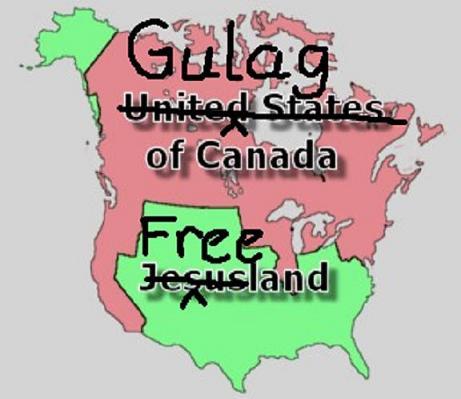
Pejman Yousefzadeh, writing at Tech Central Station, has a roundup of post-election reaction from the Left. I especially like the idea of Blue-State secession (though its proponents should check out Texas v. White). The secessionists would like to join their ideologically compatible neighbour to the north, with this result (my editing):

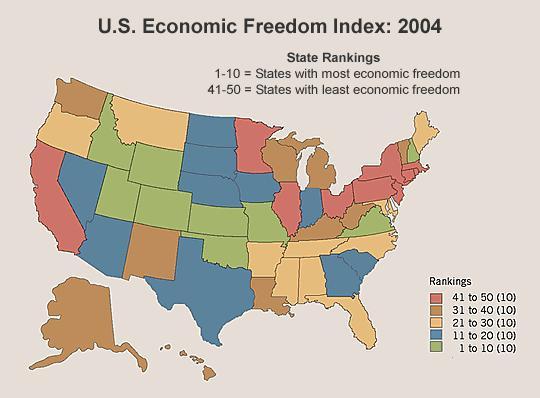
P.S. Note the correlation between “Freeland” and States with the best scores on the index of economic freedom (green, blue, and tan in the chart below):

(Thanks to Let’s Try Freedom for the pointer to the index.)

The Next Big Financial Disaster

From Arnold Kling at EconLog (quoting the Wall Street Journal):

Congress and the White House produced a big, fat bailout for the most financially shaky companies, and some of those same companies are now joining the queue to dump their liabilities on the feds. Meanwhile, PBGC’s [Pension Benefit Guaranty Corporation] deficit was left to balloon, as it now has — by $12 billion with 155 company plans terminating.

Kling adds:

A friend who once did consulting for the PBGC says that its policies are completely irrational. It tells companies with overfunded pension plans that they can take every dollar of overfunding out the plans, and it tells companies with underfunded plans that it will bail them out. There is no risk-based pricing or other incentive mechanism to make companies want to maintain sound plans. He says that it makes the pre-S&L-crisis FSLIC seem well-run by comparison.

Will politicians never learn that the best way to help individuals and businesses avoid poverty and financial ruin is to make them responsible for the consequences of their own decisions? Apparently not.

Conservative Revisionism, Conservative Backlash, or Conservative Righteousness?

Cathy Young, writing from her libertarian perch at reasononline, asks “Why are conservatives trying to rehabilitate McCarthyism and the Japanese internment?” Young refers specifically to Michelle Malkin’s In Defense of Internment: The Case for “Racial Profiling” in World War II and the War on Terror and to Ann Coulter’s Treason.

I have yet to read either book (though I’ve followed the debate about Malkin’s), so I’ll defer to Young’s summary of their theses. She says of Malkin’s book:

Malkin believes our safety is being compromised because any common-sense proposal that involves profiling — be it extra-vigilant screening of Middle Eastern passengers at airports, targeted monitoring of visitors with guest visas from countries with terrorist links, or special scrutiny of Muslim chaplains in the armed forces — is shouted down by invoking the specter of internment camps.

That leads Malkin to a defense of the internment of Japanese-Americans who were living on the West Coast.

As for Coulter’s book, Young characterizes it as a

rehabilitation of Sen. Joseph McCarthy and a debunking of “the myth of ‘McCarthyism.’” McCarthy, Coulter proclaimed, was a true hero in the struggle against communism, and the only unjust persecution was that of Tail Gunner Joe himself by his left-wing, America-hating enemies.

Although she is unsympathetic (hostile, really) to Malkin and Coulter’s theses, Young seems to grasp their essential point:

Why the rush to defend what was only recently seen, across the political spectrum, as indefensible? Partly, it’s the sheer appeal and satisfaction of skewering sacred cows, liberal ones especially — and there are, God knows, so many that deserve skewering. Indeed, in the case of McCarthyism, the stubborn blindness of leftists and many liberals both to the brutality of the Soviet regime and to the extent of Soviet espionage during the Cold War undoubtedly helped create fertile ground for Coulter-style polemics.

A similar dynamic may be at work with the Japanese internment issue. Some of the history textbooks Malkin indignantly quotes probably do err on the side of dismissing all World War II-era concerns about subversive activities by Japanese ethnics as unfounded paranoia….

It is useful, too, to remember that defending the indefensible has long been a popular sport on the left, whose own revisionist historians are busy trying to sugarcoat not McCarthyism but Stalinism….

Also at work, however, is the dark side of modern American conservatism. The left’s obsession with America’s allegedly unique evilness, and in particular with real or imagined racism, has prompted a fully justified backlash. But that backlash can morph into an ugly and disturbing mind-set — one that regards all efforts to confront America’s past wrongs as the province of sissy liberals and wild-eyed lefties….

I agree with “fully justified backlash.” As for the notion that “all efforts to confront America’s past wrongs [are] the province of sissy liberals and wild-eyed lefties,” I’ll say that all efforts to blacken Americans as a benighted, racist, ravening pack of fundamentalist yahoos are, indeed, the province of liberals and lefties. Conservatives, for the most part, have done a pretty good job of confronting America’s past wrongs and moving beyond them.

On the substance of Coulter’s book, McCarthy was right, but his methods backfired and caused otherwise sensible people to conclude that the “witch hunt” was nothing more than that. From Wikipedia, here:

In 1995, when the VENONA transcripts were declassified, it was learned that regardless of the specific number, McCarthy consistently underestimated the extent of Soviet espionage. VENONA specifically references at least 349 people in the United States–including citizens, immigrants, and permanent residents–who cooperated in various ways with Soviet intelligence agencies.

It is generally believed that McCarthy had no access to VENONA intelligence, deriving his information from other sources. VENONA does confirm that some individuals investigated by McCarthy were indeed Soviet agents. For example, Mary Jane Keeney was identified by McCarthy simply as “a communist”; in fact she and her husband were both Soviet agents. Another individual named by McCarthy was Lauchlin Currie, a special assistant to President Roosevelt. He was confirmed by VENONA to be a Soviet Agent.

And here:

The VENONA documents, and the extent of their significance, were not made public until 1995. They show that the US and others were targeted in major espionage campaigns by the Soviet Union as early as 1942.

The decrypts include 349 individuals who were maintaining a covert relationship with the Soviet Union. It can be safely assumed that more than 349 agents were active, as that number is from a small sample of the total intercepted message traffic. Among those identified are Alger Hiss, believed to have been the agent “ALES”; Harry Dexter White, the second-highest official in the Treasury Department; Lauchlin Currie, a personal aide to Franklin Roosevelt; and Maurice Halperin, a section head in the Office of Strategic Services. Almost every military and diplomatic agency of any importance was compromised to some extent, including, of course, the Manhattan Project. Even today, the identities of fewer than half of the 349 agents are known with any certainty. Agents who were never identified include “Mole”, a senior Washington official who passed information on American diplomatic policy, and “Quantum”, a scientist on the Manhattan Project.

Some known spies, including Theodore Hall, were neither prosecuted nor publicly implicated, because the VENONA evidence against them could not be made public. VENONA evidence has also clarified the case of Ethel and Julius Rosenberg, making it clear that Julius was guilty of espionage while Ethel was guilty of cooperating, while also showing that their contributions to Soviet nuclear espionage were less important than was publicly alleged at the time. In fact, Ethel had been only an accomplice, and Julius’ information was probably not as valuable as that provided by sources like “Quantum” and “Pers” (both still unidentified.)

This is an extremely different picture from the one that which had developed over most of 50 years in the absence of solid evidence. While critics debate the identity of individual agents, the overall picture of infiltration is more difficult to refute. The release of the VENONA information has forced reevaluation of the Red Scare in the US….

Tell me, again, why I shouldn’t consider FDR a Soviet dupe and why McCarthy was merely a publicity-seeking loudmouth.

As for the internment (or exclusion) of Japanese-Americans, there’s this from Wikipedia:

The attack on Pearl Harbor on December 7, 1941 led many to suspect the Japanese were preparing a full-scale attack on the West Coast. Further attacks, such as the submarine shelling of a California oil refinery in 1942 redoubled these suspicions. Also, Japan’s rapid military conquest of much of Asia made their military machine seem to Americans frighteningly unstoppable. Civilian and military officials had concerns about the loyalty of the ethnic Japanese on the West Coast and considered them to be a security risk.

Critics of the exclusion argue that the military justification was unfounded, claiming that there are no cases of military espionage that were attributable to Japanese Americans. David Lowman has, however, asserted that the decryption of the MAGIC codes suggested to the military and political leaders at the time that there was a substantial spy network of Japanese Americans feeding information to the Japanese military. Lowman’s claims have been controversial with others pointing out that much of the information that the Japanese officials obtained may have come from public sources such as newspapers, and that communications by Japanese consular officials stating an attempt to recruit Japanese-Americans did not necessarily mean that those attempts were successful. However, historical revisionists who rely on Lowman’s claims point to his assertion that some of the intercepted messages specifically said that the information had come from Japanese-American spies. One captured Japanese officer who had graduated from UCLA, and spoke fluent English specifically reported attempting to cultivate contacts for such spying, as reported in a letter sent to Congressman Wallop of Wyoming by a serviceman.

Lieutentant Commander Kenneth Ringle, a naval intelligence officer tasked with evaluating the loyalty of the Japanese American population, estimated in a 1941 report to his superiors that “better than 90% of the Nisei [second generation] and 75% of the original immigrants were completely loyal to the United States.” A 1941 report prepared on President Roosevelt’s orders by Curtis B. Munson, special representative of the State Department, concluded that most Japanese nationals and “90 to 98 percent” of Japanese American citizens were loyal. He wrote: “There is no Japanese `problem’ on the Coast … There is far more danger from Communists and people of the Bridges type on the Coast than there is from Japanese.”

Historical revisionists state that approximately 20,000 Japanese-Americans in Japan at the start of the war joined the Japanese war effort, and hundreds joined the Japanese Army. They also state that Tomoya Kawakita, an American citizen who worked as an interpreter and a POW guard for the Japanese army, actively participated in the torture (and at least one death) of American soldiers, including survivors of the Bataan Death March.

In January 25, 1942 the Secretary of War reported that “on the Pacific coast not a single ship had sailed from our Pacific ports without being subsequently attacked”. Due to this, espionage was suspected.

In addition to espionage, there was also concern that in the event of an invasion there could be sabotage of both military and civilian facilities inside the United States. Military officials expressed concerns that California’s water systems were highly vulnerable, and there were concerns about the possibility of arson, brush fires in particular….

In early 1944, the government began clearing individuals to return to the West Coast; on January 2, 1945, the exclusion order was rescinded entirely. The internees then began to leave the camps to rebuild their lives at home, although the relocation camps remained open for residents who weren’t ready to make the move back. The fact that this occurred long before the Japanese surrender (see V-J day), while the war was arguably at its most vicious, weighs heavily against the claim that the relocation was an essential security measure….

However, the outcome of the war in the Pacific had ceased to be in doubt since the Battle of Midway, which

took place on June 5, 1942 [when] [t]he United States Navy defeated a Japanese attack against Midway Atoll, marking a turning point in the war in the Pacific theatre….

…The loss of four carriers stopped the expansion of the Japanese Empire in the Pacific, and put Japan on the defensive. It had been six months to the day since the attack on Pearl Harbor. Admiral Yamamoto had predicted to his superiors that Japan would prevail for only six months to a year against the United States, after which American resources would begin to overwhelm the Japanese Navy. He had been exactly correct….

Thus, by 1944, Japanese forces were in vicious retreat, a threat to Allied forces but no longer a threat to the American homeland.

War (hot or cold) is not an academic debate. It is a life-and-death struggle, conducted in the midst of great uncertainty, without a lot of second chances. It is better to act somewhat rashly than not to act at all; the enemy whose life (or feelings) you spare will rise up to stab you in the back.

Wars aren’t won by scrupulous self-doubters, they’re won by the bold and brave. I want Malkin and Coulter on my side in the heat of battle, not a bunch of liberals, lefties, and libertarian doves.

A Day to Remember

Tomorrow will bring a spate (but not a tidal wave) of reminiscences about the death of John F. Kennedy, 41 years earlier. I still remember precisely where I was when I heard that JFK had been shot, then later when I heard that he had died.

I was devastated by the assassination, for I had come to believe in the Kennedy mystique, even though I had, three years earlier (and a bit too young to vote), favored Nixon over Kennedy because I associated the Democrat Party with such evils as legal segregation, high taxes, and corrupt unionism. (How little has changed in 44 years.)

The pomp and mourning that ensued the assassination seemed, somehow, to validate my idealistic belief in the power of government to do good, and the right of government to use that power. I then fell prey to the hysteria that Barry Goldwater’s candidacy invoked, in those days of genuine fear of a nuclear holocaust and naive idealism about ending racial separation legally. It took riots in big cities, the debacle in Vietnam, and Watergate to overcome my emotional attachment to the prevailing faith that government is all-knowing, all-wise, and beneficent.

Yes, November 22, 1963, and the days that followed are seared in my memory. But they now remind me of the folly of allowing emotion to govern reason.

John Kerry: Ingrate

In spite of Osama bin Laden’s ringing, last-minute endorsement, “Kerry blames bin Laden for defeat.” The Washington Times story continues:

Sen. John Kerry believes the videotape of Osama bin Laden that appeared days before the Nov. 2 election cost him the presidency, Fox News reported yesterday.

The Massachusetts Democrat told Fox News the tape first aired by Arab television network Al Jazeera may have scared the American electorate.

Mr. Kerry said the tape was released too late for his camp to rebut and the Democratic campaign couldn’t counteract it in time for the election.

Yeah, the tape scared the American electorate all right. It’s pretty scary when our main enemy quotes Michael Moore — the darling of the Democrat convention. That was enough to scare a lot more Republicans into the voting booth.

So what was Kerry going to rebut, the bit where bin Laden said he would attack only the Red States? I guess Kerry could have offered to substitute New York for Texas, but then he would have lost New York without gaining Texas. I mean, those Red-Staters just piled up the Bush votes when they heard about that threat from bin Laden. Come to think of it, I imagine those Blue-Staters piled up the Kerry votes when they heard about the threat.

So much for nasty, post-election gloating. I’ll stop now (maybe).

Handicapping National Politics

Catherine Seipp says:

One of the election lessons for Democrats is that while the Left doesn’t understand the Right, the Right can’t help but understand the Left, because the Left is in charge of pop culture. Urban blue staters can go their entire lives happily innocent of the world of church socials and duck hunting and Boy Scout meetings, but small-town red staters are exposed to big-city blue-state values every time they turn on the TV.

Not only that, but the Left is mainly in charge of the news — though talk radio manages to apply some corrective spin.

In spite of the Left’s dominance of pop culture and the news media, Red manages to eke out victories over Blue. Amazing.

Good Advice for Libertarians

Read this piece by Max Borders at Tech Central Station.

And this post at Borders’s blog, Jujitsui Generis.

The Republican Era Continues

Bush wins decisively and the GOP strengthens it hold on the House and Senate. The Republican era continues. As I wrote almost two months ago:

…[T]he fact is that we’re in a Republican era that began as long ago as 1968, when Nixon beat Humphrey, even though Wallace took a lot of votes that probably would have gone to Nixon. (Don’t start on that racist crap, again, there’s a lot more to the South than race — and always has been.) Republicans have held the White House ever since, except for Carter’s term, which he owed to Nixon’s disgrace, and Clinton’s two terms, which he owed to Perot’s candidacy. Moreover, Republicans began to claw their way back into congressional power in the 1980s, when they held the Senate for several years. They regained full control of Congress in the election of 1994 — ten whole years ago.

So, it seems that Democrats are suffering from a bizarre form of near-term memory loss. They remember 1933-1969, when they held the White House for all but Ike’s two terms. (And what kind of Republican was Ike, anyway?) They mistakenly thought their White House hegemony had been restored with Clinton’s ascendancy, but Clinton was really an accidental president. Democrats vividly remember having controlled both houses of Congress for most of the 62 years from 1933 to 1995, and they keep deluding themselves that they will retake Congress in the “next” election….

As long as the Democrat Party remains the Eeyore Party — or, as my son suggests, the Death (pro-abortion) and Taxes Party — it will remain the minority party.

How’d I Do?

In my final election projections I said:

Bush will win 51 percent of the two-party popular vote….

Well, it looks like Bush will wind up with about 51.5 percent of the two-party popular vote. Not bad.

Then I said:

[Bush] will take at least 279 and perhaps well more than 300 electoral votes. The range of uncertainty about electoral votes (EVs) reflects the apparent closeness of the race in many states.

Kerry faces likely-to-certain victory in the District of Columbia (3 EVs) and these 20 States: California (55 EVs), Connecticut (7), Delaware (3), Hawaii (4), Iowa (7), Illinois (21), Maine (4), Maryland (10), Massachusetts (12), Michigan (17), Minnesota (10), New Hampshire (4), New Jersey (15), New York (31), Oregon (7), Pennsylvania (21), Rhode Island (4), Vermont (3), Washington (11), and Wisconsin (10). That’s a total of 259 EVs for Kerry. The other 30 States, which are leaning-to-solid for Bush, have 279 EVs….

I went on to explain how Bush might garner more than 279 EVs. But my baseline prediction of 279 EVs for Bush and 259 EVs for Kerry is looking very good at the moment. Bush might take Iowa, but that one’s as “tight as a tick,” as Dan Whatshisname would say. Other than that, everything seems to be falling the way I called it (with a slight caveat on Ohio).

Over in the Senate, I called it this way:

Republicans are poised to pick up six Democrat seats: Florida, Georgia, Louisiana, North Carolina, South Carolina, and South Dakota. Democrats will probably pick up three Republican seats: Alaska, Colorado, and Illinois. That’s a net GOP gain of three seats, for a 54-46 advantage in the Senate.

The best the Republicans can hope for is 55-45, with a come-from-behind win by Republican Murkowski in Alaska. However, that gain could be canceled by a come-from-behind win by Democrat Daschle in South Dakota.

At the moment, the Republican (Martinez) has a slim lead in Florida. A win there would make it 54-46. On top of that, Murkowski has a slim lead in Alaska. If she holds that lead, the GOP will take a 55-45 edge, now that Daschle has gone down in South Dakota — praise heaven.

So, I humbly accept the Nostradamus Award for 2004. In doing so, I acknowledge the help of Iowa Electronic Markets and TradeSports, both of which were on the money until speculative madness began to prevail on election eve. You’ve got to know when to hold ’em and know when to fold ’em.

The Gore of 2004

UPDATED

So, in Ohio, Bush has a lead of 136,000 votes with all precincts reporting. So what? The Dems undoubtedly have a pile of votes stashed somewhere that will make it close enough for a recount, then a court battle. Kerry will be the Gore of 2004. A divisive loser.

UPDATE:

Kerry has conceded. That doesn’t rule out chicanery in Ohio, but it makes it a lot less likely. Classy move, John. At least you’re no Gore.

Time to Retire the Fair Model

The die-hards of the liberal press still refuse to call Ohio for Bush, so I’m not quite ready to claim my Nostradamus Award. But I most respectfully suggest that it is time for Yale economist Ray Fair — whose model of presidential election outcomes I have discussed here — to abandon his econometric prediction model and go with the betting markets.

Fair issued his final prediction for the 2004 election on October 29. He said that Bush would get 57.70 percent of the two-party popular vote. As it turns out, Bush will probably get something close to 51.5 percent of the two-party popular vote.

My own prediction (issued at 11:23 a.m. CST on November 1) was that Bush would get 51 percent of the two-party popular vote. I based that prediction on the state of play at Iowa Electronic Markets on October 31, where the average price on Bush’s two-party popular-vote share was equivalent to a bet of 51.7 percent — which is about as close as you can get.* I shaved my prediction to 51 percent because Rasmussen’s presidential tracking poll (as of November 1) gave Bush 50.7 percent of the two-party popular vote.

It’s only fair that Fair concede defeat and heed the wisdom of the markets — as a good economist would.

__________

* I ignored the trading on Monday, November 1, because the betting markets had by then begun to show signs of last-minute specualtive volatility. The Bush popular-vote-share contract at Iowa Electronic Markets, for example, hit a low of 48 percent on Monday. That was followed by a low of 47.7 percent on Tuesday, and an average price of 48.9 percent. Yesterday’s last price (51.9 percent at midnight last night) was close to the mark — but that’s like calling the winner of a horse race when he’s near the wire with a three-length lead.

I Told You So

Just about three weeks ago, I debunked the notion that the “upsurge” in new voter registrations bode well for Democrats. As I said then:

…Of course, voter registrations are spiking now; the election is coming and registration deadlines are looming. Of course registrations are at an all-time high; the U.S. is more populous than ever. Of course the Democrats are claiming that the new registrations help them; we hear that every four years because Democrats seem to think that new voters prefer Democrats, though there’s little evidence for that in the results of presidential elections in recent decades. In fact, the “emotionally intense” 1968 election — when new, draft-age voters presumably favored anti-war Humphrey over tricky Dick and George the segregationist — resulted in a trouncing of Humphrey, the only liberal in the field.

Well, as I write this, Bush is pulling in 51 percent of the popular vote, which is probably about what he’ll have when all’s said and done. Four years ago, Bush pulled only 48 percent of the popular vote. So much for all those new Democrats. As Fox News says: “2004: Not the Year of the Youth Vote.”

Oh, and about my final election projections. I think I was right on target. Kerry holds a slim lead in one State that I called for Bush — Nevada — but only 18 percent of the precincts have reported there. Everything else seems to be going according to my final projections, including the Senate races.

I’m not going to stay up and wait for all the States to be called. I’ll claim my Nostradamus Award later this morning.

One More Reason to Vote for Bush

I offered a few reasons here. One more just reared its ugly head:


Osama bin Laden’s script writer.

So I lied when I said I wouldn’t post any more about candidate Bush. Sue me.

The Eeyore Party

You read it here first — I think. I have dubbed the Democrat Party the Eeyore Party because it’s the party of doubt and pessimism. As it says at a Winnie-the-Pooh site:

Eeyore [is] a very gloomy, blue-gray donkey….

Red State, Blue State

I like the new political color-coding scheme that has become the norm since the 2000 election. That is, Red States are Republican and Blue States are Democrat. It sure beats the old scheme, in which the incumbent party was Blue and the challenging party was Red. That’s too hard to keep up with.

Think about recent history. In the election of 1976, Republicans were Blue and Democrats were Red. But because Carter was elected in 1976, the color scheme for the 1980 election had Republicans as Red and Democrats as Blue. Then Reagan was elected, so the color scheme for the 1984 election had Republicans as Blue and Democrats as Red. It stayed that way until the 1996 and 2000 elections, when Republicans were Red and Democrats were Blue. It should have changed after the 2000 election, but most political analysts — wisely — decided to stick with the Republican-Red and Democrat-Blue theme.

It’s a more fitting color scheme, anyway. Republicans are the party of positive thinking — as in “We won’t stand for any more of this crap; we’re coming to get you. We’re not slowing down our economy just because some pseudo-scientists mistakenly think that global warming is a bad thing caused by humans.” Red — an aggressive color — is definitely Republican.

Democrats are the party of doubt and pessimism. Blue suits the Eeyore Party.

Final Election Projections

I was planning to post this in the wee hours of election day, but — barring a catastrophe or news with a significant bearing on the election — I think this is how it will go:

THE PRESIDENCY

Bush will win 51 percent of the two-party popular vote.* He will take at least 279 and perhaps well more than 300 electoral votes. The range of uncertainty about electoral votes (EVs) reflects the apparent closeness of the race in many states.

Kerry faces likely-to-certain victory in the District of Columbia (3 EVs) and these 20 States: California (55 EVs), Connecticut (7), Delaware (3), Hawaii (4), Iowa (7), Illinois (21), Maine (4), Maryland (10), Massachusetts (12), Michigan (17), Minnesota (10), New Hampshire (4), New Jersey (15), New York (31), Oregon (7), Pennsylvania (21), Rhode Island (4), Vermont (3), Washington (11), and Wisconsin (10). That’s a total of 259 EVs for Kerry. The other 30 States, which are leaning-to-solid for Bush, have 279 EVs.

My method of estimating EVs as a function of popular-vote share indicates that Bush’s 51 percent of the two-party vote could yield as many as 318-358 EVs. (Go here and see method 3.) Such a result is possible if Bush takes the 279 EVs of all 30 leaning-to-solid States, then picks off Iowa (7) and Wisconsin (10) — where the races are tight — plus a combination of Hawaii (4), Michigan (17), Minnesota (10), New Hampshire (4), and Pennsylvania (21) — for a maximum of 352 EVs. I think that’s the best Bush can hope for, unless his popular-vote share is 52 percent or greater.

All of which assumes, of course, that Bush will take Florida (27 EVs) and Ohio (20). If Bush loses either, we may be in for a long, long night — and perhaps a long several weeks of recounts and court battles. If — in the end — Bush loses both Florida and Ohio, Kerry wins.

THE SENATE

Republicans are poised to pick up six Democrat seats: Florida, Georgia, Louisiana, North Carolina, South Carolina, and South Dakota. Democrats will probably pick up three Republican seats: Alaska, Colorado, and Illinois. That’s a net GOP gain of three seats, for a 54-46 advantage in the Senate.

The best the Republicans can hope for is 55-45, with a come-from-behind win by Republican Murkowski in Alaska. However, that gain could be canceled by a come-from-behind win by Democrat Daschle in South Dakota.

__________

* I base my estimate of Bush’s popular-vote share on the presidential vote-share market at Iowa Electronic Markets, Rasmussen’s presidential tracking poll, and the “poll of polls” at RealClear Politics.

Debating the Debates

Ed Driscoll points to a piece by Fred Barnes about the debates:

…The traits we look for in a president are wisdom, steadfastness, foresight, integrity, inner strength, emotional intelligence, and the willingness to do what’s unpopular but right. If there’s been a presidential debate that gave us a glimpse of these in a candidate, I missed that one. Instead, I’ve watched debate after debate that provided only the shallowest of impressions about a candidate….

Now think about a few presidents who served before the advent of televised debates–George Washington, James Madison, Andrew Jackson, Ulysses Grant, William McKinley, Lyndon Johnson, Dwight Eisenhower. I doubt if any of them would have fared well in a debate. Washington was too aloof, Madison too short. Jackson had a hair-trigger temper. Grant was a great writer but not as good a talker. Up against William Jennings Bryan, McKinley would have been overpowered. Johnson talked too slowly and Ike had trouble putting together a sentence with a subject and verb in the right place. All of them would have lost debates and maybe the presidency. Yet most were presidents of great merit.

Another worthwhile test of the value of debates is to consider the 1964, 1968, and 1972 presidential campaigns, the ones with no debates. Were the issues clearly drawn in those campaigns? Yes. Were the differences between the candidates clear? For sure. Did we manage to get insights into the character of the candidates? I think so….

Driscoll adds this:

Given President Bush’s unspoken war against the leftwing legacy media (and vice-versa), I’m kind of surprised he didn’t choose to use this campaign to say “no mas” to the debates.

My own take:

If Bush loses, it will because he debated Kerry, period. I know that it’s unseemly for a sitting president to refuse to participate in the quadrennial test of cramming and makeup. But the debates do nothing but show how well a candidate can perform in the artificial setting of live TV. The debates have nothing to do with governance and everything to do with performance (in the showbiz sense).

Bush should have refused to participate in the debates, on the ground that he has more pressing things to do, such as prosecute a war. His refusal might have cost him a few points in the polls, but that’s nothing compared with the damage he has suffered by giving Kerry an opportunity to feign gravitas.