Conducting, Baseball, and Longevity

It seems to be a matter of conventional wisdom that conductors (of musical performances) live longer than most mortals, and that that their above-average longevity something to the fact that the occupation of conducting involves vigorous arm motions. Various writers have looked into the matter of conductors’ longevity, and have come to various conclusions about it. In the late 1970s, for example, a medical doctor named Joseph Atlas published an article on the subject, a news account of which is available here. According to the news story,

Atlas selected a random sampling of 35 major decades symphony leaders and computed their longevity at 73.4 years, compared with 68.5 for the average American male.

Then he arrived at a series of conclusions.

Among them:

– Gratifying, or happy, stress promotes longevity.

– Driving motivation and the sense of fulfillment that comes with world recognition help forestall the ravages of age.

Atlas defines gratifying stress as the opposite of frustrating stress, which is the kind that can lead to coronaries….

…As yet there is no scientific documentation to back him up. His conclusions are hypothetical, he says, “more anecdotal than statistical.”…

…Among the prime examples of longevity, Atlas cites, is Leopold Stokowski, who was active and vital until his death at 95.

“Arturo Toscanini lived an active life to the age of 89, Bruno Walter to 85, Ernest Ansermet to 86, Walter Damrosch to 88, Arthur Fiedler is 84.”

There are problems with Atlas’s analysis, but — at bottom — Atlas is right about the longevity of conductors, and probably right that “gratifying stress” enhances longevity. Whether vigorous arm movement has anything to do with longevity is another matter, to which I will come.

As for the problems with Atlas’s analysis,consider this passage from Robert P. Abelson’s Statistics as Principled Argument (1995):

 The longevity datum on famous orchestral conductors (Atlas, 1978) provides a good example [of a spurious attribution of causality]. With what should the mean age at their deaths, 73.4 years, be compared? With orchestral players? With nonfamous conductors? With the general public?

All of the conductors studied were men, and almost all of them lived in the United States (though born in Europe). The author used the mean life expectancy of males in the U.S. population as the standard of comparison. This was 68.5 years at the time the study was done, so it appears that the conductors enjoyed about a 5-year extension of life and indeed, the author of the study jumped to the conclusion that involvement in the activity of conducting causes longer life. Since the study appeared, others have seized upon it and even elaborated reasons for a causal connection (e.g., as health columnist Brody, 1991, wrote, “it is believed that arm exercise plays a role in the longevity of conductors.”

However, as Carroll (1979) pointed out in a critique of the study, there is a subtle flaw in life-expectancy comparisons: The calculation of average life expectancy includes infant deaths along with those of adults who survive for many years. Because no infant has ever conducted an orchestra, the data from infant mortalities should be excluded from the comparison standard. Well, then, what about teenagers? They also are much too young to take over a major orchestra, so their deaths should also be excluded from the general average. Carroll argued that an appropriate cutoff age for the comparison group is at least 32 years old, an estimate of the average age of appointment to a first orchestral conducting post. The mean life expectancy among U.S. males who have already reached the age of 32 is 72.0 years, so the relative advantage, if any, of being in the famous conductor category is much smaller than suggested by the previous, flawed comparison. (p.4, quoted here)

But the comparison is not as flawed as Abelson makes it out to be. Consider the excerpts of an talk given in 2005 by Jeremiah A. Barondess, M.D., then president of the New York Academy of Medicine:

I have had more than a glancing interest in this subject [longevity] for a long time. I was first attracted to it many years ago when I came across a squib in the newspaper to the effect that Leopold Stokowski, then about 90 years old, had been the subject of a complaint to the authorities by a young woman whom he had pinched. Morals aside, I thought the act reflected a certain energy on Stokowski’s part, and I found myself led into a rumination about the apparent vigor, and then the differential longevity of symphonic conductors. Stokowski, as it turned out, lived for 95 years, and gave his last concert at the age of 93 at the Vence Festival in France. Toscanini lived to be 90, Sir Thomas Beecham 83, and Eugene Ormandy 86. The more general question that emerged for me had to do with who, in any frame of life, lives a long time, and why. And, if the posit about symphonic conductors was correct, what was it about them or their activities that was operational?

Was it the music? There is some evidence that the right side of the brain is more involved in processing music than the left, and blood flow studies have shown that the same areas of the brain that respond to euphoria-inducing stimuli like food, sex and some drugs also respond to stimulating music. How this might have to do with longevity is admittedly obscure; connections between pleasure and longevity have not been clearly established….

In any case, to return to symphonic conductors, the fact that that the sample was small and hardly random didn’t deter me much. Maybe it was just the successful ones who lived a long time. Maybe it was the music that did it. Maybe, if symphonic conductors really had preternatural longevity, it had something to do with waving their arms so much. That idea really intrigued me…. First of all, it’s plain that when people run they also move their arms a lot, so even if running is good for you, you may be able to get the same effect a lot more efficiently. And notice that arm waving is a form of upper body aerobic exercise, so the arms have a claim along that line as well, and, in any case, I found the idea that it might be better to play a little Mozart or Shostakovich and wave your arms in time with it much more congenial. Finally, in the case of symphonic conducting, an enormous amount of cognitive activity is involved, another element that has been linked to longevity.

Ultimately I felt more or less requited when I discovered a paper by Leonard Hayflick citing a MetLife study that involved 437 active and former conductors of major regional and community symphonies. The study started in 1956 and ended in 1975 when 118 of them had died, more than 20% at age 80 or older. The death rate for the entire group was 38% below that of the general population, and for conductors aged 50 to 59, a decade when stress and responsibilities are at their peak, the death rate was 56% less than that of the general population. I was somewhat disconcerted by a nearly simultaneous MetLife study that showed that corporate executives enjoyed longevity similar to that of orchestra conductors, punching a hole in the arm waving theory, though possibly not a definitive hole, since the study did not control for arm waving among the executives.

In any case, the conducting and arm waving thing had me hooked. The next thought, if you’ll forgive the expression, was that it might be interesting to compare longevity among baseball players who spent years in positions that involved a lot of throwing, and to compare them with those whose positions called for infrequent throwing. I tried to recruit to this question a bright young man who was taking a fellowship in general medicine with me, and he seemed interested. Accordingly (this was before every statistic in the world was available online, in fact before anything was available online), I provided him with the Encyclopedia of Baseball, thinking he could do the necessary with it. It contained data on everyone who had ever played professional baseball, the teams, the years and the positions played. The task proved too daunting for my young colleague, and it fell by the wayside under the pressure of other responsibilities, but, as evidence the idea wasn’t uniquely quirky, in 1988 a group at the University of Alabama published an article on the mortality experience of major league baseball players, in the New England Journal of Medicine. They assembled a cohort that included all players who had played their first games for a major league team in the United States between 1911 and 1915 and who survived at least until 1925. They had a cohort of 985 players to analyze, and successfully acquired follow-up information on 958 of them. Their average age at death was 70.7 years, the average year 1960. Infielders had the lowest overall mortality rate and catchers the highest; the differences were not statistically significant. Grouping all infielders may have blunted the study; it might have been better to compare first basemen, say, who throw relatively little, with pitchers or short stops. But there was an inverse association between standardized mortality ratios for the groups and the length of the player’s career; and being a baseball player in fact conferred a slight protective effect against death, with the cohort having only 94% of the deaths expected. It was most interesting to me that the data suggested that players who performed the best lived the longest, a fact that should bring some comfort to the accomplished people in this room. But my arm waving theory was not supported, at least by the gross categories established within the cohort. (“How to Live a Long Time: Facts, Factoids, and Descants,” Transactions of the American Clinical and Climatological Association, 116: 77–89)

It seems indisputable, based on the statistics cited by Barondess, that conductors and baseball players tend to outlive their peers. This leads to two questions: By how much do conductors and baseball players outlive their peers, and why do they and others, like corporate executives, outlive them? As Barondess suggests, the answer is not vigorous arm movement. If it were the answer, one would expect pitchers be longer-lived than other baseball players, and that is not the case.

But I am getting ahead of myself. Before considering what factors might yield a long life-span, I will present some statistics about conductors and baseball players.

I compiled a list of 152 conductors born after 1800 and before 1930 who are prominent enough to have Wikipedia entries. I obtained names of candidates for the list from this page at a site known as knowledgerush (which displays obnoxious banner ads), and from two lists at Wikipedia (one of 19th century conductors, the other of 20th century conductors). Of the 152 conductors, 18 are still living. The earliest year of birth of a living conductor is 1919. I therefore focused on the 112 conductors who were born in 1918 or earlier,* inasmuch as the inclusion of conductors born after 1918 (among them 18 living ones) would bias the analysis by understating the longevity of conductors born after 1918. Here is a plot of the 112 conductors’ ages at death, by year of birth:

The linear relationship between age at death and year of birth (dashed line) is statistically insignificant, but it roughly parallels the rising trend of life expectancies for white males aged 40 (the green line). (I used life expectancies for white, American males, given here, because there are no non-whites or females in the sample of 112 conductors.) In words, a person who — like almost everyone in the sample — had become a conductor by the age of 40 was very likely to outlive the general run of 40-year old white males, and to do so by a wide margin. By 1918, that margin had shrunk to about 6 years, but it was still large enough to say that conductors enjoyed unusually long lives. The trend line, however weak statistically, suggests that conductors will continue to enjoy unusually long lives.

But, as I have said, arm-waving probably is not the key to conductors’ long lives. The evidence for that assertion is found in an analysis of the longevity of baseball players. Using the Play Index (subscription) tool at Baseball-Reference.com, I compiled lists of deceased major-league players who either pitched at least 1,000 innings or played in at least 1,000 games in one of the following positions or groups of positions: pitcher, catcher, second base-third base-shortstop, first base-outfiield. I chose those groupings because pitchers use their arms intensely and often every few games; catchers use their arms somewhat less intensely than pitchers, but more often than other players; the second base-third base-shortstop positions involve less intense and frequent arm motions than pitching and catching, but more frequent (if not more intense) than the first base-outfield positions.

The total number of players in the sample is 1,039, broken down as follows: 592 pitchers; 41 catchers; 178 players at second, third, or short; and 228 players at first or outfield. A regression on age at death yields the following:

Age at death = 57.1 + 1.02 x number of seasons in major-league baseball – 0.004 x number of games played + 6.05 if played primarily (at least 90% of games) at 2b, 3b, or SS + 5.17 if played primarily at 1b or OF + 2.90 if played primarily at catcher.

The P-values on the intercept and coefficients are 1.7E-178,  7.89E-12, 0.05, 0.02, 0.05, and 0.33, respectively

What about pitchers? The positive coefficients on the non-pitching positions imply a negative coefficient on “pitcher.” The correlation between “pitcher” and “age at death” is negative and significant at better than the 1-percent level. The difference between the average age of pitchers at death (68.4 years) and the average age of other players at death (71.3 years) is statistically significant at the 1-percent level.

In sum, pitchers do not live as long as other players. And catchers, though they live longer than pitchers, do not live as long as other non-pitchers. So much for the idea that longevity is positively related to and perhaps abetted by vigorous and frequent arm motion.

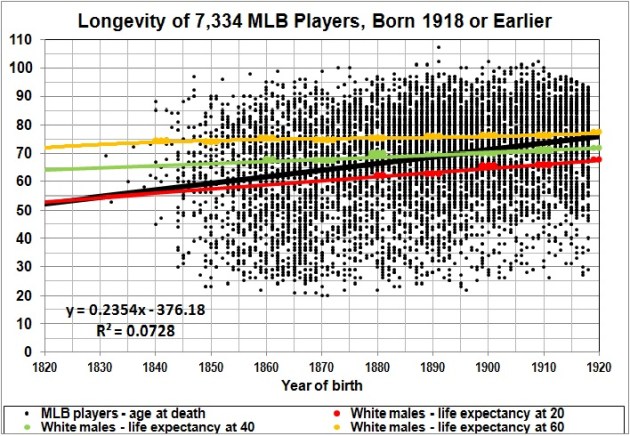
What about the longevity of baseball players in relation to that of the population of white males? I derived the following graphs from the Play Index and the table of life expectancies (both linked above):

I chose 1918 as the cutoff point for ballplayers because that is the last year in the sample of 112 conductors. (As of today, only 15 of the thousands of players born in 1918 or earlier survive** — not enough to affect the comparison.) Before I bring in the conductors, I want to point out the positive trend for longevity among ballplayers (indicated by the heavy black line), especially in relation to the trend for white, 20-year old males. The linear fit, though weak, is statistically robust, and it reflects the long, upward rise in ballplayers’ longevity that is evident in the scatter plot.

I now add conductors to the mix:

For the period covered by the statistics (birth years from 1825 through 1918), conductors enjoyed a modest and significantly insignificant increase in longevity, indicated by the dashed black line. By 1918, ballplayers had almost caught up with conductors. The trends suggest that, on average, today’s MLB players can expect to live longer than today’s conductors. Conductors, nevertheless, seem destined to live longer than their contemporaries in the population at large, but not because they (conductors) wave their arms a lot.

If the secret of a long life is not a lot of arm-waving, what is it? I return to Dr. Barondess:

[W]e’ve heard for years that the best way to live a long time is to pick long-lived parents, and there is increasing evidence that the pace of aging is to a significant degree genetically determined, but environmental influences and personal behaviors are clearly also of great importance. Scandinavian studies have calculated the heritability of average life expectancy to be 20 to 30%, with environmental differences accounting for at least 70% of variation in age at death among twins. And studies of 7th Day Adventists suggest that optimizing health related behaviors could yield up to 25 years of good health beyond age 60 with a compression of morbidity toward the end of life. The authors of that study suggested that when it comes to aging well there is no such thing as the anti-aging industry’s free lunch. I think a better suggestion might be that a really good anti-aging maneuver is no lunch, in light of other studies connecting undereating with extension of life expectancy….

There are some data connecting a specific region on chromosome 4 to the longevity of centenarians and nonagenerians, and a number of longevity genes have been discovered in yeasts, worms and fruit flies. So apparently there are gerontogenes, or longevity-enabling genes, and the genetic contribution to longevity is being investigated with increasing enthusiasm….

There’s been a good deal of research activity, and perhaps even more in the public prints in recent years, with relation to diet and longevity, especially caloric restriction. These effects were first demonstrated in the 1930s, when it was shown that laboratory rats on limited diets live about 40% longer than normal and are resistant to many chronic diseases typical of aging. These studies have been replicated in yeasts, fruit flies, nematodes, fish, spiders and mice, and there are hints that the effect may also hold true for primates. Recent research on the mechanisms underlying these phenomena has shown that the effect of caloric restriction is tied to genetic factors….

Numerous mechanisms have been suggested without great clarification to this point, but it does appear that life lengthening through caloric restriction is not primarily related to retardation of disease processes, but rather to slowing of primary aging processes, and this is related to restriction of calories rather than specific nutrients….

On the other hand, specific nutrients may impact disease processes themselves…. One study suggested that pizza intake had the potential to reduce cardiovascular risk, presumably because of the tomato sauce component, and despite the cheese.

A number of other foodstuffs have been thought to enhance health prospects, including nuts, for their resveratrol content, organo-sulfur compounds in garlic and onions, and various carotenes. Cocoa, flavanol rich, is thought to be good for you; the makers of Mars Bars are working hard on this. So are blueberries, high in antioxidants, as are raspberries, cranberries and strawberries….

One study from Rome considered alcohol consumption and its effect on longevity. The study suggested that drinking 4 to 7 drinks per day, roughly 63 grams of alcohol, a dose some might think heroic, led to a two-year edge in life expectancy, but drinking more than 10 drinks was negatively associated with longevity. These drinks were 97% wine, primarily red, high in resveratrol content. Other studies have suggested that 250 to 500 cc. of red wine a day is associated with a diminished risk of macular degeneration, Alzheimer’s disease and cognitive deficits….

Several studies … have found that social networks among humans are important predictors of longevity, including participation in formal organizations, contact with friends or relatives, and so forth. In one study of African American women aged 55 to 96, those who were extremely isolated in a social sense were more than three times as likely to die within a five-year period of observation, an impact unaffected by the use of community senior services. A search for the effects on longevity of living as a recluse or a hermit produced no results, I imagine because follow-up would be difficult, but on the other hand a number of additional papers about socialization in humans turned up. One suggested that providing social support may be more beneficial than receiving it. Mortality was significantly reduced for individuals reported to be providers of support to friends, relatives and neighbors, and emotional support for spouses.

In a study from Columbia University, the impact of marital closeness on survival was examined in 305 older couples. Closeness was defined as naming one’s spouse as a confidant or as a source of emotional support, versus not naming, or being named by the spouse on at least one of the two dimensions, versus not being named. Husbands who were named by their wives as confidants or supports, but did not name them, were least likely to have died after six years. Compared with them, husbands who were not named by their wives as a confidant or source of social support, or did not name their wives, were from 3.3 to 4.7 times more likely to be dead. The results among wives showed a similar pattern, but a weaker one….

Studies of personal histories have illuminated some personality factors that may bear on longevity. One important investigation is the Nun Study, organized by David Snowden in 1986. In this longitudinal study of aging and dementia, he was looking at a convent community of nuns aged 74 to 106, retired from careers in a variety of sites, many of them as teachers. They tended not to drink or smoke, had similar diets, income, and quality of health care and had an active social network. Snowden examined short biographical notes written at an average age of 22, on entry into the order. These suggested that positive emotions in early life were associated with longevity, with a difference of nearly 7 years between the highest and lowest quartiles of positive emotion sentences. That is, positive emotional content in early life autobiographies was strongly associated with longevity six decades later. There was some sense that positive response patterns, or more rapid return to a positive outlook after negative events, serves to dampen the physiologic sequelae of emotional arousal, such as heart rate and blood pressure changes, and presumably also hormonal responses. In a word it’s best to be cheery, or at least positive.

Further to the effect of optimism and pessimism as risk factors for disease, Peterson and his group studied questionnaires filled out by 99 Harvard graduates in the classes of 1942 to ’44, when they were about 25 years of age, and then determined physical health from ages 30 to 60 as measured by examination by physicians. Pessimistic explanatory style, the belief that bad events are caused by stable, global or internal personal factors, predicted poor health at ages 45 through 60 even when physical and mental health at age 25 were controlled for, across an array of diseases ranging from gout to diabetes, kidney stones to hypertension. The correlations increased across the life span, from age 30 to 60.

With regard to the impact of cognitive activity on optimism, health, and possibly life expectancy, there is good reason to believe, as Guy McKhann and Marilyn Albert have pointed out, that the phrase “use it or lose it” applies. Maintaining one’s mental abilities is made easier through a variety of activities, including reading, doing crossword puzzles, learning ballroom dancing, using a computer and going to lectures or concerts. Studies have shown that in rats an enriched environment that includes exercise, toys, mirrors, tunnels and interaction with other rats strengthens connections between cells in the hippocampus and even increases the rate at which new cells are born. The idea of rat fraternization may be counterintuitive, but somewhere here there may be a link with the academic parable expressed in prior talks by Dick Johns on how to swim with sharks. Fraternization with rats, has, I think, a weaker set of academic projections, but I pass it along for what it’s worth.

Related to the last point is evidence of

[a] strong inverse correlation between early life intelligence and mortality … across different populations, in different countries, and in different epochs.”[3][4][5] Various explanations for these findings have been proposed:

“First, …intelligence is associated with more education, and thereafter with more professional occupations that might place the person in healthier environments. …Second, people with higher intelligence might engage in more healthy behaviours. …Third, mental test scores from early life might act as a record of insults to the brain that have occurred before that date. …Fourth, mental test scores obtained in youth might be an indicator of a well-put-together system. It is hypothesized that a well-wired body is more able to respond effectively to environmental insults…”[5]

A study of one million Swedish men found showed “a strong link between cognitive ability and the risk of death.”[6][7][8][9]

People with higher IQ test scores tend to be less likely to smoke or drink alcohol heavily. They also eat better diets, and they are more physically active. So they have a range of better behaviours that may partly explain their lower mortality risk.—-Dr. David Batty[7]

A similar study of 4,289 former US soldiers showed a similar relationship between IQ and mortality.[7][8][10]

The strong correlation between intelligence and mortality has raised questions as to how better public education could delay mortality.[11]

There is a known inverse correlation between socioeconomic position and health. A 2006 study found that controlling for IQ caused a marked reduction in this association.[12]

Research in Scotland has shown that a 15-point lower IQ meant people had a fifth less chance of seeing their 76th birthday, while those with a 30-point disadvantage were 37% less likely than those with a higher IQ to live that long.[13]

Here is my take on all of this: Conductors, baseball players, and corporate executives (among members of other identifiable groups) tend to be long-lived because they tend to be physically and mentally vigorous, to begin with. Conductors must possess stamina and intelligence to do what they do.To rise in the corporate world, one must be capable of working long hours, putting up with a lot of stress, and coping with many complex issues. And, contrary to the popular view of athletes as “dumb,” they are not (as a group); in fact, intelligence and good health (a key component of athleticism) are are tightly bound.

Moreover, conductors (who make music), ballplayers (who play a game) and corporate executives (who attain high status and high incomes) are engaged in occupations that yield what Robert Atlas calls “gratifying stress.” And, as persons who usually enjoy above-average incomes, they are likely to enjoy better diets and better health-care than most of their contemporaries.

The finding that pitchers do not live as long as other ballplayers supports the view that “gratifying stress” fosters longevity, whereas “frustrating stress” may shorten a person’s life. Pitchers, uniquely among ballplayers, are credited or charged with the wins and losses of their teams. And pitchers, as a group, win only half the time — an ungratifying outcome. Further, pitchers with consistently bad records do not last long in the big leagues, and end their careers having won less than 50 percent of the games for which they were held responsible (i.e., with a won-lost record below .500). Accordingly, more pitchers end their careers with losing records than with winning records: In the history of the major leagues, from 1871 through 2011, there have been 6,744 pitchers with a career record of at least one loss; only 29 percent of them (1,935) had a career won-lost record better than .500.

I conclude that occupation — conducting, playing professional baseball, etc. — is a function of the main influences on longevity — mental and physical robustness — and not the other way around. Occupation influences longevity only to the extent that increases it (at the margin) by bestowing “gratifying stress” and/or material rewards, or reduces it (at the margin) by bestowing “frustrating stress” and/or exposure to health-or life-threatening conditions.

*   *   *

The footnotes are below the fold.
Continue reading “Conducting, Baseball, and Longevity”

Irrational Rationality

Economists have given “rationality” a bad name. Mario Rizzo explains:

[T]he axioms of rational choice were supposed to shed light on how people actually made choices. Then a sleight of hand occurred. It was claimed that they shed light on how rational individuals would choose – without addressing the issue of whether people were in fact rational in the sense of the axioms. Finally, it was alleged – in the face of empirical evidence that people often did not choose rationally – that the axioms defined the norms of choice. They told us how rational individuals should choose. More than that. Since being rational is taken as “good,” they show us how people should behave – full stop….

The behavioralists may well be correct that people do not act in accordance with … rationality axioms. But they are surely wrong in claiming that they ought to behave in this way. The problem is not with deficient individuals. It is a problem of deficient rationality standards.

It is an old story. Pseudo-scientific economists, suffering from physics envy, strive to reduce the complexity of human behavior to simple-minded metrics, according to which they judge human rationality. When humans fail to hew to the simple-minded preferences of economistic thinkers, it is evident (to those thinkers) that humans must be nudged toward “doing the right thing.”

When economists cross the line from theorizing about economic behavior to judging it, they put themselves on the same low plain as “liberals.” The latter, at least, are honest about wanting their own way … just because … and do not resort to cheap, pseudo-scientific tricks. They simply enforce their preferences through statutes and regulations. Why “nudge” when you can coerce?

Related posts:
Why I Don’t Hang Around with Economists
The Rationality Fallacy
Greed, Cosmic Justice, and Social Welfare
Positive Rights and Cosmic Justice
Inventing “Liberalism”
Utilitarianism, “Liberalism,” and Omniscience
Utilitarianism vs. Liberty
Beware of Libertarian Paternalists
Landsburg Is Half-Right
Negative Rights, Social Norms, and the Constitution
Rights, Liberty, the Golden Rule, and the Legitimate State
The Mind of a Paternalist
Accountants of the Soul
Physics Envy
Rawls Meets Bentham
Enough of “Social Welfare”
The Case of the Purblind Economist
The Arrogance of (Some) Economists
Extreme Economism

Are the Natural Numbers Supernatural?

Steven Landsburg writes:

…It is not true that all complex things emerge by gradual degrees from simpler beginnings. In fact, the most complex thing I’m aware of is the system of natural numbers (0,1,2,3, and all the rest of them) together with the laws of arithmetic. That system did not emerge, by gradual degrees, from simpler beginnings….

…God is unnecessary not because complex things require simple antecedents but because they don’t. That allows the natural numbers to exist with no antecedents at all—and once they exist, all hell (or more precisely all existence) breaks loose: In The Big Questions I’ve explained why I believe the entire Universe is, in a sense, made of mathematics. (“There He Goes Again,” The Big Questions Blog, October 29, 2009)

*   *   *

The existence of the natural numbers explains the existence of everything else. Once you’ve got that degree of complexity, you’ve got structures within structures within structures, and one of those structures is our physical Universe. (If that sounds like gibberish, I hope it’s only because you’re not yet read The Big Questions, that you will rush out and buy a copy, and that all will then be clear.) (“Rock On,” The Big Questions Blog, February 8, 2012)

With regard to the first quotation, I said (on October 29, 2009) that

Landsburg’s assertion about natural numbers (and the laws of arithmetic) is true only if numbers exist independently of human thought, that is, if they are ideal Platonic forms. But where do ideal Platonic forms come from? And if some complex things don’t require antecedents, how does that rule out the existence of God … ?

I admit to having said that without the benefit of reading The Big Questions. I do not plan to buy or borrow the book because I doubt its soundness, given Landsburg’s penchant for wrongheadedness. But (as of today) a relevant portion of the book is available for viewing at Amazon.com. (Click here and scroll to chapter 1, “On What There Is.”) I quote from pages 4 and 6:

…I assume — at the risk of grave error — that the Universe is no mere accident. There must be some reason for it. And if it’s a compelling reason, it should explain not only why the Universe does exist, but why it must.

A good starting point, then, is to ask whether we know of anything — let alone the entire Universe — that not only does exist, but must exist. I think I know one clear answer: Numbers must exist. The laws of arithmetic must exist. Two plus two equals four in any possible universe, and two plus two would equal four even if there were no universe at all….

…Numbers exist, and they exist because they must. Admittedly, I’m being a little vague about what I mean by existence. Clearly numbers don’t exist in exactly the same sense that, say, my dining-room table exists; for one thing, my dining-room table is made of atoms, and numbers are surely not. But not everything that exists is made of atoms. I am quite sure that my hopes and dreams exist, but they’re not made of atoms. The color blue, the theory of relativity, and the idea of a unicorn exist, but none of them is made of atoms.

I am confident that mathematics exists for the same reason that I am confident my hopes and dreams exist: I experience it directly. I believe my dining-room table exists because I can feel it with my hands. I believe numbers, the laws of arithmetic, and (for that matter) the ideal triangles of Euclidean geometry exits because I can “feel” them with my thoughts.

Here is the essence of Landsburg’s case for the existence of numbers and mathematics as ideal forms:

  • Number are not made of atoms.
  • But numbers are real because Landsburg “feels” them with his thoughts.
  • Therefore, numbers are (supernatural) essences which transcend and precede the existence of the physical universe; they exist without God or in lieu of God.

It is unclear to me why Landsburg assumes that numbers do not exist because of God. Nor is it clear to my why his “feeling” about numbers is superior to other persons’ “feelings” about God.

In any event, Landsburg’s “logic,” though superficially plausible, is based on false premises. It is true, but irrelevant, that numbers are not made of atoms. Landsburg’s thoughts, however, are made of atoms. His thoughts are not disembodied essences but chemical excitations of certain neurons in his brain.

It is well known that thoughts do not have to represent external reality. Landsburg mentions unicorns, for example, though he inappropriately lumps them with things that do represent external reality: blue (a manifestation of light waves of a certain frequency range) and the theory of relativity (a construct based on observation of certain aspects of the physical universe). What Landsburg has shown, if he has shown anything, is that numbers and mathematics are — like unicorns — concoctions of the human mind, the workings of which are explicable physical processes.

Why have humans, widely separated in time and space, agreed about numbers and the manipulation of numbers (mathematics)? Specifically, with respect to the natural numbers, why is there agreement that something called “one” or “un” or “ein” (and so on) is followed by something called “two” or “deux” or “zwei,” and so on? And why is there agreement that those numbers, when added, equal something called “three” or “trois” or “drei,” and so on? Is that evidence for the transcendent timelessness of numbers and mathematics, or is it nothing more than descriptive necessity?

By descriptive necessity, I mean that numbering things is just another way of describing them. If there are some oranges on a table, I can say many things about them; for example, they are spheroids, they are orange-colored, they contain juice and (usually) seeds, and their skins are bitter-tasting.

Another thing that I can say about the oranges is that there are a certain number of them — let us say three, in this case. But I can say that only because, by convention, I can count them: one, two, three. And if someone adds an orange to the aggregation, I can count again: one, two, three, four. And, by convention, I can avoid counting a second time by simply adding one (the additional orange) to three (the number originally on the table). Arithmetic is simply a kind of counting, and other mathematical manipulations are, in one way or another, extensions of arithmetic. And they all have their roots in numbering and the manipulation of numbers, which are descriptive processes.

But my ability to count oranges and perform mathematical operations based on counting does not mean that numbers and mathematics are timeless and transcendent. It simply means that I have used some conventions — devised and perfected by other humans over the eons — which enable me to describe certain facets of physical reality. Numbers and mathematics are no more mysterious than other ways of describing things and manipulating information about them. But the information — color, hardness, temperature, number, etc. — simply arises from the nature of the things being described.

Numbers and mathematics — in the hands of persons who are skilled at working with them — can be used to “describe” things that have no known physical counterparts. But  that does not privilege numbers and mathematics any more than it does unicorns or God.

Related posts:
Atheism, Religion, and Science
The Limits of Science
Three Perspectives on Life: A Parable
Beware of Irrational Atheism
The Creation Model
The Thing about Science
Evolution and Religion
Words of Caution for Scientific Dogmatists
Science, Evolution, Religion, and Liberty
Science, Logic, and God
Is “Nothing” Possible?
Debunking “Scientific Objectivity”
Science’s Anti-Scientific Bent
Science, Axioms, and Economics
The Big Bang and Atheism
The Universe . . . Four Possibilities
Einstein, Science, and God
Atheism, Religion, and Science Redux
Pascal’s Wager, Morality, and the State
Evolution as God?
The Greatest Mystery
What Is Truth?
The Improbability of Us
A Digression about Probability and Existence
More about Probability and Existence
Existence and Creation
Probability, Existence, and Creation
The Atheism of the Gaps
Probability, Existence, and Creation: A Footnote
Scientism, Evolution, and the Meaning of Life

“Going Viral” in the 1500s

From “How Luther went viral” (The Economist, December 17, 2011):

The start of the Reformation is usually dated to Luther’s nailing of his “95 Theses on the Power and Efficacy of Indulgences” to the church door in Wittenberg on October 31st 1517….

Although they were written in Latin, the “95 Theses” caused an immediate stir, first within academic circles in Wittenberg and then farther afield. In December 1517 printed editions of the theses, in the form of pamphlets and broadsheets, appeared simultaneously in Leipzig, Nuremberg and Basel, paid for by Luther’s friends to whom he had sent copies. German translations, which could be read by a wider public than Latin-speaking academics and clergy, soon followed and quickly spread throughout the German-speaking lands. Luther’s friend Friedrich Myconius later wrote that “hardly 14 days had passed when these propositions were known throughout Germany and within four weeks almost all of Christendom was familiar with them.”

The unintentional but rapid spread of the “95 Theses” alerted Luther to the way in which media passed from one person to another could quickly reach a wide audience. “They are printed and circulated far beyond my expectation,” he wrote in March 1518 to a publisher in Nuremberg who had published a German translation of the theses. But writing in scholarly Latin and then translating it into German was not the best way to address the wider public. Luther wrote that he “should have spoken far differently and more distinctly had I known what was going to happen.” For the publication later that month of his “Sermon on Indulgences and Grace”, he switched to German, avoiding regional vocabulary to ensure that his words were intelligible from the Rhineland to Saxony. The pamphlet, an instant hit, is regarded by many as the true starting point of the Reformation….

Modern society tends to regard itself as somehow better than previous ones, and technological advance reinforces that sense of superiority. But history teaches us that there is nothing new under the sun. Robert Darnton, an historian at Harvard University, who has studied information-sharing networks in pre-revolutionary France, argues that “the marvels of communication technology in the present have produced a false consciousness about the past—even a sense that communication has no history, or had nothing of importance to consider before the days of television and the internet.” Social media are not unprecedented: rather, they are the continuation of a long tradition. Modern digital networks may be able to do it more quickly, but even 500 years ago the sharing of media could play a supporting role in precipitating a revolution. Today’s social-media systems do not just connect us to each other: they also link us to the past.

Luther’s success, if it may be called that, was owed not so much to the new technology of printing as to certain constants of human nature:

1. Distant authority is more credible than a familiar source. CEOs resort to this kind of authority when they hire “expert” consultants to rubber-stamp decisions that they — the CEOs — had already reached, so as to “sell” the intended audience (board of directors, senior managers, employees) on the correctness of the decisions. More generally, what is said in print, on the air, on the internet, etc., is accepted as authoritative because it is (usually) delivered in tones of great certainty, supported by fabricated and/or cherry-picked evidence, and originates from a source that cannot be questioned directly and is (wrongly, for the most part) assumed to be authoritative.

2. Last in, last believed. There is a strong tendency to make judgments based on the most recent facts and/or opinions to which one is exposed, especially among persons with little education, persons whose education is non-scientific, and persons of below-average intelligence.

3. Confirmation bias. This is at work in almost everyone, even the “best and brightest.” A person who already leans toward a position will search out and seize upon “facts” that support the position. Distant authority plays a key role in enabling confirmation bias. And once a person finds “the answer” to something — whether the answer is communism, the welfare state, carbon-emission reductions, etc. — he becomes less prone to believe the last thing he hears. But the last thing that swayed him could well have been a speech by FDR denouncing “economic royalists” or one of Al Gore’s presentations about global warming. No mind is more closed than that of an “open minded liberal.”

A man who is not a Liberal at sixteen has no heart; a man who is not a Conservative at sixty has no head.

-– attributed to Benjamin Disraeli

Intelligence and Intuition

According to “Intelligence, Personality, Politics, and Happiness”, which (among other things) considers the relationship of intelligence to personality traits (as measured by the Myers-Briggs Type Indicator, MBTI),

an iNtuitive person (one who grasps patterns and seeks possibilities) is 25 times more likely to have a high IQ than a Sensing person (one who focuses on sensory details and the here-and-now).

But which comes first: intelligence or intuition? My money is on intelligence. That is, highly intelligent persons are more likely than their less intelligent peers to show up as iNtuitives on the MBTI. In my view, it is not that iNtuitives are uninterested in sensory details and the here-and-now, but — compared with Sensing persons — they more quickly grasp details and see the patterns in them and the possibilities indicated by those patterns.

In sum, I think of intuition as a manifestation of intelligence, not a cause of it. To put it another way, intuition is not an emotion; it is the opposite of emotion.

Intuition is reasoning at high speed. For example, a skilled athlete knows where and when to make a move (e.g., whether and where to swing at a pitched ball) because he subconsciously makes the necessary calculations, which he could not make consciously in the split-second that is available to him once the pitcher releases the ball.

Related reading: “The Mystery of Expertise,” The Week, December 22, 2011

Related posts:
Intelligence, Personality, Politics, and Happiness
Intelligence as a Dirty Word

Luck and Baseball, One More Time

There is such a thing as “luck.” Bad and good luck happen to everyone, at one time or another. But everything that happens to everyone is not due to luck. I am convinced by what I have seen of life — up close and at a distance — that most of what happens to people happens to them because of their intentions, skills, and resources.

Yes, the skills that one possesses may be due in part to genetic luck, and the resources that one can marshal may be due in part to genetic and geographic luck. But if skills and resources were entirely beyond a person’s control, no one would ever climb from the proverbial gutter to attain fame and fortune. That is where intentions come in.

So, I am unimpressed (to say the least) by do-gooders and levelers, who want to take from the productive and give to the unproductive because the productive have had “all the luck,” or some such thing. Balderdash! First, it takes more than luck to be productive and to enjoy even a modest income. Second, taking from the productive to give to the unproductive is like blaming the blameless. It may come as a surprise to do-gooders and levelers (most of whom ought to know better), but a person who earns a high income earns it because that is what others are willing to pay for his efforts — not because he picks the pockets of the poor.

Speaking of high-income earners, I am always puzzled by the fact that income-envy is directed toward CEOs, investment bankers, and suchlike. Why is it not directed at super-star athletes, like Albert Pujols, who will earn $254 million over the next 10 years, just for playing baseball? Perhaps it is because almost everyone recognizes that Pujols is selling a skill that (a) is his (not stolen from someone else) and (b) would not be on display were it not for his assiduous development and application of the particular genetic advantages that enable him to hit a pitched baseball with above-average frequency and power.

Well, Nassim Nicholas Taleb to the contrary notwithstanding, the earning of large sums of money in any profession takes the same assiduous application of particular genetic advantages, or assiduous compensation for the lack thereof. I will not repeat my detailed criticisms of Taleb, which can be found “here” and “here.” Instead, I will return to the subject of baseball, some aspects of which I treated in those posts.

In the 111-year history of the American League, 60 different players have led the league in batting. Those 60 players have recorded a total of 367 top-10 finishes in American League batting races over the years — an average of 6 top-10 finishes for each of the players. It is not surprising, therefore, that most of the 60 players also compiled excellent career batting averages. Specifically, through 2010, 57 of the 60 had made at least 5,000 plate appearance in the American League, and 43 of the 57 are among the top 120 hitters (for average) — out of the thousands of players with at least 5,000 plate appearances in the American League. Were those 43 players merely “lucky”? It takes a lot more than luck to hit so well, so consistently, and for so many years.

And it takes a lot more than luck to succeed at almost anything, from winning high office to making millions of dollars to painting a masterpiece to building a house to cutting hair properly. To denigrate the rich and famous by calling them lucky is to denigrate every person who strives, with some success, to overmaster whatever bad luck happens to come his way.

Related posts:
The Residue of Choice
The American League’s Greatest Hitters
The American League’s Greatest Hitters:  Part II
Fooled by Non-Randomness
Randomness Is Over-Rated
Luck-Egalitarianism and Moral Luck

An Explanation Is in Order

In two recent posts (“Libertarianism and Morality” and “Libertarianism and Morality: A Footnote“) I make it a point to locate social morality in the beneficial social convention known as the Golden Rule, which arises from self-interest and empathy. This might come as a surprise to readers who are familiar with my deism (see this and this), my denunciation of strident atheism (see this, for example), and the high value I place on the Judeo-Christian tradition (see this, for example).

As a deist, I am not prepared to say that morality comes directly from God, about whose nature and involvement in the workings of the universe I am agnostic. I am prepared to say the following:

  • It is possible that there is a God who takes a “personal” interest in human beings and their doings.
  • Such a God could have endowed human beings with free will.
  • The Golden Rule, as a manifestation of free will, would therefore be God-given.
  • And the degree to which human beings abide by the Golden Rule could be one “test” (among others) by which God judges the worthiness of His creatures, individually and collectively.

Scientism, Evolution, and the Meaning of Life

Scientism is “the uncritical application of scientific or quasi-scientific methods to inappropriate fields of study or investigation.” When scientists proclaim truths outside the realm of their expertise, they are guilty of practicing scientism. Two notable scientistic scientists, of whom I have written several times (e.g., here and here), are Richard Dawkins and Peter Singer. It is unsurprising that Dawkins and Singer are practitioners of scientism. Both are strident atheists, and a strident atheists, as I have said,  “merely practice a ‘religion’ of their own. They have neither logic nor science nor evidence on their side — and eons of belief against them.”

Dawkins, Singer, and many other scientistic atheists share an especially “religious” view of evolution. In brief, they seem to believe that evolution rules out God. Evolution rules out nothing. Evolution may be true in outline but it does not bear close inspection. On that point, I turn to the late David Stove, a noted Australian philosopher and atheist. This is from his essay, “So You Think You Are a Darwinian?“:

Of course most educated people now are Darwinians, in the sense that they believe our species to have originated, not in a creative act of the Divine Will, but by evolution from other animals. But believing that proposition is not enough to make someone a Darwinian. It had been believed, as may be learnt from any history of biology, by very many people long before Darwinism, or Darwin, was born.

What is needed to make someone an adherent of a certain school of thought is belief in all or most of the propositions which are peculiar to that school, and are believed either by all of its adherents, or at least by the more thoroughgoing ones. In any large school of thought, there is always a minority who adhere more exclusively than most to the characteristic beliefs of the school: they are the ‘purists’ or ‘ultras’ of that school. What is needed and sufficient, then, to make a person a Darwinian, is belief in all or most of the propositions which are peculiar to Darwinians, and believed either by all of them, or at least by ultra-Darwinians.

I give below ten propositions which are all Darwinian beliefs in the sense just specified. Each of them is obviously false: either a direct falsity about our species or, where the proposition is a general one, obviously false in the case of our species, at least. Some of the ten propositions are quotations; all the others are paraphrases. The quotations are all from authors who are so well-known, at least in Darwinian circles, as spokesmen for Darwinism or ultra-Darwinism, that their names alone will be sufficient evidence that the proposition is a Darwinian one. Where the proposition is a paraphrase, I give quotations or other information which will, I think, suffice to establish its Darwinian credentials.

My ten propositions are nearly in reverse historical order. Thus, I start from the present day, and from the inferno-scene – like something by Hieronymus Bosch – which the ‘selfish gene’ theory makes of all life. Then I go back a bit to some of the falsities which, beginning in the 1960s, were contributed to Darwinism by the theory of ‘inclusive fitness’. And finally I get back to some of the falsities, more pedestrian though no less obvious, of the Darwinism of the 19th or early-20th century.

1. The truth is, ‘the total prostitution of all animal life, including Man and all his airs and graces, to the blind purposiveness of these minute virus-like substances’, genes.

This is a thumbnail-sketch, and an accurate one, of the contents of The Selfish Gene (1976) by Richard Dawkins….

2 ‘…it is, after all, to [a mother’s] advantage that her child should be adopted’ by another woman….

This quotation is from Dawkins’ The Selfish Gene, p. 110.

Obviously false though this proposition is, from the point of view of Darwinism it is well-founded

3. All communication is ‘manipulation of signal-receiver by signal-sender.’

This profound communication, though it might easily have come from any used-car salesman reflecting on life, was actually sent by Dawkins, (in The Extended Phenotype, (1982), p. 57), to the readers whom he was at that point engaged in manipulating….

9. The more privileged people are the more prolific: if one class in a society is less exposed than another to the misery due to food-shortage, disease, and war, then the members of the more fortunate class will have (on the average) more children than the members of the other class.

That this proposition is false, or rather, is the exact reverse of the truth, is not just obvious. It is notorious, and even proverbial….

10. If variations which are useful to their possessors in the struggle for life ‘do occur, can we doubt (remembering that many more individuals are born than can possibly survive), that individuals having any advantage, however slight, over others, would have the best chance of surviving and of procreating their kind? On the other hand, we may feel sure that any variation in the least degree injurious would be rigidly destroyed.’

This is from The Origin of Species, pp. 80-81. Exactly the same words occur in all the editions….

Since this passage expresses the essential idea of natural selection, no further evidence is needed to show that proposition 10 is a Darwinian one. But is it true? In particular, may we really feel sure that every attribute in the least degree injurious to its possessors would be rigidly destroyed by natural selection?

On the contrary, the proposition is (saving Darwin’s reverence) ridiculous. Any educated person can easily think of a hundred characteristics, commonly occurring in our species, which are not only ‘in the least degree’ injurious to their possessors, but seriously or even extremely injurious to them, which have not been ‘rigidly destroyed’, and concerning which there is not the smallest evidence that they are in the process of being destroyed. Here are ten such characteristics, without even going past the first letter of the alphabet. Abortion; adoption; fondness for alcohol; altruism; anal intercourse; respect for ancestors; susceptibility to aneurism; the love of animals; the importance attached to art; asceticism, whether sexual, dietary, or whatever.

Each of these characteristics tends, more or less strongly, to shorten our lives, or to lessen the number of children we have, or both. All of them are of extreme antiquity. Some of them are probably older than our species itself. Adoption, for example is practised by some species of chimpanzees: another adult female taking over the care of a baby whose mother has died. Why has not this ancient and gross ‘biological error’ been rigidly destroyed?…

The cream of the jest, concerning proposition 10, is that Darwinians themselves do not really believe it. Ask a Darwinian whether he actually believes that the fondness for alcoholic drinks is being destroyed now, or that abortion is, or adoption – and watch his face. Well, of course he does not believe it! Why would he? There is not a particle of evidence in its favour, and there is a great mountain of evidence against it. Absolutely the only thing it has in its favour is that Darwinism says it must be so. But (as Descartes said in another connection) ‘this reasoning cannot be presented to infidels, who might consider that it proceeded in a circle’.

What becomes, then, of the terrifying giant named Natural Selection, which can never sleep, can never fail to detect an attribute which is, even in the least degree, injurious to its possessors in the struggle for life, and can never fail to punish such an attribute with rigid destruction? Why, just that, like so much else in Darwinism, it is an obvious fairytale, at least as far as our species is concerned.

A science cannot be wrong in so many important ways and yet be taken seriously as a God-substitute.

Frederick Turner has this to say in “Darwin and Design: The Evolution of a Flawed Debate“:

Does the theory of evolution make God unnecessary to the very existence of the world?…

The polemical evolutionists are right about the truth of evolution. But the rightness of their cause has been deeply compromised by their own version of the creationists’ sin. The evolutionists’ sin, as I see it, is even greater, because it is three sins rolled into one….

The third sin is … dishonesty. In many cases it is clear that the beautiful and hard-won theory of evolution, now proved beyond reasonable doubt, is being cynically used by some — who do not much care about it as such — to support an ulterior purpose: a program of atheist indoctrination, and an assault on the moral and spiritual goals of religion. A truth used for unworthy purposes is quite as bad as a lie used for ends believed to be worthy. If religion can be undermined in the hearts and minds of the people, then the only authority left will be the state, and, not coincidentally, the state’s well-paid academic, legal, therapeutic and caring professions. If creationists cannot be trusted to give a fair hearing to evidence and logic because of their prior commitment to religious doctrine, some evolutionary partisans cannot be trusted because they would use a general social acceptance of the truth of evolution as a way to set in place a system of helpless moral license in the population and an intellectual elite to take care of them.

And that is my issue, not only with the likes of Dawkins and Singer but also with any so-called scientist who believes that evolution — or, more broadly, scientific knowledge — somehow justifies atheism.

Science is only about the knowable, and much of life’s meaning lies where science cannot reach. Maverick Philosopher puts it this way in “Why Science Will Never Put Religion Out of Business“:

We suffer from a lack of existential meaning, a meaning that we cannot supply from our own resources since any subjective acts of meaning-positing are themselves (objectively) meaningless….

…[T]he salvation religion promises is not to be understood in some crass physical sense the way the typical superficial and benighted atheist-materialist would take it but as salvation from meaninglessness, anomie, spiritual desolation, Unheimlichkeit, existential insecurity, Angst, ignorance and delusion, false value-prioritizations, moral corruption irremediable by any human effort, failure to live up to ideals, the vanity and transience of our lives, meaningless sufferings and cravings and attachments, the ultimate pointlessness of all efforts at moral and intellectual improvement in the face of death . . . .

…[I]t is self-evident that there are no technological solutions to moral evil, moral ignorance, and the apparent absurdity of life.  Is a longer life a morally better life?  Can mere longevity confer meaning?The notion that present or future science can solve the problems that religion addresses is utterly chimerical.

Related posts:
Atheism, Religion, and Science
The Limits of Science
Three Perspectives on Life: A Parable
Beware of Irrational Atheism
The Creation Model
The Thing about Science
Evolution and Religion
Words of Caution for Scientific Dogmatists
Science, Evolution, Religion, and Liberty
The Legality of Teaching Intelligent Design
Science, Logic, and God
Capitalism, Liberty, and Christianity
Is “Nothing” Possible?
Debunking “Scientific Objectivity”
Science’s Anti-Scientific Bent
Science, Axioms, and Economics
The Big Bang and Atheism
The Universe . . . Four Possibilities
Einstein, Science, and God
Atheism, Religion, and Science Redux
Pascal’s Wager, Morality, and the State
Evolution as God?
The Greatest Mystery
What Is Truth?
The Improbability of Us
A Digression about Probability and Existence
More about Probability and Existence
Existence and Creation
Probability, Existence, and Creation
The Atheism of the Gaps
Demystifying Science

Analysis for Government Decision-Making: Demi-Science, Hemi-Demi-Science, and Sophistry

Taking a “hard science” like classical mechanics as an epitome of science and, say, mechanical engineering, as a rigorous application of it, one travels a goodly conceptual distance before arriving at operations research (OR). Philip M. Morse and George E. Kimball, pioneers of OR in World War II, put it this way:

[S]uccessful application of operations research usually results in improvements by factors of 3 or 10 or more…. In our first study of any operation we are looking for these large factors of possible improvement…. They can be discovered if the [variables] are given only one significant figure,…any greater accuracy simply adds unessential detail.

One might term this type of thinking “hemibel thinking.” A bel is defined as a unit in a logarithmic scale corresponding to a factor of 10. Consequently a hemibel corresponds to a factor of the square root of 10, or approximately 3. (Philip M. Morse and George E. Kimball, Methods of Operations Research, originally published as Operations Evaluation Group Report 54, 1946, p. 38)

This is science-speak for the following proposition: Where there is much variability in the particular circumstances of combat, there is much uncertainty about the contributions of various factors (human, mechanical, and meteorological) the the outcome of combat. It is therefore difficult to assign precise numerical values to the various factors.

OR, even in wartime, is therefore, and at best, a demi-science. From there, we descend to cost-effectiveness analysis and its constituent branches: techniques for designing and estimating the costs of systems that do not yet exist and the effectiveness of such systems in combat. These methods, taken separately and together, are (to coin a term) hemi-demi-scientific — a fact that the application of “rigorous” mathematical and statistical techniques cannot alter.

There is no need to elaborate on the wild inaccuracy of estimates about the costs and physical performance of government-owned and operated systems, whether they are intended for military or civilian use. The gross errors of estimation have been amply documented in the public press for decades.

What is less well known is the difficulty of predicting the performance of systems — especially combat systems — years before they are commanded, operated, and maintained by human beings, under conditions that are likely to be far different than those envisioned when the systems were first proposed. A paper that I wrote thirty years ago gives my view of the great uncertainty that surrounds estimates of the effectiveness of systems that have yet to be developed, or built, or used in combat:

Aside from a natural urge for certainty, faith in quantitative models of warfare springs from the experience of World War II, when they seemed to lead to more effective tactics and equipment. But the foundation of this success was not the quantitative methods themselves. Rather, it was the fact that the methods were applied in wartime. Morse and Kimball put it well:

Operations research done separately from an administrator in charge of operations becomes an empty exercise. To be valuable it must be toughened by the repeated impact of hard operational facts and pressing day-by-day demands, and its scale of values must be repeatedly tested in the acid of use. Otherwise it may be philosophy, but it is hardly science. [Methods of Operations Research, p. 10]

Contrast this attitude with the attempts of analysts … to evaluate weapons, forces, and strategies with abstract models of combat. However elegant and internally consistent the models, they have remained as untested and untestable as the postulates of theology.

There is, of course, no valid test to apply to a warfare model. In peacetime, there is no enemy; in wartime, the enemy’s actions cannot be controlled. Morse and Kimball, accordingly, urge “hemibel thinking”:

Having obtained the constants of the operations under study… we compare the value of the constants obtained in actual operations with the optimum theoretical value, if this can be computed. If the actual value is within a hemibel (…a factor of 3) of the theoretical value, then it is extremely unlikely that any improvement in the details of the operation will result in significant improvement. [When] there is a wide gap between the actual and theoretical results … a hint as to the possible means of improvement can usually be obtained by a crude sorting of the operational data to see whether changes in personnel, equipment, or tactics produce a significant change in the constants. [Ibid., p. 38]

….

Much as we would like to fold the many different parameters of a weapon, a force, or a strategy into a single number, we can not. An analyst’s notion of which variables matter and how they interact is no substitute for data. Such data as exist, of course, represent observations of discrete events — usually peacetime events. It remains for the analyst to calibrate the observations, but without a benchmark to go by. Calibration by past battles is a method of reconstruction –of cutting one of several coats to fit a single form — but not a method of validation. Lacking pertinent data, an analyst is likely to resort to models of great complexity. Thus, if useful estimates of detection probabilities are unavailable, the detection process is modeled; if estimates of the outcomes of dogfights are unavailable, aerial combat is reduced to minutiae. Spurious accuracy replaces obvious inaccuracy; untestable hypotheses and unchecked calibrations multiply apace. Yet the analyst claims relative if not absolute accuracy, certifying that he has identified, measured, and properly linked, a priori, the parameters that differentiate weapons, forces, and strategies….

Should we really attach little significance to differences of less than a hemibel? Consider a five-parameter model, involving the conditional probabilities of detecting, shooting at, hitting, and killing an opponent — and surviving, in the first place, to do any of these things. Such a model might easily yield a cumulative error of a hemibel, given a twenty-five percent error in each parameter. My intuition is that one would be lucky if relative errors in the probabilities assigned to alternative weapons and forces were as low as twenty-five percent.

The further that one travels from an empirical question, such as the likely effectiveness of an extant weapon system under specific, quantifiable conditions, the more likely one is to encounter the kind of sophistry known as policy analysis. It is in this kind of analysis that one  — more often than not — encounters in the context of broad policy issues (e.g., government policy toward health care, energy, or defense spending). Such analysis is constructed so that it favors the prejudices of the analyst or his client, or support the client’s political case for a certain policy.

Policy analysis often seems credible, especially on first hearing or reading it. But, on inspection, it is usually found to have at least two of these characteristics:

  • It stipulates or quickly arrives at a preferred policy, then marshals facts, calculations, and opinions that are selected because they support the preferred policy.
  • If it offers and assesses alternative policies, they are not placed on an equal footing with the preferred policy. They are, for example, assessed against criteria that favor the preferred policy, while other criteria (which might be important ones) are ignored or given short shrift.
  • It is wrapped in breathless prose, dripping with words and phrases like “aggressive action,”grave consequences,” and “sense of urgency.”

No discipline or quantitative method is rigorous enough to redeem policy analysis, but two disciplines are especially suited to it: political “science” and macroeconomics. Both are couched in the language of real science, but both lend themselves perfectly to the old adage: garbage in, garbage out.

Do I mean to suggest that broad policy issues should not be addressed as analytically as possible? Not at all. What I mean to suggest is that because such issues cannot be illuminated with scientific rigor, they are especially fertile ground for sophists with preconceived positions.

In that respect, the model of cost-effectiveness analysis, with all of its limitations, is to be emulated. Put simply, it is to state a clear objective in a way that does not drive the answer; reveal the assumptions underlying the analysis; state the relevant variables (factors influencing the attainment of the objective); disclose fully the data, the sources of data, and analytic methods; and explore openly and candidly the effects of variations in key assumptions and critical variables.

Politics, Sophistry, and the Academy

By “politics” I mean the business of acquiring and applying governmental power, which involves — among other things — persuading the electorate, either directly or through advertising and the utterances of political allies and friendly “opinion elites” among journalists and academicians.

“Sophistry” is more complex. Its meaning has evolved, as described at Wikipedia:

The Greek word sophos, or sophia, has had the meaning “wise” or “wisdom” since the time of the poet Homer and originally was used to describe anyone with expertise in a specific domain of knowledge or craft. For example, a charioteer, a sculptor or a warrior could be described as sophoi in their occupations. Gradually, however, the word also came to denote general wisdom and especially wisdom about human affairs (in, for example, politics, ethics, or household management)….

In the second half of the 5th century BC, particularly at Athens, “sophist” came to denote a class of mostly itinerant intellectuals who taught courses in various subjects, speculated about the nature of language and culture and employed rhetoric to achieve their purposes, generally to persuade or convince others: “Sophists did, however, have one important thing in common: whatever else they did or did not claim to know, they characteristically had a great understanding of what words would entertain or impress or persuade an audience.”…

Plato is largely responsible for the modern view of the “sophist” as a greedy instructor who uses rhetorical sleight-of-hand and ambiguities of language in order to deceive, or to support fallacious reasoning. In this view, the sophist is not concerned with truth and justice, but instead seeks power.

Here, I am concerned with sophistry in its modern, political sense: the cynical use of language in the pursuit and application of power. In a word, propaganda. Josef Pieper (1903-97), a German Catholic philosopher, has much to say about this in Abuse of Language, Abuse of Power (for which I thank my son). There, Pieper notes that propaganda

can be found wherever a powerful organization, and ideological clique, a special interest, or a pressure group uses the word as their “weapon”…. (p. 32)

A bit later, Pieper says that “the abuse of political power is fundamentally connected with the sophistic abuse of the word” (p. 32). But this is nothing new under sun, and should come as no surprise to anyone who has even a superficial knowledge of modern history and understanding of politics.

Less evident, I believe, is the tragically corrosive confluence of politics and sophistry in the academy. To push the metaphor, what was a trickle in the middle of the twentieth century has grown to a wide, roaring river of academic dishonesty in the service of political ends.

About the corruption of the academy, Pieper writes:

[T]he term academic expresses something that remained unchanged throughout the centuries, something that can be identified quite accurately. It seems that in the midst of society there is expressly reserved an area of truth, a sheltered space for the autonomous study of reality, where it is possible, without restrictions,to examine, investigate, discuss, and express what is true about any thing — a space, then, explicitly protected against all potential special interests and invading influences, where hidden agendas have no place, be they collective or private, political, economic, or ideological. At this time in history we  have been made aware amply, and forcefully as well, what consequences ensue when a society does or does not provide such a “refuge”. Clearly, this is indeed a matter of freedom — not the whole of freedom, to be sure, yet an essential and indispensable dimension of freedom. Limitations and restrictions imposed from the outside are intolerable enough; it is even more depressing for the human spirit when it is made impossible to express and share, that is, to declare publicly, what according to one’s best knowledge and clear conscience is the truth about things….

Such a space of freedom needs not only a guarantee from the outside, from the political power that thus imposes limits on itself. Such a space of freedom also depends on the requirement that freedom be constituted — and defended — within its own domain. By “defended” we mean here not against any threat from the outside but against dangers arising — disturbingly! — within the scholarly domain itself…. (pp. 37-8)

Pieper’s depiction of the academy may seem, at first glance, to be unrealistically romantic. But Pieper is merely setting forth an ideal toward which the academy should strive. If the academy would renew its dedication to the ideal, it would banish and bar the sophists who lurk within and seek to infiltrate it.

Where are the sophists most likely to be found in the academy? In such pseudo-disciplines as “women’s studies,” “black studies,” and the like, of course. But also throughout the liberal arts, humanities, and social sciences, where artistic forms, economics, history, literature, and sociology serve (to name a few) serve as vehicles for those who would destroy the foundations of Western civilization in the name of “liberation,” “equality,” and “social justice.” Even the sciences are not immune, as evidenced by almost-obligatory belief in anthropogenic global warming, and the need to subscribe to that belief or be ostracized. More generally, there is the selection bias that works against the hiring and promotion of those who come from schools that have a reputation for dissenting from left-wing academic orthodoxy, or who have themselves overtly dissented from the orthodoxy. Especially damning is the fact of dissent based on hard evidence and impeccable logic — especially damning because it is especially threatening to the orthodoxy.

The last word goes to Pieper:

“Academic” must mean “antisophistic” if it is to mean anything at all. This implies also opposition to anything that could destroy or distort the nature of the word as communication and its unbiased openness to reality. In this respect we are well able to pronounce the general principle and at the same time to to be very specific: opposition is required, for instance, against every partisan simplification, every ideological agitation, eery blind emotionality; against seduction through well-turned yet empty slogans, against autocratic terminology with no room for dialogue, against personal insult as an element of style … , against the language of evasive appeasement and false assurance …, and not least against the jargon of the revolution, against categorical conformism, and categorical nonconformism…. (pp. 38-9)

Related posts:
I Missed This One
Affirmative Action: Two Views from the Academy
Feminist Balderdash
What Is the Point of Academic Freedom?
How to Deal with Left-Wing Academic Blather
It’s Not Anti-Intellectualism, Stupid
The Case Against Campus Speech Codes
The Left, Abortion, and Adolescence
Lefty Profs
Apropos Academic Freedom and Western Values
Why So Few Free-Market Economists?
Affirmative Action: Two Views from the Academy, Revisited
Affirmative Action for Conservatives and Libertarians?
Academic Bias
Intellectuals and Capitalism
The Left
Enough of Krugman
“Intellectuals and Society”: A Review
Social Justice
The Left’s Agenda
More Social Justice
The Left and Its Delusions
The Ideal as a False and Dangerous Standard
Utilitarianism and Psychopathy
Demystifying Science

Religion on the Left

Maverick Philosopher makes an astute point:

[T]he present question is not whether God exists or not, but whether belief in Man makes any sense and can substitute for belief in God. I say it doesn’t and can’t, that it is a sorry substitute if not outright delusional. We need help that we cannot provide for ourselves, either individually or collectively. The failure to grasp this is of the essence of the delusional Left, which, refusing the tutelage of tradition and experience, and having thrown overboard every moral standard,  is ever ready to spill oceans of blood in pursuit of their utopian fantasies.

There may be no source of the help we need. Then the conclusion to draw is that we should get by as best we can until Night falls, rather than making things worse by drinking the Left’s utopian Kool-Aid.

The main ingredient of utopian Kool-Aid (its water, if you will) is a belief in the perfectibility of man and the ability of man to achieve perfection on this earth. It is that belief which enables leftists to inveigh against every inevitable imperfection of human striving as a failure that must be — and can be — corrected through state action.  The state is the left’s religion-substitute, and a most dangerous one because obeisance to the state leads to the suppression of individuals in the name of the common good — as seen from the left — and the destruction of the human spirit that enable earthly progress, imperfect as it may be.

Where one finds ostensibly religious persons on the left, one does not find a belief in voluntary acts of goodness toward others. What one finds is exemplified in A Circle of Protection, which proclaims:

As Christians, we believe the moral measure of the debate is how the most poor and vulnerable people fare. We look at every budget proposal from the bottom up—how it treats those Jesus called “the least of these” (Matthew 25:45). They do not have powerful lobbies, but they have the most compelling claim on our consciences and common resources. The Christian community has an obligation to help them be heard, to join with others to insist that programs that serve the most vulnerable in our nation and around the world are protected. We know from our experience serving hungry and homeless people that these programs meet basic human needs and protect the lives and dignity of the most vulnerable. We believe that God is calling us to pray, fast, give alms, and to speak out for justice.

As Christian leaders, we are committed to fiscal responsibility and shared sacrifice. We are also committed to resist budget cuts that undermine the lives, dignity, and rights of poor and vulnerable people. Therefore, we join with others to form a Circle of Protection around programs that meet the essential needs of hungry and poor people at home and abroad.

Hiding one’s leftism behind the robe of Jesus is a cynical act:

[T]he “Circle of Protection” … tried to browbeat conservative lawmakers into pumping taxpayer dollars at full force into welfare and wealth redistribution programs.

They claimed to be doing this for the “poor.”  The coalition’s slogan, “What would Jesus cut?”, equates federal spending levels with degree of morality….

Such political activism is its own reward—there’s unlikely to be much of a reward in Heaven for being “compassionate” with other people’s money.  Jesus noted that the Pharisees, who excelled at imposing layers of human standards to the Lord’s, practiced their “righteousness . . . [merely] in order to be seen” by other people.  The “circle” follows the same practice….

The bottom line for America is how to put our public sector on fiscally sustainable ground—for the good of all Americans.  The welfare state, the disproportionate expropriation of private income and wealth transfer schemes embodied in public programs all make for unsustainable spending patterns.

Moreover, the government is robbing middle- and upper-income Peter to pay Paul—despite the fact Paul has what would amounts to middle-class or upper-income existence in most of the world.

The so-called “Circle of Protection” and the unfair, immoral policies it stands for represent one circle that should be broken.

“Charity” at the point of the state’s gun is not charity, it is theft. There is a Commandment about that, as I recall.

Leftists-cum-religionists commit at least one other sin — or most of them do, I am sure. That is the sin of hypocrisy:

Essentially its malice is identical with that of lying; in both cases there is discordance between what a man has in his mind and the simultaneous manifestation of himself…. St. Thomas Aquinas teaches that we must carefully differentiate its two elements: the want of goodness, and the pretence of having it. If a person be so minded as definitely to intend both things, it is of course obvious that he is guilty of grievous sin, for that is only another way of saying that a man lacks the indispensable righteousness which makes him pleasing in the sight of God.

The portrait of hypocrisy is drawn with appalling vividness by Christ in His denunciation of the Pharisees in Matthew 23:23-24: “Woe to you scribes and Pharisees, hypocrites; because you tithe mint, and anise, and cummin, and have left the weightier things of the law; judgment, and mercy, and faith. These things you ought to have done, and not to leave those undone. Blind guides, who strain out a gnat, and swallow a camel.”

There are those Pharisees again. Their modern brethren are well-fed, well-clothed, well-housed leftists who proclaim their “compassion” for the “less fortunate” and use the state’s power to enforce that “compassion,” but do not share their homes with the less-fortunate or even give as generously to charity as the conservatives whose supposed lack of “compassion” they deride.

What does left-religionists’ penchant for coercion and hypocrisy have to do with atheism? A lot.

The invocation of religion as a justification for state action, for the sake of the “poor and vulnerable,” is a mockery of charity:

a divinely infused habit, inclining the human will to cherish God for his own sake above all things, and man for the sake of God.

I submit that one cannot be a Christian, in more than name, while favoring coercive “charity.” The person who does that is putting himself in the position of judging the relative worthiness of individuals, which is a kind of blasphemy. Further, the belief that one is doing good by counseling coercion is a manifestation of the vice of presumption.

I will go further and say that the leftists of my acquaintance who profess to be religious are no less mean-spirited than the leftists of my acquaintance who reject religion. Mean-spiritedness is not excused simply because it is aimed at the well-to-do. Yes, Jesus said this to the rich man: “If you will be perfect, go sell what you have, and give to the poor, and you shall have treasure in heaven: and come, follow me.” But Jesus was counseling the rich man, not directing anyone to take the rich man’s possessions and give them to the poor.

My conclusion — to which many readers will no doubt object — is that leftist-religionists are religiously shallow at best and insincerely religious at worst. Remove their veneer of religiosity and you have a utopian leftist, committed to perfection on this earth. In other words, you have an lefitist-atheist in all but name — a person who worships at the altar of the state.

Related posts:
Religion and Liberty” (at Facets of Liberty)
“Occupy Wall Street” and Religion

Nonsense about Presidents, IQ, and War

Peter Singer outdoes his usual tendentious self in this review of Steven Pinker’s The Better Angels of Our Nature: Why Violence Has Declined. In the course of the review, Singer writes:

Pinker argues that enhanced powers of reasoning give us the ability to detach ourselves from our immediate experience and from our personal or parochial perspective, and frame our ideas in more abstract, universal terms. This in turn leads to better moral commitments, including avoiding violence. It is just this kind of reasoning ability that has improved during the 20th century. He therefore suggests that the 20th century has seen a “moral Flynn effect, in which an accelerating escalator of reason carried us away from impulses that lead to violence” and that this lies behind the long peace, the new peace, and the rights revolution. Among the wide range of evidence he produces in support of that argument is the tidbit that since 1946, there has been a negative correlation between an American president’s I.Q. and the number of battle deaths in wars involving the United States.

Singer does not give the source of the IQ estimates on which Pinker relies, but the supposed correlation points to a discredited piece of historiometry by Dean Keith Simonton, “Presidential IQ, Openness, Intellectual Brilliance, and Leadership: Estimates and Correlations for 42 U.S. Chief Executives” (Political Psychology, Vol. 27, No. 4, 2006). Simonton jumps through various hoops to assess the IQs of  every president from Washington to Bush II — to one decimal place. That is a feat on a par with reconstructing the final thoughts of Abel, ere Cain slew him.

Before I explain the discrediting of Simonton’s obviously discreditable “research,” there is some fun to be had with the Pinker-Singer story of presidential IQ (Simonton-style) for battle deaths. First, of course, there is the convenient cutoff point of 1946. Why 1946? Well, it enables Pinker-Singer to avoid the inconvenient fact that the Civil War, World War I, and World War II happened while the presidency was held by three men who (in Simonton’s estimation) had high IQs: Lincoln, Wilson, and FDR.

The next several graphs depict best-fit relationships between Simonton’s estimates of presidential IQ and the U.S. battle deaths that occurred during each president’s term of office.* The presidents, in order of their appearance in the titles of the graphs are Harry S Truman (HST), George W. Bush (GWB), Franklin Delano Roosevelt (FDR), (Thomas) Woodrow Wilson (WW), Abraham Lincoln (AL), and George Washington (GW). The number of battle deaths is rounded to the nearest thousand, so that the prevailing value is 0, even in the case of the Spanish-American War (385 U.S. combat deaths) and George H.W. Bush’s Gulf War (147 U.S. combat deaths).

This is probably the relationship referred to by Singer, though Pinker may show a linear fit, rather than the tighter polynomial fit used here:

It looks bad for the low “IQ” presidents — if you believe Simonton’s estimates of IQ, which you shouldn’t, and if you believe that battle deaths are a bad thing per se, which they aren’t. I will come back to those points. For now, just suspend your well-justified disbelief.

If the relationship for the HST-GWB era were statistically meaningful, it would not change much with the introduction of additional statistics about “IQ” and battle deaths, but it does:


If you buy the brand of snake oil being peddled by Pinker-Singer, you must believe that the “dumbest” and “smartest” presidents are unlikely to get the U.S. into wars that result in a lot of battle deaths, whereas some (but, mysteriously, not all) of the “medium-smart” presidents (Lincoln, Wilson, FDR) are likely to do so.

In any event, if you believe in Pinker-Singer’s snake oil, you must accept the consistent “humpback” relationship that is depicted in the preceding four graphs, rather than the highly selective, one-shot negative relationship of the HST-GWB graph.

More seriously, the relationship in the HST-GWB graph is an evident ploy to discredit certain presidents (especially GWB, I suspect), which is why it covers only the period since WWII. Why not just say that you think GWB is a chimp-like, war-mongering, moron and be done with it? Pseudo-statistics of the kind offered up by Pinker-Singer is nothing more than a talking point for those already convinced that Bush=Hitler.

But as long as this silly game is in progress, let us continue it, with a new rule. Let us advance from one to two explanatory variables. The second explanatory variable that strongly suggests itself is political party. And because it is not good practice to omit relevant statistics (a favorite gambit of liars), I estimated an equation based on “IQ” and battle deaths for the 27 men who served as president from the first Republican presidency (Lincoln’s) through the presidency of GWB.  The equation looks like this:

U.S. battle deaths (000) “owned” by a president =

-80.6 + 0.841 x “IQ” – 31.3 x party (where 0 = Dem, 1 = GOP)

In other words, battle deaths rise at the rate of 841 per IQ point (so much for Pinker-Singer). But there will be fewer deaths with a Republican in the White House (so much for Pinker-Singer’s implied swipe at GWB).

All of this is nonsense, of course, for two reasons: Simonton’s estimates of IQ are hogwash, and the number of U.S. battle deaths is a meaningless number, taken by itself.

With regard to hogwash, Simonton’s estimates of presidents’ IQs put every one of them — including the “dumbest,” U.S. Grant — in the top 2.3 percent of the population. And the mean of Simonton’s estimates puts the average president in the top 0.1 percent (one-tenth of one percent) of the population. That is literally incredible. Good evidence of the unreliability of Simonton’s estimates is found in an entry by Thomas C. Reeves at George Mason University’s History New Network. Reeves is the author of A Question of Character: A Life of John F. Kennedy, the negative reviews of which are evidently the work of JFK idolators who refuse to be disillusioned by facts. Anyway, here is Reeves:

I’m a biographer of two of the top nine presidents on Simonton’s list and am highly familiar with the histories of the other seven. In my judgment, this study has little if any value. Let’s take JFK and Chester A. Arthur as examples.

Kennedy was actually given an IQ test before entering Choate. His score was 119…. There is no evidence to support the claim that his score should have been more than 40 points higher [i.e., the IQ of 160 attributed to Kennedy by Simonton]. As I described in detail in A Question Of Character [link added], Kennedy’s academic achievements were modest and respectable, his published writing and speeches were largely done by others (no study of Kennedy is worthwhile that downplays the role of Ted Sorensen)….

Chester Alan Arthur was largely unknown before my Gentleman Boss was published in 1975. The discovery of many valuable primary sources gave us a clear look at the president for the first time. Among the most interesting facts that emerged involved his service during the Civil War, his direct involvement in the spoils system, and the bizarre way in which he was elevated to the GOP presidential ticket in 1880. His concealed and fatal illness while in the White House also came to light.

While Arthur was a college graduate, and was widely considered to be a gentleman, there is no evidence whatsoever to suggest that his IQ was extraordinary. That a psychologist can rank his intelligence 2.3 points ahead of Lincoln’s suggests access to a treasure of primary sources from and about Arthur that does not exist.

This historian thinks it impossible to assign IQ numbers to historical figures. If there is sufficient evidence (as there usually is in the case of American presidents), we can call people from the past extremely intelligent. Adams, Wilson, TR, Jefferson, and Lincoln were clearly well above average intellectually. But let us not pretend that we can rank them by tenths of a percentage point or declare that a man in one era stands well above another from a different time and place.

My educated guess is that this recent study was designed in part to denigrate the intelligence of the current occupant of the White House….

That is an excellent guess.

The meaninglessness of battle deaths as a measure of anything — but battle deaths — should be evident. But in case it is not evident, here goes:

  • Wars are sometimes necessary, sometimes not. (I give my views about the wisdom of America’s various wars at this post.) Necessary or not, presidents usually act in accordance with popular and elite opinion about the desirability of a particular war. Imagine, for example, the reaction if FDR had not gone to Congress on December 8, 1941, to ask for a declaration of war against Japan, or if GWB had not sought the approval of Congress for action in Afghanistan.
  • Presidents may have a lot to do with the decision to enter a war, but they have little to do with the external forces that help to shape that decision. GHWB, for example, had nothing to do with Saddam’s decision to invade Kuwait and thereby threaten vital U.S. interests in the Middle East. GWB, to take another example, was not a party to the choices of earlier presidents (GHWB and Clinton) that enabled Saddam to stay in power and encouraged Osama bin Laden to believe that America could be brought to its knees by a catastrophic attack.
  • The number of battle deaths in a war depends on many things outside the control of a particular president; for example, the size and capabilities of enemy forces, the size and capabilities of U.S. forces (which have a lot to do with the decisions of earlier administrations and Congresses), and the scope and scale of a war (again, largely dependent on the enemy).
  • Battle deaths represent personal tragedies, but — in and of themselves — are not a measure of a president’s wisdom or acumen. Whether the deaths were in vain is a separate issue that depends on the aforementioned considerations. To use battle deaths as a single, negative measure of a president’s ability is rank cynicism — the rankness of which is revealed in Pinker’s decision to ignore Lincoln and FDR and their “good” but deadly wars.

To put the last point another way, if the number of battle death deaths is a bad thing, Lincoln and FDR should be rotting in hell for the wars that brought an end to slavery and Hitler.

__________
* The numbers of U.S. battle deaths, by war, are available at infoplease.com, “America’s Wars: U.S. Casualties and Veterans.” The deaths are “assigned” to presidents as follows (numbers in parentheses indicate thousands of deaths):

All of the deaths (2) in the War of 1812 occurred on Madison’s watch.

All of the deaths (2) in the Mexican-American War occurred on Polk’s watch.

I count only Union battle deaths (140) during the Civil War; all are “Lincoln’s.” Let the Confederate dead be on the head of Jefferson Davis. This is a gift, of sorts, to Pinker-Singer because if Confederate dead were counted as Lincoln, with his high “IQ,” it would make Pinker-Singer’s hypothesis even more ludicrous than it is.

WW is the sole “owner” of WWI battle deaths (53).

Some of the U.S. battle deaths in WWII (292) occurred while HST was president, but Truman was merely presiding over the final months of a war that was almost won when FDR died. Truman’s main role was to hasten the end of the war in the Pacific by electing to drop the A-bombs on Hiroshima and Nagasaki. So FDR gets “credit” for all WWII battle deaths.

The Korean War did not end until after Eisenhower succeeded Truman, but it was “Truman’s war,” so he gets “credit” for all Korean War battle deaths (34). This is another “gift” to Pinker-Singer because Ike’s “IQ” is higher than Truman’s.

Vietnam was “LBJ’s war,” but I’m sure that Singer would not want Nixon to go without “credit” for the battle deaths that occurred during his administration. Moreover, LBJ had effectively lost the Vietnam war through his gradualism, but Nixon chose nevertheless to prolong the agony. So I have shared the “credit” for Vietnam War battle deaths between LBJ (deaths in 1965-68: 29) and RMN (deaths in 1969-73: 17). To do that, I apportioned total Vietnam War battle deaths, as given by infoplease.com, according to the total number of U.S. deaths in each year of the war, 1965-1973.

The wars in Afghanistan and Iraq are “GWB’s wars,” even though Obama has continued them. So I have “credited” GWB with all the battle deaths in those wars, as of May 27, 2011 (5).

The relative paucity of U.S. combat  deaths in other post-WWII actions (e.g., Lebanon, Somalia, Persian Gulf) is attested to by “Post-Vietnam Combat Casualties,” at infoplease.com.

Related posts about war and peace:
Libertarian Nay-Saying on Foreign and Defense Policy
Libertarian Nay-Saying on Foreign and Defense Policy, Revisited
Libertarians and the Common Defense
Libertarianism and Pre-emptive War: Part I
An Aside about Libertarianism and the War
Right On! For Libertarian Hawks Only
Why Sovereignty?
Understanding Libertarian Hawks
More about Libertarian Hawks and Doves
Defense, Anarcho-Capitalist Style
War Can Be the Answer
Getting It Almost Right about Iraq
Philosophical Obtuseness
But Wouldn’t Warlords Take Over?
Sorting Out the Libertarian Hawks and Doves
Now, Let’s Talk About Something Else
Libertarianism and Preemptive War: Part II
Give Me Liberty or Give Me Non-Aggression?
My View of Warlordism, Seconded
The Fatal Naïveté of Anarcho-Libertarianism
Final (?) Words about Preemption and the Constitution
More Final (?) Words about Preemption and the Constitution
QandO Saved Me the Trouble
Thomas Woods and War
“Proportionate Response” in Perspective
Parsing Peace
Not Enough Boots
Defense as the Ultimate Social Service
I Have an Idea
September 11: Five Years On
How to View Defense Spending
Reaching the Limit?
The Best Defense . . .
More Stupidity from Cato
A Critique of Extreme Libertarianism
Anarchistic Balderdash
Not Enough Boots: The Why of It
Blood for Oil

It *Is* the Oil
The End of Slavery in the United States
Liberalism and Sovereignty
Cato’s Usual Casuistry on Matters of War and Peace
The Media, the Left, and War
A Point of Agreement
The Decision to Drop the Bomb
The “Predator War” and Self-Defense
The National Psyche and Foreign Wars
Delusions of Preparedness
Inside-Outside
A Moralist’s Moral Blindness
A Grand Strategy for the United States
The Folly of Pacifism
Why We Should (and Should Not) Fight
Rating America’s Wars
Transnationalism and National Defense
The Next 9/11?
The Folly of Pacifism, Again
September 20, 2001: Hillary Clinton Signals the End of “Unity”
NEVER FORGIVE, NEVER FORGET, NEVER RELENT!

Previous posts about Peter Singer:
Peter Singer’s Fallacy
Peter Singer’s Agenda
Singer Said It
Rationing and Health Care
Peter Presumes to Preach

Demystifying Science

“Science” is an unnecessarily daunting concept to the uninitiated, which is to say, almost everyone. Because scientific illiteracy is rampant, advocates of policy positions — scientists and non-scientists alike — often are able to invoke “science” wantonly, thus lending unwarranted authority to their positions.

WHAT IS SCIENCE?

Science is knowledge, but not all knowledge is science. A scientific body of knowledge is systematic; that is, the granular facts or phenomena which comprise the body of knowledge are connected in patterned ways. Moreover, the facts or phenomena represent reality; they are not mere concepts, which may be tools of science but are not science. Beyond that, science — unless it is a purely descriptive body of knowledge — is predictive about the characteristics of as-yet unobserved phenomena. These may be things that exist but have not yet been measured (in terms of the applicable science), or things that are yet to be (as in the effects of new drug on a disease).

Above all, science is not a matter of “consensus” — AGW zealots to the contrary notwithstanding. Science is a matter of rigorously testing theories against facts, and doing it openly. Imagine the state of physics today if Galileo had been unable to question Aristotle’s theory of gravitation, if Newton had been unable to extend and generalize Galileo’s work, and if Einstein had deferred to Newton. The effort to “deny” a prevailing or popular theory is as old as science. There have been “deniers’ in the thousands, each of them responsible for advancing some aspect of knowledge. Not all “deniers” have been as prominent as Einstein (consider Dan Schectman, for example), but each is potentially as important as Einstein.

It is hard for scientists to rise above their human impulses. Einstein, for example, so much wanted quantum physics to be deterministic rather than probabilistic that he said “God does not play dice with the universe.” To which Nils Bohr replied, “Einstein, stop telling God what to do.” But the human urge to be “right” or to be on the “right side” of an issue does not excuse anti-scientific behavior, such as that of so-called scientists who have become invested in AGW.

There are many so-called scientists who subscribe to AGW without having done relevant research. Why? Because AGW is the “in” thing, and they do not wish to be left out. This is the stuff of which “scientific consensus” is made. If you would not buy a make of automobile just because it is endorsed by a celebrity who knows nothing about automotive engineering, why would you “buy” AGW just because it is endorsed by a herd of so-called scientists who have never done research that bears directly on it?

There are two lessons to take from this. The first is  that no theory is ever proven. (A theory may, if it is well and openly tested, be useful guide to action in certain rigorous disciplines, such as engineering and medicine.) Any theory — to be a truly scientific one — must be capable of being tested, even by (and especially by) others who are skeptical of the theory. Those others must be able to verify the facts upon which the theory is predicated, and to replicate the tests and calculations that seem to validate the theory. So-called scientists who restrict access to their data and methods are properly thought of as cultists with a political agenda, not scientists. Their theories are not to be believed — and certainly are not to be taken as guides to action.

The second lesson is that scientists are human and fallible. It is in the best tradition of science to distrust their claims and to dismiss their non-scientific utterances.

THE ROLE OF MATHEMATICS AND STATISTICS IN SCIENCE

Mathematics and statistics are not sciences, despite their vast and organized complexity. They offer ways of thinking about and expressing knowledge, but they are not knowledge. They are languages that enable scientists to converse with each other and outsiders who are fluent in the same languages.

Expressing a theory in mathematical terms may lend the theory a scientific aura. But a theory couched in mathematics (or its verbal equivalent) is not a scientific one unless (a) it can be tested against observable facts by rigorous statistical methods, (b) it is found, consistently, to accord with those facts, and (c) the introduction of new facts does not require adjustment or outright rejection of the theory. If the introduction of new facts requires the adjustment of a theory, then it is a new theory, which must be tested against new facts, and so on.

This “inconvenient fact” — that an adjusted theory is a new theory —  is ignored routinely, especially in the application of regression analysis to a data set for the purpose of quantifying relationships among variables. If a “model” thus derived does a poor job when applied to data outside the original set, it is not an uncommon practice to combine the original and new data and derive a new “model” based on the combined set. This practice (sometimes called data-mining) does not yield scientific theories with predictive power; it yields information (of dubious value) about the the data employed in the regression analysis. As a critic of regression models once put it: Regression is a way of predicting the past with great certainty.

A science may be descriptive rather than mathematical. In a descriptive science (e.g., plant taxonomy), particular phenomena sometimes are described numerically (e.g., the number of leaves on the stem of a species), but the relations among various phenomena are not reducible to mathematics. Nevertheless, a predominantly descriptive discipline will be scientific if the phenomena within its compass are connected in patterned ways.

NON-SCIENCE, SCIENCE, AND PSEUDO-SCIENCE

Non-scientific disciplines can be useful, whereas some purportedly scientific disciplines verge on charlatanism. Thus, for example:

  • History, by my reckoning, is not a science. But a knowledge of history is valuable, nevertheless, for the insights it offers into the influence of human nature on the outcomes of economic and political processes. I call the lessons of history “insights,” not scientific relationships, because history is influenced by so many factors that it does not allow for the rigorous testing of hypotheses.
  • Physics is a science in most of its sub-disciplines, but there are some (e.g., cosmology and certain interpretations of quantum mechanics) where it descends into the realm of speculation. Informed, fascinating speculation to be sure, but speculation all the same. It avoids being pseudo-scientific only because it might give rise to testable hypotheses.
  • Economics is a science only to the extent that it yields valid, statistical insights about specific microeconomic issues (e.g., the effects of laws and regulations on the prices and outputs of goods and services). The postulates of macroeconomics, except to the extent that they are truisms, have no demonstrable validity. (See, for example, my treatment of the Keynesian multiplier.) Macroeconomics is a pseudo-science.

CONCLUSION

There is no such thing as “science,” writ large; that is, no one may appeal, legitimately, to “science” in the abstract. A particular discipline may be a science, but it is a science only to the extent that it comprises a factual body of knowledge and testable theories. Further, its data and methods must be open to verification and testing. And only a particular theory — one that has been put to the proper tests — can be called a scientific one.

For the reasons adduced in this post, scientists who claim to “know” that there is no God are not practicing science when they make that claim. They are practicing the religion that is known as atheism. The existence or non-existence of God is beyond testing, at least by any means yet known to man.

Related posts:
About Economic Forecasting
Is Economics a Science?
Economics as Science
Hemibel Thinking
Climatology
Physics Envy
Global Warming: Realities and Benefits
Words of Caution for the Cautious
Scientists in a Snit
Another Blow to Climatology?
A Telling Truth
Proof That “Smart” Economists Can Be Stupid
Bad News for Politically Correct Science
Another Blow to Chicken-Little Science
Same Old Story, Same Old Song and Dance
Atheism, Religion, and Science
The Limits of Science
Three Perspectives on Life: A Parable
Beware of Irrational Atheism
The Hockey Stick Is Broken
Talk about Brainwaves!
The Creation Model
The Thing about Science
Science in Politics, Politics in Science
Global Warming and Life
Evolution and Religion
Speaking of Religion…
Words of Caution for Scientific Dogmatists
Science, Evolution, Religion, and Liberty
Global Warming and the Liberal Agenda
Science, Logic, and God
Debunking “Scientific Objectivity”
Pseudo-Science in the Service of Political Correctness
This Is Objectivism?
Objectivism: Tautologies in Search of Reality
Science’s Anti-Scientific Bent
Science, Axioms, and Economics
Global Warming in Perspective
Mathematical Economics
Economics: The Dismal (Non) Science
The Big Bang and Atheism
More Bad News for Global Warming Zealots

The Universe . . . Four Possibilities
Einstein, Science, and God
Atheism, Religion, and Science Redux
Warming, Anyone?
“Warmism”: The Myth of Anthropogenic Global Warming
Re: Climate “Science”
More Evidence against Anthropogenic Global Warming
Yet More Evidence against Anthropogenic Global Warming
A Non-Believer Defends Religion
Evolution as God?
Modeling Is Not Science
Anthropogenic Global Warming Is Dead, Just Not Buried Yet
Beware the Rare Event
Landsburg Is Half-Right
Physics Envy
The Unreality of Objectivism
What Is Truth?
Evolution, Human Nature, and “Natural Rights”
More Thoughts about Evolutionary Teleology
A Digression about Probability and Existence
More about Probability and Existence
Existence and Creation
We, the Children of the Enlightenment
Probability, Existence, and Creation
The Atheism of the Gaps
Probability, Existence, and Creation: A Footnote

Utilitarianism and Psychopathy

From “No, Utilitarians Are Not Nice,” at Commentary:

The Economist reports two researchers from Columbia and Cornell have been studying the personalities of individuals who, in surveys, express a willingness to personally kill one human in the hope of saving more. Their conclusion is there is “a strong link between utilitarian answers to moral dilemmas . . . and personalities that were psychopathic.” The Economist’s conclusion, in its usual slightly tongue-in-cheek style, is utilitarianism is a “plausible framework” for producing legislation, and the best legislators are therefore psychopathic misanthropes….

What is missing … in the Economist’s praise of law-making as expressing the will of the psychopath, is the point from Friedrich Hayek​ that Steve Hayward has been making on Power Line recently: “Central planning cannot work because it is trying to substitute an individual all-knowing intelligence for a distributed and fragmented system of localized but connected knowledge.”

I will resist the justifiable temptation to apply the label of psychopath to executive, legislative, and judicial law-makers. But I will call them deluded in the extreme if they believe in the possibility of determining the greatest good for the greatest number. Hayek’s objection to central planning hints at the fundamental problem with utilitarianism, but does not quite hit it dead-center.

The fundamental problem with utilitarianism, as it is practiced by governments, is that it relies on something called cost-benefit analysis. It is modern utilitarianism:

Governments often subject proposed projects and regulations (e.g., new highway construction, automobile safety requirements) to cost-benefit analysis. The theory of cost-benefit analysis is simple: If the expected benefits from a government project or regulation are greater than its expected costs, the project or regulation is economically justified. Luckily, most “justified” projects are scrapped or substantially altered by the intervention of political bargaining and budget constraints, but many of them are undertaken — only to cost far more than estimated and return far less than expected.

Here’s the problem with cost-benefit analysis — the problem it shares with utilitarianism: One person’s benefit can’t be compared with another person’s cost. Suppose, for example, the City of Los Angeles were to conduct a cost-benefit analysis that “proved” the wisdom of constructing yet another freeway through the city in order to reduce the commuting time of workers who drive into the city from the suburbs.

Before constructing the freeway, the city would have to take residential and commercial property. The occupants of those homes and owners of those businesses (who, in many cases would be lessees and not landowners) would have to start anew elsewhere. The customers of the affected businesses would have to find alternative sources of goods and services. Compensation under eminent domain can never be adequate to the owners of taken property because the property is taken by force and not sold voluntarily at a true market price. Moreover, others who are also harmed by a taking (lessees and customers in this example) are never compensated for their losses. Now, how can all of this uncompensated cost and inconvenience be “justified” by, say, the greater productivity that might (emphasize might) accrue to those commuters who would benefit from the construction of yet another freeway.

Yet, that is how cost-benefit analysis works. It assumes that group A’s cost can be offset by group B’s benefit: “the greatest amount of happiness altogether.”

The true psychopathy of (most) law-makers (and others) is not found in their utilitarianism per se but in their raw urge to control the lives of others. Utilitarianism is an excuse to exercise that raw urge, not the source of it.

Related posts:
Modern Utilitarianism
Peter Singer’s Fallacy
The Social Welfare Function
Utilitarianism, “Liberalism,” and Omniscience
Utilitarianism vs. Liberty
Rawls Meets Bentham
The Case of the Purblind Economist

The State of Morality

David Brooks — who sometimes resembles the conservative that he claims to be — writes about

a research team that conducted in-depth interviews with 230 young adults from across America….

[A]nd the results are depressing….

The interviewers asked open-ended questions about right and wrong, moral dilemmas and the meaning of life. In the rambling answers … you see the young people groping to say anything sensible on these matters. But they just don’t have the categories or vocabulary to do so….

The default position, which most of them came back to again and again, is that moral choices are just a matter of individual taste. “It’s personal,” the respondents typically said. “It’s up to the individual. Who am I to say?”…

[The researchers] found an atmosphere of extreme moral individualism — of relativism and nonjudgmentalism….

Allan Bloom and Gertrude Himmelfarb warned that sturdy virtues are being diluted into shallow values. Alasdair MacIntyre has written about emotivism, the idea that it’s impossible to secure moral agreement in our culture because all judgments are based on how we feel at the moment.

Charles Taylor has argued that morals have become separated from moral sources. People are less likely to feel embedded on a moral landscape that transcends self. James Davison Hunter wrote a book called “The Death of Character.” Smith’s interviewees are living, breathing examples of the trends these writers have described.

In most times and in most places, the group was seen to be the essential moral unit. A shared religion defined rules and practices. Cultures structured people’s imaginations and imposed moral disciplines. But now more people are led to assume that the free-floating individual is the essential moral unit. Morality was once revealed, inherited and shared, but now it’s thought of as something that emerges in the privacy of your own heart.

And where was morality “once revealed, inherited and shared”? In religion, of course. But, as I say here,

[t]he weakening of the Judeo-Christian tradition in America is owed to enemies within (established religions trying in vain to be “relevant”) and to enemies without (leftists and nihilistic libertarians who seek every opportunity to denigrate religion)….

I believe that the incessant attacks on religion have helped to push people — especially young adults — away from religion, to the detriment of liberty. It is not surprising that “liberals”  tend to be anti-religious, for — as [Theodore] Dalrymple points out [here] — they disdain the tenets of personal responsibility and liberty that are contained in the last six of the Ten Commandments. It is disheartening, however, when libertarians join the anti-religious chorus. They know not what they do when they join the left in tearing down a bulwark of civil society, without which liberty cannot prevail.

Humans need no education in aggression and meddling; those come to us naturally. But we do need to learn to take responsibility for our actions and to leave others alone — and we need to learn those things when we are young. Such things will not be taught in public schools. They could be taught in homes, but are less likely to be taught there as Americans drift further from their religious roots.

Related posts:
Atheism, Religion, and Science
The Limits of Science
Three Perspectives on Life: A Parable
Beware of Irrational Atheism
The Creation Model
The Thing about Science
Evolution and Religion
Words of Caution for Scientific Dogmatists
Science, Evolution, Religion, and Liberty
The Legality of Teaching Intelligent Design
Science, Logic, and God
Capitalism, Liberty, and Christianity
Is “Nothing” Possible?
Debunking “Scientific Objectivity”
Science’s Anti-Scientific Bent
Science, Axioms, and Economics
The Big Bang and Atheism
The Universe . . . Four Possibilities
Einstein, Science, and God
Atheism, Religion, and Science Redux
Pascal’s Wager, Morality, and the State
Evolution as God?
The Greatest Mystery
What Is Truth?
The Improbability of Us
A Digression about Probability and Existence
More about Probability and Existence
Existence and Creation
Probability, Existence, and Creation
The Atheism of the Gaps

Where’s the (Intellectual) Beef?

That’s what Virgina Postrel asks, in effect (“Harvard Pledge Values ‘Kindness’ Over Learning“):

When the members of the class of 2015 arrived at Harvard College this fall, they encountered a novel bit of moral education. Their dorm proctors — the grad students who live with freshmen to provide guidance and enforce discipline — invited each student to sign a pledge developed by the Freshman Dean’s Office. It reads, in full:

“At Commencement, the Dean of Harvard College announces to the President, Fellows, and Overseers that ‘each degree candidate stands ready to advance knowledge, to promote understanding, and to serve society.’ That message serves as a kind of moral compass for the education Harvard College imparts. In the classroom, in extracurricular endeavors, and in the Yard and Houses, students are expected to act with integrity, respect, and industry, and to sustain a community characterized by inclusiveness and civility.

“As we begin at Harvard, we commit to upholding the values of the College and to making the entryway and Yard a place where all can thrive and where the exercise of kindness holds a place on par with intellectual attainment.”…

Kindness isn’t a public or intellectual virtue, but a personal one. It is a form of love. Kindness seeks, above all, to avoid hurt. Criticism — even objective, impersonal, well- intended, constructive criticism — isn’t kind. Criticism hurts people’s feelings, and it hurts most when the recipient realizes it’s accurate. Treating “kindness” as the way to civil discourse doesn’t show students how to argue with accuracy and respect. It teaches them instead to neither give criticism nor tolerate it….

Consider a common argument in favor of the pledge. It starts with a survey last spring in which then-freshmen were asked to indicate how they believed Harvard ranked various values, and then to do the same ranking for themselves….

Where in the list of ranked values are curiosity, discovery, reason, inquiry, skepticism or truth? (Were these values even options?) Where is critical thinking? No wonder the pledge talks about “attainment.” Attainment equals study cards and good grades — a transcript to enable the student to move on to the next stage. Attainment isn’t learning, questioning or criticizing. It’s getting your ticket punched.

Harvard is the strongest brand in American higher education, and its identity is clear. As its students recognize, Harvard represents success. But, it seems, Harvard feels guilty about that identity and wishes it could instead (or also) represent “compassion.” These two qualities have a lot in common. They both depend on other people, either to validate success or serve as objects of compassion. And neither is intellectual.

Harvard’s emphasis on “kindness” reminds me that empathy is overrated:

[T]here is a crying need for unsociable introverts, who tend (more than other types) to be thinkers, strivers, organizers, defenders, and justice-dispensers. If we did not exist, the world would be full of ill-fed, ill-housed, untutored savages. I suspect that their vaunted empathy would not survive the stress of existence and coexistence.

About

I have updated, expanded, and reorganized “About.” Go there if you’re curious about this blogger.

Nature Is Unfair

The Almighty is not a liberal… The Almighty is the driving force for the entire universe and the universe is not a very liberal place. That is what the modern world seems not to understand….

Simon Mawer, The Gospel of Judas

*   *   *

Matt Ridley‘s recent article in The Wall Street Journal, “A Truce in the War Over Smarts and Genes,” is about the heritability of intelligence. The article, which is behind WSJ’s paywall, is available on Ridley’s personal website, The Rational Optimist, under the title “Goldilocks Heritability.” Here are some relevant bits:

Hardly any subject in science has been so politically fraught as the heritability of intelligence. For more than a century, since Francis Galton first started speculating about the similarities of twins, nature-nurture was a war with a stalemated front and intelligence was its Verdun—the most hotly contested and costly battle.

So would it not be rather wonderful if a scientific discovery came along that called a truce and calmed all the fury? I think this is about to happen. Call it the Goldilocks theory of intelligence: not too genetic, not too environmental—and proving that intelligence is impossible to meddle with, genetically.

The immediate cause of this optimism is a recent paper in Molecular Psychiatry, which confirms that genes account for about half of the difference in IQ between any two people in a modern society….

So far, so good. But Ridley goes off the rails with this:

…Some of the more extreme “nurturists,” especially those who dominated the debate in the 1960s to 1980s, might not welcome the new confirmation of the nearly 50% role of genes in determining IQ differences, even though it has been blindingly clear for a long time now.

They should, though. A world in which intelligence is 100% genetic would be horribly unfair….

What does “fairness” have to do with it? Is there a master gene-dispenser in the sky to whom one can complain about not having received a “fair share” of smart genes? I think not.

There would be nothing “unfair” about a world in which intelligence is 100 percent genetic. That’s just the way it would be, and nothing could — or should — be done about it.

But that wouldn’t stop leftists from trying to do something about it. As I say here,

[t]he search for cosmic justice — the rectification of all that is “unfair” in the world — is relentless, knows no bounds, and is built upon the resentment and punishment of success.

“Unfair” is the battle cry of the envious and the rabble-rouser, who derive great satisfaction from apportioning blame where no blame is due. I expect better of Ridley.

Related posts:
Positive Rights and Cosmic Justice
Intelligence, Personality, Politics, and Happiness
Social Justice
Positive Liberty vs. Liberty
More Social Justice
On Self-Ownership and Desert
Luck-Egalitarianism and Moral Luck
Intelligence as a Dirty Word
The Ideal as a False and Dangerous Standard
An Economist’s Special Pleading: Affirmative Action for the Ugly

The Ideal as a False and Dangerous Standard

This is from my post, “The Folly of Pacifism, Again“:

[T]he case for pacifism … is fundamentally flawed….

[I]t rejects the actuality of human nature for an idealized version that is impossible of realization. It is, in other words, an example of the Nirvana fallacy in operation. In this instance it is based on two assumptions — hopes, really — that run contrary to the actuality of human existence. There is the hope for a world without states, and therefore without the kind of state-sponsored violence known as war. But states are inevitable because statelessness invites warlordism, and if a supposedly stateless people join in self-defense against a warlord they will have created what amounts to a state for the purpose of committing violence — in self-defense. Then there is the hope that people — state or no state — will not band together against the “outside world,” but they will.

Bill Vallicella, Maverick Philosopher, in a typically thoughtful post (“Can What Is Possible to Achieve Be an Ideal For Us?“) says this about  ideals:

Ideals must be realizable if they are to be ideals.  The ideal ‘points’ to a possible realization.  If that be denied then it is being denied that the ideal stands in relation to the real when the ideal has its very sense in contradistinction to the real.  At this point I could bring in analogies, though analogies seldom convince.  The possible is possibly actual.  If you say X is possible but not possibly actual, then I say you don’t understand the notion of possibility.  Or consider dispositions.  If a glass is disposed to shatter if suitably struck, then it must be possible for it to shatter.  Analogously, if such-and-such is an ideal for a person, then it must be possible  — and not just logically or nomologically — for the person to realize that ideal.

I believe this is an important topic because having the wrong ideals is worse than having no ideals at all.  Many think that to be idealistic is good.  But surely it is not good without qualification.  Think of Nazi ideals, Communist ideals, leftist ideals and of their youthful and and earnest and sincere proponents.  Those are wrongheaded ideals, and some of them are wrongheaded because not realizable.  The classless society; the dictatorship of the proletariat; the racially pure society; the society in which everyone is made materially equal by the power of the state.  Ideals like these cannot be achieved, and if the attempt is made terrible evils will be the upshot.  The Commies broke a lot of eggs in the 20th century (100 million by some estimates) but still didn’t achieve their fabulous and impossible omelet.

Pacifists and anarchists, as far as I can tell, hold unrealizable ideals. And yet they insist on judging what is real and achievable against those ideals. The pursuit of peace, in the way that pacifists would pursue it, can lead only to subjection by those who do not want peace, except on their terms. The pursuit of absolute liberty, as anarchists would pursue it, can lead only to subjection by those who despise liberty, except as their personal liberty enables them to trample others.

Pacifism and anarchism, in other words, are delusions no less dangerous than “the classless society; the dictatorship of the proletariat; the racially pure society; the society in which everyone is made materially equal by the power of the state.” All are routes to oppression.

Probability, Existence, and Creation: A Footnote

Mario Livio writes:

[H]umans invent mathematical concepts by way of abstracting elements from the world around them—shapes, lines, sets, groups, and so forth—either for some specific purpose or simply for fun. They then go on to discover the connections among those concepts. Because this process of inventing and discovering is man-made—unlike the kind of discovery to which the Platonists subscribe—our mathematics is ultimately based on our perceptions and the mental pictures we can conjure….

[W]e adopt mathematical tools that apply to our world—a fact that has undoubtedly contributed to the perceived effectiveness of mathematics. Scientists do not choose analytical methods arbitrarily but rather on the basis of how well they predict the results of their experiments….

Not only do scientists cherry-pick solutions, they also tend to select problems that are amenable to mathematical treatment. There exists, however, a whole host of phenomena for which no accurate mathematical predictions are possible, sometimes not even in principle. In economics, for example, many variables—the detailed psychology of the masses, to name one—do not easily lend themselves to quantitative analysis. The predictive value of any theory relies on the constancy of the underlying relations among variables. Our analyses also fail to fully capture systems that develop chaos, in which the tiniest change in the initial conditions may produce entirely different end results, prohibiting any long-term predictions. Mathematicians have developed statistics and probability to deal with such shortcomings, but mathematics itself is limited, as Austrian logician Gödel famously proved….

This careful selection of problems and solutions only partially accounts for mathematics’s success in describing the laws of nature. Such laws must exist in the first place! Luckily for mathematicians and physicists alike, universal laws appear to govern our cosmos: an atom 12 billion light-years away behaves just like an atom on Earth; light in the distant past and light today share the same traits; and the same gravitational forces that shaped the universe’s initial structures hold sway over present-day galaxies. Mathematicians and physicists have invented the concept of symmetry to describe this kind of immunity to change….

I started with two basic, interrelated questions: Is mathematics invented or discovered? And what gives mathematics its explanatory and predictive powers? I believe that we know the answer to the first question. Mathematics is an intricate fusion of inventions and discoveries. Concepts are generally invented, and even though all the correct relations among them existed before their discovery, humans still chose which ones to study. The second question turns out to be even more complex. There is no doubt that the selection of topics we address mathematically has played an important role in math’s perceived effectiveness. But mathematics would not work at all were there no universal features to be discovered. You may now ask: Why are there universal laws of nature at all? Or equivalently: Why is our universe governed by certain symmetries and by locality? I truly do not know the answers, except to note that perhaps in a universe without these properties, complexity and life would have never emerged, and we would not be here to ask the question. (“Why Math Works,” Scientific American, August 2, 2011)

Related posts:
Atheism, Religion, and Science
The Limits of Science
Three Perspectives on Life: A Parable
Beware of Irrational Atheism
The Creation Model
The Thing about Science
Evolution and Religion
Words of Caution for Scientific Dogmatists
Science, Evolution, Religion, and Liberty
The Legality of Teaching Intelligent Design
Science, Logic, and God
Capitalism, Liberty, and Christianity
Is “Nothing” Possible?
Debunking “Scientific Objectivity”
Science’s Anti-Scientific Bent
Science, Axioms, and Economics
The Big Bang and Atheism
The Universe . . . Four Possibilities
Einstein, Science, and God
Atheism, Religion, and Science Redux
Pascal’s Wager, Morality, and the State
Evolution as God?
The Greatest Mystery
What Is Truth?
The Improbability of Us
A Digression about Probability and Existence
More about Probability and Existence
Existence and Creation
Probability, Existence, and Creation