The Threat of the Anti-Theocracy

The following is an adaptation of Stanley Kurtz’s parody of the left’s view of the religious right’s political agenda.

What is the real agenda of the anti-religious far Left? I’’ll tell you what it is. These nuts have practically taken over the federal government. Now they want to effect total control of the populace through Hitlerian eugenics, namely, abortion and euthanasia. They want to perpetuate our enslavement to the state by raising taxes to confiscatory levels and by regulating every mode of social and economic intercourse. They want to execute anyone found guilty of thinking that abortion and pre-martial, extramarital, or homosexual sex are wrong. Otherwise, they want to abolish the death penalty, empty the prisons, and allow criminals to roam the streets, where they can prey on innocent, disarmed citizens.

But aren’’t extremists like this far from political power? On the contrary, the anti-religious political movement called “Liberalism” or “Leftism” has gained control of the Democrat party, and often controls Congress and the White House as well. Having already taken over most of the judiciary, the conversion of America to a politically correct, socialist, slave state is well in hand.

It is estimated that 100 million Americans are Liberals or Leftists, although many of them are unaware of the true effects of their beliefs and goals on liberty. It would be a mistake, by the way, to think of Liberals and Leftists as simple working people. Their leadership and funding comes from the super-rich, the influential intelligentsia, and political power brokers at all levels of government. The quest of these cryptofascists for power and world domination is a self-conscious program of pure, unmitigated evil.

You don’’t believe me? Well, consider the fact that Hillary Clinton is positioning herself to run from the center-right in the 2008 election. From that point on the political spectrum, she will draw enough votes to capture the White House and bring in a Democrat Congress on her skirt-tails. She will then be in a position to appoint Leftist justices to the Supreme Court, ensuring permanent dominion of the Leftist agenda in America.

For Leftists, the most important event of the last half of the 20th century occurred when Bill Clinton proved that Leftists would support a demonstrably corrupt leader for the sake of gaining and holding onto power.

There is an infection, an anti-religious and political pathology that has corrupted our politics. The Left has embraced evil. Let us pray that Americans will go to the voting booth and finally free this country from the Democrat Leftist menace.

A Mathematician’s Insight

G.H. Hardy (1877-1947) was, as Wikipedia says, “a prominent British mathematician, known for his achievements in number theory and mathematical analysis.” Non-mathematicians (as I am) know him mainly for A Mathematician’s Apology, “his essay from 1940 on the aesthetics of mathematics…with some personal content — which may be the layman’s best insight into the mind of a working mathematician.”

A Mathematician’s Apology is a fast and enriching read. I revisit it every few years. During my most recent visit, I was especially struck by this passage:

There are many highly respectable motives which may lead men to prosecute research, but three which are much more important than the rest. The first (without which the rest must come to nothing) is intellectual curiosity, desire to know the truth. Then, professional pride, anxiety to be satisfied with one’s performance, the shame that overcomes any self-respecting craftsman when his work is unworthy of his talent. Finally, ambition, desire for reputation, and the position, even the power or the money, which it brings. It may be fine to feel, when you have done your work, that you have added to the happiness or alleviated the sufferings of others, but that will not be why you did it. So if a mathematician, or a chemist, or even a physiologist, were to tell me that the driving force in his work had been the desire to benefit humanity, then I should not believe him (nor should I think any better of him if I did). His dominant motives have been those which I have stated and in which, surely, there is nothing of which any decent man need be ashamed. [1979 edition, p. 79]

That’s as incisive as anything Adam Smith had to say about self-interest being the engine of material progress.

It’s Not Anti-intellectualism, Stupid

The New York Sun reports:

[A] former provost of [Columbia University], Jonathan Cole, who in a speech on Tuesday night before a restive gathering of professors and students strongly suggested that [President] blinker wasn’t doing enough to defend faculty members from accusations that they have intimidated Jewish students.

Speaking for almost an hour and drawing applause from the audience, which included some of the scholars under investigation, Mr. Cole said in no uncertain terms that Columbia is under attack by what he described as outside political forces.

When the content of a professor’s views is under attack, Mr. Cole said, “leaders of research universities must come to the professor’s defense.”

He said the pressures bearing down on the university reminded him of the climate that existed on American campuses a half-century ago during the McCarthy era.

“We are witnessing a rising tide of anti-intellectualism,” Mr. Cole said, calling the present situation at the university “another era of intolerance and repression.”…

In recent months, Mr. Bollinger has had several meetings in his office with leaders of the Jewish community – some of whom have demanded that Mr. Bollinger seriously investigate the student complaints – to assuage their concerns.

Last night, with the public spotlight on his next moves and with a number of Columbia trustees in the audience, Mr. Bollinger delivered an exegesis on the scope, meaning, and history of academic freedom.

Mr. Bollinger said it was “preposterous to characterize Columbia as anti-Semitic” and said the university would not “punish professors or students for the speech or ideas they express as part of public debate about public issues.”

He also said the university “should not elevate our autonomy as individual faculty above all other values” or accept “transgressions” among faculty members “without consequences.”

Saying the classroom must not be turned into a “political convention,” Mr. Bollinger said, “We should not accept the argument that we as teachers can do what we want because students are of sufficient good sense to know bias and indoctrination when they see it.”

The students who have aired complaints claim that some professors in the department of Middle East and Asian Languages and Culture suppress opinion sympathetic of Israel and inappropriately substitute political activism for teaching.

An assistant professor of modern Arab politics, Joseph Massad, is accused of threatening to expel a student from his classroom because she defended Israel’s military actions. Mr. Massad denies the charge. Mr. Massad is undergoing his fifth-year review. According to a source, a committee within the Middle East studies department evaluating Mr. Massad has recommended that he continue teaching in the department.

Mr. Cole on Tuesday night cast Mr. Massad as an exemplary teacher who is under no obligation to give equal weight to student opinions expressed during class. Just as a Jewish history professor doesn’t have to take seriously a student who denies the Holocaust, Mr. Massad is not required to give equal time to an argument denying the 1982 Shatila refugee camp massacre in Lebanon, he said.

“The American research university is deigned to be unsettling,” Mr. Cole said. “The university must have and always welcome dissenting voices.”…

Mr. Cole’s speech was arranged by Columbia’s Center for Comparative Literature and Society and was followed by a presentation delivered by anthropologist Mahmood Mamdani, who argued that the “classroom is being politicized from the outside.”…

Philosopher Akeel Bilgrami, a member of the audience, raised his hand and said it must be exposed that “a handful of students are responsible for the university’s crisis,” referring to the group of undergraduate students who have come forward with complaints. Mr. Bilgrami is a signer of a 2002 petition urging the university to boycott companies selling arms and military hardware to Israel.

The director of the center and the event’s moderator, Gayatri Spivak, told the audience that an electronic recording of the event was prohibited. Asked by an audience member why no recording devices could be used, she said Mr. Cole requested that his speech not be recorded and that his decision was justified because of the way the press has manipulated her own words.

While the two panelists, Messrs. Cole and Mamdani, railed against intrusion by trustees and donors into academic governance, Ms. Spivak called for outside pressure on Columbia for it to hire more female faculty members. She called gender inequality a “real problem, whereas this is made up,” referring to the complaints against the Middle East scholars.

So, outside pressure is bad if it’s aimed at leftists but good if it supports leftists. Such is leftist logic.

As for “anti-intellectualism,” I call it disgust. Disgust that universities have gone far beyond any pretense of seeking truth. Universities today — by and large — merely seek to advance an anti-capitalist, anti-free speech, anti-American agenda. If that upsets donors and trustees and causes them to bring pressure to bear on universities, I say hurrah! Donors and trustee have speech rights, too. And they should use them.

Those who fund universities — donors and taxpayers — have a legitimate interest in ensuring that universities use their money wisely.

Favorite Posts: Academic Freedom and Freedom of Speech

Tell Us What You Really Think, John

John Lanchester, a British author of excellent novels (e.g., Fragrant Harbour and Mr Phillips), is laden with the usual left-wing baggage of the illiterati:

The Labour Party of semi-fond memory was a broadish church but it had some consistent currents within it. It was left of centre, socially liberal, anti-authoritarian, anti-American, pacifistic, anti-big-business, keen on benefits for the poor, and in favour of nationalisation. In government, New Labour has been right of centre, moralistic, authoritarian; it has been involved in three wars, is slavishly submissive to big business, is keener to promote the distinction between the deserving and undeserving poor than any government in the last hundred years, and is bent on extending into health and education and transport an experimental programme of private-public partnerships which allocates risk to the public sector and profits to the private. As for its attitude to America, that is comparable only to the ‘coital lock’ which makes it impossible to separate dogs during sex.

Unlike Geoffrey R. Stone, however, I wouldn’t call on government to suppress Lanchester’s views even though Manchester, as a best-selling author commands a prominent niche in “the marketplace of ideas,” whence he is able to “warp the public debate.” In fact, I love it when lefty celebrities spew their stupidity. It’s a reminder that the market rewards performance, no matter how “undeserving” are those who reap the rewards.

And I still love to listen to old Joan Baez LPs. But as Laura Ingraham says, Shut Up and Sing.

Killing Free Speech in Order to Save It

UPDATED THRICE BELOW

We all know about McCain-Feingold. Now we have the slippery logic of Prof. Geoffrey R. Stone of the University of Chicago Law School. Stone is a colleague of Cass Sunstein, a fellow traveler on the road to thought control.

Stone is debating Eugene Volokh at Legal Affairs Debate Club, on the topic “Forget Free Speech?” Stone slides this immodest proposal into his rather slick “defense” of free speech:

I agree that private employers are different. Even in employment discrimination law, we recognize that it would be inappropriate for the law to intrude too deeply into personal relationships. Thus, small employers are exempt. Similarly, we don’t make it unlawful for a person to refuse to date a person of another race. Thus, the law shouldn’t concern itself with individuals who decide not to buy the Dixie Chicks’s records because they dislike their political views.

But the logic of this doesn’t extend to a decision, for example, by General Motors to refuse to employ people who oppose the war in Iraq. Large corporations have substantial market power, and I see no reason to allow them to leverage that market power in this way any more than we let them discriminate on the basis of religion….

To the point about using antidiscrimination laws to promote tolerance of people of other races, religious, and ethnicities, I would say the same about political differences. Isn’t that the view that Lee Bollinger championed as a primary function of the First Amendment itself? Certainly, a more “tolerant society,” a less polarized society, one in which citizens come to understand, in Jefferson’s words, that not “every difference of opinion is a difference of principle,” is something to which we should aspire. And, as for the Klansman, perhaps tolerating his presence in the workplace would be good both for him and for us. No?

So, let’s just take another big slice out of liberty and prosperity by placing yet another burden on the private sector, the burden of being an equal-viewpoint employer. Why should General Motors, regardless of its size, be required to operate under such constraints? General Motors ought to be able to hire persons whose performance will help the bottom line, and thus help society. If an employee says something that embarrasses General Motors and potentially hurts its bottom line, General Motors ought to be able to fire that person — no ifs, ands, or buts.

But in the world of Sunstein and Stone, we can — and must — legislate and regulate our way to a “tolerant society.” Hah! Notice how well it worked when forced busing was used to integrate schools?

Stone, slippery lawyer that he is, doesn’t give a hoot about Klansmen. What he really wants is to make it illegal for employers to fire anyone for saying anything that seems critical of government policy (Republican policy, in particular). When that’s done, he can take up the cudgels for the Dixie Chicks and go after radio stations that refuse to play their songs.

What Sunstein and Stone mean by “free speech” is “forced listening.” Reminds me of the brainwashing scene in the movie 1984. They’ll like the results as long as they get to play Big Brother.

UPDATE: Yep, Big Brother. Here’s Stone in a later installment of the debate:

Even if I concede arguendo that private discrimination on the basis of viewpoint need not be equated with private discrimination on the basis of race, religion, or gender, we have to be concerned about private discrimination that begins seriously to threaten the marketplace of ideas. The point isn’t that such private discrimination would be unconstitutional, but that the government should step in and prohibit such discrimination through legislation if it begins to warp public debate.

In other words, if I’m in control of government and I decide that “private discrimination on the basis of viewpoint” has threatened “the marketplace of ideas,” I should step in to prohibit such discrimination when, in my infallible judgment, it begins to “warp” public debate. I therefore decree the following:

  • An employer can’t fire anyone who makes a public statement critical of the employer.
  • A right-wing radio talk-show host who has a huge audience must give equal time to left-wing ideas.

What Stone and his ilk don’t seem to understand (or choose to ignore) is that government involvement (choosing sides) warps the public debate. For every employer who fires a critical employee and for every popular right-wing talk-show host there are legions of protestors and political opponents whose messages the mainstream media amplify, with gusto. That’s the marketplace of ideas in action. Or do Stone and his ilk favor the suppression of the mainstream media? I doubt it very much. They’re just looking for a pseudo-legal justification for the suppression of speech they don’t like.

What the marketplace of ideas needs is less government involvement, not more.

UPDATE II: Stone, in his most recent volley, adds this:

My argument does not meet any of the conditions for McCarthyism (unless you think I am being intentionally manipulative in order to score partisan political gain).

He said it.

UPDATE III: And Eugene Volokh nails him:

It does sound, though, like the definition of “McCarthyism” that’s being suggested is mighty convenient for its users….After all, under this definition exactly the same criticisms—with exactly the same level of substantive merit—would be “McCarthyism” when used by one side and quite proper when used by the other.

Cheney says that voting for Kerry would endanger the nation. That’s McCarthyism, because it comes from this bad administration. Nancy Pelosi says that voting for Bush would endanger the nation. That’s just fine, if you think Democrats are open-minded, unself-righteous (except, of course, when they’re harshly deriding the Bush Administration), attentive to separation of powers and the rule of law, interested in debate, and sophisticated and introspective, with complex views of faith and suitable appreciation for gray areas. Oh, and also respectful of international law and filibusters.

Such use of the term “McCarthyism,” which seems to presuppose what it’s trying to show—which is that one’s targets are bad people—isn’t terribly useful for sober analysis. Wouldn’t it have been more profitable to instead discuss, for instance, whether voting for Bush or Kerry would indeed endanger the nation? That was actually a pretty important question a few months ago.

As best I can tell, public debate about the Administration, the war, civil liberties, and the best ways to fight terrorism has been quite vibrant. If there’s a “substantial chilling effect on the willingness of individual citizens to criticize the government,” I haven’t noticed it. The 2004 Democratic election campaign, for instance, didn’t seem to be unduly obsequious to the Bush Administration. Nor do I see much evidence of “an exaggerated sense of fear in the public,” or even attempts to create such a fear. The world is a dangerous place and I have no reason to think that people are any more fearful of terrorism than they ought to be.

So I think free speech in America is pretty healthy. There are some exceptions; I have long, for instance, criticized hostile environment harassment law, a vague, broad, and viewpoint-based set of speech restrictions. Likewise, some media responses to supposedly unpatriotic speech have indeed been misplaced; Bill Maher, for example, got a bum deal. And, sure, many people in many places—government, universities, the media—are smug and closed-minded, and too often try to name-call people into submission. That ought to be fought. Still, things today are pretty good.

And tomorrow? No-one can tell for sure, but fortunately there are plenty of people and organizations who will fight future attempts at repression, whether from the left or from the right. Geof, I know you’ll be one of them, and I’m very glad about that.

In other words, if you really favor free speech, you favor it for everyone,* not just the lefties favored by Stone.
__________
* I make an exception for overtly traitorous speech, which I come to in a future post about legal absolutism.

Rousseau’s Daycare

That’s the title of an article which appears in Latin Mass (Winter 2005). The article isn’t on line, but here are some snippets:

Apparently, the frustration of the spoiled child who cannot assert himself in society resulted in the “alienation” that is at the heart of Marx’s theory and which concept was inherited from Rousseau.

It is undoubtedly a fear of personal responsibility, guided by the doctrine of modern secularism, that has helped build the modern daycare regime that caters to adults as well as their unfortunate offspring.

My own thoughts about Rousseau are here, here, here, here, and here.

An Unreconstructed Stalinist Mangles History

Eric (The Red) Hobsbawm of the Guardian Unlimited, writes about “The last of the utopian projects,” subtitled “Perestroika plunged Russia into social ruin – and the world into an unprecedented superpower bid for global domination.”

Unprecedented? Lest we forget, there were the Greeks, the Romans, the Huns, the Portuguese, the Spanish, the English, the Axis, and the Russians — to name several aspiring dominators of the globe (or those portions of it worth dominating) that come immediately to mind.

But Hobsbawm will leap into any rhetorical chasm for the sake of celebrating communism and denigrating the United States. He betrays himself at the outset of his fatuous flapdoodle when he says this:

I have a lasting admiration for Mikhail Gorbachev. It is an admiration shared by all who know that, but for his initiatives, the world might still be living under the shadow of the catastrophe of a nuclear war….

Poppycock! We’re not “living under the shadow of the catastrophe of a nuclear war” because Reagan stared down Gorbachev.

But what do you expect from an old Stalinist?

A Leftist’s Lament

Lillian B. Rubin, writing in Dissent, laments the inability of the left to reach the “masses” (those recalcitrant Reagan Democrats):

I don’t take a backseat to anyone in my anger at the right, especially the radical religious right and its neocon partners. Their ideological inflexibility, the way they manipulate the facts to fit their preconceptions and sell their falsehoods to the American public, is both outrageous and frightening. But my concern here is to examine the political behavior of the millions of other Americans-those working-class and lower-middle-class women and men who are not driven by ideological rigor, who are not convinced that they speak the word of God, yet who listen appreciatively to the Rush Limbaughs, Sean Hannitys, and Bill O’Reillys as they rail against us as “liberal elites” who have lost touch with the people, and who went to the polls in our recent presidential election and voted accordingly. Why do they subscribe to a politics that in [Thomas] Frank’s words, “strangles their own life chances?”

She then goes on manipulate facts and manufacture falsehoods:

Why, in the face of exploding deficits, a war that has become increasingly unpopular, a three-year-long recession, millions of jobs lost and not replaced, a public education system that’s a national disgrace, prescription drugs made by American manufacturers that cost half or less in neighboring Canada, and a health-care system that’s the most expensive in the world yet fails to provide the most elementary care for tens of millions of Americans, why-when we’re on the people’s side of all these issues-don’t they listen to us?

Perhaps, Lillian, it’s because “they” are not always fooled by leftist rhetoric:

  • The left hates deficits only because they’ve been fueled by tax cuts rather than spending on leftist programs.
  • The recession — hardly unique or deep by historic standards — began in Clinton’s administration, though he’s not to be blamed for that. Recessions happen.
  • Public education is a disgrace because it’s public education, but the left won’t let parents take their tax money and spend it at private schools.
  • The creation of new “miracle” drugs depends on the prospect of earning sufficient profits to fund the necessary research. Reimportation therefore undermines advances in healthcare.
  • There’s much more to healthcare than drug prices, and America’s healthcare system is the best. Even Americans without health insurance have access to that system through emergency rooms, State and municipal public-assistance programs, and the support of charitable organizations.

The left is uncomfortable with facts, because facts get in the way of the left’s agenda, which is to remake the world to its liking. Thus, instead of blaming the “masses” for siding with what she calls “the right,” Rubin blames “the right”:

There’s much to do in the coming years to build a set of institutions that can begin to compete with the highly organized, enormously well-funded network of newspapers, periodicals, think tanks, publishing houses, and television and radio stations the right already has in place. But no institutions will save us until we find the way to reframe the debate so that it’s on our terms, not theirs. That means opening up discussion among ourselves to debate and develop positions and strategies that, while honoring our own beliefs and values, enable us to build bridges across which we can speak to those who now see us as an alien other.

It’s not enough to speak in another voice, however. We must learn to listen as well, to develop a third ear so that we can hear beneath their rage to the anguish it’s covering up. Only then will we find our way into the hearts and minds of those Americans who have been seduced and exploited by the radical right into “strangling their own life chances.” Only then will we be able to stop asking, “Why don’t they listen to us?”

Because “they” often intuit the facts, which the left ignores studiously, and because “they” often see through the left’s smug, elitist condescension. That’s why.

Rubin’s lament gives me renewed hope for the future of America.

Welcome to the Land of Oz

And I don’t mean Australia. I’ve been living in the Land of Oz, and I didn’t know it. But I do now, thanks to outfits like WING TV. For example, here’s the way the world works, according to Victor Thorn’s “The Real Dark Overlords“:

George Bush is an empty suit Manchurian creation of nepotistic fate who serves as a lightning-rod diversion to distract people’s attention away from the actual hidden evil daemon that are manipulating our planet through wars, finance, false religion, and a reconditioning of our mental faculties….

…George Bush is not enemies with Osama bin Laden, Saddam Hussein, or even Al Gore and John Kerry. It’s all a con-job because these individuals are all on the same team, and they’re all serving the same masters in one capacity or another. And what is their ultimate goal as they sell their souls? Answer: to preserve the controlling elite’s status quo, and subsequently their positions of subservient power within it.

George Bush is merely a puppet; a figurehead; and an implementer….if YOU were running the world, would you let George W. Bush be the CEO? Hell, the Bushes don’t even trust him enough to run their own family business! So, in this sense, he’s nothing more than a dangling carrot that is used as either a figure of adoration for the kool-aid conservatives, or a symbol of disdain for the lockstep liberals….Yet for some inexplicable reason, many people who should know better still allow themselves to be bamboozled by this illusory left/right paradigm….

Please, remember: George Bush, Bill & Hillary Clinton, Ronald Reagan, and John Kerry are not (and were not) the ultimate idols and demons. They’re simply conduit/actors on the public stage who are advancing the goals of those behind the veil…. “What is essential is invisible to the eye.” In other words, the true fiends that are destroying our world and feeding off their hosts (that means us – everyday people) like parasitical vampires are far-removed from the glare of public exposure….

The key to remember is this: George Bush and his ilk are merely SYMPTOMS of evil; not the true CAUSE. If we really want the truth, we have to insist on looking further than what is standing right before us.

Yup. That’s why WING TV is presenting “9/11 on Trial” this very day:

“9-11 on Trial”…will examine the government’s explanation of events following the terror attacks of September 11, 2001. Specifically, the focal point of these proceedings will be: did burning jet fuel cause the collapse of each World Trade Center tower? A subsequent trial in mid-to-late 2005 will take into consideration whether Flight 77 – a Boeing 757 – struck the Pentagon.

To prosecute this case, we are going to rely solely on verifiable scientific data of the highest order (as opposed to the obvious pitfalls associated with “theory”). In this sense, our focus will be exclusively directed at the CAUSE of the towers’ collapse, and not any peripheral SYMPTOMS.

We are engaging in this project for two primary reasons: (a) to counteract a “black hole” of sorts that has engulfed previous and/or current 9-11 lawsuits, all of which seem to be squashed, in limbo, or severely compromised; and (b) to show that this case can be proven in a court of law relying solely on verifiable scientific facts, physics, and the laws of nature.

At this point we have amassed mountains of data, but if anyone would like to submit material which fits the above-mentioned criteria, their contributions are most certainly welcome.

“9-11 on Trial” promises to be an historic event, for we will prove beyond a shadow of a doubt – in a courtroom setting for all the world to see – that the government’s explanation of events were nothing more than bold-faced lies.

Popular Mechanics disposes of crap like “9-11 on Trial” in “9/11: Debunking the Myths“:

FROM THE MOMENT the first airplane crashed into the World Trade Center on the morning of September 11, 2001, the world has asked one simple and compelling question: How could it happen?

Three and a half years later, not everyone is convinced we know the truth. Go to Google.com, type in the search phrase “World Trade Center conspiracy” and you’ll get links to an estimated 628,000 Web sites. More than 3000 books on 9/11 have been published; many of them reject the official consensus that hijackers associated with Osama bin Laden and Al Qaeda flew passenger planes into U.S. landmarks.

Healthy skepticism, it seems, has curdled into paranoia. Wild conspiracy tales are peddled daily on the Internet, talk radio and in other media. Blurry photos, quotes taken out of context and sketchy eyewitness accounts have inspired a slew of elaborate theories: The Pentagon was struck by a missile; the World Trade Center was razed by demolition-style bombs; Flight 93 was shot down by a mysterious white jet. As outlandish as these claims may sound, they are increasingly accepted abroad and among extremists here in the United States.

To investigate 16 of the most prevalent claims made by conspiracy theorists, POPULAR MECHANICS assembled a team of nine researchers and reporters who, together with PM editors, consulted more than 70 professionals in fields that form the core content of this magazine, including aviation, engineering and the military.

In the end, we were able to debunk each of these assertions with hard evidence and a healthy dose of common sense. We learned that a few theories are based on something as innocent as a reporting error on that chaotic day. Others are the byproducts of cynical imaginations that aim to inject suspicion and animosity into public debate. Only by confronting such poisonous claims with irrefutable facts can we understand what really happened on a day that is forever seared into world history.–THE EDITORS

Letsroll911.org, another conspiracy-mongering outfit,tries to debunk the debunking by using impeachable witnesses, fuzzy images (into which one can see anything one wishes to see), and such impeccable logic as this:

Did you know that: Popular Mechanics is owned by Hearst Publications, and that the term “Yellow Journalism” came from shoddy reporting from Hearst Newspapers, most notoriously Hearst’s promotion of the false claim that Spain had blown up the USS Maine in Havana harbor which was the pretext for the Spanish-American war…?

In other words, your grandfather was a horsethief, so you must be a wife-beater.

As PM‘s Jim Meigs notes:

“Everyone is entitled to his own opinion,” the great Sen. Daniel Patrick Moynihan of New York was fond of saying. “He is not entitled to his own facts.”…

These 9/11 conspiracy theories, long popular abroad, are gradually–though more quietly–seeping into mainstream America. Allegations of U.S. complicity in the attacks have become standard fare on talk radio and among activists on both the extreme left and the extreme right of the political spectrum.

Which brings me to the Republic Broadcasting Network, another purveyor of non-stop conspiracy theorizing, which offers tidbits like these:

What Was Dick Cheney Doing on the Morning of September 11, 2001?

Arnold Exposed/Save the Constitution

The Bush Doctrine is Israel’s Doctrine

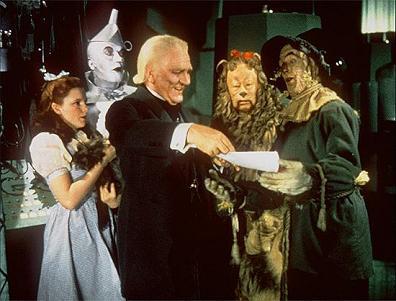
It’s obvious to me, now, that the “controlling elite” that stands “behind the veil” is a capitalist, neo-Nazi, Zionist cabal. And all these years I thought it was only Frank Morgan.


Dorothy (Judy Garland), the Tin Woodman (Jack Haley), the Cowardly Lion (Bert Lahr) and the Scarecrow (Ray Bolger) with the Wizard (Frank Morgan) in “The Wizard of Oz,” distributed by Warner Bros.

How to Deal with Left-Wing Academic Blather

David French, over at FIRE’s The Torch, writes about a speech by Newt Gingrich (my comments bolded in brackets):

Gingrich asks, “What obligation does society have to fund its own sickness?” This is a good question—but it is constitutionally dangerous. One of the most common statements we hear at FIRE (in the context of both public and private schools—since almost every college and university in the United States receives significant government funding) is: “Sure, they have their right to free speech, but why do I have to fund it?” [Good question. It’s your tax dollars at work.]

In essence, what Gingrich (and others) wants is to attach viewpoint-related strings to public funds. We will “fund” speech, but only the speech we like. In the public university context, I can think of few ideas more catastrophic to free speech and open debate than the notion that the funding entity controls the political discourse of a university community. [But the funding entity can and should control a university’s academic emphasis.] Do we really want state legislators injecting themselves into tenure disputes? Deciding which English teachers deserve their salaries? The obligation of the funding entity should be viewpoint neutrality, not ideological conformity. [So, we leave ideological conformity in the hands of the left-wingers who dominate university faculties?]

Within the university setting, think of the state as funding not a point of view but a marketplace of ideas. [Balderdash! See previous comment.] The goal is to advance knowledge and freedom through public institutions that foster and support the free exchange of ideas. [The kind of blather espoused by academic left-wingers isn’t remotely related to knowledge.] The existence of a Ward Churchill is no more evidence that the marketplace is broken than the existence of the Edsel (or, even worse, the AMC Pacer) was evidence of fundamental problems in the American car market. [But the Edsel and Pacer were evidence of fundamental problems in the American car market, which have been cured to some extent by competition from Japanese makes.] Even in a perfectly functioning marketplace, Ward Churchills would exist, teach (sometimes to packed houses), and maybe even get tenure. [In a perfectly functioning academic marketplace there would be conservative and libertarian counterparts to Ward Churchill, who would also be heard.]

The real problem in our public universities is not that “bad ideas” are funded but that the marketplace of ideas itself has broken down. [As I was saying.] Through speech codes, mandatory diversity training, viewpoint discrimination in hiring and other mechanisms that violate basic constitutional protections, universities have closed the free marketplace and are often simply vendors for the prevailing political orthodoxy. If Newt wants to create positive change at our universities, he should be talking about opening them up to more ideas, not adding yet another “forbidden topic” to the long list that currently exists. [Agreed. But how does one open them to more (non-left-wing) ideas?]

How have we improved our universities if we add just one more “ism” to the long list of banned thoughts and words? Campuses have already banned subjectively defined expressions of racism, sexism, homophobia, and so on. Do we solve anything by including “anti-Americanism”? If the state and federal government have any role in this dispute, it is to take steps to restore the free marketplace, not to add further restrictions. [Perhaps restoring the free marketplace at universities requires the application of something like an intellectual anti-trust act, to break up the left’s stranglehold on most universities.]

Actually, although Ward Churchill and his ilk are despicable human beings, I don’t care what they say as much as I care that they represent what seems to pass for “thought” in large segments of the academic community. Clearly, universities are failing in their responsibility to uphold academic standards. Left-wing blather isn’t knowledge, it’s prejudice and hate and adolescent rebellion, all wrapped up in a slimy package of academic pretentiousness.

The larger marketplace of ideas counteracts much of what comes out of universities — in particular the idiocy that emanates from the so-called liberal arts and social sciences. But that’s no reason to continue wasting taxpayers’ money on ethnic studies, gender studies, and other such claptrap. State legislatures can and should tell State-funded universities to spend less on liberal arts and social sciences and spend more on the teaching of real knowledge: math, physics, chemistry, engineering, and the like. That strikes me as a reasonable and defensible stance.

It isn’t necessary for State legislatures to attack particular individuals who profess left-wing blather. All the legislatures have to do is insist that State-funded schools spend taxpayers’ money wisely, by focusing on those disciplines that advance the sum of human knowledge. Isn’t that what universities are supposed to do?

Favorite Posts: Academic Freedom and Freedom of Speech

Unlimited Government?

Well, that’s what J. Peter Byrne seems to advocate in his online debate with Richard Epstein about Kelo v. New London (discussed in an earlier post):

[In the city of New London’s taking,] I see self-government, which while never pure, gives most of us a voice and is capable of innovation….I think that the democratic process provides the best and most legitimate accountability, especially if it is amenable to reform from above, as municipal decision making is by state statutes. The abuses in eminent domain can be addressed through statutes improving procedures and changing the measure of compensation.

Not incidentally, I think New London’s plan here is quite reasonable, so far as I understand it. They are redeveloping some 90 acres, strategically located between a new Pfizer research facility—the largest private investment in New London in many years—and the water; they are constructing a new park and providing substantial infrastructure and environmental remediation in their best shot to encourage private development of offices, hotels, and residences. The plaintiffs’ property lies in the middle of the 90 acres and in a flood plain. The elevation of the land needs to be raised for development and that cannot be done with functioning inholdings. This is not warehousing, but a sensible, long term development plan, which the people of New London have knowingly approved and financed.

In other words, government can do anything it wants to do, as long as it is done in the name of “social progress” or “economic development” — and as long as it pretends to draw its legitimacy from the “people.” By Byrne’s rule, government is entitled to tell us where to work, where to live, how many children to have, and on and on. If government is so “smart,” why don’t we just let it run all of our businesses and lives? We could then stop pretending that we live in something approximating liberty.

It all reminds me very much of Hitler’s abuse of German law to advance his repugnant agenda. Just go through the motions and what do you get? Absolute power of the kind that makes mincemeat of schnooks like Byrne.

Great Minds Agree, More or Less

UPDATED, BELOW:

Randy Barnett, writing at The Volokh Conspiracy, says:

In hindsight, I think that the creation of the Libertarian Party has been very detrimental to the political influence of libertarians. Some voters (not many lately) and, more importantly, those libertarians who are interested in engaging in political activism (which does not include me) have been drained from both political parties, rendering both parties less libertarian at the margin….

While some libertarian political activists are certainly Republicans and Democrats, the existence of the Libertarian Party ensures that there are fewer activists and fewer voters in each major party coalition than would otherwise exist. Therefore, each party’s coalition becomes less libertarian. I do not mean to exaggerate the extent of this effect. But even a handful of political activists in local and state party organizations can make a big difference. Whatever one thinks of the initial creation of the Libertarian Party, its continued existence seems to be a mistake for libertarians.

Here’s my take (from October 26, 2004):

Max Borders, writing at Jujitsui Generis, says:

A viable Libertarian Party is going to have to change its ways: 1) its platform, i.e. to moderate its views; 2) it’s [sic] image, i.e. of geeks and pot-smokers; and 3) maybe even its name and brand, i.e. a name and brand sullied by 1 and 2.

Here’s a better plan. Don’t run LP candidates for office — especially not for the presidency. Throw the LP’s support to candidates who — on balance — come closest to espousing libertarian positions. Third parties — no matter how they’re packaged — just don’t have staying power, given the American electoral system. The LP’s only hope of making progress toward libertarian ideals is to “sell” its influence to the highest bidder.

My approach would keep the LP intact, as an ideological center of gravity for politically active libertarians, who would determine which major-party candidates and causes are worthy of endorsement and active support. It seems to me that such a scheme would give libertarian ideas greater visibility and leverage than the alternative posed by Barnett.

Given a say in the matter, I would argue that the LP ought to lean toward Republican candidates and causes, for reasons I have discussed in earlier posts (here, here, and here):

[L]ibertarians and conservatives generally see eye-to-eye on so-called social programs, affirmative action, Social Security reform, school vouchers, campaign-finance laws, political correctness, and regulation. Libertarians will never see eye-to-eye with conservatives on all issues, but it seems to me that they see eye to eye on enough issues to make a political alliance worthwhile.

If libertarians were pragmatic they would adopt this view: An alliance with conservatives is, on balance, more congenial than an alliance with liberals because conservatives are closer to being “right” on more issues, and their theocratic leanings are unlikely to prevail (the social norms of the 1940s and 1950s are gone forever). If libertarians were to approach conservatives en bloc, libertarians might be able to help conservatives advance the causes on which there is agreement. If libertarians were to approach conservatives en bloc, libertarians might be able to trade their support (and the threat of withdrawing it) for influence in the councils of government. Libertarians could use that influence to push conservatives in the right direction on issues where they now differ with conservatives.

Many libertarians will reject such a strategy, but they would be wrong to do so. We will never attain a libertarian nirvana — whatever that is — but we can advance some libertarian causes. We shouldn’t let the “best” be the enemy of the “good.”

* * *

Getting the left (i.e., Democrats) to buy into economic liberty may prove to be just as hard as getting Republicans to buy into gay marriage, abortion, and decriminalization of drugs. Bill Clinton alienated much of his party by supporting welfare reform and NAFTA. He also raised taxes (against Republican opposition), tried to nationalize medicine by the back door after his 1993 plan failed (thanks to Republicans), and seldom saw a regulation he didn’t like (whereas the Bush administration has slowed the pace of regulation considerably).

Are Democrats likely to offer us another “Clinton” (but not Hillary) anytime soon? Perhaps the results of the 2004 election will cause them to do so. But that prospect doesn’t do much to brighten my day. Social freedom has advanced markedly in my lifetime, in spite of rearguard efforts by government to legislate “morality.” Government control of economic affairs through taxation and regulation has advanced just as markedly, especially under Democrats.

In sum, libertarians may be repulsed by the moralists who have taken over the Republican Party, but that moralizing, I think, is a lesser threat to liberty than regulation and taxation. For that reason — and because Republicans are more likely than Democrats to defend my life — I’m not ready to give up on the GOP.

* * *

I view a stable society as a necessary condition of liberation. Stability helps to ensure that we keep the liberation we’ve gained as individuals, without sacrificing other values, such as the prosperity we enjoy because of somewhat free markets and the security we enjoy because we remain resolute about fighting criminals and terrorists.

Of course, there is such a thing as too much stability. For example, a society that frowns on actions that do no harm to others (e.g., a white person’s trading with or marrying a black person) and then uses the government to bar and penalize such actions is not conducive to liberty.

But efforts to secure personal liberation can be destabilizing, and even damaging to “liberated” groups, when “liberation” proceeds too swiftly or seems to come at the expense of other groups (e.g., the use of affirmative action to discriminate in favor of blacks, the insistence that marriage between man and woman is “nothing special” compared with homosexual marriage). For, as I said here, “[t]he instincts ingrained in a long-ago state of nature may be far more powerful than libertarian rationality.”

Where does that leave libertarians? Well, it leaves this libertarian rather more sympathetic to conservatives, who are more reliable than leftists about defending life and economic liberty….

When I say “defend my life,” I mean on city streets as well as overseas.

…I think libertarians have a lot to lose by throwing in with leftists. And they probably have nothing to gain that won’t be gained anyway, as society proceeds — in its glacial way — to liberate individuals from the bonds of repressive laws.

Why should libertarians make a Faustian bargain with the left to achieve personal liberation — which, with persistence, will come in due time — when the price of that bargain is further economic enslavement and greater insecurity?

UPDATE:

For corroboration, I turn to Philip Klein’s “Rifts and the Right” at Tech Central Station:

Whether libertarians like it or not, cultural issues most likely did more to reelect President Bush than enthusiasm for Social Security reform.

This does not mean that libertarians who want to influence conservative thought should throw their hands up in despair. A debate that has echoed in conservative and libertarian enclaves on the Internet over the past few days has focused on the rift between the two groups, but there is a common ground to be had. To achieve this common ground, libertarians must acknowledge that values are important and conservatives must push to remove government from the values debate.


Libertarians should realize that it is not, by definition, a contradiction of limited government principles to suggest that the erosion of traditional values has had adverse effects on American society. In fact, the existence of a culture that fosters shared values is essential to a free society….


The problem with social conservatives lies not in their ultimate goal of strengthening families or in their belief that religion has an important role to play in society, but in their means of getting what they want. If conservatives believe in small government, they can’t make an exception on social issues.


Almost every major “values” issue originates from the government being overly involved in areas it shouldn’t be in. The debate over stem-cell research is spurred by government involvement in medical research. School prayer is controversial because parents are denied control over their education dollars….


Libertarians and conservatives share a common interest in getting the government out of people’s lives while preserving the values on which this country was founded.

As I wrote in Part IV of “Practical Libertarianism for Americans“:

Forbearance from meddling in the socio-economic order implies laissez-faire, except to prevent or remedy an actual harm….As Hayek pointed out, liberty requires a degree of stability in society; otherwise, how can you decide, with any degree of confidence, what sort of life and livelihood to pursue? Of course, there can be such a thing as too much stability (as Hayek also argued), as well as too much instability. Thus it is equally damaging to liberty to use the law to bar interracial marriage, to foster affirmative action as it is practiced in the United States, to prohibit smoking on private property, or to regulate economic activity on the basis of environmental hysteria rather than sound science.

To paraphrase what I wrote here, you may want government to meddle in certain private matters because that meddling seems to advance liberty. But it should bother you that government can just as easily restrict liberty, all in the name of meeting a pressing social or economic need. Government has taken liberty down a slippery slope, and every instance of meddling — always for a “good” cause — creates a precedent for another step down the slope. It all reminds me of this exchange from Act I, Scene 6, of Robert Bolt’s play about Sir Thomas More, A Man for All Seasons:

Roper: So now you’d give the Devil benefit of law.

More: Yes. What would you do? Cut a great road through the law to get after the Devil?

Roper: I’d cut down every law in England to do that.

More: Oh? And when the last law was down–and the Devil turned round on you–where would you hide? Yes, I’d give the Devil benefit of law, for my own safety’s sake.

Feminist Balderdash

Judith Shulevitz, writing in The New York Times, reviews Judith Warner’s Perfect Madness: Motherhood in the Age of Anxiety:

Warner has two points to make. The first is that, in affluent America, mothering has gone from an art to a cult, with devotees driving themselves to ever more baroque extremes to appease the goddess of perfect motherhood. Warner, who has two children, made this discovery upon her return from a stay in Paris, where, she says, mothers who benefit from state-subsidized support systems — child care, preschools, medical services — never dream of surrendering jobs or social lives to stay home 24/7 with their kids. In the absence of such calming assistance, however, American moms are turning themselves into physically and financially depleted drones.

Did I miss the part about where someone has held a gun to the collective head of those “drones” and forced them have children and work outside the home? And what kind of model is France, for goodness sake?

Later, Shulevitz notes that

Warner tends toward hyperbole, but she strikes me as right about the basic phenomenon. In a society that measures status in consumer goods and hard-to-come-by symbols of achievement — grades, awards, brand-name colleges — the scramble for advantage is bound to propel American upper-middle-class parents into exponentially goofier displays of one-upsmanship. Try giving your 3-year-old an old-fashioned cake-and-balloon birthday party at home, with neither facilitator nor gift bags, and you’ll see that Warner’s onto something, and that it’s harder to opt out than you’d think.

It’s not hard at all, if you have a sense of values. For instance, you might save the money for your children’s education. But catered birthday parties and other status symbols are more important that bringing up baby:

Take the woman who decides to scale back when her baby is born. Her smaller paycheck makes her husband feel that he must bring in a bigger one, or at least make sure not to slip into a lower income bracket. That means longer hours and less time at home. Before long, the wife cuts back her hours even more to cope with the increased housework, shopping and cooking she has to do, and to care for the baby, who, as he gets older, needs more love and educational enrichment, not less. Soon she is wondering whether to keep her expensive part-time baby sitter (who is probably looking around for a full-time position) and whether her career, now barely recognizable as such, is worth what it costs to maintain it. ”Was I really a good enough writer to justify the sacrifice?” Warner wondered when she found herself in that situation. ”Or should I, at long last, just hang it up?”

Why doesn’t she write at home or tell hubby that he’s in charge of the kids?

It gets worse:

Warner’s second point, which is more openly political than her first. Our neurotic quest to perfect the mechanics of mothering, she says, can be interpreted as an effort to do on an individual level what we’ve stopped trying to do on a society-wide one. In her view, it is the lack of family-friendly policies common in Europe that backs American mothers into the corner described above — policies that would promote ”flexible, affordable, locally available, high-quality” day care; mandate quality controls for that day care; require or enable businesses to give paid parental leave; make health insurance available for part-time workers; and so on.

Since when is mothering a society-wide function? It’s a responsibility that flows directly from the decision to become a parent. The so-called family-friendly policies common in Europe discourage mothering by encouraging women to work outside the home, and they foster unemployment (the rate of which is much higher in Europe than in the U.S.) by raising labor costs. There’s no free lunch, even for the sake of motherhood.

After dispensing with Warner’s book, Shulevitz slogs on:

[A] Families and Work Institute study…found that, compared with members of the baby boom generation, younger college-educated workers seem markedly less willing to sacrifice everything to advance in their careers. Many of the younger workers yearn to work fewer hours, and say they would turn down promotions if the new jobs required longer days and more work brought home — claims that may well prove untrue in practice, but nonetheless say a lot about the people making them. More young professionals rank their families as equal in importance to their jobs, or even greater….

Which brings us back to overparenting. Warner deplores its dangers both to us and to our children, who, she says, are likely to wind up as spoiled, callow, allergy-prone, risk-averse success machines with no inner lives. I rather doubt it….For all its excesses, overparenting is still preferable to its alternative, which was depicted with quiet sadness by the sociologist Arlie Russell Hochschild in her 1997 book, ”The Time Bind.” Hochschild studied a Fortune 500 company with exemplary work-life balance policies for both men and women and discovered that few mothers and almost no fathers took advantage of them. Some were afraid of losing their jobs; some couldn’t cope with the fear that they’d be diminished in their bosses’ eyes; some wanted overtime pay; but a majority eventually admitted that they liked life in the office and even on the plant floor better than life at home. Work was orderly and companionable. Home crackled with the anger and acting-out of children cycled through jury-rigged baby-sitting arrangements and yanked through their lives like tiny factory workers keeping pace with a speedup….

What Hochschild forces us to consider is that we’re losing the ability to imagine a world in which we work less and at more reasonable hours, and therefore that we no longer bother to fight to bring that world into being. It is our own internalized workaholism that threatens to devour us and our children — that, and the increasingly untenable absence of a public infrastructure of care.

Shulevitz almost gets it right, then she blows it by throwing the problems of parenthood — which is a choice made by individuals — back into the lap of “society.” Yes, working outside the home can be more immediately gratifying (both intellectually and financially) than facing up to the responsibilities of parenthood. But that’s an irresponsible and short-sighted attitude.

It’s irresponsible because there is no substitute for parenting (especially mothering). If you truly want and love your children, you don’t abandon them to others to raise.

It’s short-sighted because the often painful task of parenting — when done right — is rewarded, in the end, by the knowledge that you are responsible for those upstanding, hard-working adults who finally emerge from infancy, childhood, adolescence, and post-adolescence.

Related posts:

A Century of Progress?

The Marriage Contract

A Different Perspective on the Ward Churchill Affair

The Chronicle of Higher Education has a nice summary of l’affaire Churchill, which prompts me to break my silence about the whole business.

Churchill’s right to speak has its defenders among conservatives and libertarians (e.g., Stephen Bainbridge, Eugene Volokh, and FIRE). I agree fully that Churchill’s right to speak shouldn’t be abridged, though he must be prepared to pay the consequences of outrage, ostracism, and unbridled criticism for his assertion that those killed in the World Trade Center were not innocent civilians but “little Eichmanns.”

But the cancellation of a speaking engagement at a university isn’t an abridgment of speech. Neither Churchill nor anyone else has a right to speak on private property unless he is invited to do so. A university, after all, has the right to decide whom to invite and whom not to invite as a speaker. Suppose that instead of inviting Churchill to speak at Hamilton College, the Kirkland Project had invited a speaker who might actually have enlightened the student body with some facts instead of hateful opinion.* The world would be no wiser — and the students of Hamilton would be better off in the bargain.

The real issue in this whole, overblown affair isn’t Churchill’s freedom of speech, which hasn’t been abridged in the least. (He can stand in the middle of downtown Clinton, New York (the home of Hamilton College), and exercise his freedom of speech — with police protection — if feels compelled to do so.) The real issue is the university’s right to decide how best to educate its students. Hamilton College was about to execute a bad decision and expose its students to a “professor” who has seems to have nothing to offer but vile opinions. Fortunately for the students, Hamilton’s administration came to its senses. As William Klinkner, an associate professor of government at Hamilton, puts it:

“Colleges, if they choose to be a marketplace of ideas, have to be willing to bring in people who say pretty repugnant things.” Nevertheless, he adds, “If I want to have someone come to class to talk about problems with the Treaty of Versailles, I don’t have to bring in a Nazi.”

Precisely. Educators are paid not only to educate but also to educate well. Perhaps the Churchill affair will serve as a reminder that gratuitous titillation isn’t education.
__________
* An unlikely event, given the Kirkland Project’s agenda:

THE KIRKLAND PROJECT for the Study of Gender, Society and Culture is an on-campus organization committed to social justice, focusing on issues of race, class, gender, sexuality, disability, as well as other facets of human diversity.

Favorite Posts: Academic Freedom and Freedom of Speech

Lincoln, the Poet President

Abraham Lincoln ended his First Inaugural Address (March 4, 1861) with these words:

We are not enemies, but friends. We must not be enemies. Though passion may have strained it must not break our bonds of affection. The mystic chords of memory, stretching from every battlefield and patriot grave to every living heart and hearthstone all over this broad land, will yet swell the chorus of the Union, when again touched, as surely they will be, by the better angels of our nature.

Lincoln’s Gettysburg Address (November 19, 1863) is no less majestic:

…we can not dedicate—we can not consecrate—we can not hallow—this ground. The brave men, living and dead, who struggled here, have consecrated it, far above our poor power to add or detract. The world will little note, nor long remember what we say here, but it can never forget what they did here. It is for us the living, rather, to be dedicated here to the unfinished work which they who fought here have thus far so nobly advanced. It is rather for us to be here dedicated to the great task remaining before us—that from these honored dead we take increased devotion to that cause for which they gave the last full measure of devotion—that we here highly resolve that these dead shall not have died in vain—that this nation, under God, shall have a new birth of freedom—and that government of the people, by the people, for the people, shall not perish from the earth.

Lincoln’s poetry soared again in his Second Inaugural Address (March 4, 1865), weeks before Lee surrendered to Grant (April 9, 1865):

Fondly do we hope, fervently do we pray, that this mighty scourge of war may speedily pass away. Yet, if God wills that it continue until all the wealth piled by the bondsman’s two hundred and fifty years of unrequited toil shall be sunk, and until every drop of blood drawn with the lash shall be paid by another drawn with the sword, as was said three thousand years ago, so still it must be said “the judgments of the Lord are true and righteous altogether.”

With malice toward none, with charity for all, with firmness in the right as God gives us to see the right, let us strive on to finish the work we are in, to bind up the nation’s wounds, to care for him who shall have borne the battle and for his widow and his orphan, to do all which may achieve and cherish a just and lasting peace among ourselves and with all nations.

Philosophical Obtuseness

Paul McLeary reviews Benjamin Barber’s Fear’s Empire: War, Terrorism, and Democracy for the San Francisco Chronicle. According to McLeary, Barber

is a political philosopher of the highest order, he is also an astute student of practical politics, having advised a host of governments and politicians over his career and acted as an unofficial adviser and part-time speech doctor to Bill Clinton.

Now that we know where Barber is coming from, let’s examine the quality of his philosophy:

One possibly unintended consequence of the “preventative war” doctrine advocated by the Bush administration, Barber points out, is the potential for the erosion of long-held international norms. If we claim the right to attack a nation that at some point may be a threat to us, what will stop India from invading Pakistan using the same logic, or any other nation using the same rationale to launch a strike against a rival state?

Barber must have flunked or forgotten elementary logic. The idea that one nation (India in Barber’s example) might preemptively invade another nation because the U.S. invaded Iraq is a glowing example of the post hoc ergo propter hoc fallacy, that is, “the logical fallacy of believing that temporal succession implies a causal relation.” Many nations have — and will yet — invade other nations preemptively. The example of the United States and Iraq is neither here nor there.

In fact, there is no other way for a war to begin than through preemption. One side starts the shooting either because it wants something the other side has (e.g., territory or valuable resources), because it fears that the other side will shoot first, because the other side has done something provocative or heinous, or because it wants to keep the other side from becoming a formidable foe. Barber is simply trying to draw a line where no line can be drawn.

The relevant criterion — which Barber and others on the left don’t want to acknowledge — is whether the invasion of Iraq serves the interests of U.S. citizens in the long run. Leftists just don’t seem to care about that. Instead, Barber emits the usual leftist drivel about the outmoded use of brute force, the roots of terrorism in economic and political alienation, and worse:

More often than not, Barber says, the United States is more interested in setting up free markets than it is in promoting democracy, worsening social inequality and disenfranchising the local population.

Right. We invaded Iraq so that Iraqis could have McJobs, not to free Iraq from the grip of Saddam’s notably anti-Shiite regime in which wealth and power flowed to a small fraction of the populace. Does Saddam’s demise make the Middle East and the world safer for Americans and American interests? You bet, but that’s a win-win situation. And there’s nothing wrong with that — unless you’re a hair-shirt leftist philosopher who doesn’t understand economics, much less logic.

Does the example of Saddam’s demise strike fear in the hearts of other despots, whose nuclear saber-rattling is on a par with whistling in a graveyard? You bet. Their only hope for survival is that leftist logic will somehow prevail. Not for four more years, fellows, if then.

The Politician: The Pathological Pursuit of Power

Joel Bakan’s The Corporation: The Pathological Pursuit of Profit and Power is creating a bit of a stir. And no wonder, given its premise (from the jacket):

Bakan contends that the corporation is created by law to function much like a psychopathic personality whose destructive behavior, if left unchecked, leads to scandal and ruin.

In the most revolutionary assessment of the corporation as a legal and economic institution since Peter Drucker’s early works, Bakan backs his premise with the following claims:

The corporation’s legally defined mandate is to pursue relentlessly and without exception its own economic self-interest, regardless of the harmful consequences it might cause to others — a concept endorsed by no less a luminary than the Nobel Prize-winning economist Milton Friedman.

The corporation’s unbridled self-interest victimizes individuals, society, and, when it goes awry, even shareholders and can cause corporations to self-destruct, as recent Wall Street scandals reveal.

While corporate social responsibility in some instances does much good, it is often merely a token gesture, serving to mask the corporation’s true character.

Governments have abdicated much of their control over the corporation, despite its flawed character, by freeing it from legal constraints through deregulation and by granting it ever greater authority over society through privatization.

Despite the structural failings found in the corporation, Bakan believes change is possible and outlines a far-reaching program of concrete, pragmatic, and realistic reforms through legal regulation and democratic control.

Bakan would be on the right track if, instead, he were to make these claims:

The politician’s license — granted by the “living” Constitution — is to pursue relentlessly and without exception his power to control our peaceful pursuit of happiness, regardless of the harmful consequences it might cause — a concept endorsed by no less than three dozen Congresses, a dozen presidents, and dozens of Supreme Court justices.

The politician’s unbridled self-interest victimizes individuals, society, and, when it goes awry, even the purported beneficiaries of his insatiable thirst for control.

While the acts of government in some instances are necessary to the security of life, liberty, and property, most politicians — especially those of the left — do not even pretend that the scope of government power should be restricted to those necessary functions.

Elected officials and judges, sworn to uphold the Constitution, have violated their oaths of office innumerable times, by freeing government from its constitutional constraints and by granting it almost dictatorial authority over society through legislation, regulation, and adjudication.

(Thanks to Verity at Southern Appeal for the tip.)

Beware of Irrational Atheism

Thanks to Chris Lehmann, writing at reasononline in “The tedium of dogmatic atheism,” I learned of Sam Harris’s book, The End of Faith: Religion, Terror, and the Future of Reason. The publisher’s blurb for The End of Faith says this:

This important and timely book delivers a startling analysis of the clash of faith and reason in today’s world. Harris offers a vivid historical tour of mankind’s willingness to suspend reason in favor of religious beliefs, even when those beliefs are used to justify harmful behavior and sometimes heinous crimes. He asserts that in the shadow of weapons of mass destruction, we can no longer tolerate views that pit one true god against another. Most controversially, he argues that we cannot afford moderate lip service to religion—an accommodation that only blinds us to the real perils of fundamentalism. While warning against the encroachment of organized religion into world politics, Harris also draws on new evidence from neuroscience and insights from philosophy to explore spirituality as a biological, brain-based need. He calls on us to invoke that need in taking a secular humanistic approach to solving the problems of this world.

And so, we are to substitute secular humanism for religion. (Or else?) In order to defend liberty we must deprive you of it — if you are religious, that is. A reading of Lehmann’s review reveals the underlying flaw of Harris’s hysterical anti-religionism. It seems that Harris, wittingly or stupidly, has adopted the following syllogism:

1. Heinous acts are committed.

2. Some of those heinous acts are committed in the name of religion.

3. Therefore, all religion is evil.

Why not this, instead?

1. Heinous acts are committed.

2. Some of those heinous acts are committed in the name of irreligious philosophies (e.g., Nazism, fascism, and communism).

3. Therefore, all irreligious philosophies are evil. (That includes secular humanism.)

Harris, on the evidence of Lehmann’s review, strikes me as a knuckle-dragging, atheist ignoramus. And he has plenty of company at sites like The Panda’s Thumb. There’s Matt Young, for instance. Young is an atheist whose revealed attitude of superiority to religionists had already caught my attention. Now he’s back, with more “profound” thoughts about religion (mentioned here and posted here). Young quotes an earlier essay of his, in which he wrote this:

The philosopher Antony Flew, now an emeritus professor at Reading University, recounts a parable about two people who chance upon a clearing in the forest. Both flowers and weeds grow in the clearing. One of the people, the Believer, says that some gardener must be tending the plot, whereas the Skeptic disagrees. They set up camp and watch, but no gardener appears. The Believer suggests that the gardener is invisible, so they patrol with bloodhounds, then set up an electric fence, but there is still no evidence of a gardener.

The Believer insists, however, that there must be a gardener, even if that gardener is invisible, silent, odorless, and impervious to electric shocks. The Skeptic asks how that differs from an imaginary gardener or no gardener at all. Flew uses his parable as a jumping-off point to discuss whether religion is falsifiable. Specifically, referring to the problems of evil and suffering, he asks what would have to happen to falsify a belief in God or in God’s love. Flew’s question is rhetorical; he clearly implies that nothing will falsify a firm religious belief. An Oxford philosopher, Basil Mitchell, agrees or, more accurately, admits that nothing can count decisively against the belief of the true believer; by definition, the believer is committed to a belief in God and is not a detached observer. That is, to Mitchell, the concept of falsifiability is not appropriately applied to a religious belief, whereas, to Flew, religion’s lack of falsifiability evidently counts against it.

Mitchell is right, because Flew’s parable is incomplete. Flew fails to suggest the possibility that the instruments being used to detect the invisible gardener are inadequate (or irrelevant) to the task.

Young continues:

Another Oxford philosopher, R. M. Hare, responded to Flew with a parable of his own: A lunatic (Hare’s word) believes that the dons want to kill him. A friend believes otherwise and tries to convince the lunatic by introducing him to the dons and showing him that they are friendly, gentle people and mean him no harm. The lunatic responds that the dons are duplicitous and are really plotting against him, all the while pretending to be friendly.

Hare calls the lunatic’s belief a blik. This is a term that Hare has coined to describe a belief that is neither verifiable nor falsifiable. Hare notes that the friend also has a blik: The friend’s blik is that the dons are not planning to kill the lunatic. Hare considers this belief a blik just as much as the lunatic’s belief is a blik. That is, the friend does not have no blik at all, but rather has the blik that the dons are harmless. Precisely like the lunatic, the friend cannot prove his blik, because the lunatic can always find an ad hoc hypothesis to refute the friend’s arguments.

Hare’s article was influential, but it seems to me that it contains within it the seeds of its own destruction. First, the issue is not whether a sane person can convince a lunatic that the lunatic’s blik is wrong; he cannot. The issue is, rather, what arguments could both the friend and the lunatic use to convince a detached observer which one is right. In this case, it is clear that the detached observer would rule in favor of the friend, not the lunatic, because the friend would present more-convincing evidence.

And just what is that more-convincing evidence? Is it that the “are friendly, gentle people and mean…no harm”? How is that any more convincing than the lunatic’s assertion that “the dons are duplicitous and are really plotting against him, all the while pretending to be friendly.” A truly detached observer, given no more information, would necessarily adopt the agnostic position that the lunatic’s blik is indeed a blik: a belief that is neither verifiable nor falsifiable. Young seems incapable of logic when he discusses religion, even by inference.

But Young plunges on:

Later in the debate, Hare notes his own blik that the steering column of his car will not fail when he goes for a drive. This blik gives him confidence, without which he might be paralyzed into inaction. Hare’s confidence might be based on a blik, but I have no such blik. Whenever I drive my car, I am perfectly aware that the steering column might fail. I am equally aware, however, that the vast majority of steering columns do not fail during normal use, so I drive my car in the uncertain knowledge that the steering column will probably not fail. This belief is not a blik; it is a statistical statement based on evidence, which I see all around me, that other cars have sound steering columns. Not all firmly held beliefs are bliks.

Hare’s position is that a religious belief need not be defended because it is a blik and can neither be proved nor disproved. Hare himself, however, distinguishes between bliks that are right and bliks that are wrong. Indeed, he seems to intend his lunatic to be analogous to the religious believer who supports his belief with ad hoc hypotheses. The issue, then, is not whether people have bliks but rather whether their bliks are right or wrong. How do we decide whether bliks are right or wrong? We look for evidence. Far from refuting Flew’s argument, Hare has strengthened it.

Young is right to criticize Hare for giving a bad example of a blik, in the case of the steering column. But Young then resorts to a false syllogism, which goes like this:

1. Humans have many firmly held beliefs.

2. Some firmly held beliefs are not bliks.

3. Therefore, there are no bliks; every assertion can be verified or falsified.

Here’s the correct syllogism:

1. Humans have many firmly held beliefs.

2. Some firmly held beliefs are not bliks.

3. Therefore, some firmly held beliefs may be bliks; not every assertion can be verified or falsified.

In sum, Young persists in his (unreasonable) belief that religious belief* is falsifiable. He fails to see the incompleteness of Flew’s parable about the gardener; he posits a (falsely) detached observer in the case of the lunatic; and he adopts a false syllogism about unfalsifiable beliefs.

Atheism is, at bottom, simply a dogmatic position. It is a form of religion, in which the believer hews to the unfalsifiable belief that there is no God.

In case you’re wondering, I take the only scientifically valid position on the question whether there is a God: agnosticism. See here and here.

__________

* Oddly, Young seems to be a practicing Jew who is also an atheist.

Going Too Far with the First Amendment

Michael C. Dorf writes at FindLaw.com about “Why It’s Unconstitutional to Teach ‘Intelligent Design’ in the Public Schools, as an Alternative to Evolution.” Dorf — siding with the ACLU — argues that the Dover, Pennsylvania, School Board has violated the First Amendment’s Establishment Clause “by mandating that students in public school biology classes be taught the theory of ‘intelligent design’ as an alternative to evolution.”

The Establishment Clause says that “Congress shall make no law respecting an establishment of religion….” That provision, with many other parts of the Bill of Rights, became binding on the States by “incorporation” under this provision of the Fourteenth Amendment:

…No State shall make or enforce any law which shall abridge the privileges or immunities of citizens of the United States; nor shall any State deprive any person of life, liberty, or property, without due process of law; nor deny to any person within its jurisdiction the equal protection of the laws.

So far, so good. But Dorf then goes on to argue the the courts should test the School Board’s mandate by asking

whether intelligent design is, in fact, a scientific theory at all. It should do so, not because of any general obligation on the part of schools to teach science correctly, but simply because if intelligent design is not science, then the inference is almost inescapable that the state is impermissibly acting for the purpose of fostering a religious viewpoint.

Think of the fine mess we’d be in if the courts were to rule against the teaching of intelligent design not because it amounts to an establishment of religion but because it’s unscientific. That would open the door to all sorts of judicial mischief. The precedent could — and would — be pulled out of context and used in limitless ways to justify government interference in matters where government has no right to interfere.

It’s bad enough that government is in the business of funding science — though I can accept such funding where it actually aids our defense effort. But, aside from that, government has no business deciding for the rest of us what’s scientific or unscientific. When it gets into that business, you had better be ready for a rerun of the genetic policies of the Third Reich.

Nonsense and Sense about Social Security

E.J. Dionne Jr., writing in The Washington Post on November 30, opined that

…President Bush carries a heavy burden in trying to sell the country on his plan to carve private accounts out of Social Security. Bush has been pushing privatization since he first ran for the presidency in 2000. But he keeps changing his explanation of how the program will be paid for and what its effect on the deficit will be….

Dionne goes on in that vein throughout his column, using what seems to be a discrepancy between what Bush said four years ago and what he and his aides are saying now to play “gotcha.” Worse than that, however, Dionne — who is a Washington insider of sorts — spends much of his column spreading confusion about Social Security; for example:

The big cost of privatization comes from allowing individuals to keep a share of the Social Security taxes they now pay into the system and use it for private investment accounts. This reduces the amount of money available to pay current beneficiaries. Since Bush has promised the retired and those near retirement that their benefits won’t be cut, he needs to find cash somewhere. The only options are to raid the rest of the budget, to raise taxes or to borrow big time….

[During the 2000 presidential campaign] Gore…challenged Bush on his numbers. “He has promised a trillion dollars out of the Social Security trust fund for young working adults to invest and save on their own, but he’s promised seniors that their Social Security benefits will not be cut and he’s promised the same trillion dollars to them,” Gore said at that third presidential debate. “Which one of those promises will you keep and which will you break, Governor?”

…Bush is about to offer an easy answer to Gore’s challenge: More borrowing….

…Last week The Post’s Jonathan Weisman reported that Republicans were considering moving the costs of social security reform “off-budget” so that, on paper at least, they wouldn’t inflate the deficit. And Joshua B. Bolten, the director of the White House’s Office of Management and Budget, let the cat out of the bag over the weekend in an interview with Richard W. Stevenson of the New York Times. “The president does support personal accounts, which need not add over all to the cost of the program but could in the short run require additional borrowing to finance the transition,” Bolten said. “I believe there’s a strong case that this approach not only makes sense as a matter of savings policy, but is also fiscally prudent.”

A huge new borrowing — “from hundreds of billions to trillions of dollars over a decade,” as Stevenson notes — is suddenly “fiscally prudent” in the administration’s eyes….

Dionne betrays such stupendous misunderstanding of the issue that the only way to deal with his ignorance is to explain the whole megillah, step-by-step:

1. The cost of Social Security is the cost of the benefits paid out, not the payroll taxes or borrowing required to finance those benefits. There are two basic issues: how much to pay in benefits and how to finance those benefits.

2. Assuming, for the moment, that benefits will be paid to future retirees (today’s workers) in accordance with the present formula for computing benefits — which today’s workers believe is a “promise” they have been made — something must “give” when payroll taxes no longer cover benefits, beginning in 2018.*

3. No matter how you slice it, someone will pay for those future benefits. The question is: who and when? There are three conventional ways to do it:

  • Raise future workers’ payroll taxes by enough to cover benefits.
  • Borrow enough to cover benefits, thus shifting the immediate burden from future workers to willing lenders, who are also the “future generations” that “bear the burden” of the debt. The cost of borrowing (i.e., interest) raises the cost of the program a bit, but interest is also income to those who lend money to the government. In other words, borrowing — on balance — doesn’t create a burden, it merely shifts it, voluntarily.**
  • Raise taxes and borrow, in combination.

4. There’s an “unconventional” way to deal with the looming deficit in Social Security: invest payroll taxes in real assets (i.e., stocks, corporate bonds, mortgages). Why? Because money invested in real assets yields a real return that’s far higher than the “return” today’s workers will receive on their payroll taxes. (See, for example, figure 2 in this paper.) There are three ways to “privatize” Social Security by investing in real assets:

  • Abolish Social Security and make individuals responsible for their retirement (perhaps with a minimal “safety net” funded by general taxation).
  • Let the government do it, through a “blind trust” run by an independent agency.
  • Let individuals do it, through mandatory private accounts.

5. I assume that the first option is off the table, for now, even though Social Security (like so many other government programs and activities) is unconstitutional. Given the large sums of money involved, the second and third options would yield about the same result, on average. I’ll continue by outlining the third option, which is the proposal that has drawn the ire of E.J. Dionne and so many other anti-privatization leftists.

6. Workers would invest some (or all) of their payroll taxes in real assets (private accounts). Those same workers would agree to receive lower Social Security benefits when they retire. (The precise tradeoff would depend on the age at which a worker opens a private account and how much the worker has already paid into Social Security. Workers who are over a certain age — say 50 or 55 — when privatization begins wouldn’t be allowed to drop out, but would receive the Social Security benefits they expect to receive.) That leads to a series of questions and answers:

  • Q: What happens when the shift of payroll taxes to private accounts results in a deficit, that is, when payroll tax receipts are less than benefit payments? A: The government borrows to make up the difference. (See the discussion of borrowing in point 3 and the second footnote, below.)
  • Q: What happens to the money invested in private accounts? A: It would belong to the workers who invested it. They’d receive smaller payments from “regular” Social Security, but those smaller payments would be more than made up by the income they’d receive from their private accounts.
  • Q: When does it all end? A: It would depend on how much workers are allowed to invest in private accounts and how much those private accounts earn. If workers were allowed to invest all of their payroll taxes in private accounts, and if all workers elected to do so, Social Security — as we know it — would wither away. Every worker would have his or her own source of retirement income. That income come from earnings on real assets, not from taxes paid by those who are then working. And that income would exceed what the retiree would have received in Social Security benefits — even for private accounts invested “safely” in high-grade corporate bonds or mortgage-backed securities.

In sum, whether or not Bush is telling the same “story” now that he told four years ago, there is no shell game of the kind suggested by Dionne, and Gore before him. Dionne (and Gore) are simply unable to grasp the notion that by diverting payroll taxes to real investments, with real returns, no one would be made worse off, and many would be better off. They’re hung up on the borrowing that must take place in the initial stage of privatization, and they overlook the return on that borrowing, namely, higher income for future retirees and lower payroll taxes on future workers. And the threat of borrowing, as I have explained, is a bogeyman, which the economically illiterate use to scare the economically illiterate.

__________
* As I’ve explained here, here, and here, the so-called Social Security trust fund, which won’t be exhausted (on paper) until 2042, is just a myth.

** If you’re still bothered by the prospect of borrowing, read my post on “Curing Debt Hysteria in One Easy Lesson.”