Anarchistic Balderdash

Writing at Ludwig von Mises Institute, F.A. Harper says:

Liberty is the absence of coercion of a human being by any other human being; it is a condition where the person may do whatever he desires, according to his wisdom and conscience.

This means that to have liberty one must be free without qualification or modification, so far as his social relationships are concerned. Nature will still impose its restrictions on him, of course; but his fellow men shall impose none.

In order to bring this definition more clearly into focus, consider as an alternative a definition which seems to be the only possible one to be selected in its stead:

Liberty is a condition where the person must do whatever another person desires that he shall do, according to the other person’s wisdom and conscience.

This is the sole alternative, because for any one act under consideration there are only two possibilities:

  1. you determine what you shall do, or
  2. you are prohibited from determining what you shall do.

The last of these two possibilities means that some other person or persons will decide what you shall do, and force you to do it. That seems to be a definition of slavery rather than of liberty, and therefore I must reject it. And since there is no other alternative — since a person must act voluntarily by his own wisdom and conscience or involuntarily according to the mandate of another person — the first definition seems to me to be the only tenable one.

Harper’s proposed definition fails a simple test of logic. Imagine a population of three entities: A, B, and C. (Three is a more problematic number than two, as I’ll show.) Suppose that A, B, and C covet each other’s possessions and that each might, as a result, murder the others to gain their possessions. After all, Harper’s definition of liberty would allow them to do just that. Thus the logical fallacy in Harper’s definition:

  • If A kills B, B is no longer able to do as he wishes. Similarly with B and C, C and A, or any combination of two against one or one against two.
  • It follows that neither A, nor B, nor C enjoys liberty. Why? Because, even though each is free to do as he wishes without regard for the others, that very freedom stands to deprive each of his life.
  • Without life, liberty — the freedom to do entirely as one wishes (in Harper’s definition) — is a nullity.

What about Harper’s “sole alternative,” which is “where the person must do whatever another person desires that he shall do”? Harper, in his zeal to propound anarchy, omits the real alternative, the one that flows from my negation of Harper’s definition of liberty:

  • A, B, and C — knowing that it is dangerous to each of them to allow the others to live by Harper’s definition of liberty — agree that (among other things) murder is a forbidden activity, and that one may not murder another except in self-defense. (They further agree as to the ways and means of enforcing their prohibition of murder, of course.)
  • That is liberty, for it enables each of them to live and, therefore, to “pursue happiness” within their respective means.

What if A and B agree, honorably, not to kill each other, whereas C “leaves his options open”? It then behooves A and B to reach a further agreement, which is that they will defend each other against C. (This is analogous to the decision of the original States to adopt the Constitution because it bound each of them to provide men, matériel, and money for the defense of all of them.) A and B therefore agree to live in liberty (the liberty of self-restraint and mutual defense), whereas C stands outside that agreement. He has forfeited the liberty of self-restraint and mutual self-defense. How so? A and B, knowing that C has “left his options open,” might honorably kill or imprison C when they have good reason to believe that C is planning to kill them or acquire the means to kill them.

It boils down to this: Liberty requires mutual restraint, tacitly or explicitly agreed, which is based on self-interest. Liberty is not a condition in which one may “do whatever he desires, according to his wisdom and conscience.” Nor is liberty a condition in which a “person must do whatever another person desires that he shall do, according to the other person’s wisdom and conscience.” It is, rather, a condition in which each person adheres to agreed rules of behavior, rules that serve his interest as well as the interests of others.

Now, Harper might say that the liberty of mutual restraint is consistent with his statement that

[l]iberty as I have defined it does not preclude as guidance for one’s acts any form or degree of advice and influence, if voluntarily accepted, which, originates elsewhere than within himself. This guidance might be religious influences, evidence from historical records, scientific knowledge, the advice of another person, or even processes of mental telepathy or clairvoyance or insight from mystical origins, to whatever extent these may occur. If willingly accepted, the act resulting from such influences is as much an act of liberty as would be any other.

But I am talking about more than “advice and influence…voluntarily accepted” as “guidance for one’s acts.” I am talking about liberty as the result of mutual restraint (tacit or explicit). Such restraint is no more voluntary than, say, eating; it is necessary to the preservation of life and, therefore, of liberty. (You may choose to fast or to kill, but you may do neither with impunity, for very long.) of In a society of liberty, those who do not abide by the edict of mutual restraint stand to forfeit their own liberty.

Related posts:
The Meaning of Liberty
Libertarianism and Preemptive War: Part I
Libertarianism and Preemptive War: Part II

Related reading: Arnold Kling, writing at EconLog about this exchange at Cato Unbound.

And Your Point Is?

Alex Tabarrok of Marginal Revolution approvingly quotes this:

The central fact is that overwhelmingly suicide-terrorist attacks are not driven by religion as much as they are by a clear strategic objective: to compel modern democracies to withdraw military forces from the territory that the terrorists view as their homeland. From Lebanon to Sri Lanka to Chechnya to Kashmir to the West Bank, every major suicide-terrorist campaign—over 95 percent of all the incidents—has had as its central objective to compel a democratic state to withdraw.

And so? Should we withdraw from the Middle East? Does Tabarrok believe that our withdrawal would placate Islamic fundamentalists? If it would placate Osama bin Laden (or his successor), which I very much doubt, would it placate our imported and home-grown terrorists who have found in their religion an excuse to terrorize, just for the sake of doing so?

The counsel of Tabarrok and his ilk is not only to withdraw from Iraq, but also to withdraw from the Middle East. Their counsel is a counsel of appeasement and surrender.

Surrender in Iraq, and withdrawal from the Middle East generally, holds dire consequences for Americans. I have addressed the true nature of the enemy, the idea of withdrawal, the consequences of withdrawal, and the consequences of appeasement in these posts:
9/11 and Pearl Harbor
What Anonymous Really Meant to Say
Getting It All Wrong about the Risk of Terrorism
September 11: A Postscript for Peace Lovers
Riots, Culture, and the Final Showdown
What If We Lose?
Moussaoui and “White Guilt”
Parsing Peace
I Have an Idea
The Best Defense…
A Skewed Perspective on Terrorism

A Critique of Extreme Libertarianism

EXTREME LIBERTARIANISM: MARXISM OF THE RIGHT?

A few years ago I would have joined Daniel McCarthy’s defense of libertarianism (“In Defense of Freedom“) against Robert Locke’s attack on it (“Marxism of the Right“). Upon mature reflection, I find some of Locke’s arguments persuasive; for example:

If Marxism is the delusion that one can run society purely on altruism and collectivism, then libertarianism is the mirror-image delusion that one can run it purely on selfishness and individualism. . . .

The most fundamental problem with libertarianism is very simple: freedom, though a good thing, is simply not the only good thing in life. Simple physical security, which even a prisoner can possess, is not freedom, but one cannot live without it….

Libertarians try to get around this fact that freedom is not the only good thing by trying to reduce all other goods to it through the concept of choice, claiming that everything that is good is so because we choose to partake of it. Therefore freedom, by giving us choice, supposedly embraces all other goods. But this violates common sense by denying that anything is good by nature, independently of whether we choose it. Nourishing foods are good for us by nature, not because we choose to eat them. Taken to its logical conclusion, the reduction of the good to the freely chosen means there are no inherently good or bad choices at all, but that a man who chose to spend his life playing tiddlywinks has lived as worthy a life as a Washington or a Churchill….

Libertarians rightly concede that one’s freedom must end at the point at which it starts to impinge upon another person’s, but they radically underestimate how easily this happens….

[I]f limiting freedom today may prolong it tomorrow, then limiting freedom tomorrow may prolong it the day after and so on, so the right amount of freedom may in fact be limited freedom in perpetuity….If all we want is limited freedom, then mere liberalism will do, or even better, a Burkean conservatism that reveres traditional liberties.

The extreme libertarian, on the other hand, resorts to intellectual sleight-of-hand by asserting that libertarianism has only to do with the conduct of the state. Here is McCarthy:

Libertarianism is a political philosophy, not a complete system of ethics or metaphysics. Political philosophies address specifically the state and, more generally, justice in human society. The distinguishing characteristic of libertarianism is that it applies to the state the same ethical rules that apply to everyone else….

Yes, the state seizes tax money and jails those who do not pay, actions that would be denounced as gangsterism if undertaken by a private organization. But if the only way life can go on is to have the government provide defense and other necessities, such expropriations might have to be called something other than robbery.

Moderate libertarians say just that. They propose that the state should do those necessary things that it alone can do—and only those things. Radical libertarians contend there is nothing good that only the state can provide—even its seemingly essential functions are better served by the market and voluntary institutions. The differences between thoroughgoing libertarians and moderates are profound, but the immediate prescriptions of each are similar enough: cut taxes, slash spending, no more foreign adventurism.

McCarthy reveals that he is a radical, “thoroughgoing” libertarian when he assails “foreign adventurism” — a cheap rhetorical trick aimed at excluding libertarian hawks from the ranks of libertarianism.

THREE ERRORS OF EXTREME LIBERTARIANISM

I take issue with McCarthy and his fellow travelers on the “right wing” of libertarianism. I argue, specifically, that

  • libertarianism is more than a “political philosophy” that addresses the state, it is a prescription for how individuals should live their lives;
  • it is pure sophistry (or naïveté) to assert that “there is nothing good that only the state can provide”; and
  • the state, properly understood, is not a discrete “thing,” it is simply the inevitable means by which a group or society regulates relations among its members when there are too many of them to act by consensus.

LIBERTARIANISM AS A PRESCRIPTION FOR LIVING ONE’S LIFE

A political philosophy — any political philosophy — has implications for how individuals live their lives. Consider national defense, a subject about which McCarthy evidently has strong views. He calls taxation for the purpose of providing defense a form of robbery; he sees preemptive warfare as foreign adventurism. Libertarians of McCarthy’s ilk argue against preemptive war from the non-aggression principle. The problem with the non-aggression principle in the hands of radical libertarians is that it becomes a non-preemption principle. But preemption may in fact be necessary to the defense of liberty, as I have argued here and here.

A political philosophy that would do away with the state most certainly is a prescription for how people will be forced to live their lives — and it is a poisonous prescription: We can rely on “private defense agencies” to keep the peace, at home and abroad, and we would have fewer enemies abroad if we only “minded our own business.”

THE “GOOD” THAT ONLY A STATE CAN PROVIDE

Before addressing private defense agencies, I must say a thing or two about the notion of “minding our own business,” which is a naïvely dangerous view of the world on two counts. First, it assumes that having and defending overseas economic interests is, somehow, not “our own business.” Second, it entrusts the safekeeping of those interests to the beneficence of others. It is as if Hitler, Stalin, bin Laden, and their ilk did not, do not, and could not exist.

Now, to private defense agencies. I once wrote this about extreme libertarianism (known also as anarcho-capitalism):

Among the important particulars not accounted for by anarcho-capitalists is the method of resolving disputes between those who agree to settle their differences without resorting to violence and those persons (foreign as well as domestic) who simply refuse to be bound by such agreements. Anarcho-capitalists, in their blindness to that bit of reality, insist on applying the non-aggression principle to inter-state relations, thus effectively granting immunity to lawless states simply because they have not yet attacked us.

Anarcho-capitalists, in effect, have created a fantasy world in which the American state is unnecessary because anarcho-capitalists do not like what it sometimes does. Anarcho-capitalists believe that, somehow or other, the absence of the state will culminate in the advent of nirvana.

. . . The real question . . . is how to channel the power of the American state toward the defense of liberty. The Constitution of the United States, in its original meaning, offers the best practical answer to that question. Anarcho-capitalists will object that the original Constitution was imperfect (e.g., it condoned slavery) and that its desirable provisions (e.g., the Bill of Rights) have been implemented imperfectly. Such arguments assume that perfection would have overtaken us in a stateless world.

Anarcho-capitalism, in sum, is a belief in the impossible. It is the wrong standard by which to judge the possible. The right standard, simply stated, is this: When faced with politically feasible policy options, support the ones that advance liberty rather than those which detract from it.

Incremental but real steps toward liberty are infinitely superior to the self-indulgent but politically irrelevant fantasies of anarcho-capitalism.

McCarthy doesn’t go so far as to offer the extreme libertarian’s usual alternative to state power, which is the creation of “private defense agencies,” but I can tell that he is itching to do so. I have addressed that pipe-dream in several posts, including this one, in which I commented on an article by one Robert Murphy, who

assumes that if the vast majority of people agree that it’s wrong to use violence to settle disputes, then that won’t happen. Do the vast majority of people believe that it’s wrong to use violence to settle disputes? Perhaps, but it doesn’t take a vast majority to inject violence into a society; it takes only a relatively small number of renegades, who may be then be able to coerce others into condoning or supporting their criminal activities. . . .

What Murphy doesn’t entertain is the possibility that a small but very rich cabal could create a dominant defense agency that simply refuses to recongize other defense agences, except as enemies. In other words, there’s nothing in Murphy’s loose logic to prove that warlords wouldn’t arise. In fact, he soon gives away the game:

Imagine a bustling city, such as New York, that is initially a free market paradise. Is it really plausible that over time rival gangs would constantly grow, and eventually terrorize the general public? Remember, these would be admittedly criminal organizations; unlike the city government of New York, there would be no ideological support for these gangs.

We must consider that in such an environment, the law-abiding majority would have all sorts of mechanisms at their [sic] disposal, beyond physical confrontation. Once private judges had ruled against a particular rogue agency, the private banks could freeze its assets (up to the amount of fines levied by the arbitrators). In addition, the private utility companies could shut down electricity and water to the agency’’s headquarters, in accordance with standard provisions in their contracts.

Pardon me while I laugh at the notion that lack of “ideological support” for the gangs of New York would make it impossible for gangs to grow and terrorize the general public. That’s precisely what has happened at various times during the history of New York, even though the “law-abiding majority [had] all sorts of mechanisms at [its] disposal.” Murphy insists on hewing to the assumption that the existence of a law-abiding majority somehow prevents the rise a powerful, law-breaking minorities, capable of terrorizing the general public. Wait a minute; now he admits the converse:

Of course, it is theoretically possible that a rogue agency could overcome these obstacles, either through intimidation or division of the spoils, and take over enough banks, power companies, grocery stores, etc. that only full-scale military assault would conquer it. But the point is, from an initial position of market anarchy, these would-be rulers would have to start from scratch. In contrast, under even a limited government, the machinery of mass subjugation is ready and waiting to be seized.

Huh? It’s certainly more than theoretically possible for a “rogue agency” to wreak havoc. A “rogue agency” is nothing more than a fancy term for a street gang, the Mafia, or al Qaeda cells operating in the U.S. A “rogue agency” run by and on behalf of rich and powerful criminals — for their own purposes — would somehow be preferable to police forces and courts operated by a limited government that is accountable to the general public, rich and poor alike? I don’t think so. However much the American state engages in “mass subjugation” — and it does, to a degree — it is also held in check by its accountability to the general public under American law and tradition. A “rogue agency,” by definition, would be unbound by law and tradition.

Murphy’s analysis takes place in a land called “Erewhon.” He chooses to ignore the fact that he lives in the United States because he wasn’t a party to the Constitution. Yet that Constitution provides for a limited government, which in more than 200 years has yet to engage in systematic, mass subjugation of the kind practiced in the Third Reich and the Soviet Union, except in the case of slavery. And guess what? The American state ended slavery. How’s that for mass subjugation?

Anyone can conjure a Utopia, as Murphy has. But no one can guarantee that it will work. Murphy certainly hasn’t made the case that his Utopia would work.

In any event, by focusing on intra-societal violence Murphy ignores completely two crucial questions: (1) Can an anarchistic society effectively defend itself against an outside force? (2) Can it do so better than a society in which the state has a monopoly on the use of force with respect to outside entities? Murphy implies that the answer to both questions is “yes,” though he fails to explore those questions. Here is my brief answer: The cost of mounting a credible defense of the United States from foreign enemies probably would support only one supplier; that is, national defense is a natural monopoly. It is better for the American state — given its accountability to the general public — to be that supplier. . . .

A wasteful, accountable, American state is certainly preferable to an efficient, private, defense agency in possession of the same military might. Hitler and Stalin, in effect, ran private defense agencies, and look where that landed the Germans and Russians. Talk about subjugation.

THE STATE: AN INEVITABLE CREATURE OF SOCIETY

Contrary to Murphy and his ilk, there is no such thing as statelessness, at least not for groups larger than, say, hunter-gatherer bands or Hutterite colonies. Why? Because it is impossible for a group of more than a few dozen or a dozen-dozen persons to live together in pure consensus. In the end, a faction will dominate the group (a shifting faction, perhaps). And that faction will define harms that may be punished, punish those harms (i.e., administer justice), and take responsibility for the group’s defense.

The state is not a “thing” to be kept at bay; it is the mechanism by which a people enforces justice and defends itself against outsiders.The questions facing a group always are these: Upon what principles shall we found and guide the state, and to whom shall we entrust the the functions of the state?

Consider this:

A group of persons may be said to live in anarchy only if all of the rules that affect everyone in the group (e.g., where to live, how best to defend the group against predators) are made by unanimous, informed consent, which might be tacit. It follows, then, that a group might — by unanimous, informed consent — give a subset of its members the authority to make such decisions. The group’s members might delegate such authority, willingly and unanimously, because each member believes it to be in his or her best interest to do so. (The reasons for that belief might vary, but they probably would include the notion of comparative advantage; that is, those who are not in the governing subset would have time to pursue those activities at which they are most productive.) With a governing subset — or government — the group would no longer live in anarchy, even if the group remains harmonious and membership in it remains voluntary.

The government becomes illegitimate only when it exceeds its grant of authority and resists efforts to curb those excesses or to redefine the grant of authority. The passage of time, during which there are changes in the group’s membership, does not deligitimate the government as long as the group’s new members voluntarily assent to governance. Voluntary assent, as discussed above, may consist simply in choosing to remain a member of the group.

Now, ask yourself how likely it is that a group larger than, say, a nuclear family or a band of hunter-gatherers might choose to go without a government. Self-interest dictates that even relatively small groups will choose — for reasons of economy, if nothing else — to place certain decisions in the hands of a government.

All talk of anarchy as a viable option to limited government is nothing more than talk. Empy talk, at that.

EXTREME LIBERTARIANISM’S FATAL FLAW: THE “ANNE FRANK SYNDROME”

The political view that there should not be a state, if followed to its logical conclusion, would leave most Americans prey to the very real predators who lurk at home and abroad. Those very real predators care not one whit about non-aggression principles and contractual obligations, contrary to the assertions of Gustave de Molinari, a favorite of anarcho-capitalists, who wrote this:

Under a regime of liberty, the natural organization of the security industry would not be different from that of other industries. In small districts a single entrepreneur could suffice. This entrepreneur might leave his business to his son, or sell it to another entrepreneur. In larger districts, one company by itself would bring together enough resources adequately to carry on this important and difficult business. If it were well managed, this company could easily last, and security would last with it. In the security industry, just as in most of the other branches of production, the latter mode of organization will probably replace the former, in the end.

The “customers would not allow themselves to be conquered”? Tell that to those who pay gangsters for “protection,” and to the residents of gang-ridden areas. Molinari conveniently forgets that the ranks of “competitors” are open to those who, in their viciousness, will and do attack the persons and property of their rivals. If not everyone is honorable, as Molinari admits elsewhere in his essay, why would we expect private providers of security be honorable? Why would they not extort their customers while fighting each other? The result is bound to be something worse than life under an accountable state monopoly (such as we have in the U.S.) — something fraught with violence and fear. Think of The Roaring Twenties without the glossy coat of Hollywood glamour.

Molinari and his anarcho-libertarian descendants exhibit the Anne Frank syndrome. About three weeks before Frank and her family were betrayed and arrested, she wrote:

It’’s a wonder I haven’’t abandoned all my ideals, they seem so absurd and impractical. Yet I cling to them because I still believe, in spite of everything, that people are truly good at heart.

McCarthy, Murphy, Molinari, and their ilk do not proclaim the jejune belief that all “people are truly good at heart,” yet they persist in the belief that the security can be achieved in the absence of an accountable state. That is, like Anne Frank, they assume — contrary to all evidence — that “people are truly good at heart.” But competition, by itself, does not and cannot prevent criminal acts.

Competition, to be beneficial, must be conducted within the framework of a rule of law. That rule of law must be enforced by a state which is accountable to its citizens for the preservation of their liberty. The present rule of law in the United States is far from perfect, but it is far more perfect than the alternative that is dreamt of by extreme libertarians.

THE PROPER LIBERTARIAN AGENDA

As I wrote here, extreme libertarianism

rests on invalid conceptions of human nature and the state. Contrary to the evidence of history, it presumes that no one would or could accrue and exercise enough power to flout the common law and treat other persons coercively. Contrary to the evidence of history — especially American history — it presumes that a properly constituted and governed state cannot increase the quotient of liberty.

There is no choice between anarchy and the state. Anarchy leads inexorably to coercion — except in a dreamworld. The real choice…is between the toughest guy on the block or a state whose actions are capable of redirection through our representative democracy.

The proper task at hand for American libertarians isn’t to do away with the state but to work toward a state that defends free markets, property rights, the common law, and freedom of contract.

Another task for American libertarians is to work toward devolution of power back to the individual States and, within the States, to the lowest possible level. The key to liberty is the ability of the individual to pick and choose among a variety of “experiments” in government. That is true federalism.

Related posts:
Libertarian Nay-Saying on Foreign and Defense Policy (06/29/04)
Libertarianism and Preemptive War: Part I (07/10/04)
Libertarian Nay-Saying on Foreign and Defense Policy, Revisited (07/23/04)
An Aside about Libertarianism and War (08/02/04)
More about Libertarian Hawks and Doves (09/24/04)
Defense, Anarcho-Capitalist Style (09/26/04)
The State of Nature (12/05/04)
Getting Neolibertarianism Wrong (04/19/05)
Fundamentalist Libertarians, Anarcho-Capitalists, and Self-Defense (04/22/05)
The Legitimacy of the Constitution (05/09/05)
Another Thought about Anarchy (05/10/05)
Anarcho-Capitalism vs. the State (05/26/05)
Rights and the State (06/13/05)
The Essential Case for Consequentialist Libertarianism (07/10/05)
But Wouldn’t Warlords Take Over? (07/26/05)
Sorting Out the Libertarian Hawks and Doves (07/27/05)
A Paradox for Libertarians (08/04/05)
A Non-Paradox for Libertarians (08/15/05)
Common Ground for Conservatives and Libertarians? (09/04/05)
Liberty or Self-Indulgence? (10/10/05)
Some Thoughts about Liberty (11/23/05)
Libertarianism and Preemptive War: Part II (11/27/05)
Give Me Liberty or Give Me Non-Aggression? (12/08/05)
My View of Warlordism, Seconded (12/15/05)
Anarchy: An Empty Concept (12/20/05)
The Paradox of Libertarianism (01/05/06)
The Fatal Naïveté of Anarcho-Libertarianism (01/28/06)
Liberty as a Social Compact (02/28/06)
Social Norms and Liberty (03/02/06)
A Footnote about Liberty and the Social Compact (03/06/06)
Liberty and Federalism (03/12/06)
Finding Liberty (03/25/06)

See also (at Favorite Posts):
Libertarianism and Other Political Philosophies
War, Self-Defense, and Civil Liberties


Why Stay the Course?

Victor Davis Hanson gives five excellent reasons.

UPDATE: Thomas Sowell offers some more, plus some thoughts about bringing “democracy” to the Middle East.

The Real Threat to Liberty . . .

. . . is this, not this.

I Told You So

Here.

The Military Commissions Act of 2006

President Bush has signed the act into law. John Yoo has some choice things to say about it:

The new law is, above all, a stinging rebuke to the Supreme Court. It strips the courts of jurisdiction to hear any habeas corpus claim filed by any alien enemy combatant anywhere in the world. It was passed in response to the effort by a five-justice majority in Hamdan v. Rumsfeld to take control over terrorism policy. That majority extended judicial review to Guantanamo Bay, threw the Bush military commissions into doubt, and tried to extend the protections of Common Article 3 of the Geneva Conventions to al Qaeda and Taliban detainees, overturning the traditional understanding that Geneva does not cover terrorists, who are not signatories nor “combatants” in an internal civil war under Article 3.

Hamdan was an unprecedented attempt by the court to rewrite the law of war and intrude into war policy…..

Until the Supreme Court began trying to make war policy, the writ of habeas corpus had never been understood to benefit enemy prisoners in war. The U.S. held millions of POWs during World War II, with none permitted to use our civilian courts (except for a few cases of U.S. citizens captured fighting for the Axis). Even after hostilities ended, the justices turned away lawsuits by enemy prisoners seeking to challenge their detention. In Johnson v. Eisentrager, the court held that it would not hear habeas claims brought by alien enemy prisoners held outside the U.S., and refused to interpret the Geneva Conventions to give new rights in civilian court against the government. In the case of Gen. Tomoyuki Yamashita, the court refrained from reviewing the operations of military commissions.

In Hamdan, the court moved to sweep aside decades of law and practice so as to forge a grand new role for the courts to open their doors to enemy war prisoners. Led by John Paul Stevens and abetted by Anthony Kennedy, the majority ignored or creatively misread the court’s World War II precedents. The approach catered to the legal academy, whose tastes run to swashbuckling assertions of judicial supremacy and radical innovations, rather than hewing to wise but boring precedents….

…[E]nemy combatants who fight out of uniform, such as wartime spies, have always been considered illegals under the law of war, not entitled to the same protections given to soldiers on the battlefield or ordinary POWs. Disguised suicide- bombers in an age of WMD proliferation and virulent America-hatred are more immediately dangerous than the furtive information-carriers of our Cold War past. We now know that more than a dozen detainees released from Guantanamo have rejoined the jihad. The real question is how much time, energy and money should be diverted from winning the fight toward establishing multiple layers of review for terrorists. Until Hamdan, nothing in the law of war ever suggested that enemy status was anything but a military judgment….

This time, Congress and the president did not take the court’s power grab lying down. They told the courts, in effect, to get out of the war on terror, stripped them of habeas jurisdiction over alien enemy combatants, and said there was nothing wrong with the military commissions. It is the first time since the New Deal that Congress had so completely divested the courts of power over a category of cases. It is also the first time since the Civil War that Congress saw fit to narrow the court’s habeas powers in wartime because it disagreed with its decisions.

The law goes farther. It restores to the president command over the management of the war on terror. It directly reverses Hamdan by making clear that the courts cannot take up the Geneva Conventions. Except for some clearly defined war crimes, whose prosecution would also be up to executive discretion, it leaves interpretation and enforcement of the treaties up to the president. It even forbids courts from relying on foreign or international legal decisions in any decisions involving military commissions.

All this went overlooked during the fight over the bill by the media, which focused on Sens. McCain, Graham and Warner’s opposition to the administration’s proposals for the use of classified evidence at terrorist trials and permissible interrogation methods. In its eagerness to magnify an intra-GOP squabble, the media mostly ignored the substance of the bill, which gave current and future administrations, whether Democrat or Republican, the powers needed to win this war.

Imagine that. The commander-in-chief — not a majority of the Supreme Court — will command the armed forces.

Evidence that Congress did the right thing can be found in the insane, Left-wing rhetoric of Keith Olbermann, who last night said this:

For, on this first full day that the Military Commissions Act is in force, we now face what our ancestors faced, at other times of exaggerated crisis and melodramatic fear-mongering: A government more dangerous to our liberty, than is the enemy it claims to protect us from. [Thanks to John McIntyre at RCP Blog for the quotation.]

Olbermann has evolved over the years from witty sportscaster to moon-maddened opponent of anything and everything that would bring our enemies to heel. He cannot see — or chooses not to see — the difference between foreign enemies and criminal suspects. In that respect, he is typical of our domestic enemies in the Democrat Party.

Related posts:
American Royalty
Torture and Morality
A Rant about Torture
Taking on Torture
Losing Sight of the Objective
The Best Defense . . .
Reaching the Limit?
Terrorists’ “Rights” and the Military Commissions Act of 2006

More Quick Takes

World Climate Report reproduces this graphic:

Read the whole post. Then read this, and follow the links. See also this piece by Debra Saunders.

* * *

Donald Boudreaux explains, once again, why making healthcare a “right” will only make it more expensive and harder to come by.

* * *

Selwyn Duke’s “The Fascists among Us,” at The American Thinker, reminds me of my post, “Calling a Nazi a Nazi.” P.S. There’s also Thomas Sowell’s “Can we talk?” at Townhall.com.

* * *

Related to that, there’s wide support among Democrats — those “tolerant” people — for the “outing” of gay Republicans. (See this post at Patterico’s Pontifications.) It’s the old Leftist double standard: The only good gay is a Democrat gay; Bill Clinton couldn’t have been guilty of sexual harrassment because his “heart was in the right place”; the only “stolen” elections are those won by Republicans, even though Democrats are past masters at the art of stealing elections; etc., etc., etc.

* * *

Speaking of Democrats, read this post by Ed Lasky at The American Thinker, which opens thusly: “Jihadists admit they are killing for the the camera and for the Democrats.”

* * *

Tyler Cowen (Marginal Revolution) asks “Why hasn’t Mexico done better?” Perhaps because it’s not populated by immigrants from the British Isles and Northern Europe, and their descendants, whose political and economic leadership brought liberty and prosperity to the United States.

28 Months for Treason?

Captain Ed reports:

A federal judge sentenced [attorny Lynne] Stewart to 28 months in prison for assisting Omar Abdel Rahman in activating his terrorist network while the US held him in custody — and then temporarily released her on her own recognizance:

A firebrand civil rights lawyer who has defended Black Panthers and anti-war radicals was sentenced Monday to nearly 2 1/2 years in prison — far less than the 30 years prosecutors wanted — for helping an imprisoned terrorist sheik communicate with his followers on the outside. …

The judge said Stewart was guilty of smuggling messages between her client and his followers that could have “potentially lethal consequences.” He called the crimes “extraordinarily severe criminal conduct.”

But in departing from federal guidelines that called for 30 years behind bars, he cited Stewart’s more than three decades of dedication to poor, disadvantaged and unpopular clients.

“Ms. Stewart performed a public service, not only to her clients, but to the nation,” Koeltl said.

The judge said Stewart could remain free while she appeals, a process that could take more than a year.

This woman sent messages to Rahman’s followers in Egypt that instructed them to begin terrorist activity. She knew exactly what she did — after all, she had defended Rahman and had seen the evidence against him — and turned her back on her country and her humanity in order to suck up to a man who plotted the murder of tens of thousands of Americans. Stewart’s actions could easily have led to the deaths of many innocent civilians.

Despicable. Both Judge Koetl and Lynne Stewart, that is. There is no excuse for a sentence of less than 30 years, certainly not the excuse given by Judge Koetl. And why is the judge allowing the woman to go free, pending appeal? She will either abscond to Pakistan, to be with Osama, or find new ways to betray her country, right here at home.

It’s telling that Stewart gave “more than three decades of [service] to poor, disadvantaged and unpopular clients.” Lawyers like that aren’t really altruists who are dedicated to their clients. They’re malcontents who are dedicated to the subversion of the rule of law by playing the criminal-as-victim card.

Had I been prosecuting the case I would have gone for a charge of treason and the death penalty. Perhaps Stewart might have “pled out” to a 30-year sentence, to be served with hardened criminals — not at a “country club” for white-collar criminals.

The outcome of Stewart’s case reminds me of the grave mistake made by the U.S. Supreme Court when it emasculated federal sentencing guidelines by making them advisory. For more on that subject, see “More Punishment Means Less Crime,” “More About Crime and Punishment,” and “More Punishment Means Less Crime: A Footnote.”

ADDENDUM: See also Justin Levine’s post, “Attorney Lynne Stewart – Traitorous Scumbag.”

More about Treasonous Speech

Tom W. Bell (Agoraphilia) notes that

[a] grand jury in Orange County filed a charge of treason against Adam Yahiye Gadahn [on October 11]. That marks him as the first person charged with treason against the U.S. since 1952. If captured and found guilty, Gadahn could face the death sentence.

The indictment accuses Gadahn of acting as a propagandist for al-Qaeda in several of that group’s videos. He allegedly announced that he had joined al-Qaeda and claimed, “Fighting and defeating America is our first priority. . . . The streets of America shall run red with blood.” Gadahn also supposedly called on Americans to convert to Islam and urged U.S. soldiers to switch sides in the Iraq and Afghan wars. On the basis of those and other allegations, the indictment concludes that Gadhan “knowingly adhered to an enemy of the United States, namely, al-Qaida, and gave al-Qaida aid and comfort . . . with intent to betray the United States.”

Bell concludes: “If prosecutors can catch Gadahn, they have a fair chance of convicting him of treason.” The main doubt in Bell’s mind is whether or not Gadahn, who left the U.S. in 1998, had previously renounced his citizenship, which — as Bell observes — “it is not quite as easy as, say, simply burning a flag.”

Regarding treason and speech, generally, Bell refers to his article, “Treason, Technology, and Freedom of Expression.” I posted here (March 5, 2005) about an earlier version of the article.

Some months later (August 18, 2005) I had more to say about Bell’s views, as well as those of Eugene Volokh. Volokh yesterday repeated same points upon which I commented on August 18, 2005. Volokh’s option 2 regarding the treatment of speech runs thusly:

Speech is unprotected whenever the speaker has the purpose of aiding the enemy (and perhaps there’s some evidence that the speech is indeed likely to provide some at least modest aid). This exception would justify punishing any speech that falls within the statutory and constitutional definition of “treason.”

I think this too is probably too broad. Perhaps the speaker’s intentions made him morally culpable and thus theoretically deserving of punishment. But prohibiting all speech that intentionally helps the enemy risks punishing or deterring even speakers who intend only to protect American interests, but whose intentions are mistaken by prosecutors and juries — a serious risk, especially in wartime. On the other hand, I suspect that quite a few judges would take the view that treason by speech that is intended to help the enemy should be treated the same as treason by action that is intended to help the enemy.

As I wrote at the time,

I prefer Volokh’s option 2. . . .

[P]resumably an intention to aid the enemy would have to be proven in a court of law. I doubt very much that an unsubstantiated intention would survive an appeal. Why not give it a try and see how the Supreme Court rules on the issue — as surely it would be asked to do.

I must add this: Speech that intentionally aids the enemy cannot also be speech that is intended to protect Americans’ interests. You are either with us or against us.

Quick Takes

Pejman Yousefzadeh, writing at RedState, quotes Bill Clinton on the estate tax:

They [opponents of the tax] may think I should be able to give Chelsea every nickel, but I don’t.

Hey, Willie, no one’s forcing you to give Chelsea every nickel. But why should those who wish to leave every nickel to their children be denied the right to do so, on your say-so? It’s all about you — as usual — isn’t it?

* * *

Tim Lynch, of Cato-at-Liberty, writes about the power of a president to declare a person an “enemy combatant.” He concludes:

Mr. Bush (and his successors) can now bypass the judiciary by simply issuing an “enemy combatant” order. That means the liberty of every American rests upon nothing more than the grace of the White House (actually lower level bureaucrats). Some may shrug and say “This is war. Captured terrorists don’t belong in fancy hotels. Heck, some harmless drug offenders might be raped or stabbed in a U.S. prison.”

True enough, but isn’t that like saying “Yes, the casualties are mounting in Iraq, but so what. Didn’t ya know the U.S. lost 6,821 Marines at Iwo Jima, a single battle?” My point is that we ought to be careful about how we intend to assess the actions of the government. Let’s strive to keep the government limited and to minimize casualties, mistakes, and injustices.

Reasonable enough, as far as it goes. But it doesn’t go far enough. Lynch — as is the wont of anti-war libertarians — omits from his list of criteria perhaps the most important one: the defense of Americans and their interests. Those are the proper objects of war, against which “keep[ing] the government limited and . . . minimiz[ing] casualties, mistakes, and injustices” must be weighed.

Every president has the power (constitutional or not) to do great harm to the people. In the end, the liberty of the people depends very much upon presidential restraint. That President Bush has declared as enemy combatants only a few American citizens — who demonstrably were enemy combatants — should be reassuring, not alarming.

* * *

The attention-grabbing headline from Reuters:

U.K. army chief says troops should leave Iraq

Buried in the story:

Hours after Dannatt’s [the Army chief’s] interview appeared, he made radio and television appearances to calm the political storm. He said his remarks were taken out of context but he did not deny them.

“It was never my intention to have this hoo ha, which people have thoroughly enjoyed overnight, trying to suggest there is a chasm between myself and the prime minister,” he told BBC radio.

British troops were targets in some places, but were beneficial in others, he said and insisted he was not proposing an immediate withdrawal. “I’m a soldier. We don’t do surrender … We’re going to see this through,” he said.

But he added: “I’ve got an army to look after which is going to be successful in current operations. But I want an army in five years time and 10 years time. Don’t let’s break it on this one. Lets keep an eye on time.”

Britain has launched a large new operation in Afghanistan this year, and commanders have acknowledged that they had hoped they could reduce their force in Iraq faster. Generals have said they now hope to cut their force in Iraq in half by the middle of next year. They have turned over control of two of the four provinces they patrol to Iraqis. “We’re going to complete that process and … the number of troops deployed there will reduce,” Dannatt said.

Contrary to the hype of the anti-war-no-matter-what claque, the general is not a cut-and-run type.

More Stupidity from Cato

I read Cato-at-liberty mainly to find good examples of obtuse libertianism. I’m seldom disappointed. Today, for example, I find “The Weakness of Watch-Listing,” by Jim Harper. I won’t take the time to Fisk the post. I’ll just point out two fatal flaws. First, Harper says:

Easy to evade, [watch-listing] provides no protection against people who haven’t yet done anything wrong, who haven’t come to the attention of security officials, or who have adopted an alias.

Harper doesn’t know how easy it is to evade a watch list because he doesn’t know how much information we have about known or suspected terrorists. Neither do the terrorists. A suspected terrorist needn’t have done anything “wrong” to be on a watch list. To evade watch-listing, therefore, terrorists must be extra cautious and forgo some opportunities for terrorism that they would otherwise exploit.

Is watch-listing perfect? Of course not. But it’s part of a defense in depth. No part of a defense in depth is perfect, but all parts — taken together — can prove quite formidable.

Harper goes on to say:

Watch-listing has a deeper flaw, though. It does not fit with our system of law enforcement.

In the U.S., people who have done something wrong are supposed to be arrested, taken to court and charged, then permitted to contest the accusation. If they are found guilty, they pay money or serve time in jail.

Watch-listing follows no similarly familiar pattern. Law enforcement or national security personnel place a person on a list and then, wherever that list is used, treat the person (and other people with the same name) differently, stopping them, interrogating them, searching them, or whatever the case may be. This unilateral process is alien to our legal system.

Rather than watch-listing, people who are genuinely suspected of being criminals or terrorists should be sought, captured, charged, tried, and, if convicted, sentenced.

It’s obvious, again, that the concept of a defense-in-depth eludes Harper, who wants to substitute prosecution for watch-listing, instead of doing both (which involves little or no competition for resources).

The deeper flaw in Harper’s argument, however, is to think of terrorism as crime. It is not crime, it is war. The “unilateral process” of watch-listing is part of a war effort. Success in war demands sacrifices on the part of civilians. Being placed erroneously on a watch list is one of those sacrifices. As an inconvenience it barely registers on the scale of inconveniences suffered by Americans during World War II.

Related posts:
Losing Sight of the Objective
A Skewed Perspective on Terrorism
Terrorists’ “Rights” and the Military Commissions Act of 2006

Terrorists’ "Rights" and the Military Commissions Act of 2006

Cato’s Mark Moller finds that the Military Commissions Act of 2006 “is not patently unconstitutional—but it is hardly on uncontrovertible constitutional footing, either.” That is not a surprising conclusion, coming as it does from a member of the “libertarian” camp that cannot seem to focus on a key purpose of the Constitution: the protection of the liberties of American citizens.

Andrew McCarthy, writing at National Review Online, is well focused — as usual. As McCarthy points out,

Congress has already given al Qaeda detainees the very rights the critics claim have been denied [by the Military Commissions Act of 2006].

Last December, Congress enacted the Detainee Treatment Act (DTA). It requires that the military must grant each detainee a Combatant Status Review Tribunal (CSRT) at which to challenge his detention. Assuming the military’s CSRT process determines he is properly detained, the detainee then has a right to appeal to our civilian-justice system — specifically, to the U.S. Court of Appeals for the D.C. Circuit. And if that appeal is unsuccessful, the terrorist may also seek certiorari review by the Supreme Court.

McCarthy explains that, under the Constitution, terrorists have no habeas corpus rights or treaty rights:

Congress cannot “suspend” habeas corpus by denying it to people who have no right to it in the first place. The right against suspension of habeas corpus is found in the Constitution (art. I, 9). Constitutional rights belong only to Americans — that is, according to the Supreme Court, U.S. citizens and those aliens who, by lawfully weaving themselves into the fabric of our society, have become part of our national community (which is to say, lawful permanent resident aliens). To the contrary, aliens with no immigration status who are captured and held outside the territorial jurisdiction of the United States, and whose only connection to our country is to wage a barbaric war against it, do not have any rights, much less “basic rights,” under our Constitution. . . .

Isn’t habeas corpus necessary so that the terrorists can press the Geneva Convention rights with which the Court most recently vested them in its 2006 Hamdan case? Wrong again.

To begin with, although its reasoning was murky, the Hamdan majority seems technically to have held that Geneva’s Common Article 3 applied to military commissions because of a congressional statute, the Uniform Code of Military Justice. Again, if a right is rooted in a statute, not in the Constitution, Congress is at liberty to withdraw or alter the right simply by enacting a new statute. Such a right is not in any sense “basic.”

If the Supreme Court were to decide that the Military Commissions Act of 2006 is unconstitutional, it would be high time for President Bush to take a Jacksonian stance: “The Supreme Court has made its decision, now let them enforce it.” I would base that stance on an earlier holding by the Court:

The provisions of the Constitution which confer on the Congress and the President powers to enable this country to wage war are as much part of the Constitution as provisions looking to a nation at peace. And we have had recent occasion to quote approvingly the statement of former Chief Justice Hughes that the war power of the Government is “the power to wage war successfully.” . . . Therefore, the validity of action under the war power must be judged wholly in the context of war. That action is not to be stigmatized as lawless because like action in times of peace would be lawless.

— Justice Felix Frankfurter, concurring in Korematsu v. United States (1944)

A Skewed Perspective on Terrorism

When economists think about terrorism their thinking tends to be muddled. Glen Whitman, an associate professor of economics and co-proprietor of Agoraphilia, amply demonstrates muddleheadedness in “Perspective on Terrorism,” where he says this:

At Cato Unbound, in response to a lead essay by John Mueller, Clark Kent Ervin rejects the comparison of the death rate from terrorism to the death rates from bee stings, lightning, drowning, etc. Ervin’s argument is so unpersuasive (to me) that I think it deserves a fisking.

It is undoubtedly true that Americans are far more likely to die from “bee stings, lightning, or accident-causing deer” than terrorism, but so what? … This statistical argument implicitly equates deaths from bee stings, lightning or close encounters with marauding deer with deaths from terrorism.

They should be equated. It doesn’t make sense to spend a billion dollars to prevent one death by terrorism if the same billion dollars could prevent ten or a hundred deaths by other causes. Death is death. It can be sensible to give different treatment to deaths by different causes, but only if there’s some reason to think one cause of death is more easily deterred than another.

Ervin may have made his case badly, but he is right and Whitman is wrong. To see why, let’s go back to Mueller’s statement

Although polls continue to show Americans notably concerned that they or members of their families might die at the hands of terrorists, astronomer Alan Harris has calculated that, at present rates and including the disaster of 9/11 in the consideration, the chances any individual resident of the globe will be killed by an international terrorist over the course of an 80-year lifetime is about 1 in 80,000, about the same likelihood of being killed over the same interval from the impact on the Earth of an especially ill-directed asteroid or comet. At present, Americans are vastly more likely to die from bee stings, lightning, or accident-causing deer than by terrorism within the country. That seems pretty safe.

That seems “pretty safe” only because the United States (and many other countries) have taken affirmative steps to detect and thwart terrorist attacks before they occur. We have seen the enemy’s successes. But we are unaware of many of his failures because it is stupid to give the enemy an inkling of how we have achieved all of our successes.

Comparing the ex post death rate from terrorism with such unpreventable and/or random events as asteroid strikes, bee stings, lightning strikes, or deer-caused accidents is a classic demonstration of academic cluelessness. Those unpreventable and/or random events will occur regardless of terrorism. Terrorism is an additional threat — not an alternative one. The worst mistake we can make is to underestimate that threat.

Now, Whitman would say that we can spend less money on the war on terror and more to prevent asteroid strikes, for example, and that we ought to determine the right balance of spending between the two activities. That’s fine, as far as it goes, but a correct determination of the balance of spending cannot be made by using probabilities of the type cited by Mueller.

Asteroids, bees, lightning, and deer — unlike terrorists — are not sentient enemies. Ignoring those “threats” will not enable them to increase their “attacks” on us; they will do what they will do, according to the “laws of nature.” Ignoring terrorists, on the other hand, certainly would enable them — and encourage them — to increase their attacks on us. The apparently low probability of being killed by a terrorist is low precisely because we have spent a lot of money to make it low.

Moreover, we must continue to spend a lot of money to keep that probability low. If we fail to do so, we will then find out what it is like to be besieged — to live lives that are markedly poorer, filled with anxiety, and isolated from that large part of the world in which Islamism will have triumphed.

Is it possible to eliminate that prospect and avoid a future of perpetual terrorism? I believe that it is, if we put enough money and effort into the war on terror. And if we never relent, even after terrorism is reduced to a “law enforcement” problem. Evil always lurks.

Because civilization depends on continually making the effort, of never giving in. It needs to be cared for by men of goodwill, protected from the dark. These people [the Romans] gave in. They stopped caring. And because they did, this land fell under the darkness of a barbarism which lasted for hundreds of years.

— From Cicero’s “The Dream of Scipio” (Thanks to Verity of Southern Appeal.)

The Best Defense . . .

. . . is a good offense. That’s the lesson of World War I, when the entry of the United States into the war enabled the allies to go on the offensive. That’s the lesson of World War II, when the United States mobilized so massively that

  • we put Japan on the defensive by winning the Battle of Midway in June 1942, only six months after the attack on Pearl Harbor.
  • we sealed Germany’s doom in the spring of 1943 by turning the tide in the Second Battle of the Atlantic, thus ensuring that U.S. forces could mass for an invasion of Europe.

The lesson for World War IV (counting the Cold War as World War III) — which I led up to but did not spell out in “Reaching the Limit?” — is the same: The best defense is a good offense. But we have been mainly on the defensive since 9/11. We need not be on the defensive; we should not be on the defensive. Our ability to prosecute the war on terror should not be judged by what is happening in Afghanistan and Iraq.

Even though there are not enough boots on the ground in those theatres of operation, we nevertheless possess massive amounts of military power — and potential military power — which, if brought into play, would turn the tide of the war abroad and lead to renewed support for it at home and amongst most of our allies.

Yes, there would be vocal opposition to massive, decisive, military action, but the president has the authority for such action in the Authorization for the Use of Military Force of September 18, 2001. And the sooner he exerts that authority, the sooner the silent majority of Americans can rally behind the war effort, the sooner Congress can vote the necessary increases in defense spending, and the sooner the war can be prosecuted as it should be prosecuted.

The war on terror should be guided by three strategic objectives: searching out and destroying or capturing terrorists until they are truly a “law enforcement” problem, neutralizing the state sponsors of terrorism, and securing the oil reserves of the Middle East against terrorism and economic extortion. I believe that those objectives can be met within five to ten years by:

  • mobilizing on a scale at least equal to that of World War II (That level of mobilization would require a doubling of our present level of defense spending, which would consume GDP at a rate only one-sixth that of our defense spending in World War II. See the second figure, here.)
  • vigorous, uninhibited surveillance of electronic communications overseas, between the U.S. and foreign countries, and within the U.S. (Intercepts of the last type of communication should follow guidelines approved by Congress, but those guidelines must not restrict warrantless surveillance to a period following a terrorist attack.)
  • clandestine operations ranging from the infiltration of terrorist cells to close monitoring of financial transactions to small-scale search and destroy (or capture) missions (without geographic limit)
  • military operations against terrorists, their bases, and their sources of supply (Such operations may be encounters of opportunity or sustained campaigns, as circumstances warrant. A corollary is the abandonment of nation-building exercises that tie down significant numbers of military forces.)
  • aggressive interrogation of captured terrorists and enemy combatants, under rules that require approval from higher authority (Approval would be required only to ensure that a particular course of interrogation is commensurate with the information being sought and that the person being interrogated likely has that information.)
  • military retaliation and/or economic sanctions against regimes that overtly or covertly interfere with our surveillance, clandestine operations, and military operations
  • the swift and uncompromising prosecution of persons and organizations that divulge and publish information about war plans and covert programs or operations.

The alternative — if we continue to allow the enemy to take the initiative — is an endless and ultimately futile two-front war. On one front, of course, are terrorists and those who sponsor and support them. On the other front are those of the Left and Right whose counsel, if heeded, would enable terrorists and their state sponsors to slowly grind down our resolve and (even more likely) the resolve of other Western nations. Eventually, we would be held hostage within our own borders — isolated, poorer, and living lives of anxiety.

World opinion might (and probably would) turn strongly against us initially. But as our resolve is met with success, we will capture the hearts and minds of those whose hearts and minds we ought to care about.

We cannot go on as we are. Perhaps the best time of our life as a nation was when we basked in the glow of total victory following World War II. We can bask in that same glow again, if we put our resolve and our resources to it.

Related links:
A Top-Ten List on Jihad That’s Way Too Long and Quite Possibly Too Dour
Who’s Going to Win?
World War IV As Fourth-Generation Warfare
An Antidote to the Western Way of War?
The New Juristocracy
You Have the Right to Remain Silent . . .
Americans Should Not Die for Article 3, Geneva Conventions
The Fallacy of Reciprocity
How the Geneva Convention Protects Western Troops
“For McCain It’s Personal” (in Best of the Web)
Suicidal Hand-Wringing
The Religion of Peace Firebombs & Fatwas
Ahmadinejad’s Apologists
Our Covert Enemies
Know Your Enemy
The Pope and Kissinger Warn the World

Related posts:
9/11 and Pearl Harbor
A Colloquy on War and Terrorism
Vietnam and Iraq as Metaphors
Getting It Wrong: Civil Libertarians and the War on Terror (A Case Study)
Libertarianism and Preemptive War: Part I
Why Sovereignty?
Shall We All Hang Separately?
Foxhole Rats
Treasonous Speech?
Foxhole Rats, Redux
Know Thine Enemy
The Faces of Appeasement
Libertarianism and Preemptive War: Part II
Torture and Morality
Whose Liberties Are We Fighting For?
The Constitution and Warrantless “Eavesdropping”
NSA “Eavesdropping”: The Last Word (from Me)
Privacy, Security, and Electronic Surveillance
Privacy: Variations on the Theme of Liberty
Words for the Unwise
Recommended Reading about NSA’s Surveillance Program
Riots, Culture, and the Final Showdown
A Rant about Torture
More Foxhole Rats
Moussaoui and “White Guilt”
The New York Times: A Hot-Bed of Post-Americanism
Post-Americans and Their Progeny
American Royalty
“Peace for Our Time”
Anti-Bush or Pro-Treason?
Com-Patriotism and Anti-Patriotic Acts
Parsing Peace
The Problem of Good vs. Evil
A Message to Our Domestic Enemies
Taking on Torture
Conspiracy Theorists’ Cousins
Not Enough Boots
Defense as the Ultimate Social Service
I Have an Idea
The Price of Liberty
September 11: Five Years On
How to View Defense Spending
Losing Sight of the Objective
Reaching the Limit?

Reaching the Limit?

Mark Steyn on 9/11:

In the New York Times, Thomas Friedman wrote: “The failure to prevent Sept. 11 was not a failure of intelligence or coordination. It was a failure of imagination.” That’s not really true. Islamist terrorists had indicated their interest in U.S. landmarks, and were known to have plans to hijack planes to fly into them. But men like John O’Neill could never quite get the full attention of a somnolent federal bureaucracy. The terrorists must have banked on that: After all, they took their pilot-training classes in America, apparently confident that, even if anyone noticed the uptick in Arab enrollments at U.S. flight schools, a squeamish culture of political correctness would ensure nothing was done about it.

Five years on, half America has retreated to the laziest old tropes, filtering the new struggle through the most drearily cobwebbed prisms: All dramatic national events are JFK-type conspiracies, all wars are Vietnam quagmires. Meanwhile, Ramzi Yousef’s successors make their ambitions as plain as he did: They want to acquire nuclear technology in order to kill even more of us. And, given that free societies tend naturally toward a Katrina mentality of doing nothing until it happens, one morning we will wake up to another day like the “day that changed everything.” Sept. 11 was less “a failure of imagination” than an ability to see that America’s enemies were hiding in plain sight.

Michael Liccione picks up the theme:

Americans and Westerners generally do not, as a whole, seem yet to understand what all the conflict within and about the Middle East has in common. This is not a war about “terrorism,” which is only the most obvious weapon wielded by our true enemy. Whether one looks at Iraq, Southern Lebanon, Palestine, Afghanistan, or any place where Islamist terrorism has spilled blood, the enemy is the same: radical Islamic jihadism, whether of the Sunni (Wahhabi) or the Shi’ite variety best represented by Hezbollah and sustained by Iran in Iraq too. The aim of all jihadists is the same: the destruction of Israel and ultimately of the West, making way for the worldwide rule of Islam. . . [T]he trends throughout the Middle East and Southern Asia . . . are toward increasing convergence of jihadist groups. Saddam paid off the families of Palestinian suicide bombers of Israelis and tolerated Iraq’s homegrown jihadist group, Ansar al-Sunna. The hydra-headed monster had been, and has since been getting, more cohesive for quite some time. One might argue that the overthrow of Saddam and the subsequent Iraqi insurgency has only accelerated that process; but if it has, that is not such a bad thing. It helps prevent people from sleeping too long.

Wherever there is Islamist terrorism, one finds jihadists from many different countries joining together. We’re seeing only the earliest stages of what will, in due course, evolve into a true “clash of civilizations.”

At some point those Americans who are playing nicey-nicey — when they are not imitating ostriches — will embolden and enable the enemy to do something that not even a Democrat or a Buchananite will tolerate. Fair warning to the enemy. You ain’t seen nothin’ yet.

Related links:
A Top-Ten List on Jihad That’s Way Too Long and Quite Possibly Too Dour
Who’s Going to Win?
World War IV As Fourth-Generation Warfare
The New Juristocracy
Americans Should Not Die for Article 3, Geneva Conventions
The Fallacy of Reciprocity
“For McCain It’s Personal” (in Best of the Web)
The Religion of Peace Firebombs & Fatwas
Ahmadinejad’s Apologists
Our Covert Enemies
Know Your Enemy

Related posts:
Why Sovereignty?
Shall We All Hang Separately?
Foxhole Rats
Treasonous Speech?
Foxhole Rats, Redux
Know Thine Enemy
The Faces of Appeasement
Whose Liberties Are We Fighting For?
Words for the Unwise
Riots, Culture, and the Final Showdown
More Foxhole Rats
Moussaoui and “White Guilt”
The New York Times: A Hot-Bed of Post-Americanism
Post-Americans and Their Progeny
American Royalty
“Peace for Our Time”
Anti-Bush or Pro-Treason?
Com-Patriotism and Anti-Patriotic Acts
Parsing Peace

The Problem of Good vs. Evil
A Message to Our Domestic Enemies
Taking on Torture
Conspiracy Theorists’ Cousins
Not Enough Boots
Defense as the Ultimate Social Service
I Have an Idea
The Price of Liberty
September 11: Five Years On
How to View Defense Spending
Losing Sight of the Objective

Losing Sight of the Objective

Those who are so keen to bestow constitutional rights on terrorists have lost sight of a key purpose — perhaps the key purpose — of the Constitution: to provide for the common defense. Of Americans. Against their enemies: foreign and domestic, overt and covert.

How to View Defense Spending

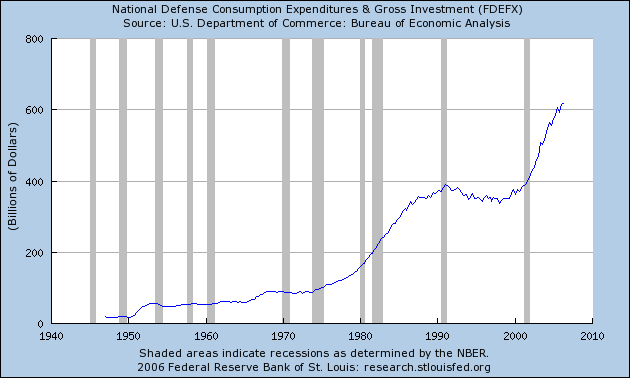
Jeffrey Tucker, one of the inmates of the Mises Economics Blog, posts “Why Libertarians Should Care about Defense.” The entire post consists of this chart:


Because Tucker doesn’t state the point of the chart, I’ll have to read his mind. He’s probably trying to convey a message like this:

  • Defense spending was just “right” (i.e., close to zero) in the years immediately after World War II, which might or might not have been a justifiable war for the United States.
  • Look at what has happened since then: Defense spending (in inflated dollars) has risen to a very large number.
  • Inasmuch as the United States really needs little defense, we’re obviously spending way too much on it.

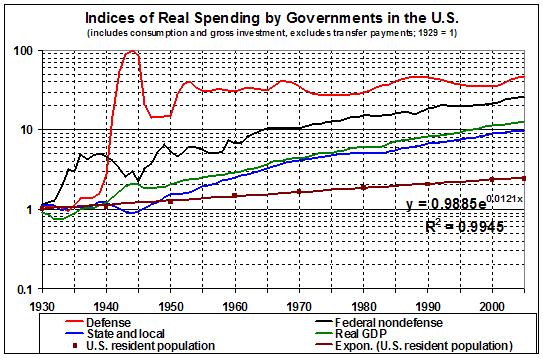
Defense spending, unlike domestic spending is driven by the outside world, by what others could or would do to us, regardless of our delusions about their benignity. It is necessary to spend a lot on defense even when we are not at war, for two reasons: deterrence and preparedness. With that thought in mind, let’s look at three indices of real (inflation-adjusted) government spending: defense, federal nondefense, and state and local — the red, black, and blue lines, respectively:

Sources: Indices of government spending derived from Bureau of Economic Analysis, National Income and Product Accounts, Table 3.9.1: Percent Change From Preceding Period in Real Government Consumption Expenditures and Gross Investment. Real GDP from What Was GDP Then? (Louis D. Johnston and Samuel H. Williamson, “The Annual Real and Nominal GDP for the United States, 1790 – Present.” Economic History Services, April 1, 2006, URL : http://eh.net/hmit/gdp/). Population statistics from U.S. Census Bureau, 2006 Statistical Abstract, Population: National Estimates and Projections, Population and Area: 1790 to 2000 and Resident Population Projections 2005 to 2050.

What does the chart suggest? Several things:

  • The benchmark for “necessary” defense spending is World War II. Real defense spending has yet to return to that level.
  • But, as a result of our foolish rush to demobilize after World War II, defense spending had to rise in response to Soviet- and Communist Chinese-backed aggression in Korea and the growing military power and aggressiveness of the Soviet Union.
  • The partial demobilizations following the Vietnam and Cold Wars necessitated remobilizations to deal with the continuing Soviet miltary buildup and the USSR’s adoption of a forward naval strategy; the likelihood that second-rate powers (e.g., Russia) would strive to counterbalance U.S. power; and our belated understanding of the threat posed by terrorist organizations and their state sponsors.
  • Federal nondefense spending and state and local spending have risen generally in step with GDP (green line), and faster than population (purple points and purple regression line). (Note that the chart does not reflect the massively disproportionate growth in spending on transfer-payment programs: Social Security, Medicare, and Medicaid.)

In sum, having becoming locked into the regulatory-welfare state via the New Deal and Great Society, nondefense spending at the federal, state, and local levels has kept pace with what we can “afford” to spend on programs that actually destroy income and wealth. By contrast, defense spending has fluctuated around a high but necessary level, a level that we are much better able to afford now than we were in the days of World War II.

It is customary in democratic countries to deplore expenditures on armaments as conflicting with the requirements of the social services. There is a tendency to forget that the most important social service that a government can do for its people is to keep them alive and free.

— Marshal of the Royal Air Force Sir John Slessor, in Strategy for the West

Related posts:
Not Enough Boots
Defense as the Ultimate Social Service
I Have an Idea
The Price of Liberty

September 11: Five Years On

The time-date stamp of this post is 7:46 a.m. CDT (8:46 a.m. EDT), September 11, 2006 — exactly five years after Mohammed Elamir Awad al-Sayed Atta flew American Airlines Flight 11 into the north tower of the World Trade Center. Atta was an Egyptian-born Muslim who was recruited into al Qaeda in 1998.

Al Qaeda is led by Osama bin Laden and dominated by adherents of Wahabism, a fundamentalist sect of Islam. Al Qaeda is one of dozens of Islamic terrorist organizations, many of which are devoted to Islamism — “a set of political ideologies that hold that Islam is not only a religion, but also a political system that governs the legal, economic and social imperatives of the state according to its interpretation of Islamic Law” — and to jihad in pursuit of Islamism.

Those terrorist organizations that are not devoted to Islamism, as such, are nevertheless motivated by an intolerance for non-Islamic cultures in general, a jealous hatred of Western civilization in particular, and a zeal to eradicate Israel, which is an outpost of Western civilization in the midst of Muslim lands. The attacks of September 11, 2001, underscored what had been true for years — and what remains true today — which is that America and the West are chosen enemies of Islamist jihadists. Those who ignore that truth are doomed either to die at the hands of Islamists or to suffer under their rule.

* * *

When my wife and I turned on our TV set on the morning of September 11, 2001, we learned that a plane had, minutes earlier, struck the north tower of the World Trade Center. Minutes later we watched in horror as a second plane soared through the bright blue sky and struck the south tower. And with that horror came the understanding that America had been attacked. That understanding soon was confirmed when — in the awful silence that had fallen over Arlington, Virginia — we could hear the “whump” as a third plane slammed into the Pentagon.

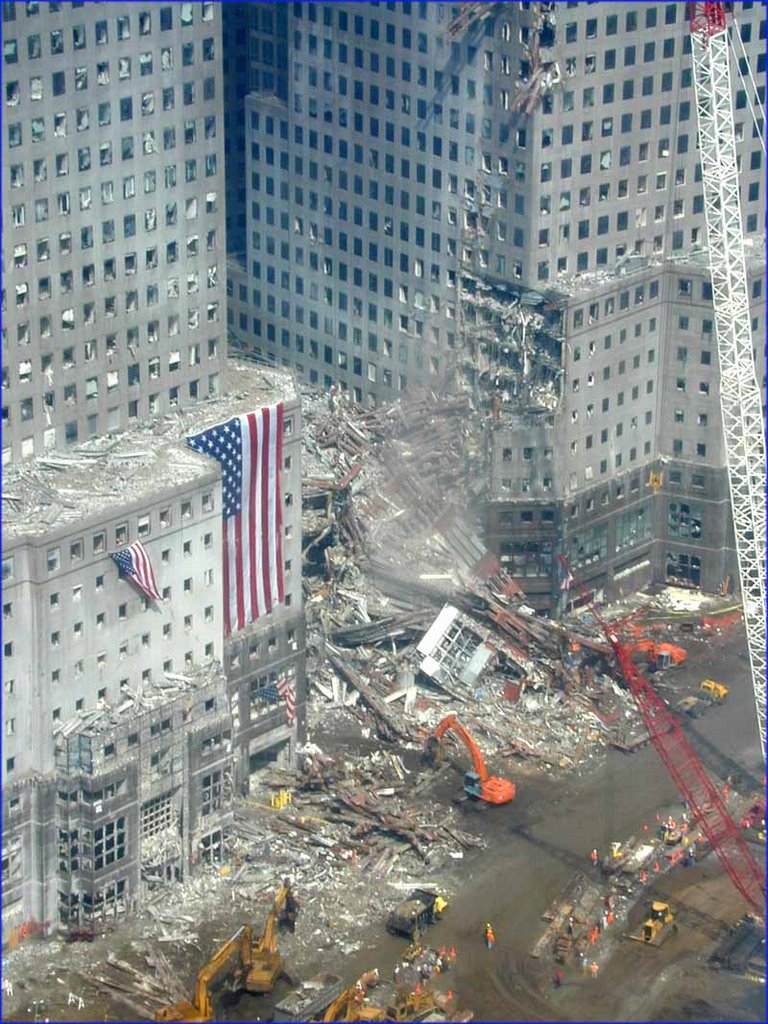
Our shock and rage were accompanied by fear for our daughter, whom we knew was at work in the adjacent World Financial Center when the planes struck the World Trade Center. (See photos below.) Was her office struck by debris? Had she fled her building only to be struck by or trapped in debris? Had she smothered in the huge cloud of dust that enveloped lower Manhattan as the towers collapsed? Because telephone communications were badly disrupted, we didn’t learn for several hours that she had made it home safely, before the towers collapsed.

Our good fortune was not shared by tens of thousands of other persons: the grandparents, parents, brothers, sisters, husbands, wives, children, grandchildren, lovers, and good friends of the 3,000 who died that day in Manhattan, the Pentagon, and western Pennsylvania.

I was enraged by the events of September 11, 2001, and I remain enraged. I am, of course, enraged at the perpetrators and those like them who remain at large. I am, if anything, even more enraged by those of my fellow citizens who seem unable to grasp the fact that terror is the fault of terrorists, and that the United States must defend itself against those terrorists, even if it means that we are at times inconvenienced and at other times deprived of a smattering of privacy. Those who lament inconvenience and conjure a police state where there is none are rank narcissists and untrustworthy companions in the fight to the finish in which we are engaged.

I have reserved a special place in hell for those politicians, pundits, journalists, celebrities, and bloggers (especially Leftists and anarcho-libertarians) who criticize the war effort simply for the sake of criticizing it, who exude schadenfreude when there is bad news from the front or when the administration suffers a political or judicial setback in its efforts to combat terrorists, and who are able to indulge themselves precisely because they live in a nation that affords them that luxury. It is not a luxury they would enjoy under Leftist or Islamist rule.

A time of war is a time for constructive criticism, for being on the same team and helping that team win by offering ideas about how to win the war. When your country loses a war, you do not win. In fact, you cannot win, unless you choose to join the other side — and the other side chooses to accept you. But, as always, be careful what you wish for.

As for me, I repeat what I have said on every anniversary of September 11, 2001:

Never forgive, never forget, never relent.

* * *

The photos below include views of the building in the World Financial Center in which our daughter was working on the morning of September 11, 2001. (The building is at the right in the first photo, center in the second, and right in the third.) The second photo shows how close her building was to the twin towers of the World Trade Center — the remains of which are partly visible in the foreground. The third photo hints at the substantial damage her building suffered as a result of the collapse of the towers. (The photos are three of many that were taken on September 13, 2001. The entire collection is available here. I am indebted to Keith Burgess-Jackson (AnalPhilosopher) for providing the link to the collection.)


Conspiracy Theories

Wikipedia offers a thorough discussion of conspiricism and a long, annotated catalog of conspiracy theories that have been popular at one time or another. The final theory in the catalog goes a long way toward explaining the present state of affairs. It also justifies the use of the somewhat controversial term “Islamic fascists.” Here it is:

IslamicFascist Axis

Radio talk show host David Emory claims that Nazi leader Martin Bormann never died and has built a global empire involving, among many others, the Bush family, Hassan al Banna, Grover Norquist, Meyer Lansky, and Michael Chertoff. This may have sprung from the factual World War Two alliance between Nazi Germany and the Grand Mufti of Jerusalem, a religious and political leader of the area then known as Palestine.

There’s a conspiracy theory for you: a Nazi, the Bushes, an Arab-Muslim extremist, an anti-tax conservative, a Jewish gangster, and a Jewish lawyer-prosecutor-cabinet secretary.

I can’t wait for the movie.

P.S. On a serious note, check out this piece about the “9/11 “Truth” movement.

P.P.S. In the same vein, there’s this at RightWingNutHouse.