A Concession, of Sorts

I voted for George W. Bush in 2000 and again in 2004. I now conclude that my preference for Bush is vindicated by perhaps as few as five things, the first four of which haven’t panned out as well as expected:

  • the vigorous military response to 9/11, including the strategically wise if tactically flawed invasion of Iraq
  • the effort to reduce taxes, in the vain hope of choking off non-defense spending — a hope that he, himself, has helped to shatter
  • the effort to begin privatizing Social Security, which was strategically wise and tactically botched
  • some reduction in the rate of expansion of the Code of Federal Regulations.

The fifth thing is Bush’s nomination of John Roberts to be Chief Justice, because Roberts seems to be dedicated to the primacy of the Constitution, though he says bothersome things about the “respect” owed precedent.

I am hopeful about the choice of Roberts, but I had high hopes about Bush’s ability to prosecute the war in Iraq, his resolve to cut spending, his ability to sell some form of Social Security privatization, and his willingness to roll back the regulatory state.

I will therefore reserve judgment about the appointment of Roberts until it is certain that Roberts is dedicated to the Constitution and — in spite of his declarations to the Senate Judiciary Committee — can find ways to work around precedents that have undermined the Constitution.

That’s all I can find to say in Bush’s favor at this stage of his presidency. The man is smarter than his enemies like to portray him, but he is far more “political” and far less principled about the proper role of government than I had expected him to be. He is turning out to be his father’s son.

September 11: A Postscript for "Peace Lovers"

Americans are targets simply because we’re Americans. Our main enemy — Osama bin Laden and his ilk — chose to be our enemy long before 9/11, and long before you began marching for “peace in our time.”

It doesn’t matter to our main enemy whether you’re an anarchist, crypto-anarchist, libertarian, fascist, Democrat, or Republican. Which “side” you choose doesn’t matter to our main enemy — unless you choose to be on his side as an active member of his terrorist team, or unless you elect a president who is likely to walk away from the fight. That’s the choice he wants from you: to walk away from the fight.

The only ideology our main enemy values is fundamentalist Islam, and he would impose a fundamentalist Islamic state upon you if he could. But he may settle for the retreat of the United States from the Middle East. In that event, he would be in a position to disrupt that region’s oil production, and you would become progressively poorer and ever more vulnerable to his threats of death and destruction.

If you think fighting for oil is “evil,” try living with a lot less oil for the many years it would take to exploit domestic oil sources (if environmentalists will let us) and to develop substitutes for it. If you think that leaving the Middle East to its own devices would buy “peace in our time,” put the face of Adolf Hitler on Osama bin Laden. It’s not hard to do, is it?

Perhaps this is all too much for you. Perhaps you would simply like to declare your independence from the policies of the United States and declare to the world that your person and possessions are off-limits to attack. Do you think al Qaida will go to the trouble of putting a tracking device on you and exempting you from harm when it blows up the building or airplane you happen to be in?

Oh, but you just want peace. Well, I want peace, too, but a peace that’s on my terms, not the enemy’s. Tell me your plan for achieving a peace that isn’t the peace of the grave. Tell me how you would deal with the reality that we have a vicious enemy who would impoverish us if he cannot enslave us. Tell me how marching for peace, instead of killing the enemy, advances the cause of a peace that’s worth having.

September 11: A Remembrance

When my wife and I turned on our TV set that morning, the first plane had just struck the World Trade Center. A few minutes later we saw the second plane strike. In that instant what had seemed like a horrible accident became an obvious act of terror.

Then, in the awful silence that had fallen over Arlington, Virginia, we could hear the “whump” as the third plane hit the Pentagon.

Our thoughts for the next several hours were with our daughter, whom we knew was at work in the adjacent World Financial Center when the planes struck the World Trade Center. Was her office struck by debris? Did she flee her building only to be struck by or trapped in debris? Had she smothered in the huge cloud of dust that enveloped lower Manhattan as the Twin Towers collapsed? Because telephone communications were badly disrupted, we didn’t learn for several hours that she had made it home safely.

Our good fortune was not shared by tens of thousands of other persons: the grandparents, parents, brothers, sisters, husbands, wives, children, grandchildren, lovers, and good friends of the 3,000 who died that day in Manhattan, the Pentagon, and western Pennsylvania.

Never forgive, never forget, never relent.

Whose Incompetence Do You Trust?

So you think government is to be trusted to “get the job done”? Are you less certain, in the aftermath of Katrina? Well, even if you’re not certain, you can bet that many other remain certain that government is still to be trusted, if it’s given more money or put it in the hands of the right party. I think not.

FDR’s administration might have foreseen the vastly expensive and intrusive central government that grew out of its anti-Depression efforts. But whether or not FDR’s administration foresaw the regulatory-welfare state, its “experiments” on the American people shouldn’t have been trusted.

FDR’s administration wasn’t to be trusted to foresee and prevent the attack on Pearl Harbor, when a successful defense of Pearl Harbor might have deterred the Japanese and hastened victory in Europe. (The U.S., rightly, would have at some point come to the aid of Great Britain.)

Truman’s administration wasn’t to be trusted to foresee and prevent the invasion of South Korea, which led to a costly and inconclusive war and demonstrated, for the first time, a lack of military resolve (Truman’s willingness to accept the status quo ante). Thus it should have come as no surprise that the USSR was emboldened to tighten its grip on Eastern Europe and to squash the 1956 uprising in Hungary.

Eisenhower’s administration wasn’t to be trusted to foresee that the Bay of Pigs invasion, which the Kennedy administration botched, would make Castro more popular in Cuba. The botched invasion pushed Castro closer to the USSR, which led to the Cuban missile crisis.

JFK’s inner circle was unwilling to believe that Soviet missile facilities were enroute to Cuba, and therefore unable to act before the facilities were installed. JFK’s subsequent unwillingness to attack the missile facilities made it plain to Kruschev that the the Berlin Wall (erected in 1961) would not fall and that the U.S. would not risk armed confrontation with the USSR (conventional or nuclear) for the sake of the peoples behind the Iron Curtain. Thus the costly and tension-ridden Cold War persisted for almost another three decades.

LBJ’s administration wasn’t to be trusted to foresee the consequences of the incremental application of military power in Vietnam, which led to the enemy’s eventual victory. Worse for the U.S., the Vietnam experience became a rallying point for the anti-war Left, which continues to undermine the defense of American interests.

Nixon’s administration wasn’t to be trusted, period.

Carter’s administration wasn’t to be trusted to foresee how its feeble, futile, and belated effort to rescure the Americans held hostage in Iran would encourage Islamic terrorists. Ditto for the Reagan administration’s willingness to cut and run after the bombing of the Marine Corps barracks in Lebanon, for the Clinton Administration’s similar bug-out after the massacre of U.S. troops in Somalia, and for the Clinton administration’s feeble, legalistic responses to the bombing of the World Trade Center and the bombings U.S. embassies in Africa.

Bush I’s administration wasn’t to be trusted to foresee that the failure to remove Saddam and install a friendly Iraqi government in 1991 would eventually require us to start from scratch, after Saddam and his party had had time to plan for a post-invasion insurrection.

Bush II’s adminstration wasn’t to be trusted to go where the Clinton administration had failed to go, that is, to anticipate and prevent the long-planned attacks of September 11, 2001.

Government incompetence is nothing new under the sun. It just seems new to hundreds of millions of naïve Americans, who want to believe that government, which usually fails to anticipate rather predictable and often manipulable human enemies (and fails to defeat them except when it wages all-out war), will magically become competent when it comes to dealing with implacable nature, in all its variety — the usual log-rolling, pork-barreling, and graft notwithstanding.

But of course, the sudden emergence of governmental competence is precisely what most Americans want to believe in. (It’s the main theme of every presidential election.) And so we will end up throwing more money at the problem, to little avail and without regard for the viable alternative. That alternative is to let people decide for themselves what risks are important to them, and to let them decide how to spend their money (cooperatively, as they wish) in preparation for those risks.

We should trust the collective wisdom of people acting cooperatively in their own interest, through markets, to protect and preserve their lives and property. We should not trust the amply demonstrated incompetence of government, which suppresses the collective wisdom of markets and replaces it with the collective misjudgments of politicians and bureaucrats, whose main interest is to protect and preserve their power and perquisites.

(For more, see this post at ParaPundit, and this one. Then there’s this one, and several others, at Capital Freedom. And don’t forget Catallarchy, which has plenty, just scroll down.)

Know Thine Enemy

Today the 4th Circuit Court of Appeals issued this spot-on opinion in the case of José Padilla. Briefly, Padilla is the wannabe dirty bomber who was captured in Chicago three years ago after having fought against U.S. forces in Afghanistan.

Lyle Benniston, writing at SCOTUSblog, says:

The ruling . . . did not go as far as the Administration had asked. The Court did not rely upon the President’s claim that he has “inherent authority” as Commander in Chief to order the designation and detention of terrorist suspects. Rather, it relied only on the resolution Congress passed in the immediate aftermath of the terrorist attacks of Sept. 11, 2001, authorizing the President to respond. The Supreme Court similarly avoided the “inherent authority” claim when it upheld detention of citizens captured in foreign battle zones in its decision in Hamdi v. Rumsfeld — so far, the only other case of detention of a citizen named as an “enemy combatant.”

The Circuit Court commented: “Like Hamdi, Padilla associated with forces hostile to the United States in Afghanistan….And, like Hamdi, Padilla took up arms against United States forces in that country in the same way and to the same extent as did Hamdi….Because, like Hamdi, Padilla is an enemy combatant, and because his detention is no less necessary than was Hamdi’s in order to prevent his return to the battlefield, the President is authorized by the AUMF [Authorization for Use of Military Force Joint Resolution] to detain Padilla as a fundamental incident to the conduct of war.”

That the ruling did not go as far as the administration asked doesn’t alter the fact that the ruling was a victory for the administration, and for Americans. After all, Padilla’s counsel raised four arguments for Padilla’s release, all of which failed. Lawyers don’t lose when they lose some of their arguments, they lose only when they lose all of their arguments.

Judge J. Michael Lutting wrote for the three-judge panel. I applaud his ability (and that of his confreres) to see through the legal cant and get it right: An enemy of the United States is an enemy of the United States, even if he happens to be a U.S. citizen. To put it another way, not all non-citizens are enemies of the United States, but some citizens — not just Hamdi and Padilla — are enemies of the United States.

Foxhole Rats, Redux

In “Shall We All Hang Separately?” I observed that

those Americans who wish “to provide for the common defence” are forced to share a foxhole with those post-patriots who wish to undermine “the common defence.”

I was referring to the “post-patriots” on the American Left who openly side with the so-called insurgents in Iraq. In”Foxhole Rats” I said a bit about the not-quite-enemy in our midst. Now, from Wizbang, I offer you this:

Did you know that back in June of this year a “world tribunal” was held to put the United States and its allies in Iraq on trial for their actions in that country? . . .

You know what one of their findings were? That the terrorist insurgency in Iraq was and is justified in its murder of Iraqi civilians and coalition troops.

It was finding number eleven in the tribunal’s “overview of findings:”

11. There is widespread opposition to the occupation. Political, social, and civil resistance through peaceful means is subjected to repression by the occupying forces. It is the occupation and its brutality that has provoked a strong armed resistance and certain acts of desperation. By the principles embodied in the UN Charter and in international law, the popular national resistance to the occupation is legitimate and justified. It deserves the support of people everywhere who care for justice and freedom.

. . . .

And guess who was behind this tribunal and these findings? More than a few prominent U.S. anti-war groups, among them:

The Campus Anti-War Network

Code Pink (A group with close ties to Congressional Democrats and Cindy Sheehan)

International A.N.S.W.E.R. (Who’s founder is one of Saddam’s lawyers)

And a host of others.

These people are actively supporting the enemy, not to mention terrorism. These people are also behind most of the anti-war rallies and protests we hear about in the media. They are the loudest voices in the anti-war movement. Collectively, they garner more attention to the anti-war cause than anyone else.

And, collectively, they are on the other side.

As I wrote in “Foxhole Rats,” I’m not equating dissent with disloyalty but I am

equating decades of anti-defense, anti-war, and sometimes pro-enemy rhetoric with a willingness to abandon the common defense.

As the author of the Wizbang post says, in closing:

Reasoned opposition to America’s foreign policies decision with regard to the middle east are one thing, but openly supporting the enemy is quite another. And that is, without equivocation, what these people are doing.

Related posts:

Getting It Wrong: Civil Libertarians and the War on Terror (A Case Study) (05/18/04)
The Illogic of Knee-Jerk Privacy Adocates (10/06/04)
Treasonous Blogging? (03/05/05)
Absolutism (03/25/05)
Shall We All Hang Separately? (08/13/05)
Foxhole Rats (08/14/05)
Treasonous Speech? (08/18/05)

Treasonous Speech?

Eugene Volokh considers treason and speech. He offers several candidate First Amendment rules:

  1. Speech is unprotected whenever the speaker knows that it’s likely to aid the enemy. . . .
  2. Speech is unprotected whenever the speaker has the purpose of aiding the enemy. . . .
  3. Speech is unprotected only when the speaker has the purpose of aiding the enemy, and is paid for such speech. . . .
  4. Speech is unprotected only when the speaker has the purpose of aiding the enemy, and is coordinating his speech with the enemy. . . .
  5. Speech is unprotected only when the speaker has the purpose of aiding the enemy, and is actually employed by the enemy. My friend and fellow lawprof Tom Bell takes this view.
  6. Speech is protected regardless of the speaker’s purpose of aiding the enemy or coordination with the enemy. . . .

I addressed Bell’s view (Volokh’s option 5) several months ago:

If it’s treason, it’s treason. An unpaid traitor can do just as much harm to the nation as can a paid traitor.

It would be better to do away with the law of treasonous expression altogether than to draw an arbitrary line between paid and unpaid traitors. If a person’s treachery goes no further than expressions of hatred for America or sympathy with America’s enemies, let that person suffer the consequences in the forum of public opinion.

I prefer Volokh’s option 2, an option that Volokh doesn’t like because

prohibiting all speech that intentionally helps the enemy risks punishing or deterring even speakers who intend only to protect American interests, but whose intentions are mistaken by prosecutors and juries — a serious risk, especially in wartime.

I suppose. But presumably an intention to aid the enemy would have to be proven in a court of law. I doubt very much that an unsubstantiated intention would survive an appeal. Why not give it a try and see how the Supreme Court rules on the issue — as surely it would be asked to do.

Just to be clear about it, I’m not suggesting charges of treason against those who sympathize with the enemy. The friend of our enemy is not our friend, but neither is he or she necessarily our enemy. Just don’t turn your back.

Related posts:

Getting It Wrong: Civil Libertarians and the War on Terror (A Case Study) (05/18/04)
The Illogic of Knee-Jerk Privacy Adocates (10/06/04)
Treasonous Blogging? (03/05/05)
Absolutism (03/25/05)
Shall We All Hang Separately? (08/13/05)
Foxhole Rats (08/14/05)

Foxhole Rats

Apropos the preceding post, there’s a sizable cheering section for the enemy, right here in the U.S. of A. David Kopel of The Volokh Conspiracy has more:

I just ran “support the Iraqi resistance” through Yahoo, and looked at some of the top hits. Among the supporters of the so-called “resistance” are James Petras (an emeritus professor at the State University of NY), . . . . comedienne Janeane Garafolo analogizing the Iraqi resistance to Americans resisting an illegitimate Russian-Chinese invasion of the United States, and Virginia Rodino (Green Party candidate for U.S. House in Maryland in 2004), who declares herself “in solidarity with the courageous Iraqi resistance.” This is obviously not a comprehensive list, just what was easy to find in a few minutes.

An interesting thread on Democratic Underground shows that among rank and file activists (not the more famous types that Eugene originally asked about), there is a substantial diversity of opinion about whether anti-war activists should support the “resistance.”

There may be a “diversity of opinion” at the Democratic Underground about support for the “resistance,” but one graphic is worth a bunch of words about the allegiance of the post-patriots who lurk in the Underground. Here’s the answer to the question “which country having ‘nukes’ concerns/scares your the most?”:

Poll result (42 votes)
Iran (3 votes, 7%)
North Korea (2 votes, 5%)
Pakistan (1 votes, 2%)
India (0 votes, 0%)
China (1 votes, 2%)
France (0 votes, 0%)
Russia (0 votes, 0%)
Israel (1 votes, 2%)
United States
(34 votes, 81%)


What scares me the most is that those people are breathing the same air as I am.

Now, some may say that I’m equating dissent with disloyalty. Not at all. I’m equating decades of anti-defense, anti-war, and sometimes pro-enemy rhetoric with a willingness to abandon the common defense.

You can call it what you like.

Shall We All Hang Separately?

I believe that the willingness of humans to come to each other’s defense has emotional and practical roots:

1. An individual is most willing to defend those who are emotionally closest to him because of love and empathy. (Obvious examples are the parent who risks life in an effort to save a child, and the soldier who throws himself on a grenade to protect his comrades.)

2. An individual is next most willing to defend those who are geographically closest to him because those persons, in turn, are the individual’s nearest allies. (This proposition is illustrated by the Union and the Confederacy in the American Civil War, and by the spirit of “we’re all in this together” that prevailed in the U.S. during World War I and World War II. This proposition is related to but does not depend on the notion that patriotism has evolutionary origins.)

3. If an individual is not willing to defend those who are emotionally or geographically closest to him, he cannot count on their willingness to defend him. In fact, he may be able to count on their enmity. (A case in point is Southerners’ antagonism toward the North for many decades after the Civil War, which arose from Southerners’ resentment toward the “War of Northern Aggresssion” and Reconstruction.)

The Constitution — in its pledge to “provide for the common defence” and its specific language enabling that “defence” — embodies the second and third observations. As Benjamin Franklin said to John Hancock at the signing of the Declaration of Independence, “We must indeed all hang together, or, most assuredly, we shall all hang separately.” A main impetus for the adoption of the Constitution, to replace the Articles of Confederation that first bound the States, was to ensure that the States and the people could indeed hang together. And so we did, in the main, through World War II (the Civil War being the exception that truly proves the rule about geographic cohesion).

What we have seen since the end of World War II is the dissipation of the spirit that “we’re all in this together.” Every American war has had its domestic opponents, even World War II — at least before America joined it. But the Leftish voices of opposition to war — and to preparedness for war — have become louder and more strident in recent decades.

Republicans who opposed LBJ’s handling of the war in Vietnam opposed it largely because they viewed LBJ’s incrementalism as self-defeating. And they were right. My own contemporary, non-Republican view of the Vietnam War was that it was the wrong war, in the wrong place, at the wrong time, but that we ought to try to win it or simply walk away from it. We did neither, opting instead for virtual defeat. That defeat emboldened and legitimated America’s anti-defense, anti-war Leftists, who came to dominate the Democrat Party even before that Party’s venture in Vietnam had ended in ignominy. And thus it came to pass that the Democrat Party’s presidential nominee in 2004 was a notorious anti-Vietnam War veteran of that war.

Congressional Democrats, who mainly opposed George H.W. Bush’s entry into Gulf War I, weren’t granted enough time in which to beat him about the head with his “mistakes.” The war ended too quickly for that. The senior Bush’s real mistake was to heed the advice of those who wanted to walk away with the job half done, that is, with Saddam Hussein defeated but not unseated.

The many congressional Democrats who ostensibly supported George W. Bush’s entry into Iraq felt they had little choice but to do so in the aftermath of 9/11. But many of them since have followed their instincts (and their constituents’ instincts) and reneged on their initial support of the war. They have reverted to the anti-defense, anti-war posture of the modern Democrat Party, reviling President Bush for his “mistakes” (i.e., lack of 100-percent foresight) and blaming him for a fictitious “climate of oppression” in which voices against the war are stifled. They are so stifled that it is hard to be heard above the din of anti-defense, anti-war talk in the media and on the Web.

The country is divided. An important reason for that division is that half the country is unsure, for good reason, that the other half understands the value of — or even wants — a “common defence.” It is apparent to many Americans that many other Americans (i.e., most Democrats and all unaffiliated Leftists) will not countenance the defense of a fellow American (except perhaps a loved one or a next-door neighbor) unless and until the enemy is within spitting distance — if then.

This isn’t about the Iraq War being “the wrong war, in the wrong place, at the wrong time.” That’s merely the latest excuse for the American Left’s long-standing allegiance to anti-defense, anti-war dogmas, under which lies the post-patriotic attitude that America is nothing special, just another place to live. Christopher Chantrill of The American Thinker explains:

Among the many things that our American liberals ask us to swallow in our own best interest is the idea that it is an act of lèse-majesté to call them unpatriotic even though they are utterly embarrassed by patriotism. Who has not heard the liberal across the dinner table dismissing nationalism as dangerous and aggressive? But we are not allowed to call them on it.

This power play began after World War II when it came to public knowledge that a number of people with first names that sounded like last names had been passing government secrets to the Soviet Union. We call this time the McCarthy Era.

The McCarthy Era taught liberals that their ideas of a post-nationalist world did not go down too well with the American people. By the skin of their teeth they managed to swim back into the mainstream through a successful counterattack upon Senator McCarthy. Ever since, when caught in a post-patriotic act, they have waved the bloody shirt of McCarthyism to cow their accusers into silence.

Alger Hiss and Dexter White were unpatriotic and proud of it, and so are today’’s liberals — in their hearts. Hiss and White believed in a world higher and better than nation states. From their experience in the 1930s they knew that the age of capitalism and fractious nation states was coming to an end, and they wanted to be part of the exciting and altruistic movement that would create a new world order to replace the old, failed system. There would be no place for atavisms like patriotism in the post-patriotic world that they wanted to build.

And so it goes today.

Well, I wonder how those anti-defense, anti-war, post-patriots would feel if there weren’t some pro-defense, willing-to-go-to-war patriots around to defend them before the enemy is at their throats? Would France save them? How about their precious enemy detainees at Gitmo?

The Left has, by its words and deeds over the decades, seceded from the mutual-defense pact of the Constitution. The Left has served notice that it will do everything in its power to weaken the ability of those Americans who aren’t post-patriotic to prepare for and execute an effective mutual defense.

Lincoln said, “A house divided against itself cannot stand.” And Lincoln was right, but he was able to reunite the “house” by force. That is not an option now. The Left has more effectively seceded from the Union than did the Confederacy, but the Left’s secession cannot be rectified by force.

And so, those Americans who wish “to provide for the common defence” are forced to share a foxhole with those post-patriots who wish to undermine “the common defence.”

If the Left’s agenda prevails, we shall indeed all hang separately.

Defending My Right to Be Bombed

Now we learn this from The Times Online:

Mohammed Atta and three other men who hijacked aircraft on September 11, 2001 were identified by the US Government as possible members of an al-Qaeda cell more than a year before the attacks, it was reported today. . . .

The secret military team, known as Able Danger, recommended that the identities of the four men be shared with the FBI and other parts of the military, but the recommendation was never taken up, according to a Republican Congressman, Curt Weldon, quoted by the newspaper. . . .

The CIA tracked the men through 2000 before passing their information to the FBI in the spring of 2001.

According to Mr Weldon, who said he has tried to share this information since September 2001, when it first came to his notice, the risk posed by Atta and his cohorts never spread through America’a law enforcement agencies because of the uneasy co-operation between the FBI and the military. . . .

The classified military intelligence unit used sophisticated “data mining” techniques, which process huge amounts of data to find patterns, to identify Atta and the three other men as likely members of an al-Qaeda cell within two months of their arrival in America in 2000.

And from The International Herald Tribune:

. . . Able Danger, prepared a chart in the summer of 2000 that included visa photographs of the four men, including the ringleader, Mohammed Atta. The unit recommended to the military’s Special Operations Command that the information be shared with the FBI, the former official and the Republican congressman, Curt Weldon of Pennsylvania, said Monday.

The recommendation was rejected, and the information was not shared, they said, apparently at least in part because Atta and the others were in the United States on valid entry visas.

Under U.S. law, intelligence agencies may not collect intelligence on individual citizens and permanent residents. That protection does not extend to visa holders, but Weldon and the former official said it may have reinforced a sense of discomfort[*] common before Sept. 11 about sharing intelligence information with a law enforcement agency.

So we have here two lessons:

  • Data mining can actually detect bad guys.
  • Intelligence sharing might well have led to the capture of the bad guys before they did something terribly bad.

But knee-jerk civil libertarians won’t have any of it. They want to defend my right to be bombed.
__________
* There was more than “discomfort” about intelligence-sharing, there was a wall between criminal investigators and intelligence agents.

Technorati tag:

Now, Let’s Talk About Something Else

UPDATED BELOW

From Richard B. Frank, writing at The Weekly Standard:

The sixtieth anniversary of Hiroshima seems to be shaping up as a subdued affair–though not for any lack of significance. A survey of news editors in 1999 ranked the dropping of the atomic bomb on August 6, 1945, first among the top one hundred stories of the twentieth century. And any thoughtful list of controversies in American history would place it near the top again. It was not always so. In 1945, an overwhelming majority of Americans regarded as a matter of course that the United States had used atomic bombs to end the Pacific war. They further believed that those bombs had actually ended the war and saved countless lives. This set of beliefs is now sometimes labeled by academic historians the “traditionalist” view. One unkindly dubbed it the “patriotic orthodoxy.”

But in the 1960s, what were previously modest and scattered challenges of the decision to use the bombs began to crystallize into a rival canon. The challengers were branded “revisionists,” but this is inapt. Any historian who gains possession of significant new evidence has a duty to revise his appreciation of the relevant events. These challengers are better termed critics.

The critics share three fundamental premises. The first is that Japan’s situation in 1945 was catastrophically hopeless. The second is that Japan’s leaders recognized that fact and were seeking to surrender in the summer of 1945. The third is that thanks to decoded Japanese diplomatic messages, American leaders knew that Japan was about to surrender when they unleashed needless nuclear devastation. The critics divide over what prompted the decision to drop the bombs in spite of the impending surrender, with the most provocative arguments focusing on Washington’s desire to intimidate the Kremlin. Among an important stratum of American society–and still more perhaps abroad–the critics’ interpretation displaced the traditionalist view….

[I]t is clear [from a review of the evidence now available] that all three of the critics’ central premises are wrong. The Japanese did not see their situation as catastrophically hopeless. They were not seeking to surrender, but pursuing a negotiated end to the war that preserved the old order in Japan, not just a figurehead emperor. Finally, thanks to radio intelligence, American leaders, far from knowing that peace was at hand, understood–as one analytical piece in the “Magic” Far East Summary stated in July 1945, after a review of both the military and diplomatic intercepts–that “until the Japanese leaders realize that an invasion can not be repelled, there is little likelihood that they will accept any peace terms satisfactory to the Allies.” This cannot be improved upon as a succinct and accurate summary of the military and diplomatic realities of the summer of 1945.

UPDATE: See also this piece by Victor Davis Hanson.

Technorati tag:

Continuation of "Sorting Out Libertarian Hawks and Doves"

This is a continuation of a post at Liberty Corner.

I commented on Micha Ghertner’s post, “Moral Relativism Isn’t What You Think It Is,” at Catallarchy. Joe Miller’s comment on my comment led me to follow up with a hypothetical and some related questions. Joe Miller replied thoroughly and thoughtfully to those questions. I reproduce below my hypothetical and the related questions (flush left), Joe Miller’s replies to those questions (indented and set in italics), and my response to Joe Miller’s replies (double-indented and set in bold).

The hypothetical:

1. In Country A (just as in Country B), the armed forces are controlled by the state. (I don’t want to get off onto the tangent of whether war is more or less likely if defense is provided by private agencies.)

2. The only restriction on the liberty of Country A’s citizens is that they must pay taxes to support their armed forces. Country B’s citizens own no property; their jobs are dictated by the state; their income is dictated by the state; and all aspects of their lives are regimented by state decrees.

3. Though Country A’s armed forces are underwritten by taxes, the members of the armed forces are volunteers. The members of Country B’s armed forces are conscripts, and Country B’s armed forces are, in effect, supplied and equipped by slave labor.

4. Country A would liberate Country B’s citizens, if it could. Country B would subjugate or kill Country A’s citizens, if it could.

The questions (all of which I answer “yes”):

1. If Country B attacks Country A, what limits (if any) would you place on the measures Country A might take in its defense? Specifically:

a. Are civilian casualties in Country B acceptable at all?

1. a. Yes, provided that Country A doesn’t directly intend those casualties, that it takes pains to minimize such casualties, and that it ensures that said casualties are proportional to military gains.

I don’t know how to evaluate proportionality. Perhaps an empathetic decision-maker might make a seat-of-the-pants judgment that “enough is enough” or “the particular objective isn’t worth the cost in human life.” Do you have a more precise metric in mind?

b. Are civilian casualties in Country B acceptable if they’re the result of mistakes on Country A’s part or the unavoidable result of Country A’s attacks on Country B’s armed forces and infrastructure?

1. b. Yes, but see 1a. for caveats.

See my comment on your answer to 1.a.

c. Is the deliberate infliction by Country A of civilian casualties in Country B acceptable as long as Country A’s leaders reasonably believe that the infliction of those casualties – and nothing else – will bring about the defeat of Country B? (Assume, here, that Country A’s leaders try to inflict only the number of casualties deemed necessary to the objective.)

1. c. Maybe. I think that there are two components to supreme emergency. One is that there must be an imminent danger of losing and the second is that losing must be catastrophically evil. Worldwide Stalinism probably would count. I’m not sure, from your quick description of Country B, that it really meets the second part of that criteron.

It would always be a judgment call. I suppose there are many libertarians (not to mention pacifists) who would rule out any deliberate infliction of casualties, even under the circumstances I’ve outlined.

(Assume, for purposes of the next 2 questions, that Country A inflicts casualties on Country B’s civilians only to the extent that those casualties are the result of mistakes or unavoidable collateral damage.)

2. Should Country A attack Country B if Country A concludes (rightly or wrongly, but in good faith) that Country B is about to attack, and if Country B strikes first it is likely to:

a. win a quick victory and subjugate Country A?

2. a. Yes. I’ve no objection to preemptive strikes, provided that it really is the case that Country B is about to attack. If you and I get into a fight, I see no reason that I’m obligated to wait for your first punch to land before I can defend myself. Once I see that you’re going to throw the punch, it’s okay if mine lands first. I can’t see why that ought not apply in war, as well.

b. inflict heavy casualties on Country A’s citizens?

2. b. Yes, again. It’s not the winning or losing or the casualties that matter here. It’s a question of aggression. The scenario you describe makes Country B the aggressor, regardless of who actually fires the first shot. That said, finding real cases of preemption isn’t easy to do. Israel in the Six Day’s War comes closest. (Or is it Seven? Hard to keep up with countries that keep winning wars in less than a week.)

3. Should Country A attack Country B if Country A concludes (rightly or wrongly, but in good faith) that Country B is developing the wherewithal to attack, and if Country B strikes first it is likely to

a. win a quick victory and subjugate Country A?

3. a. Nope. Here’s the analogy I like to use in class. Suppose that you and I really don’t like each other. In fact, we really hate one another. As it happens, right now, I’m stronger than you and know a bit about fighting, so I’m not really in much danger from you in a fight. But now suppose that I see that you’ve taken out a gym membership and signed up for Kung Fu classes at the Y. Am I justified in beating you up now on the grounds that, in a few months, you might possibly decide to beat me up? The same has to hold true for nations, I think. The mere fact that Country B doesn’t like Country A and is arming itself doesn’t imply that Country A will actually attack Country B. After all, the U.S. and the U.S.S.R. actively didn’t like one another and actively armed against one another without ever actually directly shooting at one another. Possibility of future attack doesn’t justify preventive war. Imminence of attack does. When Country B makes it clear that they actually mean to attack, then they’ve aggressed against Country A and war is justified.

Assume this situation: Country B is developing a devasting weapon that, if used, would kill half of Country A’s inhabitants. There is no way to defend against the weapon if Country B decides to use it. Country B hasn’t said that it would use the weapon, but the mere existence of the weapon poses a grave threat to Country A’s citizens. Country B has demonstrated through its past behavior that it is unreceptive to pleas, negotiations, and offers of economic “assistance” (i.e., bribes). The only way to ensure that Country B won’t use the weapon when it’s built is to destroy the weapon in a pre-emptive attack, while the weapon is still under development. Country B has deliberately placed the development site so that a pre-emptive attack would result in the deaths of one-half of Country B’s citizens. What would you do? I know what I’d do, given my opening statements about Country A and Country B: I’d launch the pre-emptive attack, as long as it had a reasonable chance of success (say 50%) and as long as I had the wherewithal to launch at least one more equally potent attack.

3.b. inflict heavy casualties on Country A’s citizens?

3. b. Same as 3a.

See my comment on your answer to 3.a.

Sorting Out the Libertarian Hawks and Doves

UPDATED TWICE, BELOW

Paleolibertarians adhere to something they call the non-aggression principle. According to Walter Block, writing at LewRockwell.com (a paleo site):

The non-aggression axiom is the lynchpin of the philosophy of libertarianism. It states, simply, that it shall be legal for anyone to do anything he wants, provided only that he not initiate (or threaten) violence against the person or legitimately owned property of another.

In another post, Block writes:

The libertarian non-aggression axiom is the essence of libertarianism. Take away this axiom, and libertarianism might as well be libraryism, or vegetarianism. Thus, if a person is to be a libertarian, he must, he absolutely must, in my opinion, be able to distinguish aggression from defense.

Here’s a joke. Do you know the difference between a bathroom and a living room? No? Well, don’t come to my house. In this spirit I ask, do you know the difference between offense and defense? Between aggression and defense against aggression? No? Well, then, don’t call yourself a libertarian.

I can’t read anyone out of the libertarian movement. No one appointed me guardian of this honorific. I am just giving my humble opinion. In like manner, if you couldn’t tell the difference between a hammer and a chisel, I wouldn’t consider you a carpenter. If you couldn’t distinguish between a brush and paint, I wouldn’t consider you a painter. In much the same way, if you can’t tell offense and defense apart, that is, if you believe in pre-emptive strikes against those who are not attacking you, then I can’t consider you a libertarian even if you favor free enterprise and oppose criminalizing voluntary adult conduct.

There are areas in which well meaning and knowledgeable libertarians disagree: minarchism vs. anarchism; immigration; abortion; inalienability; punishment theory. Although I have strong views on all of these, I recognize libertarian arguments on the other side. But not on this issue.

You don’t have to wait until I actually punch you in the nose to take violent action against me. You don’t even have to wait until my fist is within a yard of you, moving in your direction. However, if you haul off and punch me in the nose in a preemptive strike, on the ground that I might punch you in the future, then you are an aggressor.

But what about the in-between case, where you haven’t started your swing but I have good reason to believe that you’re about to do so? Consider the following comment that I posted today at Catallarchy:

I know that life’s not black & white, but a black & white case may help us to clarify the principles that we’re trying to apply to rather messy “real world” situations. Consider this hypothetical:

1. In Country A (just as in Country B), the armed forces are controlled by the state. (I don’t want to get off onto the tangent of whether war is more or less likely if defense is provided by private agencies.)

2. The only restriction on the liberty of Country A’s citizens is that they must pay taxes to support their armed forces. Country B’s citizens own no property; their jobs are dictated by the state; their income is dictated by the state; and all aspects of their lives are regimented by state decrees.

3. Though Country A’s armed forces are underwritten by taxes, the members of the armed forces are volunteers. The members of Country B’s armed forces are conscripts, and Country B’s armed forces are, in effect, supplied and equipped by slave labor.

4. Country A would liberate Country B’s citizens, if it could. Country B would subjugate or kill Country A’s citizens, if it could.

What say you, then, to these questions:

1. If Country B attacks Country A, what limits (if any) would you place on the measures Country A might take in its defense? Specifically:

a. Are civilian casualties in Country B acceptable at all?

b. Are civilian casualties in Country B acceptable if they’re the result of mistakes on Country A’s part or the unavoidable result of Country A’s attacks on Country B’s armed forces and infrastructure?

c. Is the deliberate infliction by Country A of civilian casualties in Country B acceptable as long as Country A’s leaders reasonably believe that the infliction of those casualties — and nothing else — will bring about the defeat of Country B? (Assume, here, that Country A’s leaders try to inflict only the number of casualties deemed necessary to the objective.)

(Assume, for purposes of the next 2 questions, that Country A inflicts casualties on Country B’s civilians only to the extent that those casualties are the result of mistakes or unavoidable collateral damage.)

2. Should Country A attack Country B if Country A concludes (rightly or wrongly, but in good faith) that Country B is about to attack, and if Country B strikes first it is likely to:

a. win a quick victory and subjugate Country A?

b. inflict heavy casualties on Country A’s citizens?

3. Should Country A attack Country B if Country A concludes (rightly or wrongly, but in good faith) that Country B is developing the wherewithal to attack, and if Country B strikes first it is likely to

a. win a quick victory and subjugate Country A?

b. inflict heavy casualties on Country A’s citizens?

What I’m trying to get at is whether we should value non-aggression (which I take to be a means to liberty that’s favored by certain libertarians) over liberty itself (the end upon which all libertarians agree). In light of that distinction, my answers are:

1. a. Yes
1. b. Yes
1. c Yes
2. a. Yes
2. b. Yes
3. a. Yes
3. b. Yes

Over to you.

Let me emphasize the essential question: Should libertarians favor non-aggression — which is really a means to liberty — over liberty itself? Paleos like Block have latched onto non-aggression (which Block, at least, cannot define very well), as if non-aggression were the same thing as liberty. They have mixed up ends and means. Aggression may be necessary to the pursuit of liberty; non-aggression may be inimical to liberty.

Of course, the paleos can always argue that my answers are within the (vague) bounds of non-aggression. And that’s okay with me, as long as they also stop harping about American imperialism.

UPDATE (7:26 pm CT): Joe Miller (not a paleo, in my book) has posted a thorough and thoughtful reply to my comment. I will think it through and respond to him here and at Catallarchy.

UPDATE 2 (4:02 pm CT, 07/28/05): I have continued this post at Liberty Corner II.

Technorati tag:

But Wouldn’t Warlords Take Over?

That’s the title of a piece by Robert Murphy at the Mises Economics Blog. Murphy says:

On two separate occasions in the last couple of weeks, people have asked me a familiar question: In a system of anarcho-capitalism or the free-market order, wouldn’t society degenerate into constant battles between private warlords?”…

For the warlord objection to work, the statist [or minarchist: ED] would need to argue that a given community would remain lawful under a government, but that the same community would break down into continuous warfare if all legal and military services were privatized….

Now that we’’ve focused the issue, I think there are strong reasons to suppose that civil war would be much less likely in a region dominated by private defense and judicial agencies, rather than by a monopoly [s]tate. Private agencies own the assets at their disposal, whereas politicians (especially in democracies) merely exercise temporary control over the [s]tate’’s military equipment. Bill Clinton was perfectly willing to fire off dozens of cruise missiles when the Lewinsky scandal was picking up steam. Now regardless of one’s beliefs about Clinton’’s motivations, clearly Slick Willie would have been less likely to launch such an attack if he had been the CEO of a private defense agency that could have sold the missiles on the open market for $569,000 each.

Aside from this brief excursion into Clinton’s use or misuse of national defense assets, Murphy’s argument is focused in the issue of intra-societal violence; viz: “civil war would be much less likely in a region dominated by private defense and judicial agencies, rather than by a monopoly [s]tate. ” Let’s return to Murphy:

We can see this principle [of the profligate use of force] in the case of the United States. In the 1860s, would large scale combat have broken out on anywhere near the same scale if, instead of the two factions controlling hundreds of thousands of conscripts, all military commanders had to hire voluntary mercenaries and pay them a market wage for their services?

Murphy concedes that there might have been combat. He’s merely quibbling about its scale. He continues:

I can imagine a reader generally endorsing the above analysis, yet still resisting my conclusion. He or she might say something like this: “In a state of nature, people initially have different views of justice. Under market anarchy, different consumers would patronize dozens of defense agencies, each of which attempts to use its forces to implement incompatible codes of law. Now it’’s true that these professional gangs might generally avoid conflict out of prudence, but the equilibrium would still be precarious.

To avoid this outcome,” my critic could elaborate, “citizens put aside their petty differences and agree to support a single, monopoly agency, which then has the power to crush all challengers to its authority. This admittedly raises the new problem of controlling the Leviathan, but at least it solves the problem of ceaseless domestic warfare.

There are several problems with this possible approach. First, it assumes that the danger of private warlords is worse than the threat posed by a tyrannical central government. Second, there is the inconvenient fact that no such voluntary formation of a [s]tate ever occurred. Even those citizens who, say, supported the ratification of the U.S. Constitution were never given the option of living in market anarchy; instead they had to choose between government under the Articles of Confederation or government under the Constitution.

Murphy sets up a quasi-straw man — the voluntary formation of a state — then proceeds to blow it down. Big deal. That doesn’t prove that the danger of warlords is less than the threat posed by a central government, which is what Murphy implies. Non sequitur. Moreover, many citizens did support the ratification of the Constitution, and those who didn’t had the option of going to Canada or over the Blue Ridge. Back to Murphy:

But for our purposes, the most interesting problem with this objection is that, were it an accurate description, it would be unnecessary for such a people to form a government. If, by hypothesis, the vast majority of people — —although they have different conceptions of justice — can all agree that it is wrong to use violence to settle their honest disputes, then market forces would lead to peace among the private police agencies.

Murphy’s hypothesis is his undoing. He assumes that if the vast majority of people agree that it’s wrong to use violence to settle disputes, then that won’t happen. Do the vast majority of people believe that it’s wrong to use violence to settle disputes? Perhaps, but it doesn’t take a vast majority to inject violence into a society; it takes only a relatively small number of renegades, who may be then be able to coerce others into condoning or supporting their criminal activities. There’s more:

Yes, it is perfectly true that people have vastly different opinions concerning particular legal issues. Some people favor capital punishment, some consider abortion to be murder, and there would be no consensus on how many guilty people should go free to avoid the false conviction of one innocent defendant. Nonetheless, if the contract theory of government is correct, the vast majority of individuals can agree that they should settle these issues not through force, but rather through an orderly procedure (such as is provided by periodic elections).

Well, Murphy now admits that there’s something to the voluntary formation of a state. But, like most anarcho-capitalists, he doesn’t want to admit to the legitimacy of an institution that he didn’t contract for. Tough. But that still doesn’t have anything to do with the superiority of private defense agencies over state-controlled police forces and courts. Nevertheless, Murphy plows on:

But if this does indeed describe a particular population, why would we expect such virtuous people, as consumers, to patronize defense agencies that routinely used force against weak opponents? Why wouldn’’t the vast bulk of reasonable customers patronize defense agencies that had interlocking arbitration agreements, and submitted their legitimate disputes to reputable, disinterested arbitrators? Why wouldn’t the private, voluntary legal framework function as an orderly mechanism to settle matters of “public policy””?

There sure are a lot of hypotheticals piled on top of one another. What Murphy doesn’t entertain is the possibility that a small but very rich cabal could create a dominant defense agency that simply refuses to recognize other defense agencies, except as enemies. In other words, there’s nothing in Murphy’s loose logic to prove that warlords wouldn’t arise. In fact, he soon gives away the game:

Imagine a bustling city, such as New York, that is initially a free market paradise. Is it really plausible that over time rival gangs would constantly grow, and eventually terrorize the general public? Remember, these would be admittedly criminal organizations; unlike the city government of New York, there would be no ideological support for these gangs.

We must consider that in such an environment, the law-abiding majority would have all sorts of mechanisms at their [sic] disposal, beyond physical confrontation. Once private judges had ruled against a particular rogue agency, the private banks could freeze its assets (up to the amount of fines levied by the arbitrators). In addition, the private utility companies could shut down electricity and water to the agency’’s headquarters, in accordance with standard provisions in their contracts.

Pardon me while I laugh at the notion that lack of “ideological support” for the gangs of New York would make it impossible for gangs to grow and terrorize the general public. That’s precisely what has happened at various times during the history of New York, even though the “law-abiding majority [had] all sorts of mechanisms at [its] disposal.” Murphy insists on hewing to the assumption that the existence of a law-abiding majority somehow prevents the rise a powerful, law-breaking minorities, capable of terrorizing the general public. Wait a minute; now he admits the converse:

Of course, it is theoretically possible that a rogue agency could overcome these obstacles, either through intimidation or division of the spoils, and take over enough banks, power companies, grocery stores, etc. that only full-scale military assault would conquer it. But the point is, from an initial position of market anarchy, these would-be rulers would have to start from scratch. In contrast, under even a limited government, the machinery of mass subjugation is ready and waiting to be seized.

Huh? It’s certainly more than theoretically possible for a “rogue agency” to wreak havoc. A “rogue agency” is nothing more than a fancy term for a street gang, the Mafia, or al Qaeda cells operating in the U.S. A “rogue agency” run by and on behalf of rich and powerful criminals — for their own purposes — would somehow be preferable to police forces and courts operated by a limited government that is accountable to the general public, rich and poor alike? I don’t think so. However much the American state engages in “mass subjugation” — and it does, to a degree — it is also held in check by its accountability to the general public under American law and tradition. A “rogue agency,” by definition, would be unbound by law and tradition.

Murphy’s analysis takes place in a land called “Erewhon.” He chooses to ignore the fact that he lives in the United States because he wasn’t a party to the Constitution. Yet that Constitution provides for a limited government, which in more than 200 years has yet to engage in systematic, mass subjugation of the kind practiced in the Third Reich and the Soviet Union, except in the case of slavery. And guess what? The American state ended slavery. How’s that for mass subjugation?

Anyone can conjure a Utopia, as Murphy has. But no one can guarantee that it will work. Murphy certainly hasn’t made the case that his Utopia would work.

In any event, by focusing on intra-societal violence Murphy ignores completely two crucial questions: (1) Can an anarchistic society effectively defend itself against an outside force? (2) Can it do so better than a society in which the state has a monopoly on the use of force with respect to outside entities? Murphy implies that the answer to both questions is “yes,” though he fails to explore those questions. Here is my brief answer: The cost of mounting a credible defense of the United States from foreign enemies probably would support only one supplier; that is, national defense is a natural monopoly. It is better for the American state — given its accountability to the general public — to be that supplier.

To revert to Murphy’s example of Clinton’s profligate use of expensive missiles, the CEO of a private defense agency might well have an incentive to fire missiles at a bogus target. He might want to demonstrate his apparent “resolve” iprovocation of putative provaction in order to quell unrest among his shareholders or to attract new clients. Murphy’s example suggests only that the state may be wasteful in its expenditure of conscripted dollars. Murphy’s example does not show that the state is necessarily any less effective than would be a private defense agency or defense agencies. In matters of life and death, a wasteful state is preferable to an efficient private defense agency (if there could be such a thing).

A wasteful, accountable, American state is certainly preferable to an efficient, private, defense agency in possession of the same military might. Hitler and Stalin, in effect, ran private defense agencies, and look where that landed the Germans and Russians. Talk about subjugation.

Related posts:

Defense, Anarcho-Capitalist Style (09/26/04)
Fundamentalist Libertarians, Anarcho-Capitalists, and Self-Defense (04/22/05)
The Legitimacy of the Constitution (05/09/05)
Another Thought about Anarchy (05/10/05)
Anarcho-Capitalism vs. the State (05/26/05)
Rights and the State (06/13/05)

Technorati tag:

Whose Side Are They On?

NYCLU Calls Decision To Conduct Random Searches Of Individuals On New York’s Subways Unconstitutional

Putting His Money Where His Mouth Is

BBC News reports:

Pizza man fined for war racism

A Danish pizzeria owner who refused to serve German and French customers because of their countries’ position on the Iraq war has been convicted of racial discrimination.

Aage Bjerre, who owns Aage’s Pizza in Nordby on the tourist island of Fanoe, was fined 5,000 kroner ($787).

Mr Bjerre, 44, said he would appeal, but would rather go to prison than pay the fine.

“I don’t want to sell pizza to people from those two countries,” he said.

“Every day I turn tourists down, but my conscience is doing fine.”

He added: “I feel that I was convicted for supporting the coalition.”…

Mr Bjerre said he had received many messages of support from the US, including job offers, and did not rule out accepting one of them.

He says he has already lost nearly 50,000 kroner ($7,800) because of a drop in business, and because of vandalism to his restaurant.

Note Denmark’s typically European approach to freedom of speech* — there is none. It’s a McCain-Feingold paradise. It prompts me to suggest a new bumper-sticker for Volvo-driving American liberals:

I ♥ freedom, European style.

(Thanks to my son for the lead.)
__________
* Consider, for example, the “incitement to religious hatred” bill now being pushed (again) by Britain’s Labour Party.

Judge Roberts and the Defense of America

Emily Bazelon, writing at Slate, doesn’t like Judge John Roberts’s willingness to defend America:

Roberts may…turn out to be a wise, thoughtful, and appealing justice. Tonight when Bush announced his nomination, Roberts talked about feeling humbled, which won him points on TV. But an opinion that the 50-year-old judge joined just last week in the case Hamdan v. Rumsfeld should be seriously troubling to anyone who values civil liberties. As a member of a three-judge panel on the D.C. federal court of appeals, Roberts signed on to a blank-check grant of power to the Bush administration to try suspected terrorists without basic due-process protections.

According to the government, Salim Ahmed Hamdan is the former driver and bodyguard of Osama Bin Laden. He was captured by an Afghan militia in November 2001, during the U.S. invasion, and shipped off to Guantanamo Bay. In July 2003, the Bush administration brought charges against Hamdan, as it has done against only three others among the hundreds of suspected terrorists being held at Guantanamo. Hamdan was accused of conspiring to commit attacks on civilians, murder, and terrorism, and the Bush administration moved to try him before a special military tribunal.

This tribunal isn’t like the courts-martial that are used for prisoners of war. It goes by rules that cut back the rights of defendants even more drastically than the tribunal that the United States has helped establish in Iraq to try Saddam Hussein has. Hamdan has no right to be present at his trial. Unsworn statements, rather than live testimony, can be presented as evidence against him. The presumption of innocence can be taken away from him at any time; so can his right not to testify to avoid self-incrimination. If Hamdan is convicted, he can be sentenced to death.

The opinion Roberts joined, written by Judge A. Raymond Randolph for a unanimous panel (though the third judge, Stephen Williams, expressed a reservation in a concurrence), swallows all of that and then some. The opinion says that Congress authorized the president to set up whatever military tribunal he deems appropriate when it authorized him to use “all necessary and appropriate force” to fight terrorism in response to 9/11. While the president has claimed the authority only to try foreign suspects before the tribunals, there’s nothing in the Hamdan opinion that stops him from extending their reach to any other suspected terrorist, American citizens included. This amounts to a free hand—and one Bush is not shy about extending. The administration has already devised its own tribunals to review its claims that the Guantanamo detainees are all enemy combatants who are not entitled to the international protections accorded to prisoners of war. As of February, 558 hearings had resulted in freedom for only three prisoners. The Supreme Court has yet to rule on the legality of these tribunals—a question that Roberts may now help decide.

I hope so.

What Bazelon and her ilk cannot seem to grasp is that America is at war. Hamdan isn’t a jay-walker; he’s an enemy; he could have been shot on the spot. As Justice Franfurter wrote 61 years ago:

The provisions of the Constitution which confer on the Congress and the President powers to enable this country to wage war are as much part of the Constitution as provisions looking to a nation at peace. And we have had recent occasion to quote approvingly the statement of former Chief Justice Hughes that the war power of the Government is ‘the power to wage war successfully.’… Therefore, the validity of action under the war power must be judged wholly in the context of war. That action is not to be stigmatized as lawless because like action in times of peace would be lawless. To talk about a military order that expresses an allowable judgment of war needs by those entrusted with the duty of conducting war as ‘an unconstitutional order’ is to suffuse a part of the Constitution with an atmosphere of unconstitutionality. The respective spheres of action of military authorities and of judges are of course very different. But within their sphere, military authorities are no more outside the bounds of obedience to the Constitution than are judges within theirs. ‘The war power of the United States, like its other powers … is subject to applicable constitutional limitations’,….To recognize that military orders are ‘reasonably expedient military precautions’ in time of war and yet to deny them constitutional legitimacy makes of the Constitution an instrument for dialectic subtleties not reasonably to be attributed to the hard-headed Framers, of whom a majority had had actual participation in war.

Judge Roberts seems to adhere to that principle. Let’s hope that he joins the Supreme Court, for America’s sake.

Related posts:

Getting It Wrong: Civil Libertarians and the War on Terror
(A Case Study) (05/18/04)
More about War and Civil Liberties (06/28/04)
Why Soverignty? (09/14/04)
Why We Fight (12/07/04)
Redeeming the Promise of Liberty (05/06/05)
Where Do You Draw the Line? (05/22/05)
An Agenda for the Supreme Court (06/29/05)

Round Up the Usual Hypocrites

From the Associated Press:

British Gov’t Under Fire Over Bomber Probe

LONDON – Criticism of the British government grew Monday over the revelation that the vaunted domestic intelligence service did not detain one of the London attackers last year after linking him to a suspect in an alleged plot by other Britons of Pakistani descent to explode a truck bomb in the capital.

Can you imagine the furor if the Briton of Pakistani descent had been detained?

By Their Deeds You Shall Know Them

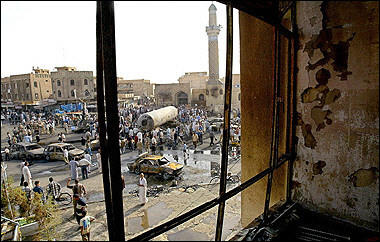
A small taste of what would happen if U.S. forces were to leave Iraq:


A general view of the square where a suicide bomber killed at least 60 people and wounded 85 in a massive fireball, when he blew himself up next to a liquefied gas tanker outside a Shiite mosque in the town of al-Mussayib, south of Baghdad. More than 110 Iraqis were killed and 300 wounded in a three day suicide bombing blitz as justice officials lifted the curtain on the trial of ousted dictator Saddam Hussein.(AFP/Ahmad al-Rubaye)

Unusually Bad Advice

Don Boudreaux of Cafe Hayek writes:

I content myself here merely to point out that if a government has any legitimate functions, surely the most central of these is to protect its people from violence inflicted by foreign invaders. If Uncle Sam’s current foreign policies promote such invasions of terrorists (as Pape’s evidence suggests), then Uncle Sam’s first duty – if it truly puts the welfare of Americans first – is to have its garrisons and guns scram from the middle east ASAP.

Our garrisons and guns in the Middle East are there not only to fight organized terrorism (not an oxymoron) but also to guard our access to oil. Our withdrawal would enable bin Laden and his ilk to disrupt the production and shipment of oil at will. Our withdrawal would also send the message that we’re unwilling to defend our vital interests, which would only embolden bin Laden and his ilk. In sum, withdrawal would undermine the economic and physical security of Americans.

Boudreaux, who usually thinks clearly, seems to have let his anti-statism cloud his judgment on a matter of fundamental importance to Americans. Cafe Hayek is reliable on economic issues, but not otherwise.

The only way to defend against terrorism is to fight it, wherever we find it.