
Howard Zinn, ranting from the Left, assembles a hodge-podge of non-sequiturs, false premises, and excluded middles in his attack on American exceptionalism (“The Power and the Glory,” Boston Review). Or is it an attack on American self-defense, religion, and G.W. Bush? It’s all of the above, premised on the notion that because America isn’t perfect it must be evil and resisted by the rest of the world. Same to you, Howard.
Category: War – Peace – Foreign Affairs
Perspectives on Iraq
Defeatism from isolationist libertarians:
Selective quotations: US Officers See No Military Solution In Iraq.
Gloom and doom about military recruiting: You and What Army?.
The not altogether gloomy facts about military recruiting: Army misses recruiting goal again.
How to help the Iraqis win their own war: Training the Iraqi Army
Someone who understands the real problem: Recruitment Improvement, in which the author says:
I read that the Army and the Marines are not meeting their enlistment quotas and I have two thoughts about this problem:
One, pay them a lot more. Not just a little more, but a lot more. Much, much more. They are indispensable. Let’s treat them that way. If we have to raise taxes to do it, let’s do it. These guys deserve a great life style if they offer up their lives for us.
Second, why would anyone join the Army if he reads the newspapers and watches TV? The mainstream media show the military doing three things: being criminals, abusing captives, killing civilians, torturing the innocent — that’s one way. Then they show the Army being stupid, making mistakes that get people killed. That’s the second way. Then they show the military getting killed.
Who would want to join a military that’s criminal, stupid, and a deathtrap?
But what if the media showed the military building schools, saving little children’s lives, feeding families, getting sick people medical care? What if the media showed smiling, grateful Iraqis thanking the Army and the Marines? What if the media showed the military winning battles and capturing and killing terrorists?
But this is the more true picture of the military and it rarely gets showed.
Again, why wouldn’t the Army and Marines have trouble attracting recruits if the media is endlessly saying you have to be a fool to enlist?
Well, I guess it never ends, does it?
The American media are still fighting the anti-Vietnam War. I guess it never ends.
But there’s this: Good news from Iraq, part 29. And there’s a lot of it. Where there’s a will, there’s a way. That used to be the American spirit. It still is, where it matters, which is in the White House (from Staying in Iraq):
It’s too bad this job has turned out to be tougher than expected. But “bad” isn’t “calamitous” — the condition into which everything would fall were we to say to democratic, liberty-seeking Iraq: Over to you; call us if you need anything, like advice on franchising pizza delivery service.
The president knows the consequences of copping out. We may count on him both to recognize and live up to his understanding, which is that as awful as Iraq might be, more awful still would be a stampede now for the exits. No sensible government allows itself to be governed in turn by pollsters.
Let us hope that sensible government is here to stay for a while.
I Dare Call It Treason
The New York Times today reports on a CIA cover operation. Winds of Change summarizes:
Today’s New York Times provides intimate detail on the charter flights used by the CIA to ferry prisoners across the globe. The names of the charter companies are disclosed. The types of aircraft flown are revealed. The points of departure and destinations of these flights are stated. There is even a picture of one of the charter craft, with the identification number of the aircraft in full display.
All of this is extremely valuable to al Qaeda members who may have an interest in rescuing, or if deemed appropriate, conducting a suicide attack against suspected extraction flights. A successful attack resulting from this story can endanger the lives of CIA, security and civilian personnel involved in these missions, as well as deprive the intelligence and military communities of valuable information that can be gained from interrogations….
What exactly is the purpose of the New York Times in reporting on sensitive issues such as these? Do they even care about the consequences of making such information pubic? It appears the editors of the New York Times feel that breaking a titillating story about sensitive CIA operations is much more important than national security and the lives of those fighting in the war. All to our detriment.
If the Times‘s reporting isn’t “aid and comfort” to the enemy, I don’t know what is. As I wrote here:
The preservation of life and liberty necessarily requires a willingness to compromise on what — in the comfortable world of abstraction — seem to be inviolable principles. For example:
- The First Amendment doesn’t grant anyone the right to go on the air to compromise a military operation by American forces…
The NYT article about a CIA operation being conducted in support of an authorized war amounts to the same thing. The right to publish cannot be absolute and should not exempt anyone from a charge of treason.
Eine Kleine Schadenfreude!
France Says No to EU Constitution
Two reasons to rejoice: (1) the prospect of something like self-rule for Europeans and (2) the rebuke to Jacques Chirac, le premier con de France.
War and Other Bad News
John Tierney’s latest NYT piece (“Give Peace a Chance“) puts war in perspective:*
You would never guess it from the news, but we’re living in a peculiarly tranquil world. The new edition of “Peace and Conflict,” a biennial global survey being published next week by the University of Maryland, shows that the number and intensity of wars and armed conflicts have fallen once again, continuing a steady 15-year decline that has halved the amount of organized violence around the world….
Meanwhile, the number of people fighting has plummeted, even though population has grown enormously….
These benign trends may be hard to believe, especially if you’ve been watching pictures from Iraq or listening to warnings about terrorists acquiring nuclear weapons. One explosion could indeed change everything.
But before you dismiss the optimists as hopeless naifs, you might ask yourself if you’re suffering from the malaise described in a book by [Gregg] Easterbrook called “The Progress Paradox”: the better life gets, the worse people feel. The more peaceful and wealthy the world becomes, the more time we all have to watch wars and warnings on television.
The only antidote is to look at long-term trends instead of daily horrors. For a really long-term trend, consider that of 59 skeletons found in a Stone Age graveyard, at least 24 died from violence. Or that a quarter of the male population died fighting in some pre-agricultural societies.
In the 20th century, despite two world wars, humans had less than a 2 percent chance of dying in war or a mass killing, according to John Mueller, a political scientist at Ohio State. Today the risk is lower still – about a quarter the chance of dying in a car accident.
Tierney focuses on war, but the same story applies to disease, nutrition, poverty, our ability to cope with bad weather, the quality of the products and services we buy, and on and on into the night.
Most of us are so busy making progress that we hardly notice it. Then we catch the news, where bad things are played up because they’re unusual, which is what sells advertising. And so, deluded by the media, we forget that progress is almost universal and constant.
I like to remember what I once told my boss’s secretary, who kept nagging me for my monthly progress report: “I’m making so much progress that I don’t have time to report it.” Think of that the next time you see a disaster headline.
Better yet, ignore the disaster headline. What can you do about it, anyway?
__________
* Tierney, as usual, appends a bibliography:
“The End of War?: Explaining Fifteen Years of Diminishing Violence” by Gregg Easterbrook. The New Republic, pp. 18-21, May 30, 2005
The Progress Paradox : How Life Gets Better While People Feel Worse by Gregg Easterbrook (Random House. 400 pp., November 2003)
Why Isn’t There More Violence? By John Mueller. Security Studies 13, p. 191-203, Spring 2004
The Remnants of War by John Mueller. (Cornell University Press, 272 pp., September 2004)
The Ultimate Resource 2 by Julian L. Simon. (Princeton University Press, 778 pp., July 1998)
Peace and Conflict 2005: A Global Survey of Armed Conflicts, Self-Determination Movements, and Democracy by Monty G. Marshall and Ted Robert Gurr
Getting It Right about Terrorism
This makes sense to me:
In Poverty, Political Freedom, and the Roots of Terrorism (NBER Working Paper No. 10859) Alberto Abadie…finds that the risk of terrorism is not significantly higher for poorer countries, once other country-specific characteristics are considered. In particular, Abadie finds that a country’s level of political freedom better explains the presence of terrorism….
After controlling for the level of political rights, fractionalization, and geography, Abadie concludes that per capita national income is not significantly associated with terrorism. He finds, though, that lower levels of political rights are linked to higher levels of terrorism[.] [C]ountries with the highest levels of political rights are also the countries that suffer the lowest levels of terrorism. However, the relationship between the level of political rights and terrorism is not a simple linear one. Countries in an intermediate range of political rights experience a greater risk of terrorism than countries either with a very high degree of political rights or than severely authoritarian countries with very low levels of political rights.
Why this relationship? Abadie offers two possibilities. “On the one hand, the repressive practices commonly adopted by autocratic regimes to eliminate political dissent may help [keep] terrorism at bay,” he explains. “On the other hand, intermediate levels of political freedom are often experienced during times of political transitions, when governments are weak, political instability is elevated, so conditions are favorable for the appearance of terrorism.”
(Thanks to EconoPundit for the pointer.)
A Quasi-Jacksonian Solution
UPDATED BELOW
This:
The Pentagon is seeking to enlist help from the State Department and other agencies in a plan to cut by more than half the population at its detention facility in Guantánamo Bay, Cuba, in part by transferring hundreds of suspected terrorists to prisons in Saudi Arabia, Afghanistan and Yemen, according to senior administration officials….
The White House first embraced using Guantánamo as a holding place for terrorism suspects taken in Afghanistan, in part because the base was seen as beyond the jurisdiction of United States law. But recent court rulings have held that prisoners there may challenge their detentions in federal court.
Indeed, the Pentagon has halted, for the last six months, the flow of new terrorism suspects into the prison, Defense Department officials said. In January, a senior American official said in an interview that most prisoners at Guantánamo no longer had any intelligence value and were not being regularly interrogated.
The proposed transfers would represent a major acceleration of Pentagon efforts that have transferred 65 prisoners from Guantánamo to foreign countries.
Reminds me of this:
On March 3, 1832, Chief Justice Marshall handed down the unanimous opinion of the Court. The Cherokee Nation was sovereign. Georgia law no longer applied to the Cherokee. Justice Story wrote “The Court has done its duty. Now let the Nation do theirs.” At some point, Andrew Jackson supposedly said “Marshall made the ruling, let him enforce it.”
It seems that the White House has taken my advice, after a fashion.
UPDATE:
Judges are still getting into the act:
A federal judge on Saturday prohibited the government from transferring 13 Yemeni prisoners from the military’s detention facility at Guantánamo Bay, Cuba, until a hearing could be held on their lawyers’ fear that they might face torture if sent to another country.
With results like this:
Authorities have begun legal action against two Frenchmen for alleged terrorist-related activity following their release from the U.S. military prison at Guantanamo Bay, Cuba, judicial officials said Saturday.
Welcome to the Land of Oz
And I don’t mean Australia. I’ve been living in the Land of Oz, and I didn’t know it. But I do now, thanks to outfits like WING TV. For example, here’s the way the world works, according to Victor Thorn’s “The Real Dark Overlords“:
George Bush is an empty suit Manchurian creation of nepotistic fate who serves as a lightning-rod diversion to distract people’s attention away from the actual hidden evil daemon that are manipulating our planet through wars, finance, false religion, and a reconditioning of our mental faculties….
…George Bush is not enemies with Osama bin Laden, Saddam Hussein, or even Al Gore and John Kerry. It’s all a con-job because these individuals are all on the same team, and they’re all serving the same masters in one capacity or another. And what is their ultimate goal as they sell their souls? Answer: to preserve the controlling elite’s status quo, and subsequently their positions of subservient power within it.
George Bush is merely a puppet; a figurehead; and an implementer….if YOU were running the world, would you let George W. Bush be the CEO? Hell, the Bushes don’t even trust him enough to run their own family business! So, in this sense, he’s nothing more than a dangling carrot that is used as either a figure of adoration for the kool-aid conservatives, or a symbol of disdain for the lockstep liberals….Yet for some inexplicable reason, many people who should know better still allow themselves to be bamboozled by this illusory left/right paradigm….
Please, remember: George Bush, Bill & Hillary Clinton, Ronald Reagan, and John Kerry are not (and were not) the ultimate idols and demons. They’re simply conduit/actors on the public stage who are advancing the goals of those behind the veil…. “What is essential is invisible to the eye.” In other words, the true fiends that are destroying our world and feeding off their hosts (that means us – everyday people) like parasitical vampires are far-removed from the glare of public exposure….
The key to remember is this: George Bush and his ilk are merely SYMPTOMS of evil; not the true CAUSE. If we really want the truth, we have to insist on looking further than what is standing right before us.
Yup. That’s why WING TV is presenting “9/11 on Trial” this very day:
“9-11 on Trial”…will examine the government’s explanation of events following the terror attacks of September 11, 2001. Specifically, the focal point of these proceedings will be: did burning jet fuel cause the collapse of each World Trade Center tower? A subsequent trial in mid-to-late 2005 will take into consideration whether Flight 77 – a Boeing 757 – struck the Pentagon.
To prosecute this case, we are going to rely solely on verifiable scientific data of the highest order (as opposed to the obvious pitfalls associated with “theory”). In this sense, our focus will be exclusively directed at the CAUSE of the towers’ collapse, and not any peripheral SYMPTOMS.
We are engaging in this project for two primary reasons: (a) to counteract a “black hole” of sorts that has engulfed previous and/or current 9-11 lawsuits, all of which seem to be squashed, in limbo, or severely compromised; and (b) to show that this case can be proven in a court of law relying solely on verifiable scientific facts, physics, and the laws of nature.
At this point we have amassed mountains of data, but if anyone would like to submit material which fits the above-mentioned criteria, their contributions are most certainly welcome.
“9-11 on Trial” promises to be an historic event, for we will prove beyond a shadow of a doubt – in a courtroom setting for all the world to see – that the government’s explanation of events were nothing more than bold-faced lies.
Popular Mechanics disposes of crap like “9-11 on Trial” in “9/11: Debunking the Myths“:
FROM THE MOMENT the first airplane crashed into the World Trade Center on the morning of September 11, 2001, the world has asked one simple and compelling question: How could it happen?
Three and a half years later, not everyone is convinced we know the truth. Go to Google.com, type in the search phrase “World Trade Center conspiracy” and you’ll get links to an estimated 628,000 Web sites. More than 3000 books on 9/11 have been published; many of them reject the official consensus that hijackers associated with Osama bin Laden and Al Qaeda flew passenger planes into U.S. landmarks.
Healthy skepticism, it seems, has curdled into paranoia. Wild conspiracy tales are peddled daily on the Internet, talk radio and in other media. Blurry photos, quotes taken out of context and sketchy eyewitness accounts have inspired a slew of elaborate theories: The Pentagon was struck by a missile; the World Trade Center was razed by demolition-style bombs; Flight 93 was shot down by a mysterious white jet. As outlandish as these claims may sound, they are increasingly accepted abroad and among extremists here in the United States.
To investigate 16 of the most prevalent claims made by conspiracy theorists, POPULAR MECHANICS assembled a team of nine researchers and reporters who, together with PM editors, consulted more than 70 professionals in fields that form the core content of this magazine, including aviation, engineering and the military.
In the end, we were able to debunk each of these assertions with hard evidence and a healthy dose of common sense. We learned that a few theories are based on something as innocent as a reporting error on that chaotic day. Others are the byproducts of cynical imaginations that aim to inject suspicion and animosity into public debate. Only by confronting such poisonous claims with irrefutable facts can we understand what really happened on a day that is forever seared into world history.–THE EDITORS
Letsroll911.org, another conspiracy-mongering outfit,tries to debunk the debunking by using impeachable witnesses, fuzzy images (into which one can see anything one wishes to see), and such impeccable logic as this:
Did you know that: Popular Mechanics is owned by Hearst Publications, and that the term “Yellow Journalism” came from shoddy reporting from Hearst Newspapers, most notoriously Hearst’s promotion of the false claim that Spain had blown up the USS Maine in Havana harbor which was the pretext for the Spanish-American war…?
In other words, your grandfather was a horsethief, so you must be a wife-beater.
As PM‘s Jim Meigs notes:
“Everyone is entitled to his own opinion,” the great Sen. Daniel Patrick Moynihan of New York was fond of saying. “He is not entitled to his own facts.”…
These 9/11 conspiracy theories, long popular abroad, are gradually–though more quietly–seeping into mainstream America. Allegations of U.S. complicity in the attacks have become standard fare on talk radio and among activists on both the extreme left and the extreme right of the political spectrum.
Which brings me to the Republic Broadcasting Network, another purveyor of non-stop conspiracy theorizing, which offers tidbits like these:
What Was Dick Cheney Doing on the Morning of September 11, 2001?
It’s obvious to me, now, that the “controlling elite” that stands “behind the veil” is a capitalist, neo-Nazi, Zionist cabal. And all these years I thought it was only Frank Morgan.
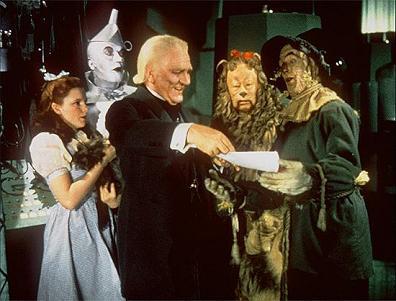
Dorothy (Judy Garland), the Tin Woodman (Jack Haley), the Cowardly Lion (Bert Lahr) and the Scarecrow (Ray Bolger) with the Wizard (Frank Morgan) in “The Wizard of Oz,” distributed by Warner Bros.
Treasonous Blogging?
Tom W. Bell of Agoraphilia posts about and links to an article he has submitted to several law reviews. The title is of the article is “Treason, Technology, and Freedom of Expression.” Here are some excerpts of the abstract and concluding section:
The power to punish treason against the U.S. conflicts with the First Amendment freedoms of speech and of the press. Far from a question of mere theory, that conflict threatens to chill public dissent to the War on Terrorism….After World War II, the United States won several prosecutions against citizens who had engaged in propaganda on behalf of the Axis powers. Today, critics of the War on Terrorism likewise face accusations of treason. Under the law of treasonous expression developed following World War II, those accusations could credibly support prosecutions. Any such prosecutions could win convictions, moreover, unless courts narrow the law of treasonous expression to satisfy the First Amendment….
In terms of abstract doctrine, the law of treason condemns anyone who owes allegiance to the U.S., who adheres to U.S. enemies, and who gives them aid and comfort by an overt act to which two witnesses testify. As courts have applied that doctrine, however, it threatens any citizen or resident of the U.S. who publicly expresses disloyal sentiments. The Internet has made it cheap, easy, and dangerous to publish such sentiments….Even if no prosecutions for treason arise, the alarmingly broad yet ill-defined reach of the law of treason threatens to unconstitutionally chill innocent dissent….
As courts have interpreted it, the law of treason allows for the punishment of an indeterminate but wide range of disloyal public expressions that help enemies of the U.S. That interpretation both subverts the original meaning of the constitution’s treason clause and violates the strict scrutiny test applied to content-based restrictions on expression. To save the law from unconstitutionality, courts should in cases of treasonous expression interpret the “adhering to [U.S.] enemies” element of treason as nothing broader than “being employed by enemies of the U.S.” Perhaps courts should demand a still less restrictive variation on the law of treason. Perhaps they should do away with the law of treasonous expression altogether. At the least, though, they should limit liability for treasonous expression to defendants employed by enemies of the U.S. Anything broader than that would, by wounding our First Amendment rights, do far more to harm the U.S. than disloyal expressions would.
I disagree with the compromise position Bell offers in the final sentence. If it’s treason, it’s treason. An unpaid traitor can do just as much harm to the nation as can a paid traitor.
It would be better to do away with the law of treasonous expression altogether than to draw an arbitrary line between paid and unpaid traitors. If a person’s treachery goes no further than expressions of hatred for America or sympathy with America’s enemies, let that person suffer the consequences in the forum of public opinion.
We bloggers are already facing enough trouble, given the strong possibility that our freedom of expression may be throttled by the strict application of the McCain-Feingold Act. The last thing that we (bloggers) need is an inquisition into our views about the War on Terrorism.
I do detest the extremists of the left and right who portray America as the villain of the piece. But I defend their right to do so — as long as they aren’t doing it on my dime.
Free Riders to the North
Canada Opts Out of U.S. Defense Shield
TORONTO – Prime Minister Paul Martin said Thursday that Canada would opt out of the contentious U.S. missile defense program, a move that will further strain brittle relations between the neighbors but please Canadians who fear it could lead to an international arms race.
Martin, ending nearly two years of debate over whether Canada should participate in the development or operation of the multibillion-dollar program, said Ottawa would remain a close ally of Washington in the fight against global terrorism and continental security.
It’s the old “arms race” bugaboo. In other words, when we stop arming the bad guys will stop, too. Ha! As Reagan proved in the 1980s, when we continue to arm, the bad guys are (a) outmatched, (b) give up because they can’t afford to keep up with us, or both.
Actually, Martin’s decision smacks of an excuse to free-ride at the expense of American taxpayers. Martin and his advisers know full well that our defense shield must provide at least partial protection for Canada — especially for the most densely populated parts of Canada, which lie along or near the border with the U.S.
As for the rest of it, I’m not impressed by Canada’s politically correct stance on terrorism. Nor am I aware of any significant Canadian contributions to continental security.
The Canadian anthem is a parody of the political views now dominant in the land of my forbears.* Read it and weep:
O Canada!
Our home and native land!
True patriot love in all thy sons command.With glowing hearts we see thee rise,
The True North strong and free!From far and wide,
O Canada, we stand on guard for thee.God keep our land glorious and free!
O Canada, we stand on guard for thee.O Canada, we stand on guard for thee.
__________
* With the notable exception of the Red Ensign Bloggers:
Abraca-Pocus!
Absinthe & Cookies
All AgitProp, all the Time…
Angry in the Great White North
Anthroblogogy
Argghhh!
Babbling Brooks
bluetory.ca
bound by gravity
BumfOnline
canadiancomment
Candepundit
ChrisCam
doxology
dustmybroom
ESR | Musings…
Gen X at 40
Hammer into Anvil
Hypothesis.ca
John The Mad
Just Between Us Girls
Minority of One
Musing
Musings of a Canadian Slacker
myrick
Nathan’s Updates from Seoul
North Western Winds
OCCAM’S CARBUNCLE
Quotulatiousness
Raging Kraut
Ravishing Light
Rempelia Prime
Rightjab
SHINY HAPPY GULAG
Skeet Skeet Skeet
Stephen Taylor
Striving Against Opposition
Taylor & Company
The Freeway To Serfdom
The Green Baron
The Last Amazon
The London Fog
The Meatriarchy
The Monger
The Phantom Observer
The Tiger in Winter
tipperography
Trudeaupia
West Coast Chaos
Dancing with Chirac
UPDATED, BELOW
James Lewis at The American Thinker doesn’t think much of our apparent flirtation with Jacques Chirac and his band of continental cronies:
Even while Condi Rice was in Europe, the EU was planning to lift its arms embargo against China. Jacques Chirac flew to Beijing to sell stealth aircraft to China a few months ago, knowing that the Red Army has some 600 short-range missiles aimed at Taiwan. Against those bombers, the Taiwanese may be helpless. In the last Taiwan crisis the US had to interpose naval ships in the Straits, placing our ships in mortal danger to keep the peace. High-tech European arms could easily destabilize that fragile balance. This is a classic old Great Power gambit, to arm the enemy of your enemy. It is how the Kaiser knocked out Russia in 1917. Now the US military is forced [to] plan for a two-front war, one in Iraq, the other in the Pacific. Merci beaucoup, our European friends.
So while the American media go all moist and fuzzy about Europe’s willingness to forgive our sins, I would just ask one question: What European allies?
I don’t think Bush has any illusions about the intentions of Chirac and Schroeder. The “opening to Europe” strikes me as a ploy to quell, if not dispel, the fashionable, uninformed (or malicious) grumbling about “unilateralism.” When Bush shows you his left, look out for the hard jab with the right, followed by a left hook. In this case, I expect to see something like this: “I tried to make nice to Europe, but they’re just bent on opposing our interests,” followed by unilateral military action as necessary against Korea, Iran, or Syria.
Don’t misunderestimate Mr. Bush.
UPDATE:
Mark Steyn is on my frequency:
[T]he administration is changing the tone [vis-à-vis Europe] precisely because it understands there can be no substance. And, if there’s no substance that can be changed, what’s to quarrel about? International relations are like ex-girlfriends: if you’re still deluding yourself you can get her back, every encounter will perforce be fraught and turbulent; once you realise that’s never gonna happen, you can meet for a quick decaf latte every six – make that 10 – months and do the whole hey-isn’t-it-terrific-the-way-we’re-able-to-be-such-great-friends routine because you couldn’t care less. You can even make a few pleasant noises about her new romance (the so-called European Constitution) secure in the knowledge he’s a total loser.
Irrelevance, thy name is Old Europe.
Getting It Almost Right about Iraq
Mark Brown, a Chicago Sun-Times columnist, asks “What if Bush has been right about Iraq all along?” Brown who “opposed the Iraq war since before the shooting started,” is now beginning to think the unthinkable: “What if it turns out Bush was right, and we [knee-jerk opponents of the war] were wrong?”
But he still has many qualms:
Going to war still sent so many terrible messages to the world. [Well, it certainly sent this message: Don’t mess with US.]
Most of the obstacles to success in Iraq are all still there, the ones that have always led me to believe that we would eventually be forced to leave the country with our tail tucked between our legs. (I’ve maintained from the start that if you were impressed by the demonstrations in the streets of Baghdad when we arrived, wait until you see how they celebrate our departure, no matter the circumstances.) [What are those obstacles to success, other than the defeatist rhetoric spewed by contemporary versions of Axis Sally and Tokyo Rose? We faced tougher odds in World War II, and its aftermath, and overcame them because we were determined to do so.]
In and of itself, the voting did nothing to end the violence. The forces trying to regain the power they have lost — and the outside elements supporting them — will be no less determined to disrupt our efforts and to drive us out. [So what? Does that mean we should let them drive us out? I guess it does if you’re one of the Mark Browns of this world whose mind cannot comprehend the strategic value of the Middle East. Perhaps his SUV runs on ethanol.]
Somebody still has to find a way to bring the Sunnis into the political process before the next round of elections at year’s end. The Iraqi government still must develop the capacity to protect its people. [The Sunnis can get on the train or get run over by it. I suspect they’ll get on board. With adequate help from the U.S., the Iraqi government will develop the capacity to protect its people. That’s another reason not to pull out just to satisfy the “peace at any price” crowd.]
And there seems every possibility that this could yet end in civil war the day we leave or with Iraq becoming an Islamic state every bit as hostile to our national interests as was Saddam. [The only way to ensure a civil war and the creation of an Islamic state is to pull out prematurely and allow civil war to happen.]
Brown — like his brethren on the left — simply can’t understand what the war in Iraq is all about because his mind is cluttered with Orwellian slogans: “America evil – war always bad.” Thus it has been since the U.S. broke with Stalin in the aftermath of World War II. But, unlike Stalin, “intellectual” lefties like Brown have no conception of the uses of power, for good as well as evil.
In the “intellectual” version of the world, things will happen simply because of inexorable historical forces, that is, because lefties wish they would happen. Marx (the intellectual) wished for “dictatorship of [by] the proletariat,” and Lenin (the man of action) gave Russia dictatorship — period.
Yes, ideas are important, but they’re nothing without action. And — thank God — we have a president who knows it. When you want good things to happen you have to be in command of events. That’s where we seem to be at the moment. And that’s where we’ll stay, as long as defeatists like Brown, Kennedy, and Kerry don’t have their way.
Why We Fight
December 7, 1941

September 11, 2001

I was far too young on December 7, 1941, to understand what had happened on that awful day in American history. I remember September 11, 2001, all too well.
I am not by nature an empathic person. But on the morning of September 11, 2001, I immediately empathized with those Americans who — 60 years earlier — must have felt the kind of shock, fear, and rage that I felt when I saw and learned what 19 vicious fanatics had unleashed in New York, Virginia, and Pennsylvania. Now we are engaged in a war — at home and abroad — against the comrades and supporters of those 19 vicious fanatics.
Some Americans support that war but question the way our government is pursuing it. Other Americans wonder why we are engaged in that war or whether it is worth the cost. I will not try to persuade either of those groups, nor will I call them names. My thoughts, today, are aimed at those who have supported the war and the way the government is pursuing it, but who may be beginning to waver in the face of what the press portrays as adversity.
Don’t lose heart. Don’t fall victim to the post-Vietnam syndrome of American defeatism. I will explain.
Vietnam was the wrong war, in the wrong place, at the wrong time. But once we had committed our forces there, we should have fought to win, regardless of the amount of force required for victory. Why? Because our ignominious withdrawal from Vietnam changed the national psyche — especially coming as it did within a generation of the stalemate in Korea. As a result of Vietnam, we went from believing that we could win any war we set our minds to win to believing that there wasn’t a war worth fighting.
Our (incomplete) victory in the Gulf War of 1991 came so quickly and at so little cost that it didn’t really reinvigorate America’s military self-confidence. Our 1999 bombing campaign in Kosovo succeeded only in showing our willingness to win a quick victory (if it was that) in a situation that posed little or no threat to American forces.
On the other hand, the new, defeatist American psyche — which most of the mainstream press has been striving for 30 years to perpetuate — manifested itself in our abrupt withdrawals from Lebanon (1983) and Somalia (1993) after the public saw “too many” body bags. Then there was our legalistic response to the 1993 World Trade Center bombing and our tepid military response to the 1998 bombings of the U.S. embassies in Kenya and Tanzania. The sum total of American actions in 1983, 1993, and 1998 — coupled with the obvious ascendancy of American defeatism — surely led Osama bin Laden to believe that he could accomplish his aims through a few spectacular terrorist attacks within the U.S., and the threat of more such attacks.
Thus, although we may be having a hard time in Iraq — and the hard time may continue for a while — we cannot back down. We must redouble our efforts to quell the insurgency and to build a stable Iraq. To do otherwise would be to admit that the American psyche remains defeatist. It would invite our enemies and potential enemies to take bold actions — if not directly against us, then against our interests around the world. We would find it harder and harder to fight back, diplomatically and militarily, against increasingly emboldened enemies and rivals — even if we had the will to fight back. Vital resources would become exorbitantly expensive to us, if we did not lose access to them altogether. America’s economic and military might would descend together, in a death spiral, and with them — very likely — the remnants of domestic civility.
And that is how bin Laden will destroy America, if he can. And that is why we must persevere in Iraq.
Some argue that such scenarios are so unrealistic as to be unthinkable. Well, that’s what English pacifists were saying about Hitler until 1939.
Then, there are those who profess to believe that America would be better off shorn of its economic and military might. They should reflect on the 1930s, when we were mired in the Great Depression and surrounded by a rising tide of totalitarianism.
Others, mimicking the one-worlders who dominated the conventional wisdom about foreign policy after the two world wars, suggest that our hubris foments hatred, hostility, and rivalry toward America . Their naïve notion — based on hope rather than reality — is that we would court less trouble and find more support by suppressing our sovereign pride and adapting our values, interests, and policies to those of “the international community.” Those who think that should consider this:
The sovereignty of the United States is inseparable from the benefits afforded Americans by the U.S. Constitution, most notably the enjoyment of civil liberties, the blessings of more-or-less free markets and free trade, and the protections of a common defense. To cede sovereignty is to risk the loss of those benefits….
Given the low estate of civil liberties and free markets in Europe — and most of the world — it is worth almost any price to preserve America’s sovereign independence, which is the bodyguard of America’s values and interests. The immediate price we must pay is the price of perseverance in Iraq.
Does the Constitution Allow This?
The First Amendment says that “Congress shall make no law…abridging the freedom of speech, or of the press….” Great stuff. I buy it. But then there’s this, from a story at latimes.com:
On the evening of Oct. 14, a young Marine spokesman near Fallouja appeared on CNN and made a dramatic announcement.
“Troops crossed the line of departure,” 1st Lt. Lyle Gilbert declared, using a common military expression signaling the start of a major campaign. “It’s going to be a long night.” CNN, which had been alerted to expect a major news development, reported that the long-awaited offensive to retake the Iraqi city of Fallouja had begun.
In fact, the Fallouja offensive would not kick off for another three weeks. Gilbert’s carefully worded announcement was an elaborate psychological operation — or “psy-op” — intended to dupe insurgents in Fallouja and allow U.S. commanders to see how guerrillas would react if they believed U.S. troops were entering the city, according to several Pentagon officials.
In the hours after the initial report, CNN’s Pentagon reporters were able to determine that the Fallouja operation had not, in fact, begun.
“As the story developed, we quickly made it clear to our viewers exactly what was going on in and around Fallouja,” CNN spokesman Matthew Furman said.
Officials at the Pentagon and other U.S. national security agencies said the CNN incident was not an isolated feint — the type used throughout history by armies to deceive their enemies — but part of a broad effort underway within the Bush administration to use information to its advantage in the war on terrorism….
Surely the viewers of CNN included our enemies, or persons friendly to them who passed along the information broadcast by CNN.
I know the arguments about undermining the credibility of the news media — and the government — by using the media to broadcast disinformation. But those are just arguments. The fact is that the U.S. is engaged in a legal war against a determined and ruthless enemy, and the use of disinformation is a time-honored tactic of warfare. Why not risk undermining the credibility of the media — to the extent that the media have much credibility left — if it helps to win the war?
Unless CNN’s report and the news story I’ve quoted are part of a disinformation campaign, it seems that media may be undermining the war effort by revealing particular instances of disinformation and giving the enemy hints as to the shape of our disinformation campaign.
That leads to my question: Is there an interpretation of the Constitution that would make it illegal for the media to publish information that compromises military operations?
ADDENDUM: If there is a compelling governmental interest in the regulation of political speech (i.e., campaign-finance “reform”) and a compelling governmental interest in allowing publicly funded universities to pursue “diversity” (a concept that I cannot find in the Constitution), why not a compelling governmental interest in the suppression of media reports that undermine the prosecution of a constitutional war?
I’m being provocative here because I hope to draw out my host and some of his readers on this issue.
What Makes Them So Special?
From The Washington Times:
9/11 kin support provisions on illegals
THE WASHINGTON TIMES
A group of families of September 11 victims yesterday told Congress to scrap the entire intelligence overhaul effort this year and start over next year rather than pass the pending bill, which omits strong immigration security provisions.
“You allowed the murder of my son. I will not allow you to kill my daughters,” said Joan Molinaro, mother of a New York City firefighter who died September 11….


Every American has a stake in the future course of the war on terror, not just those who lost loved ones on 9/11. It’s time for the “9/11 kin” to quit hogging the microphone and let other voices be heard.
But War Isn’t the Answer
The Globe and Mail of Toronto reports:
People will use ‘direct action’ to express themselves, says one campaign organizer
By GLORIA GALLOWAY
Saturday, November 27, 2004 – Page A7OTTAWA — A coalition of anti-war protesters, left-wing lawyers and anti-capitalists refused repeatedly yesterday to condemn those who might resort to violence during the “loud” demonstrations planned for the visit next week of U.S. President George W. Bush.
“A number of protesters are coming together to protest the real violence going on around the world right now,” said Joe Cressy of the No To Bush campaign, which is organizing two large demonstrations for Nov. 30, the day Mr. Bush will be in Ottawa. “People are angry at Bush. People are going to express themselves through art, through direct action, through a number of different formats.”
Mr. Cressy would not define what he means by direct action, but his committee has already said it will offer medical and legal help to protesters who need it. “Police response can sometimes act as a provocateur of violence,” he said….
Aha! The lefties’ violence won’t be “real.” And if the lefties’ “unreal violence” just happens to result in injuries it will be blamed on “police response.” Doublespeak of that sort is another reason the left occupies the moral low ground.
(Thanks to Charles at Little Green Footballs for the pointer.)
Europe, Take Note
From Robert Kagan’s “The Crisis of Legitimacy: America and the World“:
…The great transatlantic debate over Iraq was rooted in deep disagreement over world order. Yes, Americans and Europeans debated whether Saddam Hussein posed a serious threat and whether war was the right way to deal with it. A solid majority of Americans answered yes to both questions, while even larger majorities of Europeans answered no. Yet these disagreements reflected more than just differing tactical and analytical assessments of the situation in Iraq . As Dominique de Villepin, France ‘s foreign minister, put it, the struggle was less about Iraq than it was between “two visions of the world.” The differences over Iraq were not only about policy. They were also about first principles.
Opinion polls taken before, during, and after the war show two peoples living on separate strategic and ideological planets. Whereas more than 80 percent of Americans believe that war can sometimes achieve justice, less than half of Europeans agree. Americans and Europeans disagree about the role of international law and international institutions and about the nebulous but critical question of what confers legitimacy on international action. These diverging world views predate the Iraq war and the presidency of George W. Bush, although both may have deepened and hardened the transatlantic rift into an enduring feature of the international landscape.
At the beginning of 2003, before the Iraq war, the transatlantic gulf was plainly visible. What was less clear then was how significant it would turn out to be for the world as a whole.
Today, a great philosophical schism has opened within the West, and mutual antagonism threatens to debilitate both sides of the transatlantic community. At a time when new dangers and crises are proliferating rapidly, this schism could have serious consequences. For Europe and the United States to come apart strategically is bad enough. But what if their differences over world order infect the rest of what we have known as the liberal West? Will the West still be the West?
A few years ago, such questions were unthinkable. After the Cold War, the political theorist Francis Fukuyama assumed along with the rest of us that at the end of history the world’s liberal democracies would live in relative harmony. Because they share liberal principles, these democracies would “have no grounds on which to contest each other’s legitimacy.” Conflicts might divide the West from the rest, but not the West itself. That reasonable assumption has now been thrown into doubt, for it is precisely the question of legitimacy that divides Americans and Europeans today — not the legitimacy of each other’s political institutions, perhaps, but the legitimacy of their respective visions of world order. More to the point, for the first time since World War II, a majority of Europeans has come to doubt the legitimacy of U.S. power and of U.S. global leadership….
…To address today’s global dangers, Americans will need the legitimacy that Europe can provide, but Europeans may well fail to grant it. In their effort to constrain the superpower, they might lose sight of the mounting dangers in the world, which are far greater than those posed by the United States. Out of nervousness about unipolarity, they might underestimate the dangers of a multipolar system in which nonliberal and nondemocratic powers would come to outweigh Europe. Out of passion for the international legal order, they might forget the other liberal principles that have made postmodern Europe what it is today. Europeans might succeed in debilitating the United States this way. But since they have no intention of supplementing its power with their own, in doing so they would only succeed in weakening the overall power that the liberal democratic world can wield in its defense — and in defense of liberalism itself.
Right now, many Europeans are betting that the risks posed by the “axis of evil,” from terrorism to tyrants, will never be as great as the risk posed by the American leviathan unbound. Perhaps it is in the nature of a postmodern Europe to make such a judgment. But now may be the time for the wisest heads in Europe, including those living in the birthplace of Pascal, to ask themselves what will result if that wager proves wrong.
Europeans should reflect on this simple fact: The enemy of Europe’s rival isn’t Europe’s friend.
Seeing the Handwriting
Charles Paul Freund, writing at reasononline more than two years ago, said:
…The U.S.’ actual intentions in Iraq may have very little—perhaps nothing—to do with the reasons that have been offered by the administration, either before the UN or in the domestic debate. The U.S. may actually be pursuing a strategy it is unwilling to articulate in public….
Getting rid of Saddam and installing a friendly government in his place would have immediate consequences, because it would give the U.S. a number of strategic options it currently lacks. For one thing, the U.S. could count on access to Iraq’s immense oil resources. To some critics on the left, Iraq’s oil is the whole purpose behind Bush’s bellicosity, because he wants to distribute it among his oil-industry cronies. But there is another possibility: Access to Iraqi oil would profoundly alter the U.S. role in the region, because it would alter the nation’s relationship with Saudi Arabia.
The U.S. and Saudi Arabia have long been trapped in a relationship that neither party much likes. But because America needs lots of oil, and because the Saudis need security, the two nations have tried to find a way to deal with each other. The terror attacks have shaken this relationship of interdependence. Most of the hijackers on 9/11 came from Saudi Arabia, and much of the money being funneled into global terrorist networks reportedly originates from there as well. If the U.S. seeks ultimately to choke off the finances of Al Qaeda and groups like it, it must first do something about its dependence on Saudi oil. In that sense, the road to Riyadh runs through Baghdad.
So, perhaps, does the road to Tehran. According to numerous accounts, the mullahs’ control of Iran has been crumbling for months. Many Iranians have had enough of their failed revolution and their economic stagnation. They’ve had enough of being arrested for listening to music on the radio, and of being jailed for attending private gatherings where both men and women are present. Iran’s revolution is now reportedly so shaky that it may collapse even if the U.S. does nothing in the region. Were the U.S. to succeed in establishing a regime in adjacent Iraq that exhibited at least some democratic values and allowed greater personal freedoms, the fate of Iran’s ruling mullahs would probably be sealed, and the future of any future democratic government there bolstered.
A region that features at least relatively democratic regimes in both Iraq and Iran, a Saudi Arabia whose leverage on the West is greatly reduced, and, as Bush put it at the UN, “an independent and democratic Palestine,” however that might be achieved, would be a region where modern political values are advancing and retrograde dictatorship and theocracy are declining.
In his UN address, Bush hinted at the outlines of “a very different future” for the Middle East. As he put it, “The people of Iraq can shake off their captivity. They can one day join a democratic Afghanistan and a democratic Palestine, inspiring reforms throughout the Muslim world. These nations can show by their example that honest government, and respect for women, and the great Islamic tradition of learning can triumph in the Middle East and beyond.”…
Precisely. That’s about what I’ve been saying all along, most recently here:
…The invasion of Iraq was — and is — a means of removing an avowed enemy of the U.S. and gaining a base in the Middle East. If Bush wins re-election, watch the dominos fall in Syria and Iran — both of which are assuredly sponsors of terrorism….
Freund, you’re a genius.
(Thanks to Virginia Postrel for the pointer.)
French Hypocrisy of a Welcome Kind
The Washington Post reports:
French Push Limits in Fight On Terrorism
Wide Prosecutorial Powers Draw Scant Public DissentBy Craig Whitlock
Washington Post Foreign Service
Tuesday, November 2, 2004; Page A01PARIS — In many countries of Europe, former inmates of the U.S. military prison at Guantanamo Bay, Cuba, have been relishing their freedom….
Not so in France, where four prisoners from the U.S. naval base were arrested as soon as they arrived home in July, and haven’t been heard from since. Under French law, they could remain locked up for as long as three years while authorities decide whether to put them on trial — a legal limbo that their attorneys charge is not much different than what they faced at Guantanamo.
Armed with some of the strictest anti-terrorism laws and policies in Europe, the French government has aggressively targeted Islamic radicals and other people deemed a potential terrorist threat. While other Western countries debate the proper balance between security and individual rights, France has experienced scant public dissent over tactics that would be controversial, if not illegal, in the United States and some other countries….
French counterterrorism officials say their preemptive approach has paid off, enabling them to disrupt plots before they are carried out and to prevent radical cells from forming in the first place. They said tips from informants and close cooperation with other intelligence services led them to thwart planned attacks on the U.S. Embassy in Paris, French tourist sites on Reunion Island in the Indian Ocean and other targets.
“There is a reality today: Under the cover of religion there are individuals in our country preaching extremism and calling for violence,” Interior Minister Dominique de Villepin said at a recent meeting of Islamic leaders in Paris. “It is essential to be opposed to it together and by all means.”
Thomas M. Sanderson, a terrorism expert with the Center for Strategic and International Studies in Washington, said France has combined its tough law enforcement strategy with a softer diplomatic campaign in the Middle East designed to bolster ties with Islamic countries.
“You do see France making an effort to cast itself as the friendly Western power,” as distinct from the United States, he said. “When it comes to counterterrorism operations, France is hard-core. . . . But they are also very cognizant of what public diplomacy is all about.”
France has embraced a law enforcement strategy that relies heavily on preemptive arrests, ethnic profiling and an efficient domestic intelligence-gathering network. French anti-terrorism prosecutors and investigators are among the most powerful in Europe, backed by laws that allow them to interrogate suspects for days without interference from defense attorneys.
The nation pursues such policies at a time when France has become well known in the world for criticizing the United States for holding suspected terrorists at Guantanamo without normal judicial protections. French politicians have also loudly protested the U.S. decision to invade Iraq, arguing that it has exacerbated tensions with the Islamic world and has increased the threat of terrorism.
Despite the political discord over Iraq, France’s intelligence and counterterrorism officials say they work closely with their American counterparts on terrorism investigations….
It’s their country, their rules. C’est la vie.
Speaking of the EU Constitution…
…as I was in this post, there’s still a chance that all of Europe won’t be herded down the socialist path by France and Germany. According to an AP story, “All it takes is one rejection to sink the constitution.”
I sometimes wish that our Constitution could have been derailed by only one State’s failure to ratify it. The Antifederalists were mostly right about the consequences of the Constitution. As “An Old Whig” put it in Antifederalist No. 46:
…
Where then is the restraint? How are Congress bound down to the powers expressly given? What is reserved, or can be reserved? Yet even this is not all. As if it were determined that no doubt should remain, by the sixth article of the Constitution it is declared that “this Constitution and the laws of the United States which shall be made in pursuance thereof, and all treaties made, or which shall be made, under the authority of the United States, shalt be the supreme law of the land, and the judges in every state shall be bound thereby, any thing in the Constitutions or laws of any State to the contrary notwithstanding.” The Congress are therefore vested with the supreme legislative power, without control. In giving such immense, such unlimited powers, was there no necessity of a Bill of Rights, to secure to the people their liberties?
Is it not evident that we are left wholly dependent on the wisdom and virtue of the men who shall from time to time be the members of Congress? And who shall be able to say seven years hence, the members of Congress will be wise and good men, or of the contrary character?
Despite the subsequent adoption of the Bill of Rights — and despite occasional resistance from the Supreme Court (in the midst of much acquiescence) — Congress (often in league with the Executive) has for most of its 215 years been engaged in an unconstitutional power grab. Campaign-finance “reform” is merely a recent and notably egregious bit of evidence that the Antifederalists were right.
 Politics and Prosperity