Memorial Day 2012

For the departed:

Where are Elmer, Herman, Bert, Tom and Charley,
The weak of will, the strong of arm, the clown, the boozer, the fighter?
All, all, are sleeping on the hill.

One passed in a fever,
One was burned in a mine,
One was killed in a brawl,
One died in a jail,
One fell from a bridge toiling for children and wife —
All, all are sleeping, sleeping, sleeping on the hill.

From The Hill, by Edgar Lee Masters (1869-1930)

Time, you old gipsy man,
Will you not stay,
Put up your caravan
Just for one day?….

Last week in Babylon,
Last night in Rome,
Morning and in the crush
Under Paul’s dome;
Under Paul’s dial
You tighten your rein —
Only a moment, and off once again;
Off to some city
Now blind in the womb,
Off to another
Ere that’s in the tomb.

From Time, You Old Gipsy Man, by Ralph Hodgson (1871-1962)

Not-So-Random Thoughts (II)

Links to the other posts in this occasional series may be found at “Favorite Posts,” just below the list of topics.

Atheism

Philip Kitcher reviews Alex Rosenberg’s The Atheist’s Guide to Reality:

The evangelical scientism of “The Atheist’s Guide” rests on three principal ideas. The facts of microphysics determine everything under the sun (beyond it, too); Darwinian natural selection explains human behavior; and brilliant work in the still-young brain sciences shows us as we really are. Physics, in other words, is “the whole truth about reality”; we should achieve “a thoroughly Darwinian understanding of humans”; and neuroscience makes the abandonment of illusions “inescapable.” Morality, purpose and the quaint conceit of an enduring self all have to go.

The conclusions are premature. Although microphysics can help illuminate the chemical bond and the periodic table, very little physics and chemistry can actually be done with its fundamental concepts and methods, and using it to explain life, human behavior or human society is a greater challenge still. Many informed scholars doubt the possibility, even in principle, of understanding, say, economic transactions as complex interactions of subatomic particles. Rosenberg’s cheerful Darwinizing is no more convincing than his imperialist physics, and his tales about the evolutionary origins of everything from our penchant for narratives to our supposed dispositions to be nice to one another are throwbacks to the sociobiology of an earlier era, unfettered by methodological cautions that students of human evolution have learned: much of Rosenberg’s book is evolutionary psychology on stilts. Similarly, the neuroscientific discussions serenely extrapolate from what has been carefully demonstrated for the sea slug to conclusions about Homo sapiens.

And David Albert gets rough with Lawrence M. Krauss’s A Universe from Nothing:

Look at how Richard Dawkins sums it up in his afterword: “Even the last remaining trump card of the theologian, ‘Why is there something rather than nothing?,’ shrivels up before your eyes as you read these pages. If ‘On the Origin of Species’ was biology’s deadliest blow to super­naturalism, we may come to see ‘A Universe From Nothing’ as the equivalent from cosmology. The title means exactly what it says. And what it says is ­devastating.”

Well, let’s see. There are lots of different sorts of conversations one might want to have about a claim like that: conversations, say, about what it is to explain something, and about what it is to be a law of nature, and about what it is to be a physical thing. But since the space I have is limited, let me put those niceties aside and try to be quick, and crude, and concrete.

Where, for starters, are the laws of quantum mechanics themselves supposed to have come from?…

Never mind. Forget where the laws came from. Have a look instead at what they say. It happens that ever since the scientific revolution of the 17th century, what physics has given us in the way of candidates for the fundamental laws of nature have as a general rule simply taken it for granted that there is, at the bottom of everything, some basic, elementary, eternally persisting, concrete, physical stuff….

The fundamental laws of nature generally take the form of rules concerning which arrangements of that stuff are physically possible and which aren’t, or rules connecting the arrangements of that elementary stuff at later times to its arrangement at earlier times, or something like that. But the laws have no bearing whatsoever on questions of where the elementary stuff came from, or of why the world should have consisted of the particular elementary stuff it does, as opposed to something else, or to nothing at all.

The fundamental physical laws that Krauss is talking about in “A Universe From Nothing” — the laws of relativistic quantum field theories — are no exception to this. The particular, eternally persisting, elementary physical stuff of the world, according to the standard presentations of relativistic quantum field theories, consists (unsurprisingly) of relativistic quantum fields. And the fundamental laws of this theory take the form of rules concerning which arrangements of those fields are physically possible and which aren’t, and rules connecting the arrangements of those fields at later times to their arrangements at earlier times, and so on — and they have nothing whatsoever to say on the subject of where those fields came from, or of why the world should have consisted of the particular kinds of fields it does, or of why it should have consisted of fields at all, or of why there should have been a world in the first place. Period. Case closed. End of story….

[Krauss] has an argument — or thinks he does — that the laws of relativistic quantum field theories entail that vacuum states are unstable. And that, in a nutshell, is the account he proposes of why there should be something rather than nothing.

But that’s just not right. Relativistic-quantum-field-theoretical vacuum states — no less than giraffes or refrigerators or solar systems — are particular arrangements of elementary physical stuff…. And the fact that particles can pop in and out of existence, over time, as those fields rearrange themselves, is not a whit more mysterious than the fact that fists can pop in and out of existence, over time, as my fingers rearrange themselves. And none of these poppings — if you look at them aright — amount to anything even remotely in the neighborhood of a creation from nothing.

None of this is news to me. This is from my post, “The Atheism of the Gaps“:

The gaps in scientific knowledge do not prove the existence of God, but they surely are not proof against God. To assert that there is no God because X, Y, and Z are known about the universe says nothing about the creation of the universe or the source of the “laws” that seem to govern much of its behavior.

(See also the many posts linked at the bottom of “The Atheism of the Gaps.”)

Caplan’s Perverse Rationalism

Regular readers of this blog will know that I have little use for the psuedo-libertarian blatherings of Bryan Caplan, one of the bloggers at EconLog. (See also this and this.) Caplan, in a recent post, tries to distinguish between “pseudo output” and “real output”:

1. Some “output” is actually destructive.  At minimum, the national “defense” of the bad countries you think justifies the national defense of all the other countries.

2. Some “output” is wasted.  At minimum, the marginal health spending that fails to improve health.

3. Some “output” doesn’t really do what consumers think it does.  At minimum, astrology.

Note: None of these flaws have any definitional libertarian component.  Even if there’s no good reason for tax-supported roads, existing government roads really are quite useful.  Still, coercive support is often a credible symptom of pseudo-output: If the product is really so great, why won’t people spend their own money on it?

Once you start passing output through these filters, the world seems full of pseudo-output.  Lots of military, health, and education spending don’t pass muster.  Neither does a lot of finance.  Or legal services. In fact, it’s arguably easier to name the main categories of “output” that aren’t fake.  Goods with clear physical properties quickly come to mind:

  • Food.  People may be mistaken about food’s nutritional properties.  But they’re not mistaken about its basic life-preserving and hunger-assuaging power – or how much they enjoy the process of eating it.
  • Structures.  People may overlook a structure’s invisible dangers, like radon.  But they’re not mistaken about its comfort-enhancing power – or how aesthetically pleasing it is.
  • Transportation.  People may neglect a transport’s emissions.  But they’re not mistaken about how quickly and comfortably it gets them from point A to point B.

Lest this seem horribly unsubjectivist, another big category of bona fide output is:

  • Entertainment.  People may be misled by entertainment that falsely purports to be factual.  But they’re not mistaken about how entertained they are.

Caplan is on to something when he says that “coerc[ed] support is often a credible symptom of pseudo-output,” but he gives away the game when he allows entertainment but dismisses astrology. In other words, if Caplan isn’t “entertained” (i.e., made to feel good) by something, it’s of no value to anyone. He is a pacifist, so he dismisses the value of defense. He (rightly) concludes that the subsidization of health care means that a lot of money is spent (at the margin) to little effect, but the real problem is not health care — it is subsidization.

Once again, I find Caplan to be a muddled thinker. Perhaps, like his colleague Robin Hanson, he is merely being provocative for the pleasure of it. Neither muddle-headedness nor provocation-for-its-own-sake is an admirable trait.

The Sociopaths Who Govern Us

I prefer “psychopath” to “sociopath,” but the words are interchangeable; thus:

(Psychiatry) a person afflicted with a personality disorder characterized by a tendency to commit antisocial and sometimes violent acts and a failure to feel guilt for such acts Also called sociopath

In “Utilitarianism and Psychopathy,” I observe that the psychopathy of law-makers is revealed “in their raw urge to control the lives of others.” I am not alone in that view.

Steve McCann writes:

This past Sunday, the Washington Post ran a lengthy front-page article on Obama’s machinations during the debt ceiling debate last summer.  Rush Limbaugh spent a considerable amount of his on-air time Monday discussing one of the highlights of the piece: Barack Obama deliberately lied to the American people concerning the intransigence of the Republicans in the House of Representatives.  The fact that a pillar of the sycophantic mainstream media would publish a story claiming that their hero lied is amazing….

What I say about Barack Obama I do not do lightly, but I say it anyway because I fear greatly for this country and can — not only from personal experience, but also in my dealing with others — recognize those failings in a person whose only interests are himself and his inbred radical ideology, which as its lynchpin desires to transform the country into a far more intrusive state by any means possible….

… Obama is extremely adept at exploiting the celebrity culture that has overwhelmed this society, as well as the erosion of the education system that has created a generation or more of citizens unaware of their history, culture, and the historical ethical standards based on Judeo-Christian teaching….

The reality is that to Barack Obama lying, aka “spin,” is normal behavior. There is not a speech or an off-the cuff comment since he entered the national stage that does not contain some falsehood or obfuscation. A speech on energy made last week and repeated on March 22 is reflective of this mindset. He is now attempting to portray himself as being in favor of drilling in order to increase oil production and approving pipeline construction, which stands in stark contrast to his stated and long-term position on energy and reiterated as recently as three weeks ago. This is a transparent and obvious ploy to once again fool the American people by essentially lying to them….

[T]here has been five years of outright lies and narcissism that have been largely ignored by the media, including some in the conservative press and political class who are loath to call Mr. Obama what he is, in the bluntest of terms, a liar and a fraud. That he relies on his skin color to intimidate, either outright or by insinuation, those who oppose his radical agenda only adds to his audacity. It is apparent that he has gotten away with his character flaws his entire life, aided and abetted by the sycophants around him; thus, he is who he is and cannot change.

Obama: Sociopath-in-Chief.

Poetic Justice

Newspaper Ad Revenues Fall to 60-Yr. Low in 2011

“Nuff said.

Defense as an Investment in Liberty and Prosperity

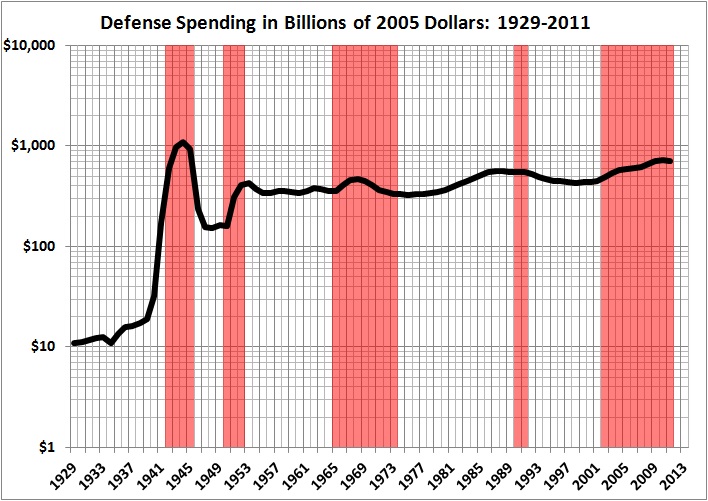
Drawing on GDP statistics provided by the Bureau of Economic Analysis, I constructed the following graphs. The red bands indicate years in which U.S. armed forces were fighting wars: WWII, 1942-1945; Korean War 1950-1953; Vietnam War, 1965-1973; Gulf War, 1990-1991; Afghanistan and Iraq, 2002-2011.


Source: Derived from Table 1.1.5, Gross Domestic Product (then-year dollars).


Source: Obtained by averaging two estimates. The first is a top-down estimate, which applies the percentages displayed in the preceding graph to the estimate of constant-dollar GDP given in Table 1.1.6, Real Gross Domestic Product, Chained Dollars. The second is to construct a chained 2005 dollar estimate of defense spending from Tables A, B, C, and D, which cover overlapping periods (1929-1947, 1942-1962, 1962-1982, 1977-1997, and 1995-2011), and to divide the resulting “double chained” values by the top-line estimate of GDP given in table 1.1.6.

The point of the second graph is that defense spending should not be thought of as a “share” of GDP but as the cost of protecting Americans and their interests from the world’s evil-doers, who are always in plentiful supply. If the real cost of defending America in the 21st century approaches the real cost of fighting World War II, so what? The threats are what they are; today’s enemies (actual and potential) have access to weapons and technologies that far outstrip the relatively primitive weapons and technologies used in WWII.

Moreover, critics of defense spending to the contrary, the object of defense is not to have “just enough” for a “fair fight”; the object of defense is to deter enemies and, if deterrence fails, to defeat them. It is ludicrous to say — as some pundits have said — that the U.S. has “too many” aircraft carriers because their number exceeds the number owned by the rest of the world’s navies. That is a plus, not a minus; Americans should take comfort in such superiority and demand it across the board. America’s enemies do no discriminate between left-wing appeasers and right-wing zealots; we are all targets.

In any event, here are my “takeaways” from the graphs and the history that lies behind them:

Capsule history
Low defense spending and anti-war fervor in the 1930s German and Japanese aggression lead to WWII.
Hasty demobilization after WWII N. Korea invades S. Korea after U.S. declares “lack of interest.” The Korean War is a proxy war for the USSR, which finds U.S. wanting in resolve.
Buildup of strategic forces in the 1950s Nuclear war does not ensue.
Buildup of conventional forces in the early 1960s Domestic opposition leads to a faltering (and eventually failed) U.S. effort to counter Communist aggression in Vietnam.
Post-Vietnam drawdown in the 1970s, followed by Reagan buildup in the 1980s Nuclear war does not ensue. Conventional superiority enables the U.S. to score an easy win in the defense of Kuwaiti oil from Saddam (who, mistakenly, is allowed to remain in power).
Post-Gulf War drawdown in the 1990s (Clinton balances budget on the back of defense.) Drawdown and other signs of U.S. weakness encourage 9/11; subsequent campaigns to stabilize hotbed of terrorism hindered by domestic opposition.
Lessons
Incorrect: Correct:
The availability of armed force leads to war. The appearance of weakness encourages aggressors.
The U.S. is a war-like nation. The U.S. reluctantly prepares for and fights wars.
Defense is a huge drain on the economy. Defense protects Americans and their vital overseas economic interests. As the economy grows, peacetime preparedness and regional wars take an increasingly smaller share of GDP.
Defense takes money away from vital social services. Defense is the most vital of social services; it keeps Americans alive, free, and prosperous.

Related posts:
Libertarians and the Common Defense
Libertarianism and Pre-emptive War: Part I
An Aside about Libertarianism and the War
Right On! For Libertarian Hawks Only
Conservative Criticism of the War on Terror
Why Sovereignty?
Understanding Libertarian Hawks
More about Libertarian Hawks and Doves
Defense, Anarcho-Capitalist Style
War Can Be the Answer
Getting It All Wrong about the Risk of Terrorism
Why We Fight
Getting It Almost Right about Iraq
Philosophical Obtuseness
But Wouldn’t Warlords Take Over?
Sorting Out the Libertarian Hawks and Doves
Now, Let’s Talk About Something Else
Shall We All Hang Separately?
Foxhole Rats
Foxhole Rats, Redux
Know Thine Enemy
September 11: A Remembrance
September 11: A Postscript for “Peace Lovers”
The Faces of Appeasement
Libertarianism and Preemptive War: Part II
Torture and Morality
Give Me Liberty or Give Me Non-Aggression?
We Have Met the Enemy . . .
My View of Warlordism, Seconded
Whose Liberties Are We Fighting For?
The Constitution and Warrantless “Eavesdropping”
NSA “Eavesdropping”: The Last Word (from Me)
Privacy, Security, and Electronic Surveillance
Privacy: Variations on the Theme of Liberty
Words for the Unwise
More Foxhole Rats
The Fatal Naïveté of Anarcho-Libertarianism
Final (?) Words about Preemption and the Constitution
Anarcho-Libertarian “Stretching”
Recommended Reading about NSA’s Surveillance Program
Riots, Culture, and the Final Showdown
A Rant about Torture
More Final (?) Words about Preemption and the Constitution
QandO Saved Me the Trouble
What If We Lose?
A Footnote about “Eavesdropping”
Thomas Woods and War
More than Enough Amateur Critics
Moussaoui and “White Guilt”
Jihad in Canada
In Defense of Ann Coulter
In Which I Reply to the Executive Editor of The New York Times
Post-Americans and Their Progeny
“Peace for Our Time”
Anti-Bush or Pro-Treason?
“Proportionate Response” in Perspective
Parsing Peace
Taking on Torture
Conspiracy Theorists’ Cousins
Not Enough Boots
Defense as the Ultimate Social Service
I Have an Idea
September 11: Five Years On
How to View Defense Spending
Reaching the Limit?
The Best Defense . . .
A Skewed Perspective on Terrorism
Terrorists’ “Rights” and the Military Commissions Act of 2006
More Stupidity from Cato
The Military Commissions Act of 2006
A Critique of Extreme Libertarianism
And Your Point Is?
Anarchistic Balderdash
Not Enough Boots: The Why of It
Blood for Oil

Katie Couric: Post-American
It *Is* the Oil
Here We Go Again
Christmas in Iran: Foreign Affairs According to Planet Rockwell
Torture, Revisited
Waterboarding, Torture, and Defense
9/11 Plotters and the Death Penalty
Cato’s Usual Casuistry on Matters of War and Peace
The Media, the Left, and War
Torture
September 11: A Remembrance
Getting It Wrong and Right about Iran
The “Predator War” and Self-Defense
The National Psyche and Foreign Wars
Delusions of Preparedness
Inside-Outside
A Moralist’s Moral Blindness
A Grand Strategy for the United States
The Folly of Pacifism
Why We Should (and Should Not) Fight
Rating America’s Wars
Transnationalism and National Defense
The Next 9/11?
The Folly of Pacifism, Again
September 20, 2001: Hillary Clinton Signals the End of “Unity”
NEVER FORGIVE, NEVER FORGET, NEVER RELENT!
Patience as a Tool of Strategy
The War on Terror, As It Should Have Been Fought
The Cuban Missile Crisis, Revisited
Preemptive War
Preemptive War and Iran
Some Thoughts and Questions about Preemptive War

Don’t Just Stand There, “Do Something”

“Activists” try my patience, and exhaust it. Their message — no matter the particulars of content or phrasing — boils down to this: Government should “do something” about “something.” This is a formula that has been invoked since the beginning of the Republic, though increasingly more often since the onset of the Progressive Era in the late 1800s. The exhortation betrays three beliefs, unconscious as they may be on the part of those who do the exhorting.

The first belief is that a particular phenomenon is so important — in the view of the exhorting person or group — that government should contrive to impose a particular outcome with respect to that phenomenon — regardless of the costs of that imposition, in treasure or liberty.

The second belief is a kind of prediction that proponents of government action usually cannot be bothered to test. This kind of prediction is known as the Nirvana fallacy: the logical error of comparing actual things with unrealistic, idealized alternatives. The actual things are the “somethings” about which government is supposed to “do something.” The unrealistic, idealized alternatives are the outcomes sought by the proponents of a particular course of government action. Thus legislation and regulation by mere mortals is taken as the functional equivalent of fiat lux.

This points to the third belief, which is that government — a mere creation of fallible, squabbling, power-lusting humans — is a kind of omniscient, single-minded, benevolent being that can overcome the forces of nature and human nature which gave rise, in the first place, to the “something” about which “something must be done.”

The evidence against these beliefs is so overwhelming that their persistence must be attributed to the psychological phenomenon summarized by Samuel Johnson as “the triumph of hope over experience.”

Proponents of government action will counter with the excuse that “something must be done” because of  “market failure,” which is the failure of markets to produce outcomes preferred by the proponents. And yet they overlook government failure, and often seek to rectify it by exhorting more government action, which leads to more government failure, and so on.

Here are some salient examples of government failure — and its correlate, misfeasance — that ought to (but will not) give pause to the “do something” crowd:

“Entitlements” (Social Security, Medicare, Medicaid, and their expansion through Obamacare) — These programs grew from an understandable (but ill-advised) urge to provide for the elderly who were seen as unable to provide for themselves. Through the predictable processes of constituency-mongering, the “social safety net” has acquired almost-inviolable status as a subsidy for millions of persons who could well provide for themselves. This dependency has discouraged thrift and, in the process, stripped away a key source of funds for investments in economic growth. The looming burden of taxation promises to cripple an already hobbled economy.

Welfare, the Minimum Wage, and Affirmative Action — Altogether, these programs have succeeded in breaking up black families, denying to many young blacks an opportunity to join the ranks of the economically productive (and to advance on their own merit), fomented crime, caused racial resentment, and positioned aspiring black students and professionals for failure.

The Great Depression and the Great Recession — These two devastating economic downturns, one of which became an excuse for the enactment of Social Security and the other of which still lingers, are quintessential examples of government failure. In the case of the Great Depression, the Federal Reserve’s monetary policies (first too loose, then too tight) caused a recession to deepen into a depression. That depression lingered for almost a decade (and ended largely because of a catastrophic war) because of interventionist, anti-business policies that began under Hoover and continued, with a vengeance, under Roosevelt. We owe the Great Recession to a combination of too-loose credit (the Fed again) and too-loose mortgage lending: a policy insisted upon by the Federal Reserve and influential members of Congress, and reinforced by their minions at Fannie and Freddie. “Wall Street” — as a willing maker of credit — deserves blame for the resulting financial meltdown and recession only in the way that a prostitute deserves blame for serving her clients.

Defense and Police Services  — These are public goods, but not for the reason advanced by believers in public goods, namely, that they would not be provided voluntarily because too many of their beneficiaries would try to take a “free ride” on paying customers, which would drive the prices of defense and police services too high to attract enough customers to pay for them. That is an unproved assertion, which runs counter to everyday experience (e.g., charitable giving and voluntarism) and ignores the very high stakes that could drive major corporations and very-high income earners to combine in a joint defense of their considerable interests in the U.S. and abroad — a defense that would unavoidably benefit free-riders. In this regard, it is noteworthy that in 2007 the combined pre-tax income of households in the top quintile was $2.5 trillion and pre-tax corporate profits came to $1.7 trillion. It is arguable that a consortium of taxpayers and corporations could underwrite the cost of defense and police forces (including courts, prosecutors, etc.), which in 2007 came to about $900 billion ($662 billion for defense and $230 billion for justice). In 2007, for example, taxpayers in the top 10 percent of adjusted gross incomes paid more than 70 percent of federal income taxes collected from filers of individual and joint returns. Who do you think pays the lion’s share of the costs of defense and police forces? The answer, of course, is high-income taxpayers, directly and through taxes on corporate income.

Defense and police services are tax-funded not because they must be, but because there is something menacing about the thought of privately owned defense and police forces that could be employed in coups and oppressions. A main consequence of the “publicization” of America’s defense and police forces is that they afford a lucrative opportunity for various kinds of pork-barrel legislation (e.g., the location of military bases, the awarding of defense contracts, and patronage for political supporters), as well as the usual (and unavoidable) instances of waste, fraud, and abuse. Even worse are the fluctuations in political attitudes toward defense and policing, which in the ebb invite aggression and crime, and in the flow invite vast over-spending — though over-spending can be defended on the ground that it deters aggression and crime and thus the human and monetary costs that accompany them.

In any event, not even defense is a sacrosanct function of government, and its provision by government is far from an unmitigated blessing. If you think that I overstate the case against government-owned defense forces, consider that

  • They fought only one “popular” war in the past 100 years — a war that became “popular” only after the surprise attack on Pearl Harbor.
  • The thesis that Reagan’s defense build-up won the Cold War remains controversial.
  • The size of the defense budget rides on political whims more than on hard-to-come-by cold facts. Would it be worse if those with the most to lose took a direct hand in the provision of defense forces and in decisions about when to employ them? I doubt it.

*   *   *

Perhaps there are examples of “government success,” but these are hard to identify because the intervention of government usually forecloses the alternatives to which the “do something” crowd is blind:

  • voluntary, cooperative solutions through the actions of markets, private charities, and other private institutions (family, church, club, close-knit neighborhood, etc.)
  • benign neglect, where persons with a “problem” choose not to act on it because the cost of action is greater than its likely benefits.

Anyone who says that government can be “managed” by limiting it to certain kinds of activities (e.g., defense or welfare) while eschewing others (e.g., welfare or defense), merely deludes himself; “democratic” governments cannot and will not function without throwing money in all directions, in an effort to placate all constituencies. As a minarchist, I must admit to sharing this delusion, but I am beginning to think that anarcho-capitalism has merit, if only the right kind of anarcho-capitalists could be in charge of police and defense forces.

Anyone who says that such-and-such a government program will succeed in accomplishing a certain goal at a certain cost — and that the cost will justify the accomplishment — proves himself a presumptuous fool. I cannot truthfully say that government-provided police and defense forces are worth their cost in money and liberty, and I scorn anyone who believes that any other type of governmental endeavor is remotely worth its cost in money and liberty.
__________
For more posts related generally and specifically to this one, go to “Favorite Posts” and browse at will.

The Least Evil Option

Wilson D. Miscamble, writing at Public Discourse in “The Least Evil Option,” defends Harry Truman’s decision to drop the A-bomb on Japan:

[T]he United States eventually could have defeated Japan without the atomic bomb, but all the viable alternate scenarios to secure victory—continued obliteration bombing of Japanese cities and infrastructure, a choking blockade, the likely terrible invasions involving massive firepower—would have meant significantly greater Allied casualties and higher Japanese civilian and military casualties. These casualties would likely have included thousands of Allied prisoners of war whom the Japanese planned to execute. Notably, all of these options also would have indirectly involved some “intentional killing of innocents,” including the naval blockade, which sought to starve the Japanese into submission. Hard as it may be to accept when one sees the visual evidence of the terrible destruction of Hiroshima and Nagasaki, Japanese losses probably would have been substantially greater without the A-bombs….

Bluntly put, the atomic bombs shortened the war, averted the need for a land invasion, saved countless more lives on both sides of the ghastly conflict than they cost, and brought to an end the Japanese brutalization of the conquered peoples of Asia.

(I, too, have defended Truman’s decision. See this post, for example.)

Miscamble’s article is aimed at Christopher O. Tollefson’s critique of  Miscamble’s book, The Most Controversial Decision. Tollefson, according to Miscamble,

largely repeats the fundamental criticism mounted against President Harry Truman by Elizabeth Anscombe over a half-century ago: Violating the moral absolute against the intentional killing of the innocent is always wrong. The atomic bombs involved such killing and so should not have been used––end of story. It is all neat, and clear, and logically consistent.

Is the intentional killing of the innocent always wrong? Consider these situations:

1. A homicidal maniac rushes into a restaurant, grabs a diner and holds her in front of himself as a shield, then begins to shoot other diners. You are seated in the restaurant, in the maniac’s line of vision, and he will soon shoot you if you do nothing. You are carrying a high-powered handgun, and have time to take a shot at the maniac before he aims at you, but your only sure way of stopping the him is to shoot through the innocent diner whom he is using as a shield. It is your life or the innocent person’s. Would you shoot before being shot or wait to see what happens; the maniac might not shoot at you, he might not hit you, he might not hurt you seriously, or you might be able to duck. But you do not know which of these things will happen. Therefore, if you do nothing, you are inviting the worst of them to happen, namely, that the maniac will shoot you and kill you or seriously wound you.

2. Then, there is this classic: You are at a train track and see five people tied to the track ahead. A switch is in front of you which will divert the train, but as you look down you see a man is strapped to that track and will be killed. Is it permissible to flip the switch and save the five people at the expense of one?

3. And this variation: Now imagine in order to save the five people, you have to push a stranger in front of the train to stop it. You know for certain it would stop the train in time to save the five people tied to the tracks. Is it permissible to push the man and save the five people at the expense of one?

There are three ways to view each situation:

  • through the lens of utilitarianism, which considers one (innocent) life to be the equivalent of another
  • through the lens of in-group solidarity, which places a premium on one’s own life and the lives of those with whom one has a special relationship (kinsfolk, neighbors, countrymen) for reasons of affection and/or mutual dependence
  • through the lens of the Golden Rule, which (in my view) is a social convention that arises from self-interest tempered by empathy.

The utilitarian answers to three problems are as follows:

1. Shoot. Your life is equal to the life of the human shield, and if you are able to kill or seriously wound the thug, you may save the lives of other innocent persons in the restaurant.

2. Flip the switch and save five lives at the cost of one.

3. Overcome your squeamishness about being so directly involved in the death of the stranger; push him in front of the train and save five lives at the cost of one.

These are the “right” answers from the perspective of in-group solidarity:

1. Shoot. The life you save may be your own, and you are the center of your in-group. Moreover, you probably have more in common with the other diners (most of whom are probably productive citizens) than with the thug (who is in the process of killing productive citizens).

2. If the potential victims of the train are strangers to you, you have to flip a coin to decide whether to throw the switch or leave it alone. Otherwise, your action depends on your relationship(s) with any of the potential victims of the oncoming train.

3. If the potential victims are strangers, you have to flip a coin to decide whether to push the man in front of the train or do nothing. Otherwise, your action depends on your relationship(s) with any of the potential victims of the oncoming train.

These are the “right” answers for a person whose adherence to the Golden Rule arises from a combination of self-interest and empathy:

1. Shoot. Unless you are a psychopath like the homicidal maniac, you identify with the other diners and you cringe when he shoots one of them because their pain and death affects you emotionally. And if you do not shoot him, he probably will shoot you.

2 and 3.The answers can be the same as they were from the perspective of in-group solidarity. But, if all of the potential victims are strangers to you, it is not utilitarian to suggest that you can have more empathy for five strangers than for one stranger, especially if you take into account the (probable) larger number of persons who would be hurt by the death of five than the death of one. Moreover, if all of the potential victims are strangers, the saving of five of them is more likely to yield positive “returns” in the form of friendship and gratitude. The latter might, in turn, lead to a better job, a monetary reward, or something else along those lines.

What does all of this have to do with Truman’s decision to drop the A-bomb? If you are a utilitarian, you might be persuaded that Truman’s decision was the correct one because it resulted in fewer deaths than there would have been in the case of an invasion or blockade. (I dismiss the possibility that the Japanese military would have quit fighting if the U.S. had simply stopped fighting after driving Japanese forces back to their homeland.) If you place great stock in in-group solidarity, Truman’s move was the correct one because it saved American lives — possibly the lives of friends and family members.

If you are an adherent of the Golden Rule, you come to the same place for two reasons. The first reason is the empathic one just mentioned: the saving of lives of persons for whom you have a natural affinity.

The second reason arises from self-interest and has at least two branches:

  • You are glad that Truman put an end to a war that would have proved more costly to you (directly or through your ancestors) had he not decided to drop the bomb.
  • You are glad that Truman, in effect, warned off prospective enemies of the United States who are therefore enemies of your interests. That Truman’s warning was later undermined by his own actions in Korea, America’s withdrawal from Vietnam, and similar actions has not entirely vitiated the strong signal sent by the dropping of the A-bomb. Truman told the world that aggression against the United States invites the United States to smite the aggressor. (Do unto others what they do unto you.)

If you still object to Truman’s decision because you believe that it is always wrong to take an innocent life, you are putting yourself in the shoes of an armed diner who decides against shooting a homicidal maniac because that would require the shooting of an innocent person. But do not forget that  the diner’s refusal to shoot the maniac probably will allow the deaths of many innocent persons (the diner included). The refusal to kill an innocent person, under any circumstances, can be the moral equivalent of murder and/or suicide.

To put it baldly, the refusal to kill an innocent person, under any circumstances, is shallow posturing. It is not a considered moral stance.

*   *   *

Related posts:
Why Sovereignty?
Liberalism and Sovereignty
The Decision to Drop the Bomb
The Folly of Pacifism
Transnationalism and National Defense
The Folly of Pacifism, Again
______

Rights, Liberty, the Golden Rule, and the Legitimate State
Evolution and the Golden Rule
The Golden Rule as Beneficial Learning
Rights: Source, Applicability, How Held
Libertarianism and Morality
Libertarianism and Morality: A Footnote

Some Thoughts and Questions about Preemptive War

A reader named Bill K. offered some thoughts and questions about my post, “Preemptive War.” Bill’s offerings are reproduced below (in italics), followed by my responses (in bold).

On the one hand, it bothers me that one could read the UN charter, as you summarize, “to proceed to war only in the case of self defense, and then only until the UN had decided what to do about the situation.” With this in view, though your argument seems strong in demonstrating precedent in our government holding the US Constitution superior to the UN Charter, as a nation, we could find ourselves standing alone against world opinion should we act on what we know and are unwilling to divulge to others.

I am unperturbed by the prospect of “standing alone against world opinion.” I quote from my post, “Liberalism and Sovereignty“:

Americans — as a mostly undifferentiated mass — are disdained and hated by many foreigners (and by many an American “liberal”). The disdain and hatred arise from a variety of imperatives, ranging from pseudo-intellectual snobbery to nationalistic rivalry to anti-Western fanaticism. When those imperative lead to aggression (threatened or actual), that aggression is aimed at all of us: liberal, “liberal,” conservative, libertarian, bellicose, pacifistic, rational, and irrational.

Having grasped that reality, the Framers “did ordain and establish” the Constitution “in Order to . . . provide for the common defence” (among other things). That is to say, the Framers recognized the importance of establishing the United States as a sovereign state for limited and specified purposes, while preserving the sovereignty of its constituent States and their inhabitants for all other purposes.

If Americans do not mutually defend themselves through the sovereign state which was established for that purpose, who will? That is the question which liberals (both true and false) often fail to ask. Instead, they tend to propound internationalism for its own sake. It is a mindless internationalism, one that often disdains America’s sovereignty, and the defense thereof.

Mindless internationalism equates sovereignty with  jingoism, protectionism, militarism, and other deplorable “isms.” It ignores or denies the hard reality that Americans and their legitimate overseas interests are threatened by nationalistic rivalries and anti-Western fanaticism.

In the real world of powerful rivals and determined, resourceful fanatics, the benefits afforded Americans by our (somewhat eroded) constitutional contract — most notably the enjoyment of civil liberties, the blessings of  free markets and free trade, and the protections of a common defense — are inseparable from and dependent upon the sovereign power of the United States.  To cede that sovereignty for the sake of mindless internationalism is to risk the complete loss of the benefits promised by the Constitution.

Bill K. does not strike me as a “mindless” internationalist, but his worry about “world opinion” plays into the hands of that breed.

*   *   *

On the other hand, it also bothers me that your first summary point, “…to protect Americans’ liberty interests, broadly understood, by preventing a foreign state or entity from acquiring the means by which to attack… or… from deploying…” is a judgment call requiring reasonably accurate knowledge of both capabilities and intentions.As fallen men with imperfect knowledge and judgment, there is the possibility that we might make a mistake in proceeding with preemptive attack.

Mistakes cut both ways. Inaction could be a mistake. In the end, one has to rely on those charged with responsibility for national defense to execute that responsibility prudently. Although the parallel between preemptive war and capital punishment is inexact, I take the same attitude toward both, namely, that it is never a good idea to rule out in advance an option that might prove to be the best one, in certain circumstances.

*   *   *

It would seem to me that should the US preemptively attack Iran, we will face both reactions above – other nations disagreeing with our right to act preemptively, showing disgust in perhaps tangible ways, such as cancellation of treaty & trade agreements, as well as those within our own country who will demand to ‘see the evidence’ and ‘judge for ourselves’, resulting in internal strife, particularly if the preemption started a war requiring sustained effort.

I agree that the possibility of reactions by foreigners that could adversely affect Americans’ interests should be considered and weighed in taking a decision to wage preemptive war. But if the case for preemption is strong, the possibility of internal dissent should not make a difference. War will almost always yield dissent, and it will be vocal. So will a child’s dissent from just punishment be vocal.

*   *   *

[L]ooking at your necessary conditions in bullet points, the ones I have some disagreement with are points #1 & #5:

#1: “Undertaking to harm American’s interests through unilateral actions (e.g., shutting off a major supply of oil)” – Would you agree with me that this would be a necessary condition only if such a shut-off were likely to bring the US military to its knees, fuel-wise? That a substantial rise in the price of fuel would not be sufficient? I’d like to think that the US in such circumstances could well turn to other suppliers as well as develop its own reserves to counteract such a strategy without resorting to preemptive war.

To begin at the end, turning to other suppliers will not reverse a substantial rise in the price of oil, unless those suppliers are able to increase their rate of output dramatically. Further, existing transportation and pipeline systems must be able to accommodate the related geographic shifts in supply, without much delay.

If by “develop … reserves” Bill means that the federal government should buy and hold oil against the possibility of a cutoff, there is already the Strategic Petroleum Reserve. The development and maintenance of that reserve is costly, both in terms of outlays on facilities and their operation but also in terms of the effects of government purchases on the price of oil. It may be prudent to maintain the SPR so that U.S. military operations are not hampered by a sudden reduction in the output of foreign oil. But, for the reasons discussed, the SPR is no boon to the domestic consumers of oil.

If by “develop … reserves” Bill means that the federal government should encourage exploration and production in the United States and its littoral waters, good luck with that. On the one hand we have global-warming alarmists, environmental extremists, the not-in-my-back-yard mentality, the lobbies for the subsidization of “alternative fuels” and “renewable energy,” and their allies in the Democrat Party. On the other hand we have average Americans whose interests will continue to be sacrificed on the altar of sanctimony unless and until the Republican Party of Calvin Coolidge returns to power for a long time.

Returning to the beginning, I cannot agree that “a substantial rise in the price of fuel would not be sufficient” grounds for preemption. The circumstances leading to the substantial rise would indicate whether or not rise is aimed at coercing the U.S. government or severely damaging the American economy. If it seems clear that those responsible for the price rise have one or both aims in mind, then they will have effectively committed an act of war against the U.S. and its citizens. War is war, and it ought to be thought of as such, regardless of the means by which it is conducted. A military strike against the perpetrators might not be the best course of action; as I say in “Preemptive War,” preemption should be a last resort. But to eschew the use of force as a response to economic warfare is to invite it.

*   *   *

#5: “Otherwise engaging in a persistent course of provocative opposition…” Your examples of this behavior, Cuba, NK, USSR, with the exception of Saddam, are all examples that we have lived with and handled by other means (embargo, competitive military spending, foreign base agreements). Saddam was different because he embarked on conquest of an ally. Do you believe that should we decide to preemptively strike Iran, we should do so upon their assembly of a nuclear warhead, and attack NK at the same time? If we were to hold off on NK, given that they have demonstrated a test detonation, why so?

Context is important. What I say in “Preemptive War” is that

preemption is appropriate when several conditions are met. First, it must be clear that the target of preemption is an enemy of the United States. A foreign state or entity can be an enemy without having any immediate or specific plans to attack Americans or their interests. Thus a foreign state or entity can become an enemy by….

  • otherwise engaging in a persistent course of provocative opposition toward the United States, which opposition might consist of pronounced ideological enmity (as in the cases of Cuba and North Korea, for example), supporting efforts by third parties to harm the United States (as was the case with Saddam, doubters to the contrary), or engaging in efforts to harm the United States through economic or diplomatic machinations (as did the USSR during the Cold War).

Such conditions are necessary but not sufficient for preemption.

North Korea, despite its anti-Americanism and provocative behavior, is much less of a threat than Iran is to American interests. If a strike against Iran would stop or significantly delay its development of nuclear weapons, and if all other conditions for preemption were met, I would favor a preemptive strike on relevant Iranian facilities. As a reminder, here are the other (sufficient) conditions that I list in “Preemptive War”:

  • the failure of diplomatic efforts, which may include the United Nations but need not depend on the UN’s course of action (see the later discussion of treaty obligations)
  • the failure of economic sanctions and military threats
  • the likelihood that preemption would not cause a breakdown of diplomatic, military, or economic relations with foreign states, where such relations are important to the well-being of Americans
  • the prospect of a successful preemption, where the costs (in life, limb, and money) are judged to be less than the costs of failing to act
  • an open debate resulting in an authorization by Congress, where events do not require swift and even clandestine actions, which should be taken in accordance with the War Powers Resolution of 1973.

Preemptive War and Iran

My post, “Preemptive War,” is mainly a general argument for preemption, where American’s vital interests are at stake. But it was prompted by ” the imminent acquisition by Iran of material with which to produce nuclear weapons.”

The authors of “Why Obama Should Take Out Iran’s Nuclear Program” (Foreign Affairs, November 9, 2011) see the wisdom of preemption:

The November 8 International Atomic Energy Agency (IAEA) report casts further doubt on Iran’s continual claims that its nuclear program is intended solely for peaceful use….

…[T]he Obama administration has downplayed the findings of the new IAEA report, suggesting that a change in U.S. policy is unlikely. Yet this view underestimates the challenges that the United States would confront once Iran acquired nuclear weapons.

For example, the Obama administration should not discount the possibility of an Israeli-Iranian nuclear conflict….

Beyond regional nuclear war, Tehran’s acquisition of these weapons could be a catalyst for additional proliferation throughout the Middle East and beyond….

…Iran’s rivals for regional dominance, such as Turkey, Egypt, and Saudi Arabia, might seek their own nuclear devices to counterbalance Tehran. The road to acquiring nuclear weapons is generally a long and difficult one, but these nations might have shortcuts. Riyadh, for example, could exploit its close ties to Islamabad — which has a history of illicit proliferation and a rapidly expanding nuclear arsenal — to become a nuclear power almost overnight….

The closer Iran gets to acquiring nuclear weapons, the fewer options will be available to stop its progress. At the same time, Iran’s incentives to back down will only decrease as it approaches the nuclear threshold. Given these trends, the United States faces the difficult decision of using military force soon to prevent Iran from going nuclear, or living with a nuclear Iran and the regional fallout.

But the Obama administration — more accurately, Barack Obama — seems committed to a perverse foreign policy in the Middle East. This is from “Panetta Assures Iran It Has Little to Worry About” (Commentary, November 11, 2011):

If the leaders of the Iranian regime were worried about Jeffrey Goldberg’s prediction that Barack Obama would confound the world and launch a U.S. military strike designed to save Israel from nuclear destruction, they can now calm down. Secretary of Defense Leon Panetta made it crystal clear at a Pentagon news conference yesterday he has no intention of supporting an American attack on Iran’s nuclear facilities….

…But by publicly throwing cold water on the idea the United States is ready and able to militarily squash Iran’s nuclear ambitions, Panetta has sent a dangerous signal to Tehran that the Pentagon intends to veto any use of force against them. Combined with Russia’s pledge to block any further sanctions on Iran, the statement should leave the Khameini/Ahmadinejad regime feeling entirely secure as they push ahead to the moment when they can announce their first successful nuclear test.

This — combined with Obama’s dubious support of Israel, his unseemly withdrawal from Iraq, and his reluctant and easily reversed decision to “surge” in Afghanistan — confirms Obama’s position as the Jimmy Carter of the 21st century. Where is the next Ronald Reagan when we need him?

The “loss” of the Middle East and its relatively cheap oil would be a disaster for America’s economy. Further, it would leave an opening for an ambitious and increasingly powerful China.

Does Obama care about such things? Evidently not. He is too busy trying to remake the U.S. in the image of Europe: defenseless, bankrupt, and hostage to enviro-nuts.

See also “Some Thoughts and Questions about Preemptive War.”

Analysis for Government Decision-Making: Demi-Science, Hemi-Demi-Science, and Sophistry

Taking a “hard science” like classical mechanics as an epitome of science and, say, mechanical engineering, as a rigorous application of it, one travels a goodly conceptual distance before arriving at operations research (OR). Philip M. Morse and George E. Kimball, pioneers of OR in World War II, put it this way:

[S]uccessful application of operations research usually results in improvements by factors of 3 or 10 or more…. In our first study of any operation we are looking for these large factors of possible improvement…. They can be discovered if the [variables] are given only one significant figure,…any greater accuracy simply adds unessential detail.

One might term this type of thinking “hemibel thinking.” A bel is defined as a unit in a logarithmic scale corresponding to a factor of 10. Consequently a hemibel corresponds to a factor of the square root of 10, or approximately 3. (Philip M. Morse and George E. Kimball, Methods of Operations Research, originally published as Operations Evaluation Group Report 54, 1946, p. 38)

This is science-speak for the following proposition: Where there is much variability in the particular circumstances of combat, there is much uncertainty about the contributions of various factors (human, mechanical, and meteorological) the the outcome of combat. It is therefore difficult to assign precise numerical values to the various factors.

OR, even in wartime, is therefore, and at best, a demi-science. From there, we descend to cost-effectiveness analysis and its constituent branches: techniques for designing and estimating the costs of systems that do not yet exist and the effectiveness of such systems in combat. These methods, taken separately and together, are (to coin a term) hemi-demi-scientific — a fact that the application of “rigorous” mathematical and statistical techniques cannot alter.

There is no need to elaborate on the wild inaccuracy of estimates about the costs and physical performance of government-owned and operated systems, whether they are intended for military or civilian use. The gross errors of estimation have been amply documented in the public press for decades.

What is less well known is the difficulty of predicting the performance of systems — especially combat systems — years before they are commanded, operated, and maintained by human beings, under conditions that are likely to be far different than those envisioned when the systems were first proposed. A paper that I wrote thirty years ago gives my view of the great uncertainty that surrounds estimates of the effectiveness of systems that have yet to be developed, or built, or used in combat:

Aside from a natural urge for certainty, faith in quantitative models of warfare springs from the experience of World War II, when they seemed to lead to more effective tactics and equipment. But the foundation of this success was not the quantitative methods themselves. Rather, it was the fact that the methods were applied in wartime. Morse and Kimball put it well:

Operations research done separately from an administrator in charge of operations becomes an empty exercise. To be valuable it must be toughened by the repeated impact of hard operational facts and pressing day-by-day demands, and its scale of values must be repeatedly tested in the acid of use. Otherwise it may be philosophy, but it is hardly science. [Methods of Operations Research, p. 10]

Contrast this attitude with the attempts of analysts … to evaluate weapons, forces, and strategies with abstract models of combat. However elegant and internally consistent the models, they have remained as untested and untestable as the postulates of theology.

There is, of course, no valid test to apply to a warfare model. In peacetime, there is no enemy; in wartime, the enemy’s actions cannot be controlled. Morse and Kimball, accordingly, urge “hemibel thinking”:

Having obtained the constants of the operations under study… we compare the value of the constants obtained in actual operations with the optimum theoretical value, if this can be computed. If the actual value is within a hemibel (…a factor of 3) of the theoretical value, then it is extremely unlikely that any improvement in the details of the operation will result in significant improvement. [When] there is a wide gap between the actual and theoretical results … a hint as to the possible means of improvement can usually be obtained by a crude sorting of the operational data to see whether changes in personnel, equipment, or tactics produce a significant change in the constants. [Ibid., p. 38]

….

Much as we would like to fold the many different parameters of a weapon, a force, or a strategy into a single number, we can not. An analyst’s notion of which variables matter and how they interact is no substitute for data. Such data as exist, of course, represent observations of discrete events — usually peacetime events. It remains for the analyst to calibrate the observations, but without a benchmark to go by. Calibration by past battles is a method of reconstruction –of cutting one of several coats to fit a single form — but not a method of validation. Lacking pertinent data, an analyst is likely to resort to models of great complexity. Thus, if useful estimates of detection probabilities are unavailable, the detection process is modeled; if estimates of the outcomes of dogfights are unavailable, aerial combat is reduced to minutiae. Spurious accuracy replaces obvious inaccuracy; untestable hypotheses and unchecked calibrations multiply apace. Yet the analyst claims relative if not absolute accuracy, certifying that he has identified, measured, and properly linked, a priori, the parameters that differentiate weapons, forces, and strategies….

Should we really attach little significance to differences of less than a hemibel? Consider a five-parameter model, involving the conditional probabilities of detecting, shooting at, hitting, and killing an opponent — and surviving, in the first place, to do any of these things. Such a model might easily yield a cumulative error of a hemibel, given a twenty-five percent error in each parameter. My intuition is that one would be lucky if relative errors in the probabilities assigned to alternative weapons and forces were as low as twenty-five percent.

The further that one travels from an empirical question, such as the likely effectiveness of an extant weapon system under specific, quantifiable conditions, the more likely one is to encounter the kind of sophistry known as policy analysis. It is in this kind of analysis that one  — more often than not — encounters in the context of broad policy issues (e.g., government policy toward health care, energy, or defense spending). Such analysis is constructed so that it favors the prejudices of the analyst or his client, or support the client’s political case for a certain policy.

Policy analysis often seems credible, especially on first hearing or reading it. But, on inspection, it is usually found to have at least two of these characteristics:

  • It stipulates or quickly arrives at a preferred policy, then marshals facts, calculations, and opinions that are selected because they support the preferred policy.
  • If it offers and assesses alternative policies, they are not placed on an equal footing with the preferred policy. They are, for example, assessed against criteria that favor the preferred policy, while other criteria (which might be important ones) are ignored or given short shrift.
  • It is wrapped in breathless prose, dripping with words and phrases like “aggressive action,”grave consequences,” and “sense of urgency.”

No discipline or quantitative method is rigorous enough to redeem policy analysis, but two disciplines are especially suited to it: political “science” and macroeconomics. Both are couched in the language of real science, but both lend themselves perfectly to the old adage: garbage in, garbage out.

Do I mean to suggest that broad policy issues should not be addressed as analytically as possible? Not at all. What I mean to suggest is that because such issues cannot be illuminated with scientific rigor, they are especially fertile ground for sophists with preconceived positions.

In that respect, the model of cost-effectiveness analysis, with all of its limitations, is to be emulated. Put simply, it is to state a clear objective in a way that does not drive the answer; reveal the assumptions underlying the analysis; state the relevant variables (factors influencing the attainment of the objective); disclose fully the data, the sources of data, and analytic methods; and explore openly and candidly the effects of variations in key assumptions and critical variables.

A Declaration and Defense of My Prejudices about Governance

I am a pro-defense, conservative libertarian.

By conservative libertarian, I mean that I am a libertarian who understands that liberty depends on the preservation of the traditional institutions of civil society (e.g., marriage, religion, voluntary charity) because it is those institutions that make possible mutual trust, respect, and forbearance. And it is those things that enable a people to coexist peacefully and cooperatively, to their mutual benefit. It is those things — not the statutes, ordinances, codes, and regulations that may be overlaid on them — which constitute the rule of law. Without the rule of law, liberty and the enjoyment of its fruits is impossible.

The alternatives to a robust civil society are chaos, from which warlordism springs, and the police state. Police and courts are a necessary evil, because bad things happen, even where civil society is strong. But, as civil society is weakened by the intrusions of government, police and courts become more necessary because dependence on police and courts to maintain the rule of law further weakens civil society, which leads to the need for even more intrusion by police and courts, and so on, toward the dark night of oppression.

In any event, I part company with those libertarians who believe that private agencies can and should perform the functions of police forces and courts. Private agencies, each acting on behalf of their clients, will sooner or later clash, warlord-style. Or the vacuum of statelessness will be filled by those who seek power for its own sake and for the riches it can bring them. Better an accountable state than an unaccountable warlord.

The same is true when it comes to defense against foreign powers — whether they are states or terrorist groups. Yes, some very wealthy Americans might pool their resources and provide defense, from which everyone might benefit. But the might of a defense force can easily be turned inward and aimed at particular individuals and groups who are out of favor with the proprietors of the defense force.

An accountable, state-run defense force, on the other hand, should be used to defend Americans and their legitimate overseas interests, and to do that decisively. Either get in and win, or stay out. But always remember that staying out — or delaying action — enables an actual or potential enemy to gather strength.

Enough of that. How did I become a libertarian, of the kind that I am?

My disillusionment with the predictably “liberal” worldview that I acquired as an undergraduate came in stages, beginning in the late 1960s. The urban riots that had begun earlier in the decade and reached a zenith in 1968 were evidence of the futility of solving the “black problem” by throwing tax dollars at it. What was needed instead of welfare was robust economic growth and jobs — especially for black males. The intellectual clincher came for me in the mid-1970s, when — as a defense analyst — I grasped the limitations of warfare models.

What is the connection between the limitations of warfare models and the proper role of government? A mathematical model of a fairly well-defined phenomenon — combat involving certain types of weapons — is unlikely to yield an accurate prediction of the outcome of combat. Therefore, it is even more unlikely that emotionally justified government programs — designed mainly to benefit this and that interest group — will perform as predicted. Or, even if they deliver something like the expected benefits, they will also have unanticipated, negative side effects.

The evidence against social and economic engineering is staggering. See, for example, the 144 issues of Regulation that have been published since the magazine’s inception in 1977. Or consider just four salient examples of the social and economic engineering that have had untoward results:

1. Social Security. On the surface, this seems to have helped millions of old persons live more comfortably. It has in fact led people to save less for their retirement, causing them to be more dependent on Social Security and reducing the nation’s rate of saving, with adverse consequences for growth-inducing capital investment. Add to that the inevitable political consequences of a popular program that brings in revenue — the expansion of benefits as a vote-getting measure and the expenditure of “contributions” on other government programs — and you have an explanation for a large chunk of the burgeoning federal deficit.

2. Health care. The creation and expansion of Medicare and Medicaid, coupled with employer-supported health insurance (a result of tax policy), have led to the over-consumption of health-care services with little effect on health. (There is an authoritative, scientific RAND study to support that contention.) It is therefore largely because of government actions that drugs and medical services have become so expensive in the U.S. Another contributor to the apparently high cost of health-care in the U.S. has been the invention and improvement of life- and health-saving drugs, procedures, and equipment. Such things do not come cheaply. But put them all together and you have what the proponents of government intervention like to call a “broken” system. That it is “broken” largely because of government intervention does not faze the proponents of still more intervention.

3. Welfare. Daniel Patrick Moynihan explained well the contributions of government welfare programs to what he called “he cycle of poverty and disadvantage” among urban blacks. For his pains, he was labeled a “racist” and accused of “blaming the victim.” The evidence of subsequent history is on Moynihan’s side.

4. Deficit spending. This canon of Keynesian orthodoxy has led to bouts of wasteful spending and a larger federal debt, both of which cause the displacement of private outlays on consumption goods (including health care) and job-producing, growth-enhancing capital investments. Deficit spending is stoutly defended by believers in big government, even though (a) it did not cure the Great Depression (conventional wisdom to the contrary), (b) its sudden withdrawal at the end of World War II did not cause a new depression (despite “authoritative” predictions to the contrary), and its recurrence in the form of “stimulus” did not alleviate the Great Recession. There are many reasons that deficit spending does not work as advertised, but its defenders will hear none of them because they are persons of faith in big government, not facts and reason.

Were it not for these and other government interventions, Americans — even the poorest ones — would be much better off than than they are, because they would strive to do better for themselves and because they would earn much more from their striving. In addition, there would be significantly more voluntary charity for those many fewer persons who really need it. That is a real “social safety net.”

Despite the foregoing, social and economic engineering by government persists for five reasons:

  • Ignorance — which includes the kind of blind faith in the power of government to do “the right thing,” as discussed above.
  • Smugness — the self-satisfaction that comes from having supported or voted for a certain cause as a token of one’s “enlightenment,” “open-mindedness,” or “compassion.”
  • Power-seeking — as politicians cater to and shape the preferences of certain voting blocs, for the sake of gaining and holding office and the power that goes with it.
  • Rent-seeking — the effort to gain an economic or social advantage at the expense of others, an advantage that is mainly illusory because one group’s gains must be paid for, politically, by supporting the efforts of other groups to acquire gains.

Appeals to “fairness,” “social justice,” “equality,” and other such high-flown concepts are good indicators of ignorance, smugness, power-seeking, and rent-seeking.

Am I right about the essential bankruptcy of social and economic engineering by government? All I can say is that I came to my views as a result of observation and reflection. I did not inherit them from my parents (who were inarticulate in such matters), nor did I absorb them from my professors (who, if anything led me in the opposite direction). I believe in the rightness of my views — of course. But whether I am right or wrong is not for me to say. What I could say has been said well by an economist named Russell Roberts that I will quote him:

I am willing to admit that I have trouble thinking of a natural experiment that would get me to change my worldview. It would take a lot of natural experiments in lots of different settings before I became convinced, for example, that government can spend our way out of a recession or that bailouts are a good way to deal with systemic risk. I have a worldview. I’m an ideologue. I have a philosophy of what makes the world a better place. I stand by that philosophy because I think its principles if implemented more widely would actually make the world a better place. It would take a lot of evidence to dissuade me from my views on economic freedom and the proper role of government. Those principles color the way I see the world. I think that’s true for almost all of us. What distinguishes is honesty about what we believe and why.

Now you have a good idea — if you didn’t already — of what I believe and why I believe it.

*   *   *

Related and supporting posts: Too many to list. Go here and browse.

Preemptive War

What should be done about the imminent acquisition by Iran of material with which to produce nuclear weapons? This is a question that the president of the United States and Congress must face because Iran’s possession of nuclear weapons will threaten vital U.S. interests in the Middle East, namely, access to about one-third of the world’s present output of oil. That alone — even if Iran would not strike U.S. allies in Europe or the U.S. itself — should cause the president and congressional leaders to entertain the possibility of a preemptive strike on the Iranian facilities that could produce material for nuclear weapons.

This is not a new subject, and my aim here is not to assess the chances of a successful strike or the political fallout from a strike, successful or not. I want to explore different aspects of preemption — aspects that, so far, have drawn relatively little attention — namely, its morality, the conditions under which it should occur, and its constitutionality.

A MORAL CASE FOR PREEMPTIVE WAR

Here is my argument, in brief:

1. Any sovereign nation (A) has the right to act preemptively against any other sovereign nation (B) to prevent B from harming the ability of A‘s citizens to enjoy liberty and its fruits. In fact, if A could afford to do so, and if it would serve the interests of A‘s citizens, A might act preemptively against B to prevent B from harming C‘s citizens because of the resulting harm to A‘s citizens.

2. If A‘s preemptive act results in A‘s violating its treaty obligations, A simply has put its reason for being above an obligation that was supposed to serve its reason for being, but which patently does not. A nation dedicated to liberty is obliged, first and foremost, to take the course of action that best serves its citizens’ liberty and their enjoyment of it.

You should note that harm (or prospective harm) is not just bodily harm. There is more to liberty than the preservation of life and limb. What are life and limb without the ability to own property and pursue happiness? Theft is a denial of liberty, no matter where the theft occurs, that is, whether it takes place in the U.S. or overseas? If it is not theft to disrupt America’s economy by force or threat of force, and to make Americans poorer by denying them (among others) access to oil pumped from the ground in Middle Eastern countries, then what is it?

The only other thing it can be called — with good reason — is an act of aggression against the liberty of Americans. If there is good reason to believe that the aggression will occur, if not prevented, then it is the duty of the American government to act preemptively to prevent the aggression and thus the harm that would flow from it.

Given the preceding, I cannot exempt any nation or foreign entity as a legitimate target of preemption. Nor can I rule out any form of action against Americans’ interests as a legitimate cause of preemption. Harm is harm; the question is how best to respond to the certain prospect of harm.

Now, if you remain opposed to preemption, you should ask yourself whether you are willing to acquiesce in the aims of a foreign entity. For, to believe that the United States should not act against aggression — except where the evidence of impending aggression is weak or doubtful — is tantamount to acquiescing in the aggression. I can see it no other way.

But, as outlined below, a decision to preempt should not be taken easily.

PREEMPTION IN PRACTICE

Criteria for Preemption

The case for preemption must be met by answering six questions:

1. What is the object of preemption?

2. Who can be the target of preemption?

3. When is preemption the appropriate course of action?

4. Must preemption be limited to a “proportional” response?

5. Do treaty obligations trump preemption?

6. Is preemption unconstitutional?

What Is the Object of Preemption?

The object of preemption must be to prevent a foreign state or entity from acquiring or deploying the means of attacking Americans’ liberty interests, as discussed above, where the foreign entity’s behavior clearly indicates that an attack is almost certain to follow from said acquisition or deployment.

Who Can Be a Target of Preemption?

Does that formulation mean, for example, that the United States should act preemptively if good intelligence indicates that (a) the Saudi regime is about to drastically curtail oil production, (b) a terrorist organization has co-opted the Saudi regime, or (c) the terrorist organization is about to launch a massive attack on Saudi oil facilities?

The first scenario might lead to preemption, if certain other conditions are met, as discussed below.

The second and third scenarios would almost certainly warrant preemption because of the potential harm to the well-being of Americans. It is one thing if Americans lose jobs and income through the normal fluctuations of the business cycle. It is another thing, entirely, if Americans are likely to lose jobs and income because of what would amount to an act of aggression by a foreign enemy. If we would not stand for the sabotage of oil refineries on American soil, why would we contemplate the sabotage of overseas facilities that provide oil which is refined in the United States?

Americans are not “entitled” to oil. But they are entitled to ply trade with willing partners who provide oil. The principle applies to any product or service. The question is not whether the United States might legitimately conduct preemptive operations in defense of free trade, but under what circumstances such operations are warranted.

When Is Preemption the Appropriate Course of Action?

Given the foregoing, preemption is appropriate when several conditions are met. First, it must be clear that the target of preemption is an enemy of the United States. A foreign state or entity can be an enemy without having any immediate or specific plans to attack Americans or their interests. Thus a foreign state or entity can become an enemy by

  • undertaking to harm Americans’ interests through unilateral actions (e.g., shutting off a major supply of oil)
  • threatening or attacking allies of the United States upon whom we depend for trade (e.g., Iraq in 1990)
  • threatening or attacking nations whose defeat might jeopardize the security of the United States (e.g., Hitler’s declaration of war on Great Britain in 1939)
  • threatening or attacking overseas areas of strategic importance to the United States (e.g., the oil fields of the Middle East or South America, the Suez or Panama Canal)
  • developing, or planning to develop, the wherewithal to acquire weapons that could enable an attack the United States, harm Americans’ interests, attack our allies, or attack strategically important nations or strategic areas
  • otherwise engaging in a persistent course of provocative opposition toward the United States, which opposition might consist of pronounced ideological enmity (as in the cases of Cuba and North Korea, for example), supporting efforts by third parties to harm the United States (as was the case with Saddam, doubters to the contrary), or engaging in efforts to harm the United States through economic or diplomatic machinations (as did the USSR during the Cold War).

Such conditions are necessary but not sufficient for preemption. Sufficient conditions are:

  • the failure of diplomatic efforts, which may include the United Nations but need not depend on the UN’s course of action (see the later discussion of treaty obligations)
  • the failure of economic sanctions and military threats
  • the likelihood that preemption would not cause a breakdown of diplomatic, military, or economic relations with foreign states, where such relations are important to the well-being of Americans
  • the prospect of a successful preemption, where the costs (in life, limb, and money) are judged to be less than the costs of failing to act
  • an open debate resulting in an authorization by Congress, where events do not require swift and even clandestine actions, which should be taken in accordance with the War Powers Resolution of 1973.

Must Preemption Be Limited to a “Proportional” Response?

Preemption should be limited to the military means necessary to accomplish the object of preemption, no more and no less. No more because excessive force can harm the standing of the United States with its allies others upon whom it might depend for moral and military support in future contingencies. No less because failure or perceived failure (as in Vietnam, Lebanon, Somalia, and Gulf War I) can embolden enemies and potential enemies to act against Americans’ interests.

Do Treaty Obligations or the Constitution Trump Preemption? (Iraq as a Case Study)

Opponents of the war in Iraq argued, among other things, that the war was illegal because the United States was not acting under a resolution of the United Nations that specifically authorized the war. That argument hinged on a reading of certain provisions of the U.S. Constitution and the UN Charter. First, there is Article VI, Clause 2, of the Constitution, which says:

This Constitution, and the Laws of the United States which shall be made in Pursuance thereof; and all Treaties made, or which shall be made, under the Authority of the United States, shall be the supreme Law of the Land; and the Judges in every State shall be bound thereby, any Thing in the Constitution or Laws of any State to the Contrary notwithstanding.

Then there are these provisions of the UN Charter:

All Members shall settle their international disputes by peaceful means in such a manner that international peace and security, and justice, are not endangered. (Article 2, Clause 3)

The Security Council shall determine the existence of any threat to the peace, breach of the peace, or act of aggression and shall make recommendations, or decide what measures shall be taken in accordance with Articles 41 and 42, to maintain or restore international peace and security. (Article 39)

Nothing in the present Charter shall impair the inherent right of individual or collective self-defense if an armed attack occurs against a Member of the United Nations, until the Security Council has taken measures necessary to maintain international peace and security. Measures taken by Members in the exercise of this right of self-defense shall be immediately reported to the Security Council and shall not in any way affect the authority and responsibility of the Security Council under the present Charter to take at any time such action as it deems necessary in order to maintain or restore international peace and security. (Article 51)

All of which has been read to say this: Treaty obligations are legally binding on the United States. Our treaty obligations under the UN Charter therefore required us to proceed to war only in the case of self defense, and then only until the UN had decided what to do about the situation.

On the other hand, there is Article II, Section 1, of the UN Charter, which states that the UN “is based on the principle of the sovereign equality of all its Members.” From that principle comes the authorization for the invasion of Iraq (Public Law 107-243, 16 October 2002):

SEC. 3. AUTHORIZATION FOR USE OF UNITED STATES ARMED FORCES.

(a) AUTHORIZATION. –The President is authorized to use the Armed Forces of the United States as he determines to be necessary and appropriate in order to —

(1) defend the national security of the United States against the continuing threat posed by Iraq; and

(2) enforce all relevant United Nations Security Council resolutions regarding Iraq.

(b) PRESIDENTIAL DETERMINATION. — In connection with the exercise of the authority granted in subsection (a) to use force the President shall, prior to such exercise or as soon thereafter as may be feasible, but no later than 48 hours after exercising such authority, make available to the Speaker of the House of Representatives and the President pro tempore of the Senate his determination that —

(1) reliance by the United States on further diplomatic or other peaceful means alone either (A) will not adequately protect the national security of the United States against the continuing threat posed by Iraq or (B) is not likely to lead to enforcement of all relevant United Nations Security Council resolutions regarding Iraq. . . .

The Security Council resolutions referred to are those that had been passed in the years preceding the invasion of Iraq. It is clear that PL 107-243 contemplated military action without a further, authorizing UN resolution.

Absent PL 107-243 the invasion of Iraq might be found illegitimate under the doctrine enunciated by Chief Justice Marshall in The Nereide (13 U.S. [9 Cranch] 388, 422, 3 L. Ed. 769 [1815]), that in the absence of a congressional enactment, United States courts are “bound by the law of nations, which is a part of the law of the land.” But there was a congressional enactment in the case of Gulf War II. Therefore, under the Constitution, the issue of the legitimacy of the invasion of Iraq or any other preemptive act authorized by Congress becomes a political question.

A legal challenge of the legitimacy of the PL 107-243 (Doe v. Bush) was rebuffed, first by the U.S. District Court for the District of Massachusetts in a summary judgment, then by the U.S. Court of Appeals for the First Circuit after hearing arguments from both parties. It was evident by the date of the appellate court’s opinion (March 13, 2003) that President Bush was on a course to invade Iraq without a specific authorizing resolution by the UN Security Council (the pre-invasion air bombardment began on March 20, 2003). The appellate court nevertheless ducked the issue of the war’s legitimacy under the UN Charter, claiming that that issue was not yet “ripe” for adjudication. The concluding language of the court’s opinion suggests, however, that the judicial branch is unlikely to rule on the legitimacy of military action unless such action is the subject of a dispute between the legislative and executive branches:

In this zone of shared congressional and presidential responsibility [for war-making], courts should intervene only when the dispute is clearly framed…. Nor is there clear evidence of congressional abandonment of the authority to declare war to the President. To the contrary, Congress has been deeply involved in significant debate, activity, and authorization connected to our relations with Iraq for over a decade…. Finally, the text of the October Resolution itself spells out justifications for a war and frames itself as an “authorization” of such a war.

It is true that “courts possess power to review either legislative or executive action that transgresses identifiable textual limits” on constitutional power…. But courts are rightly hesitant to second-guess the form or means by which the coequal political branches choose to exercise their textually committed constitutional powers…. As the circumstances presented here do not warrant judicial intervention, the appropriate recourse for those who oppose war with Iraq lies with the political branches.

Similar formulations can be found in Dellums v. Bush, 752 F. Supp. (D.C. Cir. 1990), and Goldwater v. Carter, 444 U.S. 996 (1979).

More about the Constitutionality of Preemption

I begin with Mr. Justice Black, writing for the U.S. Supreme Court in Reid v. Covert (1957):

Article VI, the Supremacy Clause of the Constitution, declares:

“This Constitution, and the Laws of the United States which shall be made in Pursuance thereof; and all Treaties made, or which shall be made, under the Authority of the United States, shall be the supreme Law of the Land;… .”

There is nothing in this language which intimates that treaties and laws enacted pursuant to them do not have to comply with the provisions of the Constitution. Nor is there anything in the debates which accompanied the drafting and ratification of the Constitution which even suggests such a result….

There is nothing new or unique about what we say here. This Court has regularly and uniformly recognized the supremacy of the Constitution over a treaty. For example, in Geofroy v. Riggs, 133 U.S. 258, 267 , it declared:

“The treaty power, as expressed in the Constitution, is in terms unlimited except by those restraints which are found in that instrument against the action of the government or of its departments, and those arising from the nature of the government itself and of that of the States. It would not be contended that it extends so far as to authorize what the Constitution forbids, or a change in the character of the [354 U.S. 1, 18] government or in that of one of the States, or a cession of any portion of the territory of the latter, without its consent.”

In sum, a treaty (such as the UN Charter) may neither violate nor change the meaning of the Constitution. The UN, in other words, may not in any way usurp the authority of Congress (or the president) to decide when and in what circumstances the U.S. goes to war.

As long as Congress and the president have agreed a course of action, as in the case of the preemptive invasion of Iraq, U.S. courts are unlikely to rule that a preemptive military operation is illegitimate under the Constitution. Whether such an operation is illegitimate in the minds of its opponents or in the councils of the United Nations should be irrelevant to those who care about the liberty of Americans.

The decision to preempt is a political judgment in which Congress puts America’s sovereignty and the protection of Americans’ interests above putative treaty obligations. It seems unlikely that a court (the U.S. Supreme Court, in particular) would find that the constitutional grant of power to declare war, which is so fundamental to America’s sovereignty and to the protection of Americans’ interests, can be ceded by treaty to an international body that cannot be relied upon to protect our sovereignty and our interests.

SUMMARY

Preemptive war is morally justified if it serves to protect the interests of Americans. But preemptive war is not to be undertaken without careful consideration of its necessity, costs, and consequences. Any specific act of preemption must pass a five-fold test:

1. The object must be to protect Americans’ liberty interests, broadly understood, by preventing a foreign state or entity from acquiring the means by which to attack Americans’ those interests, or to prevent the state or entity from deploying those means if it already has acquired them.

2. The sovereignty and legitimacy of the target of preemption are irrelevant, ultimately, though such considerations should influence our willingness to strive for a diplomatic and/or economic solution.

3. Preemption should be a last resort, following our good-faith efforts toward finding a diplomatic and/or economic solution, and only then after an open debate in which the likely costs and benefits of preemption are weighed.

4. Preemptive military operations should not be undertaken unless there is a good certainty of success. Failure could prove to be more costly, in the long, run than inaction.

5. A preemptive operation must be carried out in accordance with the War Powers Resolution of 1973. But treaty obligations cannot trump America’s sovereign right to wage war for the protection of Americans’ liberty interests.

See also “Some Thoughts and Questions about Preemptive War” and “Preemptive War and Iran.”

The Cuban Missile Crisis, Revisited

Stephen Hayward, writing at Powerline in “Reckoning with JFK,” says:

JFK’s supposed “cool handling” of the missile crisis is probably the greatest enduring myth of JFK’s presidency.  Yes, it was good that we avoided World War III, but aside from that just about every common judgment about the missile crisis is wrong.  It was both a political and military defeatfor the United States, but the great Kennedy spin machine managed from the first moments to convey the exact opposite impression.  And the whole matter arose precisely because the Soviet Union perceived JFK’s weakness.

This fact was not generally recognized because key concessions from Kennedy were kept secret from the American people and even from most of Kennedy’s top advisers at the time.  Kennedy secretly agreed to withdraw American missiles from Greece and Turkey, something he had publicly stated he would not do when the Soviets demanded it.  (When this concession leaked out years later, it was said the missiles were “obsolete” and unimportant, though the Soviets did not share this view.)  The biggest public concession was Kennedy’s pledge that the U.S. would cease attempting to overthrow the Castro regime in Cuba.

Hayward’s assessment squares with my own, which I have given in various posts:

The botched [Bay of Pigs] invasion pushed Castro closer to the USSR, which led to the Cuban missile crisis.

JFK’s inner circle was unwilling to believe that Soviet missile facilities were enroute to Cuba, and therefore unable to act before the facilities were installed. JFK’s subsequent unwillingness to attack the missile facilities made it plain to Kruschev that the the Berlin Wall (erected in 1961) would not fall and that the U.S. would not risk armed confrontation with the USSR (conventional or nuclear) for the sake of the peoples behind the Iron Curtain. Thus the costly and tension-ridden Cold War persisted for almost another three decades. (“Whose Incompetence Do You Trust?“)

*   *   *

I should add that Kennedy’s willingness to withdraw missiles from Turkey — a key element of the settlement with the USSR — played into Nikita Krushchev‘s hands, further emboldening the Soviet regime. (“Presidential Legacies“)

*   *   *

JFK succeeded Eisenhower before the [Bay of Pigs] invasion took place, in April 1961. JFK approved changes in the invasion plan that resulted in the failure of the invasion. The most important change was to discontinue air support for the invading forces. The exiles were defeated, and Castro has remained firmly in control of Cuba.

The failed invasion caused Castro to turn to the USSR for military and economic assistance. In exchange for that assistance, Castro agreed to allow the USSR to install medium-range ballistic missiles in Cuba. That led to the so-called Cuban Missile Crisis in 1962. Many historians give Kennedy credit for resolving the crisis and avoiding a nuclear war with the USSR. The Russians withdrew their missiles from Cuba, but JFK had to agree to withdraw American missiles from bases in Turkey. (“The Modern Presidency: A Tour of American History since 1900“)

*   *   *

The Cold War had some “hot” moments and points of high drama. Perhaps the most notable of them was the so-called Cuban Missile Crisis of 1962, which was not the great victory proclaimed by the Kennedy administration and its political and academic sycophants… That the U.S. won the Cold War because the USSR’s essential bankruptcy was exposed by Ronald Reagan’s defense buildup is a fact that only left-wingers and dupes will deny. They continue to betray their doomed love of communism by praising the hapless Mikhail Gorbachev for doing the only thing he could do in the face of U.S. superiority: surrender and sunder the Soviet empire. America’s Cold War victory owes nothing to LBJ (who wasted blood and treasure in Vietnam), Richard Nixon (who would have sold his mother for 30 pieces of silver), or Jimmy Carter (whose love for anti-American regimes and rebels knows no bounds). (“Rating America’s Wars“)

I could not resist including the part after the ellipses in the quotation from “Rating America’s Wars.” Since the end of Eisenhower’s presidency on January 20, 1961, the United States has had only two presidents worthy of the title “commander-in-chief”: Ronald Reagan and George W. Bush.

Related posts: Go to “Favorite Posts” and click on “XIV. War and Peace.”

The War on Terror, As It Should Have Been Fought

The war on terror encompasses more than military action, but military action is a necessary part of it. However, as with the Vietnam War, the military response to the attacks of September 11, 2001, have been half-hearted and therefore inconclusive. What should have been done? The answers are given in two recent essays at the Claremont Review of Books.

In “The Lost Decade” (October 20, 2011), Angelo M. Codevilla writes:

America’s ruling class lost the “War on Terror.” During the decade that began on September 11, 2001, the U.S. government’s combat operations have resulted in some 6,000 Americans killed and 30,000 crippled, caused hundreds of thousands of foreign casualties, and spent—depending on various estimates of direct and indirect costs—somewhere between 2 and 3 trillion dollars. But nothing our rulers did post-9/11 eliminated the threat from terrorists or made the world significantly less dangerous. Rather, ever-bigger government imposed unprecedented restrictions on the American people and became the arbiter of prosperity for its cronies, as well as the manager of permanent austerity for the rest. Although in 2001 many referred to the United States as “the world’s only superpower,” ten years later the near-universal perception of America is that of a nation declining, perhaps irreversibly. This decade convinced a majority of Americans that the future would be worse than the past and that there is nothing to be done about it. This is the “new normal.” How did this happen?…

America’s current ruling class, the people who lost the War on Terror, monopolizes the upper reaches of American public life, the ranks of those who make foreign and domestic policy, including the leadership of the Republican and Democratic parties. It is more or less homogeneous socially and intellectually. In foreign affairs, the change from the Bush to the Obama Administrations was barely noticeable. In domestic matters, the differences are more quantitative than qualitative. Dissent from the ruling class is rife among the American people, but occurs mostly on the sidelines of our politics. If there is to be a reversal of the ongoing defeats, both foreign and domestic, that have discredited contemporary America’s bipartisan mainstream, heretofore marginal people will have to generate it, applying ideas and practices recalled from America’s successful past.

The world of 2011 is even less congenial to America and Americans than it was on September 10, 2001. The U.S. government is not responsible for all the ways in which the world was menacing then and is menacing now, of course. Regardless of what America did, China’s challenge to the post-1945 Peace of the Pacific was going to become more serious. Vladimir Putin’s neo-Soviet Russia was not and could not be anything but a major bother. Western Europe would be living off civilizational capital it had lost the will to replenish, irrespective of any American deeds or entreaties. The Muslim world would be choking on the dysfunctions inherent in its government and cultures.

But U.S. policy has made things worse because the liberal internationalists, realists, and neoconservatives who make up America’s foreign policy Establishment have all assumed that Americans should undertake the impossible task of changing such basic facts, rather than confining themselves to the difficult but vital work of guarding U.S. interests against them. For the Establishment, 9/11 meant opportunities to press for doing more of what they had always tried to do….

After 9/11 President George W. Bush told the American people to go shopping and behave normally. In short: forget that you will never again be free to live as before. Think about money. This advice followed naturally from the government’s decision to persist in its ways instead of lifting terrorism’s burden from America. What might have happened if, instead, Bush had told Americans that the terror threat would not last forever, because their government would now undertake some expensive military operations that would soon allow normal life to resume? To support those operations the government would have had to cut back other spending and perhaps raise some taxes. No doubt, in fall 2001 the American people would have accepted these sacrifices. But they would have demanded results. Since the administration was not about to try that, it sought to satisfy the American people with the pretend-safety of “homeland security,” with images of U.S. troops in combat, and perhaps above all with domestic prosperity fueled by record-low interest rates and massive deficit-spending.

This pretend-prosperity aimed not only to anesthetize criticism of endless war, but also to feed both political parties’ many constituencies—the ruling class’s standard procedure. Both parties joined in expanding federal guarantees for sub-prime mortgages, subsidies for education, alternative fuels, and countless activities dear to well-connected players. Both parties congratulated themselves for establishing new entitlements for prescription drugs and for medical care for children. When the “great recession” began in 2007 Democrats blamed Republicans’ excessive spending on “the wars,” while Republicans blamed it on Democrats’ excessive spending on everything else. Both are correct, and both are responsible….

What should have been done? Mark Helprin gives the prescription, in “The Central Proposition” (same source, September 13, 2011):

True shock and awe following upon September 11, when the world was with us, could have pitched the Middle East (and beyond, including the Islamists) into something resembling its torpor under European domination or its shock after the Arab-Iraeli War of 1967. That is to say, pacified for a time, with attacks on the West subsiding. And if the West could have resisted the arrogance of the victor and been magnanimous, who knows for how long such a period would have been extended? Instead, we exhibit the generosity of the soon-to-be defeated, otherwise known as concession and surrender.

Comporting with the idea that if you’re going to have a war it’s a good idea to win it, and with the Powell Doctrine, General Eric Shinseki’s recommendations, the lessons of military history, the American way of war, and simple common sense, an effective response to September 11 would have required an effort of greater scale than that of the Gulf War—i.e., all in. With a full and fully prepared “punch through,” we could have reached Baghdad in three days, and instead of staying there for a decade or more put compliant officials or generals in power (which is more or less what we’re doing now) and wheeled left to Damascus, smashing the Syrian army against the Israeli anvil and putting another compliant regime in place before returning to the complex of modern military bases at the northern borders of Saudi Arabia. There, our backs to the sea, which we control, and our troops hermetically sealed by the desert and safe from insurgency, we could have occupied the center of gravity in the heart of the Middle East, able to sprint with overwhelming force within a few days to either Baghdad, Damascus, or Riyadh.

Having suffered very few casualties, our forces would have been rested, well-trained, ready for deployment in other parts of the world, and able to dictate to (variously and where applicable) the Syrians, Iraqis, and Saudis that they eradicate their terrorists, stay within their borders, abandon weapons of mass destruction, break alliances with Iran and Hezbollah, keep the oil price down, and generally behave themselves. These regimes live for power, do anything for survival, and have secret police who can flush out terrorists with ruthless efficiency. Such strategy, had we adopted it, would have been demanding and imperious, yes, but not as demanding and imperious as ten years of war across much of the Middle East. Our own economy and alliances need not have been disrupted, our polity not so severely divided, and far fewer people would have suffered.

What happened between World War II and September 11, 2001, to change the American way of war from tenacity to pusillanimity? A lot of what happened has to do with the ascendancy of leftism, which too many conservatives seem bent on accommodating for fear of seeming mean-spirited and (in the case of too many conservative politicians) for the sake of gaining office.

Beyond that, and more importantly, there is the decline of willpower. On that point, I turn to Andrew Klavan:

A book called Willpower has been making a splash lately and will, I’m told, appear on the New York Times bestseller list next week. I have not read the book yet, but while in New York last week at the behest of the Manhattan Institute, I attended an MI-sponsored presentation by the book’s authors, psychology researcher Roy F. Baumeister and science writer John Tierney.

Willpower surpasses even intelligence as a predictor of success in life. And Baumeister has performed a number of experiments that convinced him that willpower is something like a muscle:  it can be strengthened, conserved, and fatigued. Like a muscle, it also needs to be fueled. Baumeister’s assertion that glucose in the blood is essential to willpower has featured in the headlines about the book.

But in the question period after the presentation, I asked Baumeister how else, aside from eating well, could willpower be strengthened. His response was this:  Exercise strengthens willpower just as it strengthens muscles. Even a meaningless exercise of will — training yourself to use your left hand for a task instead of your right, for instance — can make the will stronger over time. He added — I quote from memory: “When I was a boy, I used to be baffled by the idea of profanity. I used to wonder why there should be all these words that everyone knew but nobody used. But now I understand:  that strengthens willpower.”

Well, right. In other words, behaving well, behaving responsibly, learning the norms of politeness and refusing to abandon them without good reason tend to make you a more self-controlled, successful, and finally better person.

This is precisely the wisdom my generation threw away. Their promiscuity, adolescent foul-mouthedness, bad manners, and disregard for tradition — all of which they claimed were a new kind of freedom — were in fact the precursors to the very oldest kind of slavery:  slavery to one’s own impulses and desires…. (“‘Willpower’ and the Suckiest Generation” (Klavan on the Culture, September 26, 2011)

In so many words, a lack of staying power. If one goes through life expecting to be rewarded at every turn for having done nothing, one acquires a habit of mind that precludes doing what is necessary to remain alive and free.

Drone warfare is not wrong (as leftists and extreme libertarian would have it) because it uses technology to kill our enemies. But drone warfare is symptom of the moral torpor that has overtaken most Americans, especially our so-called leaders. It is an (illusory) easy way out of a situation that defies an easy solution and demands the application of vastly more military might than our so-called leaders have been willing to muster.

Related posts:
Vietnam and Iraq as Metaphors
Getting It Wrong: Civil Libertarians and the War on Terror (A Case Study)
More about War and Civil Liberties
Libertarian Nay-Saying on Foreign and Defense Policy
Wisdom about the War on Terror
Libertarian Nay-Saying on Foreign and Defense Policy, Revisited
Libertarians and the Common Defense
Libertarianism and Pre-emptive War: Part I
An Aside about Libertarianism and the War
Right On! For Libertarian Hawks Only
Understanding Libertarian Hawks
More about Libertarian Hawks and Doves
Defense, Anarcho-Capitalist Style
War Can Be the Answer
Getting It All Wrong about the Risk of Terrorism
Philosophical Obtuseness
Sorting Out the Libertarian Hawks and Doves
Now, Let’s Talk About Something Else
Libertarianism and Preemptive War: Part II
Give Me Liberty or Give Me Non-Aggression?
The Fatal Naïveté of Anarcho-Libertarianism
Final (?) Words about Preemption and the Constitution
More Final (?) Words about Preemption and the Constitution
Thomas Woods and War
Moussaoui and “White Guilt”
In Defense of Ann Coulter
In Which I Reply to the Executive Editor of The New York Times
Post-Americans and Their Progeny
“Peace for Our Time”
“Proportionate Response” in Perspective
Parsing Peace
Not Enough Boots
Defense as the Ultimate Social Service
How to View Defense Spending
The Best Defense . . .
A Skewed Perspective on Terrorism
Terrorists’ “Rights” and the Military Commissions Act of 2006
More Stupidity from Cato
The Military Commissions Act of 2006
Not Enough Boots: The Why of It
Blood for Oil

It *Is* the Oil
Liberalism and Sovereignty
Cato’s Usual Casuistry on Matters of War and Peace
The Media, the Left, and War
A Point of Agreement
Our Sacred Honor?
The Decision to Drop the Bomb
The “Predator War” and Self-Defense
The National Psyche and Foreign Wars
Delusions of Preparedness
Inside-Outside
A Moralist’s Moral Blindness
A Grand Strategy for the United States
The Folly of Pacifism
Why We Should (and Should Not) Fight
Rating America’s Wars
Transnationalism and National Defense
The Next 9/11?
The Folly of Pacifism, Again
September 20, 2001: Hillary Clinton Signals the End of “Unity”
NEVER FORGIVE, NEVER FORGET, NEVER RELENT!
Patience as a Tool of Strategy

Right On!

Jeffrey Lord, writing at The American Spectator (“Iran Bomb Plot Sinks Ron Paul’s Credibility“):

Remember Congressman Paul back at that Fox debate in Iowa saying to Chris Wallace that the threat from Iran was “small”? That “Iran does not have an air force that can come here…. They can’t even make enough gasoline for themselves…” This was in addition to Paul’s attack on former president George W. Bush for signing an executive order designating Iran’s Revolutionary Guard a “terrorist group.” All are of a piece in the consistent Ron Paul theme that many see as a McGovernite foreign policy. Not only far-left wing philosophically but with a startling — and dangerous — naïveté about the nature of America’s enemies.

Comes now the news that lo and behold Iran is being accused by the FBI — with the charge backed up by House Intelligence Chairman Mike Rogers, the Kentucky Republican — of plotting not one but two attacks on American soil. The targets being the Saudi Ambassador to the U.S. and the Israeli Embassy….

All of which is to say, Congressman Paul’s theories about Iran have just been blown to smithereens.

Iran didn’t use an air force to get to America — it had an Iranian, American-naturalized citizen Manssor Arbabsiar — already here.

Suppose instead of a plot to blow up a Washington restaurant — among the charges — with a conventional bomb, Arbabsiar and his cohort had managed to smuggle in a nuclear weapon? What did Paul write in his book The Revolution in addition to scorning the idea that Iran’s Revolutionary Guard was a danger?

I had said all along that Iran posed no imminent nuclear threat to us or to her neighbors.

This time around, luck was on America’s side. Iran didn’t — yet — have the capacity to smuggle in a nuclear weapon. But they were within a whisker of getting a conventional bomb and killing hundreds –on American soil.

An act which all by itself could easily be defined as an act of war.

But the real casualty here?

The Ron Paul movement.

The congressman has just been shown to be wrong about Iran — big time.

Ron Paul is not the only so-called libertarian who has been shown to be wrong. Paul — along with many so-called libertarians and great swaths of leftists — likes to preach the gospel of benign neglect: Leave others alone and they will leave us alone. This is such jejune nonsense that I find it hard to believe that sentient adults profess to believe it. But a dangerously high number of them do.

Rather than repeat the long list of posts that I have written on this subject, I refer you to the list at the end of “Nonsense about Presidents, IQ, and War.”

Nonsense about Presidents, IQ, and War

Peter Singer outdoes his usual tendentious self in this review of Steven Pinker’s The Better Angels of Our Nature: Why Violence Has Declined. In the course of the review, Singer writes:

Pinker argues that enhanced powers of reasoning give us the ability to detach ourselves from our immediate experience and from our personal or parochial perspective, and frame our ideas in more abstract, universal terms. This in turn leads to better moral commitments, including avoiding violence. It is just this kind of reasoning ability that has improved during the 20th century. He therefore suggests that the 20th century has seen a “moral Flynn effect, in which an accelerating escalator of reason carried us away from impulses that lead to violence” and that this lies behind the long peace, the new peace, and the rights revolution. Among the wide range of evidence he produces in support of that argument is the tidbit that since 1946, there has been a negative correlation between an American president’s I.Q. and the number of battle deaths in wars involving the United States.

Singer does not give the source of the IQ estimates on which Pinker relies, but the supposed correlation points to a discredited piece of historiometry by Dean Keith Simonton, “Presidential IQ, Openness, Intellectual Brilliance, and Leadership: Estimates and Correlations for 42 U.S. Chief Executives” (Political Psychology, Vol. 27, No. 4, 2006). Simonton jumps through various hoops to assess the IQs of  every president from Washington to Bush II — to one decimal place. That is a feat on a par with reconstructing the final thoughts of Abel, ere Cain slew him.

Before I explain the discrediting of Simonton’s obviously discreditable “research,” there is some fun to be had with the Pinker-Singer story of presidential IQ (Simonton-style) for battle deaths. First, of course, there is the convenient cutoff point of 1946. Why 1946? Well, it enables Pinker-Singer to avoid the inconvenient fact that the Civil War, World War I, and World War II happened while the presidency was held by three men who (in Simonton’s estimation) had high IQs: Lincoln, Wilson, and FDR.

The next several graphs depict best-fit relationships between Simonton’s estimates of presidential IQ and the U.S. battle deaths that occurred during each president’s term of office.* The presidents, in order of their appearance in the titles of the graphs are Harry S Truman (HST), George W. Bush (GWB), Franklin Delano Roosevelt (FDR), (Thomas) Woodrow Wilson (WW), Abraham Lincoln (AL), and George Washington (GW). The number of battle deaths is rounded to the nearest thousand, so that the prevailing value is 0, even in the case of the Spanish-American War (385 U.S. combat deaths) and George H.W. Bush’s Gulf War (147 U.S. combat deaths).

This is probably the relationship referred to by Singer, though Pinker may show a linear fit, rather than the tighter polynomial fit used here:

It looks bad for the low “IQ” presidents — if you believe Simonton’s estimates of IQ, which you shouldn’t, and if you believe that battle deaths are a bad thing per se, which they aren’t. I will come back to those points. For now, just suspend your well-justified disbelief.

If the relationship for the HST-GWB era were statistically meaningful, it would not change much with the introduction of additional statistics about “IQ” and battle deaths, but it does:


If you buy the brand of snake oil being peddled by Pinker-Singer, you must believe that the “dumbest” and “smartest” presidents are unlikely to get the U.S. into wars that result in a lot of battle deaths, whereas some (but, mysteriously, not all) of the “medium-smart” presidents (Lincoln, Wilson, FDR) are likely to do so.

In any event, if you believe in Pinker-Singer’s snake oil, you must accept the consistent “humpback” relationship that is depicted in the preceding four graphs, rather than the highly selective, one-shot negative relationship of the HST-GWB graph.

More seriously, the relationship in the HST-GWB graph is an evident ploy to discredit certain presidents (especially GWB, I suspect), which is why it covers only the period since WWII. Why not just say that you think GWB is a chimp-like, war-mongering, moron and be done with it? Pseudo-statistics of the kind offered up by Pinker-Singer is nothing more than a talking point for those already convinced that Bush=Hitler.

But as long as this silly game is in progress, let us continue it, with a new rule. Let us advance from one to two explanatory variables. The second explanatory variable that strongly suggests itself is political party. And because it is not good practice to omit relevant statistics (a favorite gambit of liars), I estimated an equation based on “IQ” and battle deaths for the 27 men who served as president from the first Republican presidency (Lincoln’s) through the presidency of GWB.  The equation looks like this:

U.S. battle deaths (000) “owned” by a president =

-80.6 + 0.841 x “IQ” – 31.3 x party (where 0 = Dem, 1 = GOP)

In other words, battle deaths rise at the rate of 841 per IQ point (so much for Pinker-Singer). But there will be fewer deaths with a Republican in the White House (so much for Pinker-Singer’s implied swipe at GWB).

All of this is nonsense, of course, for two reasons: Simonton’s estimates of IQ are hogwash, and the number of U.S. battle deaths is a meaningless number, taken by itself.

With regard to hogwash, Simonton’s estimates of presidents’ IQs put every one of them — including the “dumbest,” U.S. Grant — in the top 2.3 percent of the population. And the mean of Simonton’s estimates puts the average president in the top 0.1 percent (one-tenth of one percent) of the population. That is literally incredible. Good evidence of the unreliability of Simonton’s estimates is found in an entry by Thomas C. Reeves at George Mason University’s History New Network. Reeves is the author of A Question of Character: A Life of John F. Kennedy, the negative reviews of which are evidently the work of JFK idolators who refuse to be disillusioned by facts. Anyway, here is Reeves:

I’m a biographer of two of the top nine presidents on Simonton’s list and am highly familiar with the histories of the other seven. In my judgment, this study has little if any value. Let’s take JFK and Chester A. Arthur as examples.

Kennedy was actually given an IQ test before entering Choate. His score was 119…. There is no evidence to support the claim that his score should have been more than 40 points higher [i.e., the IQ of 160 attributed to Kennedy by Simonton]. As I described in detail in A Question Of Character [link added], Kennedy’s academic achievements were modest and respectable, his published writing and speeches were largely done by others (no study of Kennedy is worthwhile that downplays the role of Ted Sorensen)….

Chester Alan Arthur was largely unknown before my Gentleman Boss was published in 1975. The discovery of many valuable primary sources gave us a clear look at the president for the first time. Among the most interesting facts that emerged involved his service during the Civil War, his direct involvement in the spoils system, and the bizarre way in which he was elevated to the GOP presidential ticket in 1880. His concealed and fatal illness while in the White House also came to light.

While Arthur was a college graduate, and was widely considered to be a gentleman, there is no evidence whatsoever to suggest that his IQ was extraordinary. That a psychologist can rank his intelligence 2.3 points ahead of Lincoln’s suggests access to a treasure of primary sources from and about Arthur that does not exist.

This historian thinks it impossible to assign IQ numbers to historical figures. If there is sufficient evidence (as there usually is in the case of American presidents), we can call people from the past extremely intelligent. Adams, Wilson, TR, Jefferson, and Lincoln were clearly well above average intellectually. But let us not pretend that we can rank them by tenths of a percentage point or declare that a man in one era stands well above another from a different time and place.

My educated guess is that this recent study was designed in part to denigrate the intelligence of the current occupant of the White House….

That is an excellent guess.

The meaninglessness of battle deaths as a measure of anything — but battle deaths — should be evident. But in case it is not evident, here goes:

  • Wars are sometimes necessary, sometimes not. (I give my views about the wisdom of America’s various wars at this post.) Necessary or not, presidents usually act in accordance with popular and elite opinion about the desirability of a particular war. Imagine, for example, the reaction if FDR had not gone to Congress on December 8, 1941, to ask for a declaration of war against Japan, or if GWB had not sought the approval of Congress for action in Afghanistan.
  • Presidents may have a lot to do with the decision to enter a war, but they have little to do with the external forces that help to shape that decision. GHWB, for example, had nothing to do with Saddam’s decision to invade Kuwait and thereby threaten vital U.S. interests in the Middle East. GWB, to take another example, was not a party to the choices of earlier presidents (GHWB and Clinton) that enabled Saddam to stay in power and encouraged Osama bin Laden to believe that America could be brought to its knees by a catastrophic attack.
  • The number of battle deaths in a war depends on many things outside the control of a particular president; for example, the size and capabilities of enemy forces, the size and capabilities of U.S. forces (which have a lot to do with the decisions of earlier administrations and Congresses), and the scope and scale of a war (again, largely dependent on the enemy).
  • Battle deaths represent personal tragedies, but — in and of themselves — are not a measure of a president’s wisdom or acumen. Whether the deaths were in vain is a separate issue that depends on the aforementioned considerations. To use battle deaths as a single, negative measure of a president’s ability is rank cynicism — the rankness of which is revealed in Pinker’s decision to ignore Lincoln and FDR and their “good” but deadly wars.

To put the last point another way, if the number of battle death deaths is a bad thing, Lincoln and FDR should be rotting in hell for the wars that brought an end to slavery and Hitler.

__________
* The numbers of U.S. battle deaths, by war, are available at infoplease.com, “America’s Wars: U.S. Casualties and Veterans.” The deaths are “assigned” to presidents as follows (numbers in parentheses indicate thousands of deaths):

All of the deaths (2) in the War of 1812 occurred on Madison’s watch.

All of the deaths (2) in the Mexican-American War occurred on Polk’s watch.

I count only Union battle deaths (140) during the Civil War; all are “Lincoln’s.” Let the Confederate dead be on the head of Jefferson Davis. This is a gift, of sorts, to Pinker-Singer because if Confederate dead were counted as Lincoln, with his high “IQ,” it would make Pinker-Singer’s hypothesis even more ludicrous than it is.

WW is the sole “owner” of WWI battle deaths (53).

Some of the U.S. battle deaths in WWII (292) occurred while HST was president, but Truman was merely presiding over the final months of a war that was almost won when FDR died. Truman’s main role was to hasten the end of the war in the Pacific by electing to drop the A-bombs on Hiroshima and Nagasaki. So FDR gets “credit” for all WWII battle deaths.

The Korean War did not end until after Eisenhower succeeded Truman, but it was “Truman’s war,” so he gets “credit” for all Korean War battle deaths (34). This is another “gift” to Pinker-Singer because Ike’s “IQ” is higher than Truman’s.

Vietnam was “LBJ’s war,” but I’m sure that Singer would not want Nixon to go without “credit” for the battle deaths that occurred during his administration. Moreover, LBJ had effectively lost the Vietnam war through his gradualism, but Nixon chose nevertheless to prolong the agony. So I have shared the “credit” for Vietnam War battle deaths between LBJ (deaths in 1965-68: 29) and RMN (deaths in 1969-73: 17). To do that, I apportioned total Vietnam War battle deaths, as given by infoplease.com, according to the total number of U.S. deaths in each year of the war, 1965-1973.

The wars in Afghanistan and Iraq are “GWB’s wars,” even though Obama has continued them. So I have “credited” GWB with all the battle deaths in those wars, as of May 27, 2011 (5).

The relative paucity of U.S. combat  deaths in other post-WWII actions (e.g., Lebanon, Somalia, Persian Gulf) is attested to by “Post-Vietnam Combat Casualties,” at infoplease.com.

Related posts about war and peace:
Libertarian Nay-Saying on Foreign and Defense Policy
Libertarian Nay-Saying on Foreign and Defense Policy, Revisited
Libertarians and the Common Defense
Libertarianism and Pre-emptive War: Part I
An Aside about Libertarianism and the War
Right On! For Libertarian Hawks Only
Why Sovereignty?
Understanding Libertarian Hawks
More about Libertarian Hawks and Doves
Defense, Anarcho-Capitalist Style
War Can Be the Answer
Getting It Almost Right about Iraq
Philosophical Obtuseness
But Wouldn’t Warlords Take Over?
Sorting Out the Libertarian Hawks and Doves
Now, Let’s Talk About Something Else
Libertarianism and Preemptive War: Part II
Give Me Liberty or Give Me Non-Aggression?
My View of Warlordism, Seconded
The Fatal Naïveté of Anarcho-Libertarianism
Final (?) Words about Preemption and the Constitution
More Final (?) Words about Preemption and the Constitution
QandO Saved Me the Trouble
Thomas Woods and War
“Proportionate Response” in Perspective
Parsing Peace
Not Enough Boots
Defense as the Ultimate Social Service
I Have an Idea
September 11: Five Years On
How to View Defense Spending
Reaching the Limit?
The Best Defense . . .
More Stupidity from Cato
A Critique of Extreme Libertarianism
Anarchistic Balderdash
Not Enough Boots: The Why of It
Blood for Oil

It *Is* the Oil
The End of Slavery in the United States
Liberalism and Sovereignty
Cato’s Usual Casuistry on Matters of War and Peace
The Media, the Left, and War
A Point of Agreement
The Decision to Drop the Bomb
The “Predator War” and Self-Defense
The National Psyche and Foreign Wars
Delusions of Preparedness
Inside-Outside
A Moralist’s Moral Blindness
A Grand Strategy for the United States
The Folly of Pacifism
Why We Should (and Should Not) Fight
Rating America’s Wars
Transnationalism and National Defense
The Next 9/11?
The Folly of Pacifism, Again
September 20, 2001: Hillary Clinton Signals the End of “Unity”
NEVER FORGIVE, NEVER FORGET, NEVER RELENT!

Previous posts about Peter Singer:
Peter Singer’s Fallacy
Peter Singer’s Agenda
Singer Said It
Rationing and Health Care
Peter Presumes to Preach

Patience as a Tool of Strategy

Today is the 14th anniversary of my retirement from full-time employment. I take special delight in this annual observance because my retirement capped a subtle campaign to arrange the end of my employment on terms very favorable to me. The success of the campaign brought a profitable end to my tense relationship with my boss.

I liken the campaign to fly-fishing: I reeled in a big fish by accurately casting an irresistible lure then playing the fish into my net. I have long wondered if my boss ever grasped what I had done and how I had done it. The key was patience; more than a year passed between my casting of the lure and the netting of the fish (early retirement with a financial sweetener).

Without going into the details of my “fishing expedition,” I can translate them into the elements of success in any major undertaking:

  • strategy — a broad and feasible outline of a campaign to attain a major objective;
  • intelligence — knowledge of the opposition’s objectives, resources, and tactical repertoire, supplemented by timely reporting of his actual moves (especially unanticipated ones);
  • resources — the physical and intellectual wherewithal to accomplish the strategic objective while coping with unforeseen moves by the opposition and strokes of bad luck;
  • tactical flexibility — a willingness and ability to adjust the outline of the campaign, to fill in the outline with maneuvers that take advantage of the opposition’s errors, and to compensate for one’s own mistakes and bad luck;
  • and — as mentioned — a large measure of patience, especially when one is tempted either to quit or escalate blindly.

Patience is not a virtue that accrues to amorphous masses, like nations. It can be found only in individuals or groups of individuals who share the same objectives and are able to work together long enough to attain those objectives. Whether such individuals or groups lead nations — and lead them wisely — is another matter.

Related post: A Grand Strategy for the United States

About

I have updated, expanded, and reorganized “About.” Go there if you’re curious about this blogger.

NEVER FORGIVE, NEVER FORGET, NEVER RELENT!

For an egregious view of 9/11 and events since, see Robin Hanson’s post,”Forget 9/11.” Read my comment.* And then forget Robin Hanson. What a jerk.

P.S. Hanson can shove Krugman up his a**, and vice versa. They make a nice couple. Bill Vallicella, on the other hand, is a voice of reason, as is another Hanson (Victor Davis).

P.P.S. See also my previous post about 9/11, “September 20, 2001: Hillary Clinton Signals the End of ‘Unity’.”

P.P.P.S. If you wonder why I react so strongly to Hanson and Krugman, see “September 11: A Remembrance.” I despise the likes of Hanson and Krugman, whose extreme libertarianism and extreme statism seem unbounded by taste and reality.
__________
* Defense against terrorists, not solidarity with victims, explains the “pissing away” of three trillion dollars. But you are not in a position to say that it was “pissed away,” unless you happen to know, with some certainty, just how much or how little physical and economic security was bought with the three trillion dollars. I detect a bias on your part against defense spending. Or do you believe that the U.S. wouldn’t have been attacked if only (insert your favorite gripe against U.S. foreign policy here)?

What does the fact that half a billion persons have died since 9/11 have to do with the deaths of the three thousand victims of 9/11? If your spouse was murdered, I suppose you’d say “Oh well, people die every day.” Same thing, right?

Were long-standing legal principles trashed? Maybe. But the ACLU is hardly an unbiased judge of such things. Try this for some balance: http://originalismblog.typepad.com/the-originalism-blog/2011/09/comment-on-911.html.

Finally, I second Adam’s comment that you are looking down on a natural human reaction to what was seen (quite properly) as a dramatic event. Actually, “dramatic” is an understatement. It was a concerted act of barbarism, not the everyday occurrence that you liken it to.

September 20, 2001: Hillary Clinton Signals the End of “Unity”

This is my 9/11 post, a day early. For my remembrance of 9/11, go here.

I reluctantly watched George W. Bush’s post-9/11 speech before a joint session of Congress. I say “reluctantly” because I cannot abide the posturing, pomposity, and wrong-headedness that are the usual ingredients of political speeches — even speeches that follow events like the attack on Pearl Harbor and the atrocities of 9/11. (Churchill’s rallying speeches during World War II are another thing: masterworks of inspirational oratory.)

In any event, Bush’s performance was creditable (thanks, no doubt, to his writers and ample preparation). And I found nothing to fault in what he said, inasmuch as I am a libertarian hawk. The vigorous and evidently sincere applause that greeted Bush’s applause lines — applause that arose from Democrats as well as Republicans — seemed to confirm the prevailing view that Americans (or their political leaders, at least) were defiantly united in the fight against terrorism.

But I noted then, and have never forgotten, the behavior of Hillary Clinton, who was a freshman senator. Some of Clinton’s behavior is captured in this video clip, from 11:44 to 12: 14. The segment opens with Bush saying

Terror unanswered can not only bring down buildings, it can threaten the stability of legitimate governments. And you know what, we’re not going to allow it.

The assemblage then rises in applause. The camera zooms to Hillary Clinton, who seems aware of it and stares at the camera briefly while applauding tepidly. (Compare her self-centered reaction with that of the noted camera-hog Chuck Shumer, who is standing next to her, applauding vigorously, and looking toward Bush.) Clinton then turns away from the camera and, while still applauding tepidly, directs a smirk at someone near her. I also noted — but cannot readily find on video — similar behavior, include eye-rolling, at the conclusion of Bush’s speech.

Clinton — as a veteran political campaigner who knew that her behavior would draw attention — was sending a clear signal of her reluctance to support Bush because … because why? Because he had an opportunity for leadership that her husband had squandered through his lame responses to the 1993 bombing of the World Trade Center, the downing of U.S. helicopters in Somalia, and the bombings of U.S. embassies in East Africa? Because Bush was a Republican who had won the presidency after great controversy? Because she resented not being at the center of attention after having been there for eight years, as an influential FLOTUS?

Yes Clinton was “hawkish” on the wars in Afghanistan and Iraq. But I will always suspect that her hawkishness was, in part, a kind of atonement for her public display of disdain for George W. Bush on an occasion when such a display was inappropriate. No president should be given leave to do as he will, for any reason, but neither should his unexceptionable remarks on a solemn occasion be mocked.

Regardless of Clinton’s later stances, her behavior on January 20, 2011, signaled that the war on terror would become a partisan feast for Democrats and head-in-the clouds pseudo-libertarians. And it became just that.

The Folly of Pacificism, Again

I had meant to be done with pacifism after writing “The Folly of Pacifism.” But I cannot ignore the subject because it rears its ugly head again, in Fernando Teson’s “Libertarian Wars” at Bleeding Heart Libertarians.

It is not that Teson is a pacifist, but he neatly summarizes an argument against war that Bryan Caplan — an avowed pacifist (and the main target of my earlier post) — is fond of using; for example:

[D]oesn’t pacifism contradict the libertarian principle that people have a right to use retaliatory force?  No.  I’m all for revenge against individual criminals.  My claim is that in practice, it is nearly impossible to wage war justly, i.e., without trampling on the rights of the innocent.

Why is it “nearly impossible to wage war justly”? In a later post, Caplan puts it this way:

1. The immediate costs of war are clearly awful.  Most wars lead to massive loss of life and wealth on at least one side.  If you use a standard value of life of $5M, every 200,000 deaths is equivalent to a trillion dollars of damage.

2. The long-run benefits of war are highly uncertain.  Some wars – most obviously the Napoleonic Wars and World War II – at least arguably deserve credit for decades of subsequent peace.  But many other wars – like the French Revolution and World War I – just sowed the seeds for new and greater horrors.  You could say, “Fine, let’s only fight wars with big long-run benefits.”  In practice, however, it’s very difficult to predict a war’s long-run consequences.  One of the great lessons of Tetlock’s Expert Political Judgment is that foreign policy experts are much more certain of their predictions than they have any right to be.

3. For a war to be morally justified, its long-run benefits have to be substantially larger than its short-run costs.  I call this “the principle of mild deontology.”  Almost everyone thinks it’s wrong to murder a random person and use his organs to save the lives of five other people.  For a war to be morally justified, then, its (innocent lives saved/innocent lives lost) ratio would have to exceed 5:1.  (I personally think that a much higher ratio is morally required, but I don’t need that assumption to make my case).

It would seem that Caplan is not entirely opposed to war — as long as the ratio of lives saved to lives lost is acceptably high. And Caplan gets to choose the number of persons who may die for the sake of those who may thus live. He wears his God-like omniscience with such modesty.

Teson offers a more rigorous interpretation of the pacifist point of view:

[I]n any war innocents die. They did not initiate violence against us, yet in response to the foreign attack we will be bringing about their deaths. Maybe the morally right thing to do is to surrender to the aggressor, if doing so would prevent us from causing the deaths of innocents. The libertarian who thinks that we cannot permissibly fight even defensive wars is a contingent pacifist. To him, if we could repeal the attack avoiding simultaneously the deaths of bystanders, then we could permissibly do it. But because we cannot avoid those deaths, we may not react against the attack: we must wave the white flag. This reasoning applies to the defense of others as well, because that action, too, will bring about the deaths of innocents. On this view, NATO’s intervention in Libya is wrong, not because it protects persons attacked by Khadaffy, but because it impermissibly kills innocents.

Teson’s formulation strikes me as the one that most pacifists would prefer. But it is as mistaken as Caplan’s more blatantly presumptuous brand of soul-accountancy. Perhaps Caplan is angling to be the Death-Panel Czar.

Seriously — and war is a serious matter — the case for pacifism, as it is made by Caplan and Teson, is fundamentally flawed.

First, it assumes a social-welfare function, wherein A’s unhappiness can cancels B’s happiness. In this instance, the lives of some “innocents” are weighed against the lives of other “innocents” and found unworthy of defense by war. This is a weighing that no human being is qualified to conduct on behalf of others.

Second, this weighing of lives can be done only if one studiously refuses to be counted among those whose lives are saved (or potentially saved) by waging war. In other words, the true pacifist is saying that his life is not worth that of any other person, even an armed enemy. So much for self-defense, which may be rejected readily enough on paper and behind the shield afforded by the defense and police forces of the United States.

Third, it rejects the actuality of human nature for an idealized version that is impossible of realization. It is, in other words, an example of the Nirvana fallacy in operation. In this instance it is based on two assumptions — hopes, really — that run contrary to the actuality of human existence. There is the hope for a world without states, and therefore without the kind of state-sponsored violence known as war. But states are inevitable because statelessness invites warlordism, and if a supposedly stateless people join in self-defense against a warlord they will have created what amounts to a state for the purpose of committing violence — in self-defense. Then there is the hope that people — state or no state — will not band together against the “outside world,” but they will.

I address this second hope in “Inside-Outside,” which is aimed at another of Caplan’s many pacifistic screeds. The whole of my post bears repeating:

Bryan Caplan seems to think that the tendency of geographically proximate groups to band together in self-defense is a kind of psychological defect. He refers to it as “group-serving bias.”

It is nothing of the kind, however. It is a simple case of self-defense. And who better to help you defend yourself than the people with whom you share space, be it a neighborhood, a city-state, a principality, or even a vast nation? As a member of one or the other, you may be targeted for harm by outsiders who wish to seize your land and control your wealth, or who simply dislike your way of life, even if it does them no harm.

The cause of Caplan’s confusion is his adherence to a kind of libertarian idealism. In the anti-war argot of the 1960s, it was expressed as “Why can’t we all just get along?” But hope is not reality, Caplan notwithstanding.

Not getting along, to Caplan, is a moral defect. He therefore considers the differential treatment of insiders and outsiders to be an unmitigated wrong. But group cohesion is a prudential social instinct that no amount of rationalism can obliterate. Differential treatment of insiders and outsiders is an inevitable aspect of that prudential social instinct. It is not, at bottom, a moral issue.

If Caplan were logically consistent, he would focus his moral lens on the animal kingdom. There is plenty of inter-group conflict to condemn there: shark vs. tuna, cheetah vs. antelope, spider vs. fly, and so on. In the case of man vs. cattle (hog, fish, fowl, or other living thing), I wonder if Caplan opts for veganism? It would be the proper choice — for him.

Pacifism is a sophomoric fantasy on a par with anarchism. It is sad to see Caplan’s intelligence wasted on the promulgation and defense of an ideological fantasy.

Related posts:
Libertarians and the Common Defense
Libertarianism and Pre-emptive War: Part I
An Aside about Libertarianism and the War
Right On! For Libertarian Hawks Only
Conservative Criticism of the War on Terror
Why Sovereignty?
Understanding Libertarian Hawks
More about Libertarian Hawks and Doves
Defense, Anarcho-Capitalist Style
War Can Be the Answer
Getting It All Wrong about the Risk of Terrorism
Why We Fight
Getting It Almost Right about Iraq
Philosophical Obtuseness
But Wouldn’t Warlords Take Over?
Sorting Out the Libertarian Hawks and Doves
Now, Let’s Talk About Something Else
Shall We All Hang Separately?
Foxhole Rats
Foxhole Rats, Redux
Know Thine Enemy
September 11: A Remembrance
September 11: A Postscript for “Peace Lovers”
The Faces of Appeasement
Libertarianism and Preemptive War: Part II
Torture and Morality
Give Me Liberty or Give Me Non-Aggression?
We Have Met the Enemy . . .
My View of Warlordism, Seconded
Whose Liberties Are We Fighting For?
The Constitution and Warrantless “Eavesdropping”
NSA “Eavesdropping”: The Last Word (from Me)
Privacy, Security, and Electronic Surveillance
Privacy: Variations on the Theme of Liberty
Words for the Unwise
More Foxhole Rats
The Fatal Naïveté of Anarcho-Libertarianism
Final (?) Words about Preemption and the Constitution
Anarcho-Libertarian “Stretching”
Recommended Reading about NSA’s Surveillance Program
Riots, Culture, and the Final Showdown
A Rant about Torture
More Final (?) Words about Preemption and the Constitution
QandO Saved Me the Trouble
What If We Lose?
A Footnote about “Eavesdropping”
Thomas Woods and War
More than Enough Amateur Critics
Moussaoui and “White Guilt”
Jihad in Canada
In Defense of Ann Coulter
In Which I Reply to the Executive Editor of The New York Times
Post-Americans and Their Progeny
“Peace for Our Time”
Anti-Bush or Pro-Treason?
“Proportionate Response” in Perspective
Parsing Peace
Taking on Torture
Conspiracy Theorists’ Cousins
Not Enough Boots
Defense as the Ultimate Social Service
I Have an Idea
September 11: Five Years On
How to View Defense Spending
Reaching the Limit?
The Best Defense . . .
A Skewed Perspective on Terrorism
Terrorists’ “Rights” and the Military Commissions Act of 2006
More Stupidity from Cato
The Military Commissions Act of 2006
A Critique of Extreme Libertarianism
And Your Point Is?
Anarchistic Balderdash
Not Enough Boots: The Why of It
Blood for Oil

Katie Couric: Post-American
It *Is* the Oil
Here We Go Again
Christmas in Iran: Foreign Affairs According to Planet Rockwell
Torture, Revisited
Waterboarding, Torture, and Defense
9/11 Plotters and the Death Penalty
Cato’s Usual Casuistry on Matters of War and Peace
The Media, the Left, and War
Torture
September 11: A Remembrance
Getting It Wrong and Right about Iran
The “Predator War” and Self-Defense
Accountants of the Soul
The National Psyche and Foreign Wars
Delusions of Preparedness
Inside-Outside
A Moralist’s Moral Blindness
A Grand Strategy for the United States
The Folly of Pacifism
Why We Should (and Should Not) Fight
Rating America’s Wars
Transnationalism and National Defense
The Next 9/11?

The Next 9/11?

Obama has released a paper titled “Empowering Local Partners to Prevent Violent Extremism in the United States.” It ends — as one would expect of a screed bearing Obama’s imprimatur — with a statement of “guiding principles”:

We must continually enhance our understanding of the threat posed by violent extremism and the ways in which individuals or groups seek to radicalize Americans, adapting our approach as needed….

We must do everything in our power to protect the American people from violent extremism while protecting the civil rights and civil liberties of every American….

We must build partnerships and provide support to communities based on mutual trust, respect, and understanding….

We must use a wide range of good governance programs—including those that promote immigrant integration and civic engagement, protect civil rights, and provide social services—that may help prevent radicalization that leads to violence….

We must support local capabilities and programs to address problems of national concern….

Government officials and the American public should not stigmatize or blame communities because of the actions of a handful of individuals….

Strong religious beliefs should never be confused with violent extremism….

Though we will not tolerate illegal activities, opposition to government policy is neither illegal nor unpatriotic and does not make someone a violent extremist….

That must set a record for the highest number of treacly, politically correct, operationally useless and self-defeating statements made in the span of a typewritten page.

If this is how the Obama administration sets about protecting Americans from terrorism, I fear that the next 9/11 isn’t far off.

For example, I challenge the administration to tell me that the following has not happened and cannot happen in the United States:

  • A large but dispersed collection of improvised weapons for improvised, mortar-style attacks has been gathered in and around major U.S. cities and transportation and energy nodes.
  • These weapons are positioned so that their activation, on a massive scale would create havoc and panic — and might well disrupt transportation and communication networks. (With a massive salvo, not every weapon must reach its target.)
  • These weapons can be activated remotely — perhaps through signals transmitted from a single point — so that they can be fired in coordinated waves. Each successive wave disrupts and complicates rescue and recovery efforts that ensue from preceding waves, heightens confusion and panic, and lays the groundwork for economic disaster and political repression.

Obama’s political correctness, I fear, goes hand-in-hand with his demonstrated fecklessness in matters of national security. The intelligence and special operations forces of the United States should be capable of detecting and dismantling a threat of the kind outlined above. But will they be given the necessary resources and leeway? I doubt it.

UPDATE (10/15/15): There are plenty of other cheap and easy ways of killing Americans en masse, making their lives unbearable, or crippling economic activity; for example:

A 2013 attack on an electric substation near San Jose that nearly knocked out Silicon Valley’s power supply was initially downplayed as vandalism by Pacific Gas & Electric Co., the facility’s owner. Gunfire from semiautomatic weapons did extensive damage to 17 transformers that sent grid operators scrambling to avoid a blackout.

But this week, a former top power regulator offered a far more ominous interpretation: The attack was terrorism, he said, and if circumstances had been just a little different, it could have been disastrous.

Jon Wellinghoff, who was chairman of the Federal Energy Regulatory Commission when the shooting took place, said that attack was clearly executed by well-trained individuals seeking to do significant damage to the area, and he fears it was a test run for an even larger assault.

“It would not be that hard to bring down the entire region west of the Rockies if you, in fact, had a coordinated attack like this against a number of substations,” Wellinghoff said Thursday. “This [shooting] event shows there are people out there capable of such an attack.”

Wellinghoff’s warning about the incident at PG&E’s Metcalf substation was reported this week by the Wall Street Journal, expanding on a December report by Foreign Policy magazine.

FBI officials said they are taking the shooting very seriously.

“Based on the information we have right now, we don’t believe it’s related to terrorism,” said Peter Lee, an FBI spokesman in San Francisco. But, he added, “Until we understand the motives, we won’t be 100% sure it’s not terrorism.”

Months after the shooting, the bureau has named no suspects.

Potential terrorism scenarios usually involve elaborate cyberattacks, expertly executed hijackings or smuggled nuclear weapons. But concern grows that California may have come unnervingly close to learning that calamity might just as easily be inflicted by a few well-trained snipers.

As law enforcement tries to piece together who fired at the electricity facility, lawmakers and analysts express bewilderment that little is being done to protect against a repeat performance….

The classified report was completed in 2007 and became public two years ago. Asked what has happened since then to protect the nation’s electricity system, Morgan replied that very little has been done.

The attack on the PG&E facility targeted the sophisticated transformers that are at the backbone of the nation’s electricity grid. The giant pieces of equipment are essential, costly and could take months to replace. Knock out enough of them, experts warn, and an entire region can be crippled for an extended period. They are also typically out in the open like sitting ducks.

On that April night, the attackers managed to disable 17 of them just by shooting through a chain-link fence. The bullet holes caused the transformers to leak thousands of gallons of oil, and ultimately overheat. Grid operators scrambled to reroute power from elsewhere to keep the system from collapse. The power stayed on, but just barely, because it happened during a time when demand for electricity was very low.

“Fortunately it was spring and we did not have air conditioners running full throttle in the morning,” said Stephanie McCorkle, a spokeswoman for the California Independent System Operator in Folsom, which runs most of the state’s electrical grid. “That’s why the situation was manageable.”

Wellinghoff, now a partner at the San Francisco law office Stoel Rives, said the grid’s interdependence on substations across large swaths of the country — and a scarcity of spare equipment — makes it possible to trigger an enduring blackout across several states simply by destroying key transformers in one of them.

Days after the April shooting, Wellinghoff flew out to review the damage with experts from the Pentagon and the FBI. They noticed piles of stones had been set up outside the site, apparently by someone who had scoped it out to guide the snipers. [Evan Halper and Mark Lifsher, “Attack on Electric Grid Raises Alarm,” Los Angeles Times, February 6, 2015]