Cringing before the Enemy

Craven cringing in the face of Muslim threats is a European way of life. There’s no news there. And, given that, there’s no surprise here:

President Vladimir V. Putin, after meeting with NATO members in Bucharest on Friday, bluntly declared that an expansion that included Ukraine and Georgia, former Soviet republics with deep historical links to Russia, would constitute a threat.

NATO rebuffed pleas by Mr. Bush and some other NATO allies to extend a preliminary “membership action plan” to Ukraine and Georgia, a major step toward full membership. Many have seen the move as a result of Russia’s warnings.

The obvious move is to invite Russia into NATO, because an alliance that includes your likeliest enemy is no alliance at all. Which seems to be the aim of “sophisticated” Europeans. They’ll continue to surrender their liberty, chunk by chunk, rather than confront any threat to it. Not surprising, in that they evidently haven’t the faintest idea what liberty is.

How Do You Say "Shut Up and Sing" in Economist-ese?

Here’s how:

Overall, the results presented in this paper suggest several important facts. First, the findings suggest that there is an explicit and quantifiable cost to public debate during wartime in the form of increased attacks. Based on these results, it appears that Iraqi insurgent groups believe that when the U.S. political landscape is more uncertain, initiating a higher level of attacks increases the likelihood that the U.S. will reduce the scope of its engagement in the conflict. However, the magnitude of the response by Iraqi insurgent groups is relatively small. To the extent that U.S. political speech does affect insurgent incentives, it changes things only by about 10-20 percent….

[R]egardless of whether the observed effect represents an overall increase or intertemporal substitution, the evidence in this study indicates that insurgent groups are strategic actors that respond to the incentives created by the policies and actions of the counterinsurgentforce, rather than groups driven by purely ideological concerns with little sensitivity to costs. There appears to be a systematic response of Iraqi insurgent groups to information about the U.S. willingness to remain in Iraq and/or public support for the war.

(NBER Working Paper No. 13839, “Is There an Emboldenment Effect? Evidence from the Insurgency in Iraq,” by Radha Iyengar and Jonathan Monten. The quotations are from pp. 24-25 of the version available at Iyengar’s site.)

The “however” in the first quotation is gratuitous; it takes only “relatively small” increases in “insurgent” attacks to goad defeatists into spewing yet more defeatism. The point — underscored in the second quotation — is that the “insurgents” not only are trying to influence U.S. policy but also are influenced by their perception of our willingness to stay the course.

9/11 Plotters and the Death Penalty

Should the U.S. execute the 9/11 plotters being held at Guantanomo? AG Mukasey says “no,” and Stephen Bainbridge circles the issue several times before agreeing with the AG:

Let KSM and his pals sit in Guantanamo for the rest of their lives, contemplating their sins.

Doug Mataconis seems to agree with Prof. Bainbridge:

The visceral reaction is to say that these men should die a slow, painful death. But I’ve got to wonder what that’s going to accomplish at this point.

I stand by what I said three years ago:

Justice serves civilization and social solidarity…. [I]t meets the deep, common need for catharsis through vengeance, while protecting the innocent (and all of us) by replacing mob rule with due process of law.

Justice — to serve its purposes — must be swift, sure, and hard. That is, it must work and be seen to work, by the just and unjust alike.

“Swift” and “sure” seldom apply to the death penalty anymore, but “hard” certainly does. The need for social catharsis through judicial vengeance was never greater than in the case of 9/11. Fry ’em.

Waterboarding, Torture, and Defense

I stipulate, only for the sake of argument, that waterboarding is torture.

Some argue that torture is unconscionable — even when done sparingly, as a defensive act, and not for its own sake — because it “lowers us to the enemy’s level.” This is non-torture for its own sake, regardless of the consequences of such a policy: the killing and maiming of innocents.

Others conjure the specter of rampant torture in their zeal to discredit the war in Iraq and the war on terrorism. I disregard such views because those who hold them are either dupes, or enemies themselves, if they are not simply pseudo-rational academics.

The question remains whether we should commit (or allow) isolated, controlled acts of self-defense that might be called torture. I say “yes,” for these reasons:

  • In spite of our national descent into statism, we (most of us) remain morally superior to our terrorist enemies.
  • I do not believe that our “national character” can be diminished by isolated, controlled acts of torture. (Just as I do not believe, for example, that our “national character” was diminished by our wise use of the A-bomb to end of World War II and avert millions of casualties, Japanese and American.)
  • It is folly to tell our enemies that we will not do what it takes to defend ourselves. [UPDATE, 02/13/08: Like this.]
  • If we fail to defend ourselves, we enable our enemies to harm us and gain more influence in the world. Those are not conditions in which we (most of us) would choose to live.

Related posts:
Torture and Morality” (04 Dec 2005)
A Rant about Torture” (16 Feb 2006)
Taking on Torture” (15 Aug 2006)
Torture, Revisited” (26 Dec 2007)

Torture, Revisited

UPDATED (12/29/07)

Jonathan Adler, writing at The Volokh Conspiracy, says:

Waterboarding was a horrific thing to do to someone, even someone as evil as Abu Zubaydah. Such conduct should be forbidden and never sanctioned as official policy…. At the same time, there may be extreme (and extremely rare) circumstances in which life does imitate an episode of “24,” and horrific measures may be necessary. This does not mean such measures should be legal. Rather… the specific context should be considered when authorities decide whether and how to prosecute those involved for breaking the law.

To which I say:

1. Adler, like most opponents of torture, frames the issue wrongly. If Abu Zubaydah is evil, he is evil because of what he does or enables others to do. The purpose of torture, when used against an Abu Zubaydah, is to prevent evil, not to commit it. By Adler’s standard, it would be wrong to defend oneself against an armed aggressor because the possible result — the aggressor’s death — would be “horrific.” As if one’s own death would not be “horrific.”

2. The “authorities” should prosecute those who commit an illegal act. To do otherwise — to wink at illegality — is to undermine the rule of law.

3. Uncertainty about prosecutorial responses to acts of “aggressive interrogation” will, in some cases, cause interrogators to restrain themselves when they should not.

4. It is better to define torture by statute and, as Alan Dershowitz advises, allow its authorized use.

UPDATE: Mark Bowden, in this article, makes the same wrong-headed case as Adler does with respect to the legality of torture. Bowden, at least, acknowledges its effectiveness in certain circumstances:

Opponents of torture argue that it never works, that it always produces false information. If that were so, then this would be a simple issue, and the whole logic of incentive/disincentive is false, which defies common sense. In one of the cases I have cited previously, a German police captain was able to crack the defiance of a kidnapper who had buried a child alive simply by threatening torture (the police chief was fired, a price any moral individual would gladly pay). The chief acted on the only moral justification for starting down this road, which is to prevent something worse from happening. If published reports can be believed, this is precisely what happened with Zubaydah.

People can be coerced into revealing important, truthful information. The German kidnapper did, Zubaydah did, and prisoners have throughout recorded time. What works varies for every individual, but in most cases, what works is fear, fear of imprisonment, fear of discomfort, fear of pain, fear of bad things happening to you, fear of bad things happening to those close to you. Some years ago in Israel, in the course of investigating this subject exhaustively, I interviewed Michael Koubi, a master interrogator who has questioned literally thousands of prisoners in a long career with Shin Bet. He said that the prisoner who resisted noncoercive methods was rare, but in those hard cases, fear usually produced results. Fear works better than pain.

In order to induce fear, torture must be known to be an option. There must be a real threat of pain or psychological terror (as in the case of waterboarding) if fear is to play its role in extracting crucial information.

Related posts:
Torture and Morality” (04 Dec 2005)
A Rant about Torture” (16 Feb 2006)
Taking on Torture” (15 Aug 2006)

Christmas in Iran: Foreign Affairs According to Planet Rockwell

Guest post:

Maybe this time it’s a case of too much eggnog at LewRockwell.com. But I could pull up dozens of articles which illustrate the jejune quality of much of that site’s political analysis over the years. I can remember one item from awhile back which held up the Balkans as a good example of political decentralization and self-determination. The Balkans!? Well, never mind.

Instead, how about this slush piece on Iran (no pun intended): “A Christian Christmas in Snowy Iran” by William Wedin (December 20, 2007). Synopsis: the author sets out to prove that there is social normalcy and religious tolerance in Iran after “surfing the web for photos of Iran.” An amazing depth of research from a college professor. Has he been to Iran? Does he take into account reports from just about everyone on the planet, including Amnesty International (not exactly “neo-con central”) about the totalitarian abuses in Iran? Dr. Wedin also runs a site called Photo Activists for Peace. He wants to bring 1960s “flower power” pacifism back to the U.S. Didn’t we already have enough of that? Apparently he didn’t learn the lesson that the rest of us did, that the peace movements since World War II were largely tools for totalitarian apologists, bankrolled by rogue nations, and championed by ideological nitwits.

“Photos are egalitarian….” Wedin proclaims. “They are the most libertarian mode of communication that we have in common.” The photos of a winter resort town in Iran are indeed charming to look at, but this a rather hasty assertion. Recent history demonstrates that there is probably no more potentially manipulative form of communication that the photograph. While browsing in libraries over the years I’ve found similar depictions of normalcy in the photojournalism of Soviet Russia and Nazi Germany: people shopping, playing games, joking, eating, flirting, etc. In the case of the Third Reich one can even find pictures of Christians attending Church (just like the ones Dr. Wedin shows in his essay). The sensible deduction is not that Iran is an absolute social wasteland in which every single inhabitant is killed or locked-up. Not even Stalin managed that much. But a government doesn’t have to be 100% bad to be a threat to its inhabitants or its neighbors.

Most of the hype is on Dr. Wedin’s side. There may be some lowbrows who think we should “murder” Iran (as Rockwell puts it on his homepage). I don’t think annihilation is the aim of the U.S. government now, anymore than it was when we were fighting Hitler in the 1940s. There were some nut-jobs advocating the extermination of the German people back then, but no one listened to them. In conclusion, while the Rockwell crowd likes to boast of its economic rationalism—and no doubt has some very sensible things on that score—the commentary on most every other subject is so consistently distraught one feels that the Rockwellians should stick to their core subject.

P.S. For a very different commentary that shows how Christians can work with non-fanatical Muslims (thanks to a little armed American intervention) see Chris Blosser’s recent post on Christmas in Iraq.

Related comments, see: “Mike Huckabee and the View from Planet Rockwell.”

"The War": Final Grade

See this, this, and this for my reactions to the first six episodes of Ken Burns’s The War.

REVISED, 11/17/07

Having now seen the seventh and final episode of The War, I give the series a grade of “D”; it escapes an “F” only for its willingness to say, hesitantly, that

  • World War II was, for the United States, a necessary war because of the nature of the enemy. It was, therefore, worth its cost in lives, limbs, and money.
  • It was, in the end, necessary to drop A-bombs on Japan in order to bring the war to avert an invasion of Japan — an invasion that would have cost the lives of millions of Americans and Japanese.

But we already knew those things, didn’t we?

Like episodes two through six, episode seven suffers from viewpoint confusion. The War makes the points I list above, then — time after time — retracts or undermines them. In episode seven, for example, we hear again from the egregious Paul Fussell (see this), who clearly implies that the war wasn’t worth fighting until the Holocaust came to light, late in the war.

And there is the insistence on presenting “balanced” reactions to the dropping of A-bombs on Japan. One of the “witnesses” who appears throughout the series staunchly defends the act. Another notes its strategic wisdom but still wishes it hadn’t been necessary. But it was necessary — and, really, an act of mercy toward the Japanese as well as to America’s fighting men. Why pander to the nay-sayers, who will go to their graves condemning the act, in spite of its moral necessity?

Burns and company, I fear, simply wanted to make a “blockbuster.” To that end, they chose World War II and the “greatest generation” — subjects guaranteed to elicit sympathy and lull the viewer into agreement with the film’s subtext, which has two main elements.

One element is voiced at the very end of the final episode, in the dedication. It is to those who served in World War II, “that necessary war” (emphasis added), not “a necessary war,” as the first episode has it. The implication is that no later war was or is necessary — certainly not the present one.

The second element of the subtext reinforces the first one, and it is less subtle. That second element is The War‘s insistence on playing up America’s moral failings (as discussed above and in my second and third reactions to The War). The intended message is that because of our moral failings, and because war is hell, World War II was barely worth fighting, although it seemed necessary at the time (even to the Left). Therefore, given the murkiness of our present cause — as proclaimed loudly by the Leftists who have come to dominate the media and academe — the war in Iraq (and perhaps the war on terror) is unjustified because America remains morally imperfect and war remains hellish. The Left proclaims an act of war against anyone but Hitler (not a Hitler, the Hitler) to be an act of hypocrisy and brutality by a morally imperfect nation.

That is Metaethical Moral Relativism (MMR), about which I have written:

It treats different groups as if they had different moral imperatives. By and large, they do not; most groups (or, more exactly, most of their members) have the same moral imperative: The Golden Rule.

There are, of course, groups that seldom if ever observe The Golden Rule. Such groups are ruled by force and fear, and they deny voice and exit to their members. The rulers of such groups are illegitimate because they systematically try to suppress observance of The Golden Rule, which is deep-seated in human nature. Other groups may therefore justly seek to oust and punish those despotic rulers.

I go on to point out that MMR, these days, seems to take this form:

The United States is imperfect. It is, therefore, no better than its enemies.

Such is the relativism we see in those who excuse despotic, murderous regimes and movements because “we asked for it” or “we are no better than they are” or “war is never the answer” or “one man’s terrorist is another man’s freedom fighter” or “terrorists deserve the protections of the Geneva Convention.” That kind of relativism empowers the very despots and terrorists whose existence is an affront to The Golden Rule.

The War is a barely redeemed exercise in Metaethical Moral Relativism. I say that only because its subtext may escape many viewers who are not of the Left. As for the Left, it had embraced MMR long before The War appeared on PBS; The War merely affirms

the American Left’s long-standing allegiance to anti-defense, anti-war dogmas, under which lies the post-patriotic attitude that America is nothing special, just another place to live.

Related posts:
Shall We All Hang Separately?
Foxhole Rats
Foxhole Rats, Redux
The Faces of Appeasement
We Have Met the Enemy . . .
Whose Liberties Are We Fighting For?
Words for the Unwise
More Foxhole Rats
Post-Americans and Their Progeny
Anti-Bush or Pro-Treason?
Com-Patriotism and Anti-Patriotic Acts
Depressing but True
Katie Couric: Post-American

"The War": A Third Reaction

My first and second reactions.

I write this post after having watched the first six episodes of Ken Burns’s The War. I will not repeat what I’ve already said; it still applies.

I focus here on the fifth episode because it features three new themes. The first:

“No plan survives contact with the enemy.” –Field Marshal Helmuth von Moltke (1800-91)

That’s a reasonable observation, especially given its source. But the fifth episode of The War, after making that observation (in slightly different words and with the wrong attribution), goes on to conflate it with a second theme about defective leadership. To that end, the episode leans heavily on scenes about a few dunderhead commanders (notably this one) who wasted men’s lives to no good end.

The fact that war is an unpredictable endeavor is a thing entirely apart from the fact that some commanders aren’t fit to lead men in battle. We can thank The War for reminding us that the unpredictability and bad decisions can be part of any war, including a necessary one. But the fifth episode focuses too much on bad leadership, and slights the unpredictability of war and the necessity of working through it to the end, which is victory. It is almost as if the possibility of a few bad leaders coming to the fore should preclude our going to war for any reason.

The idea that war is unconscionable is underscored by a third theme: disgust with the horrors of war, especially as expressed by Eugene Sledge and Paul Fussell. Fussell has become an outspoken critic of the military, and of the war in Iraq. He seems to have forgotten, conveniently, that it can be a necessary thing. In any event, the parts of the fifth episode that focus on the horrors of World War II are unleavened by any clear reference to the necessity of war. They stand on their own, denying the message of the first episode, “A Necessary War.”

The sixth episode, though generally balanced, gives a lot of attention to the fire-bombings that took the lives of so many Japanese and Germans. But the episode glosses over — or misrepresents — the military rationale for those fire-bombings.

I reserve judgment on the entire series, pending the seventh episode. But the trend does not bode well for a good final grade.

"The War": A Second Reaction

I have now watched the first three episodes of Ken Burns’s The War. The second episode reinforced my reaction to the first episode:

War is not glorified (nor should it be), but Burns makes a strong case that war can be necessary — contrary to the anti-war mantra that substitutes for thought on the Left.

The War illustrates that, however necessary a war, victory may be attainable only at a very high price. (That illustration is especially valuable for the generations whose only war was the seemingly quick-and-easy Gulf War of 1990-91.) The War also makes the case, graphically, that there can be no alternative but to pay that very high price when one is faced with brutal, fanatical enemies.

The third episode further supports that view. But the third episode also spends a lot of time on issues with racial dimensions; specifically:

  • “the forced removal and internment of approximately 120,000 Japanese and Japanese Americans (62 percent of whom were United States citizens) from the West Coast of the United States during World War II.” (Wikipedia)
  • government-enforced racial segregation in the armed forces (and, sometimes, among workers in defense plants), against a backdrop of racial tension.

The internment of Japanese and Japanese Americans remains controversial. I have no doubt that racial hatred (inflamed by the attack on Pearl Harbor) enabled the decision to remove Japanese nationals and persons of Japanese origin and descent from the West Coast. But The War neglects to mention the military considerations that justified the action. (See these three posts, for example.) The War, in other words, engages in the kind of second-guessing eschewed by the U.S. Supreme Court when it opined in the case of Korematsu v. United States (1944). Justice Black, writing for the 6-3 majority:

To cast this case into outlines of racial prejudice, without reference to the real military dangers which were presented, merely confuses the issue. Korematsu was not excluded from the Military Area because of hostility to him or his race. He was excluded because we are at war with the Japanese Empire, because the properly constituted military authorities feared an invasion of our West Coast and felt constrained to take proper security measures, because they decided that the military urgency of the situation demanded that all citizens of Japanese ancestry be segregated from the West Coast temporarily, and finally, because Congress, reposing its confidence in this time of war in our military leaders — as inevitably it must — determined that they should have the power to do just this. There was evidence of disloyalty on the part of some, the military authorities considered that the need for action was great, and time was short. We cannot — by availing ourselves of the calm perspective of hindsight — now say that at that time these actions were unjustified.

It is right to give time to the internment; it was a significant (and temporary) event arising out of our prosecution of the war. But it is wrong to give a one-sided presentation of that event.

The segregation of blacks — and black-white conflict — on the other hand, were nothing new in America. Racial segregation had been (and would remain, for some years), a government policy. Would it have been too much to expect a government that was battling ferocious enemies abroad to take time out to desegregate the armed forces, desegregate civilian life, and deal with the resulting racial conflict (of which there was already enough)? The short answer is “yes.” That is not to excuse government-sponsored and government-enforced segregation. It is simply to call, once again, for perspective and balance, which The War does not offer. A viewer lacking historical perspective (and there are many out there) might well conclude that segregation and racial tension arose from the war effort.

The War redeems itself, to some extent, by giving expression (perhaps too subtly) to these truths: However imperfect the United States of 1941-45, it was far more perfect than its militaristic, inhumane enemies. Americans of Japanese and African descent could hope for (and would realize) a better future here; they could have had no such hope for a world dominated by Japan and Germany.

Here We Go Again

David Friedman, in “When Is a War Not a War?,” writes:

The problem is that the “War on Terror” is at least in part a metaphor. It is in some ways more like the War on Drugs or the War on Poverty, a project given emotional force by analogizing it to a military conflict, than it is like WW II or the Korean War.

Suppose the President declared a War on Crime–as, for all I know, some President at some point has. Is he then entitled to arrest people he claims are criminals and hold them without trial for an indefinite period of time–as prisoners of war?

The analogy is not perfect. The attack on the World Trade Center was more like an act of war than it was like a bank robbery. But it was less like an act of war than the Pearl Harbor attack was, not only because the targets were not primarily military but because the attackers were not agents of a hostile state. The War on Terror is not as metaphorical as the War on Drugs. But it fits the pattern of war as usually and literally understood poorly enough to make a policy of taking people prisoners and holding them without trial until the war is over at best problematical.

Friedman tries to equate war-fighting and crime-fighting by relying on the surface similarity between the phrases “war on terror” and “war on crime.” But a war on crime, if such there were such a thing, would exercise an entirely separate and distinct aspect of the president’s constitutional authority than does the War on Terror. The president cannot, under the rubric of a war on crime, “arrest people he claims are criminals and hold them without trial for an indefinite period of time–as prisoners of war.” A president might well announce a war on crime,” but it would not be a war (in the constitutional sense), it would an exercise of executive authority conducted by the non-military apparatus of government within constitutional bounds, that is, respecting Amendments I, II, IV, V, VI, and VIII of the Bill of Rights. The Framers of the Constitution understood the difference between war and crime (even if Friedman does not), and did a very nice job of distinguishing them in the Constitution.

The War on Terror is a real war, given that its components (e.g., operations in Afghanistan and Iraq, clandestine operations elsewhere overseas) are conducted under authority granted by Congress (i.e., the functional equivalent of a declaration of war). The president, as long as he acts under that authority — and as long as the U.S. Supreme Court sides with his interpretation of that authority — is conducting a war, not fighting crime.

The president’s authority to conduct the various components of the War on Terror was granted as a result of the attack on the World Trade Center. Friedman is playing word games when he suggests that that attack “was less like an act of war than the attack on Pearl Harbor, not only because the targets were not primarily military but because the attackers were not agents of a hostile state.” Since when do attacks on civilians not count as acts of war? (The dropping of A-bombs on Hiroshima and Nagasaki, for example were ultimate acts of war, aimed at forcing Japan’s surrender.) Since when do anarcho-libertarians (as is Friedman) view acts by non-state entities as somehow lacking authority because they were not explicitly authorized by a state (as far as we know). Is cold-blooded murder somehow less of a crime if it is committed by an anarchist gypsy, as opposed to a fascist functionary, for example?

Friedman seems dismayed by the prospect of enemy combatants being held indefinitely because there might be no end to the War on Terror. But why the dismay, if they are enemies? Friedman would answer: Because they have not been tried and found to be enemies. Friedman (along with his fellow anarchos and the anti-war Left) argues from one erroneous premise (the War on Terror isn’t really a war) to another (therefore, it must be an exercise in criminal justice), in order to reach a desired conclusion (prisoners in the War on Terror are entitled to the protections of the Bill of Rights). This they do, even though those prisoners are enemies who would spit on the Bill of Rights.

What to do about those enemy combatants who might be held indefinitely? My take: If military necessity dictates indefinite detention, so be it. The alternative? Take no prisoners.

War and justice are two different things, as the Framers wisely understood, and as Friedman — and his fellow anarchos and their brethren on the Left — cannot seem to understand. Wars are fought to protect the rights of U.S. citizens, not to strengthen our enemies in their quest to harm U.S. citizens and their legitimate economic interests.

We do not live in “one world.” And even if everyone in the world were endowed with equal rights (a concept that I reject), no one would be entitled to attack what we in the U.S. enjoy. To rephrase what I wrote here,

the sovereignty of the United States is inseparable from the benefits afforded Americans by the U.S. Constitution, most notably the enjoyment of civil liberties, the blessings of more-or-less free markets and free trade, and the protections of a common defense. To cede sovereignty — by allowing other nations a say in our laws or by treating our enemies as equals under the Constitution — is to risk the loss of the benefits we derive from the Constitution. That is why we must always be cautious in our commitments to international organizations and laws, and resist the temptation to treat enemies as if they were entitled to the very benefits they would deny us.

“War” is not “justice”; “nationalism” is not a dirty word.

"The War": An Initial Reaction

I taped Ken Burns’s The War for later viewing. Later is now; I watched the first episode last night.

My initial reaction: War is not glorified (nor should it be), but Burns makes a strong case that war can be necessary — contrary to the anti-war mantra that substitutes for thought on the Left.

The War illustrates that, however necessary a war, victory may be attainable only at a very high price. (That illustration is especially valuable for the generations whose only war was the seemingly quick-and-easy Gulf War of 1990-91.) The War also makes the case, graphically, that there can be no alternative but to pay that very high price when one is faced with brutal, fanatical enemies.

The series could not have been aired at a better time. Perhaps it has (in a small way) contributed to Americans’ somewhat more optimistic views about the war on terror and the war in Iraq. The main reason for optimism, of course, is the impression that the anti-insurgency campaign is succeeding.

More later.

Adolescents Will Be Adolescents, Even When They’re Grown

Bookworm (of Bookworm Room) plays a theme that I explore in “The Adolescent Rebellion Syndrome.” Writing about an episode of Frontline, she says,

those who oppose Cheney and the Neocons are outraged that all those guys had the temerity to take so seriously the 9/11 attacks and their aftermath. The opposers clearly want to view these matters as Kerry once did: police matters, with the crime scene encompassing a few thousand, rather than one or two…. And to them, to these opposers, it just seems ridiculous that Cheney et al are trying to put in place systems that enable the Commander in Chief to try to nip any future attacks in the bud.

Listening to this outrage, outrage that’s certainly not unique to this Frontline episode, I couldn’t help but think of the difference between your average teenager and your average grownup. To the grownup, things such as mortgages, insurance, and other life security matters are of overriding importance. To the teenager in the house, “Dad is, like, so totally stupid, because he’s, you know, like, always sitting at his desk worrying about the bills, you know. So, I’m all, ‘Dude, stop thinking about that. You know, I’m like trying to score some tickets to the Ugly Red Rash concert, and I need, like, oh, $200 dollars. Right?’”

All of which is both amusing and irritating when you’re in the house with the teenager, but remarkably less interesting when the teenagers are trying to run your country.

As I say in “…Syndrome,”

adolescent rebellion and other forms of intellectual immaturity…are to be found mainly — but not exclusively — among “artists,” academicians, and the Left generally.

I leave room in that indictment for anarcho-libertarians, though they’re so ineffectual that their adolescent petulance is of no account (but of some intellectual interest).

It *Is* the Oil

Jim Holt says it, loud and clear. And why not?

Katie Couric: Post-American

What is a post-American? From Mark Krikorian of NRO, via an earlier post:

Let me be clear [as to] what I mean by a post-American. He’s not an enemy of America — not Alger Hiss or Jane Fonda or Louis Farrakhan. He’s not necessarily even a Michael Moore or Ted Kennedy. A post-American may actually still like America, but the emotion resembles the attachment one might feel to, say, suburban New Jersey — it can be a pleasant place to live, but you’re always open to a better offer. The post-American has a casual relationship with his native country, unlike the patriot, “who more than self his country loves,” as Katharine Lee Bates wrote. Put differently, the patriot is married to America; the post-American is just shacking up.

What makes Katie Couric a post-American? This:

“The whole culture of wearing flags on our lapel and saying ‘we’ when referring to the United States and, even the ‘shock and awe’ of the initial stages, it was just too jubilant and just a little uncomfortable. And I remember feeling, when I was anchoring the ‘Today’ show, this inevitable march towards war and kind of feeling like, ‘Will anybody put the brakes on this?’ And is this really being properly challenged by the right people? And I think, at the time, anyone who questioned the administration was considered unpatriotic and it was a very difficult position to be in.” (Quotation from Jonah Goldberg of NRO, via many bloggers.)

Katie, Katie, Katie, how could anyone possibly question your patriotism after reading that?

Actually, one cannot fault the patriotism of a person who questions how the administration pursues the enemy, as long as that person offers a reasonable alternative in good faith. But the loony Left and whacky Right simply assert that “we” are the enemy and “we” had it coming to “us,” when they are not peddling the notion that “we” did it to ourselves — as in “inside job.”

But Couric is, by her own admission, unpatriotic. She is more than unpatriotic, however. She is, at best, a dupe for the loony Left and whacky Right. She is, at worst (I think), a witting dupe (to coin an oxymoron).

Related post: Depressing But True (and the links at the end)

Depressing But True

From Mark Steyn’s post of Monday last:

In his pugnacious new book [World War IV: The Long Struggle against Islamofascism: LC], Norman Podhoretz calls for redesignating this conflict as World War IV.* Certainly, it would have been easier politically to frame the Iraq campaign as being a front in a fourth world war than as a necessary measure in an anti-terrorist campaign. Yet who knows? Perhaps we would still have mired ourselves in legalisms and conspiracies and the dismal curdled relativism of the Flight 93 memorial’s “crescent of embrace.” In the end, as Podhoretz says, if the war is to be fought at all, it will “have to be fought by the kind of people Americans now are.” On this sixth anniversary, as 9/11 retreats into history, many Americans see no war at all.

Depressing but true.

In a related essay at OpinionJournal, Podhoretz writes this:

It is impossible at this point to predict how and when the battle of Iraq will end. But from the vitriolic debates it has unleashed we can already say for certain that the attacks of Sept. 11, 2001, did not do to the Vietnam syndrome what Pearl Harbor did to the old isolationism. The Vietnam syndrome is back and it means to have its way. But is it strong enough in its present incarnation to do what it did to the honor of this country in 1975? Well acquainted though I am with its malignant power, I still believe that it will ultimately be overcome by the forces opposed to it in the war at home. Even so, I cannot deny that this question still hangs ominously in the air and will not be answered before more damage is done to the long struggle against Islamofascism into which we were blasted six years ago and that I persist in calling World War IV.

We have, I fear, gone beyond the “Vietnam syndrome” — the simplistic view that war is always bad — to something much worse: Many Americans — far too many — simply think of America as the enemy. Thus these posts:
Shall We All Hang Separately?
Foxhole Rats
Foxhole Rats, Redux
The Faces of Appeasement
We Have Met the Enemy . . .
Whose Liberties Are We Fighting For?
Words for the Unwise
More Foxhole Rats
Post-Americans and Their Progeny
Anti-Bush or Pro-Treason?
Com-Patriotism and Anti-Patriotic Acts

A New Motto

Not enough boots, but plenty of nukes.” And the nukes may be needed.

Blood for Oil

Jules Crittenden reminds us that “oil is worth fighting for”; specifically:

If the world’s single most important stragetic resource isn’t worth fighting for, in addition to peace, truth, justice, the American way, and slightly less abstract threats to U.S. national interests and security, then what is?

My take (on September 19, 2006):

The war on terror should be guided by three strategic objectives: searching out and destroying or capturing terrorists until they are truly a “law enforcement” problem, neutralizing the state sponsors of terrorism, and securing the oil reserves of the Middle East against terrorism and economic extortion.

That’s still my take.

P.S. From John Ray:

Greenspan clarifies Iraq war, oil link: “Clarifying a controversial comment in his new memoir, former Federal Reserve Chairman Alan Greenspan said he told the White House before the Iraq war that removing Saddam Hussein was “essential” to secure world oil supplies, according to an interview published on Monday. Greenspan, who wrote in his memoir that “the Iraq War is largely about oil,” said in a Washington Post interview that while securing global oil supplies was “not the administration’s motive,” he had presented the White House before the 2003 invasion with the case for why removing the then-Iraqi leader was important for the global economy. “I was not saying that that’s the administration’s motive,” Greenspan said in the interview conducted on Saturday. “I’m just saying that if somebody asked me, ‘Are we fortunate in taking out Saddam?’ I would say it was essential.”

September 11, 2001

I cannot add to what I have said before.

But Arnold Kling, as usual, says it best. I like all of Arnold’s points, especially this one:

I believe that civilization is a fragile thing. It is easy to imagine a more peaceful world. It is easy to imagine a less nationalistic world. But I find it even easier to imagine a world that is worse along both dimensions. My guess is that if the United States becomes less nationalistic and less assertive, then the world as a whole will take a turn for the worse rather than for the better.

Not Enough Boots: The Why of It

REVISED 08/30/07

This post complements these:

Not Enough Boots
Defense as the Ultimate Social Service
I Have an Idea
The Price of Liberty
How to View Defense Spending
The Best Defense…

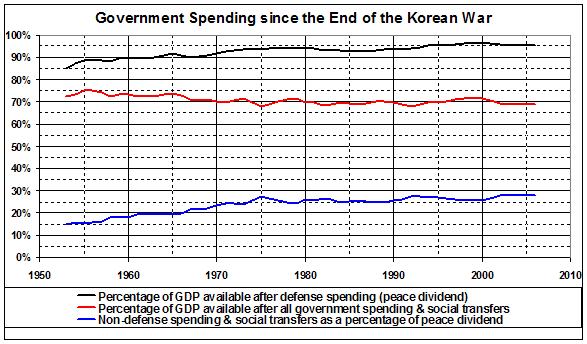
Iran foments much of the so-called insurgency in Iraq. Iraqi terrorists might be infiltrating the U.S. via Mexico. These are military problems, not diplomatic or law-enforcement problems. Yet, we are unable to respond to those problems militarily because we continue on the course that was set when Truman surrendered Korea to the Communists. What is that course? This:*

Note: For a clearer view of the graph, right-click on it and select “open link in a new tab.”

Source: Derived from National Income and Product Accounts tables 1.1.5 and 3.1, available here.

I have argued that defense spending should be independent of GDP; that is, it should be geared to the threats we face, and not be set at an arbitrary percentage of GDP. I have not changed my position.

I am pointing out, here, that non-defense spending has displaced defense spending. The black and red lines in the graph highlight that displacement; the blue line in the graph measures it.

The black line plots the percentage of GDP that is available after defense spending (a percentage that I call the “peace dividend”). The red line plots the percentage of GDP available after government spending and social transfer payments at all levels of government: national, State, and local. Note that the red line moves downward even as the black line moves upward. The growing distance between the lines measures the rising share of GDP that is commandeered by government for non-defense spending and social transfer payments.**

The blue line takes us to the heart of the matter. The blue line plots all non-defense spending plus social transfers as a percentage of the peace dividend. That percentage has nearly doubled since the end of the Korean War.

In fact, there has been for more than seventy years a felt need among politicians to respond to the voices that call loudly for more “social services.” Such services — in the minds of politicians — must come at the expense of defense spending. And so they do, even though defense is the ultimate “social service.”

Imagine, then, the defenses we could mount if non-defense spending plus social transfers had not risen above ten percent of GDP. What is special about ten percent? That was a satisfactory share for non-defense spending plus social transfers from the end of the Civil War through the early 1900s — an era of rapid economic growth. In fact, that share remained satisfactory through 1929. It took the unique, government-fostered Great Depression to create in the minds of most Americans the false idea that we need government to ensure economic growth and take care of “social needs.”

So, here we are, rich in “social services” — except by the standards of no-growth Euro-socialists who free-ride on our defenses — but vulnerable to terrorists and opportunists (like those in Iran and Russia).

Other related posts:
The Destruction of Wealth and Income by the State
Things to Come
__________
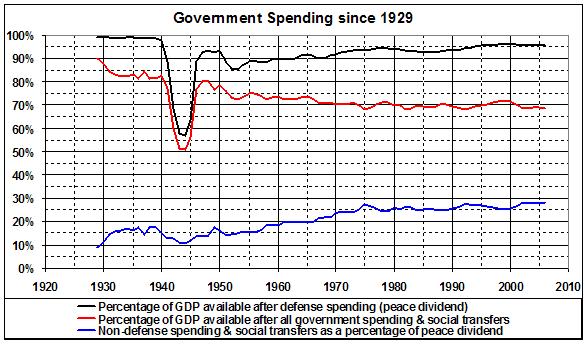
* Here is a longer view of the trends:This figure makes more obvious the growing allocation of the peace dividend to non-defense spending and social transfers. That trend began with the onset of the Great Depression, but it was interrupted by World War II — the last war in which the United States committed itself to total victory. The trend re-started at the end of World War II and became almost irreversible after the end of the Korean War, which is the point I chose to emphasize above. The low level of defense spending in the 1930s and the sudden drop after World War II arose from the (false) perception that the United States and its overseas interests did not then face serious threats from abroad. The peace dividends of the 1930s and late 1940s were declared before the peace had been won. The peace dividend of the 1990s and 2000s has cost us the ability to deter Russia and Iran (among others) while we respond (half-heartedly) to terrorism and those who foment it.

** I include social transfer payments in the analysis because, even though they are not government expenditures (by the standards of economic accounting), they do take money away from those who earn it and give it to those who do not. Social transfers therefore diminish the incentives that foster economic growth. Moreover, the tax revenues generated for the purpose of making such transfers could be applied to defense. That would create a “transition” problem with respect to Social Security, but it is a problem with a straightforward solution.

Always Prepare for the Next War

McQ, in a post at QandO, says:

I’d like to see someone actually do a real defense review and tell me why submarines and strategic bombers at the level we have them today are still necessary. Our future military conflicts are much more likely to be low-tech light infantry combat and not high-tech near peer battles.

I don’t know what a “real defense review” is, but I do know that if we don’t maintain our strategic nuclear forces we’ll be at the mercy of this guy (and his successors):