The Firing of Juan Williams

The firing of Juan Williams by NPR isn’t surprising, given NPR’s political “sensitivity” (i.e., tendency toward craven appeasement). But I suspect that NPR had been waiting for a convenient excuse to fire Williams for consorting with the folks at Fox News.

In any event, Williams is to be commended for his candor, not condemned as a bigot.

Leave it to Andrew Sullivan to take the low road:

What if someone said that they saw a black man walking down the street in classic thug get-up. Would a white person be a bigot of he assumed he was going to mug him?

No! The white person would be prudently fearful, as would any respectable and sensible person of color.

Sullivan continues:

What percentage of traditionally garbed Muslims – I assume wearing a covered veil or some other indicator and being of darker skin – have committed acts of terror? And, of course, the 9/11 mass-murderers were in everyday attire, to blend in. So was the Christmas Day undie-bomber. The Fort Hood murderer was in US military uniform, for Pete’s sake.

The percentage of terrorist acts committed by Muslims in traditional garb is irrelevant. What is relevant is that Muslims are the most likely perpetrators of terrorist acts. Sullivan makes the dangerous assumption that a traditionally garbed Muslim is above suspicion. But a traditionally garbed Muslim who has acquired a seat on a plane — thanks to screening of dubious quality and the politically correct prohibition of profiling — is no less suspect than a Muslim wearing “everyday attire” or an Army uniform.

Two Weeks Hence . . .

This post combines and updates the analyses and forecasts I presented in “Three Weeks Hence . . .” and “Another Election Indicator.”

As of today (UPDATED 10/23/10):

  • The GOP will gain 8 Senate seats, leaving the Democrats with a 51-49 majority in the Senate. (This estimate is based on the Intrade odds on individual Senate races.)
  • Over in the House, it looks like the GOP will re-take the House, with a majority ranging from 25 seats (230-205) to 33 seats (234-201) 53 seats (244-191).

My forecast of Republican gains in the House is based on two indicators. The first is Scott Rasmussen’s generic congressional ballot, which has been polled weekly since January 11, 2009. The data points in the graph below represent the results of the poll, to date. Although the GOP enjoys a lead of 9 percentage points in the latest poll, my analysis indicates that there will be a slight reversal of GOP gains as more noncommittal voters choose sides. The solid black line, which is fitted to the data points, shows that the downward trend has begun. A separate statistical analysis yields the dashed black line, which points to a GOP lead of 6.7 percentage points (a 234-201 majority) when the polls close on November 2.

The second indicator of GOP prospects in the House is Obama’s degree of unpopularity. The following graph depicts the relationship between Obama’s net unpopularity (percentage strongly disapproving less percentage strongly approving) and the number of percentage points by which votes cast for GOP House candidates will exceed votes cast for Democrat candidates.

This graph is derived from the results of Rasmussen’s generic congressional ballot and presidential tracking poll. The points on the graph represent the weekly results of the two Rasmussen polls for January 8, 2009, through October 17, 2010. If Obama’s unpopularity index stays at its current level of -10 -19 percentage points, the equation for the regression line in the graph yields a GOP advantage of 5.5 9.0 percentage points in the popular vote for House candidates. That translates into a majority of 230-205 244-191.

All of this assumes no major shocks between now and election day — nothing on the order of a terror attack, a specific terror threat, a scandal involving a major political figure, and so on.

Democrat Office-Holders = Faithful Nazis?

You may not be old enough to remember Adolf Eichmann, so here’s a thumbnail history lesson, courtesy of Wikipedia:

Otto Adolf Eichmann … , sometimes referred to as “the architect of the Holocaust”, was a German Nazi and SS-Obersturmbannführer (equivalent to Lieutenant Colonel). Because of his organizational talents and ideological reliability, he was charged by Obergruppenführer (General) Reinhard Heydrich with the task of facilitating and managing the logistics of mass deportation of Jews to ghettos and extermination camps in German-occupied Eastern Europe.

After the war, he fled to Argentina using a fraudulently obtained laissez-passer issued by the International Red Cross and lived there under a false identity working for Mercedes-Benz until 1960. He was captured by Israeli Mossad operatives in Argentina and abducted to Israel to face trial in an Israeli court on 15 criminal charges, including crimes against humanity and war crimes. He was found guilty and executed by hanging in 1962, and is the only person to have been executed in Israel on conviction by a civilian court.

Eichmann’s defense:

Eichmann, speaking in his own defense, said that he did not dispute the facts of what happened during the Holocaust. During the whole trial, Eichmann insisted that he was only “following orders”—the same Nuremberg Defense used by some of the Nazi war criminals during the 1945–1946 Nuremberg Trials. He explicitly declared that he had abdicated his conscience in order to follow the Führerprinzip. Eichmann claimed that he was merely a “transmitter” with very little power. He testified that: “I never did anything, great or small, without obtaining in advance express instructions from Adolf Hitler or any of my superiors.”

The “only following orders” defense reminds me of the meme that’s popular in “progressive” circles. A commenter at Daily Kos captures it well:

If you believe “A job worth doing is worth doing well,” you probably also believe a job that’s not worth doing is not worth doing well.  A classic conservative belief is that the government that governs least governs best, and it seems a lot of Republicans honestly believe that some things our government does it shouldn’t be doing at all….

If you’re a top-level Republican patronage recipient, you probably got a job doing something you still think the government should do.  But if you’re a B team talent who took a political patronage job, there’s a good chance it’s in a program or agency you don’t even think should exist.  If it’s a program you’d like to cancel but you know cancellation is a legislative impossibility, it almost makes sense to do the worst possible job you can get away with….

In other words, it doesn’t matter whether the function is constitutional. Nor does it matter that you took an oath of office in which you swore to uphold the Constitution. What matters is following orders. And if your job is to follow the “orders” enshrined in unconstitutional laws, regulations, and executive edicts, you’d better follow those “orders,” by gum.

S*** H***!

(I have replaced the letters i-e-g and e-i-l with asterisks because it seems that the filters on some public computers blocked this blog because it contained the verboten words. It is beyond the ability of  filtering software to put the words in context. The mock salute is to the fascisti in D.C.; it is by no means an homage to one of the most evil regimes of the twentieth century.)

Another Election Indicator

The GOP’s prospects for re-taking the House of Representatives track nicely with the course of Obama’s unpopularity. The following graph depicts the relationship between Obama’s net unpopularity (percentage strongly disapproving less percentage strongly approving) and the number of percentage points by which votes cast for GOP House candidates will exceed votes cast for Democrat candidates.


Derived from the results of Rasmussen’s generic congressional ballot and presidential tracking poll.

The points on the graph represent weekly results of the two Rasmussen polls from January 8, 2009, through October 10, 2010. I will update the graph following the release of congressional ballot results for October 17, 24, and 31.

Obama’s current unpopularity rating is -14 percentage points. If it stays around that level, the GOP will do as well as I forecast in “Three Weeks Hence“: a 37-seat majority in the House. Even if Obama enjoys a sudden resurgence to -10 — which is his standing when his “base” flocks to him — the GOP will enjoy a 5 percentage point advantage in the popular vote for House candidates. That translates into a 21-seat majority.

All of this assumes no major shocks between now and election day — nothing on the order of a terror attack, a specific terror threat, a scandal involving a major political figure, and so on.

The Improbability of Us

An argument often used against the belief in a Creator who designed the universe runs like this:

The existence of humans is indeed improbable. The laws of nature that govern our existence are but one set out of infinitely many possible sets of laws of nature. Ad had they differed only slightly the universe would be a mere swirl of subatomic particles, free from medium-sized objects like rocks, trees and humans. And even given the actual laws of nature, evolutionary history would have taken different twists and turns and failed to deliver human beings. (Jamie Whyte, Bad Thoughts – A Guide to Clear Thinking, p. 125)

Embedded in that seemingly reasonable statement is an unwarranted — but critical — assumption: that there are infinitely many (or even a large number) of possible sets of laws of nature. But there is no way of knowing such a thing. There is only one observable universe, and one set of observable and (mostly*) consistent laws of nature within it. It is impossible for the human mind to conjure an alternative set of consistent natural laws that could, in fact, coexist in a possible universe. Any such conjuring would be mere speculation, not a falsifiable hypothesis.

Given that, it is impossible to deny that a grand design lies behind the universe. But it is also impossible to prove, by the methods of science, the existence of a grand design. The fact of the universe’s existence is, as I have called it, the greatest mystery.

Related posts:
Atheism, Religion, and Science
The Limits of Science
Three Perspectives on Life: A Parable
Beware of Irrational Atheism
The Creation Model
The Thing about Science
Evolution and Religion
Words of Caution for Scientific Dogmatists
Science, Evolution, Religion, and Liberty
The Legality of Teaching Intelligent Design
Science, Logic, and God
Capitalism, Liberty, and Christianity
Is “Nothing” Possible?
A Dissonant Vision
Debunking “Scientific Objectivity”
Science’s Anti-Scientific Bent
Science, Axioms, and Economics
The Big Bang and Atheism
The Universe . . . Four Possibilities
Einstein, Science, and God
Atheism, Religion, and Science Redux
Pascal’s Wager, Morality, and the State
Evolution as God?
The Greatest Mystery
What Is Truth?
__________
* The exception is quantum mechanics, the science of the sub-atomic world. Sub-atomic particles do not seem to behave according to the same physical laws that describe the actions of the visible universe; their behavior is discontinuous (“jumpy”) and described probabilistically, not by the kinds of continuous (“smooth”) mathematical formulae that apply to the macroscopic world.

Three Weeks Hence . . .

. . . the GOP will retake the House and possibly the Senate. If the election were held today, Republicans would capture a 45-seat majority in the House (240-195) and a 51-49 majority in the Senate.

What will happen in the next three weeks? Some voters (mainly independents) will be unable to resist the allure of “something for nothing” (e.g., Obamacare) and will vote for Democrats in the end.

My fearless prediction (which I may change at any time):

  • 37-seat GOP majority in the House (236-199)
  • 50-50 split in the Senate (with Dem VP breaking ties in favor of Dem positions)

It won’t be possible for Republicans to repeal Obamacare. But with absolute control of the House and a cloture-proof voting bloc in the Senate, the GOP will be able to impede the implementation of Obamacare, while blocking other statist initiatives.

It remains to be seen whether congressional Republicans (or enough of them) can resist the urge to seem “compassionate” rather than “mean.”

*     *     *

My forecast of Republican gains in the House is based on Scott Rasmussen’s generic congressional ballot, which has been polled weekly since January 11, 2009. The data points in the graph below represent the results of the poll, to date. The blue point represents last week’s anomalous dip in the GOP’s fortunes; the red point represents this week’s results, which are in keeping with the long-term trend. My analysis indicates that there will be a slight reversal of GOP gains, as more noncommittal voters choose sides. The slowing of GOP gains is indicated by the shape of the solid black line, which is fitted to the data points. My statistical projection of the trend between now and election day is indicated by the dashed black line.  The odds in favor of a GOP majority are about 9-1.

Society and the State

Updated and revised, here.


Clear Thinking about the Death Penalty

Here’s my position:

The econometric evidence is there, for those who are open to it: Capital punishment does deter homicide. See, for example, the careful analysis by Hashem Dezhbaksh, Paul Robin, and Joanna Shepherd, “Does capital punishment have a deterrent effect? New evidence from post-moratorium panel data,” American Law and Economics Review 5(2): 344–376 (available in PDF format here). Dezhbaksh, Rubin, and Shepherd argue that each execution deters eighteen murders. That number may be high, but the analysis is rigorous and it accounts for relevant variables, such as income, age, race, gender, population density, and use of the death penalty where it is legal. It’s hard to read that analysis and believe that capital punishment doesn’t deter homicide — unless you want to believe it. I certainly wouldn’t take “Ouija Board” Goertzel’s opinion over that of careful econometricians like Dezhbaksh, Rubin, and Shepherd.

Now, I must say that I don’t care whether or not capital punishment deters homicide. Capital punishment is the capstone of a system of justice that used to work quite well in this country because it was certain and harsh. There must be a hierarchy of certain penalties for crime, and that hierarchy must culminate in the ultimate penalty if criminals and potential criminals are to believe that crime will be punished. When punishment is made less severe and less certain — as it was for a long time after World War II — crime flourishes and law-abiding citizens become less secure in their lives and property.

John McAdams, a professor of political science at Marquette University, makes a succinct case for the death penalty, regardless of its deterrent effect:

I’m a bit surprised . . . [by the] claim that “the burden of empirical proof would seem to lie with the pro-death penalty scholar.” If we execute murderers and there is in fact no deterrent effect, we have killed a bunch of murderers. If we fail to execute murderers, and doing so would in fact have deterred other murders, we have allowed the killing of a bunch of innocent victims. I would much rather risk the former. This, to me, is not a tough call.

I wish I’d said that.

Related posts:
Does Capital Punishment Deter Homicide?
Libertarian Twaddle about the Death Penalty
Crime and Punishment
Abortion and Crime
Saving the Innocent?
Saving the Innocent?: Part II
More on Abortion and Crime
More Punishment Means Less Crime
More About Crime and Punishment
More Punishment Means Less Crime: A Footnote
Let the Punishment Fit the Crime
Another Argument for the Death Penalty
Less Punishment Means More Crime
Crime, Explained
Abortion and Crime (from a different angle than the earlier post of the same name)

The Illusion of Prosperity and Stability

For reasons I outlined in “The Price of Government,” the post-Civil War boom of 1866-1907 finally gave way to the onslaught of Progressivism. Real GDP grew at the rate of 4.3 percent annually during the post-Civil War boom; it has since grown at an annual rate of 3.3 percent. The difference between the two rates of growth, compounded over a century, is the difference between $13 trillion (2009’s GDP in 2005 dollars) and $41 trillion (2009’s potential GDP in 2005 dollars).

As I said in “The Price of Government,” this disparity

may seem incredible, but scan the lists here and you will find even greater cross-national disparities in per capita GDP. Go here and you will find that real, per capita GDP in 1790 was only 4.6 percent of the value it had attained 218 years later. Our present level of output seems incredible to citizens of impoverished nations, and it would seem no less incredible to an American of 1790. In sum, vast disparities can and do exist, across nations and time.

The main reason for the disparity is the intervention of the federal government in the economic affairs of Americans and their businesses. I put it this way in “The Price of Government”:

What we are seeing [in the present recession and government’s response to it] is the continuation of a death-spiral that began in the early 1900s. Do-gooders, worry-warts, control freaks, and economic ignoramuses see something “bad” and — in their misguided efforts to control natural economic forces (which include business cycles) — make things worse. The most striking event in the death-spiral is the much-cited Great Depression, which was caused by government action, specifically the loose-tight policies of the Federal Reserve, Herbert Hoover’s efforts to engineer the economy, and — of course — FDR’s benighted New Deal. (For details, see this, and this.)

But, of course, the worse things get, the greater the urge to rely on government. Now, we have “stimulus,” which is nothing more than an excuse to greatly expand government’s intervention in the economy. Where will it lead us? To a larger, more intrusive government that absorbs an ever larger share of resources that could be put to productive use, and counteracts the causes of economic growth.

One of the ostensible reasons for governmental intervention is to foster economic stability. That was an important rationale for the creation of the Federal Reserve System; it was an implicit rationale for Social Security, which moves income to those who are more likely to spend it; and it remains a key rationale for so-called counter-cyclical spending (i.e., “fiscal policy”) and the onerous regulation of financial institutions.

Has the quest for stability succeeded? If you disregard the Great Depression, and several deep recessions (including the present one), it has. But the price has been high. The green line in the following graph traces real GDP as it would have been had economic growth after 1907 followed the same path as it did in 1866-1907, with all of the ups and down in that era of relatively unregulated “instability.” The red line, which diverges from the green one after 1907, traces real GDP as it has been since government took over the task of ensuring stable prosperity.

Only by overlooking the elephant in the room — the Great Depression — can one assert that government has made the economy more stable. Only because we cannot see the exorbitant price of government can we believe that it has had something to do with our “prosperity.”

What about those fairly sharp downturns along the green line? If it really is important for government to shield us from economic shocks, there are much better ways of getting the job done that they ways now employed. There was no federal income tax during the post-Civil War boom (one of the reasons for the boom). Suppose that in the early 1900s the federal government had been allowed to impose a small, constitutionally limited income tax of, say, 0.5 percent on gross personal incomes over a certain level, measured in constant dollars (with an explicit ban on exemptions, deductions, and other adjustments, to keep it simple and keep interest groups from enriching themselves at the expense of others). Suppose, further, that the proceeds from the tax had a constitutionally limited use: the payment of unemployment benefits for a constitutionally limited time whenever real GDP declined from quarter to quarter.

Perhaps that’s too much clutter for devotees of constitutional simplicity. But wouldn’t the results have been worth the clutter? The primary result would have been growth at a rate close to that of 1866-1907, but with some of the wrinkles ironed out. The secondary result — and an equally important one — would have been the diminution (if not the elimination) of the “need” for governmental intervention in our affairs.

Related posts:
Basic Economics
The Economic and Social Consequences of Government

The Winningest Managers

Thanks to Baseball-Reference.com, I have compiled the following table:

Managers with at least 1000 wins after 1900, sorted by W-L record
Yrs From To G W L W-L% ▾
Joe McCarthy 24 1926 1950 3487 2125 1333 .615
Billy Southworth 13 1929 1951 1770 1044 704 .597
John McGraw 33 1899 1932 4769 2763 1948 .586
Al Lopez 17 1951 1969 2425 1410 1004 .584
Earl Weaver 17 1968 1986 2541 1480 1060 .583
Fred Clarke 19 1897 1915 2829 1602 1181 .576
Davey Johnson 14 1984 2000 2039 1148 888 .564
Steve O’Neill 14 1935 1954 1879 1040 821 .559
Walter Alston 23 1954 1976 3658 2040 1613 .558
Bobby Cox 29 1978 2010 4508 2504 2001 .556
Miller Huggins 17 1913 1929 2570 1413 1134 .555
Billy Martin 16 1969 1988 2267 1253 1013 .553
Charlie Grimm 19 1932 1960 2368 1287 1067 .547
Sparky Anderson 26 1970 1995 4030 2194 1834 .545
Hughie Jennings 16 1907 1925 2203 1184 995 .543
Danny Murtaugh 15 1957 1976 2068 1115 950 .540
Leo Durocher 24 1939 1973 3739 2008 1709 .540
Joe Cronin 15 1933 1947 2315 1236 1055 .540
Joe Torre 29 1977 2010 4329 2326 1997 .538
Tony LaRussa 32 1979 2010 4934 2638 2293 .535
Whitey Herzog 18 1973 1990 2409 1281 1125 .532
Tom Lasorda 21 1976 1996 3041 1599 1439 .526
Bill McKechnie 25 1915 1946 3647 1896 1723 .524
Red Schoendienst 14 1965 1990 1999 1041 955 .522
Clark Griffith 20 1901 1920 2918 1491 1367 .522
Dusty Baker 17 1993 2010 2690 1405 1284 .522
Dick Williams 21 1967 1988 3023 1571 1451 .520
Jack McKeon 15 1973 2005 1952 1011 940 .518
Lou Piniella 23 1986 2010 3548 1835 1713 .517
Ralph Houk 20 1961 1984 3157 1619 1531 .514
Frankie Frisch 16 1933 1951 2246 1138 1078 .514
Bobby Valentine 15 1985 2002 2189 1117 1072 .510
Chuck Dressen 16 1934 1966 1990 1008 973 .509
Casey Stengel 25 1934 1965 3766 1905 1842 .508
Mike Hargrove 16 1991 2007 2363 1188 1173 .503
Felipe Alou 14 1992 2006 2054 1033 1021 .503
Wilbert Robinson 19 1902 1931 2819 1399 1398 .500
Art Howe 14 1989 2004 2266 1129 1137 .498
Jim Leyland 19 1986 2010 3013 1493 1518 .496
Chuck Tanner 19 1970 1988 2738 1352 1381 .495
Bruce Bochy 16 1995 2010 2574 1274 1300 .495
Bucky Harris 29 1924 1956 4410 2158 2219 .493
Lou Boudreau 16 1942 1960 2404 1162 1224 .487
Connie Mack 53 1894 1950 7755 3731 3948 .486
John McNamara 19 1969 1996 2395 1160 1233 .485
Bill Rigney 18 1956 1976 2561 1239 1321 .484
Jim Fregosi 15 1978 2000 2123 1028 1095 .484
Gene Mauch 26 1960 1987 3942 1902 2037 .483
Tom Kelly 16 1986 2001 2386 1140 1244 .478
Jimmy Dykes 21 1934 1961 2962 1406 1541 .477
Frank Robinson 16 1975 2006 2242 1065 1176 .475

Provided by Baseball-Reference.com: View Original Table
Generated 10/6/2010.

I will take a stab at assessing the “greatness” of the top ten in a future post.

The Yankees’ 2010 Season, in One Graph

Here:


The Yankees’ season didn’t fall apart until September 5. Despite some ups and downs, the Yankees’ season record stood at .632 after the game of Saturday, September 4. At that point, the Yankees had a lead of 2.5 games — their largest lead since July 26.

And then the bottom dropped out. The Yankees went 9-17 (.346) in the last four weeks of the season, finishing second in the AL East, with a final record of .586. The “stretch drive” was just too much for New York’s aging position players and shaky pitching staff.

The Resurgence of Obamacare

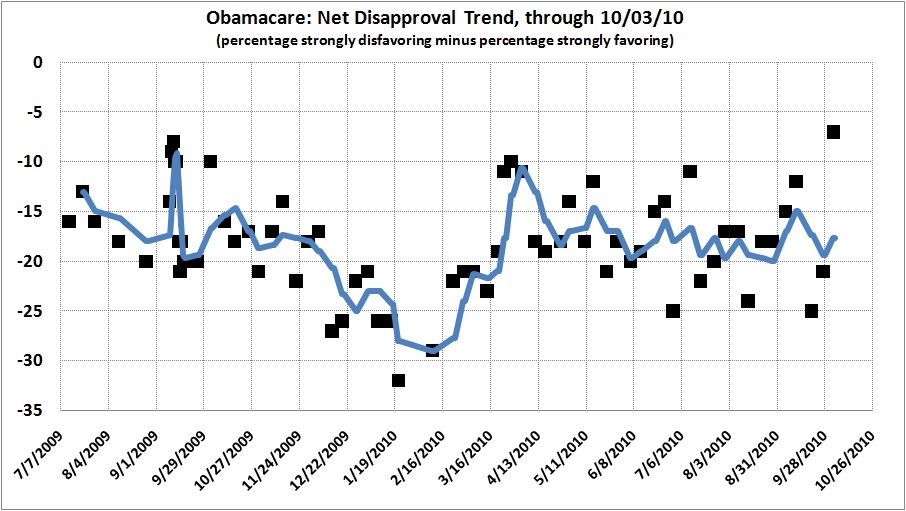
Rasmussen’s weekly poll of likely voters’ views of Obamacare reveals a sharp turnaround in attitudes. Here’s what has happened in the last three polls:

  • September 18-19 — 25 percent strongly oppose repeal of Obamacare; 50 percent strongly favor repeal; net disapproval index = -25 (not far from the all-time low of -32 recorded in January 2010)
  • September 24-25 — 25 percent strongly oppose repeal; 46 percent strongly favor it; net disapproval index = -21.
  • October 2-3 — 34 percent strongly oppose repeal; 41 percent strongly favor it; net disapproval index = -7 (the highest value yet recorded).

What is going on? In a word: bribery.

Millions of $250 checks have been sent to Medicare beneficiaries in recent weeks — and more will be sent in the four weeks remaining until election day.

There’s more to the bribery than $250 checks. Here are excerpts of the letter that accompanies the checks:

The Affordable Care Act, a new law passed by Congress and signed by President Obama on March 30, 2010, provides a one-time rebate to help with your drug cots. The rebate is sent automatically to most people enrolled in Medicare Part D who reach the Medicare drug plans coverage gap (“doughnut hole”) in 2010….

As part of this new law, starting next year, you will get a 50% discount on covered brand name drugs if you reach the coverage gap. On top of this, Medicare will add even more savings over the next several years until the coverage gap is closed by 2020.

The Affordable Care Act has many other provisions that protect and strengthen your Medicare, reduce your costs, and give you and your familymore control over health care….

It’s the old “something for nothing” trick. In this case, millions of old folks are getting something for nothing, while millions of younger folks will be getting nothing for something — their tax dollars. But the tax bill hasn’t come due yet because the federal government is still able to borrow money from abroad. And so, most of the people have been fooled — for the time being. By the time they understand what’s happening, it will be too late for them to do anything about it.

Republicans face a daunting challenge, if they return to power. They must repeal Obamacare while convincing the electorate that the result will be more, better, and cheaper health care.  This, I fear, is a task well beyond the power of today’s GOP, or the GOP of any day. “Something for nothing” wins every time.

*     *     *

The following graph gives a longer view of the unpopularity of Obamacare. Individual polls are represented by black squares; the blue line indicates the average for the three most recent polls.


Derived from this article and its predecessors at Rasmussen Reports. Poll results before passage of Obamacare represent strong approval minus strong disapproval. Poll results after passage of Obamacare represent strong approval of repeal minus strong disapproval of repeal.

Related posts:
Rationing and Health Care
The Perils of Nannyism: The Case of Obamacare
More about the Perils of Obamacare
Health-Care Reform: The Short of It
Presidential Chutzpah
Can Markets Force Financial Discipline?
As Goes Greece…
A Moral Dilemma

The Return of the Missing Bloggers

In “Missing Bloggers,” I lamented the lapse of posting at The Fourth Checkraise and the disappearance of Occam’s Carbuncle. I am happy to report that posting has resumed at The Fourth Checkraise, and that Occam’s Carbuncle is back, in a new location: http://occamscarbuncle.wordpress.com/. (“Occam” hasn’t had much to say yet, but give him time.)

Our Miss Brooks

Some time back, Tom Smith referred to the NYT columnist and pseudo-conservative David Brooks as “prissy little Miss Brooks.” Smith’s recycling of the appellation has not diminished its satirical effect — or its substantive accuracy.

Miss Brooks recently cringed when she contemplated an America without government, in the aftermath of a victorious Tea Party movement. Miss Brooks, it seems, is besotted with the manliness of limited-but-energetic governments

that used aggressive [emphasis added] federal power to promote growth and social mobility. George Washington used industrial policy, trade policy and federal research dollars to build a manufacturing economy alongside the agricultural one. The Whig Party used federal dollars to promote a development project called the American System.

Abraham Lincoln supported state-sponsored banks to encourage development, lavish infrastructure projects, increased spending on public education. Franklin Roosevelt provided basic security so people were freer to move and dare. The Republican sponsors of welfare reform increased regulations and government spending — demanding work in exchange for dollars.

Throughout American history, in other words, there have been leaders who regarded government like fire — a useful tool when used judiciously and a dangerous menace when it gets out of control. They didn’t build their political philosophy on whether government was big or not. Government is a means, not an end. They built their philosophy on making America virtuous, dynamic and great. They supported government action when it furthered those ends and opposed it when it didn’t.

I am surprised that Miss Brooks was able to recover from her swoon and finish writing the column in question. I am less surprised that Miss Brooks omitted to mention Thomas “Louisiana Purchase” Jefferson and Theodore “I Can Do Whatever I Please” Roosevelt, given that Jefferson was an effete Francophile and Roosevelt was a squeaky-voiced nutcase.

Other than that, there are only two problems with Brooks’s prescription for beneficent government: The first is the impossibility of electing only those leaders who know how to use government power judiciously. The second problem is the assumption that the things wrought by Washington, Lincoln, et al. were judicious uses of government power.

As to the first problem, all I can do is note the number of times that a majority of Americans has been convinced of the goodness of a candidate, only to be disappointed — when not outraged — by his performance in office. Take LBJ, Nixon, Carter, G.H.W. Bush, Clinton, G.W. Bush, and Obama — please take them! –not to mention myriad Congress-critters and State and local office-holders.

The second problem is a problem for reasons that are evidentlybeyond Miss Brooks’s comprehension:

  • Government action isn’t cost-less. It absorbs resources that the private sector could have put to use.
  • Government officials, despite their (occasional) great deeds, are not gifted with superior knowledge about how to put those resources to use.
  • Private firms — when not shielded from competition and failure by governments — put resources to uses that satisfy the actual needs of consumers, as opposed to the whims (however high-minded) of politicians.
  • Private firms — when not shielded from competition and failure by government — use resources more efficiently than government.

In short, Miss Brooks, Washington may have been a great man for having led a rag-tag army to victory over the British, and Lincoln may have been a great man for having preserved the Union and (incidentally) freed the slaves, but neither man — and certainly no other man or collection of men exercising the arbitrary power of government — was or ever will be equal to the task of simulating the irreproducibly complex set of signals and decisions that are embedded in free markets.

In the end, Miss Brooks works herself into hysterics at the prospect of less government:

The social fabric is fraying. Human capital is being squandered. Society is segmenting. The labor markets are ill. Wages are lagging. Inequality is increasing. The nation is overconsuming and underinnovating. China and India are surging. Not all of these challenges can be addressed by the spontaneous healing powers of the market.

The social fabric is fraying precisely because government has pushed social institutions aside and made millions of Americans its dependents. Society is segmenting for the same reason, and also because millions of Americans are fed up with government and its dominance of their lives. Labor markets are ill and wages are lagging (compared to what?) because of various government actions that have slowed economic growth and caused (not for the first time) a deep recession. The nation is overconsuming (i.e., underinvesting) and underinnovating because of the aforesaid government-caused economic malaise, which (among other things) has reduced the demand for money (seen in the form of low interest rates) and the potential returns on innovative investments. That China and India are surging is no skin off our teeth; the more productive they are the less Americans have to pay for the goods and services they produce, and the more Americans can produce of other things — if government will only get off the back of American business.

None of these “challenges” would be challenges were it not for governmental interference in private social institutions and markets. As Ronald Reagan said in his first inaugural address, “In this present crisis, government is not the solution to our problem, government is the problem.” Amen.

So, Miss Brooks, I advise you to take two Valium and read Friedrich Hayek’s Nobel Prize lecture, “The Pretence of Knowledge.” Then pass it on to your politician friends.

Related posts:
Columnist, Heal Thyself
The Economic and Social Consequences of Government

The Mind of a Paternalist, Revisited

If there was any doubt that Richard Thaler is not a “libertarian,” even though he implies that he is one when he calls himself a “libertarian paternalist,” read this:

There is another possible argument for including the rich in these tax cuts, one based on “fairness.” By this reasoning, the wealthy are entitled to low tax rates because they have temporarily had them, and it would now be unfair to take them back.

But by that same argument, unemployment insurance should never expire, and every day should be your birthday. “Temporary” has no meaning if it bestows a permanent right.

By Thaler’s convoluted logic, the money one earns is a gift from government, and those who pay taxes have no greater claim on their own money than those to whom the government hands it. How is this “libertarian,” by any reasonable interpretation of that word?

As I have said in various ways, Thaler is a paternalist but not a libertarian. One cannot be both.

Related posts:
Beware of Libertarian Paternalists
Columnist, Heal Thyself
Discounting and “Libertarian” Paternalism
The Mind of a Paternalist

A Moralist’s Moral Blindness

Bryan Caplan restates his version of the Golden Rule, which is that “we” ought to be treated just as “we” would treat others. (My take on Caplan’s earlier post is here.) Much as I like the Golden Rule, for its civilizing influence on humans, I am not a simple-minded moralist like Caplan and other libertarian purists.

Caplan objects to the “double standard” by which Americans, for example, would praise the killing of enemy civilians, were it a necessary act of war, but condemn the killing of 3,000 Americans by an enemy who proclaims his act necessary in the service of some objective. I wonder if Caplan would object to the “double standard” when faced with the prospect of his children being among the 3,000 Americans killed.

The Golden Rule also is known as the ethic of reciprocity, and for a good reason. For the Golden Rule to operate effectively, it must be accompanied by a reasonable expectation that your mundane acts of self-restraint and helpfulness will be returned in kind by persons whose lives touch yours, or with whom you share a bond of kinship or culture.

The Golden Rule simply doesn’t operate very well across personal, familial, or cultural boundaries, Caplan’s wishful thinking to the contrary. (Consider, for example, the rudeness that often prevails in anonymous encounters over the internet and on the highway.) And there is no inherent reason that the Golden Rule should operate well across those boundaries, just because Caplan (or any other intellectual) asserts that it should. Who died and left him (and his ilk) in charge?

There are other moral considerations at work, aside from reciprocity. One of them, which I discussed in my previous post, is the ethic of mutual defense:

[W]ho better to help you defend yourself than the people with whom you share space, be it a neighborhood, a city-state, a principality, or even a vast nation? As a member of one or the other, you may be targeted for harm by outsiders who wish to seize your land and control your wealth, or who simply dislike your way of life, even if it does them no harm.

If, like Caplan, you are willing to allow an enemy to obliterate some of your fellow citizens because you have obliterated some enemy citizens, you are not to be trusted. You might as well be an enemy.

More generally, Caplan’s moral blindness betrays his Rationalism. As Michael Oakeshott explains,

the Rationalist never doubts the power of his ‘reason … to determine the worth of a thing, the truth of an opinion or the propriety of an action. Moreover, he is fortified by a belief in a ‘reason’ common to all mankind, a common power of rational consideration….

… And having cut himself off from the traditional knowledge of his society, and denied the value of any education more extensive than a training in a technique of analysis, he is apt to attribute to mankind a necessary inexperience in all the critical moments of life, and if he were more self-critical he might begin to wonder how the race had ever succeeded in surviving. (“Rationalism in Politics,” pp. 5-7, as republished in Rationalism in Politics and Other Essays)

Thomas Sowell puts it this way:

One of the things intellectuals [his Rationalists] have been doing for a long time is loosening the bonds that hold a society [or a nation] together. They have sought to replace the groups into which people have sorted themselves with groupings created and imposed by the intelligentsia. Ties of family, religion, and patriotism, for example, have long been treated as suspect or detrimental by the intelligentsia….

Under the influence of the intelligentsia, we have become a society that rewards people with admiration for violating its own norms and for fragmenting that society into jarring segments. In addition to explicit denigrations of their own society for its history or current shortcomings, intellectuals often set up standards for their society which no society has ever met or is likely to meet.

Calling those standards “social justice” enables intellectuals to engage in endless complaints about the particular ways in which society fails to meet their arbitrary criteria, along with a parade of groups entitled to a sense of grievance, exemplified in the “race, class and gender” formula…. (Intellectuals and Society, pp. 303, 305)

Sowell’s attack is aimed at left-wing intellectuals, but it could just as well be aimed at libertarian purists like Caplan and his ilk.

The Divine Right of the Majority

From “Fun For Clio,” an essay in Hilaire Belloc’s The Silence of the Sea (1941):

An older generation marvelled that men should unquestioningly obey a King, who claimed absolute Divine authority for his mandates. To-day you find men falling into exactly that state of mind in the presence of what they call a majority. All sorts of evidence is shouting at them to show them that this word “majority” has no meaning because it may be of any kind whatsoever — a majority of men or a majority of women or a majority of men and women combined, or a majority of those who care, or a majority of those who want to express an opinion, or a majority of those who are bored stiff with having to express an opinion, or a majority of those who don’t express an opinion but simly make a mark on a bit of paper. It may mean a majority of a thousand and one to a thousand, or a majority of nine out of ten, a majority of citizens or a majority of professional politicians, a majority of murderers, a majority of savages, a majority of lunatics, a majority which changes in a few hours or a majority which is fixed — it is all one, majority is worshipped as of Divine Right. (p. 88, Glendalough Press edition)

Plus ça change, plus c’est la même chose.

Related posts:
Democracy and Liberty
Greed, Cosmic Justice, and Social Welfare
Utilitarianism, “Liberalism,” and Omniscience
Utilitarianism vs. Liberty
Accountants of the Soul
Rawls Meets Bentham
Enough of “Social Welfare”
The Case of the Purblind Economist

The End of a Dynasty

UPDATED

The Yankees’ recent record [written 09/26/10] — 4 straight losses, 6-12 in the past three weeks, .529 since the All-Star break — suggests that their third dynasty may be drawing to a close [but not quite, see below]. It would be unsurprising if that turns out to be so. Where are the replacements for Jeter, Posada, Pettitte, and Rivera, whose average age is 38? A-Rod is close behind, at 34, and not the A-Rod of a few years ago. Tex, at 30, is on the cusp of decline, and his numbers show it. Of the younger generation of position players, only Robinson Cano exudes star quality. Curtis Granderson is no Bernie Williams; Nick Swisher, no Paul O’Neill.

The only reliable starter is CC Sabathia. A.J. Burnett and Javier Vasquez don’t belong on a championship-calibre team. Phil Hughes isn’t convincing, despite his 17 wins. The bullpen reminds me of a rowboat in a hurricane. Even Mariano has become a question mark.

Given the evident dearth of outstanding young players, the end of the present dynasty seems to be in sight — or perhaps visible in the rear-view mirror. The 2009 World Series may have marked the end of Yankees Dynasty III.

Dynasty I lasted from 1921, the year of the Yankees’ first AL championship, to 1964, the year of their 29th AL championship. There were some “down” years sprinkled throughout the period — most notably, 1925, the year of the Babe’s big stomach ache, when the Yankees finished seventh in the days of the eight-team league. But the Yankees never went more than four seasons without a pennant, and finished below third (in eight- and ten-team leagues) only twice. Overall record in 44 seasons: 29 league championships and 20 World Series championships.

Dynasty II lasted only six seasons: 1976-1981. The Yankees led their division in four of those years, and wound up with the AL crown in 1981, despite an overall fourth-place finish, thanks to the split season (due to a players’ strike) and a post-season playoff to determine the division winner. Overall record in six seasons: 5 division championships, 4 league championships, and 2 World Series championships.

Dynasty III (on the current evidence) lasted 16 19 seasons: 1994-2009 2012. Overall record: 14 17 appearances in post-season play, 12 14 division championships, 7 league championships, and 5 World Series championships. (Don’t forget that in 1994 the Yankees had no opportunity to compete for a league or World Series championship because a players’ strike wiped out post-season play.) That’s a lot better than Dynasty II and a lot worse than Dynasty I.

In the following graph [updated to include the 2011-13 seasons], the black line indicates the Yankees’ finishes in the American League (1901-1968) or Eastern Division of the AL (1969-2013). The red, horizontal bars indicate the number of teams in the league or division, for each season. The blue shading highlights the years of the Yankees’ dynasties, to date. It looks like the end for Dynasty III — and end that coincides with the retirements of Mariano Rivera and Andy Pettite, the final declines of Jeter and A-Rod.

The Mood of the Country

UPDATED 09/25/10

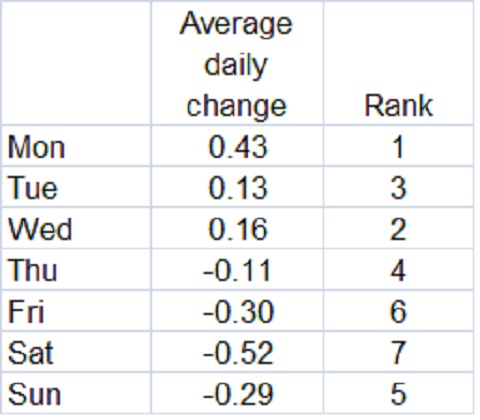
From the morning of January 21, 2009, through this morning, Obama’s net popularity rating has dropped from +28 to -13 (according to Rasmussen Reports). That’s an average daily decline of 0.07 rating points. But how Obama’s rating fares on a given day depends, in part, on the day of the week; thus:

As the week wears on, the likely voters polled by Rasmussen become less satisfied — or more dissatisfied — with Obama’s performance in office. Irascibility peaks on Saturday, then begins to recede on Sunday. Blue Monday, oddly enough, is Obama’s best day in the eyes of Rasmussen’s survey group. Conversely, the first day of the weekend — a day eagerly anticipated by most working persons — is Obama’s worst day. Go figure.

UPDATE: Saturday continues to be Obama’s blue polling day. With today’s 2-point drop, Saturday’s average change is now -0.54.

Inside-Outside

Bryan Caplan seems to think that the tendency of geographically proximate groups to band together in self-defense is a kind of psychological defect. He refers to it as “group-serving bias.”

It is nothing of the kind, however. It is a simple case of self-defense. And who better to help you defend yourself than the people with whom you share space, be it a neighborhood, a city-state, a principality, or even a vast nation? As a member of one or the other, you may be targeted for harm by outsiders who wish to seize your land and control your wealth, or who simply dislike your way of life, even if it does them no harm.

The cause of Caplan’s confusion is his adherence to a kind of libertarian idealism. In the anti-war argot of the 1960s, it was expressed as “Why can’t we all just get along?” But hope is not reality, Caplan notwithstanding.

Not getting along, to Caplan, is a moral defect. He therefore considers the differential treatment of insiders and outsiders to be an unmitigated wrong. But group cohesion is a prudential social instinct that no amount of rationalism can obliterate. Differential treatment of insiders and outsiders is an inevitable aspect of that prudential social instinct. It is not, at bottom, a moral issue.

If Caplan were logically consistent, he would focus his moral lens on the animal kingdom. There is plenty of inter-group conflict to condemn there: shark vs. tuna, cheetah vs. antelope, spider vs. fly, and so on. In the case of man vs. cattle (hog, fish, fowl, or other living thing), I wonder if Caplan opts for veganism? It would be the proper choice — for him.

Related posts:
Parsing Political Philosophy
“Natural Rights” and Consequentialism
More about Consequentialism
Line-Drawing and Liberty