Venus vs. Mars

Excerpts of a typically excellent post at Public Discourse, “Women, Abortion, and the Brain“:

Women’s brains are, of course, in many fundamental ways the same as men’s. Men and women think and reason in similar ways. But recent research shows that there are some significant differences in the brain and brain-related psychology of the two sexes. And a few of these differences can make a very large difference with regard to decision-making and its emotional consequences.

The part of the brain that processes emotion, generally called the limbic system, of women functions differently than that of men. Women experience emotions largely in relation to other people: what moves women most is relationships. Females are more personal and interpersonal than men. (Differences show up as early as a day after an infant’s birth: newborn baby girls look at faces relatively more than boys, who focus more on moving robotic figures.) There is wide consensus among scientists and researchers on this fundamental issue.

Recent research has also studied the ways in which males and females cope with stress. Whereas men’s behavior under stress is generally characterized by what is called “fight or flight,” women respond to stress by turning toward nurturing behavior, nicknamed “tend and befriend.”

Men’s and women’s brains also work differently in handling memory and memories. Men are more apt to recall facts of all kinds, on the one hand, and a global picture of events, on the other. By contrast, women remember people (for example, faces), details of all kinds, and emotion-laden narratives—and they may return to them obsessively.

I am only passingly familiar with the research that supports these observations, but they comport well with what I have seen in five decades as an adult. I offer, as just one of many possible examples, my daughter, who — untypically, for a woman — is much better with numbers than with words, and who has succeeded in the male-dominated field of investment banking. She is nevertheless strongly “feminine” in her emotions.

Radical feminists and egalitarians to the contrary, women aren’t just men with different anatomical features. There is a good case to be made for the injection of “feminine” traits into the worlds of business and politics. But there is no case to be made for enforced equality of pay or representation.

Individuals should be dealt with as individuals, not as “group members.” It is the levelers who are guilty of group bias, given their insistence that males and females are alike in their stock of mental and physical abilities — except that females are superior, of course.

Related posts:
Sexist Nonsense
Cornered by Gender?

A Conversation with Uncle Sam

Uncle Sam graciously granted me a telephone interview. Here is a complete transcript of the conversation between Uncle Sam (S) and me (T):

S: Sam here.

T: Hello, uncle, it’s Thomas.

S: It’s good to hear your voice, Mr. Jefferson.

T: Sorry, not that Thomas. I’m just a humble blogger. Do you know about blogs?

S: Oh, yes. I follow all the blogs about politics and economics. It’s quite a chore, but very enlightening. The things some people think about me are shocking.

T: How so?

S: Well, there are a lot of people out there who think that I hold the solution to all economic and social problems.

T: Don’t you?

S: Of course not. People are responsible for solving their own problems. All I can do is try to create a safe environment in which they can get on with the business of life.

T: Before we explore that idea further, tell me about yourself. How did you get your job?

S: I was hired by nine of the original States in 1788, when the Constitution was ratified. The other four soon joined them, and others came along later.

T: What was your job description when you were hired?

S: Pretty much what I said a minute ago: to keep the people safe, which includes refereeing squabbles among the States and ensuring that they don’t erect barriers to keep out people and goods from other States.

T: But you seem to have acquired a lot of additional duties since 1788.

S: Sad, but true. And it’s wearing me down. I have to pretend to be a lot wiser and more capable than any one person can be. I wish the States would get together and pare my job description down to its original specifications.

T: It seems unlikely, though. A lot of people have come to depend on you to do things they could do for themselves.

S: And it’s getting very expensive — like having 300 million dependents. The only way I’ll be able to support them all is to raise their taxes. I could borrow money from foreigners, but the more I borrow, the more expensive it will become. Eventually, foreigners will look at my balance sheet and cut me off.

T: So what it boils down to is this: In the end, your dependents must pay for the things that you do for them. Correct?

S: That’s exactly right. I’m just running a big Ponzi scheme. And most of the people who sign up for it are fools who believe that they’re getting something for nothing.

T: What’s in it for you?

S: Well, I must admit that I get a cut of the action.

T: So, when all the dust settles, your dependents don’t even get all of their money back from you?

S: Are you kidding? Of course they don’t. If they want me to do all of this extra work, they have to pay me for my trouble.

T: Do you think it’s possible to cut your job back to its original size?

S: Only if a lot more people get wise to me. Most of them seem to think I’m Santa Claus or the Tooth Fairy.

T: But the politicians who give you your orders don’t believe such things, do they?

S: Some of them do. Most of them are just using me to make things work the way they want them to. It’s called “control.” I’ve seen all the presidents, members of Congress, and Supreme Court jutices — from great to mediocre — and almost every one of them was, or is, a control freak. Washington had to be one in order to get things off the ground. Without him, I wouldn’t have a job. Ditto Lincoln, who had to be a control freak in order to save the Union. Not that that was a bad thing, mind you, especially because it brought an end to slavery. But how many presidents since Lincoln have tried to stuff the genie (me) back in the bottle? Cleveland, Coolidge, and Reagan — that’s about it. And whatever success they enjoyed was only temporary. The people are good at fooling themselves, and politicians excel at helping them along.

T: You seem pessimistic.

S: I am. What’s needed is another Revolution, but a peaceful one. Those are hard to come by.

T: I’ll end our conversation on that note. Thanks very much, Sam.

S: Thank you for listening. And give my best wishes to the Tea Party.

Team W-L Histories: 1901-2009

In the course of preparing the three preceding posts, I compiled the table below. Note that the American League’s overall record is slightly better than the National League’s. That’s because of the AL’s edge in interleague play, which continues into 2010.

Won-Lost records, 1901-2009
(franchise histories at bottom of table)
National League
Team Games Won Lost W-L%
Giants 16994 9070 7834 .537
Dodgers 16995 8841 8065 .523
Cardinals 17006 8774 8128 .519
Pirates 16993 8607 8292 .509
Cubs 17012 8545 8367 .505
Reds 17010 8484 8436 .501
Diamondbacks 1944 970 974 .499
Astros 7652 3812 3835 .498
Braves 16983 8168 8708 .484
Mets 7644 3655 3981 .479
Marlins 2686 1283 1403 .478
Nationals 6511 3098 3409 .476
Rockies 2692 1281 1411 .476
Phillies 16955 7830 9051 .464
Padres 6518 3008 3508 .462
Brewers 1943 889 1053 .458
NL totals 173538 86315 86455 .4996
American League
Team Games Won Lost W-L%
Yankees 16962 9575 7294 .568
Red Sox 16973 8730 8160 .517
Indians 16987 8622 8274 .510
Tigers 17013 8564 8356 .506
White Sox 16982 8540 8339 .506
Angels 7811 3887 3921 .498
Blue Jays 5224 2589 2632 .496
Athletics 16947 8189 8671 .486
Royals 6505 3143 3360 .483
Twins 16995 8138 8748 .482
Brewers 4570 2200 2367 .482
Orioles 16986 8013 8863 .475
Mariners 5223 2461 2760 .471
Rangers 7797 3657 4134 .469
Rays 1941 826 1115 .426
AL totals 174916 87134 86994 .5004
Franchise histories:
National League
Giants in San Francisco, 1958- ; in New York (also as Gothams), 1883-1957
Dodgers in Los Angeles, 1958 – ; in Brooklyn (also as Robins, Bridegrooms, Grooms), 1890-1957); previously in American Association (as Bridegrooms, Grays, Atlantics), 1884-1889
Cardinals in St. Louis (also as Perfectos, Browns), 1892- ; previously in American Association (as Browns, Brown Stockings), 1882-1891
Pirates in Pittsburgh (also as Alleghenys), 1887- ; previously in American Association (as Alleghenys), 1882-1886
Cubs in Chicago (also as Orphans, Colts, White Stockings), 1876-
Reds in Cincinnati (also as Redlegs), 1890- ; previously in American Association (as Red Stockings), 1882-1889
Diamondbacks in Arizona (Phoenix), 1998-
Astros in Houston (also as Colt .45’s), 1962-
Braves in Atlanta, 1966- ; in Milwaukee, 1953-1965; in Boston (also as Bees, Rustlers, Doves, Beaneaters, Red Caps), 1876-1952
Mets in New York, 1962-
Marlins in Florida (Miami), 1993-
Nationals in Washington, 2005- ; in Montreal (as Expos), 1969-2004
Rockies in Colorado (Denver), 1993-
Phillies in Philadelphia (also as Quakers), 1883-
Padres in San Diego, 1969-
Brewers in Milwaukee, 1998- (see AL entry for previous history)
American League
Yankees in New York (also as Highlanders), 1903- ; in Baltimore (as Orioles), 1901-1902
Red Sox in Boston (also as Americans), 1901-
Indians in Cleveland (also as Naps, Bronchos, Blues), 1901-
Tigers in Detroit, 1901-
White Sox in Chicago, 1901-
Angels in Anaheim, 1961- , but indentified variously as Los Angeles Angels of Anaheim, Anaheim Angels, California Angels, Los Angeles Angels
Blue Jays in Toronto, 1977-
Athletics in Oakland, 1968- ; in Kansas City, 1955-1967; in Philadelphia, 1901-1954
Twins in Minnesota (Minneapolis), 1961- ; in Washington (as Senators), 1901-1960
Royals in Kansas City, 1969-
Brewers in Milwaukee, 1970-1997; in Seattle (as Pilots), 1969
Orioles in Baltimore, 1954- ; in St. Louis (as Browns), 1902-1953; in Milwaukee (as Brewers), 1901
Rangers in Texas (Arlington), 1972- ; in Washington (as Senators) 1961-1971
Mariners in Seattle, 1977-
Rays in Tampa Bay (St. Petersburg, also as Devil Rays), 1998-

Enough of Krugman

Paul Krugman, who has descended to the use of survey statistics, declares that small businesses aren’t hiring because their sales are down (“It’s Demand, Stupid“). Krugman has two points to make:

  • Small businesses aren’t cowed by regime uncertainty, taxes, and red tape, and all of those other “wonderful” things about which Krugman knows nothing.
  • The way to get out of the recession is to double down on “stimulus.”

Krugman’s first point aligns with  his stubborn insistence — against mountains of evidence  to the contrary– that government is benign and free-markets are malign.

Krugman’s second point aligns with his simplistic Keynsian view of the world, in which GDP is a homogeneous substance, like water, the level of which can be raised or lowered in a trice by government spending or the lack thereof. There’s no room in the Krugmanesque view of the world for real firms, run by real people, staffed by real people, producing myriad goods and services in myriad ways, and subject to the whims of Washington and thousands of State and local governments.

To say that small-businesspersons are reluctant to hire because there is inadequate demand for their products is like saying that a sick person is lying down because he doesn’t feel well. It’s a banal and incomplete interpretation of the situation. In any event, the fact that small businesses — and businesses in general — haven’t resumed hiring at the pre-recession rate is not an argument for mindless pump-priming. If it is an argument for anything, it is an argument for government to get out of the way.

Were the government a business, with a strong incentive to perform services of value to willing buyers, it would get out of the business of managing the economy and stick to what it does best: dispense justice and defend the nation. That it often fails to do those things well should be a clue to the Krugmans of the world about their risible faith in the wise, omniscient, and efficient government of their imagining.

There’s plenty more out there to indict and convict Krugman and his insistently wrong-headed view of the world. Here’s a minute sample:

Krugman and DeLong, a Prevaricating Pair
Professor Krugman Flunks Economics
The Negative Consequences of Government Expenditure
Regime Uncertainty: Behind the Reports of Economic Doom
Finally, Some Evidence from Krugman
Reviewing Krugman
In Pursuit of Empirical Macroeconomics
Krugman: Republicans Are Fiscally Irresponsible for Pushing Smaller Tax Cut, Threatening Much Larger One

To write about Krugman is to grant him the favor of being taken seriously. Basta!

Today Is Constitution Day

The members of the Constitutional Convention approved the new Constitution on this day in 1787. The Constitution then went to the old Confederation Congress, which approved the submission of the Constitution to conventions of the States.

The Constitution took effect on June 21, 1788, when it was ratified by a ninth State (New Hampshire), though it bound only the nine States that had thus far ratified it. The other four States followed suit, but the Constitution was not ratified by — and did not become binding on — all thirteen States until Rhode Island joined the Union on May 29, 1790. By then, more than a year had passed since the first Congress of the United States had assembled and George Washington had been inaugurated.

In honor of the original Constitution — which has been shredded by generations of legislative, executive, and judicial malfeasance — I refer you to these posts:

A New, New Constitution
The Real Constitution and Civil Disobedience
A Declaration of Independence
First Principles
The Constitution: Original Meaning, Corruption, and Restoration

A Simpler Pythagorean Formula

According to an article posted in the “Bullpen” at Baseball-Reference.com, the Pythagorean Theorem of Baseball

relates the number of runs a team has scored and surrendered to its actual winning percentage….

There are two ways of calculating Pythagorean Winning Percentage (W%). The more commonly used, and simpler version uses an exponent of 2 in the formula.

W%=[(Runs Scored)^2]/[(Runs Scored)^2 + (Runs Allowed)^2]

More accurate versions of the formula use 1.81 or 1.83 as the exponent.

W%=[(Runs Scored)^1.81]/[(Runs Scored)^1.81 + (Runs Allowed)^1.81]

An analysis of statistics available at Baseball-Reference.com, which include expected W%, yields the following straightforward version of the Pythagorean expectation:

W% = 1.8195*RS% – 0.4098, where

W% = games won/(games won + games lost),

RS% = runs scored/(runs scored + runs allowed), and

* indicates multiplication.

The Pythagorean formula used by Baseball-Reference.com bears a strong resemblance to the long-term (1901-2009) relationship between W% and RS%, which is:

W% = 1.8372*RS% – 0.4191

This equation is no longer accurate, however. Nor is any equation that neglects the evolution of the game through its six “modern” eras: Deadball (1901-1919), Lively Ball I (1920-1941), Wartime Lull (1942-1946), Lively Ball II (1947-1961), High Plateau (1962-1993), and Juiced Player (1994-2xxx). Here are the formulae for each of the six eras:

Deadball

W% = 1.7679 * RS% – 0.3843

Lively Ball I

W% = 1.8965 * RS% – 0.4482

Wartime Lull

W% = 1.7389 * RS% – 0.3686

Lively Ball II

W% = 1.8704*RS% – 0.4377

High Plateau

W% = 1.7521*RS% – 0.3760

Juiced Player

W% = 1.9882*RS% – 0.4940

This final equation seems like the one to use, until there is a marked change in the style of play. Results will vary from year to year, of course. Here, for example, is the equation for 2009:

W% = 1.9419*RS% – 0.4707

Related post: Explaining a Team’s W-L Record

The Six Eras of Baseball

In the preceding post, I identified six eras of “modern” baseball:

1901-1919 — Deadball (“modern”)

1920-1941 — Lively Ball I

1942-1946 — Wartime Lull

1947-1961 — Lively Ball II

1962-1993 — High Plateau

1994-2xxx — Juiced Player

These six eras have distinctive characters, which are captured in the following table:

Change from 1901-1919
Runs per HR per Add’l runs Add’l HR Runs per
Era # Teams game game per game per game add’l HR
1901-1919 16 7.84 0.30
1920-1941 16 9.69 0.97 1.85 0.67 2.76
1942-1946 16 8.14 0.88 0.30 0.58 0.52
1947-1961* 18 8.91 1.62 1.07 1.32 0.81
1962-1993** 26 8.37 1.56 0.53 1.26 0.42
1994-2009*** 30 9.62 1.63 1.78 1.33 1.34
1994-2009 “old 16” 9.73
1901-2009 30 8.82
1901-2009 “old 16” 8.85
* 2 expansion teams in 1961
** 2 expansion teams in 1962; 4 in 1969; 2 in 1977; 2 in 1993
*** 2 expansion teams in 1998

Lively Ball Era I was the most dynamic era to date. There were more home runs than in the Deadball era, to be sure, but it is evident that much of the “small ball” action of the Deadball era carried over into Lively Ball I.

The Wartime Lull was just that. There were more home runs than in the Deadball era, but every home run netted only 0.52 runs on the scoreboard. Think of batters reaching base and mostly waiting around for a home run to be hit, usually to no avail.

The next two eras — Lively Ball II and High Plateau — saw a resurgence of home-run hitting, but run production didn’t return to the level of Lively Ball II. Again, there was a lot of waiting around for home runs, usually to no avail.

The era of the Juiced Player rivals (but falls short of) the dynamism of Lively Ball I. Yes, a lot more home runs per game (what would you expect?), but not quite the same number of runs per game.

I have always had the impression that baseball in the 1920s and 1930s was baseball at its exciting best: power added to the “small ball” wiles of the Deadball era. The numbers seem to confirm that impression.

EXTRA INNINGS:

The runs-per-game figures for the “old 16” teams — the franchises in existence from 1901 through 1960 — suggest that those teams have done better than the expansion upstarts. In fact, for the Juiced Player era (1994-2009), the “old 16” have a W-L record of .512.

But not all of the “old 16” have fared well. Here are the W-L rankings of the “old 16” for the period 1994-2009:

Rank (of 30) Team G W L W-L%
1 NYY 2524 1514 1007 .601
2 ATL 2525 1456 1068 .577
3 BOS 2526 1409 1117 .558
4 CLE 2523 1353 1170 .536
5 STL 2525 1347 1176 .534
7 LAD 2526 1336 1190 .529
9 OAK 2524 1312 1212 .520
10 CHW 2527 1312 1212 .520
11 SFG 2526 1310 1215 .519
14 PHI 2526 1260 1266 .499
17 MIN 2525 1251 1273 .496
19 CIN 2530 1232 1295 .488
20 CHC 2524 1230 1294 .487
24 BAL 2525 1175 1347 .466
27 DET 2526 1108 1418 .439
28 PIT 2523 1091 1431 .433

“Old 16” teams occupy the top five spots and 10 of the top 15 spots. But Baltimore (13 straight losing seasons, 1998-2010), Detroit (12 straight losing seasons, 1994-2005), and Pittsburgh (18 straight losing seasons, 1993-2010) have turned in especially embarrassing performances.

The Lively Ball Eras

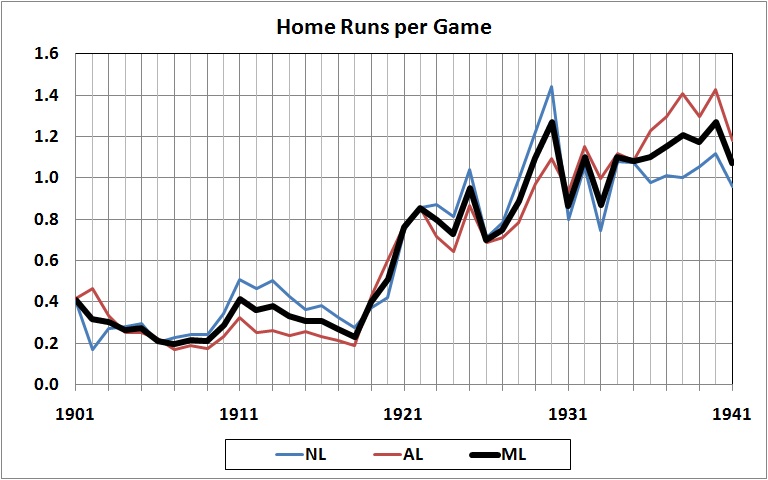
It is generally thought that the lively ball era began in 1920. In that year, the number of home runs per major-league game jumped to 0.511, eclipsing the previous “modern” high of 0.411, set in 1911. But the home-run barrage was only beginning in 1920. It jumped to 0.762 per game in 1921 — nearly double the 1911 mark — and continued around a rising trend through the rest of the pre-World War II era:

Despite Babe Ruth’s dominance in the early years of the lively ball era — he hit almost 9 percent of ML home runs in 1920, and more than 6 percent in 1927 — it wasn’t until 1931 that the AL began to outslug the NL every year. But there was plenty of slugging to go around, as the peaks and high valleys of 1930-1941 attest. I attribute the higher home-run output of those years to arrival of a new generation of players, who were selected more often than not for their slugging ability and encouraged to cultivate that ability.

But the real lively ball eras were yet to come:

Following a lull from 1942 through 1946, the home-run barrage resumed in 1947, with the post-war return of slugging veterans and the influx of newcomers raised in the slugging tradition. The second lively ball era peaked in 1961. It subsided with the “era of the pitcher” and the first waves of expansion. But even at its lowest ebb in the 1970s and 1989s, the pace of home-run production exceeded the peaks of the first lively ball era, with only a few exceptions.

Then came 1994 and a third era. This one, sad to say, probably owed its existence not to a “juiced” baseball but to “juiced” baseball players. Given the crackdown on performance-enhancing substances, the rate of home-run production in 2010 (to date) has dropped to that of 1961 — when the “juice” in the game came from a performance-inhibiting substance known as alcohol.

I hereby declare the following eras:

1901-1919 — Deadball (“modern”)

1920-1941 — Lively Ball I

1942-1946 — Wartime Lull

1947-1961 — Lively Ball II

1962-1993 — High Plateau

1994-2xxx — Juiced Player

The Population Mystery

Despite the doomsayers, past and present, the world’s population has grown and will grow:


Estimates for 10,000 B.C. through 1940 derived from U.S. Census Bureau, “Historical Estimates of World Population” (left column). Estimates for 1950 through 2050 derived from U.S. Census Bureau, “Total Midyear Population for the World: 1950-2050.” Intervals between years are irregular because of variations in the intervals in the Census tables.

Is it possible that the world’s population will reach an unsustainable level, after which it must shrink and/or plunge the world into abysmal poverty?

Donald Boudreaux, in a 2008 post, writes:

In his new book, Common Wealth, Jeffrey Sachs expresses his concern about population growth.  Worried by a U.N. prediction that global population will rise to 9.2 billion by the year 2050, from 6.6 billion today, Sachs says (on page 23 of his new book) the following about these additional 2.6 billion persons:

I will argue at some length that this is too many people to absorb safely, especially since most of the population increase is going to occur in today’s poorest countries.  We should be aiming….to stabilize the world’s population at 8 billion by midcentury.

Eight billion.  I’m not sure where Sachs got that number.  And, to be frank, I’m not curious about where he got it….

A … problem with Sachs’s eight-billion number is that, in calculating it, there is no way to predict how human creativity will alter the world during the next 42 years.  It’s ludicrous to pretend that we can know now what, say, the average MPG will be for internal-combustion engines in 2050.  Hell, we don’t even know if automobiles and lawnmowers and the like will still use such engines then.

Will another Norman Borlaug arise, between now and 2050, to spark another green revolution?  Will someone invent a way to efficiently power automobiles with air?  Will someone develop new and better techniques for defining and enforcing private property rights in ocean-going fish stocks so that the tragedy of the commons called “over-fishing” is eliminated?  Will an enterprising entrepreneur invent a means for ordinary households to power their homes with mulch or autumn leaves or small fragments of fingernail clippings?

Think back 42 years to 1966.  Who in that year imagined personal computers in nearly every home in America?  The Internet?  Digital cameras?  Cell phones?  Quality wines sold in screw-top bottles?  Buying music with literally the click of a button (and not having to burn fossil fuels in driving to the record store).  Aluminum cans that contain only a fraction of the metal that cans contained back then?  The Kindle (that will reduce the number of trees cut down to enable people to read books)?  Medical advances that make hip-replacements about as routine as getting cavities filled by the dentist?  Microfiber?

There is no way — literally, no way — to know how technology and social institutions will change between now and 2050.  Given this impossibility — and given the fact that we can nevertheless predict with confidence that technology will advance and that social institutions will change — to assert that “optimal” population in the year 2050 will be eight-billion persons is ludicrous in the extreme.  It’s faux-science, and deserves only ridicule.

Here’s Bryan Caplan, writing today:

I finally got around to reading Matt Ridley’s The Rational Optimist. Highlights….

2. How non-renewable energy is more abundant than renewable energy:

The Atlantic Ocean is not infinite, but that does not mean you have to worry about bumping into Newfoundland if you row a dingy out of a harbour in Ireland.  Some things are finite but vast; some things are infinitely renewable, but very limited.  Non-renewable resources such as coal are sufficiently abundant to allow an expansion of both economic activity and population to the point where they can generate sustainable wealth for all the people of the planet without hitting a Malthusian ceiling, and can then hand the baton to some other form of energy.

3. The fallacy of pessimistic extrapolation:

[T]he pessimists are right when they say that, if the world continues as it is, it will end in disaster for humanity.  If all transport depends on oil, and oil runs out, then transport will cease.  If agriculture continues to depend on irrigation and aquifers are depleted, then starvation will ensue.  But notice the conditional: if.  The world will not continue as it is.  That is the whole point of human progress, the whole message of cultural evolution, the whole import of dynamic change – and the whole thrust of this book….

5. Declining flu mortality is not dumb luck.

The modern way of life, with lots of travel but also rather more personal space, tends to encourage mild, casual-contact viruses that need their victims to be healthy enough to meet fresh targets fleetingly…

[W]hy then did H1N1 flu kill perhaps fifty million people in 1918?  Ewald and others think the explanation lies in the trenches of the First World War.  So many wounded soldiers, in such crowded conditions, provided a habitat ideally suited to more virulent behaviour by the virus: people could pass on the virus while dying….

The main argument I wish Ridley pursued more: How the very existence of civilization creates a mighty presumption against pessimism in all its forms.  But I view his omission optimistically: The arguments for optimism are so numerous that no one book can contain them all.

Doomsayers are simple-minded extrapolators. I suspect that they have an aesthetic objection to population growth, which they wrap in pseudo-scientific garb. Like their close kin, anti-market politicians and pundits, doomsayers seem to have no conception of the power of human ingenuity to make life more livable — when that ingenuity is not stifled by government.

Related posts:
The Causes of Economic Growth
A Short Course in Economics
Addendum to a Short Course in Economics
The Price of Government
The Price of Government Redux

The Birth of “Urban Legend”

The term “urban legend,” according to Wikipedia (citing the OED),

has appeared in print since at least 1968. Jan Harold Brunvand, professor of English at the University of Utah, introduced the term to the general public in a series of popular books published beginning in 1981.

I have news for the editors of the OED and the contributors to Wikipedia: Hilaire Belloc (1870-1953) got there first. In “Fun for Clio,” one of the essays collected in The Silence of the Sea (1941), Belloc writes:

Our great urban masses swallow the most fantastic legends and become furious if they hear the absurdity denied. (p. 87  in the Glendalough Press reprint)

In my book, that is close enough to count as the proximate source of “urban legend.”

What Is Truth?

There are four kinds of truth: physical, logical-mathematical, psychological-emotional, and judgmental. The first two are closely related, as are the last two. After considering each of the two closely related pairs, I will link all four kinds of truth.

PHYSICAL AND LOGICAL-MATHEMATICAL TRUTH

Physical truth is, seemingly, the most straightforward of the lot. Physical truth seems to consist of that which humans are able to apprehend with their senses, aided sometimes by instruments. And yet, widely accepted notions of physical truth have changed drastically over the eons, not only because of improvements in the instruments of observation but also because of changes in the interpretation of data obtained with the aid of those instruments.

The latter point brings me to logical-mathematical truth. It is logic and mathematics that translates specific physical truths — or what are taken to be truths — into constructs (theories) such as quantum mechanics, general relativity, the Big Bang, and evolution. Of the relationship between specific physical truth and logical-mathematical truth, G.K. Chesterton said:

Logic and truth, as a matter of fact, have very little to do with each other. Logic is concerned merely with the fidelity and accuracy with which a certain process is performed, a process which can be performed with any materials, with any assumption. You can be as logical about griffins and basilisks as about sheep and pigs. On the assumption that a man has two ears, it is good logic that three men have six ears, but on the assumption that a man has four ears, it is equally good logic that three men have twelve. And the power of seeing how many ears the average man, as a fact, possesses, the power of counting a gentleman’s ears accurately and without mathematical confusion, is not a logical thing but a primary and direct experience, like a physical sense, like a religious vision. The power of counting ears may be limited by a blow on the head; it may be disturbed and even augmented by two bottles of champagne; but it cannot be affected by argument. Logic has again and again been expended, and expended most brilliantly and effectively, on things that do not exist at all. There is far more logic, more sustained consistency of the mind, in the science of heraldry than in the science of biology. There is more logic in Alice in Wonderland than in the Statute Book or the Blue Books. The relations of logic to truth depend, then, not upon its perfection as logic, but upon certain pre-logical faculties and certain pre-logical discoveries, upon the possession of those faculties, upon the power of making those discoveries. If a man starts with certain assumptions, he may be a good logician and a good citizen, a wise man, a successful figure. If he starts with certain other assumptions, he may be an equally good logician and a bankrupt, a criminal, a raving lunatic. Logic, then, is not necessarily an instrument for finding truth; on the contrary, truth is necessarily an instrument for using logic—for using it, that is, for the discovery of further truth and for the profit of humanity. Briefly, you can only find truth with logic if you have already found truth without it. [Thanks to The Fourth Checkraise for making me aware of Chesterton’s aperçu.]

To put it another way, logical-mathematical truth is only as valid as the axioms (principles) from which it is derived. Given an axiom, or a set of them, one can deduce “true” statements (assuming that one’s logical-mathematical processes are sound). But axioms are not pre-existing truths with independent existence (like Platonic ideals). They are products, in one way or another, of observation and reckoning. The truth of statements derived from axioms depends, first and foremost, on the truth of the axioms, which is the thrust of Chesterton’s aperçu.

It is usual to divide reasoning into two types of logical process:

  • Induction is “The process of deriving general principles from particular facts or instances.” That is how scientific theories are developed, in principle. A scientist begins with observations and devises a theory from them. Or a scientist may begin with an existing theory, note that new observations do not comport with the theory, and devise a new theory to fit all the observations, old and new.
  • Deduction is “The process of reasoning in which a conclusion follows necessarily from the stated premises; inference by reasoning from the general to the specific.” That is how scientific theories are tested, in principle. A theory (a “stated premise”) should lead to certain conclusions (“observations”). If it does not, the theory is falsified. If it does, the theory lives for another day.

But the stated premises (axioms) of a scientific theory (or exercise in logic or mathematical operation) do not arise out of nothing. In one way or another, directly or indirectly, they are the result of observation and reckoning (induction). Get the observation and reckoning wrong, and what follows is wrong; get them right and what follows is right. Chesterton, again.

PSYCHOLOGICAL-EMOTIONAL AND JUDGMENTAL TRUTH

A psychological-emotional truth is one that depends on more than physical observations. A judgmental truth is one that arises from a psychological-emotional truth and results in a consequential judgment about its subject.

A common psychological-emotional truth, one that finds its way into judgmental truth, is an individual’s conception of beauty.  The emotional aspect of beauty is evident in the tendency, especially among young persons, to consider their lovers and spouses beautiful, even as persons outside the intimate relationship would find their judgments risible.

A more serious psychological-emotional truth — or one that has public-policy implications — has to do with race. There are persons who simply have negative views about races other than their own, for reasons that are irrelevant here. What is relevant is the close link between the psychological-emotional views about persons of other races — that they are untrustworthy, stupid, lazy, violent, etc. — and judgments that adversely affect those persons. Those judgments range from refusal to hire a person of a different race (still quite common, if well disguised to avoid legal problems) to the unjust convictions and executions because of prejudices held by victims, witnesses, police officers, prosecutors, judges, and jurors. (My examples point to anti-black prejudices on the part of whites, but there are plenty of others to go around: anti-white, anti-Latino, anti-Asian, etc. Nor do I mean to impugn prudential judgments that implicate race, as in the avoidance by whites of certain parts of a city.)

A close parallel is found in the linkage between the psychological-emotional truth that underlies a jury’s verdict and the legal truth of a judge’s sentence. There is an even tighter linkage between psychological-emotional truth and legal truth in the deliberations and rulings of higher courts, which operated without juries.

PUTTING TRUTH AND TRUTH TOGETHER

Psychological-emotional proclivities, and the judgmental truths that arise from them, impinge on physical and mathematical-logical truth. Because humans are limited (by time, ability, and inclination), they often accept as axiomatic statements about the world that are tenuous, if not downright false. Scientists, mathematicians, and logicians are not exempt from the tendency to credit dubious statements. And that tendency can arise not just from expediency and ignorance but also from psychological-emotional proclivities.

Albert Einstein, for example, refused to believe that very small particles of matter-energy (quanta) behave probabilistically, as described by the branch of physics known as quantum mechanics. Put simply, sub-atomic particles do not seem to behave according to the same physical laws that describe the actions of the visible universe; their behavior is discontinuous (“jumpy”) and described probabilistically, not by the kinds of continuous (“smooth”) mathematical formulae that apply to the macroscopic world.

Einstein refused to believe that different parts of the same universe could operate according to different physical laws. Thus he saw quantum mechanics as incomplete and in need of reconciliation with the rest of physics. At one point in his long-running debate with the defenders of quantum mechanics, Einstein wrote: “I, at any rate, am convinced that He [God] does not throw dice.” And yet, quantum mechanics — albeit refined and elaborated from the version Einstein knew — survives and continues to describe the sub-atomic world with accuracy.

Ironically, Einstein’s two greatest contributions to physics — special and general relativity — were met with initial skepticism by other physicists. Special relativity rejects absolute space-time; general relativity depicts a universe whose “shape” depends on the masses and motions of the bodies within it. These are not intuitive concepts, given man’s instinctive preference for certainty.

The point of the vignettes about Einstein is that science is not a sterile occupation; it can be (and often is) fraught with psychological-emotional visions of truth. What scientists believe to be true depends, to some degree, on what they want to believe is true. Scientists are simply human beings who happen to be more capable than the average person when it comes to the manipulation of abstract concepts. And yet, scientists are like most of their fellow beings in their need for acceptance and approval. They are fully capable of subscribing to a “truth” if to do otherwise would subject them to the scorn of their peers. Einstein was willing and able to question quantum mechanics because he had long since established himself as a premier physicist, and because he was among that rare breed of humans who are (visibly) unaffected by the opinions of their peers.

Such are the scientists who, today, question their peers’ psychological-emotional attachment to the hypothesis of anthropogenic global warming (AGW). The questioners are not “deniers” or “skeptics”; they are scientists who are willing to look deeper than the facile hypothesis that, more than two decades ago, gave rise to the AGW craze.

It was then that a scientist noted the coincidence of an apparent rise in global temperatures since the late 1800s (or is it since 1975?) and an apparent increase in the atmospheric concentration of CO2. And thus a hypothesis was formed. It was embraced and elaborated by scientists (and others) eager to be au courant, to obtain government grants (conveniently aimed at research “proving” AGW), to be “right” by being in the majority, and — let it be said — to curtail or stamp out human activities which they find unaesthetic. Evidence to the contrary be damned.

Where else have we seen this kind of behavior, albeit in a more murderous guise? At the risk of invoking Hitler, I must answer with this link: Nazi Eugenics. Again, science is not a sterile occupation, exempt from human flaws and foibles.

CONCLUSION

What is truth? Is it an absolute reality that lies beyond human perception? Is it those “answers” that flow logically or mathematically from unproven assumptions? Is it the “answers” that, in some way, please us? Or is it the ways in which we reshape the world to conform it with those “answers”?

Truth, as we are able to know it, is like the human condition: fragile and prone to error.

Future Hall of Famers?

The induction of Andre Dawson into the Hall of Fame provides a new benchmark for admission:

  • a career OPS+* of at least 119 and
  • a career BA of at least .279

By that standard, there are 45 players (past and present) with substantial careers (at least 8,000 plate appearances) who deserve (or will deserve) membership in the Hall of Fame. Here they are, ranked by career OPS+ and then by career BA:

OPS+ rank Player OPS+ BA
1 Barry Bonds 181 .298
2 Frank Thomas 156 .301
3 Manny Ramirez 155 .313
4 Jeff Bagwell 149 .297
5 Edgar Martinez 147 .312
6 Alex Rodriguez 146 .303
7 Jason Giambi 143 .282
8 Vladimir Guerrero 143 .320
9 Chipper Jones 142 .306
10 Gary Sheffield 140 .292
11 Larry Walker 140 .313
12 Todd Helton 138 .324
13 Carlos Delgado 138 .280
14 Bob Johnson 138 .296
15 Will Clark 137 .303
16 Reggie Smith 137 .287
17 Sherry Magee 136 .291
18 Ken Griffey 135 .284
19 Fred McGriff 134 .284
20 Rafael Palmeiro 132 .288
21 Ken Singleton 132 .282
22 Bobby Abreu 130 .296
23 John Olerud 128 .295
24 Keith Hernandez 128 .296
25 Joe Torre 128 .297
26 Ellis Burks 126 .291
27 Bernie Williams 125 .297
28 Bobby Bonilla 124 .279
29 Rusty Staub 124 .279
30 Bob Elliott 124 .289
31 Jimmy Ryan 124 .308
32 Jeff Kent 123 .290
33 Tim Raines 123 .294
34 Cesar Cedeno 123 .285
35 Hal McRae 122 .290
36 Ed Konetchy 122 .281
37 Dave Parker 121 .290
38 Al Oliver 121 .303
39 George Van Haltren 121 .316
40 Harold Baines 120 .289
41 Paul O’Neill 120 .288
42 Jose Cruz 120 .284
43 Derek Jeter 119 .314
44 Mark Grace 119 .303
45 Stan Hack 119 .301

BA rank Player OPS+ BA
1 Todd Helton 138 .324
2 Vladimir Guerrero 143 .320
3 George Van Haltren 121 .316
4 Derek Jeter 119 .314
5 Manny Ramirez 155 .313
6 Larry Walker 140 .313
7 Edgar Martinez 147 .312
8 Jimmy Ryan 124 .308
9 Chipper Jones 142 .306
10 Alex Rodriguez 146 .303
11 Will Clark 137 .303
12 Al Oliver 121 .303
13 Mark Grace 119 .303
14 Frank Thomas 156 .301
15 Stan Hack 119 .301
16 Barry Bonds 181 .298
17 Jeff Bagwell 149 .297
18 Joe Torre 128 .297
19 Bernie Williams 125 .297
20 Bob Johnson 138 .296
21 Bobby Abreu 130 .296
22 Keith Hernandez 128 .296
23 John Olerud 128 .295
24 Tim Raines 123 .294
25 Gary Sheffield 140 .292
26 Sherry Magee 136 .291
27 Ellis Burks 126 .291
28 Jeff Kent 123 .290
29 Hal McRae 122 .290
30 Dave Parker 121 .290
31 Bob Elliott 124 .289
32 Harold Baines 120 .289
33 Rafael Palmeiro 132 .288
34 Paul O’Neill 120 .288
35 Reggie Smith 137 .287
36 Cesar Cedeno 123 .285
37 Ken Griffey 135 .284
38 Fred McGriff 134 .284
39 Jose Cruz 120 .284
40 Jason Giambi 143 .282
41 Ken Singleton 132 .282
42 Ed Konetchy 122 .281
43 Carlos Delgado 138 .280
44 Bobby Bonilla 124 .279
45 Rusty Staub 124 .279

___
* OPS+ is on-base percentage plus slugging average (OPS) adjusted for where and when a batter compiled his statistics.

Statistics derived from the Play Index at Baseball-Reference.com.

September 11

Never forgive, never forget, never relent.

Related post: September 11: A Remembrance

A Belated Labor Day Message

The good news:


Derived from “Union Membership, Coverage, Density, and Employment Among Private Sector Workers, 1973-2010,” © 2010 by Barry T. Hirsch and David A. Macpherson.

Why is this good news? Read on: “The Truth about Labor Day,” from the Ludwig von Mises Institute; “Toward a Capital Theory of Value,” “A Very Politically Incorrect Labor Day Post,” and “Your Labor Day Reading,” by me. (NB: Some of the links in these old posts may be broken, and some of the quoted Wikipedia articles may have been revised by “contributors” eager to whitewash the labor-union movement.)

A Mere Coincidence?

UPDATED 09/10/10

On this morning after Barack Obama indulged in the politics of envy and class warfare by rejecting the continuation of the “Bush tax cuts” for high-income individuals, his unpopularity rating fell to a new low: -24.

By my estimate, rejection of Obama by conservative-libertarian-independent voters gives him a baseline unpopularity rating of -10. Ratings lower than that require the disapproval of Obama by disaffected Democrats who think he isn’t “doing enough.”

Well, if this morning’s poll results are any indication, there are some well-to-do and aspiring-to-do-well Democrats out there who think Obama would be “doing too much” if he succeeds in raising their marginal tax rates.

UPDATE: Despite today’s slight improvement, from -24 to -21, Obama’s unpopularity rating has hit new lows: 28-day average = -17.4; 7-day average = -20.7.

Macroeconomics and Microeconomics

Macroeconomic aggregates (e.g., aggregate demand, aggregate supply) are essentially meaningless because they represent disparate phenomena.

Consider A and B, who discover that, together, they can have more clothing and more food if each specializes: A in the manufacture of clothing, B in the production of food. Through voluntary exchange and bargaining, they find a jointly satisfactory balance of production and consumption. A makes enough clothing to cover himself adequately, to keep some clothing on hand for emergencies, and to trade the balance to B for food. B does likewise with food. Both balance their production and consumption decisions against other considerations (e.g., the desire for leisure).

A and B’s respective decisions and actions are microeconomic; the sum of their decisions, macroeconomic. The microeconomic picture might look like this:

  • A produces 10 units of clothing a week, 5 of which he trades to B for 5 units of food a week, 4 of which he uses each week, and 1 of which he saves for an emergency.
  • B, like A, uses 4 units of clothing each week and saves 1 for an emergency.
  • B produces 10 units of food a week, 5 of which she trades to A for 5 units of clothing a week, 4 of which she consumes each week, and 1 of which she saves for an emergency.
  • A, like B, consumes 4 units of food each week and saves 1 for an emergency.

Given the microeconomic picture, it is trivial to depict the macroeconomic situation:

  • Gross weekly output = 10 units of clothing and 10 units of food
  • Weekly consumption = 8 units of clothing and 8 units of food
  • Weekly saving = 2 units of clothing and 2 units of food

You will note that the macroeconomic metrics add no useful information; they merely summarize the salient facts of A and B’s economic lives — though not the essential facts of their lives, which include (but are far from limited to) the degree of satisfaction that A and B derive from their consumption of food and clothing.

The customary way of getting around the aggregation problem is to sum the dollar values of microeconomic activity. But this simply masks the aggregation problem by assuming that it is possible to add the marginal valuations (i.e., prices) of disparate products and services being bought and sold at disparate moments in time by disparate individuals and firms for disparate purposes. One might as well add two bananas to two apples and call the result four bapples.

The essential problem is that A and B will derive different kinds and amounts of enjoyment from clothing and food, and that those different kinds and amounts of enjoyment cannot be summed in any meaningful way. If meaningful aggregation is impossible for A and B, how can it be possible for an economy that consists of millions of economic actors and an untold variety of goods and services? And how is it possible when technological change yields results such as this?

GDP, in other words, is nothing more than what it seems to be on the surface: an estimate of the dollar value of economic output. It is not a measure of “social welfare” because there is no such thing.

Given that, why do I sometimes use GDP statistics? And, if GDP is really a meaningless aggregate, is there a valid, alternative way of depicting aggregate well-being? To be continued.

Related posts:
Greed, Cosmic Justice, and Social Welfare
Utilitarianism, “Liberalism,” and Omniscience
Utilitarianism vs. Liberty
Accountants of the Soul
Rawls Meets Bentham
Enough of “Social Welfare”
The Case of the Purblind Economist

Why Outsourcing Is Good: A Simple Lesson for “Liberal” Yuppies

You work in Manhattan, at the headquarters of a company whose product is sold throughout the U.S. and overseas. You live in Connecticut and commute to Manhattan by train. You drive to and from the train station in an SUV that was assembled in Tennessee; the parts came from many places, including Japan and Korea.

Shazam! Outsourcing is outlawed. You can’t buy a new SUV unless it’s assembled in Connecticut and all its parts are made in Connecticut of raw materials that are native to Connecticut.

Wait, it gets worse. You can’t work for a Manhattan-based firm if you live in Connecticut. Only Manhattanites need apply. The good news is that you won’t need an SUV if you move to Manhattan, so that you can keep your job. The bad news is that you can’t afford to live in Manhattan. The good news is that you wouldn’t want to live there anyway, because the only raw materials native to Manhattan are soot and dog droppings.

Missing Bloggers

Ilkka, the owner of The Fourth Checkraise, has not posted since August 1.

Alan, the owner of Occam’s Carbuncle (no longer online) has not posted in more than a year.

I hope that both bloggers will once again take up their keyboards. I have missed their perceptive and wickedly entertaining commentaries.

Comments are enabled for this post, so that the bloggers in question (or someone who knows the whereabouts of either of them) can enlighten me.

UPDATE (09/06/10): Ilkka comments: “I’m on a break until I get the spark to write something good again.”

Youthful Wisdom

A recent e-mail from my 15-year-old grandson includes this:

I am great lover of industry and I fume when I hear people complain about the chemical plants in __________, but without industry you cannot have the comforts of home….

I was in my 30s before I even began to think about the preciousness of the intellectualoids. Here is a 15-year-old who already sees through their cant.

I am proud to be his grandfather.

Obama’s Short-Lived “Peace Dividend”

UPDATED 09/05/10

On August 31, BHO declared an end to U.S. combat operations in Iraq. In anticipation of that declaration, and for a few days following it, BHO enjoyed what (for him) is a surge in popularity. His approval index (per Rasmussen Reports) went from -20 on August 25 to -12 on August 28. It dropped to -14 on August 31, but returned to -12 on September 1 (the morning after BHO’s declaration). It has been all downhill since: -13 on September 2, -16 on September 3, -21 on September 4, -23 on September 5.

Our boy president has recorded an unpopularity rating of -20 or lower only33 times in the 579 polling days that began with his inauguration. Nine of those low marks (more than a fourth of them) have come in the most recent 10 weeks of BHO’s 85 weeks in office.

In fact, Obama has earned a zero or positive rating 27 percent of the time; a negative rating, 73 percent of the time. More than half of his ratings have been -10 and lower. His last zero or positive rating came on June 29, 2009 — 62 weeks ago. That shouldn’t be surprising, given that he peaked two days after his inauguration. It has been mostly downhill and in a negative trough since then. Obama’s 28-day average rating hit -10 on November 7, 2009, and has stayed below -10 (usually well below) for the past 10 months.

It seems that BHO will have to keep looking for a way to become popular. Resignation might do the trick.