A Roundup of Crime Posts

A misguided social engineer at work: Mark Kleiman, guest-blogging at The Volokh Conspiracy last year (posts are in reverse chronological order).

Now, for some antitodes.

A breath of fresh air from Bryan Caplan, on the subject of addiction-as-disease as an excuse for anti-social and criminal behavior.

A look at crime and race in New York City, from City Journal.

A series of posts (in reverse chronological order) by Lester Jackson, writing at TCS Daily about the death penalty.

My own contributions:

Does Capital Punishment Deter Homicide?
Libertarian Twaddle about the Death Penalty
Crime and Punishment
Abortion and Crime
Saving the Innocent?
Saving the Innocent?: Part II
More on Abortion and Crime
More Punishment Means Less Crime
More About Crime and Punishment
More Punishment Means Less Crime: A Footnote
Clear Thinking about the Death Penalty
Let the Punishment Fit the Crime
Another Argument for the Death Penalty
Less Punishment Means More Crime
Crime, Explained
Abortion and Crime (from a different angle than the earlier post of the same name)

The Shape of Things to Come

Given the “State of the Union: 2010,” you may wonder how much worse things can get in this land of the once-free. Here are some very real possibilities:

  • More curbs on freedom of speech, in the name of “protecting” certain groups (e.g., homosexuals, immigrants, Muslims) and “preserving public order” (i.e., protecting government and government officials from criticism).
  • A complete government takeover of medical services (a U.S. National Heath Service), with no provision for opting-out to private care.
  • Environmentalism and warmism rampant, with draconian restrictions on everything from where we live, the design of our housing, and the range of products and services we are allowed to buy.
  • A stagnant economy — crushed by the weight of entitlement programs, environmentalism, warmism, and income equalization — affords a lower quality of life (on a par with the U.S. of the 1950s), and is unable to support a robust defense against foreign enemies.
  • Further reductions in quality of life, brought about by economic isolation, arising partly out of protectionism, partly out of voluntary withdrawal from overseas interests (in the name of self-sufficiency), and partly out of our unwillingness and inability to defend our overseas interests in the face of superior Chinese and Russian forces.
  • The erosion of traditional morality — aided by governmental endorsement of moral relativism — leading to the increasing brutalization of the citizenry and an eventual police-state response.

I could expand the list, but it is already depressing enough.

If you cannot participate in the efforts of the Tea Party movement, the American Conservative Union, and the Club for Growth to roll back the forces of oppression in this land, support those organizations with your dollars. Every little bit helps.

Not Conservative Enough

Some pundits were amazed that Sen. Robert Bennett was denied re-nomination by a GOP convention in Utah. After all, they said, Bennett earned an American Conservative Union rating of 84 in 2009. How much more should Utah Republicans expect? A lot more in a State that is staunchly Republican and cast more than 62 percent of its votes for McCain in 2008 (trailing only Oklahoma at 66 percent and Wyoming at 65 percent).

It turns out that Bennett’s lifetime ACU rating (83.63) earned him 27th place among the 40 Republicans who sat in the Senate at the end of 2009:

ACU Lifetime Ratings through 2009: GOP Senators
Rank Rating Member State
1 98.67 BARRASSO WYOMING
2 98.55 DeMINT S. CAROLINA
3 98 COBURN OKLAHOMA
4 97.66 INHOFE OKLAHOMA
5 96.75 KYL ARIZONA
6 96 RISCH IDAHO
7 95.08 SESSIONS ALABAMA
8 95 JOHANNS NEBRASKA
9 94.54 BUNNING KENTUCKY
10 94.37 ENSIGN NEVADA
11 93.82 VITTER LOUISIANA
12 93.14 CORNYN TEXAS
13 92.83 CHAMBLISS GEORGIA
14 92.82 ENZI WYOMING
15 92.76 BROWNBACK KANSAS
16 92.27 CRAPO IDAHO
17 91 BURR N. CAROLINA
18 90.8 WICKER MISSISSIPPI
19 89.77 HUTCHISON TEXAS
20 89.68 GRAHAM S. CAROLINA
21 89.66 McCONNELL KENTUCKY
22 89.15 HATCH UTAH
23 89.09 ISAKSON GEORGIA
24 87.97 THUNE S. DAKOTA
25 86.86 ROBERTS KANSAS
26 86 LeMIEUX FLORIDA
27 83.63 BENNETT UTAH
28 83.5 GRASSLEY IOWA
29 83.33 CORKER TENNESSEE
30 81.97 McCAIN ARIZONA
31 81.9 BOND MISSOURI
32 80.13 COCHRAN MISSISSIPPI
33 79 ALEXANDER TENNESSEE
34 78.68 GREGG NEW HAMPSHIRE
35 77.26 LUGAR INDIANA
36 75.43 SHELBY ALABAMA
37 70.19 MURKOWSKI ALASKA
38 69.83 VOINOVICH OHIO
39 49.43 COLLINS MAINE
40 47.88 SNOWE MAINE

Derived from American Conservative Union, Congressional Ratings 2009, 2009 Senate Ratings.

Obviously, it would be more difficult — and even foolhardy — for Maine Republicans to eject Senators Collins and Snowe, but there are plenty of firmly-Red States whose GOP constituencies aren’t getting their votes’ worth out of their senators. For example, the following States gave their electoral votes to the not-very-stellar Republican candidates in the last three presidential elections, and yet those States have GOP senators with ACU lifetime ratings below 90:

Alabama — Richard Shelby (75.43 ACU rating)

Alaska — Lisa Murkowski (70.19)

Arizona — John McCain (81.97)

Georgia — Sonny Isakson (89.09)

Kansas — Pat Roberts (86.86)

Kentucky — Mitch McConnell (89.66)

Mississippi — Thad Cochran (80.13)

South Carolina — Lindsey Graham (89.68)

South Dakota — John Thune (87.97)

Tennessee — Lamar Alexander (79.00), Bob Corker (83.33)

Texas — Kay Bailey Hutchison (89.77)

Utah — Orrin Hatch (89.15)

I’ve used bold type to highlight the weakest of the lot, though I’m certainly not enamored of the rest — several of whom (e.g., Thad Cochran, Lindsey Graham, Orrin Hatch, and Kay Bailey Hutchison) hold safe seats and could earn much higher ACU scores, if they chose to do so.

By the way, I have reviewed the ACU’s positions on the votes considered in rating senators for 2009. As a pro-life libertarian hawk, I find myself in agreement with the ACU’s positions on those votes and in agreement with the ACU’s principles.

The State of the Union: 2010

We are in a state of statism.

Statism, as I have said,

boils down to one thing: the use of government’s power to direct resources and people toward outcomes dictated by government. . . .

The particular set of outcomes toward which government should strive depends on the statist who happens to be expounding his views. But all of them are essentially alike in their desire to control the destiny of others. . . .

“Hard” statists thrive on the idea of a powerful state; control is their religion, pure and simple. “Soft” statists [sometimes] profess offense at the size, scope, and cost of government, but will go on to say “government should do such-and-such,” where “such-and such” usually consists of:

  • government grants of particular positive rights, either to the statist, to an entity or group to which he is beholden, or to a group with which he sympathizes
  • government interventions in business and personal affairs, in the belief that government can do certain things better than private actors, or simply should do many things other than — and sometimes in lieu of — dispensing justice and defending the nation.

Hard statists simply reject liberty. Soft statists reject it in fact even as they claim to embrace it in principle. Together, hard and soft statists have harnessed themselves and the liberty-loving minority to the yoke of the state. It is by this tyranny of the majority that America has descended into Europeanism, from which there can be no escape unless the liberty-loving minority begins actively to resist it — as did a similar minority in 1775.

If you are a “fish in water,” and cannot see the extent to which America is in thrall to statism — nationally, regionally, and locally — consider these examples of the ways in which statism grips us:

1. Compulsory public education has been used by statists to inculcate statism. Higher education — especially the so-called liberal arts — is dominated by the products of statist inculcation.

2. “Free enterprise” and freedom of personal action are barely more free than they were under Hitler or Mussolini. If you doubt that, consider the hundreds of thousands of pages comprised in the U.S. Code, its implementing regulations, and the statutes, codes, and ordinances of States and municipalities.

3.  “Private property” has gone by the wayside, in company with “free enterprise,” thanks to the same enactments. If you doubt that, think about compulsory unionism, smoking bans, the continuing misuse of eminent domain, and various restrictions on the sale and use of personal and business property.

4. Productive Americans, on the whole, pay about half of their income to their governments, for the purpose of supporting the counterproductive activities of those governments and their clients. Some of those productive Americans endorse and support this confiscatory regime because (a) they don’t understand its costs and consequences; (b) it makes them feel good; and (c) they subscribe to the Nirvana fallacy, in which an all-good, all-knowing government can (somehow) do the “right” things and do them “right.” The persistence of the Nirvana fallacy owes much to compulsory public education (point 1).

5. Our prosperity, such as it is, waxes and wanes with the whims of the Federal Reserve, which has the power to inflate, to  feed bubbles, to cause depressions, and to fund government’s profligate spending (where taxation is insufficient or politically unpopular).

6. Incentives to work and save — to be self-reliant, in other words — have been diminished by the establishment of welfare “rights,” Social Security, Medicare, and Medicaid. To this list has been added the expansion of Medicare-Medicaid known as Obamacare.

7. Affirmative action, equal lending opportunity, equal housing opportunity, and other  “preference” schemes penalize the more-capable at the expense of the less-capable. In a single stroke, such schemes enable advancement based on personal characteristics instead of merit, while destroying freedom of association and freedom of contract.

8. Various legislative, executive, and judicial acts have led to a kind of perverted legality that requires prisoners to be released when prisons become “overcrowded”; allows unborn and partially born human beings to be killed on a whim; stifles the free expression of political views for which the Founders fought and suffered; and treats foreign enemies as mere criminals with the same jurisprudential rights as the American citizens whose lives and property they would destroy.

There is much more, but that is all I can bear to acknowledge in a single post.

Is it any wonder that the Tea Party movement enjoys strong support, that Barack Obama (our statist-in-chief) merits strong disapproval, or that we must resort to civil disobedience if we are to enjoy a smattering of liberty?

Have a nice day!

The Mind of a Paternalist

The April 2010 edition of Cato Unbound, “Slippery Slopes and the New Paternalism,” is about “libertarian” paternalism and whether it deserves to be called libertarian, without the scare quotes. Richard Thaler, of whom I have written extensively (e.g., see this, this, and this), is a key contributor to the colloquy and a fierce defender of his ideas, which have had their fullest exposition in Nudge: Improving Decisions About Health, Wealth, and Happiness. The co-author of Nudge is Cass Sunstein, which should be enough to tell you that “libertarian” paternalism is about paternalism, not liberty. (Even The New York Times Magazine can’t disguise Sunstein’s arrogance.)

Thaler’s method of defending his position is to insist, repeatedly, that it is “libertarian,” even as he oozes paternalism. Consider one of his entries (“The Argument Clinic“) in the Cato Unbound colloquium, where he says the following:

[S]ince the word paternalism is what seems to give [the colloquium’s lead essayist Glen] Whitman fits, let’s re-label our policy “Best Guess”. “Best Guess” is the policy of choosing the choice architecture that is your best guess of what the participants would choose for themselves if they had the time and expertise to make an informed choice.

If that isn’t pure, presumptive arrogance, I don’t know what is. It conveys a presumption of omniscience on the part of the “best guesser,” along with a presumption that the “best guesser” ought to be making decisions for others.

Here’s another passage from Thaler’s post:

In many domains we [paternalists] can drastically improve on what is customary. Consider organ donations. In most states in the United States, to make your donation available you have to take some action such as sign the back of your driver’s license and get two witnesses to sign it. In some countries such as Spain they have switched to an “opt out” system called presumed consent. In Nudge we endorse a third approach, in this domain called “mandated choice.” It also happens to be used in my home state of Illinois.

Under this plan, when you go in to get your drivers license picture retaken every few years, you are asked whether you want to be a donor or not. You must say yes or no to get a license. About two thirds of drivers are saying yes, and lots of lives will be prolonged as a result. This is a great example of libertarian Best Guess in action. Although a large majority of people say in polls that they would want their organs harvested, many never get around to opting in, and a vocal minority in the United States object strenuously to the idea of presumed consent. So it is worthwhile to find a policy that gets many of the benefits of presumed consent without while honoring the preferences of those who object to having to opt out. Mandated choice has some other advantages in this context, namely that families are less likely to overrule the choices of the donor if that choice has been made actively rather than passively.

Let me count the assumptions: (1) Organ donation is the government’s business. (2) The government should deny a driver’s license to a person does not wish to say whether or not he wishes to be an organ donor. (3) This oppression of an individual is justified by the supposed fact that “a large majority of people . . . say that they would want their organs harvested.” Why give the government yet another excuse to intrude into private matters? The obvious answer to that question is that Thaler can’t resist the urge to lead others toward the decisions that he wants them to make. If, when you renew your driver’s license, you’re asked if you want to be an organ donor, your likely (politically correct) response is to say “yes,” even if you don’t really want to be an organ donor. This is not freedom of choice; it is subtle coercion.

Thaler stretches hard to discredit Whitman’s objections to “libertarian” paternalism; for example:

One of the examples we discuss in Nudge is an innovation by the city of Chicago on a dangerous curve on Lake Shore Drive. The city painted horizontal lines across the road that get closer and closer together as the driver approaches the apex of the curve. As we recently posted on our blog, this innovation has reduced accidents by 36%. Does Whitman think this is bad because it was implemented by the government? Should only private toll roads be allowed to think creatively? And notice that the “customary” signage in this location, which included a reduction in the speed limit to 20 mph, was less effective than the nudge.

What does this have to do the subject at hand? The government of Chicago is already in place as the paternalistic provider of Chicago’s streets — having usurped voluntary private decisions about the placement, construction, upkeep, and regulation of those streets. Given that the government is the provider of Chicago’s streets, it has assumed the duty of making those streets “safe” for their users, without the benefit of market feedback about users’ preferences as to the the tradeoff between safety and other attributes (e.g., speed). The government merely adopted an innovation (the horizontal lines), which replaced (or supplemented) another innovation (a speed-limit sign). Horizontal lines are no more or less paternalistic than speed-limit signs, merely different in their effectiveness along one dimension of street-users’ preferences.

In the examples I have given, Thaler simply assumes that government is “the answer.” Instead of arguing that decisions are best made in by private, voluntary actors, he too readily accepts the role of government and, instead, seeks ways to embed it more deeply in our lives by making it seem more effective. That is one path down the slippery slope toward serfdom — a slope that Thaler denies, even as he pours intellectual lubricant on it.

Thaler’s invocation of the Lake Shore Drive innovation is especially revealing. Only a hardened paternalist (if a closeted one) would stretch so hard (and fail) to find something non-paternalistic about one of America’s most paternalistic institutions: the government of Chicago.

As Goes Greece . . .

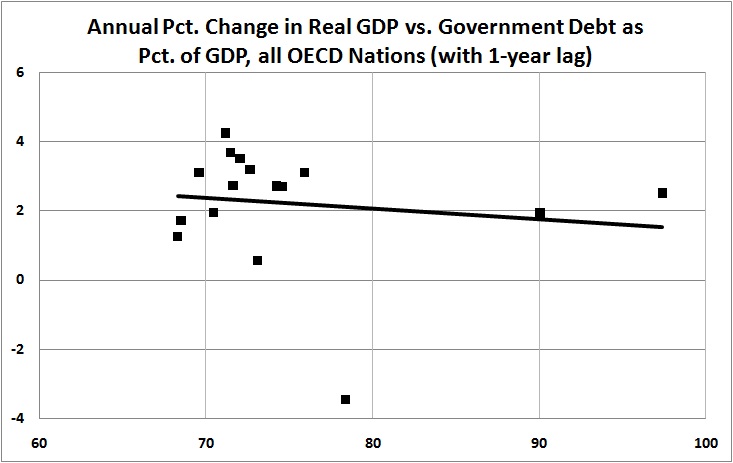
. . . so goes the United States? Well, maybe the dependents of our welfare state won’t riot. But, riots aside, the U.S. has much in common with Greece: a huge and rising burden of government (accompanied by a huge and rising burden of government debt), leading to economic stagnation.

As for how the burden of government stagnates an economy, I’ve said plenty. See especially this and this. For more evidence, I turn to statistics and projections available from the Organization for Economic Cooperation and Development (OECD), which has 31 (mostly Western) member nations:

Derived from tables 1 and 32, available at OECD Economic Outlook No. 86 Annex Tables — Table of Contents. The debt-burden statistics represent gross government debt for 1995-2010. The changes in GDP are for 1996-2011.

How fares the debt burden of the United States? Not well:

Derived from OECD annex table 32. I use gross debt because net debt understates the debt burden. For example, it treats the federal government’s IOUs to the Social Security Trust Fund as if they were legitimate assets, which they are not.

All Euro zone countries are represented by the wide, gold line. Greece is a Euro zone country, but I have plotted its debt burden separately to highlight its plight. Japan, the most burdened OECD country, is infamous for its economic stagnation. And there’s the U.S. (wide, blue line) moving ahead of the Euro zone, and not far behind Greece. What’s worse is that the outlook for the U.S. beyond 2011 is deeper debt.

Here’s Robert J. Samuelson’s (correct) analysis of the situation:

What we’re seeing in Greece is the death spiral of the welfare state. This isn’t Greece’s problem alone, and that’s why its crisis has rattled global stock markets and threatens economic recovery. Virtually every advanced nation, including the United States, faces the same prospect. Aging populations have been promised huge health and retirement benefits, which countries haven’t fully covered with taxes. The reckoning has arrived in Greece, but it awaits most wealthy societies. . . .

The welfare state’s death spiral is this: Almost anything governments might do with their budgets threatens to make matters worse by slowing the economy or triggering a recession. By allowing deficits to balloon, they risk a financial crisis as investors one day — no one knows when — doubt governments’ ability to service their debts and, as with Greece, refuse to lend except at exorbitant rates. Cutting welfare benefits or raising taxes all would, at least temporarily, weaken the economy. Perversely, that would make paying the remaining benefits harder.

Greece illustrates the bind. To gain loans from other European countries and the International Monetary Fund, it embraced budget austerity. Average pension benefits will be cut 11 percent; wages for government workers will be cut 14 percent; the basic rate for the value added tax will rise from 21 percent to 23 percent. These measures will plunge Greece into a deep recession. In 2009, unemployment was about 9 percent; some economists expect it to peak near 19 percent.

If only a few countries faced these problems, the solution would be easy. Unlucky countries would trim budgets and resume growth by exporting to healthier nations. But developed countries represent about half the world economy; most have overcommitted welfare states. They might defuse the dangers by gradually trimming future benefits in a way that reassured financial markets. In practice, they haven’t done that; indeed, President Obama’s health program expands benefits. What happens if all these countries are thrust into Greece’s situation? One answer — another worldwide economic collapse — explains why dawdling is so risky.

How to Respond to the Census-Taker

UPDATED BELOW (05/09/10, 05/13/10, 03/31/11)

The census-taker has been to my door. He left a “notice of visit,” which includes a request to call him to arrange a time for my “census interview . . . it generally takes about 10 minutes.” His phone number isn’t in my local calling area, so a call to arrange an unconstitutional “interview” will cost me money. That’s adding injury to insult.

I won’t call him, of course, so he’ll drop by again. If he happens to catch me at home, I will be tempted to give him my 10-minute lecture about the unconstitutionality of the census, as it is conducted these days. The lecture addresses each of the 10 questions on this year’s census form, and the justifications for the various questions. Here’s the lecture:

The Constitution authorizes the census for the purpose of apportioning membership in the House of Representatives among the States. And it says in the Constitution that “the actual Enumeration . . . shall be made . . . in such Manner as they shall by Law direct.” But the operative word is “enumeration.” It follows that Congress’s power to direct the “manner” of the enumeration is restricted to such matters as when and at what cost the enumeration shall be made.

Of the ten questions asked on this year’s census form, only question 1 is relevant to the constitutional purpose of determining the number of persons living in each State. The other nine questions are irrelevant, not to mention intrusive. If the right to privacy includes the right to kill an unborn or partially born human being (see Roe v. Wade, et seq.), surely it includes the right to refuse to answer unconstitutionally intrusive questions posed by the government.

I am therefore honoring the Constitution by answering question 1, and only question 1, which asks for the number or residents at my address on April 1, 2010.

The Census 2010 website offers reasons for asking questions 2 through 10. Here are my views about those questions:

2. This question – about persons not included in the answer to question 1 — does not apply to me. In any event, there would be no need for question 2 if question 1 were posed correctly.

3. Now you want to know about the ownership of my house. Why? Because the question has been asked since 1890 and the information is “an indicator of the nation’s economy” and “the data are . . . used to administer housing programs and to inform planning decisions.” As I will point out several times, the longevity of a question does not make it a legitimate one. Moreover, (1) the question has nothing to do with the constitutional purpose of the census; (2) decennial home-ownership data is practically meaningless, except possibly as an excuse for the government to underwrite risky mortgages and trigger yet another financial meltdown; and (3) there is no constitutional basis for the federal government’s involvement in housing programs. (Regarding this and several subsequent questions, I refer you to the Constitution, with which you may be unfamiliar. You should take special note of the powers of Congress, which are enumerated in Article I, Section 8.)

4. You want my phone number so that you can contact me if some of the information I provide is “incomplete or missing.” Well, you don’t need my phone number because I’ve answered question 1, which is the only information required for the constitutional purpose of the census.

5. Now you’re asking for names. One ostensible reason for the question is to help the respondent remember the number of members of a large household. But that’s just an excuse for unconstitutional prying, given that the instructions for question 1 could suggest that the respondent for a large household  could work from a (private) list of names when answering the question. The other ostensible reason is “if additional information about an individual must be obtained to complete the census form.” The problem, of course, is that an enumeration for the purpose of allocating seats in the U.S. House of Representatives doesn’t require information about individuals; it simply requires a count of them.

6. The census has been asking about gender since 1790. So what? The federal programs and laws cited as justification for the question are as unconstitutional as the question. And since when is it the job of the federal government to collect data for “sociologists, economists, and other researchers”?

7. You’ve asked for age and date of birth since 1800. Again, a big “so what?” – does my age affect how many of me there are? And, again, you refer to federal programs for which the data are required; all of them – including Social Security and Medicare — are most assuredly unconstitutional.

8.  Am I Hispanic, Latino, or of Spanish origin? More unconstitutional stuff, mainly designed to enable (or force) various governments to discriminate for certain racial/ethnic groups.

9.  My race? Yeah, it’s been a question since 1790, but that was when a slave counted for 3/5 of a white person. The question has been irrelevant since the ratification of the Thirteenth Amendment in 1865. Regarding the various programs and laws cited as justification, see my comments about question 8.

10. Do I sometimes live or stay somewhere else? Well, you wouldn’t have to ask if you framed question 1 more precisely. In any event, what does the question have to do with the enumeration of the number of persons at my residence on a certain date?

I would, of course, assure the census-taker that he’s a good fellow, toward whom I harbor no ill will. And I would explain to him that I’m just sharing with him the views that I will impart in writing to the head of the Census Bureau and various members of Congress. I will wish him well, and express my hope that he is able to find a good job at the end of his stint as a census-taker. But I will answer only question 1.

UPDATE (05/09/10 @ 3:59 p.m.)

Well, the census-taker dropped by while my wife was working outside, so she handed him off to me. I spared him the 10-minute lecture and gave him the bottom line: the answer to question 1.  I told him that I’d send the Census Bureau an explanation of my refusal to answer the rest of the questions. End of discussion. What will happen next? Stay tuned.

UPDATE (05/13/10@ 10:08 a.m.)

Do not — I repeat, do not — respond to the census-taker in this manner:

Williamson County [Texas] sheriff’s officials have charged an attorney with aggravated assault with a deadly weapon, saying she fired five shots when a U.S. Census Bureau worker visited her home Saturday [May 8, 2010], court records show.

Carolyn M. Barnes, 53, could face up to 20 years if convicted of the second-degree felony. She was being held in the Williamson County Jail on Wednesday afternoon with bail set at $50,000 .

Williamson County sheriff’s office Sgt. John Foster said the census employee, Kathleen Gittel, went to Barnes’ home on Indian Trail, just north of Leander, about 5:40 p.m. to collect information.

After Gittel identified herself as a census worker, Foster said, Barnes came outside with a handgun and told Gittel to get off the property.

Gittel “was apparently not getting off of her property fast enough, and Ms. Barnes decided to shoot five rounds in her direction,” Foster said. He said Gittel was not injured.

. . . fortunately.

The census-taker is just doing a job for money. He or she probably has no views about the constitutionality of the census, as it is conducted, and is not responsible for the questions on the census form. It is wrong and counter-productive to loose your wrath on the census-taker.

As for Congress, the president (and his minions), and the courts, express yourself in votes, words, nonviolent deeds, and contributions to the defenders of liberty (the Tea Party movement, the American Conservative Union, and the Club for Growth).And do it while you can.

UPDATE (03/31/11 @ 11:00 a.m.)

So far, so good. It has been 12 months since I refused to submit the questionnaire for Census 2010, and almost 11 months since I refused the 10-minute interview. Not a peep from the Census Bureau or a federal marshal.

Can Markets Force Fiscal Discipline?

Today’s market meltdown was triggered by the fear that Greece’s financial problems will spread to other European governments, and then to the United States. Greece’s problems can be described simply: The government cannot afford to pay the debts it owes because it has expanded the welfare state at the behest of its ignorant, greedy citizens. Moreover, the problems of Greece will spread to other Euro-zone nations if and as they incur debt in order to bail out Greece. (Recommended reading: “The Mother of All Bubbles.”)

Now, change “Greece” to the “United States” and you have a perfect description of what is likely to happen in this country if “our” government continues to drive us along the road to Europeanism.

The question of the day is whether the strongly negative response of financial markets to the situation in Europe will cause Europe’s “leaders” — and our own — to re-think their commitment to fiscal profligacy. Or, as seems more likely, will those “leaders” be so fearful of reneging on their irredeemable promises to their political constituents that they fall back on the time-honored “remedy” known as hyperinflation?

Hyperinflation — which is easy enough for central bankers to engineer — “solves” the problem of debt by smothering it under a mountain of new money. The problem with that “solution,” of course, is that it affects not just a government’s creditors but every economic actor. Real economic activity grinds to a near-standstill as vendors raise their prices to unaffordable levels in anticipation of facing even higher prices for their factors of production. Entrepreneurs give up on business formation for the same reason. In the end, a vibrant economy based on money and credit is reduced to a stagnant, near-subsistence economy based on personal relationships and barter.

Which way will Europe and the United States go? I have little confidence that our “leaders” will choose the path of fiscal discipline. They are especially unlikely to choose the path that encourages economic growth by shrinking the welfare state.

Good Riddance (I Hope) to Bad Rubbish

The Washington Post Company has announced its intention to sell Newsweek, the 77-year-old magazine which the Post has owned for 49 years. The magazine’s editor, Jon Meacham, had this to say in an interview with Jon Stewart:

“I do not believe that Newsweek is the only Catcher in the Rye between democracy and ignorance, but I think we’re one of them,” Meacham said. “And I don’t think there are that many on the edge of that cliff.”

Asked by Stewart about today’s free flow of information – including news consumption – Meacham struck a foreboding tone. “We have to decide, ‘are we ready to get what we pay for?’ If you’re not going to pay for news, then you’re going to get a different kind of news,” he said.

Meacham’s “reasoning” is in keeping with the wrong-headedness of Newsweek‘s cheerleading for all things statist. For starters, he poses a false dichotomy of democracy vs. ignorance. Democracy, in fact, thrives on ignorance: the ignorance of the masses that enables demagogues and charlatans to impoverish the masses while claiming to enrich them.

Meacham then resorts to the statist’s all-purpose “we” — arrogating to himself intimate knowledge of what the masses want — when he says “We have to decide, ‘are we ready to get what we pay for?’” The thrust of his statement is that the news provided “free” over the internet is inferior to the opinions masquerading as news in the pages of Newsweek and other print media. This is nonsense, for two reasons. First, news is not provided “free” over the internet; it is supported by advertisers. Second, this “free” news flows, in large part, from media sources like Newsweek; that is to say, it consists of kernels of news smothered in layers of leftist opinion.

Meacham has more to say, but you get the idea: With “great thinkers” of his ilk at the helm, it is no wonder that the likes of Newsweek are doomed. I say “doomed” because the Post is unlikely to find a buyer for Newsweek, which eventuality will allow the Post to fold the magazine. If the post does find a buyer for Newsweek, I would expect it to fold outright or to be merged with the buyer’s other failing properties.

In any event, it will be good riddance (I hope) to bad rubbish.

Discounting and “Libertarian” Paternalism

Richard Thaler is a leading proponent of “libertarian” (or “soft”) paternalism. But there is nothing “libertarian” or “soft” about paternalism, no matter what it’s called. (See this, for example.)

Thaler’s embrace of paternalism springs from arrogance — the presumption that he knows how others should lead their lives. A sign of that arrogance, and one that finds its way into Thaler’s rationale for paternalism, is the identification of well-being with wealth-maximization.

The surest route to wealth-maximization — for the Thalers of this world — is to evaluate alternative courses of action by discounting projected streams of revenues (income) or costs (expenses). Consider the following passage from an old paper of Thaler’s:

A discount rate is simply a shorthand way of defining a firm’s, organization’s, or person’s time value of money. This rate is always determined by opportunity costs. Opportunity costs, in turn, depend on circumstances. Consider the following example: An organization must choose between two projects which yield equal effectiveness (or profits in the case of a firm). Project A will cost $200 this year and nothing thereafter. Project B will cost $205 next year and nothing before or after. Notice that if project B is selected the organization will have an extra $200 to use for a year. Whether project B is preferred simply depends on whether it is worth $5 to the organization to have those $200 to use for a year. That, in turn, depends on what the organization would do with the money. If the money would just sit around for the year, its time value is zero and project A should be chosen. However, if the money were put in a 5 percent savings account, it would earn $10 in the year and thus the organization would gain $5 by selecting project B. (Center for Naval Analyses,  “Discounting and Fiscal Constraints: Why Discounting is Always Right,” Professional Paper 257, August 1979, pp. 1-2)

More generally, the preferred alternative — among alternatives conferring equal benefits (effectiveness, output, utility, satisfaction) — is the one whose cost stream has the lowest present value:

the value on a given date of a future payment or series of future payments, discounted to reflect the time value of money and other factors such as investment risk.

It is my view that economists seize on discounting as a way of evaluating options because it is a trivial exercise to compute the present value of a stream of outlays (or receipts). I should say that discounting seems like a trivial exercise because the difficult tasks — choosing a time horizon, choosing a discount rate, and translating outlays into future benefits — are assumed away.

Consider the choices facing a government decision-maker. In Thaler’s simplified version of reality, a government decision-maker (manager) faces a choice between two projects that (ostensibly) would deliver equal benefits (effectiveness, output), even though their costs would be incurred at different times. Specifically, the manager must choose between project A, at a cost of $200 in year 1, and equally-effective project B, at a cost of $205 in year 2. Thaler claims that the manager can choose between the two projects by discounting their costs:

A [government] manager . . . cannot earn bank interest on funds withheld for a year. . . .  However, there will generally exist other ways for the manager to “invest” funds which are available. Examples include cost-saving expenditures, conservation measures, and preventive maintenance. These kinds of expenditures, if they have positive rates of return, permit a manager to invest money just as if he were putting the money in a savings account.

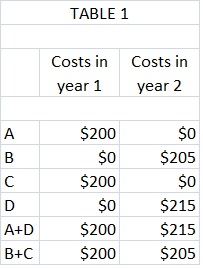
. . . Suppose a thorough analysis of cost-saving alternatives reveals that [in year 2] a maintenance project will be required at a cost of $215. Call this project D. Alternatively the project can be done [in year 1] (at the same level of effectiveness) for only $200. Call this project C. All of the options are displayed in table 1.

Discounting in the public sector_table 1

(op. cit, pp. 3-4)

Thaler believes that his example clinches the argument for discounting because the choice of project B (an expenditure of $205 in year 2) enables the manager to undertake project C in year 1, and thereby to “save” $10 in year 2. But Thaler’s “proof” is deeply flawed:

  • If a maintenance project is undertaken in year 1, it will pay off sooner than if it is undertaken in year 2 but, by the same token, its benefits will diminish sooner than if it is undertaken in year 2.
  • More generally, different projects cannot, by definition be equally effective. Projects A and B may be about equally effective by a particular measure of effectiveness, but because they are different things they will differ in other respects, and those differences could be crucial in choosing between A and B.
  • Specifically, projects A and B might be equally effective when compared quantitatively in the context of an abstract scenario, but A might be more effective in an unquantifiable but crucial respect. For example, the earlier expenditure on A might be viewed by a potential enemy as a more compelling deterrent than the later expenditure on B because it would demonstrate more clearly the government’s willingness and ability to mount a strong defense against the potential enemy.
  • The “correct” discount rate depends on the options available to a particular manager of a particular government activity. Yet Thaler insists on the application of a uniform discount rate by all government managers (op. cit., p. 6). By Thaler’s own example, such a practice could lead a manager to choose the wrong option.
  • For a decision to rest on the use of a particular discount rate, there must be great certainty about the future costs and benefits of alternative courses of action. But there seldom is. The practice of discounting therefore promotes an illusion of certainty — a potentially dangerous illusion, in the case of national defense.

The fundamental problem is that Thaler presumes to place himself in the position of the decision-maker. But every decision-maker — from a senior government executive to a young person starting his first job — has a unique set of objectives, options, uncertainties, and risk preferences. Because Thaler cannot locate himself in a decision-maker’s unique situation, he can exercise his penchant for arrogance only by insisting that each and every decision-maker adhere to a simplistic rule of thumb — one that obtains results favored by Thaler.

In the context of personal decision-making — which is the focal point of “libertarian” paternalism — the act of discounting serves wealth-maximization (a favored paternalistic objective). But, as I have said,

[t]here is simply a lot more to maximizing satisfaction than maximizing wealth. That’s why some people choose to have a lot of children, when doing so obviously reduces the amount they can save. That’s why some choose to retire early rather than stay in stressful jobs. Rationality and wealth maximization are two very different things, but a lot of laypersons and too many economists are guilty of equating them.

The 34-year-old Richard Thaler of 1979 was arrogantly wrong about government decision-making. The 65-year old Thaler of 2010 is — and has been — arrogantly wrong about personal decision-making.

I will have more to say about Thaler’s wrong-headedness. In the meantime, read this post and follow the links therein.

The Immigration Debate

I have said all that I wish to say about immigration in a 3.5-year-old post at Liberty Corner. (Warning: Some of the links may no longer work.)

P.S. Be sure to read this relevant and thoughtful post by Eugene Volokh.

Is the Recession Still On?

Yes, by my definition of a recession:

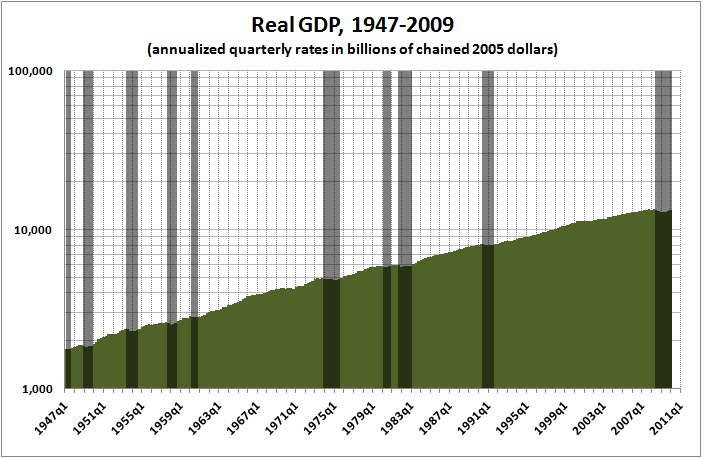
  • two or more consecutive quarters in which real GDP (annualized) is below real GDP (annualized) for an earlier quarter, during which
  • the annual (year-over-year) change in real GDP is negative, in at least one quarter.

Here’s how real GDP has fared from the first quarter of 1947 through the first quarter of 2010 (recessions are denoted by vertical bars):

This picture is misleading, of course, because it fails to depict the length and depth of America’s mega-depression, which is now more than a century old and deepening every day.

Not All Sheep

In “A Nation of Sheep,” I expressed my disappointment that the mail participation rate for Census 2010 is the same as it was for Census 2000. But not all residents of all States were equally compliant. The following table sorts the States by the changes in their participation rates between 2000 and 2010:

Change in Mail Participation Rate, by State (percentage)

State Census 2000 Census 2010 Change

Wyoming 72 68 -4

Colorado 73 70 -3

Montana 70 67 -3

Nebraska 79 76 -3

North Dakota 76 73 -3

Oklahoma 69 66 -3

South Dakota 78 75 -3
Alaska 64 62 -2
California 73 71 -2
New Mexico 65 63 -2
South Carolina 65 63 -2
West Virginia 66 64 -2
Arizona 68 67 -1
Arkansas 68 67 -1
Connecticut 75 74 -1
Idaho 75 74 -1
Iowa 79 78 -1
Louisiana 65 64 -1
Massachusetts 74 73 -1
Missouri 74 73 -1
New Hampshire 71 70 -1
New Jersey 73 72 -1
Ohio 77 76 -1
Wisconsin 82 81 -1
Kansas 75 75 0
Maryland 74 74 0
Michigan 77 77 0
Mississippi 67 67 0
Nevada 69 69 0
Oregon 74 74 0
Pennsylvania 76 76 0
Delaware 68 69 1
Georgia 69 70 1
Maine 65 66 1
New York 66 67 1
Rhode Island 70 71 1
Texas 68 69 1
Hawaii 64 66 2
Illinois 73 75 2
Indiana 76 78 2
Minnesota 78 80 2
Utah 72 74 2
Vermont 65 67 2
Washington 72 74 2

Florida 69 72 3

Virginia 73 76 3

Alabama 66 70 4

Kentucky 70 75 5

Tennessee 69 74 5

North Carolina 66 74 8

Source: Census.gov download.

I have highlighted the States in which participation rates changed significantly (i.e., by more than one standard deviation from the mean). Kudos to the residents of Wyoming, Colorado, Montana, Nebraska, North Dakota, Oklahoma, and South Dakota. Honorable mention to the residents of the next seventeen States with negative numbers: Alaska through Wisconsin. Scorn for the lamb-like residents of the thirteen States from Delaware through Washington. And a hearty b-a-a-a to the sheep-like denizens of Florida, Virginia, Alabama, Kentucky, Tennessee, and North Carolina.

Blasts from the Past

I have republished much of the pre-blog (“home page”) version of my old blog, Liberty Corner, in 29 posts at The Original Liberty Corner. (There’s a link to TOLC in the right sidebar, for permanent access.) Some of the material at TOLC is dated; most of it remains current; some of it is prescient.

The preceding post, “First Principles,” is based on one of my early contributions to the pre-blog version of Liberty Corner. From time to time, I will update other material and re-post it at this blog.

Restoring the Constitutional Contract

Introduction

Contracts come in many forms and serve many purposes. They may be as informal and ephemeral as the understanding between barber and customer that the barber will cut the customer’s hair and the customer will pay the barber a certain amount of money for the haircut. They may be as solemn and hopefully eternal as marriage vows.

In the public realm there is no more solemn contract than the Constitution of the United States. But the great national crises of the Twentieth Century–especially the Depression and World War II–fostered the habit of giving illegitimate power (and money) to the federal government. Thus the constitutional contract and the pillars of the Constitution–the States and citizens–have been undermined

The immense, illegitimate power that has accrued to the federal government cannot be found in the Constitution. It arises from the cumulative effect of generations of laws, regulations, and court rulings–each ostensibly well-meant by its perpetrators

The habit of recourse to the federal government has become a destructive cycle of dependency. Elected representatives and unelected elites have vested unwarranted power in the federal government to deal with problems “we” face–problems the federal government cannot, for the most part, begin to solve and which it demonstrably fails to solve many more times than not. The conditioned response to failure has been to cede more power (and money) to the federal government in the false hope that the next increment will get the job done.

There has been much bold talk in recent times about making the federal government smaller and devolving federal power to the States. The bottom line is that the executive branch still regulates beyond its constitutional license, Congress still passes laws that give unwarranted power to the federal government, and federal spending still consumes about the same fraction of economic output that it did two decades ago.

To break out of this cycle of addiction, we must restore the constitutional contract and thus free the States and citizens–especially citizens–to realize their economic, social, and spiritual potential.

The Contract, Its Reach, and Its Principles

The Constitution is a contract between the States. In it, the States cede certain powers to a government of the united States, created by the States on behalf of the States and their citizens. Thus, for example, in Section 10 of Article I, the States voluntarily deny themselves certain powers that in Section 9 they vest in Congress–creation of money, regulation of trade among the States and between the States and other nations, conduct of foreign relations, and conduct of war.

The Preamble lists the States’ reasons for entering into the constitutional contract, which are “…to form a more perfect union, establish justice, insure domestic tranquillity, provide for the common defence, promote the general welfare, and secure the blessings of liberty to ourselves and our posterity….” These are ends desired, not outcomes promised.

To further these ends, the Constitution establishes a government of the united States, and authorizes it to enact, execute, and adjudicate laws within a delimited sphere of authority. The Constitution not only delimits the federal government’s authority but also diffuses it by dividing it among the federal government’s legislative, executive, and judicial branches.

The Framers knew what we are now only re-learning: A government is a power-hungry beast–even a representative government. More power in the hands of government means less power for individuals. Individuals are better off when they control their own lives than when government, directly or indirectly, controls their lives for them.

Thus the limited scope of the constitutional contract provides for:

  • primacy of the federal Constitution and of constitutional laws over those of the States (This primacy applies only within the limited sphere of authority that the Constitution grants to the federal government. The federal government is not, and was not intended to be, a national government that supersedes the States.)
  • collective obligations of the States, as the united States, and individual obligations of the States to each other
  • structure of the federal government–the three branches, elections and appointments to their offices, and basic legislative procedures
  • powers of the three branches
  • division of powers between the States and federal government
  • rights and privileges of citizens
  • process for amending the Constitution.

The principles embodied in the details of the contract are few and simple:

  • The Constitution and constitutional laws are the supreme law of the land, within the clearly delimited scope of the Constitution.
  • The federal government has no powers other than those provided by the Constitution.
  • The rights of citizens include not only those rights specified in the Constitution but also any unspecified rights that do not conflict with powers expressly granted the federal government or reserved by the States in the creation of the federal government.

The Limits of Federal Power

The Constitution may be the “supreme law of the land” (Article VI), but as the ardent federalist Alexander Hamilton explained, the Constitution

…expressly confines this supremacy to laws made pursuant to the Constitution…[Federalist number 33].

Thus the authority of the federal government–the government formed by the united States–enables the States to pursue common objectives. But that authority is limited so that it does not usurp the authority of States or the rights of citizens.

Moreover, the “checks and balances” in the Constitution limit the federal government’s ability to act, even within its sphere of authority. In the legislative branch neither the House of Representatives nor the Senate can pass a law unilaterally. In his sole constitutional role–as head of the executive branch–the President of the United States must, with specified exceptions, sign acts of Congress before they become law, and may veto acts of Congress–which may, in turn, override his vetoes. From its position atop the judicial branch, the Supreme Court is supposed to decide cases “arising under” (within the scope of) the Constitution, not to change the Constitution without benefit of convention or amendment.

The Constitution itself defines the sphere of authority of the federal government and balances that authority against the authority of the States and the rights of citizens. Although the Constitution specifies certain powers of the federal executive and judiciary (e.g., commanding the armed forces and judging cases arising under the Constitution), federal power rests squarely and solely upon the legislative authority of Congress, as defined in Article I, Sections 8, 9, and 10. The intentionally limited scope of federal authority is underscored by Amendments IX and X; to repeat:

The rights of citizens include not only those rights specified in the Constitution but also any unspecified rights that do not conflict with powers expressly granted the federal government or reserved by the States in the creation of the federal government.

The Rise of Unconstitutional Laws and Regulations

The generations of laws and regulations that have seized the powers and rights of States and citizens are, to put it plainly, unconstitutional. Most such laws and regulations seem to rest on these foundations:

  • the phrase “promote the general welfare” in the Preamble. This was a desired result of the adoption of the Constitution, not an edict to redistribute income and wealth.
  • the power of Congress “to regulate commerce…among the several states [Article I, Section 8].” This power was meant to prevent the States from restricting or distorting the terms of trade across their borders, not to enable the federal government to dictate what is traded, how it is made, or how businesses operate.
  • the authority of Congress “[t]o make all Laws which shall be necessary and proper for carrying into execution the foregoing powers, and all other powers vested by this Constitution in the Government of the United States, or in any department or officer thereof [Article I, Section 8].” The words “necessary and proper” have been wrenched out of their context and used to turn the meaning of this clause upside down. It was meant to limit Congress to the enactment of constitutional legislation, not to give it unlimited legislative authority.
  • the “equal protection” clause of Amendment XIV: “…nor shall any State…deny to any person within its jurisdiction the equal protection of the laws.” Amendment XIV was meant to secure the legal equality of those former slaves whose freedom had been secured by Amendment XIII. Amendment XIV became, instead, the basis for Supreme Court decisions and federal laws and regulations that have given special “rights” to specific, “protected” groups by curtailing the constitutional rights of the many who cannot claim affiliation with one or another of the “protected” groups. As the proponents of such groups might ask, is it fair?

Restorative Remedy

The constitutional contract charges the federal government with keeping peace among the States, ensuring uniformity in the rules of inter-State and international commerce, facing the world with a single foreign policy and a national armed force, and assuring the even-handed application of the Constitution and of constitutional laws. That is all.

It is clear that the contract has been breached. Only by restoring it and reversing generations of federal encroachment on the rights and powers of the States and people can we “secure the Blessings of Liberty to ourselves and our posterity.”

The Constitution itself contains the restorative remedy:

[O]n the application of the legislatures of two thirds of the several States, [Congress] shall call a convention for proposing amendments, which …shall be valid to all intents and purposes, as part of this Constitution, when ratified by the legislatures of three fourths of the several States, or by the conventions in three fourths thereof…

Congress has in hand the requisite number of applications for a constitutional convention but has resisted calling one. If pressed, the leaders of Congress would invoke the spectre of the rabble rescinding the Bill of Rights. But what the professional politicians in Congress (and their allies in the executive branch and community of special-interest groups) must truly fear is the reassertion by the citizens and States of their constitutional rights and powers.

Here is a place to begin: “A New, New Constitution.”

More Miscellany

Politicos on Parade

Most politicians — especially but not only liberals — pay lip service to the Constitution but tend not to honor it. They have a passion for laws and regulations that dictate, in the name of “good,” how people will live their lives, run their businesses, and spend their incomes. They seem not to understand or care that such laws and regulations undermine liberty and thus, to borrow a phrase, the general welfare that flows from liberty.

A “do-nothing” Congress is the best kind of Congress. Would that there were such a thing.

Career politician: a person who has succeeded in fooling just enough of the people almost all of the time.

The Presidency in Perspective

As the presidency has gone from Washington to Clinton, so too has it gone from service to self-gratification, from honor to corruption, from courage to cowardice, and from dignity to disrepute. The fault lies not in the office but in an electorate that has tolerated — nay, encouraged — the debasement of Washington’s legacy.

The presidency is as dignified or debased as its incumbent.

The impeachment (and removal) of a President is not a constitutional crisis. Rather, it reaffirms the soundness of the Constitution’s design for the orderly transfer of executive power. Through impeachment and removal the nation may, without recourse to mayhem or insurrection, be relieved of a President who has dishonored his trust.

Legal proceedings against a President do not disable the presidency, only the ability of the incumbent to serve. Amendment XXV provides for such instances:

Whenever the President transmits to the President pro tempore of the Senate and the Speaker of the House of Representatives his written declaration that he is unable [for any reason] to discharge the powers and duties of his office, and until he transmits to them a written declaration to the contrary, such powers and duties shall be discharged by the Vice President as Acting President.

Presidents come and go but the nation survives [maybe] and thrives [sort of].

Social-isms

Where is it written in the Constitution that the federal government is a repository for retirement savings?

A “liberal” of the Twentieth Century persuasion is a person who presumes to tell others how to live their lives. This use of the word “liberal” is a corruption of language fully consistent with the intellectual corruption of American politics.

Would those who decry meritocracy replace it with mediocracy?

The culture of “public service” was born in the New Deal, came to maturity with John F. Kennedy’s New Frontier (“ask what you can do for your country”), and continues to thrive, as always, amongst Ivy-leaguers with all the answers, idealistic naifs as yet un-mugged by reality, and lawyers bent on acquiring inside knowledge and cultivating future business.

In Their Own Words…

Newsweek quotes Alan Dershowitz as saying “Yes, I would defend [Hitler]. And I would win.” No matter that justice would lose.

The constitutional balance, as seen by Hamilton and Madison in The Federalist Papers:

It will always be far more easy for the State governments to encroach upon the national authorities than for the national government to encroach upon the State authorities. (Hamilton, No. 17)

[T]here is greater probability of encroachments by the members upon the federal head than by the federal head upon the members. (Hamilton, No. 31)

The State governments will have the advantage of the federal government…in respect to…the weight of personal influence which each side will possess…the powers respectively vested in them…[and] the…faculty of resisting and frustrating the measures of each other. (Madison, No. 45)

The powers delegated by the proposed Constitution to the federal government are few and defined. Those which are to remain in the State governments are numerous and indefinite. The former will be exercised principally on external objects, as war, peace, negotiation, and foreign commerce; with which last the power of taxation will, for the most part, be connected. (Madison, No. 45)

[T]he powers proposed to be lodged in the federal government are as little formidable to those reserved to the individual States as they are indispensably necessary to accomplish the purposes of the Union; and that all those alarms which have been sounded of a mediated and consequential annihilation of the State governments must, on the most favorable interpretation, be ascribed to the chimerical fears of the authors of them. (Madison, No. 46)

Thus is paved the road to hell.

“Cato” foresaw in 1787 that: “the great powers of the president…would lead to oppression and ruin”; the national government “would be an asylum of the base, idle, avaricious, and ambitious,” a “court [with] language and manners different from [ours]”; and “rulers in all governments will erect an interest separate from the ruled, which will have a tendency to enslave them.”

Out with the Old, in with the Older

The punctilious say the century won’t end until midnight on the 31st of December 2000. Meanwhile, the other 99.99 percent of Earth’s denizens (or those who care about such things) prepares to celebrate the end of the decade, century, and millennium on December 31, 1999. Contrary to our custom, we bow here to the popular will, but just long enough to offer this paean to the Twentieth Century. After boldly diagnosing the last 100 years in a few hundred words, we also thrown in a prognosis for the next 100 years.

The American Century?

The Twentieth Century, like any other complex phenomenon, cannot be judged one-dimensionally. Let us begin by comparing it with the other centuries of our nationhood.

Yes, the Twentieth Century has been called the American Century, but that soubriquet reflects one of the least of our achievements as a nation, namely, our dominant role in world affairs. In any event, the American Century was the Eighteenth Century, when the greatest heroes of American history gave us liberty and framed the Constitution to assure liberty’s blessings unto their posterity. (Well, that’s how they talked in those days — you can look it up.)

The Nineteenth Century was decidely less stellar than the Eighteenth. The Nineteenth started well enough, with Mr. Jefferson in the White House, the purchase of Louisiana Territory, and the expedition of Lewis and Clark Then the British burned the Executive Mansion, causing it to be painted white (whence the White House). That was one of the first — but far from the last — whitewashings in Washington.

If the history of the presidency counts for anything in rating centuries, the Nineteenth weighs in with one great (Lincoln) and a whole flock of losers and nonentities: Van Buren, Harrison I (he of the 30-day term of office), Tyler (the “too” in “Tippecanoe and…”), Polk, Taylor, Fillmore (later an avowed Know-Nothing as that party’s candidate for President), Pierce (a New Hampshire dipsomaniac), Buchanan, Johnson I (he of the first impeachment trial), Grant (the bury-ee in Grant’s Tomb), Hayes, Garfield, Arthur (call me Chet), Cleveland (who, unlike Billy-boy, fessed up to his sins before he was caught lying about them), Harrison II, and McKinley.

In the Twentieth Century, there have been three honorable Presidents — Coolidge, Truman, and Reagan — surrounded by a sea of fools and scoundrels: Roosevelt I (a Napoleonic nut-case), Taft (the answer to two trivia questions: heaviest and only one to become Chief Justice), Harding (sex-Clinton I), Hoover and Carter (two humorless engineers), Roosevelt II (our first socialist President), Eisenhower (principle-Clinton I), Kennedy (sex-Clinton II), Johnson II (wager of disastrous wars on poverty and Vietnamese civilians), Nixon (truth-Clinton I), Ford (duh!), Bush (principle-Clinton II), and Clinton (combining the worst of Harding, Eisenhower, Kennedy, Nixon, and Bush — oversexed, unprincipled, and a congenital liar).

The Twentieth Century may have been the century of American power, but it has not been a century to be proud of if you still have any principles.

Major Themes of Century XX

The century’s dominant theme was established in its first decade: Capitalism became evil incarnate and — in the name of fighting evil — the federal government began to usurp the socializing roles of family, friends, neighborhood, and church. The second and third decades should have disillusioned the true believers in progress through government, as Wilson led us into the charnel-house called Europe and the sons and daughters of Carrie Nation led us into Prohibition. But prosperity casts a rosy glow on the sordid truth, as attests Clinton’s survival of l’affaire Lewinsky.

The fourth decade — specifically, the Great Depression — legitimated the federal government’s seizure of power in the name of “good.” The President and other elected officials became Santa Claus incarnate, doling largesse and special privileges to the masses in return for their votes, at the expense of the objects of the masses’ envy. Judges briefly and episodically resisted the power grab, then joined their executive and legislative brethren in the rape of the Constitution.

Succeeding decades saw more wars (perhaps only one of them was not a senseless exercise in presidential megalomania), more “social progress” (read aggrandizement of government), more “freedom” (read erosion of moral and ethical standards), more crime, and less civility. More crime and less civility being the direct result of moral and ethical erosion; moral and ethical erosion being a by-product of aggrandized government (the “nanny” state).

Other than that, it’s been a peachy 100 years. Somehow, our high standard of living (which would be even higher were it not for senseless wars and aggrandized government) doesn’t make up for all the rest. But perhaps the prospect of the “grand nanny” of them all — Ms. Rodham-Clinton — lecturing us from the well of the Senate is makes us just a bit peevish.

Inside and Outside

Each decade’s foreign adventures reflected the home front’s view of the world outside. In the 1900s, government could do no wrong: it busted trusts, stole Panama, and sailed the Great White Fleet — all to great acclaim from the masses. A decade later it was time to assuage national guilt and get into a serious war, but only after much vacillation about what side to join. As if in atonement for trust-busting days of the first decade, the Marines were enlisted to the aid of capitalism in the “Banana Republic” skirmishes of the 1920s.

In the 1930s, the hangover from the Great War and the cancer of the Great Depression sapped our willingness to confront the most potent (but nevertheless distant) threat to national sovereignty since 1812. But Roosevelt II, with the unwitting help of the foolhardy Nipponese, managed to drag us into another foreign war. The feat of vanquishing not one but two legitimate powerhouses, awakened the will to power that lurks just below the skin of every politician and policy wonk.

The poobahs on the Potomac — who reap vicarious ego gratification (and perhaps sexual gratification) from the very thought of being at the center of world power — demanded that we stay in the arena so that we could shape the world in the American image. (Well, in the self-image of an all-wise, all-powerful effete stratum of the Eastern establishment and its acolytes, who come from all regions and walks of life to sniff at the seat of power.) Whence the misbegotten Korean War, the utterly tragic Vietnam War, and the various travesties, gunboat diplomacies, and chest-thumpings known as the invasion of Grenada, “peacekeeping” in Lebanon, the bombing of Tripoli, the confrontation with Iran, the seemingly endless Persian Gulf War, the feckless “humanitarian” excursion into Somalia, and the “humanitarian” bombing of Kosovar civilians so that the “good” thugs of the country formerly known as Yugoslavia can take their turn at savagery.

Thus has self-interested isolationism — like constitutional government — given way to the self-indulgent whims of the “wizards” behind the curtain of the ominscient, omnipotent state.

Historical Determinism Revisited

Moralists would say that the Great Depression was the price we paid for the Roaring Twenties. If that is so, think what might lie beyond the turn of the millenium. In any event, there may be something to the theory that what we sow in one decade we reap in the next.

The “gay” 1890s gave way to the “uplifting” 1900s, when such moralists as Frank Norris, Ida Tarbell, and Roosevelt I strode the land. Their moral vigor gave way to the next decade’s Great War and the disillusionment it wrought. What could follow moral disillusionment but the amoral and “immoral” goings on the the materialistic 1920s? We paid for that holiday from reality with the plunge into the Great Depression and the rise of fascism.

Our indifference to fascism led to the next decade’s Greater War and thence to the Cold War. Fatigue set in, and the 1950s became the decade of “complacency,” featuring such entertainments as “Ozzie and Harriet,” “I Love Lucy,” and President Eisenhower’s studiedly incoherent ramblings at press conferences.

“Down with complacency,” said the children of the 1960s. “Up with the people (of all colors), down with imperialistic, paranoic foreign adventures, up with sex and drugs and rock and roll,” they chanted. And they were mostly right — but some of them became what they had hated and…but I digress.

If the 1960s began in hope and ended in despair, the 1970s began in despair and ended in despondency. It was a decade of unremitting bad news, from the presidency and resignation of Nixon to the “oil shock” to double-digit inflation to the seizure of American hostages by Iran. There was nowhere to go but up, and up we went, through most of the 1980s and — with a breather for another foreign adventure and a brief recession — on into the 1990s: ever more prosperous, ever more hopeful of the future — materially if not spiritually.

And so here we are in what should be called — for more than one reason — the “gay” 1990s: where “rights” flourish and responsibilities diminish; where more and more parents neglect their children and blame the schools (if not society) for the tragic results of that neglect; where gratuitous sex and violence pass for entertainment; where reading, writing, coherent speech, and good manners are practiced more in the breach than in the observance; where those who believe in and practice personal responsibility are simply sick and tired of giving a free ride to the indolent and self-indulgent (of all colors, genders, and political persuasions across all socio-economic strata).

Century XXI

Just when you think things can’t get worse, they do. It’s not hard to imagine a United States in which the following new “rights” have been legislated and/or adjudicated:

  • Animals may not be kept as pets without a license from the Department of Animal Rights & Welfare (DARW), whose inspectors may enter any home at any time in order to ensure that pets are being treated in accordance with the Animal Bill of Rights.
  • Animals and their produce (e.g., meat, eggs, feathers, manure) may be raised and processed only on “reservations” controlled by the DARW.
  • Guns may not be kept for any purpose — not for self-defense and (of course) not for hunting — by anyone other than law enforcement officers and members of the armed forces.
  • Because criminals are merely misguided or genetically defective products of society they may not be punished. Rather, society must be punished by turning criminals loose to exact their vengeance on it.
  • Because incessant media attention to every politician’s peccadilloes merely demoralizes the public — and because politicians are merely misguided or genetically defective products of society — the media may no longer report news about politics or politicians without a license from the Department of Happiness. Licenses are granted only to Hollywood producers who agree to produce uplifting “documentaries” of politicians in action (e.g., “Mr. Smith Goes to Washington” with James Stewart but without Claude Rains and his cronies).
  • Health care is socialized — no more ifs, ands, or buts; no more half-baked efforts to screw up the world’s best system of health care. It’s socialized and screwed up for good because Republicans — weary of being called “meanies” — give in on the last issue on which they differ from Democrats.

“How,” you ask, “could all of that happen?” Simple…Al Gore is elected President in 2000 and re-elected in 2004, with Ms. Rodham-Clinton as his running mate the second time. Ms. R-C shoots Gore at his second swearing in. She pardons herself (as a misguided product of society) and the Chief Justice swears her in — at gunpoint. In case you’re wondering, Ms. R-C was authorized to carry a gun because, following her unsuccessful Senate race in 2000, she became Gore’s Attorney General. (That’s called “first the good news, then the bad news.”)

And it goes downhill from there…

Economic "Wisdom"

Even though Stephen Jay Gould once accused social scientists of “physics envy,” he did not deter economists’ efforts to practice the dismal science as if it were really a science. Thus, for example, a Robert Shiller of Yale University arms himself with data about the past performance of the stock market and warns us that the Dow will lunge from 8,000 (make that 9,000 . . . 10,000 . . . 11,000) to 6,000 or less. The problem with such analytical exercises is that they tell us what has happened but not what will happen. Statistics predict the past with uncanny accuracy.

Not that Professor Shiller is entirely wrong about the future performance of the stock market. He is almost certainly right, in principle, because the only known monotonic trends in the universe are its expansion and its aging — and a lot of physicists aren’t sure about the permanence of those trends. No, Professor Shiller will probably be right, some day, because — as the old saying goes — a stopped watch is right twice a day.

John Maynard Keynes (created Lord Keynes for his services to economic thought and to some members of the Bloomsbury Set) averred that a government could spend an economy out of a depression. In spite of Keynes, the United States and Great Britain remained mired in the Great Depression for most of the 1930s. Some have argued that Keynes was vindicated by post-World War II prosperity, which they attribute to the the binge of consumer spending spawned by the massive infusion of government spending in wartime. That argument overlooks the inconvenient possibility that the Great Depression, like earlier depressions, would have ended without the benefit of government largesse. The argument also overlooks the fact that, unlike the United States, Great Britain did not plunge into prosperity at the end of World War II.

One could argue that Germany and Japan proved Keynes right because unemployment in those countries vanished in the face of their massive arms buildups. Yes, and one could say that the members of a chain gang are well off because they have “jobs.”

Enough of old feuds. Let us return to the present scene.

Today’s “green economists” advance the notion that free markets are all right in their place — but not when it comes to protecting the environment. Conjuring dire results for humankind if markets continue to cater to the crass demands of consumers, those economists would commandeer the economy in the name of future generations yet unborn. (Sound the trumpets! Wave the flag!) If one reasonably assumes that such economists know that there are market-based ways to solve the problems caused by pollution, what is one to make of their anti-market rhetoric? Answer: Just like any consumer of “political pork,” they’re perfectly willing to have the government aggrandize their own (psychic) income at the expense of the general welfare. That is, they simply don’t like economic growth and don’t care who is hurt by their anti-growth propoganda.

Consider, finally, the antediluvian agitators for antitrust actions against successful companies. The scions of Roosevelt the First seem to be stuck in a zero-sum view of the economic universe, in which “winners” must perforce be balanced by “losers.” Or perhaps they, like their green brethren, suffer a form of success envy.

Whatever the case, the antitrusters forget (or wish not to remember) that (1) successful companies become successful by satisfying consumers, (2) consumers wouldn’t buy the damned stuff if they didn’t think it was worth the price, and (3) “immense” profits invite competition (direct and indirect), which benefits consumers. On the third point, if the USPS — a government monopoly that claims to own my mailbox — can’t stave off competition from alternative delivery services and e-mail, what’s to keep a new Bill Gates from building a better mouse (pun) trap? Only the fear of being pursued by the almighty federal government. Thanks a lot, feds.

All of which underscores another old saying: A sucker is born every minute — and then he moves to Washington.

The Trials of William Jefferson Whatsit

This is a farce in three acts. The first act takes place in the presidential study near the Oval Office — also known as the nookie nook. Act two is set in the presidential boudoir, where the air is definitely chilly. Act three takes place beyond the great divide, that is, when Willie Whatsit meets the Chief Justice of us all.

Act I: In the Nookie Nook

Willie Whatsit: Wow, Veronica, that was great!

Monica Crapinsky: It’s Monica, you schmuck. Get it right. That’s only the fourteenth time I’ve given you a back rub, lard butt.

WW: Well, as leader of the free world, commander-in-chief of the armed forces, and first fund-raiser I’ve got too much on my mind to remember a detail like your first name.

MC: You’d better remember it, buster, because I’ve just been subpoenaed to testify against you in a wrongful discharge suit.

WW: But I haven’t fired anyone since I cleaned out the travel office to make room for the meetings of Hillary’s coven.

MC: Oh, I meant to say “paternity suit.” Paternity, wrongful discharge, same thing. Get it?

WW: Yuk-yuk-yuk. You’re as funny as Orrin Hatch eating a sour pickle. Anyway, if I’m the sue-ee, who’s the sue-er?

MC: You have to ask?

WW: Of course I have to ask. It could be almost anyone, couldn’t it?

Act II: In the Deep Freeze

WW enters the presidential boudoir to find Hillary Ramrod — his liberated, emancipated, and constipated spouse — writing his State of the Union speech.

HR: I heard a rumor that you’ve been cavorting with an intern in your private study.

WW: Who told you that? Come on, I need to know so I can figure out how to wiggle out of this one.

HR: Since you’re not going to be able to wiggle out of this one, I’ll tell you. It was our favorite flack, Sid “The Snake” Loveinbloom.

WW: You can’t believe anything Sid tells you. He’s got the hots for you and he’d say anything to tear me down.

HR: Well, you of all people know that he can have all the “hots” he wants, but it won’t get him anywhere with me. I’ve sworn off sex since I discovered witchcraft. Double, double, toil and trouble, send money to Washington, on the double.

WW: I’m glad you have such a laid-back — I mean relaxed — attitude. I was afraid you’d heard about the paternity suit.

HR: What paternity suit?

WW: What do you mean “What paternity suit?” How do you expect me to keep track of them? Do you think I do all that fund-raising, to help elect a bunch of yokels to Congress?

Scream of rage from HR. Blackout. Loud thwack (simulated by striking Arkansas watermelon with baseball bat).

Act III: Beyond the Blue Horizon

The Great Chief Justice in the Sky: How do you come to be here, Mr. Whatsit?

WW: That’s a trick question if I ever heard one. It depends on what you mean by “come.” Where am I, anyway?

CJ: You’re in the land of the final judgment — beyond civil suits, criminal prosecutions, and impeachment trials.

WW: I always thought you had a flowing white beard and wore a blinding white robe. Why are you wearing that silly black robe with gold stripes on the sleeves?

CJ: Shut up. I ask the questions here. And the robe’s not silly, Justice Sandy made it for me. Do you have anything to say for yourself before I pass sentence on you?

WW: I didn’t do it.

CJ: “It” what?

WW: It depends on what you mean by “it.”

CJ: Enough with the clever wordplay, already. Do you take me for some dumb Senator?

WW: You’re about the right age.

CJ: Before I get any older, I’m sentencing you, William Jefferson Whatsit, to eternal community service, in the “other place.”

WW: Is that the best you can do? The “other place” can’t be any hotter than an Arkansas summer, and I’ll be glad to service the community. There must be some hot babes down there.

CJ: Just for that, I’m changing the sentence. Earphones will be permanently affixed to your ears and you will be forced to listen to right-wing talk radio twenty-four hours a day for all eternity.

WW grins broadly.

CJ: How can that sentence cause you to smile?

WW: It could have been worse. You could have sentenced me to listen to Hillary.

CJ: Mmmm….

Lights dim. Drone of HR reading from It Takes A Village Idiot to Know One swells in volume.

Don’t Blame Me

Three years ago one Wendell Williamson wantonly gunned down two strangers in Chapel Hill, North Carolina. He was found not guilty by reason of insanity. Purportedly his paranoid schizophrenia bade him to kill in order to save the world.

Now another North Carolina jury has decided that the psychiatrist who had treated Williamson months before his shooting spree should pay Williamson $500,000. This eminent jury seems to have concluded that Williamson might have been cured had the psychiatrist done his job right.

It’s the O.J. defense with a twist. O.J.’s lawyers shifted the blame to the police who caught him. Williamson’s lawyers have shifted the blame to the psychiatrist who failed to cure the purported insanity that triggered the fatal shooting spree.

What happens to people when they become jurors? Does Lamont Cranston cloud their minds? Does confinement to a courtroom and jury room make them temporarily insane?

Whatever the case, consider the defenses that today’s lawyers could mount, successfully, for the villains of history:

Yes, Brutus struck the blow that killed Caesar, but there was a blood-lust in the air that day in Rome. Someone was bound to kill the power-crazed Caesar. Brutus was merely the pawn of fate, swept along in the force-field of hate that surrounded him. If you blame Brutus, you must blame all of Rome.

The South was within its rights to secede from the Union. Lincoln provoked an illicit war in his effort to preserve the Union. Therefore, John Wilkes Booth did not commit murder, he merely killed an enemy who was waging an unjust war against Booth’s homeland. Booth is a patriot warrior, not a murderer.

Aldolf Hitler and Josef Stalin cannot be blamed for the millions of lives they took. Clearly, they suffer from paranoia, delusions of grandeur, and sociopathy. These men are to be pitied, not punished, for they were driven by demons beyond their control to commit acts whose heinousness only normal human beings can comprehend.

Lee Harvey Oswald, James Earl Ray, and Sirhan Sirhan are victims of unrealistic expectations. As males living in the United States of the mid-Twentieth Century they were expected to rise to the top, to become powerful and famous. When they were unable to fulfill society’s expectations, they could only strike out at those who were powerful and famous. Society must forgive Oswald, Ray, and Sirhan; society itself must shoulder the blame for their acts.

No one expects politicians to be truthful. Politicians are expected to lie and voters have come to rely on the fact that politicians lie. Bill Clinton merely acted in accordance with the ethics of his profession when he lied under oath and encouraged others to do the same. It would be grossly unfair to him and confusing to voters if we were to change the rules in the middle of the game. Leave Bill Clinton alone and go after real criminals like smokers.