The Census of 2010: Bring It On

I’m waiting eagerly for the census form to arrive in the mail. Its arrival will give me an opportunity to comply with the “real” Constitution by committing an act of civil disobedience. Specifically, I will refuse to answer the questions that have nothing to do with the constitutional purpose of the census.

Yes, the Constitution mandates the census, for the purpose of apportioning membership in the House of Representatives among the States. And it says in the Constitution that “the actual Enumeration . . . shall be made . . . in such Manner as they shall by Law direct.” But the operative word is “enumeration.” It follows that Congress’s power to direct the “manner” of the enumeration is restricted to such matters as when and at what cost the enumeration shall be made.

In fact,  nine of the questions asked on this year’s ten-question census form are  extraneous to the constitutional purpose of determining the number of persons living in each State. It is telling that the “box” in which the constitutional purpose of the census is stated contains only question 1: “How many people were living or staying in this house, apartment, or mobile home on April 1, 2010?” The layout of the form indicates clearly that the other nine questions are unnecessary, not to mention intrusive; for example: Do you own or rent your home? Is it mortgaged? What’s your phone number, age, and date of birth? Are you Hispanic? What’s your race (since the abolition of slavery, relevant only to the exclusion of “Indians not taxed” from the enumeration)? Do you sometimes live or stay somewhere else, and why?

Worse than the basic census form is the American Community Survey (ACS), which is sent to a random sample of addresses. The survey redoubles the constitutional irrelevance and unwarranted intrusiveness of the basic census form by asking about such things as the characteristics of your dwelling (e.g., number of rooms, number of bathrooms, age of building, types of appliances), number of automobiles you own, cost and type of utilities you use, the estimated value of your home, your annual real-estate taxes, the amount of mortgage payment, your education, your type of employment and work status, etc., etc., etc.

According to the Census Bureau,

The 2010 Census will help communities receive more than $400 billion in federal funds each year for things like:

  • Hospitals
  • Job training centers
  • Schools
  • Senior centers
  • Bridges, tunnels and other-public works projects
  • Emergency services

The data collected by the census also help determine the number of seats your state has in the U.S. House of Representatives.

It is noteworthy that the constitutional purpose of the census is stated as an afterthought, whereas top billing is given to several unconstitutional purposes — none of which derives from the powers granted Congress in Article I, Section 8, of the Constitution. The fact that courts have upheld the constitutionality of extraneous, intrusive questions is no proof of their constitutionality. The real Constitution is what the Constitution says, not what some court says.

Nor is there a scintilla of a penumbra of a justification in the Constitution for the use of the census to satisfy the desire of social “scientists” to collect data from which they can derive unconstitutional policy prescriptions..Yet, the Census Bureau boldly proclaims the value of the census as a source of data for such endeavors by quoting one such “scientist”:

“For many sociologists and other scholars like me, the census data that is compiled every 10 years is flat-out the most reliable, comprehensive, and best source of data on the American population.”

— C.N. Le, Professor at University of Massachusetts, Amherst

In addition to the essential unconstitutionality of the census, as it is conducted, there is the potential for the misuse of the census by an administration that is determined to micromanage our lives, as the present administration is wont to do. (A primary case in point: “health care reform.”)

As if that weren’t enough, Hans A. von Spakovsky notes that a court in Delaware has ruled that “there is a separate violation for each question you don’t answer. So, on this year’s ten-question Census form, you could be fined as much $1,000” — even though it is evident that the law (U.S. Code, Title 13, Section 221) contemplates a maximum fine of $100:

(a) Whoever, being over eighteen years of age refuses or willfully neglects, when requested by the Secretary, or by any other authorized officer or employee of the Department of Commerce or bureau or agency thereof acting under the instructions of the Secretary or authorized officer, to answer, to the best of his knowledge, any of the questions on any schedule submitted to him in connection with any census or survey provided for by subchapters I, II, IV, and V of chapter 5 of this title, applying to himself or to the family to which he belongs or is related, or to the farm or farms of which he or his family is the occupant, shall be fined not more than $100.

The operative phrase is “any of the questions,” meaning any or all of them. Otherwise, the phrase would read “a question.” But arrogant, statist judges — like arrogant, statist executives and legislators — have no respect for the Constitution or laws that threaten to curb their power-lust.

Nevertheless, as von Spakovsky observes,

If there was a mass refusal by millions of Americans to answer parts of the form — like the race question — the U.S. Justice Department would not have the resources to prosecute everyone who violated the law. But you could be prosecuted and fined . . . .

What’s a Constitution-abiding citizen to do? Aside from giving false answers, which is neither principled nor wise (the potential penalty is five times greater than the penalty for not answering), I see three options:

1. Don’t return the census form(s) and avoid the census-taker when he comes a-calling. If the census-taker happens to catch you at home, you can put him off by recording his ID and telling him to return at some future time, after you have had a chance to call the Regional Census Center to confirm his identity. (If the census-taker gives you a phone number to call, explain to him that it would be imprudent of you to rely on him to give you a valid number.) It might just happen that you forget to be home at the agreed time, or that you don’t hear the doorbell.

2. Answer question 1 and its equivalent on the ACS (if you receive it), and return the form(s). Respond to follow-up visits by the census taker as suggested in 1.

3. Answer question 1 and its equivalent on the ACS (if you receive it), and return the form(s) with an note explaining the constitutional basis for your refusal to answer the other questions. Undaunted, the census-taker will come a-calling, and you (equally undaunted) can deal with him as suggested above. Don’t argue; just avoid.

In the census of 2000, I received the long census form (the predecessor of the ACS), and chose to exercise option 3. The census-taker gave up, and I never heard from a prosecutor. I can’t guarantee the same outcome (for you or me) this time around. But I intend, once again, to resist the unconstitutional intrusion of Big Brother’s minions into my life. I urge you to join me in sending this message to Washington:

Get out of my home and out of my life!

UPDATE (05/10/10):

See this, this, and this for more about Census 2010.

The “Predator War” and Self-Defense

There is a body of opinion which holds that the use of new war-fighting technology is illegal and tantamount to murder. Those who hold that opinion have particular reference to the Predator drone, which the U.S. has used to some effect in the Middle East. The position of the nay-sayers permeates a New Yorker article by Jane Mayer, entitled “The Predator War.” By the standards of Mayer and the anti-predator critics upon whom she leans heavily, David (of “David and Goliath”) and the English longbowmen at Agincourt were war criminals, just because they used superior technology to defeat their enemies. This pseudo-legal nonsense is merely a pretext for anti-American Americans, and others, to find fault with the United States.

The correct view of this matter is taken by Kenneth Anderson here, here, here, and here. In the fourth-linked item, Anderson outlines the legal position that the U.S. government should take (but has not):

  • Targeted killings of terrorists, including by Predators and even when  the targets are American citizens, are a lawful practice;
  • Use of force is justified against terrorists anywhere they set up safe havens, including in states that cannot or will not prevent them;
  • These operations may be covert—and they are as justifiable when the CIA is tasked to carry them out secretly as when the military does so in open armed conflict.
  • All of the above fall within the traditional American legal view of “self-defense” in international law, and “vital national security interests” in U.S. domestic law.

Moreover,

The U.S. government should . . . defend what its officers in fact believe to be the case—that targeted killing from drone platforms is not merely a question of hard-edged military necessity, but is also a humanitarian step forward in technology. The president believes that and so does the vice president, and they are correct. These technologies are lessening, not increasing, civilian damage, are being applied in ways (because it is killing that is, indeed, targeted) that lessen collateral damage from what it would otherwise be in traditional war. The U.S. government should react with outrage to the charge, implied or express, of American cowardice or some abstract increased propensity to violence on account of drone strikes, and assert its humanitarian moral ground.

For that matter, hostile journalists ought to be pressed to explain why drone attacks are significantly different from missiles fired from aircraft or offshore naval vessels​—save for the vastly greater ability to monitor the circumstances of firing through sensor technologies. Senior officials believe that drone warfare allows the United States to take far greater measure and care with collateral damage than it can using either conventional war or attack teams on the ground. The U.S. government should say so, rather than simply falling back on narrow arguments of military necessity, operational convenience, and force protection, while ceding the moral high ground to the international soft-law community.

The Near-Victory of Communism

It is said, often, that communism failed, and that its failure was marked by the fall of the Berlin Wall and the collapse of the Soviet Union. Communism is in fact alive and as well as it ever was in the Soviet Union. Where? In the so-called Western democracies. In evidence, I quote from the Manifesto of the Communist Party (English edition of 1888):

[T]he first step in the revolution by the working class, is to raise the proletariat to the position of ruling as to win the battle of democracy.

The proletariat will use its political supremacy to wrest, by degrees, all capital from the bourgeoisie, to centralise all instruments of production in the hands of the State, i.e., of the proletariat organised as the ruling class; and to increase the total of productive forces as rapidly as possible.

Of course, in the beginning, this cannot be effected except by means of despotic inroads on the rights of property, and on the conditions of bourgeois production; by means of measures, therefore, which appear economically insufficient and untenable, but which, in the course of the movement, outstrip themselves, necessitate further inroads upon the old social order, and are unavoidable as a means of entirely revolutionising the mode of production.

These measures will of course be different in different countries.

Nevertheless in the most advanced countries, the following will be pretty generally applicable.

1. Abolition of property in land and application of all rents of land to public purposes.

2. A heavy progressive or graduated income tax.

3. Abolition of all right of inheritance.

4. Confiscation of the property of all emigrants and rebels.

5. Centralisation of credit in the hands of the State, by means of a national bank with State capital and an exclusive monopoly.

6. Centralisation of the means of communication and transport in the hands of the State.

7. Extension of factories and instruments of production owned by the State; the bringing into cultivation of waste-lands, and the improvement of the soil generally in accordance with a common plan.

8. Equal liability of all to labour. Establishment of industrial armies, especially for agriculture.

9. Combination of agriculture with manufacturing industries; gradual abolition of the distinction between town and country, by a more equable distribution of the population over the country.

10. Free education for all children in public schools. Abolition of children’s factory labour in its present form. Combination of education with industrial production, &c., &c.

So much of the agenda of Communism has been adopted by the “Western democracies” — through executive fiat, legislation, judicial decree, taxation, regulation, and nationalization — that I wonder why we bothered to wage and win the Cold War.

World Series Contestants: Usually Not the Best Teams

Since the advent of three-tiered postseason play in 1995, a league’s best team has seldom appeared in the World Series. Here’s the tally (National League teams listed first; * indicates winner of World Series):

1995 —
Atlanta Braves (division winner; .625 W-L, best record in NL)*
Cleveland Indians (division winner; .694 W-L, best record in AL)

1996 —
Atlanta Braves (division winner; .593, best in NL)
New York Yankees (division winner; .568, second-best in AL)*

1997 —
Florida Marlins (wild-card team; .568, second-best in NL)*
Cleveland Indians (division winner; .534, fourth-best in AL)

1998–
San Diego Padres (division winner; .605 third-best in NL)
New York Yankees (division winner, .704, best in AL)*

1999–
Atlanta Braves (division winner; .636, best in NL)
New York Yankees (division winner; .605, best in AL)*

2000–
New York Mets (wild-card team; .580, fourth-best in NL)
New York Yankees (division winner; .540, fifth-best in AL)*

2001–
Arizona Diamondbacks (division winner; .568, fourth-best in NL)*
New York Yankees (division winner; .594, third-best in AL)

2002–
San Francisco Giants (wild-card team; .590, fourth-best in NL)
Anaheim Angels (wild-card team; .611, third-best in AL)*

2003–
Florida Marlines (wild-card team; .562, third-best in NL)*
New York Yankees (division winner; .623, best in AL)

2004–
St. Louis Cardinals (division winner; .648, best in NL)
Boston Red Sox (wild-card team; .605, second-best in AL)*

2005–
Houston Astros (wild-card team; .549, third-best in NL)
Chicago White Sox (division winner; .611, best in AL)*

2006–
St. Louis Cardinals (division winner; .516, fifth-best in NL)*
Detroit Tigers (wild-card team; .586, third-best in AL)

2007–
Colorado Rockies (wild-card team; .552, second-best in NL)
Boston Red Sox (division winner; .593, tied for best in AL)*

2008–
Philadelphia Phillies (division winner; .568, second-best in NL)*
Tampa Bay Rays (division winner; .599, second-best in AL)

2009–
Philadelphia Phillies (division winner; .574, second-best in NL)
New York Yankees (division winner; .636, best in AL)*

There you have it. The last year in which the World Series featured each league’s best team was 1999. The only other time was in 1995.

Of the 15 Series from 1995 through 2009, 9 were won by the inferior team, as measured by W-L record. Division winners opposed each other in only 6 of the 15 Series.

Wild-card teams appeared in 8 of the 15 Series. With an all wild-card Series in 2002, wild-card teams have occupied almost a third of the 30 Series slots — 9 of 30.

As I have said, the winner of the World Series can claim nothing more than having been the better team over a span of four to seven games.

Columnist, Heal Thyself

David Brooks’s recent column, “The Protocol Society,” is a typical Brooksian muddle, in which he attributes evolutionary changes in economic behavior to the “discoveries” of contemporary economists.

Despite Brooks, there is nothing new under the sun of economic analysis. The practitioners of today who draw on sociology and psychology are simply returning to the roots of economics — the description of human behavior — which can be found in Adam Smith and his successors, well into the 20th century. This “old school” of literary economics didn’t give way to the “new school” of mathematical economics until after WWII, when Paul Samuelson led the profession down the dead-end street of convoluted, abstract theorizing.

The difference between the old-old school and the new-old school is that the moderns rely less on introspection and casual observation and more on data collection, “laboratory” experiments, statistical analysis, and the research findings of sociologists and psychologists. That this is not an unalloyed blessing can be seen in the “accomplishments” of a leading member of the new-old school, one Richard Thaler, whom Brooks omits to mention. Thaler’s specialty, which has been dubbed “behavioral economics,” focuses on the psychology of decision-making and how it leads individuals to make what Thaler believes are sub-optimal and even unwise choices. From there, Thaler and his collaborator, Cass Sunstein, have ventured into normative policy recommendations, which they dub “libertarian” or “soft” paternalism. Needless to say, actual libertarians find much to criticize in Thaler’s normative prescriptions, which carve out a role for government in “nudging” people in directions that “wise men” like Thaler and Sunstein would like to seem them nudged.  For much more about the dangers of “libertarian” paternalism, see these two posts and follow the links therein.

In any event, Brooks writes as if there were a real difference between economic activity in the 19th century and economic activity in the 21st century. As if, for example, there wasn’t a lot of brainpower and organizational skill involved in the “second industrial revolution” of the last third of the 19th century. As if, to take another example, the “protocols” of the modern food court didn’t have their counterparts in the market squares of yore. As if, to take a final example, the manufacture of steel, autos, and other durable goods doesn’t (and didn’t) involve massive capital investments (many of which were made possible by patented processes and machinery), so that the average cost of making each unit declines markedly as the rate of output rises. It is as if the 21st century simply arrived, bright and shining, with no connection to the past.

On the whole, Brooks is onto something, which is that economists are getting back in touch with the realities of human behavior. However, he is guilty of a gross attribution error. He writes as if there were something new in economic behavior because economists are now better able to describe it. The same attribution error is found among teenagers (of every era), who believe that sex didn’t exist until they discovered it.

Trade

Imagine two individuals, A and B, each of whom makes something different. Let’s say that A makes bread and B makes butter. If A wants butter for his bread, he buys some butter from B; if B wants bread to go with his butter, he buys some bread from A. This kind of exchange for mutual benefit, stripped of monetary measures, is the essence of economic activity.

What is special about trade if it happens to take place across international borders? Nothing. If I’m B (in Boston), and I have a choice between bread produced by A (in Alberta) and bread produced by C (in Chicago), I’ll choose A’s bread if I consider it a better value than C’s (e.g., same quality, lower price or higher quality, same price). Do I owe C a living? No. If C can’t compete with A in bread-making, he ought to try his hand at something else, but he shouldn’t use superior force (i.e., government) to force me to buy his product.

If B spends more on A’s bread than A spends on B’s butter, B is running a deficit. Isn’t that awful? No, it isn’t. B, to finance his deficit, can draw on his savings, borrow from A, or sell stock in his butter-making business to A. All of these are voluntary choices; none should be cause for alarm. If B draws on his savings, he’s getting something in return that he values: bread. No problem there. If B borrows from A, A is taking a risk and B is getting bread. No problem there. If A buys stock in B’s butter-making operation, A is taking a risk and B is getting bread. No problem there. (None of these actions is different, in principle, than allocating a portion of one’s savings to a down payment on a house, and financing the balance with a loan — which isn’t much different than selling the lender stock in one’s future earnings prospects.)

In each case, A and B are making informed decisions based on direct knowledge of their wants and the risks involved in satisfying them. The aggregation of such decisions into national accounts (e.g, the trade account) gives the impression that the transactions are collective, that “we” Americans in the aggregate are suffering at the hands of shifty foreigners, and that government ought to “do something” about it. Well, they aren’t collective decisions, the Americans involved aren’t being fleeced, and government efforts to “do something”  (e.g., raise tariffs on imported goods) invite the kind of disaster that followed enactment of the Smoot-Hawley Tariff Act.

What about unemployment that might result from trade? Well, yes, trade can cause transitional unemployment, but that’s true of domestic trade as well as international trade. If the U.S. government, as a matter of long-standing policy, had banned domestic and international trade because it might cause transitional unemployment, we wouldn’t have progressed from buggies to Model Ts to reliable Japanese cars, from parchment and quill pens to PCs, from face-to-face conversation to cell phones, and so on. In growing economies — as more-or-less laissez-faire economies are most of the time — temporary unemployment is soaked up by growth, that is, by the expansion of existing industries and the addition of new ones. It’s Schumpeter’s “creative destruction” at work.

The alternative to “creative destruction” (of which international trade is a necessary part) is the kind of insular, centrally directed economy that prevailed in Soviet Russia, where nominal “full employment” masked the wholesale misuse and real underemployment of land, labor, and capital. The same thing has happened by “democratic” means in most of Europe, and is happening by similarly “democratic” means in the United States. Witness, for example, the Environmental Protection Agency’s recent decree about “greenhouse gas” emissions.

In summary, trade is trade, whether domestic or foreign. When government acts in ways that stifle trade, the result is underemployment of land, labor, and capital. There are but two valid reason to stifle trade. One is to prevent, deter, or punish truly harmful acts. The other is to prevent, deter, or punish the easy acquisition of U.S. military secrets and technology by enemies and potential enemies.

For related posts, see these categories:

Economics – Fundamentals
Economics – Growth & Decline
Political Economy & Civil Society

Good News?

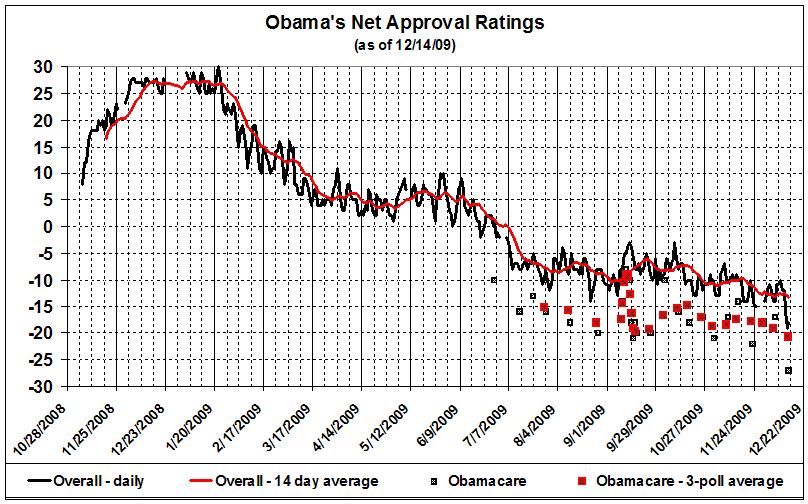
GRAPHIC UPDATED 12/14/09

What’s bad news for Obama is good news for the country. As I have said:

To hope that Obama fails is not to wish ill for the nation; to the contrary, it is to hope that Obama’s policies fail of realization because they are seen (rightly) as inimical to liberty and prosperity.

It is my sincere and fervent hope that the following trends portend good news for the liberty and prosperity of Americans:

Sources: Rasmussen Reports Daily Presidential Tracking Poll and Health Care Reform Poll. Overall net approval ratings represent the difference in the percentage of  respondents strongly approving and strongly disapproving of Obama (negative numbers mean net disapproval). Health care ratings represent the difference in the percentage of respondents strongly supporting and strongly opposing Obama’s health care “plan,” or what they take to be his plan. I use Rasmussen’s polling results because Rasmussen has a good track record with respect to presidential-election polling.

The Real Constitution and Civil Disobedience

INTRODUCTION

I have no doubt that there is a “real” Constitution. Randy Barnett makes a good case for it:

Under our system, the Supreme Court has the last word on whether a statute challenged as unconstitutionality will be upheld or nullified. But it does not have the power to change the written Constitution, which always remains there to be revived when there is a political and judicial will to do so. For example, after the Supreme Court gutted the Fourteenth Amendment during Reconstruction, it remained a part of the written Constitution for a future more enlightened Supreme Court to put to good use. By the same token, the current Supreme Court can still make serious mistakes about the Constitution. Because it is in writing there is an external “there” there by which to assess its opinions.

It is equally indubitable that the United States has become a nation of unconstitutional laws — a vast number and variety of them. For proof, if proof you need, peruse the United States Code, the Code of Federal Regulations (which includes presidential Executive Orders), and the statutes and regulations of the States (accessible through State and Local Government on the Net).

Which brings me to civil disobedience:

the active refusal to obey certain laws, demands and commands of a government, or of an occupying power, without resorting to physical violence.

It is entirely reasonable to think of America’s present governments — federal, State, and local — as occupying powers. We might just as well have been invaded by a foreign power that chose to abide by our electoral rules, then substituted its own laws for what, until then, had been America’s more-or-less constitutional ones.

LEGITIMATE VS. ILLEGITIMATE LAWS

As a result of the de facto seizure of America’s governments by forces aligned against the Constitution, Americans and the American economy are weighed down with tens of thousands of intrusive, arbitrary, and wasteful laws and regulations. Every aspect of our lives is touched, directly or indirectly, by those laws and regulations.

Some laws and regulations are legitimate, in that they are consistent with liberty:

Whether a particular regulation is consistent with liberty depends on the justification offered on its behalf. Regulations are not inimical to liberty if they coordinate individual conduct as do, for example, traffic regulations mandating driving on one side of the street or the other. They may also be consistent with liberty if they prevent irreparable tortious accidents before they occur, as speed limits do. . . . Although many libertarians object to government ownership of highways, no libertarian objects in principle to a highway owner regulating its use to enhance the speed and safety of driving. Similarly, contract law is a body of rules regulating the making and enforcing of agreements, and libertarians are not opposed to contract law. . . .

A law restricting conduct is consistent with a right to liberty, therefore, if it is prohibiting wrongful acts that violate the rights of others or regulating rightful acts in such a way as to coordinate conduct or prevent the violation of rights that might accidentally occur. A law is inconsistent with liberty if it is either prohibiting rightful acts, or regulating unnecessarily or improperly. A regulation is improper when it imposes an undue burden on rightful conduct, or when its justification is merely a pretext for restricting a liberty of which others disapprove. And one way of identifying a regulation as pretextual is to assess whether the regulatory means it employs do not effectively fit its purported health and safety ends.

Here is how the majority in Lochner distinguished a constitutional exercise of the police power from an unconstitutional restraint on liberty:

In every case that comes before this court, therefore, where legislation of this character is concerned, and where the protection of the Federal Constitution is sought, the question necessarily arises: Is this a fair, reasonable and appropriate exercise of the police power of the state, or is it an unreasonable, unnecessary and arbitrary interference with the right of the individual to his personal liberty, or to enter into those contracts in relation to labor which may seem to him appropriate or necessary for the support of himself and his family?

We may conclude from all this that . . . the fact that regulations of liberty have been upheld as constitutional is no evidence that the general constitutional right to liberty does not exist. It may merely be a sign that the government has met its properly-defined burden of proof. (Randy Barnett, “Is the Constitution Libertarian?,” pages 8-9)

The difficulty is that

the Supreme Court has upheld countless federal laws restricting liberty, primarily under the power of Congress “to regulate commerce . . . among the several states” combined with an open-ended reading of the Necessary and Proper Clause. Further it has upheld the power of Congress to spend tax revenue for purposes other than “for carrying into execution” its enumerated powers, thereby exceeding the scope of the Necessary and Proper Clause. . . .

Beginning in the 1930s, the Supreme Court . . . adopted a presumption of constitutionality whenever a statute restricted unenumerated liberty rights. In the 1950s it made this presumption effectively irrebuttable. Now it will only protect those liberties that are listed, or a very few unenumerated rights such as the right of privacy. (op. cit., pp. 15, 17-18)

I consider few governmental restrictions on action as legitimate, that is, “properly regulating rightful acts,” as Barnett puts it. It is legitimate to set and enforce a low speed limit in a school zone, to exact stiff penalties for drunken driving, and to ban the use of a cell phone while driving. But it is questionably legitimate to ticket a capable, sober driver for exceeding the speed limit by 10 miles an hour on a flat stretch of well-maintained, dry interstate highway, in light traffic. And it is grossly illegitimate to enter a judicial decision that forbids a wheat farmer to exceed a federal allotment by growing additional wheat for consumption on his own farm. Indeed, the law that allows the federal government to establish such allotments in the first place is supremely illegitimate — as are all laws that do harm rather than good because they penalize and interfere with acts that are either harmless or actually beneficial.

THE ROAD TO ILLEGITIMACY, AND THE TOLL

Americans have been lulled by what Tocqueville calls “soft despotism.” As I have said,

Soft despotism is “soft” only in that citizens aren’t dragged from their houses at night and executed for imaginary crimes against the state — though they are hauled into court for not wearing seatbelts, for smoking in bars, and for various other niggling offenses to the sensibilities of nanny-staters.

Despite the absence of arbitrary physical punishment, soft despotism is despotism, period. It can be nothing but despotism when the state holds sway over your paycheck, your retirement plan, your medical care, your choice of associates, and thousands of other details of your life — from the drugs you may not buy to the kind of car you can’t drive, from where you can build a house to the features that your house must include.

How did we get to this point? We got here via the interest-group paradox:

You may believe that a particular program is worth what it costs — given that you probably have little idea of its direct costs and no idea of its indirect costs. The problem is millions of your fellow Americans believe the same thing about each of their favorite programs. Because there are thousands of government programs (federal, State, and local), each intended to help a particular class of citizens at the expense of others, the net result is that almost no one in this fair land enjoys a “free lunch.” . . .

The paradox that arises from the “free lunch” syndrome is much like [two other] paradoxes. . . . It is like the paradox of thrift, in that large numbers of individuals are trying to do something that makes certain classes of persons better off, but which in the final analysis makes those classes of persons worse off. It is like the paradox of panic, in that there is a  crowd of interest groups rushing toward a goal — a “pot of gold” — and (figuratively) crushing each other in the attempt to snatch the pot of gold before another group is able to grasp it. The gold that any group happens to snatch is a kind of fool’s gold: It passes from one fool to another in a game of beggar-thy-neighbor, and as it passes much of it falls into the maw of bureaucracy.

I call this third, insidious, paradox the interest-group paradox. It is the costliest of the three — by a long shot. It has dominated American politics since the advent of “progressivism” in the late 1800s. Today, most Americans are either “progressives” (whatever they may call themselves) or victims of “progressivism.” All too often they are both.

Today, with a century-plus of “progressivism” behind us, more than 40 percent of GDP is controlled directly by government, through taxes and regulations. Those same taxes and regulations, because of their disincentivizing effects, have imposed vastly higher hidden costs on Americans.

And there is more to come, as the demi-gods in Washington seek to repeal the laws of economics by promising more medical care to more persons while discouraging entry into the healing professions and the development of beneficial drugs. On top of that they seek to repeal the laws of physics by further constraining the economy in a fruitless struggle against global warming, which is not a man-made phenomenon.

If you think your liberty (such as it is) has survived (or will survive) those and other economic depredations, think again, for social liberty is indivisible from economic liberty:

There can be no freedom of the press if the instruments of printing are under the control of government, no freedom of assembly if the needed rooms are so controlled, no freedom of movement if the means of transport are a government monopoly, etc. This is the reason why governmental direction of all economic activity, often undertaken in the vain hope of providing more ample means for all purposes, has invariably brought severe restrictions of the ends which the individuals can pursue. (Friedrich A. Hayek, Liberalism, part 16)

A small sample of control, in today’s America, is found in a recent action by the Department of Health and Human Services. HHS prevented government-regulated insurance companies from advising policy holders of the ill effects that Obamacare would have on their insurance coverage. So much for freedom of speech.

More generally, I offer the following thoughts by Walter Lippmann (via Don Boudreaux):

I recalled this wise warning from Walter Lippmann (found on pages 105-106 of Lippmann’s 1937 book The Good Society):

“Though it is disguised by the illusion that a bureaucracy accountable to a majority of voters, and susceptible to the pressure of organized minorities, is not exercising compulsion, it is evident that the more varied and comprehensive the regulation becomes, the more the state becomes a despotic power as against the individual.  For the fragment of control over the government which he exercises through his vote is in no effective sense proportionate to the authority exercised over him by the government.”

THE LEGITIMACY, POSSIBILITY, AND URGENCY OF CIVIL DISOBEDIENCE

The seizure of America’s governments by the lawless occupying powers of “progressivism” not only has cost Americans dearly but also has made us hostages in our own land:

Voice is now so circumscribed by “settled law” that there is a null possibility of restoring Lochner and its ilk. Exit is now mainly an option for the extremely wealthy among us. (More power to them.) For the rest of us, there is no realistic escape from illegitimate government-made law, given that the rest of the world (with a few distant exceptions) is similarly corrupt.

Under the circumstances, it would be natural — and legitimate — for Americans to resort to massive civil disobedience.

And Americans often do resort to civil disobedience, but mainly in relatively trivial ways (e.g., exceeding speed limits on open highways, under safe conditions). The general reluctance of Americans to commit acts of civil disobedience is unsurprising, given the apparent entanglement of government in our lives and businesses. Unless one chooses a truly self-sufficient life, it is practically impossible to avoid governmental notice of and influence on major events and transactions, for example, births, weddings, employment, the acquisition of life’s essentials (food, clothing, shelter, medical care), and the enjoyment of stimulants, entertainment, and so on.

Accordingly, it is natural for individuals to believe that the heavy hand of government is inescapable. Thus most of us do not try to elude government’s heavy hand, except in relatively trivial ways. And we believe that those who do try to elude it — bootleggers and black marketeers, for example — are often found out and punished. But that impression is due to a kind of reverse survivor bias; that is, we know about the bootleggers and black marketeers who are caught, but we don’t know about the ones who elude official notice.

Imagine an America in which most individuals and businesses routinely commit acts of civil disobedience. Could the various governments in and of the United States possibly detect and punish more than a small fraction of those acts of civil disobedience? The answer, of course, is “no.”

What keeps most individuals and businesses from committing more than trivial acts of civil disobedience is the fear that their particular transgressions will be among the small fraction that is detected and punished. This kind of fear has an especially strong deterrent effect under oppressive regimes that rely on informants and harsh punishments to discourage acts of civil disobedience. The contrast between America and, say, Hitler’s Germany and Stalin’s Russia ought to give heart to Americans. Informants and punishments there are, and always will be, but in American neither of them is on a scale to match the insidious and barbaric regimes of Hitler, Stalin, and their ilk. Not yet, at least.

And in the preceding sentence there is both hope and urgency. Our daily lives are not yet completely dominated by the state. We still have options in many aspects of our lives — even if those options, themselves, are shaped by laws and regulations. Houses and automobiles, for example, must meet thousands of government specifications, but they still are available with a broad array of features, for a broad range of prices.

But how much longer will our illusory freedom last against the onslaught of statism? That is the urgent question, given the prospects at hand for effective government control of the economy through environmental legislation, a complete government takeover of medicine, the punishment of “thought crimes,” the general expansion of paternalistic policies, and on and on.

I leave the enumeration of legitimate acts of civil disobedience as an exercise for the reader. But the time to consider civil disobedience is now, while there is a spark of liberty in the land.

See “The Constitution: Myths and Realities“.

The Texas Marriage Canard

The left-o-sphere has resurrected the canard that the constitution of Texas bans all marriage. This canard rests on an incomplete reading of the following section of the constitution’s bill of rights:

Sec. 32.  MARRIAGE. (a) Marriage in this state shall consist only of the union of one man and one woman.

(b)  This state or a political subdivision of this state may not create or recognize any legal status identical or similar to marriage.

(Added Nov. 8, 2005.)

The lefties like to pull sub-section (b) out of context and claim that it stands alone. Why? Because section (b), taken out of context, can be used to scare “straights,” who might then agitate for the repeal of section 32. That would open the way for left-wing judges to decree that Texas must allow homosexual “marriage.” (Yes, there are left-wing judges in Texas, which still has a sizable Democrat minority.)

The lefties, in other words, are promoting their agenda through dishonesty. But what else is new?

Here is the correct reading of Section 32: Sub-section (a) defines marriage. Sub-section (b) spells out the implication of (a), which is to prohibit any form of “marriage” or something similar (e.g., “civil union”) that does not accord with the definition given in (a). The word “identical” in (b) should be understood to mean “equivalent,” that is, “having similar or identical effects” with respect to persons of the same sex.

Here is an analogy from mathematics:

(a) Only certain pairs of non-negative integers can be added to get the number 2, specifically: 1,1 and 0, 2.

(b) No other pair or pairs of non-negative integers can be added to get the number 2.

The framers of Section 32 might have chosen a better word than “identical,” but Section 32 clearly means what it was intended to mean: Texas recognizes no form of marriage, by any name, other than the union of one man and one woman.

End of discussion.

Landsburg Is Half-Right

*     *     *

God does not play dice with the universe. — Albert Einstein

Einstein, stop telling God what to do. — Niels Bohr

*     *     *

In a post at The Big Questions blog, Steven Landsburg writes:

Richard Dawkins . . . [has] got this God thing all wrong. Here’s some of his latest, from the Wall Street Journal:

Where does [Darwinian evolution] leave God? The kindest thing to say is that it leaves him with nothing to do, and no achievements that might attract our praise, our worship or our fear. Evolution is God’s redundancy notice, his pink slip. But we have to go further. A complex creative intelligence with nothing to do is not just redundant. A divine designer is all but ruled out by the consideration that he must be at least as complex as the entities he was wheeled out to explain. God is not dead. He was never alive in the first place.

But Darwinian evolution can’t replace God, because Darwinian evolution (at best) explains life, and explaining life was never the hard part. The Big Question is not: Why is there life? The Big Question is: Why is there anything?

So far, so good. But Landsburg doesn’t quit when he’s ahead:

Ah, says, Dawkins, but there’s no role for God there either:

Making the universe is the one thing no intelligence, however superhuman, could do, because an intelligence is complex—statistically improbable —and therefore had to emerge, by gradual degrees, from simpler beginnings

That, however, is just wrong. It is not true that all complex things emerge by gradual degrees from simpler beginnings. In fact, the most complex thing I’m aware of is the system of natural numbers (0,1,2,3, and all the rest of them) together with the laws of arithmetic. That system did not emerge, by gradual degrees, from simpler beginnings. . . .

Now I happen to agree with Professor Dawkins that God is unnecessary, but I think he’s got the reason precisely backward. God is unnecessary not because complex things require simple antecedents but because they don’t. That allows the natural numbers to exist with no antecedents at all. . . .

What breathtaking displays of arrogance. Dawkins presumes that the only kind of intelligence that can exist is the kind that comes about through evolution. Landsburg wishes us to believe that complex things can exist on their own, without antecedents, which is why there is no God. (He fudges by saying “God is unnecessary” but we know what he really believes, don’t we?)

Landsburg’s “proof” of the non-existence of God is the existence of natural numbers, a “system [that] did not emerge, by gradual degrees, from simpler beginnings.” Landsburg’s assertion about natural numbers (and the laws of arithmetic) is true only if numbers exist independently of human thought, that is, if they are ideal Platonic forms. But where do ideal Platonic forms come from? And if some complex things don’t require antecedents, how does that rule out the existence of God — who, by definition, embodies all complexity?

Related posts:
Same Old Story, Same Old Song and Dance
Atheism, Religion, and Science
The Limits of Science
Beware of Irrational Atheism
The Creation Model
Evolution and Religion
Science, Evolution, Religion, and Liberty
Science, Logic, and God
The Universe . . . . Four Possibilities
Einstein, Science, and God
Atheism, Religion, and Science Redux
A Non-Believer Defends Religion
Evolution as God?
The Greatest Mystery

More about Paternalism

To complement my earlier post, “Beware of Libertarian Paternalists,” I offer the following links:

Pitfalls of Paternalism (Ilya Somin, The Volokh Conspiracy)

Hayek on the Use of Superior Expert Knowledge as a Justification for Paternalism (Ilya Somin, The Volokh Conspiracy)

The Knowledge Problem of New Paternalism (Mario Rizzo, ThinkMarkets)

Little Brother Is Watching You: The New Paternalism on the Slippery Slopes (Mario Rizzo, ThinkMarkets)

New Paternalism on the Slippery Slopes, Part I (Glen Whitman, Agoraphilia)

Be sure to read the posts and articles linked therein.

Our Sacred Honor?

In “Sizing Up Obama,” I wrote:

On the one hand, we have FDR II, replete with schemes for managing our lives and fortunes.

On the other hand, we have Carter-Clinton II, ready to: kowtow to those who would bury us, create the illusion that peace will reign perforce, and act on that illusion by slashing the defense budget (thereby giving aid and comfort to our enemies).

I have said a lot more about Obama’s schemes for managing our lives and fortunes. (See this, this, this, this, this, and this.) I also have addressed Obama’s apparent willingness to compromise our sacred honor. But it is clear that I have been preoccupied with Obama’s economic agenda, to the neglect of his foreign follies.

While the war in Iraq winds down to a successful conclusion, and the outcome of the war in Afghanistan depends on Obama’s willingness to buck the surrender lobby (of which Obama is a leading member), there is the problem of Iran:

The price of a pre-emptive attack on Iran might be high, but the price of inaction will be even higher. Legitimate U.S. interests in the Middle East (i.e., access to oil) will be threatened by a regime that has proceeded thus far in the face of sanctions and is unlikely to be fazed by more sanctions. The economic hardships caused by the “oil shocks” of the 1970s will be as nothing compared with the hardships caused by Iranian dominance of the Middle East.

Where will Western Europe, Russia, and China be in our hour of need? Western Europe will be busy emulating Vichy France, in the hope that its obseqiousness toward Iran is rewarded by dribbles of oil. Russia and China will actively support Iran (covertly if not overtly), in the expectation of profiting from higher prices on the oil they sell to Western Europe and the United States. Eventually, Russia and China will exploit the inevitable decline of American military power, as our defense budget disappears into the maw of Obamacare, Medicare, Medicaid, Social Security, and other misbegotten ventures.

What has happened since I wrote those words on September 26? Just about what you would expect. Here is Charles Krauthammer, writing on October 16:

And what’s come from Obama’s single most dramatic foreign-policy stroke — the sudden abrogation of missile-defense arrangements with Poland and the Czech Republic that Russia had virulently opposed? . . .

. . . Surely we got something in return for selling out our friends. Some brilliant secret trade-off to get strong Russian support for stopping Iran from going nuclear before it’s too late? . . .

. . . Well, Clinton went to Moscow this week to nail down the deal. What did she get?

“Russia Not Budging on Iran Sanctions: Clinton Unable to Sway Counterpart.” Such was the Washington Post headline’s succinct summary of the debacle.

Note how thoroughly Clinton was rebuffed. Russian foreign minister Sergei Lavrov declared that “threats, sanctions, and threats of pressure” are “counterproductive.” Note: It’s not just sanctions that are worse than useless, but even the threat of mere pressure.

It gets worse. Having failed to get any movement from the Russians, Clinton herself moved — to accommodate the Russian position! Sanctions? What sanctions? “We are not at that point yet,” she averred. “That is not a conclusion we have reached. . . . It is our preference that Iran work with the international community.”

But wait a minute. Didn’t Obama say in July that Iran had to show compliance by the G-20 summit in late September? And when that deadline passed, did he not then warn Iran that it would face “sanctions that have bite” and that it would have to take “a new course or face consequences”?

Gone with the wind. It’s the U.S. that’s now retreating from its already flimsy position of just three weeks ago. We’re not doing sanctions now, you see. We’re back to engagement. Just as the Russians suggest.

Henry Kissinger once said that the main job of Anatoly Dobrynin, the perennial Soviet ambassador to Washington, was to tell the Kremlin leadership that whenever they received a proposal from the United States that appeared disadvantageous to the United States, not to assume it was a trick.

No need for a Dobrynin today. The Russian leadership, hardly believing its luck, needs no interpreter to understand that when the Obama team clownishly rushes in bearing gifts and “reset” buttons, there is nothing ulterior, diabolical, clever, or even serious behind it. It is amateurishness, wrapped in naïveté, inside credulity. In short, the very stuff of Nobels.

And so it goes, in the Orwellian world of Obama, where a temporary illusion of peace is attained through accommodation and surrender.

Health Care “Reform”: The Short of It

Congress and Obama will deliver unto us:

  • an entitlement program that promises “free” or “inexpensive” access to drugs and medical services;
  • higher prices for drugs and medical services, fueled by greater demand (thanks to the entitlement program) and shrinking supply (as more providers decline to accept government-set fees and red tape); and, therefore,
  • more expensive, and rationed, medical care.

The unthinkable alternative — and the only workable one — is to stimulate supply by deregulating the medical professions and the pharmaceutical industry.

In short, Obamacare will not work, unless government (a) nationalizes the drug industry and the medical professions and (b) drafts individuals into the medical professions, Soviet-style. Neither event is unimaginable, as evidenced by the enthusiasm with which  politicians have embraced the nationalization and regimentation of American financial institutions.

Of course, to suggest that Obamacare could be made to work through nationalization and regimentation is to suggest that nothing works unless it is run from Washington. That is precisely the belief held by Obama, most members of Congress, and far too many Americans.

UPDATE: Nationalization and regimentation will not take place immediately upon the enactment of Obamacare, but in response to its obvious objective: Drive private insurers out of business so that government is “forced” to step in, assume the role of the “single payer,” and effectively ration the delivery of prescription drugs and medical services. For an analysis of the slippery-slope mechanisms by which this will happen, see Mario Rizzo’s “Fast Track to the Single Payer.”

UPDATE 2: The chief actuary of the Centers for Medicare and Medicaid services confirms that Obamacare will drive costs up, not down.

Related posts:
Fear of the Free Market — Part I
Fear of the Free Market — Part II
Fear of the Free Market — Part III
Rationing and Health Care
The Perils of Nannyism: The Case of Obamacare
More about the Perils of Obamacare

Beware the Rare Event

Carl Bialik, “The Numbers Guy” at The Wall Street Journal, notes that

a 1-in-5.2 million shot came through in Bulgaria, as the same six winning numbers turned up in two consecutive drawings. And 18 Bulgarians profited by betting on recent history: They chose the winning combination of numbers from the drawing four days earlier — which hadn’t been selected by anyone the first time around — and split the pot.

The coincidence drew international news coverage and sparked a probe by a government-appointed commission. Bulgarian officials ultimately chalked it up to coincidence. . . .

The general principle . . . is that this would have happened eventually. There are lotteries in dozens of countries, and multiple ones within countries — scores in the U.S. alone. Many of these lotteries have had multiple drawings each week for decades. If there have been, say, a million lottery drawings, then a coincidence as unlikely as this one becomes more of a 1-in-5 yawn. That still means that any one player’s chances of winning the lottery are close to zero.

In short, regardless of less-than-amazing coincidences, it is a rare event to hold the winning number in a lottery.

People are drawn to coincidences of the kind described by Bialik
because the coincidences are rare events, as are celebrity scandals (as opposed to the relatively stable marriages of “ordinary” people), aircraft accidents that take 200 lives (as opposed to myriad uneventful flights), the acts of murderers and other violent criminals (as opposed to the relatively civilized behavior of most people), and so on.

A problem with rare events — “outliers” in the terminology of operations research — is that, despite their rarity, they attract a disproportionate share of public and political attention. They skew our perceptions of normality. A rare but notorious tragedy usually is followed by calls for government to “do something” to prevent future tragedies of similar kinds.

Consider, for example, the National Highway Traffic Safety Administration (NHTSA), the Occupational Safety and Health Administration (OSHA), and the Consumer Product Safety Commission (CPSC). All three agencies were established in 1970-72, in the wave of fear-mongering that followed the publication of Ralph Nader’s Unsafe at Any Speed. All three agencies were inspired by the occurrence of relatively rare events. And those occurrences had been in decline long before the establishment of NHTSA, OSHA, and CPSC.

I introduce in evidence Figures 1 and 2 of “Safety at Any Price?” by W. Kip Viscusi and Ted Gary (Regulation, Fall 2002, pp. 54-63), which indicate that unintentional injury deaths in the United States had been falling steadily, long before the advent of NHTSA, OSHA, and CPSC.* In 1928, the first year treated by the authors, the annual rate of unintentional injury deaths arising from accidents of all kinds was only about 80 per 100,000 persons; that is, about 8/100 of 1 percent of the population died of unintentionally inflicted injuries.  By 1960, the rate was only about 5/100 of 1 percent of the population, and by 1990 it was down to 3.5/100 of 1 percent of the population, where it has leveled off.

In other words, the incidence of fatal accidents declined faster before the establishment of NHTSA, OSHA, and CPSC than it has since. NHTSA, OSHA, and CPSC have had no demonstrable effect on the incidence of fatal accidents. Why? Because human beings tend to act responsibly, for the sake of self-preservation. When, on rare occasions, they fail to act responsibly — or their machinery fails them — they can be counted on to learn from their misfortunes and the misfortunes of others. And there is nothing new about learning from experience and applying that learning to improve our material possessions. Just ask a caveman.

What, then, is the role of NHTSA, OSHA, and CPSC? They are like cheerleaders who claim credit for their team’s victories because they cavort on the sidelines for the entertainment of the crowd. Cheerleaders notwithstanding, the team generally does what it was going to do, anyway, except when a cheerleader gets too close to the action and obstructs it. Sometimes a cheerleader’s obstruction accidentally benefits the cheerleader’s team; other times, it hurts the cheerleader’s team. There are three main differences between NHTSA, OSHA, and CPSC and cheerleaders. Cheerleaders (a) aren’t supposed to interfere with the players (and rarely do); (b) they provide their services relatively cheaply or free of charge; and (c) they are more attractive than most bureaucrats.

The occurrence of a rare event should be an occasion for noting that it is a rare event. It should not be an occasion for the creation of a costly, intrusive, and essentially ineffective regulatory agency or a sheaf of misguided regulations.

__________

* Figure 1 seems to show a general rise in the rate of deaths from motor vehicle accidents between 1945 and 1975. That increase  is explained by the growing use of automobiles. As shown in Figure 2 of the Viscusi-Gayer article, death rates per vehicle and per vehicle-mile had been dropping steadily until 1960, when those rates rose slightly for a few years before continuing to decline. For more about the long-term trend in deaths from motor-vehicle accidents, see this post, which also includes a discussion of the Peltzman effect: “the hypothesized tendency of people to react to a safety regulation by increasing other risky behavior, offsetting some or all of the benefit of the regulation.” There is more evidence for the Peltzman effect in this article.

More about the Perils of Obamacare

This is an addendum to “The Perils of Nannyism: The Case of Obamacare.”

If you believe that Obamacare is a good idea, read Megan McArdle’s “Controlling Healthcare Costs the American Way: Not Doing It,” Peter Suderman’s “The Lessons of State Health-Care Reforms,” and Mark Perry’s “Cost of Health Care Legislation: $829B? Not Likely.”

If you then still believe in the wisdom of Obamacare, perhaps you would like to buy a piece of land here.

My Nobel Prize

I awoke this morning to the news that I had been awarded the Nobel Prize for the Suppression of Blogospheric Bloviation. Needless to say, the award would not have been possible without the pioneering efforts of the millions of blogospheric bloviators who preceded me.

As for my humble efforts to suppress blogospheric bloviation, the Nobel Committee’s citation reads as follows:

Politics & Prosperity is a blog of some eight months’ standing, with no record of accomplishment in the world of politics. It stands as a feeble symbol of libertarian enlightenment in a blogosphere dominated by the voices of statism. We therefore recognize the author of Politics & Prosperity for his naïve belief that his writings will have the slightest salutary influence on the strident tone of blogospheric discourse.

I have released the following statement to the media:

I am both surprised and deeply humbled by the decision of the Nobel Committee.  Let me be clear:  I do not view it as a recognition of my accomplishments, which are nil, but rather as an affirmation of my foolish belief in the possibility of suppressing blogospheric bloviation.

I also know that this prize reflects the kind of world that all non-bloggers want to build — a world that gives life to the promise of the internet to sweep away ugly reality and replace it with an imaginary world of perfection. And that is why I will accept this award as a call to action — a call for all bloggers to cease their partisan bickering and bow to my superior wisdom on subjects of which I have no knowledge.

We cannot tolerate a world in which blogospheric bloviation engulfs the internet and intrudes on healthier occupations, such as watching reality TV and getting blitzed every Saturday night.  And that’s why I’ve begun to take concrete steps to pursue a world without blogospheric bloviation, because all people have the right to think, but not all people have the right to share their thoughts with millions of innocent readers.

We cannot accept the growing threat posed by blogospheric bloviation, which could forever damage the world that we pass on to our children — sowing conflict and confusion; destroying friendships and emptying minds.  And that’s why all nations must now accept their share of responsibility for transforming the blogosphere.

We bloggers can’t allow our ideological differences to define the way that we see one another, even though those differences often are fundamental. It is our obligation to pretend that we all love and admire one another, even though most bloggers (especially those on the left) are dangerous ignoramuses.

We can’t accept a blogosphere in which some bloggers thrive while others are neglected. That is why I have made it my goal to ensure that all blog readers are programmed to carry only my blog instead of the blogs requested by subscribers. I understand that such a policy would violate deep constitutional principles, but what the hell. When you want something badly, you don’t let such niceties stand in the way.

The challenge confronting us will not be completed during my time as a blogger.  But I know the challenge can be met because, sooner or later, a wise Latina judge will say “screw the Constitution, suppress bloviation.”

And that’s why this award must be shared with everyone who strives for calmness in the blogosphere — all five of you, wherever you  are.

Thank you very much.

P.S. I have asked the International Olympic Committee to reject summarily any application from the city of Austin, Texas, to host games. Austin is vastly over-rated — especially by its smug “leaders,” who believe that progress consists of ugly high-rises, congested roads (which are narrowed by little-used bicycle lanes, and often closed for public extravaganzas), and tax breaks for commercial enterprises at the expense of residential property owners. (Contrary to the party line in Austin, it is not the live music capital of the world.) The last thing the over-taxed, silent majority of Austin needs is another disruptive, expensive tribute to the city’s supposed wonderfulness. Rio’s loss is Chicago’s gain.

(The main portion of the “release” is adapted from Obama’s remarks on winning the Nobel Peace Prize. The P.S. is inspired by his chauvinistic advancement of Chicago’s application to host the 2016 summer games. The timing of Obama’s Nobel Prize suggests that it was a consolation prize for Chicago’s “loss” to Rio de Janeiro.)

The McNamara Legacy: A Personal Perspective

The death earlier this year of former secretary of defense Robert S. McNamara caused me to reflect on my brief time as a “whiz kid” in McNamara’s Systems Analysis office. SA was run by assistant secretary of defense Alain Enthoven, a quintessential whiz kid who was only 30 when he began his eight-year reign as the Pentagon’s “doubting Thomas.”

My own days as a minor whiz kid ran from July 1967 to March 1969, that is, from late in McNamara’s regime (January 21, 1961 – February 29, 1968), through the interregnum of Clark Clifford (March 1, 1968 – January 20, 1969), and into the early months of Nixon’s appointee, Melvin Laird (January 22, 1969 – January 29, 1973). SA’s influence dwindled sharply upon McNamara’s departure from the Pentagon, but SA had been very powerful until then, for three reasons.

First, of course, SA was a key ingredient of McNamara’s management
“revolution,” which came straight from the playbook of RAND — the Air Force’s influential think-tank. McNamara recruited Charles Hitch from RAND to serve as comptroller of the Department of Defense. Hitch — a leading proponent of the use of planning, programming, and budgeting systems (PPBS) and co-author of the “bible” of systems analysis, The Economics of Defense in the Nuclear Age — brought with him Alain Enthoven, who began as deputy assistant aecretary of defense for systems analysis in 1961 and was elevated to assistant secretary of defense for SA in 1965. (For a recounting of McNamara’s love affair with RAND-ites and their techniques, see “Early RAND and the McNamara Revolution,” which begins on p. 4 of the RAND Review, Fall 1998. A Time magazine piece from 1962 about McNamara’s “whiz kids” profiles five top McNamara aides, including two RAND-ites, Enthoven and Henry Rowen.)

A second, closely related reason for SA’s power was its central position in McNamara’s decision process. SA exercised its power mainly through the so-called draft presidential memorandum (DPM). DPMs, which originated in SA, took the form of lengthy memos from the secretary of defense to the president, none of which — as far as I know — actually went to the president. DPMs were, in fact, vehicles for obtaining and recording McNamara’s decisions on major program issues. Each DPM treated a broad set of issues (e.g., force structure, force mix, manning levels, major procurement programs) in a particular mission area (e.g., strategic forces; tactical air forces, naval forces, and land forces). For each of the dozen or so issues addressed in a DPM (e.g., the number and mix of amphibious ships), the responsible SA analyst(s) would (in about a page) summarize the sponsoring service’s proposed program and the analytical basis for the service’s position, criticize the service’s analysis (usually by focusing on critical but debatable assumptions and the inevitable uncertainty of cost estimates), briefly discuss alternatives (almost always less ambitious and expensive than the service’s proposal), recommend one of them, and give a tabular comparison of the alternatives, using simple figures of merit chosen for the purpose of making the recommended alternative look good. (We called it “tablesmanship.”) The coup de grace often would be a “clinching” reason for approving SA’s recommended (less-expensive) alternative (e.g., the unlikelihood of another amphibious assault on the scale of the landing at Inchon, given the location of approved planning scenarios). DPMs would be sent to the services and the Joint Chiefs of Staff (JCS) for comment. After some back and forth, decision versions would go up to McNamara, who almost always chose the alternatives recommended by SA.

In sum, we SA civilians played “gotcha.” We did it because we were encouraged to do it, though not in so many words. And we got away with it, not because we were better analysts — most of our work was simplistic stuff — but because we usually had the last word. (Only an impassioned personal intercession by a service chief might persuade McNamara to go against SA — and the key word is “might.”) The irony of the whole process was that McNamara, in effect, substituted “civilian judgment” for oft-scorned “military judgment.” McNamara revealed his preference for “civilian judgment” by elevating Enthoven and SA a level in the hierarchy, 1965, even though (or perhaps because) the services and JCS had been open in their disdain of SA and its snotty young civilians.

A third reason for SA’s power, and its ability to play “gotcha,” was the essential lack of structure in the Department of Defense’s PPBS. For all of the formality and supposed rigor of the system, it lacked an essential ingredient: budget constraints against which the services could submit realistic program proposals. Budget constraints had existed de facto under Eisenhower and were to exist de jure under Nixon. In fact, Melvin Laird introduced a decision process built around fiscal constraints soon after taking office, on the recommendation of a former subordinate of Enthoven’s who stayed on as acting assistant secretary for about a year into Laird’s regime.

In any event, because McNamara didn’t give the services budget targets, the services were effectively encouraged to ask for a lot more than they could get. That incentive was reinforced by the reorientation of the defense program toward “flexible response” in the 1960s. Each service, naturally, sought a piece of the new action, and — lacking fiscal guidance — each of them did the sensible thing by asking for a lot more than it was likely to get. Under such a system, SA was bound to look good, and SA analysts were bound to make the services look bad by playing “gotcha.” It turns out that I didn’t have the stomach for it, which is why I left SA after 20 increasingly depressing months.

And that brings me to the players and their “tone.” What did the SA staff look like?

– There were a lot of youngish civilians, like me, who were bereft of military service and may never have seen a military unit or military equipment, except in a parade. Many of the young civilians had Harvard MBAs, and they were notorious, even within SA, for their brashness and rudeness.

– There was a smaller cadre of lightly less-young civilians, imported from other parts of DoD and the defense industry. Their SA experience lent them a certain cachet that they could trade on for advancement in government and industry.

– There were many junior officers with ROTC commissions who had deferred their active service to pursue graduate degrees. Because of those degrees, they were snatched up by SA instead of being sent to Vietnam. They were really civilians, at heart, who happened to carry military ranks.

– Most of the major components of SA had one or two “service reps” — senior officers nominated by the services. Some of them were dead-enders with nothing to lose (which worked against their sponsoring services). Others (notably the Navy reps) were rising stars who (a) tried to keep SA “honest” and (b) kept their sponsoring services informed of what SA was up to.

– The higher echelons were populated by “seasoned” civilians, with military analysis experience at places like RAND and the aerospace industry. One such senior civilian exemplified the tone of SA. He wrote a white paper in which he discussed (among other things) the role of amphibious forces in defense strategy. In the course of that discussion, he pointedly and sneeringly referred to amphibious forces as “ambiguous forces.”

In my 20 months at the Pentagon, I came to understand the essential difference between Systems Analysis, as it was in McNamara’s day, and outfits like the Operations Evaluation Group, a Navy-sponsored civilian organization. SA, to put it baldly, existed to work against the services. OEG, by contrast, existed (and exists) to work with a service, to help it make the best use of its forces and systems. There is no doubt in my mind that the contributions of OEG were (and are) far more valuable to the nation’s defense than the “contributions” of SA, which may well have harmed it.

Analysis per se is neither a good thing nor a bad thing. It’s like a loaded gun, in that its goodness or badness depends on who wields it and for what purpose.

Anthropogenic Global Warming Is Dead, Just Not Buried Yet

I once wrote a very long post in which I presented some of the evidence against the theory of anthropogenic global warming: “‘Warmism’: The Myth of Anthropogenic Global Warming.” Much has been written since then to further undermine the fanatical and destructive belief that humans are the cause of the sharp rise in Earth’s temperature from the mid-1960s to the late 1990s.

Now comes what may be the coup de grace: a post by Steve McIntyre at his blog, Climate Audit. There, McIntyre offers strong evidence that the tree-ring data on which the infamous “hockey stick” is based were, um, selected for the purpose of creating the “hockey stick” effect.

The jury is still out, but my money is on McIntyre.

P.S. There’s more here and here.

Getting it Wrong and Right about Iran

Jeffrey Miron, an economist who graces the halls of Harvard University and Cato Institute, has a new blog, Libertarianism from A to Z. There, Miron mirrors Cato’s approach to policy issues, taking a free-market line on economic affairs and a knee-jerk isolationist line on defense matters. Consider this passage from Miron’s post, “Iran: Engagement, Sanctions, or Nothing?“:

Let’s take as given that, other things equal, it is in the world’s interest that Iran not possess nuclear weapons. . . . Then the following propositions all seem plausible:

1. Continued engagement just allows Iran to continue developing its nuclear capabilites.

2. Sanctions might slow Iran’s nuclear development a bit, but since both Russia and China are not really on board with sanctions, this effect will be minimal. (UPDATE: Miron, in a later post, has more to say about the essential futility of sanctions.)

3. Military action to destory the Iranian nuclear capabilities will address the issue in the short term, but Iran will just start over. Plus, such military action might escalate into something far more costly.

Faced with these choices, my vote is to do nothing.

Note the glaring contradiction. Miron postulates that it is not in the world’s interest for Iran to possess nuclear weapons, but he prefers to do nothing about it. If it is not in the world’s interest for Iran to have nuclear weapons, then something ought to be done about it — and I don’t mean having a “serious, meaningful dialogue” with Iran, as our “glorious leader” proposes.

The time to deal with a serious threat is before it becomes an imminent one. So what if Iran might “start over” if we and/or Israel destroy its nuclear capabilities? Here, from DEBKAfile, is a realistic take:

Defense secretary Robert Gates hit the nail on the head when he said Friday: “The reality is there is no military option that does anything more than buy time. The estimates are one to three years or so.” . . .

The answer to this argument is simple: It is exactly this approach which gave Iran 11 quiet years to develop its weapons capacity. For Israel and Middle East, a three-year setback is a very long time, a security boon worth great risk, because a) It would be a happy respite from the dark clouds hanging over the country from Iran and also cut back Hamas and Hizballah terrorist capabilities, and b) In the volatile Middle East anything can happen in 36 months. (Emphasis added.)

What’s missing from Miron’s analysis of the situation is an assessment of the consequences (i.e., costs) of allowing Iran to proceed. That’s a strange omission for an economist, an omission which suggests that Miron, like many another libertarian, “adheres to the [non-aggression] principle with deranged fervor.”

Well, evidently it takes a law professor (Tom Smith of The Right Coast) to get it right:

A nutcase regime in Asia is about to get nuclear weapons and not long after that the missiles to send them to Israel, Europe, Saudi Arabia and after that, who knows. The regime is populated by religious fanatics who deny the Holocaust and profess the desire to wipe Israel off the map in all apparent sincerity. Normally, one could rely on the Israelis to take care of themselves, but in this case, the crazed regime has gotten too powerful for the Israelis to handle. Just to fill out the picture, the folks building the nukes just stole an election and are imprisoning, torturing and killing into silence their domestic critics. These leaders are backed up by a praetorian guard of fanatics, a Waffen-SS if you will, to switch to another entirely appropriate comparison, on whose secret bases (for what is a geopolitical villain without secret bases?) the nuclear weapons are being gestated.

So who ya gonna call? Obviously, patently, indisputably the only people who can stand up to these frightening thugs are us. But as luck would have it, we are presently governed by the party who strategy is to talk to death the people whose idea of dialog is to throw their opponents in prison and beat them with hoses until they change their minds.

What will happen if the U.S. continues to muddle along in a Chamberlainesque fashion? For starters, this:

By now, Iran has used the gift of time to process enough enriched uranium to fuel two nuclear bombs and is able to produce another two per year.

Its advanced medium-range missiles will be ready to deliver nuclear warheads by next year.

Detonators for nuclear bombs are in production at two secret sites.

And finally, a second secret uranium enrichment plant – subject of the stern warning issued collectively in Pittsburgh Friday by Obama, French president Nicolas Sarkozy and British premier Gordon Brown – has come to light, buried under a mountain near Qom. Its discovery doubles – at least – all previous estimates of Iran’s nuclear capabilities.

The price of a pre-emptive attack on Iran might be high, but the price of inaction will be even higher. Legitimate U.S. interests in the Middle East (i.e., access to oil) will be threatened by a regime that has proceeded thus far in the face of sanctions and is unlikely to be fazed by more sanctions. The economic hardships caused by the “oil shocks” of the 1970s will be as nothing compared with the hardships caused by Iranian dominance of the Middle East.

Where will Western Europe, Russia, and China be in our hour of need? Western Europe will be busy emulating Vichy France, in the hope that its obseqiousness toward Iran is rewarded by dribbles of oil. Russia and China will actively support Iran (covertly if not overtly), in the expectation of profiting from higher prices on the oil they sell to Western Europe and the United States. Eventually, Russia and China will exploit the inevitable decline of American military power, as our defense budget disappears into the maw of Obamacare, Medicare, Medicaid, Social Security, and other misbegotten ventures.

It should be clear to anyone who thinks seriously about the state of the world that the time to act against Iran was years ago. That opportunity having passed, now will have to do. The Obama-ish left will cry “no blood for oil,” but the burden should be on the left to offer affordable alternatives to Middle Eastern oil in lieu of war. If the left cannot offer affordable alternatives, the left’s low-to-moderate income constituencies are likely to suffer disproportionately when Iran begins to squeeze the West, and — surely — the elite left does not want that to happen. (Actually, the elite left couldn’t care less about lesser mortals, as long as the elitist agenda of political and environmental correctness becomes writ.)

The rub is that the  left cannot offer affordable alternatives without relaxing its embrace of radical environmentalism. The left has thus far decried “dependence” on foreign oil as an excuse to pour money into ethanol, wind power, and solar energy — none of which is a viable alternative to oil. And, of course, the left opposes feasible and relatively efficient alternatives, such as nuclear energy, coal-fired power plants, drilling in ANWR, and additional off-shore drilling. That leaves us with no choice but to import a lot of oil, much of it from the Middle East. But the left is loath to defend our interests there.

The left’s irreconcilable positions with respect to Iran, oil, and the environment — like the left’s positions on so many other issues — epitomize the “unconstrained vision” of which Thomas Sowell writes. The left, like Alice in Wonderland, likes to believe in “six impossible things before breakfast,” and all the rest of the day, as well.

We are now at a point in history similar to that of England in 1935. If England had begun to rearm then, Hitler might have been deterred or — if not deterred — defeated sooner. Doing nothing, as Miron and his libertarian and leftist brethren would prefer, is a prescription for eventual economic disaster or a longer, bloodier war than is necessary.

P.S. Tom Smith says it all, far more vividly and vigorously.

P.P.S. Two relevant items, here and here.

Related posts:
Not Enough Boots
Defense as the Ultimate Social Service
I Have an Idea
The Price of Liberty
How to View Defense Spending
The Best Defense…
Not Enough Boots: The Why of It
Liberalism and Sovereignty
Cato’s Usual Casuistry on Matters of War and Peace
The Media, the Left, and War
A Point of Agreement
The Folly of Nuclear Disarmament

The Folly of Nuclear Disarmament

From the Associated Press:

UNITED NATIONS [September 24, 2009] – With President Barack Obama presiding, the U.N. Security Council on Thursday unanimously endorsed a sweeping strategy aimed at halting the spread of nuclear weapons and ultimately eliminating them, to usher in a world with “undiminished security for all.”

“That can be our destiny,” Obama declared after the 15-nation body adopted the historic, U.S.-initiated resolution at an unprecedented summit session. “We will leave this meeting with a renewed determination to achieve this shared goal.”

The lengthy document was aimed, in part, at the widely denounced nuclear programs of Iran and North Korea, although they were not named. It also reflected Obama’s ambitious agenda to embrace treaties and other agreements leading toward a nuclear weapon-free world, some of which is expected to encounter political opposition in Washington.

On both counts, Thursday’s 15-0 vote delivered a global consensus — countries ranging from Britain to China to Burkina Faso — that may add political impetus to dealing with nuclear violators, advancing arms control in international forums and winning support in the U.S. Congress.

“This is a historic moment, a moment offering a fresh start toward a new future,” U.N. Secretary-General Ban Ki-moon said, saluting the first such Security Council gathering of presidents and premiers to deal with nuclear nonproliferation.

Yeah, and “peace for our time,” to you. For the youngsters out there, that’s a reference to Neville Chamberlain’s infamous capitulation to Hitler, whose peace was the peace of his victims’ graves.

Well, today’s charade in New York — like the one in Munich 71 years ago — simply gives the bad guys more time in which to perfect their evil designs. When nuclear weapons are outlawed, only outlaws will have nuclear weapons.

P.S. So, Obama and other Democrats are now talking tough about Iran’s nuclear program. Two questions: Where were those Democrats when Bush called Iran out a couple of years ago? Will Obama back his tough talk with action? Answer to the second question: Not bloody likely.

P.P.S. As I was saying . . . Instead of destroying Iran’s nuclear facilities, Obama offers Iran “serious, meaningful dialogue.” Gimme a break.