Paternalism, Yet Again

Bryan Caplan skewers another effort by Richard Thaler and Cass Sunstein to defend government-mandated, “libertarian” paternalism. As Caplan says, “government long ago took up the burden of helping consumers, and the result is a mess.”

Thaler, Sunstein, and their ilk must not have been paying attention when Ronald Reagan (supposedly) said that the scariest phrase a person can hear is “We’re from the government, and we’re here to help you.” If you’re not scared by that phrase, you should be. If you badly want government to do something, government will do it badly.

Related posts:
Libertarian Paternalism” (24 Apr 2005)
A Libertarian Paternalist’s Dream World” (23 May 2005)
The Short Answer to Libertarian Paternalism” (24 Jun 2005)
Second-Guessing, Paternalism, Parentalism, and Choice” (13 Jul 2005)
Another Thought about Libertarian Paternalism” (16 Aug 2005)
Back-Door Paternalism” (20 Jan 2006)
Another Voice Against the New Paternalism” (22 Feb 2006)
The Feds and Libertarian Paternalism” (17 Aug 2006)
A Further Note about Libertarian Paternalism” (15 Sep 2006)
Apropos Paternalism” (04 Oct 2006)

Intellectual Hazards

Guest post:

When reading The Idea of a University by John Henry Newman it is clear why the book has been so highly praised by people from very different viewpoints. It is a work of tremendous discernment. I don’t need to add anything to what Cardinal Newman says other than to put it into context, since the excerpt (from Discourse IV on University Teaching) is a lengthy one.

Newman begins by explaining that all men are “philosophical” to some extent:

One of the first acts of the human mind is to take hold of and appropriate what meets the senses…. It seizes and unites what the senses present to it; it grasps and forms what need not have been seen or heard except in its constituent parts. It discerns in lines and colours, or in tones, what is beautiful and what is not. It gives them a meaning, and invests them with an idea. It gathers up a succession of notes into the expression of a whole, and calls it a melody; it has a keen sensibility towards angles and curves, lights and shadows, tints and contours. It distinguishes between rule and exception, between accident and design. It assigns phenomena to a general law, qualities to a subject, acts to a principle, and effects to a cause. In a word, it philosophizes; for I suppose Science and Philosophy, in their elementary idea, are nothing else but this habit of viewing, as it may be called, the objects which sense conveys to the mind, of throwing them into system, and uniting and stamping them with one form.

Few people are so brutish and sensual so as to avoid intellectualizing completely. Most of us feel the need to take the material world and put it into some sort of mental order. This is invariably seen as a good thing—a noble “idealism” pursued for its own sake. But Newman notes its drawbacks when conducted without the right training and discipline (the emphasis on the key phrase is mine).

This method is so natural to us, as I have said, as to be almost spontaneous; and we are impatient when we cannot exercise it, and in consequence we do not always wait to have the means of exercising it aright, but we often put up with insufficient or absurd views or interpretations of what we meet with, rather than have none at all. We refer the various matters which are brought home to us, material or moral, to causes which we happen to know of, or to such as are simply imaginary, sooner than refer them to nothing; and according to the activity of our intellect do we feel a pain and begin to fret, if we are not able to do so. Here we have an explanation of the multitude of off-hand sayings, flippant judgments, and shallow generalizations, with which the world abounds. Not from self-will only, nor from malevolence, but from the irritation which suspense occasions, is the mind forced on to pronounce, without sufficient data for pronouncing. Who does not form some view or other, for instance, of any public man, or any public event, nay, even so far in some cases as to reach the mental delineation of his appearance or of its scene? yet how few have a right to form any view. Hence the misconceptions of character, hence the false impressions and reports of words or deeds, which are the rule, rather than the exception, in the world at large; hence the extravagances of undisciplined talent, and the narrowness of conceited ignorance; because, though it is no easy matter to view things correctly, nevertheless the busy mind will ever be viewing. We cannot do without a view, and we put up with an illusion when we cannot get a truth.

Part of the problem is the tendency of people, who suffer from a limited education and/or a philosophical bias, of trying to fit the world into their own little box. This is the behavior of intellectual cranks and bullies.

Now, observe how this impatience acts in matters of research and speculation. What happens to the ignorant and hotheaded, will take place in the case of every person whose education or pursuits are contracted, whether they be merely professional, merely scientific, or of whatever other peculiar complexion. Men, whose life lies in the cultivation of one science, or the exercise of one method of thought, have no more right, though they have often more ambition, to generalize upon the basis of their own pursuit but beyond its range, than the schoolboy or the ploughman to judge of a Prime Minister. But they must have something to say on every subject; habit,
fashion, the public require it of them: and, if so, they can only give sentence according to their knowledge. You might think this ought to make such a person modest in his enunciations; not so: too often it happens that, in proportion to the narrowness of his knowledge, is, not his distrust of it, but the deep hold it has upon him, his absolute conviction of his own conclusions, and his positiveness in maintaining them. He has the obstinacy of the bigot, whom he scorns, without the bigot’s apology, that he has been taught, as he thinks, his doctrine from heaven. Thus he becomes, what is commonly called, a man of one idea; which properly means a man of one science, and of the view, partly true, but subordinate, partly false, which is all that can proceed out of any thing so partial. Hence it is that we have the principles of utility, of combination, of progress, of philanthropy, or, in material sciences, comparative anatomy, phrenology, electricity, exalted into leading ideas, and keys, if not of all knowledge, at least of many things more than belong to them,— principles, all of them true to a certain point, yet all degenerating into error and quackery, because they are carried to excess, viz. at the point where they require interpretation and restraint from other quarters, and because they are employed to do what is simply too much for them, inasmuch as a little science is not deep philosophy.

Newman concludes with Aristotle’s adage: “they who contemplate a few things have no difficulty in deciding.”

(My thanks to http://www.newmanreader.org/ for the online version of The Idea of the University. It saved me a lot of typing!)

Changing Perceptions on Population: Chevron ad

Guest post:

Is Chevron Corporation another example of changing perceptions about “overpopulation.” According to its recent print ad, appearing in many and news magazines:

With our planet’s population continuing to increase, and the quality of life for millions in the developing world improving daily, our demand for energy is also growing. And to meet everyone’s needs 25 years from now may take 50% more energy than we use today.

Finding and developing all the fuel and power we need for our homes, businesses and vehicles, while protecting the environment, could be one of the greatest challenges our generation will face. The key to ensuring success is found in the same place that created this need: humanity itself. When the unique spirit we all possess is allowed to flourish, mankind has proven its ability to take on, and overcome, any issue. It’s a spirit of hard work, ingenuity, drive, courage and no small measure of commitment. To success, to each other, to the planet. The problem…becomes the solution.

This is very much in line with the analysis of Donald Boudreaux (Cafe Hayek) about unduly panicky UN population growth predictions, as cited in an earlier post. The new perception of many people, including Chevron, is that a growing population — with the right political and economic resources — can more than support itself.

Don’t Subscribe to Consumer Reports

A time-wasting experience with a product recommended by Consumer Reports was the last straw. The first straw? It probably landed on my back years ago, but I was too besotted by the idea of an “independent” testing service to pay attention to it.

Over the years, however, I have noticed that CR‘s advice in areas about which I know something (e.g., retirement planning) is pure pablum. That should have been a tip-off. Another tip-off should have been CR‘s embrace of “greenness” and other Left-wing causes. But I kept on subscribing. After all, it costs less than $40 a year to receive CR‘s “wisdom” via print and the web.

Worse, I heeded CR‘s advice from time to time. Thus the second-to-last straw: CR‘s ratings of exterior house paints. I bought, at great expense, the highest-rated paint available in my area. A third of a house later my painting contractor informed me that the “liquid gold” I bought is thin gruel. Thanks to my contractor — and no thanks to CR — I wasted “only” $600 before switching to a different brand of paint. If my contractor hadn’t blown the whistle, I would have wasted about $2,000.

The bottom line: I have canceled my print and web subscriptions to CR. It joins AARP on my long list of phony, worse-than-useless, overrated (pun intended), Left-leaning organizations that enjoy tax-exempt status (at taxpayers’ expense).

CR claims to warn consumers against rip-off schemes. Well, it takes one to know one.

Originalism vs. the "Thin" Constitution

See this and this.

A Case for the Second Amendment

The Second Amendment protects an individual right to bear arms, as the U.S. Supreme Court will decide (I think). That right is predicated on, among other things, the need for private citizens to protect themselves against an overbearing state. The overbearing state, in this instance, is the State of New Mexico — its Human Rights Commission to be precise. Praise the Second Amendment and pass the ammunition.

P.S. Here’s another relevant case, also involving New Mexico. (It occurs to me that the adjective “New” is window-dressing. Mexico is Mexico, even when it’s dressed up as “New.”)

Why I Am/Am Not a Liberal

Guest post:

I am taking the unique stance of simultaneously embracing and rejecting “liberalism.” This is not simply an ironic pose, however. The difficulty lies in the term. Labels stand as convenient representations of abstract concepts. But over-generalization can cause a lot of trouble. Hence, as a “traditional Christian,” I find myself

1) rejecting theological liberalism;
2) partially accepting political liberalism;
3) accepting economic liberalism.

The problem is that liberalism has been applied to many different things by many different people across the political spectrum.

In ancient times, to be liberal meant to be magnanimous. It also implied a liberty of means. A sufficiency of power and goods was needed in order to freely exercise one’s generosity. We see an expansion of this idea with regard to the liberal arts. This term referred to the education appropriate for a freeman (as opposed to a slave or serf).

I am not sure when “liberal” began to take on modern connotations. Certainly by the late 16th century, liberty was a leading theme in European society. Part of this grew out of the Reformation, with the idea of individual “religious liberty” and the rejection of the ancient hierarchy and teaching authority of the Church. For more about theological liberalism, see this article from the old Catholic Encyclopedia. I think a lot of conservatives would favor the critique of liberalism as a kind of substitute faith; however, my main focus here is not on the religious side.

Over time liberalism also referred to the advocacy of political liberty. But there has always been ambiguity about this. Sometimes this was favored by radicals. On the other hand, consider the Italian Cardinal Robert Bellarmine who, in the name of religious conservatism, promoted a degree of political liberalism. In De laicis (“A Treatise on Civil Government”) he opposed the tyrannical theory of the “divine right of kings” and advanced the idea of government by consensus of the governed. By that same token, the absolutism of Henry VIII was actually very progressive for its day, advancing the “benign despot” view of power that was popular up through the Enlightenment.

I am therefore a “classical liberal” in politics, as regards the methods. But I am a conservative in rejecting complete and unrestrained liberty. Liberty is a means to certain ends. It is not an autonomous concept. It must be defined and governed by some higher human purpose. Liberty, after all, implies free will and the ability to do good or evil. Without liberty we would be robots (of the sort proposed by Rousseau and Marx). We need freedom in order to exercise virtue, whether for the benefit of ourselves or others. But the fact remains that we have the ability to act badly.

In classic terms, politics is the prudential achievement of certain social aims. This also involves a degree of pragmatism. If my aim is justice, liberty and stability, then I will seek out whatever form of government can fulfill this. I may find that a moderate, representational republicanism is better than monarchy. By that same token, there are times when a monarchy is preferable to a democracy (e.g., Russia or Germany in the early 20th century). As John Henry Newman said in regard to matters of polity: “It is no principle with sensible men, of whatever cast of opinion, to do always what is abstractedly best.”

Insofar as being “liberal” refers to a way of employing and advancing rational liberty for the individual, I agree with it. That is why I accept the broad concept of economic liberalism, about which there are huge misconceptions. The intellectual conflict of the 18th and 19th centuries suffered from this confusion as well. Traditionalists (rightly) condemned moral liberalism but they sometimes (mistakenly) condemned aspects of political or economic liberty. It didn’t help that there were people advancing both “liberalism” and “anti-liberalism” to promote their own vested interests. A few sagacious thinkers, like Alexis de Tocqueville, hit the right balance and discriminated between good and bad aspects of liberalism.

To mistake labels for realities is a form of unthinking reaction. Concepts should stand or fall on their own merits. To give an example, some conservatives today have become so fixated on combating “Western liberalism” that they have actually allied themselves with leftists and proponents of totalitarianism. As a result their “conservatism” has been surrendered for a mess of pottage. It has ceased to conserve those values which it set out to protect and instead has become their enemy.

To push the paradox to its ultimate conclusion, liberalism needs conservatism in order to work. Certain things must be maintained and even restricted if meaningful liberties are to be exercised. Complete liberty would destroy the security and trust by which normal economic and political freedom is obtained.

In conclusion, it might be better if we treated “liberal” and “conservative” as viewpoints for the sensible individual in given situations, and instead use terms like “radical” and “reactionary” as the improper and extreme expressions of these ideas. I only suggest it of course. In the meantime, we’ll just have to make use of the old labels… while adding the appropriate qualifications.

The Population Mystery, Again

Donald Boudreaux explains, in about one thousand words, what this chart depicts:

Source: Liberty Corner, The Population Mystery” (02 Mar 2005)

Bail-Outs

For my views about the present effort to bail out home buyers who borrowed money foolishly and lenders who lent money foolishly, see this and this. Just change the subject from bankruptcy to default.

An Honest Woman Speaks Out

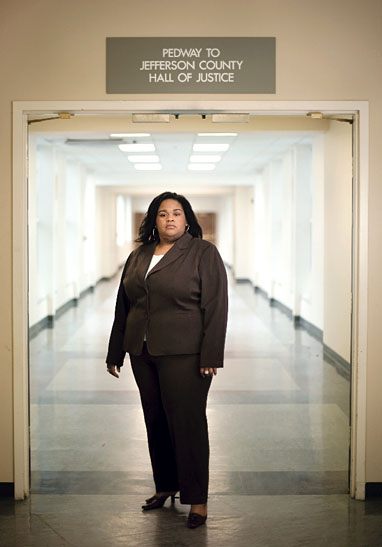
The “My Turn” feature in the April 14 issue of Newsweek offers “I Am Not the Enemy,” by Felicia J. Nu’Man. She writes so compellingly and wisely that I am tempted to reproduce her every word. But I won’t. Here’s a sample:

I battle crime every day, and I defend myself every day, too. I’m a [__] prosecutor in Louisville, Ky. I have presented cases before juries, but from my first day on the job I have felt that I have been on trial in the court of public opinion. Even my maternal grandmother once asked if I was a Republican (I’m not), while others just asked the ultimate question: how can you put our [__] men in jail?

Depending on my mood, the answer can be a three-part speech on the decay of moral values, educational-attainment levels and teenage motherhood. Other times I simply tell them the defendants put themselves in the penitentiary and I facilitated their exodus from the community. Or better yet, my favorite answer: I didn’t put the crack in their pocket and a gun in the other….

My job is not that of a social worker or a social scientist. I was hired to enforce the laws as drafted. I have a duty to the citizens of the Commonwealth of Kentucky, including all the [__] victims of the drug culture. These victims are not just the dead rival drug dealers but the addicted mothers who neglect their children, the neglected children themselves and the overburdened extended families who care for these addicts and their children.

…Race does not enter the equation for me. My question to these [__] people who believe me to be a traitor is, when will you connect the dots? Please realize, the police and the prosecutors are not the problem; it is the criminals in these depressed neighborhoods who are.

…Of course, [__] people are treated unfairly. Of course, the inner cities have a decaying infrastructure. But there is absolutely no reason to break a reasonable, appropriate law. None. The alternative is chaos.

If you hadn’t guessed, my underscoring replaces the word “black.” And Nu’Man is a brave and wise woman who happens to be black:

James Chance / Rapport for Newsweek

The "Thin" Constitution

Not long ago I came across Louis Michael Seidman’s “Can Constitutionalism Be Leftist?” The paper is an encomium, of sorts, to Seidman’s mentor, Mark Tushnet, who seems to be something oxymoronic, namely, a constitutionalist-socialist. How one could claim to be both things with a straight face is beyond me. It is true, however, that lawyers, politicians, and deluded citizens have conspired (often unwittingly, always in the name of “good,” and seldom admitting their socialism) to replace the Constitution with a socialist manifesto (e.g., see this and this).

In any event, Seidman remarks (on page 5) that

Most of the great goals of the Constitution’s preamble that form the center of Tushnet’s thin constitution — to “establish Justice … promote the general Welfare, and secure the Blessings of Liberty….”

Which is to admit that Tushnet does not honor the Constitution. For the Constitution is not its preamble, it is the text that follows. That text specifies, in some detail, how justice, the general welfare, and the blessings of liberty are to be realized under law.

Tushnet’s “thin” Constitution, then, is no Constitution at all. It is a do-it-yourself approach to law, in which the majority may steal the minority’s property, and vice versa, as long as it is done in the name of “social justice.” (See also this.)

Politicizing Economic Growth

UPDATED (04/09/08, 04/10/08)

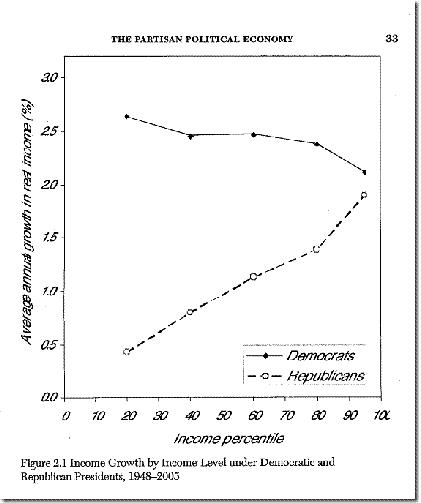
According to economist Dani Rodrik, the author of the following graph (one Larry Bartels) claims to have shown that

[w]hen a Republican president is in power, people at the top of the income distribution experience much larger real income gains than those at the bottom–a difference of 1.5 percent per year going from the bottom to the top quintile in the income distribution. The situation is reversed when a Democrat is in power: those who benefit the most are the lower income groups.

Source: Dani Rodrik’s Weblog, American political economics in one picture.”

As I discuss below, the graph is deceptive because of the period it encompasses. Taking into account the downward trend in real GDP growth that began a century ago, and the timing of Democrat and Republican presidencies from Truman’s second term onward, the graph shows only this: Republican presidents (when they had congressional support) enacted tax and regulatory policies that encouraged economic growth. The rewards of stronger growth, naturally, went mainly (though not exclusively) to those who contributed the most to growth, namely, risk-takers and highly skilled persons. Conversely, Democrat presidents (when they had congressional support, which was more often) enacted tax and regulatory policies that discouraged economic growth, which harmed high earners more than low earners.

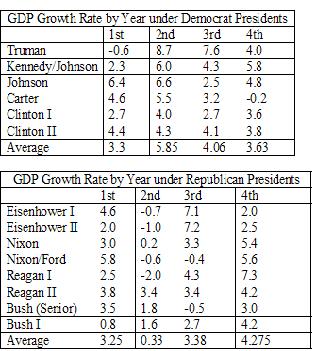
Nor is this table conclusive of anything:

Source: Marginal Revolution, More on Bartels

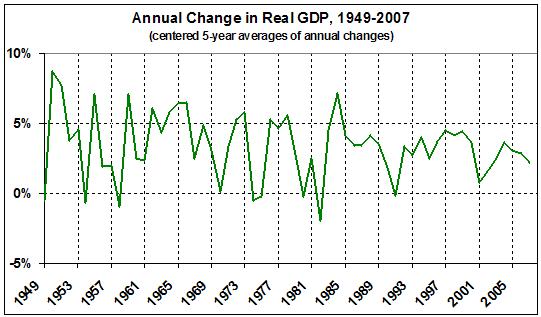
The preceding graph and table both mask the long, downward trend in the real rate of GDP growth, which I document in this post. Thus:


Why the downward trend in real GDP growth? See this post. In sum, the downward trend is due to the policies of (most) presidents and Congresses since the early 1900s: deliberate expansion of the regulatory-welfare state, with almost no opposition from the Supreme Court after the mid-1930s.

Here’s a closer look at the GDP trend since Truman’s first year as an elected president:

Source: Year-over-year changes in real GDP computed from estimates of real GDP available at Louis D. Johnston and Samuel H. Williamson, “What Was the U.S. GDP Then? MeasuringWorth.Com, 2008.

Given the long, downward trend in the real rate of GDP growth, it is statistical nonsense to pin the growth rate in any given year to a particular year of a particular president’s term. It is evident that GDP growth has been influenced mainly by the cumulative, anti-growth effects of government regulation. And GDP growth, in any given year, has been an almost-random variation on a downward theme.

As an additional piece of evidence for that proposition, I offer this: The strongest correlation between the year of a presidential term (i.e., first, second, etc.) and real GDP growth during 1949-2007 does not involve a one-year lag (as Dani Rodrik’s post suggests) but a one-year lead. There is a positive statistical relationship between growth rate and Democrat presidencies for the period 1949-2007 only because Democrats sat in the White House in half of the years from 1949 through 1981 and less than a third of the years after that. But Democrats weren’t responsible for the higher growth rate of those earlier years. They were, if anything, responsible for the lower growth rate of the later years. It took decades for the cumulative regulatory and redistributive effects of the New Deal, Fair Deal, and Great Society to be felt. But felt they were, eventually, even during the years of the so-called Clinton boom — when the liar-in-chief compounded them.

A more useful analysis of the influence of government policy on growth is found in this post. It is about the Laffer curve and the real stimulus afforded by tax cuts, regardless of the president’s party affiliation.

UPDATE: Paul Krugman, of course, is eager to believe the pseudo-relationship “discovered” by Bartels.

SECOND UPDATE: An analysis by The Corner‘s Jim Manzi corroborates my points.

Left "Libertarianism" and Child-Bearing

I once wrote that “[l]iberty, to … the ‘libertarian’ Left, is the ‘right’ to believe as they do.” One “libertarian” Leftist is Will Wilkinson, who invites the wrath of Arnold Kling by invoking happiness research in support of his (Wilkinson’s) evident bias against child-bearing. (See for example, this dissection of Wilkinson’s position by Bryan Caplan.)

Wilkinson is so hard up for an argument against child-bearing that he ignores the libertarian doctrine of personal responsibility and falls back on “happiness research.” Thus Kling’s rightful wrath.

The Fed: Unconstitutional and Worse than Useless

Here and here.

Democracy vs. Liberty, in a Paragraph

Colin McGinn writes:

In order for democracy to be acceptable, it needs to be combined with legal protections for the rights of minorities (gays, atheists, et al), or else there will be a tyranny of majority rule. But these protections cannot be made subject to the will of the majority or they lose their point and force. So, they must stay in place even if the majority opposes them–which is undemocratic. Therefore, democracy is acceptable only if it is not absolute. A tolerable form of democracy cannot be consistently democratic. The problem is that democracy and individual rights are at odds with each other.

My own views about democracy and its insidious effect on liberty are here, here, here, here, here, here, here, and here.

(Thanks to Maverick Philosopher for the pointer.)

Cringing before the Enemy

Craven cringing in the face of Muslim threats is a European way of life. There’s no news there. And, given that, there’s no surprise here:

President Vladimir V. Putin, after meeting with NATO members in Bucharest on Friday, bluntly declared that an expansion that included Ukraine and Georgia, former Soviet republics with deep historical links to Russia, would constitute a threat.

NATO rebuffed pleas by Mr. Bush and some other NATO allies to extend a preliminary “membership action plan” to Ukraine and Georgia, a major step toward full membership. Many have seen the move as a result of Russia’s warnings.

The obvious move is to invite Russia into NATO, because an alliance that includes your likeliest enemy is no alliance at all. Which seems to be the aim of “sophisticated” Europeans. They’ll continue to surrender their liberty, chunk by chunk, rather than confront any threat to it. Not surprising, in that they evidently haven’t the faintest idea what liberty is.

What, No Cattle Futures?

From Greg Mankiw’s blog:

I noted last week that Senator Obama has for some reason not taken the opportunity to put some of his Schedule C income into a tax-deferred retirement account. Now that Senator Clinton and her husband have released their tax return, I see they also passed up the chance…. I believe each of them could have put $44,000 into a SEP-IRA, but apparently, … they chose not to.

Why? I suggested two hypotheses for Senator Obama: bad tax advice or the expectation of much higher future tax rates. For the Clintons, a third hypothesis is possible: Given their substantial income ($16 million in 2006), the chance of sheltering $88,000 may be too trivial to bother with.

There is a fourth hypothesis: Bill spent the money at Emperors Club VIP or somewhere north of Bear Mountain Ridge. And a fifth one: He is still paying hush money to Susan McDougal and Webster Hubbell.

(I objected to muckraking about Sen. Debbie Stabenow’s husband, Thomas Athans, because he is not on a government payroll, as far as I know. Ex-president (fortunately) Bill Clinton receives a large government pension, a munificent expense account, lavish offices, a pre-humous memorial in the form of a presidential library, and costly Secret Service protection because of the office he once held, thanks (not) to H. Ross Perot. Clinton (born William Jefferson Blyth III) is a “public figure” of the second-worst sort: in a class with James Earl “Jimmy” Carter, though not as foul as Mohammed Abdel Rahman Abdel Raouf Arafat al-Qudwa al-Husseini, Mao Tse-tung, Ioseb Vissarionovich Jugashvili, or Adolf (Schicklgruber) Hiedler. Given Clinton’s detestable performance as governor, president and ex-president — and the fact that he is the only president to have plea-bargained his way out of a perjury charge — he deserves more ridicule than any thousand writers could heap on him in a millennium of trying.)

Religion in Public Schools: The Wrong and Right of It

Below the Beltway scorns a lawsuit, which (as FoxNews reports)

demand[s] that a popular European history teacher at California’s Capistrano Valley High School be fired for what they say were anti-Christian remarks he made in the classroom….

[Chad] Farnan recorded his teacher telling students in class: “What country has the highest murder rate? The South! What part of the country has the highest rape rate? The South! What part of the country has the highest rate of church attendance? The South!”

Scorn is the wrong reaction. If employees of public schools are forbidden, as they are, to proselytize for religion (or to allow students to do so through voluntary activities that might somehow be related to school), then employees of public schools, by the same token, should be forbidden to proselytize against religion. And that is evidently what the “popular” teacher did.

Classical Values, on the other hand, has it right. First, the relevant bits from another FoxNews story:

A Tomah [Wisconsin] High School student has filed a federal lawsuit alleging his art teacher censored his drawing because it featured a cross and a biblical reference….

According to the lawsuit, the student’s art teacher asked his class in February to draw landscapes. The student, a senior identified in the lawsuit by the initials A.P., added a cross and the words “John 3:16 A sign of love” in his drawing.

His teacher, Julie Millin, asked him to remove the reference to the Bible, saying students were making remarks about it. He refused, and she gave him a zero on the project.

Millin showed the student a policy for the class that prohibited any violence, blood, sexual connotations or religious beliefs in artwork. The lawsuit claims Millin told the boy he had signed away his constitutional rights when he signed the policy at the beginning of the semester.

The boy tore the policy up in front of Millin, who kicked him out of class. Later that day, assistant principal Cale Jackson told the boy his religious expression infringed on other students’ rights.

Jackson told the boy, his stepfather and his pastor at a meeting a week later that religious expression could be legally censored in class assignments. Millin stated at the meeting the cross in the drawing also infringed on other students’ rights.

Here’s what Classical Values has to say about that:

This is a public school, and the state is not supposed to take positions on religion. It would be one thing had the school told students that they must depict or display images of the cross, but here a student acted on his own, and in a constitutionally protected manner.

Precisely.

More about "Libertarian" Paternalism…

…from Jonah Goldberg, here. See related posts here, here, here, here, here, here, here, here, and here.

UPDATE (04/04/08): See these three posts by Jim Manzi, and related posts here, here, here, and here.

I Object

The follies of Thomas Athans, husband of Senator Debbie Stabenow (D-Mich.), shouldn’t be an occasion for gloating by right-wing outlets (e.g., Newsmax.com and Michelle Malkin’s eponymous blog). Athans is not a government official. Stabenow, who is an egregious senator in her own right, shouldn’t be judged by or held to account for her husband’s peccadilloes.

Malkin quite rightly points out, however, that Republicans — who in the election campaign of 2006 were accused of fomenting a “culture of corruption” — have no monopoly on corruption. Never did have. Never will have.