
Hockey: a Three Stooges film with many extras
Basketball: a video game
Football: a feature-length cartoon
Baseball: a novel that sometimes becomes a trilogy
Hockey: a Three Stooges film with many extras
Basketball: a video game
Football: a feature-length cartoon
Baseball: a novel that sometimes becomes a trilogy
I know some Leftists. They’re not Leftists of the loony, venomous, conspiracy-theory variety who hang out in the comment threads of Left-wing blogs. They’re you’re garden-variety, conservatives-are-mean, government-is-good, Bush-is-bad, pull-out-of-Iraq, global-warming-is real, Social Security-Medicare-and-universal-health-care-are-necessary type of Leftist. But they’re generally quiet about it, unless they’re talking to each other, in mutual support.
The thinking of the Leftists I know was shaped by “educators” and is constantly reinforced by selective (i.e., biased) reading, listening, and viewing. In other words, they have never matured mentally. They’re stuck on the themes they were force-fed before and during their college years. I would say “stuck on stupid,” but they’re not stupid — just ignorant and mentally lazy.
The hard part is: Most of them are nice. So, it’s hard to dislike a garden-variety Leftist, in spite of his or her views. Of course, it will be a different story if any of them starts hanging around the comment threads of Leftist blogs.
…to say that women are more cooperative than men? Not if it’s true. Nor am I surprised.
Related posts:
Students, Beware!
The Ultimatum Game and Genes
Greg Mankiw points to research which suggests that our sense of “fairness” may be genetic:
The paper, published in the Oct. 1 advanced online issue of the Proceedings of the National Academy of Sciences, looked at the ultimatum game, in which a proposer makes an offer to a responder on how to divide a sum of money. This offer is an ultimatum; if the responder rejects it, both parties receive nothing.
Because rejections in the game entail a zero payoff for both parties, theories of narrow self-interest predict that any positive amount will be accepted by a responder. The intriguing finding in the laboratory is that responders routinely reject free money, presumably in order to punish proposers for offers perceived as unfair.
To study genetic influence in the game, Cesarini and colleagues took the unusual step of recruiting twins from the Swedish Twin Registry, and had them play the game under controlled circumstances. Because identical twins share the same genes but fraternal twins do not, the researchers were able to detect genetic influences by comparing the similarity with which identical and fraternal twins played the game.
The researchers’ findings suggest that genetic influences account for as much as 40 percent of the variation in how people respond to unfair offers. In other words, identical twins were more likely to play with the same strategy than fraternal twins.
More than three years ago I said this about the ultimatum game:
Being offered only one of 10 dollars [in the ultimatum game] is an insult, and accepting an insult isn’t worth a dollar, to most people. When someone who is holding 10 dollars offers you only one dollar, that person is sending you a signal about your worth in his or her eyes.
I don’t know whether the typical rejection of an insulting offer is genetic. But rejection makes sense, if you consider how people act in “real life” as opposed to being the wealth-maximizers portrayed in economics texts.
John Ray points to a story at Telegraph.co.uk:
Student’s ‘English bash’ deemed racist
A student at a university that prides itself on being among the most multicultural in Britain has been branded “racist” after distributing invitations to an “English party”.
Rugby captain Timothy McLellan has been forced to apologise after pinning up posters around the campus promising the event would have “no bongos, shisha pipes or Arabic music”.
The 20-year-old law student had intended the flyer to be a joke poking fun at parties held at the School of Oriental and African Studies in London, which typically have an ethnic theme.
McLellan apologized, of course, saying (in part):
The choice of the word ‘English’, which I now regret, was not intended to mean that it was a party for white English students but was rather intended to express that the party’s vibe reflected England’s mainstream culture, which in itself is not racially exclusive.
Well, mainstream English culture may or may not be “racially exclusive,” but it is (as McLellan clearly implies) substantially different than the cultures celebrated at the School of Oriental and African Studies.
The incident reminds me of one that I witnessed 25 years ago, when I was, for a while, taking a bus to work. The regular bus driver was a white gentleman of Southern extraction. Most of the passengers were Asians and West Indian blacks who attended a community college located near a stop toward the end of the bus route. My stop was the last one on the route.
It was usual for everyone on the bus but me to disgorge at the stop located near the community college. One day, after the students has swarmed from the bus, the driver turned to me and said “I think I’ll go to Germany, where I can see some Americans.” (This was, of course, before the Muslim invasion of Western Europe.)
I understand what the bus driver felt, just as I sympathize with Timothy McLellan. There is — or was — a mainstream American culture,* just as there is — or was — a mainstream English culture. It is now de rigeur to deride those cultures and to say that their proponents and practitioners are insensitive racists. What does that make the proponents and practitioners of sub-cultures and imported cultures, especially those whose aim is the overthrow of the mainstream culture?
Mainstream Americans and Englishmen, arise. Shake off your apologetic airs. Assert your cultural pride. Illegitimi non carborundum.
_________
* The American mainstream was: upper lower-class (i.e., non-redneck) to upper middle-class; against welfare (charity was for the helpless and hopeless, and it began at home); for punishment (as opposed to excuses about poverty, etc.); overtly religious or respectful of religion (and, in either case, generally respectful of the last six of the Ten Commandments); personally responsible (stuff happens, and it’s rarely someone else’s fault); polite and helpful to strangers; patriotic (the U.S. was better than other countries and not beholden to international organizations, wars were to be fought to victory); and anti-socialist (being anti-communist was a given). Racist views, to the extent they were held, were expressed only to people one knew well (and who were of a like mind); such views were not acted upon violently or even impolitely. The “f” word and similar expletives were closeted, as well. Homosexuality and “shacking up” were disgraceful novelties, not “lifestyles” to be venerated.
Mainstream Americans might have been white or black, Christian or Jewish, rural or urban, college-educated or not, but the mainstream was wide. I knew mainstreamers well. They were to be found on main street, in side streets, and even in universities — often among the faculty. They abounded in public education, where they taught mainstream values.
The mainstream began to dry up when universities began to spew forth “educators” whose beliefs run contrary to those recited above (i.e., for welfare, against punishment, etc., etc., etc.). Those “educators” have long since done the bidding of anti-mainstream élites, in and out of academia. Thus the mainstream is now a relative trickle in an arid valley of Leftist sentiments, which have become so commonplace that they are parroted even by persons who do not consider themselves Leftists.
Greg Mankiw and Ilya Somin raise the issue. Mankiw says:
Question to think about: If right-wingers are underrepresented in universities relative to the population and discriminated against by the left-wing majority, as Larry suggests, should there be affirmative action for right-leaning academics? It seems that, on principle, those on the left (who favor affirmative action to promote diversity and correct past injustice) should endorse such a university policy, and those on the right (who more often oppose affirmative action) would be against.
Somin comments:
The underrepresentation of conservatives (and, I would add, libertarians) is almost certainly not all due to ideological discrimination. But evidence suggests that discrimination is probably at least a part of the story. In this excellent Econlog post, economist Bryan Caplan explained why ideological discrimination is more likely to flourish in academia than in most other employment markets. Even aside from discrimination, the ideological homogeneity of much of academia causes a variety of problems, such as reducing the diversity of ideas reflected in research, skewing teaching agendas, and generating the sorts of “groupthink” pathologies to which ideologically homogenous groups are prone.
However, whether or not [ideological] discrimination is the cause of the problem, affirmative action for conservative academics (or libertarian ones) is a poor solution. Among other things, it would require universities to define who counts as a “conservative” for affirmative action purpose, a task that they aren’t likely to do well. Affirmative action for conservatives would also give job candidates an incentive to engage in deception about their views in the hopes of gaining professional advancement. Moreover, conservative professors hired on an affirmative basis despite inferior qualifications would find it difficult to get their ideas taken seriously by colleagues and students. They might therefore be unable to make a meaningful contribution to academic debate – the very reason why we want to promote ideological diversity in hiring to begin with.
Somin’s argument is correct, as far as it goes. I would add this: Left-dominated disciplines (primarily the so-called liberal arts) will become less and less rewarding, relative to other (non-ideological) disciplines) as they become less and less relevant, economically. Left-dominated disciplines, therefore, will attract (proportionally) fewer and fewer students — because students (especially grad students) tend to go where the money is. As a result, the number of faculty supported by such disciplines will shrink (relatively, if not absolutely), and the academic influence of Leftists will diminish (relatively, if not absolutely).
In other words, the market will take care of the problem, albeit over a longish period of time. Market signals will influence tax-funded universities, as well as private ones, because tax-funded universities do compete with each other and with private ones for the “best and the brightest” students.
According to Aristotle (restating Zeno):
In a race, the quickest runner [Achilles] can never overtake the slowest [Tortoise], since the pursuer must first reach the point whence the pursued started [i.e. the pursued has a head start], so that the slower must always hold a lead.
Can anyone really believe that Achilles fails to catch the Tortoise? Yes. See this, this, this, and this, for example.
To show what’s wrong with Aristotle’s analysis, I begin with an example:
What’s the catch? It’s verbal sleight-of-hand, much like the “proof” that 1 + 1 = 3. We know that A must be able to catch T, but we are trapped in a fallacious argument which seems to prove that A can’t catch T.
The trick lies in the presentation of A’s and T’s movements as occurring alternately instead of simultaneously. A is always described as going to where T was, not to where T will be when A catches him.
Such reasoning contradicts what we know of reality. Fast runners often catch (relatively) slow runners on the football field. The best sprinter on any high-school track team could give me a 25-yard head start and beat me to the finish line of a 100-yard dash. And so on.
When a real A catches a real T, the real A does so by covering a greater distance than the real T, but the real A covers that distance by running for exactly the same length of time as the real T runs. Along the way, A will pass points already passed by T, but A will not pause at any of those points and allow T to move a bit farther ahead — which is the trick that lies behind the Aristotelian “proof” of A’s inability to catch T.
Going back to the example (A runs 15 miles an hour, etc.), we can determine when and where A catches T simply by describing the race correctly:
Generally, if A is able to overtake T at time t and distance d (from A’s starting point):
ta = tt = t, where ta is A’s time since the start of the race and tt is T’s time since the start of the race
da = dt = d, where da is A’s distance from his starting point and dt is T’s distance from A’s starting point, which include’s T’s head start: h
da = (va)(t), where va is A’s speed
dt = h + (vt)(t), where vt is T’s speed
If da = dt = d:
(va)(t) = h + (vt)(t)
(va)(t) – (vt)(t) = h
(va – vt)(t) = h
t = h/(va – vt)
Having solved this equation for t — given h, va, and vt — it is then trivial to solve the equations for da and dt, and to show that both yield the same result, which is d.
Meaningful values can be found for t and d only if va > vt. Otherwise, t and d take meaningless negative values. This null possibility means that the answer “A catches T” is not assumed in the algebraic statement of the problem; that is, the algebraic formulation given here is not a circular proof of A’s ability to catch T.
David Friedman asserts that the
market for law in an anarcho-capitalist society will tend to produce economically efficient law for reasons related, but not identical, to the reasons that other markets tend to produce efficient outcomes. Libertarians believe that freedom works, that libertarian law is closely, if not perfectly, correlated with efficient law. If that belief is correct, there will be a strong tendency for the market for law to generate libertarian law.
So far as I know, no comparable argument exists for the minarchist side of the debate, no good reason, short of assuming that everyone has become a libertarian, to expect law produced by political mechanisms to be either efficient or libertarian.
Friedman’s argument in favor of anarcho-capitalism contains a fatal flaw: Markets are unlikely to work in the absence of a supervening rule of law if — as is likely — there are predators who are unwilling to participate in markets and powerful enough to dictate non-market outcomes.
There must, therefore, be an overarching, non-market institution which enables markets to operate efficiently, that is, to reach outcomes that are seen as beneficial by all those willingly operate within markets. The necessary supervening institution is the minimal state (a minarchy) that is vested with enough authority to protect market participants from force and fraud, but not so much authority so as to enable its interference with market outcomes.
Only a wise (and rare) élite can establish such a state. The existence of such an élite — and its success in establishing a lasting minarchy — depends on serendipity, determination, and (yes) even force. That we, in the United States, came close (for a time) to having such a minarchy was due to historical accident (luck). We had just about the right élite at just about the right time, and the élite’s wisdom managed to prevail for a while.
The dichotomy between anarcho-capitalism and minarchy is a false one. The true dichotomy is between minarchy and warlordism (which follows from anarchy).
That we have moved on to something worse than minarchy is not proof of the superiority of anarcho-capitalism. It is, rather, proof that our luck ran out.
Someone named Reihan is pinch-hitting for Ross Douthat. Reihan writes,
better to have a smart, coherent welfare system at the federal or at least state level than a patchwork that encourages the arbitrary and often harmful shifting around of the poor.
A politically designed, state-run “smart, coherent welfare system.” There’s an oxymoron, in spades. What does that say about Reihan? I report, you decide.
Hurry back, Ross.
David Friedman addresses Pascal’s wager:
Pascal famously argued that, as long as there was any probability that God existed, a rational gambler should worship him, since the cost if he did exist and you failed to worship him was enormously greater than the cost if it went the other way around.
A variety of objections can be made to this, most obviously that a just God would reject a worshiper who worshiped on that basis.
That is my view, also. But Friedman goes on to say that he has “a variant on the argument” that he “find[s] more persuasive.” Thus:
The issue is not God but morality. Most human beings have a strong intuition that some acts are good and some bad–that one ought not to steal, murder, lie, bully, torture, and the like. Details of what is covered and how it is defined vary a good deal, but the underlying idea that right and wrong are real categories and one should do right and not wrong is common to most of us.
There are two categories of explanation for this intuition. One is that it is a perception–that right and wrong are real, that we somehow perceive that, and that our feel for what is right and what is wrong is at least very roughly correct. The other is that morality is a mistake. We have been brainwashed by our culture, or perhaps our genes, into feeling the way we do, but there is really no good reason why one ought to feed the hungry or ought not to torture small children.
Suppose you are uncertain which of the two explanations is correct. I argue that you ought to act as if the first is. If morality is real and you act as if it were not, you will do bad things–and the assumption that morality is real means that you ought not to do bad things. If morality is an illusion and you act as if it were not, you may miss the opportunity to commit a few pleasurable wrongs–but since morality correlates tolerably well, although not perfectly, with rational self interest, the cost is unlikely to be large.
I think this version avoids the problems with Pascal’s. No god is required for the argument–merely the nature of right and wrong, good and evil, as most human beings intuit them. And, by the morality most of us hold, the fact that you are refraining from evil because of a probabilistic calculation does not negate the value of doing so–you still haven’t stolen, lied, or whatever. One of the odd features of our intuitions of right and wrong is that they are not entirely, perhaps not chiefly, judgements about people but judgements about acts.
Friedman actually changes the subject from Pascal’s wager (why one should believe in God) to the basis of morality. As I say above, I agree with Friedman’s observation about Pascal’s wager: God might well reject a cynical believer.
But it seems to me that Pascal’s wager has nothing much to do with the origin of morality. Not all worshipers are moral; not all moral persons are worshipers.
Moreover, Friedman overlooks two important (and not mutually exclusive) explanations of morality. The first is empathy; the second is consequentialism.
We (most of us) flinch from doing things to others that we would not want done to ourselves. Is that because of inbred (“hard wired”) empathy? Or are we conditioned by social custom? Or is the answer “both”?
If inbred empathy is the only explanation for self-control with regard to other persons, why is it that our restraint so often fails us in interactions with others are fleeting and/or distant? (Think of aggressive driving and rude e-mails, for just two examples of unempathic behavior.) Empathy, to the extent that it is a real and restraining influence, seems most to work best (but not perfectly) in face-to-face encounters, especially where the persons involved have more than a fleeting relationship.
If behavior is (also) influenced by social custom, why does social custom favor restraint? Here is where consequentialism enters the picture.
We are taught (or we learn) about the possibility of retaliation by a victim of our behavior (or by someone acting on behalf of a victim). In certain instances, there is the possibility of state action on behalf of the victim: a fine, time in jail, etc. So we are taught (or we learn) to restrain ourselves (to some extent) in order to avoid punishments that flow directly and (more or less) predictably from our unrestrained actions.
More deeply, there is the idea that “what goes around comes around.” In other words, bad behavior can beget bad behavior, whereas good behavior can beget good behavior. (“Well, if so-and-so can get away with X, so can I.” “So-and-so is rewarded for good behavior; it will pay me to be good, also.” “If so-and-so is nice to me, I’ll be nice to him so that he’ll continue to be nice to me.”)
Why do we care that “what goes around comes around”? First, we humans are imitative social animals; what others do — for good or ill — cues our own behavior. Second, there is an “instinctive” (taught/learned) aversion to “fouling one’s own nest.”
Unfortunately, our aversion to nest-fouling weakens as our interactions with others become more fleeting and distant — as they have done since the onset of industrialization, urbanization, and mass communication. Bad behavior then becomes easier because its consequences are less obvious or certain; it becomes a model for imitation and, perhaps, even a norm. Good behavior then flows from the fear of being retaliated against, not from socialized norms, or even from fear of state action. Aggression — among the naturally aggressive — becomes more usual.
And so we become ripe for rule by a “protective” state, and by rival warlords if the state fails to protect us.
“Threat of punishment can deter bad behaviour,” says this article.
I agree, wholeheartedly. See:
Does Capital Punishment Deter Homicide?
Crime and Punishment
More Punishment Means Less Crime
More About Crime and Punishment
More Punishment Means Less Crime: A Footnote
Less Punishment Means More Crime
This is my first follow-up to “Has Baseball Become More Competitive?” Here I draw on the first two graphs from that post to make some observations about the best and worst teams in the history of the American League. My metric is the centered, nine-year won-lost (W-L) record (see “…Competitive?” for more about the metric). For reasons given here and here, I eschew performance in post-season play as a measure of excellence.
The graphs (to enlarge, right click and select “open in new tab”):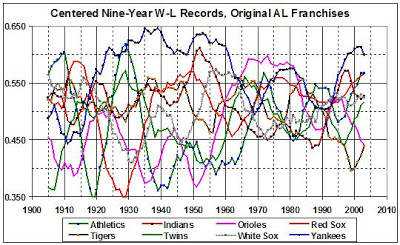
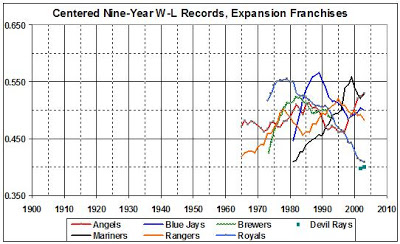 Remember, I am measuring performance over nine-year spans — not individual seasons — so the following lists will not always correspond with lists of teams having the best and worst W-L record, by season. Using the nine-year, I present the best (E = expansion team)…
Athletics (then of Philadelphia), 1905-11
Red Sox, 1912-1917
White Sox, 1918
Yankees, 1919-62
White Sox, 1963
Yankees, 1964
Orioles, 1965-81
Yankees, 1982-85
Blue Jays (E), 1986-90
Athletics (then of Oakland), 1991-92
White Sox, 1993
Yankees, 1994-2003
…and the worst (E = expansion team)…
Twins (then the original Washington Senators), 1905-08
Orioles (then the St. Louis Browns), 1909-15
Athletics (then in Philadelphia), 1916-22
Red Sox, 1923-32
Orioles (still the Browns), 1933-37
Athletics (still in Philadelphia), 1938-47
Orioles (still the Browns), 1948-54 (tied with Athletics in ’54)
Athletics, 1954-64 (tied with Browns in ’54) (A’s in Philadelphia through 1954; in Kansas City, 1955-67)
Rangers (E), 1965-72 (as the expansion Washington Senators, 1965-71; as the Texas Rangers, 1972)
Brewers (E), 1973-74
Indians, 1975
Angels (E), 1976
White Sox, 1977
Twins, 1978-79
Athletics (in Oakland), 1980
Mariners (E), 1981-85
Indians, 1986-89
Mariners (E), 1990-91
Tigers, 1992-2001
Devil Rays (E), 2002-03
I take these lists (especially the list of worst teams) as further evidence that baseball has become more competitive since the onset of expansion and free agency. Just look at the number of original franchises at the bottom of the heap since 1965.
There’s more to come, in future posts.
Here and here. The first item is interesting mainly for what it reveals about global-warming zealots. The second article offers strong, scientific evidence of the key role of cosmic radiation, which is influence by solar activity and the galactic position of the solar system.
P.S. There’s a related piece, here, on the high cost of minimal reductions in CO2 emissions.
P.P.S. My son adds this quotation, from Evelyn Waugh’s Love Among the Ruins:
Despite their promises at the last Election, the politicians had not
yet changed the climate.
As of this evening, Iowa Electronic Markets has Hillary Clinton as a better than two-to-one favorite for the Democrat nomination in 2008. Rudy Giuliani, Mitt Romney, and Fred Thompson are in a close race for the Republican nomination; therefore, none is better than a one-in-three favorite.
In spite of the Republican elephant race, and because of Frau Clinton’s dominance of Democrats, the IEM odds on the outcome of the election give only a slight edge to the Democrat nominee: 52-48. And that’s before Republicans unite to attack Clinton and her Soviet-style agenda.
I begin to answer the question by presenting the following graphs. They show the nine-year, centered won-lost (W-L) record (a.k.a. winning percentage) of each of the franchises that has had teams in the American League. (To enlarge an image, right-click on it and select “open in a new tab.”)
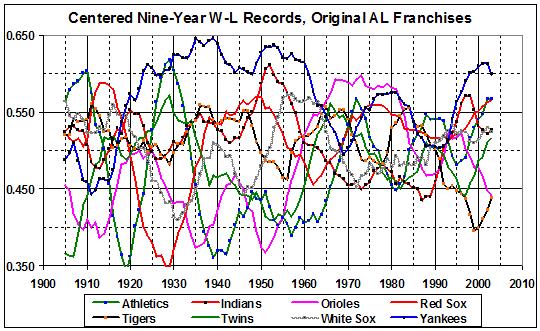

Source: Statistics derived from information available at Baseball-Reference.com.
Each franchise is identified by the nickname of its current team. Some franchises have changed cities, of course, and some teams’ nicknames have changed, even when the teams have stayed put.
I chose to plot nine-year, centered W-L records for three reasons. First, a team’s record over nine years should obliterate aberrations: unusually bad or good years. Second, the selection of nine years (rather than ten, for instance) allows for the computation of a centered average. Third, a centered average gives a better indication of a team’s success (or failure) in the year for which the average is plotted.
I plotted the original eight franchises separately from the seven expansion franchises for two reasons. First, a graph that plots the records of all the franchises would be too cluttered to read easily. Second, I wanted to highlight the effects of expansion (if any) on the success (or failure) of the original franchises. (Note that the records of the seven expansion teams include those of the Milwaukee Brewers, now a National League team. The Brewers entered the AL in 1969 as the Seattle Pilots, moved to Milwaukee in 1970, and moved to the National League after the 1997 season. Accordingly, I computed and plotted nine-year, centered averages only for the years that the Pilots/Brewers were an AL team.)
Now, for some relevant history:
Given that, what can one glean from the two charts above? One obvious fact (obvious to me, anyway) is that the AL has become more competitive since the onset of expansion and free agency. (By “competitive” I mean that the teams’ W-L records have become more tightly bunched around .500.) The following graph confirms that observation. (To enlarge the image, right-click on it and select “open in a new tab.”)

Source: Statistics derived from information available at Baseball-Reference.com.
This graph plots, for each season from 1901 through 2007, the average absolute value of the deviation of team W-L records from the league’s overall record. For example, a W-L record of .400 and a W-L record of .600 both deviate by .100 from a league W-L record of .500. (The AL”s overall record was, of necessity, .500 in each year through 1996, when there was no interleague play during the regular season. Since the advent of interleague play after 1996, the overall W-L record of the AL has ranged from a low of .495 in 1997 to a high of .512 in 2006.)
It seems indisputable that baseball, represented here by the AL, has become more competitive since the advent of expansion and the establishment of free agency. (The “blip” around 2002 seems to be an anomaly caused by the confluence of several unusually abysmal and outstanding seasons.)
Why? I suggest the following:
In a future post I will discuss the records of certain teams — the Athletics and their wild swings between excellence and dysfunction, for example.


You must be logged in to post a comment.