The Slippery Slope of Constitutional Revisionism

In “The Erosion of the Constitutional Contract,” I attribute the accretion of government power to the misapplication of four elements of the U.S. Constitution:

  • the phrase “promote the general welfare” in the Preamble [and in Article I, Section 8, Clause 1]. This was a desired result of the adoption of the Constitution, not an edict to redistribute income and wealth [or an unbounded power to tax and spend].
  • the power of Congress “to regulate commerce…among the several states [Article I, Section 8, Clause 3].” This power was meant to prevent the States from restricting or distorting the terms of trade across their borders, not to enable the federal government to dictate what is traded, how it is made, or how businesses operate.
  • the authority of Congress “[t]o make all Laws which shall be necessary and proper for carrying into execution the foregoing powers, and all other powers vested by this Constitution in the Government of the United States, or in any department or officer thereof [Article I, Section 8, Clause 18].” The words “necessary and proper” have been wrenched out of their context and used to turn the meaning of this clause upside down. It was meant to limit Congress to the enactment of constitutional legislation, not to give it unlimited legislative authority.
  • the “equal protection” clause of Amendment XIV: “…nor shall any State…deny to any person within its jurisdiction the equal protection of the laws.” Amendment XIV was meant to secure the legal equality of those former slaves whose freedom had been secured by Amendment XIII. Amendment XIV became, instead, the basis for Supreme Court decisions and federal laws and regulations that have given special “rights” to specific, “protected” groups by curtailing the constitutional rights of the many who cannot claim affiliation with one or another of the “protected” groups. As the proponents of such groups might ask, is it fair?

Here, with the help of Wikipedia, I sketch our path down the slippery slope to our present state, which I once captured in these questions:

If liberty is so bounteous, why don’t we enjoy it in full? Why are our lives so heavily regulated and legislated by so many federal, State, and local agencies at such a high cost? What happened to the promise of liberty given in the Declaration of Independence and Constitution?

Our way down the slope has been led, of course, by the U.S. Supreme Court. I restrict the following quotations from Wikipedia to historically accurate background material and summaries of the Court’s actions. My notes and comments are in brackets and initialed LC.

The General Welfare Clause (a.k.a. the Taxing and Spending Clause)

Two theories of the taxing power have been advocated by constitutional scholars: (A) the narrower Madisonian view that taxation must be tied to one of the other specifically enumerated powers such as regulating commerce or providing for the military, and (B) the broader Hamiltonian view that taxation is a separately enumerated, independent power, and that Congress may tax and spend in any way that will benefit the general welfare….

[The Madisonian view was] overturned in United States v. Butler, 297 U.S. 1 (1936)[3]. In that case the Court held that the power to tax and spend is an independent power; that is, that the Taxing and Spending Clause gives Congress power it might not have anywhere else. [See also the history of Social Security, which cites other instances — most notably, the passage of the Social Security Act — in which the Court conveniently adapted its tune to the times, as if Madison’s long-prevailing view of the “tax and spend clause” had been a mere whim of the Court. John Eastman, in “Restoring the General to the General Welfare Clause,” argues at length and convincingly “that the blank check interpretation given to the clause since Butler simply cannot be squared with the original understanding of either Hamilton or Madison.”: LC.]

The modern Supreme Court has interpreted this clause to give Congress a plenary power to impose taxes and to spend money for the general welfare, including the power to force the states to abide by national standards by threatening to withhold federal funds. See South Dakota v. Dole, 483 U.S. 203 (1987)[4]. [I need say no more: LC.]

The Commerce Clause

In Gibbons v. Ogden (1824), Chief Justice John Marshall ruled that….[contrary to Amendment X: LC] “[T]he power of Congress does not stop at the jurisdictional lines of the several states. It would be a very useless power if it could not pass those lines.”…

In Swift v. United States (1905), the Court ruled that the clause covered meatpackers; although their activity was geographically “local,” they had an important effect on the “current of commerce” and thus could be regulated under the Commerce Clause….

The clause was the subject of conflict between the U.S. Supreme Court and the Administration of Franklin D. Roosevelt in 1935-37 when the Court struck down several of the President’s “New Deal” measures on the grounds that they encroached upon intrastate matters. After winning the 1936 election, FDR proposed a plan to appoint an additional justice for each unretired Justice over 70. Given the age of the current justices this permitted a court population of up to 15….

There was widespread opposition to this “court packing” plan, but in the end the New Deal did not need it to succeed. In what became known as “the switch in time that saved nine,” Justice Owen Josephus Roberts and Chief Justice Charles Evans Hughes switched sides in 1937 and, in National Labor Relations Board v. Jones & Laughlin Steel Corporation, upheld the National Labor Relations Act, which gave the National Labor Relations Board extensive power over unions across the country.

In 1941 the Court upheld the Fair Labor Standards Act which regulated the production of goods shipped across state lines. In Wickard v. Filburn, (1942) the Court upheld the Agricultural Adjustment Act, stating that the act of growing wheat on one’s own land, for one’s own consumption, affected interstate commerce, and therefore under the Commerce Clause was subject to federal regulation….

The wide interpretation of the scope of the commerce clause continued following the passing of the Civil Rights Act of 1964, which aimed to prevent business from discriminating against black customers. In Heart of Atlanta Motel v. United States (1964), the Court ruled that Congress could regulate a business that served mostly interstate travelers; in Katzenbach v. McClung (1964) the Court ruled that the federal government could regulate Ollie’s Barbecue, which served mostly local clientele but sold food that had previously moved across state lines; and in Daniel v. Paul (1969), the Court ruled that the federal government could regulate a recreational facility because three out of the four items sold at its snack bar were purchased from outside the state….

Many described the Rehnquist Court’s commerce clause cases [links added: LC] as a doctrine of “new federalism”. The outer limits of that doctrine were delineated by Gonzales v. Raich (2005), in which Justices Scalia and Kennedy departed from their previous positions as parts of the Lopez and Morrison majorities to uphold a federal law regarding marijuana. The court found the federal law valid, although the marijuana in question had been grown and consumed within a single state, and had never entered interstate commerce. [Thus giving Congress the power to regulate anything done anywhere within the United States: LC.]

The Necessary and Proper Clause

Strict constructionists interpret the clause to mean that Congress may make a law only if the inability to do so would cripple its ability to apply one of its enumerated powers (“foregoing powers”). Others argue that the elastic clause expands the authority of Congress to all areas tangentially related to one of its enumerated powers. It is often known as the elastic clause because of the great amount of leeway in interpretation it allows….

In McCulloch v. Maryland [1819],…the court held that because the Congress has the power to control national economic policy [a power not specified or enumerated in the Constitution: LC], creating a national bank is necessary and proper to carry out its duties….

The clause has been paired with the commerce clause to provide the constitutional basis for a wide variety of laws. For example, Congress may make it a crime to transport a kidnapped person across state lines, because the transportation would be an act of interstate activity over which the Congress has power. A series of Supreme Court decisions resulting in the desegregation of private businesses, such as hotels and restaurants, were supported on the basis that these business establishments, although not directly engaged in interstate commerce, no doubt had an effect on it. Since the New Deal the Supreme Court has been reluctant to limit the scope of authority allowed under the combination of these clauses. United States v. Lopez was the first modern case finding limits to Congress’s authority in this regard. [Those limits were short-lived, as discussed in the last paragraph of the section on the Commerce Clause: LC.]

The Equal Protection Clause

[T]he Equal Protection Clause, along with the rest of the Fourteenth Amendment, marked a great shift in American constitutionalism. Before the enactment of the Fourteenth Amendment, the Bill of Rights protected individual rights only from invasion by the federal government. After the Fourteenth Amendment was enacted, the Constitution also protected rights from abridgement by state governments, even including some rights that arguably were not protected from abridgement by the federal government. In the wake of the Fourteenth Amendment, the states could not, among other things, deprive people of the equal protection of the laws. What exactly such a requirement means, of course, has been the subject of great debate; and the story of the Equal Protection Clause is the gradual explication of its meaning [and the gradual corruption of its meaning: LC].

The next important post[-Civil W]ar case was the Civil Rights Cases (1883), in which the constitutionality of the Civil Rights Act of 1875 was at issue. The Act provided that all persons should have “full and equal enjoyment of … inns, public conveyances on land or water, theatres, and other places of public amusement.” In its opinion, the Court promulgated what has since become known as the “State Action Doctrine,” which limits the guarantees of the equal protection clause only to acts done or otherwise “sanctioned in some way” by the state….

The Supreme Court has [ruled] that the equal protection clause itself does not forbid policies which lead to racial disparities, but that Congress may by legislation prohibit such policies. [What the Court taketh away with one hand it giveth back with the other: LC.]

Take, for example, Title VII of the Civil Rights Act of 1964, which forbids job discrimination on the basis of race, national origin, sex or religion. Title VII applies both to private and to public employers. (While Congress applied Title VII to private employers using its interstate commerce power, it applied Title VII to public employers under its power to enforce the Fourteenth Amendment…. [What Congress cannot do under one judicially created loophole it can do under another: LC.]

Although the Supreme Court had ruled in Nixon v. Herndon (1927) that the Fourteenth Amendment prohibited denial of the vote based on race, the first modern application of the Equal Protection Clause to voting law came in Baker v. Carr (1962), where the Court ruled that the districts that sent representatives to the Tennessee state legislature were so malapportioned (with some legislators representing ten times the number of residents as others) that they violated the Equal Protection Clause. This ruling was extended two years later in Reynolds v. Sims (1964), in which a “one man, one vote” standard was laid down: in both houses of state legislatures, each resident had to be given equal weight in representation. [Thus undoing arrangements that the Framers implicitly accepted when they guaranteed each State a republican form of government: LC.]

It may seem counterintuitive that the equal protection clause should provide for equal voting rights; after all, it would seem to make the Fifteenth Amendment and the Nineteenth Amendment redundant. Indeed, it was on this argument, as well as on the legislative history of the Fourteenth Amendment, that Justice John M. Harlan (the grandson of the earlier Justice Harlan) relied in his dissent from Reynolds. Harlan quoted the congressional debates of 1866 to show that the framers did not intend for the Equal Protection Clause to extend to voting rights….[But a majority of the Court is not to be persuaded by the logic and meaning of the Constitution when it has a result to accomplish: LC.]

And so it goes, down the slippery slope of constitutional revisionism toward a dystopian future, in which Congress may recklessly (but with impunity) herd us into absolute, collectivist conformity. What has been done by the Supreme Court is likely to remain done, given stare decisis. And so what has been done will become precedent for the few remaining leaps down the slippery slope. Dystopia, we’re almost there!

Related post: Slopes, Ratchets, and the Death Spiral of Liberty (among many others in the category Constitution – Courts – Law – Justice)

For Labor Day

The Truth about Labor Day,” from the Ludwig von Mises Institute.

Toward a Capital Theory of Value,” “A Very Politically Incorrect Labor Day Post,” and “Your Labor Day Reading,” by me.

Sets: A Physical Perspective

Maverick Philosopher, in the third of a series of related posts, avers that

the following situation is conceivable: only two physical objects exist, two iron spheres, say. Now what I said earlier implies that, given two physical objects, there exists ‘automatically’ the set consisting of them. By ‘automatically,’ I mean that the existence of the spheres is logically sufficient for the existence of the set consisting of them. There is no need for any (finite) mind to collect them into a unity. So if a is one sphere and b the other, and if the situation we are envisaging is to be possible, then a third item must also exist, namely, {a, b}.

MP may be right, philosophically, but I prefer a physical interpretation:

  • There are only two physical objects: iron spheres a and b.
  • The description of the spheres (e.g., “physical objects” and “iron”) is an abstraction. (That it is an abstraction in the mind of an observer who also exists is a complication outside the scope of this analysis.)
  • The spheres, in fact, are collections of matter-energy in a specific state; there is more to than them meets the naked eye.
  • By definition, the spheres comprise all of the matter-energy in existence.
  • The universe comprises all of the matter-energy in existence.
  • Therefore, “universe” (the set {a, b} in MP‘s analysis) is simply an abstraction of a higher order than “iron sphere,” just as “iron sphere” is an abstraction of a higher order than the particular state of matter-energy that produces an iron sphere.

What we have, then, is not three things but one thing: a universe of matter-energy that may be perceived in many ways, for example:

  • as a whole, which comprises the things that it comprises, however those things may be described
  • the coherent bits of matter-energy that are perceptible as iron spheres by the naked eye
  • more discrete forms matter-energy that are perceptible as sub-atomic particles, given the proper scientific apparatus.

Alternatively (but equivalently), we have many, many things (the various and sundry forms taken by matter-energy), which may be abstracted into such things as iron spheres and the universe.

What we don’t have is three things: a, b, and the set {a, b}. Rather, a and b (and their constituent bits of matter-energy) are within {a, b}, not apart from it as separate things.

ADDENDUM (1:35 p.m. CT): An analogy can be found in the visible surface of a TV screen. That surface is the universe of the hundreds of thousands or millions of pixels it comprises. That surface also is the universe of the discernible shapes it comprises. Those discernible shapes are composed of pixels, but the pixels are not discernible without magnification. The visible surface of the TV screen, the shapes on it, and the pixels that compose the shapes are different abstractions of the same thing, not different things.

A Telling Contrast

Two tenured professors of economics: the gentlemanly, rather conservative, well published N. Gregory Mankiw vs. the rancid, Leftist, seldom published J. Bradford DeLong.

Then there’s Arthur Miller, the typical I love mankind, it’s people I can’t stand* kind of Leftist.
__________
* Linus van Pelt of Peanuts, circa 1963.

My Sentiments, Exactly

Here.

Related posts:
Katrina’s Aftermath: Who’s to Blame?
“The Private Sector Isn’t Perfect”
A Modest Proposal for Disaster Preparedness
No Mention of Opportunity Costs
Whose Incompetence Do You Trust?
Enough of Amateur Critics
An Open Letter to Michael Moore

September Songs

Anticipating September, I searched today for audio clips of my two favorite September songs: “September Song” and “September in the Rain.” I was looking especially for clips featuring Walter Huston (“September Song”) and James Melton (“September in the Rain”) because their renditions are the definitive originals.

Huston introduced “September Song” in the 1938-39 Broadway musical, Knickerbocker Holiday. That Huston was an actor and not a trained (or very skilled) singer makes his delivery all the more sincere and poignant. It is especially poignant for me because I remember first hearing the song (and Huston singing it) on an autumn day almost fifty years ago. Here’s the clip.

Melton, on the other hand, was a trained singer. The affected style of some of his recordings (especially the early ones) can be off-putting, but it’s a style that was common in those days (the 1920s and 1930s) and it doesn’t (for me) detract from the beauty of Melton’s voice. Now an obscure figure, Melton had a long career on the band platform, on radio, in movies, in opera, and on TV. (I remember watching his short-lived 1951 TV series.) Melton possessed a bright, ringing tenor voice with a melancholic edge: a perfect voice for “September in the Rain,” which Melton made famous in the 1937 film, Melody for Two. Here’s the clip.

The State of England

It seems to be going the way of Detroit.

Yankees vs. Red Sox: The End Games

The Red Sox remaining games at home through the end of the season

Orioles — 3 games — home record vs. Orioles this season: W4-L2
Blue Jays — 3 games — home vs. Blue Jays: 2-4
Devil Rays — 3 games — home vs. Devil Rays: 5-1
Yankees — 3 games — home vs. Yankees: 4-2
Athletics — 2 games — home vs. Athletics: 1-1
Twins — 4 games — home vs. Twins: no games

The Red Sox away

Orioles — 4 games — away vs. Orioles: 3-2
Blue Jays — 3 games — away vs. Blue Jays: 5-1
Devil Rays — 3 games — away vs. Devil Rays: 4-2

The Yankees at home

Devil Rays — 3 games — home vs. Devil Rays: 4-2
Mariners — 3 games — home vs. Mariners: 2-2
Orioles — 3 games — home vs. Orioles: 2-4
Blue Jays — 4 games — home vs. Blue Jays: 3-2

The Yankees away

Royals — 3 games — away vs. Royals: 3-1
Blue Jays — 3 games — away vs. Blue Jays: 3-3
Red Sox — 3 games — away vs. Red Sox: 2-4
Devil Rays — games — away vs. Devil Rays: 3-3
Orioles — 3 games — away vs. Orioles: 2-4

Combined home and away records against remaining opponents

Red Sox: 28-15
Yankees: 24-25

Current standings

Red Sox lead Yankees by 5 games

Conclusion

Draw your own, bearing in mind that “past performance is no guarantee of future results.”

The State of Michigan

When you don’t have anything else going for you, you move your presidential primary to January 15.

The "Jewell Effect" and Larry Craig

UPDATED THRICE, BELOW

Remember Richard Jewell, who died yesterday? Jewell, as The Washington Post‘s headline says, was “wrongly linked to Olympic bombing”:

On July 27, 1996, [Jewell] spotted a crudely made pipe bomb inside a green knapsack near a concert stage [at Atlanta’s Centennial Olympic Park].

At first, he was praised for his decisive handling of the situation. He hurried people away and called for backup. His actions were credited with reducing casualties; one woman died, and 111 people were injured at the scene.

Within three days, Mr. Jewell’s status as a hero was challenged after the Atlanta Journal-Constitution called him “the focus” of the FBI investigation into the bombing. The FBI neither arrested nor formally charged Mr. Jewell, but the scrutiny that descended on him was invasive and crude….

In October 1996, the FBI cleared Mr. Jewell. In a news conference, he called his 88 days under suspicion a nightmare for him and his mother, with whom he lived near the Olympic park.

“In its rush to show the world how quickly it could get its man, the FBI trampled on my rights as a citizen,” he said. “In its rush for the headline that the hero was the bomber, the media cared nothing for my feelings as a human being. In their mad rush to fulfill their own personal agendas, the FBI and the media almost destroyed me and my mother.”

The matter of Larry Craig may seem different (after all, he pled guilty to something), but the rush to judge and punish Craig for something he didn’t plead guilty to (soliciting a homosexual act) is Jewell-like. Rick Moran, writing at The American Thinker Blog, describes the cynical reaction of Craig’s Senate “colleagues”:

The humiliation of Senator Larry Craig continues as party leaders in the Senate have stripped him of his status as ranking Republican on the Veterans Affairs Committee as well as an Appropriations subcommittee.

In addition, several prominent Senators have called on Craig to resign immediately – a sure sign that the party is nervous about holding on to as many seats as they can after next year’s election….

Senator [Norm] Coleman [R-MN] said that Craig was guilty of “conduct unbecoming a Senator” and should resign. Other Republican Senators have privately expressed deep concern that in an election cycle where they must defend 21 seats, Craig’s Idaho constituency – among the most reliably Republican in the country – might opt for a Democrat if the stain of the scandal can’t be wiped away.

I should note, however, that Moran’s reaction is equally cynical:

GOP Senators should probably do an intervention on Craig’s behalf and lay out the facts for him in umistakable terms. His effort to overturn his guilty plea will not change anyone’s mind about him one iota and only keeps the scandal in front of the voters where both the voters and the party will be constantly reminded of it.

Best he resign and just fade away. [More of the same here: ED.]

Thus effectively conceding a fact that he denies, namely, that he is a homosexual. But who cares about that when there are Senate seats at stake?

UPDATE (08/30/07): The newly released audio tape of Craig’s questioning by the cop who arrested him proves absolutely nothing, except that the cop’s interrogation technique is as subtle as toilet seat. (I couldn’t resist using that rather obscure simile, given the subject.) Either Craig is lying through his teeth (to switch from simile to metaphor in mid-stream) or the cop “saw” what he expected, no, hoped to see: signals of solicitation. The cop was involved in a sting operation, after all.

UPDATE (08/31/07): Relevant commentary here.

UPDATE (09/01/07): Well, Senator Craig has resigned. Here’s my take:

Craig has been plagued for decades by accusations that he is homosexual. He chose to plead to disorderly conduct in the hope that the mens’ room incident would “go away.” It didn’t. Now he has chosen to resign his Senate seat in the hope that the furore about his so-called misconduct will go away. The two choices are consistent with what I have seen of Craig (as a public figure): a principled conservative who is articulate about his principles but not combative.

Thus endeth a distinguished career. Let us hope that Craig’s successor (probably Idaho’s lieutenant governor, Jim Risch, is as conservative as Craig.

"Liberalism," as Seen by Liberals

This is from a book review in The Washington Post. The book attempts to rehabilitate “liberalism” in the United States. The book seems unwittingly to disclose the truth about the modern version of liberalism, which is not liberal all:

…The revolutions in 17th-century England that limited monarchical power, for example, left English subjects paying higher taxes [emphasis added] than any other people in Europe.

By opening up power to progressively broader participation, liberal constitutions have subjected government to scrutiny, criticism and even resistance, and thus have helped to protect citizens against overweening bureaucracies. At the same time, they have made democratic states more legitimate and have enabled them to borrow, tax and, until recently, conscript more and more. Paradoxically, then, constitutionally limited states [i.e., “liberal” states] historically have wielded more power than despotic ones [emphasis added]….

Although [the author] recognizes that those who rebelled against liberalism in the United States felt disrespected by the liberal elite, he pays too little attention to this emotional side of the debate. In an alarmingly colossal understatement, he says of the 1960s, “The experience of that time did give rise to some legitimate concerns about what liberalism stands for and whether it works.” Liberalism’s revival now depends not just on reaffirming its core values and achievements, as Starr does so insightfully, but also on repairing relations with lower-middle-class voters whose religiosity, anxieties about globalization and fears of rapid social change were often dismissed by liberal leaders. To be right is never enough in politics; to appear condescending is fatal.

An enlightened liberal (newsman Frank Mele) sees it this way:

[C]onsidering that I was raised as a good Democrat and a proud liberal, it pains me to have to admit such distaste for the current state of liberalism….

Week after week, I endeavor to write columns which raise questions and propose answers. Week after week I am told by my liberal friends that my questions are foolish and my answers are stupid. Yet I wait in vain for anyone to read my last two columns on global warming and show me where I went wrong. What I hear instead is that “all” the climate scientists in the world agree that global warming is man-made and ruinous, with the implication left hanging or spoken aloud that I am supposed to shut up, get in line and do what I am told.

Sorry, but I don’t work that way.

What I believe in is looking at the evidence for myself, weighing it with the scales of logic and reason, and then making up my own mind. I have been studying the evidence on global warming for more than two years, and for all the reasons already listed the past two weeks I am convinced that this is a manufactured crisis….

It is almost as though liberals are at war with liberalism itself — with the spirit of freedom. Consider, for instance, what liberals themselves say they believe in. Geoffrey Stone, a law professor at the University of Chicago, wrote an interesting essay on “What it means to be a liberal” in which he lists 10 fundamental principals that encapsulate the liberal position. [For my analysis of Stone’s essay, go here: ED.] Here are the first three:

“1. Liberals believe individuals should doubt their own truths and consider fairly and open-mindedly the truths of others.

“2. Liberals believe individuals should be tolerant and respectful of difference.

“3. Liberals believe individuals have a right and a responsibility to participate in public debate….”

Say what?

I just need to look at my mail bag to know that some liberals have gone seriously astray in their efforts to “doubt their own truths” and “be tolerant and respectful of difference.” And as for rights, the only one I know for sure that liberals apportion to me is “the right to remain silent.”

Here are a few examples of liberals “doubting their own truth” in response to my last two columns on global warming (note: grammatical and spelling errors have been corrected):

• “Those who claim that research has been falsified have not been able to demonstrate that to legitimate climatologists. It’s easy to make claims. It’s not so easy to back them up. But I’m not surprised that those on the right don’t understand how science works. Those facts are cleverly hidden in books.”

• “The way Frank Miele cherry-picks factoids to match his Rush Limbaugh opinions right down the line every week is absolutely irresponsible. He says there is no ‘scientific certitude about a long-range trend’ but he doesn’t seem to realize the simple fact that there is no such thing as scientific certitude. There is however something called ‘likelihood.’ The overwhelming evidence is that this warming trend is most likely to be due to human activity. But Frank and his right-wing cronies only like things to be black or white.”

• “Another right-wing rant… Frank does not appear to understand science.”

• “With all your latent scientific knowledge you should be the USA’s leading climate scientist. The problem is not that you’re a schmuck, which you are, or that you’re an a–hole, which you are, but that you’re a damned FOOL.”

Nor is this kind of ambush mentality limited to liberals who read my column, and want to shut me up. It appears to be part and parcel of the liberal agenda to bring all humanity into compliance with — well — the liberal agenda.

An example of this mentality was exhibited by Robert F. Kennedy Jr. during the “Live Earth” concert last month, when he jumped into the vanguard of global warming fanatics by denouncing skeptics as “corporate toadies” for “villainous” enemies. Remarkably, he declared that holding a scientific view counter to his own was “treason,” and said, “we need to start treating them now as traitors.”

“Off with their heads,” as the equally emphatic Queen told Alice in Wonderland.

Fortunately, RFK Jr. does not control public policy yet, but he speaks for a large group of people in this country who want to silence or besmirch the opposition. In a sense, the Global Warming Movement is the framework for a liberals’ version of the Chinese Cultural Revolution, although presumably without the bloodshed. Today’s “corporate toadies” would have been called “capitalist roaders” back in 1966 when Mao launched his attack on the culture, history and freedom of his own people — but aren’t they really the same thing? Isn’t the name-calling just an effort to stifle debate?

The Cultural Revolution was an effort to institutionalize Communist Party thinking as the mechanism of massive social change under the guise of inevitable progress. Similarly, the Global Warming Movement is intent on institutionalizing environmental thinking that will lead to massive social change under the guise of indisputable science. Mao used the Cultural Revolution to empower the masses to crush intellectual debate and the free exchange of ideas in the service of the “higher calling” of “class struggle.” The Global Warming Movement is empowering the mass media to crush intellectual debate in the service of the “higher calling” of “saving the planet.”…

Liberal or not, it is up to all of us to listen to opposing ideas, expose ourselves to challenges, and engage in Socratic dialogue. Otherwise we will be no more than stagnant, unevolving, politically correct lumps of mud that will never experience the pleasure of walking upright, unafraid and unbowed.

It is time to live the life of free thought that we espouse.

(Thanks to John Ray for the pointer to Mele’s column.)

The Persistence of Poverty

First off, it’s not generally persistent (despite this). But where it is, it can be blamed on genes and culture.

Social Norms, State Action, and Liberty

Only a benighted anarchist can believe that liberty consists in doing as one pleases, period. That belief, as I explain here, is antithetical to liberty.

The question then becomes this: When and how are restraints on behavior consistent with liberty? True liberty exists where restraints come in the form of voluntarily evolved social norms, which (and only which) the state enforces, and where there is voice and exit. (The preceding sentence encapsulates the argument of a series of posts, collected here.)

Therefore — I say provocatively — the discriminatory actions of whites toward blacks (and vice versa) may be consistent with liberty, though such actions are not necessarily libertarian, as I will come to. Why “consistent with”? Because many whites have adopted, voluntarily, a social norm which has led them to discriminate against blacks (and vice versa). But…discrimination is (obviously) anti-libertarian when it extends to slavery. Moreover, state-enforced discrimination is anti-libertarian because it does not allow for acts of non-discrimination by those who choose not to discriminate.

By the same token, if discrimination (absent slavery) is practiced widely, but voluntarily, it is libertarian. As I say here,

regardless of how many citizens agree on a particular subject, that agreement is not tantamount to state action if the subject lies outside the power granted the state. Enforcement of an extra-constitutional collective agreement rests on the voluntary submission of citizens to that agreement. The same citizens who entered the collective agreement may dissolve it piecemeal by abandoning it, one or a few at a time, whereas they cannot similarly revoke a power specifically granted the state.

I bring this up because I am weary of “anti-discrimination” measures — extant and proposed — all which have the stated aim of “protecting” various groups based on their color, ethnicity, gender, sexual orientation, and so on. Such measures, because they are (or would be) state-enforced, are anti-libertarian. The wrong of state-enforced discrimination against blacks does not make right any form of state-enforced discrimination for blacks — or women or any other group. Such discrimination, when you think about it for less than a minute, is state-enforced discrimination against someone. Several wrongs do not justice make.

Continuing, from above,

I conclude that the state has no business telling its citizens how they may or may not carry their racial [or other group-related] attitudes into the conduct of their affairs, as long as that conduct is passive — that is, as long as it takes such forms as not buying from, hiring, or otherwise associating with members of certain groups…[W]e have gone far beyond the abolition of slavery and the granting of equal civil rights. We have practically repudiated freedom of association, we have severely undermined property rights, and — more lately with speech codes and hate-crime laws — we have entered an early stage of thought policing.

Not to mention Euro-style behavior control.

For many, many, related posts, go to:
Affirmative Action – Immigration – Race
Constitution – Courts – Law – Justice
Leftism- Statism – Democracy
Liberty – Libertarianism – Rights
Self-Ownership… – Gender – Etc.

Not Enough Boots: The Why of It

REVISED 08/30/07

This post complements these:

Not Enough Boots
Defense as the Ultimate Social Service
I Have an Idea
The Price of Liberty
How to View Defense Spending
The Best Defense…

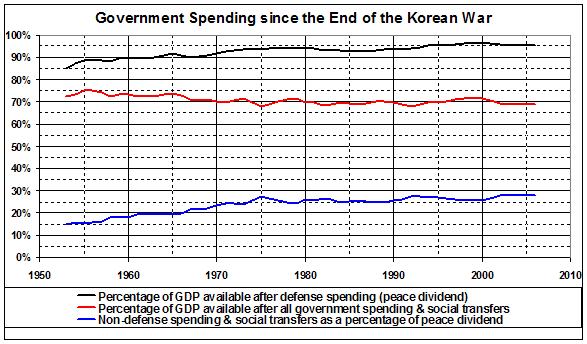
Iran foments much of the so-called insurgency in Iraq. Iraqi terrorists might be infiltrating the U.S. via Mexico. These are military problems, not diplomatic or law-enforcement problems. Yet, we are unable to respond to those problems militarily because we continue on the course that was set when Truman surrendered Korea to the Communists. What is that course? This:*

Note: For a clearer view of the graph, right-click on it and select “open link in a new tab.”

Source: Derived from National Income and Product Accounts tables 1.1.5 and 3.1, available here.

I have argued that defense spending should be independent of GDP; that is, it should be geared to the threats we face, and not be set at an arbitrary percentage of GDP. I have not changed my position.

I am pointing out, here, that non-defense spending has displaced defense spending. The black and red lines in the graph highlight that displacement; the blue line in the graph measures it.

The black line plots the percentage of GDP that is available after defense spending (a percentage that I call the “peace dividend”). The red line plots the percentage of GDP available after government spending and social transfer payments at all levels of government: national, State, and local. Note that the red line moves downward even as the black line moves upward. The growing distance between the lines measures the rising share of GDP that is commandeered by government for non-defense spending and social transfer payments.**

The blue line takes us to the heart of the matter. The blue line plots all non-defense spending plus social transfers as a percentage of the peace dividend. That percentage has nearly doubled since the end of the Korean War.

In fact, there has been for more than seventy years a felt need among politicians to respond to the voices that call loudly for more “social services.” Such services — in the minds of politicians — must come at the expense of defense spending. And so they do, even though defense is the ultimate “social service.”

Imagine, then, the defenses we could mount if non-defense spending plus social transfers had not risen above ten percent of GDP. What is special about ten percent? That was a satisfactory share for non-defense spending plus social transfers from the end of the Civil War through the early 1900s — an era of rapid economic growth. In fact, that share remained satisfactory through 1929. It took the unique, government-fostered Great Depression to create in the minds of most Americans the false idea that we need government to ensure economic growth and take care of “social needs.”

So, here we are, rich in “social services” — except by the standards of no-growth Euro-socialists who free-ride on our defenses — but vulnerable to terrorists and opportunists (like those in Iran and Russia).

Other related posts:
The Destruction of Wealth and Income by the State
Things to Come
__________
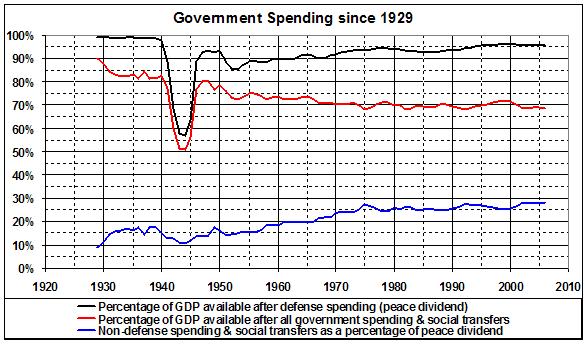
* Here is a longer view of the trends:This figure makes more obvious the growing allocation of the peace dividend to non-defense spending and social transfers. That trend began with the onset of the Great Depression, but it was interrupted by World War II — the last war in which the United States committed itself to total victory. The trend re-started at the end of World War II and became almost irreversible after the end of the Korean War, which is the point I chose to emphasize above. The low level of defense spending in the 1930s and the sudden drop after World War II arose from the (false) perception that the United States and its overseas interests did not then face serious threats from abroad. The peace dividends of the 1930s and late 1940s were declared before the peace had been won. The peace dividend of the 1990s and 2000s has cost us the ability to deter Russia and Iran (among others) while we respond (half-heartedly) to terrorism and those who foment it.

** I include social transfer payments in the analysis because, even though they are not government expenditures (by the standards of economic accounting), they do take money away from those who earn it and give it to those who do not. Social transfers therefore diminish the incentives that foster economic growth. Moreover, the tax revenues generated for the purpose of making such transfers could be applied to defense. That would create a “transition” problem with respect to Social Security, but it is a problem with a straightforward solution.

Are the Yankees in Meltdown?

UPDATED, BELOW

The New York Yankees lost to the Detroit Tigers yesterday by a score of 0-16. The loss left the Yankees 8 games behind the Boston Red Sox with 31 games remaining. It looks bad for the Yankees. But — although “past performance is no indication of future returns,” as they say in the mutual-fund business — let’s look at the Yankees’ regular-season record for the 12 seasons of Joe Torre’s managership. The first half of each entry describes the Yankees’ record after 131 games; the second half describes the Yankees’ record at the end of the regular season.

1996 — 74-57 (.565),4 games ahead of Baltimore; 92-60 (.568), 4 games ahead of Baltimore

1997 — 78-53 (.595), 7 games behind Baltimore; 96-66 (.593), 2 games behind Baltimore

1998 — 95-36 (.725), 16.5 games ahead of Boston; 114-48 (.704), 22 games ahead of Boston

1999 — 81-50 (.618), 7.5 games ahead of Boston; 98-64 (.605), 4 games ahead of Boston

2000 — 75-56 (.573), 5 games ahead of Boston; 87-74 (.540), 2.5 games ahead of Boston

2001 — 76-55 (.580), 4 games ahead of Boston; 95-65 (.593), 13.5 games ahead of Boston

2002 — 83-48 (.634), 9 games ahead of Boston; 103-58 (.640), 10.5 games ahead of Boston

2003 — 80-51 (.611), 4 games ahead of Boston; 101-61 (.623), 6 games ahead of Boston

2004 — 81-50 (.618), 3.5 games ahead of Boston; 101-61 (.623), 3 games ahead of Boston

2005 — 75-57 (.568), 2.5 games behind Boston; 95-67 (.586), same record as Boston (New York awarded division championship for winning season series against Boston)

2006 — 78-53 (.595), 8 games ahead of Boston; 97-65 (.599), 10 games ahead of Toronto (Boston finished third, 11 games behind New York)

2007 — 72-59 (.550), 8 games behind Boston; ???

In sum, the Yankees of 2007 not only are not the Yankees of Torre’s past, but the Yankees of Torre’s past also had little come-from-behind experience this late in the season. I now believe that the Yankees might not win the American League East championship. I come to that tentative view by considering the Yankees’ performance — in this season and recent seasons — not by playing mindless “what if” arithmetic games. (For more on that, see this.)

UPDATE (08/30/07): Well, maybe the Yankees aren’t in meltdown. They just swept three games from the Red Sox and are now “only” five games back, with 28 games left in the regular season. The Yankees-Red Sox three-game series (September 14-16) at Fenway Park could be decisive — if the Yanks don’t slip badly between now and then.

What a Fine Quandary This Is — for the Left

Real Clear Politics quotes a story at Roll Call. The juicy bits:

Sen. Larry Craig (R-Idaho) was arrested in June at a Minnesota airport by a plainclothes police officer investigating lewd conduct complaints in a men’s public restroom, according to an arrest report obtained by Roll Call Monday afternoon….

A spokesman for Craig described the incident as a “he said/he said misunderstanding,” and said the office would release a fuller statement later Monday afternoon.

After he was arrested, Craig, who is married, was taken to the Airport Police Operations Center to be interviewed about the lewd conduct incident, according to the police report….

Craig was detained for approximately 45 minutes, interviewed, photographed, fingerprinted and released, and police prepared a formal complaint for interference with privacy and disorderly conduct.

Real Clear Politics notes that Craig (official bio here) is up for reelection in 2008.

The Leftosphere is all over this story (e.g., here), in part because rumors that Craig is a homosexual have been flying around the web for quite some time. (A Google search on “Larry Craig” AND “homosexual” yields 19,000 hits, for example.) More importantly, there’s the Republican angle: The only “bad” homosexual (to a Lefty) is a Republican homosexual.

Lefties will claim — with a straight face — that it’s all right to attack Craig because (a) he’s a Republican and (b), if he’s a homosexual, he’s a Republican hypocrite. “Everyone” knows that all Republicans hate homosexuals and want to put all of them in concentration camps, right?

Well, many (probably most) Republicans (along with a lot of Democrats) would deny homosexuals a right to “marry.” And most Republicans (and libertarians) — unlike homosexuals and their Leftist claque — do not support “hate crime” legislation on behalf of any group. Such positions have nothing to do with “hate” and everything to do with the protection of civil society and equal justice for all. Not that Leftists care about such things, mind you.

Of course, Leftists would not countenance the use of rumors of Craig’s homosexuality to harm his reelection bid. I say that sarcastically because Leftists would countenance said use of such rumors. They are world-class hypocrites when it comes to things like

  • homosexuality (Barney Frank is the only homosexual Democrat in Congress, right?)
  • diversity (It’s okay, as long as my kid gets into the college of his choice.)
  • public education (That’s for other people’s children.)
  • capitalism (Hate that “greed,” except for the part about rising stock prices.)

The hypocrisy of attacking someone because he is (rumored to be) a homosexual seems to escape the Left.

UPDATE (08/28/07): Senator Craig’s statement about the matter is here.

UPDATE (08/29/07): Here is a balanced story from the Idaho Statesman.

Affirmative Action: Two Views from the Academy, Revisited

I wrote “Affirmative Action: Two Views from the Academy” almost three years ago. What has happened since to the second view, that of UCLA law professor Richard Sander? Sander’s evidence-based article, “A Systematic Analysis of Affirmative Action in American Law Schools,” (other related links here) concludes that race-based affirmative action hurts, rather than helps, black law students.

Gail Heriot of The Right Coast, who is a professor at the University of San Diego School of Law and a commissioner of the U.S. Commission on Civil Rights, pens an update:

No one claims Sander’s findings are the last word on the subject. Although so far his work has held up to scrutiny as least as well as the work of his critics, all fair-minded scholars agree that more research is necessary before the” mismatch thesis” can be definitively accepted or rejected.

Unfortunately, fair-minded scholars are hard to come by when the issue is affirmative action. Some of the same people who argue Sander’s data are inconclusive are now actively trying to prevent him from conducting follow-up research that might yield definitive answers. If racial preferences really are causing more harm than good, these thinly-disguised political operatives don’t want anyone to know.

Take William Kidder, a University of California staff member and co-author of a frequently-cited attack of Sander’s study. When Sander and his ideologically-diverse co-investigators sought bar passage data from the State Bar of California, Kidder passionately argued that access should be denied, because disclosure “risks stigmatizing African American attorneys.” At the same time, the Society of American Law Teachers, which leans so heavily to the left it risks falling over sideways, subtly threatened future litigation against the State Bar. Coincidentally, one of Kidder’s co-authors, University of Michigan law professor David Chambers, is a former SALT president.

Sadly, the State Bar’s Committee of Bar Examiners caved under the pressure. The committee members didn’t formally explain their decision to deny Sander’s request for the non-personally-identifiable data, but the root cause is clear: Over the last forty years, many distinguished citizens–university presidents, judges, philanthropists, and other leaders–have built their reputations on their support for race-based admissions. Ordinary citizens have found secure jobs as part of the resulting diversity bureaucracy. If it’s not working, they too don’t want anyone to know.

The U.S. Commission on Civil Rights hopes that it can persuade the State Bar to reconsider. Its newly-released report on affirmative action in law schools specifically calls for state bar authorities to cooperate with qualified scholars studying the mismatch issue. Its recommendation is thus modest. It doesn’t claim that Sander is right or his critics wrong. It simply seeks to encourage and facilitate important research.

Its deeper purpose is to remind those who support and administer affirmative action polices of something that ought to be obvious: The good intentions of one’s predecessors do not give anyone a permanent moral free ride. Good faith requires a willingness to re-examine the consequences of one’s actions from time to time. Deliberate ignorance is not an option….

Sander doesn’t need to be proven 100% correct for his research to be devastating news for affirmative action supporters. Suppose the consequences of race-based admissions turn out to be simply a wash–neither increasing nor decreasing the number of minority attorneys. In that case, few people would think it worth the costs, not least among them the human cost that results from the failure of the supposed affirmative action beneficiaries to graduate and pass the bar. Under current practices, only 45% of blacks who enter law school pass the bar on their first attempt as opposed to over 78% of whites. Even after multiple tries, only 57% of blacks succeed. The rest are often saddled with student debt, routinely running as high as $160,000, not counting undergraduate debt. The real question therefore is how great an increase in the number of black attorneys is needed to justify this. If it is decreasing the number, it can hardly be defended.

Well, it can (and will) be defended if you are a Leftist who is bent on shaping the world to suit his preferences, be they about affirmative action, “global warming,” crime and punishment, defense of the nation, or the host of other topics on which Leftists are obdurately ignorant and wrong. Leftists like to call themselves “reality based,” but reality-based Leftism is an oxymoron of the first rank.

UPDATE: There’s more here, here (but the name is Sander, not Sanders), here, and here.

A Reminder

UPDATED (09/02/07)

CNN to the contrary, religion doesn’t kill people. People kill people:

Why single out a belief in God as a cause of violence? What about the “religion of the state” or the “cult of personality” as practiced under Hitler, Stalin, Mussolini, Mao, and Saddam Hussein, among many others of their ilk?

Violence comes from humans. God — or, more precisely, religion — is but one excuse for violence. There are many other excuses….

In fact, religion fosters cooperative behavior and generosity toward strangers, which is probably why Red-Staters are more generous givers than Blue-Staters. Religious belief, true or not, seems to be a beneficial evolutionary adaptation that, on the whole, causes believers to live more positive and productive lives than non-believers.

The influence of religion on human behavior is asymmetrical because the anti-social aspects of human nature — dominance, enviousness, and aggressiveness — outweigh the pro-social ones. That is to say, religion is a counterweight to our natural anti-social impulses, which would (and do) dominate our pro-social ones in the absence of religion.

UPDATE: Thanks to John Ray’s Political Correctness Watch I found this article about the study which finds that religion fosters cooperative behavior and generosity toward strangers.

Less Punishment Means More Crime

From Don Surber, writing at the Charleston Daily Mail:

Norwegian officials estimate that after sentencing, 20 percent of Norway’s criminals don’t bother to show up for prison.

That is because until very recently it was not against the law in Norway to skip out of prison. Norway’s legislature recently changed that law, but prison officials haven’t gotten around to implementing the law….

Not surprisingly, Norway’s crime rate is double that of the United States.

In 2006, Norway had 86.3 crimes reported for every 1,000 people, according to Statistics Norway.

In the United States, reported crimes were 39.8 per 1,000 people, according to the FBI.

The violent crime rates are similar: 5.5 per 1,000 people in Norway, 4.7 per 1,000 people in the United States.

No, for violent crime, one has to head north to Canada, where there are 9.5 violent crimes for every 1,000 people. That figure is down 5 percent from 1996. The numbers are from Statistics Canada.

That’s double the violent crime rate in the United States….

We are told that the United States leads the world in its prison population. This may be true. Roughly 1/2 of 1 percent of Americans are in prison.

The upside is that is nearly 1.4 million robbers, muggers, killers and rapists who are not out robbing, mugging, killing and raping….

The state of West Virginia spends about $100 million on prisons. That is about 2.5 percent of the state’s $4 billion general revenue budget.

The prisons are worth every penny.

Prisons keep more children from being molested. Prisons keep more people from being killed. Prisons keep more drunken drivers off the road.

Some say the nation is becoming a “prison state.” I grew up in a high crime area in Cleveland where no one ventured out after dark.

That’s a prison state.

The choice is this: Either have a high incarceration rate or have a high crime rate. Norway and Canada have made their choice. America has made hers.

Surber’s column reminds me of several of my posts. From this one:

Justice serves civilization and social solidarity. First, of course, it deters and prevents wrong-doing. Second, it meets the deep, common need for catharsis through vengeance, while protecting the innocent (and all of us) by replacing mob rule with due process of law.

Justice — to serve its purposes — must be swift, sure, and hard. That is, it must work and be seen to work, by the just and unjust alike.

And this one:

I…ran many regressions on the violent-crime rate and various combinations of the key variables. Only one regression yields credible results (high R-squared, standard error of estimate among the lowest, intuitively correct signs on all coefficients, and high t-statistics on all coefficients). That regression takes the following form:

Number of violent crimes per 100,000 persons =
– 3723
+ 37058 x number of Blacks as a decimal fraction of the population
– 0.568 x number of persons incarcerated per 100,000 of population

The t-statistics on the intercept and coefficients are -15.854, 17.047, and -5.042, respectively; the adjusted R-squared is 0.936; the standard error of the estimate is 47.0.

The mean value of the dependent variable is 483.1, with a range of 158.1 to 758.2. The corresponding values for proportion of blacks: 0.117, 0.105, 0.125; for incarceration rate: 202.4, 93, 476.

The years represented in the regression are 1960-99 (the last year of data on Blacks as a fraction of the population).

That equation is especially compelling because both explanatory variables are statistically signficant even though they are strongly correlated (R = 0.84). Given that, and the evidence of the plots above — in which the declining crime rate is accompanied by a rising incarceration rate — two things are evident: incarceration is the key to crime reduction, and abortion has no place in the discussion of crime. What happened was that the incarceration rate finally became high enough, around 1991, to offset the countervailing influences on crime.

Incarceration follows from prosecution, which follows from investigation. I therefore stand by my earlier conclusion that “incarceration and spending on the criminal justice system . . . . are the public-policy weapons of choice” when it comes to fighting crime.

UPDATE (01/04/06): None of my regressions (not even the best one) fully accounts for the sharp decline in the violent-crime rate after 1990. That is because I did not try to model the effects of concerted efforts, since the late 1980s, to put violent offenders behind bars and to keep them there longer. The missing variable, of course, is to be found in the effectiveness of federal sentencing guidelines, which were enacted in 1987 and declared constitutional by the U.S. Supreme Court in 1989. Liberal do-gooders and their allies on the bench nevertheless persuaded the Supreme Court last year (in a pair of related cases) to find the guidelines unconstitutional and, therefore, only advisory rather than mandatory.

Given the inevitability of more lenient sentencing in many jurisdictions, I predict that the violent-crime rate will resume its long-term ascent. That ascent will mirror the continuing destruction of civil society at the hands of liberals — and those libertarians who seem unable to grasp the notion that liberty must be defended, at home and abroad.

And this one:

I argue in “More Punishment Means Less Crime” that making federal sentencing guidelines advisory rather than mandatory, as the Supreme Court has done, will lead a resurgence of the violent-crime rate. Eugene Volokh cites a case in point:

Why People Are Skeptical of Judicial Discretion in Sentencing: Here’s the story:

Wednesday [Vermont trial court Judge Edward Cashman] sentenced child rapist Mark Hulett to 60 days in jail. Hulett admitted he raped a little girl countless times when she was between 7 and 10 years old.

Prosecutors said Hulett deserved at least 8 years in prison in part as punishment.

But Judge Cashman said the 60-day sentence guaranteed that Hulett would get into sex offender rehabilitation quickly or face a possible life sentence. He said he had no choice because the Corrections Department classified Hulett as a low risk offender meaning he can’t get treatment until he’s out of jail.

And more importantly the judge announced that after 25 years on the bench, he no longer believes in punishment….

…Mandatory federal sentencing guidelines were a necessary and fairly effective counter-measure to that reign of reverse racism. But the Supreme Court has neutralized that counter-measure.

Government’s sole justification is to fight the enemies of liberty, namely, criminals and terrorists. The Judge Cashmans of this world have sided with those enemies.

Finally:

…Now we have this, from an exchange at Legal Affairs Debate Club between Douglas Berman and Frank O. Bowman III:

Berman: 1/16/06, 09:43 AM
Given the enormous and unexpected shocks to the federal sentencing system over the past three years—Congress’ enactment of the PROTECT Act, then the Supreme Court’s decision in Blakely v. Washington, and finally the Supreme Court’s decision in United States v. Booker—I am wary about making any predictions about what will be the future of federal sentencing. But I am happy to opine about what should be the future of federal sentencing: Congress should allow the advisory guideline system created by the Booker decision to continue to operate while the U.S. Sentencing Commission and others assess its efficacy and fairness….

Bowman: 1/17/06, 09:01 AM
…A year has passed since the Booker decision. The Sentencing Commission has been gathering and promulgating data about post-Booker practice on a nearly monthly basis since April 2005. In consequence, we have a very good idea about how the post-Booker system has worked so far:

…since Booker, the rate of compliance with the Guidelines, by which I mean the percentage of cases sentenced within the guideline range calculated by the sentencing judge, has declined by about 11% nationally—from about 72% to about 61%.

…Virtually the entire country has experienced a decline in compliance with the guidelines. The compliance rate of every circuit has fallen, and compliance fell in more than 90% of all districts.

…the average length of a federal sentence in 2005 stayed the same as it was in 2004. On the other hand, the trend in sentence length (and guidelines compliance) from 2001-2004 was sharply up, the apparent result of conscious efforts by both Congress and the central administration of DOJ to increase guidelines adherence and criminal penalties. In short, the average federal sentence length post-Booker seems to reflect not maintenance of the status quo, but the sudden arrest of what had been a powerful and continuing upward surge.

…the decrease in guidelines compliance after Booker is almost entirely due to judicial action. Judges are using their new authority to reduce sentences below the range in almost 10% of all cases, and it is their exercise of this authority that is driving the decline in overall compliance rate.

I’ll make no comment now on these facts, other than to suggest that the argument for delay in response to Booker cannot much longer be premised on the claim that we don’t know how the new system will work. In fact, we have a very good idea of how it’s working.

Indeed we do. It’s working in favor of criminals. And that will lead to a resurgence of crime.

Stay tuned.

Related posts:
Does Capital Punishment Deter Homicide?
Libertarian Twaddle about the Death Penalty
Crime and Punishment
Abortion and Crime
Saving the Innocent?
Saving the Innocent?: Part II
More on Abortion and Crime
More Punishment Means Less Crime
More About Crime and Punishment
More Punishment Means Less Crime: A Footnote
Clear Thinking about the Death Penalty
Let the Punishment Fit the Crime
Another Argument for the Death Penalty
Crime, Explained

"Warmism": The Myth of Anthropogenic Global Warming

“Warmism” is the belief that the warming trend which began in the latter half of the twentieth century (a.k.a. “global warming”) is mainly an artifact of human activity. Warmism is a “religious” and political cause; it is not based on “scientific consensus.” (Science and consensus are antithetical, anyway.) I will not venture to summarize here the mountain of evidence against warmism. (Links to some of the evidence are here, in the section headed Climate Change.) I will focus, instead, on

  • “smoking gun” evidence against warmism
  • alternative and compelling explanations of the warming phase that we have been through, but which may be about to end.

(Some of the graphs that support my argument may be hard to read. To enlarge a graph, just right-click on it and select “open link in a new tab.”)

I begin with Steve McIntyre’s post about the “spaghetti graph,” which purports to show various estimates of changes in the temperature of the Northern Hemisphere since about 900 A.D. In fact, only three of the twelve series plotted in the “spaghetti graph” go back as far a 900 A.D.. And only one of those — the Moberg series — goes back as far as 1 A.D. Here, I splice NASA’s estimates of Northern Hemisphere temperatures to the Moberg series and compare the result to the world’s population (a proxy for “human activity”):

Notes and sources: The values on the x-axis are years A.D. The temperature anomalies (variations in degrees C from the mean for a base period) are plotted in 50-year intervals, except that the first year in the Moberg series (linked above) is 1 A.D. I re-indexed the Moberg series to give it a value of 1 in 1 A.D. (The underlying index is based on the mean value for 1961-90.) I re-indexed NASA’s estimates of temperatures in the Northern Hemisphere for 1900, 1950, and 2000 to make the value for 1900 coincide with the value of the re-indexed Moberg series in that year. I indexed population estimates to a value of 1 in year 1 A.D. Population estimates for selected years from 10000 B.C. through 1950 A.D. are taken from “Historical Estimates of World Population” (U.S. Census Bureau). I averaged the “summary” values from that source to obtain estimates for the years plotted from 1 A.D. through 1900 A.D. I took population estimates for 1950 and 2000 from “Total Midyear Population of the World: 1950-2050” (U.S. Census Bureau).

Oops! First, temperatures rise while population falls; next, population rises while temperatures fall; finally, late in the twentieth century, temperatures rise while population rises. Well, perhaps it takes a while (centuries?) for human activity to affect Earth’s temperature. Perhaps, for a long time, there were simply “too few” humans and too little of the “wrong kinds” of human activities. That is the story that “warmists” would like us to believe, though they concocted that story only after seizing upon the apparent relationship between human activity (i.e., the satisfaction of wants through economic endeavor) and the warming trend of the late twentieth century. Let us turn to that relationship.

Taking population as a proxy for the kind of human activity that generates carbon dioxide emissions — the chief culprit in the “greenhouse” theory of global warming — one would expect temperatures to rise with population. And so, it seems, they have — in the recent past:

Notes and sources: Again, the x-axis represents years A.D. I re-indexed NASA’s estimates of U.S. and global temperature anomalies (base period 1951-80) to equal 1 in 1880 A.D. (I used the global series that represents only meteorological stations, though I suspect its validity, given the disparity in the U.S. and global trends. That disparity cannot be explained simply by the fact that the U.S. represents only two percent of Earth’s surface, as Steve McIntyre points out in these three postsUPDATES: plus this more recent one, and this and this one.) I drew estimates of sunspot activity from this NOAA source, and indexed them so that the value for 1880 equals 1. The sources for population estimates are as above, except that I estimated the value for 1880 by interpolation from the values for 1850 and 1900. I then indexed the population series so that the value for 1880 equals 1. Population is a proxy for carbon-dioxide emissions, though there hasn’t been a one-to-one relationship between population and emissions of carbon dioxide since 1980 (at least), according to the National Energy Administration’s “World Energy Use and Carbon Dioxide Emissions: 1980-2001.” (See the figure on page 13 and related text.) It seems that population has been growing faster than carbon dioxide emissions: 1.6 percent a year as against 1.2 percent a year.

Oops, again! It seems that temperatures not only have risen with population since the 1960s or 1970s, but also have risen with solar activity. Solar activity (inversely) affects the level of cosmic radiation reaching Earth; cosmic radiation, in turn, (directly) affects cloud formation; and cloud formation, in turn, (inversely) affects temperatures. (See this for an explanation.) In sum, more solar activity means higher temperatures, but it takes about seven years for changes in solar activity to be reflected in temperature changes. (See this.)

It should be quite evident by now that the warming trend of the past thirty-odd years merely coincides with the rise in human activity (as measured by population) but is not explained by the “greenhouse” effect that supposedly arises from human activity. (The “greenhouse” effect is in fact a physically impossible phenomenon, according to this source). There are alternative and compelling alternative explanations for the warming trend, including the influence of solar activity summarized above, as well as alternative (and far less alarming) estimates of the likely rise in temperatures over the next several decades. (Again, for more on such matters, go to the Climate Change section of this page).

The nail in the coffin of warmism — as far as I am concerned — is the fact that the present warm period is a mere blip on Earth’s temperature chart. Consider, for example, the following reconstruction of temperatures in the Northern Hemisphere for the past 11,000 years (the red-blue curve):

Source: “Climate Patterns in Northern Finnoscandia during the Last Millenium” (figure 6).

Two articles on paleoclimatology at Wikipedia accurately reflect what I have read elsewhere about long-run climate change. It takes only two figures to put things in perspective. First, a reconstruction of ice-core temperatures (blue line) at Vostok, Antarctica (the present is at the left):

Source: This figure from “Paleoclimatology” at Wikipedia.

The next chart shows that the current cyclical era began about 500,000 years ago. (The present is at the right in this graph.) The expansion of the time scale from 10,000 years ago to the present puts the present warm spell in perspective. It is not extraordinarily warm, by any standard. It is, rather, only a small segment of a the “spike” that typically signals the end (or beginning) of a 120,000-year cycle. The present spike has thus far lasted about 10,000 years, a mere blink of the eye in geological time. It does not look like a spike in the graph because of the expansion of the time scale for the period from 10,000 years ago to the present.

Source: This figure from “Geologic Temperature Record” at Wikipedia.

Two complementary theories explain climate change. First, there are

Milankovitch cycles…the collective effect of changes in the Earth‘s movements upon its climate, named after Serbian civil engineer and mathematician Milutin Milanković. The eccentricity, axial tilt, and precession of the Earth’s orbit vary in several patterns, resulting in 100,000 year ice age cycles of the Quaternary glaciation over the last few million years. The Earth’s axis completes one full cycle of precession approximately every 26,000 years. At the same time, the elliptical orbit rotates, more slowly, leading to a 21,000 year cycle between the seasons and the orbit. In addition, the angle between Earth’s rotational axis and the normal to the plane of its orbit changes from 21.5 degrees to 24.5 degrees and back again on a 41,000 year cycle. Currently, this angle is 23.44 degrees.

Then, as outlined above, there is the varying influence of solar activity on cosmic radiation as the Solar System traverses the Milky Way. This is from an article (“The Real Deal?“) in the National Post:

Astrophysicist Nir Shariv, one of Israel’s top young scientists, describes the logic that led him — and most everyone else — to conclude that SUVs, coal plants and other things man-made cause global warming.

Step One Scientists for decades have postulated that increases in carbon dioxide and other gases could lead to a greenhouse effect.

Step Two As if on cue, the temperature rose over the course of the 20th century while greenhouse gases proliferated due to human activities.

Step Three No other mechanism explains the warming. Without another candidate, greenhouses gases necessarily became the cause.

Dr. Shariv, a prolific researcher who has made a name for himself assessing the movements of two-billion-year-old meteorites, no longer accepts this logic, or subscribes to these views. He has recanted: “Like many others, I was personally sure that CO2 is the bad culprit in the story of global warming. But after carefully digging into the evidence, I realized that things are far more complicated than the story sold to us by many climate scientists or the stories regurgitated by the media.

“In fact, there is much more than meets the eye.”

Dr. Shariv’s digging led him to the surprising discovery that there is no concrete evidence — only speculation — that man-made greenhouse gases cause global warming. Even research from the Intergovernmental Panel on Climate Change– the United Nations agency that heads the worldwide effort to combat global warming — is bereft of anything here inspiring confidence. In fact, according to the IPCC’s own findings, man’s role is so uncertain that there is a strong possibility that we have been cooling, not warming, the Earth. Unfortunately, our tools are too crude to reveal what man’s effect has been in the past, let alone predict how much warming or cooling we might cause in the future.

All we have on which to pin the blame on greenhouse gases, says Dr. Shaviv, is “incriminating circumstantial evidence,” which explains why climate scientists speak in terms of finding “evidence of fingerprints.” Circumstantial evidence might be a fine basis on which to justify reducing greenhouse gases, he adds, “without other ‘suspects.’ ” However, Dr. Shaviv not only believes there are credible “other suspects,” he believes that at least one provides a superior explanation for the 20th century’s warming.

“Solar activity can explain a large part of the 20th-century global warming,” he states, particularly because of the evidence that has been accumulating over the past decade of the strong relationship that cosmic- ray flux has on our atmosphere. So much evidence has by now been amassed, in fact, that “it is unlikely that [the solar climate link] does not exist.”

The sun’s strong role indicates that greenhouse gases can’t have much of an influence on the climate — that C02 et al. don’t dominate through some kind of leveraging effect that makes them especially potent drivers of climate change. The upshot of the Earth not being unduly sensitive to greenhouse gases is that neither increases nor cutbacks in future C02 emissions will matter much in terms of the climate.

Even doubling the amount of CO2 by 2100, for example, “will not dramatically increase the global temperature,” Dr. Shaviv states. Put another way: “Even if we halved the CO2 output, and the CO2 increase by 2100 would be, say, a 50% increase relative to today instead of a doubled amount, the expected reduction in the rise of global temperature would be less than 0.5C. This is not significant.”

The evidence from astrophysicists and cosmologists in laboratories around the world, on the other hand, could well be significant. In his study of meteorites, published in the prestigious journal, Physical Review Letters, Dr. Shaviv found that the meteorites that Earth collected during its passage through the arms of the Milky Way sustained up to 10% more cosmic ray damage than others. That kind of cosmic ray variation, Dr. Shaviv believes, could alter global temperatures by as much as 15% –sufficient to turn the ice ages on or off and evidence of the extent to which cosmic forces influence Earth’s climate.

In another study, directly relevant to today’s climate controversy, Dr. Shaviv reconstructed the temperature on Earth over the past 550 million years to find that cosmic ray flux variations explain more than two-thirds of Earth’s temperature variance, making it the most dominant climate driver over geological time scales. The study also found that an upper limit can be placed on the relative role of CO2 as a climate driver, meaning that a large fraction of the global warming witnessed over the past century could not be due to CO2 — instead it is attributable to the increased solar activity.

Finally, there is this compelling evidence against warmism (from “Look to Mars for the Truth on Global Warming,” also in the National Post):

“One explanation could be that Mars is just coming out of an ice age,” NASA scientist William Feldman speculated after the agency’s Mars Odyssey completed its first Martian year of data collection. “In some low-latitude areas, the ice has already dissipated.” With each passing year more and more evidence arises of the dramatic changes occurring on the only planet on the solar system, apart from Earth, to give up its climate secrets.

NASA’s findings in space come as no surprise to Dr. Habibullo Abdussamatov at Saint Petersburg’s Pulkovo Astronomical Observatory. Pulkovo — at the pinnacle of Russia’s space-oriented scientific establishment — is one of the world’s best equipped observatories and has been since its founding in 1839. Heading Pulkovo’s space research laboratory is Dr. Abdussamatov, one of the world’s chief critics of the theory that man-made carbon dioxide emissions create a greenhouse effect, leading to global warming.

“Mars has global warming, but without a greenhouse and without the participation of Martians,” he told me. “These parallel global warmings — observed simultaneously on Mars and on Earth — can only be a straightline consequence of the effect of the one same factor: a long-time change in solar irradiance.”

The sun’s increased irradiance over the last century, not C02 emissions, is responsible for the global warming we’re seeing, says the celebrated scientist, and this solar irradiance also explains the great volume of C02 emissions.

“It is no secret that increased solar irradiance warms Earth’s oceans, which then triggers the emission of large amounts of carbon dioxide into the atmosphere. So the common view that man’s industrial activity is a deciding factor in global warming has emerged from a misinterpretation of cause and effect relations.”

Dr. Abdussamatov goes further, debunking the very notion of a greenhouse effect. “Ascribing ‘greenhouse’ effect properties to the Earth’s atmosphere is not scientifically substantiated,” he maintains. “Heated greenhouse gases, which become lighter as a result of expansion, ascend to the atmosphere only to give the absorbed heat away.”

The real news from Saint Petersburg — demonstrated by cooling that is occurring on the upper layers of the world’s oceans — is that Earth has hit its temperature ceiling. Solar irradiance has begun to fall, ushering in a protracted cooling period beginning in 2012 to 2015. The depth of the decline in solar irradiance reaching Earth will occur around 2040, and “will inevitably lead to a deep freeze around 2055-60” lasting some 50 years, after which temperatures will go up again.

To paraphrase Shakespeare: The warming, dear reader, is not in ourselves, but in our stars.

Related posts:
Re: Climate “Science”
More Evidence against Anthropogenic Global Warming
Yet More Evidence against Anthropogenic Global Warming
Anthropogenic Global Warming Is Dead, Just Not Buried Yet

Related reading:
A 2000-Year Temperature Reconstruction Based on Non-Treering Hypotheses (in which the Medieval Warm Period looms much larger than the current warm spell and the irrelevance of tree-ring data is explained)
Aliens Cause Global Warming and other speeches by Michael Crichton
Are Carbon Emissions the Cause of Global Warming ? (No. Moreover, global warming has reversed.)
Climate Audit (a blog by Steve McIntyre of the M&M project — see below — and a comprehensive resource for those interested about the science of global warming, as opposed to the religion of it)
Climate Change Chaos (two posts about alternative explanations of “global warming”)
Climate Change 2007: Climate Change Impacts, Adaptation, and Vulnerabilities (IPCC’s latest contribution to the scare about global warming)
Climate Patterns in Northern Fennoscandia during the Last Millenium (the present episode as a blip in Finnish temperature patterns dating back 7,640 years)
Climate Warming Is Naturally Caused and Shows No Human Influence
Clouding the Issue (the effect of the “Asian Brown Cloud” on “global warming”)
Cool Heads Required (Spiked! survey article about climate change)
A Consensus about Consensus
Consensus, What Consensus? Among Climate Scientists the Debate Is Not Over
Cosmoclimatology: A New Theory Emerges (Henrik Svensmark‘s theory of climate change as being caused mainly by the level of cosmic radiation reaching Earth; supported by this article; criticized in Lockwood and Frohlich’s paper, which is debunked here in a cached article that I have downloaded in case it disappears)
Datasets & Images (main page for NASA temperature data: U.S., northern hemisphere, various latitude bands, an global)
Falsification of the Atmospheric CO2 Greenhouse Effects within the Frame of Physics (in which two scientists explain that the so-called greenhouse effect violates the laws of physics)
Greenie Watch (a blog by John Ray in which he reprints articles debunking “warmism” and other enviro-nut causes)
Global Warming’s Silver Lining
Heat Capacity, Time Constant, and Sensitivity of Earth’s Climate System (a downward re-estimate of the likely change in Earth’s temperature, summarized here by John Ray)
Heretical Thoughts about Science and Society (an essay by noted physicist Freeman Dyson, in which he factually and logically dissects global-warming alarmism)
The Iris Opens Again? (a post about research into the cyclical relationship between clouds, warming, and cooling)
Let’s Be Honest about the Real Consensus
Let’s Look on the Sunny Side (Timesonline article about the sun and global warming)
M&M Project Page (summaries of and links to scientific analyses that refute the “hockey stick” paradigm upon which the global-warming scare rests)
New Peer-Reviewed Scientific Studies Chill Global Warming Fears (annotated bibliography, released by the ranking minority member of the U.S. Senate Committee on Environment and Public Works)
Peter Huber And Mark Mills On Our Energy Future
The Real Deal? (introductory article about cosmoclimatology, with links to 10 other articles on various aspects of “warmism”)
A Report from the Global Warming Battlefield
Scientific Forecasts vs. Forecasts by Scientists (documentation of the fact that the climate models that support “warmism” based on opinion, not evidence)
Tellus More about Hurricanes (a post at World Climate Report about three journal articles on the relationship between “global warming” and hurricanes)
Trouble in Climate-Model Paradise (how climate models used to project warming trends significantly underestimate precipitation)