The Case against Genetic Engineering

Slate‘s William Saletan, writing at The New York Times, reviews Michael J. Sandel’s The Case against Perfection: Ethics in the Age of Genetic Engineering. I have not read Sandel’s book, nor do I plan to read it. My case against genetic engineering, to which I will come, may bear no resemblance to Sandel’s. But there’s no way of learning what Sandel’s case is, given Saletan’s rather glib criticism of Sandel’s book.

Saletan’s glibness is evident in passages such as these:

[G]enetic engineering is too big for ethics. It changes human nature, and with it, our notions of good and bad.

When norms change, you can always find old fogeys who grouse that things aren’t the way they used to be….But eventually, the old fogeys die out, and the new norms solidify.

Once gene therapy becomes routine, the case against genetic engineering will sound as quaint as the case against running coaches [a practice apparently unknown before the 1924 Olympics].

In a world…controlled by bioengineering, we would dictate our nature as well as our practices and norms. We would gain unprecedented power to redefine the good. In so doing, we would strip perfection of its independence. Its meaning would evolve as our nature and our ideals evolved.

Saletan, in so many words, professes a tautology: The future will bring what it will bring, and whatever it brings will be the future. Saletan might as well write this: If murder is widely accepted in the future, murder will be acceptable in the future. I doubt very much that Saletan would endorse such a statement. I suspect, rather, that an effort to be clever at Sandel’s expense led Saletan down a moral blind alley of his own construction.

What is that moral blind alley? If it is not obvious to you, consider this passage from the entry for moral relativism at the Stanford Encyclopedia of Philosophy:

Metaethical Moral Relativism (MMR). The truth or falsity of moral judgments, or their justification, is not absolute or universal, but is relative to the traditions, convictions, or practices of a group of persons.

The definition of MMR* points to Saletan’s error. He treats the same (or very much the same) group of persons as being a different group because of the passage of time. In other words, the future just “happens” — as if people cannot make judgments in the present about the consequences, for them, of pending or reversible decisions.

To come at it a different way, Saletan conflates what could be with what should be. There could be a market for genetic engineering, but should there be such a market? There are, after all, markets for murder, arson, and the fruits of theft (among other such things), but I doubt that Saletan would condone such markets.

The real issue, then, is whether to allow genetic engineering, in light of its consequences. Saletan finally approaches that question when he says that “self-engineering….seizes control of humanity so radically that humanity can no longer judge it.”

But Saletan waits until the final paragraph of his review to say even that much. He then quickly closes the review with with smart-alecky observations instead of pursuing the consequences of genetic engineering. Perhaps he thinks that he has done so when, earlier in the review, he writes this:

The older half of me shares [Sandel’s] dismay that some parents feel blamed for carrying babies with Down syndrome to term. But my younger half cringes at his flight from the “burden of decision” and “explosion of responsibility” that come with our expanding genetic power. Given a choice between a world of fate and blamelessness [without genetic engineering] and a world of freedom and responsibility [with genetic engineering], I’ll take the latter. Such a world may be, as Sandel says, too daunting for the humans of today. But not for the humans of tomorrow.

There again, Saletan assumes that the future will be what it will be. More importantly, he badly mischaracterizes the world of today. Our present world, contra Saletan, is (relative to the brave new world of genetic engineering) one of freedom and responsibility. To use the example of a baby with Down syndrome (properly Down’s syndrome), parents who choose to abort such a baby (for that is what Saletan means) have every bit as much “freedom” to make that choice (under today’s abortion laws) and are just as responsible (morally) for their decision as they would be if they were to choose bioengineering instead. Genetic engineering simply introduces different “freedoms.”

Thus we come to the real issue, which is the wisdom (or not) of allowing genetic engineering in the first place. For, as we know from our experience with the regulatory-welfare state, once an undesirable practice gains the state’s approbation and encouragement it becomes the norm.

And that is the broad case against allowing genetic engineering: If it gains a government-approved foothold it will become the norm. It will result in foreseeable (and unforeseeable) changes in the human condition. It will cause most of us who are alive today to wish that it had never been allowed in the first place.

How so? Consider the specific case against genetic engineering:

  • Following upon (but not supplanting) abortion, it would enable humans to retreat further from the acceptance of responsibility for the consequences of the procreative act. The prospective acceptance of responsibility for our actions is a restraining influence upon which civil society depends. That restraining influence has been lessened enough by such elitist initiatives as the legalization of abortion, leniency in the punishment of criminals, and permissiveness in the face of disruptive speech and behavior in public schools.
  • It would reinforce the attitude — inherent in abortion — that humans are mere machines to be overhauled or junked at will. It would, in other words, take us another giant step down the slippery slope toward state-condoned (if not state-conducted) euthanasia.
  • From there it would be an easy step for the state (controlled by “liberal” elites) to dictate who may have children, how many children they may have, the gender-mix of the children, the occupations those children may pursue, etc., etc., etc.

Yes, genetic engineering could have some positive consequences (e.g., reducing the number of children born with Down’s syndrome). But the prospect of such consequences should not eclipse the broad, fundamental, negative consequences for human dignity and liberty.
__________
* The validity of MMR is a matter for another post…sometime, perhaps.

Mindsets

Authoritarian (i.e., “liberal,” fascist, or communist): The greater good (“social welfare”) lies in the conformity of all (elites excepted, of course) to rules set down by elites.

Conservative: The greater good lies in conformity to well-established traditions — modes of living together that have stood the test of time. Such norms must arise from society and not be imposed on it by elites, though leaders will arise whose wisdom and foresight helps to shape constructive changes in social norms.

Libertarian: There is no greater good; the welfare of individuals cannot be summed. Neither elites nor traditions should dictate how individuals choose to live, as long as they do not harm others by their choices. Individuals may choose to adopt broadly accepted social norms, but only insofar as those norms are consistent with their own (harmless) behavioral preferences.

Conservative libertarian: There is no greater good, but individuals are generally better off if they respect social norms that have stood the test of time. To violate those norms willy-nilly (as a libertarian would do) or to efface those norms through fiat (as an authoritarian would do) is to undo the bonds of trust that enable peaceful and prosperous coexistence and mutual self-defense of that modus vivendi.

Overcoming Adversity

UPDATED (BELOW), 07/08/07, 07/09/07, 07/12/07, 07/25/07, 08/28/07

Keith Burgess-Jackson proclaims that it’s over for the New York Yankees. He buttresses his conviction (wish, really) by constructing four “suppositions,” based on the state of play through July 4:

1. Boston plays .500 ball the rest of the way. The Yankees will have to go 53-28 (.654) to tie. Projected over a season, that’s 106 victories.

2. Boston plays .550 ball the rest of the way. The Yankees will have to go 56-25 (.691) to tie. Projected over a season, that’s 112 victories.

3. Boston plays .600 ball the rest of the way. The Yankees will have to go 60-21 (.740) to tie. Projected over a season, that’s 120 victories.

4. Boston plays .626 ball the rest of the way. The Yankees will have to go 62-19 (.765) to tie. Projected over a season, that’s 124 victories.

I have two comments:

  • The outcome of a pennant race cannot be foreshadowed by constructing hypothetical outcomes. Strange and wondrous (or devastating) events can (and do) intervene.
  • Keith’s “suppositions” are therefore irrelevant. Keith’s (negative) hopes for the Yankees aside, it is quite possible for the Bronx Bombers to improve their record vastly, and for the perennial fold-up team from Boston to fold once more.

Cases in point (found here):

1914 Boston Braves — 15 games out on July 6 with a 26-40 won-lost record — went 68-19 [.782] in the final 87 games of the season to win the N.L. pennant by 10 games over the New York Giants.

1930 St. Louis Cardinals — 12 games behind on August 9 with a 53-52 record — won 39 of their final 49 games [.796] to win the N.L. pennant by two games over the Cubs.

1935 Chicago Cubs — 10 and a half games behind the Giants on July 5 with a 38-32 record — won 62 of their final 84 games [.738] , including a 21-game winning streak from September 4 through September 27, to win the N.L. pennant by four games over St. Louis and eight and a half ahead of the Giants.

1936 New York Giants — in fifth-place in the N.L. with a 42-41 won-lost record (10 and a half games behind the Cubs) — went 50-21 [.704] to capture the NL. pennant by five games over the Cubs, who went 36-38 [.486] in their final 74 games.

1942 St. Louis Cardinals — 10 games behind on August 5 with a 62-39 mark — won 44 of their last 53 games [.830] to overtake the Dodgers and win the N.L. pennant by two games.

1951 New York Giants — behind the Dodgers by 13 games on August 12 with a 59-51 record — went 37-8 [.822] while Brooklyn went 27-24 [.529] over the rest of the season (including the three-game playoff won by the Giants on Bobby Thomson’s historic home run).

1964 St. Louis Cardinals — 11 games behind the Phillies on August 24 with a 65-58 record — but the Phillies went 16-23 [.410] in the final 39 games while the Cardinals went 28-11 [.718] and took the N.L pennant.

1969 New York Mets — 10 games behind the Chicago Cubs on August 14 with a 62-51 won-lost mark — ended the season with a 38-11 run [.776] as the Cubs went 18-27 [.400]. The Mets won the N.L. East division by eight games.

1973 New York Mets — 11 and a half games behind the Cardinals in the N.L. East division on August 5 with a 48-60 won-lost mark — finished with a 34-19 record [.642] in the final 53 games while the Cardinals went 20-31 [.392] during the same span.

1973 Cincinnati Reds — 11-games behind the Dodgers on July 1 with a 39-37 record — finished 60-26 [.698] while Los Angeles went 44-39 [.537] over the same stretch and lost the N.L. West division to the Reds by three and a half games.

1978 New York Yankees — trailing by 14 games in the A.L. East division on July 20 with a 48-42 record — won 52 of their remaining 73 games [.712] (including a one-game playoff over the Red Sox) to win the AL. East.

1989 Toronto Blue Jays — in sixth-place in a seven-team A.L. East division with a 38-45 won-lost record — went 51-28 [.646] in the final 12 weeks of the season to win the division by two games over the Orioles.

1993 Atlanta Braves — 10 games behind on July 23 with a 55-42 record — finished 49-16 [.754] to win the N.L. West division over the Giants by one game.

1995 Seattle Mariners — 13 games behind the California Angels on August 3 with a 44-46 record — went 35-20 [.636] to win the A.L. West title, while the Angels finished 22-33 [.400].

“It ain’t over ’til it’s over.” *

UPDATE (07/08/07): Since Keith posted his proclamation, the Red Sox have gone 1-3 (.250) while the Yankees have gone 3-1 (.750). Four games do not a season decide, but the assertion that the Red Sox cannot fold and the Yankees cannot surpass them borders on hubris.

UPDATE (07/09/07): Keith asks: “Where did I say that the New York Yankees ‘cannot’ overtake the Boston Red Sox?” Answer: Here, where he says: “I have two words for fans of the New York Yankees: It’s over.” The implication of that statement is clear: The Yankees will not overtake the Red Sox because the Yankees cannot do so. (If the Yankees could, they would, unless they are taking a dive this year. I assume that even as rabid a Yankees-hater as Keith doesn’t believe that.) I So is it “over” or is it just “improbable” that the Yankees will fail to win the A.L. East Division title this year (as Keith now says)? Keith wants to bet me $1,000 on the outcome. If I didn’t have eight grandchildren to think of, I’d take his bet.

UPDATE (07/12/07): Keith continues to play with numbers, proving nothing other than his ability to do arithmetic. On August 31 of last year, for example, he held out hope that the Tigers would hold on to win the 2006 A.L. Central crown:

Chicago is 78-55 and Minnesota 77-55. If the Tigers split their remaining 28 games, they’ll finish 97-65. The White Sox will have to go 19-10 to tie them. The Twins will have to go 20-10 to tie.

In the comment thread, Keith added:

For the Twins or White Sox to catch the Tigers, the Tigers, who have had the best record in Major League Baseball all season, will have to continue playing terrible baseball. How likely is that? I predict that the Tigers will win the division by at least six games.

Well, as it turned out, the Tigers did continue to play something like “terrible” baseball (12-16, .428). As a result, the Twins didn’t have to play 20-10 to tie the Tigers. Instead, the Twins were able finish one game ahead of the Tigers by going 19-11. So much for the Tigers’ six-game margin of victory.

UPDATE (07/25/07): Since July 4 the Red Sox have gone 9-9 (.500) while the Yankees have gone 15-4 (.789). The Yankees have, in just three weeks, gained 5.5 games on the Sox. I find no portent in such results, just as I found no portent in the results through July 4. What a difference a few weeks can make — as KBJ should have learned in 2006.

UPDATE (08/28/07): See this.
__________
* Said byYogi Berra in 1973 when his New York Mets were still nine and a half games behind the division leader.

Who Visits Liberty Corner?

According to my Sitemeter stats, most visitors to Liberty Corner arrive via a search engine (Google, Yahoo, etc.). So, although I’m pleased that some of you arrive via Bloglines, other RSS readers, and the occasional link from another blog, I’m especially pleased that web searches often point to Liberty Corner.

P.S. A standard Google search on “Liberty Corner” yields this result (as of a few minutes ago):

Results 1100 of about 2,500,000 for liberty corner. (0.13 seconds)

Liberty Corner Church – Welcome!

A growing, bible-based, family-oriented 1100+ member church in Liberty Corner, NJ.
www.libertycorner.org/ – 30k – Jul 3, 2007 – CachedSimilar pagesNote this

Liberty Corner

Yahoo! reviewed these sites and found them related to New Jersey > Liberty Corner.
dir.yahoo.com/Regional/U_S__States/New_Jersey/Cities/Liberty_Corner/ – 7k – CachedSimilar pagesNote this

Travel and Transportation < Liberty Corner

Yahoo! reviewed these sites and found them related to New Jersey > Liberty Corner > Travel and Transportation.
dir.yahoo.com/Regional/U_S__States/New_Jersey/Cities/Liberty_Corner/Travel_and_Transportation/ – 6k – CachedSimilar pagesNote this

See results for: liberty corner hedge fund

Refco’s Empty Requiem
Bennett’s subterfuge allegedly included a series of $335 million loans made by
Refco Capital Markets to Liberty Corner. The hedge fund then turned around
http://www.thestreet.com/_tscs/markets/matthewgoldstein/10247702.html

New Focus in Refco Inquiry
In the early days of the scandal, investigators suspected that other hedge funds
may have been employed in the debt-hiding scheme besides Liberty Corner.
http://www.thestreet.com/pf/stocks/brokerages/10277682.html

InvestmentSeek.com – Investment Managers > Hedge Fund > Fixed
Liberty Corner Asset Management. QVT Financial. Did we miss a fixed income
arbitrage hedge fund manager? Tell us and we’ll add them.
http://www.investmentseek.com/Investment_Managers/Hedge_Fund/fia.htm

Also see liberty corner capital


Liberty Corner

The rational person’s guide to politics, economics, and culture.
libertycorner.blogspot.com/ – 147k – Jul 5, 2007 – CachedSimilar pagesNote this

Liberty Corner

Liberty Corner. Acts deemed harmless by an individual are not harmless if they subvert social norms and, thus, the mutual trust and self-restraint upon
libertycorner.blogspot.com/2005/11/substantive-due-process-liberty-of.html – 40k – CachedSimilar pagesNote this
[ More results from libertycorner.blogspot.com ]

Etc. Pretty close to the top, wouldn’t you say?

Then there’s the advanced search on “Liberty Corner” as an exact phrase:

Results 1100 of about 278,000 for liberty corner. (0.21 seconds)


Sponsored Links

Liberty corner
Find info on Liberty Corner
Great guide for Liberty Corner
http://www.americantowns.com

Shopping Just Got Easier
Shop & Save – New Quality Furniture
Store Ratings. Consumer Reviews.
http://www.Shopping.com


Liberty Corner Church – Welcome!

A growing, bible-based, family-oriented 1100+ member church in Liberty Corner, NJ.
http://www.libertycorner.org/ – 30k – Jul 3, 2007 – CachedSimilar pagesNote this

Liberty Corner

Yahoo! reviewed these sites and found them related to New Jersey > Liberty Corner.
dir.yahoo.com/Regional/U_S__States/New_Jersey/Cities/Liberty_Corner/ – 7k – CachedSimilar pagesNote this

Travel and Transportation < Liberty Corner

Yahoo! reviewed these sites and found them related to New Jersey > Liberty Corner > Travel and Transportation.
dir.yahoo.com/Regional/U_S__States/New_Jersey/Cities/Liberty_Corner/Travel_and_Transportation/ – 6k – CachedSimilar pagesNote this

Liberty Corner

The rational person’s guide to politics, economics, and culture.
libertycorner.blogspot.com/ – 147k – Jul 5, 2007 – CachedSimilar pagesNote this

Liberty Corner

Liberty Corner. Acts deemed harmless by an individual are not harmless if they subvert social norms and, thus, the mutual trust and self-restraint upon
libertycorner.blogspot.com/2005/11/substantive-due-process-liberty-of.html – 40k – CachedSimilar pagesNote this
[ More results from libertycorner.blogspot.com ]

Etc. Even closer to the top.

Both outcomes indicate the frequency with which searches on a wide range of topics yield hits for Liberty Corner (the blog).

What the Fourth of July Means to Me

The Fourth of July, as a political event, is two things. It is, first, a celebration of an eventually successful — if dimly remembered — fight for independence from British rule. It is, second, an occasion for invoking the principles which animated that fight for independence. Those principles, as enunciated in the Declaration of Independence are

that all men are created equal, that they are endowed by their Creator with certain unalienable Rights, that among these are Life, Liberty and the pursuit of Happiness.–That to secure these rights, Governments are instituted among Men, deriving their just powers from the consent of the governed, –That whenever any Form of Government becomes destructive of these ends, it is the Right of the People to alter or to abolish it, and to institute new Government, laying its foundation on such principles and organizing its powers in such form, as to them shall seem most likely to effect their Safety and Happiness.

The original Constitution gave form to the Declaration’s rather vague statement of principles. The corruption of the Constitution — especially in the twentieth and twenty-first centuries — by the deadly combination of democracy and demagoguery has taken us far from what the Founders meant by “created equal,” “endowed by their Creator with certain unalienable rights,” and “consent of the governed.” Those phrases do not imply — contrary to current “wisdom” — that all God’s creatures deserve a minimum wage and an internet connection, that it is legitimate to pursue happiness through abortion and homosexual “marriage,” or that coalitions of the governed may legitimately conspire to rob the majority of their property, income, freedom of association, and freedom of contract (among many other things).

What did the Founders wish for themselves and their progeny? This: a central government of limited powers, devoted mainly to the defense of the nation, the regulation of relations with other nations, and the free movement of people and goods across the nation’s internal borders. The people could, within those broad parameters, govern themselves at the State and local level. Liberty — which, in large part, is a personal conception — was to be found in the freedom to live and work in the locality and State of one’s choosing; each State and locality was “an experiment in living” (e.g., see this, by David Boaz). The continuation of slavery was the signal flaw in that scheme, but that flaw was long ago rectified.

The limited right to vote that prevailed at the Founding and for generations thereafter was not a flaw. It was, rather, a prudent safeguard against majoritarianism. Decisions about the scope and functions of government should be made with those who have to bear the cost of those decisions, not by those who seek to have others bear the cost.

What the Fourth of July means to me, then, is that the promise of liberty made in the Declaration and (largely) redeemed by the Constitution has been betrayed. The federal behemoth has smothered our sundry experiments in living under a heavy burden of regulation and taxation. The measurable economic cost has been huge; the social cost, commensurate. As I wrote here,

you are unique — no one but you knows your economic and social preferences. If you are left to your own devices you will make the best decisions about how to run the “business” of getting on with your life. When everyone is similarly empowered, a not-so-miraculous thing happens: As each person gets on with the “business” of his or her own of life, each person tends to make choices that others find congenial. As you reward others with what you produce for them, economically and socially, they reward you in return. If they reward you insufficiently, you can give your “business” to those who will reward you more handsomely. But when government meddles in your affairs — except to protect you from actual harm — it damages the network of voluntary associations upon which you depend in order to run your “business” most beneficially to yourself and others. The state can protect your ability to run the “business” of your life, but once you let it tell you how to run your life, you compromise your ability to make choices that are right for you.

The American state has long since become “destructive” of our liberty. Thus, according to our Founding document, “it is the Right of the People to alter or to abolish” that state.

Illogic from the Pro-Immigration Camp

UPDATED BELOW (07/04/07)

The usually sensible Don Boudreaux, writing at Cafe Hayek, says:

James D. Miller is not alone in arguing that the existence of the U.S. welfare state means that more open immigration — particularly of unskilled foreign workers — is unwise policy. My reasons for rejecting this argument are several, but at the top of the list is this reason: If immigrants come to America to suckle on the tits of American taxpayers, why does Uncle Sam spend so much effort trying to prevent these immigrants from working?

Boudreaux’s argument amounts to this:

  1. Some (including James D. Miller) argue that open (i.e., illegal) immigration is unwise because the existence of the U.S. welfare state attracts immigrants whose presence imposes a (net) cost on taxpaying Americans.
  2. The cost arises because the U.S. government spends “so much effort trying to prevent these [illegal] immigrants from working” instead of getting jobs and paying taxes.
  3. Therefore, if the U.S. government made it easier for illegal immigrants to work, their presence would not impose a (net) cost on taxpaying Americans.

Boudreaux’s simplistic response to Miller (et al.) omits these considerations:

  • Illegal immigration is…illegal. For the U.S. government to condone it (openly) by making it easier for illegal immigrants to work would create yet another excuse for the U.S. government to bestow special privileges (monetary, most likely) on yet some other “downtrodden” group (e.g., subsidies for U.S workers “displaced” by immigrants). Boudreaux, in effect, counsels behavior that would encourage the expansion of the welfare state.
  • Relatively few illegal immigrants have skills that are marketable at an above-subsistence wage. Legalizing the immigration of their ilk would only encourage the entry of even more unskilled workers, thus further increasing the burden on taxpaying Americans.

For a detailed analysis of the folly of open immigration, please read “An Immigration Roundup.”

UPDATE: Boudreaux, in this post, points to his article at TCS Daily (“Absorption Nation“), in which he argues that

America today can better absorb immigrants [than in the great wave of immigration that ended in the 1920s]. For example, compared to 1920, per person today we:

  • have 10 times more miles of paved roads
  • have more than twice as many physicians
  • have three times as many teachers
  • have 540 percent more police officers
  • have twice as many firefighters
  • produce 2.4 times more oil — as known reserves of oil grow
  • produce 2.67 times more cubic feet of lumber — as America’s supply of lumber stands grows
  • have conquered most of the infectious diseases that were major killers in the past.

Boudreaux conveniently overlooks (forgets?) the fact that the welfare state was almost non-existent in 1920: no Social Security, no Medicare, no Medicaid, no tax-funded courses in “English as a second language,” no AFDC (or little of its equivalent), no tax-funded day-care centers for the children of illegal immigrants, etc., etc., etc. America can absorb immigrants who pay their own way — as did the immigrants of yore (or their friends and families). But American should not absorb the type of immigrant Boudreaux seems so willing to subsidize — at my expense.

Atheism, Religion, and Science Redux

In which I expose the intellectual sloppiness (or chicanery) of strident atheists in general and Richard Dawkins (noted scientist and virulent anti-religionist) in particular.

UPDATED 07/02/07 (addendum at the end of the post)

I posit this range of possible positions about God (from “Atheism, Religion, and Science“):

A. I believe that there is a God; that is, an omniscient, omnipotent being who created the universe, and who remains involved in the events of the universe, including the lives of humans. (Theism)

B. I believe that there is some kind of force or intelligence created the universe, but that force or intelligence has since had no involvement in the universe. (Deism)

C. I believe that there is no God, force, or intelligence of the kind posited in A or B. (Strong atheism)

D.1. I choose not to believe in a God, force, or intelligence of the kind posited in A or B, even though His or its existence cannot be proved or disproved. (Weak atheism)

D.2. I choose to believe in a God, force, or intelligence of the kind posited in A or B, even though His or its existence cannot be proved or disproved. (Weak theism or deism)

E. I take no position on the existence of a God, force, or intelligence of the kind posited in A or B because His or its existence can never be proved or disproved. (Agnosticism)

None of those statements implies a position about religion; thus:

A. A theist need not adhere to a religion. A theist might, for example, believe that religions have their roots in myth, superstition, power-seeking — or some combination of these — and that they too often foment evil. But a theist may nevertheless believe that the existence of the universe and (at least some) documented events or natural phenomena are consistent with the possibility of an intervening Creator. Such a theist would be a “believer,” even though not affiliated with an organized religion.

B. A deist need not adhere to a religion. A deist might, for example, believe that all religions have their roots in myth, superstition, power-seeking — or some combination of these — and that they too often foment evil. But a deist may nevertheless believe that the existence of the universe is owed to an intelligent Creator. Such a deist would be a “believer,” even though not affiliated with an organized religion.

C. Strong atheism and religious adherence — seemingly contradictory positions — can be found in the same person under certain circumstances. Such a person doesn’t accept the religious doctrines that proclaim God’s existence or demand that he be obeyed and worshiped. Such a person does believe, however, that certain religious traditions are valuable socializing influences which should be perpetuated; that is, his reasons for adherence might be called “non-religious.”

D.1. A weak atheist, like a strong one, may adhere to a religion for “non-religious” reasons.

D.2. A weak theist or deist, like his strong counterpart, might be a “believer” while rejecting organized religion.

E. An agnostic might adhere to a religion because he is “hedging his bets” or because he, like some atheists, values the “non-religious” benefits of religion. Contrarily, an agnostic might spurn religion because, like some theists and deists, he believes that religions have their roots in myth, superstition, power-seeking — or some combination of these — and that they too often foment evil.

It should now be obvious that one’s views about God and one’s views about religion are entirely separable.
Atheists — like some theists, deists, and agnostics — may reject religion because it is founded on myth, superstition, power-seeking — or some combination of these — or because it too often foments evil. But the rejection of religion neither proves nor disproves the existence of God. God exists (or not) regardless of the origins of religion, its value, or one’s beliefs about the existence of God.

Think of it this way: An atheist who rejects the idea of God because he rejects religion is (unwittingly perhaps) guilty of making this kind of circular argument:

  1. There can be no God if religion is based on myth, superstition, power-seeking — or some combination of these — and is sometimes conducive to evil.
  2. Religion (in the atheists’ view) is based on myth, superstition, power-seeking — or some combination of these — and is sometimes conducive to evil.
  3. Therefore, there is no God.

Yes, the conclusion follows from the premises, but only because the conclusion is assumed in the first premise. Such reasoning is a type of logical fallacy known as “begging the question.” One’s disbelief in the existence of God or the possibility of God’s existence does not disprove God’s existence or the possibility of God’s existence.

There are multitudes (e.g., many theists, even more deists, and most agnostics) who — preferring not to beg the question — accept the existence of God, or the possibility of the existence of God, even though they reject religion. They understand (perhaps intuitively) that the atheist who rejects God because he rejects religion is guilty of begging the question.

There are, nevertheless, strident atheists (strong, vociferously virulent atheists) who believe that their arguments against religion somehow bear on the question of God’s existence. Christopher Hitchens — a non-scientist — is an exemplar of this brand of strident atheism. Hitchens and his ilk disdain religion for one reason or another (sometimes validly), which (invalidly) leads them to pronounce that there is no God. They simply adopt atheism as a matter of faith. Atheism is their religion.

What about scientists who are strident atheists, and who claim not to be “religious” atheists but scientific ones? An exemplar of that breed is Richard Dawkins, a noted British ethologist, evolutionary biologist, and popular science writer who holds the Charles Simonyi Chair for the Public Understanding of Science at Oxford University. In spite of all that, Dawkins is guilty of the same kind of unscientific (and illogical) thinking as that of non-scientists like Hitchens.

Dawkins — like Hitchens and his ilk — is virulently anti-religious. But Dawkins tries to deny his “religious” atheism by asserting that the question of God’s existence is a scientific one.

Dawkins expresses his hostility to religion in A Devil’s Chaplain (inter alia), where he latches onto “Russell’s teapot“:

The reason organized religion merits outright hostility is that, unlike belief in Russell’s teapot,[“] religion is powerful, influential, tax-exempt and systematically passed on to children too young to defend themselves. Children are not compelled to spend their formative years memorizing loony books about teapots. Government-subsidized schools don’t exclude children whose parents prefer the wrong shape of teapot. Teapot-believers don’t stone teapot-unbelievers, teapot-apostates, teapot-heretics and teapot-blasphemers to death. Mothers don’t warn their sons off marrying teapot-shiksas whose parents believe in three teapots rather than one. People who put the milk in first don’t kneecap those who put the tea in first. [Quoted here.]
__________
* A hypothetical, undetectable object in space, the existence of which cannot be disproved. The teapot (in Russell’s view) is analogous to God: ED.

Dawkins, like other strident atheists, is guilty of citing instances of evil committed in the name of (but not necessarily because of) religion, and then generalizing from those instances to the conclusion that he wishes to reach: Religion is evil because it is the cause of much evil. Dawkins, like other strident atheists, simply chooses to ignore all the good that is done in the name of (and even because of) religion (e.g., the humanitarian works of myriad Christian groups through the ages; the rescue of Jews from the Holocaust by many Christians — including Pope Pius XII). Or perhaps Dawkins — unscientifically — assumes that the evil outweighs the good. In any case, Dawkins’s anti-religious prejudices are evident.

Dawkins attacks religion because religion is founded on God — if not by God — and Dawkins simply doesn’t want to believe in God. His “faith” consists of a unfounded disbelief in God — and he admits it:

I believe, but I cannot prove, that all life, all intelligence, all creativity and all “design” anywhere in the universe, is the direct or indirect product of Darwinian natural selection. It follows that design comes late in the universe, after a period of Darwinian evolution. Design cannot precede evolution and therefore cannot underlie the universe. [Emphasis added.]

But Dawkins never ceases in his quest to disprove God “scientifically.” Here are some relevant passages from a recent colloquy between Dawkins and eminent physicist Lawrence Krauss (“Should Science Speak to Faith,” ScientificAmerican.com, June 19, 2007):

Dawkins: …I agree with you [Krauss] that it might be surprisingly hard to detect, by observation or experiment, whether we live in a god-free universe or a god-endowed one. Nevertheless, I still maintain that there is a cogent sense in which a scientist can discuss the question. There still is a sense in which we can have an interesting and illuminating scientific discussion about whether X is the case, even if we can’t demonstrate it one way or the other by observation or experiment. How can I argue this and still claim to be doing science?

In The God Delusion, I made the distinction between two kinds of agnosticism. Permanent Agnosticism in Principle (PAP) is exemplified by that philosophical chestnut, “Do you see red the way I see red, or might your red be my green or some completely different hue (‘sky-blue-pink’) that I cannot imagine?” Temporary agnosticism in practice (TAP) refers to things that we cannot (or cannot yet) know in practice but nevertheless have a true scientific reality in a way that the ‘sky-blue-pink’ conundrum does not. Bertrand Russell’s hypothetical orbiting teapot might be an example. Some people think the question of God’s existence is equivalent to ‘sky-blue-pink’ (PAP), and they wrongly deduce that his existence and non-existence are equiprobable alternatives. I think we should be TAP agnostic about God, and I certainly don’t think the odds are 50/50.

Statements such as ‘There are (or are not) intelligent aliens elsewhere in the universe’ are clearly TAP statements insofar as we are talking about the observable universe this side of our event horizon. At any time, a flying saucer or a radio transmission could clinch the matter in one direction (it can never be clinched in the other). What, though, of statements about the existence of intelligent aliens in those parts of the universe that are beyond our event horizon, where the galaxies are receding from us so fast that information from them can never in principle reach us because of the finite speed of light? In this case, at least according to the physicists I have read, the aliens would forever be undetectable by any means whatever. On the face of it, therefore, we would have to be PAP agnostic about them, not just TAP agnostic.

Yet I would resent it as a scientist, not just as a person, if you tried to rule out any scientific discussion of aliens beyond our event horizon, on the grounds that it is beyond the reach of empirical test (PAP). Suppose we take the Drake equation for calculating the odds of alien intelligences existing, and apply it to the whole universe rather than just our galaxy. Clearly it will yield very different results depending on whether we hold to a finite or infinite model of the universe. Those two models of the universe are discriminable by empirical evidence, and that empirical evidence would therefore have some bearing on the probability of alien life existing somewhere in the universe. Hence the probability of alien life is a question of TAP rather than PAP agnosticism, even though direct empirical experience of the aliens might be impossible. It is not obvious to me that gods are beyond such probability estimates, any more than aliens are. And a probability estimate is the limit of my aspiration.

What Dawkins wants us to accept is this: He is a scientist; therefore, any speculation on his part about the existence (or non-existence) of God is scientific if it is couched in the language of science (however devoid of empirical content). That is, of course, pure balderdash.

Science — the accumulation, interpretation, and organization of knowledge — may benefit from speculation, if speculation yields testable hypotheses. But the analysis suggested by Dawkins is nothing more than speculation. It does not and cannot advance our knowledge regarding the existence or non-existence of God. An article in Wikipedia says this about the Drake equation:

The Drake equation (rarely also called the Green Bank equation or the Sagan equation) is a famous result in the speculative fields of exobiology, astrosociobiology and the search for extraterrestrial intelligence.

This equation was devised by Dr Frank Drake (now Emeritus Professor of Astronomy and Astrophysics at the University of California, Santa Cruz) in the 1960s in an attempt to estimate the number of extraterrestrial civilizations in our galaxy with which we might come in contact. The main purpose of the equation is to allow scientists to quantify the uncertainty of the factors which determine the number of extraterrestrial civilizations. [Emphasis added.]

The Drake equation says nothing about the actual possibility of extraterrestrial civilizations — or of God — as Krauss explains in response to Dawkins:

First, I have to say that I have nothing against trying to think about phenomena that might never be directly measurable. I do this all the time in my work in cosmology, where I consider the possibilities of other causally disconnected universes. Of course I do this to see if I can resolve outstanding puzzles in the physics of our universe. If this approach turns out not to work, then I find the issue less interesting. I also agree with you that probabilities are important, but I think your example of the Drake equation is quite relevant here, but perhaps not in the way you intended. First of all, the Drake Equation is really applied locally, within our galaxy. If the probabilities turn out to be small that there is more than one intelligent life form in our galaxy, I think most astrophysicists will not be particularly interested in worrying about the civilizations that might exist in other galaxies but which will be forever removed from us. But more important is that fact that the probabilities associated with the Drake equation are almost all so poorly known that the equation really hasn’t driven much useful research. Varying each of the conditional probabilities in the equations by an order of magnitude or so, one can derive results that either argue strongly in favor of extraterrestrial intelligence, or strongly against it. The proof is likely to come from empirical searches. As bad as this is, I would argue it is far worse when attempting to quantify probabilities for the existence of divine intelligence or purpose in the universe.

Krauss is being too kind to Dawkins. Or, perhaps I should say that Krauss skewers Dawkins politely. One can hypothesize until the cows come home, but hypothesizing about phenomena that cannot be quantified empirically is not science. It’s nothing more than college-dorm bull-sh*****g with a veneer of (pseudo) scientific precision. It is an appeal to authority — the authority of (in this case) an eminent scientist. But it is an appeal founded on two pre-conceived ideas: There is no God. Religion is evil.

There is no “probability” that God exists, as Dawkins would have it. God either does or does not exist. And the existence of God is a question beyond the grasp of science. To use Dawkins’s terms, the question of God’s existence is permanently agnostic in principle (PAP); intellectual sleight-of-hand cannot convert it to a question that is temporarily agnostic in practice (TAP). Whatever we might know (or suspect) about the foundations of religion and its influence on human behavior has no bearing on the question of God’s existence.

Related posts:
Same Old Story, Same Old Song and Dance
Atheism, Religion, and Science
The Limits of Science
Beware of Irrational Atheism
The Creation Model
Evolution and Religion
Science, Evolution, Religion, and Liberty
Science, Logic, and God
The Universe . . . . Four Possibilities

ADDENDUM

After publishing this post, I came across a post by Keith Burgess-Jackson that led me to this article by Thomas Nagel (B.Phil., Oxford; Ph.D., Harvard; University Professor, professor of law, and professor of philosophy at New York University). Among many other things, Nagel has this to say about Dawkins’s efforts to make atheism seem scientific:

The theory of evolution through heritable variation and natural selection reduces the improbability of organizational complexity by breaking the process down into a very long series of small steps, each of which is not all that improbable. But each of the steps involves a mutation in a carrier of genetic information—an enormously complex molecule capable both of self-replication and of generating out of surrounding matter a functioning organism that can house it. The molecule is moreover capable sometimes of surviving a slight mutation in its structure to generate a slightly different organism that can also survive. Without such a replicating system there could not be heritable variation, and without heritable variation there could not be natural selection favoring those organisms, and their underlying genes, that are best adapted to the environment.

The entire apparatus of evolutionary explanation therefore depends on the prior existence of genetic material with these remarkable properties. Since 1953 we have known what that material is, and scientists are continually learning more about how DNA does what it does. But since the existence of this material or something like it is a precondition of the possibility of evolution, evolutionary theory cannot explain its existence. We are therefore faced with a problem analogous to that which Dawkins thinks faces the argument from design: we have explained the complexity of organic life in terms of something that is itself just as functionally complex as what we originally set out to explain. So the problem is just pushed back one step: how did such a thing come into existence?…

The fear of religion leads too many scientifically minded atheists to cling to a defensive, world-flattening reductionism. Dawkins, like many of his contemporaries, is hobbled by the assumption that the only alternative to religion is to insist that the ultimate explanation of everything must lie in particle physics, string theory, or whatever purely extensional laws govern the elements of which the material world is composed….

It is natural to try to take any successful intellectual method [i.e., modern science] as far as it will go. Yet the impulse to find an explanation of everything in physics has over the last fifty years gotten out of control. The concepts of physical science provide a very special, and partial, description of the world that experience reveals to us. It is the world with all subjective consciousness, sensory appearances, thought, value, purpose, and will left out. What remains is the mathematically describable order of things and events in space and time.

…The reductionist project usually tries to reclaim some of the originally excluded aspects of the world, by analyzing them in physical—that is, behavioral or neurophysiological—terms; but it denies reality to what cannot be so reduced. I believe the project is doomed—that conscious experience, thought, value, and so forth are not illusions, even though they cannot be identified with physical facts….

We have more than one form of understanding. Different forms of understanding are needed for different kinds of subject matter. The great achievements of physical science do not make it capable of encompassing everything, from mathematics to ethics to the experiences of a living animal.We have no reason to dismiss moral reasoning, introspection, or conceptual analysis as ways of discovering the truth just because they are not physics….

A religious worldview is only one response to the conviction that the physical description of the world is incomplete. Dawkins says with some justice that the will of God provides a too easy explanation of anything we cannot otherwise understand, and therefore brings inquiry to a stop. Religion need not have this effect, but it can. It would be more reasonable, in my estimation, to admit that we do not now have the understanding or the knowledge on which to base a comprehensive theory of reality.

Amen.

Things to Come

Revised, 09/24/07

Arnold Kling observes, in an article in the June 1 edition of TCS Daily, that

[according to The Forgotten Man by Amity Shlaes, Franklin] Roosevelt’s vaunted brain trust was divided as well as misguided. Some shared an outlook that one might trace back to Jefferson and Jackson, of hostility toward Wall Street finance and concentrated economic power. They wanted to break up large businesses and create a level playing field for the common man.

Others, however, were ready to embrace bigness. This group held that a modern economy was characterized by great economies of scale. They viewed laissez-faire capitalism as “horse-and-buggy economics.” They saw a future of collectivization and central planning. For this group, Italy and the Soviet Union represented successful role models.

Roosevelt turned to his populist advisers for campaign rhetoric and for tax proposals that would punish wealthy individuals and large corporations. But most of the New Deal, including the alphabet-soup agencies like the NRA and the TVA, reflected the influence of the collectivist-planners.

In the June 26 edition of TCS Daily, Kling predicts that

[t]he Democratic Party base does not want to see a rerun of President Clinton’s budget-balancing approach. They are looking instead at Franklin Roosevelt [the New Deal] and Lyndon B. Johnson [the Great Society] as models for the next Administration. In addition to socialized medicine, they want major new initiatives and dramatic spending increases in anti-poverty programs, education, and so on. They are not willing to be thwarted by questions about where the money might come from to pay for this….

My prediction is that we will see tax increases on estates, high incomes, and other popular targets….

If the economy remains strong, so that tax revenues are healthy, then the big spenders probably will get a lot of their wish list, such as government day-care programs, more money to throw down the public school drain, and job training programs. The only thing that can stop the next wave of taxpayer-funded feel-goodism would be a recession in 2008-2009.

Kling is right about Roosevelt, the Democrat Party, and the likely outcome of the 2008 election. Moreover, the economy is likely to remain strong — or to seem as if it remains strong — thus opening the way to a further expansion of the New Deal-Great Society. What will go unheeded is the insidious long-term effect of Rooseveltian-Johnsonian policies on the economy. As I wrote here and here,

  • Real GDP (in year 2000 dollars) was about $10.7 trillion in 2004.
  • If government had grown no more meddlesome after 1906 [when the modern regulatory state began, under the first Roosevelt], real GDP might have been $18.7 trillion….
  • That is, real GDP per American would have been about $63,000 (in year 2000 dollars) instead of $36,000.
  • That’s a deadweight loss to the average American of more than 40 percent of the income he or she might have enjoyed, absent the regulatory-welfare state.*
  • That loss is in addition to the 40-50 percent of current output which government drains from the productive sectors of the economy.

A principal result of economic ignorance is an inability to grasp the subtle, corrosive effects of big government on those things that drive economic progress: invention, innovation, entrepreneurship, the saving that funds those activities, and the hard work that makes possible the rest. Americans of today are far better off materially than Americans of a century ago — but very few Americans (and policymakers) understand how much better off they would be had they not clamored for (and delivered) bigger government.

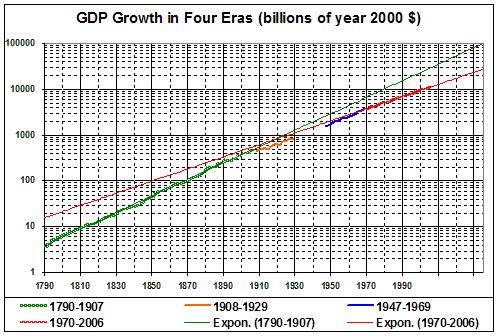
Now, the question is how much worse off Americans will be a generation hence. To answer that question, I revisited the estimates of real GDP that underlie my earlier work. I used the new estimates in the following chart, dividing the data into four eras (described below) and indicating the exponential trends for two eras (1790-1907, 1970-2006).

This graph is based on new estimates of real GDP from Louis D. Johnston and Samuel H. Williamson, “The Annual Real and Nominal GDP for the United States, 1790 – Present.” Economic History Services, URL : http://eh.net/hmit/gdp/. The new estimates cover the period through 2006 (vice 2003 in my earlier work). On re-examining the data, I decided that 1907 (vice 1906) was the last year of the laissez-faire era; that is, the effects of TR’s anti-business policies did not begin to affect GDP growth seriously until 1908.

The four distinct eras and the annual rate of growth in real GDP during each of them:

  • 1790-1907: laissez-faire reigns (more or less) — 4.3% growth
  • 1908-1929: even though the peacetime tax burden remains about 10 percent of GDP, the modern regulatory state emerges — 3.3% growth
  • 1947-1969: post-Depression/post-WWII recovery underwrites the extension of the New Deal to the Great Society, imposing a heavier burden of taxation and regulation — 4.2% growth
  • 1970-2006: New Deal-Great Society policies are entrenched and extended through greater regulatory control of economic activity and an even greater tax burden — 3.1% growth

(I have omitted 1930-1946 because the GDP figures for World War II grossly overstate the value of goods and services available to the civilian population and (falsely) suggest a high rate of growth for era.)

For more about the effects of taxation and regulation on GDP growth, and the failure of the New Deal to bring the country out of the Great Depression, go here and here.

The bottom line (all GDP estimates are in year 2000 dollars):

  • Had the economy continued to grow after 1907 at the 1790-1907 rate, real GDP in 2006 would have been $32 trillion, vice the actual value of $11 trillion.
  • Thus my earlier work, linked above, vastly understates the deadweight loss owed to big government: I had estimated that loss at 40 percent of potential GDP; it was, in fact, about two-thirds of potential GDP.
  • Had the economy continued to grow after 1907 at the 1790-1907 rate, real GDP in 2035 (a generation hence) would be $108 trillion (in year 2000 dollars).
  • If the economy continues to grow at the 1970-2006 rate, real GDP in 2035 will be $30 trillion (in year 2000 dollars).
  • However, growth is very likely to be less than 3.1% annually, given the advent of a new New Deal-Great Society under a new, anti-business, pro-regulation Democrat regime.
  • Thus the average American will “enjoy” (at best) about 28 percent of the income that would be his absent the advent of the regulatory-welfare state.

That — I am sorry to say — is the shape of things to come economically.

I have discussed, in these posts, the shape of things to come socially.

The Movies: (Not) Better Than Ever

UPDATED BELOW, 06/23/07

According to the lists of movies that I keep at the Internet Movie Database (IMDb), I have thus far seen 2,034 theatrically released feature films in my lifetime. That number does not include such forgettable fare as the grade-B westerns, war movies, and Bowery Boys comedies that I saw on Saturdays, at two-for-a-nickel, during my pre-teen years.

I have given 570 (28 percent) of those 2,034 films a rating of 8, 9, or 10 (out of 10). The proportion of high ratings does not indicate low standards on my part; rather, it indicates the care with which I have (usually) selected films for viewing.

I call the 570 highly rated films my favorites. I won’t list all them here, but I will mention some of them — and their stars — as I analyze the up-and-down history of film-making.

I must, at the outset, admit two biases that have shaped my selection of favorite movies. First, because I’m a more or less typical American movie-goer (or movie-viewer, since the advent of cable, VCR, and DVD), my list of favorites is dominated by American films starring American actors.

A second bias is my general aversion to silent features and early talkies. Most of the directors and actors of the silent era relied on “stagy” acting to compensate for the lack of sound — a style that persisted into the early 1930s. There are exceptions, of course. Consider Charlie Chaplin, whose genius as a director and comic actor made a virtue of silence; my list of favorites includes two of Chaplin’s silent features (The Gold Rush, 1925) and (City Lights, 1931). Perhaps a greater comic actor (and certainly a more physical one) than Chaplin was Buster Keaton, whose Our Hospitality (1923), The Navigator (1924), Sherlock Jr. (1924), The General (1927), and Steamboat Bill Jr. (1928) outnumber Chaplin’s contributions to my favorites. My list of favorites includes only ten other films from the years before 1933, among them F.W. Murnau’s Nosferatu the Vampire (1922) and Fritz Lang’s Metropolis (1927) — the themes of which (supernatural and futuristic, respectively) enabled them to transcend the limitations of silence — and such early talkies as Whoopee! (1930), Dracula (1931), and Grand Hotel (1932).

On the whole, I can recall having seen only 42 feature films that were released before 1933, 17 of which (40 percent) rank among my favorites. (I plan, however, to increase that number as I sample other highly rated silent films, including several of Harold Lloyd’s.) So, I will say no more here about films released before 1933. I will focus, instead, on movies released from 1933 to the present — which I consider the “modern” era of film-making.

My inventory of modern films comprises 1,992 titles, of which I have rated 553 at 8, 9, or 10 on the IMDb scale. But the overall proportion of favorites (28 percent) masks vast differences in the quality of modern films, which were produced in three markedly different eras:

  • the Golden Age (1933-1942) — 179 films seen, 96 favorites (54 percent)
  • the Abysmal Years (1943-1965) — 317 films seen, 98 favorites (31 percent)
  • the Vile Years (1966-present) — 1,496 films seen, 359 favorites (24 percent)

What made the Golden Age golden, and why did films go from golden to abysmal to vile? Read on.

To understand what made the Golden Age golden, let’s consider what makes a great movie: a novel or engaging plot, dialogue that is fresh if not witty, and strong performances (acting, singing, and/or dancing). (A great animated feature may be somewhat weaker on plot and dialogue if the animations and sound track are first rate.) The Golden Age was golden largely because the advent of sound fostered creativity — plots could be advanced through dialogue, actors could deliver real dialogue, and singers and dancers could sing and dance with abandon. It took a few years to fully realize the potential of sound, but movies hit their stride just as the country was seeking respite from worldly cares: first, a lingering and deepening Depression, then the growing certainty of war.

Studios vied with each other to entice movie-goers with new plots (or plots that seemed new when embellished with sound), fresh and often wickedly witty dialogue, and — perhaps most important of all — captivating performers. The generation of super-stars that came of age in the 1930s consisted mainly of handsome men and beautiful women, blessed with distinctive personalities, and equipped by their experience on the stage to deliver their lines vibrantly and with impeccable diction.

What were the great movies of the Golden Age, and who starred in them? Here’s a sample of the titles: 1933 — Dinner at Eight, Flying Down to Rio, Morning Glory; 1934 — It Happened One Night, The Thin Man, Twentieth Century; 1935 — Mutiny on the Bounty, A Night at the Opera, David Copperfield; 1936 — Libeled Lady, Mr. Deeds Goes to Town, Show Boat; 1937 — The Awful Truth, Captains Courageous, Lost Horizon; 1938 — The Adventures of Robin Hood, Bringing up Baby, Pygmalion; 1939 — Destry Rides Again, Gunga Din, The Hunchback of Notre Dame, The Wizard of Oz, The Women; 1940 — The Grapes of Wrath, His Girl Friday, The Philadelphia Story; 1941 — Ball of Fire, The Maltese Falcon, Suspicion; 1942 — Casablanca, The Man Who Came to Dinner, Woman of the Year.

And who starred in the greatest movies of the Golden Age? Here’s a goodly sample of the era’s superstars, a few of whom came on the scene toward the end: Jean Arthur, Fred Astaire, John Barrymore, Lionel Barrymore, Ingrid Bergman, Humphrey Bogart, James Cagney, Claudette Colbert, Ronald Colman, Gary Cooper, Joan Crawford, Bette Davis, Irene Dunne, Nelson Eddy, Errol Flynn, Joan Fontaine, Henry Fonda, Clark Gable, Cary Grant, Jean Harlow, Olivia de Havilland, Katharine Hepburn, William Holden, Leslie Howard, Allan Jones, Charles Laughton, Carole Lombard, Myrna Loy, Jeanette MacDonald, Joel McCrea, Merle Oberon, Laurence Olivier, William Powell, Ginger Rogers, Rosalind Russell, Norma Shearer, Barbara Stanwyck, James Stewart, and Spencer Tracy. There were other major stars, and many popular supporting players, but it seems that a rather small constellation of superstars commanded most of the leading roles in the best movies of the Golden Age — most of the great movies and many others of merit.

Why did movies go into decline after 1942’s releases? World War II certainly provided an impetus for the end of the Golden Age. The war diverted resources from the production of major theatrical films; grade-A features gave way to low-budget fare. And some of the superstars of the Golden Age went off to war. (Two who remained civilians — Leslie Howard and Carole Lombard — were killed during the war.) With the resumption of full production in 1946, the surviving superstars who hadn’t retired were fading fast, though their presence still propelled many a movie. In fact, superstars of the Golden Age starred in 44 of my 98 favorites from the Abysmal Years but only two of my 359 favorites from the Vile Years.

Stars come and go, however, as they have done since Shakespeare’s day. The Abysmal and Vile Years have deeper causes than the dimming of old stars:

  • The Golden Age had deployed all of the themes that could be used without explicit sex, graphic violence, and crude profanity — none of which become an option for American movie-makers until the mid-1960s.
  • Prejudice got significantly more play after World War II, but it’s a theme that can’t be used very often without boring audiences.
  • Other attempts at realism (including film noir) resulted mainly in a lot of turgid trash laden with unrealistic dialogue and shrill emoting — keynotes of the Abysmal Years.
  • Hollywood productions sank to the level of TV, apparently in a misguided effort to compete with that medium. The garish technicolor productions of the 1950s often highlighted the unnatural neatness and cleanliness of settings that should have been rustic if not squalid.
  • The transition from abysmal to vile coincided with the cultural “liberation” of the mid-1960s, which saw the advent of the “f” word in mainstream films. Yes, the Vile Years have brought us more more realistic plots and better acting (thanks mainly to the Brits). But none of that compensates for the anti-social rot that set in around 1966: drug-taking, drinking and smoking are glamorous; profanity proliferates to the point of annoyance; sex is all about lust and little about love; violence is gratuitous and beyond the point of nausea; corporations and white, male Americans with money are evil; the U.S. government (when Republican-controlled) is in thrall to that evil; etc., etc. etc.

There have been, of course, outbreaks of greatness since the Golden Age. During the Abysmal Years, for example, aging superstars appeared in such greats as Life With Father (Dunne and Powell, 1947), Key Largo (Bogart and Lionel Barrymore, 1948), Edward, My Son (Tracy, 1949), The African Queen (Bogart and Hepburn, 1951), High Noon (Cooper, 1952), Mr. Roberts (Cagney, Fonda, Powell, 1955), The Old Man and the Sea (Tracy, 1958), Anatomy of a Murder (Stewart, 1959), North by Northwest (Grant, 1959), Inherit the Wind (Tracy, 1960), Long Day’s Journey into Night (Hepburn, 1962), Advise and Consent (Fonda and Laughton, 1962), The Best Man (Fonda, 1964), and Othello (Olivier, 1965). A new generation of stars appeared in such greats as The Lavender Hill Mob (Alec Guinness, 1951), Singin’ in the Rain (Gene Kelly, 1952), The Bridge on the River Kwai (Guiness, 1957), The Hustler (Paul Newman, 1961), Lawrence of Arabia (Peter O’Toole, 1962), and Dr. Zhivago (Julie Christie, 1965). Even Lancaster (Elmer Gantry, 1960) , Kerr (The Innocents, 1962), and Peck (To Kill a Mockingbird, 1962) had their moments. Nevertheless, selecting a movie at random from the output of the Abysmal Years — in the hope of finding something great or even worth watching — is like playing Russian Roulette with a loaded revolver.

The same can be said for the Vile Years, which in spite of their seaminess have yielded many excellent films and new stars. Some of the best films (and their stars) are A Man for All Seasons (Paul Scofield, 1966), Midnight Cowboy (Dustin Hoffman, 1969), MASH (Alan Alda, 1970), The Godfather (Robert DeNiro, 1972), Papillon (Hoffman, Steve McQueen, 1973), One Flew over the Cuckoo’s Nest (Jack Nicholson, 1975), Star Wars and its sequels (Harrison Ford, 1977, 1980, 1983), The Great Santini (Robert Duvall, 1979), The Postman Always Rings Twice (Nicholson, Jessica Lange, 1981), The Year of Living Dangerously (Sigourney Weaver, Mel Gibson, 1982), Tender Mercies (Duvall, 1983), A Room with a View (Helena Bonham Carter, Daniel Day Lewis 1985), Mona Lisa (Bob Hoskins, 1986), Fatal Attraction (Glenn Close, 1987), 84 Charing Cross Road (Anne Bancroft, Anthony Hopkins, Judi Dench, 1987), Dangerous Liaisons (John Malkovich, Michelle Pfeiffer, 1988), Henry V (Kenneth Branagh, 1989), Reversal of Fortune (Close and Jeremy Irons, 1990), Dead Again (Branagh, Emma Thompson, 1991), The Crying Game (1992), Much Ado about Nothing (Branagh, Thompson, Keanu Reeves, Denzel Washington, 1993), Trois Couleurs: Bleu (Juliette Binoche, 1993), Richard III (Ian McKellen, Annette Bening, 1995), Beautiful Girls (Natalie Portman, 1996), Comedian Harmonists (1997), Tango (1998), Girl Interrupted (Winona Ryder, 1999), Iris (Dench, 2000), High Fidelity (John Cusack, 2000), Chicago (Renee Zellweger, Catherine Zeta-Jones, Richard Gere, 2002), Master and Commander: The Far Side of the World (Russell Crowe, 2003), Finding Neverland (Johnny Depp, Kate Winslet, 2004), Capote (Philip Seymour Hoffman, 2005), The Chronicles of Narnia: The Lion, the Witch, and the Wardrobe (2005), The Painted Veil (Edward Norton, Naomi Watts, 2006), and Breach (Chris Cooper, 2007).

But every excellent film produced during the Abysmal and Vile Years has been surrounded by outpourings of dreck, schlock, and bile. The generally tepid effusions of the Abysmal Years were succeeded by the excesses of the Vile Years: films that feature noise, violence, sex, and drugs for the sake of noise, violence, sex, and drugs; movies whose only “virtue” is their appeal to such undiscerning groups as teeny-boppers, wannabe hoodlums, resentful minorities, and reflexive leftists; movies filled with “bathroom” and other varieties of “humor” so low as to make the Keystone Cops seem paragons of sophisticated wit.

In sum, movies have become progressively worse than ever since the end of the Golden Age — and I have the numbers to prove it. The numbers are based on my IMDb ratings, and my conclusion about the low estate of film-making flows from those ratings. That is to say, I came to the conclusion that the quality of films has been in decline since 1942 only after having rated some 2,000 films. Before I looked at the numbers I believed that there had been a renaissance in film-making, inasmuch as the number of highly rated films (favorites), has been rising since the latter part of the Abysmal Years:
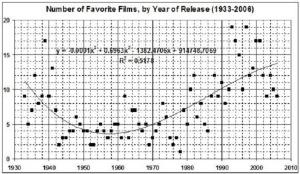

But the rising number of favorites is due to the rising number of films (mainly recent releases) that I have seen since the advent of VHS and DVD (and especially since my retirement about 10 years ago). In the chart below, all of the points to the right of 30 on the x-axis represent films released in 1982 or later; all of the points to the right of 60 represent films released in 1994 or later. (I have omitted the releases of 2007 from this analysis because I have seen only one of them: Breach.)


Those observations led to me to run a regression films released from 1933 through 2006. The result:

Number of favorite films (for a given year of release) = 147.94 – (o.075 x year) + (0.24 x number of films seen)

Regression statistics: adjusted r-square — 0.66; standard error of estimate — 2.61; F — 72.52; t values of intercept and independent variables — 3.46, 3.40, 10.06

By applying the regression equation to the number of films seen in each year I could compare the actual and predicted number of favorites as a percentage of films seen:


The downward trend is unmistakable, both in the data and in the predictions:

  • Actual percentages for seven of the 10 years of the Golden Age exceed predictions for those years.
  • Actual percentages fall short of predicted percentages in 18 of the 23 Abysmal Years — evidence of the general dreariness of the films of that era.
  • The Vile Years have had their high points and low points — both mainly in the 1960s and ’70s — but, nevertheless, the downward trend since the Golden Age continues unabated.

Imagine how much steeper the downward trend would be if my observations were to include absolute trash of the sort that dominates the trailers which one encounters on TV and DVDs. My selectivity in movie-watching has led me to overstate the quality of recent and current movie offerings.

Movies are worse than ever, but there are gems yet to be found among the dross.

UPDATE: The lowest IMDb rating for a movie is a “1” — a rating that I have given to 37 films. Those 37 are the movies that I found too moronic or vile to watch to the end. The following table lists the films, shows my ratings, and shows the average ratings assigned by users of IMDb. It is telling that (with three exceptions) the average ratings range from 6.6 to 8.2 — relatively high scores in the world of IMDb.

Bad Santa (2003) 1 7.2
Better Off Dead… (1985) 1 7.1
Big Night (1996) 1 7.1
Bottle Rocket (1996) 1 7.2
The Butterfly Effect (2004) 1 7.7
Diva (1981) 1 7.1
Exotica (1994) 1 7.0
Garden State (2004) 1 8.0
The General’s Daughter (1999) 1 6.0
Hannah and Her Sisters (1986) 1 7.8
Happiness (1998) 1 7.6
Harold & Kumar Go to White Castle (2004) 1 7.1
The Holiday (2006) 1 6.9
I’m the One That I Want (2000) 1 7.3
The Joy Luck Club (1993) 1 7.2
King of the Corner (2004) 1 6.0
Lord of War (2005) 1 7.7
The Lost City (2005) 1 6.9
Lucía y el sexo (2001) 1 7.5
Lucky Number Slevin (2006) 1 7.8
Metropolitan (1990) 1 7.2
My Dinner with Andre (1981) 1 7.4
One Last Thing… (2005) 1 7.1
Quills (2000) 1 7.3
Reine Margot, La (1994) 1 7.5
Roger Dodger (2002) 1 7.2
Sideways (2004) 1 7.8
Sleepy Hollow (1999) 1 7.4
The Spook Who Sat by the Door (1973) 1 6.9
Tape (2001) 1 7.3
The Thing About My Folks (2005) 1 6.6
Under the Volcano (1984) 1 6.6
The Upside of Anger (2005) 1 7.1
Waking Life (2001) 1 7.5
Z (1969) 1 8.2
Zelig (1983) 1 7.5
Zoolander (2001) 1 6.2

Einstein, Science, and God

I have written several times about the connection between science and faith. My views (links below) put me in excellent company. From “Einstein & Faith” (Time, April 5, 2007):

[Einstein] and his wife were at a dinner party in Berlin when a guest expressed a belief in astrology. Einstein ridiculed the notion as pure superstition. Another guest stepped in and similarly disparaged religion. Belief in God, he insisted, was likewise a superstition.

At this point the host tried to silence him by invoking the fact that even Einstein harbored religious beliefs. “It isn’t possible!” the skeptical guest said, turning to Einstein to ask if he was, in fact, religious. “Yes, you can call it that,” Einstein replied calmly. “Try and penetrate with our limited means the secrets of nature and you will find that, behind all the discernible laws and connections, there remains something subtle, intangible and inexplicable. Veneration for this force beyond anything that we can comprehend is my religion. To that extent I am, in fact, religious.”…

Shortly after his 50th birthday, Einstein also gave a remarkable interview in which he was more revealing than he had ever been about his religious sensibility. It was with George Sylvester Viereck….

[Viereck asked Einstein] Do you believe in God? “I’m not an atheist. I don’t think I can call myself a pantheist. The problem involved is too vast for our limited minds. We are in the position of a little child entering a huge library filled with books in many languages. The child knows someone must have written those books. It does not know how. It does not understand the languages in which they are written. The child dimly suspects a mysterious order in the arrangement of the books but doesn’t know what it is. That, it seems to me, is the attitude of even the most intelligent human being toward God. We see the universe marvelously arranged and obeying certain laws but only dimly understand these laws.”….

Einstein tried to express these feelings clearly, both for himself and all of those who wanted a simple answer from him about his faith. So in the summer of 1930, amid his sailing and ruminations in Caputh, he composed a credo, “What I Believe,”….”The most beautiful emotion we can experience is the mysterious. It is the fundamental emotion that stands at the cradle of all true art and science. He to whom this emotion is a stranger, who can no longer wonder and stand rapt in awe, is as good as dead, a snuffed-out candle. To sense that behind anything that can be experienced there is something that our minds cannot grasp, whose beauty and sublimity reaches us only indirectly: this is religiousness. In this sense, and in this sense only, I am a devoutly religious man.”…

[T]hroughout his life, Einstein was consistent in rejecting the charge that he was an atheist. “There are people who say there is no God,” he told a friend. “But what makes me really angry is that they quote me for support of such views.” And unlike Sigmund Freud or Bertrand Russell or George Bernard Shaw, Einstein never felt the urge to denigrate those who believed in God; instead, he tended to denigrate atheists. “What separates me from most so-called atheists is a feeling of utter humility toward the unattainable secrets of the harmony of the cosmos,” he explained.

In fact, Einstein tended to be more critical of debunkers, who seemed to lack humility or a sense of awe, than of the faithful. “The fanatical atheists,” he wrote in a letter, “are like slaves who are still feeling the weight of their chains which they have thrown off after hard struggle. They are creatures who–in their grudge against traditional religion as the ‘opium of the masses’– cannot hear the music of the spheres.”

Einstein later explained his view of the relationship between science and religion at a conference at the Union Theological Seminary in New York. The realm of science, he said, was to ascertain what was the case, but not evaluate human thoughts and actions about what should be the case. Religion had the reverse mandate. Yet the endeavors worked together at times. “Science can be created only by those who are thoroughly imbued with the aspiration toward truth and understanding,” he said. “This source of feeling, however, springs from the sphere of religion.” The talk got front-page news coverage, and his pithy conclusion became famous. “The situation may be expressed by an image: science without religion is lame, religion without science is blind.”

Related posts:
Atheism, Religion, and Science
The Limits of Science
Beware of Irrational Atheism
The Creation Model
Evolution and Religion
Science, Evolution, Religion, and Liberty
Science, Logic, and God
The Universe . . . . Four Possibilities

The Real Threat to Liberty . . .

. . . is this, not this.

I Told You So

Here.

Toward a Capital Theory of Value

David L. Prychitko addresses the labor theory of value:

The labor theory of value is a major pillar of traditional Marxian economics, which is evident in Marx’s masterpiece, Capital (1867). Its basic claim is simple: the value of a commodity can be objectively measured by the average amount of labor hours that are required to produce that commodity.

If a pair of shoes usually takes twice as long to produce as a pair of pants, for example, then shoes are twice as valuable as pants. In the long run the competitive price of shoes will be twice the price of pants, regardless of the value of the physical inputs.

The labor theory of value is demonstrably false. But it did prevail among classical economists through the midnineteenth century. Adam Smith, for instance, flirted with a labor theory of value in his classic defense of capitalism, The Wealth of Nations (1776), while David Ricardo later systematized it in his Principles of Political Economy (1817), a text studied by generations of free-market economists.

So the labor theory of value was not unique to Marxism. Marx did attempt, however, to turn the theory against the champions of capitalism.

Now, I would not posit a parallel theory of value in which capital is central. But I will posit a capital theory of value along these lines:

1. A broad array of capital goods (e.g., metal presses and railroad cars) will produce the same outputs (e.g., auto body parts of a certain quality and a certain number of passenger-miles) despite wide variations in the intelligence, education, and motor skills of their operators.

2. That is to say, capital leverages labor (especially unskilled labor).

3. Rewards justifiably — if unpredictably — flow to those who invent capital goods, innovate improvements in capital goods, invest in the production of such goods, and take the risk of owning businesses that use such goods in the production of consumer goods and services.

4. The activities of those inventors, innovators, investors, and entrepreneurs constitute a form of labor, but it is a very special form. It is not the brute force kind of labor envisaged by Marx and his intellectual progeny. It is a kind of labor that involves mental acuity, special knowledge, a penchant for risk-taking, and — yes, at times — hard work.

Without capital, labor would produce far less than it does. Capital, by the same token, enables labor of a given quality to produce more than it otherwise would.

Vive le capitalisme!

The Censored Wisdom of T.S. Eliot

Eliot, unfortunately for us, censored himself on at least one occasion. Virginia Quarterly Review explains:

In May 1933, T. S. Eliot delivered three lectures at the University of Virginia, as part of the Page-Barbour Series. By Eliot’s own description, these lectures were intended as “further development of the problem which the author first discussed in his essay, ‘Tradition and the Individual Talent.’”…

[T]he lectures, gathered in Spring 1934 as the slim volume After Strange Gods, have gained most of their notorious reputation, because they contain some of the strongest evidence of Eliot’s intolerance for non-Christian religions and his blatant anti-Semitism. At one point, he declared that, “The population should be homogeneous; where two or more cultures exist in the same place they are likely either to be fiercely self-conscious or both to become adulterate. What is still more important is unity of religious background; and reasons of race and religion combine to make any large number of free-thinking Jews undesirable.”…

Barely a decade later….Eliot had grown leery of having his remarks published in post-Nazi Europe. Eliot withdrew After Strange Gods from publication, and it has remained unavailable ever since.

[O]ne of the lectures, “Personality and Demonic Possession,” appeared in VQR in January 1934…. The following essay is decidedly the least incendiary of the three Eliot delivered at Virginia; however, even here it is clear the degree to which his dogmatic artistic beliefs have blurred into social intolerance.

VQR, being a publication with academic pretensions, evidently takes the position that to it amounts to “social intolerance” when someone has coherent literary and social standards — as opposed to the morally relativistic stance that all ideas and cultures are created equal. What VQR calls “social intolerance,” is really a defense of the kind of civility and civilization that enables VQR and its ilk to survive, which it would not have done in the USSR or could not do in the Caliphate.

Recent events in Europe — and long-term trends in the United States — attest to the wisdom of Eliot’s statement that “where two or more cultures exist in the same place they are likely either to be fiercely self-conscious or both to become adulterate.” That really is an understatement, given the barely contained (and sometimes uncontained) state of tension (and sometimes violence) that exists where whites, blacks, and tans rub together in the U.S., and where Muslims and non-Muslims rub together in Europe.

Eliot does go too far in his emphasis on religious homogeneity. Jews certainly can be and have been staunch defenders of Western civilization — by which I mean a republican government of limited powers; respect for the rule of law; and, underpinning those things, rationality as opposed to emotionalism in political and civil discourse. But it must be said that many Jews (along with many more non-Jews) have been prominent among those who advance and fund ideas that are inimical to Western civilization. But the failings of those particular Jews cannot be laid to Judaism, else the failings of their non-Jewish brethren could be laid to Christianity.

In any event, here is what Eliot has to say about emotionalism, on page four of “Personality and Demonic Possession”:

[E]xtreme emotionalism seems to me a symptom of decadence; it is a cardinal point of faith in a romantic age to believe that there is something admirable for its own sake in violent emotion, whatever the emotion or whatever its object. But it is by no means self-evident that human beings are most real when most violently excited; violent passions do not in themselves differentiate men from each other, but rather tend to reduce them to the same state…. Furthermore, strong passion is only interesting or significant in strong men; those who abandon themselves without resistance to excitements which tend to deprive them of reason become merely instruments of feeling and lose their humanity; and unless there is moral resistance and conflict there is no meaning. But as the majority is capable neither of strong emotion nor of strong resistance, it always inclines, unless instructed to the contrary, to admire passion for its own sake; and if somewhat deficient in vitality, people imagine passion to be the surest evidence of vitality.

Thus do demagogues dupe the masses.

A Provisional Summing Up

Liberty arises from mutual respect and forbearance. Those who would live in liberty therefore bear a super-contractual obligation — a societal obligation. It is an obligation to treat others as those others would be treated, in the expectation that those others will reciprocate that respect and forbearance.

State power erodes the societal bonds upon which liberty depends. The possibility of attaining gratification through the exercise of state power tempts us to use the power of the state to treat others coercively. As subjects of the state we develop the habit of looking to the state for guidance about proper behavior, instead of consulting our consciences and our fellow men.

One misuse of state power leads to another, eventually destroying the fragile bonds of mutual respect and forbearance that undergird liberty. We have followed this slippery slope in America. Our slide into statism began in earnest with with Teddy Roosevelt’s “Square Deal,” accelerated with Franklin Roosevelt’s “New Deal,” and has been compounded since through the steady accretion of power by the central government.

The Universe . . . Four Possibilities

UPDATED, BELOW

1. Everything just is — without an outside cause or overarching design. Scientists claim to find “laws” governing the behavior of matter, energy, time, and space. But such laws only partly explain the universe; there is no grand unifying theory of everything. And those laws are subject to change as science unveils new aspects of matter, energy, time, and space — as it does continuously.

2. Same as 1, but the sum of everything is a “cosmic consciousness,” akin to the consciousness that seems to emerge from the disparate parts of the brain. Being “in tune” with the cosmic consciousness is a “gift” that entitles its self-anointed recipients to pass judgment on the behavior of those lesser mortals whose actions are out of step with the cosmic consciousness.

3. Similar to 2, but instead of a “cosmic consciousness” there is a “cosmic balance.” The “right” balance is, of course, known only to the self-anointed high priests of environmentalism and animal rights. In their reckoning, human beings have no special place in the scheme of things, and may not even be a necessary part of the “right” balance. Their natural allies are those who deny the superiority of Western civilization, the importance of the Judeo-Christian tradition to the development of that civilization, and the particular importance of the Constitution of the United States (in its original meaning) as a bulwark of that civilization in one of its most secure bastions — the United States of America. Ironically, extreme libertarians (i.e., anarcho-capitalists, or market capitalists) and Objectivists (their close correlates) — both of which groups disdain the high priests of environmentalism and the enemies of Western civilization — also hew to a belief in a “cosmic balance,” given their insistence that rights are Platonic essences that simply exist without the benefit of human efforts to secure them through politics and war.

4. There is an external force or consciousness that brought everything into being. That force or consciousness may merely have set things in motion, or it may play a continuing role in some or all aspects of existence. The intentions of the external force or consciousness are known to religionists, by revelation and/or faith; science is inadequate to fathom those intentions or to prove that the universe conforms to an underlying “design.” Those who reject this fourth possibility as “unscientific” — that is, most scientists as well as the typical libertarian/Objectivist — can do so only by accepting one of the equally unscientific (i.e., untestable) possibilities outlined above.

To be continued . . . perhaps.

UPDATE

In “Existence and Creation” (May 20, 2011) I refine these four possibilities and add a fifth.

People Are Idiots

The proof is found in the lede of an AP story:

People overwhelmingly support two of the Democrats’ top goals — increasing the minimum wage and making it easier to buy prescription drugs from other countries….

Increasing the minimum wage will hurt the class of persons it is intended to help. There will be fewer jobs (or worse working conditions) for those unskilled workers who now seek employment, and even fewer jobs for succeeding generations of unskilled workers.

Making it easier to buy prescription drugs from other countries will result in (a) fraudulent sales of inferior substitutes and (b) less R&D by American drug companies. Those results will harm the consumers of drugs.

As I say, people are idiots.

About This Blog

Liberty Corner (1 March 2004 – 19 July 2008) is the work of a practical libertarian, one who believes in the kind of limited, accountable state envisioned by the Framers of the Constitution, in which individuals are free to choose that locality that best suits them — socially and economically — under the aegis of a central government of limited powers. (The impractical alternative is an anarchistic “utopia” in which atomistic cooperation improbably averts the rise of unaccountable warlords and despots.) Liberty Corner is, therefore, predominantly about politics and economics — as seen through the eyes of a seasoned skeptic.

But there is more to life than the political and economic framework in which it is lived. There is life itself: humanity (in all its dignity and disarray) and the enjoyment of nature, the arts (musical, dramatic, and representational), sports (especially baseball), and so on; there are science and religion, and their implications for the meaning of life. Liberty Corner gives much attention to those subjects, as well to politics and economics.

This blog is not a journal; it is a compendium of my considered views on a wide range of topics. Some of those views evolved during my blogging lifetime. In particular, my views about the nature of liberty and the conditions under which it is possible, matured from knee-jerk anti-statism to Burkean-Hayekian conservatism. (See, for example, “On Liberty in the sidebar.)

I remain anonymous because, like Ebenezer Scrooge, I wish to be left alone. I am not anonymous for the purpose of feigning unwarranted expertise; my credentials are fully on view at “About the Author.” The merits of my writings can be judged by their empirical and logical validity, and have nothing to do with my identity.

I have left a blogroll in place, but have pared it to those 46 blogs and syndicators whose feeds I would read were I still reading feeds. But keeping abreast of blogdom, like blogging, is in my past.

I thank Postmodern Conservative for his contributions to this blog, especially in the months following my final substantive post. Now that he has retired from the fray, it is time for me to say adieu.

An Immigration Roundup

Go to this very long post at Liberty Corner II for a thorough debunking of the economic and sociological fallacies upon which the case for unfettered immigration has been built. The post at Liberty Corner II consolidates and replaces several posts about immigration.

An Immigration Roundup

This post consolidates and replaces several posts that I have written about immigration.

March 29, 2006 — IT’S TIME FOR PLAIN TALK ABOUT ILLEGAL IMMIGRATION

Steve Antler (EconoPundit) has a neat graphic in this post, which illustrates a key point. The point? The minimum wage — to the extent that it is actually paid by employers of illegal immigrants — raises the unemployment rate. That, in turn, gives pandering politicians yet another opportunity to buy votes by expanding welfare benefits for illegal immigrants (and other low-income groups).

Minimum wage laws and welfare programs are especially favored on the Left (though large corporations have no objection to taxpayer-funded welfare programs that subsidize labor). An article by Ben Johnson at FrontPageMag.com details the Leftist connections to the massive protests of proposals to curb illegal immigration; for example:

As events spanned from California to Detroit, Phoenix to Washington, D.C., the media kept up its anti-enforcement drumbeat. Although some have credited Latino DJs for the 500,000-strong illegal immigrant turnout in Los Angeles alone – and some credit is deserved – the real legwork was done by a more eclectic group of organizations: leftist labor unions, George Soros-funded agitators, Open Borders lobbyists, Roman Catholic clergy, and teachers unions. . . .

Andres Jiminez, director of the University of California’s California Policy Research Center, told the media, “It’s not only Latinos who are marching in the streets, its unions too: firefighters, farm workers and Hispanic students who had thought of U.S. law as protecting them and are now starting to see it as a threat to their future.”

He was right about this much: Latino organizations did not act alone. The media has failed to report that organized labor directed the illegals and minors. The L.A. Times revealed the rally’s “security” was handled by a union identified only as “Local 1877.” That would be local 1877 of the Service Employees International Union (SEIU), the far-Left union founded by New Left radical Andrew Stern, which called for the withdrawal of all U.S. troops from Iraq in June 2004 and worked in concert with Ted Kennedy to roll back anti-terrorist Homeland Security measures. According to the L.A. Times, the SEIU’s goons kindly helped “herd marchers along the route.” That was not the extent of SEIU’s help, though. The union also “coordinated the more than 100 buses that dropped off marchers from throughout California, Las Vegas and a few Southwestern cities.”

In other words, the massive rally against Homeland Security – since that is what gaining control of America’s borders would promote – was staged by a leftist labor union and staffed primarily with illegal immigrants.

SEIU did not work alone in this. It was aided by other radical or left-wing political pressure groups [which Johnson details].

Pandering to illegals is, of course, an exercise in building political power. The pandering curries favor with those legals who want the company of their “brothers and sisters” from south of the border. And many of the illegals will become voters themselves — sooner rather than later if the Left has its way. (U.S. Rep. Steve King (R-IA) analyzes the Left’s strategy in an article at Human Events Online: “Democrats Will Use Immigration to Divide and Conquer.”) President Bush seems to believe that he can corral some of those voters into the GOP, but I have no doubt that the GOP will come up with the short end of the stick.

Which leads me to Thomas Sowell, who makes sense, as usual, in “Guests or gate crashers” at townhall.com:

The Bush administration is pushing a program to legalize “guest workers.” But what is a guest? Someone you have invited. People who force their way into your home without your permission are called gate crashers.If truth-in-packaging laws applied to politics, the Bush guest worker program would have to be called a “gate-crasher worker” program. The President’s proposal would solve the problem of illegal immigration by legalizing it after the fact. . . .

None of the rhetoric and sophistry that we hear about immigration deals with the plain and ugly reality: Politicians are afraid of losing the Hispanic vote and businesses want cheap labor.

What millions of other Americans want has been brushed aside, as if they don’t count, and they have been soothed with pious words. But now the voters are getting fed up, which is why there are immigration bills in Congress.

The old inevitability ploy is often trotted out in immigration debates: It is not possible to either keep out illegal immigrants or to expel the ones already here.

If you mean stopping every single illegal immigrant from getting in or expelling every single illegal immigrant who is already here, that may well be true. But does the fact that we cannot prevent every single murder cause us to stop enforcing the laws against murder? . . .

Let’s hope the immigration bills before Congress can at least get an honest debate, instead of the word games we have been hearing for too long.

I fully understand and agree with the economic arguments for “open borders” — and I do favor free trade and outsourcing (e.g., read this post and follow the links at the bottom). But the immigration issue is really about political power. The cause of illegal immigration is mainly (though not entirely) a Leftist play for power and the expansion of the welfare state.

March 30, 2006 — AS I WAS SAYING ABOUT IMMIGRATION

Immigration, legal or not, is more than an economic issue. Most economists — even economists I respect — just don’t get it. It is stupid to let people enter the U.S. if the result of doing so is an expansion of the regulatory-welfare state, both directly — for the benefit of immigrants — and indirectly — as a result of the votes those immigrants cast (eventually) for politicians who seek to expand the regulatory-welfare state.

It’s time to seal the borders and admit immigrants based strictly on their demonstrated ability to make an immediate, positive economic contribution. That prescription might seem to run against my interest, inasmuch as I live in Texas, which is a first stop for immigrants who work for low wages. Given the cost of the regulatory-welfare state of Texas, however, I believe that I would be better off with fewer immigrants. In any event, the long-run economic vitality of the United States requires a citizenry that has a stake in, and is more likely to support, limited government and free markets.

An immigrant to the U.S. makes a positive contribution to economic growth only if he or she can be more productive here than in his or her homeland. That’s true of Mexican construction workers who are harnessed to America’s economic-growth engine, but it’s even more true of scientists and engineers from Europe and Asia, who can advance the technology that enables economic growth. Furthermore, those scientists and engineers are not going to demand welfare benefits, and they are less likely (on the whole) to vote for politicians who seek to expand the regulatory-welfare state.

Immigration is an economic issue, but a far more complex issue than the one depicted by most economists, who omit the economic implications of the politics of immigration.

UPDATE: The Conservative Philosopher says

. . . if we could kick out one leftist for every immigrant, I’d favor it.

Roger that.

Recommended reading:

Answering 13 Frequently Asked Questions About Illegal Immigration, at Right Wing News.

The 1965 Immigration Act
, at WizBang! A related note: constant-dollar (real) GDP per capita grew at an annualized rate of 2.1% in the 39 years from 1965 through 2004, compared with a rate of 2.3% for the 39 years from 1926 through 1965. The higher rate for 1926-65 was accomplished in spite of the Great Depression; for the 10 years from 1929 through 1939, real GDP per capita grew at an annual rate of 0.2%.

April 1, 2006 — SOCIETAL SUICIDE

Eternity Road has an excellent post about societal suicide in the West. Relatedly, this op-ed at OpinionJournal suggests that the Supreme Court is about to help the U.S. slide a bit further down the slippery slope of defenselessness.

April 3, 2006 — MORE ABOUT IMMIGRATION

Noted economist Greg Mankiw (who now has a blog) seconds one of my key points. Here’s Mankiw:

The hard issues tend to revolve around the immigration of unskilled workers, who are more likely to drain resources from the social safety net and increase U.S. income inequality by pushing down wages at the bottom of the wage distribution.

Immigration of skilled workers is another matter. A skilled worker coming into the United States will likely pay more in taxes than he or she gets in social benefits. Moreover, an increased supply of skilled labor will tend to reduce income inequality. A strong case can be made that any worker with significant skills (such as a college degree) should be admitted without restriction.

Meanwhile, over at EconLog, Arnold Kling quotes himself:

What should you call someone who wants government to provide for our education, competitiveness, and health care but whose concern about “us” stops at the border? The obvious label would be national socialist. But George Bush and Paul Krugman are not Nazis…

The alternative ideology that I would propose might be called transnational libertarianism. The ideal libertarian world would have no economic borders. There would be no problem of illegal immigration, because all forms of immigration would be legal.

My comment:

The ideal libertarian world would be governed by a unified rule of law. That rule of law would protect citizens from predators — including government-sponsored predation (e.g., welfare programs). To the extent that immigrants come to the U.S. because it offers “better” welfare programs, those immigrants are engaging in predation and enabling the election of politicians who would multiply the predation. Your prescription works in the ideal world, but not in the real one that we inhabit.

Mankiw is that rare economist who sees the real world.

April 3, 2006 — MY DIAGNOSIS AND PROGNOSIS

This message is prompted by the attempt to hijack the “melting pot” concept for the advancement of the regulatory-welfare state. The “melting pot” — properly understood — refers to the assimilation of immigrants to the prevailing culture and rule of law, not to the subversion of that culture and rule of law by a wave of illegal immigrants and their Leftist proponents.

Not all cultures and legal systems are beneficial, and none is perfect. But one culture and legal system — the Anglospheric culture that shaped the Founding Generation of Americans and the Constitution they bequeathed us — comes as close to perfection as one might reasonably expect in this imperfect world. It is no longer de rigeur to say that. And therein lies the tale.

Americans — whether or not they know it — are in a last-ditch fight to save the already much-diluted culture and rule of law that made possible our now-vanishing liberty and pursuit of happiness. And yet, many Americans and American institutions persist in enabling efforts to further dilute that culture and rule of law. This dilution, which is essentially anti-American and anti-liberty, arises from the Left — as represented by Ted Kennedy, Michael Moore, and Hollywood — and is abetted by the parrot-like political correctness that passes for thought among public “educators,” academicians, the media, much of the legal profession, and most government officials and employees. At the rate we are going, I give the U.S. another ten years before it becomes a listless, socialist “paradise” on a par with Canada and Great Britain.

I can only hope that the Supreme Court will prove me wrong.

UPDATE: See this post by the Maverick Philosopher and follow his link to a column by Cal Thomas. Steve Burton (Right Reason) makes an excellent offering in a similar vein. Burton ends his post with this:

W$J conservatives and libertarians . . . will point out that we’ve done it before, back when we absorbed wave after wave of Europe’s huddled masses, yearning to breathe free, and turned them in short order into unhyphenated Americans.

To which I reply: the great waves of American immigration in the 19th and early 20th centuries swept ashore in a harsh, sink-or-swim society where you either fit in and made your own way or died trying. The Latin American immigrants of today, on the other hand, show up in an advanced welfare state under the seemingly ineradicable spell of officially imposed multiculturalist dogma. So the first generation will be as hard-working and family-oriented as anyone could wish. But just wait until our educational system gets ahold of their children. Just wait. In the blink of an historical eye, their work ethic and family values will be replaced with a sense of aggrieved victimhood and entitlement to state compensation, with all the appalling panoply of ills that follow in their wake. After that, it will be ethnic separatism and socio-economic dysfunction as far as the eye can see.

It is a bitter cup that we are preparing for ourselves, and nothing in history teaches us how to drink it and live.

Dale Franks of QandO weighs in with this:

Allowing a large group of foreign persons into the country, and making no effort to assimilate them, will culminate in a disaster. Look at what is happening in Europe as a result of unbridled Muslim immigration. We’re on a very similar path.

As far as I’m concerned, anyone who comes here and makes the effort to become an American, and to subscribe to our ideals and values, is welcome. Those who prefer to maintain their primary allegiance to another country need to go back to that country, rather than trying to make mine a mirror image of the Third World hellhole they hated so much that they risked their lives to flee it.

Given the difficulty of knowing ahead of time who will try to assimilate and who will not, the most effective immigration policy is one that discriminates on the basis of skills. As I wrote here,
It’s time to seal the borders and admit immigrants based strictly on their demonstrated ability to make an immediate, positive economic contribution. That prescription might seem to run against my interest, inasmuch as I live in Texas, which is a first stop for immigrants who work for low wages. Given the cost of the regulatory-welfare state of Texas, however, I believe that I would be better off with fewer immigrants. In any event, the long-run economic vitality of the United States requires a citizenry that has a stake in, and is more likely to support, limited government and free markets.

An immigrant to the U.S. makes a positive contribution to economic growth only if he or she can be more productive here than in his or her homeland. That’s true of Mexican construction workers who are harnessed to America’s economic-growth engine, but it’s even more true of scientists and engineers from Europe and Asia, who can advance the technology that enables economic growth. Furthermore, those scientists and engineers are not going to demand welfare benefits, and they are less likely (on the whole) to vote for politicians who seek to expand the regulatory-welfare state.

April 4, 2006 — MISCELLANEOUS NOTES AND UPDATES

See “Immigrating Terror,” published today at FrontPageMag.com.

UPDATE (9:50 pm): There’s more from the Maverick Philosopher. (Be sure to follow his links to posts by Victor Davis Hanson.)

UPDATE (04/06/06, 6:35 pm): The Senate’s apparent “compromise” on the immigration issue is a surrender. It doesn’t increase border security and includes unenforceable provisions for illegals who are already here, or who arrive in the future. As reported by the NYT,

the compromise would place illegal immigrants in three categories:

¶Those who have lived in the country at least five years would be put on a path toward guaranteed citizenship, provided that they remained employed, paid fines and back taxes, and learned English, a senior Republican aide said. The aide said this group accounted for about 7 million of the roughly 11 million illegal immigrants believed to be living here.

¶Those who have lived here for two to five years, said to number about three million, would have to leave the country briefly before reporting to an American port of entry, where they would be classified as temporary workers. They would be allowed to apply for citizenship but would have no guarantee of obtaining it. Those who did not would have to leave after participating in the temporary worker program for six years.

¶The remaining one million or so, those who have lived in the country less than two years, would be required to leave. They could apply for temporary worker status but would not be guaranteed it.

“Required” to leave? Who’s going to make them leave, the Border Patrol, which can’t even keep them out in the first place? The Immigration and Naturalization Service? Hah! Republicans are selling out for the false hope of attracting Latino votes. Democrats are posturing for even more concessions, though they’ll gladly take what Republicans have handed them. But let the Times tell it:

Republicans said the compromise, whose prominent backers include Mr. McCain and Senators Mel Martinez of Florida and Chuck Hagel of Nebraska, would attract votes from their members who are uncomfortable with broader legalization. But the compromise cannot pass without the support of Democrats, who said they were still weighing their options.

“Aren’t we entitled to at least a chance to have a vote on a comprehensive approach?” Mr. Kennedy said.

There were signs, though, that some of Mr. Kennedy’s allies among business and immigrant advocacy groups were throwing their support behind the compromise proposal.

The leaders of the Essential Worker Immigration Coalition, which represents hotels, restaurants and other service industries, said a limited legalization would be better than a bill that focused solely on tightening border security.

In sum: If the proposed “compromise” becomes law, illegals will continue to stream in, they won’t be evicted, and most of them will become citizens who vote for expansion of the regulatory-welfare state.

UPDATE (04/07/06, 12:11 pm): Well, the “compromise” fell apart. A critic nails it:

“Today is a good day for America. The Senate — in a rare moment of clarity — rejected its amnesty-now, enforcement-later approach to immigration,” said Rep. Tom Tancredo, R-Colo. “Amnesty is a non-starter. If the Senate is serious about sending real security legislation to the President’s desk this year, it must take a different approach.”

UPDATE (04/10/06, 4:14 pm): Michelle Malkin points out the congruence between illegal immigration and the Leftist agenda.

UPDATE (04/11/06, 9:23 pm): Thomas Sowell waxes eloquent, as always; for example:

Both liberals and free-market libertarians often see this [immigration] as an abstract issue about poor people being hindered from moving to jobs by an arbitrary border drawn across the southwest desert.

Intellectuals’ ability to think of people in the abstract is a dangerous talent in a world where people differ in all the ways that make them people. The cultures and surrounding circumstances of those people are crucial for understanding what they are likely to do and what the consequences are likely to be.

Some free-market advocates argue that the same principle which justifies free international trade in commodities should justify the free movement of people as well. But this ignores the fact that people have consequences that go far beyond the consequences of commodities. . . .

Unlike commodities, people in a welfare state have legal claims on other people’s tax dollars and expensive services in schools and hospitals, not to mention the high cost of imprisoning many of them who commit crimes.

Immigrants in past centuries came here to become Americans, not to remain foreigners, much less to proclaim the rights of their homelands to reclaim American soil, as some of the Mexican activist groups have done. . . .

Today, immigrant spokesmen promote grievances, not gratitude, much less patriotism. Moreover, many native-born Americans also promote a sense of separatism and grievance and, through “multi-culturalism,” strive to keep immigrants foreign and disaffected. . . .

Hispanic activists themselves recognize that many of the immigrants from Mexico — legal or illegal — would assimilate into American society in the absence of these activists’ efforts to keep them a separate constituency. But these efforts are widespread and unrelenting, a fact that cannot be ignored.

Whatever is said or done in the immigration debate, no one should insult the American people’s intelligence by talking or acting as if this is a question about the movement of abstract people across an abstract line.

April 10, 2006 — LEFTISM, RACISM, AND SEXISM

Leftists often deploy blatantly muddled logic in support of their statist agenda. But they can, at times, be subtle. Consider the following passage, by one Barbara Katz Rothman (from an exchange at the Debate Club of legalaffairs):

Racism takes whatever differences are biological—skin color, hair texture, eye shape—and goes on to make assumptions about personality, values, abilities, interests. Sexism does the same, taking genitalia and reproductive potential as the biologic and then making assumptions about personality, values, abilities and interests.

Here’s what Katz Rothman evidently believes, and would like others to believe:

  • Biological differences have no bearing on such attributes as personality, values, abilities, and interests. (Here, she hews to a flat-wrong axiom, beloved of the Left.)


  • If differentiation on the basis of personality, values, abilities, and interests results in differential treatment of races and sexes, such differentiation is, therefore, racism or sexism.


The immature and unsuspecting (e.g., school children and naive college students) will, of course, swallow such “logic.” Thus does political correctness take root.

But biologically identifiable groups do exhibit different distributions of personality, values, abilities, and interests (e.g., this article, and this one, and this one, and this one, and this one). It is valid to differentiate on those dimensions (by discriminating in favor of highly skilled immigrants or more intelligent job applicants, for example), and to let the chips fall where they may — even if they do not fall equally on all races or both sexes.

Those who do let the chips fall where they may — or who advocate doing so — are not racists or sexists. The racists and sexists are those who persist in focusing on race and gender to the exclusion of socially and economically relevant differences in personality, values, abilities, and interests.

April 17, 2006 — A REALLY TOUGH STANCE ON IMMIGRATION

Keith Burgess-Jackson (AnalPhilosopher) is tougher than I am when it comes to immigration. He offers a 6-point program:

(1) deport everyone who is here illegally; (2) confiscate the property of everyone who is here illegally; (3) build a wall between the United States and Mexico; (4) stop all immigration from all countries for 20 years; (5) require that only English be spoken in public schools and courts; and (6) punish anyone who employs an illegal immigrant.

I agree with #s 1, 2, 3 (taking “wall” to mean a physical-surveillance barrier), and 5. But as for #4, I wouldn’t rule out all immigration. Instead, as I wrote above, I would

seal the borders and admit immigrants based strictly on their demonstrated ability to make an immediate, positive economic contribution.

That is, I would keep out low-wage workers who are likely to attach themselves to the welfare system, but admit scientists, engineers, and the like.

Number 6 is problematic only because it may be economically sound — and humane — to hire an illegal immigrant who already is in the country. But I understand KBJ’s point. If employers aren’t deterred from hiring illegals, illegals will have a greater incentive to find a way into the country.

May 2, 2006 — LET ‘EM LEAVE

During yesterday’s “Day Without Immigrants” an estimated 1 million illegal immigrants and their supporters didn’t shop (or so they say), go to work, or attend classes. Instead, they spent the day protesting legislation that would criminalize illegal immigration. The idea was to show Americans what life would be like without illegal immigrants.

An obvious effect of not having illegal immigrants in our midst would be fewer protest marches that result in street closings and detours. Less obviously:

  • The welfare system (and our taxes) would be much reduced.
  • Fewer schools would be needed, so that property owners would face lower tax bills.
  • The extra costs incurred by governments and businesses to operate in two languages could be avoided. (There is no need to cater to persons who learn English as a prerequisite of citizenship.)
  • Democrats — with their big-spending ways — wouldn’t control as many local and State governments, and they would be less of a force at the national level. Republicans would be able to revert to something like fiscal conservatism.

I say, let’s have a permanent “Day Without Illegal Immigrants” — for real.

May 19, 2006 — ECONOMISTS OUT OF TOUCH WITH REALITY

Steve Burton, writing at Right Reason, has much to say about a survey by the Pew Hispanic Center of the beliefs and attitudes of Hispanic Americans. Here’s a sample:

Those surveyed overwhelmingly prefer “higher taxes to support a larger government that provides more services” – by contrast to American whites, who, by an equally overwhelming margin, prefer “lower taxes and…a smaller government that provides fewer services.”

But I already knew that, as did most persons who are attuned to reality. As I wrote above,

It is stupid to let people enter the U.S. if the result of doing so is an expansion of the regulatory-welfare state, both directly — for the benefit of immigrants — and indirectly — as a result of the votes those immigrants cast (eventually) for politicians who seek to expand the regulatory-welfare state. . . .

Immigration is an economic issue, but a far more complex issue than the one depicted by most economists, who omit the economic implications of the politics of immigration.

Most academic economists — that is to say, “intellectuals” — nevertheless ignore the economic implications of unfettered immigration. Over-educated idiots!

May 21, 2006 — THE ECONOMICS OF ILLEGAL IMMIGRATION

On March 31, I pointed to a post about immigration which includes these informative segments:

8) But, aren’t these illegal aliens doing jobs Americans won’t do? To begin with, in many of the industries most associated with illegal immigrant labor, you find that the majority of workers in those fields are not illegals. As Rich Lowry pointed out in National Review:

“According to a new survey by the Pew Hispanic Center, illegals make up 24 percent of workers in agriculture, 17 percent in cleaning, 14 percent in construction, and 12 percent in food production. So 86 percent of construction workers, for instance, are either legal immigrants or Americans, despite the fact that this is one of the alleged categories of untouchable jobs.”

Moreover, it needs to be pointed out that there’s no such thing as a job, “Americans won’t do.” There are only jobs Americans won’t do at a certain price. Consider your job. Would you still do it if the pay were 50% less? For most people, the answer to that question is, “no.”

Well, since illegal immigrants generally come from poor countries with mediocre economies, they’re willing to work for much lower wages than the going market rate because they’re still making substantially more than what they can make at home. So, if there’s a large influx of illegal aliens into an America industry, it depresses wages so much that Americans simply won’t do those jobs any more for the going pay rate.

This harms poor Americans the most, because they’re the group that generally ends up competing with illegal aliens for jobs on the low end of the pay scale.

9) If these illegal aliens were to leave the United States, wouldn’t there be a major impact on the American economy? There’s disagreement about that, but it’s highly doubtful. As Rich Lowry at National Review has pointed out:

“Phillip Martin, an economist at the University of California, Davis, has demolished the argument that a crackdown on illegals would ruin it, or be a hardship to consumers. Most farming — livestock, grains, etc. — doesn’t heavily rely on hired workers. Only about 20 percent of the farm sector does, chiefly those areas involving fresh fruit and vegetables.

The average “consumer unit” in the U.S. spends $7 a week on fresh fruit and vegetables, less than is spent on alcohol, according to Martin. On a $1 head of lettuce, the farm worker gets about 6 or 7 cents, roughly 1/15th of the retail price. Even a big run-up in the cost of labor can’t hit the consumer very hard.

Martin recalls that the end of the bracero guest-worker program in the mid-1960s caused a one-year 40 percent wage increase for the United Farm Workers Union. A similar wage increase for legal farm workers today would work out to about a 10-dollar-a-year increase in the average family’s bill for fruit and vegetables. Another thing happened with the end of the bracero program: The processed-tomato industry, which was heavily dependent on guest workers and was supposed to be devastated by their absence, learned how to mechanize and became more productive.”

If every illegal alien here today currently left America, the immediate economic impact would be insignificant and over the long haul, the impact would likely be negligible.

10) What about other costs to society? On the whole, are illegals a net benefit or net liability to the American economy?

The answer to this question can vary wildly depending on what’s included as an asset and what’s not included as a liability. For example, liberal economist and popular New York Times columnist Paul Krugman says that overall, illegals are an insignificant, positive asset to the economy, although their presence harms poor Americans:

“First, the net benefits to the U.S. economy from immigration, aside from the large gains to the immigrants themselves, are small. Realistic estimates suggest that immigration since 1980 has raised the total income of native-born Americans by no more than a fraction of 1 percent.

Second, while immigration may have raised overall income slightly, many of the worst-off native-born Americans are hurt by immigration – especially immigration from Mexico. Because Mexican immigrants have much less education than the average U.S. worker, they increase the supply of less-skilled labor, driving down the wages of the worst- paid Americans.

The most authoritative recent study of this effect, by George Borjas and Lawrence Katz of Harvard, estimates that U.S. high school dropouts would earn as much as 8 percent more if it weren’t for Mexican immigration.”

On the other hand, according to a conservative group, the Center for Immigration Studies:

“Based on Census Bureau data, this study finds that, when all taxes paid (direct and indirect) and all costs are considered, illegal households created a net fiscal deficit at the federal level of more than $10 billion in 2002. We also estimate that, if there was an amnesty for illegal aliens, the net fiscal deficit would grow to nearly $29 billion.”

Again, estimates vary on how much of an impact illegals have on the economy, but most of the credible ones show the benefits are insignificant or even in the negative range.

A few days ago, thanks to a post at Politics of Prudence, I found a study by two Columbia University economists, who find that factor (e.g., labor) immigration from less technologically advanced countries costs U.S. citizens about “$72 billion dollars per year or 0.8 percent of GDP.” (That’s $360 billion over five years, the relevance of which I explain below.) The same Politics of Prudence post also points to an article in The Washington Post, which conveys this bit of information:

A new study by a liberal Washington think tank puts the cost of forcibly removing most of the nation’s estimated 10 million illegal immigrants at $41 billion a year, a sum that exceeds the annual budget of the Department of Homeland Security.

The study, “Deporting the Undocumented: A Cost Assessment,” scheduled for release today by the Center for American Progress, is billed by its authors as the first-ever estimate of costs associated with arresting, detaining, prosecuting and removing immigrants who have entered the United States illegally or overstayed their visas. The total cost would be $206 billion to $230 billion over five years, depending on how many of the immigrants leave voluntarily, according to the study.

So, the net, five-year benefit to U.S. citizens of rounding up and deporting illegal aliens would be about $100 billion, even if the presence of illegal aliens were otherwise costless to U.S. citizens (an unlikely proposition). And after five years, it would be all gravy. That’s not to mention the inestimable benefits that would accrue with the shrinkage of the potential pool of socialist-leaning voters.

May 25, 2006 — A CATALLARCH SAYS IT STRAIGHT

Patri Friedman, who writes at Catallarchy, has two excellent posts about the consequences of unfettered immigration. He, like I, rejects the simplistic “open borders” rhetoric of most economists. He then goes on to discuss generally how the preservation of liberty sometimes requires the performance of acts that (superficially) seem anti-libertarian.

UPDATE (05/26/06 @ 7:30 pm): And a non-Catallarch (Steve Antler of EconoPundit) says it straighter:

Hey, these two experts [Brad DeLong and Greg Mankiw] are smarter than you. They agree that immigration’s no problem, so you should just shut up.

Listen to the experts.

UPDATE: For anyone who’s interested, I’ve finally come around to the position the symbolics of the issue are more important than the actual economics.

Two basic facts define a nation: contol of its currency and its borders. To me, those who loudly whine we simply can’t hope to control the border are gloating over what they see as an implicit victory — that of international liberal multiculturalism over a traditional and conventional American patriotism they privately despise. . . .

That sums it up, for a host of issues. If the “man in the street” is agin’ it, they’re for it, because they’re Cosmopolitans, not Americans. I guess they expect the Cosmopolitan army to defend them.

June 20, 2006 — CAN 500 ECONOMISTS ALL BE WRONG?

That’s the question asked and answered in the negative by Greg Mankiw. He links to a letter signed by 500 economists — many of them eminent in their profession and beyond — in which they claim that “immigration has been a net gain for American citizens, though a modest one in proportion to the size of our 13 trillion-dollar economy.”

One problem with the letter — aside from the arrogance of economists who say that only “a small percentage of native-born Americans may be harmed by immigration” — is that it says nothing about the propensity of immigrants from Latin America to draw on social services and, when they become citizens, to vote for the expansion of those services.

Yes, 500 economists can be wrong — and are wrong — when they fail to take into account all the costs of unfettered immigration (illegal and otherwise).

September 22, 2006 — ANOTHER PROBLEM WITH IMMIGRATION

I’ve written many times about the high cost of low-skilled immigrants, but I haven’t touched on this aspect of the issue (from Greg Mankiw):

Immigration and African-American Employment Opportunities: The Response of Wages, Employment, and Incarceration to Labor Supply Shocks
by George J. Borjas, Jeffrey Grogger, Gordon H. Hanson

The employment rate of black men, and particularly of low-skill black men, fell precipitously from 1960 to 2000. At the same time, the incarceration rate of black men rose markedly. This paper examines the relation between immigration and these trends in black employment and incarceration. Using data drawn from the 1960-2000 U.S. Censuses, we find a strong correlation between immigration, black wages, black employment rates, and black incarceration rates. As immigrants disproportionately increased the supply of workers in a particular skill group, the wage of black workers in that group fell, the employment rate declined, and the incarceration rate rose. Our analysis suggests that a 10-percent immigrant-induced increase in the supply of a particular skill group reduced the black wage by 3.6 percent, lowered the employment rate of black men by 2.4 percentage points, and increased the incarceration rate of blacks by almost a full percentage point.

A reasonable inference is that the influx of low-skilled immigrants from Central America has pushed black Americans out of jobs and caused more of them to turn to crime. The higher incarceration rate of black males imposes a direct cost on society — the cost of incarceration — and indirect (but very real) costs: the breakup of more black families and the greater alienation of black males from the norms of civility.

Addendum: See this, by Roger Scruton at The New Criterion. Scruton, writing from a British perspective, observes that as a result of

[t]he liberal view of rights, as universal possessions which make no reference to history, community, or obedience, . . . [i]ndigenous people can claim no precedence, not even in this matter in which they have sacrificed a lifetime of income for the sake of their own future security. Immigrants are given welfare benefits as of right, and on the basis of their need, whether or not they have paid or ever will pay taxes. And since their need is invariably great—why else have they come here?—they take precedence over existing residents in the grant of housing and income support. . . .

It is not “racist” to draw attention to this kind of fact. Nor is it racist to argue that indigenous people must take precedence over newcomers, who have to earn their right of residence and cannot be allowed to appropriate the savings of their hosts.