The "Privacy Crisis"

This is an appendix to “Privacy: Variations on the Theme of Liberty.”

In the first half of 2005, when “identity theft” and the possibility of a national ID card were hot stories, I was sure that the mainstream media would declare a “privacy crisis.” But the MSM has the attention span of a fly, and so its gaze wandered to other issues, not the least of them being the indictment of VP Cheney’s chief of staff for allegedly having committed a crime by lying about something he might or might not have said about a crime that probably wasn’t committed. The MSM returned to the privacy issue in a big way with the disclosure in December that President Bush had authorized warrantless intercepts by the National Security Agency of communications between persons in the U.S. and overseas.

Here, then, is a summary of what the media — if they had the attention span of a two-year old — would call a “privacy crisis.”

My exposure to the “privacy crisis” began on February 5, 2005, when I watched “this amusing advert” (courtesy: Alex Tabarrok at Marginal Revolution).

In late February and early March I learned of the massive thefts of personal information from databases at ChoicePoint and LexixNexis. Those thefts led predictably to calls for more stringent regulation of private data aggregators, which in mid-March encountered resistance on the part of ChoicePoint and LexisNexis to a ban on the sale of Social Security numbers.

Also in mid-March, Glen Whitman of Agoraphilia weighed in with “Accomplices to Identity Theft,” which points to an MSN Money article that pins some of the blame for identity theft on lenders:

Now that intruders have raided a second big consumer database, we’re bound to hear lots more calls for increased federal oversight of the companies that buy and sell our personal information.

What will get far less attention, unfortunately, is the fact that these incursions wouldn’t be so incredibly damaging to consumers’ finances if lenders didn’t make that information worth stealing in the first place.

Think about it: The only reason an identity thief cares about knowing your Social Security Number or other private data is that it can be used to open accounts in your name and commit fraud. Lax verification procedures at credit card companies and other financial institutions make that possible — even easy.

“Companies are so eager to grant credit,” said Linda Foley, executive director of the Identity Theft Resource Center, “that they will grant it to almost anyone for any reason.”

(Whitman reasonably asked whether “lenders [should] be made liable for damages to identity theft victims, or punished in some other way when they facilitate identity theft, in order to give them an incentive to adopt more scrupulous lending practices?”)

On March 27, Wired News worried me with a report that “Amazon Knows Who You Are“; thus:

Amazon.com has one potentially big advantage over its rival online retailers: It knows things about you that you may not know yourself.Though plenty of companies have detailed systems for tracking customer habits, both critics and boosters say Amazon is the trailblazer, having collected information longer and used it more proactively. It even received a patent recently on technology aimed at tracking information about the people for whom its customers buy gifts.

Amazon sees such data gathering as the best way to keep customers happy and loyal, a relationship-building technique that analysts consider potentially crucial to besting other online competitors.

“In general, we collect as much information as possible such that we can provide you with the best feedback,” said Werner Vogels, Amazon’s chief technology officer.

But some privacy advocates believe Amazon is getting dangerously close to becoming Big Brother with your credit card number.

I was next faced with William Safire’s dire warning about the end of privacy in his April 10 review of Robert O’Harrow Jr.’s No Place to Hide and Patrick Radden Keefe’s Chatter: Dispatches from the Secret World of Global Eavesdropping:

O’Harrow notes that many consumers find it convenient to be in a marketing dossier that knows their personal preferences, habits, income, professional and sexual activity, entertainment and travel interests and foibles. These intimately profiled people are untroubled by the device placed in the car they rent that records their speed and location, the keystroke logger that reads the characters they type, the plastic hotel key that transmits the frequency and time of entries and exits or the hidden camera that takes their picture at a Super Bowl or tourist attraction. They fill out cards revealing personal data to get a warranty, unaware that the warranties are already provided by law. ”Even as people fret about corporate intrusiveness,” O’Harrow writes about a searching survey of subscribers taken by Conde Nast Publications, ”they often willingly, even eagerly, part with intimate details about their lives.”

Such acquiescence ends — for a while — when snoopers get caught spilling their data to thieves or exposing the extent of their operations. The industry took some heat when a young New Hampshire woman was murdered by a stalker who bought her Social Security number and address from an online information service. But its lobbyists managed to extract the teeth from Senator Judd Gregg’s proposed legislation, and the intercorporate trading of supposedly confidential Social Security numbers has mushroomed.

Safire moved on to “snooping” by the government and its links to private data-mining:

When an article in The New York Times by John Markoff, followed by another in The Washington Post by O’Harrow, revealed the Pentagon’s intensely invasive Total Information Awareness program headed by Vice Admiral John Poindexter of Iran-Contra infamy, a conservative scandalmonger took umbrage. (”Safire’s column was like a blowtorch on dry tinder,” O’Harrow writes in the book’s only colorful simile.) The Poindexter program’s slogan, ”Knowledge Is Power,” struck many as Orwellian. Senators Ron Wyden and Russell D. Feingold were able to limit funding for the government-sponsored data mining, and Poindexter soon resigned. A Pentagon group later found that ”T.I.A. was a flawed effort to achieve worthwhile ends” and called for ”clear rules and policy guidance, adopted through an open and credible political process.” But O’Harrow reports in ”No Place to Hide” that a former Poindexter colleague at T.I.A. ”said government interest in the program’s research actually broadened after it was apparently killed by Congress.”

There are many issues swirling around in the maelstrom of utterances about privacy….

Of all the companies in the security-industrial complex, none is more dominant or acquisitive than ChoicePoint of Alpharetta, Ga. This data giant collects, stores, analyzes and sells literally billions of demographic, marketing and criminal records to police departments and government agencies that might otherwise be criticized (or de-funded) for building a national identity base to make American citizens prove they are who they say they are. With its employee-screening, shoplifter-blacklisting and credit-reporting arms, ChoicePoint is also, in the author’s words, ”a National Nanny that for a fee could watch or assess the background of virtually anybody.”…

A second book — not as eye-opening as O’Harrow’s original reporting but a short course in what little we know of international government surveillance — is ”Chatter: Dispatches from the Secret World of Global Eavesdropping,” by Patrick Radden Keefe. This third-year student at Yale Law School dares to make his first book an examination of what he calls the liberty-security matrix….

Keefe’s useful research primer on today’s surveillance society, and especially O’Harrow’s breakthrough reporting on the noxious nexus of government and commercial snooping, open the way for the creation of privacy beats for journalism’s coming generation of search engineers. A small furor is growing about the abuse of security that leads to identity theft. We’ll see how long the furor lasts before the commercial-public security combine again slams privacy against the wall of secrecy….

I next wrung my hands about the national ID card that seems to be in the making (via Wired News):

02:00 AM May. 12, 2005 PT

Legislation supporting a standardized national driver’s license may have won unanimous approval in the Senate on Tuesday, but the bill’s apparently smooth passage left some jagged edges in its wake….

Supporters of the bill say it would prevent terrorists and undocumented immigrants from obtaining legitimate documents that would help them move freely through the country. Last year, the 9/11 Commission called for tightening control over government-issued IDs because 18 of the 19 hijackers in the Sept. 11, 2001, terror attacks used U.S. IDs to pass through airport security.

But opponents of the bill say it would create a national ID card and a de facto national database — a concept that Congress rejected when it was first proposed several years ago.

The act would force states to produce standardized, tamper-resistant driver’s licenses that would include machine-readable, encoded data. States wouldn’t be required to comply. But those that don’t comply would create hardship for residents, who wouldn’t be able to use their licenses as official identification to travel on airplanes, collect federal benefits or gain access to federal buildings.

On July 15 Wired News reported on a bill now before Congress that “strives to protect privacy“:

A bipartisan group of senators introduced comprehensive identity-theft legislation Thursday that throws some of the burden for preventing the increasingly common crime onto businesses and other organizations that collect personal information. The new legislation also would give consumers more control over their personal data.

The Identity Theft Protection Act, introduced in the Senate commerce committee by a bipartisan coalition, addresses problems with recent high-profile data breaches by requiring entities that collect sensitive information, such as Social Security numbers, to secure the data physically and technologically and to notify consumers nationwide when data is compromised.

The bill also allows consumers to freeze their credit reports to help prevent unauthorized parties from accessing private data or opening new credit accounts in an individual’s name without their permission.

On July 17 Wired News reported about the threat of “Google-opoly”:

Google is at once a powerful search engine and a growing e-mail provider. It runs a blogging service, makes software to speed web traffic and has ambitions to become a digital library. And it is developing a payments service.

Although many internet users eagerly await each new technology from Google, its rapid expansion is also prompting concerns that the company may know too much: what you read, where you surf and travel, whom you write.

“This is a lot of personal information in a single basket,” said Chris Hoofnagle, senior counsel with the Electronic Privacy Information Center. “Google is becoming one of the largest privacy risks on the internet.”

An InformationWeek Weblog entry dated November 4 had this to say about “spychips”:

“Spychips” is a scary new book out by consumer-privacy advocates Katherine Albrecht and Liz McIntyre, and it should be must-reading for anyone who doesn’t “get” the concerns over RFID chips. Even if half of what the book says in the planning or thinking stages is true, that’s more than enough to make anyone nervous about the potential — or even planned, if the authors are to be believed — misuse of this technology.

Albrecht is by no means without bias here — she also is the founder and director of Consumers Against Supermarket Privacy Invasion and Numbering (CASPIN), which, among other things, has organized events such as the recent consumer protest against RFID use at a Dallas Wal-Mart. She definitely has an ax to grind.

So it would be easy to dismiss the concerns highlighted in the book, and the evidence backing them were it not for where Albrecht and McIntyre dug up some of this stuff. They wielded the Freedom Of Information Act, hunted through corporate Web sites, crawled through company reports, and excavated some very interesting proposals filed at the patent office.
They even checked up on the government. Much of this is stuff you could track yourself, except for perhaps a page with what Albrecht claimed was misleading information on RFID, which allegedly was removed from a medical-products company’s Web site after the publication of “Spychips.”

McIntyre is quoted in a CASPIN release saying that “…companies like IBM, Procter & Gamble, Bank of America, BellSouth, and Philips will also have some explaining to do when people read about their patent pending ways to use RFID to track people through the things they wear, carry, and throw away. Consumers will realize these companies have an RFID agenda that should concern us all.” Like what? Well, like embedding the chips in shoes so that the wearer can be tracked in RFID reader-equipped buildings. There is even a reference to a company that wants to implant RFID chips inside of people. How nice.

Indeed, as RFID reporter Laurie Sullivan notes in a recent story, the start of what has privacy advocates and some consumers worried is already happening: “Check the next Hewlett-Packard printer you buy at Wal-Mart or that Ann Taylor blouse you picked up. Chances are a radio-frequency ID tag came home with your purchase.”

I don’t think anyone cares about the really neat uses of RFID — to track Alzheimer patients or newborns, manage inventory, or track the shipment of goods. Sun, for example, is trialing an RFID-fueled asset-tracking service that supposedly lets the company verify any item’s location and physical characteristics within an hour, without linking to a network. And Ford just announced an RFID just-in-time delivery system, which will enable better coordination of 40 to 50 shipments a day of truck parts. Lots of people would like their appliances and cars to alert them before a major failure.

But none of this changes the fact that RFID can be used badly, invasively, and secretly, something “Spychips” makes plenty clear. Even potentially useful applications, such as installing biometric or RFID chips in passports and licenses, have as many cons as there are pros. It’s worth stopping to take a breath and think this stuff out. Which is what some people are doing.

Sullivan has reported on a bill pending in the California Senate that is seeking to put a three-year moratorium on using RFID chips in various government-issued documents — driver’s licenses, library cards, etc. And in a somewhat related action, Microsoft is pushing for a national, federal standard on protecting consumer data. Obviously, one of the concerns about RFID tracking is who will have access to any data that is collected.

To get an idea of where Albrecht is coming from, and to judge her views on RFID for yourself, listen to Sullivan’s two-part podcast with the privacy advocate and author. You can access part one here.

Not to let the Patriot Act go unmentioned, there’s this (from Wired News of November 6):

Lawmakers expressed concern Sunday [November 6] that the FBI was aggressively pushing the powers of the anti-terrorist USA Patriot Act to access private phone and financial records of ordinary people.”We should be looking at that very closely,” said Sen. Joseph Biden (D-Delaware), who is a member of the Senate Judiciary Committee. “It appears to me that this is, if not abused, being close to abused.”

Sen. Chuck Hagel (R-Nebraska), a member of the Senate Intelligence Committee, agreed, saying the government’s expanded power highlights the risks of balancing national security against individual rights.

“It does point up how dangerous this can be,” said Hagel, who appeared with Biden on ABC’s This Week.

Under the Patriot Act, the FBI issues more than 30,000 national security letters allowing the investigations each year, a hundredfold increase over historic norms, The Washington Post reported Sunday, quoting unnamed government sources.

The security letters, which were first used in the 1970s, allow access to people’s phone and e-mail records, as well as financial data and the internet sites they surf. The 2001 Patriot Act removed the requirement that the records sought be those of someone under suspicion.

As a result, FBI agents can review the digital records of a citizen as long as the bureau can certify that the person’s records are “relevant” to a terrorist investigation. . . .

Issued by the FBI without review by a judge, the letters are used to obtain electronic records from “electronic communications service providers.” Such providers include internet service companies but also universities, public interest organizations and almost all libraries, because most provide access to the internet.

Last September in an ACLU lawsuit, a federal judge in New York struck down this provision as unconstitutional on grounds that it restrains free speech and bars or deters judicial challenges to government searches. That ruling has been suspended pending an appeal to the New York-based 2nd U.S. Circuit Court of Appeals.

In a hearing last week the court suggested it might require the government to permit libraries, major corporations and other groups to challenge FBI demands for records.

The Patriot Act provision involving national security letters was enacted permanently in 2001, so it was not part of Congress’ debate last summer over extending some Patriot Act provisions.

As the Dec. 31 deadline has approached for Congress to renew provisions of the act, the House and Senate have voted to make noncompliance with a national security letter a criminal offense.

Finally, on December 16, The New York Times disclosed the NSA intercepts, about which an editorialist at Wired News erroneously wrote this:

This week, The New York Times revealed that the Bush administration ignored the Foreign Intelligence Surveillance Act, or FISA, and intercepted telephone calls and e-mails from American citizens without a warrant. FISA requires that investigators provide a judge with evidence that there’s reason to believe the person they plan to place under surveillance is an agent of a foreign power. . . .

There is no legal justification for these warrantless interceptions, which included calls to and from American citizens.

John Schmidt, a former associate attorney general in the Clinton administration, set the record straight:

President Bush’s post- Sept. 11, 2001, authorization to the National Security Agency to carry out electronic surveillance into private phone calls and e-mails is consistent with court decisions and with the positions of the Justice Department under prior presidents.

The president authorized the NSA program in response to the 9/11 terrorist attacks on America. An identifiable group, Al Qaeda, was responsible and believed to be planning future attacks in the United States. Electronic surveillance of communications to or from those who might plausibly be members of or in contact with Al Qaeda was probably the only means of obtaining information about what its members were planning next. No one except the president and the few officials with access to the NSA program can know how valuable such surveillance has been in protecting the nation.

In the Supreme Court’s 1972 Keith decision holding that the president does not have inherent authority to order wiretapping without warrants to combat domestic threats, the court said explicitly that it was not questioning the president’s authority to take such action in response to threats from abroad.

Four federal courts of appeal subsequently faced the issue squarely and held that the president has inherent authority to authorize wiretapping for foreign intelligence purposes without judicial warrant. . . .

The passage of the Foreign Intelligence Surveillance Act in 1978 did not alter the constitutional situation. That law created the Foreign Intelligence Surveillance Court that can authorize surveillance directed at an “agent of a foreign power,” which includes a foreign terrorist group. Thus, Congress put its weight behind the constitutionality of such surveillance in compliance with the law’s procedures.

But as the 2002 Court of Review noted, if the president has inherent authority to conduct warrantless searches, “FISA could not encroach on the president’s constitutional power.”

Every president since FISA’s passage has asserted that he retained inherent power to go beyond the act’s terms. Under President Clinton, deputy Atty. Gen. Jamie Gorelick testified that “the Department of Justice believes, and the case law supports, that the president has inherent authority to conduct warrantless physical searches for foreign intelligence purposes.” . . .

Should we be afraid of this inherent presidential power? Of course. If surveillance is used only for the purpose of preventing another Sept. 11 type of attack or a similar threat, the harm of interfering with the privacy of people in this country is minimal and the benefit is immense. The danger is that surveillance will not be used solely for that narrow and extraordinary purpose.

But we cannot eliminate the need for extraordinary action in the kind of unforeseen circumstances presented by Sept.11. I do not believe the Constitution allows Congress to take away from the president the inherent authority to act in response to a foreign attack. That inherent power is reason to be careful about who we elect as president, but it is authority we have needed in the past and, in the light of history, could well need again.

(For more on the NSA issue, go here and follow the links at the end of the post.)

A Dissonant Vision

I noted, way back on June 8, 2004, Thomas Sowell’s A Conflict of Visions: Ideological Origins of Political Struggles. There, at the end of chapter 2, Sowell explains that

[t]he dichotomy between constrained and unconstrained visions is based on whether or not inherent limitations of man are among the key elements included in each vision….These different ways of conceiving man and the world lead not merely to different conclusions but to sharply divergent, often diametrically opposed, conclusions on issues ranging from justice to war.

Thus, in chapter 5, Sowell writes:

The enormous importance of evolved systemic interactions in the constrained vision does not make it a vision of collective choice, for the end results are not chosen at all — the prices, output, employment, and interest rates emerging from competition under laissez-faire economics being the classic example. Judges adhering closely to the written law — avoiding the choosing of results per se — would be the analogue in law. Laissez-faire economics and “black letter” law are essentially frameworks, with the locus of substantive discretion being innumerable individuals.

By contrast,

those in the tradition of the unconstrained vision almost invariably assume that some intellectual and moral pioneers advance far beyond their contemporaries, and in one way or another lead them toward ever-higher levels of understanding and practice. These intellectual and moral pioneers become the surrogate decision-makers, pending the eventual progress of mankind to the point where all can make moral decisions.

That observation helps to explain why persons who hew to the unconstrained vision — liberals, that is — also have become apocalyptic in their outlook: the environmentwill kill us, our food is poisonous, defense is a military-industrial plot, we’re running out of oil, we can’t defeat terrorism, etc., etc., etc. I will make the connection below but, first, let’s hear from Joe Kaplinsky, who reviews a book full of such apocalyptic tripe — James Howard Kunstler’s, The Long Emergency: Surviving the Converging Catastrophes of the Twenty-First Century (bolded emphasis added by me):

As recently as a decade ago it was unusual to encounter books predicting the imminent collapse of civilisation and probable extinction of the human race. . . . Today such works are common. The core elements of the litany are predictable: climate change, disease, terrorism, and an-out-of-control world economy. Other elements such as killer asteroids, nanotechnology or chemical pollution can be added according to taste.

James Howard Kunstler’s The Long Emergency: Surviving the Converging Catastrophes of the Twenty-First Century clearly fits the genre. While not neglecting any of the usual suspects, Kunstler builds his litany around the increasingly fashionable panic over oil depletion. The Long Emergency has received a warm welcome, featuring on the front covers of both the leftish British publication the New Statesman and Pat Buchanan’s old-right American Conservative.

The picture of the future put forward in The Long Emergency is truly grim. The best-case scenario is a mass die-off followed by a forced move back to the land, complete with associated feudal relations. As the title implies, this is to be an ongoing state rather than a crisis to be overcome . . . .

The successes of science and the Enlightenment present a conundrum for green pessimists. How to explain away the failed predictions of collapse from Malthus on, through to Paul Ehrlich and the Club of Rome in the 1970s?

. . . Conceding that Malthus may have got his facts wrong here, Kunstler wants to rehabilitate Malthus’ larger point: a focus on mechanisms of social restraint as a counterpoint against the claims of Enlightenment optimists such as Godwin and Condorcet. . . .

Kunstler also puts forward a second explanation for the successful economic growth of the twentieth century: oil. ‘Malthus was certainly correct, but cheap oil has skewed the equation over the past hundred years’, he says. He claims that oil, and fossil fuels more broadly, have been responsible for the gains of the twentieth century, from agriculture to medicine to transport.

Furthermore, Kunstler claims that this was a one-shot deal. Having used up our oil he thinks we are about to descend back into Malthusianism – for which we are worse prepared, because we have invested so much economically and psychologically in a modern world that is unsustainable. Our past progress, he thinks, is only setting ourselves up for a fall. He calls suburbia and the motorcar the ‘greatest misallocation of resources in history’.

The deeper theme of The Long Emergency is not oil so much as human powerlessness. The projection of all the products of human resourcefulness on to fossil fuels is only one example of this. Another example is disease. . . .

Kunstler’s discussion of emerging diseases is headed ‘Nature Bites Back’. Such a notion endows Nature with intentions, interests, and intrinsic moral value. Yet without pausing to defend such implausible assumptions, Kunstler ploughs straight on: in ‘response to unprecedented habitat destruction by humans and invasion of the wilderness, the Earth itself seems to be sending forth new and much more lethal diseases, as though it has a kind of protective immune system with antibody-like agents aimed with remarkable precision at the source of the problem: Homo Sapiens.’

Human beings are pushed to one side, as puppets or parasites, while nature is endowed with superhuman powers. It is this process which transforms any of the difficulties we face from problems to be solved into warnings of apocalypse to come.

The most striking example of the sense of powerlessness is as it applies to Kunstler himself. He has long argued against suburbia and the car, in favour of a ‘New Urbanism’. In places it is perhaps possible to read The Long Emergency as a revenge fantasy. Embittered at his inability to convince others that they should change their ways, Kunstler takes refuge under the wing of Nature’s avenging angel. He can be ignored (he attributes this to a psychological flaw in his detractors); the inhuman laws of nature cannot. . . .

The global economy, or perhaps even any economy based on monetary exchange, is apparently an ‘hallucination’. Only a low-energy, local economy in which we are in touch with the land, claims Kunstler, can avoid the destructive effects of entropy. . . .

. . . But entropy doesn’t have any mystical qualities. It is a thermodynamic variable like any other. There is no more reason to connect a breakdown of civilisation with an increase in entropy than with, say, an increase in atmospheric pressure or the Earth’s magnetic field. Kunstler’s discussion of this topic is plain and simple pseudoscience.

His underlying argument about human powerlessness also cannot stand. In abolishing old problems, progress brings new problems. How could it not? The new problems can sometimes appear larger than the old, existing on a global scale. But this just arises from human society operating on a global scale, which carries with it the benefits of global cooperation, trade and travel. History shows that exchanging older problems for newer, sometimes greater, ones has been a good bargain.

The capacity to solve problems expands faster than the problems themselves. It is harder to defend a modern city – with skyscrapers, highways, and energy infrastructure – against a flood or an earthquake. But alongside the technologies that enabled us to build modern cities we have created solutions that make them resilient to natural disasters. That is why life is better in the more developed parts of the world.

While it is always possible that we will stumble at the next hurdle, science confirms that we have a good chance of flourishing in the future, too. The core of The Long Emergency is the anxiety that problems will outweigh solutions. It is summed up by Kunstler’s complaint that by following the path of progress humanity is continually setting itself an exam. Alienated from progress he has no answers himself and fears we are relying on a few techno-geeks to come up with a fix. He is haunted by the question, what if we fail?

This question assumes overwhelming significance for Kunstler because he seems to believe we must fail. A more reasoned approach balances it against two other questions. What if we succeed? Everything worthwhile in human culture and civilisation has come from such successes. What if we do not try?

The emphasis on social restraints — to a Leftist of Kunstler’s ilk — means social engineering writ large. He wants a society that operates according to his strictures. But society refuses to cooperate, and so he conjures historically and scientifically invalid explanations for the behavior of man and nature. By doing so he is able to convince himself and his fellow travelers that the socialist vision is the correct one. He and his ilk cannot satisfy their power-lust in the real world, so they retaliate by imagining a theoretical world of doom. It is as if they walk around under a thought balloon which reads “Take that!”

More Innumeracy and Illogic from the Left

TomPaine.com, a leftist blog, features a “Daily Indicator,” Here’s today’s:

Percent of physicians accepting new Medicare patients, despite congressional cuts to Medicare reimbursement fees: 73

The link is to a Yahoo! News article about the findings of a study which

suggests that doctors would not quit seeing Medicare patients if Congress had gone ahead with a proposed 4.4 cut in reimbursement rates in 2006. . . .

Presumably, “Paine” thinks that such findings attest to the benefits of regulation in general and socialized medicine in particular. The study’s clear implication, however, is that Medicare overpays doctors. That’s unsurprising, given the tendency of regulatory bodies to identify with the industries and professions they are supposed to regulate.

Well Said

From Occam’s Carbuncle, a Canadian blog:

Wilfrid Laurier[*] once said that the 20th century would belong to Canada. As it turned out, the times were driven by all things American, both good and bad. I don’t propose that we should try to take on another whole century as our very own. Rather, I think that what Canada should aim for is simply to become freest nation on earth. Let liberty be our great project. The field is open. . . . We can make personal liberty, autonomy and responsibility the building blocks of our society, our true values. I think they are the strongest and least discussed values of the majority of Canadians. Of course, if you ask ten people what liberty means, you’ll get ten different answers. Let’s argue about it. Debating the meaning of liberty can’t possibly be a waste of time. Making liberty the cornerstone of a country strikes me as a great enterprise.

As “Occam” rightly points out, “America has often been described as the leader of the free world. I don’t think they’ve done much to earn that title in the last few years, with their explosive growth of government at all levels.” This has happened, in large part, because the GOP — which rose to power on the promise of smaller government — has lost its bearings. OpinionJournal puts it this way:

The real House GOP problem isn’t about lobbyists so much as it is the atrophying of its principles. As their years in power have stretched on, House Republicans have become more passionate about retaining power than in using that power to change or limit the federal government. Gathering votes for serious policy is difficult and tends to divide a majority. Re-election unites them, however, so the leadership has gradually settled for raising money on K Street and satisfying Beltway interest groups to sustain their incumbency.

This strategy has maintained a narrow majority, but at the cost of doing anything substantial. The last year in particular was an historic lost opportunity. House Republicans were also the main culprit in watering down Medicare reform, while Ohio’s Mike Oxley has run the Financial Services Committee more or less as liberal Barney Frank would. Beyond welfare reform and tax cuts (and perhaps health-savings accounts), the GOP has achieved little in the last decade that will outlast the next Democratic majority.

We Americans may have much to learn from the debate in Canada. We should be paying attention to it.
__________
* From Wikipedia:

The Right Honourable Sir Wilfrid Laurier, PC, KC, GCMG, BCL, DCL, LLD, LittD (November 20, 1841February 17, 1919) was the seventh Prime Minister of Canada from July 11, 1896, to October 7, 1911. . . .

Laurier led Canada during a period of rapid growth, industrialization, and immigration. His long career straddles a period of major political and economic change. As Prime Minister he was instrumental in ushering Canada into the 20th century and in gaining greater autonomy from Britain for his country.

John Sharpe’s Legion of St. Louis

Fringe Watch has posted “John Sharpe’s Legion of St. Louis.” This is the second Fringe Watch post about Neo-Conned series of anti-war books, published by John Sharpe (through his IHS Press/Light in the Darkness affiliate). It seems that Sharpe has ties to anti-Semitic, anti-American extremist politics. It is disconcerting therefore, to find that some members of the anarcho-capitalist contingent at LewRockwell.com (“anti-state, anti-war, pro-market”) have contributed to and touted the Neo-Conned books (see here, here, and here). They have let their opposition to the present war blind them to the agenda that animates the Neo-Conned books. Here, with permission, is “John Sharpe’s Legion of St. Louis”:

John Sharpe’s Legion of St. Louis

In my last entry I revealed the disturbing extremist connections of John Sharpe’s IHS Press, publisher of two anti-war books: Neo-Conned and Neo-Conned Again!. If it is argued that we “can’t shoot the messenger” it is also true that we needn’t believe the messenger when he cites dubious authorities.

This is not about Mr. Sharpe’s political past. It is about his political present. And while otherwise respectable individuals (deceived by Mr. Sharpe) have contributed to IHS Press volumes, the fact remains that neo-fascist propagandists, with whom Sharpe collaborates, have adopted an “entryist” Marxist-style means of infiltrating conservative circles to their own advantage – and the obvious disadvantage of their unwitting allies. For now, we’ll concentrate on the hard evidence of John Sharpe as a far-right mole.

Sharpe heads up the Legion of St. Louis (LSL), though his name no longer appears on the site. But it can be verified from other sources, such as this article published in 2002. On the LSL booklist page we find the following for sale:

1) Henry Ford’s International Jew, a pseudo-historical study in anti-Semitism used by Hitler and other extremists to justify their conspiratorial view of Jews and, ergo, their desire to eliminate them.

2) The New Unhappy Lords, the “Mein Kampf” of British neo-fascism by A. K. Chesterton. Chesterton founded the racialist National Front, which was the direct predecessor of groups involved in the establishment of the Legion of St. Louis and IHS Press.

3) Strange Gods of Judaism by the conspiracy-obsessed Michael A. Hoffman II. Mr. Hoffman is a veteran of American neo-nazism and a promoter of Holocaust revisionism. For a sampling of Hoffman’s rhetoric, see “The White Separatist FAQ.”

While John Sharpe’s proclivities have yet to receive widespread coverage, they are documented by Searchlight magazine (“Faith-based fascists bridging the waters“) – a UK liberal source, as well as the conservative Irish Catholic journal The Brandsma Review.

If that’s not enough, consider the absurdities posted by Mr. Sharpe in the wake of the 9/11 terror attacks (the LSL news page). He sounds more like Michael Moore than an advocate of traditional conservatism. There is the assertion that “America wasn’t attacked. America isn’t the World Trade Center, nor is it the Pentagon. At least those things don’t represent our America, nor should they for our readers.” Sharpe made the presumptuous claims early on that Bin Ladin had nothing to do with the attacks – a point that not even al Qaeda debates now. If you’re Mr. Sharpe, it seems anything’s better than the mainstream media…. Unfortunately, as with his Neo-Conned series, it’s a false alternative – an ideological equivalent of “out of the frying pan and into the fire.”

Risk and Regulation

Robert Higgs makes this acute observation:

Risk is an inescapable condition. However much people may prefer to live in a world of complete certainty, they simply cannot do so. Just banishing risk, whether by regulation or otherwise, is not a feasible option.

Higgs goes on to argue against the irrationality of drug-safety regulation; for example:

Whether the condition to be treated is life-threatening or simply unpleasant, the [Food and Drug Administration] requires the same rigid, elaborate, and time-consuming testing. Once again, the regulators frustrate the desires of consumers by insisting that one size (testing procedure) fits all (drugs and patients), regardless of the urgency with which consumers desire access to certain drugs. In some cases this regulatory intransigence creates the absurd situation in which the FDA denies dying patients access to a new drug because the manufacturer has not yet established beyond a reasonable doubt that the drug will not harm the users.

Rationality will get you nowhere in the face of massive ignorance. The ability of government bureaucracies to write regulations leads most Americans to believe that those regulations will “solve problems.” When a “problem” is not solved because actually solving it would be prohibitively expensive (as in reducing traffic fatalities to zero), Americans assume that “they” (corporations, for example) have simply found a “loophole” or “bought” someone. That kind of thinking leads, inexorably, to more regulation. It is beyond the ken of most Americans that regulation creates problems rather than solving them. Those unseen problems are the loss of freedom and fortune.

Other related posts:

Fear of the Free Market — Part I
Fear of the Free Market — Part II
Fear of the Free Market — Part III

Privacy, Security, and Electronic Surveillance

Interesting takes on privacy, spawned by the controversy about NSA surveillance of internet and cell-phone communications.

From Orin Kerr (The Volokh Conspiracy):

For those with criminal law experience, this was basically a large-scale pen regsister/trap-and-trace or wiretap. . . .

[T]he details of the program from [James] Risen’s book [State of War: State of War : The Secret History of the C.I.A. and the Bush Administration] arguably explains the national security interest in keeping the domestic surveillance program a secret. It’s not that terrorists may suddenly realize that they may be monitored; that argument never made much sense, as every member of Al-Qaeda must know that they may be monitored. Rather, I suspect the security issue is twofold. In the short term, terrorist groups now know that they can stand a significantly better chance of hiding their communications from the NSA by chosing communications systems that don’t happen to route through the U.S. And in the long term, some countries may react to the disclosures of the program by redesigning their telecommunications networks so less traffic goes through the United States. The more people abroad know that the NSA can easily watch their communications routed through the U.S., the less people will be willing to route their communications through the U.S. Cf. Bruce Hayden’s comment. No doubt it was a long-term priority of the NSA to ensure that lots of international communications traffic was routed through the U.S., where the NSA could have much better access to it. Indeed, Risen’s book more or less says this. The disclosure of the program presumably helps frustrate that objective.

From anarcho-libertarian David Friedman (Ideas):

A computer wiretap is not really an invasion of privacy–nobody is listening. Why should it require a search warrant? If I were an attorney for the FBI, facing a friendly judiciary, I would argue that a computerized tap is at most equivalent to a pen register, which keeps track of who calls whom and does not currently require a warrant. The tap only rises to the level of a search when a human being listens to the recorded conversation. Before doing so, the human being will, of course, go to a judge, offer the judge the computer’s report on key words and phrases detected, and use that evidence to obtain a warrant.

And from Tom Smith (The Right Coast):

Jack Balkin has a very good point here.

To add to it a little bit, technology on the data mining front is moving very fast. In fact, the term data mining is too narrow and somewhat dated. For just a taste of one cutting edge approach, check this out. This company takes a semantic network approach to unstructured databases. There are other approaches as well.

What I am getting at is, if the government puts together a huge database — and Jack is absolutely correct; it is within their capabilities, well within — then with tech from the private sector, not to mention what NSA geniuses come up with, then what they can figure out about individuals, firms, and so on, really does not have any clear limit. It is not at all far fetched to say if the government wanted to, it could know more about people than they know about themselves, a lot more.

There are many questions here. The first is whether the storage of this information violates constitutional protections. I think sentience may make some difference here. If every email you have sent in the last five years is stored in some place the government has access to, but they do not actually access it, then I’m not sure your privacy has been affected at all.

But here is something that worries me, though maybe it shouldn’t. Search algorithms are already astonishingly powerful. They are advancing rapidly. It may be possible soon to pull out from such things as patterns of emails, phone calls, puchases and the like, people likely to be involved in drug trafficing, money laundering, whatever. If an impartial algorithm can troll through a database and produce a list of people who really are, to some high degree of probability, connected with herion trafficking say, should that be enough to support a warrant to start the really intrusive, traditional sort of surveillance?

I have already made clear that I think the President should be able to do exactly this if it is necessary to fight a war. But law enforcement agencies doing it does strike me as pretty creepy. It could be an extremely powerful law enforcement tool, though.

The use of surveillance to create databases from which law-enforcement officials can, with proper judicial oversight, solve crimes and detect actual criminal conspiracies is one thing; the use of those same databases to anticipate or imagine conspiracies is quite another thing, against which we should be on guard. But the second possiblity should not serve as an excuse to prevent the use of surveillance to detect actual or incipient conspiracies to commit acts of war against the United States.

P.S. This is worth reading.

Is "Nothing" Possible?

Not according to the Maverick Philosopher, who writes:

1. Let S = Something exists and N = Nothing exists.
2. If N is possibly true, then S, which is true, and known to be true, is only contingently true.
Therefore
3. There are possible worlds in which S is false and possible worlds in which S is true. (By defn. of ‘contingently true’)
4. In the worlds in which S is true, something exists.
5. In the worlds in which S is false, it is also the case that something exists, namely, S. (For an item cannot have a property unless it exists, and so S cannot have the property of being false unless S exists)
Therefore
6. There is no possible world in which nothing exists.
Therefore
7. N is not possibly true, and necessarily something exists.

I think the Maverick slipped a fast one by us. Let’s try it my way:

1. Let S = Something exists and N = Nothing exists.
2. If N is possibly true, then S, which is true, and known to be true, is only contingently true.
3. Where N is possibly true, S must be false.
Therefore
4. There are possible worlds in which S is false and possible worlds in which S is true. (By defn. of ‘contingently true’)
5. In the possible worlds in which S is true, something exists.
6. In the possible worlds in which S is false, it is the case that nothing exists, because N is true where S is false. (For an item cannot have a property unless it exists, and so S cannot have the property of being true where N is true, because something cannot exist where nothing exists.)
Therefore
7. There is a possible world in which nothing exists.
Therefore
8. N is possibly true in a world that exists apart from our world, in which S is true.

My conclusion: “Nothing” is logically possible, but we can never experience it because (a) we live in a world where there is “something,” (b) it is impossible to live in a world where there is “nothing,” and (c) it is impossible to experience “nothing.” Therefore, a world of “nothing” is nothing more than a logically possible fantasy.

More about Crime and Punishment

I argue in “More Punishment Means Less Crime” that making federal sentencing guidelines advisory rather than mandatory, as the Supreme Court has done, will lead a resurgence of the violent-crime rate. Eugene Volokh cites a case in point:

Why People Are Skeptical of Judicial Discretion in Sentencing: Here’s the story:

Wednesday [Vermont trial court Judge Edward Cashman] sentenced child rapist Mark Hulett to 60 days in jail. Hulett admitted he raped a little girl countless times when she was between 7 and 10 years old.

Prosecutors said Hulett deserved at least 8 years in prison in part as punishment.

But Judge Cashman said the 60-day sentence guaranteed that Hulett would get into sex offender rehabilitation quickly or face a possible life sentence. He said he had no choice because the Corrections Department classified Hulett as a low risk offender meaning he can’t get treatment until he’s out of jail.

And more importantly the judge announced that after 25 years on the bench, he no longer believes in punishment. . . .

There’s a similar situation in Australia, Norway, Sweden, and France, where“Islamic men are raping Western women for ethnic reasons. We know this because the rapists have openly declared their sectarian motivations.” Why is this happening? Political correctness or, more accurately, reverse racism:

In Australia, when journalist Paul Sheehan reported honestly on the Sydney gang rapes, he was called a racist and accused of stirring up anti-Muslim hatred. And when he reported in his Sydney Morning Herald column that there was a high incidence of crime amongst Sydney’s Lebanese community, fellow journalist, David Marr sent him an e-mail stating, “That is a disgraceful column that reflects poorly on us all at the Herald.”

Keysar Trad, vice-president of the Australian Lebanese Muslim Association said the gang rapes were a “heinous” crime but complained it was “rather unfair” that the ethnicity of the rapists had been reported.

Journalist Miranda Devine reported during the same rape trials that all reference to ethnicity had been deleted from the victim impact statement because the prosecutors wanted to negotiate a plea bargain.

So when Judge Megan Latham declared, “There is no evidence before me of any racial element in the commission of these offences,” everyone believed her. And the court, the politicians and most of the press may as well have raped the girls again.

Retired Australian detective Tim Priest warned in 2004 that the Lebanese gangs, which emerged in Sydney in the 1990s – when the police were asleep – had morphed out of control. “The Lebanese groups,” he said, “ were ruthless, extremely violent, and they intimidated not only innocent witnesses, but even the police that attempted to arrest them.”

Priest describes how in 2001, in a Muslim dominated area of Sydney two policemen stopped a car containing three well-known Middle Eastern men to search for stolen property. As the police carried out their search they were physically threatened and the three men claimed they were going to track them down, kill them and then rape their girlfriends.

According to Priest, it didn’t end there. As the Sydney police called for backup the three men used their mobile phones to call their associates, and within minutes, 20 Middle Eastern men arrived on the scene. They punched and pushed the police and damaged state vehicles. The police retreated and the gang followed them to the police station where they intimidated staff, damaged property and held the police station hostage.

Eventually the gang left, the police licked their wounds, and not one of them took action against the Middle Eastern men. Priest claims, “In the minds of the local population, the police are cowards and the message was, ‘Lebanese [Muslim gangs] rule the streets.’”

In France, in the banlieues, where gang rape is now known simply as tournantes or ‘pass-around,’ victims know the police will not protect them. If they complain, Samir Bellil said, they know that they and their families will be threatened.

However, Muslim women in the French ghettos are finally fighting back against gang rape and police non-action. They have begun a movement called, “We’re neither whores nor doormats.” They are struggling against the intrinsic violence that plagues their neighbourhoods and the culture that condones it.

In most French prosecutions, the Muslim rapists state that they do not believe they have committed a crime. And in a frightening parallel with the gang rapists in Australia, they claim the victim herself is to blame and accuse her of being a “slut” or a “whore.”

According to The Guardian, during the recent French riots, a Saudi Prince with shares in News Corporation boasted to a conference in Dubai that he had phoned Rupert Murdoch and complained about Fox News describing the disturbances as “Muslim riots.” Within half an hour he said, it was changed to “civil riots.”

Swedish translator, Ali Dashti, stated that in Sweden when three men raped a 22-year-old woman recently, they said one word to her. “Whore.” Such stories, according to Dashti, are in the Swedish newspapers every week. And, the politically correct “take great care not to mention the ethnic background of the perpetrators.”

Sweden’s English newspaper The Local reported in July that Malmo police commander Bengt Lindström had been charged with inciting racial hatred. He sent e-mails from his home computer to two city officials. To the head of healthcare, he wrote: “You…treat old Swedes who have worked hard building up the fatherland like parasites and would rather give my taxes to criminals called Mohammed from Rosengärd.”

In Malmo, the third largest city in Sweden, the police have admitted, Dashti says, that they no longer control the city. “It is effectively ruled by violent gangs of Muslim immigrants.” Ambulance personnel are regularly attacked and spat upon and are now refusing to help until a police escort arrives. The police are too afraid to enter parts of the city without backup.

In early 2005, Norwegian newspapers reported that Oslo had recorded the highest ever number of rape cases in the previous twelve months. However, Fjordman explained, the official statistics contained no data regarding “how immigrants were grossly over represented in rape cases”, and the media remain so strangely silent.

Oslo Professor of Anthropology, Unni Wikan, said Norwegian women must take responsibility for the fact that Muslim men find their manner of dress provocative. And since these men believe women are responsible for rape, she stated, the women must adapt to the multicultural society around them.

The BBC pulled a documentary scheduled for screening in 2004, after police in Britain warned it could increase racial tension. “In these exceptional circumstances… Channel 4 as a responsible broadcaster has agreed to the police’s request…” The documentary was to show how Pakistani and other Muslim men sexually abused young, white English girls as young as 11.

The number of rapes committed by Muslim men against women in the last decade is so incredibly high that it cannot be viewed as anything other than culturally implicit behaviour. It is overtly reinforced and sanctioned by Islamic religious leaders who blame the victims and excuse the rapists….

In July 2005, Melbourne Sheik Mohammad Omran told Sixty Minutes that “…we believe we have more rights than you because we choose Australia to be our home and you didn’t. “

In the same interview visiting Sheik Khalid Yasin warned “There’s no such thing as a Muslim having a non-Muslim friend, so a non-Muslim could be your associate but they can’t be a friend. They’re not your friend because they don’t understand your religious principles and they cannot because they don’t understand your faith.”

Despite being told over and over by Islamic scholars, and witnessing massive influxes of Islamic crime, Western countries continue to believe in the reality of assimilation and moral relativism.

It can happen here. If fact, it has been happening here since the 1960s, when America’s media and courts began in earnest to avoid blaming blacks for criminal conduct. Mandatory federal sentencing guidelines were a necessary and fairly effective counter-measure to that reign of reverse racism. But the Supreme Court has neutralized that counter-measure.

Government’s sole justification is to fight the enemies of liberty, namely, criminals and terrorists. The Judge Cashmans of this world have sided with those enemies.

Related posts:
Does Capital Punishment Deter Homicide?
Libertarian Twaddle about the Death Penalty
Crime and Punishment
Abortion and Crime
Saving the Innocent?
Saving the Innocent?: Part II
More on Abortion and Crime
More Punishment Means Less Crime
More Punishment Means Less Crime: A Footnote
Clear Thinking about the Death Penalty
Let the Punishment Fit the Crime
Another Argument for the Death Penalty
Less Punishment Means More Crime
Crime, Explained

A New Whine from Prof. Bainbridge

Today, the prof picks up a theme that resounds on the loony right: War without a foreseeable end (i.e., the war on terror) means the limitless accretion of power in the hands of the presidency. Yeah, well, we had a Cold War thatfor almost 40 years had no foreseeable end, and the prof and his ilk remain at large and unstifled.

(The title of this post is a bad pun on the prof’s wine snobbery.)

Lew-nacy

Apropos “Neo-Nazi Conned?“: LewRockwell.com has a department called “The Peace Archive,” which features writings by many obscure loonies and such eminent ones as Pat Buchanan, Bobby (Klansman) Byrd, and Cindy Sheehan. Strange bedfellows, indeed, for a staunch anti-statist. Lew, your desperation is showing.

Crime and Punishment

I have twice updated “More Punishment Means Less Crime” (scroll down to the updates). The new material reinforces my conclusion that incarceration is the key to controlling violent crime. As I said at the end of the original post,

[i]ncarceration follows from prosecution, which follows from investigation. I therefore stand by my earlier conclusion that “incarceration and spending on the criminal justice system . . . . are the public-policy weapons of choice” when it comes to fighting crime.

The Paradox of Libertarianism

Chris Matthew Sciabarra’s article, “Libertarianism,” first appeared in the International Encyclopedia of Economic Sociology (2006, pp. 403-7). Sciabarra leads off with this:

Libertarianism is the political ideology of voluntarism, a commitment to voluntary action in a social context, where no individual or group of individuals can initiate the use of force against others.

Sciabarra’s rendition of libertarianism emphasizes the non-aggression principle. My version has a somewhat different emphasis and allows for a minimal state:

If you are doing no harm to anyone, no one should harm you physically, coerce you, defraud or deceive you, steal from you, or tell you how to live your life. “No one” includes government, except to the extent that government is empowered — by the people — to defend life, liberty, and property through the circumscribed use of police, courts, and armed forces.

The first sentence of my version is operationally equivalent to the quotation I pulled from Sciabarra’s entry. To put it more simply:

The core of libertarianism is liberty: briefly, the negative right to be left alone — in one’s person, pursuits, and property — as long as one leaves others alone.

The problem with all such formulations, however, is that they gloss over two important questions:

  1. What is harm and who defines it?
  2. How does one ensure that one is “left alone” in a world where there are predators and parasites who will not subscribe voluntarily to a pact of mutual restraint?

The paradox of libertarianism lies in the answers to those two questions, which I’ll answer in reverse order.

Here is how one ensure that one is “left alone”:

  1. All members of a group agree as to what specifically constitutes harm.
  2. All members of the group agree to honor the obligation to leave other members alone, as long as those other members do not commit acts that are recognized as harmful.
  3. By the same token, all members of the honor the obligation to defend a fellow member or members against predators (renegades within the group, or outsiders).

The “catch” is point 1, which requires an answer to the question “What is harm and who defines it?”

To be a member of the group and to merit its protection (through mutual restraint and mutual defense) requires acceptance of a common, specific definition of harm. Various members might prefer different definitions. (For example, some might view abortion as harmless; some might view it as the murder of a prospective member of the group; and others might view it as an act that will inevitably lead to harm because it invites, say, euthanasia.) But unless each member subscribes to the same, specific definition of harm there can be no basis for mutual restraint — or for mutual defense. Where some see harm — from other members of the group or from outsiders — others may see no harm.

In summary: Liberty rests on an agreed definition of harm, and on an accompanying agreement to act with mutual restraint and in mutual defense. Given the variety of human wants and preferences, the price of mutual restraint and mutual defense is necessarily some loss of liberty. That is, each person must accept, and abide by, a definition of harm that is not the definition by which he would abide were he able to do so. But, in return for mutual restraint and mutual defense, he must abide by that compromise definition.

That insight carries important implications for the “anything goes” or “do your own thing” school of pseudo-libertarianism. That school consists of those libertarians who believe that harm is in the mind of the doer, or who believe that they can define harm while standing on the outside of society looking in. Thus they proclaim abortion and same-sex “marriage” (among other things) to be harmless — just because they favor abortion and same-sex “marriage” or cannot see the harm in them.

But, as I have explained, that is not how liberty is defined. So the paradox of libertarianism is this: Libertarians cannot properly define it.

East Meets West

Mark Steyn writes:

Since the president unveiled the so-called Bush Doctrine–the plan to promote liberty throughout the Arab world–innumerable “progressives” have routinely asserted that there’s no evidence Muslims want liberty and, indeed, that Islam is incompatible with democracy. If that’s true, it’s a problem not for the Middle East today but for Europe the day after tomorrow. According to a poll taken in 2004, over 60% of British Muslims want to live under Shariah–in the United Kingdom. If a population “at odds with the modern world” is the fastest-breeding group on the planet–if there are more Muslim nations, more fundamentalist Muslims within those nations, more and more Muslims within non-Muslim nations, and more and more Muslims represented in more and more transnational institutions–how safe a bet is the survival of the “modern world”?

Perhaps safer than he thinks. Gerard Van der Leun reckons that a

second series of attacks on America at the level of 9/11 or greater will not bring out more B-52s. They are already out. A second series will bring out the one arm of America’s war machine that has rarely been asked about, written about, or even mentioned in passing since September, 2001; the ballistic missile submarines. . . .

Under the right circumstances, human beings are capable of anything. . . . Should Europe feel the threat of Islam within its borders too keenly it is not difficult to envision it returning to the up close and personal techniques of genocide it perfected in the last century. Europe is very, very good at police states, purges, death camps, massacres and Gulags. Although it may look to be weak and appeasing, Europe’s final solution skill set is never stored very far away.

Should the United States come to feel threatened in a similar way, its preferred technique (also perfected in the last century) is remote genocide. . . . I have no doubt that, if we feel for any reason threatened enough, we will indeed come to the day when the unthinkable becomes doable.

This is why I still deeply believe that the current effort in Iraq and the Middle East to counter and expunge Islamic terrorism and turn Islam from the road it is on towards one of reformation and assimilation is the best path that can be taken at this time. Indeed . . . this shoot-the-moon, Hail Mary of a foreign policy in Iraq is not just a policy to make America safer at home. It is the only thing that stands between Islam and its own destruction.

Sometime shortly after 9/11 in an online forum I frequented then, an exasperated idealist proclaimed that “After all, you can’t kill a billion Muslims.” Like so many others he spoke from somewhere outside History. History, especially the world’s most recent history, shows us all that, “Yes, if you really want to, you can.”

And that is the most terrible and terrorizing thought of the 21st century.

But less terrible and terrorizing than the alternative.

Thought for the Day

Having your overseas communications monitored by the use of an impersonal, computerized algorithm is no more harmful to life, liberty, and happiness than the requirement to use blackout curtains or ration coupons. (And I still have some of my ration coupons from World War II.)

The Real Con Job

Fringe Watch has posted “The Real Con Job: John Sharpe’s ‘Anti-War’ Series.” The subject of the post is the Neo-Conned series of anti-war books, published by John Sharpe (through his IHS Press/Light in the Darkness affiliate). As documented in the Fringe Watch posts, Sharpe has ties to anti-Semitic, anti-American extremist politics. It is disconcerting therefore, to find that some members of the anarcho-capitalist contingent at LewRockwell.com (“anti-state, anti-war, pro-market”) have contributed to and touted the Neo-Conned books (see here, here, and here). They have let their opposition to the present war blind them to the agenda that animates the Neo-Conned books. Here, with permission, is “The Real Con Job”:

The Real Con Job: John Sharpe’s “Anti-War” Series

On November 9, 2005, LewRockwell.com posted “ The Case Against This Monstrous War,” a glowing endorsement of two anti-war books: Neo-Conned and Neo-Conned Again!. They are put out by the IHS Press, under its Light in the Darkness imprint. As the review opines, IHS “has assembled one of the most impressive lineups of scholars and commentators. . . ever seen on any subject.” The bi-partisan authorship spans the entire political range from paleo-conservative Pat Buchanan to Marxist Noam Chomsky. Some contributors are entirely reputable. However, beneath the superficial respectability of IHS Press there lies a web of connections that conservatives should find disturbing.

The problem with the Neo-Conned series is more than impassioned rhetoric, it’s a matter of caveat emptor. Unsavory politics lurk beneath the surface. Consider that the founder, CEO, and editor of IHS Press is John Sharpe. The following points should send off alarm bells among his target conservative audience:

1) John Sharpe has a long record of sympathy with anti-American Arab regimes and tries to downplay the horror of 9/11 by blaming it on Israel and the US itself.

2) He promotes socialist/leftist economic theories, through the works of IHS Press’ Sheffield Hallam University Press series and the works of the eccentric British “guild socialist” Arthur Penty.

3) He disseminates anti-Semitic publications through a subsidiary called the Legion of St. Louis (LSL).

If it is thought that this last charge is an exaggeration, consider Mr. Sharpe’s argument for “sane” anti-Semitism:

Finally, let us not fear the epithet “anti-Semite” as it is used by the enemies of the Faith and of the West. . . . [W]e all then have the courage to respond with the words of Fr. Fahey: “In that sense, every sane thinker must be an anti-Semite” (“Judaism and the Vatican,” The Angelus, June 2003).

The LSL is an ostensibly Catholic organization which pitches to traditionalists. But a perusal of the Legion’s eclectic offering of books turns up such titles as The International Jew (admired by Adolf Hitler), the writings of British fascist A.K. Chesterton and an anti-Jewish screed by self-proclaimed “white separatist” Michael Hoffman.

To sum up, this exposé is not meant to discuss the merits of the Iraq War. Whatever one’s views, it is possible to be concerned about ideological radicals exploiting sensitive issues for their own benefit. What is the upshot? First, political radicals (tied to neo-Nazis) gain the credibility they have long coveted by collaboration with well-known and respected individuals. Second, dissenting conservatives, understandably scandalized by the insanity of mainstream culture, are sidetracked from their real work and are ethically compromised.

Authoritarianism and Adolescence on the Left

Dr. Helen writes today about the inverse authoritarian personality:

I have spent some interesting hours reading [in Roots of Radicalism: Jews, Christians, and the Left] about studies done with Jewish and Christian leftist radicals in the 1970’s and 80’s. Please bear the age of these studies in mind when I talk about some of the information I gleaned from the book. Yes, this is old stuff but I think in discussing some of the traits of radicals on the left, much of it still holds true. I do not believe these traits are necessarily pathological–but they are descriptive in helping to understand those who follow extreme left-leaning thought. . . .

The authors of the book, Stanley Rothman & S. Robert Lichter spend chapters discussing how the same conflicts that underlie the authoritarian can be turned inside out. “The traditional authoritarian deflects his hidden hostilities onto outsiders and outgroups. The inverse (my italics) authoritarian unleashes his anger directly against the powers that be while taking the side of the world’s ‘victims’ and ‘outcasts.'” The authors ask an important question about the inverse authoritarian: “Was it not possible that the ‘liberated generation’ was bound to potentially dangerous unconscious personality dynamics no less than its forebears?” . . .

Without going into too much detail, here are a few other things they found. Conservatives–particularly Jewish Conservatives–were found to be lowest on the need to feel powerful, followed by liberals but the need to feel powerful rose sharply among the New Left radical group–it was especially high in the Jewish radicals. Jewish conservatives, liberals, and radicals were all more affiliative (defined as a concern to establish, maintain and restore positive emotional relationships) than their non-Jewish counterparts.

What I carried away from the book is that there is no difference in the rigidity between fighting against outsiders or outgroups and fighting against the establishment—both are a form of rebellion that is based not on what is right, but on how one chooses to rebel. Basing politics and policy on how they fullfill our need for power, affiliation or hostility cannot be the best way of deciding what is right for our country.

Dr. Helen is a Ph.D. psychologist. I’m a mere observer of the human condition, which led me to write this some months ago:

Persons of the Left simply are simply unthinking, selfish adolescents who want what they want, regardless of the consequences for others. The Left’s stance on abortion should be viewed as just one more adolescent tantrum in a vast repertoire of tantrums.

Indeed.

More Punishment Means Less Crime

UPDATED 01/04/06
UPDATED 01/05/06

In Freakonomics, Steven Levitt rehashed an earlier paper he wrote with John Donohue, in which the two economists posit a strong relationship between the legalization of abortion in the early 1970s and the drop in the crime rate, which began around 1990. Here’s how The Washington Post summarizes what Freakonomics has to say about the relationship between abortion and crime:

. . . First, Freakonomics shows that although commonly cited factors such as improved policing tactics, more felons kept in prison and the declining popularity of crack account for some of the national reduction in crime that began in about the year 1990, none of these completes the explanation. (New York City and San Diego have enjoyed about the same percentage decrease in crime, for instance, though the former adopted new policing tactics and the latter did not.) What was the significance of the year 1990, Levitt asks? That was about 16 years after Roe v. Wade . Studies consistently show that a disproportionate number of crimes are committed by those raised in broken homes or who were unwanted as children. When abortion became legal nationally, Levitt theorizes, births of unwanted children declined; 16 years later crime began to decline, as around age 16 is the point at which many once-innocent boys start their descent into the criminal life. Leavitt’s [sic] clincher point is that the crime drop commenced approximately five years sooner in Alaska, California, Hawaii, New York and Washington state than it did in the nation as a whole. What do these states have in common? All legalized abortion about five years before Roe .

Levitt has defended his findings against some well-qualified critics, most notably Steve Sailer (see here, here, here, and here, for example) and economists Christopher L. Foote and Christopher F. Goetz. If you’re interested in the minutiae of the debate, go here, where Levitt also discusses the sideshow involving Bill Bennett. Bennett, as you recall, created a stir with this colloquy during the September 28, 2005, broadcast of Salem Radio Network’s Bill Bennett’’s Morning in America:

BENNETT: . . . one of the arguments in this book Freakonomics that they make is that the declining crime rate, you know, they deal with this hypothesis, that one of the reasons crime is down is that abortion is up. Well . . .—

CALLER: Well, I don’’t think that statistic is accurate.

BENNETT: Well, I don’’t think it is either, I don’’t think it is either, because first of all, there is just too much that you don’t know. But I do know that it’’s true that if you wanted to reduce crime, you could . . . —if that were your sole purpose, you could abort every black baby in this country, and your crime rate would go down. That would be an impossible, ridiculous, and morally reprehensible thing to do, but your crime rate would go down. So these far-out, these far-reaching, extensive extrapolations are, I think, tricky.

Rather than rehash all the debates about Levitt’s work and Bennett’s statement, I decided to take a fresh look at the numbers. I drew on the U.S. Census Bureau’s “Mini-Historical Statistics” to derive the following statistics for the United States (each descriptor links to the Excel spreadsheet from which I derived the relevant statistics):

Violent crimes per 100,000 persons
Percentage of population aged 15-24
Births and illegitimate births per 100,000 women aged 15-19
Blacks as a percentage of the population
Persons incarcerated per 100,000

I selected the 15-24 year age range because persons in that age bracket are most prone to the commission of violent crimes. Because the midpoint of that age bracket is approximately 19, I lagged the birth statistics by 19 years so that birth rates in a particular year are measured against crime statistics 19 years later (e.g., births in 1960 vs. crime in 1977, births in 1973 vs. crime in 1990). I used the overall rate of incarceration rather than a rate for violent offenders because locking up offenders of any kind must ensure that persons who would otherwise commit violent crimes are unable to do so.

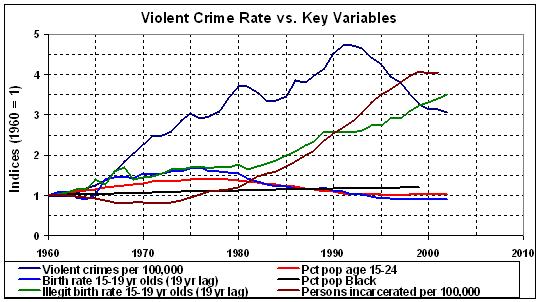
Before plunging into a regression analysis, I indexed the series to 1960 (the first year in the violent-crime series) and plotted them (again, with a 19-year lag on the birth-rate series). Here are the plots:

The relationships suggest strongly that the legalization of abortion did not have a significant effect on the rate of violent crime in the U.S. The violent-crime rate rose almost steadily from 1960 until 1991, when it peaked. The lagged rate of illegitimate births for women aged 15-19 (probably the best available proxy for “unwanted” children) leveled off about when the crime rate peaked, but the illegitimacy rate then resumed its steady rise, even as the violent-crime rate dropped dramatically. It is therefore improbable (if not impossible) that abortion — as measured by the rate of illegitimate births — had anything to do with the drop in the crime rate. Using the total rate of births for women aged 15-19 as a proxy for “unwantedness” yields even more problematic results: the lagged rate peaked in 1976, fully 15 years before the crime rate peaked.

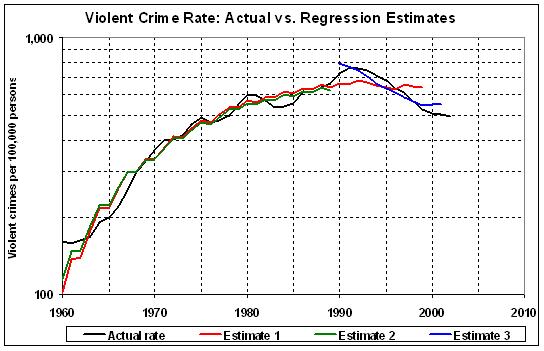
I nevertheless ran many regressions on the violent-crime rate and various combinations of the key variables. Only one regression yields credible results (high R-squared, standard error of estimate among the lowest, intuitively correct signs on all coefficients, and high t-statistics on all coefficients). That regression takes the following form:

Number of violent crimes per 100,000 persons =
– 3723
+ 37058 x number of Blacks as a decimal fraction of the population
– 0.568 x number of persons incarcerated per 100,000 of population

The t-statistics on the intercept and coefficients are -15.854, 17.047, and -5.042, respectively; the adjusted R-squared is 0.936; the standard error of the estimate is 47.0.

The mean value of the dependent variable is 483.1, with a range of 158.1 to 758.2. The corresponding values for proportion of blacks: 0.117, 0.105, 0.125; for incarceration rate: 202.4, 93, 476.

The years represented in the regression are 1960-99 (the last year of data on Blacks as a fraction of the population).

That equation is especially compelling because both explanatory variables are statistically signficant even though they are strongly correlated (R = 0.84). Given that, and the evidence of the plots above — in which the declining crime rate is accompanied by a rising incarceration rate — two things are evident: incarceration is the key to crime reduction, and abortion has no place in the discussion of crime. What happened was that the incarceration rate finally became high enough, around 1991, to offset the countervailing influences on crime.

Incarceration follows from prosecution, which follows from investigation. I therefore stand by my earlier conclusion that “incarceration and spending on the criminal justice system . . . . are the public-policy weapons of choice” when it comes to fighting crime.

UPDATE (01/04/06): None of my regressions (not even the best one) fully accounts for the sharp decline in the violent-crime rate after 1990. That is because I did not try to model the effects of concerted efforts, since the late 1980s, to put violent offenders behind bars and to keep them there longer. The missing variable, of course, is to be found in the effectiveness of federal sentencing guidelines, which were enacted in 1987 and declared constitutional by the U.S. Supreme Court in 1989. Liberal do-gooders and their allies on the bench nevertheless persuaded the Supreme Court last year (in a pair of related cases) to find the guidelines unconstitutional and, therefore, only advisory rather than mandatory.

Given the inevitability of more lenient sentencing in many jurisdictions, I predict that the violent-crime rate will resume its long-term ascent. That ascent will mirror the continuing destruction of civil society at the hands of liberals — and those libertarians who seem unable to grasp the notion that liberty must be defended, at home and abroad.

UPDATE (01/05/06): In light of the preceding update I ran separate regressions on the violent crime rate for two periods: 1960-89 and 1990-2001, 1990 being the first full year under the federal sentencing guidelines. The best regression for 1960-89 has the same two explanatory variables above. The best regression for 1990-2001 (the last year of my series on incarceration rate) has only one explanatory variable: number of persons incarcerated per 100,000 of population. The graph below gives plots of the following statistics and regression estimates:

  • actual rate of violent crimes (per 100,000 persons)
  • estimates for the original regression (estimate 1)
  • estimates for the separate regressions on 1960-89 (estimate 2) and 1990-2001 (estimate 3).

Estimate 3 further convinces me that more punishment means less crime, and that we are about to see a resurgence of violent crime because punishment has become less certain.

P.S., here are the numbers:

1. As in the original portion of the post.

2. Number of violent crimes per 100,000 persons =

– 3496
+ 34964 x number of Blacks as a decimal fraction of the population
– 0.528 x number of persons incarcerated per 100,000 of population

The t-statistics on the intercept and coefficients are -19.241, 20.544, and -2.982, respectively; the adjusted R-squared is 0.936; the standard error of the estimate is 47.0.

The mean value of the dependent variable is 419.8, with a range of 158.1 to 666.9. The corresponding values for proportion of blacks: 0.114, 0.105, 0.122; for incarceration rate: 139.6, 93, 276.

The years represented in the regression are 1960-89, as explained in this update.

3. Number of violent crimes per 100,000 persons =

1216 – 1.413 x number of persons incarcerated per 100,000 of population

The t-statistics on the intercept and coefficients are 15.976 and -7.595, respectively; the adjusted R-squared is 0.837; the standard error of the estimate is 40.4.

The mean value of the dependent variable is 645.0, with a range of 506.5 to 758.2. The corresponding values for incarceration rate: 404.5, 297, 476.

The years represented in the regression are 1990-2001, as explained in this update.

The “Black” variable drops out of #3 because it is almost constant during the relevant period. It is “working” in the background to produce a high crime rate, but the “incarceration” variable has a measurable countervailing effect on crime.

Related posts:
Does Capital Punishment Deter Homicide?
Libertarian Twaddle about the Death Penalty
Crime and Punishment
Abortion and Crime
Saving the Innocent?
Saving the Innocent?: Part II
More on Abortion and Crime
More About Crime and Punishment
More Punishment Means Less Crime: A Footnote
Clear Thinking about the Death Penalty
Let the Punishment Fit the Crime
Another Argument for the Death Penalty
Less Punishment Means More Crime
Crime, Explained

January 3, 2006 . . .

. . . in Austin: temperature 86 degrees, ceiling unlimited, visibility limited only by your elevation.

The haziness is caused what the locals call “cedar” pollen, which is really the pollen of the Ashe Juniper. The juniper grows profusely in central Texas and emits copious quantities of pollen in late December and early January. Persons who are especially allergic to the pollen are said to suffer “cedar fever.”

The body of water visible in the center of the photo is Lake Austin, which is one of several lakes that were created by damming the Colorado River (the one that rises in Texas and flows to the Gulf of Mexico). The undammed Colorado isn’t much more than a stream, by my standards, and Lake Austin is a glorified pond. Lake Austin, at its widest, is perhaps a quarter-mile wide, which is only about one-fourth the width of the St. Clair River, near which I grew up. The St. Clair flows from Lake Huron, which is about 200 miles long and 200 miles wide, at its widest point.

But . . . today’s high in eastern Michigan was only about 40 degrees . . . and it was cloudy . . . and rain is expected tomorrow, with rain and snow on Thursday, etc., etc., . . .

That’s why I’m here and not there.

Capitalism, Liberty, and Christianity

William Grimes, writing in The New York Times, reviews Rodney Stark’s The Victory of Reason: How Christianity Led to Freedom, Capitalism, and Western Success:

Mr. Stark, the author of “The Rise of Christianity” and “One True God: Historical Consequences of Monotheism,” is sick and tired of reading that religion impeded scientific progress and stunted human freedom. To those who say that capitalism and democracy developed only after secular-minded thinkers turned the light of reason on the obscurantism of the Dark Ages, he has a one-word answer: nonsense.

“The success of the West, including the rise of science, rested entirely on religious foundations, and the people who brought it about were devout Christians,” he argues in this provocative, exasperating and occasionally baffling exercise in revisionism. Capitalism, and the scientific revolution that powered it, did not emerge in spite of religion but because of it.

. . . Mr. Stark argues [that] . . . . [d]espite the prejudiced arguments of anticlerical Enlightenment thinkers, free inquiry and faith in human reason were intrinsic to Christian thought. Christianity, alone among the world’s religions, conceived of God as a supremely rational being who created a coherent world whose inner workings could be discovered through the application of reason and logic. Consequently, it was only in the West, rather than in Asia or the Middle East, that alchemy evolved into chemistry, astrology into astronomy.

Mr. Stark gets down to cases quickly. He rapidly administers a few bracing slaps to Max Weber’s theory that the Protestant ethic of self-denial and reinvestment propelled capitalism, pointing out that capitalism was in full flower in Italy centuries before the Reformation. . . .

The most persuasive chapters in “The Victory of Reason” describe the early stirrings of free-market enterprise and scientific experimentation on the monastic estates that spread throughout Western Europe after the ninth century. It was during the so-called Dark Ages that Christian monks, throwing off “the stultifying grip of Roman repression and mistaken Greek idealism,” developed innovations like the water wheel, horseshoes, fish farming, the three-field system of agriculture, eyeglasses and clocks. “All of these remarkable developments can be traced to the unique Christian conviction that progress was a God-given obligation, entailed in the gift of reason,” writes Mr. Stark, who has described himself in interviews, surprisingly, as not religious in any conventional sense.

The seeming contradiction between Stark’s lack of religiosity and his understanding of the nexus of Christianity, liberty, and capitalism is not at all surprising. Stark has the ability, so lacking in many of today’s “rational” thinkers (i.e., anti-religious bigots) to confront the facts. There is, first of all, the libertarianism of the last six of the Ten Commandments. As the Catholic Encyclopedia puts it:

The precepts [of the last six of the Commandments] are meant to protect man in his natural rights against the injustice of his fellows.

  • His life is the object of the Fifth;
  • the honour of his body as well as the source of life, of the Sixth;
  • his lawful possessions, of the Seventh;
  • his good name, of the Eighth;
  • And in order to make him still more secure in the enjoyment of his rights, it is declared an offense against God to desire to wrong him, in his family rights by the Ninth;
  • and in his property rights by the Tenth.

Also from the Catholic Encyclopedia, here is some wisdom about rights and justice:

. . . We sometimes say that the unemployed have a right to work, that the needy have a right to assistance, and it may be conceded that those phrases are quite correct, provided that such a right is understood as a claim in charity not as a claim in justice. For, at least if we confine our attention to natural law and ordinary circumstances, the assistance to which a man in need has a claim does not belong to him in justice before it is handed over to him, when it becomes his. His claim to it rests on the fact that he is a brother in distress, and his brotherhood constitutes his title to our pity, sympathy, and help. It may, of course, happen that positive law does something more than this for the poor and needy; it may be that the law of the land has given a legal right to the unemployed to have employment provided for them, or to the poor a legal right to relief; then, of course, the claim will be one of justice.

A claim in justice, or a right in the strict sense, is a moral and lawful faculty of doing, possessing, or exacting something. If it be a moral and lawful faculty of doing something for the benefit of others, it belongs to the class of rights of jurisdiction. Thus a father has the natural right to bring up and educate his son, not for his own, but for the son’s benefit. A lawful sovereign has the right to rule his subjects for the common good. The largest class of rights which justice requires that we should render to others are rights of ownership. Ownership is the moral faculty of using something subordinate to us for our own advantage. The owner of a house may dispose of it as he will. He may live in it, or let it, or leave it unoccupied, or pull it down, or sell it; he may make changes in it, and in general he may deal with it as he likes, because it is his. Because it is his, he has a right to all the uses and advantages which it possesses. It is his property, and as such its whole being should subserve his need and convenience. Because it belongs to him he must be preferred to all others as to the enjoyment of the uses to which it can be put. He has the right to exclude others from the enjoyment of its uses, it belongs with all the advantages which it can confer to him alone. Were anyone else to make use of the house against the reasonable wish of the owner, he would offend against justice, he would not be render- ing to the owner what belongs to him.

Finally, St. Pope Pius X (quoted by Father Stephen DeLallo) said this in his motu proprio Fin Dalla Prima of December 18, 1903:

IV. Of the goods of the earth man has not merely the use, like the brute creation, but he has also the right of permanent proprietorship—and not merely of those things which are consumed by use, but also of those which are not consumed by use. (Encyclical Rerum Novarum.)

V. The right of private property, the fruit of labor or industry, or of concession or donation by others, is an incontrovertible natural right; and everybody can dispose reasonably of such property as he thinks fit. (Encyclical Rerum Novarum.)

VI. To heal the breach between rich and poor, it is necessary to distinguish between justice and charity. There can be no claim for redress except when justice is violated. (Encyclical Rerum Novarum.) . . . .

XI. For the settlement of the social question much can be done by the capitalists and workers themselves, by means of institutions designed to provide timely aid for the needy and to bring together and unite mutually the two classes. Among these institutions are mutual aid societies, various kinds of private insurance societies, orphanages for the young, and, above all, associations among the different trades and professions. (Encyclical Rerum Novarum.)

Private property, voluntary exchange, and voluntary charity. These are concepts that our statist regime has long since subverted.

Rodney Stark’s thesis is entirely consistent with the teachings of the Church. As I wrote a few weeks ago,

One does not have to be a believer to understand the intimate connection between religion and liberty. . . . Strident atheists of Singer’s ilk like to blame religion for the world’s woes. But the worst abuses of humanity in the 20th century arose from the irreligious and anti-religious regimes of Hitler, Stalin, and Mao.

(Thanks to my son for pointing me to the second set of quotations from the Catholic Encyclopedia and to the piece by Fr. DeLallo.)

Related posts:

Judeo-Christian Values and Liberty (02/20/05)
Religion and Liberty (08/25/05)
Science, Evolution, Religion, and Liberty (08/31/05)